This article was downloaded by: [National Chiao Tung University 國立交通大學]
On: 24 April 2014, At: 21:04
Publisher: Taylor & Francis
Informa Ltd Registered in England and Wales Registered Number: 1072954 Registered office: Mortimer
House, 37-41 Mortimer Street, London W1T 3JH, UK
Journal of the Air & Waste Management
Association
Publication details, including instructions for authors and subscription information:
http://www.tandfonline.com/loi/uawm20
Copper Loaded on Sol-Gel-Derived Alumina
Adsorbents for Phosphine Removal
Jung-Nan Hsu
a, Hsunling Bai
b, Shou-Nan Li
c& Chuen-Jinn Tsai
b aEnergy and Environment Research Laboratories, Industrial Technology and
Research Institute; and Institute of Environmental Engineering, National Chiao Tung
University , Hsinchu , Taiwan , Republic of China
b
Institute of Environmental Engineering, National Chiao Tung University , Hsinchu ,
Taiwan , Republic of China
c
Energy and Environment Research Laboratories, Industrial Technology and Research
Institute , Hsinchu , Taiwan , Republic of China
d
Institute of Environmental Engineering, National Chiao Tung University , Hsinchu ,
Taiwan , Republic of China
Published online: 24 Jan 2012.
To cite this article: Jung-Nan Hsu , Hsunling Bai , Shou-Nan Li & Chuen-Jinn Tsai (2010) Copper Loaded on
Sol-Gel-Derived Alumina Adsorbents for Phosphine Removal, Journal of the Air & Waste Management Association, 60:5,
629-635, DOI:
10.3155/1047-3289.60.5.629
To link to this article:
http://dx.doi.org/10.3155/1047-3289.60.5.629
PLEASE SCROLL DOWN FOR ARTICLE
Taylor & Francis makes every effort to ensure the accuracy of all the information (the “Content”)
contained in the publications on our platform. However, Taylor & Francis, our agents, and our licensors
make no representations or warranties whatsoever as to the accuracy, completeness, or suitability for any
purpose of the Content. Any opinions and views expressed in this publication are the opinions and views
of the authors, and are not the views of or endorsed by Taylor & Francis. The accuracy of the Content
should not be relied upon and should be independently verified with primary sources of information.
Taylor and Francis shall not be liable for any losses, actions, claims, proceedings, demands, costs,
expenses, damages, and other liabilities whatsoever or howsoever caused arising directly or indirectly in
connection with, in relation to or arising out of the use of the Content.
This article may be used for research, teaching, and private study purposes. Any substantial or systematic
reproduction, redistribution, reselling, loan, sub-licensing, systematic supply, or distribution in any
form to anyone is expressly forbidden. Terms & Conditions of access and use can be found at
http://
www.tandfonline.com/page/terms-and-conditions
Copper Loaded on Sol-Gel-Derived Alumina Adsorbents for
Phosphine Removal
Jung-Nan Hsu
Energy and Environment Research Laboratories, Industrial Technology and Research Institute;
and Institute of Environmental Engineering, National Chiao Tung University, Hsinchu, Taiwan,
Republic of China
Hsunling Bai
Institute of Environmental Engineering, National Chiao Tung University, Hsinchu, Taiwan,
Republic of China
Shou-Nan Li
Energy and Environment Research Laboratories, Industrial Technology and Research Institute,
Hsinchu, Taiwan, Republic of China
Chuen-Jinn Tsai
Institute of Environmental Engineering, National Chiao Tung University, Hsinchu, Taiwan,
Republic of China
ABSTRACT
The hydride gas of phosphine (PH3) is commonly used for
semiconductor and optoelectronic industries. The local scrubbers must immediately abate it because of its high toxicity. In this study, copper (Cu) loaded on the sol-gel-derived␥-alumina (Al2O3) adsorbents are prepared and
tested to investigate the possibility of PH3removal and
sorbent regeneration. Test results showed that during the breakthrough time of over 99% PH3 removal
effi-ciency, the maximum adsorption capacity of Cu loaded on the sol-gel-derived␥-Al2O3adsorbent is 18 mg-PH3
/g-adsorbent. This is much higher than that of Cu loaded on the commercial ␥-Al2O3adsorbent— 8.6 mg-PH3
/g-adsorbent. The high specific surface area, narrow pore size distribution, and well dispersion of Cu loaded on the sol-gel-derived␥-Al2O3could be the reasons for its
high PH3 adsorption capacity. The regeneration test
shows that Cu loaded on the sol-gel-derived ␥-Al2O3
adsorbent can be regenerated after a simple air purging procedure. The cumulative adsorption capacity for five
regeneration cycles is 65 mg-PH3/g-adsorbent, which is
approximately double that of the Cu/zeolite adsorbent demonstrated in the literature.
INTRODUCTION
The hydride gas of phosphine (PH3) is used in large
quan-tity for semiconductor, liquid crystal display (LCD), and light-emitting diode (LED) manufacturing industries in various processes. The unutilized PH3gas must be abated
right after the process tool because of its high toxicity and flammability. In addition, the PH3gas is thought to be an
airborne molecular contaminant (AMC), which decreases the product yield. Dry chemical adsorption is a preferred method used for hazardous gas removals from these man-ufacturing factories. It can treat PH3effectively,1–3
espe-cially when the PH3 coexists with arsine (AsH3) in the
exhaust gases. However, commercialized dry chemical ad-sorbents cannot be reused and they must be treated as hazardous wastes. Thus it is essential to develop a regen-erative adsorbent for reducing the amount of hazardous waste production.
Earlier researchers4treated PH
3by carbon dry
adsorp-tion. The capacity of activated carbon (AC) can reach approximately12 mg-PH3/g-AC at 140 °C5; however, its
disadvantage is its inflammability.6 The spent carbon
might react exothermically with air and result in sponta-neous combustion. Thus the AC adsorbent is not practi-cally acceptable in abating the toxic hydride gases for the semiconductor and optoelectronic industries. Li et al.7
used metal (Cu, Zn, or Mn)-loaded ZSM-5 and Y zeolite adsorbents for the adsorption of PH3 toxic gas. Their
results showed that more than 99% PH3adsorption
effi-ciency was achieved when zeolites were loaded with Cu. However, they also revealed that PH3removal efficiencies IMPLICATIONS
PH3is a common air toxic used in the semiconductor, liquid
crystal display, and light-emitting diode manufacturing in-dustries. However, its removal has received less research attention because of its handling difficulty. This study shows that Cu loaded on the sol-gel-derived␥-Al2O3
ad-sorbent can effectively treat PH3, and it can also be
regen-erated. The work presented here demonstrated that the nonflammable adsorbent for PH3removal with regenerative
ability could be manufactured, which reduces the cost and hazardous solid waste production rate.
(REs) can only be up to 97% for the regenerated adsor-bent, which cannot meet the more than 99% requirement for toxic PH3removal from the semiconductor and LCD
industries. Recently, some new materials (e.g., titanium dioxide [TiO2] nanotubes or MCM-41) with high specific
surfaces were developed and could be used as supports of Cu to enhance the activity of Cu as a catalyst/adsorbent.8
Unfortunately, these new porous materials with very high specific areas are too expensive thus far to treat the haz-ardous air pollutant (HAP) in large quantities. It seems that the adsorbents with cost-effectiveness and better re-generative performance are worthy of investigation.
The Cu/␥-alumina (␥-Al2O3) catalyst/adsorbent is
commonly used for air pollution control.9
Convention-ally, the␥-Al2O3catalyst support is prepared from bauxite
directly or from the monohydrate by dehydration or re-crystallization at elevated temperature.10Relatively small
surface area and poor attrition resistance are the two ma-jor drawbacks of the adsorbents prepared by conventional methods. The small surface area limits the amount of active metal species that can be dispersed on the support surface and thus restricts the adsorption capacity of the adsorbent. Sol-gel-derived adsorbent with the characteris-tics of high surface area and uniform pore-size distribu-tion has the potential to improve this demerit. Use of the sol-gel-derived Cu/␥-Al2O3adsorbent for treating oxides
of sulfur (SOx) has been attempted.11The results indicated
that the sol-gel-derived adsorbents offered higher surface area, more uniform pore size distribution, and higher crush strength, thus they showed superior sulfation and regeneration properties than those of the commercially available adsorbents. Studies on simplifying the synthe-sizing step and improving the performance of adsorbent/ catalyst have also been performed.12,13
To the best of the authors’ knowledge, the perfor-mance of Cu catalyst loaded on the sol-gel-derived meso-porous␥-Al2O3for removal of HAPs such as PH3has not
been investigated. In this study, adsorbents of Cu loaded on mesoporous␥-Al2O3were prepared and used to
inves-tigate the possibility for PH3removal, and the
relation-ship between adsorption capacity and physical/chemical characteristics of the adsorbents are established. In addi-tion, the possibility of regenerating this mesoporous ad-sorbent is tested.
EXPERIMENTAL PROCEDURES Sample Preparation
The sol-gel-derived mesoporous ␥-Al2O3 was prepared
from 1 M boehmite sol (␥-AlOOH) and it acted as the support of adsorbents. The sol was synthesized by the Yoldas process,10,14 –16which included dissolution of
alu-minum (Al) tri-sec-butoxide in deionized water and pep-tization of the resulting precipitates with nitric acid. The ␥-Al2O3 support was then prepared by drying a given
amount of␥-AlOOH in a Petri dish followed by calcina-tion at 450 °C for 3 hr. Finally, the product was crushed and sieved into granules with sizes of 420 – 840m.
A total of 20 mL of sol-gel-derived␥-Al2O3granular
and 150 mL of metal precursor solution, Cu(NO3)23 H2O
(aq), were mixed and stirred at room temperature for 12 hr. After a filtration process, the adsorbents were dried in an oven at 120 °C for 12 hr and then calcined in a furnace
at 550 °C for 6 hr. The sample was named CuXM/SGAl, where X represents the concentration of precursor solu-tion. The commercial␥-Al2O3 (lot no. B0625036, Strem
Chemicals) was also used as the support of adsorbent for comparison purposes. Similar to sol-gel-derived␥-Al2O3,
the commercial ␥-Al2O3 was crushed and sieved into
granules with sizes of 420 – 840 m. The sample was named CuXM/ComAl.
The amount of metal loaded on the ␥-Al2O3 was
varied using different concentrations of metal precursor solutions, and the actual mass of metal loaded on the ␥-Al2O3 was determined by inductively coupled
plasma-atomic emission spectrometry (ICP-AES, Jarrell Ash).
Characterization of the Adsorbent
The surface area of the adsorbent was determined by the Brunauer-Emmett-Teller (BET) method applied to the ad-sorption isotherms of nitrogen, whereas the pore volume and the pore size distribution were determined by the Barret-Joyner-Halenda (BJH) method applied to the de-sorption isotherms of nitrogen. Nitrogen adde-sorption/de- adsorption/de-sorption isotherms were obtained by using an ASAP 2020 apparatus (Micromeritics Instrument Corporation).
The X-ray powder diffractometer (XRPD; model XRD-6000, Shimadzu) was used to examine the crystalline structure of the adsorbents. The X-ray source used Cu as its target, and its working voltage and current were set at 40 kV and 30 mA, respectively. The scanning speed was 1 °/min in the 2 range of 15–90°.
The chemical states of compounds on the adsorbent surface were measured by electron spectroscopy for chem-ical analysis (ESCA; model ESCA Lab 250, Thermo Elec-tron) before and after adsorption. The X-ray source used was Al K␣. The core-level binding energy of C 1s for carbon at 284.6 eV was used as an internal reference for calibration.
PH3Adsorption
The PH3 adsorption experiments were carried out in a
chamber that controls pressure to be slightly below atmo-spheric pressure to avoid PH3toxic gas escaping from the
adsorption column. The adsorption temperature was at an ambient temperature of 25 ⫾ 1 °C. The adsorption column was stainless steel with an inner diameter of 2.25 cm and length of 11.7 cm. A total of 15 mL of adsorbents were packed into the column during each test.
The PH3concentration of 1% (v/v) in nitrogen was
used in this study, which is a typical peak value measured in a semiconductor factory. PH3 gas with a flow rate of
0.235 L/min was used to meet the same linear velocity of 1 cm/sec in a typical industrial adsorber for PH3removal.
Fourier transform infrared (FTIR) spectrometry was used to continuously monitor the concentration of PH3. Before
the adsorption test, part of the gas flow was directed to the FTIR spectrometer for measuring the inlet PH3
concentra-tion. After that, the whole flow was directed to the ad-sorber to start the adsorption test. FTIR spectrometry then continuously measured the PH3concentration at the
out-let of the adsorber. This may cause a slight time lag in the detection of the PH3 concentration at the beginning of
the test.
Hsu, Bai, Li, and Tsai
The RE was defined by the following equation:
RE⫽ 100% ⫻ 1 ⫺Cout
Cin (1)
where Cin is the influent PH3 volumetric concentration
and Cout is the effluent PH3volumetric concentration.
The effective adsorption capacity was determined by the cumulated amount of adsorbed PH3during the period
of over 99% PH3RE. That is, the breakthrough point of
the adsorbent was set at PH3effluent gas concentration of
100 parts per million by volume (ppmv) (0.01% v/v).
Purge and Regeneration
Because PH3is a highly toxic compound, the residual PH3
remaining in the system as gas-phase molecules could result in human health problems. Therefore, after the completion of the adsorption test, the whole system was purged by a nitrogen gas flow to remove the residual PH3
gas, and then by an airflow to decrease the toxicity of the adsorbed phosphorous species.
It is expected that the mechanism of reaction be-tween PH3and Cu compounds should be similar to that
between AsH3 and Cu compounds, in which the active
specie, Cu2⫹, would be reduced to Cu0 during the PH 3
adsorption.17Hence, after adsorption, external air with a
flow rate of 2.35 L/min was passed through the adsorp-tion column for 60 min to oxidize the Cu0. At the same
time, the phosphorous species that adsorbed on the ad-sorbent surface could also be oxidized and then form particulate species, which could be purged out by the same airstream. Thus, the air purging process completed the regenerating procedure of the adsorbent.
RESULTS AND DISCUSSION
Characterization of Cu/␥-Al2O3Adsorbents This study used Cu as the active metal species for adsorb-ing PH3because it was shown in the authors’ prior study6
that Cu is superior to Zn or Mn under the same prepara-tion condiprepara-tions. Copper nitrate (Cu(NO3)2) solutions of
various concentrations ranging from 1 to 5 M were used to obtain Cu/Al2O3 adsorbents of various metal loading
amounts. The relationships between the precursor con-centration of Cu(NO3)2 3 H2O and the actual loading
amounts of Cu metal for sol-gel-derived ␥-Al2O3(Cu/
SGAl) and commercial ␥-Al2O3 (Cu/ComAl) adsorbents
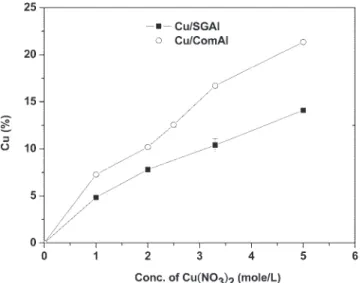
are shown in Figure 1. The figure indicates that as the Cu(NO3)23 H2O precursor concentrations are increased,
the actual Cu content loaded on both types of Al2O3
increases in the same manner. However, the amount of Cu loaded on the commercial␥-Al2O3adsorbent is higher
than that on the sol-gel-derived␥-Al2O3adsorbent under
the same precursor concentration. The maximum Cu loadings on sol-gel-derived ␥-Al2O3 and commercial
␥-Al2O3are 14% (w/w) and 21% (w/w), respectively, with
a Cu(NO3)23 H2O precursor concentration of 5 M. This
may be due to a relatively higher pore volume of com-mercial ␥-Al2O3, which provides larger space for the
Cu(NO3)2precursor solution to be loaded on.
The BET surface area and pore volume of adsorbents are listed in Table 1. One can see that the BET specific surface area and the pore volume for Cu/SGAl and Cu/ ComAl adsorbents are decreased as the Cu loading is increased. In addition, the Cu/SGAl adsorbents have rel-atively higher specific surface areas than those of the Cu/ComAl adsorbents. This can be explained by the pore size distributions of adsorbents, which are shown in Fig-ure 2. The Cu/SGAl adsorbents have smaller pore sizes and narrower pore size distributions than the Cu/ComAl ad-sorbents. The average pore diameter of Cu/SGAl is in-creased from 36.1 to 47.6 Å when the Cu loading is increased from 0 to 5 M (14 wt %), and the average pore diameter of Cu/ComAl is increased from 62.6 to 65.6 Å when the Cu loading is increased from 0 to 5 M (21 wt %). This indicates that the relatively uniform and smaller pore size of Cu/SGAl adsorbents as compared with that of the Cu/ComAl adsorbents explains the higher BET surface area of Cu/SGAl adsorbents shown in Table 1.
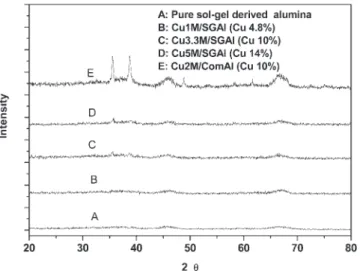
The XRPD patterns of adsorbents are shown in Figure 3. It is observed that the XRPD patterns of Cu/ComAl adsorbents show observable peaks of CuO crystallite (at 2 of 35.6 and 38.8°) for Cu loading amounts more than 10% (Cu2M/ComAl). However, the Cu/SGAl adsorbent does not show apparent peaks even if the actual Cu loading is as high as 14% (see B, C, and D pattern in Figure 3 for Cu of 4.8, 10, and 14%). Some studies10,18,19found that if the
active species is coated on the surface in monolayer or submonolayer form, the active species phase will not be
Figure 1. Cu-loaded content (wt %) on ComAl and SGAl adsor-bents as a function of Cu(NO3)2precursor concentrations.
Table 1. Pore properties of the PH3adsorbents.
Sample Name
BET Surface Area (m2/g) Pore Volume (cm3/g) Average Pore Diameter (Å) Sol-gel-derived␥-Al2O3 296 0.327 36.1 Cu1M/SGAl 196 0.328 44.3 Cu3.3M/SGAl 197 0.296 43.4 Cu5M/SGAl 165 0.275 47.6 Commercial␥-Al2O3 209 0.452 62.6 Cu1M/ComAl 173 0.382 64.3 Cu3.3M/ComAl 160 0.364 65.2 Cu5M/ComAl 137 0.324 65.6
detected by XRD. Hence the result of X-ray analysis indi-cates that CuO might be loaded on sol-gel-derived ␥-Al2O3with well-dispersed monolayer or submonolayer
form as compared with the larger crystal form of CuO loaded on the commercial␥-Al2O3.
PH3Adsorption
The PH3RE and adsorption capacity were tested for the
sol-gel-derived ␥-Al2O3 and commercial ␥-Al2O3 before
metal loading. The results are shown in Figure 4. Without the presence of Cu, commercial and sol-gel-derived ␥-Al2O3 could not reach the goal of over 99% PH3
removal and were completely exhausted after a few minutes. On the other hand, the PH3REs of Cu loaded
on␥-Al2O3adsorbents can be over 99% and they lasted
for 27 and 47 min, respectively, for Cu loaded on com-mercial␥-Al2O3and sol-gel-derived␥-Al2O3. Hence one
can say that blank tests of both ␥-Al2O3materials are
not effective in PH3 adsorption and thus Cu must be
incorporated with ␥-Al2O3 to provide active sites for
effectively adsorbing PH3.
The effective adsorption capacities for achieving over 99% PH3removals with Cu/SGAl and Cu/ComAl
adsor-bents are shown in Figure 5 as a function of actual Cu-loaded mass concentration. The adsorption capacity of Cu/SGAl adsorbent increases from 0 to 18 mg PH3 per
gram adsorbent (mg-PH3/g-ads) as the Cu concentration
is increased from 0 to 14% (w/w). Thus the loaded Cu metal amount has a significant effect on the adsorption capacity. Different from Cu/SGAl adsorbents, the ad-sorption capacity of Cu/ComAl adsorbent increases from 0 to 8.1 mg-PH3/g-ads as Cu loading is increased
from 0 to 7.2% (w/w) and then stays at approximately 8.1– 8.6 mg-PH3/g-ads even if the Cu-loaded
concentra-tion is increased from 7.2 to 16.7% (w/w). And a further increase in the Cu-loaded concentration to 21.4% only leads to a decrease in the PH3adsorption capacity to 3.4
mg-PH3/g-ads. The maximum adsorption capacity of
Cu/SGAl adsorbents, 18 mg-PH3/g-ads, is much higher than
that of the Cu/ComAl adsorbents, 8.6 mg-PH3/g-ads.
From the above results, it is possible to further im-prove the adsorption capacity of adsorbent by increasing
Figure 2. Pore size distribution of adsorbents.
Figure 3. X-ray diffraction patterns of adsorbents.
Figure 4. PH3REs of pure␥-Al2O3(SGAL, ComAl) and Cu loaded
on␥-Al2O3adsorbents.
Figure 5. The PH3adsorption capacity of Cu/SGAl and Cu/ComAl
adsorbents as a function of Cu-loaded content (wt %)
Hsu, Bai, Li, and Tsai
the Cu loading of Cu/SGAl. However, the maximum con-centration of Cu(NO3)2(aq) used in this study (5 M) was
close to the upper limit of its solubility in water at room temperature (⬃5.27 M); a further increase of Cu loading must be achieved by multiple impregnating or under a heating process.
The Utilization of Active Metal Oxides in Adsorbent
For a better understanding of PH3adsorption behaviors,
the relationships between Cu utilization (mole-PH3
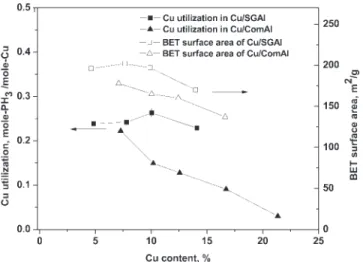
/mole-Cu), BET specific surface area, and the Cu loading amounts of the Cu/SGAl and Cu/ComAl adsorbents are shown in Figure 6. The figure reveals that the utilization of Cu using the Cu/SGAl adsorbent remains almost the same at approximately 0.24 mole-PH3/mole-Cu when the
Cu loading is increased from 4.8 to 14%. The BET surface area is approximately 200 m2/g for a Cu loading of less
than 10% (w/w); it then decreases slightly as Cu loading is increased to 14%. Thus, the decrease in the surface area does not have a significant effect on the Cu utilization rate. Different from the Cu/SGAl adsorbents, the utiliza-tion of Cu in Cu/ComAl adsorbent decreases apparently as the Cu loading increases. This corresponds to the de-crease of BET surface area as the amount of Cu loading increases. Thus a further increase in the Cu loading amount only results in the decrease in the Cu utilization rate; it cannot help to increase the adsorption capacity.
These results indicate that the Cu utilization rate of Cu/SGAl adsorbent could be kept at a high value even when it was loaded with a high amount of Cu. This may be explained by the XRPD data in which cupric oxide (CuO) was loaded on sol-gel-derived ␥-Al2O3 with
well-dispersed form. The high BET surface area and narrower and smaller pore size distribution of sol-gel-derived ␥-Al2O3could lead to monolayer or submonolayer
distri-bution of CuO. On the contrary, CuO exists with a larger crystal form although the Cu loading is only 10 wt % in Cu/ComAl adsorbent. The larger CuO crystal has the lower activity to reduce itself and to oxidize the adsorbed PH3gas.
This phenomenon is similar to the observation of SO2
adsorption or CO oxidation by Cu/␥-Al2O3 adsorbent/
catalyst.10,20The larger amount of Cu precursor solution
loaded on the large pore of commercial␥-Al2O3leads to
the aggregation of CuO particles that become larger crys-tals and thus decrease the activity of adsorbent.
Except Cu loading amount, the preparing process for adsorbent also influenced the dispersion of active species. Proper stirring time and temperature could cause the Cu precursor to be uniformly coated on the support, which will lead to well-dispersed CuO. In addi-tion, some research showed that mixing the Cu precursor with ␥-AlOOH can enlarge the pore volume and BET surface area of the adsorbent,21which could be an
inter-esting goal for future study.
Regeneration and Surface Analysis of Adsorbents
The regeneration test was conducted on the Cu5M/SGAl adsorbent for PH3 removal after air purging of the
ex-hausted adsorbent for 60 min. The PH3REs of Cu5M/SGAl
for five regeneration cycles are shown in Figure 7a, which reveals that although the adsorbent deteriorates as regen-eration time increases, PH3 REs of up to 99% are still
achievable for the regenerated adsorbent. The cumulative adsorption capacity and the adsorption index with re-spect to the regeneration cycles are shown in Figure 7b.
Figure 6. Cu utilization (mole-PH3/mole-Cu) as functions of sorbent
specific surface area and Cu-loaded content (wt %).
Figure 7. (a) PH3 REs of Cu5M/SGAl at different regeneration
cycles. (b) Cumulative adsorption capacity and adsorption index over five cyclic adsorption tests.
The adsorption index (%) was calculated based on the ratio of adsorption capacity of the regenerated adsorbent to the fresh one. Although the adsorption capacity at the second cycle decreases to approximately 80% of the fresh sample, the cumulative adsorption capacity reaches 32 mg-PH3/g-ads, which is similar to the authors’ prior
re-sult7of 30 mg/g-ads using the relatively expensive Cu/
zeolite for adsorbing PH3. The sum of the adsorption
capacity for five cycles is 65 mg-PH3/g-ads, which is
ap-proximately double that of using Cu/zeolite. After the fifth cycle, 58% of the capacity remained as compared with the fresh adsorbent. The adsorption capacity could possibly be increased if the regeneration cycle continues. For a better understanding of the behavior of the regeneration, surface analysis was conducted before and after the adsorption test. The chemical states of the ele-ments on the Cu5M/SGAl adsorbent before and after ad-sorption were examined by ESCA. Figure 8a shows ESCA spectra of core-level binding energy in the phosphorus 2p orbital after adsorption/oxidation. The major phosphorus 2p peak centered at 133.6 eV can be assigned to phos-phate or phosphite.4 Thus the reaction product of PH
3
should possibly remain in the form of particles, so if the purged air system is properly designed to blow out the particles and prevent the adsorbent from plugging prob-lems, it may be possible that the adsorption capacity of regenerated adsorbent can be further increased.
The ESCA spectra of core-level binding energy in Cu 2p orbital before adsorption and after adsorption/oxida-tion are shown in Figure 8b. Before adsorpadsorption/oxida-tion, the Cu 2p3/2 peak centered at 933.6 eV can be assigned to
CuO.22,23After adsorption and air purging (regeneration),
the peak shifted to the lower binding energy. This indi-cates that the Cu exists with a chemical state other than the CuO form. Another possible chemical state of Cu in the regenerated adsorbent is cuprous oxide (Cu2O) or
Cu0, for which the binding energy of Cu 2P
3/2is
approx-imately 932.6 eV.22This can be explained from the
reac-tions during the PH3adsorption and the following
regen-eration of air purging and oxidation. The reaction during the PH3 adsorbed on Cu/Al2O3 can be inferred to be
similar to the reaction between AsH3 and Cu-Cr/AC
ad-sorbent,17at which CuO was reduced to Cu0whereas PH 3
was oxidized to less valence of phosphorus. The domi-nant reaction is proposed as the following equation:
2 PH3⫹ 3 CuO 3 2 P ⫹ 3 Cu ⫹ 3 H2O (2)
After the air purging, the dominant reactions are pro-posed as follows:
4 P⫹ 3 O23 2 P2O3 (3)
or
4 P⫹ 5 O23 2 P2O5 (4)
2 Cu⫹ O23 2 CuO (5)
As seen from reaction 2, the stoichiometric reaction for PH3and CuO is 2/3, which is higher than the Cu
utiliza-tion of Cu/SGAl (0.25 mole PH3/mole Cu) demonstrated
previously in Figure 6. This might be because the CuO particles buried in the deep pores can hardly contact the PH3, the reaction products of phosphate particles blocked
the pores, or a small part of CuO did not disperse well on the support. Therefore, after regeneration, the unused CuO in previous adsorption still could not be used. In the regeneration process, Cu0was mostly oxidized back
to CuO by the oxygen existing in the purging air or by the active oxygen formed on the surface. However, some Cu0 could not be oxidized or it was oxidized to
Cu2O instead of CuO. This leads to degradation of the
chemical adsorbent.
Thus the formation of phosphate on the surface of adsorbent and the transformation of the CuO into an-other Cu status such as Cu2O in the CuO/SGAl adsorbent
are responsible for the decrease in adsorption capacity for regenerated adsorbent.
Figure 8. (a) ESCA spectra of Cu5M/SGAl (14% Cu) adsorbent for phosphorus 2p orbital after PH3 adsorption and air purging. (b)
ESCA spectra of Cu5M/SGAl adsorbent for Cu 2p: (i) before PH3
adsorption and (ii) after PH3adsorption and air purging.
Hsu, Bai, Li, and Tsai
CONCLUSIONS
This study demonstrated that the PH3 adsorption
effi-ciency of greater than 99% using Cu loaded on ␥-Al2O3
adsorbents was achievable with a PH3inlet concentration
of 10,000 ppmv. The adsorption capacity of Cu-loaded sol-gel-derived ␥-Al2O3 adsorbent is much higher than
that of Cu-loaded commercial␥-Al2O3because of the high
BET surface area and uniform mesopore structure of sol-gel-derived ␥-Al2O3, which leads to well-dispersed
CuO active species as confirmed by XRD patterns. The maximum adsorption capacity is 18 mg-PH3/g-ads for
Cu/SGAl adsorbent and only 8.6 mg-PH3/g-ads for Cu/
ComAl adsorbent. The results also showed that the Cu/ SGAl adsorbent can be regenerated by simply purging the air into the adsorption bed. The particulate phosphate formed as the possible reaction product and the decreas-ing amount of CuO are responsible for the decrease of adsorption capacity for the regenerated cycles. However, the cumulative adsorption capacity for a total of five regenerated cycles is approximately 65 mg-PH3/g-ads,
which is double that reported in the literature. The results indicate that the simple preparation method of Cu loaded on sol-gel-derived␥-Al2O3has a high potential to reduce
the hazardous waste produced from hydride air toxic re-movals. Further study is needed toward the modification of the adsorbent and purging gas conditions for enhanc-ing the regeneration cycles.
REFERENCES
1. Hsu, J.N.; Tsai, C.J.; Chiang, C.; Li, S.N. Silane Removal at Ambient Temperature by Using Alumina-Supported Metal Oxide Adsorbents; J.
Air & Waste Manage. Assoc. 2007, 57, 204-210.
2. Li, S.N.; Hsu, J.N.; Shih, H.Y., Lin, S.J.; Hong, J.L. FTIR Spectrometers Measure Scrubber Abatement Efficiencies; Solid State Technol. 2002, July, 157-165.
3. Hayes, M.; Woods, K. Treating Semiconductor Emissions with Point-of-Use Abatement System; Solid State Technol. 1996, October, 141-146. 4. Colabella, J.M.; Stall, R.A.; Sorenson, C.T. The Adsorption and Subse-quent Oxidation of AsH3 and PH3 on Activated Carbon; J. Cryst.
Growth 1988, 92, 189-195.
5. Quinn, R.; Dathl, T.A.; Diamond, W.; Toseland, B.R. Removal of Arsine from Synthesis Gas Using a Copper on Carbon Adsorbent, Ind. Eng.
Chem. Res. 2006, 6272-6278.
6. Hardwick, S.J.; Mailloux, J.C. Waste Minimization in Semiconductor Processing; Mat. Res. Soc. Symp. Proc. 1994, 344, 273-279.
7. Li, W.C.; Bai, H.L.; Hsu, J.N.; Li, S.N.; Chen, C.C. Metal Loaded Zeolite Adsorbents for Phosphine Removal; Ind. Eng. Chem. Res. 2008, 47, 1501-1505.
8. Chen, S.A.; Nian, J.N.; Chien-Cheng Tsai, C.C.; Teng, H. TiO2
Nano-tube Supported Cu as the Catalyst for Selective NO Reduction with NH3; J. Air & Waste Manage. Assoc. 2007, 57, 600-605; doi: 10.3155/
1047-3289.57.6.600.
9. Wey, M.Y.; Lu, C.Y.; Tseng, H.H.; Fu, C.H. The Utilization of Catalyst Sorbent in Scrubbing Acid Gases from Incineration Flue Gas; J. Air &
Waste Manage. Assoc. 2002, 52, 449-458.
10. Deng, S.G.; Lin, Y.S. Synthesis, Stability, and Sulfation Properties of Sol-Gel-Derived Regenerative Sorbents for Flue Gas Desulfurization,
Ind. Eng. Chem. Res. 1996, 1429-1437.
11. Wang, Z.M.; Lin, Y.S. Sol-Gel Synthesis of Pure and Copper Oxide Coated Mesoporous Alumina Granular Particles; J. Catal. 1998, 174, 43-51.
12. Kureti, S.; Weisweiler, W. A New Route for the Synthesis of High Surface Area␥-Aluminum Oxide Xerogel; Appl. Catal. A: Gen. 2002,
225, 251-259. ]
13. Dilsiz, N.; Akovali, C.W. Study of Sol-Gel Processing for Fabrication of Low Density Alumina Microspheres; Mater. Sci. Eng. 2002, A332, 91-96 14. Yoldas, B.E. Hydrolysis of Alkoxides and Bayerite Conversion; J. Appl.
Chem. Biotechnol. 1973, 23, 803-809.
15. Yoldas, B.E. A Transparent Alumina; Am. Ceram. Soc. Bull. 1975, 54, 286-288.
16. Yoldas, B.E. Alumina Sol Prepared from Alkoxides; Am. Ceram. Soc.
Bull. 1975, 54, 289-290.
17. Haacke, G.; Brinen, J.S.; Burkhard, H. Arsine Adsorption on Activated Carbon; J. Electrochem. Soc. 1988, 3, 715-717.
18. Friedman, R.M.; Freeman, J.J.; Lytle, F.W. Characterization of Cu/ Al2O3Catalysts; J. Catal. 1978, 55, 10-28.
19. Xie, Y.C.; Tang, Y.Q. Spontaneous Monolayer Dispersion of Oxides and Salts onto Surfaces of Supports: Applications to Heterogeneous Catalysis; Adv. Catal. 1990, 37, 1-43.
20. Larsson, P.O.; Andersson, A. Oxides of Copper, Ceria Promoted Cop-per, Manganese and Copper Manganese on Al2O3for the Combustion
of CO, Ethyl Acetate and Ethanol; Appl. Catal. B Environ. 2000, 24, 175-192.
21. Buelna, G.; Lin, Y.S. Characteristics and Desulfurization-Regeneration Properties of Sol-Gel-Derived Cooper Oxide on Alumina Sorbents; Sep.
Purif. Technol. 2004, 3, 167-179.
22. Strohmeier, B.R.; Leyden, D.E.; Field, R.S.; Hercules, D.M. Surface Spectroscopic Characterization of Cu/A1203Catalysts; J. Catal. 1985,
94, 514-530.
23. Hussain, Z.; Slin, M.A.; Khan, M.A.; Khawaja, E.E. X-Ray Photoelectron and Auger Spectroscopy Study of Cooper-Sodium-Germanate Glasses;
J. Non. Crys. Solids. 1989, 110, 44-52.
About the Authors
Jung-Nan Hsu is a Ph.D. candidate at the Institute of En-vironmental Engineering at National Chiao Tung University in Taiwan. He also works for the Industrial Technology and Research Institute in Taiwan. Dr. Hsunling Bai and Dr. Chuen-Jinn Tsai are professors at the Institute of Environ-mental Engineering at National Chiao Tung University. Dr. Shou-Nan Li is a manager at the Industrial Technology and Research Institute. Please address correspondence to: Hsunling Bai, Institute of Environmental Engineering, Na-tional Chiao Tung University, No. 1001, University Road, Hsinchu 300, Taiwan; phone: ⫹886-3-573-1868; fax: ⫹886-3-572-5958; e-mail: [email protected].