A Dynamic Traffic Control System in
Wireless Mesh Networks
P. J. Lin1, 2 C. R. Dow1 C. Y. Chang1 P. Hsuan1 S. F. Hwang1 1Department of Information Engineering and
Computer Science Feng Chia University, Taichung, Taiwan
{P9431567, crdow, T95016, shfwang}@fcu.edu.tw
2Department of Computer Science and Information
Engineering Hungkuang University, Taichung, Taiwan
Abstract―Wireless mesh networks (WMNs) depend on a
resilient and high performance infrastructure to provide users pervasive Internet access. In WMNs, all Internet traffic will be forwarded to the Internet gateways. Hence, these gateways are generally bottleneck nodes. This work proposes a traffic control technique to reduce the bottleneck problem and increase the utilization of network resources. Our approach provides a traffic control strategy that exploits dynamic techniques to adjust the threshold according to the traffic load of each gateway. Thus, our proposed scheme can handle the unnecessary traffic redirection and reduce the traffic control overhead for various distributions of traffic. Experimental results demonstrate that our scheme outperforms other schemes in terms of throughput and end-to-end delay, especially in bursty traffic environments.
Index Terms―wireless mesh networks; dynamic
thresholding; traffic control; traffic redirection
I. INTRODUCTION
WMNs are an alternative technology for last-mile broadband Internet access [7]. In WMNs, many mesh hosts communicate with each other via wireless links. Mesh hosts consist of mesh routers and mesh clients: the mesh routers form the backbone of the WMNs and the mesh clients connect to the mesh routers to form a mesh network [1]. Gateway functionality enables mesh routers to be connected to the Internet and other mesh routers to use multi-hop communications to access the Internet through the gateways.
To provide sufficient network capacity and robustness of the network, one or more gateways must be added into WMNs. Although multiple gateways can increase the network capacity, the packet loss problem may still arise when a gateway is overloaded and the overloaded traffic cannot be effectively redirected. To reduce this problem and improve network performance, an efficient traffic control scheme must be developed to distribute
network traffic fairly and effectively within the multiple gateways.
In recent years, some traffic control schemes for application in WMNs have been proposed [3-4, 8, 10]. However, most of these schemes have focused on gateways with equal capacity. If every gateway in the network is assigned the same traffic load and has a different capacity, the gateways with the lower capacities will have higher probabilities of becoming overloaded than other gateways, since their remaining capacities are smaller. This effect may cause a serious packet congestion problem and reduce the network performance. Besides, when a gateway is overloaded, some methods will switch the overloading traffic to other gateways that have minimum load. The switched traffic will easily overload if the gateway has a low capacity. The gateways are likely to become performance bottlenecks [6], especially when a sudden burst of traffic floods the network within a relatively short period, which effect is usually referred to as bursty traffic. A high traffic concentration at a gateway may cause serious packet dropping.
The traffic control method [4] considers different capacities for multiple gateways. The strategy is to distribute the traffic load according to the usage ratio of each gateway. It can yield the same proportion of used capacity for each gateway. For example, if two gateways with capacities 100MB and 10MB are involved and the traffic loads in the network is 55MB, then 50MB and 5MB traffic loads will be distributed to the two gateways which will thus have the same usage rate. Although the two gateways use the same capacity ratio, the remaining capacity of the two gateways is different. Under bursty traffic, the gateway with the lower capacity may have a higher overloading probability
than the other because its remaining capacity is lower. Given bursty traffic, the network will suffer from packet congestion if the traffic generated within the networks tends to be very bursty because of the widespread use of distributed applications and the transmission of a large amount of data in a very short period.
As mentioned above, different capacities of gateways are considered to improve the current traffic control techniques. This work presents a traffic control scheme based on dynamic thresholding to adjust the traffic load among the gateways in WMNs. An event-driven scheme is developed to increase the network efficiency and prevent the bursty traffic problem. First, a network partitioning scheme is developed using which the mesh router can select a suitable default gateway. Then, the base threshold is defined to control the traffic effectively. The dynamic thresholding algorithm is used to adjust the gateway threshold for various traffic loads based on the proposed scheme. When the current load exceeds the threshold of the gateway, the traffic control strategy is implemented by switching border nodes to other gateways.
The remainder of this paper is organized as follows. Section II describes the related work. In Section III, we describe the detailed operations of our proposed scheme. Section IV summarizes the experimental results with network simulation. Finally, Section V presents the conclusions and future perspectives.
II. RELATED WORK
This section introduces general observations about the related work on WMNs. Many schemes exist for controlling traffic in WMNs [6, 10], such as gateway-based/path-based schemes and proactive/reactive schemes. Traffic in WMNs can be controlled by path-based traffic control [5] and gateway-based traffic control [5] schemes. In path-based traffic control, the traffic is distributed across multiple paths to gateways. Most path-based traffic control schemes rely on some forms of multi-path routing, which requires more complex routing computation and management, since the load balancing optimization problem in a multi-hop
network is NP-hard [2]. In gateway-based traffic control, the traffic is distributed among a set of gateways by decisions carried out at gateways. These schemes would be applied to find load imbalances among the gateways, and then an attempt is made to neutralize them by redirecting traffic among gateways.
Most of the above traffic control techniques [4, 6-7, 9-10] usually use the proactive strategy for maintaining traffic administration, such that each gateway periodically broadcasts its information to the nodes and each node uses the information to choose a suitable gateway for Internet access in each period. However, the traffic oscillation problem between gateways may occur frequently. The authors of another work [4] proposed a method for selecting the suitable gateway depending upon the bandwidth utilization. That method could not handle the bursty traffic immediately before the next periodic advertisement, and so the overloaded gateways may increase the packet drop ratio. In this way, every gateway to be used in the proposed system has different attributes and statuses. Another work [10] proposed the reactive scheme that also called the event-driven scheme. When an event occurs, the reactive traffic control scheme will redistribute the network traffic according to the information triggered by the event.
III. PROPOSED METHOD
This section describes the proposed dynamic thresholding techniques. Variations of gateway capacity must be considered. A key point in this work is that a gateway with a larger capacity should handle more traffic loads. Hence, a network partition scheme is initially developed to divide network nodes into non-overlapping subsets. Then, a base threshold is defined for each gateway. This threshold can be used to distribute traffic load more fairly. Next, a dynamic thresholding algorithm is proposed to adjust the threshold of each gateway under various traffic loads. Finally, if the traffic load exceeds the base threshold, then a traffic control strategy is used to redirect the traffic load by reallocating border nodes.
The proposed network partition scheme divides a number of service regions in WMNs. Each region consists of one gateway and a number of mesh
routers that are associated to the gateway. Three roles are defined for mesh routers.
(1) Gateway: a mesh router can be connected to the
Internet and other mesh routers can use multi-hop communication to access the Internet through the gateways.
(2) Border Node (BN): a mesh router is defined as a BN when it is located at the boundary between two regions. The BN has an important role in our proposed algorithm because the information on the gateway is used to implement the traffic redirection strategy.
(3) Ordinary Node: if a mesh router is neither a gateway nor a BN, it is defined as an ordinary node. An ordinary node belongs to only one service region of a gateway.
The proposed network partition scheme has two phases. One is the initial phase, and the other is the tree construction phase. In the initial phase, the mesh routers need to be divided into several groups in the initial stage of network partition to allocate appropriate mesh routers to each gateway. Hop count [5] is the most commonly used metric in routing protocols. Although using the shortest hop count can reduce the packet delay, if each mesh router only connects to the closest gateway, the probability of overloading of the gateway in WMNs increases. Besides, some researches consider the capacity [9] or traffic load [3] of a gateway to control traffic and enhance the network throughput and reduce the packet congestion problem. Therefore, the three metrics, hop count, traffic load, and capacity, are considered in the network partition scheme proposed herein. As mentioned above, the network partition weight metric herein is defined by equations (1) and (2):
gateway G BW load usageGi = Gi/ Gi, i∈ (1)
∑
= − + × = n i Gi Gi i G k usage usage k GWExp 1 ) 1 ( / gateway G hop hop i n i Gi Gi ∈ ×∑
= , / 1 (2)In equation (1), loadGi and BWGi denote the
traffic load and the capacity of gateway Gi,
respectively. The value of usageGi represents the
proportion of the capacity of gateway Gi that is
used. In equation (2), GWExpGi stands for the
weight of gateway Gi and this equation
incorporates two factors, usage and hop count, where hopGi denotes the distance between the mesh
router and gateway Gi and k is a constant that
denotes the relative weight of these two factors, where 0 ≤ k ≤ 1. Each mesh router chooses the lowest GWExpGi as its default gateway.
The basic ideas of our dynamic thresholding algorithm are introduced to control the threshold levels at each gateway to accommodate bursty traffic in the network. Finally, the proposed threshold increasing and decreasing strategies are explained in detail. In the proposed method, each gateway should define a base threshold initially. When the aggregated traffic flows exceed the prescribed threshold limit, our traffic control method is executed. The base threshold definition focuses on how to distribute traffic load to gateways with different capacities. After the network is partitioned, a gateway with a higher capacity will control more mesh routers than other gateways with lower capacities. Therefore, equation (3) is used to compute the base threshold of each gateway according to the capacity of each gateway as a proportion of the total capacity. In this equation, the base threshold of gateway x is defined as a base value (Base) plus an increment that is computed as a proportion of the capacity of the gateway x. ) / ( ) % 100 ( _ 1
∑
= × − + = k i i x x Base Base BW BW threshold Base (3)After the base threshold of each gateway is thus determined, each gateway will monitor its traffic load. If aggregated traffic loads exceed the base threshold, then the dynamic thresholding scheme or traffic redirection strategy described in the following sections will be performed.
A. Dynamic Thresholding Algorithm
In this section, our dynamic thresholding algorithm is used to regulate the threshold level at each gateway to accommodate the bursty traffic in the network. Each gateway periodically announces its information to other gateways if the information is changed. This control overhead can be ignored because gateways are connected to each other via wired links. The base-threshold is the first
threshold level at a gateway, and each increment level can be defined based on a fixed amount, a rate, or any progressive scheme.
Table 1: Threshold Increasing and Decreasing Schemes i G Gj Threshold Increasing curr_loadi>Load(Ci) Threshold Decreasing curr_loadi<Load(Ci-1) { } j j i C L ≠ = U Case 1 Ci = H Case 7 H = L L = L - 1 Ci = L { , } j j i C L H ≠ = U Case 2 Ci = H Case 8 No change i C =L { } j j i C H ≠ =
U Case 3 Ci = H Case 9 No change
{ } j j i C L ≠ =
U
Case 4 Redirect(RT,Gj) where Cj=L Case 10 Ci = L { , } j j i C L H ≠ = U Case 5 Redirect(RT,Gj) where Cj=L Case 11 Ci = L i C=H { } j j i C H ≠ =U
Case 6 L = H H = H + 1 Ci = H Case 12 Ci = LTable 1 presents the detail of the dynamic thresholding scheme. The first column provides the threshold level Ci of gateway Gi, which is low (L)
or high (H). In the second column, the union set represents the threshold level of all other gateways Cj, except Ci. For example, if all threshold levels of
these gateways are H, then the union set is {H}. The third column presents the proposed strategy for threshold increasing (cases 1 to 6). The last column presents the proposed strategy for threshold decreasing (cases 7 to 12). When the current traffic load (curr_loadi) of the gateway Gi is larger than
the current threshold level (Load(Ci)) or is less than
the previous threshold level (Load(Ci -1)), where
Load(Ci) and Load(Ci-1) are defined as the load
ratio of level Ci and Ci-1, two situations – adjusting
the threshold level and redirecting the traffic load must be considered.
In the first situation, if the current threshold level of the gateway Gi is at the low level (Ci =L), then
the loading of this gateway is less than that of other gateways. Thus, if curr_loadi>Load(Ci), then only
the threshold increasing scheme can be used to reduce the number of traffic redirections and reduce the control overhead. In the second situation, if the current threshold level of the gateway Gi is at the
high level (Ci =H), then the loading of this gateway
is heavier than those of other gateways. In this
situation, if curr_loadi>Load(Ci) and other
gateways currently have low threshold levels, then the traffic is redirected. If other gateways (Gj) can
take over the redirected traffic (RT) from the bottlenecked gateway (Gi), then Gi will redirect the
RT to Gj and RT equals Diff plus Buff. Diff is
defined as curr_loadi minus Load(Ci) and indicates
the overloading traffic of Gi. Buff is defined as a
constant and is used to prevent gateway Ci from
executing the redirection process again within a short period. For example, if the traffic overload (Diff) is 5%, and Buff is assumed to be 5%, then the Gi will redirect 10% of the traffic load to other
gateways.
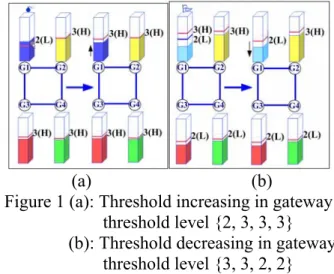
(a) (b)
Figure 1 (a): Threshold increasing in gateway threshold level {2, 3, 3, 3} (b): Threshold decreasing in gateway
threshold level {3, 3, 2, 2}
Figure 1 (a) demonstrates the example of case 3 in Table 1. In this example, Gateway G1 is
considered to explain the process by which the threshold is increased. L andH are set to 2 and 3, and the current levels for gateways G1, G2, G3, and
G4 are set to (2, 3, 3, 3), respectively. As shown on
the left-hand side of Figure 1 (a), since curr_load1
is larger than Load(C1), C1 equals L, and the union
of the current threshold level for other gateways is {H}; this situation indicates that the loading of G1
is lighter than that of other gateways. Thus, G1 will
update its threshold level by increasing it by one unit and the current level for each gateway becomes (3, 3, 3, 3), as shown at the right-hand side of Figure 1 (a).
The threshold decreasing can cooperate with threshold increasing for our dynamic thresholding techniques. When the current load of gateway Gi
(curr_loadi) is less than the previous level (Load(Ci
triggered. If the difference of threshold levels between any two gateways is not controlled within one level, the process of threshold decreasing will not be executed and the gateway keeps the current threshold level.
The scenario of Figure 1 (b) is an example of case 11 in Table 1. In this example, L andH are set to 2 and 3, and the current levels for the four gateways are set to (3, 3, 2, 2), respectively. As shown in the left-hand side of Figure 1 (b), because curr_load1 is less than Load(C1), C1 equals H, and
the union of the statuses of current threshold levels for other gateways is {L, H}, It then updates its threshold level by decreasing it by one unit and the current levels for all gateways become (2, 3, 2, 2), as shown in the right-hand side of Figure 1 (b). B. Traffic Redirection Strategy
In the previous section, if the traffic load of a gateway exceeds its threshold and its threshold level is that of case 4 or 5 in Table 1, then the gateway prunes BNs to share its load with its neighboring gateways. Since the BNs are located in the areas of intersection between the gateways, the BNs are suited to be pruned in the network. To select BNs that can be switched to neighboring gateways, the overloaded gateway must estimate the weight of each BN according to equation (4).
GWExpmin=min{GWExpGi},
Gi∈neighbor gateways of BNi
(4) Equation (4) is defined to yield the minimum weighted value of BNi. Equation (2), defined in
Section III, derive formulate (4). In equation (4), Gi
does not include the current default gateway of BNi.
GWExpmin is used to determine which BNi can be
selected for traffic redirection.
IV. EXPERIMENTAL RESULTS
In this section, experiments were conducted to evaluate the performance of the proposed schemes. The ns-2 with wireless extensions is used for the experiments. A 1000m × 1000m square contains four gateways and 100 to 400 nodes. The network area is divided into four 500 × 500 regions and a gateway is placed in the center of each region. A network in which four gateways share the same
frequency channel is simulated. Each host has a transmission distance of 200m and uses IEEE 802.11 DCF for the medium access control. To model the bursty traffic of these two scenarios, 10 to 40 sources are randomly chosen and assigned to the network in a short period. The total traffic load that is assigned to the network is close to the maximum capacity of the network. The performance metrics used in this work for evaluation purposes are explained below.
(1) Throughput: defined as the ratio of the amount of data received by ultimate destinations and the interval of time between the first and last received data packets. A higher value implies better performance.
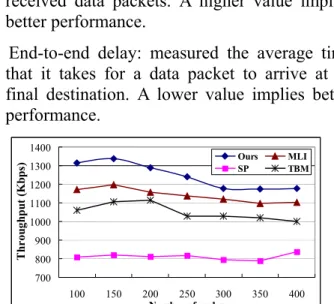
(2) End-to-end delay: measured the average time that it takes for a data packet to arrive at its final destination. A lower value implies better performance. 700 800 900 1000 1100 1200 1300 1400 100 150 200 250 300 350 400 Number of nodes T hr oug hpu t (Kbps ) OursSP MLITBM
Figure 2: Throughput vs. Number of Nodes in Pattern 1:2:4:8
As shown in Figure 2, with various numbers of nodes, our proposed scheme has a higher throughput than the other schemes. Since the dynamic thresholding mechanism make the gateways determine whether the traffic load should be redirected, it can effectively control the traffic load and eliminate unnecessary traffic redirection.
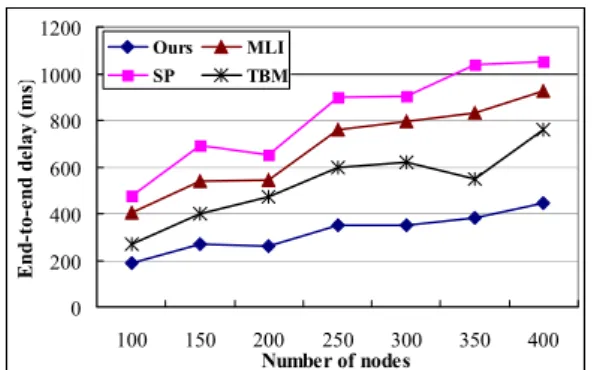
Then, as shown in Figure 3, because our proposed scheme can reduce the bottleneck problem and increase the utilization of network resources, the end-to-end delay of our proposed scheme is lower than that of other schemes with various numbers of nodes. In summary, our proposed scheme is more scalable than the other schemes.
0 200 400 600 800 1000 1200 100 150 200 250 300 350 400 Number of nodes E nd-to -e nd de la y ( m s) Ours MLI SP TBM
Figure 3: End-to-end delay vs. Number of Nodes in Pattern 1:2:4:8
V. CONCLUSIONS
This work considers the various capacities of gateways to develop a new traffic control technique using dynamic thresholding techniques to distribute the traffic loading among multiple gateways in WMNs. Firstly, a network partition scheme is developed to enable the mesh router to select a suitable default gateway. Secondly, to control the traffic effectively, the base threshold is defined. Then, according to the based threshold, the dynamic thresholding scheme is developed to adjust the gateway threshold. This scheme can estimate the traffic load of gateways and control the relative threshold levels of any two gateways to eliminate unnecessary traffic redirection and reduce the traffic control overhead in various distributed traffic conditions. The simulation results show that the throughput and the end-to-end delay of our proposed method exceed those of other methods in the bursty traffic scenario.
ACKNOWLEDGEMENTS
The authors would like to thank the National Science Council of the Republic of China for financially supporting this research under Contract No. NSC97-2221-E-035-034-MY2. We thank Dr. Sheng-Chang Chen for clarifying some algorithms and explicit aspects of our approach.
REFERENCES
1. [1] I. F. Akyildiz, X. Wang, and W. Wang,
“Wireless Mesh Networks: A Survey,” Computer Networks Journal (Elsevier), Vol. 47, No. 4, pp. 445-487, March 2005.
2. [2] Y. Bejerano, S. J. Han, and L. Li, “Fairness
and Load Balancing in Wireless LANs Using Association Control,” IEEE/ACM Transactions on Networking, Vol. 15, Issue 3,
pp. 560-573, June 2007.
3. [3] L. Dai, Y. Xue, B. Chang, Y. Cao, and Y. Cui,
“Routing for Wireless Mesh Networks With Dynamic Traffic Demand,” ACM/Springer Mobile Networks and Applications, Vol. 13, Issue 1-2, pp. 97-116, April 2008.
4. [4] C. F. Huang, H. W. Lee, and Y. C. Tseng, “A
Two-Tier Heterogeneous Mobile Ad Hoc Network Architecture and Its Load-Balance Routing Problem,” ACM Mobile Networking and Applications (MONET), Special Issue on Integration of Heterogeneous Wireless Technologies, Vol. 9, Issue 4, pp. 379-391, August 2004.
5. [5] D. Marrero, E. M. Macias and A. Suarez, “An
Admission Control and Traffic Regulation Mechanism for Infrastructure WiFi networks, ” IAENG International Journal of Computer Science, Vol. 35, Issue 1, pp.154-160, February 2008.
6. [6] D. Nandiraju, L. Santhanam, N. Nandiraju,
and D. P. Agrawal, “Achieving Load Balancing in Wireless Mesh Networks Through Multiple Gateways,” Proceedings of IEEE International Conference on Mobile Ad hoc and Sensor Systems (MASS 2006), pp. 807-812, October 2006.
7. [7] N. Nandiraju, D. Nandiraju, L. Santhanam, B.
He, J. F. Wang, and D. P. Agrawal, “Wireless Mesh Networks: Current Challenges and Future Directions of Web-In-The-Sky,” IEEE Wireless Communications, Vol. 14, Issue 4, pp. 79-89, August 2007.
8. [8] V. Raghunathan and P.R. Kumar, “Wardrop Routing in Wireless Networks,” IEEE Transactions on Mobile Computing, Vol. 8, Issue 5, pp. 636-652, May 2009.
9. [9] J. Tang, G. Xue, and W. Zhang, “Maximum
throughput and fair bandwidth allocation in multi-channel wireless mesh networks,” Proceedings of 25th IEEE International Conference on Computer Communications, pp. 1-10, April 2006.
10. [10] X. Tao, T. Kunz, and D. Falconer, “Traffic Balancing in Wireless MESH Networks,” Proceedings of International Conference on Wireless Networks, Communications, and Mobile Computing (WirelessCom 2005), Vol. 1, pp. 169-174, June 2005.