國
立
交
通
大
學
管理科學系
博 士 論 文
No.049
推薦來源對使用學術電子書意願之影響
Recommendation Sources on the Intention to Use
E-Books in Academic Digital Libraries
研 究 生 : 金揚傑
指導教授 : 林君信 教授
: 曾國雄 教授
國
立
交
通
大
學
管理科學系
博
士
論
文
No.049
推薦來源對使用學術電子書意願之影響
Recommendation Sources on the Intention to Use
E-Books in Academic Digital Libraries
研 究 生:金揚傑
研究指導委員會:林君信 教授
曾國雄 教授
黃仁宏 教授
姜 齊 教授
指導教授:林君信 教授
曾國雄 教授
中 華 民 國 九 十 九 年 五 月
推薦來源對使用學術電子書意願之影響
Recommendation Sources on the Intention to Use E-Books in
Academic Digital Libraries
研 究 生: 金揚傑
Student: Yang-Chieh Chin
指導教授: 林君信
曾國雄
Advisor: Dr. Chiun-Sin Lin
Dr. Gwo-Hshiung Tzeng
國 立 交 通 大 學
管理科學系
博 士 論 文
A DissertationSubmitted to Department of Management Science College of Management
National Chiao Tung University in Partial Fulfillment of the Requirements
for the Degree of Doctor of Philosophy
in Management
May 2010
Hsin-Chu, Taiwan, Republic of China 中華民國九十九年五月
推薦來源對使用學術電子書意願之影響
研 究 生:金揚傑 指導教授:林君信 教授
曾國雄 教授
國立交通大學管理科學系博士班
摘
要
過去許多研究多半在探討使用學術電子書的意願會受到何種推薦的直接影響,顯 少有學者比較不同推薦來源(口碑推薦、廣告推薦、專家推薦)是否對於使用學術電 子書的意願產生不同程度的影響效果。本研究以數位圖書館之學術電子書為探討對 象,了解使用者在不同推薦來源之下,對其自身欲使用學術電子書的意願,並以知覺 信任與知覺風險擔任中介變數。研究問卷發放於382 位數位圖書館之使用者,年齡層 介於18 至 25 歲,詢問其在不同的推薦來源之下,對此項推薦所感受到的信任與風險 程度,以及其對使用學術電子書意願之看法。首先藉由迴歸分析指出,三種不同的推 薦效果均對使用學術電子書之意願產生正向影響,此外,口碑推薦最可提升使用者之 知覺信任,以及最能降低其風險之感受性;第二階段分析利用優勢約略理論與流網絡 圖來產生影響使用學術電子書意願之最具代表性的規則。根據研究結果,本研究將提 出學理上與實務上之建議,並可供後續相關研究加以參考與延伸。 關鍵詞:推薦來源、電子書、使用意願、優勢約略理論、流網絡圖。
Recommendation Sources on the Intention to Use E-Books in Academic
Digital Libraries
Department of Management Science
National Chiao Tung University
Student: Yang-Chieh Chin
Advisor: Dr. Chiun-Sin Lin
Dr. Gwo-Hshiung Tzeng
ABSTRACT
Few library studies have investigated recommendation classifications for e-book (electronic book) usage, whereas none have directly compared which recommendation sources (word-of-mouth recommendations, advertising recommendations, and expert recommendations) might influence e-book usage intentions. To fill this gap in the literature, the main purpose of this study is to examine how users perceive the influence of recommendations in their intentions to use e-books for academic purposes. Data for this study were collected from 382 academic digital library users between the ages of 18 and 25. Firstly, a multiple regression analysis was conducted to identify the key causal relationships. A comparison of three recommendation sources (word-of-mouth recommendations, advertising recommendations, and expert recommendations) revealed that word-of-mouth (WOM) recommendations played a more important role than other recommendations did in determining the intention to use e-books in an academic digital library. The results also showed that enhancing the perceived trust and reducing risk in the use of e-books can mediate the relationship between recommendation sources and customers’ behavioral intentions to use
e-books. The second analysis of this study is grounded in the taxonomy of induction-related activities using the dominance-based rough set approach (DRSA), a rule-based decision-making technique, to infer the behavioral intention of using e-book decision rules; then uses a flow network graph, a path-dependent approach, to infer decision rules and variables; and finally presents the relationships between rules and different kinds of behavioral intentions. Practical and research implications are also offered.
Keywords: Recommendation Source, E-Book, Behavioral Intention, Dominance-based Rough Set Approach, Flow Network Graph
誌 謝
博士論文的完成,必須感謝很多人的幫忙與協助,讓我在進行研究時可以克服所有 的難題。先謝謝指導教授林君信教授,面試時與您的巧遇,彷彿註定了彼此的緣份。感 謝您總是一直鼓勵我,與我分享博班生活的點滴,並給我力量,讓學生能更有自信地從 事我所感興趣的研究;同時謝謝另一名指導教授-曾國雄教授,感謝您帶領著我走向充 滿陽光的學術殿堂,並將您浩瀚的知識無私地與學生分享,從您身上我看到學者之風 采,您對研究的熱情,會是學生一輩子努力的目標。此外,也要感謝管科系的黃仁宏教 授教導研究方法與行銷相關課程,奠定了學生行銷管理領域之基礎;姜齊教授則教導學 生作業研究之精髓,使我成為實實在在的“管科人"。而也要特定感謝校外口試委員陳 定國教授、胡哲生教授在百忙之中抽空擔任學生論文口試委員,並提供寶貴意見,使本 論文能更臻完善。 博班生涯中也需要感謝許多貴人相助,俊賢學長、新沅學長對於學弟之提攜;管科 96 級同學(志斌、中民、慧賢、美玲、燕萍、素鈴)對於我生活與課業上之照顧,也謝 謝葉姐辛苦的幫忙我處理庶務,並時時給予提點。 最後,感謝我的父親金明遠、母親張文石,他們在我自小時悉心照料我至今,是我 經濟上及精神上的支柱,如果不是他們的周全照顧,也不會成就今天的我。也特定感謝 Aka,感謝妳陪伴我走過人生幽谷,在柳暗花明豁然開朗時與我一同慶祝,並不斷督促 我往更高處行。另外,感謝交大土地公的庇佑,讓我的學業如此順利,還有一直以來陪 伴我成長的小猩猩,給予我莫大的力量,讓我可以堅持完成夢想。謹將此論文獻給所有 支持我的人,我的榮耀與你們分享。 金揚傑2010.5Table of Contents
Chinese Abstract
iAbstract
iiAcknowledgement
ivTable of Contents
vLists of Tables
viiLists of Figures
viiiChapter 1 Introduction
11.1 Research Background 1
1.2 Research Objective 4
1.3 Organization of the Dissertation 4
Chapter 2 Theoretical Background and Research Hypotheses
72.1 Electronic Books 7
2.2 Behavioral Intention 9
2.3 Perceived Trust 10
2.4 Perceived Risk 11
2.5 Sources of Recommendations 13
Chapter 3 Dominance-based Rough Set Approach and Flow Network
Graph Algorithm
17
3.1 Basic Concepts of Dominance-based Rough Set Approach 17 3.2 Approximation of the Dominance Relation 18
3.3 Extraction of Decision Rules 21
Chapter 4 Empirical Studies of E-books in Academic Digital Libraries
25 4.1 Study one: Identify the Key Causal Relationships 25 4.2 Study two: Infer the Behavioral Intention Rules of E-books 32Chapter 5 Discussion and Managerial Implications of Research Findings
41Chapter 6 Conclusions and Remarks
45References
48Appendix A
60List of Tables
Table 1 Results of regression analysis examining the influence of perceived trust and perceived risk related on behavioral intention (Comparison between the reduced model vs. the full model)
31
Table 2 Main effects of recommendation sources 31 Table 3 Attribute specification for behavioral intention to use e-books analysis 34 Table 4 Accuracy of classification and quality of classification 35 Table 5 Rules on behavioral intention of use e-books 36
List of Figures
Figure 1 Research flow chart 6
Figure 2 Conceptual model 26
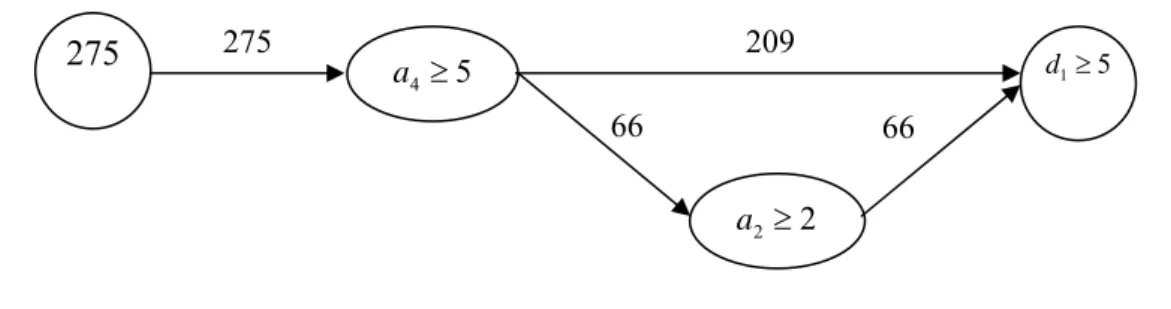
Figure 3 Decision flow graph and rule-set of d1≥5 37
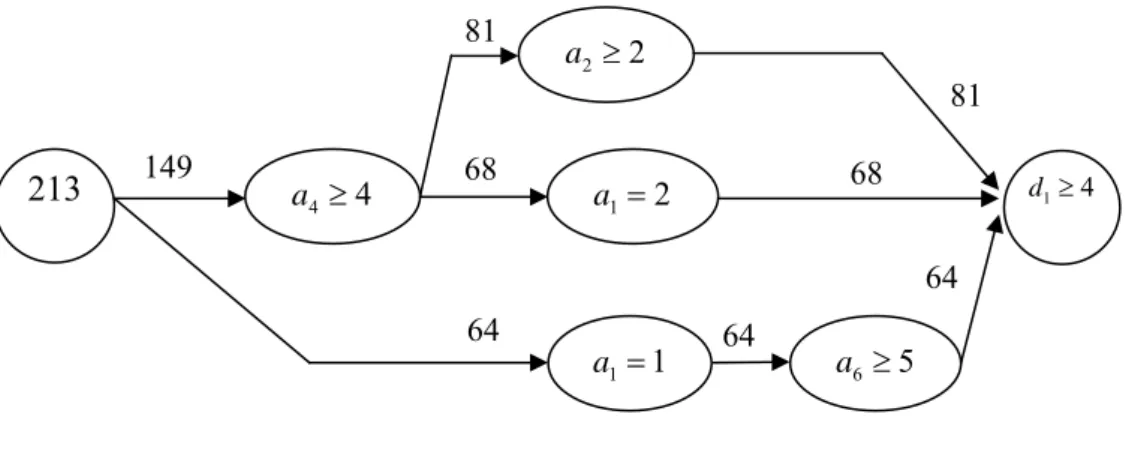
Figure 4 Decision flow graph and rule-set of d1≥4 38
Figure 5 Decision flow graph and rule-set of d1≤4 38
Chapter 1 Introduction
1.1 Research Background
Agee (2003) examined a number of positive aspects of technology as applied to electronic textbooks. Electronic journals and databases have firmly established themselves as essential resources for libraries and their users, revolutionizing the information-seeking behavior of academics, scientists and researchers, especially as expressed in Nicholas Huntington and Rowlands’ 2007 study. Electronic books (e-books) have a similar or arguably more significant potential to impact behaviors, with important consequences for the future role and existence of libraries (Vasileiou, Hartley, and Rowley, 2008). In a computer-media-based environment depending on users’ information-seeking behaviors, library digitization initiatives, and vendors’ product offerings, academic libraries have illustrated their interests in acquiring e-books. E-books are books that are created in, or converted to, a digital format (Abdullah and Gibb, 2006). Academic e-books are an integral part of a scholar’s workstation, a networked environment where e-journals, aggregated full-texts, indexes, and other relevant scholarly materials are accessible through a single window, opening a world of permanent, integrated, and cross-linked scholarly resources (Dillon, 2001).
University libraries have illustrated that the demand and use of written content has clearly moved towards electronic sources. As a result, they have begun to amass a sizeable collection of digital materials that includes e-books (Jantz, 2001). Furthermore, academic e-books are gaining popularity and significance among libraries (Nelson, 2008). Many higher education institutions around the world are placing e-book collections in their campus libraries and adopting e-books as learning materials. Sixty-nine percent of university research libraries are planning to increase their spending on e-books over the next two years, according to a recent study published by The Primary Research Group (2003). This study involved a
survey of 45 research libraries around the world, including libraries in the United States, Canada, Australia, Germany, and Japan. Thus, the advantages of academic e-books over traditional texts are being seen, although somewhat gradually.
Even though e-books offer the convenience of searching for information using keywords anytime and anywhere, their popularity has not grown dramatically because users lack the awareness and training to use them properly (Connaway and Wicht, 2007); they have no sense of ownership during their frequent uses during an academic year, and users still have a preference for printed books (Rowlands, 2007). We expect that the negative evaluation of e-books can be rectified through better and more accurate recommendations. This is because most users, or potential users, rely on interpersonal and other sources of recommendations to make their usage decisions (Selnes and Gronhaug, 1986).
The sources of recommendations can be classified as interpersonal, impersonal (Andreasen, 1968) and neutral (Cox, 1967). Prior researchers have been able to shed some light on the importance of sources of recommendations in the context of product purchases (Murray, 1991); however, little is known about the relevance of these recommendation sources in the context of e-book usage. One of our primary goals in this study is to compare the sources of recommendations that may lead to different degrees of academic e-book usage more effectively than previous studies have done.
However, a user’s intentions may be directly affected by the perception of trust and risk in online environments (Mukherjee and Nath, 2007; Kiran, Sharma, and Mittal, 2008). Thus, another one of our primary goals is to explore whether the effect of recommendation sources, including word-of-mouth recommendations (e.g., interpersonal recommendation), advertising recommendations (e.g., impersonal recommendation) and expert recommendations (e.g., neutral recommendations), can enhance the library user’s trust and reduce the risks in using e-books in academic digital libraries. That is, the mediating effects of trust and risk may
strengthen the relationship between the recommendation sources and users’ behavioral intentions to use e-books.
In addition, to gain new insights into this important area, this study uses a data mining technique perspective to examine, in an academic e-book context, three key influences on the evaluation of recommendation sources that may explain how recommendations influence consumers’ decision-making and usage intentions. Many studies rely on empirical research to predict customers’ behaviors with data mining techniques (Giudici and Passerone, 2002; Liou and Tzeng, 2010). Data mining is a methodology for the extraction of new knowledge from data, involving the application of specific algorithms for pattern extraction. Rough set theory (RST), a kind of natural language computation, can integrate learning-from-example technology, extract rules from datasets, and identify data regulations (Komorowski and Zytkow, 1997). More specifically, RST effectively derives a set of decision rules based on observed behaviors (Beynon and Driffield, 2005). These decision rules can be expressed as “IF condition(s) THEN decision(s)”. The decision rule reflects a relationship between a set of conditions and a conclusion or decision. Recently, RST has been applied in the marketing field because it is useful for analyzing and segmenting customers’ characteristics to formulate efficient and effective marketing strategies (Tseng and Huang, 2007), such as personal investment portfolio analysis (Shyng, et al., 2010), business aviation decision-making (Ou Yang, et al., 2010), video game customer purchase behaviors (Tseng and Huang, 2007), insurance market attributes analysis (Shyng, et al., 2007) and travel demand analysis (Goh and Law, 2003).
However, the main restriction on the use of RST is that the domain of attributes is preference-ordered. To help fill this gap, Greco, Matarazzo and Slowinski (1998) proposed an extension of RST based on the dominance principle to incorporate the ordinal nature of the preference data into the classification problem; this is called the dominance-based rough set
approach (DRSA). In addition, the DRSA was motivated by representing preference models for multiple criteria decision analysis (MCDA) problems where preference orderings on domains of attributes are quite typical in exemplary-based decision-making (Liou, Yen, and Tzeng, 2010). The rules developed by DRSA can be directly translated into a path-dependent flow network to infer decision paths and parameters. The flow network graph and cause-and-effect relationship of decision rules are heavily exploited in recommendation sources. As a result, the major objective of this study is to apply the DRSA to mining the decision rule for recommendation sources to predict the intention to use e-books.
1.2 Research Objective
Few library studies have investigated recommendation classifications for e-book usage, whereas none have directly compared which recommendation sources (word-of-mouth, advertising, and expert recommendation) might influence e-book usage intentions. To fill this gap in the literature, the main purposes of this study are as follows: (1) to examine how users perceived the influence of recommendations on the intention to use e-books for academic purposes; (2) to measure the level of the perception of trust and perceived risk when users receive e-book recommendations from peers, advertisers, and experts; and, (3) to employ the taxonomy of induction-related activities using the combined DRSA and flow network graph to infer the behavioral intention to use e-book decision rules.
1.3 Organization of the Dissertation
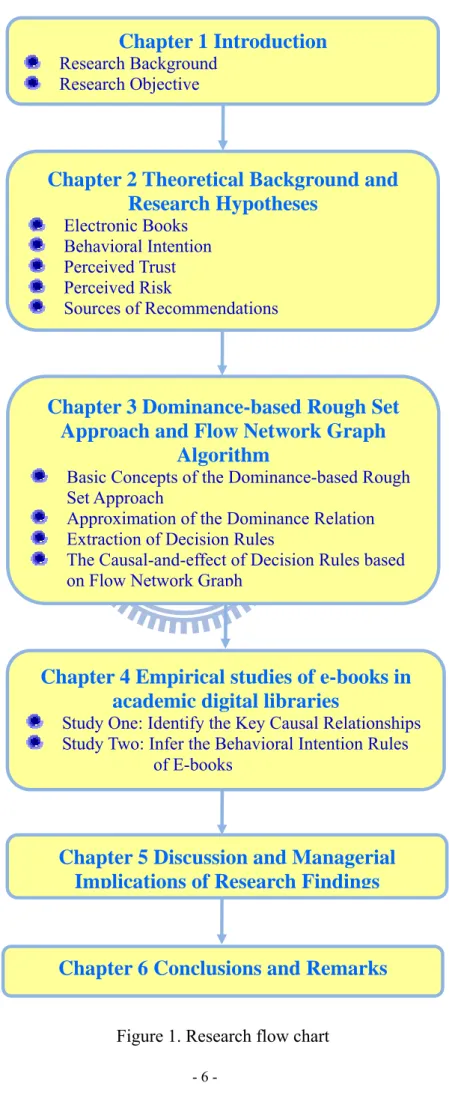
This dissertation is organized in the following manner, as Figure 1 shows: Chapter 1 presents the motive and objective of the study. Chapter 2 reviews the relevant literatures, thereby forming a conceptual framework and the hypotheses. Chapter 3 gives a brief introduction of the DRSA and flow network graph. Next, in Chapter 4, this research firstly using a multiple regression analysis was conducted to identify the key causal relationships in Study 1, and then designs and develops a flow network dependent on the DRSA decision rule
created in Study 2. Chapter 5 provides a detailed discussion and managerial implications. Finally, conclusions and remarks are proposed in Chapter 6.
Figure 1. Research flow chart
Chapter 1 Introduction
Research BackgroundResearch Objective
Chapter 2 Theoretical Background and
Research Hypotheses
Electronic Books Behavioral Intention Perceived Trust Perceived Risk Sources of RecommendationsChapter 3 Dominance-based Rough Set
Approach and Flow Network Graph
Algorithm
Basic Concepts of the Dominance-based Rough Set Approach
Approximation of the Dominance Relation Extraction of Decision Rules
The Causal-and-effect of Decision Rules based on Flow Network Graph
Chapter 4 Empirical studies of e-books in
academic digital libraries
Study One: Identify the Key Causal Relationships Study Two: Infer the Behavioral Intention Rules
of E-books
Chapter 6 Conclusions and Remarks
Chapter 5 Discussion and Managerial
Chapter 2 Theoretical Background and Research Hypotheses
This chapter reviews the theoretical background of e-books, the behavioral intentions and recommendation sources. Other concepts discussed below include the moderating role of perceived trust and perceived risk. The following five hypotheses were developed accordingly.
2.1 Electronic Books
E-books are similar to printed books; only their medium is different. Considering that a book can be understood as a medium for communicating information, an e-book is, or should be, a printed book’s digital equivalent. The information is organized and structured so that it can be presented to the reader so as to facilitate consultation (Landoni, 2003). The birth of the electronic book or e-book has provided publishers with new methods of serving customers that offer the opportunity to preserve publishers’ competitiveness within the e-publishing and e-commerce markets (Connaway and Wicht, 2007). To some, an e-book is any type of digitized material that was previously available in printed format (e.g., books and reference materials). In the e-book industry, the term implies the use of devices designed to distribute and allow the reading of largely copyrighted, digitized books (Herther, 2005).
As to the advantages and disadvantages of e-books, Ball (2009) summarized that the advantages can be described as follows: (1) fast acquisition; (2) 24/7 availability; (3) Web-like interactivity and search functions; (4) fast updates; (5) access to and, in some cases, the purchasing of individual chapters; (6) global availability; (7) multimedia elements; and (8) no deterioration through use. The disadvantages can be categorized as follows: (1) dependent on access to the Internet; (2) dependent on a technical platform; (3) lack of the physical ‘look and feel’ of a printed book; (4) on-screen reading is not very comfortable; (5) lack of individuality (compared to a printed book) in terms of size, binding, etc.; (6) limited access rights (often no concurrent use or limited user numbers, and no interlibrary loans); and (7) proprietary
systems.
With the continual and massive growth of the Internet, texts presented as e-books can be updated quickly; they can be dynamic, interactive, and accessible anytime from anywhere (Wilson Landoni, and Gibb, 2002). E-books are regarded as a vital digital resource, as they can be available from a library’s Web site, offer helpful characteristics that include the use of multimedia, hyperlinks, and other interactive components, contain search features, and give users the ability to customize the appearance of text or convert text into audio information.
Gibbons, Peters and Bryan (2003) suggest seven types of e-book functionalities, including the following: the physical functionality of the device (readability and ergonomics), functionality that helps read e-book content (ability to search and navigational tools), means to enhance functionality (inclusion of multimedia and links to data and bulletin boards), functionality that places content within a context (links to other e-content and inter-textual search ability), functionality that helps the reader “possess” the text (make annotations or print), and the functionality that supports library activities (preserving the confidentiality of users and being “scrubbable”). E-books also offer presumed lower reproduction and distribution costs and higher longevity, as they are paperless (Mattison, 2002; Shirattudin, Hassan, and Landoni, 2003).
On the other hand, it is important to note that e-books cannot, and probably will not, ever fully replace print collections for libraries. They are not available for all subject areas and have limited uses. The subject areas that are most likely to be available today on e-book format are reference materials, classic literature, economics, business, health, education, technology, engineering, and computer science materials. Copyright restrictions, a limited selection of e-books in certain subjects, and the difficulty of citation are other key concerns.
In the academic environment, e-books have already had a significant impact on academic libraries. There have also been major advances in technology that will bring further changes.
The academic e-books in this study relate to student materials that confer knowledge, e.g., e-journals, learning materials and instruction manuals (Hoorebeek, 2003).
Recently, academic libraries, whether domestic or abroad, are realizing the potential benefits of adding e-books to their collections and are now addressing the concept and details of e-book acquisition more closely (Landoni and Hanlon, 2006). The Primary Research Group (2003) reported that libraries have found e-books to be most useful for supplementing collections, using in distance-learning programs, and for increasing libraries’ e-reserves.
However, Anuradha and Usha (2005) pointed out that one of the main unfavorable features of e-books is a lack of user-friendliness. Students also want more multimedia capabilities and better knowledge when using e-books (ebrary, 2008). This is another compelling reason to understand whether recommendations from different sources can help correct the negative impression of e-books and enhance perceived trust while reducing perceived risk and attracting more people to use e-books.
2.2 Behavioral Intention
A behavioral intention to use an item is based on Fishbein and Ajzen’s (1975) definition of a behavioral intention: “the strength of one’s intention to perform a specified behavior” (p. 288). It is an indication of an individual’s readiness to perform a given behavior and is assumed to be the immediate antecedent of that behavior (Ajzen, 2002). It is also based on the attitude toward the behavior, the subjective norm, and perceived behavioral control, with each predictor weighed for its importance in relation to the actual behavior and the population of interest. In a virtual environment, a behavioral intention has been shown to predict an individual’s likelihood of performing a conscious act, such as determining to accept (or use) a technology (Chau and Hu, 2002).
In this study, we emphasize the behavioral intention to use e-books rather than the actual usage. Davis, Bagozzi and Warshaw (1989) were able to demonstrate that behavioral intention
is significantly correlated with actual usage, and that behavioral intention is a major determinant of a user’s behavior(s).
2.3 Perceived Trust
Prior research in this area makes significant progress toward understanding the importance of trust (Johnson, 2007). For example, Whitener, et al. (1998) defined trust holistically as possessing three components: trust reflects expectation or conviction of there being good will behind the counterpart’s anticipated action; counterparts cannot force or control this conviction; one believes that one’s performance depends on the actions of the counterpart. Mayer, Davis and Schoorman (1995) defined trust as behavioral, being based on one’s personal beliefs about the characteristics of another person. Because, in a virtual environment, the degree of uncertainty of a transaction is higher than in a traditional or real-life setting, trust becomes an even more important factor (Roca, García, and de la Vega, 2009). Past research on e-commerce has illustrated that trust in online vendors increases consumers’ intentions to use a vendor’s Web site (e.g., George, 2002; Mukherjee and Nath, 2007).
Furthermore, trust is also an important antecedent of the behavioral intention, and is the basis of behaviors that demonstrate dependence on others, such as accepting others’ advice (McKnight, Choudhury, and Kacmar, 2002). Sources of recommendation could help build consumers’ trust in specific products (Gershoff, Mukherjee, and Mukhopadhyay, 2003) and, if the sources aid effectively in the decision-making process, the user will be more likely to trust the recommendation. Consequently, trust is expected to be a significant mediator between recommendation sources and the behavioral intention to use e-books in academic digital libraries.
2.4 Perceived Risk
Perceived risk is conceptualized as the subjective expectation of a loss (Stone and Gronhaug, 1993) and refers to someone’s perception of the uncertain and adverse consequences of engaging in an intention or behavior. Perceived risk is also an important element in affecting behavior in online environments (Jarvenpaa, Tractinsky, and Vitale, 1999; Kiran, et al., 2008). In other words, people perceive a higher level of risk in an online environment than they do in a physical environment (Tan, 1999). Pavlou (2003) also revealed that perceived risk has a negative effect on usage intentions regarding information technology.
Other studies have suggested that perceived risk enhances exploratory or informational search tendencies (e.g., Batra and Sinha, 2000; Campbell and Goodstein, 2001) because people seek out information to ensure whether the uncertain consequences of new technology adoption corresponds to their own acceptable levels (Dholakia, 2001; Dowling and Staelin, 1994). In other words, a source of recommendations that matches user-specified criteria to the user’s intention can help the user reduce perceived risks and save time when the user is considering a wide variety of alternatives. Also, in the digital library environment, users’ adoption of e-books may be affected by the perceived risk.
However, prior research has modeled perceived risk only as a single construct, though this approach fails to reflect the real characteristics of perceived risk or explain why users resist online digital library services. Cox (1967), who was among the first to explore the components of perceived risk, divided perceived risk into two parts: the risk the consumer endures before making decisions, and the loss people perceive if the decision is unsuccessful. Jacoby and Kaplan (1972) suggested that perceived risk included performance risk, financial risk, temporal risk, social risk and security or privacy risk. On a conceptual level, these five dimensions are functionally independent: as one type of risk increases, another type can increase, decrease, or remain unaffected. Cherry and Fraedrich (2002) further identified six
key dimensions of perceived risk: financial, performance, physical, temporal, social, and psychological. Because this study focuses on the information product domain (e.g., academic electronic books), we introduced three risk dimensions in this domain-specific circumstance: performance risk, temporal risk, and social risk. Performance risk is the concern that products will not perform as anticipated (Kim and Lennon, 2000). Temporal risk refers to the perception that the adoption and use of the product will take too much time (Roselius, 1971). For example, time-conscious users with less available time were more likely to use an e-book to save time than other, non-time-conscious users were (Feathermana and Pavlou, 2003). Social risk deals with negative responses received regarding an item through a person’s social network (Dowling and Staelin, 1994).
Based on the trust model suggested by Mayer et al. (1995), perceived trust and perceived risk are essential constructs when uncertainty is present. Most people perceive a level of trust when they consider using a product. Therefore, obtaining recommendations can enhance a person’s sense of trust that then supports the person’s intentions or behaviors. Similarly, people perceive risk when they consider using a product. As a result, people obtain recommendations to decrease uncomfortable feelings and reduce risk. The basic assumption then is that perceived trust and perceived risk will have a positive (negative) effect on an individual’s intentions to engage in using e-books. Thus, the following associated hypotheses are developed:
H1. Higher perceived trust will lead to higher behavioral intentions to use e-books in an
academic digital library.
H2. Lower perceived risk will lead to higher behavioral intentions to use e-books in an
2.5 Sources of Recommendations
Cox (1967) categorized information sources into three categories: consumer-dominated, marketer-dominated, and neutral sources. Whereas marketer-dominated sources (i.e., packaging, promotion, and advertising) are controlled by the marketer, consumer-dominated sources refer to interpersonal informational channels over which the marketer has little control. Neutral sources (i.e., consumer reports, newspapers) are recommendation sources controlled neither by the marketer nor the consumer.
Andreasen (1968) categorized informational sources into four categories: impersonal advocate, impersonal independent, personal advocate, and personal independent. Impersonal advocate sources include printed media and broadcast advertising, whereas personal independent sources consist of information gathered from popular articles and broadcast programming. Personal advocate sources refer to information received from salespersons, and personal independent sources include facts gathered from friends and relatives. Klippel and Sweeny (1974) further classified recommendation sources as being from friends and neighbors, television advertisements, radio advertisements, member(s) of the immediate family, and newspaper or magazine advertisements. Given the prevalence of computer-mediated shopping environments, another important recommendation source is electronic decision-making sources that can provide personalized information to consumers (Ansari, Essegaier, and Kohli, 2000). Senecal and Nantel (2004) concluded that recommendation sources can be divided into three typologies: other consumers, human experts and recommendation systems, the last of which is produced by online media technologies and is more influential than other consumers and human experts are. Adapting information from the e-books market and the prior literature, we concluded that WOM (interpersonal source), general advertising (impersonal source) and expert recommendations (neutral source) may lead to the behavioral intention to use e-books in an academic digital
library.
2.5.1 Word-of-mouth (WOM) Sources
Harrison-Walker (2001) defined word-of-mouth advertising (WOM) as “informal, person-to-person communication between a perceived noncommercial communicator and a receiver regarding a brand, a product, an organization, or a service” (p. 63). Word-of-mouth advertising (WOM) is face-to-face (or e-mail-to-e-mail or text-to-text) communication about products or companies between people who are not commercial entities (Carl, 2006). In the context of marketing, WOM communication is advice to one consumer from another (East, Hammond, and Wright, 2007), whether the consumer is a friend, relative, classmate, colleague, or acquaintance (Kuan and Bock, 2007). Thus, WOM recommendation sources are primarily interpersonal sources, where interpersonal sources refer to non-commercial personal sources used by consumers to gather product-related information. These sources may include family, friends, and colleagues, but exclude sales personnel and other sales representatives (Mourali and Laroche, 2005). The following hypotheses are offered:
H3a. Positive WOM recommendations will have a positive effect on perceived trust when
using e-books in an academic digital library.
H3b. Positive WOM recommendations will have a negative effect on perceived risk when
using e-books in an academic digital library.
H3c. Positive WOM will have a positive effect on behavioral intentions to use e-books in
an academic digital library. 2.5.2 Advertising
Advertising is “the non-personal communication of information usually paid for and usually persuasive in nature about products, services or ideas by identified sponsors through the various media” (Bovee, 1992, p. 7). Advertising is further defined as “paid non-personal communication from an identified sponsor using mass media to persuade or influence an
audience” (Wells, Moriarty, and Burnett, 2000, p. 7). Whereas marketers continue to use traditional print advertising methods to promote their businesses, products and services, the Internet has been adopted rapidly as a powerful advertising medium, so research on attitudes toward advertising has naturally extended to the online environment (Havlena and Graham, 2004, Wang and Sun, 2010). Jung and Choi (1999) determined that advertising can be classified into three groups: attraction tools, advertisement content, and follow-up marketing. The attraction tool provides an easy way for consumers to locate and visit a site through banners and search engines. Advertising content provides core messages and information on products and services. Follow-up marketing provides information to special targets through e-mails or ‘push’ advertisements.
Although many people are inundated with advertising every day, librarians are used to applying various advertising techniques for the express purpose of delivering informative messages to recruit and educate users. Traditional advertising modes include newspapers, magazines, television, radio, mailboxes and public transportation. Web advertising also has many forms, such as contextual advertisements on search engine result pages, banner advertisements (graphical elements on a Web page), and e-mail marketing (including e-mail spam).
Effective advertising can increase the exposure of e-book information, but it may also lead to increased trust, decreased risk, or different levels of customers’ usage intentions. Therefore, we investigated the mediating effects of perceived trust and perceived risk on the intentions to use e-books, and we hypothesized that:
H4a. Advertising recommendations will have a positive effect on perceived trust in using
e-books in an academic digital library.
H4b. Advertising recommendations will have a negative effect on perceived risk in using
H4c. Advertising recommendations will have a positive effect on behavioral intentions to
use e-books in an academic digital library. 2.5.3 Expert Recommendation Sources
An expert source is one who is knowledgeable about a particular product or service (Bone, 1995). Crisci and Kassinove (1973) suggest that the perceived level of expertise and advice positively influence compliance with source recommendations. Expert recommendations exploit detailed heuristics and social interactions to recommend sources of expertise in an organizational environment (McDonald and Ackerman, 2000). In online environments, people may seek out an expert as a source of information for a particular undertaking. Expert opinions are useful methods to use to reduce existing uncertainties that may produce informational asymmetry in the decision-making process (Aqueveque, 2006). We hypothesize that expert recommendations will affect users’ perceptions and the intention to use e-books. Our hypotheses are:
H5a. Positive expert recommendations will have a positive effect on perceived trust in
using e-books in an academic digital library.
H5b. Positive expert recommendations will have a negative effect on perceived risk in
using e-books in an academic digital library.
H5c. Positive expert recommendations will have a positive effect on behavioral intentions
Chapter 3 Dominance-based Rough Set Approach and Flow
Network Graph Algorithm
The classical rough set theory (RST) was proposed by Pawlak (1982) as an effective mathematical approach for discovering hidden deterministic rules and associative patterns in all types of data and for handling unknown data distributions and information uncertainty. RST is especially useful for analyzing imprecision, uncertainty, or vagueness in the classification of objects in a set. RST can used to deal with quantitative and qualitative attributes simultaneously without requiring any a priori information about the probability distribution of the data. Therefore, many different studies have adopted the RST approach to extract rules and patterns from original data and unclassified information. For a long time, however, the main restriction on the use of RST has been that the domain of attributes is preference-ordered. This is because RST cannot handle inconsistencies from violations of the dominance principle (Greco, Matarazzo, and Slowinski, 2001). For this reason, Greco et al. (1998) proposed the dominance-based rough set approach (DRSA) to substitute the indiscernible relation used in the classical RST approach with a dominance relation that is reflexive and transitive (Greco, Matarazzo, and Slowinski, 2007). The DRSA derives a set of decision rules from preference-ordered data (Slowinski, Greco, and Matarazzo, 2009) that are then used in a classifier (Blaszczynski, Greco, and Slowinski 2007). To understand the initiatives for building decision rules for sources of recommendations on customers’ behavioral intentions for using e-books, this research starts by using the combined DRSA and flow network graph to extract and discover the recommendation sources.
3.1 Basic Concepts of the Dominance-based Rough Set Approach
The DRSA uses an ordered information table where each row represents an object defined as a respondent to the survey, and each column represents an attribute, including preference-ordered domain and regular (non-preference-ordered domains) domains (Greco,
Matarazzo, and Slowinski, 2002). Each cell of this information table indicates an evaluation (quantitative or qualitative) of the object placed in that row by means of the attributes in the corresponding column. Therefore, the entries of the table are attribute values.
Formally, an information system can be represented by the quadruple IS =
(
U Q V f, , ,)
, where U is a finite and non-empty set of objects (universe), Q={ , ,..., }a a1 2 am is anon-empty finite set of ordered or unordered attributes, V is the domain of attribute a a,
a Q a V
V = U ∈ , and :f U Q× → is the total information function for which V f x a
( )
, ∈ Vafor every a Q∈ and x U∈ . The set Q is divided into set C, which consists of ordered or
unordered attributes, and set D , which consists of decision attributes (Pawlak, 1982; Blaszczynskiet al., 2007; Liou and Tzeng, 2010).
3.2 Approximation of the Dominance Relation
A rough set-based rule induction technique can be expressed by a pair of crisp sets called the lower and upper approximations. The lower approximation contains all objects that belong in that category. The upper approximation consists of all objects that possibly belong in that category. A rough set offers a way to describe vague classes through these lower and upper approximations.
In the DRSA, which is based on there being at least one conditional attribute and classes’ being preference-ordered, the approximation is a collection of upward and downward unions of classes. The DRSA uses a dominance relation instead of an indiscernible relation (Blaszczynski, et al., 2007). A rough set offers a way to describe vague classes through these lower and upper approximations.
Greco et al. (2001) has proposed the following formula: firstly, let fa be an outranking
relation on U with respect to criterion a Q∈ , such that x fa y means that “x is at
Furthermore, let Cl=
{
Cl tt, ∈T}
, T ={
1,...,n}
, be a set of decision classes of U such that each x U∈ belongs to one and only one class Clt = Cl . Assume that for all r s, ∈T , rf , sor the elements of Cl are preferred to the elements of r Cl . In addition, if s f is a
comprehensive outranking relation on U , then suppose that:
[x∈Clr, y∈Cls, r> s] xf y (1)
where xf y means xf y and not yf x. Then, given the set of the decision class Cl, it
is possible to define upward and downward unions of classes, respectively, as the following:
t s s t Cl≥ Cl ≥ = U , t s s t Cl≤ Cl ≤ = U , t=1,...,n. (2) For example, x Clt ≥
∈ means that “x belongs at least in class Cl ,” whereas t x∈Clt≤
means that “x belongs to, at most, class Cl .” t
In dominance-based approaches, we say that x dominates y with respect to P⊆ C
if x fa y for all a P∈ . Given P C⊆ and x⊆U , let Dp( )x
{
y U y x:}
+ = ∈
f represent a set of objects dominating x , called a P-dominating set, and
{
}
( ) :
p
D− x = y∈U x yf represent a set of objects dominated by x, called a P-dominated set.
We can adopt Dp( )x
+ and ( )
p
D− x to approximate a collection of upward and downward
unions of decision classes.
The P-lower approximation of (P Clt≥) of the unions of class Clt≥, t∈
{
2,3,...,n}
withrespect to P⊆ contains all objects C x in the universe U , such that objects y that have
at least the same evaluations for all of the considered ordered attributes from P also belong to class Cl or such that: t
{
}
( t ) : P( ) t
P Cl≥ = x U D∈ + x ⊆Cl≥ (3)
universe U, whose evaluations on the criteria from P are not worse than the evaluations of
at least one object y belonging to class Cl or such that: t
{
}
( t ) : P( ) t
P Cl≥ = x∈U D− x ∩Cl≥ ≠ ∅ (4)
Analogously, the P-lower and P-upper approximations of (P Clt≤) and (P Clt≤) ,
respectively, of the union of class Clt≥ for which t∈
{
2,3,...,n}
, with respect to P⊆ , are Cdefined as:
{
}
( t ) : P( ) t P Cl≤ = x U D x∈ − ⊆Cl≤ (5){
}
( t ) : P( ) t P Cl≤ = x∈U D+ x ∩Cl≤ ≠ ∅ (6)The P-boundaries (P-doubtable regions) of Clt
≥ and
t
Cl≤ are defined as:
( ) ( ) ( )
P t t t
Bn Cl≥ =P Cl≥ −P Cl≥ (7)
Bn ClP( t≤)=P Cl( t≤)−P Cl( t≤) (8) With each set P⊆U, we can estimate the accuracy of the approximation of Clt≥ and Clt≤
using the following expression: ( ) ( ) ( ) t P t t P Cl Cl P Cl α ≥ ≥ ≥ = ( ) ( ) ( ) t P t t P Cl Cl P Cl α ≤ ≤ ≤ = (9) and the ratio
{2,....,}
( )
{1,...., 1}( )
( ( ( ) t n P t t n P t P U Bn Cl U Bn Cl U U γ ≥ ≤ ∈ ∈ − − − = U = U Cl (10)The ratio γP( )Cl is called the quality of approximation of classification Cl by the set of
attributes P or, in short, the quality of classification. It indicates the ratio of all of the P−
correctly classified objects (all of the non-ambiguous objects to all of the objects in the system). Each minimal subset P⊆ such that C γP( )Cl =γC( )Cl is called a reduct of
C with respect to Cl, and is denoted by REDCl( )P .
3.3. Extraction of Decision Rules
The end result of the DRSA is a representation of the information contained in the considered information table. A decision rule can be expressed in a logical manner in the if (antecedent) then (consequence) type of decision. The deterministic decision table uniquely expresses the decisions to be defined when particular conditions are satisfied. On the other hand, elements of the non-deterministic decision table are not uniquely determined by the conditions. Therefore, a set of decision rules can be derived from a decision table for decision analysis. The procedure of capturing decision rules from a set of initial data is known as induction (Pawlak, 1991). An induced decision rule can be expressed in a logical manner.
For a given upward union of classes Clt
≥, the decision rule included under the
hypothesis that all objects belonging to P Cl( t≥) are positive and others are negative suggests an assignment to “at least class Cl .” Analogously, for a given downward union t Cls≤, the rule
induced under a hypothesis for which all items belonging to P Cl( s)
≤ are positive and all
others are negative suggests an assignment to “at most class Cl .” There are two types of s
decision rules:
(1) D≥ decision rules (“at least” decision rules):
If 1 1 ( , ) a f x a ≥ and r 2 2 ( , ) a f x a ≥r and … ( , ) P P a f x a ≥r , then x∈Clt≥
These rules are supported only by objects from P-lower approximations of the upward unions of classes Clt
≥.
(2) D≤ decision rules (“at most” decision rules):
If 1 1 ( , ) a f x a ≤ and r 2 2 ( , ) a f x a ≤r and … ( , ) P P a f x a ≤r , then x∈Clt≤
unions of classes Clt
≤.
The decision rule reflects a relationship between a set of conditions and a conclusion or decision. Mark and Munakata (2002) argue that the extraction of rules using rough sets is relatively simple and straightforward and that no extra computational procedures are required before rules can be extracted. Therefore, in this study, the construction of decision rules is performed based on upper and lower approximations extracted from the decision table using dominance relations; this gives a more synthetic representation from the RST, which uses indiscernible relations.
3.4 The Causal-and-effect of Decision Rules based on Flow Network Graph
Under the assumption of decision rules of the customers’ behavioral intention characteristics, this research finds a causal-and-effect path-dependent figure that depends on the rule and initial characteristics of behavioral intention potential. The flow graph, proposed by Ford and Fulkerson (1962), is a powerful tool for explaining a path-dependent relationship based on the rough sets of decision rules. Branches of the flow network graph are interpreted as decision rules, whereas the flow graph is supposed to describe a decision algorithm. According to the flow graph and Bayes’ theorem (Pawlak, 2002), the model was used to capture and describe the nature of decision processes within flow network graphs rather description of flow optimization. The relationship between flow network graphs and decision algorithms is presented as follows (Pawlak, 2004, 2005; Ou Yang, et al., 2010; Wang, Chin, and Tzeng, 2010).
A flow graph is a directed acyclic finite graph G =(V,β,h) where V is a set of nodes,
β 2
V
⊆ is a set of directed branches, → R+
h:β is a flow function and R is the set of +
non-negative real numbers. A branch ( yx, )∈β, then x is an input of y and y is an
output of x. The throughflow of a branch( yx, )∈β and can be defined as r( yx, ). For
β ∈ ) ,
set I(x)={y∈V|(y,x)∈β} , and the output of a node x∈V is defined as } ) , ( { ) (x = y∈V| x y ∈β
O . Based on these concepts, the input and output of a graph G are
defined as I(G)={x∈V|I(x)≠∅} and O(G)={x∈V |O(x)≠∅}. For every node x in
flow graph, inflow is defined as
∑
∈ + = ) ( ) , ( ) ( y I x y x h y
h and outflow is defined as
( )
( ) ( , )
y O x
h y− h x y
∈
=
∑
. Similarly, the inflow and outflow of the whole flow graph can be defined as∑
∈ − + = ) ( ) ( ) ( G I x x h G h and∑
∈ + − = ) ( ) ( ) ( G O x x h Gh , respectively. This research assumes
that for any nodex in a flow graph G , h+(x)=h−(x)=h(x) . In a similar way, a
throughflow of the whole flow graph G is expressed as h+(G)=h−(G)=h(G).
To measure strength of every branch ( yx, ) in a flow graph G=(V,β,h), this research
defines the strength ρ(x,y)=h(x,y)/r(G). Obviously, 0≤ρ(x,y)≤1. The strength of the
branch simply expresses the amount of total flow through the branch. Every branch ( yx, ) of a flow graph G is associated with certainty and coverage coefficients. The certainty and
coverage of every branch are defined as cer(x,y)=ρ(x,y)/ρ(x) , and the ) ( / ) , ( ) , (x y =ρ x y ρ y
cov , respectively, where ρ(x,y)=h(x,y)/h(G), )ρ(x)=h(x)/h(G
and )ρ(y)=h(y)/h(G are normalized throughflow, and ρ(x)≠0, ρ(y)≠0, and
1 ) , (
0≤ρ x y ≤ . The meaning of certainty coefficient expresses outflow distribution between outputs of a node, whereas the coverage coefficient exhibits how inflow is distributed between inputs of the node. The above coefficients simply explain some properties of flow distribution among branches in the whole flow network graph. The basis of the flow graph theory can be traced back to Ford and Fulkerson (1962). More advanced topics of decision and flow networks are discussed in Pawlak (2002, 2004 and 2005), Ou Yang, et al. (2010) and Wang, et al. (2010). Hence, the flow network graph is basically meant as a powerful tool for modeling flow information represented by a set of decision rules. Hence, in this sresearch also
applied influence diagrams to help the decision makers or managers by through a set of the behavioral intention of using e-books decision rules to the description of the appropriate decision paths and directions. The primary reason that such an approach can be considered employable here is that it effectively derives a set of related rules based on the results of DRSA. The influence diagram tries to connect as much rules as possible from the contextual aspects of the data, hence the relationship between DRSA and influence diagram is quite complementary. This integration model can serve as a valuable indicator of the direction into which possible further analysis can explore more hidden information.
Chapter 4
Empirical Studies of E-books in Academic Digital Libraries
Having great potential for teaching and learning, the use of e-books has significant consequences most immediately for academic libraries (Armstrong, Lonsdale, and Nicholas, 2006; Nicholas, et al, 2007; Vasileiou, et al., 2009). It is particularly true that e-books can enable teachers to have greater capabilities to customize the curriculum to meet students’ interests and educational needs (Barlow and Wetherill, 2005). Although McFall (2005) examined the increased use of e-books in a university setting as compared to the traditional use of paper-based textbooks, several researches have indicated that students overwhelmingly choose the traditional paper textbook over e-texts (Vernon, 2006; Shepperd, Grace, and Koch, 2008). Therefore, academic libraries need to improve users’ behavioral intentions of using e-books. A recommendation source that matches consumer-specified criteria to the product assortment can help consumers reduce perceived risks and save time when they are considering a wide variety of alternative products. Academic libraries must consider recommendation characteristics in order to provide consumers with the appropriate type of recommendations for their decision-making tasks.
This chapter provides two studies. In Study 1, a multiple regression analysis is conducted to identify the key causal relationships among recommendation sources. Design and develop a flow network dependent on combined DRSA and flow network graph decision rules for using academic e-books created in Study 2. The proposed approach was successfully employed in the academic empirical study.
4.1 Study one: Identify the Key Causal Relationships
Data for this study were collected from 382 academic digital library users between the ages of 18 and 25. A multiple regression analysis was conducted to identify key causal relationships. The purpose of this study is to (1) examine how users perceive the influence of recommendations on the intention to use e-books for academic purposes and (2) measure the
level of the perception of trust and perceived risk when users receive e-book recommendations from peers, advertisers, and experts.
4.1.1 Research Design
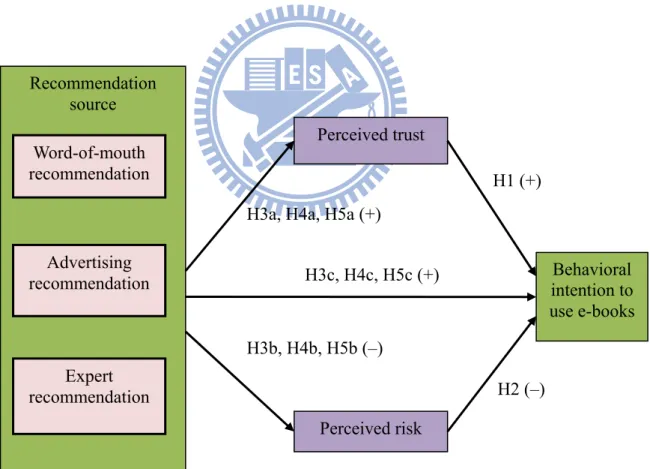
This study testes the conceptual model (Figure 2) to capture the relationships between recommendation sources (WOM recommendations, advertising recommendations, and expert recommendations) and the intention to use e-books in an academic digital library. The two mediators of perceived trust and perceived risk were also discussed. This study then prepares and conducts a questionnaire to capture participants’ opinions on academic e-book usage intentions to evaluate the influence of recommendations.
Figure 2. Conceptual model Recommendation source Perceived trust Behavioral intention to use e-books Advertising recommendation Word-of-mouth recommendation Expert recommendation Perceived risk H3a, H4a, H5a (+)
H1 (+)
H3c, H4c, H5c (+)
H2 (–) H3b, H4b, H5b (–)
4.1.2 Sample and Procedure
A total of 382 undergraduate and graduate students from a university in Northern Taiwan participated in the survey. To minimize the data’s variation, data collection occurred over limited periods. Questionnaires were distributed inside the campus library. The first part of the questionnaire offered the definition of an e-book as “an electronic form of a book that can be viewed and read on a computer in an academic digital library.” The participants were then asked to complete a self-reported questionnaire containing study measures for their intentions to use e-books in an academic digital library.
All subjects who were approached participated in the study voluntarily. Within the sample population, 238 (62.3%) were undergraduate students and 144 (37.7%) were graduate students. The participants were 47% male and 53% female and their ages ranged from 18 to 25 years old. Most of the participants (71%) stated that they were familiar with the term “e-book” prior to taking the survey.
4.1.3 Measures
All of the measurement items were slightly modified from the original items to fit the library environment better. Recommendation sources for behavioral intentions to use e-books were measured using three dimensions: WOM recommendations (friend or classmate reviews, e.g., “Your friend/classmate talked you about the advantage of academic e-books”), advertising recommendations (banner advertisements of academic e-books on a library’s Web page, e.g., “Librarians use their Web pages to present the advantages of academic e-books”), and expert recommendations (professors’ comments, e.g., “The professor introduced an academic e-book in class”). The respondents were asked to choose the recommendation source they would normally consult and indicate the extent to which the source was perceived as influential on a 5-point Likert-type scale with 1 = not very important, 3 = neutral, and 5 = very important. Furthermore, the participants were asked to evaluate the perception of trust
and risk in terms of the recommendation, and then determine their e-book usage intentions. The survey also asked questions on multi-item scales, measured on a 5-point Likert-type scale, where 1 = strongly disagree, 3 = neutral, and 5 = strongly agree.
Perceived trust was measured using three items based on Smith, Menon and Sivakumar, (2005), with higher scores indicating a greater trust in the recommendation in regard to using e-books. The measured items were: “I trust the WOM/advertising/expert recommendation such that, if I were unable to make this decision, I would follow the recommendation to determine whether to use e-books”, “I have confidence in the WOM/advertising/expert recommendation”, and, “I relied on the WOM/advertising/expert recommendation.”
The measurement for perceived risk was drawn from previous research (Dowling and Staelin, 1994; Kim and Lennon, 2000; Roselius, 1971) and included three items, with lower scores illustrating a lower perception of risk towards using e-books in terms of the recommendation. These items were: “Under the WOM/advertising/expert recommendation, this e-book is extremely risky in terms of how it would perform”, “Under the WOM/advertising/expert recommendation, using e-books in an academic digital library will cause time loss”, and “Under the WOM/advertising/expert recommendation, using e-books in an academic digital library causes me to worry that this action is inconsistent with my peers’ opinions”.
The remaining three items were adapted from Ajzen (1988) to assess the behavioral intentions of using e-books, with higher scores indicating a greater likelihood of using e-books in an academic digital library. The three items included: “All things considered, I tend to use e-books in an academic digital library”, “I think e-books and online resources on the digital library Web site are beneficial”, and “In the future, I intend to use e-books in an academic digital library routinely.” Each participant’s score for each construct was averaged from its indicators to form a single-indicator construct.
To ensure that the variables in each proposed research construct were internally consistent, a reliability assessment was conducted using Cronbach’s alpha. The Cronbach alpha coefficients were 0.87 for perceived trust, 0.90 for perceived risk, and 0.89 for behavioral intention. High Cronbach alpha coefficients illustrate that measures have a good level of internal reliability (Churchill, 1979). This study also includes three demographic variables (respondent gender, age, and education) and respondent familiarity with e-books as the controls.
4.1.4 Results
To examine the mediating effects of perceived trust and perceived risk in the recommendation between the effect of recommendation sources and the intentions to use e-books in an academic digital library, we created Equation (1) to conduct a regression analysis: e R T S Y =β0+β1 +β2 +β3 + (11)
where Y is the intention to use e-books, S is the influence of the recommendation, T is
the perceived trust, R is the perceived risk, and e is the error term.
The results illustrated that the F test for the 2
R increment between the reduced model
and the full model pointed to significant effects of perceived trust and perceived risk (Rreduced2
= 0.372, 2
full
R = 0.996, F(3,378) = 28798.36, P < 0.001). Therefore, the observed level of
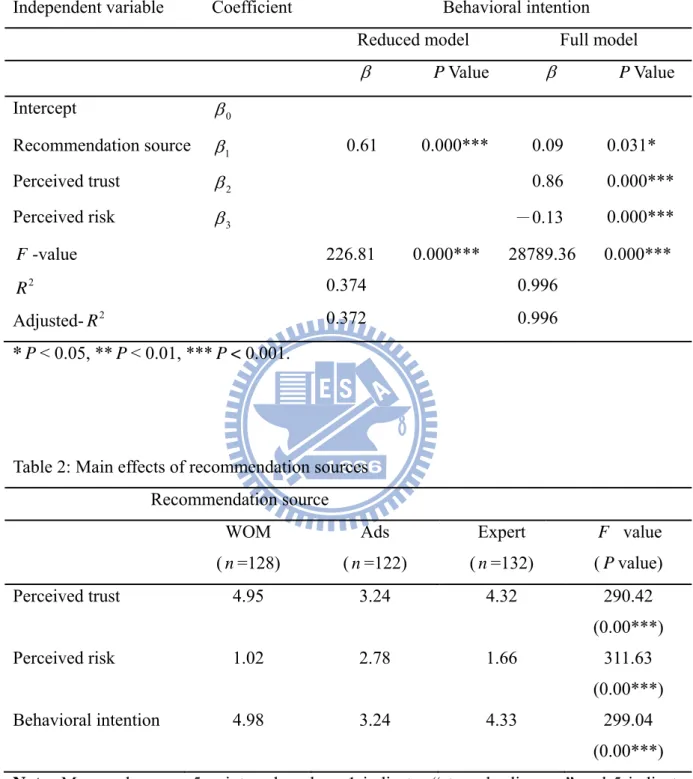
significance for the value of the increment was 0.624, supporting H1 and H2. The comparison regression results for the reduced model and the full model are presented in Table 1, which demonstrates that the explanatory power of the model may be considered satisfactory ( 2
R = 0.996) and indicates that the model fits the data and is appropriate for testing the hypothesis (Darlington, 1978). In addition, a positive coefficient (β = 0.86) indicated that perceived trust was positively associated with the intention to use e-books, whereas a negative
coefficient (β = -0.13) illustrated that perceived risk was negatively related to the intention to use e-books. This supported the hypothesized causal relationships.
Furthermore, to test the main effect between recommendation sources and perceived trust, perceived risk, and the behavioral intention to use e-books, we conducted an ANOVA analysis. As illustrated in Table 2, WOM communication, advertising, and expert recommendations had positive effects on trust in the recommendation (F(2,379)= 290.42, P <
0.001), and supported H2a, H3a and H4a, respectively. This analysis also revealed a negative relationship between recommendation sources and perceived risk (F(2,379)= 311.63, P <
0.001), supporting H3b, H4b and H5b. The findings implied that a lower perception of risk would lead to higher usage intentions for using e-books. The main effect between recommendation sources and behavioral intentions to use e-books was significant (F(2,379)=299.04, P < 0.001), supporting H3c, H4c and H5c. The findings imply that,
irrespective of the mediating effects of perceived trust and perceived risk, the main effect of recommendation sources directly influences customers’ behavioral intentions to use e-books.
Table 1: Results of regression analysis examining the influence of perceived trust and perceived risk as related to behavioral intentions (comparison of the reduced model vs. the full model).
Independent variable Coefficient Behavioral intention Reduced model Full model
β PValue β PValue Intercept β0 Recommendation source β1 0.61 0.000*** 0.09 0.031* Perceived trust β 2 0.86 0.000*** Perceived risk β3 -0.13 0.000*** F -value 226.81 0.000*** 28789.36 0.000*** 2 R 0.374 0.996 Adjusted- 2 R 0.372 0.996 * P < 0.05, ** P < 0.01, *** P < 0.001.
Table 2: Main effects of recommendation sources
Recommendation source WOM (n=128) Ads (n=122) Expert (n=132) F value ( P value) Perceived trust 4.95 3.24 4.32 290.42 (0.00***) Perceived risk 1.02 2.78 1.66 311.63 (0.00***) Behavioral intention 4.98 3.24 4.33 299.04 (0.00***) Note: Mean value on a 5-point scale, where 1 indicates “strongly disagree” and 5 indicates “strongly agree”.
4.2 Study Two: Infer the Behavioral Intention Rules of E-books
Developments in technology and the Internet have changed the nature of digital content and its accessibility, and have created new opportunities for academic e-books. The purpose of this study is to provide a discussion in the context of academic digital libraries to understand what will stimulate the usage of e-books. Furthermore, Study 2 was conducted to investigate and compare what recommendation sources influence the behavioral intention to use e-books, and, to combine gender, daily Internet (per hour) usage and past usage experience to infer the usage of e-book decision rules using a dominance-based rough-set approach (DRSA). In addition, the rules developed by RST are directly translated into the path-dependent flow network graph (Ford and Fulkerson, 1962; Pawlak, 2002; 2004; 2005; Ou Yang, et al., 2010; Wang, et al., 2010) to infer the decision path and parameters between recommendation sources and behavioral intentions in e-book-related organizations. Therefore, this study used JAMM software (2006), which was developed by the Laboratory of Intelligent Decision Support Systems (IDSS) at the Poznan University of Technology, for the DRSA to analytical procedures, including: (1) selecting variables and data, (2) calculating the approximation, (3) generating decision rules and (4) incorporating decision rules into a flow network graph as the final decision algorithm. The results are used to understand the influence of recommendation sources on customers’ behavioral intentions to use e-books.
4.2.1 Selection Variables and Data
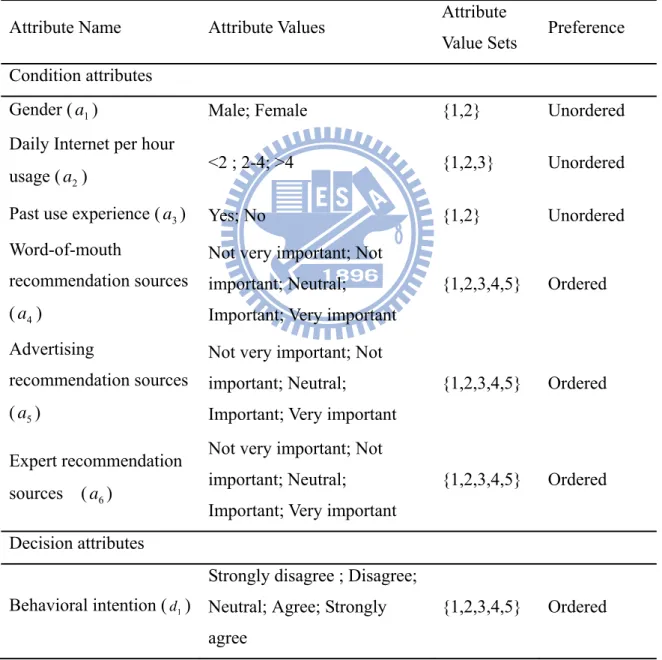
In this study, a total of 382 research subjects are used—the same as those of Study 1. The participants were asked to complete a self-reported questionnaire containing study measures for their intentions to use e-books. In addition, because gender information, daily Internet usage (measured by the average number of hours a person is on the Internet in a 24-hour period) and past use experience (measured by whether persons had used e-books in the past) can also reflect the composition of the users, this study also included the three variables. The