Digital Learning in Knowledge Society:
A Perspective for Asian Countries with India as an Example
S. B. Ghosh
Former Professor,
Indira Gandhi National Open University
E-mail: [email protected]
【Abstract】
The 21st century is stated to be a knowledge century in which knowledge plays a primary role in the societal and economic development of a country. The development of storage, communication, media, and web technologies and the effects of their convergence are ushering in a new era wherein the creation, organization, and management of information and knowledge will be much faster and pervasive. Nations and people will be more dependent on the accessibility of information and knowledge. In light of this significance of information and knowledge, nations of the world and international agencies like UN are much concerned about the availability of technologies in various countries. The uneven infrastructures of some countries have resulted in knowledge gaps between and within nations. To reduce the gaps, an essential component of a knowledge society is worth considering, that is, the human capital, which constantly contributes to the creation and utilization of knowledge. To develop the human capital, it is necessary to develop a proper educational system with the application of Information and Communication Technology (ICT). The method of distance learning evolved through this technological application may help bridge the knowledge gaps to a considerable extent. This paper highlights the scenario of digital learning in Asian developing countries, with particular reference to India. The initiatives taken by India for moving towards a knowledge society and its efforts made for developing digital learning for distance education will be included in this discussion. The methodology of developing a digital learning system will also be analyzed.
Keyword
Digital learning;E-learning;Knowledge society;Open and distance learning;IGNOU
67(Nov ‟08)1-10 ISSN 1023-2125
圖書與資訊學刊 第 67 期
Preamble
The 21st Century is poised for a new form of society termed as knowledge society wherein the material and well-being of the society will be triggered by knowledge as the power. This transformation process evolved through ages wherein knowledge assumes central role in bringing about a radical change in the social progress. As we are aware, the societal evolution process went through different stages starting from agrarian society wherein agriculture was the predominant occupation of the society, which created the knowledge base. Subsequently, industrial revolution triggered the emergence of industrial society, which brought drastic change in the social structure resulting in remarkable improvement in the standards of living. These changes from one form of the society to another were progressively fast. In the emerging knowledge society, the time span of changes is in decades and the transformation practically started since the last two decades of the previous century. The present century poised for radical changes in all aspects of life including education.
The Factors for Emergence of
Knowledge Society
Though information and knowledge have always affected the advancement of old forms of society, it is recognized that human knowledge is the source of power, which ushers in a new era in the social life of people. There are various factors affecting the emergence of knowledge society: (a) the accelerated growth of new knowledge; (b) the distribution, accessibility, and availability of new
knowledge; (c) increased globalization; (d) development planning and process of implementation.
The Agent for Change
The creation of new knowledge is very fast in the present society. In comparison to earlier century, particularly till the third quarter of the previous century, wherein new knowledge was generated due to the efforts of individuals with motivation for research, intense passion and total dedication. Today, a research is a corporate activity supported by governmental and non-governmental agencies. The dissemination and accessibility of information and knowledge has become faster due to the advent and development of Information and Communication Technologies (ICT), which has triggered generation and creation of new knowledge. This phenomenal growth of new knowledge has been one of the most important causes for the change towards a knowledge society wherein ICT with all its facilities such as e-mail, Internet, tele-conferencing acts as the agent for change.
Characteristics of Knowledge Society
It is well recognized now that information and knowledge are two of the key resources for development of a society. In the economic development of a nation, information and knowledge are distinct factors of economic production replacing the earlier concept of their being considered as overheads.
In the change towards knowledge society, preparing well-educated and well-informed citizen becomes the prime factor. The knowledge society is dependent upon well educated people whose knowledge will become the intellectual capital. The
ICT is changing the pattern of education system, which needs to be an open system, equally accessible for all the people crossing the boundary of space and time. New forms of education like e-learning, digital learning are in place now in many countries.
The life of citizens has changed drastically due to all pervasive roles of information and knowledge in one‟s life. The most important changes are moving towards higher standard of living, instant access to information and knowledge through Internet, increasing brands towards consumerism and influence of mass media in the society.
Growth of Knowledge Society
In the societal transition process, the initial phase was characterized by manual labor, as the critical factor in agricultural society, moving to industrial society wherein management of technology, capital and labor provided the competitive advantage. In the last quarter of the 20th century, the connectivity and software products were driving the economy of a few nations.
In the 21st Century, a new society is emerging where knowledge is the primary production resource instead of capital and labor. Efficient utilization of existing knowledge can create comprehensive wealth of the nation and also improves the quality of life -- in the form of better health, education infrastructure and other societal indicators. Ability to create and maintain the knowledge infrastructure, developing knowledge workers and enhance their productivity through creation, growth and exploitation of new knowledge will be the key factors in deciding the prosperity of the
knowledge society. Whether a nation has arrived at a stage of knowledge society is judged by the way the country effectively deals with knowledge creation and knowledge deployment in all sectors like IT, industries, agriculture, health care etc. (Kalam, 2006).
Knowledge Industry
All the factors and features discussed above have necessitated the emergence of new class of knowledge workers who are designated by varieties of names such as knowledge manager, knowledge officer, knowledge analyst, knowledge engineer and many more. The broad group of knowledge workers comprises the information producers, information processors, information distributors and information infrastructure developers. All these have led to the development of a new industry--knowledge Industry. The varieties of services in which the professionals in the industry are concerned with are:
1. Content development and organization: Processing of contents particularly in electronic form to facilitate their accessibility. 2. Content services: Creation of databases,
indexing, libraries, information brokerage and database distribution.
3. Content packages: Newspapers, books, journals, reports, tapes and discs, electronic publishing
4. Facilitation services: Advertising, software services, video conferencing, system design services, consultancy, bank services and electronic fund transfer.
5. Information and communication technologies: Computers, office technology, printing and
圖書與資訊學刊 第 67 期
graphics technology, radio, television, video disc and transmission systems.
6. Convergence technologies: Packet switches, switch boards, modems, digital switches and routers.
7. Communication channels: Physical delivery, postal systems, CMC, satellite carrier, CTV, mobile services, value added services, Internet services, TV networks and telecast .
For a nation to sustain in the competitive market, knowledge industry requires adequate and qualified professionals to design, develop, and deliver products based on customer needs.
The knowledge society envisages economic, societal, and cultural development of all sections of the people in society. In the road towards knowledge society, there is a large gap in generation, access, and utilization of information and knowledge between and within the countries. Though the ICT is well developed nevertheless the inadequacy in infrastructure, literacy rate and uneven economic development still hinder the achievement of the goal, except for a few developed countries.
Uneven Development--Hindrance
toward Knowledge Society
The access to World Wide Web as a criteria for joining the information and knowledge age is available to less than 5 % of world‟s population of 6 billion (Keniston & Kumar, 2004, p.12). This unevenness is witnessed within every nation, whether developed or developing, between rich and poor, educated and uneducated. In the US, statistics of 1999 shows the household with incomes over $75,000(roughly, the top 10 %) have 20 times more Internet access than those in the lowest income brackets; 80 % of rich and 5 % of the poor have access to Internet. University educated persons own 69 % of computers as compared to 8 % to less educated persons. In India with a population of 1 billion and more, less than 1 percent had had access to computers and just 0.5 percent had access to Internet (Keniston & Kumar, 2004, p.13).
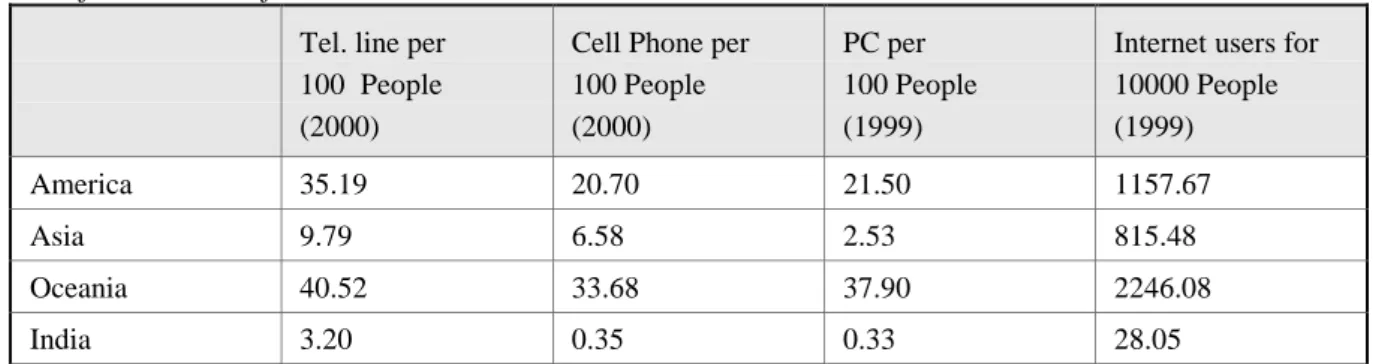
Table 1 provides a glimpse of IT infrastructure of USA, Asia, Oceania, and India.
Table 1
IT infrastructure of USA, Asia, Oceania, and India
Tel. line per 100 People (2000)
Cell Phone per 100 People (2000)
PC per 100 People (1999)
Internet users for 10000 People (1999) America 35.19 20.70 21.50 1157.67 Asia 9.79 6.58 2.53 815.48 Oceania 40.52 33.68 37.90 2246.08 India 3.20 0.35 0.33 28.05
Note. From “The changing context of higher education in 21st century,” ed. by V. Venugopal Reddy and S. Manjulika, 2002, Towards virtualization, New Delhi: Kogan Page India, pp 1-47.
Towards Knowledge Society: A Case for
a Developing Country
It is recognized by all now that a nation‟s ability to convert knowledge into wealth and social good through the process of innovation is going to determine its future. Developing countries are taking positive steps towards this direction.
In India, the National Knowledge Commission (NKC) was constituted on 13th June 2005 with the following goals and objectives.
1. To build excellence in the educational system to meet the knowledge challenge of the 21st century and increase India‟s competitive knowledge advantage in the field of knowledge.
2. To promote creation of knowledge in S & T laboratories.
3. To improve management of institutions engaged in intellectual property rights.
4. To promote knowledge applications in agriculture and industry.
5. To promote the use of knowledge capabilities in making Government an effective, transparent and accountable service provider to the citizen and promote widespread sharing of knowledge to maximize public benefit.
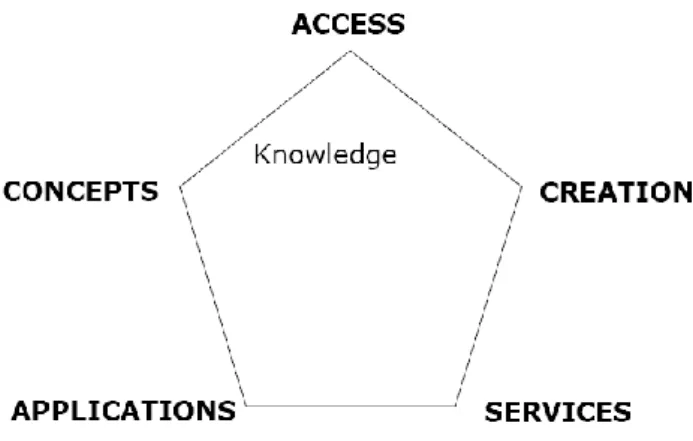
The identified focuses of NKC are: (a) access to knowledge; (b) knowledge services; (c) knowledge concepts; (d) knowledge application; (e) knowledge creation.(Firgure 1)
Figure 1 Knowledge Pentagon
Note: From “National Knowledge Commission of India : An overview,” by S. Pitroda, P. M. Bhargava, P. B. Mehta, A. Béteille, A.Ganguly, J. Ghosh, et al., 2006, In Proceedings Launching of the National Knowledge Commission, New Delhi. Retrieved Oct. 27, 2007 from
The NKC has given major emphasis to knowledge concepts and literacy, which are organized, distributed and transmitted through education system, including professional education, vocational education, distance education, continuous learning and language education.
The NKC has put special importance on the development of human capital capable of converting knowledge into wealth and social good.
India with a population of more than a billion has the world‟s eleventh largest economy. There has been a great disparity between „haves‟ and „have nots‟. It is estimated that more than a quarter of the world‟s poorest people are in India. Though the country is having more than 260 universities, yet around 33% of adults are illiterate. “Illiteracy today is reducing only at the rate of 1.5% per annum. The use of conventional methods of learning is from alphabets to words, which requires 200 hours of instruction. At this rate, 20 years will be needed to attain literacy level of 95%. (Pitroda, et al., 2006) Here comes the importance of distance learning system.
With this vision, a specific emphasis has been laid down by the Government on the development of Open and Distance Learning (ODL) system. The ODL system in India started with the establishment of the Indira Gandhi National Open University (IGNOU) in 1985. Apart from IGNOU, 12 open universities at the state level have been established offering varieties of programmes at different levels from doctorate to certificate level in various disciplines. It is now recognized that ODL system is the viable complementary education system and plays a decisive role in the creation of a stable
knowledge based society. About two million students studying through this mode constitute 20 % of the total enrolment in higher education in the country. All the open universities put together are enrolling 625,000 students each year (Dixit, 2002). IGNOU now estimate an enrollment of around 1.85 million students for its 167 academic programmes in 2009 (Indira Gandhi National Open University, 2008).
The mechanism for delivery of the programme varies from print materials to tele-learning mode.
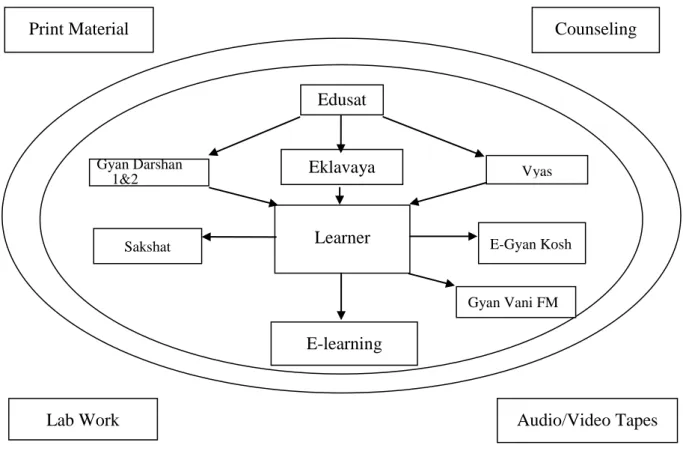
In this context, certain technological developments initiated by the government to facilitate ODL are worth mentioning.(Figure 2)
1. Edusat
A dedicated satellite built for serving educational sector. Edusat provides services of Internet and Intranet transmission, interaction, dialogue, digital repositories, digital multimedia content and for visual education and research.
2. Educational TV Channels:
(a) Gyan Darshan (1&2) -for programmes of IGNOU and other institutions;
(b) Ekalavya (Gyan Darshan 3) -Engineering Education;
(c) Vyas (Gyan Darshan 4) -General Higher Education.
3. Gyan Vani
A dedicated FM radio network for low cost, interactive medium for enhance of teaching learning process.
4. Sakshat
A one stop education portal for addressing all the education and learning related needs of students, scholars, teachers and life long learners of all fields of study.
5. e-Gyankosh
A repository to store, index procure, distribute and share the digital learning resources developed by ODL institutions in the country.
Digital Learning, Knowledge Society
and Developing Countries
The 21st century will be characterized as „Knowledge Century‟, where knowledge will be capital resources for all kinds of activities in the society. The development of convergence technology including computer, communication, and media is the key factor for bringing the change. Full range of media such as graphics, text, picture, sound can all be combined, stored and communicated now at a faster rate due to development of storage, communication and web technologies. These technological features are a boon for educational applications. The real context of the technology is not the technology but the information and knowledge. The application of technology has opened up new option in the education in teaching, learning and delivery of education. Thus, new form of delivery of education has evolved which is referred to by various names such as e-learning, digital learning, ICT-based learning, and virtual class room. The digital learning is concerned with developing instructions involving designing, delivery, managing instructions and
developing technology for training, teaching, learning and delivery of education.
Many of the countries in developing world of Asian region such as, Japan, Israel, China, South Korea, Singapore, and Taiwan have adopted the ICT enabled education. Many others have either adopted it partially or preparing themselves for the same depending upon the infrastructural capabilities. The infrastructural development required for adoption of technology is diverse in Asian region. For example, South Asian countries had the lowest per capita computers in the whole continent. In contrast, the countries of West Asia and South East Asia comparatively have higher numbers (Manjulika & Venugopal Reddy, 2002).
However, for bridging the gap of difference between literates and illiterates; information rich and information poor, no sooner than later the countries are adopting the new form of teaching learning, open and distance learning with the application of technology. The term ODL is becoming synonymous with digital/e-learning. The factor which galvanizes the adoption of digital learning methodology is the growing number of foreign universities offering virtual courses.
The most active countries in the Asian region in the area of digital learning are Japan, China, Korea, Singapore, and Taiwan. India has already initiated the adoption of digital learning methodology. Though the ICT-enabled education was initiated earlier, the IGNOU has successfully developed the e-learning for delivery of CDS/ WINISIS package. The courses on digitalization and digital libraries are to be launched soon.
圖書與資訊學刊 第 67 期
Figure 2 ODL Diagram
The Digital Learning-Methodology for
Development
․
Identification of environment- every one may not have access to Internet.․
Identification of target groups.․
Design features-
Online and offline-
Security of contents.-
Prevent duplication-
Virus protection-
User authentication-
Learning time-
Content delivery․ Development of e-learning platform (web and CD) ․ Learning resources
-
Content-
Slide Show-
Simulation Interface-
E Tutorial ․ Evaluation-
Methodology-
Tools (Feedback forms, e-mail, discussions group, chat sessions)Edusat
Vyas E-Gyan Kosh Gyan Vani FM SakshatLearner
E-learning
Print Material
Eklavaya
Counseling
Audio/Video Tapes
Lab Work
Gyan Darshan 1&2The Future
Knowledge is needed for societal and economic development for which development of human capital is a necessity. Distance education is a means for providing education across time and geographical boundary. The technology acts as a means to achieve the goal. Considerable development of teaching and learning through web is expected in the near future. The private players will be involved more and more in this process. Though the digital gap between developed and developing nations and within the nations is increasing, the efforts by international agencies, such as UN (WSIS) and UNESCO, and national governments, such as NKC in India, thrive for reducing the gap. The development of National Information Infrastructure (NII) will augment the implementation of the new form of delivery of education. The countries are formulating plans and policies towards this end. For example, The government has taken initiated to provide telephony
to 66,822 villages by the end of November 2007, out of which 48,125 villages have already been connected by May 2007. An effort is on to provide broadband connectivity to 5 million rural connections by 2007 and increase 8 million by 2010.
The demand for ICT professionals in India grew less than 200,000 in 1998 to more than 1.6 million in 2007. The National Association of Software and Services Companies (NASSCOM) predicts that there will be a need of 2.13 million professionals by 2010. All these developments lead to a perfect atmosphere for ushering in a new era for provision of digital learning in the country. The development of sufficient infrastructure will facilitate delivery and access to knowledge across the boundaries of developed and developing nations.
(收稿日期:2008 年 2 月 22 日)
Acknowledgment
This paper has been presented at the International Conference on Advancing Library and Information in Asian Countries, held at Shih-Hsin University, Taipei, Taiwan, November 23-24, 2007.
圖書與資訊學刊 第 67 期
References
Dixit, H. P. (2002). Access and equity through open and flexible learning. In 15th Annual Conference of Asian Association of
Open Universities, held at Indira Gandhi National Open University, New Delhi, India.
Indira Gandhi National Open University. (2008) IGNOU by June 2009 at a glance, Retrieved October 29, 2008, from http://www.ignou.ac.in/IGNOUGlance/FACT_JUNE_2009GLANCE.htm.
Kalam, A. P. J. (2006, March 5). How to add value to distance education. 16th Convocation Address. New Delhi, IGNOU.
Keniston, K. & Kumar, D. (2004). IT experience in India: Bridging the digital device. Delhi: Sage.
Manjulika, S. & Venugopal Reddy V. (2002). The changing context of higher education in 21st century. In V.Venugopal Reddy & S. Manjulika (Eds). Towards virtualization ( pp 1-47). New Delhi: Kogan Page India, 2002.
Pitroda, S., Bhargava, P. M., Mehta, P. B., Béteille, A., Ganguly, A., Ghosh, J., et al. (2006). National Knowledge
Commission of India : An overview. In Proceedings Launching of the National Knowledge Commission, New Delhi, India. Retrieved Oct. 27, 2007 from