On: 29 April 2014, At: 23:52 Publisher: Routledge
Informa Ltd Registered in England and Wales Registered Number: 1072954 Registered office: Mortimer House, 37-41 Mortimer Street, London W1T 3JH, UK
Media Psychology
Publication details, including instructions for authors and subscription information: http://www.tandfonline.com/loi/hmep20
The Mediated Moderation
Model of Interactivity
Erik P. Bucy a & Chen-Chao Tao b a
Indiana University , Bloomington b
National Chiao Tung University , Taiwan Published online: 05 Dec 2007.
To cite this article: Erik P. Bucy & Chen-Chao Tao (2007) The Mediated
Moderation Model of Interactivity, Media Psychology, 9:3, 647-672, DOI: 10.1080/15213260701283269
To link to this article: http://dx.doi.org/10.1080/15213260701283269
PLEASE SCROLL DOWN FOR ARTICLE
Taylor & Francis makes every effort to ensure the accuracy of all the information (the “Content”) contained in the publications on our platform. However, Taylor & Francis, our agents, and our licensors make no
representations or warranties whatsoever as to the accuracy, completeness, or suitability for any purpose of the Content. Any opinions and views
expressed in this publication are the opinions and views of the authors, and are not the views of or endorsed by Taylor & Francis. The accuracy of the Content should not be relied upon and should be independently verified with primary sources of information. Taylor and Francis shall not be liable for any losses, actions, claims, proceedings, demands, costs, expenses, damages, and other liabilities whatsoever or howsoever caused arising directly or indirectly in connection with, in relation to or arising out of the use of the Content.
This article may be used for research, teaching, and private study purposes. Any substantial or systematic reproduction, redistribution, reselling, loan, sub-licensing, systematic supply, or distribution in any form to anyone is
The Mediated Moderation Model
of Interactivity
Erik P. Bucy
Indiana University, Bloomington
Chen-Chao Tao
National Chiao Tung University, Taiwan
This paper argues for enhanced consideration of third variables in interactivity re-search and proposes a “mediated moderation” model to bring increased sophistica-tion to bear on the study of informasophistica-tion technology effects. Interactivity, a central phenomenon in new media research, is an elusive concept that has enduringly in-trigued and confused scholars. Extant conceptualizations have produced incomplete causal models and have generally ignored the effect of third variables. We conceptu-alize interactivity as technological attributes of mediated environments that enable reciprocal communication or information exchange, which afford interaction be-tween communication technology and users, or bebe-tween users through technology. Specifying roles for mediator and moderator variables, this paper proposes a model that incorporates interactive attributes, user perceptions (mediators such as perceived interactivity), individual differences (moderators such as Internet self-efficacy), and media effects measures to systematically examine the definition, process, and conse-quences of interactivity on users. Lastly, statistical procedures for testing mediated moderation are described.
An enduring question and major inconsistency in interactivity research is how to best isolate the concept for systematic investigation. Various definitions and multi-dimensional models have been proposed but current approaches attempt to either mix structural characteristics of media systems, message exchanges, and user perceptions into a single multidimensional construct, or identify one of these factors as the central locus of interactivity (Sundar, 2004). Not surprisingly, the empirical research on interactivity has yielded scattered findings and has been un-able to ascertain consistent patterns of effects on users. After three decades of anal-ysis and investigation, we scarcely know what interactivity really is, let alone what Correspondence should be sent to Erik P. Bucy, Department of Telecommunications, 1229 E. Sev-enth Street, Indiana University, Bloomington, IN 47405-5501. E-mail: [email protected]
it does, and we have scant insight into the conditions in which interactive processes are consequential for individual technology users (Bucy, 2004a).
In this paper we argue that enhanced consideration of third variables, notably me-diators and moderators, may effectively address questions about causal mechanisms and under what contingent conditions interactive processes are influential (see Preacher & Hayes, 2004; Rosenberg, 1968). The omission of third variables can lead to equivocal and even contradictory findings (McLeod, Kosicki, & McLeod, 2002; McLeod & Reeves, 1980), a problem that characterizes the interactivity literature (Bucy, 2004a; Liu & Shrum, 2002). To improve conceptual coherence, this paper elaborates a model of interactivity that takes into account theoretically derived hy-potheses and the influence of both mediator and moderator variables.
In the first section we selectively review the interactivity literature based on how the concept has been operationalized and provide a brief explication or con-cept clarification (Chaffee, 1991).1 Next, we assert that the investigation of
interactivity should involve four types of variables: predictor (e.g., technological attributes that constitute interactivity), mediator (e.g., user perceptions), modera-tor (e.g., individual differences, such as Internet self-efficacy), and outcome (e.g., media effects) measures. We then apply the concept of “mediated moderation” to formulate relationships between these variables. Finally, a statistical procedure is described for testing the influence of third variables, providing a methodological roadmap for subsequent research.
A BRIEF EXPLICATION OF INTERACTIVITY
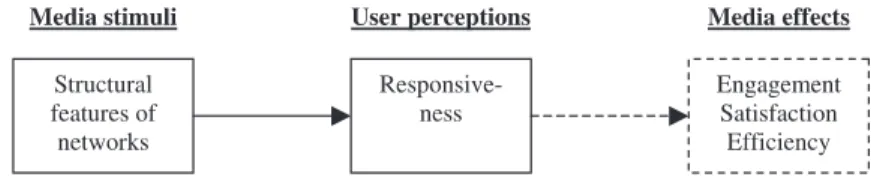
Uncertainty over the conceptual definition of interactivity arises from a lack of shared agreement about the concept’s unit of measure (see Chaffee, 1996). Scholars hold different views about the locus of interactivity or location of the phe-nomenon (Bucy, 2004a); therefore, operationalizations vary widely from struc-tural features on web pages, to hyperlink density, to the relatedness of messages in a communication exchange, to the user’s perception of involvement with a net-worked medium. Focusing on the unit of measure, the extant literature can be di-vided into three approaches: message-centered (based on semantic relatedness), structural (based on technological attributes), and perceptual (based on user per-ceptions). Figure 1 illustrates the conceptual models embraced by these different approaches based on their unit of measure.
Message-Centered Approaches: Equating Interaction with Interactivity
Message-centered approaches consider message exchanges between two (or more) communicants as the unit of measure. Rafaeli’s (1988) responsiveness
model, which operationalizes interactivity as semantic relatedness, is a widely used message-centered approach. Rafaeli contends that “interactivity is not a char-acteristic of the medium. It is a process-related construct about communication” (Rafaeli & Sudweeks, 1997). He places great emphasis on interactivity conform-ing to a continuum of interaction; from one-way transmission to an ongoconform-ing com-munication exchange, and regards interactivity as a reciprocal process between the sender and receiver (Rafaeli, 1988). In essence, Rafaeli conceptualizes interactivity as the exchange of meaning but operationalizes the concept as the ex-change of messages. Specifically, he asserts that “interactivity is an expression of the extent that in a given series of communication exchanges, any third (or later)
FIGURE 1 Conceptual models of interactivity classified by the unit of measure. (Note: The dotted boxes indicate variables that remain unexamined in different lines of research.)
transmission (or message) is related to the degree to which previous exchanges re-ferred to even earlier transmissions” (Rafaeli, 1988). In this scheme, messages pro-vide the only epro-vidence of interactivity; user-centered observations are not offered to demonstrate the exchange of meaning. Rather, he asserts, “actual social actions and relations are transacted through observable behaviors, the exchange of mes-sages” (Rafaeli & Sudweeks, 1997). Problematically, however, Rafaeli never of-fers a concrete example of what he considers an interactive message exchange to be.
Empirical research does not support the assumption that the exchange of mes-sages equates with the exchange of meaning (for a discussion, see Newhagen, 2004). Instead, an increase in message traffic may produce just the opposite. Rafaeli and Sudweeks’ (1997) own unsupported hypothesis from a study of online community shows the more that messages are exchanged, the less they are seman-tically related. Similarly, Tremayne and Dunwoody (2001) find that rather than promoting elaboration (the exchange of meaning), clicking on hyperlinks and in-putting data on a webpage may hinder learning and promote temporal disorientation.
Message-centered approaches also pay scant attention to media effects—the outcome of interaction—focusing instead on the quality of two-way message flows. In this sense, Rafaeli’s suggestion of bidirectional, reactive, and interactive message exchange categories represents a typology for measuring and classifying the interactivity in communication more than it does a theoretical proposition (Newhagen, 2004). Rafaeli and Sudweeks (1997) hypothesize that organizational features of the online community, such as whether censorship exists and member-ship is free, will affect the degree of interaction—and this statement receives em-pirical support. But whether the degree of interaction then influences other out-come measures, such as cognitive engagement, attitudes toward the online community, or sociability, is not examined.
In online journalism, Schultz (2000) attempted to apply the responsiveness model to the analysis of interaction between New York Times readers and journal-ists via e-mails and online forums, but the hypothesized effects of interaction, in-cluding a narrowing knowledge gap and increase in political participation, were not found. In health communication, Cassell, Christine, and Brian (1998) contend that the level of website interactivity indicates the extent to which the Internet mimics interpersonal communication (see also Robinson, Patrick, Eng, & Gustafson, 1998), but the hypothesized effect of interaction, namely, the facilita-tion of persuasive public health intervenfacilita-tions, is absent.
Owing to the difficulty of isolating discrete messages in most dynamic commu-nication settings, scholars usually devise an implicit rather than explicit opera-tional definition to assess responsiveness. For instance, Tremayne and Dunwoody (2001) applied Rafaeli’s conceptualization to examine the relationship between message exchange and knowledge acquisition. They operationalized responsive
communication as user intent during hyperlink clicking, but the relatedness of messages in this instance does not occur until after users retrieve the desired content. Message-centered approaches assume that interactivity is behaviorally-oriented, involving a series of actions represented by message ex-changes (Tremayne, 2005) but rely on an untested assumption that the exchange of
messages equates with the exchange of meaning and generally omit media effects
(see Figure 1, panel I).
Structural Approaches: Ignoring the Effects of Third Variables
Structural approaches consider the technological attribute or media feature, which allows users to talk to other users, engage with or manipulate media, or influence the content, as the unit of measure. The degree of interactivity, presumed to be ob-jective and invariant across different users, is reflected in the unique qualities of the attribute. A number of early studies conducted in this tradition simply concen-trated on developing typologies of interactivity. Scholars have been eager to pro-pose new dimensions to classify a wide range of new media (e.g., Ha & James, 1998; Jensen, 1998; Steuer, 1995) but have just as often been at a loss to explain how specific attributes make one technology more interactive than another does. In addition, no typology enables all forms of communication technology to be readily classified, and new technologies not considered at the time of analysis continu-ously appear.
As with message-centered approaches, early structural studies of the Web gen-erally overlooked effects of user engagement with technological attributes or what motivated users to perform interactive behaviors in the first place (Bucy, 2004a). Aside from a handful of experimental studies that have controlled the media stimu-lus presentation (e.g., Eveland & Dunwoody, 2001; Sundar, Kalyanaraman, & Brown, 2003; Tao & Bucy, 2005), communication scholars have not shown much interest in tracking which interactive attributes have actually been used. Structural analyses, including Heeter’s (1989) six-dimensional model, Ha and James’ (1998) five-dimensional model, and Jensen’s (1998) three-dimensional model, effectively catalog the types of interactivity available in mediated environments but do not go beyond initial classification to advance the field with empirical testing and theory building.
With the transition to effects studies (see Wu, 2005), interactivity researchers investigating the relationship between technological attributes and media effects have embraced a conceptual model that views interactive features as the independ-ent variable and media effects as the dependindepend-ent variable (see Figure 1, panel II). From this perspective, Sundar, Kalyanaraman, and Brown (2003) examined the impact of different hierarchical hyperlink structures (layers of related links) on po-litical campaign websites and found that the level of website interactivity
enced participants’ perceptions of the candidate as well as their levels of agreement with his policy positions. Bucy (2004b) investigated how interactive (e.g., slide shows, online polls, e-mail) and noninteractive (reading) tasks on news websites impacted user evaluations and emotional responses and found interactive condi-tions to elicit more favorable responses but at the same time provoked a certain de-gree of confusion, frustration, and disorientation—a phenomenon referred to as the interactivity paradox.2
Although the level of interactivity in structural studies is generally presumed to be objective and the effects more or less uniform across users, interactive attributes can and do have differential effects (see McMillan, 2002b; Wu, 1999). Such find-ings suggest that changes in the dependent variable are not a direct function of the independent variable (the level of interactivity), that is, Y is not equal to f(X). In-stead, there may be one or more third variables mediating or moderating the rela-tionship between the independent and dependent variables. Tremayne and Dunwoody (2001), for instance, found that the relationship between interactivity (the number of hyperlinks) and elaboration (knowledge acquisition) varied at the level of Web experience (see Figure 2a). Particularly on low interactivity websites, experienced users evidenced a lower degree of elaboration than novice users. In a political context, Sundar, Hesser, Kalyanaraman, and Brown (1998) found that the relationship between interactivity (the number of hyperlinks plus an e-mail func-tion) and affinity for a candidate varied with the user’s degree of apathy. These studies imply that Web experience and an individual difference variable such as apathy may moderate the cause and effect (X→Y) relationship between interactivity and media effects.
FIGURE 2 Insoluble phenomena raised by the structural approach.
Interestingly, Sundar and colleagues (2003) have observed that the relationship between interactivity and impression formation may be nonlinear: users in me-dium-interactivity conditions offered more favorable evaluations than users in high-interactivity conditions (see Figure 2b). Bucy (2004a) describes such results in terms of a curvilinear or threshold model of interactivity where the presumed benefits of interactivity accrue up to a point but then once an optimal level of en-gagement is achieved, continued increases in intensity begin to overwhelm users. Therefore, too much interactivity may have a negative influence on performance, impression formation, and other outcomes of interest. Figure 2 illustrates the seemingly insoluble phenomena raised by the structural approach.
What is lacking from these observations, however, is an adequate explanation of how the nonlinear pattern emerges. The conceptual model implied by a simple structural approach does not address this question and omits the possibility of third variables. As with the two-variable (predictor-outcome) model, it ignores the me-diating role of unaccounted perceptual factors and the possible moderating role of individual differences between users. Consequently, without modification, the structural approach cannot accurately explain how interactivity works or predict what interactivity does.
Perceptual Approaches: Positioning the Mediator as the Predictor
Perceptual approaches consider user perceptions as the unit of measure. Contrary to structural approaches, the degree of interactivity, which is now presumed to have variable effects, is reflected in the extent to which users subjectively
experi-ence interactivity. Perceptual approaches have begun to attract research attention
as a promising alternative to message-oriented or technology centered studies given their focus on the user (Bucy, 2004a; Bucy & Newhagen, 1999; Lee, 2000; McMillan & Hwang, 2002; Newhagen, Cordes, & Levy, 1995; Wu, 1999, 2005). As Chaffee (1996) once commented in relation to telepresence, conceptualizing interactivity from the point of view of user perceptions “can direct a coherent pro-gram of research” (p. 21).
The perceptual approach derives from media effects studies of television, which have shown that even a medium without interactive attributes may elicit a sense of perceived interactivity through one-sided techniques employed in interpersonal communication, such as direct appeals and nonverbal expressions (Bucy & Newhagen, 1999; Morrison, 1998; see also Reeves & Nass, 1996). Newhagen, Cordes, and Levy (1995) documented the existence of perceived interactivity in a content analysis of 650 audience e-mail messages to NBC Nightly News. They found that some viewers responded to encouragement from the news anchor with individual-level messages that were written with the expectation of receiving a re-sponse. In a study of televised town meetings, Bucy and Newhagen (1999) showed that close-ups with a single actor (political candidate) on the screen induced a
higher level of perceived interactivity than medium or long shots with multiple ac-tors on the media stage.3The salience of such invitational production techniques
may prompt the experience of parasocial interaction, or the viewer’s illusion of so-cial intimacy with a media persona (Horton & Wohl, 1956). Isotalus (1998) points out that parasocial interaction explains how a noninteractive medium, such as tele-vision, may produce delayed feedback from audiences through different media channels, including telecommunications or e-mail.
More recently, scholars have developed indices of perceived interactivity with multiple dimensions. Wu (1999) contends that perceived interactivity is “a two-component construct consisting of navigation and responsiveness.” McMillan and Hwang (2002) conducted a scale development exercise, generating three di-mensions of perceived interactivity: real-time conversation, no delay, and an en-gaging aspect. Liu (2003) validated a multidimensional scale of perceived interactivity consisting of active control, two-way communication, and synchronicity. Perceptual approaches tend to position perceived interactivity as the independent variable and media effects as the dependent variable but generally fail to acknowledge that structural characteristics of information technology systems are required to evoke a sense of perceived interactivity in the first place—and should therefore be included in the statistical model as the manipulated independ-ent variable (for an exception, see Wu, 2005).
Despite their user-based orientation, simple perceptual approaches thus neglect the relationship between technological attributes (the antecedent variable) and per-ceived interactivity (see Figure 1, panel III). O’Keefe (2003) argues that ef-fect-based variable definitions, popular in persuasion research (such as vividness, fear appeals, and argument quality), examine the relationship between psychologi-cal states and media effects but overlook individual differences and media attrib-utes. This leads to confusing mediator variables—psychological states in users— with independent variables, which induce the perception. The conceptual model implicit in perceptual approaches to interactivity thus ignores antecedent condi-tions and treats perceived interactivity as a free-floating independent or predictor variable. Perceived interactivity should instead be positioned as a mediator vari-able induced by a mediated experience or stimulus, which has the capacity to sub-sequently influence outcomes of interest.
Limitations of Current Approaches
As the above discussion highlights, each of these approaches specifies a different unit of measure. This lack of consistency raises three issues that are important to ad-dress. First, the conceptual model of each approach is incomplete: message-centered approaches ignore media effects; structural approaches omit third variables; and, perceptual approaches position the mediator variable as the predictor. Owing to the complexity of media effects, establishing accurate causal explanations between
communication technology use and outcome measures requires systematic mea-surement and consideration of four indispensable factors: media stimuli, media ex-posure, media effects, and third variables (McLeod & Reeves, 1980). The bulk of interactivity research examines just one or two of these factors, leading to disputable interpretations of what interactivity actually does. Similar problems have been ob-served in political and health communication (see McLeod, Kosicki, & McLeod, 2002; Worden & Flynn, 2002). Despite calls for conceptual models to include media stimuli, psychological states (mediator variables), and media effects at the same time (Holbert & Stephenson, 2002, 2003; McLeod, et al., 2002; O’Keefe, 2003), me-diator variables generally receive short shrift in communication research.
Second, the conceptual models used in interactivity research seldom draw on existing theories or systematically develop relational statements—concepts cou-pled by specified relationships—to link different variables. As Bucy (2004a) notes, interactivity scholars have concentrated on defining and typologizing inter-activity rather than theorizing it.
Third, the common use of analysis of variance (ANOVA) in experimental stud-ies, particularly those with a small number of subjects, hinders researchers from fully investigating mediating states and may produce inaccurate tests of modera-tion effects (Baron & Kenny, 1986; Mongeau & Stiff, 1993; O’Keefe, 2003). When applied to factorial designs involving two or more experimental factors (or independent variables), ANOVA has no room for mediators because they act as predictor and outcome variables simultaneously. As Baron and Kenny (1986) ob-serve, “a successful mediator is caused by the independent variable and [at the same time] causes the dependent variable” (p. 1177). Consequently, scholars em-ploying ANOVA, which is simply not built to directly test mediation effects (Baron & Kenny, 1986; O’Keefe, 2003), cannot distinguish mediators from independent or dependent variables in experimental designs.4Moreover, because ANOVA
rele-gates independent variables to categorical level data, statistical power is sacrificed, increasing the chance of spurious findings (Maxwell & Delaney, 1993).
Studies of interactivity should not abandon the investigation of mediated phe-nomena using the message-centered, structural, and perceptual approaches but should proceed with greater awareness that each approach is constrained by its unit of measure and generally lacks a robust conceptual model appropriate for predic-tion. In the following section, we propose a mediated moderation model and matain that interactivity, serving as a media stimulus, should be defined in terms of in-trinsic media attributes. Next, we argue that interactivity influences media effects through the mechanism of perceived interactivity, which arises from engagement with interactive media but occurs prior to media effects. Finally, we posit that the relationship between interactivity and perceived interactivity may be moderated by individual differences, such as Internet self-efficacy, computer literacy, Web ex-perience, or other user-oriented variables. Therefore, interactivity (the independ-ent variable), perceived interactivity (the mediator variable), individual differences
(the moderator variable), and media effects (the dependent variable) are all impor-tant for ascertaining a more precise causal explanation for interactive processes and effects.
The Mediated Moderation Model of Interactivity
An effective test of interactivity requires piecing together the relational puzzle de-scribed above and testing a more complete conceptual model. However, without identifying important third variables, it is impossible to establish a comprehensive framework. The omission of third variables arises from a lack of careful theorizing about causal relationships (Holbert & Stephenson, 2003). Accordingly, the current section addresses three issues important to theorizing the effects of interactivity: (1) where interactivity resides, to clarify the linkage between the conceptual defi-nition of interactivity and its unit of measure; (2) how interactivity effects occur, to uncover the cognitive and emotional processes at play when users of communica-tion technology are engaged in mediated interaccommunica-tion; and, (3) what interactivity does, to more precisely specify the causal model.
Where Interactivity Resides: Locating the Concept for Research
In relation to information and communication technology, interactivity may be usefully understood as intrinsic media attributes, which consist of technological features, modes of presentation, and interface affordances (see Bucy & Affe, 2006). The architecture and formal features of media systems are typically treated as an afterthought and have not received widespread attention in communication research. However, how information is packaged explains a certain amount of vari-ance in media effects (Bucy, Lang, Potter, & Grabe, 1999; Grabe, Zhou, Lang, & Bolls, 2000).
Given that interactivity serves as a media stimulus, isolating the concept from the broader media environment is a crucial issue that delineates which attributes will cause media effects. McLeod and Reeves (1980) suggested that three aspects of a media stimulus should be specified; its unit of measure, strength, and inde-pendence. Based on the above criteria, interactivity is conceptualized as
techno-logical attributes of mediated environments that enable reciprocal communication or information exchange, which afford interaction between communication tech-nology and users or between users through techtech-nology. Operationally, the unit of
measure is the interactive attribute, such as textual or graphical hyperlinks, search functions, direct manipulation buttons, chat features, and so on. The degree of interactivity, that is, the strength of the media stimulus, varies quantitatively in terms of the number of different attributes and qualitatively in terms of their capac-ity to engage users. The greater the two indicators, the higher the presumed level of
interactivity. The independence of interactivity as a distinct variable for research derives from the recognition that user interactions and perceptions are evoked by technological engagement and are not synonymous with it.
To delimit the concept for systematic investigation, interactivity, as a research term, should be reserved for mediated communication and should not encompass face-to-face or direct interpersonal interaction (see Bucy, 2004a). Confused link-ages between the conceptual definition of interactivity and its unit of measure arise from the term being applied too widely, which in turn results in haphazard use (Sundar, 2004). As a stimulus, interactivity consists of the attributes responsible for message sending or retrieval, which cause a corresponding change in content. The existence of these attributes is a prerequisite for interactivity research. This criterion distinguishes interactivity from quasi or pseudo forms of mediated inter-action in which communication media have no reciprocal capacity but still pro-duce a sense of perceived interactivity.5Importantly, the reciprocal
communica-tion caused by interactivity may occur between different media. For instance, through an Internet phone service such as Skype, users can communicate with oth-ers through networked computoth-ers, landline telephones, and cellular phones.
How Interactivity Effects Occur
Interactivity effects require actual use of interactive attributes in mediated envi-ronments, which forms a series of interactions between communication technol-ogy and users or between users through technoltechnol-ogy. As highlighted by structural and message-centered approaches, interactivity effects involve a behavioral di-mension—user engagement with technology that differentiates interactive
pro-cesses from interactive attributes, which trigger those propro-cesses (Chung & Zhao,
2004; Tremayne, 2005). Moreover, scholars have suggested that inconsistent find-ings in empirical studies using structural approaches may result from users engag-ing with some interactive attributes and ignorengag-ing others. In a study examinengag-ing the effects of structural and perceptual variables on attitudes toward hotel websites, McMillan, Hwang, and Lee (2003) found that the site with the fewest interactive attributes elicited the most favorable evaluations. They argued that one particular feature on that site (a virtual tour) was likely to be used more frequently than other interactive attributes, leading to their counterintuitive finding.
In another curious finding, Lee, Lee, Kim, and Stout (2004) observed that websites with a similar amount of interactive attributes generated different levels of perceived interactivity. In this study, participants were asked to browse three computer manufacturer sites (Apple, Compaq, and Dell), which were content ana-lyzed for structural characteristics. Although there was no significant difference in the number of interactive attributes on each website, in-depth interviews with par-ticipants revealed that one site in particular (the Dell site) was regarded as substan-tially more interactive than the others, owing to the site’s option to “build your own
computer” with custom specifications. Whether interactive attributes are actually used thus leads to significant differences in perceived interactivity (Tremayne, 2005). In short, true interactivity effects cannot occur without actual use of interac-tive attributes.
Perceived interactivity as a mediator variable
Recently, communication and technology researchers have begun to place greater emphasis on mediator variables, arguing that new insights are likely to come from research postulating how different psychological states mediate the re-lationship between media stimuli and effects (see O’Keefe, 2003). Indeed, the amount of variance in media effects accounted for by mediating states is much higher than that by media stimuli alone (Potter & Tomasello, 2003).6
Incorporating mediating states into research designs may therefore increase ex-planatory power. Along these lines, Sherry (2004) observes that most media ef-fects research explains less than 10% of the variance in the dependent variable. He contends that the media effects tradition largely focuses on the influence of the en-vironment (nurture) and assumes that people exposed to the same media stimuli will have the same or similar responses but ignores the diversity of biological pro-cesses (nature), which may lead individuals to interpret and process media stimuli in disparate ways.
As a mediating state, perceived interactivity may provide compelling evidence to explain how interactivity effects occur. Hoffman and Novak (1996) observed, “a consumer’s perception of behavioral control over [information technology] use and its impact on intentions and actions is more important than real control” (p. 64). Indeed, empirical research is beginning to show that the effects of interactive attributes may be rendered insignificant once objective interactivity and perceived interactivity are considered simultaneously (Wu, 2005). Thus, the relationship be-tween interactive attributes and attitudes or other outcome measures appears to be mediated by perceived interactivity. In another study, Chung and Zhao (2004) ran-domly assigned participants to websites with different levels of interactive attrib-utes (6, 24, or 48 hyperlinks). Clicking behavior, assessed by the number of hyperlinks used, and the user’s sense of perceived interactivity were measured. Findings indicated that clicking behavior was highly correlated with perceived interactivity, which in turn affected memory for site content and attitude towards the site.
In the mediated moderation model, interactivity, which inheres in media tech-nology, serves as the manipulated independent variable, while perceived interactivity, which consists of user perceptions, functions to transform the impact of interactivity. Importantly, the objective existence of interactive attributes does not guarantee the subjective experience of interactivity—but actual technology use may. Both interactivity and perceived interactivity thus play an important role in
theorizing information technology effects yet represent disparate constructs and should be treated as having independent influence. Recognizing a mediating state between interactivity and media effects may further uncover the mechanisms un-derlying issues being raised by technology researchers, such as the finding that interactivity has non-uniform consequences or threshold effects (see Bucy, 2004a; Sundar et al., 2003).
In justifying self-efficacy as a moderator variable, several experiments on web-based interactivity (e.g., Eveland, Marton, & Seo, 2004; Tremayne & Dunwoody, 2001) have shown that the user’s degree of Internet experience sepa-rates the relationship between interactivity and media effects into different patterns (see Figure 2a): for experienced users, the level of interactivity is positively corlated with positive outcomes, whereas for novice users, the relationship is re-versed. To clarify this finding, a discriminating measure of motivation and compe-tency is required; self-efficacy, which occupies a central position in social cognitive theory (Bandura, 1986, 1997, 2001), is a likely candidate. In communi-cation research, scholars have employed Internet self-efficacy to predict Internet usage (Eastin & LaRose, 2000; LaRose, Mastro, & Eastin, 2001) but rarely em-ploy this important measure as a moderator variable.
Conceptually, self-efficacy refers to “beliefs in one’s capabilities to organize and execute the courses of action required to produce given attainments” (Bandura, 1997). This motivational trait activates and regulates not just behavior but also psychological responses to environmental stimuli, including affect and cognition (Bandura, 1989, 1997). The influence of self-efficacy on cognitive effort (the mediating state), which in turn affects outcomes, depends on one’s perception of task difficulty or control over outcomes.
Difficulty refers to whether tasks performed involve preexisting or new skills and influences the cognitive effort users are willing to invest. For people with high self-efficacy, difficult tasks (involving new skills) spur them to invest more effort, whereas easy tasks (involving preexisting skills) hinder them from paying much attention; for those with low self-efficacy, difficult tasks lead to investing less ef-fort since goal attainment seems remote, whereas easy tasks generate increased at-tention. In other words, experienced users enjoy the challenge of acquiring new skills, while novice users prefer to rely on preexisting skills (Bandura, 1997).
Control over outcomes refers to whether one’s performance can determine end results. When individuals believe that the quality of their performance can have in-fluence, cognitive effort will intensify regardless of the level of self-efficacy; on the contrary, when outcomes are not completely determined by the quality of per-formance, cognitive effort will diminish (Bandura, 1997). Therefore, for those with high self-efficacy, easy tasks will lead to weaker control over outcomes, which subsequently decreases cognitive effort, whereas difficult tasks will pro-duce stronger control over outcomes, which subsequently increases cognitive ef-fort. Conversely, for those with low self-efficacy, easy tasks will lead to heightened
control over outcomes, which subsequently increases cognitive effort, whereas dif-ficult tasks will produce less control of outcomes, which subsequently decreases cognitive effort.
Given the importance of self-efficacy to the activation and regulation of behav-ior, and its subsequent influence on emotion and cognition, modeling its contribu-tion to interactivity effects seems vital to assessing patterns of impacts on users. For this purpose, various scales of Internet self-efficacy have been proposed (see Eastin & LaRose, 2000; Thompson, Meriac, & Cope, 2002).
What Interactivity Does: Modeling Third Variables
Communication scholars have commented on the issue of third variables for over two decades. McLeod and Reeves (1980) stressed the importance of the “con-ditional variable” (p. 19) and held it up as one of the four key elements required to fully document media effects. Chaffee and Berger (1987) argued that most bona fide theories involve third variables. Indeed, some well known mass communica-tion theories directly integrate the effect of third variables: with the Knowledge Gap Hypothesis, the relationship between media exposure and knowledge acquisi-tion varies at the level of educaacquisi-tion (Tichenor, Donohue, & Olien, 1970); with Agenda Setting, the relationship between news issues and perceptions of issue im-portance varies with the “need for orientation” (McCombs, 1994); with the Elabo-ration Likelihood Model, the relationship between argument quality and attitude strength varies at the level of personal involvement (Petty & Cacioppo, 1984), or may be affected by message cognitions (Mongeau & Stiff, 1993). Although there are some notable exceptions, the contribution of third variables, widely discussed in social psychology, is seldom elucidated in the field of communication (Eveland, 1997; O’Keefe, 2003).
Following Baron and Kenny (1986; see also Holmbeck, 1997), there are two ba-sic processes involving third variables: mediation and moderation. The differences between the two are related to their function, causal relationship, and main con-cern. Combining these two processes results in mediated moderation and moder-ated mediation (for a review, see Muller, Judd, & Yzerbyt, 2005). The definitions and characteristics of these four processes can be summarized as follows:
Mediation. A mediator variable represents a pathway through which the in-dependent variable influences the in-dependent variable. With regard to causal order, a mediator variable is also called an “intervening” variable (see Figure 3). On the one hand, mediator variables, serving as effects, causally arise from the independ-ent variable; on the other hand, serving as causes, they occur prior to the dependindepend-ent variable. The main concern of mediation is how cognitive mechanisms operate. As a statistical technique, it is suitable for answering how or why the independent vari-able relates to the dependent varivari-able. In short, mediation “explain[s] how external
physical events take on internal psychological significance” (Baron & Kenny, 1986). Operationally, the mediator variable should be measured after manipulat-ing the independent variable. In communication research, scholars typically use “intervening” or “process” variables to represent mediation. Message cognitions, for example, represent a mediator variable in studies employing the Elaboration Likelihood Model (Mongeau & Stiff, 1993).
Moderation. A moderator variable divides the causal relationship between the independent and dependent variables into separate patterns that determine the direction and/or strength of the relationship (Baron & Kenny, 1986). In regard to causal order, a moderator variable is prior to the dependent variable and has no causal relationship with the independent variable (see Figure 3). The main concern of moderation is the effect of the independent variable; it is suitable for answering when the independent variable influences the dependent variable (Baron & Kenny, 1986). In short, moderation specifies various conditions under which the direction and/or strength of the relationship varies. Although any variable could be used as a moderator, reducing the pool of potential candidates primarily relies on elabora-tion of a conceptual model. Operaelabora-tionally, the moderator variable should be mea-sured before manipulating the independent variable. In communication research, scholars have used “contingent” or “conditional” variables to represent modera-tion. For instance, in studies of the Knowledge Gap Hypothesis, education level functions as a moderator (Tichenor, Donohue, & Olien, 1970).
Mediated moderation. Moderation may also involve a mediator variable (Baron & Kenny, 1986; James & Brett, 1984; Muller et al., 2005). In this case, the interaction effect of the independent and moderator variables on the dependent variable is transmitted through the mediator variable. A prerequisite of mediated
FIGURE 3 Causal diagrams of moderation and mediation.
moderation is the occurrence of overall moderation between the independent and dependent variables (Baron & Kenny, 1986). The effect of the independent vari-able on the dependent varivari-able must depend on the moderator varivari-able. There are at least three different types of mediated moderation: between the independent and mediator variables, between the mediator and dependent variables, or both (see Muller et al., 2005). Mediated moderation can be used to explain the causal rela-tionship between four variables. For instance, Scheufele (2002) proposes that in-terpersonal discussion of politics serves as a moderator in the relationship between hard news use and political participation, and this moderation is further mediated by political knowledge. For people with high levels of self-reported political dis-cussion, hard news use leads to increased political knowledge, which enhances po-litical participation. On the other hand, for people with low levels of self-reported political discussion, hard news use has no significant influence on political knowl-edge or participation.
Moderated mediation. Mediation may also involve a moderator variable (Baron & Kenny, 1986; James & Brett, 1984; Muller et al., 2005; Preacher, Rucker, & Hayes, in press). That is, either the effect of the independent variable on the mediator or the effect of the mediator on the dependent variable, or both, may depend on one or more moderator variables. A prerequisite of moderated media-tion is for there to be no overall moderamedia-tion between the independent and depend-ent variables (Muller et al., 2005). There are at least five differdepend-ent types of moder-ated mediation (see Preacher et al., in press). Modermoder-ated mediation could also explain the causal relationship between four variables. For instance, Holbert (2005) proposes that debate viewing serves as a mediator in the relationship be-tween news use and vote choice, and the impact of news use on debate viewing is moderated by party identification.
Specifying the Model
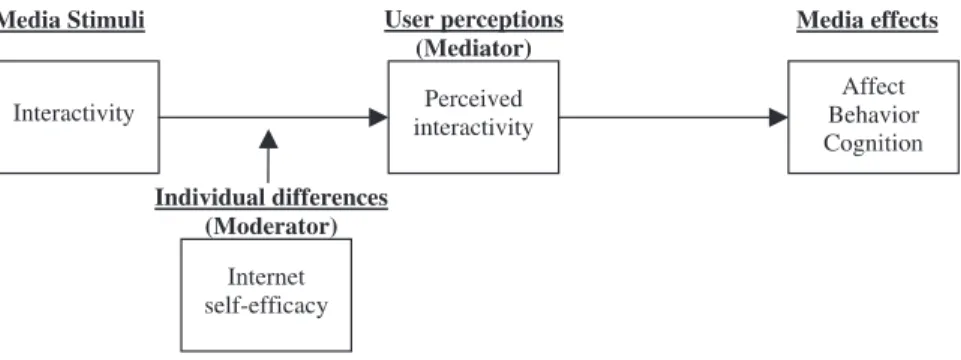
The mediated moderation model of interactivity emphasizes that systematic vestigation of interactivity effects should take media stimuli, user perceptions, in-dividual differences, and media effects into consideration when determining the individual-level consequences of information and communication technology use (see Figure 4). The model specifies a causal mechanism among these variables, providing a systematic approach to empirically test interactivity and its effects. In the model, the relationship between interactivity and media effects is moderated by individual differences; this constitutes overall moderation and meets the prerequi-site of mediated moderation. Next, the influence of interactivity on media effects is transmitted through perceived interactivity, which functions as a mediator vari-able. Finally, mediated moderation should occur between interactivity and per-ceived interactivity. The model accommodates the possibility that the same
active features may produce different levels of perceived interactivity in different users depending on individual differences, such as Internet self-efficacy. This, in turn, influences media effects. Elements of the model are discussed below.
Interactivity
Interactivity is made possible by technological attributes of information and communication technology systems engaged by users and serves as the manipu-lated independent variable or media stimulus. Based on its function, interactivity has three major forms. First, information selection may be facilitated by interactive media attributes that make available or deliver content users intend to browse. Se-lection can be further separated into two types, static and dynamic: static seSe-lection brings users to relatively fixed locations or resources, such as Web hyperlinks, menus on cell phones or digital television systems, whereas dynamic selection in-volves user input and database retrieval, as with search engines, online auctions, and GPS navigation systems. Second, adaptive content consists of interactive me-dia attributes used to customize content according to user preferences, such as per-sonalized webpages and weblogs. Third, interpersonal communication occurs when interactive media attributes are used to facilitate computer-mediated com-munication. Users interact with each other either synchronously, as with text messaging or online chat, or asynchronously, as with traditional e-mail or online discussion forums.
Perceived interactivity
Perceived interactivity consists of the user’s perception of the interactive expe-rience and serves as the mediator variable. In networked environments media ex-posure is a dynamic and continuous process, involving message exchanges in
com-FIGURE 4 The mediated moderation model of interactivity.
puter-mediated communication or direct manipulation in human-computer interaction. Perceived interactivity indicates the degree to which users process technological affordances and interactive media attributes. Importantly, even a large number of interactive media attributes may result in low perceived interactivity because different attributes are recognized, used, and experienced to varying degrees by different users. Self-report measures are typically employed for assessing user responses to technology (see Liu, 2003), while physiological data such as facial EMG or skin conductance may also be used to index subjective impressions.
Internet self-efficacy
Internet self-efficacy is an important individual difference, which serves as a moderator variable. Contrary to the conventional point of view, which tends to po-sition individual differences as antecedent variables, the mediated moderation model holds that Internet self-efficacy should moderate the causal relationship be-tween interactivity and media effects, dividing different groups into separate pat-terns. Internet self-efficacy should help explain why, for instance, some people ap-proach and favorably evaluate specific technologies and applications while others avoid them. There are several other motivational traits, which scholars can use to test moderation. Other traits suitable for this purpose include need for cognition, computer frustration, or need for novelty and stimulation.
Media effects measures
Media effects measures encompass the range of outcomes associated with in-formation and communication technology use and serve as dependent variables. Among a multitude of different variables, media effects measures include indica-tors of attitudes, behaviors, emotions, cognitions, and psychophysiological re-sponses (see Bryant & Zillmann, 2002; Lang, 1994). In the interactivity literature, scholars have examined the effect of interactivity on media credibility, impression formation, attitude towards and intentions to revisit the website, knowledge acqui-sition, memory, navigation within the site, purchase intention, and so on.
Statistical Methods
Although statistical models including both mediator and moderator variables have been roundly discussed in social psychology (e.g., Baron & Kenny, 1986; James & Brett, 1984; Muller et al., 2005; Wegener & Fabrigar, 2000), the appropriate proce-dure for testing mediated moderation is seldom mentioned in communication re-search. Recently, Muller et al. (2005) clarified the definitions of mediated modera-tion and moderated mediamodera-tion. In addimodera-tion, they provided an analytic procedure for examining these techniques.
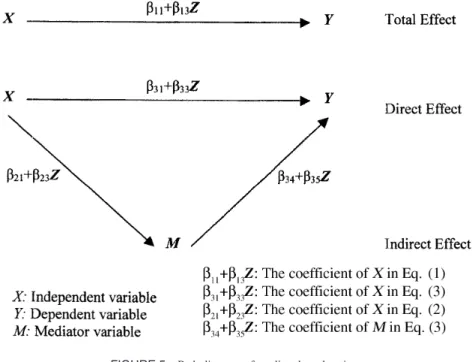
Based on Baron and Kenny’s (1986) original approach, Muller et al.’s procedure consists of three regression equations given below: X, the manipulated independent variable, is assumed to be dichotomous and is contrast coded (e.g., –1 and +1); M, the mediator, and Z, the moderator, should be centered by subtracting their sample mean from each case’s raw score before entering them into the regression equation;7Y is
the dependent variable. Eq. (1) estimates whether moderation occurs between the in-dependent and in-dependent variables (β13) (see top panel of Figure 5):
Y =β10+β11X +β12Z +β13XZ +ε1 (1)
Eq. (2) estimates whether moderation occurs between the independent and me-diator variables (β23), and whether the first half of mediation from the independent
variable to the mediator variable occurs (β21) (see bottom panel of Figure 5):
M =β20+β21X +β22Z +β23XZ +ε2 (2)
Eq. (3) estimates whether moderation occurs between the mediator and depend-ent variable (β35) (when the independent variable is controlled) and between the
independent and dependent variable (β33) (when the mediator variable is
con-FIGURE 5 Path diagram of mediated moderation.
trolled), and whether the second half of mediation from the mediator variable to the dependent variable occurs (β34) (see bottom panel of Figure 5):
Y =β30+β31X +β32Z +β33XZ +β34M +β35MZ +ε3 (3)
In addition, the existence of mediated moderation and moderated mediation is assessed by the following equality (for the mathematical proof, see Muller et al., 2005):
β13–β33=β34× β23+β35× β21 (4)
This equality must be significantly different from zero. That is, eitherβ13–β33
≠0 orβ34× β23+β35× β21≠0.
To demonstrate mediated moderation, three criteria must be met to make Eq. (4) significantly different from zero. First, moderation between X and Y must occur. That is,β13in Equation 1 must be statistically significant. Next, either or both of the
following two conditions must exist: (a) moderation between X and M must occur (β23is statistically significant) and there must be an effect of M on Y when X is
con-trolled (β34is significant); and (b) moderation between M and Y must occur (β35is
statistically significant) and there must be an effect of X on M (β21is statistically
sig-nificant). Finally, the moderation of the direct effect (β33) must be reduced in
magni-tude or even nonsignificant compared to the moderation of the total effect (β13).
Therefore, establishing the mediated moderation model of interactivity requires the evaluation of four unstandardized regression coefficients (see Table 1).8First,
b13 must be statistically significant to indicate overall moderation between
interactivity and media effects measures. Second, in our example, b23must be
sta-tistically significant to indicate that the path from interactivity to perceived interactivity is moderated by Internet self-efficacy. Third, b34must be statistically
significant to indicate the existence of mediated moderation (b34×b23≠0). Fourth,
b33must be reduced or even nonsignificant compared to b13to indicate the
exis-tence of a mediation process.
CONCLUSIONS
This paper has attempted to advance the study of interactivity in three ways. First, interactivity and perceived interactivity has been conceptually and operationally distinguished. The former plays the role of an independent variable and the latter a mediator variable. Both are independent but interrelated and should be included in the conceptual model simultaneously. Second, Internet self-efficacy, an important individual difference, should be regarded as a moderator variable that may alter the influence of interactivity on outcomes and help explain why the same media
lus can have differential effects on different users. Finally, the mediated modera-tion model of interactivity and appropriate statistical methods have been proposed to provide a systematic approach for clarifying the underlying mechanisms be-tween interactivity and media effects.
With increased recognition of the perceptual factors and individual differences that may mediate or moderate interactivity effects, researchers will be better posi-tioned to isolate when and under what conditions information and communication technology use is likely to be consequential. The model proposed here offers a structure for placing previously scattered observations about technological attrib-utes, user perceptions, and motivational traits into a conceptual framework useful for prediction. Such modeling requires greater analytical and methodological so-phistication than has been the case with most interactivity research thus far. But with increased conceptual consistency and more robust hypothesis testing, includ-ing the pursuit of promisinclud-ing questions and abandonment of nonproductive lines of inquiry, more reliable results may be obtained, contributing to the larger goal of theory building in this important area of investigation.
ACKNOWLEDGMENTS
The authors wish to thank R. Lance Holbert for his insightful comments on an ear-lier version of this paper, which was presented to the National Communication As-sociation, Mass Communication Division, Boston, MA, November 2005.
TABLE 1
Presumed Least Squares Regression Results for the Mediated Moderation Model of Interactivity
Equation 1 Equation 2 Equation 3 Predictors Y: Media effects Y: PI Y: Media effects
X: Interactivity b11 b21 b31 Z: ISE b12 b22 b32 XZ: Interactivity×ISE b13* b23* b33 M: PI b34* MZ: PI×ISE b35 X: Independent variable Y: Dependent variable M: Mediator variable Z: Moderator variable
b: Unstandardized regression coefficient
*: Statistical significance ISE: Internet self-efficacy PI: Perceived interactivity
NOTES
1As Bucy (2004a) observes, the literature is rife with exhaustive reviews and definitional reformulations of the interactivity concept (see Jensen, 1998; Kiousis, 2002; McMillan, 2002a); hence, we take a more focused approach here.
2In addition, scholars have employed manipulation checks of interactivity to verify that technologi-cal attributes are experienced as intended. For instance, stechnologi-cale items have been used to ask participants how interactive they considered the visited website to be, confirming whether the level of interactivity was reliably manipulated (e.g., Bucy, 2004b; Macias, 2003; Sundar et al., 2003).
3Perceived interactivity was operationalized as the degree to which participants indicated that the communication event shown in the clip was spontaneous, two-way in nature, or occurring in real-time; that is, they or someone like them could have expected an individualized response had they been present (Bucy & Newhagen, 1999).
4On the other hand, Spencer, Zann, and Fong (2005) argue that, under certain conditions, experi-ments are more effective than mediational analyses in examining psychological processes. In particu-lar, when it is easy to manipulate and measure a proposed psychological process, a series of “causal chain” experiments is preferable. On the other hand, when measurement of a psychological process is easy but manipulation of it is difficult, designs that rely on mediational analyses are preferred (Spencer, Zanna, & Fong, 2005).
5Parasocial interaction elicited by a noninteractive medium is a typical example. When watching a political talk show, for instance, audience members may “call in” to express their opinions using the telephone but the perception of the experience depends on television, which does not afford a talk-back function. Although nonverbal communication may evoke the illusion of intimacy (or perceived interactivity) and promote further contact through other media, it is not interactivity per se.
6Potter and Tomasello (2003) suggest that there are four types of mediators: demographics, person-ality traits, viewer or user states, and audience interpretations of treatment material.
7Centering the variable is necessary because moderated multiple regression (MMR) utilizes the in-teraction term, which is computed from existing variables in the regression equation. However, this cre-ates problems with multicollinearity, which inflcre-ates standard errors of regression coefficients of first or-der terms (the independent and moor-derator variables), which in turn can widen confidence intervals and produce low statistical power (Cohen, 1978). In addition, correlated variables make regression coeffi-cients unstable and change with different samples. This leads to the difficulty of separating and explain-ing the impact of each variable.
Although variable centering minimizes multicollinearity, its effectiveness is still disputable be-cause centering does not affect any values of interest; that is, the regression coefficient, standard error, simple slope, t-test, and p-value of second order terms (the interaction term) are identical regardless of whether the continuous variable is centered (see Aiken & West, 1991; Kromrey & Foster-Johnson, 1998). Variable centering does not improve the power of MMR for detecting moderation effects but should be conducted with tests of mediated moderation so as to distinguish the impact of each variable and obtain meaningful regression results.
8When the regression equation involves interaction terms, we suggest reporting unstandardized re-gression coefficients (b) rather than standardized rere-gression coefficients (β) in the results. The compu-tation of standardized regression coefficients requires that the independent and moderator variables be standardized before being entered into the equation, producing an interaction term that is the product of the standardized variables but not the standardized product of the raw variables (Friedrich, 1982).
REFERENCES
Aiken, L. S., & West, S. G. (1991). Multiple regression: Testing and interpreting interactions. Newbury Park, CA: Sage.
Bandura, A. (1986). Social foundations of thought and action: A social cognitive theory. Englewood Cliffs, NJ: Prentice Hall.
Bandura, A. (1989). Regulation of cognitive processes through perceived self-efficacy. Developmental
Psychology, 25, 729–735.
Bandura, A. (1997). Self-efficacy: The exercise of control. New York: W.H. Freeman & Co. Bandura, A. (2001). Social cognitive theory of mass communication. Media Psychology, 3, 265–299. Baron, R. M., & Kenny, D. A. (1986). The moderator-mediator variable distinction in social psycholog-ical research: Conceptual, strategic, and statistpsycholog-ical consideration. Journal of Personality and Social
Psychology, 51, 1173–1182.
Bryant, J., & Zillmann, D. (2002) (Eds). Media effects: Advances in theory and research, 2nd ed. Mahwah, NJ: Erlbaum.
Bucy, E. P. (2004a). Interactivity in society: Locating an elusive concept. The Information Society, 20, 375–385.
Bucy, E. P. (2004b). The interactivity paradox: Closer to the news but confused. In E. P. Bucy & J. E. Newhagen (Eds.), Media access: Social and psychological dimensions of new technology use (pp. 47–72). Mahwah, NJ: Erlbaum.
Bucy, E. P., & Affe, R. B. (2006). The contributions of Net news to cyber democracy: Civic affordances of major metropolitan newspaper sites. In X. Li (Ed.), Internet newspapers: Making of a mainstream
medium (pp. 227–242). Mahwah, NJ: Erlbaum.
Bucy, E. P., Lang, A., Potter, R. F., & Grabe, M. E. (1999). Formal features of cyberspace: Relationships between Web page complexity and site traffic. Journal of the American Society for Information
Sci-ence, 50, 1246–1256.
Bucy, E. P., & Newhagen, J. E. (1999). The micro- and macrodrama of politics on television: Effects of media format on candidate evaluations. Journal of Broadcasting & Electronic Media, 43, 193–210. Cassell, M., Jackson, C., & Cheuvront, B. (1998). Health communication on the Internet: An effective
channel for health behavior change? Journal of Health Communication, 3, 71–79. Chaffee, S. H. (1991). Explication. Newbury Park, CA: Sage.
Chaffee, S. H. (1996). Thinking about theory. In M. B. Salwen & D. W. Stacks (Eds.), An integrated
ap-proach to communication theory and research (pp. 15–32). Mahwah, NJ: Erlbaum.
Chaffee, S. H., & Berger, C. R. (1987). What communication scientists do. In C. R. Berger & S. H. Chaffee (Eds.), Handbook of communication science (pp. 99–122). Newbury Park, CA: Sage. Chung, H., & Zhao, X. (2004). Effects of perceived interactivity on Web site preference and memory:
Role of personal motivation. Journal of Computer Mediated Communication, 10. Retrieved Decem-ber 28, 2005, from http://jcmc.indiana.edu/vol10/issue1/chung.html
Cohen, J. (1978). Partialed products are interactions; partialed powers are curve components.
Psycho-logical Bulletin, 85, 858–866.
Eastin, M. S., & LaRose, R. (2000). Internet self-efficacy and the psychology of the digital divide.
Jour-nal of Computer Mediated Communication, 6. Retrieved March 30, 2004, from http://
www.ascusc.org/jcmc/vol6/issue1/eastin.html
Eveland, W. P., Jr. (1997). Interactions and nonlinearity in mass communication: Connecting theory and methodology. Journalism & Mass Communication Quarterly, 74, 400–416.
Eveland, W. P., Jr., & Dunwoody, S. (2001). User control and structural isomorphism or disorientation and cognitive load? Learning from the Web versus print. Communication Research, 28, 48–78. Eveland, W. P., Jr., Marton, K., & Seo, M. (2004). Moving beyond “just the facts”: The influence of
on-line news on the content and structure of public affairs knowledge. Communication Research, 31, 82–108.
Friedrich, R. J. (1982). In defense of multiplicative terms in multiple regression equations. American
Journal of Political Science, 26, 797–833.
Grabe, M. E., Zhou, S., Lang, A., & Bolls, P. D. (2000). Packaging television news: The effects of tab-loid on information processing and evaluative responses. Journal of Broadcasting & Electronic
Me-dia, 44, 581–598.
Ha, L., & James, E. L. (1998). Interactivity reexamined: A baseline analysis of early business websites.
Journal of Broadcasting & Electronic Media, 42, 457–474.
Heeter, C. (1989). Implications of new interactive technologies for conceptualizing communication. In J. Salvaggio & J. Bryant (Eds.), Media in the information age: Emerging patterns of adoption and
consumer use (pp. 217–235). Hillsdale, NJ: Erlbaum.
Hoffman, D. L., & Novak, T. P. (1996). Marketing in hypermedia computer-mediated environments: Conceptual foundations. Journal of Marketing, 60, 50–68.
Holbert, R. L. (2005). Debate viewing as mediator and partisan reinforcement in the relationship be-tween news use and vote choice. Journal of Communication, 55, 85–102.
Holbert, R. L., & Stephenson, M. T. (2002). Structural equation modeling in the communication sci-ences, 1995–2000. Human Communication Research, 28, 531–551.
Holbert, R. L., & Stephenson, M. T. (2003). The importance of indirect effects in media effects re-search: Testing for mediation in structural equation modeling. Journal of Broadcasting & Electronic
Media, 47, 556–572.
Holmbeck, G. N. (1997). Toward terminological, conceptual, and statistical clarity in the study of medi-ators and modermedi-ators: Examples from the child-clinical and pediatric psychology literatures. Journal
of Consulting and Clinical Psychology, 65, 599–610.
Horton, D., & Wohl, R. R. (1956). Mass communication and parasocial interaction: Observations on in-timacy at a distance. Psychiatry, 19, 215–229.
Isotalus, P. (1998). Television performance as interaction. Nordicom Review, 19(1), 175–183. James, L. R., & Brett, J. M. (1984). Mediators, moderators, and tests for mediation. Journal of Applied
Psychology, 69, 307–321.
Jensen, J. F. (1998). Interactivity: Tracking a new concept in media and communication studies.
Nordicom Review, 1, 185–204.
Kiousis, S. (2002). Interactivity: A concept explication. New Media & Society, 4, 355–383. Kromrey, J. D., & Foster-Johnson, L. (1998). Mean centering in moderated multiple regression: Much
ado about nothing. Educational and Psychological Measurement, 58, 42–67.
Lang, A. (1994) (Ed.). Measuring psychological responses to media messages. Hillsdale, NJ: Erlbaum. LaRose, R., Mastro, D., & Eastin, M. S. (2001). Understanding Internet usage: A social-cognitive
ap-proach to uses and gratifications. Social Science Computer Review, 19, 395–413.
Lee, J.-S. (2000). Interactivity: A new approach. Paper presented at the annual meeting of the Associa-tion for EducaAssocia-tion in Journalism and Mass CommunicaAssocia-tion, Phoenix, AZ.
Lee, S.-J., Lee, W.-N., Kim, H., & Stout, P. A. (2004). A comparison of objective characteristics and user perception of websites. Journal of Interactive Advertising, 4. Retrieved December 28, 2005, from http://www.jiad.org/vol4/no2/lee/index.htm
Liu, Y. (2003). Developing a scale to measure the interactivity of websites. Journal of Advertising
Re-search, 43, 207–216.
Liu, Y., & Shrum, L. J. (2002). What is interactivity and is it always such a good thing? Implications of definition, person, and situation for the influence of interactivity on advertising effectiveness.
Jour-nal of Advertising, 31, 53–64.
Macias, W. (2003). A preliminary structural equation model of comprehension and persuasion of inter-active advertising brand Web sites. Journal of Interinter-active Advertising, 3. Retrieved December 28, 2005, from http://www.jiad.org/vol3/no2/macias/index.htm
Maxwell, S. E., & Delaney, H. D. (1993). Bivariate median splits and spurious statistical significance.
Psychological Bulletin, 113, 181–190.
McCombs, M. E. (1994). News influence on our pictures of the world. In J. Bryant & D. Zillmann (Eds.), Media effects: Advance in theory and research (pp. 1–16). Hillsdale, NJ: Erlbaum. McLeod, D. M., Kosicki, G. M., & McLeod, J. M. (2002). Resurveying the boundaries of political
com-munication effects. In J. Bryant & D. Zillmann (Eds.), Media effects: Advances in theory and
re-search (2nd ed., pp. 215–267). Mahwah, NJ: Erlbaum.
McLeod, J. M., & Reeves, B. (1980). On the nature or mass media effects. In S. B. Withey & R. P. Abeles (Eds.), Television and social behavior: Violence and children (pp. 17–54). Hillsdale, NJ: Erlbaum.
McMillan, S. J. (2002a). Exploring models of interactivity from multiple research traditions: Users, documents, and systems. In L. Lievrouw & S. Livingston (Eds.), Handbook of new media (pp. 163–182). London: Sage.
McMillan, S. J. (2002b). A four-part model of cyber-interactivity: Some cyber-places are more interac-tive than others. New Media & Society, 4, 271–291.
McMillan, S. J., & Hwang, J.-S. (2002). Measures of perceived interactivity: An exploration of the role of direction of communication, user control, and time in shaping perceptions of interactivity. Journal
of Advertising, 31, 29–42.
McMillan, S. J., Hwang, J.-S., & Lee, G. (2003). Effects of structural and perceptual factors on attitudes toward the website. Journal of Advertising Research, 43, 400–409.
Mongeau, P. A., & Stiff, J. B. (1993). Specifying causal relationships in the Elaboration Likelihood Model. Communication Theory, 3, 65–72.
Morrison, M. (1998). A look at interactivity from a consumer perspective. In J. B. Ford & E. J. D. Honeycutt, Jr. (Eds.), Developments in Marketing Science, Vol. 21 (pp. 149–154). Norfolk, VA: Academy of Marketing Science.
Muller, D., Judd, C. M., & Yzerbyt, V. Y. (2005). When moderation is mediated and mediation is mod-erated. Journal of Personality and Social Psychology, 89, 852–863.
Newhagen, J. E. (2004). Interactivity, dynamic symbol processing, and the emergence of content in hu-man communication. The Information Society, 20, 397–402.
Newhagen, J. E., Cordes, J. W., & Levy, M. R. (1995). [email protected]: Audience scope and the per-ception of interactivity in viewer mail on the Internet. Journal of Communication, 45, 164–175. O’Keefe, D. J. (2003). Message properties, mediating states, and manipulation checks: Claims,
evi-dence, and data analysis in experimental persuasive message effects research. Communication
The-ory, 13, 251–274.
Petty, R. E., & Cacioppo, J. T. (1984). The effects of involvement on response to argument quantity and quality: Central and peripheral routes to persuasion. Journal of Personality and Social Psychology,
46, 69–81.
Potter, W. J., & Tomasello, T. K. (2003). Building upon the experimental design in media violence re-search: The importance of including receiver interpretations. Journal of Communication, 53, 315–329. Preacher, K. J., & Hayes, A. F. (2004). SPSS and SAS procedures for estimating indirect effects in
sim-ple mediation models. Behavior Research Methods, Instruments, & Computers, 36, 717–731. Preacher, K. J., Rucker, D. D., & Hayes, A. F. (in press). Suggested procedures for addressing
moder-ated mediation hypotheses. Multivariate Behavioral Research.
Rafaeli, S. (1988). Interactivity: From new media to communication. In R. P. Hawkins, J. Wiemann & S. Pingree (Eds.), Advancing communication science: Merging mass and interpersonal process (pp. 110–134). Newbury Park, CA: Sage.
Rafaeli, S., & Sudweeks, F. (1997). Networked interactivity. Journal of Computer Mediated
Commu-nication, 2. Retrieved March 30, 2004, from http://www.ascusc.org/jcmc/vol2/issue4/ rafaeli.sudweeks.html
Reeves, B., & Nass, C. (1996). The media equation: How people treat computers, television, and new
media like real people and places. New York: Cambridge University Press.
Robinson, T. N., Patrick, K., Eng, T. R., & Gustafson, D. (1998). An evidence-based approach to inter-active health communication: A challenge to medicine in the information age. Journal of the
Ameri-can Medical Association, 280, 1264–1269.
Rosenberg, M. (1968). The logic of survey analysis. New York: Basic Books.
Scheufele, D. A. (2002). Examining differential gains from mass media and their implications for par-ticipatory behavior. Communication Research, 29, 46–65.