RAPID COMMUNICATIONS
The purpose of this Rapid Communications section is to provide accelerated publication of important new results in the fields regularly covered by Journal of Materials Research. Rapid Communications cannot exceed four printed pages in length, including space allowed for title, figures, tables, references, and an abstract limited to about 100 words.
Strong Zn concentration effect on the soldering reactions
between Sn-based solders and Cu
S.C. Yang, C.E. Ho, and C.W. Chang
Department of Chemical & Materials Engineering, National Central University, Jhongli City, Taiwan C.R. Kaoa)
Department of Materials Science & Engineering, National Taiwan University, Taipei, Taiwan (Received 18 May 2006; accepted 12 July 2006)
The acute Zn concentration sensitivity of the reaction between Sn-based solders and Cu substrate is reported and explained in this article. Three Sn-xZn solders (x⳱ 0.5, 0.7, and 2 wt%) were reacted with Cu substrates at 250 °C for 2–10 min. A slight variation in the Zn concentration changed the reaction product formed at the interface. When the Zn concentration was low (x⳱ 0.5 wt%), the reaction product was Cu6Sn5. When the Zn concentration was slightly increased to 2 wt%, the reaction product became Cu5Zn8. When Zn concentration was in-between (x⳱ 0.7 wt%), Cu6Sn5and CuZn co-existed. The above findings are explained using the Cu–Sn–Zn phase diagram. The implication is that the type of compound forms at the interface can be controlled by adjusting the Zn concentration of the Sn-based solders.
The SnAgCu family of solders has firmly established itself as the leading replacement for the eutectic PbSn solder for electronic applications. At this stage, main research efforts in lead-free solder development are fo-cused on adding minor alloy elements to enhance or to fine-tune the various properties of the SnAgCu solders. For example, Mn, Ni, Ge, Ti, Si, Cr, and Zn had been evaluated for their potential for suppressing the void coa-lescence during the reactions between solders and Cu substrate.1The most noteworthy alloying element is Zn. Adding Zn had been shown to improve the creep resis-tance of SnAgCu.2The addition of Zn could also restrain the formation of large Ag3Sn plates.
3
Recently, Kang et al.4
pointed out minor Zn additions (0.1 and 0.7 wt%) into SnAgCu solders could suppress the growth of Cu3Sn, which was believed to be responsible for the formation of Kirkendall voids over the Cu substrates. It was proposed that the suppression of the Cu3Sn growth was probably associated with the accumulation of Zn at
the Cu3Sn/Cu interface. 4
In the literature, it had also been reported that Zn could in fact completely inhibit the for-mation of both Cu3Sn and Cu6Sn5, and produced Cu–Zn compounds instead.5 In short, more studies on the Zn effect are needed. The objective of this study was to investigate this Zn effect in detail.
In this study, the reactions between Cu substrates and the Sn-xZn solders with three different Zn concentrations (x⳱ 0.5, 0.7, and 2.0 wt%) were investigated. No Cu or Ag was added to Sn–xZn so that complications from the presence of either element could be avoided. The obser-vations from the present study, however, can reasonably foretell the reaction between Zn-doped SnAg solders and Cu substrates because it had long been established that Ag did not participate in the interfacial reactions.6–9
The reactions between Zn-doped SnCu and SnAgCu solders and Cu can be more convoluted because our preliminary results indicate that Zn and Cu do cross-interact during reaction. Nevertheless, the results of this study can still serve as the baseline for future reaction studies between Cu and Zn-doped SnCu and SnAgCu solders.
Before the reaction, the Cu substrates (12.0 mm length × 9.5 mm width × 0.5 mm thick) used in this study were metallurgically polished and fluxed with a mildly acti-vated rosin flux. Each solder bath was formed by placing 6 g of solder into a 7-mm diameter vial. Each fluxed Cu
a)
Address all correspondence to this author. e-mail: [email protected]
This author was an editor of this journal during the review and de-cision stage. For the JMR policy on review and publication of manu-scripts authored by editors, please refer to http://www.mrs.org/ jmr_policy
DOI: 10.1557/JMR.2006.0320
J. Mater. Res., Vol. 21, No. 10, Oct 2006 © 2006 Materials Research Society 2436
plate was then inserted into a fresh molten solder bath at 250 °C. Reaction time ranged between 2 and 10 min. After the reaction, the samples were cross-sectioned to reveal the interface and the internal microstructure of the solders. The compositions of the phases were determined by a state-of-the-art field-emission electron probe micro-analyzer (FE-EPMA, JEOL JXA-8500F, Tokyo, Japan). This FE-EPMA has the capability of lowering the radius of interaction volume down to as small as 0.5m so that accurate composition measurements for thin intermetal-lic layers can be performed. In this study, at least four measurements were made for every phase and the aver-age value was reported. In addition, x-ray diffraction (XRD) was also carried out to identify the crystal struc-tures of the reaction products.
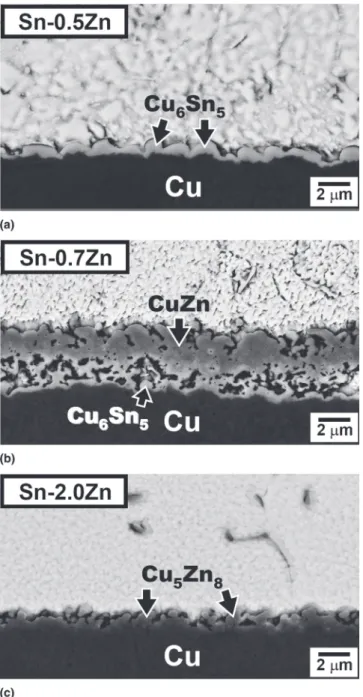
Figures 1(a)–1(c) show the reaction products that formed for different Zn concentrations after reaction at 250 °C for 2 min. When the solder composition was Sn–0.5Zn [Fig. 1(a)], a layer of compound with the scal-lop microstructure existed at the interface. The com-pound had the Cu6Sn5 crystal structure as verified by XRD analysis [Fig. 2(a)]. The composition of this Cu6Sn5layer was determined by FE-EPMA to be 39.1 at.% Sn, 4.8 at.% Zn, and 56.1 at.% Cu, indicating that a small amount of Zn had been incorporated into the Sn sublattice of Cu6Sn5. Consequently, this compound should be more properly referred to as Cu6(Sn1-xZnx)5.It should be noted that accurate composition measurements for this compound layer would have been difficult by using a conventional EPMA because this layer was too thin. The FE-EPMA used in this study has a much smaller interaction volume, and therefore accurate composition measurements could be performed. We also measured the composition using a Sn-0.5Zn/Cu sample that had been reacted for 10 min and had a thicker Cu6(Sn1-xZnx)5 (1.5 m). The measured Cu6(Sn1-xZnx)5composition remained the same, suggesting that the thickness was not an issue and the measured com-position was accurate. From the fact that only Cu6(Sn1-xZnx)5 formed, one can conclude that the addition of 0.5 wt% Zn to Sn did not change the chemistry of the puSn/Cu re-action reported in the literature.10,11The effect of Zn addi-tion at this level was that Zn became incorporated into the Sn sublattice of Cu6Sn5.
However, when the Zn addition was increased to 2 wt%, the chemistry was completely different, as shown in Fig. 1(c). The reaction product now had the Cu5Zn8 crystal structure as verified by x-ray diffraction analysis shown in Fig. 2(c). Using samples that were reacted for 2 min and 10 min (larger particles size facilitating more accurate FE-EPMA measurements), we determined the composition of Cu5Zn8to be 1.5 at.% Sn, 59.5 at.% Zn, and 39.0 at.% Cu. Apparently, Zn was the most reactive element, and when the Zn concentration was high enough, the Zn–Cu reaction dominated at the interface. The type of compound formed here, Cu5Zn8, was the
same as that formed in the reaction between eutectic SnZn (Sn-9Zn) and Cu substrate.12Therefore, it can be expected that the reaction product will be Cu5Zn8when the Zn concentration is between 2 and 9 wt%.
When the Zn concentration was 0.7 wt%, two com-pounds were identified at the interface: a Cu6Sn5-based compound next to the Cu substrate and a CuZn-based compound next to the solder, as shown in Fig. 1(b). The FIG. 1. The cross-section view for the solder/Cu interfaces that re-acted at 250 °C for 2 min: (a) Sn-0.5Zn/Cu interface, (b) Sn-0.7Zn/Cu interface, and (c) Sn-2.0Zn/Cu interface. The Sn-0.5Zn/Cu reaction produced Cu6Sn5. The Sn-2.0Zn/Cu reaction produced Cu5Zn8. The
Sn-0.7Zn/Cu reaction produced Cu6Sn5 and CuZn. A selective Sn
etching solution (5 vol% HCl-methanol) had been used to reveal the morphologies of reaction zones.
Rapid Communications
crystal structures for these two compounds were verified by XRD [Fig. 2(b)]. According to the FE-EPMA meas-urements, the composition for the Cu6Sn5-based com-pound was 38.3 at.% Sn, 7.1 at.% Zn, and 54.6 at.% Cu, and the composition for the CuZn-based compound was 17.5 at.% Sn, 33.1 at.% Zn, and 49.4 at.% Cu. It should be noted that there were numerous voids within the Cu6Sn5phase. These voids were originally occupied by Sn, which was etched away during the selective etching process. These voids were the premonition for the mas-sive spalling of the CuZn layer. The CuZn masmas-sive spall-ing occurred when the reaction time increased to 10 min, as shown in Fig. 3. The massive spalling phenomenon was first reported for the SnAgCu/Ni system.13–16 Ac-cording to the mechanism proposed,13–15 such spalling was attributed to the depletion of the alloying element (Zn) in solder.
The strong Zn concentration effect discussed here in fact is not unique for solders. A very similar Cu concen-tration effect for the SnAg-xCu/Ni reaction had been
reported.7–9 It was pointed out that a slight decrease in Cu concentration from 0.6 to 0.2 wt% would change the reaction product from a Cu6Sn5–based compound to a Ni3Sn4–based compound. The Cu-Ni-Sn phase diagram was successfully used to explain this strong concentra-tion effect.7–9The results reported in this article can also be explained by using the Cu-Sn-Zn phase diagram. Shown in Fig. 4 is the Sn-rich corner of the Cu-Sn-Zn 250 °C isotherm according to Chou and Chen.17Notice that the molten Sn phase can be in two-phase equilibrium with Cu6Sn5, CuZn, or Cu5Zn8, depending on the Zn concentration. When the Zn concentration in solder was high (e.g., 2 wt%, equivalent to 3.6 at.%), the interface represented a tie-line in the Sn+ Cu5Zn8two-phase field, and Cu5Zn8 formed next to the solder. When the Zn
FIG. 4. Sn-rich corner of the Cu-Sn-Zn ternary isotherm at 250 °C. This isotherm was drawn based on the information determined by Chou and Chen.17
FIG. 2. The x-ray diffraction patterns for the reaction products at 250 °C for 2 min. The Cu signals originated from the Cu layer beneath the intermetallic compounds. (a) Sn-0.5Zn, (b) Sn-0.7Sn, and (c) Sn-2.0Zn.
FIG. 3. Micrograph showing the Sn-0.7Zn/Cu interface after reaction at 250 °C for 10 min. The entire CuZn layer had massively spalled into the solder.
Rapid Communications
J. Mater. Res., Vol. 21, No. 10, Oct 2006 2438
concentration was low (e.g., 0.5 wt%, equivalent to 0.9 at.%), the interface represented a tie-line in the Sn+ Cu6Sn5 two-phase field, and Cu6Sn5formed next to the solder. When the Zn concentration was in-between (e.g., 0.7 wt%, equivalent to 1.3 at.%), the Sn+ Cu6Sn5+ CuZn three-phase field dominated, and both Cu6Sn5and CuZn formed. It should be noted that the CuZn+Sn two-phase field was not encountered in this study, and the CuZn phase did not form alone at the interface. Nevertheless, if a Sn-xZn alloy with Zn concentration between 0.7 and 2 wt% Zn had been used, it was very likely that CuZn would form alone at the interface.
In this study, the solder volume used was substantially greater than the actual array–array package solder joints. Therefore, the results presented here were for the condi-tion that the amount of the solder was relatively large so that the supply of Zn was also large. The average Zn concentration in the solder could therefore remain nearly constant during the reaction.14,15
The thermodynamic condition at the interface was thus static, and the forma-tion of one compound or another was more or less dictated by the thermodynamics. For a real solder joint in array–array packages, the supply of Zn is actually very limited because the solder volume is quite small in the first place, and secondly the Zn concentration in Zn-doped SnAgCu solder is always less than a few atomic percents. The Zn concentration can decrease no-ticeably as the Zn atoms are incorporated into the intermetallic. As the Zn concentration changes, the type of the equilibrium intermetallic at the interface might also change. Now the condition at the interface becomes dynamic. The so-call solder volume effect must be considered because the volume of the solder deter-mines the total available Zn. As the size of the joints shrinks, the supply of Zn becomes more limited, and the decrease in Zn concentration becomes more critical. In short, a large solder volume was used purposely in this study to serve as a baseline study, in which only the concentration effect was at play and the solder volume effect was not important. Only after the pure concentra-tion effect is understood can one begin to be able to understand the combined effect of solder volume effect and the concentration effect encountered in real solder joints.
In summary, the intermetallic formed between Cu and Sn-xZn solders were very sensitive to the Zn concentra-tion. For low Zn concentration (Sn-0.5Zn), only a Cu6Sn5-based compound formed. At high Zn concentra-tion (Sn-2.0Zn), only Cu5Zn8formed. When the Zn con-centration was in-between (Sn-0.7Zn), both Cu6Sn5and CuZn formed. These three different types of results might produce interfaces with very different mechanical properties. If Zn becomes one of the alloying elements in solder joints, the electronic industry must assess their choice of the optimal solder composition and strictly
control the Zn concentration to ensure the joints exhibit consistent interfacial properties.
ACKNOWLEDGMENT
This work was supported by the National Science Council of R.O.C. through Grants NSC 94-2216-E-008-001 and NSC 94-2214-E-008-005.
REFERENCES
1. I.E. Anderson and J.L. Harringa: Suppression of void coalescence in thermal aging of tin-silver-copper-x solder joints. J. Electron.
Mater. 35, 94 (2006).
2. M. McCormack, S. Jin, G.W. Kammlott, and H.S. Chen: New Pb-free solder alloy with superior mechanical properties. Appl.
Phys. Lett. 63, 15 (1993).
3. S.K. Kang, D.Y. Shih, D. Leonard, D.W. Henderson, T. Gosselin, S. Cho, J. Yu, and W.K. Choi: Controlling Ag3Sn plate formation in near-ternary-eutectic Sn-Ag-Cu solder by minor Zn alloying.
JOM 56, 34 (2004).
4. S.K. Kang, D. Leonard, D.Y. Shih, L. Gignac, D.W. Henderson, S. Cho, and J. Yu: Interfacial reactions of Sn-Ag-Cu solders modi-fied by minor Zn alloying addition. J. Electron. Mater. 35, 479 (2006).
5. J.K. Kivilahti: Modeling joining materials for microelectronics packaging. IEEE Trans. Compon. Pack. Manuf. Technol. B18, 326 (1995).
6. C.M. Liu, C.E. Ho, W.T. Chen, and C.R. Kao: Reflow soldering and isothermal solid-state aging of Sn-Ag eutectic solder on Au/Ni surface finish. J. Electron. Mater. 30, 1152 (2001).
7. C.E. Ho, Y.L. Lin, and C.R. Kao: Strong effect of Cu concentra-tion on the reacconcentra-tion between lead-free microelectronic solders and Ni. Chem. Mater. 14, 949 (2002).
8. W.T. Chen, C.E. Ho, and C.R. Kao: Effect of Cu concentration on the interfacial reactions between Ni and Sn-Cu solders. J. Mater.
Res. 17, 263 (2002).
9. C.E. Ho, R.Y. Tsai, Y.L. Lin, and C.R. Kao: Effect of Cu con-centration on the reactions between Sn-Ag-Cu solders and Ni.
J. Electron. Mater. 31, 584 (2002).
10. K.N. Tu and R.D. Thompson: Kinetics of interfacial reaction in bimetallic Cu-Sn thin films. Acta Metall. 30, 947 (1982). 11. S. Bader, W. Gust, and H. Hieber: Rapid formation of
interme-tallic compounds by interdiffusion in the Cu-Sn and Ni-Sn sys-tems. Acta Metall. Mater. 43, 329 (1995).
12. C.W. Huang and K.L. Lin: Interfacial reactions of lead-free Sn-Zn based solders on Cu and Cu plated electroless Ni-P/Au layer under aging at 150 °C. J. Mater. Res. 19, 3560 (2004).
13. C.E. Ho, Y.W. Lin, S.C. Yang, and C.R. Kao: Volume effect on the soldering reaction between SnAgCu solders and Ni,
Proceed-ings of 10th International Symposium on Advanced Packaging Materials (IEEE, Piscataway, NJ, 2005), p. 39.
14. C.E. Ho, S.C. Yang, and C.R. Kao: Interfacial reaction issues for lead-free electronic solders. J. Mater. Sci.-Mater. El. (2006) (in press).
15. C.E. Ho, Y.W. Lin, S.C. Yang, C.R. Kao, and D.S. Jiang: Effect of limited Cu supply on soldering reactions between SnAgCu and Ni. J. Electron. Mater. 35, 1017 (2006).
16. L.C. Shiau, C.E. Ho, and C.R. Kao: Reactions between SnAgCu lead-free solders and the Au/Ni surface finish in advanced elec-tronic packages. Solder Surf. Mt. Technol. 14, 25 (2002). 17. C.Y. Chou and S.W. Chen: Phase equilibria of Sn-Zn-Cu ternary
system. Acta Mater. 54, 2393 (2006).
Rapid Communications