Novel Ferroelectric Liquid Crystals Consisting Glassy Liquid Crystal
as Chiral Dopants
Huang-Ming Philip Chen
a*, Yun-Yen Tsai
a, Chi-Wen Lin
a, Han-Ping David Shieh
aa
Department of Photonics and Display Institute, National Chiao Tung University, Hsinchu, Taiwan,
30010 R.O.C.
ABSTRACT
A series of ferroelectric liquid crystals consisting new glassy liquid crystals (GLCs) as chiral dopants were prepared and evaluated for their potentials in fast switching ability less than 1 ms. The properties of pure ferroelectric glassy liquid crystals (FGLCs) and mixtures were reported in this paper. In particular, the novel FGLC possessing wide chiral smectic C mesophase over 100 oC is able to suppress smectic A phase of host. The mixture containing 2.0 % GLC-1 performs greater alignment ability and higher contrast ratio than R2301 (Clariant, Japan) in a 2 µm pre-made cell (EHC, Japan). These results indicate that novel FLC mixtures consisting glassy liquid crystals present a promising liquid crystal materials for fast switching field sequential color displays.
Key word: Ferroelectric liquid crystal, glassy liquid crystal, field sequential color displays, SSFLC
INTRODUCTION
The association of properties between chirality and spontaneous polarity in liquid crystals was first reported by Robert B. Meyer in 1975 [1]. Few years later, Clark and Lagerwall realized the electrical manipulation of spontaneous polarization by using surface stabilized ferroelectric liquid crystals (SSFLCs), in which the unwound helix of chiral smectic LC is filled between two closely spaced substrates [2]. The characteristic cone-shaped switching between two stable states gives FLCs fast response time, wide viewing angle, and bistable switching. These unique properties can be considered as assets in the next generation of displays. The tasks in preparing good domain without zigzag and stripe defects, however, remain a great challenge to many. These domain defects cause light leakage which can lead to the degrading on optical performance of the device. In addition, the working temperature is usually limited by crystallization at lower temperature and other mesophases at elevated temperature for most of the FLC materials. Lately some efforts have been made in order to enlarge SmC* phase by ferroelectric liquid crystalline polymers [3, 4].
Glassy liquid crystals (GLCs) represent a unique class of LC materials that preserve the molecular order into solid state without crystallization upon cooling [5-7]. In addition, the GLCs have glass transition temperature (Tg) emulating polymeric LCs, but have superior chemical purity and favorable rheological properties over polymeric counterparts [8]. Thus, low-molecular-weight glassy liquid crystals possessing wide mesophase without polymeric approaches can be good candidates for display applications. In this study, a series of new glassy liquid crystals was synthesized, targeting application for FLC devices. Both pure compounds and mixtures were examined for their electro-optical properties as well. In all GLC mixtures, the rise times were under 700 µs, and the fall times were around or less than 1ms without enhancement by specific driving scheme at room temperature. The large domain size and fast response time of FLC mixtures are suitable for field sequential color display application.
CHIRAL SMECTIC C GLASSY LIQUID CRYSTALS
It has been successfully implemented a molecular design concept for low molecular weight glassy liquid crystals (GLCs), in which nematic and chiral pendants are bonded to a volume-excluding core chemically to prevent crystallization upon cooling [9, 10]. We targeted chiral-smectic C GLCs that can be prepared by 1, 3, 5-cyclohexane core with various pendants. Liquid crystal molecules, therefore, can be switched between two stable states within the chiral smectic C (SmC*) mesophase by applying a voltage pulse with adequate width and polarity under surface stabilized condition. The general structure has been depicted in Figure 1.
R R
R
*
COO(CH2)10O COO COO COOCHCOOC4H9
CH3
GLC2 : R =
* COO(CH2)6O O FGLC1 : R =
*COO(CH2)6O COO COO COOCHCOOC4H9
CH3
*
COO(CH2)10O COO COO COOCHCOOC4H9
CH3
GLC3 : R =
3
:
2
(S) (S) (S) (S)Figure 1. Molecular structures of chiral smectic GLCs
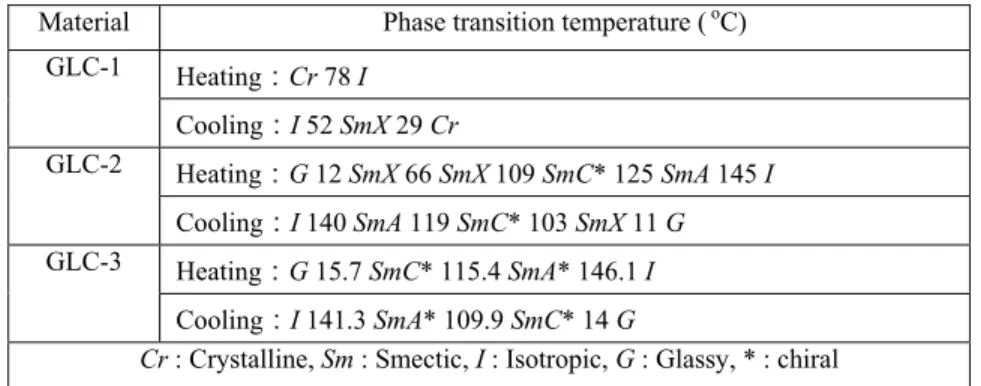
Thermal properties of pure chiral smectic C glassy liquid crystals (GLCs) were listed in Table 1. The phase transition temperatures were measured by differential scanning calorimetry (DSC, Diamond DSC, Perlin Elmer, Inc.) with heating and cooling rate at 20 oC/min. Among these materials, the GLC-1 is a monotropic liquid crystal with unidentified chiral smectic phase. With pendant modification, the GLC-2 shows a very short range of chiral smectic C mesophase between 109 oC and 125 oC from heating. By mixing two different spacer lengths of the same pendant, the GLC-3 attains a very wide chiral smectic C mesophase ranging between 15.7 oC and 115.4 oC from heating.
Table 1. Phase transition for pure compounds obtained by DSC with heating and cooling rate at 20 oC/min
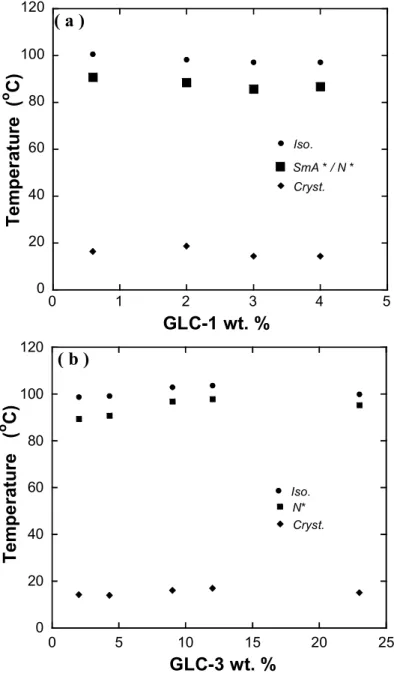
The FLC mixtures were obtained by doping GLC materials into an achiral smectic C host, W206A. The phase transition temperatures of W206A smectic C host are Cr 14-15 SmC 85.7-86.4 SmA 90.1-90.6 Nm 99.4-102 I from heating, and I 101.4-98.4 Nm 90.4-89.9 SmA 86.3-85.6 SmC -0.65 Cr from cooling. Thermal properties of GLC-1 mixtures with various weight percentage, 0.6 %, 2.0 %, 3.0 % and 4.0 %, were measured by DSC listed in Figure 2 (a). There is a broad transition peak from DSC data covered the transition temperature from chiral smectic C (SmC*) phase to chiral nematic (N*) phase in GLC-1 mixtures. This broad transition peak consists of the mixture of chiral smectic A (SmA*) phase and chiral nematic (N*) phase transition, in which both phases can be observed under polarizing optical microscope (POM). Thermal transition properties of 2.0 %, 4.3 %, 9.0 %, 12 %, and 23 % GLC-3 mixtures were shown in Fig. 2 (b). The clear transition between SmC* and N* phase, conversely, exists in all GLC-3 mixtures under POM. The success of suppressing SmA* phase can be attributed to the wide SmC* phase of GLC-3. In particular, the widest SmC* phase can be achieved by 12 % GLC-3 mixture with temperature ranging from 16.9 oC to 97.9 oC.
Material Phase transition temperature (oC) Heating:Cr 78 I GLC-1 Cooling:I 52 SmX 29 Cr Heating:G 12 SmX 66 SmX 109 SmC* 125 SmA 145 I GLC-2 Cooling:I 140 SmA 119 SmC* 103 SmX 11 G Heating:G 15.7 SmC* 115.4 SmA* 146.1 I GLC-3 Cooling:I 141.3 SmA* 109.9 SmC* 14 G
0 20 40 60 80 100 120 0 1 2 3 4 5 Cryst. SmA * / N * Iso.
T
em
p
er
at
u
re
(
oC)
GLC-1 wt. %
( a )
0 20 40 60 80 100 120 0 5 10 15 20 25 Cryst. N* Iso.Te
mp
e
rat
ur
e
(
oC)
GLC-3 wt. %
( b )
Figure 2. Thermal properties of (a) 0.6, 2.0, 3.0, and 4.0 % GLC-1 mixtures; and (b) 2.0, 4.3, 9.0, 12, and 23 % GLC-3 mixtures measured by DSC at heating rate 20 oC /min.
ALIGNMENT OF PURE FGLC AND MIXTURES
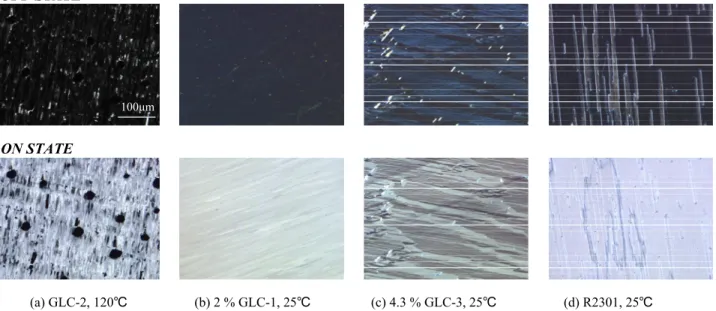
Glassy liquid crystals have been demonstrated the ability to form monodomain thin films over a large area with shorter annealing time due to uniform relaxation times in previous studies [4-6]. The advantages of GLC molecular self aligning ability will be adopted to enhance the alignment of FLC mixtures. The 2.0 ± 0.5 µm pre-made cells with 1 cm2 of ITO pattern area (purchased from E.H.C., Japan) were used in this study. All sample pictures of pre-made cells, presented in Figure 3, were captured under polarizing optical microscope (POM) with the size of 673.5 µm × 497.5 µm. A 1 kHz driving waveform was applied to the cells for ON state whereas the driving voltage was depended on the saturation voltage of each sample. Pure GLC-2 was only able to be driven at elevated temperature, 120 oC, because of its chiral smectic C phase, as shown in Figure 3 (a). The contrast of GLC-2 was relatively good but with pin holes defects. This was because of trapped air bubbles in the filling process. The 2.0 % GLC-1 mixture demonstratedgreat alignment and large domain in pre-made cell, as shown in Figure 3 (b). 4.3 % FGLC-3, however, appeared to perform poor alignment and zigzag defects as illustrated in Figure 3 (c). Comparing to the commercial FLC material (R2301, from Clariant) as depicted in Figure 3 (d), the 2.0 % GLC-1 mixture demonstrated a better alignment in pre-made cells.
Figure 3. Pictures of ON/OFF state under POM: (a) 100 % GLC-2, 120 ℃; (b) 2 % GLC-1 mixture, 25 ℃;(c) 4.3 % GLC-3 mixture, 25 ℃; and (d) R2301, 25 ℃ (Driving Scheme :1 kHz square wave)
ELECTRO-OPTICAL PROPERTIES
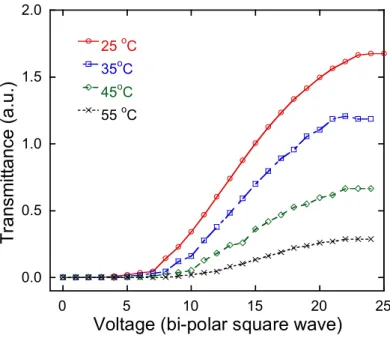
The electro-optical (EO) properties of 2.0 % GLC-1 mixture using a 10 Hz triangular wave at various temperatures were presented in Figure 4. The 2.0 % GLC-1 mixture showed a smooth V-shaped switching and the threshold voltage was about 8 V. The EO properties of 2.0 % GLC-1 mixture under a 60 Hz square wave at different temperatures exhibited much stronger temperature dependence. The optical transmittance decreased along with the
(a) GLC-2, 120℃ (b) 2 % GLC-1, 25℃ (c) 4.3 % GLC-3, 25℃ (d) R2301, 25℃ OFF STATE
ON STATE
dependent. This is due to the tendency of the molecular long axes align vertically in SmA phase, resulting in switching cone angle that has been greatly reduced at higher temperature.
0 1 2 3 4 5 6 7 -40 -30 -20 -10 0.0 10 20 30 40 21 oC 30 oC 40 oC 50 oC
Tr
ansm
itt
ance (a
rb
. un
its)
Applied voltage (V)
Figure 4. EO properties of the 2.0 % FGLC-1 mixture using 10 Hz triangular wave at various temperatures
0.0 0.5 1.0 1.5 2.0 0 5 10 15 20 25 25 oC 35oC 45oC 55 oC
T
ra
nsmit
ta
nce (a.u
.)
Voltage (bi-polar square wave)
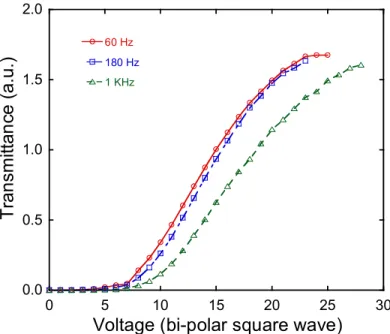
Figure 6 presented the EO properties of 2.0 % FGLC-1 using a bi-polar square wave at various driving frequencies. The driving frequencies at 60 Hz and 180 Hz made no difference in EO characteristics. The frequency at 1 kHz, however, shifted the threshold voltage to nearly 30V, as shown in Figure 6. The result implied that 1 kHz driving with pulse width 500 µs did not have enough time for the director to maximize its switching. The response times of pure GLC-2 and selected GLC mixtures were listed in Table 2. Pure GLC-2 compound showed an extremely fast response time at 120 oC with bistability. As for 2.0 % GLC-1 mixture, the rise time is under 700 µs and the fall time is near 1 ms. The rise and fall times of 4.3 % GLC-3 mixture are 580 µs and 760 µs, respectively. Thus, both mixtures are suitable for field sequential color display.
0.0 0.5 1.0 1.5 2.0 0 5 10 15 20 25 30 60 Hz 180 Hz 1 KHz
Tr
an
smi
tta
n
ce
(a
.u
.)
Voltage (bi-polar square wave)
Figure 6. EO characteristics of the 2.0 % FGLC-1 mixture using 60, 180, 1K Hz bi-polar square wave at 25℃
Table 2. Response time of various FLC samples in 2±0.5 µm cell, driven by 1 kHz 30V square wave
Material Rise Time (τ10→τ90) Fall Time (τ90→τ10)
GLC-2 (120℃) 400 µs 296 µs
2.0 % GLC-1 680 µs 1.1 ms
CONCLUSIONS
Chiral smectic C GLCs as chiral dopants possess great ability maintaining chiral smectic C mesophase in mixtures. SmA* mesophase can be suppressed by GLC-3 compound, which possesses large SmC* mesophase. Both GLC-2 and 3 can be identified as ferroelectric glassy liquid crystals. The GLCs mixtures have potentials in preparing a good domain in SSFLC. Several groups have obtained monodomain with FLC material R2301 by utilizing hybrid alignment [11] or asymmetrical cell with linearly-photo-polymerized polymers (LPPs) and liquid crystal polymers (LCPs) [12]. Since large domain size was able to be accomplished by using 2% GLC-1 mixture, we believe that the criteria of achieving monodomain FGLCs or FGLC mixtures would be less strict than R2301. These advantages may minimize manufacturing process and simplify cell structure in the future.
ACKNOWLEDGEMENT
This research is supported by National Science Council (Grant No. NSC 94-2215-E-009-041- ) of the Republic of China and partially supported by MOEA Technology Development for Academic Project #94-EC-17-A-07-S1-046. The W206A was kindly provided by Professor Roman Dabrowski (Military University of Technology, Warsaw, Poland). We are indebted to Professor Shaw H. Chen (Department of Chemical Engineering and Laboratory for Laser Energetics, Center for Optoelectronics and Imaging, University of Rochester) for numerous helpful discussions. We are also grateful for Dr. Pani Kumar (Display Institute, National Chiao Tung University) for his experimental support.
REFERENCES
[1] R. B. Meyer, L. Lieber, L. Strzelecki, and P. Keller J. Phys. Lett. (Paris) 36, L69-L71 (1975)
[2] N. A. Clark and S. T. Lagerwall, “Submicrosecond bistable electro-optic switching in liquid crystals” Appl. Phys.
Lett., 36(11), pp.899-901 (1980)
[3] C. S. Hsu, L. J. Shih, G. H. Hsiue, “Synthesis of Liquid Crystalline Polysiloxanes and Polymethacrylates with Broad Temperature Ranges of the Chiral Smectic C Phase” Macromolecules, 26, pp.3161-3167 (1993)
[4] G. H. Hsiue, Y. A. Sha, S. J. Hsieh, et al., “Synthesis and characterization of halogen-containing ferroelectric liquid crystals and side chain liquid crystalline polymers” Liquid Crystals, 28, pp.365-374 (2001)
[5] S. H. Chen, H. M. P. Chen, D. Katsis, J. C. Mastrangelo, “Glassy liquid crystals for tunable reflective coloration”
ACS Symposium Series 888, Chapter 22, pp.290-306 (2005)
[6] H. M. P. Chen, D. Katsis, S. H. Chen, “Deterministic Synthesis and Optical Properties of Glassy Chiral-Nematic Liquid Crystals” Chem. Mater., 15, pp.2534-2542 (2003)
[7] H. P. Chen, D. Katsis, J. C. Mastrangelo, S. H. Chen, S. D. Jacobs, P. J. Hood, “Glassy Liquid-Crystal Films with Opposite Chirality as High-Performance Optical Notch Filters and Reflectors” Adv. Mater., 12, pp.1283-1286 (2000) [8] H. Shi, S. H. Chen, M. E. De Rose, T. J. Bunning, W. W. Adams, “Dynamic mechanical properties of
cyclohexane-based glass-forming liquid crystals and a linear side chain polymer analog” Liq. Cryst., 20, pp. 277-282 (1996). [9] H. Shi, S. H. Chen, “Effects of stereochemistry, mesogenic core and spacer length on crystallization from nematic
3. Cubane with pendant nematogens, carbazole, and Disperse Red 1” Macromolecules, 30, pp. 93-97 (1997). [11] S. Kobayashi, J. Xu, H. Furuta, Y. Murakami, S. Kawamoto, M. Oh-kouchi, H. Hasebe, H. Takatsu, “Fabrication
and electro-optic characteristics of polymer-stabilized V-mode ferroelectric liquid crystal display and intrinsic H-V-mode ferroelectric liquid crystal displays: their application to field sequential fullcolor active matrix liquid crystal displays”, Opt. Eng. 43 (2), pp.290-298 (2004)
[12] M. Okabe, N. Sawatari, M. Ishikawa, H. Hama, “A Novel Mono-Domain Alignment Method for Ferroelectric Liquid Crystal Applying to Half-V Shape Mode Field Sequential Color Displays” SID 2005 Digest, 1084-1087