行政院國家科學委員會專題研究計畫 期末報告
學術講演的開場和結尾用語與班級大小的關聯性之比較研
究
計 畫 類 別 : 個別型
計 畫 編 號 : NSC 100-2410-H-009-033-
執 行 期 間 : 100 年 08 月 01 日至 102 年 01 月 31 日
執 行 單 位 : 國立交通大學英語教學研究所
計 畫 主 持 人 : 鄭維容
計畫參與人員: 碩士班研究生-兼任助理人員:劉曉珊
碩士班研究生-兼任助理人員:施佳琪
公 開 資 訊 : 本計畫可公開查詢
中 華 民 國 102 年 04 月 29 日
中 文 摘 要 : 本研究使用 MICASE 語料庫來探討學術課堂演講的結尾的修辭
結構(rhetorical structure),以及班級大小對其之影響。
本研究提出一個二層次之架構來分析課堂演講之結尾,第一
個層次是階段(stage),分為結束前(Pre-ending),結束
(Ending),以及結束後(Post-ending)三個階段。第二個層次
是策略(strategy),每個階段都可使用不同策略。
研究結果顯示在課堂演講結尾時,三個最常使用的策略分別
是:解釋下次上課的課程規劃,解散學生,以及明白的表示
課程結束。整體而言,每個策略的使用率不高,不同老師所
使用的策略也有很大差異,顯示每個老師對於策略的使用很
有彈性。另一方面,班級大小對於演講結尾的修辭結構之影
響有統計上的顯著差異,大小班級在結束前與結束後兩階段
的策略使用也達到顯著差異。在大班級中,策略大多集中在
結束階段,但是在小班級中,策略大多集中在結束前與結束
後階段,顯示大班級使用較正式的課堂演講結尾,小班級則
是有比較多的師生互動,尤其是在結束後階段,師生常有與
課程不相關之非正式的互動。另外,小班級使用的策略總數
較大班級多,有較多的師生互動策略,顯示小班級的課堂氣
氛較大班級輕鬆,讓師生有較多的互動,學生也較願意提
問。
在人稱代名詞的使用量方面,班級大小的差別也很大,相當
接近顯著差異。老師在小班級使用我(I)遠比在大班的使用量
多,達到顯著差異,但是在你(you)或是我們(we)的使用上,
大小班並沒有顯著差別,這個結果與策略的分析結果相呼
應,由於小班級使用較多的師生互動策略,老師和學生會較
常使用我來問對方問題或是回應對方的想法。反觀在大班級
中,老師通常是告知課程相關議題或直接解散學生,因此較
常使用你和我們。此外,老師會很有彈性,也很有技巧的使
用人稱代名詞,因為每個人稱代名詞都可用來指稱多個不同
的語意指示者(semantic referents)。例如,老師雖然常用
包含學生在內的我們(inclusive-we)來指稱自己和學生,以
促進師生更密切的關係,但是也會在指定學生作業或說明考
試時,雖僅指稱學生,卻用我們,以表示共同參與之事,避
免學生排斥。這些研究結果顯示班級大小確實對課堂演講結
尾有顯著的影響,也提供老師如何使用各種策略與人稱代名
詞,以增進師生互動與良好關係,扮演適當的角色。
本研究的研究結果不僅可以使我們更深入了解英語課堂演講
結尾的修辭結構、人稱代名詞的語意和語用特色、以及班級
大小對於課堂演講結尾的影響。另一方面,研究結果也可以
幫助新進老師瞭解課堂演講結尾之彈性架構與策略。由於本
研究結果顯示課堂演講結尾的修辭結構彈性很大,老師應該
針對班級大小採用各種合適的策略以促進師生互動,並加深
與學生之間的人際關係。此外,研究結果可以提供相關研究
實用的分析架構、教學資料與真實語料實例。在學術口語文
類的分析上,則建立課堂演講結尾的修辭結構,也確認其具
有很大的彈性與差異性(variation)。此外,本研究讓我們瞭
解課堂演講結尾這個部份文類(part genre)不單只是總結課
程內容而已,更能增進師生互動與人際關係,具有社會言談
功能。
中文關鍵詞: 學術課堂演講,學術課堂演講結尾,班級大小,MICASE,人
稱代名詞
英 文 摘 要 : The present study investigates the rhetorical
structure of academic lecture closings, and the
impact of class size on this part genre. A framework
of stages and strategies is developed to analyze the
rhetorical structure of lecture closings. Large and
small classes are further compared to find how class
size may influence the ways lecturers close their
lectures. Personal pronouns I, you, and we are also
examined to explore interpersonal dynamics. Results
show that lecturers use a wide range of strategies in
closings, yet with great variation. Three
strategies—explicitly indicating the end of lecture,
explaining course plans for the next class, and
dismissing the class—are most frequently used. Large
and small classes differ in both stages and
strategies. Strategies tend to concentrate at the
Ending Stage in large classes, but at the Pre-ending
and Post-ending Stages in small classes.
Interestingly, students and lecturers in small
classes have frequent, informal interaction on
non-course-related issues. Lecturers may use personal
pronouns flexibly and strategically, referring to a
variety of semantic referents, to enhance student
engagement and mitigate potential disfavor. These
findings demonstrate the impact of class size on
lecture closings, which provide an opportunity for
lecturers to establish close rapport with students.
英文關鍵詞: Lecture closings, Academic lectures, Class size,
‘‘That’s it for today’’: Academic lecture closings and the impact of class size
Stephanie W. Cheng
⇑Graduate Institute of TESOL, National Chiao Tung University, 1001 University Road, Hsinchu 300, Taiwan
a r t i c l e
i n f o
Article history:
Available online 1 July 2012 Keywords: Lecture closings Academic lectures Class size MICASE Personal pronouns
a b s t r a c t
The present study investigates the rhetorical structure of academic lecture closings, and the impact of class size on this part genre. A framework of stages and strategies is developed to analyze the rhetorical structure of lecture closings. Large and small classes are further compared to find how class size may influence the ways lecturers close their lectures. Per-sonal pronouns I, you, and we are also examined to explore interperPer-sonal dynamics. Results show that lecturers use a wide range of strategies in closings, yet with great variation. Three strategies—explicitly indicating the end of lecture, explaining course plans for the next class, and dismissing the class—are most frequently used. Large and small classes dif-fer in both stages and strategies. Strategies tend to concentrate at the Ending Stage in large classes, but at the Pre-ending and Post-ending Stages in small classes. Interestingly, students and lecturers in small classes have frequent, informal interaction on non-course-related issues. Lecturers may use personal pronouns flexibly and strategically, referring to a variety of semantic referents, to enhance student engagement and mitigate potential disfavor. These findings demonstrate the impact of class size on lecture closings, which provide an opportunity for lecturers to establish close rapport with students.
Ó 2012 Elsevier Ltd. All rights reserved.
1. Introduction
Understanding lectures, for most university students, plays a critical role in their academic success. It is widely acknowl-edged that listening to lectures can present a considerable processing burden to students, particularly those who are non-native speakers (Flowerdew, 1994a; Young, 1994). Research has indicated that lectures are both linguistically and cogni-tively demanding (Flowerdew, 1994a; Flowerdew & Miller, 1997; Thompson, 2003), and that even L2 learners with adequate English proficiency have difficulty comprehending academic lectures (Allison & Tauroza, 1995; Flowerdew, 1994b; Flower-dew & Miller, 1996; Thompson, 1994; Young, 1994). A number of studies have examined various aspects of academic lec-tures to increase our understanding of academic lecture discourse and to help learners better process information in lectures. These have included, for example, the overall organization of lectures (Dudley-Evans, 1994; Tauroza & Allison, 1994; Thompson, 1994, 2003; Young, 1990, 1994), lecture introductions (Lee, 2009; Thompson, 1994), the interactive nature of lecture discourse (Crawford Camiciottoli, 2004; Morell, 2004), the use of asides (Strodt-Lopez, 1991), personal pronouns (Fortanet, 2004; Rounds, 1987a, 1987b; Young, 1994), discourse markers as signaling cues (Allison & Tauroza, 1995; Chaudron & Richards, 1986; Dunkel & Davis, 1994; Flowerdew & Miller, 1997; Jung, 2003, 2006; Thompson, 2003), and the pedagogical implications for EAP (Ferris & Tagg, 1996; Flowerdew, 1994b; Flowerdew & Miller, 1997). However, classroom lecture closings have not received much attention in academic discourse studies.
The closing of a lecture is as important as the opening or the body of the lecture because a strong and powerful ending often stays clearly in the listeners’ minds. In legal situations, lawyers or prosecutors often make the best of their final
0889-4906/$ - see front matter Ó 2012 Elsevier Ltd. All rights reserved.
http://dx.doi.org/10.1016/j.esp.2012.05.004
⇑ Tel.: +886 3 5712121x52759; fax: +886 3 5739033. E-mail address:[email protected]
Contents lists available atSciVerse ScienceDirect
English for Specific Purposes
closings to appeal to the juries. In a public speech, a powerful ending can leave the audience not only with a good impression of the presentation, but with the important messages the speech conveys as well. The same situation can apply to movies or book series, in which an attractive ending encourages viewers and readers to return. Although the situation in a university setting is slightly different, since the students are required to attend the course for a long period of time, the importance of lecture closings remains. In the closing of university lectures, lecturers can make up for lapses in the body of the lecture, review or summarize the key points, and discuss or explain course-related issues, such as homework or the following week’s exam. Students, on the other hand, may use this time to ask questions about specific lecture content.
In addition, lecture closings provide a good chance for comparatively informal interactions, which help enhance interper-sonal relationships between the lecturer and students. In these more relaxed moments, the lecturer and students may en-gage in small talk that deepens the positive bonding between them. Thus, pragmatically, closings are significant in highlighting interpersonal dynamics in the classroom. It is important, therefore, to investigate this part genre in terms of its rhetorical structure in order to acquaint students, teaching assistants and novice teachers with spoken academic language.
A few studies have investigated the macrostructure of lectures; for example,Young (1994)identified six phases: dis-course structuring, conclusion, evaluation, interaction, theory or content, and examples. Among them, the concluding phase refers to a phase when lecturers summarize points they have discussed throughout the lecture. This phase may certainly occur at the end of a lecture, but a lecture closing often goes beyond a summary or conclusion of the lecture content; for example, it may include an explicit indication of the end of lecture, an explanation of course-related issues, as mentioned earlier, or even non-course-related issues, such as casual conversations between lecturers and students.
In addition to the analysis of entire lectures, the introductions of lectures have also attracted researchers’ interest.
Thompson (1994)proposed two main rhetorical functions in the introductions of lectures. One function sets up the frame-work of the lecture as a textual object, giving information about the topic, scope, structure, and aims of the lecture. The other function establishes a context for the topic, relating it to what the audience already knows.
However, lecturers’ individual styles may have an impact on how lectures are organized and what discourse features are employed, and consequently, students may need to develop different strategies to understand the lectures. One of the vari-ables that influence lecturers’ styles and discourse is the size of the class (Ferris & Tagg, 1996; Lee, 2009). Conversational style lectures, in which lecturers deliver the lectures from notes and in a relatively informal style with a certain amount of interaction with students (Dudley-Evans, 1994), are becoming more common, especially in smaller classes (Crawford Camiciottoli, 2005; Morell, 2004, 2007; Northcott, 2001; Schleef, 2009).
Research on academic lectures has indicated that both the level of interactivity and the interactive style have an impact on how lectures are structured (Basturkmen, 1999; Crawford Camiciottoli, 2004; Jung, 2006; Morell, 2004, 2007; Northcott, 2001). Although it is expected that large class lectures are more monologic in nature, whereas small class lectures are more interactive, very few studies have empirically investigated the effects of class size on the macrostructure of academic lec-tures (Lee, 2009).Lee (2009)found that class size does affect lecturers’ discursive decisions in university lecture introduc-tions. Lecturers in large classes are inclined to have more reminders of class-related issues and upcoming lectures as a way to establish positive learning environments, whereas lecturers in small classes tend to make digressions to reinforce rapport between lecturers and students. AlthoughLee’s (2009)study provides information on the effect of class size on lec-ture introductions, it is a small-scale exploratory study, consisting of only ten leclec-tures. Studies with a larger sample size are needed for further generalization of the effects of class size on the rhetorical structure of lectures.
In addition to rhetorical structure, lectures are characterized by some linguistic features, including conversational char-acteristics such as incomplete clauses, pauses, false starts, redundancies, and repetitions (Dudley-Evans & Johns, 1981), phraseology (Simpson, 2004; Simpson-Vlach & Ellis, 2010), metadiscourse (Ädel, 2010; Mauranen, 2001), discourse markers (Chaudron & Richards, 1986; Flowerdew & Tauroza, 1995), and the use of personal pronouns (Fortanet, 2004; Rounds, 1987b). Among these features, the use of personal pronouns could reflect how speakers perceive social relations, including self, selves, others and the academic community; they could mark important interactional aspects of academic oral dis-course, particularly the relationship between speakers and listeners and their roles and attitudes (Ädel, 2010; Mauranen, 2001).
Moreover, previous research on lectures has revealed that the size of the class tends to have an impact on the occurrences of personal pronouns in lectures (Crawford Camiciottoli, 2005; Lee, 2009; Morell, 2004). For example,Morell (2004)found that interactive lectures tend to be characterized by a greater number of the pronouns you and we, elicitation markers, and questions.Crawford Camiciottoli (2005)indicated that small classes appear to demonstrate features of interaction, such as the use of personal pronouns, asides and rhetorical questions, more clearly.Lee (2009)found that I and you occur more fre-quently in lecture introductions in small classes than in large classes while we occurs more frefre-quently in large classes than in small classes.
Research has also revealed that personal pronouns may have a number of semantic referents. For instance, Rounds (1987b)found that teachers avoid third-person pronouns and they redefine first-person pronouns to include third-person and indefinite reference.Fortanet (2004)analyzed we in university lectures and demonstrated that we is used with a wide variety of referents and discourse functions. Despite these interesting findings in existing research, little is known about the semantic-pragmatic interface of personal pronouns in lecture closings in relation to the generic rhetorical structure or the interpersonal dynamics in large and small classes based on the use of I, you, and we.
Personal pronouns are more than a grammatical category that replaces nouns with simple semantic references. A prag-matic approach to the meanings and functions of personal pronouns in diverse types of discourse could enlighten the inter-pretation of texts or utterances in research (Hyland, 2001; Kuo, 1999; Mauranen, 2001). The pragmatic meanings of personal pronouns in lecture closings may be grounded in the notions of face and positive and negative politeness (Brown & Levinson, 1987; Fortanet, 2004). In interactions, speakers tend to employ appropriate politeness strategies to avoid or mitigate the threat to the hearer’s positive face. For example, one of the positive politeness strategies Brown and Levinson identified is to include both speaker and hearer in an activity. The use of inclusive we in lectures can thus often be identified as positive politeness. Negative politeness is oriented towards the hearer’s negative face and emphasizes the avoidance of imposition on the hearer. For example, the use of you and I instead of inclusive we in certain contexts may have a distancing effect and be regarded as negative politeness (Fortanet, 2004).
From this point of view, the use of we by the lecturer or the student can be inclusive or exclusive (Fortanet, 2004; Lee, 2009; Pennycook, 1994). We-inclusive has a covert assumption about shared communality between the speaker and the lis-tener. We-exclusive, in contrast, defines the listener as a you for the claim of non-communality, serving a distancing function between the speaker and the listener. You suggests an assumed other being addressed and a dichotomy between the speaker and the listener. I assumes subjectivity, particularly in relation to the role and position the speaker takes, and stands in oppo-sition to you, or even we.
In academic lectures, the pragmatic aspects of the use of personal pronouns, particularly the role relationship between lecturers and students and their interactions, are of interest to explore. The results could be expected to highlight the anal-ysis of the rhetorical structure of lecture closings and the comparison between large class and small class lecture closings. The present study, therefore, attempts to investigate both the rhetorical structure of academic lecture closings and the impact of class size on them. The study also analyzes the semantic-pragmatic meanings of personal pronouns I, you, and we since the use of these personal pronouns may reflect the level of interactivity and the interactive style between lecturers and students in the classroom. Specifically, the study aims to answer the following research questions:
1. What is the rhetorical structure of academic lecture closings?
2. What are the semantic-pragmatic meanings of personal pronouns in lecture closings?
3. Does class size have an impact on the rhetorical structure and the semantic–pragmatic use of personal pronouns in lec-ture closings?
2. Methods
2.1. The data
This study takes a corpus-based approach to the closings of authentic academic lectures in MICASE.1MICASE is a
special-ized corpus of contemporary university lectures recorded at the University of Michigan between 1997 and 2001 (Simpson, Lee, & Leicher, 2002). It contains approximately 1.7 million words (nearly 200 h) in 152 speech events. The speech events are cat-egorized according to various contextual variables, including the type of event, the subject area of the event, the extent to which an event is monologic or interactive, as well as the academic role or level of the majority of participants (e.g., whether the class is a graduate or an undergraduate class, or whether the meeting is primarily of senior faculty members).
The MICASE Handbook (Simpson-Vlach & Leicher, 2006) provides not only rich and helpful contextual information, as indi-cated above, but the abstracts of the speech events and their pragmatic highlights as well. The interpretation and discussion of the results from analysis may benefit from the data and information.
The corpus in this study consists of 56 closings of lectures out of a total of 62 lectures from different disciplines in MICASE, excluding those without closings or those having restricted information on the transcripts. The large and small class lecture corpora (26 and 30 lecture closings, respectively) were selected according to the criteria defined by MICASE; that is, a large class lecture (LCL) refers to a class consisting of more than 40 students whereas a small class lecture (SCL) consists of 40 or fewer students. There are in total 7409 running words in the whole lecture closing corpus, including 2401 words from the LCL corpus and 5008 words from the SCL corpus. The average number of words per lecture closing is 132 words; however, there are fewer words per lecture closing in LCLs than SCLs (92.35 and 166.93 words, respectively).
2.2. Methods of analysis
The framework used in the analysis was characterized by the generic features of this part genre. Instead of usingSwales’ (1990)terms moves and steps orThompson’s (1994)functions and sub-functions, this study uses the term strategy to empha-size the non-sequential and recurrent nature of the elements in the framework. Strategies do not occur regularly or in sequential order in a lecture or a stage, and some strategies may recur in a lecture or a stage. The term stage is used to reflect the upper-level rhetorical structure, and the sequential process of lecture closings.
1
The coding process starts with the identification of the strategies, which were then categorized into the larger structure of stages. The rhetorical structure of a lecture closing was divided into Pre-ending, Ending, and Post-ending Stages, and un-der each stage, a number of strategies were identified. The Pre-ending Stage is when the lecturer prepares to wrap up the lecture, such as raising questions or issues for discussion, summarizing or reviewing key points of the lecture, and explain-ing course-related issues such as homework or exams, but not offerexplain-ing new information on the lecture topics. The Endexplain-ing Stage follows the Pre-ending Stage, but it is the stage first identified in the analysis since the lecturer uses explicit ending expressions to signal the end of the lecture. The lecturer may, in the meantime, indicate future course plans, and allow students to leave, including leave-taking good-byes and good wishes. The third stage is the Post-ending Stage, referring to the period after the lecturer has explicitly indicated the end of the lecture but interactions and activities still go on before students leave.
Strategies were identified based on their communicative functions. A strategy is similar to a move in genre analysis, which can be defined as ‘‘a discoursal or rhetorical unit that performs a coherent communicative function in a written or spoken discourse’’ (Swales, 2004, p. 228). However, a strategy can occur in any stage of a lecture closing. A coding scheme of strategies consisting of codes for all the strategies identified in the corpus was then developed. The data of all occurrences of strategies were further examined to identify their possible sequential patterns in order to better understand the organi-zation of each stage and how lecturers often combine strategies.
To mitigate the researcher’s analytical subjectivity, all transcripts were also analyzed by two other raters independently (a former colleague and a graduate student in TESOL). Whenever there were disagreements among the raters on the coding of strategies, the three raters discussed the discrepancies until consensus was achieved. The computer software AntConc 3.2.1 was used to analyze both the frequencies and sequences of the strategies.
The quantitative analysis of personal pronouns I, you, and we was also conducted on AntConc 3.2.1, but the discourse anal-ysis of their semantic referents was done manually by the three raters.
2.3. Coding lecture closings
Analysis of the data showed that in the three main rhetorical stages of lecture closings, there are in total 15 strategies. The 15 strategies were further categorized into 12 teacher strategies and three student strategies (seeTable 1). After the analysis of stages and strategies in the lecture closings, code tagging was performed. Strategy codes, as shown inTable 1, were tagged on the electronic texts. The tag was positioned at the beginning of each strategy in the text. The tagging served the following two functions: the statistical analysis of the strategies, and the retrieval of all cases of a certain strategy in the corpus via concordance.
2.4. Analysis of personal pronouns
The analysis of personal pronouns aimed not only at the frequency of I, you, and we but at their semantic referents and their variants as well, including the subjective, objective, and possessive forms, and those appearing with contracted verbs. The referent of each occurrence of these personal pronouns was determined on the basis of the discourse context where the personal pronoun occurred. All the referents in large and small class lecture closings were then pooled and compared.
The results from the analyses of strategies and personal pronouns were triangulated in the hope of reaching a better understanding of lecture closings and the possible impact of class size, such as the use of a specific personal pronoun in rela-tion to a strategy to help realize its communicative funcrela-tion.
Table 1
Strategies in lecture closings. Teacher strategies
AE Indicating the end of lecture AF Asking if students have questions AQ Answering students’ questions CA Calling for attention
CC Coming to a conclusion of lecture content
CI Explaining course-related issues (e.g., assignments or class hours) DS Dismissing the class or leave-taking goodbyes and wishes
FP Indicating the plan for the future (e.g., course content or activities for the next class) NC Explaining non-course-related matters
QD Raising questions or issues for discussion RK Summarizing or reviewing key points TR Responding to students
Student strategies
CQ Raising questions about course-related issues LQ Raising questions about lecture content SR Responding to the lecturer
3. Findings and discussion
This section first presents and discusses the results from a corpus-based analysis of the stages and strategies in academic lecture closings and a comparative analysis of lecture closings in large and small classes. The frequency as well as semantic-pragmatic analyses of personal pronouns are subsequently reported, as is a comparison of their uses in large and small classes.
3.1. The overall rhetorical structure of lecture closings
A total of 221 occurrences of all strategies were identified in the 56 lecture closings, with a mean of 3.95 occurrences of strategies per lecture closing. To further examine how commonly each strategy occurs in the lecture closings and whether the strategy is obligatory or optional, both the frequency (i.e., occurrences) and range (i.e., distribution of each strategy in the 56 academic lecture closings) of each strategy were calculated. As shown inTable 2, indicating the plan for the future (FP) and dismissing the class or leave-taking goodbyes and good wishes (DS) are used most frequently, with a frequency higher than 30 and a range above 50%. This suggests that, at the end of the lecture, around half of the lecturers tell their students what they intend to do in the next class and also verbally dismiss the class. In addition, both the frequency and range of the strategies for indicating the end of lectures (AE) and explaining course-related issues (CI) are also relatively high, showing that lecturers often explicitly indicate the end of the lecture and explain course-related issues.
However, a noteworthy finding from this analysis is that all strategies occur in fewer than 60% of the lecture closings, and more than two-thirds of the strategies occur in fewer than 20% of them. The low frequency and low percentage of range of the strategies reflect the lack of a typical rhetorical structure of lecture closings. This is consistent with the findings of pre-vious studies of lectures or lecture introductions (Lee, 2009; Thompson, 1994; Young, 1994). As discussed in the literature, the greater rhetorical flexibility of lecture closings can be expected, mainly because they are spoken discourse, occurring in real time (Flowerdew & Miller, 1997; Lee, 2009; Thompson, 1994). From the perspective of genre analysis, this seems con-tradictory to the definition of genres which states that exemplars of a particular genre share similarities in rhetorical struc-ture (Swales, 1990). However, the value of genre analysis is not to provide prescription, but to identify the rhetorical structure that tends to recur in genre-specific texts (Swales, 1990). As disciplinary variation has been found to play a role in the rhetorical structure of the written genre of research articles, other factors, such as size of class, discipline, lecture type, or lecturing style of lecturers, may contribute to variability in individual lecture closings.
In addition to the mere counting of the strategies, an examination of the distribution of strategies across the three stages as well as their sequences may reveal the ‘‘rhetorical movement’’ (Swales, 1990, p. 140) in lecture closings and hence provide a clearer picture of this part genre.
3.2. Distribution of strategies across the three stages
An examination of the occurrences of the strategies across the three stages (Table 3) revealed that the Ending Stage has the highest occurrences (85) of strategies, followed by the Pre-ending Stage (70), and the Post-ending Stage has the least occur-rences (66). However, the Pre-ending Stage (12) contains more types of strategies than the Ending Stage (9) and the Post-end-ing Stage (9). Furthermore, it can be observed that the frequencies of the strategies in each of the three stages are low. For example, DS, which has the highest frequency among all strategies at a single stage, has only 28 occurrences in the Ending
Table 2
Frequency and range of strategies in lecture closings.
Frequency Rangea
Frequency Rank Range % Rank
FP 35 1 33 58.93 1 SR 34 2 12 21.43 5 DS 30 3 28 50.00 2 AE 23 4 22 39.29 3 TR 19 5 7 12.50 9 CI 16 6 14 25.00 4 NC 14 7 11 19.64 6 AQ 11 8 5 8.93 10 AF 9 9 8 14.29 7 CQ 9 9 5 8.93 10 CC 8 11 8 14.29 7 CA 4 12 4 7.14 12 LQ 4 12 3 5.36 13 RK 3 14 3 5.36 13 QD 2 15 2 3.57 15
Stage, given that there are 56 lectures in the corpus. Moreover, most strategies can occur at any stage of a lecture closing. For example, strategies of raising questions about course-related issues (CQ), explaining non-course-related matters (NC) and responding to the lecturer (SR) occur at all three stages. These results suggest great flexibility in the use of strategies at the stages.
It was also found that a great majority of lectures (89.29%) have an Ending Stage, whereas the Pre-ending (39.29%) and Post-ending (26.79%) Stages are less common. Thus it seems most lecture closings focus on the Ending Stage. In fact, not many lecturers actually wrap up the lecture by summarizing key points, having a discussion of the lecture, and so forth, and not many lecturers seem to have further announcements, discussion, or interaction with the students after ending the lecture; more often lecturers continue the lecture until the very end of the class time and close the lecture briefly.
With respect to the use of individual strategies at each stage, DS, FP, and AE occur most frequently at the Ending Stage (together constituting 84.71% of all occurrences of strategies at this stage), while SR has the highest frequency at both the Pre-ending and Post-ending Stages. The former suggests that indicating the end of the lecture, explaining future course plans, and dismissing the class are three major strategies lecturers use more frequently than other strategies, and they use them more often at the Ending Stage. The latter reveals that there is more student involvement before and after the lecture ending is announced. The following are examples showing these high frequency strategies:
(1) so, have a nice weekend a good holiday. (Ending Stage, DS, S056) (2) okay, exam on Thursday, don’t forget. (Ending Stage, FP, L088)
(3) we’re about out of time today so, i’m2gonna stop here continue later. (Ending Stage, AE, L074)
(4) i guess, i don’t know. it just seems, to me that like picking them early wouldn’t be that different than, shutting off the A-C-C synthase (Post-ending Stage, SR, S078)
3.3. Strategies in individual lecture closings
A majority of strategies occur only once in a lecture closing; however, strategies SR and TR (responding to students) occur more than once in most lecture closings that contain them. This is comprehensible since cycles of SR and TR show continuous interactions between the lecturer and students. We may infer that some lectures are more interactive than others. This find-ing was later found to be closely related to class size. In other words, they often show cyclic interactions between the lecturer and students.
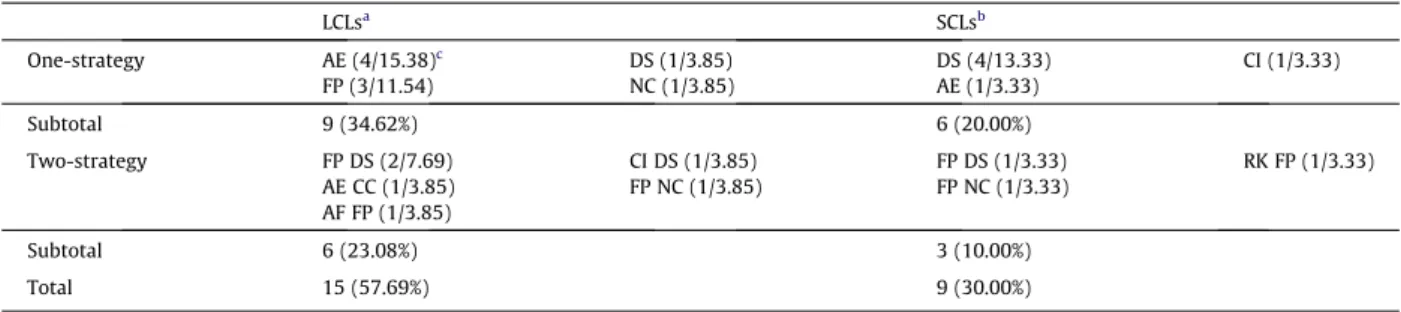
Interestingly, 15 of the 56 (26.79%) lecture closings consist of only one strategy, and another 9 (16.07%) lectures contain only two strategies in the closings. Therefore, more than two-fifths of the lecturers end lectures briefly and these short lec-ture closings mainly contain one or two of the strategies FP, AE and DS. Examples 5 and 6 illustrate one-strategy-only and two-strategy-only lecture closings.
(5) okay it’s time to stop, let’s stop. (Ending Stage, AE, L097)
(6) any other questions about what i’ve done. <PAUSE:06> okay next time we’ll start talking about carbon acids, and eno-late ions and then move on to their reactions. (Ending Stage, AF-FP, L110)
3.4. Sequences of strategies
To know how the strategies are used in combination with each other, an analysis of strategy sequences was conducted, using the Clustering function of the software AntConc. As shown inTable 4, the frequencies of the 3-strategy and 4-strategy sequences are generally low, suggesting the lack of a fixed rhetorical structure in terms of strategy sequences, probably due to the fact that lectures are oral communication in real time, as indicated byBhatia (1993) and Thompson (1994). It is also possible that lecture closings, similar to lecture introductions in Thompson’s study, do not need to have a fixed or preferred sequence of strategy patterns, in contrast with endings in other academic genres (e.g., speeches or academic essays). Table 3
Frequency of strategies in the three stages of lecture closings.
Pre-ending stage Ending stage Post-ending stage SR (14)a CC (7) QD (2) DS (28) SR (2) SR (18) LQ (4) FP (11) AE (3) NC (1) FP (24) AQ (1) NC (12) CA (2) CI (10) RK (3) AE (20) CQ (1) TR (11) DS (2) TR (8) CA (2) CI (6) NC (1) AQ (10) CC (1) AF (7) CQ (2) AF (2) CQ (6) 70 85 66 a
Number in parentheses indicates frequency.
2
Only three 3-strategy and two 4-strategy sequences have a frequency higher than five, and four of them consist of the SR-TR pair or the pair in cycles. These interactive strategy patterns suggest cyclic interactions between the lecturer and students, corresponding to the results in the preceding section. Example 7 shows a 4-strategy sequence in a conversation between the lecturer (S1) and a student (S3) in the Post-ending Stage of a lecture closing.
(7) S3: (xx) (you know) next week we we don’t have (time)
S1: let’s try for Friday and then with the option to cancel how’s that? i i would feel better if i S3: (xx) Friday like i don’t have class (xx) so
S1: oh Friday doesn’t work okay (Pre-ending Stage, SR–TR–SR–TR, S138)
The only 3-strategy pattern that does not consist of SR and TR is AE–FP–DS. These three strategies are also strategies that have both high frequency and range and occur at the Ending Stage most frequently. We may infer that these three strategies in the sequence of AE–FP–DS are probably the most essential in lecture closings. An example is given below:
(8) and uh okay so we’ve run out of time, the final page on the handouts is just an illustration, of a transgressive sequence, in the, Grand Canyon. okay, and of course you’ll notice that we have, sands at the bottom, uh then shale, then lime-stone, very much like we’ve just described, uh over here. okay on Thursday, i’ll begin by, describing or defining exactly what radioactivity is and we can continue on from there. see you Thursday. (Ending Stage, AE–FP–DS, S108)
3.5. Comparison of stages of lecture closings in LCLs and SCLs
The comparative analysis of large and small classes revealed interesting differences in the rhetorical structure of their lecture closings (seeTable 5), which in turn suggested the possible impact of class size on the teacher-student relationship and interactions in the classroom. First, the two-tailed t test performed on the frequency data of strategies in lecture closings shows a significant difference between LCLs and SCLs (p < 0.05); the difference between the two types of classes in the Pre-ending and Post-Pre-ending Stages is also significant (p < 0.05). However, the frequency of strategies at the Ending Stage between the two types of classes is not significantly different (p = 0.06).
Table 4
Frequency of strategy sequences in lecture closings.
3-Strategy 4-Strategy SR–TR–SR (10)a
SR–TR–SR–TR (6) TR–SR–TR (6) TR–SR–TR–SR (5) AE–FP–DS (6)
a Number in parentheses indicates frequency. Strategy sequences with a
frequency of 5 or higher are selected.
Table 5
Three stages of lecture closings in LCLs and SCLs. LCLsa SCLsb Pre-ending Stage CC (4/6.15)c CI (1/1.54) SR (13/8.33) RK (3/1.92) AE (2/3.08) FP (1/1.54) FP (10/6.41) CQ (2/1.28) AF (1/1.54) QD (1/1.54) CI (9/5.77) AE (1/0.64) CA (1/1.54) SR (1/1.54) TR (8/5.13) CA (1/0.64) AF (6/3.85) NC (1/0.64) CC (3/1.92) QD (1/0.64) Subtotal 12 (18.46) 58 (37.18) Ending Stage FP (14/21.54) AQ (1/1.54) DS (15/9.62) AF (1/0.64) DS (13/20.00) CQ (1/1.54) AE (10/6.41) CI (1/0.64) AE (10/15.38) NC (1/1.54) FP (10/6.41) SR (1/0.64) CI (5/7.69) SR (1/1.54) AF (1/1.54) Subtotal 47 (72.31) 38 (24.36) Post-ending Stage CA (1/1.54) NC (1/1.54) SR (18/11.54) CQ (6/3.85) CC (1/1.54) DS (1/1.54) NC (11/7.05) LQ (3/1.92) LQ (1/1.54) TR (1/1.54) AQ (10/6.41) CA (1/0.64) TR (10/6.41) DS (1/0.64) Subtotal 6 (9.23) 60 (38.46) a
n (total occurrences of strategies in LCLs) = 65.
b
n (total occurrences of strategies in SCLs) = 156.
c
Nevertheless, as we compared the amount of strategies used in the two types of classes in terms of percentages, it was revealed that the distribution of strategies in LCLs and SCLs are very different. As shown inTable 5, in LCLs, 72.31% of the strategies occur at the Ending Stage, whereas in SCLs, only 24.36% of the strategies occur at this stage. At this stage, lecturers in LCLs tend to use strategies like FP, DS and AE more frequently, suggesting a preference for a more formal lecture closing. However, lecturers in SCLs use interactive strategies like SR, TR, and AQ (answering students’ questions) more frequently at the Pre-ending or Post-ending Stages, showing that they tend to interact actively with students before wrapping up the lecture or after ending the lecture and dismiss the class in a more informal way.
In addition, lecture closings in LCLs often have short or no Pre-ending and Post-ending Stages, whereas strategies are used much more frequently at these two stages in SCLs. At the Pre-ending Stage, the percentage of strategies in SCLs is more than two times the percentage in LCLs; strategies SR, FP, CI, and TR are used most frequently; in contrast, in LCLs, only the strategy of CC (coming to a conclusion of lecture content) has a percentage higher than 5%. This suggests that there are more inter-actions at this stage in SCLs than in LCLs.
At the Post-ending Stage, the occurrences of strategies in SCLs are about four times the amount in LCLs. Only six strategies were found at this stage in LCLs and each merely occurs once. The frequent use of strategies SR, NC, AQ and TR in SCLs (hav-ing a percentage higher than 5%) suggests not only that lecturers and students have more interactions, but also that non-course-related issues are raised much more often at this less formal stage, after the lecturers have dismissed the class.
3.6. Comparison of strategies in lecture closings of LCLs and SCLs
As shown inTable 6, in general, more strategies were identified in SCLs (156 occurrences, with a mean of 5.20) than in LCLs (65 occurrences, with a mean of 2.50). Specifically, FP, DS, and AE are the top three strategies, having the highest per-centages in both frequency and range in both types of classes; they occur in half or more than half of LCLs and SCLs. This result can be expected since these strategies (by definition) use marked lexical expressions for the closing of lectures, per-forming a clear discourse function of signaling to students the lecturer’s intention to end the lecture.
However, a striking difference between LCLs and SCLs is the great discrepancy in the use of SR and TR. These two strat-egies in SCLs far outnumber LCLs in both frequency and range, indicating a preference for interactions in SCLs. Similarly, strategies NC, AQ and CQ have a much higher frequency and range in SCLs than in LCLs, revealing that small class size may create a more relaxed atmosphere so that lecturers and students are more likely to talk about non-course related issues and students are more likely to raise questions. It might be assumed that students in large classes are likely to stay after the lecture to ask questions or to discuss certain issues with the lecturer. However, as shown in the data, it is not a very common practice in large classes.
In contrast, strategies AE and CC have both higher frequencies and percentages in range in LCLs than in SCLs, indicating that more lecturers in large classes tend to conclude their lectures or indicate that the lecture is going to an end more fre-quently than lecturers in small classes.
A close examination of the overall rhetorical structure of LCLs and SCLs shows that more than half of the LCLs (57.69%) use only one or two strategies, whereas only 30% of SCLs use one or two strategies (seeTable 7). This suggests that more lecturers in LCLs end their class rather abruptly, compared to those in SCLs, where the ending of the class more often proceeds in all
Table 6
Frequency and range of strategies in lecture closings in LCLs and SCLs. Frequency Range LCLs SCLs LCLsa SCLsb FP 15 (23.08)c 20 (12.82) 15 (57.69) 18 (60.00) DS 14 (21.54) 16 (10.26) 13 (50.00) 15 (50.00) AE 12 (18.46) 11 (7.05) 12 (46.15) 10 (33.33) CI 6 (9.23) 10 (6.41) 6 (23.08) 8 (26.67) CC 5 (7.69) 3 (1.92) 5 (19.23) 3 (10.00) AF 2 (3.08) 7 (4.49) 2 (7.69) 6 (20.00) CA 2 (3.08) 2 (1.28) 2 (7.69) 2 (6.67) NC 2 (3.08) 12 (7.69) 2 (7.69) 9 (30.00) SR 2 (3.08) 32 (20.51) 2 (7.69) 10 (33.33) AQ 1 (1.54) 10 (6.41) 1 (3.85) 4 (13.33) CQ 1 (1.54) 8 (5.13) 1 (3.85) 4 (13.33) LQ 1 (1.54) 3 (1.92) 1 (3.85) 2 (6.67) QD 1 (1.54) 1 (0.64) 1 (3.85) 1 (3.33) TR 1 (1.54) 18 (11.54) 1 (3.85) 6 (20.00) RK 0 (0.00) 3 (1.92) 0 (0.00) 3 (10.00) Total 65 (100) 156 (100) a
Range of LCLs refers to the distribution of each strategy in 26 large-class lectures.
b
Range of SCLs refers to the distribution of each strategy in 30 small-class lectures.
c
three stages. Strategies AE and FP are used most frequently in one-strategy-only lecture closings in LCLs; however, strategy DS is the most preferred in SCLs. Examples of one-strategy and two-strategy lecture closings are provided in Examples 5 and 6 above.
Table 8shows the strategy sequences in LCLs and SCLs. It can be observed that most of the common strategy sequences consist of interactive strategies SR and TR in cycles, but they occur only in SCLs. Another interactive strategy pair CQ and AQ also occurs in SCLs, forming 3-strategy sequences with SR and NC, respectively. These results provide strong evidence of the more interactive nature of SCLs than LCLs. In contrast, the sequence pattern of AE–FP–DS occurs comparatively more often in LCLs than in SCLs, suggesting that lecturers in large classes are more likely to remind students of the end of lecture or indi-cate the plans for next class when they dismiss the class. Examples 7 and 8 in the previous section illustrate the 4-strategy and 3-strategy sequence in SCLs.
3.7. Frequency of personal pronouns
The frequency analysis of I, you, and we showed that for all lecture closings, the differences among the three pronouns are substantial (seeTable 9). The first-person singular pronoun I and its variants (i.e., my, me, and mine) occur most frequently (36.98%), followed by the second–person pronoun you and its variants (i.e., your and yours) (34.42%), whereas the first-per-son plural pronoun we and its variants (i.e., our, us, and ours) occur least frequently (16.06%). The result is consistent withLee (2009)who showed that we occurs less frequently than I and you. However, the finding is in strong contrast toKuo’s (1999)
analysis of the frequencies of these personal pronouns in research articles. Kuo found that we and its variants occur far more frequently than other personal pronouns in research articles while I does not occur at all and you has very few occurrences. These differences may result from many possible variables in the two genres, including their distinctive communicative Table 7
One-strategy and two-strategy lecture closings in LCLs and SCLs. LCLsa SCLsb One-strategy AE (4/15.38)c DS (1/3.85) DS (4/13.33) CI (1/3.33) FP (3/11.54) NC (1/3.85) AE (1/3.33) Subtotal 9 (34.62%) 6 (20.00%) Two-strategy FP DS (2/7.69) CI DS (1/3.85) FP DS (1/3.33) RK FP (1/3.33) AE CC (1/3.85) FP NC (1/3.85) FP NC (1/3.33) AF FP (1/3.85) Subtotal 6 (23.08%) 3 (10.00%) Total 15 (57.69%) 9 (30.00%) a n (number of lectures in LCLs) = 26. b n (number of lectures in SCLs) = 30. c
The first number in parentheses indicates occurrences and the second number indicates percentages (%).
Table 8
Strategy sequences in lecture closings in LCLs and SCLs. LCLsa SCLsb 3 AE–FP–DS (3/4.62)c SR–TR–SR (10/6.41) CQ–AQ–SR (3/1.92) TR–SR–TR (6/3.85) NC–CQ–AQ (3/1.92) AE–FP–DS (3/1.92) 4 0 SR–TR–SR–TR (6/3.85) TR–SR–TR–SR (5/3.21) a
n (total occurrences of strategies in LCLs) = 65.
b
n (total occurrences of strategies in SCLs) = 156.
c The first number in parentheses indicates occurrences and the second number indicates percentages (%).
Table 9
Frequency of personal pronouns in lecture closings in LCLs and SCLs.
LCLs SCLs Total N Frequencya N Frequency N Frequency I/my/me/mine 53 22.07 215 42.93 268 36.17 We/our/us/ours 43 17.91 76 15.18 119 16.06 You/your/yours 86 35.82 166 33.15 252 34.01 a
purposes and audience. The result, nevertheless, suggests that classroom lectures may be considered a more interactive genre than research articles, particularly in lecture closings; lecturers may finish the more monologic part of lectures and often discuss course-related issues, such as homework or exams, with students, and students may ask questions about spe-cific lecture content or next week’s plan. The high frequency of I and you in closings clearly demonstrates great personal involvement and a high level of interactivity.
With respect to the use of the three pronouns in LCLs and SCLs, raw frequency data showed that the frequency of all three personal pronouns together is much higher in SCLs than in LCLs. For individual pronouns, I and its variants are used more frequently in SCLs, but you and we have a slightly higher frequency in LCLs. However, the two-tailed t test showed that the p value for the frequency of all personal pronouns (I, you, and we) in these two types of classes is only near the signif-icance level (p = 0.0503). For individual pronouns, LCLs and SCLs differ significantly in the frequency of I, but not in that of you and we. These results seem to correspond to the analysis of strategies, as reported earlier. For example, the more inter-active strategies such as TR, SR, AQ and LQ (raising questions about lecture content) have higher frequencies in small classes than in large classes; both the lecturer and students use I much more frequently than you and we to ask and answer each other’s questions or respond to each other’s ideas. On the other hand, as shown inTables 5 and 6, lecturers in large classes tend to explain course-related issues (CI), indicate the end of the lecture (AE), and dismiss the class (DS) more often than lecturers in small classes; the inclusive we and you may be more frequently used than I in these strategies, informing the students of how they are expected to subsequently act.
These findings are not completely consistent withLee (2009), who found that in lecture introductions, the frequencies of both I and you are higher in SCLs than in LCLs. There are some possible reasons for the difference. Firstly, Lee’s study focused on lecture introductions whereas this study considers lecture closings. Moreover, inLee (2009), the various forms of the pro-nouns and the propro-nouns appearing with contracted verbs were not taken into account.
Since either I or you can have a number of semantic referents, merely counting the occurrences of the pronouns may not fully reveal how the use of personal pronouns is related to class size and the interactive nature of lectures in different types of classes. The semantic referents of I, you, and we as well as their strategic use, as discussed in the next section, may provide a better explanation of the role that class size may play in lecture closings.
3.8. Semantic-pragmatic meanings of I, you, and we
The semantic referents of I, you, and we were identified on the basis of the discourse context where each personal pro-noun occurs. The semantic-pragmatic interface that the context may reveal was given special attention. An attempt was also made to integrate the results of the analysis of semantic referents with those of strategies. In other words, specific semantic referents in relation to a strategy or strategies are discussed.
It was noticed that lecturers may sometimes indicate that their lectures are videotaped or have a short conversation with the researcher of the MICASE project. Since the researcher obviously does not appear in typical classroom lectures, s/he was not taken into account in this study.
In total, four semantic referents of I were identified in the corpus.Table 10shows that in both large and small classes, the lecturer almost always uses the first-person singular pronoun I to refer to himself/herself (95.83%). This use of I may suggest to the students the role of the speaker as the lecturer, and the power differentials between the lecturer and students, thus I in this sense often stands in opposition to the use of you to refer to the student(s). The fact that most occurrences of I refer to the lecturer is understandable in view of the need of the lecturer to show explicitly or implicitly his/her role in lecturer–stu-dent(s) interactions in most contexts.
Five occurrences of I were found to refer to anyone in the field and all in the context of explaining the technical content of the lecture, as shown in Example 9. ‘‘Anyone in the field’’ is the role of a representative disciplinary persona which lecturers often use when providing an example or explicating a method or procedure during the lecture.
Table 10
Referents of I/my/me/mine in lecture closings in LCLs and SCLs.
Referent LCLs SCLs Total
N % N % N %
Lecturer as speaker
1. Lecturer 51 98.08 133 95.00 184 95.83 2. Anyone in the field 0 0.00 5 3.57 5 2.60 3. Anyone (general people) 1 1.92 0 0.00 1 0.52 4. Lecturer and students 0 0.00 2 1.43 2 1.04 Total 52 100.00 140 100.00 192 100.00 Student(s) as speaker
1. Student 1 100.00 75 100.00 76 100.00 2. Anyone in the field 0 0.00 0 0.00 0 0.00 3. Anyone (general people) 0 0.00 0 0.00 0 0.00 4. Lecturer and students 0 0.00 0 0.00 0 0.00 Total 1 100.00 75 100.00 76 100.00
(9) this is called a discrete logarithm. so, instead of working with the actual numbers, i can go, uh, and work, with the indices. it’s just like, the indices tell me, what number i have to use, what, i have to raise two-to-the-third power, to get eight. i have to raise two, to-the, ninth power to get six. (S007)
Two occurrences of I refer to both the lecturer and students. Both occur in a small class lecture when the lecturer first uses a we to refer to what s/he and the students are doing, but then uses I to repeat what can be done and compare two different methods, suggesting, from a lecturer’s professional perspective, appropriate activity for both students and himself/herself. One occurrence of I was found to refer to anyone (general people), serving as a general persona in exemplification, similar to the use of I to refer to anyone in the field. When the speaker is a student, all the occurrences of I refer to the student him-self/herself.
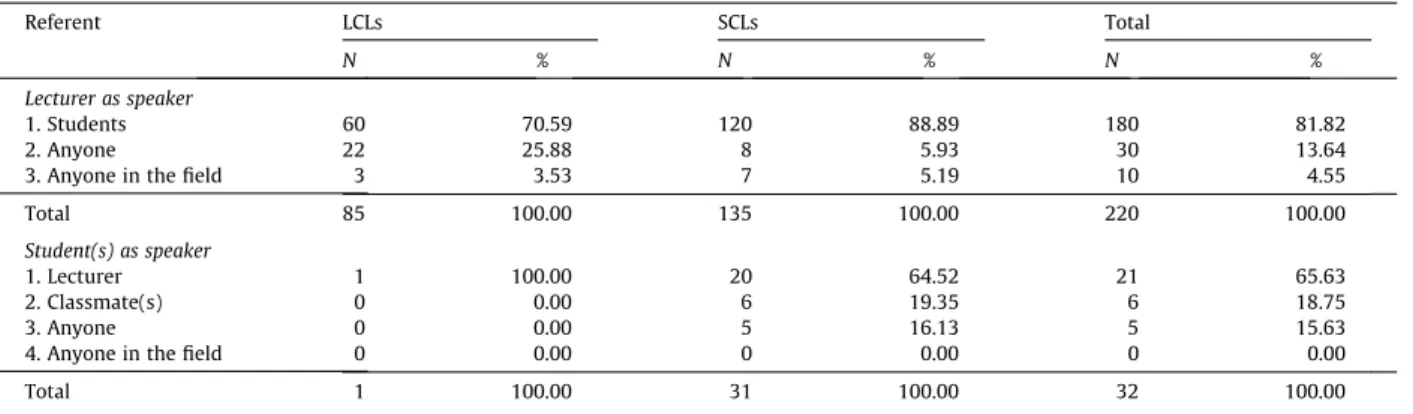
Table 11shows the referents of you in lecture closings. In most occurrences, the lecturer uses you to address the students (81.82%). Nevertheless, the lecturer also uses you to refer to anyone (general people) (13.64%) or anyone in the field (4.55%), both in the context of explaining a method or procedure. For instance, in the following example, you is used to refer to any member of society. The function of you here is to involve students as the persona in the exemplification the lecturer is pro-viding. We can observe that these two referents together have a higher frequency in large classes than in small classes. A possible reason is that when lecturing in large classes, lecturers may desire more student involvement.
(10) and if you are middle class, that’s the lowest of the low, man if you only get one trip to Hawaii per year, oh you’ve gone to the absolute bottom of, of the social ladder. (L090)
When the students are speakers, you may refer to not only the lecturer, anyone, or anyone in the field, but to the speaker student’s classmates as well. This occurs in the situation when students have a conversation with each other, or when the lecturer has conversation with several students. In the following example, a student speaker (S2) is asking another student (Brody, SU-m) if he is going to Amsterdam.
(11) (The lecturer is asking students where they are going for their spring vacation.) S1: is someone really going to Amsterdam? Cool. Are you going Brody?
SU-m: yeah.
S1: oh I wanna show you Brody’s S2: you’re going to Amsterdam?
S1: Brody did this great cover for his um, [S2: (xx) New York.] for his paper, wait. But where is my ba-here it is. (S085)
More interesting results reside in the semantic referents of we. As shown inTable 12, although the largest proportion of the occurrences of we refers to the lecturer and students (40.57%), other referents of we together constitute approximately three-fifths of the occurrences. This reflects the more flexible and probably also strategic uses of we in lecture closings. In particular, the frequency of we to actually mean the lecturer himself/herself is remarkable (29.25%), suggesting that the turer tends to replace an exclusive I with an inclusive we for either positive or negative politeness. In Example 12, the lec-turer is indicating his/her intention to end the class and we is used to enhance positive politeness. This use of we is common in lecture closings, particularly in the strategy of FP (indicating the plan for the future) and AE (indicating the end of lecture). A possible explanation is that when signposting to the students what s/he would like to do in the next hour or the following week, or when s/he intends to end the lecture, the lecturer tends to present these as shared concerns/goals with the students, to show that s/he and the students are cooperators (Brown & Levinson, 1987). However, in Example 13, the lecturer uses we (the second we) for negative politeness, mitigating a possible threat to the students’ face want, since s/he is talking about an exam which the students may dislike; this often occurs in CI (explaining course-related issues).
Table 11
Referents of you/your/yours in lecture closings in LCLs and SCLs.
Referent LCLs SCLs Total
N % N % N %
Lecturer as speaker
1. Students 60 70.59 120 88.89 180 81.82 2. Anyone 22 25.88 8 5.93 30 13.64 3. Anyone in the field 3 3.53 7 5.19 10 4.55 Total 85 100.00 135 100.00 220 100.00 Student(s) as speaker
1. Lecturer 1 100.00 20 64.52 21 65.63 2. Classmate(s) 0 0.00 6 19.35 6 18.75
3. Anyone 0 0.00 5 16.13 5 15.63
4. Anyone in the field 0 0.00 0 0.00 0 0.00 Total 1 100.00 31 100.00 32 100.00
(12) kay well it’s after ten so we’ll stop here, and we’ll pick up with structs tomorrow. (S099)
(13) uh, plan your time because we just have fifty minutes to get it in, uh we’ll probably try to pass them out as you come into the room so if you get here, on time you’ll have a better chance to finish up. (S136)
We may further compare the use of I or we to refer to the lecturer himself/herself. In Example 14, when the lecturer uses I, s/he emphasizes the role of a lecturer (that is, assigning practice problems for homework), whereas inclusive we is used when the lecturer expects to wrap up the lecture.
(14) . . . and next Thursday i’m also gonna assign i mean this Thursday next lecture i’m gonna assign uh practice problems for homework. any questions before we wrap up. . .? (S052)
We can also be used to mean a larger group of general people (12 occurrences) or anyone in the field (10 occurrences), as shown in Examples 15 and 16. Both semantic referents occur much more frequently in large classes than in small classes, again probably because lecturers in large classes tend to call more student attention to the lecture content.
Ten occurrences of we refer to students only, mostly occurring in the context when the lecturer informs the students of course-related issues, such as an assignment or exam, probably for the purpose of addressing these issues as shared con-cerns, as illustrated in Example 17. Here the strategic inclusive we is used to actually refer to the students, who are going to take a quiz. I is used in the same utterance to refer to the lecturer himself/herself (that is, the role of a lecturer who is empowered to give a quiz).
(15) tha- that’s just a real life style that depends on keeping trying, reproducing and eventually hope we get a, successful clutch. (S077)
(16) it’s just, more of the same. biology we are still figuring out how life works, um, we are still figuring out basic, funda-mental questions. how cancer works, um whether there’s life on other planets. (L014)
(17) uh for next time i wanna then move, on into looking at the Roman family, and then as i say at the last part of of the time, uh we’ll have that quick quiz. take care. (L150)
When students are speakers, the referents of we can be the speaker student, the speaker student and other students, the whole class, or the whole class and the lecturer.
Comparing the semantic referents of we in large and small class lecture closings, we may observe that in both types of classes, lecturers tend to use we to refer to both lecturers and students or to lecturers. However, in large classes, nearly two-fifths (39.53%) of the occurrences of we refer to a larger group of general people, and anyone in the field. The percentage is much higher than that in small classes (7.94%). This finding suggests that lecturers in large classes may adopt a more for-mal lecturing style, using we for enhancing positive politeness.
When we correlated the results from the analysis of personal pronouns with those of the strategies, we noted that some are closely correlated with each other. For example, when you and we are used to refer to anyone in the field, or anyone/lar-ger group of general people, they often occur in CC and RK (summarizing or reviewing key points) since this use is correlated with specific lecture content. The use of we to refer to only the lecturer can occur in FP, AE, AF (asking if students have ques-tions), and CI, but more often in the first two strategies, while the referent of we for students also occurs in CI, AE, and FP; both are used strategically for positive or negative politeness, as indicated earlier. However, the lecturer may be implicitly assuming a different discourse role and status from the students. For example, in the lecture closing below, the lecturer is giving the students an assignment and telling them what he expects them to do; we, referring to the students, is used in
Table 12
Referents of we/our/us/ours in lecture closings in LCLs and SCLs.
Referent LCLs SCLs Total
N % N % N %
Lecturer as speaker
1. Lecturer 9 20.93 22 34.92 31 29.25 2. Students 1 2.33 9 14.29 10 9.43 3. Lecturer and students 16 37.21 27 42.86 43 40.57 4. Anyone in the field 6 13.95 4 6.35 10 9.43 5. Larger group of general people 11 25.58 1 1.59 12 11.32 Total 43 100.00 63 100.00 106 100.00 Student(s) as speaker
1. A student 0 0.00 2 15.38 2 15.38 2. A student and other student(s) 0 0.00 3 23.08 3 23.08 3. The whole class 0 0.00 7 53.85 7 53.85 4. The whole class and lecturer 0 0.00 1 7.69 1 7.69
the first sentence and the last sentence to mitigate disfavor. It can be noted that you is used a number of times in the sen-tences between these two we’s. The lecturer is conscious of his own role as an instructor but uses the pronoun we strategi-cally for pragmatic purposes.
(18) . . .because this week we’re gonna, have a search. . .[SU-f: oh no] about juvenile delinquents. Only Freetext. let me tell you this a thousand times you’re gonna search Freetext, no descriptors however you can use descriptors. . . .okay we’re out of here. (S065)
An overview of all the referents of the three personal pronouns I, you, and we reveals two interesting phenomena. One is that all three personal pronouns I, you, and we can be used to refer to anyone in the field, or anyone/a larger group of general people; this is, as mentioned earlier, a persona for explication or exemplification of a method or process. The other phenom-enon is that lecturers sometimes make shifts in the use of personal pronouns for pragmatic purposes. Lecturers may use the same personal pronoun to refer to different referents or use different personal pronouns to refer to the same referent. In Example 19, all three personal pronouns I, you, and we are used. The first I and you refer to the lecturer and the students, respectively. However, the first we is then used to refer to the students, indicating what they are required to do. Following this is a more detailed description of the job, and you is used to refer to what the lecturer expects the students to do. What attracts our attention is the change from I to we in the next utterance (‘‘what i c-we care about’’). The use of I implies that the speaker perceives her role to be that of the lecturer. Nevertheless, the speaker suddenly catches herself and replaces I with we. She is using inclusive we to mitigate student disagreement. The last we then refers to both herself and the students. Therefore, in this example, different pronouns you and we are used to refer to the same referent, the students, and the same pronoun we is used to refer to different referents, the lecturer and both the lecturer and students.
(19) okay i have one little task, you’re all ready to race out and jump in the lake and do something. we need to compile the info from this summer, this morning, which is not a big job. if you go into your groups, and, what you need to do i don’t care about the individual points. what i c- we care about, is, uh, doing like we typically do on the checklist. (S028)
The flexible uses of personal pronouns are characterized by the variety of referents personal pronouns can have. The prag-matic meanings can be derived from the discourse contexts as well as the speaker’s attitude and intention.
4. Conclusion
This study has investigated the rhetorical structure and personal pronouns usage of academic lecture closings; it has also examined whether class size has an impact on them. The analysis of the rhetorical structure reveals that there is not a pre-ferred sequence of strategies across the three stages in academic lecture closings. The results also indicate that only a small percentage of lecture closings, mostly in small classes, contain all three stages, while in large classes, more than half of the lecturers end their lectures briefly in one stage, mostly the Ending Stage.
Although a total of 15 strategies are used in the lecture closings, none of them is obligatory. FP, DS, and AE are the strat-egies that lecturers use most frequently. They usually occur at the Ending Stage. In other words, lecturers most frequently indicate that the class is going to the end and address the course plan for the next class before they verbally dismiss the class. Many of the interactive strategies occur at the Post-ending Stage, suggesting that this stage provides an opportunity for tea-cher-student interaction and also for the lecturers to establish a closer rapport with students.
An unexpected result is the very few occurrences of strategies LQ, RK, and QD (raising questions or issues for discussion) despite the common advice in teaching resource books that summarizing at the end of lectures and providing students chances to ask questions are good lecturing techniques because they help students memorize and clarify key concepts in the lectures. In addition, it is suggested that drawing explicit conclusions provides continuity and indicates closure since stu-dents need to see how new topics relate to what they have already learned as well as to what they will be learning (Davis, 2009; McKeachie, 2002). However, it seems few lecturers actually apply these strategies in their lecture closings. As McKea-chie (2002)himself commented, after having provided various teaching tips on how to conclude lectures, ‘‘having suggested all this, I must admit that my own greatest problem as a lecturer is that I never seem to be ready for the conclusion until it is already past time to dismiss the class’’ (p. 61).
The comparative analysis shows that class size does influence the rhetorical structure of lecture closings. More occur-rences of strategies, particularly more interactive strategies, are identified in small classes than in large classes. Most of the non-course-related issues are also raised in small classes, especially at the Post-ending Stage. Thus lecturers are advised to make use of this stage to establish close rapport with students through course- or non-course-related interactions.
With respect to the use of personal pronouns, I and you are used far more frequently than we, suggesting that there may be a lot of interactions between the lecturer and students in lecture closings since a great majority of the occurrences of I and you refer to the lecturer himself/herself and the students, respectively. We seems to be used in a more flexible way by lec-turers and has a variety of referents. Particularly, the lecturer tends to use inclusive we, instead of I, to enhance student engagement and rapport, or mitigate student disfavor. Comparing the frequency and semantic referents of these personal