國立交通大學
資訊管理研究所
碩士論文
在行動隨意網路中利用群集與情境資訊的
服務發現
Service Discovery using Cluster and Context Information in
Mobile Ad Hoc Networks
研究生:潘律甫
指導教授:羅濟群教授
中華民國 102 年 6 月
在行動隨意網路中利用群集與情境資訊的服務發現
Service Discovery using Cluster and Context Information in
Mobile Ad Hoc Networks
研究生:潘律甫 指導教授:羅濟群 Student:Lu-Fu Pan Advisor:Chi-Chun Lo國立交通大學
資訊管理研究所
碩士論文
A ThesisSubmitted to Institute of Information Management College of Management
National Chiao Tung University in Partial Fulfillment of the Requirements
for the Degree of
Master of Science in Information Management June 2013
Hsinchu, Taiwan, the Republic of China
i
在行動隨意網路中利用群集與情境資訊的服務發現
研究生:潘律甫 指導教授:羅濟群 老師
國立交通大學資訊管理研究所
摘要
隨 著 動 態 網 路 與 行 動 隨 意 網 路 (MANET) 的 發 展 , 服 務 發 現 (Service Discovery)機制在行動隨意網路中可進行資源和服務的共享,因此,如何在行動 節點的電力和儲存能力有限的情況下,快速發現正確可用服務的服務發現機制足 以影響整個行動隨意網路系統的效能。GSD (Group-based Service Discovery Protocol)為隨意網路中典型的服務發現協定,但是有太多的冗餘封包傳送造成 大量的網路傳輸量(Network Overhead),為了改善這個情況,本論文提出了一個 基於群集與情境資訊的隨意網路發現機制: Context Node enhanced Group-based Service Discovery Protocol (CNGSD),利用群集的型式搭配群組資訊來達到需 求封包轉送、增加服務發現的效率與減少冗餘封包的傳送。此外透過情境資訊能 夠讓使用者取得更適合的服務,本論文利用 NS-3 進行實驗模擬,模擬結果顯示 了 CNGSD 與 GSD 的比較,CNGSD 具有較好的服務發現效能,平均少了 71.2%網路 傳輸量;回應時間也比較快,平均加速了 44.5%。Service Discovery using Cluster and Context Information in
Mobile Ad Hoc Networks
Student: Lu-Fu Pan Advisor: Dr. Chi-Chun Lo
Institute of Information Management
National Chiao Tung University
Abstract
With growing of dynamic networks and mobile ad hoc network (MANET), service discovery is prerequisite part in pervasive environment. It can share the resources and services of MANET. In the case of limited power and storage capacity of the mobile node, an effective mechanism for discovering service affects the performance of the system. GSD (Group-based Service Discovery Protocol) is a typical service discovery protocol in MANET, but it creates enormous network overhead due to redundant packet transmission. In this paper, a cluster-based and context information service discovery approach: Context Node enhanced Group-based Service Discovery Protocol (CNGSD) is proposed. In form of clustering with group information leads to intelligence forwarding the request packets, increase performance of service discovery, and reduce redundant disseminative packets. Besides, clients can get better service matching by using context information. In this paper, we use GSD as benchmark and compare with CNGSD in NS-3. Simulation results show that our approach has better performance than GSD with an average 71.2% less network overhead. The response time also accelerated with an average of 44.5%.
iii
致謝
能夠順利完成研究所碩士的學業,首要感謝我的家人,他們對我的支持與鼓 勵,讓我沒有後顧之憂,可以把重心放在學業上,不論遇到什麼挫折與困難,隨 時都能夠有一個依靠,讓我順利完成學業。 接著我要感謝我的指導教授羅濟群老師,對我的指導與幫助,讓我不管是在學術 領域上還是做人處事的道理上都有更深一層的進步,思維能夠更細膩更周全,此 外,我更要感謝實驗室博班的學姐張栩嘉,帶領著我完成論文,不時給我的叮嚀 與建議,讓我在研究的路上不會迷失方向,我還要感謝其他的博班學長、學姊: 斯寅、志華,在各方面給我的協助與經驗的分享,真的受益良多。 再來要感謝的是泊寰學長,給我機會能夠在學長的公司工讀,讓我能夠有機 會不斷的汲取各種技術並且茁壯成長,同時了解現在業界的生態發展,使我能夠 具備更多的技能與競爭力。 然後我還要感謝實驗室的同學─建宏、楷名、健彰、家宏、宗育、果、珈媛、 岱蓉、美君,他們在學業上與生活上帶給我的點點滴滴與歡樂。當然也少不了學 弟妹們帶給我各式各樣的歡樂氣氛,讓我在苦悶的研究生涯中依舊能保持愉快的 心情。Contents
摘要... i Abstract ... ii 致謝... iii Contents ... iv Chapter 1 Introduction ... 11.1Research Background and Motivation ... 1
1.2Research Objective ... 2
1.3Research Approach ... 2
1.4Organization... 3
Chapter 2 Literature Reviews ... 4
2.1 Mobile Ad Hoc Networks (MANET) ... 4
2.1.1 Service Discovery Protocol in MANET... 4
2.2 Overview of GSD ... 9
2.2.1 Service Advertisements and Peer-to-Peer Caching ... 9
2.2.2 Service Discovery Routing ... 11
2.3 Context Information in Service Discovery Protocols ... 12
2.4 Clustering for MANET ... 14
2.5 Network Simulator 3 (NS-3) ... 15
2.6 Summary of Related Works ... 15
Chapter 3 A Service Discovery Protocol using Cluster and Context Information in Mobile Ad Hoc Network ... 17
3.1 Design Issues ... 17
3.2 Notation ... 18
3.3 Context Node enhanced Group-based Service Discovery Protocol (CNGSD) ... 19
v
3.3.2 Service Advertisement Phase ... 22
3.3.3 Service Discovery Process Phase ... 25
3.3.4 Service Maintain Phase ... 29
3.3.5 Message Type in CNGSD ... 31
3.4 Discussion ... 32
Chapter 4 Simulation and Result Analyses ... 33
4.1 Simulation ... 33 4.1.1 Simulation Scenario ... 33 4.1.2 Simulation Environment ... 34 4.1.3 Simulation Setup ... 35 4.1.4 Simulation Assumption ... 35 4.1.5 Simulation Metrics ... 36
4.2 Results and Analyses ... 36
4.3 Discussion ... 40
Chapter 5 Conclusions and Future Works ... 41
5.1 Conclusions ... 41
5.2 Future Works ... 42
List of Figures
FIGURE 2.1EXAMPLE OF SERVICE ADVERTISEMENT MESSAGE IN GSD ... 10
FIGURE 2.2EXAMPLE OF SERVICE DISCOVERY IN GSD ... 12
FIGURE 3.1STATE DIAGRAM OF CNGSD ... 20
FIGURE 3.2THE PROCEDURE DIAGRAM OF THE “NETWORK FORMATION PHASE” ... 21
FIGURE 3.3EXAMPLE OF THE “NETWORK FORMATION PHASE” IN CNGSD ... 21
FIGURE 3.4THE PROCEDURE DIAGRAM OF “SERVICE ADVERTISEMENT PHASE” ... 23
FIGURE 3.5THE MESSAGE FLOW OF “SERVICE ADVERTISEMENT PHASE” ... 23
FIGURE 3.6EXAMPLE OF “SERVICE ADVERTISEMENT PHASE” IN CNGSD ... 24
FIGURE 3.7THE PROCEDURE DIAGRAM OF “SERVICE DISCOVERY PROCESS PHASE” ... 26
FIGURE 3.8THE MESSAGE FLOW OF “SERVICE DISCOVERY PROCESS PHASE” ... 27
FIGURE 3.9EXAMPLE OF SERVICE REQUEST IN CNGSD’S “SERVICE DISCOVERY PROCESS PHASE”... 28
FIGURE 3.10EXAMPLE OF SERVICE REPLY IN CNGSD’S “SERVICE DISCOVERY PROCESS PHASE” ... 29
FIGURE 3.11THE PROCEDURE DIAGRAM OF “SERVICE MAINTAIN PHASE” ... 30
FIGURE 3.12MESSAGE TYPE IN CNGSD ... 32
FIGURE 4.1RESPONDS TIME OF SERVICE DISCOVERY PROCESS ... 37
FIGURE 4.2PACKETS LOST RATIO ... 38
FIGURE 4.3TOTAL NUMBER OF HELLO MESSAGE TRANSMITTED ... 39
vii
List of Tables
TABLE 2.1COMPARISON OF DIRECTORY-BASED AND DIRECTORY-LESS SDPS ... 8
TABLE 2.2SYMBOLS USED IN DEMONSTRATING FIGURE ... 10
TABLE 2.3SUMMARY OF RELATED WORKS ... 16
TABLE 3.1NOTATION DEFINITION ... 18
TABLE 3.2SYMBOLS OF EXAMPLES ... 19
TABLE 4.1SIMULATION ENVIRONMENT ... 34
Chapter 1 Introduction
1.1 Research Background and Motivation
Mobile Ad Hoc Network (MANET) is a kind of dynamic networks, and it could provide various services which include hardware and software without any infrastructure[1]. The clients can connect the services wirelessly. On the other hand, data services like files and music can be transmit from one node to another node. For operating these services, a device must be locate in the network and invoke the required services.
Therefore, Service Discovery Protocol (SDP) plays an important role in the MANET, and lots of articles have been proposed [1-3]. Through SDP make services of MANET to be found and imposed. The normal manner for service discovery is the client who in the network gets the required service and directly communicates with the service. However, the better way for the service discovery needs minimal client implication and gets the most suitable one.
The context information can improve the service matching of the result which be found through SDPs. Although context aware mechanisms are always implemented in directory-based architecture such as [4-6], directory-less solutions do not pay attention to this issue. Combining context information with directory-less architecture, the approach will possess both better service matching and mobility in the MANET.
There are several service discovery protocols have been proposed in MANET and some of them inspired us in this paper, for instance, GSD, Jini, SLP, and so on. We will briefly describe in the following sections.
1.2 Research Objective
A directory-less architecture which should not depend on specific node is proper in the pervasive computing environment. Besides, we need an efficient approach to discover services in the network. A efficient service discovery approach can create little network overhead when the network forward the request message and reply message between services and clients in addition to service advertisement message. Moreover, it can provide a better result for clients with context information which contains dynamic properties depends on the type of services. If combining context information with directory-less architecture, the approach will possess both better service matching and mobility in the MANET.
1.3 Research Approach
In this paper we propose an efficient service discovery approach which is based on group-based service discovery protocol (GSD)[7, 8] with context information: Context Node enhanced Group-based Service Discovery Protocol (CNGSD). In this approach, the network will divided into several clusters, and each cluster will elect a clusterhead, called Context Node which is mainly responsible for most of the messages dissemination of service discovery. Additionally, CNGSD has Service Weight Table (SWT) to find out the services according to clients’ preferences. CNGSD is a two-tier and directory-less architecture. By using clusterheads deal with more dissemination can create less overhead than GSD, and imposing SWT can facilitate clients find the most suitable service in MANET.
1.4 Organization
The remaining part of this paper is structured as follows. Chapter 2 contains the literature reviews including the typical directory-based and directory-less SDPs. Second, the overview of GSD will be described. Third, we briefly introduce context information in SDPs. Fourth, clustering algorithm for MANET will be presented. Last, a summary and comparison of these related work is given. Chapter 3, we will describe the proposed approach CNGSD. In Chapter 4, we present the simulation result and analysis of GSD and GNGSD. Chapter 5 concludes this paper and proposes some future works.
Chapter 2 Literature Reviews
In this chapter, we first briefly introduce Mobile Ad Hoc Network and the related Service Discovery Protocol (SDPs). In the end of this section, a comparison table of SDPs is given. Second, an overview of GSD is presented. Third, we present the context information in service discovery protocol. Fourth, clustering algorithm for MANET will be introduced. Last, a summary of these related works is given.
2.1 Mobile Ad Hoc Networks (MANET)
MANET [1-3] consists of a set of mobile nodes, as a typical dynamic network without infrastructure in pervasive environments. Each mobile node in a MANET is free to move independently, and links with neighbor nodes frequently for maintaining network topology. Clients in the network can connect the services wirelessly. In the past, MANET applies to military operation, disaster rescue, and environment
monitoring because of the resource limitation in nodes. However, with the growth of nodes capacity, mobile nodes are able to share the resources and data services recently. Thus, how to find the required services is an important issue in the MANET. We will introduce the major service discovery protocol in the following section.
2.1.1 Service Discovery Protocol in MANET
Generally, SDPs classified into two categories: directory-based and
directory-less[9]. In directory-based SDPs, there is a directory node in the networks, and request packets form clients have to forward to the directory node first. Then the node will search the matching service in the network which always implicated in wire network. In the beginning, services in directory-based architecture should register with directory node when they join the network. For example, Salutation, Jini, UPnP, and SLP are all directory-based architecture.
Salutation[2, 3]
Salutation is one of the major cooperation architecture to deal with service discovery and exploitation a wide set of application and equipment in mobile ad hoc network. In salutation architecture, there are two core components: salutation manager and transport manager. Salutation manager is a directory in the network and it is defined as a service broker: “A service provider registers its capability with a Salutation Manager. When a client asks its local Salutation Manager for a service search, the search is performed by coordination among Salutation Managers. Then, the client can use the returned service. ”. Transport Manager s provide reliable communication channel, regardless of what the underlying network transports are.
Jini[2, 3, 10]
Jini is middleware network technology that support a set of application
programming interface (API) and protocol, it can meet home network requirement. Jini technology provides distribute environment for federating clients, devices, and services through Java Remote Method Invocation (RMI). Each device publishes its interface that other devices in the network can communicate with it and access the specific service. All the service providers register their service announce with lookup service first. In this process, service providers upload the serialized Java object, named service proxy. The lookup service is the repository of services offered by the network. When clients request for specific services, they sent service requests to lookup service and lookup service will return the service proxy object to clients if there are matching service. Once the client gets the proxy, it can interact with the network service directly through the proxy and establish a communication channel.
UPnP[2, 3, 5]
Universal Plug and Play is a peer to peer architecture in mobile ad hoc network; it can connect intelligent applications, wireless devices, and PCs in the network. A device can join the network dynamically and get an IP address which is automatic configured. Besides, it convey its capabilities on request, learns the presence and capabilities of other ones in the network. UPnP leverages TCP/IP, UDP, HTTP, and XML, to enable control and data transmit among network devices in the home or indoors seamlessly. UPnP uses Simple Service Discovery Protocol (SSDP) in service discovery process. Through SSDP, devices announce their presence and discovery others or services. SSDP uses HTTP over multicast and unicast UDP. UPnP consists of three major parts: devices, services, and control point. Control point in UPnP provides capability of service discovery and control devices by receiving the description of devices or services. After retrieving the service description, control point sends control messages which are expressed in XML by Simple Object Access Protocol (SOAP) to the target device and waits for service reply.
SLP[2-4]
Service Location Protocol is a decentralized, lightweight, scale and extensible service discovery protocol designed for TCP/IP networks to enterprise environment. there are three agents in SLP: User Agents(UA), Service Agents(SA), and Directory Agents(DA). UA perform service discovery on behalf of clients software by the return URL of service, DA as a centralize service repository store information about services announcement in the network, and SA advertise the description and attribute on behalf of services and should refresh the registration with DA periodically. SLP provides a flexible and scalable solution for supporting hosts with access to information about the existence, location, and configure network services by scope mechanism.
However, the above service discovery protocols face some issues about single point of failure, directory selection and maintenance. In contrast, directory-less SDPs use broadcast to send request packets to the neighbor nodes in the network and try to find whether matching services or not. For instance, GSD, Konark, and PDP are directory-less architecture.
Konark[1, 3]
Konark is a middleware for discovery and delivery services in multi-hop ad hoc networks. It support push and pull models by using cache in every devices in the network. Moreover, Konark exploits XML to describe its service descriptions and uses multicast to announce and discovery services. It allows services delivery by lightweight HTTP server on all devices which host services.
PDP[1, 3]
PDP is a distributed service discovery protocol in ad hoc network and merges features of push and pull models. PDP considers the limitation of every device in the network, for instance, device power and processing capabilities. All messages in PDP are broadcasted; all devices cooperate through their replies and the information in their caches. Because PDP takes into account the needs of different application, it allows reducing the power consumption.
GSD[7, 8]
GSD is a typical service discovery protocol in ad hoc network and we will introduce the detail of GSD in section 2.2.
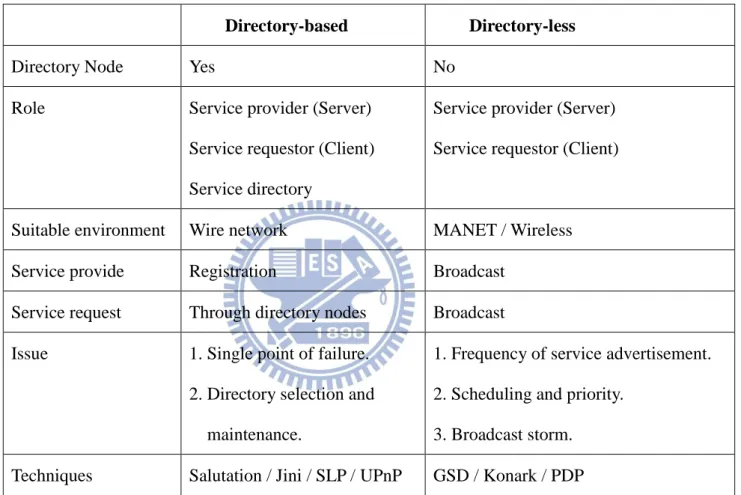
The directory-less service discovery protocols also encounters some issues, including frequency of service advertisement, scheduling and priority, and broadcast storm. The comparison between directory-based and directory-less architecture as shown in Table 2.1.
Table 2.1 Comparison of Directory-based and Directory-less SDPs
Directory-based Directory-less
Directory Node Yes No
Role Service provider (Server)
Service requestor (Client) Service directory
Service provider (Server) Service requestor (Client)
Suitable environment Wire network MANET / Wireless
Service provide Registration Broadcast
Service request Through directory nodes Broadcast
Issue 1. Single point of failure.
2. Directory selection and maintenance.
1. Frequency of service advertisement. 2. Scheduling and priority.
3. Broadcast storm.
2.2 Overview of GSD
Group-based service discovery protocol(GSD) is characterized in 1) advertising of services are bounded in the vicinal nodes 2) peer-to-peer caching of service
advertisements dynamically 3) group-based selective forwarding of service discovery packets. With these characteristic, GSD provides an efficient mechanism in service discovery, increased the bandwidth usage and has mobility.
2.2.1 Service Advertisements and Peer-to-Peer Caching
Every service provider advertises itself service advertisement periodically to vicinal nodes. Rather than traditional solution which broadcast service advertisement to the entire node in the network, GSD limits the spreading range of service
advertisement through the field ADV_DIAMETR. The field can determines the count of traveling hop. Moreover, the service advertisement includes the
Service-Description which describes the providing service and Service-Group which
represents the corresponding service group of the service.
When receiving the service advertisement, each node will store the information in its Service Cache and maintain Service Information Cache that is called
peer-to-peer caching demonstrates the service group of neighbor nodes belong to. As the result of service advertisement, a node can know not only the providing service but also groups about its neighbors.
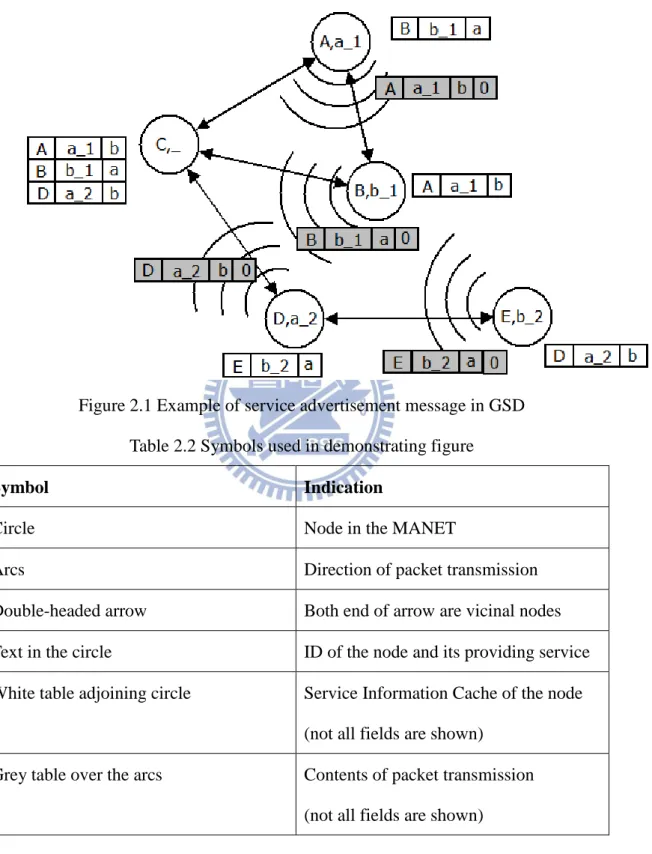
Figure 2.1 shows an example about service advertisement in GSD with
ADV_DIAMETR = 1. The symbols of figure are summary in Table 2.2.
In Figure 2.1, when receiving service advertisement message, each node will structure its Service Information Cache. If the network has any change for example, new node into the network, service advertisements need to update. Before forwarding
the packet to next node, the number of hops will be decreased by 1. Therefore, the limit of service advertisement message is 1, the remaining hop is 0.
Figure 2.1 Example of service advertisement message in GSD Table 2.2 Symbols used in demonstrating figure
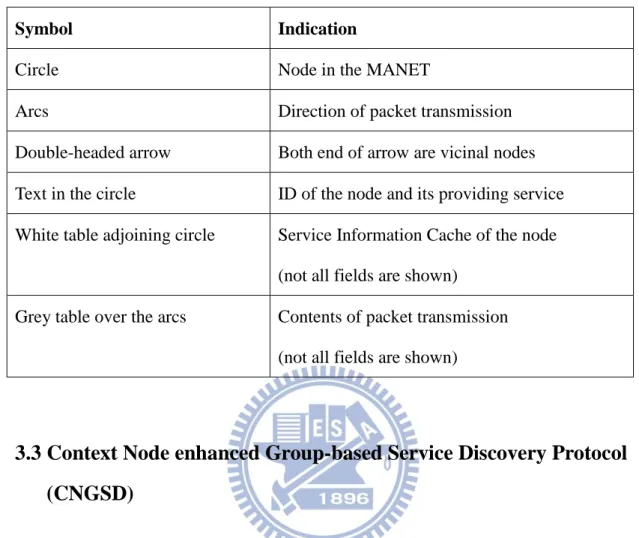
Symbol Indication
Circle Node in the MANET
Arcs Direction of packet transmission
Double-headed arrow Both end of arrow are vicinal nodes
Text in the circle ID of the node and its providing service
White table adjoining circle Service Information Cache of the node
(not all fields are shown)
Grey table over the arcs Contents of packet transmission
2.2.2 Service Discovery Routing
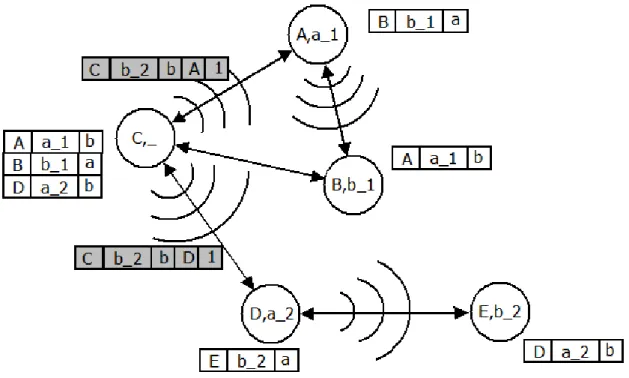
After advertising services, the network is ready for receiving service request. When a node needs services, it will forward the request message to selected nodes in its ADV_DIAMETR-hop neighbor set. Each selected node receives request packet and transmits further, unless the count of traveling hop exceeds the limit or finds matching service. Figure 2.2 shows an example of service discovery in GSD, and symbols are the same as Figure 2.1.
Once node C requires service “b_2” belonging to service group “b”, and there is no matching service in its Service Information Cache. But node C learns that both node A and D have service belonging to group “b” in their vicinity. Therefore, node A and D will receive the request packet respectively as selected nodes. Take the request packet <C, b_2, b, A, 1> sent to node A for example: 1) the source address is node C; 2) the requested service is “b_2”; 3) the requested service belongs to group “b”; 4) the packet is sent to node A; 5) the packet remaining number of hops is “1”. When
receiving request packet, node A will forward the packet further. Once node B gets the packet, it will respond a reply packet instead of transmitting it further.
Figure 2.2 Example of service discovery in GSD
2.3 Context Information in Service Discovery Protocols
The context information refers to the surrounding environment and reflects current state of the service. Context is a situation of an entity (person, place or object) that is relevant to the interaction between a user and an application[11]. It can improve the service matching of the result which be found through SDPs.
Context aware mechanisms are always implemented in directory-based architecture such as[4-6].In [6],the model provides a context aware architecture and focus on dynamic service attribute. This model is based on directory-based service discovery protocol, SLP. The service attributes are divided into static which are assigned when the service is initially deployed like the printer is color, and dynamic which change as time goes by after the service has been set, for instance, the numbers of prints jobs in the queue. Besides, this model provides “Table of Weights Service
(TOW)” for computing the ranking of matching services and the ranking is based on
by the client or use the default weight vector. It allows client to decide the priority of service attributes and gets the most suitable service which will obtain the highest score. But the model is suitable for fix network likes home network not for pervasive environments.
However, combining context information with directory-less architecture, the solution will possess both service quality and mobility in the MANET such as [12, 13]. In [12], the solution has used the GSD’s model to categorize services into groups. In this model, the network is organized into a two-tier hierarchy and the resource-rich nodes, called Ultrapeers (UPs); resource-constrained nodes, called Leaves (LFs).UPs are responsible for most of the communication in the network. Moreover, Ups in the domain will select the most resource-rich Up as domain Service Description Keeper
(SDK), which store all the service advertisement information in its domain. In the
beginning, LF in various domains selects an UP and sends service advertisements to the serving UP. After receiving service advertisements, Ups aggregate the information and transmit to the SDK. If the service request is from LFs, the packet will send to the serving UP to find the matching service or selectively forward the packet further. The model is context aware and suitable in pervasive network.
2.4 Clustering for MANET
There are several clustering algorithm in the MANET like [14-17]. But in this paper, we do not pay attention on clustering algorithm , but we assume the clusterhead is elected based on the criteria[17] which determine by certain nodes parameters, like: ideal degree, transmission power, mobility and battery power. A good clustering algorithm affects the performance of MANET, and provides good stability.
WCA- a weighted clustering algorithm for mobile ad hoc network takes nodes degree, distances, mobility, and consumed battery power into account. It defines the number of nodes that a cluserhead can handle is δ.
1) The degree of each node 𝑣 , 𝑑𝑣 = |𝑁(𝑣)| = ∑ {𝑑𝑖𝑠𝑡(𝑣, 𝑣′) < 𝑡𝑥
𝑟𝑎𝑛𝑔𝑒} 𝑣′∈ 𝑉,𝑣′≠𝑣 .
2) The degree-difference for each node 𝑣 , ∆𝑣 = |𝑑𝑣 − 𝛿|.
3) Compute the sum of distances 𝐷𝑣 = ∑ {𝑑𝑖𝑠𝑡(𝑣, 𝑣′)}
𝑣′∈𝑁(𝑣) .
4) Compute the average of speed for each node till current time T. Define the mobility 𝑀𝑣, 𝑀𝑣 =𝑇1∑𝑇𝑡=1√(𝑋𝑡− 𝑋𝑡−1)2+ (𝑌𝑡− 𝑌𝑡− 𝑌𝑡−1)2.
5) Compute the cumulative time, 𝑃𝑣, during the node 𝑣 acts as a clusterhead, implies
how much battery power has been consumed.
6) Use 𝑊𝑣 = 𝑤1∆𝑣+ 𝑤2𝐷𝑣+ 𝑤3𝑀𝑣 + 𝑤4𝑃𝑣 to calculate the weight of each node and choose the node with the smallest 𝑊𝑣 as the clusterhead.
Clusterheads are responsible for maintain the topology of the network, and involve in most of traffic. Therefore, clusterheads usually served by resource-rich nodes, such as processing and transmission power. Other nodes register with the nearest clusterhead and become members of specific cluster. Finally, the network is divided to several clusters, and clusterheads play the critical role in the network.
2.5 Network Simulator 3 (NS-3)
NS-3[18] is a discrete-event network simulator targeted primarily for research and educational use. The goal of the ns-3 project is to develop a better, open simulation environment for networking research. It should be aligned with the simulation needs of modern networking research and should encourage community contribution, peer review, and validation of the software.
In addition, it supports research on both IP and non-IP based network including models for Wi-Fi, WiMax, LTE for network 1and 2 layers. Besides, it supports variety of static and dynamic routing protocols, for instance, OLSR and AODV for IP-based applications. NS-3 also supports a real-time scheduler which facilitates a number of "simulation-in-the-loop" use cases for interacting with real systems. NS-3 wants to spread this workload over a large community of users and developers for creating a good network simulator that has enough number of high-quality validated and develops more related network models.
2.6 Summary of Related Works
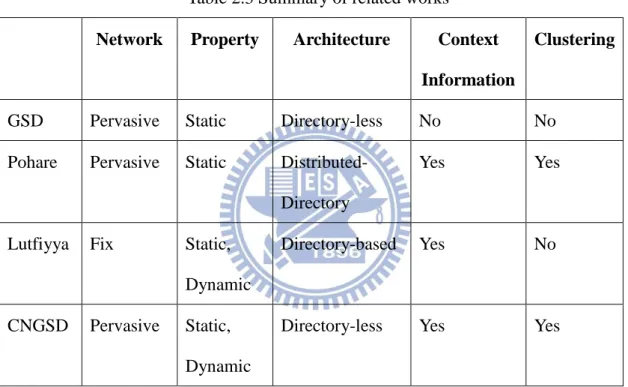
The summary of related works is shown in Table 2.2. GSD[7, 8] and S.S. Yau and G.G. Pohare’s[12] model are the nearest solution in pervasive environment. GSD is a directory-less solution and based on grouping for services in the network, but it doesn’t have context information.
S.S. Yau and G.G. Pohare’s model depends on Ultrapeers (UPs) and it is context aware. However, it does not mention how to organize the network and elect the
Ultrapeers (UPs), Service Description Keeper (SDK). Network in the model divided
network is formed. Moreover, because the SDK stores all the service information in the serving domain, network will modify lots of service advertisement information whenever services update.
S. Cuddy, M. Katchabaw and H. Lutfuyya’s[6] model focus on dynamic attribute and use weight vector to ranking the matching services. Make it easier to deal with context information but it directory-based not suitable in dynamic environments.
Table 2.3 Summary of related works
Network Property Architecture Context Information
Clustering
GSD Pervasive Static Directory-less No No
Pohare Pervasive Static Distributed-
Directory
Yes Yes
Lutfiyya Fix Static,
Dynamic
Directory-based Yes No
CNGSD Pervasive Static,
Dynamic
Chapter 3 A Service Discovery Protocol using Cluster and
Context Information in Mobile Ad Hoc Network
In this chapter, we present a cluster-based and context information service discovery protocol in MANET. First, we define the basic assumption of the paper. The detail of CNGSD will be introduced following.
3.1 Design Issues
Our approach is based on group-based service discovery protocol (GSD)[7, 8], but the network is divided into several clusters, and each cluster elects the clusterhead by the algorithm[17] firstly. All nodes in the network have enough memories for saving the service cache and service advertisement message. In addition, nodes have an omni-directional antenna and support context data collection component are necessary.
GSD is a typical service discovery protocol in MANET, but it has enormous network overhead due to redundant packet transmission, as a result, we want to propose an effective approach which service responds time is short, packet delivery ratio is stable and overhead is lower than GSD.
3.2 Notation
The notation definition is shown in Table 3.1, and Table 3.2 explains the symbols of examples which are presented in the following sections.
Table 3.1 Notation definition
Notation Description
CN Context node
SD Service description
SGI Service group information
SWT Service weight table
𝑉𝐶𝑃𝑖𝑗𝑘 The monitored value that the context data
collection component[6] return for property𝑉𝐶𝑃𝑘
when node𝑗 requests the context information for service𝑖.
𝑤𝑖𝑗𝑘 The weight that node 𝑗 assigns to service 𝑖 for
the property𝑘, 𝑤𝑖𝑗𝑘 = (𝑤𝑖𝑗1, 𝑤𝑖𝑗2, … , 𝑤𝑖𝑗𝑛) which
Table 3.2 Symbols of examples
Symbol Indication
Circle Node in the MANET
Arcs Direction of packet transmission
Double-headed arrow Both end of arrow are vicinal nodes
Text in the circle ID of the node and its providing service
White table adjoining circle Service Information Cache of the node
(not all fields are shown)
Grey table over the arcs Contents of packet transmission
(not all fields are shown)
3.3 Context Node enhanced Group-based Service Discovery Protocol
(CNGSD)
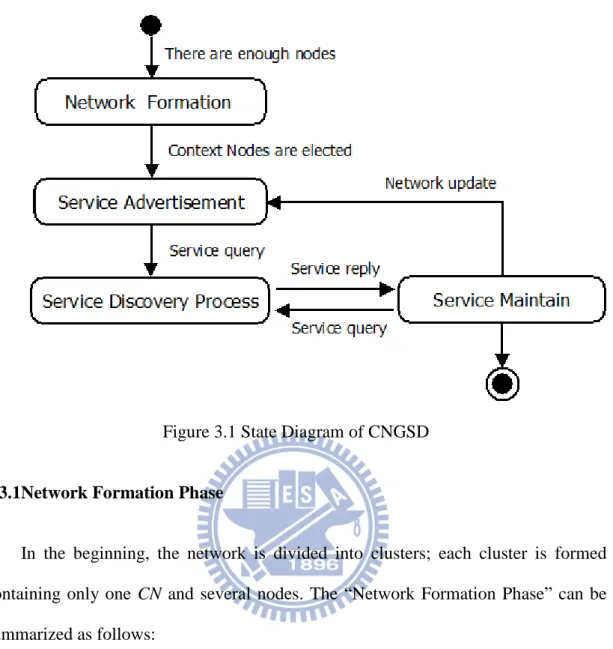
A general overview of the model includes four phases. Network formation and service advertisement, service discovery process, and service maintain. Each of these parts will be explained individually. The state diagram of CNGSD is shown in Figure 3.1.
Figure 3.1 State Diagram of CNGSD
3.3.1Network Formation Phase
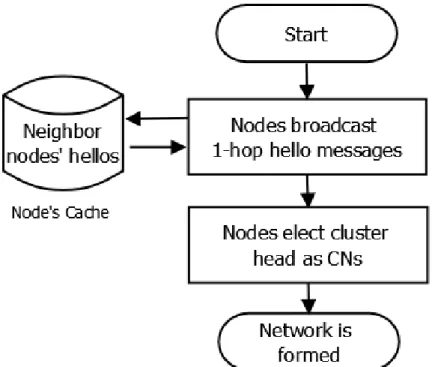
In the beginning, the network is divided into clusters; each cluster is formed containing only one CN and several nodes. The “Network Formation Phase” can be summarized as follows:
1) Each node broadcasts 1-hop hello messages to discover neighbor nodes and stores the latest hellos which sent by neighbor nodes in its cache.
2) Use “Weighted Clustering Algorithm”[17] to election clusterhead as CN.
The procedure diagram of the “Network Formation Phase” is shown in Figure 3.2, and the example of CNGSD in this phase is shown in Figure3.3. The symbols of the example are shown in Table 3.2.
Figure 3.2 The procedure diagram of the “Network Formation Phase”
3.3.2 Service Advertisement Phase
After “Network Formation Phase”, each node has its serving clusterhead, called
CN. For the network be able to access, service advertisement is necessary. The
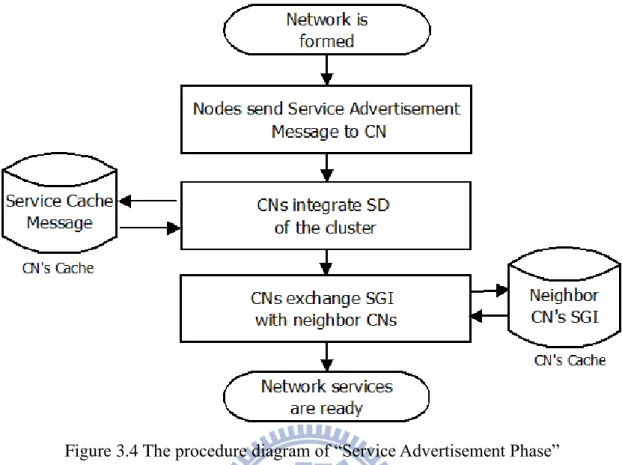
“Service Advertisement Phase” is summarized as follow:
1) Each node connects to only one CN and sends Service Advertisement
Message in a single-hop count to serving CN.
1.1) Service Advertisement Message contains SD and SD is divided into two properties:
(a) Static Property: Description of the service which is assigned when
the service is first deployed.
(b) Context Property: Context Information related to the service. The value
changes after the service has been deployed.
2) The CN integrates all the SD in the cluster as Service Cache Message which stores all the SD in its cluster.
3) The CN exchanges SGI with neighbor CN which in the 1-hop range. 4) Network Services are ready for access.
The connections between any pair of directly connected nodes are maintained using the 1-hop periodic hello messages. Figure 3.4 presents the procedure diagram of “Service Advertisement Phase”, and Figure 3.5 shows the message flow of this phase.
Figure 3.4 The procedure diagram of “Service Advertisement Phase”
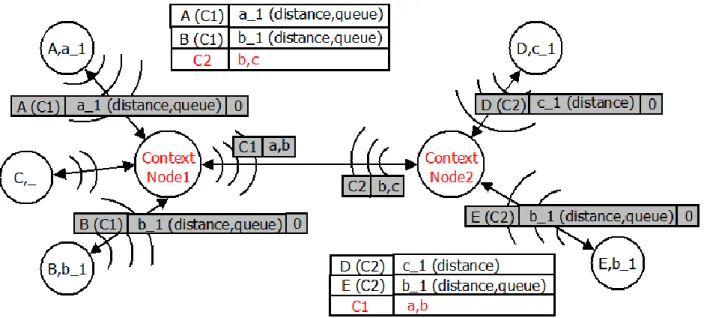
In Figure 3.6, there is an example of “Service Advertisement Phase” in CNGSD. Take Context Node1 cluster for instance, node A and B sent their Service
Advertisement Message to Context Node1. The packet <A(C1),a_1 (distance, queue), 0>presents: 1) the source address is node A, and belongs to cluster “C1”; 2) the static
property of service description is “a_1” and dynamic properties are “distance” and “queue”; 3) the packet remaining number of hops is “0”. The SGI packet <C1, “a, b”> shows the source cluster is “C1”, and there are services belongs to group “a” and “b”. The packet will send to neighbor CNs.
3.3.3 Service Discovery Process Phase
Once the network is formed and the services are advertised to their serving CNs, the network is ready for receiving service request from nodes in any cluster. The “Service Discovery Process Phase” can be summarized as follow:
1) Nodes in any cluster can send Service Request Message to its serving CN. 2) The CN first checks its Service Cache Message to find matching services in the
local cluster.
3) If SGI has the required service group, the CN will also selectively forward the
Service Request Message to the target CN.
3.1) If no SD match at the CN and no required service group in the SGI, the
Service Request Message will not transmitted further.
4) If matching services are found, corresponding nodes will collect the Context
Properties of the service imposing context data collection component and return Service Reply Message to requesting CN.
5) When receiving the Service Reply Message, the requesting CN uses the SWT to rank the score of matching service.
5.1) The context properties of matching services will be ordered, and be
renumbered a value from high to low which represents the most suitable to inferior.
5.2) Requesting node can send its weight vector for the required service to its
6) The CN determines the most suitable service which has the highest score and returns to requesting node.
6.1) Score is computed by∑𝑉𝐶𝑃𝑖𝑗𝑘∗ 𝑤𝑖𝑗𝑘.
6.2) 𝑉𝐶𝑃𝑖𝑗𝑘: The monitored value that the context data collection component[6]
return for property 𝑉𝐶𝑃𝑘 when node 𝑗 requests the context information for service 𝑖.
6.3) 𝑤𝑖𝑗𝑘: The weight that node 𝑗 assigns to service 𝑖 for the property𝑘, 𝑤𝑖𝑗𝑘 = (𝑤𝑖𝑗1, 𝑤𝑖𝑗2, … , 𝑤𝑖𝑗𝑛) which 𝑤𝑖𝑗1+ 𝑤𝑖𝑗2+ ⋯ + 𝑤𝑖𝑗𝑛 = 1
The procedure diagram of “Service Discovery Process Phase” is shown in Figure 3.7, and the message flow is shown as Figure3.8.
Figure 3.8 The message flow of “Service Discovery Process Phase”
Figure 3.9 shows the example of service request in CNGSD’s “Service Discovery Process Phase”. Node C creates a Service Request Message to Context
Node1 for getting service “b_1”. When receiving the packet, Context Node1 first
checks its Service Cache Message to find matching service. Although Context Node1 finds service “b_1” in its cluster, Context Node1 still forward the packet to neighbor clusterhead, Context Node2 because of the SGI. It shows that there is also matching service group in the cluster “C2”. The packet <C(C1), b_1 (distance, queue), b, C1, 1>means: 1) the source address is node C, and belongs to cluster “C1”; 2) the static property of service description is “b_1” and dynamic properties are “distance” and “queue”; 3) the requested service belongs to group “b”; 4) the destination is Context
Figure 3.9 Example of service request in CNGSD’s “Service Discovery Process Phase”
In Figure 3.10, when CNs find the matching service, the corresponding node will use the collect the Context Properties of the service imposing context data collection component[6] and return Service Reply Message to requesting Context Node1. Node B and E responds the value of Context Properties individually. For example, <b_1 (1, 5)>represents 𝑉𝐶𝑃𝑑𝑖𝑠𝑡𝑎𝑛𝑐𝑒 = 1 and𝑉𝐶𝑃𝑞𝑢𝑒𝑢𝑒 = 5 in node B. When receiving the
Service Reply Message, Context Node1orders the value of Context Properties, and
renumbers the value from high to low which represents the most suitable to inferior. The value of “distance” and “queue” in node B are renumbered as “2” and “1”. Next,
Context Node1uses the SWT to rank the score of matching services. Take the weight
vector (𝑤𝑏_1,𝐶,𝑑𝑖𝑠𝑡𝑎𝑛𝑐𝑒, 𝑤𝑏_1,𝐶,𝑞𝑢𝑒𝑢𝑒) = (0.4, 0.6), for instance, “queue” has higher priority in weight vector. In the end, node E obtains score“1.6”, and will be return to node C.
Figure 3.10 Example of service reply in CNGSD’s “Service Discovery Process Phase”
3.3.4 Service Maintain Phase
Whether requesting node gets the required service, the network will into the “Service Maintain Phase” after service discovery process. In this phase, the network continuous listens to service request unless there are any changes in the network. The following conditions will cause network update:
(i). Node leaves. (ii). New Node joins.
(iii). Service Cache Message expired. (iv). Node adjusts static property of SD.
The “Service Maintain Phase” can be summarized as follow:
1) Only the node which occurs changes will transmits the Service Advertisement
Message to its serving CN for renewing the Service Cache Message.
2) The CN will renew its Service Cache Message and SGI.
3) The CN exchanges the updated SGI with neighbor CNs which in the 1-hop range.
The procedure diagram of “Service Maintain Phase” is shown in Figure 3.11, and the message flow is the same as “Service Advertisement Phase” has been shown in Figure 3.5.
3.3.5 Message Type in CNGSD
In Figure 3.12 presents the detail of message type in CNGSD, the gray fields represent the modification in GSD filed and the white fields are identical with GSD.
Figure 3.12 Message type in CNGSD
3.4 Discussion
In this chapter, we introduce the four phase in the CNGSD and explain every phase separately. There are “Network formation”, “Service Advertisement”, “Service Discovery Process”, and “Service Maintain”. We also provide the procedure diagram and message flow for reference. Last, we provide the message types which are used in CNGSD four phases.
Chapter 4 Simulation and Result Analyses
This chapter presents the simulation of CNGSD. First, simulation environment includes simulation design, assumption and performance metrics in section4.1. Next, we evaluate the performance of CNGSD and compare with GSD in section4.2. Finally, there is a discussion in the end of this chapter.
4.1 Simulation
In this section, we introduce the simulation environment and make some
assumption in our experiment. Next, we have several metrics for evaluating the GSD and CNGSD.
4.1.1 Simulation Scenario
Today a career fair hold in open site, there are service information counters and company vendors which are classified in several service group including engineer, computer sciences, commerce……etc. Besides, these vendors are created by ad-hoc. Assume that there are many job seeker carrying smart phones on site. In order to quickly find the interesting company vender and finish the resume or search the service information counter, the worker in every vendor have laptop or pad to provide data services. There is a job seeker named James who entered the site near service information counter and he wants to search some computer sciences vendors. By using his smart phone and input the service description, service requirement and service group, James can find the desire company and get service reply.
4.1.2 Simulation Environment
We implemented our approach and GSD in the NS-3 simulator which is a discrete-event network simulator and open environment for network education and research. In addition, it supports research on both IP and non-IP based network including models for Wi-Fi, WiMax, LTE for network 1and 2 layers. Besides, it supports variety of static and dynamic routing protocols, for instance, OLSR and AODV for IP-based applications[18]. For the sake of above feature in NS-3, we select it as our implementation environment for simulating the related experiments. Table 4.1 displays the simulation environment.
Table 4.1 Simulation environment
Simulation Environment
Hardware Environment • Intel Core i5 CPU M430 @ 2.27GHz 2.27GHz
• 2 GB RAM
Software Environment • Linux (Ubuntu)
• NS-3 (Network Simulator)
4.1.3 Simulation Setup
The simulations were performed in NS-3, and used the wireless model with dynamic routing protocol AODV. Simulation set the nodes from 10 up to 50 and distributed in a random radius of disc from 30m to 800m. Simulation time up to 1200 seconds for simulating the stable situation, the frequency of hello messages is 1-second for all nodes. For GSD, the advertisements message diameter is 1-hop. Thus, the broadcast range is limited in 1-hop. Table 4.2 shows the common simulator parameters in the experiments.
Table 4.2 Simulation parameters
Simulation Parameter
Network Area Random radius in a disc 30m up to 800m
Number of nodes 10 up to 50
Mac Layer 802.11
Routing Layer AODV
Simulation Time 100 seconds to 1200 seconds
Hellos-Update-Rate 1 seconds
4.1.4 Simulation Assumption
We divide the nodes into several clusters and every node has its service group initially. These nodes are distributed randomly, thus in every cluster has several service group. Because NS-3 doesn’t support the clustering models, we need to setup the cluster manually and the cluster nodes are determined. The simulation focus on the service discovery process phase and the target service exists in the network.
4.1.5 Simulation Metrics
There are three metrics for evaluating the performance of CNGSD and GSD. The descriptions are as follows:
1) Service Responds Time (SRT): First received RREP (Route Reply) time - First transmitted RREQ (Route Request) time.
2) Packet Lost Ratio (PLR): Total numbers of lost packets
Total numbers of transmitted packets
3) Total number of hello message transmitted (THMT): Total number of hellos transmitted by all nodes in the network for maintaining the topology.
4.2 Results and Analyses
In this section, we evaluate the performance of CNGSD and GSD by using the previous metrics: service responds time (SRT), packet lost ratio (PLR), and total hello message transmitted (THMT).
SRT
Figure 4.1 represents the responds time of service discovery process. When increasing the number of nodes, the responds time of both GSD and CNGSD don’t have rapid growth. Because of the intelligence routing, both of them uses the service group to forward the service request. However, CNGSD exploits CN to reduce the transmitted packets and has shorter responds time in the simulation. The average responds time of GSD is 46.06 seconds and CNGSD is 25.56 seconds.
Figure 4.1 Responds time of service discovery process
PLR
Figure 4.3 displays the packet lost ratio; the less lost the better efficiency in service discovery process. Through the chart we can realize that both GSD and CNGSD are stable service discovery approach. As simulation time increase, the packet lost ratio has no fluctuations. And the result shows that the average packets lost ratio of GSD is 15.83% and CNGSD is 11.5%. 45.51 46.3 44.01 46.2 48.3 25.51 26.47 24.09 25.43 26.3 0 10 20 30 40 50 60 10 20 30 40 50 SR T ( sec ) Number of nodes
SRT
GSD CNGSDFigure 4.2 Packets lost ratio
THMT
Figure 4.4 shows the total number of hellos transmitted by all nodes in the network for maintaining the topology. It represents the network overhead of GSD and GNGSD. As time goes by, the transmitted packets will increase. But CNGSD greatly reduce the rate of increase. Due to the service advertisements are sent to only CNs rather than sent to all neighbor nodes. Moreover, CNs are responsible for delivery most of service request and reduce redundant packets transmission as well. The average packets transmitted of GSD is 8261 and CNGSD is 2372.
17 15 16 15 16 16 11 12 12 11 12 11 0 2 4 6 8 10 12 14 16 18 100 300 500 700 900 1200 PL R ( % )
Simulation Time (sec)
PLR
GSD CNGSD
Figure 4.3 Total number of hello message transmitted
PLR and Distance of nodes
Figure 4.5 shows the impact of nodes distance, and we can see that when increasing the distance to 100m the packet delivery ratio begins to decline. Once the distance is 800m, the lost ratio is 47%. Therefore, the previous simulations are all in the distance under 50m for having the better performance. However, in our scenario the radius 50m in a disc is enough.
2623 4802 7174 9380 11660 13932 1588 1924 2280 2462 2810 3168 0 2000 4000 6000 8000 10000 12000 14000 16000 100 300 500 700 900 1200 TH M T
Simulation Time (sec)
THMT
GSD CNGSD
Figure 4.4 Distance of nodes impact the performance
4.3 Discussion
In our approach, the responds time is shorter than GSD due to reduce of redundant packets forward. We use CN to forward most of traffic, and store cluster services description messages. As the result, services can be found faster. CNGSD enhancing average 44.5%
Moreover, the packets lost ratio is lower than GSD. It means CNGSD is stable and efficiency. The average packets lost ratio of CNGSD is 11.5% lower than 15.83% of GSD. Besides, the total overhead of our approach is significantly lower than GSD, due to decrease the data transmission between the nodes. CNGSD decreases 71.2% network overhead.
Although the distance will impact the packet lost ratio of CNGSD, the range of major existing wireless transmission technologies do not exceed 100m. Thus, it is not a big problem to us. In conclusion, CNGSD is an efficient service discovery approach in MANET. 11 12 20 31 35 47 0 5 10 15 20 25 30 35 40 45 50 30 50 100 300 500 800 PL R ( % ) Distance of nodes (m)
PLR
CNGSDChapter 5 Conclusions and Future Works
In this chapter, we will give the conclusion and recommend future works for this paper. In section 5.1, we give the conclusions for CNGSD and some future works can be done based on this paper is discussed in section 5.2.
5.1 Conclusions
In this paper, we proposed an efficient approach; CNGSD-Context Node enhanced Group-based Service Discovery Protocol, using cluster and group
information to intelligence forwarding the service request packets. It is based on GSD and improves the service responds time and the overhead of network by using the clusterhead- Context Node. Nodes in the network send the service description only to the nearest Context Node rather than all the neighbors. In this way, CNGSD can reduce the redundant packets transmitted, also it can reduce the transmission of hellos which for maintaining the network topology.
Context Node is responsible for most of traffic in the network. Service request and service reply can be transmitted through Context Node, greatly reducing the number of node forward. The benefit of using Context Node reflects on the responds time of service discovery process and total hello messages transmitted. The simulation results show that CNGSD enhances the service responds time with an average 44.5% and decreases 71.2% network overhead. It represents that CNGSD has better
performance than GSD in service discovery process.
Moreover, the service descriptions of CNGSD have dynamic attributes and uses
Service Weight Table (SWT) to rank the score of matching services. Clients can find
out the most suitable services according to their preferences. It provides the solution for selecting identical services in the network.
5.2 Future Works
In this section, we propose the future works which can put more effort to improve based on this paper. One is the leader election algorithm used in “Network Formation Phase”, the other is context aware mechanism used in the context node. The detail of these issues will be described in the following.
(1) Leader Election Algorithm Analysis in MANET
In this paper, we do not pay attention on clustering algorithm and the clusterhead is elected based on the criteria [17]. We focus on the service discovery process. However, clustering is an important issue in mobile ad-hoc network; a good leader election algorithm can affect the performance. Thus, clustering is a big issue to research and analysis if CNGSD wants to improve in the future.
(2) Evaluate Quality of Service (Qos) Metrics
With the service quality requirement, context aware is a potential direction to develop in the future. In this paper, we just use context information with weight mechanism to determine the better matching service. However, we do not evaluate the Qos metrics, for instances, throughput, errors, jitter and so on. We hope this issue could implement in the future.
REFERENCES
[1] Mian, A.N., R. Baldoni, and R. Beraldi, A survey of service discovery
protocols in multihop mobile ad hoc networks. Pervasive Computing,
IEEE, 2009. 8(1): p. 66-74.
[2] Lee, C. and S. Helal, Protocols for service discovery in dynamic and
mobile networks. International Journal of Computer Research, 2002.
11(1): p. 1-12.
[3] Cho, C. and D. Lee, Survey of service discovery architectures for mobile
ad hoc networks. term paper, Mobile Computing, CEN, 2005. 5531.
[4] Hughes, E., et al. Service recommendation using SLP. in IEEE
International Conference on Telecommunications 2001. 2001.
[5] Song, H., et al. UPnP-based sensor network management architecture. in
Proc. ICMU Conf. 2005.
[6] Cuddy, S., M. Katchabaw, and H. Lutfiyya. Context-aware service
selection based on dynamic and static service attributes. in Wireless And Mobile Computing, Networking And Communications, 2005.(WiMob'2005), IEEE International Conference on. 2005. IEEE.
[7] Chakraborty, D., et al. GSD: A novel group-based service discovery
protocol for MANETS. in Mobile and Wireless Communications Network, 2002. 4th International Workshop on. 2002. IEEE.
[8] Chakraborty, D., et al., Toward distributed service discovery in pervasive
computing environments. Mobile Computing, IEEE Transactions on, 2006.
5(2): p. 97-112.
[9] Ververidis, C.N. and G.C. Polyzos, Service discovery for mobile ad hoc
networks: a survey of issues and techniques. Communications Surveys &
Tutorials, IEEE, 2008. 10(3): p. 30-45.
[10] Gupta, R., S. Talwar, and D.P. Agrawal, Jini home networking: a step
toward pervasive computing. Computer, 2002. 35(8): p. 34-40.
[11] Perkins, C., et al., Service location protocol. RFC2165, 1997.
[12] Yau, S. and G. Pohare, An Efficient Approach to Situation-Aware Service
Discovery in Pervasive Service Computing Environments. Ubiquitous
Intelligence and Computing, 2009: p. 68-82.
[13] Ilka, M., M.c. Niamanesh, and A. Faraahi. A context-aware and
group-based service discovery in mobile ad hoc networks. in Systems and Informatics (ICSAI), 2012 International Conference on. 2012. IEEE.
[14] Rahman, M.M. and A. Nahar, Modified bully algorithm using election
commission. arXiv preprint arXiv:1010.1812, 2010.
algorithm in distributed systems. in Information Technology and Multimedia (ICIM), 2011 International Conference on. 2011. IEEE.
[16] Park, S.-H., Y. Kim, and J.S. Hwang. An efficient algorithm for
leader-election in synchronous distributed systems. in TENCON 99. Proceedings of the IEEE Region 10 Conference. 1999. IEEE.
[17] Chatterjee, M., S.K. Das, and D. Turgut, WCA: A weighted clustering
algorithm for mobile ad hoc networks. Cluster Computing, 2002. 5(2): p.
193-204.