行政院國家科學委員會專題研究計畫成果報告
肌酸增補及恢復方式對高強度間歇踏車運動後
下肢肌群無氧動力之效應
Effect of creatine supplementation on anaerobic jumping test following
heavy intermittent cycling with active and passive recovery
計畫類別:ˇ個別型計畫 □整合型計畫 計畫編號:NSC-89-2413-H-028-003 執行期間:九十年八月一日至九十二年二月二十八日 主 持 人 :呂欣善 國立臺灣體育學院 體育學系 協同主持人 :陳相榮 國立臺灣體育學院 競技運動學系 參與計畫人員:麥財振 國立臺灣體育學院 競技運動學系 本成果報告包括以下應繳交之附件: □赴國外出差或研習心得報告一份 □赴大陸地區出差或研習心得報告一份 □出席國際學術會議心得報告及發表之論文各一份 □國際合作研究計畫國外研究報告書一份
執行單位:國立臺灣體育學院
中 華 民 國 九 十 三 年 三 月 二 十 一 日
行政院國家科學委員會專題研究計畫成果報告
肌酸增補及恢復方式對高強度間歇踏車運動後
下肢肌群無氧動力之效應
Effect of creatine supplement on anaerobic jumping test following heavy,
intermittent cycling with active and passive recovery
計畫編號:NSC 89-2413-H-028-003 執行期間:九十年八月一日至九十二年二月二十八日 主 持 人 :呂欣善 國立臺灣體育學院 體育學系 協同主持人 :陳相榮 國立臺灣體育學院 競技運動學系 參與計畫人員:麥財振 國立臺灣體育學院 競技運動學系 一、中文摘要 本研究旨在探討肌酸增補及恢復 方式對高強度間歇踏車後下肢肌群無 氧動力之效應。受測者為十六名國立臺 灣體育學院男子籃球隊,年齡為 18-22 歲,將隨機分配為肌酸增補組(雙盲設 計; 劑量 0.35 g /體重; 7 天)及控制組 並進行包括無氧縱跳測驗(5 秒及 45 秒 跳)與兩種踏車時間(15 秒、60 秒)及兩 種恢復方式(靜態及動態恢復以 40%最 大耗氧量)運動測試。每次運動測試包 括 8 回合踏車,每回合間恢復時間為三 分鐘。運動測試前及每回合恢復三分鐘 後進行 5 秒無氧縱跳測驗。無氧縱跳測 驗 將 收 集 及 計 算下 肢肌 群 動 力 平 均 值。所得數據將以獨立樣本變異數分析 考驗無氧動力值在肌酸增補組及控制 組之差異。以重複量數三因子變異數分 析考驗無氧動力值在肌酸增補及不同 運動時間、恢復方式之差異及交互作 用。以皮爾遜積差相關係數分析肌酸增 補劑量與無氧動力值之關係。本研究統 計顯著水準定為 p<0.05。根據結果, 本研究認為肌酸增補、動態恢復、及短 時間運動是維持間歇運動時下肢無氧 平均動力之重要因素。 關鍵詞:肌酸、無氧動力、動態恢復 Abstract
The purpose of the study was to examine the effects of creatine supplement on anaerobic jumping test following heavy, intermittent cycling with active and passive recovery. Subjects were male basketball players (N=16; age=18-22 yrs) from Department of Athletics, National Taiwan College of Physical Education. Subjects were randomly assigned to creatine supplement (double blind; 0.35g/kg wt) and control groups. Anaerobic test was a 5s consecutive vertical jump. Experimental protocol was a combination of two durations (15s and 60s) and two modes of recovery (passive and active recovery; cycling at 40% VO2max). Exercise will consist of 8 bout of cycling at 120% VO2 max
interspersed with three minutes recovery periods. Before cycling and following recovery period, 5s anaerobic jumping test will conduct for each bout. Mean power was determine. Independent one-way ANOVA was performed to compare the effect of creatine supplement and control on power output. Repeated measure of 3 way factorial ANOVA was perform to examine the effect of exercise duration, recovery mode, and exercise bout. Pearson moment product correlation coefficient was performed to examine the relationship between supplement dosage of creatine and anaerobic power output. Statistic significant was p<0.05 in the study. In summary, results suggest that creatine supplementation, active recovery, and shortening exercise duration is the crucial factor in maintaining the anaerobic power of lower extremities during intermittent exercise.
Keywords:Creatine, Anaerobic power, Active recovery 二、緣起與目的 許多研究實施肌酸增補後發現其 對數回合短時間高強度之運動項目成 績表現較有幫助,而對長時間低強度 (15,13) 及單一回合之高強度運動 (10) 表現較無改善效果。實驗發現每日肌酸 增補 20 - 25 g,三至五日後進行 10 - 30 秒單一回合高強度踏車運動之表現並 無顯著改善(6, 7, 11, 15)。此外,許多 以肌酸增補後進行數回合短時間高強 度之運動實驗發現第一回合表現無顯 著變化(1, 2, 9, 12)。 肌酸增補 (15.7 – 25 g/day) 6 - 28 天後反覆進行 6 -10 秒高強度踏車及恢 復時間 20 秒至 3 分鐘之運動測驗時發 現改善表現 6 - 61.9% (1, 4, 7, 8)。然 而,類似研究卻沒有發現相同效果(2, 6)。Juhn 與 Tarnopolsky (10)認為運動 間恢復期中 PCr 再合成作用及個體差 異是影響這種實驗結果之重要因素。 一般了解,運動後恢復方式可影響 代謝物濃度。高強度運動後如進行次最 大強度運動可以加速血流、促進肌群有 氧代謝、增加粒腺體以氧化磷酸解作用 後合成 ATP。先前研究進行以 40%最 大耗氧量強度腳踏車運動增加有氧代 謝降低乳酸濃度。Bonen 與 Belcastro (5)在高強度運動後以 57 - 70%最大耗 氧量強度進行平面跑步運動,結果發現 乳酸濃度每分下降 7.1 mg/dL。根據 PCr/Cr 粒腺體穿梭理論,有氧運動可 促進粒腺體氧化磷酸解作用而有利於 合成 ATP,這些 ATP 再經由粒腺體上 肌酸激? 之作用後合成 PCr。肌酸增補 之效應與數回合短時間高強度之運動 項目間實施恢復方式有關。 許多研究利用不同運動測驗觀察
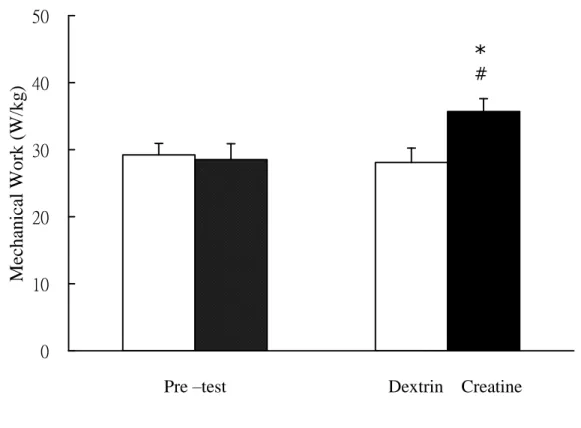
受測者對運動刺激反應。運動生理學運 用科學方法在實驗室及室外場地進行 不同體能測試及訓練。不論這些測試及 訓練方法是複雜還是簡單均需考慮其 信度(Reliability)、效度(Validity)、及特 屬性(Specificity) (14)。信度是指相同實 驗 所 測 得 觀 察 值 之 一 致 性 (Consistency)、穩定性(Stability)、或再 現性(Reproducibility)。效度是指實驗所 測觀察值即為研究所欲得之觀察值,是 導致觀察值產生因果關係(Cause and effect)。特屬性是指檢測應與運動所涉 及技巧與動作愈接近愈能夠將觀察值 應用於該運動。這些要素在設計實驗及 分析結果時十分重要。 當這些考量要 素被掌握,體能測試及補強處理可做為 一個有用工具,而所得資料提供教練及 科學家。體能運動影響生理參數被驗 證,而運用於體能訓練有效改善運動表 現。 籃球競賽是一項間歇性快速衝刺 與密集跳躍動作組合之運動。在激烈對 抗競賽中,籃球運動特別強調快速移動 及高空優勢。其中,影響反覆縱跳高度 之下肢無氧動力優劣常是決定勝負之 關鍵。 本研究應用 Pcr/Cr 粒腺體穿梭 理論以實驗室測驗模擬籃球運動及觀 察肌酸增補及恢復方式對下肢無氧動 力之效應。 本研究旨在探討一、肌酸增補對 下肢平均無氧動力之效應;二、間歇踏 車運動後動態恢復對下肢平均無氧動 力之效應;三、間歇踏車時間對下肢平 均無氧動力之效應;四、間歇踏車回合 對下肢平均無氧動力之效應;五、肌酸 增補、恢復方式、及踏車時間對平均無 氧動力之交互作用;六、肌酸增補劑量 與平均動力之關係。七 肌酸增補對身 體組成之效應 三、結果與討論 1、肌酸增補對下肢平均功值之效應 高強度(8 回合, 120% VO2max)間 歇踏車進行蹲跳測試發現肌酸增 補組下肢平均功值顯著(p<0.001) 高於控制組(圖一)。 提升作用肌群中磷肌酸濃度促 進 ATP 再合成(re-synthesis)速率, 促進快速供能之路徑(pathway),有 提升短時間、高負荷間歇運動之表 現之效應。肌酸增補有助於體內緩 衝系統(buffering system)作用,由於 磷肌酸合成 ATP 及肌酸過程中耗 用氫離子,因此避免 pH 下降而產 生酸化(acidosis)導致疲勞出現。此 外,維持磷肌酸含量將減少因磷酸 果 醣 激 ? (phosphofructokinase; PFK) 上 升 而 抑 制 之 醣 解 作 用 (glycolysis),而此效應使收縮肌群 持續獲得能量(5)。 2、恢復方式對下肢平均功值之效應 間歇踏車進行三分鐘恢復後進 行蹲跳測試發現以 40% VO2max實 施 動 態 恢 復 下 肢 平 均 功 值 顯 著 (p<0.05) 高 於 靜 態 恢 復 方 式 ( 圖 二)。
動態恢復促進血流,加速代謝 物清除,提升能量及氧氣供應。以 40% VO2max 有氧運動促進肌酸在 細胞質及粒腺體間穿梭活動及氧 化磷酸解(oxidative phosphorylaton) 而合成中磷肌酸( phosphocreatine) (3)。維持工作肌群溫度有助有氧酵 素活性。 3、運動時間對下肢平均功值之效應 以時間長短進行 120% VO2max 間歇踏車後進行蹲跳測試發現實 施 15 秒踏車下肢平均功值顯著 (p<0.05)高於 60 秒踏車(圖二)。 高強度踏車運動會大幅增加人 體能量供應需求。短時間(5-15 秒) 體能活動以磷肌酸及 ATP 分解供 應能量。磷肌酸及 ATP 能量系統並 無大量製造乳酸及 pH 降低等抑制 肌肉收縮作用。此外,運動後磷肌 酸合成速率快速,因此維持肌群收 縮強度。 30-90 秒 無 氧 運 動 (anaerobic exercise)肌群會隨著運動進行而使 肌肝醣含量下降,乳酸濃度則增 加。本研究比較每回合高強度間歇 踏車運動時間 15 及 60 秒發現,加 長(prolonged) 高強度運動時間造 成運動表現顯著下降,是因作用肌 群肝醣快速遞減,乳酸大量堆積, pH 降低等因素而抑制能量產生, 肌肉出現疲勞導致平均功值下降 (5)。 4、肌酸增補、恢復方式及運動時間對 下肢平均功值之交互作用 統計分析顯示肌酸增補、恢復 方式及運動時間對下肢平均功值 之 交 互 作 用 皆 未 達 顯 著 水 準 (p<0.05)(表一)。 結果顯示雖然主要效果達到顯 著差異,但肌酸增補、恢復方式及 運動時間對下肢平均功值則無交 互作用存在。實施單一因子實驗處 理即達到顯著效應,多重因子統計 處理可能抵消各組之間下肢平均 功值而無法達到顯著水準。 5、肌酸增補劑量與下肢平均功值之關 係 本研究使用之肌酸及麥芽糊精 劑量皆為每公斤體重 0.35 公克, 經皮爾遜相關積差(Pearson product moment correlation coefficiency)。不 論是控制組所用麥芽糊精或肌酸 增補劑量與縱跳測試下肢平均功 值相關係數分別為 r= -0.355 及 r= 0.161,也不顯著(p>0.05)。結果顯 示高劑量肌酸增補與縱跳測試下 肢平均功值相關低。 許多相關研究使用肌酸劑量不 同,以每日固定劑量(20-30 克/日) 及相對體重劑量(0.2-0.35 克/公斤/ 日)。 研究結果較高劑量肌酸並未 產生較高肌肉表現。生化檢驗顯示 高劑量肌酸增補而無法吸收會經 由泌尿系統排泄排出體外(7)。本研 究以高劑量(0.35 克/公斤/日)肌酸 增 補 發 現 與 下 肢 平 均 功 值 無 相 關,顯示過高劑量肌酸無法被工作 肌群所用而表現於下肢平均功值 提升。 6、增補對身體組成之效應 本研究實施肌酸增補前受測者 身體組成檢測,結果發現同質性 (Homogeneity)(p>0.05)現象。一週
肌 酸 增 補 後 發 現 受 測 者 (n=8) 體 重、體脂肪百分比、身體質量指數 增加 5%-10%,總水分則下降 5%, 但 都 未 達 顯 著 水 準 (p>0.05)( 表 一)。實驗結果顯示短期增補對身體 組成無效應。 本研究根據實驗結果做以下 小結: 一、 肌酸增補具有提升下肢平均無氧 動力之效應。 二、 間歇踏車運動後實施動態恢復具 有提升下 肢平均 無氧動 力之 效 應。 三、 較短(15 秒 )間歇踏車時間具有維 持 較高下 肢平均 無氧動 力之 效 應。 四、 增加間歇踏車回合數具有降低下 肢平均無氧動力之效應。 五、 肌酸增補、恢復方式、及踏車時 間對平均無氧動力無交互作用。 六、 肌酸增補劑量與平均動力無顯著 相關。 七、肌酸增補對身體組成無顯著效應。 根 據 結 果 , 本 研 究 認 為 肌 酸 增 補、動態恢復、及短時間運動是維持間 歇運動時下肢無氧平均動力之重要因 素。 四、成果自評 藉由本研究計劃完成而觀察以等 速抗阻運動對人體代謝及類固醇變化 之效應。結果整理後將向國內外運動生 理學相關期刊投稿。 本研究針對肌酸增補之實驗所得 數據比對先前研究結果使得研究人員 更加瞭解肌酸增補對人類無氧代謝效 應,也觀察特定籃球選手對間歇運動 之反應程度及運動表現與肌酸之關 係。也藉此建立運動員對肌酸增補、 運動時間、及恢復方式做為人體運動 之刺激模式而作為後續運動科學相關 研究及做為運動教練進行相關訓練及 競賽時之參考。 此外,參與實驗之工作人員及學 生獲得操作及設定測功器、數據處理之 經驗,有助於訓練及培養從事後續相關 運動科學研究人才。 五、參考文獻 1.Balsom, P. D., B. Ekblom, K.
Soderlund, B. Sjodin, and E. Hultman. Creatine supplementation and dynamic high-intensity intermittent exercise. Scand. J. Med. Sci. Sports, 3:143-149, 1993.
2.Barnett, C. M. Hind, and D. G. Jenkins. Effect of oral creatine supplementation on multiple sprint cycle performance. Aust. J. Sci. Med. Sport, 28:35-39, 1996.
3.Bessman, S. P., and P. J. Geiger. Transport of energy in muscle: the phosphorylcreatine shuttle. Science, 211:448-452, 1981.
4.Birch, R., D. Noble, and P. Greenhaff. The influence of dietary creatine supplemantation on performance during repeated bouts of maximal isokinetic cycling in man. Eur. J. Appl. Physiol. 69:268-270, 1994.
5.Bonen A., and A. Belcastro. A physiological rational for active recovery exercise. Can. J. Appl. Sport Sci. 3:160-162, 1976.
6.Cooks, W. H., and W. S. Barnes. The influence of recovery duration on high-intensity exercise performance after oral creaine supplementation. Can. J. Appl. Physiol. 78:670-667, 1995. 7.Dawson, B., M. Cutler, A. Moody, S.
Lawrence, C. Goodman, and N. Randall. Effect of creatine loading on single and repeated maximal short sprints. Aust. J. Sci. Med. Sport, 27:56-61, 1995.
8.Earnest, C. P., P. G. Snell, R. Rodriguez, and A. L. Almada. The effect of creatine monohysrate
ingestion on anaerobic power indices, muscular strength, and body
composition. Acta. Physiol. Scnd. 153:207-209, 1995.
9.Grindstaff, P. D., R. Kreider, R. Bishop, M. Wilson, L. Wood, C. Alexander, and A. Almada. Effect of creatine supplementation on repetitive sprint performance and body composition in competitive swimmers. Int. J. Sport Nutr. 7:330-346, 1997.
10.Juhn, M. S., M. Tarnopolsky.
Potential side effects of oral creatine supplementation: a critical review. Clin. J. Sport Med. 8:298-304, 1998.
11.Odland, L., M. J. D. MacDougall, M. Tarnopolsky, A. Elorriaga, and A. Borgmann. The effect of oral creatine supplemantation on muscle [Pcr] and short-term maximum power output. Med. Sci. Sports Exerc. 29:216-219, 1997.
12.Redondo, D. R., E. A. Dowling, and B. L. Graham. The effect of oral creatine monohydrate
supplementation on running velocity. Int. J. Sport. Nutr. 6:213-221, 1996. 13.Rossiter, H. B., E.R.Cannell, P.M.
Jakeman. The effect of roal creatine supplementation on the 1000m
performance of competitive orwers. J. Sports Sci. 14:175-179, 1996.
14.Safrit, M. F. Validity and reliability of norm-reference tests. Introduction to Measurement in Physical Eduction and Exercise Science. Times Mirror/Mosby College Publishing. 15.Snow, R. J., M. J. McKenna, S. E.
Selig, J. Kemp, C. G. Stathis, and S. Zhao. Effect of creatine ingestion on sprint exercise performance and muscle metabolism. J. Appl. Physiol. 84:1667-1673, 1998.
16.Tompson, C. H., G. J. Kemp, A. L. Sanderson, R. M. Dison, P. Styles, D. J. Taylor, and G. K. Radda. Effect of creatine on aerbic and anaerobic metabolism in skeletal muscle in
swimmers. Bri. J. Sports Med. 30(3):222-225, 1996.
0 10 20 30 40 50 Mechani cal Work (W/ kg)
Pre –test Dextrin Creatine
圖 一、肌酸增補前後垂直跳測驗下肢平均功值 (W/kg) 效應。*, p<0.05, 肌酸組 (■)增補前後下肢動力比較。#, p<0.05, 肌酸組與控制組(麥芽糊精, )下肢
平均功值比較。
*
0 6 12 18 24 30 36 Mecha nic al W ork (W /kg)
Dextrin (n=8)
Creatine (n=8)
Recovery Passive Active Passive Active Time 15s 15s 60s 60s 圖 二、肌酸增補前後運動測驗下肢平均功值 (W/kg) 效應。*, p<0.05, 肌酸組(■) 與控制組(麥芽糊精, ) 下肢平均功值比較。#, p<0.05, 間歇踏車 15 秒、 動態恢復、肌酸組與踏車 60 秒組下肢平均功值比較比較。+, p<0.05, 間歇 踏車 15 秒、靜態恢復、肌酸組與踏車 60 秒組下肢平均功值比較。 * # * + *
表一、三因子變異數分析試驗處理對垂直跳測驗下肢平均功值 (W/kg)之效應 來源 平方和 自由度 平均平方和 F 檢定 顯著性 增補劑 117.11 1 117.11 20.01 0.001 恢復方式 27.79 1 27.79 4.75 0.033 運動時間 38.25 1 38.25 6.53 0.013 增補劑×恢復方式 3.15 1 3.15 0.54 0.466 增補劑×運動時間 11.90 1 11.90 2.03 0.159 恢復方式×運動時間 3.26 1 3.26 0.56 0.458 增補劑×恢復方式×運動時間 0.70 1 0.70 0.12 0.732 誤差 345.30 59 5.85 總和 21909.35 67
表 一、 受測者增補前後身體組成(N=16) 變數 增補前 增補後 身高 (cm) 182.76 ± 8.08 182.74 ± 8.08 體重 (kg) 79.97 ± 9.26 80.58 ± 9.47 體脂肪百分比 (%) 9.21 ± 3.82 11.98 ± 3.46 淨體重 (kg) 72.40 ± 6.74 70.69 ± 6.64 總水分 (L) 52.25 ± 5.61 50.33 ± 5.39 身體質量指數(kg/M2 ) 23.93 ± 2.16 24.12 ± 2.15