
血藤(Mucuna macrocarpa Wallich)化學成分之研究; Studies on the Chemical Constituents of the Mucuna macrocarpa Wallich
94
0
0
全文
(2) 因此本研究以細胞毒性及抗氧化能力作為活性指標,進行血藤化 學成分之分離,將血藤的乾燥莖部,以甲醇浸泡抽取後,取甲醇抽出 物以不同極性的溶媒萃取,經減壓濃縮至乾後,再將各萃取層成分分 別以管柱層析法分離,並以再結晶法純化而得到七個化合物,分別為 tetracosanoic acid, β-sitosterol 和 stigmasterol 混 合 物 , friedelin, medicarpin, afrormosin, calycosin, genistein,並利用紅外光譜、紫外光 譜、質譜及核磁共振等光譜分析法,進行結構鑑定,盼望藉由台灣藥 用植物血藤的化學成分研究,來確定其成分種類,進而瞭解血藤在醫 療上的功效,及民間用途使用的正確性,以提高台灣本土藥用植物之 利用價值。並期望本研究所分離的化合物,能對往後研究本藥用植物 者,提供一些具有價值的參考。. 2.
(3) 第二章 第一節. 總. 論. 血藤之藥用植物學考察. 一、血藤之植物學分類 [7]. 被子植物門 Angiospermae 雙子葉綱 Dicotyledoneae 離瓣花亞綱 Choripetalae 雙花被類 Dialypetalae 薔薇目 Rosales 豆科 Leguminosae 血藤屬 Mucuna. 二、豆科(Leguminosae)血藤屬(Mucuna)植物之特徵 [1]. 一年生或多年生藤本,莖汁紅色。三出葉。總狀花序。花萼寬 鐘形,5 齒裂,上方二面合生,最下方一片明顯較長。花瓣蝶形。莢 果通常具刺毛。台灣有 4 種。. 3.
(4) 三、血藤屬(Mucuna)植物之種檢索表 [2] 1.莖被有白色伏毛;每個莖節有 3 朵花;豆莢不平坦,白色毛狀… … … … … … … … … … … … … … … … … … … M. pruriens var. utilis 虎爪豆 1.莖被有銹色柔毛或無毛;每個莖節有 2 朵花;豆莢平坦,銹色毛狀 或無毛。 2.小葉無小托葉;豆莢長於 20 公分,沿縫線處無翼… … … … … … … … .… … … … … … … … … … … … … … … … … … … M. macrocarpa 血藤 2.小葉有小托葉;豆莢短於 15 公分,沿縫線處有翼。 3.頂小葉橢圓至長菱形;豆莢平滑且無毛… … … … … … … … … … … … … … … … … … … … … … … … … … … … M. membranacea 蘭嶼血藤 3.頂小葉卵橢圓或卵圓形;豆莢不平滑且無毛… … … … … … … … … … … … … … … … … … … … … … … .M. gigantean ssp. tashiroi 大血藤. 四、血藤(M. macrocarpa)之植物形態 [1-2]. 大型木質攀緣植物,枝條被銹色柔毛。三出複葉,頂小葉橢圓形, 長 12-15 cm,寬 6-7 cm,背面被毛,先端尾狀突尖。總狀花序,花軸 上有 15-30 朵花,花軸可達 40 cm 長;小花柄約 2.5 cm 長;花萼約 1 cm 長;花冠深紫色約 5 cm 長。豆莢平坦,大部分 7-15 cm 長,5 cm 寬,密被柔毛,種子 6-12 顆。. 4.
(5) 1. flowering branch;. 2. flower removed corolla;. 3. standard;. 4. wings;. 5. keels;. 6. pistil;. 7. pod;. 8. seed.. Figure 2-1: 血藤(Mucuna macrocarpa WALLICH)植物型態特徵圖 [2]. 5.
(6) 五、血藤之基原、分佈與功用. 1.學名:Mucuna macrocarpa WALLICH 2.科名:豆科 Leguminosae 3.別名:黑血藤、長莢油麻藤 [3],老鴉花藤、大血藤、嘿良龍[8]。 4.分佈:台灣、廣東、海南、廣西、貴州、雲南等地 [3]。 5.藥性:味苦、澀,性涼 [3]。 6.效用:莖可強筋壯骨,調經補血。用於小兒麻痺後遺症,月經不調, 風濕筋骨痛 [7]。 7.附方:(1) 治小兒麻痺後遺症:血藤 60 g,研細。加粗糠炒熱,外包 環跳穴或肩? 穴,3 天換藥 1 次 (2) 治月經不調:血藤 15 g 泡酒 500 mL。每次 10 mL,每日服 2 次 [3]。. 6.
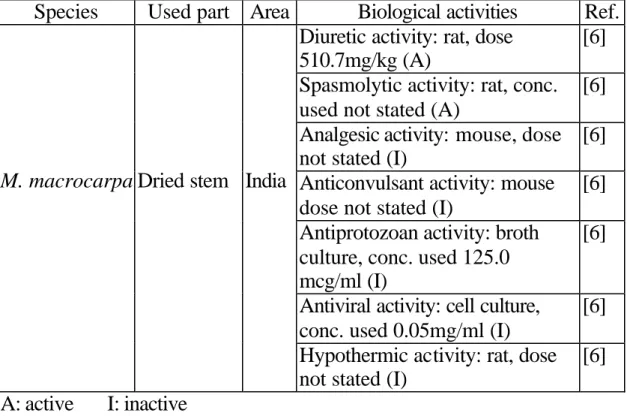
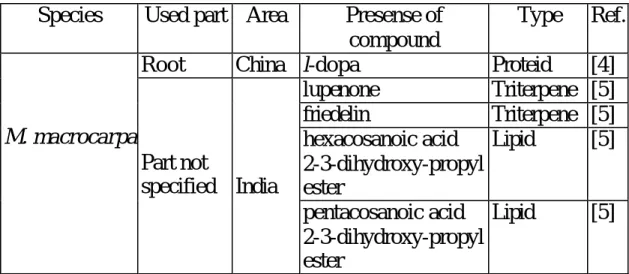
(7) 第二節 血藤之植物成分及藥理文獻考察 有關血藤 (Mucuna macrocarpa WALLICH)植物成分及藥理之文 獻,據美國伊利諾大學 Narpralert Database Profiles on Mucuna 在 2001 年以前所做的統計,依民俗用法(ethnomedical usage)、抽出物之生物 活性(biological activities)及分離之成分(presense of compounds)等三項 歸類整理如下: 血藤之民俗用法報導方面,血藤之乾燥全植物,在中國大陸地區 有作為藥物使用[9]。而在台灣則是用乾燥莖部治療糖尿病[10]。(詳見 Table 2-1) 血藤植物之生物活性研究方面,血藤乙醇與水抽出物主要有利尿 及解痙活性。對大鼠以胃管給藥,劑量為 510.7 mg/kg,顯示具有利 尿活性 [6]。(詳見 Table 2-2) 血藤植物之成分研究方面,目前已分離得到 l-dopa[4], lupenone, friedelin, pentacosanoic acid 2-3-dihydroxy-propyl ester, hexacosanoic acid 2-3-dihydroxy-propyl ester[5]等。(詳見 Table 2-3). 7.
(8) Table 2-1: Ethnomedical information on M. macrocarpa. Species. Used part Dried entire M. macrocarpa plant Dried stem. Area China. Ethnomedical usage Used medicinally. Taiwan Used to treat Diabetes mellitus. Ref. [9] [10]. Table 2-2: Biological activities for extracts of M. macrocarpa. Species. Used part Area. Biological activities Diuretic activity: rat, dose 510.7mg/kg (A) Spasmolytic activity: rat, conc. used not stated (A) Analgesic activity: mouse, dose not stated (I) M. macrocarpa Dried stem India Anticonvulsant activity: mouse dose not stated (I) Antiprotozoan activity: broth culture, conc. used 125.0 mcg/ml (I) Antiviral activity: cell culture, conc. used 0.05mg/ml (I) Hypothermic activity: rat, dose not stated (I) A: active I: inactive. 8. Ref. [6] [6] [6] [6] [6]. [6] [6].
(9) Table 2-3: Presence of compounds in M. macrocarpa. Species. Used part Area. Presense of compound Root China l-dopa lupenone friedelin M. macrocarpa hexacosanoic acid Part not 2-3-dihydroxy-propyl specified India ester pentacosanoic acid 2-3-dihydroxy-propyl ester. Type. Ref.. Proteid Triterpene Triterpene Lipid. [4] [5] [5] [5]. Lipid. [5]. 由上述整理發現,血藤(M. macrocarpa)之民俗用法、生物活性及 成分研究方面相當有限,具有值得進一步研究及開發的潛力。. 9.
(10) 第三節. 血藤屬之植物成分及藥理文獻彙整. 有關血藤屬(Mucuna)全屬之植物成分及藥理文獻,據 2001 年美 國伊利諾大學 Narpralert Database Profiles on Mucuna 在 2001 年以前 所做的統計,依民俗用法(ethnomedical usage)、抽出物之生物活性 (biological activities)及分離之成分(presense of compounds)等三項歸類 整理如下:. 10.
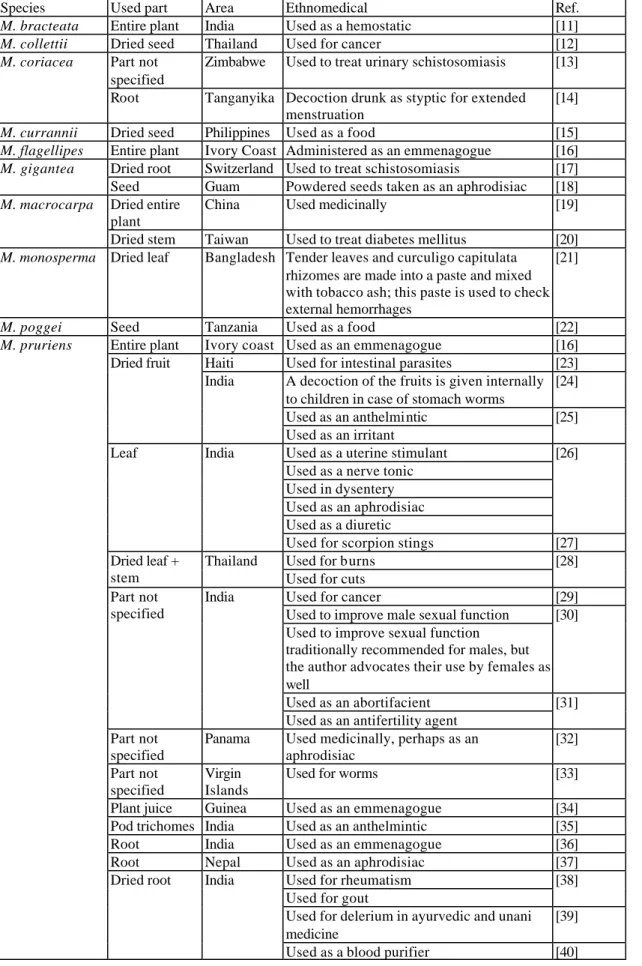
(11) 一、血藤屬 (Mucuna)植物之民俗用法報導方面: [11-70]. 1. M. bracteata 做為止血劑(hemostatic)。 2. M. collettii 用於治療癌症(cancer)。 3. M. coriacea 治療尿道血吸蟲病(urinary schistosomiasis);做為經期外的止血劑 (as styptic for extended menstruation)。 4. M. currannii 當作食物。 5.M. flagellipes 做為調經劑(emmenagogue)。 6. M. gigantea 治療血吸蟲病(schistosomiasis);種子粉末用作催情劑(aphrodisiac)。 7. M. macrocarpa 當作藥用(used medicinally)、治療糖尿病(diabetes mellitus)。 8. M. monosperma 用於檢查外部出血情形(external hemorrhages)。 9. M. poggei 當作食物。 10. M. pruriens 做 為 刺 激 物 質 (irritant) 、 調 經 劑 (emmenagogue) 、 驅 蟲 劑 (anthelmintic)、 子 宮 興 奮 劑 (uterine stimulant)、 神 經 滋 補 劑 (nerve tonic)、神經鎮定劑(nervine)、催情劑(aphrodisiac)、利尿劑(diuretic)、 墮胎劑 (used as an abortifacient)、避孕劑(antifertility agent)、抗蛇毒素. 11.
(12) (antivenin);用於治療癌症(cancer)、風濕症(rheumatism)、痛風(gout)、 糖 尿 病 (diabetes) 、 腎 臟 結 石 (kidney stones)、 肺 結 核 (pulmonary tuberculosis)、 長期咳嗽 (persistent coughs)、痢疾 (dysentery)、 腹瀉 (diarrhea) 、 腸 道 寄 生 物 (intestinal parasites)、 蠍 子 螫 傷 和 蛇 咬 傷 (scorpion stings and snakebite)、男性無能和不孕症(male impotence and sterility)。 11.M. pruriens var. pruriens 做為催情劑(aphrodisiac)。 12. M. pruriens var. utilis 當作食物;用於治療蛇咬傷(snakebite)。 13. M. rostrata 做為解毒劑(antidote);治療糖尿病(diabetes)、痔瘡(hemorrhoids)。 14. M. species 做為墮胎藥(abortive);用於減輕胃部疼痛(stomach pains)。 15. M. urens 做 為 消 化 劑 (digestive) 、 驅 蠕 蟲 藥 (vermifuge) 並 用 於 治 療 淋 病 (gonorrhea)、偏頭痛(migraine)、疼痛(aches and pains)、咬傷及螫傷 (bites and stings)。 (詳見 Table 2-4). 12.
(13) Table 2-4: Ethnomedical information on Mucuna. Species M. bracteata M. collettii M. coriacea. M. currannii M. flagellipes M. gigantea M. macrocarpa. M. monosperma. M. poggei M. pruriens. Used part Entire plant Dried seed Part not specified Root Dried seed Entire plant Dried root Seed Dried entire plant Dried stem Dried leaf. Area India Thailand Zimbabwe. Ethnomedical Used as a hemostatic Used for cancer Used to treat urinary schistosomiasis. Tanganyika Decoction drunk as styptic for extended menstruation Philippines Used as a food Ivory Coast Administered as an emmenagogue Switzerland Used to treat schistosomiasis Guam Powdered seeds taken as an aphrodisiac China Used medicinally. Taiwan Used to treat diabetes mellitus Bangladesh Tender leaves and curculigo capitulata rhizomes are made into a paste and mixed with tobacco ash; this paste is used to check external hemorrhages Seed Tanzania Used as a food Entire plant Ivory coast Used as an emmenagogue Dried fruit Haiti Used for intestinal parasites India A decoction of the fruits is given internally to children in case of stomach worms Used as an anthelmintic Used as an irritant Leaf India Used as a uterine stimulant Used as a nerve tonic Used in dysentery Used as an aphrodisiac Used as a diuretic Used for scorpion stings Dried leaf + Thailand Used for burns stem Used for cuts Part not India Used for cancer specified Used to improve male sexual function Used to improve sexual function traditionally recommended for males, but the author advocates their use by females as well Used as an abortifacient Used as an antifertility agent Part not Panama Used medicinally, perhaps as an specified aphrodisiac Part not Virgin Used for worms specified Islands Plant juice Guinea Used as an emmenagogue Pod trichomes India Used as an anthelmintic Root India Used as an emmenagogue Root Nepal Used as an aphrodisiac Dried root India Used for rheumatism Used for gout Used for delerium in ayurvedic and unani medicine Used as a blood purifier 13. Ref. [11] [12] [13] [14] [15] [16] [17] [18] [19] [20] [21]. [22] [16] [23] [24] [25] [26]. [27] [28] [29] [30]. [31] [32] [33] [34] [35] [36] [37] [38] [39] [40].
(14) M. pruriens Fresh root Seed. Dried seed. Fresh seed Dried seed pods Fresh stem. M. pruriens var.pruriens M. pruriens var.utilis M. rostrata. Seed. M. species. Part not specified Fresh stem. M. urens. Dried leaf Dried seed Seed. Part not specified Sap. Used as a diuretic Used for kidney stones India Used to relieve dysmenorrhea Guadeloupe Seeds crushed and mixed with syrup to be given to infants as a vermifuge Guinea Used as an aphrodisiac India Used to cure night dreams and impotency Used to promote fertiltiy Used as an emmenagogue Used as an aphrodisiac to increase seminal fluid and manly vigour Used as an aphrodisiac Used as an aphrodisiac Used for diarrhea Used as an antivenin Used for diabetes Used for scorpion stings and snakebite Used as a nervine Used as an aphrodisiac in ayurveda and unani medicine Madagascar Used as an aphrodisiac Nepal Used as an aphrodisiac Pakistan Used as an aphrodisiac Used as an aphrodisiac Trinidad Seeds crushed and taken with molasses for intestinal worms Brazil Used as a nerve tonic Used as an aphrodisiac India Used to treat male impotence and sterility Used for abortion Used as an aphrodisiac Used for sexual debility Used for persistent coughs Used for pulmonary tuberculosis Pakistan Used for diabetes India Used as an aphrodisiac, and for seminal weakness and impotence India Used as an anthelmintic in ayurvedic and unani medicine Philippines Used to treat sore/wind burns-cut a fresh stem and blow one end of the stem allowing sap to flow to other end over the mouth of the child Mozambiq- Used as an aphrodisiac ue Nigeria Used to treat snakebite Brazil Used as a food Peru Used as a diuretic Used as an antidote Used against hemorrhoids Peru Known as an abortive Papua-new guinea Peru. Nicaragua. [41] [42] [34] [43] [44]. [45] [35] [46] [47] [48] [27] [39]. [49] [50] [51] [52] [53] [54] [55] [56] [57] [58] [59] [60] [61] [40] [39] [62]. [63] [64] [65] [66]. [67]. Used to relieve stomach pains. [68]. Used to treat gonorrhea Used to treat migraine Used as a vermifuge Used for aches and pains. [66]. 14. [69].
(15) Seed. Guatemala. Used for bites and stings Used as a digestive Used for skin rashes Used for gonorrhea. 15. [70].
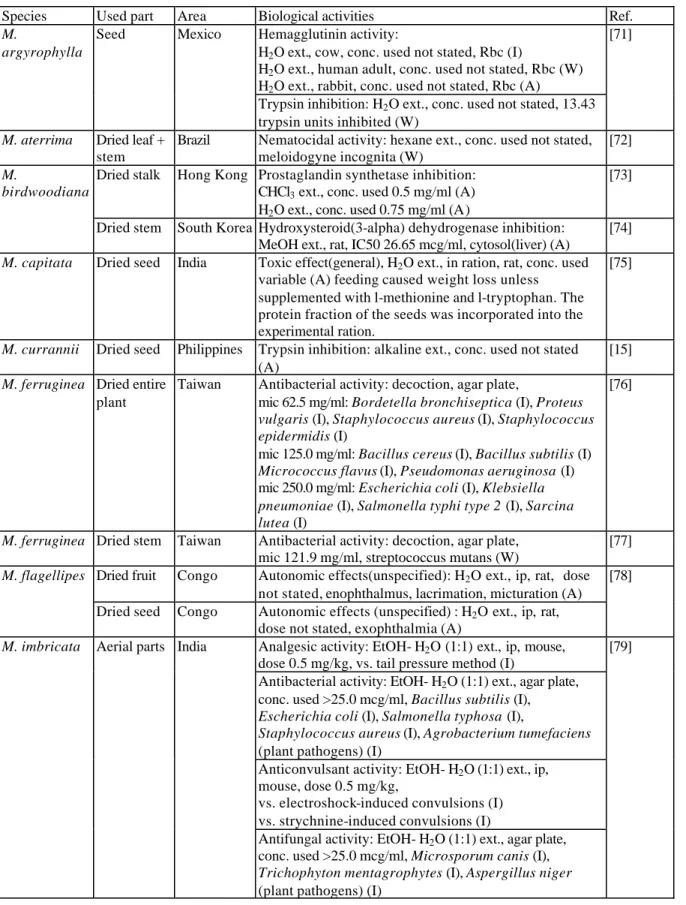
(16) 二、血藤屬 (Mucuna)植物之生物活性研究方面: [71-117]. 1. M. argyrophylla 紅血球凝集活性(hemagglutinin activity)。 2. M. aterrima 線蟲毒殺活性(nematocidal activity)。 3. M. birdwoodiana 前列線素合成抑制作用(prostaglandin synthetase inhibition);固醇類 去氫酵素抑制作用(hydroxysteroid dehydrogenase inhibition)。 4. M. capitata 毒性反應(toxic effect)。 5. M. currannii 胰蛋白酵素抑制作用(trypsin inhibition)。 6. M. ferruginea 抗菌活性 (antibacterial activity)。 7. M. flagellipes 自律神經反應 (autonomic effects)。 8.M. macrocarpa 利尿作用 (diuretic activity)。 抗痙攣作用 (spasmolytic activity)。 9. M. monosperma 墮胎作用 (abortifacient effect)。 10. M. pruriens 抗 痙 攣 作 用 (antispasmodic activity) ; 低 血 糖 作 用 (hypoglycemic activity);止痛作用(analgesic activity);抗發炎作用(antiinflammatory activity) ; 解 熱 作 用 (antipyretic activity); 抗 高 膽 固 醇 血 症 作 用 (antihypercholesterolemic activity);抗高脂血症作用(antihyperlipemic 16.
(17) activity);促進代謝作用(anabolic activity);改善前列腺肥大(benign prostatic hyperplasia improvement);雄性激素作用(androgenic effect); 增 加 睪 固 酮 濃 度 作 用 (testosterone level increased) ; 催 情 作 用 (aphrodisiac activity);陰莖勃起刺激作用(penis erectile stimulant);性 行為改善作用(sexual behavior modification); 促進精液產生作用 (spermatogenic effect);提升生育力作用(fertility promotion effect);刺 激組織胺釋放作用(histamine release stimulation);增加褪黑激素濃度 作用(melatonin level increase);血清素釋放作用(serotonin releasing effect);抗高血糖症作用(antihyperglycemic activity);抗巴金森氏症作 用(antiparkinson activity);催乳激素抑制作用(prolactin inhibition);絛 蟲毒殺活性(taenicide activity);致畸胎作用(teratogenic activity);毒性 反應 (toxic effect);抗蛇毒素反應(antivenin effect);骨骼肌興奮作用 (skeletal muscle stimulant activity);平滑肌興奮作用 (smooth muscle stimulant activity)。 11. M. pruriens var. utilis 抗 血 液 凝 集 作 用 (anticoagulant activity) ; 紅 血 球 凝 集 作 用 (hemagglutinin activity);胰蛋白酵素抑制作用(trypsin inhibition)。 12.M. pruriens var. utilis 植物成長抑制作用(plant growth inhibitor)。 13. M. species 中樞神經作用(CNS effects);抗痙攣作用(spasmolytic activity)。 14.M. utilis 抗痙攣作用(spasmolytic activity)。 (詳見 Table 2-5). 17.
(18) Table 2-5: Biological activities for extracts of Mucuna (A:active, S:strong, W:weak, I:inactive) Species Used part M. Seed argyrophylla. Area Mexico. Biological activities Hemagglutinin activity: H2 O ext., cow, conc. used not stated, Rbc (I) H2 O ext., human adult, conc. used not stated, Rbc (W) H2 O ext., rabbit, conc. used not stated, Rbc (A) Trypsin inhibition: H2 O ext., conc. used not stated, 13.43 trypsin units inhibited (W) M. aterrima Dried leaf + Brazil Nematocidal activity: hexane ext., conc. used not stated, stem meloidogyne incognita (W) M. Dried stalk Hong Kong Prostaglandin synthetase inhibition: birdwoodiana CHCl3 ext., conc. used 0.5 mg/ml (A) H2 O ext., conc. used 0.75 mg/ml (A) Dried stem South Korea Hydroxysteroid(3-alpha) dehydrogenase inhibition: MeOH ext., rat, IC50 26.65 mcg/ml, cytosol(liver) (A) M. capitata Dried seed India Toxic effect(general), H2 O ext., in ration, rat, conc. used variable (A) feeding caused weight loss unless supplemented with l-methionine and l-tryptophan. The protein fraction of the seeds was incorporated into the experimental ration. M. currannii Dried seed Philippines Trypsin inhibition: alkaline ext., conc. used not stated (A) M. ferruginea Dried entire Taiwan Antibacterial activity: decoction, agar plate, plant mic 62.5 mg/ml: Bordetella bronchiseptica (I), Proteus vulgaris (I), Staphylococcus aureus (I), Staphylococcus epidermidis (I) mic 125.0 mg/ml: Bacillus cereus (I), Bacillus subtilis (I) Micrococcus flavus (I), Pseudomonas aeruginosa (I) mic 250.0 mg/ml: Escherichia coli (I), Klebsiella pneumoniae (I), Salmonella typhi type 2 (I), Sarcina lutea (I) M. ferruginea Dried stem Taiwan Antibacterial activity: decoction, agar plate, mic 121.9 mg/ml, streptococcus mutans (W) M. flagellipes Dried fruit Congo Autonomic effects(unspecified): H2 O ext., ip, rat, dose not stated, enophthalmus, lacrimation, micturation (A) Dried seed Congo Autonomic effects (unspecified) : H2 O ext., ip, rat, dose not stated, exophthalmia (A) M. imbricata Aerial parts India Analgesic activity: EtOH- H2 O (1:1) ext., ip, mouse, dose 0.5 mg/kg, vs. tail pressure method (I) Antibacterial activity: EtOH- H2 O (1:1) ext., agar plate, conc. used >25.0 mcg/ml, Bacillus subtilis (I), Escherichia coli (I), Salmonella typhosa (I), Staphylococcus aureus (I), Agrobacterium tumefaciens (plant pathogens) (I) Anticonvulsant activity: EtOH- H2 O (1:1) ext., ip, mouse, dose 0.5 mg/kg, vs. electroshock-induced convulsions (I) vs. strychnine-induced convulsions (I) Antifungal activity: EtOH- H2 O (1:1) ext., agar plate, conc. used >25.0 mcg/ml, Microsporum canis (I), Trichophyton mentagrophytes (I), Aspergillus niger (plant pathogens) (I). 18. Ref. [71]. [72] [73]. [74] [75]. [15] [76]. [77] [78]. [79].
(19) M. imbricat. M. macrocarpa. M. monosperma M. pruriens. Antiinflammatory activity: EtOH- H2 O (1:1) ext., oral, rat, male, dose 0.5 mg/kg, vs. carrageenin-induced pedal edema, animals dosed one hour before carrageenin injections (I) Antispasmodic activity (unspecified type): EtOH- H2 O (1:1) ext., guinea pig, conc. used not stated, ileum, vs. ach- and histamine-induced spasms (I) Antitumor activity: EtOH- H2 O (1:1) ext., ip, mouse, dose not stated, leuk-p388 (I) Antiyeast activity: EtOH- H2 O (1:1) ext., agar plate, conc. used >25.0 mcg/ml, Candida albicans (I), Cryptococcus neoformans (I) Barbiturate potentiation: EtOH- H2 O (1:1) ext., ip, mouse, dose 0.5 mg/kg (I) Diuretic activity: EtOH- H2 O (1:1) ext., ip, rat, male, dose 0.25 mg/kg, saline-loaded animals used, urine collected for 4 hours post-drug (I) Hypoglycemic activity: EtOH- H2 O (1:1) ext., oral, rat, dose 250.0 mg/kg, less than 30% drop in blood sugar level (I) Hypolipemic activity: EtOH- H2 O (1:1) ext., oral, rabbit, dose 50.0 mg/kg (I) Hypothermic activity: EtOH- H2 O (1:1) ext., ip, mouse, dose 0.5 mg/kg (I) Semen coagulation: EtOH- H2 O (1:1) ext., rat, conc. used 2.0%, sperm (I) Spermicidal effect: EtOH- H2 O (1:1) ext., rat, male, conc. used not stated, sperm (I) Toxicity assessment (quantitative): EtOH- H2 O (1:1) ext, ip, mouse, LD 50 1.0 gm/kg Dried stem India Analgesic activity: EtOH- H2 O (1:1) ext., intragastric, mouse, dose not stated, vs. hot plate method, vs. tail clip method (I) Anticonvulsant activity: EtOH- H2 O (1:1) ext., ip, mouse dose not stated, vs. supramaximal electroshock-induced convulsions. (I) Antiprotozoan activity: EtOH- H2 O (1:1) ext., broth culture, conc. used 125.0 mcg/ml, Entamoeba histolytica (I) Antiviral activity: EtOH- H2 O (1:1) ext., cell culture, conc. used 0.05 mg/ml, virus-ranikhet (I), virus-vaccinia(I) Diuretic activity: EtOH- H2 O (1:1) ext., intragastric, rat, dose 510.7 mg/kg (A) Hypothermic activity: EtOH- H2 O (1:1) ext., intragastric, rat, dose not stated (I) Spasmolytic activity: EtOH- H2 O (1:1) ext., rat, conc. used not stated, uterus (unspec.cond) (A) Toxicity assessment (quantitative): EtOH- H2 O (1:1) ext., ip, mouse, LD 50 681.0 mg/kg Dried root India Abortifacient effect: type ext. not stated, ip, species not stated, dose not stated (A) Entire plant Puerto Rico Insecticide activity: plant, dose not stated (I) Dried entire India Benign prostatic hyperplasia improvement: hot H2 O ext., plant oral, human adult, male, dose not stated (A) Fertility promotion effect: type ext. not stated, oral, human adult, male, dose 96.0 mg/day (A) Genitourinary effect (unspecified): H2 O ext., oral, mouse dose 5.0 mg/day (A) 19. [80]. [81] [82] [83] [84] [85].
(20) M. pruriens. Fruit. India. Dried fruit. Italy. Dried leaf. Africa. Dried leaf + India root + seed Commercial Italy sample of leaf. Part not specified. India. Dried part not specified. India. Dried prothallus Root. Japan India. Antis pasmodic activity (unspecified type): EtOH- H2 O (1:1) ext., guinea pig, conc. used not stated, ileum (A) Cytotoxic activity: EtOH- H2 O (1:1) ext., cell culture, ED50 >20.0 mcg/ml, CA-9KB (I) Hypoglycemic activity: EtOH- H2 O (1:1) ext., oral, rat, dose 250.0 mg/kg (A) Toxicity assessment (quantitative): EtOH- H2 O (1:1) ext., ip, mouse, maximum tolerated dose 1.0 gm/kg Analgesic activity: EtOH (95%) ext., intragastric, rat, vs. hot plate method, dose 1.0 gm/kg (A) vs.acetic acid-induced writhing, dose 2.0 gm/kg (A) Antiinflammatory activity: EtOH (95%) ext., intragastric, rat, vs. carrageenan-induced pedal edema, dose 3.0 gm/kg (A) Antipyretic activity: EtOH (95%) ext., intragastric, rat, vs. yeast-induced pyrexia, dose 1.0 gm/kg (A) Analgesic activity: EtOH (95%) ext., intragastric, rat, dose 1.0 gm/kg, vs. hot plate method (A) vs.acetic acid-induced writhing (A) Antiinflammatory activity: EtOH (95%) ext., intragastric, rat, dose 1.0 gm/kg, vs. carrageenan-induced pedal edema (A) Antipyretic activity: EtOH (95%) ext., intragastric, rat, dose 1.0 gm/kg, vs. yeast-induced pyrexia (A) Antiinflammatory activity: root, oral, human adult, dose variable (A) Antihypercholesterolemic activity: decoction, intragastric, rat, dose 5.0 gm/kg, vs. diet-induced hypercholesterolemia (A) vs. triton-induced hypercholesterolemia (A) Antihyperlipemic activity: decoction, intragastric, rat, dose 5.0 gm/kg, vs. diet-induced hypercholesterolemia (A) vs. triton-induced hypercholesterolemia (A) Anabolic activity: plant, oral, mouse (castrate) , male, dose 7.70 mg/animal (A) Androgenic effect: plant, oral, mouse (castrate) , male (child) , dose 7.7 mg/animal (A) mouse(infant), male, dose 22.0 mg/animal (A) Aphrodisiac activity: plant, oral, human adult, male, dose not stated (A) Histamine release stimulation: type ext. not stated, intragastric, rat, dose 1.0 gm/kg (A) Melatonin level increase: type ext not stated, intragastric, rat, dose 1.0 gm/kg (A) Serotonin releasing effect: type ext. not stated, intragastric rat, dose 1.0 gm/kg (A) Antiradiation effect: MeOH ext, ip, mouse, dose 100 mg/kg, vs. soft x-ray irradiation at lethal dose (I) Antispasmodic activity (unspecified type): EtOH-H2 O (1:1) ext., guinea pig, conc. used not stated, ileum, vs. ach: and histamine-induced spasms (A) Cytotoxic activity: EtOH-H2 O (1:1) ext., cell culture, ED50 >20.0 mcg/ml, CA-9KB (I) Hypoglycemic activity: EtOH-H2 O (1:1) ext., oral, rat, dose 250.0 mg/kg more than 30% drop in blood sugar level (A). 20. [86]. [87]. [88] [89]. [90]. [91] [92]. [93] [86].
(21) M. pruriens Seed. India. Boiled seed Nigeria. Toxicity assessment (quantitative): EtOH-H2 O (1:1) ext., ip, mouse, maximum tolerated dose 250.0 mg/kg Antihyperglycemic activity: intragastric, rat, sex not indicated (adult) , vs. glucose tolerance tests; albino rats, ash, dose 90.0 mg/kg (A) EtOH (100%) ext., dose 250.0 mg/kg (I) Hypoglycemic activity: EtOH-H2 O (1:1) ext., oral, rat, dose 250.0 mg/kg less than 30% drop in blood sugar level (I) Spasmogenic activity: decoction, guinea pig, ED 50 3.3 mg/ml, ileum, atropine, promethazine, nifedipine, cyproteptadine and verapamil antagonized effect with increasing effectiveness (A) Nematocidal activity: decoction, conc. used 10.0 mg/ml, Toxocara canis (I). Commercial Sri Lanka sample of seed Dried seed No address Penis erectile stimulant: type ext. not stated, oral, human given adult, male, dose not stated (A) Dried seed Bangladesh Nematocidal activity: H2 O ext., conc. used 10.0 mg/ml, Toxocara canis (I) MeOH ext., conc. used 1.0 mg/ml, Toxocara canis (I) Dried seed Cuba Bronchodilator activity: hot H2 O ext., iv, guinea pig, dose 1.5 ml/animal (I) Dried seed India Antigalactagogue effect: seeds, oral, human adult, female, dose 15.0 gm/animal (I) Antiparkinson activity: endocarp tissue, in ration, rat, dose 5.0 gm/kg, carbidopa also administered required to have effect (A) Antiparkinson activity: MeOH ext., ip, rat, dose 200.0 mg/kg an alcohol-insoluble methanol ext.ract ,free from l-dopa, was tested, data incomplete - derived from an abstract (A) seeds, gastric intubation, rat, dose 400.0 mg/kg data incomplete - derived from an abstract (A) Cholinesterase inhibition: MeOH ext., ip, rat, dose 200.0 mg/kg, an alcohol-insoluble methanol ext.ract, free from l-dopa,was tested, data incomplete - derived from an abstract (I) Antiparkinson activity: seeds, oral, human adult, dose 15-40 gm/person l-dopa content was about 4.5-5.5%, study involving 33 patients with parkinson's disease (A) Antiparkinson activity: type ext. not stated, oral, human adult, dose not stated, levodopa has been isolated from this extract (A) Aphrodisiac activity: ip, rat, male, dose not stated, no effect on social behavior including homosexual mounting, sniffing, lying over one another, etc, data incomplete - derived from an abstract, Ether ext. (I) EtOH (95%) ext. (I) Embryotoxic effect: H2 O ext., intragastric, rat (pregnant), dose 175.0 mg/kg (I) Hypocholesterolemic activity: seeds, in ration, rat, dose not stated (A) Hypoglycemic activity: seeds, in ration, rat, dose not stated (A) Aphrodisiac activity: oral, human adult, male, dose variable, the product contained a mixture (A) 21. [48]. [79]. [94]. [95]. [96] [97]. [98] [99] [100]. [101]. [102]. [103]. [57]. [56] [104]. [105].
(22) M. pruriens. FSH release inhibition: oral, human adult, male, dose variable, the product contained a mixture (equivocal) FSH release stimulation effect: oral, human adult, male, dose variable, the product contained a mixture (equivocal) FSH synthesis stimulation: oral, human adult, male, dose variable, the product contained a mixture (equivocal) Gonadotropin release stimulation (unspecified): oral, human adult, male, dose variable, the product contained a mixture (equivocal) Gonadotropin synthesis stimulation (unspecified): oral, human adult, male, dose variable, the product contained a mixture (equivocal) LH-release inhibition: oral, human adult, male, dose variable (equivocal) LH-release stimulation: oral, human adult, male, dose variable (equivocal) LH-synthesis s timulation: oral, human adult, male, dose variable (equivocal) Pharmacokinetic study: powder, oral, human adult, male dose 300.0 ml (A) Prolactin inhibition: seeds, oral, human adult, female, dose 15.0 gm/person (I) Prolactin inhibition: seeds, oral, human adult, male, dose 15.0 gm/person, inhibition of prolactin response to chlorpromazine injection, five subjects were studied (A) Sexual behavior modification: H2 O ext., intragastric, dose 500.0 mg/kg, effects described are from a multicomponent rx, rat, male (A) rat, male, in alcohol exposed rats (A) Sexual behavior modification: seeds, intragastric, rat, male, dose 1.0 gm/kg (A) Spermatogenic effect: oral, human adult, male, dose variable, the product used contained a mixture (equivocal) Spermatogenic effect: H2 O ext., intragastric, dose 500.0 mg/kg, effects described are from a multi- component rx rat, male (A) rat, male, in alcohol exposed rats (A) Spermatogenic effect: plant, oral, human adult, male, dose not stated used to increase fertility, this was a human study involving 40 subjects, most of whom were claimed to show (A) Taenicide activity: conc. used not stated, taenia solium EtOH (95%) ext. (A) H2 O ext. (A) Teratogenic activity: H2 O ext., intragastric, rat (pregnant) dose 175.0 mg/kg (A) Testosterone level increased: H2 O ext., intragastric, dose 500.0 mg/kg, effects described are from a multicomponent rx rat, male (A) rat, male, in alcohol exposed rats (A) Toxic effect (general): H2 O ext., in ration, rat, conc. used variable, feeding caused weight loss unless supplemented with l-methionine and l-tryptophan, the protein fraction of the seeds was incorporated into the experimental ration (A) 22. [106] [99] [107]. [55]. [108] [109]. [55]. [58]. [110]. [56] [55]. [75].
(23) M. prurien. M. pruriens var.utilis M. pruriens var.utilis. M. pruriens var.utilis M. pruriens var.utilis M. sloanei. M. species. M. urens M. utilis. Dried seed. Nigeria. Antivenin effect: type ext. not stated, ip, mouse, dose variable, using serum immunoglobulins from M. Pruriens- sensitized rabbits (A) Skeletal muscle stimulant activity: H2 O ext., rat, conc. used 300 mcg/ml, phrenic nerve- diaphragm (A) Smooth muscle stimulant activity: H2 O ext., guinea pig, conc. used 1.2 mg/ml, ileum (A) rabbit, conc. used 1.5 mg/ml, jejunum (A) Dried seed Pakistan Antihyperglycemic activity: type ext. not stated, intragastric, rabbit, dose not stated, vs. alloxan-induced hyperglycemia (A) Hypoglycemic activity: type ext. not stated, intragastric, rabbit, dose not stated (A) Toxic effect (general): type ext. not stated, intragastric, rabbit, dose 8.0 gm/kg (I) Dried leaf Nigeria Anticoagulant activity: H2 O ext., conc. used 1.0 mg/ml, blood- human-whole (A) Dried seed Brazil Hemagglutinin activity: protein fraction, conc. used 25.0 microliters/well, Rbc (I) Trypsin inhibition: protein fraction, dose 5.0 microliters (A) Dried seed Japan Plant growth inhibitor (unspec): plant, conc. used not stated, plant exhibits allelopathic effect in field tests (A) Fresh Japan Plant growth inhibitor (unspec): EtOH (80%) ext., seedling external, plant, the acid fraction of given extract inhibited the growth of lactuca sativa seedlings (A) Fresh entire Puerto Rico Molluscicidal activity: aqueous slurry (homogenate) plant LD100 >1m ppm, fruits, roots and leaves were tested Lymnaea columella (I) Lymnaea cubensis (I) Fresh Samoa CNS effects (general): hippocratic screen stembark intragastric, mouse, dose 1.0 gm/kg (A) ip, mouse, dose 1.0 gm/kg (W) Spasmolytic activity: guinea pig, conc. used 2.0 mg/ml, ileum, vs. electrical stimulation (A) Seed Guatemala Antibacterial activity: EtOH- H2 O (1:1) ext., agar plate, conc. used 50.0 microliters/disc, Neisseria gonorrhea (I) Seed India Analgesic activity: EtOH- H2 O (50%) ext., intragastric, mouse, dose not stated, vs. hot plate method, vs. tail clip method (I) Antiviral activity: EtOH- H2 O (50%) ext., cell culture, conc. used 0.05 mg/ml, virus- vaccinia (I) Diuretic activity: EtOH- H2 O (50%) ext., intragastric, rat, dose 750.0 mg/kg (I) Spasmolytic activity: EtOH- H2 O (50%) ext., rat, conc. used not stated, uterus (A) Toxicity assessment (quantitative): EtOH- H2 O (50%) ext., ip, mouse, LD 50 >1000 mg/kg. 23. [111]. [112]. [61]. [64] [65]. [113] [114]. [115]. [116]. [70] [117].
(24) 三、血藤屬 (Mucuna)植物之成分研究方面: [118-147]. 1.Benzenoids: 2-6-dimethoxyphenol; syringic acid; vanillic acid; protocatechuic acid 2.Terpenes: asiatic acid; 3-O-(6-O-methyl-beta-d-glucuronopyranosyl) asiatic acid; 28-O-beta-D-glucopyranoside-3-O-(6-O-methyl-beta-D-glucuronopyrano syl) asiatic acid; 3-O-[alpha-l-arabinopyranosyl(1-2)]-6-O-methyl-beta-D-glucuronopyran osylasiatic acid; maslinic acid; 3-O-[alpha-l-arabinopy-ranosyl(1-2)]-6-O-methyl-beta-D-glucuronopyran osyl) maslinic acid; M. genin a; M. genin b; friedelin; lupenone; friedelinol 3.Steroids: beta-sitosterol; stigmasterol 4.Alkanes: 1-triacontanol. 5.Lipids: tetracosanoic acid triacontyl ester; linoleic acid; oleic acid; palmitic acid; stearic acid; hexacosanoic acid 2,3-dihydroxy-propyl ester; pentacosanoic acid 2,3-dihydroxy-propyl ester; threo-12,13-dihydroxyoctadec-cis-9-enoic acid; cis-12,13-epoxyoctadec-trans-9-enoic acid; threo-12,13dihydroxyoctadec-trans-9-enoic acid. 24.
(25) 6.Phenylpropanoids: trans-para-coumaric acid. 7.Proteids: l-dopa; stizolobic acid; hemagglutinin; lectin 8.Flavonoids: daidzin; 7-O-beta-D-glucoside-4'-8-dimethoxyisoflavone; ononin; cyclosin; daidzein; pratensein; 3'-methoxydaidzein; formononetin; isoformononetin; genistein; geraldol; luteolin; orobol; apigenin 6,8-di-C-alpha-l-arabinosyl; luteolin 8-C-alpha-l-arabinosyl; isoorientin; kievitone. 9.Alkaloids: (1) Isoquinoline alkaloid: 3-carboxy-6,7-dihydroxy-1-methyl1,2,3,4-tetrahydroisoquinoline; 3-carboxy-6,7-dihydroxy-1,2,3,4-tetrahydroisoquinoline; 2,6-dimethoxyphenol; syringic acid; vanillic acid; N-(trans)-feruloyltyramine; dopamine (2) Indole alkaloid: bufotenine; N,N-dimethyltryptamine; N-oxide-N,N-dimethyltryptamine; 5-hydroxytryptamine; methoxy-N,N-dimethyltryptamine (3)Alkaloid-misc.: Mucuna pruriens alkaloid p, q, r, s, x; prurienidine; prurieninine; choline 10.Carbohydrates: phytic acid; lecithin; D-pinitol. 25.
(26) 11. Inorganic: hydrocyanic acid (詳見 Table 2-6). 26.
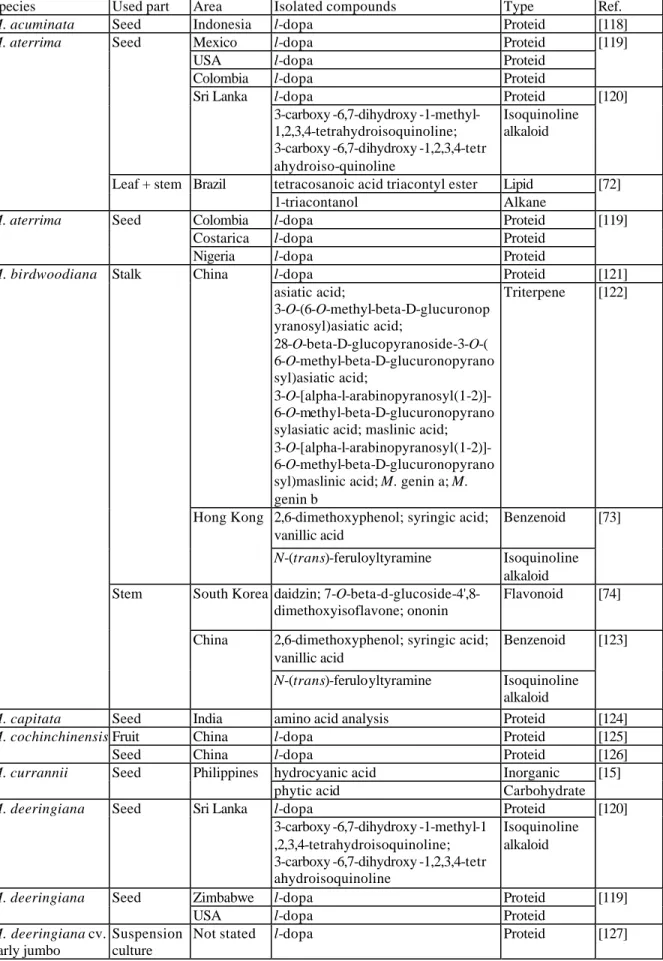
(27) Table 2-6: Presence of compounds in Mucuna Species M. acuminata M. aterrima. M. aterrima. M. birdwoodiana. Used part Seed Seed. Area Indonesia Mexico USA Colombia Sri Lanka. Isolated compounds l-dopa l-dopa l-dopa l-dopa l-dopa 3-carboxy -6,7-dihydroxy -1-methyl1,2,3,4-tetrahydroisoquinoline; 3-carboxy -6,7-dihydroxy -1,2,3,4-tetr ahydroiso-quinoline Leaf + stem Brazil tetracosanoic acid triacontyl ester 1-triacontanol Seed Colombia l-dopa Costarica l-dopa Nigeria l-dopa Stalk China l-dopa asiatic acid; 3-O-(6-O-methyl-beta-D-glucuronop yranosyl)asiatic acid; 28-O-beta-D-glucopyranoside-3-O-( 6-O-methyl-beta-D-glucuronopyrano syl)asiatic acid; 3-O-[alpha-l-arabinopyranosyl(1-2)]6-O-methyl-beta-D-glucuronopyrano sylasiatic acid; maslinic acid; 3-O-[alpha-l-arabinopyranosyl(1-2)]6-O-methyl-beta-D-glucuronopyrano syl)maslinic acid; M. genin a; M. genin b Hong Kong 2,6-dimethoxyphenol; syringic acid; vanillic acid. Type Proteid Proteid Proteid Proteid Proteid Isoquinoline alkaloid. Ref. [118] [119]. Lipid Alkane Proteid Proteid Proteid Proteid Triterpene. [72]. Benzenoid. [73]. Isoquinoline alkaloid Flavonoid. [74]. 2,6-dimethoxyphenol; syringic acid; vanillic acid. Benzenoid. [123]. N-(trans)-feruloyltyramine. Isoquinoline alkaloid Proteid Proteid Proteid Inorganic Carbohydrate Proteid Isoquinoline alkaloid. N-(trans)-feruloyltyramine Stem. South Korea daidzin; 7-O-beta-d-glucoside-4',8dimethoxyisoflavone; ononin China. M. capitata Seed M. cochinchinensis Fruit Seed M. currannii Seed. India China China Philippines. M. deeringiana. Seed. Sri Lanka. M. deeringiana. Seed. Zimbabwe USA M. deeringiana cv. Suspension Not stated early jumbo culture. amino acid analysis l-dopa l-dopa hydrocyanic acid phytic acid l-dopa 3-carboxy -6,7-dihydroxy -1-methyl-1 ,2,3,4-tetrahydroisoquinoline; 3-carboxy -6,7-dihydroxy -1,2,3,4-tetr ahydroisoquinoline l-dopa l-dopa l-dopa. 27. Proteid Proteid Proteid. [120]. [119]. [121] [122]. [124] [125] [126] [15] [120]. [119] [127].
(28) Leaf Seed Proteid Seed Seed Seed oil. Not stated Indonesia Nigeria Indonesia Guatemala India. M. macrocarpa. Root Part not specified. China China. M. macrophylla M. membranacea. Seed Root. Indonesia China. M. diabolica M. flagellipes M. gigantea M. holtonii M. imbricata. M. nivea. Seed. M. pruriens. Seed. Seed oil. Leaf. stizolobic acid l-dopa hemagglutinin l-dopa l-dopa linoleic acid; oleic acid; palmitic acid; stearic acid l-dopa hexacosanoic acid 2,3-dihydroxy -propyl ester; pentacosanoic acid 2,3-dihydroxy -propyl ester friedelin; lupenone l-dopa trans-para-coumaric acid. Fruit. Shoots. Proteid Lipid. [10] [4]. vanillic acid; protocatechuic acid beta-sitosterol; stigmasterol. Steroid. friedelin; friedelinol. Triterpene Flavonoid. Proteid Isoquinoline alkaloid Proteid Proteid Proteid Proteid Carbohydrate Alkaloid-misc. [120]. Lipid. [136]. Proteid Proteid Isoquinoline alkaloid bufotenine; N,N-dimethyltryptamine; Indole N-oxide-N,N-dimethyltryptamine alkaloid. choline bufotenine; 5-hydroxytryptamine; methoxy -N,N-dimethyltryptamine Netherlands l-dopa Netherlands l-dopa China l-dopa Not stated bufotenine; 5-hydroxytryptamine; methoxy -N,N-dimethyltryptamine. Alkaloid-misc Indole alkaloid Proteid Proteid Proteid Indole alkaloid. Not stated. Proteid. Leaf + stem Not stated Stem Root. [128] [118] [129] [118] [119] [130]. Triterpene Proteid [118] Phenylpropan- [131] oid Benzenoid. cyclosin; daidzein; pratensein; 3'-methoxydaidzein; formononetin; isoformononetin; genistein; geraldol; luteolin; orobol Sri Lanka l-dopa 3-carboxy -6,7-dihydroxy -1,2,3,4-tetr ahydroisoquinoline India l-dopa l-dopa l-dopa l-dopa lecithin Mucuna pruriens alkaloid p, q, r, s, x prurienidine; prurieninine India threo-12,13-dihydroxyoctadec-cis-9enoic acid; cis-12,13-epoxyoctadec-trans-9-enoi c acid; threo-12,13-dihydroxyoctadec-trans9-enoic acid Not stated l-dopa Netherlands l-dopa dopamine India. Proteid Proteid Proteid Proteid Proteid Lipid. l-dopa. 28. [132] [133] [100] [99] [134] [135]. [137] [138]. [26]. [139] [138] [10] [139]. [137].
(29) Seed. Indonesia. l-dopa. Indole alkaloid Proteid Proteid Isoquinoline alkaloid Proteid. Seed. Indonesia. l-dopa. Proteid. Seed. Indonesia. l-dopa. Proteid. Indonesia Not stated. l-dopa l-dopa. Proteid Proteid. [118] [141]. Japan Japan Japan Japan. l-dopa l-dopa l-dopa apigenin 6,8-di-C-alpha-l-arabinosyl; luteolin 8-C-alpha-l-arabinosyl; isoorientin. Proteid Proteid Proteid Flavonoid. [113] [114]. M. sempervirens. Seed Suspension culture Seed Leaf Root Leaf. M. sloanei M. species. Seed Seed Seed. France China India Indonesia Sri Lanka. Carbohydrate Proteid Proteid Proteid Proteid Isoquinoline alkaloid. [143] [144] [145] [118] [120]. M. urens M. utilis. Seed Seed. USA India. D-pinitol lectin l-dopa l-dopa l-dopa 3-carboxy -6,7-dihydroxy -1-methyl-1 ,2,3,4-tetrahydroisoquinoline; 3-carboxy -6,7-dihydroxy -1,2,3,4-tetr ahydroisoquinoline l-dopa l-dopa kievitone l-dopa 3-carboxy -6,7-dihydroxy -1,2,3,4-tetr ahydroisoquinoline. Proteid Proteid Flavonoid Proteid Isoquinoline alkaloid. [119] [146] [147] [120]. M. pruriens. M. pruriens fa.cochinchinensis M. pruriens fa.hirsuta M. pruriens fa.pruriens M. pruriens fa.utilis M. pruriens var.utilis. Pod India 5-hydroxytryptamine trichomes Suspension Not stated l-dopa culture Netherlands l-dopa dopamine. Sri Lanka Sri Lanka. 29. [26] [140] [138]. [118]. [142].
(30) 第三章 第一節. 實驗部分 實驗試劑與儀器. 一、溶媒、試藥與層析材料:. 1.溶媒 (1)正己烷、氯仿、乙酸乙酯、甲醇、苯、乙醚、正丁醇等溶媒(以 上購自 Merck)。 (2)乙醇為台灣省菸酒公賣局之 95%酒精。 (3) 測 核 磁 共 振 (NMR) 光 譜 所 用 之 溶 媒 CDCl3 ( Deuterated chloroform )、CD3OD (Deuterated methanol)等均為光譜級(以上購 自 Merck)。. 2.顯色劑 (1) 10 % Sulfuric acid spray reagent。 (2) Anisaldehyde sulfuric acid spray reagent。 (3) Vanillin sulfuric acid spray reagent。. 3.薄層層析(Thin Layer Chromatography) TLC plate:Kieselgel 60 F254 silica gel pre-coated aluminium plate,厚 度 0.2 mm (Merck)。. 30.
(31) 4.管柱色層層析(Column Chromatography) 以 Pyrex 或 Merck 公司生產之不同型號管柱。 填 充 物 質 : Kieselgel 60 70~230 mesh (Merck) , Kieselgel 60 230~400 mesh (Merck),Sephadex LH-20 (Pharmacia),Diaion HP-20。. 5.試藥 醋酸、硫酸、硝酸、氫氧化銨、無水硫酸鈉、茴香醛、香莢蘭醛及 溴化鉀等均為試藥級(以上購自 Merck 公司)。. 31.
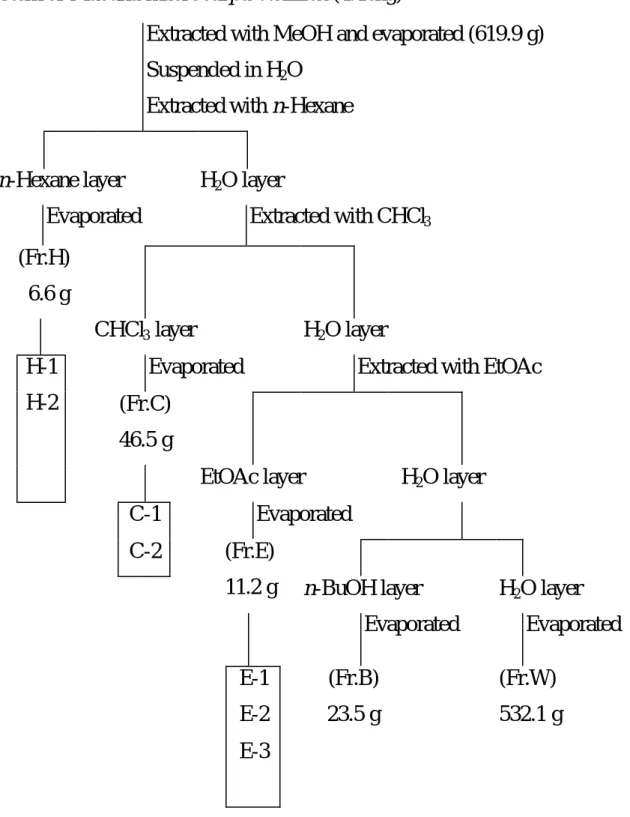
(32) 二、實驗儀器:. 1.迴轉式濃縮機:Rotavapor R-114 (Büchi)。. 2.烘箱:Chanel Drying Oven OV602。. 3.電子乾燥箱:用於保存 TLC 片、NMR 溶媒及紅外線譜用之 KBr。. 4.電子天平:Mettler AJ100 and Metter Toledo PB 602。. 5.電熱板:Coroning Model PC-320。. 6.超音波震盪器: (1) Bandelin Sonorex Super PK1028BH (2) Aquusonic TM Model 150D。. 7.玻璃展開槽:120 mm × 150 mm 及 220 mm × 70 mm。. 8.紫外線燈: CAMAG Universal UV lamp,波長 254 nm 及 366 nm。. 9.微量熔點測定器: Yanaco MP-500,其溫度未經校正。. 32.
(33) 10.紅外線分光光譜儀 (Infared Spectrophotometer) 使用 Nicolet Impact 400 FT-IR Spectrophotometer 測定,固體以乾的 KBr 粉未混合均勻,在真空下加壓成透明薄片測定之,光譜單位為 波數(cm-1)(中國醫藥學院)。. 11.質譜儀(MS) (1) VG Platform II Mass Spectrometer,離子化電壓為 70 eV(中國醫 藥學院) (2) JOEL JMS-SX/SX 102A Tandem Mass Spectrometer(中興大學) 。. 12.核磁共振光譜儀 (1) Bruker DPX-200 FT-NMR(中國醫藥學院)。 (2) Bruker AMX-400 FT-NMR(中國醫藥學院)。 (3) Varian VXR-600 FT-NMR (中興大學)。 Internal standard 為 Tetramethy Silane (TMS),化學位(Chemical shift) 以δ表示,單位 ppm,以 J 表示偶合常數(coupling constant),單位 Hz 峰線訊號以“s”表示單峰(singlet),“d”表示雙重峰(doublet),“t” 表示三重峰 (triplet), “q”表示四重峰(quartet), “m”表示多重峰 (multiplet),“br”表示寬峰(broad)。. 33.
(34) 第二節. 實驗藥材來源及其抽提與分離. 一、植物採集及前處理:. 植物血藤(Mucuna macrocarpa WALLICH)於民國九十年十二月在 南投縣魚池鄉中採得。經中國醫藥學院技正邱年永老師鑑定,確認為 豆科(Leguminosae)之血藤(M. macrocarpa)後,先將莖部與葉部分開處 理後,針對血藤莖部之甲醇粗抽物及莖部之各有機溶媒萃取層,進行 細胞毒殺活性試驗及抗氧化活性之探討。. Figure 3-1: 血藤(Mucuna macrocarpa WALLICH)植物圖 [1]. 34.
(35) 二、提取與分離:. 陰乾後之血藤約 4.46 公斤。將莖部切片並用甲醇於室溫下浸泡 一週後,經過濾取濾液減壓濃縮,殘渣再經甲醇浸泡,如此反覆浸泡 抽取 3 次,得到莖部的甲醇粗抽物約 619.9 公克(Fr. M),抽出率約為 13.9%。 將莖部的甲醇粗抽物,加入蒸餾水形成懸浮液。再以正己烷分配 分離正己烷層合併減壓濃縮至乾後得正己烷層(Fr. H)共 6.6 公克,以 氯仿層和水層分配分離出氯仿層(Fr. C)共 46.5 公克,以乙酸乙酯和水 層分配分離出乙酸乙酯層(Fr. E)減壓濃縮後為 11.2 公克,以正丁醇和 水層分配分離出正丁醇層(Fr. B)減壓濃縮後為 23.5 公克,最後剩餘水 層(Fr. W)為 532.1 公克。. 35.
(36) 利用管柱色層層析法 (column chromatography), 以 silica gel (70-230 mesh 及 230-400 mesh)、Sephadex LH-20 或 Diaion HP-20 充 填在玻璃管柱內為固定相,經不同溶媒梯度沖提管柱,並利用再結晶 法純化化合物,結果分離得到下列化合物:. 1.正己烷層(Fr. H): tetracosanoic acid (H-1) friedelin (H-2). 2.氯仿層(Fr. C): mixture of β-sitosterol and stigmasterol (C-1) medicarpin (C-2). 3.乙酸乙酯層(F. E): afrormosin (E-1) genistein (E-2) calycosin (E-3). 36.
(37) 三、實驗 抽提 流程圖:. Stem of Mucuna macrocarpa WALLICH (4.46kg) Extracted with MeOH and evaporated (619.9 g) Suspended in H2O Extracted with n-Hexane. n-Hexane layer. H2O layer. Evaporated. Extracted with CHCl3. (Fr.H) 6.6 g CHCl3 layer H-1 H-2. H2O layer. Evaporated. Extracted with EtOAc. (Fr.C) 46.5 g EtOAc layer C-1 C-2. H2O layer. Evaporated (Fr.E) 11.2 g. n-BuOH layer Evaporated. H2O layer Evaporated. E-1. (Fr.B). (Fr.W). E-2. 23.5 g. 532.1 g. E-3. Figure 3-2: 血藤(Mucuna macrocarpa WALLICH)莖部之抽提流程圖. 37.
(38) 第三節. 血藤之藥理活性評估. 一、細胞毒殺活性試驗:. 此部分實驗委託國家衛生研究院 陳淑貞博士與陳華鍵博士代為 進行細胞毒殺活性測試,利用 MTS 分析法,將人類癌細胞植入 96 孔培養皿中。經過一夜的適應,在每孔中加入置於無胎牛血清、最終 濃度為 50 µg/ml 之待測物。三天後,由 MTS 還原試劑決定細胞存活 能力。Actinomycin D 10 µM 及 0.1 % DMSO 為正對照組及控制組, 其結果與 DMSO 相比,換算成百分比。. MTS: 5-(3-carboxymethoxyphenyl)-2-(4,5-dimethyl-thiazolyl)-3-(4-sulfophenyl) tetrazolium. 培養人類腫瘤細胞: NUGC(胃癌細胞) 、HONE-1(鼻咽癌細胞)在 Dulbecco’s modified Eagle’s 培養基培養。 (5 % CO2 濕式培養基,維持在 37℃,外加 10 % 胎牛血清和非必需胺基酸)。. 38.
(39) 二、抗氧化活性實驗:. 參考 Shyu YS (2002)[148]等之方法,以 DPPH 自由基清除能力之 試驗,測試植物萃取物(crude extract)之抗氧化活性。DPPH 為一相對 安定的自由基,熔點為 137°C,其甲醇溶液為紫蘿蘭色(violet)在 517 nm 下有強吸光,當 DPPH 自由基與抗氧化劑反應時,將會降低吸光 值 [149]。因而藉此判斷抗氧化劑清除 DPPH 自由基的能力,其吸光值 愈低,表示試樣清除 DPPH 自由基的能力愈強。. DPPH: 1,1-Diphenyl-2-picrylhydrazyl NO2. . O2N. N. N. NO2. DPPH + AH → DPPH2 + A violet. decolorized (yellow). DPPH 自由基的甲醇溶液會隨著 pH 值的不同及時間長短而有所 變化,DPPH 自由基甲醇溶液在 pH 5.0-6.5 比較穩定而有適當的吸 收,在鹼性時則不穩定。此外,DPPH 自由基的甲醇溶液會隨時間的 增長而逐漸劣化,故實驗時需新鮮配製 [150]。. 39.
(40) 依 Shyu YS (2002)等之實驗方法及步驟: 1. 先檢測 DPPH (75 µM)甲醇溶液在可見光 517nm 之吸收值(A0)。 2. 將血藤甲醇萃取物(Fr. M)、正己烷層(Fr. H)、氯仿層(Fr. C)、乙酸 乙酯層(Fr. E),正丁醇層(Fr. B)、水層(Fr. B)及沈澱物(Fr. P)等萃取 層,分別配製出 50, 100, 200, 250, 500 µg/mL 等五種濃度之樣品 (sample)兩組。接著在 10 mL 的試管中加入各樣品 0.3 mL 再加入 0.2 mL 之甲醇溶液。 3. 此時將樣品分成兩組,一組為空白實驗,一組則加入 2.5 mL 的 DPPH (75 µM)甲醇溶液至總體積為 3 mL。將兩組溶液置於室溫反 應 90 分鐘,之後分別將各組使用可見光 517 nm (A517)吸收波長偵 測並記錄。 4. 將各測得之吸光值代入下列公式換算成自由基清除能力 (Scavenging effect)[148]:. Scavenging effect (%) =. [ A0 − (A − Ab)] × 100 % A0. A0:. A517 of DPPH without sample. A:. A517 of sample and DPPH. Ab:. A517 of sample without DPPH. 40.
(41) 第四章. 第一節. 結. 果. 血藤各成分之物理性質及光譜數據. 【一】H-1:tetracosanoic acid. 1. 白色粉末(以氯仿—甲醇再結晶) 2. 熔點:82-84℃ 3. TLC:Rf = 0.45 (n-Hexane:CHCl3 = 5:1) 4. 10% H2SO4 spray:灰黑色(110℃) 5. IR ?max(KBr) cm-1:2918, 2849, 1699, 1463。 6. MS (m/z % ; EI 30 eV): 368 (M+, 3). 340 (1). 241 (1). 213 (1). 199 (1). 185 (2). 171 (1). 129 (9). 101 (5) 73 (80). 97 (23). 85 (26). 60 (100). 57 (73). 7. 1H-NMR (in CDCl3, 400 MHz) ppm:. 2.37. (2H, t, J = 7.5 Hz, H-2). 1.63. (2H, m, H-3). 1.26. (40H, s, br). 0.89. (3H, t, J = 7.5 Hz, H-24). 41. 83 (43).
(42) 8. 13C-NMR (in CDCl3, 100MHz) ppm:. 178.0 (C-1). 33.7 (C-2). 31.9 (C-22). 24.7 (C-3). 22.7 (C-23). 14.1 (C-24). 42. 29.7 (C-4~21).
(43) 【二】H-2:friedelin. 1. 白色針晶(以氯仿—甲醇再結晶) 2. 熔點:238-240℃ 3. TLC:Rf = 0.45 (n-Hexane:CHCl3 = 3:1) 4. 10% H2SO4 spray:藍紫色(110℃) 5. IR ?max(KBr) cm-1:1715, 1457, 1389, 1261, 1108, 1051, 802。 6. MS (m/z % ; EI 70eV): 426 (M+, 14). 411 (5). 341 (3). 302 (11). 273 (20). 246 (20). 205 (27). 191 (20). 123 (71). 109 (84). 95 (35). 81 (85). 69 (100). 55 (100). 7. 1H-NMR (in CDCl3, 200 MHz) ppm:. 1.18. (3H, s, H-28). 1.05. (3H, s, H-27). 1.00. (6H, s, H-26, H-30). 0.96. (3H, s, H-29). 0.90. (3H, s, H-23). 0.87. (3H, d, J = 6.5 Hz, H-25). 0.73. (3H, s, H-24). 43.
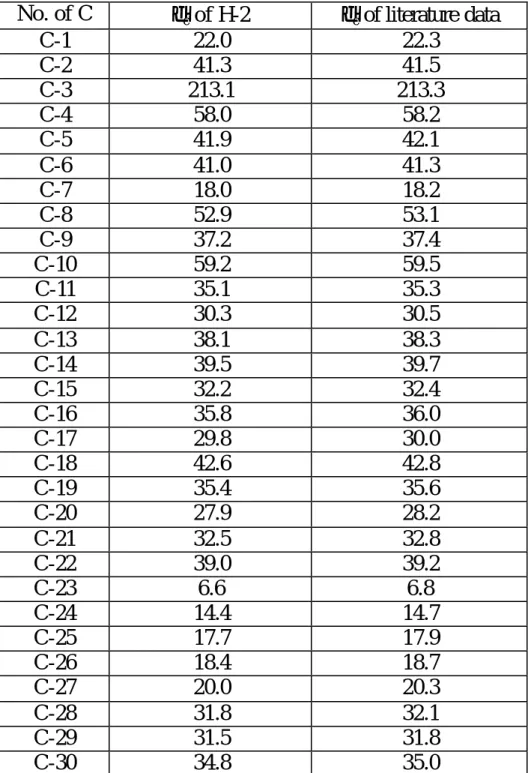
(44) 8. 13C-NMR (in CDCl3, 50 MHz) ppm:. 213.1 (C-3). 59.2 (C-10). 58.0 (C-4). 52.9 (C-8). 42.6 (C-18). 41.9 (C-5). 41.3 (C-2). 41.0 (C-6). 39.5 (C-14). 39.0 (C-22). 38.1 (C-13). 37.2 (C-9). 35.8 (C-16). 35.4 (C-19). 35.1 (C-11). 34.8 (C-30). 32.5 (C-21). 32.2 (C-15). 31.8 (C-28). 31.5 (C-29). 30.3 (C-12). 29.8 (C-17). 27.9 (C-20). 22.0 (C-1). 20.0 (C-27). 18.4 (C-26). 18.0 (C-7). 17.7 (C-25). 14.4 (C-24). 6.6 (C-23). 9. DEPT (π/4, 2π/4, 3π/4, in CDCl3, 50 MHz) ppm:. CH3 :. 35.0, 32.0, 31.7, 20.2, 18.6, 17.9, 14.6, 6.8. CH2 :. 41.5, 41.2, 39.2, 36.0, 35.6, 35.3, 32.7, 32.4, 30.5, 22.2, 18.2. CH :. 59.4, 58.2, 53.0, 42.7. 44.
(45) 【三】C-1: β-sitosterol 和 stigmasterol 混合物. 1. 白色粉末(以氯仿—甲醇再結晶) 2. 熔點:138-141℃ 3. TLC:Rf = 0.45 (CHCl3:EtOAc = 9:1) 4. 10% H2SO4 spray:藍紫色(110℃) 5. IR ?max(KBr) cm-1:3421, 2936, 2867, 1464, 1380, 1052。 6. MS (m/z % ; EI 70eV): 414 (M+, 14). 412 (M+, 5). 271 (8). 255 (13). 213 (10). 159 (18). 145 (18). 105 (15). 95 (28). 81 (37). 69 (64). 7. 1H-NMR (in CDCl3, 200 MHz) ppm:. 5.36. (1H, d, H-6). 5.10. (1H, m, H-23). 5.05. (1H, m, H-22). 3.51. (1H, m, H-3). 0.93. (3H, s, H-19). 0.84. (6H, m, H-26, H-27). 0.68. (3H, s, H-18). 45. 55 (100).
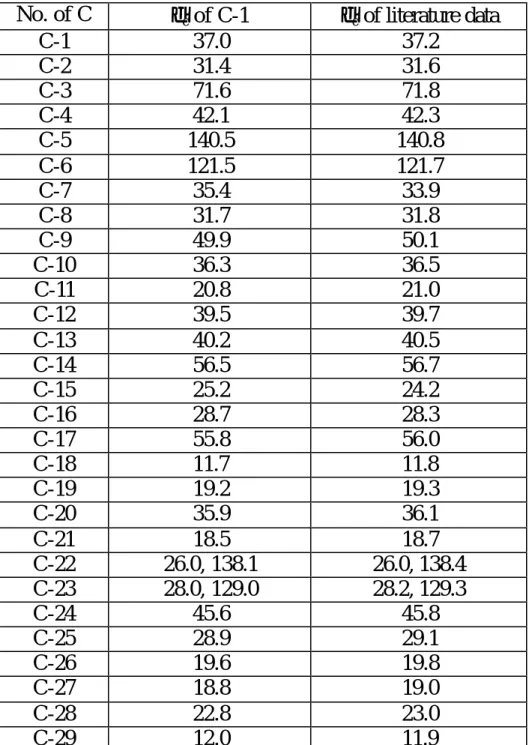
(46) 8. 13C-NMR (in CDCl3, 50 MHz) ppm:. 140.5 (C-5). 138.1 (C-22). 129.0 (C-23). 121.5 (C-6). 71.6 (C-3). 56.5 (C-14). 55.8 (C-17). 49.9 (C-9). 45.6 (C-24). 42.1 (C-4). 40.2 (C-13). 39.5 (C-12). 37.0 (C-1). 36.3 (C-10). 35.9 (C-20). 35.4 (C-7). 31.7 (C-8). 31.4 (C-2). 28.9 (C-25). 28.7 (C-16). 28.0 (C-23). 26.0 (C-22). 25.2 (C-15). 22.8 (C-28). 20.8 (C-11). 19.6 (C-26). 19.2 (C-19). 18.8 (C-27). 18.5 (C-21). 12.0 (C-29). 11.7 (C-18). 9. DEPT (π/4, 2π/4, 3π/4, in CDCl3, 50 MHz) ppm:. CH3 :. 19.8, 19.3, 19.0, 18.7, 12.2, 11.8. CH2 :. 42.2, 39.7, 37.2, 33.9, 31.6, 29.1, 28.9, 24.3, 23.0, 21.0. CH :. 138.3, 129.2, 121.7, 71.8, 56.7, 56.0, 50.1, 45.8, 36.1, 31.9, 28.9. 46.
(47) 【四】C-2:medicarpin. 1. 白色針晶(以甲醇再結晶) 2. 熔點:128-130℃ 3. TLC:Rf = 0.55 (CHCl3:EtOAc = 4:1) 4. 10% H2SO4 spray:橘黃色(110℃) 5. IR ?max(KBr) cm-1:3409, 1621, 1597, 1496, 1471 ,1454。 6. MS (m/z % ; EI 70 eV): 270 (M+, 100). 269 (42). 255 (34). 197 (7). 181 (7). 161 (20). 152 (9). 148 (30). 147 (33). 139 (11). 137 (17). 135 (13). 134 (13). 133 (12). 128 (8). 105 (13). 90 (13). 89 (18). 63 (40). 51 (36). 69 (37). 7. 1H-NMR (in CDCl3, 200 MHz) ppm:. 7.41. (1H, d, J = 8.4 Hz, H-1). 7.15. (1H, d, J = 8.9 Hz, H-7). 6.57. (1H, dd, J = 8.4 and 2.4 Hz, H-2). 6.48. (2H, m, H-8 and H-10). 6.44. (1H, d, J = 2.4 Hz, H-4). 5.52. (1H, d, J = 6.8 Hz, H-11a). 4.23. (1H, m, H-6eq). 3.77. (3H, s, OCH3). 3.55. (2H, m, H-6ax, 6a) 47. 65 (29).
(48) 8. 13C-NMR (in CDCl3, 50 MHz) ppm:. 160.9 (C-9). 160.4 (C-10a). 156.9(C-3). 156.4 (C-4a). 132.0 (C-1). 124.5 (C-7). 118.9(C-6b). 112.3 (C-11b). 109.6 (C-2). 106.2 (C-8). 103.5(C-4). 96.7 (C-10). 78.3 (C-11a). 66.3 (C-6). 55.3 (9-OCH3). 9. DEPT (π/4, 2π/4, 3π/4, in CDCl3, 50 MHz) ppm:. CH3 :. 55.5. CH2 :. 66.5. CH :. 132.2, 124.7, 109.8, 106.4, 103.6, 78.5, 96.9, 39.5. 48. 39.3 (C-6a).
(49) 【五】E-1: afrormosin. 1. 白色針晶(以甲醇再結晶) 2. 熔點:227-229℃ 3. TLC:Rf = 0.48 (CHCl3:EtOAc = 1:1) 4. 10% H2SO4 spray:黃色(110℃) 5. IR ? max(KBr) cm-1:3124, 2924, 1622, 1576, 1517, 1479, 1463, 1282。 6. MS (m/z % ; EI 70 eV): 298 (M+, 100). 283 (13). 255 (13). 166 (56). 151 (23). 149 (28). 132 (51). 123 (35). 95 (32). 89 (67). 69 (100). 51 (35) 7. 1H-NMR (in CDCl3, 200 MHz) ppm:. 7.93. (1H, s, H-2). 7.66. (1H, s, H-5). 7.51. (2H, d, J = 8.5 Hz, H-2’ and H-6’). 6.99. (2H, d, J = 8.5 Hz, H-3’ and H-5’). 6.96. (1H, s, H-8). 4.02. (3H, s, OCH3). 3.85. (3H, s, OCH3). 49. 63 (50).
(50) 8. 13C-NMR (in CDCl3 + CD3OD (1:3), 50 MHz) ppm:. 176.0 (C-4). 159.2 (C-4’). 152.5(C-2). 152.0 (C-6). 152.0 (C-9). 146.3 (C-7). 129.9(C-2’). 129.9 (C-6’). 124.1 (C-3). 123.8 (C-1’). 117.0(C-10). 113.6 (C-3’). 113.6 (C-5’). 104.4 (C-5). 102.5 (C-8). 55.0 (OCH3). 50. 55.9 (OCH3).
(51) 【六】E-2: genistein 1. 白色針晶(以甲醇再結晶) 2. 熔點:278-280℃ 3. TLC:Rf = 0.45 (CHCl3:EtOAc = 1:1) 4. 10% H2SO4 spray:黃色(110℃) 5. IR ?max(KBr) cm-1:3443, 2924, 1653, 1623, 1540, 1519, 1472, 1457, 1262。 6. MS (m/z % ; EI 70 eV): 270 (M+, 94). 269 (35). 153 (70). 152 (49). 135 (9). 124 (69). 118 (85). 111 (14). 96 (45). 89 (82). 77 (43). 63 (52). 51 (59). 7. 1H-NMR (in CD3OD, 400 MHz) ppm:. 8.05. (1H, s, H-2). 7.37. (2H, d, J = 8.4 Hz, H-2’ and H-6’). 6.85. (2H, d, J = 8.4 Hz, H-3’ and H-5’). 6.35. (1H, d, J = 2.1 Hz, H-8). 6.23. (1H, d, J = 2.1 Hz, H-6). 51. 69 (100).
(52) 8. 13C-NMR (in CD3OD, 100 MHz) ppm:. 180.9 (C-4). 164.6 (C-7). 162.4(C-5). 158.3 (C-9). 157.5 (C-4’). 153.4 (C-2). 130.1(C-2’). 129.9 (C-6’). 123.3 (C-3). 121.9 (C-1’). 115.2(C-3’). 114.8 (C-5’). 104.9 (C-10). 98.8 (C-6). 93.5 (C-8). 52.
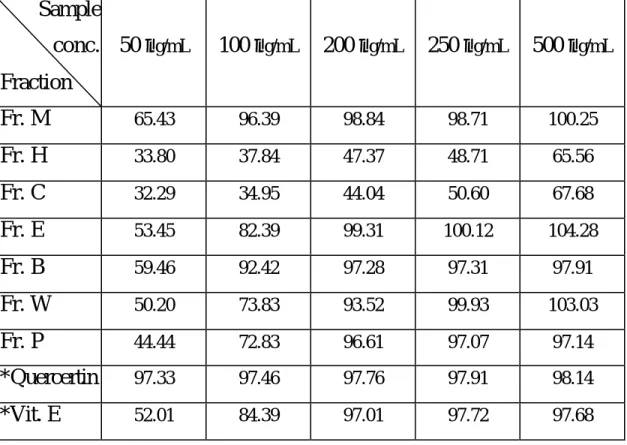
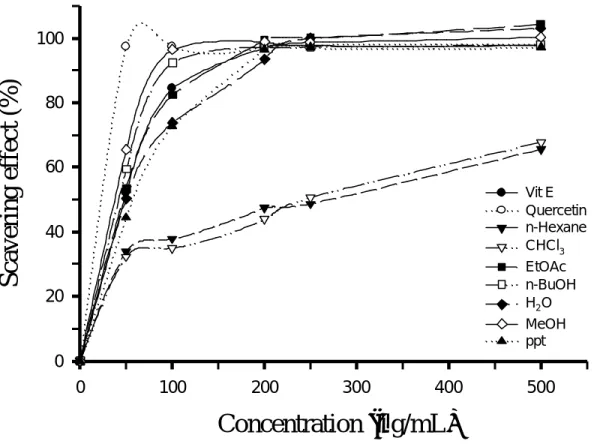
(53) 【七】E-3:calycosin 1. 白色針晶(以甲醇再結晶) 2. 熔點:245-246℃ 3. TLC:Rf = 0.45 (n-Hexane:EtOAc = 1:2) 4. 10% H2SO4 spray:黃色(110℃) 5. IR ?max(KBr) cm-1:3421, 3169, 1624, 1572, 1508, 1541, 1472。 6. MS (m/z % ; EI 70 eV): 284 (M+, 48). 283 (21). 269 (13). 241 (21). 213 (17). 148 (11). 137 (56). 136 (8). 133 (51). 126 (33). 112 (64). 105 (64). 77 (29). 69 (35). 63 (100). 7. 1H-NMR (in CD3OD, 400 MHz) ppm:. 8.13. (1H, s, H-2). 8.05. (1H, d, J = 8.8 Hz, H-5). 7.04. (1H, s, H-5’). 6.97. (2H, s, H-2’ and H-6’). 6.94. (1H, dd, J = 8.9 and 2.2 Hz, H-6). 6.85. (1H, d, J = 2.1 Hz, H-8). 3.88. (3H, s, OCH3). 53. 51 (76).
(54) 8. 13C-NMR (in CD3OD, 100 MHz) ppm:. 176.6(C-4). 163.2 (C-7). 158.3(C-9). 153.5(C-2). 147.8(C-4’). 146.0 (C-3’). 127.1(C-5). 124.8 (C-1’). 124.4(C-3). 119.9 (C-6’). 116.8(C-2’). 116.3(C-10). 115.7(C-6). 110.9 (C-5’). 102.2(C-8). 54. 55.6 (4’-OCH3).
(55) 第二節. 血藤之藥理活性試驗結果. 一、細胞毒殺活性試驗:. 將血藤甲醇萃取物(Fr. M)以不同溶媒分別萃取後,分成正己烷層 (Fr. H)、氯仿層(Fr. C)、乙酸乙酯層(Fr. E),正丁醇層(Fr. B)、水層(Fr. B)及沈澱物(Fr. P)等。以 MTS 分析法試驗血藤各萃取層之細胞毒殺活 性,結果發現血藤莖部之甲醇粗抽物、乙酸乙酯層、水層及沉澱物對 胃癌細胞(NUGC)具有明顯的抑制作用。此部分結果委託國家衛生研 究院代為測試。(詳見 Table 4-1). Table 4-1:血藤各層對細胞毒殺活性測試結果 Cell Line Plant. NUGC 50 µg/mL. HONE-1 50 µg/mL. 3% 110% 106% 30% 51% 21% 1%. 97% 112% 109% 96% 94% 91% 85%. Fr. M Fr. H Mucuna Fr. C macrocarpa Fr. E Fr. B Fr. W Fr. P (1) Sample conc.: 50 µg/mL;. (2) 以%表 cell 之存活率,小於 50%表示有效。. 55.
(56) 二、抗氧化活性試驗: 依 Shyu YS (2002)等之方法,以 DPPH 自由基清除能力之試驗, 測試血藤甲醇萃取物(Fr. M)、正己烷層(Fr. H)、氯仿層(Fr. C)、乙酸 乙酯層(Fr. E),正丁醇層(Fr. B)、水層(Fr. B)及沈澱物(Fr. P)等萃取層, 結果發現血藤之甲醇萃取物、乙酸乙酯層、正丁醇層、水層及沉澱物 具有顯著的抗氧化活性。本實驗以 Quercertin 及 Vit. E (α-tocopherol) 為正對照組。(詳見 Table 4-2, Figure 4-1). Table 4-2:Scavenging effect (%) of the fractions of M. macrocarpa Sample conc. 50 µg/mL. 100 µg/mL. 200 µg/mL. 250 µg/mL. 500 µg/mL. Fraction Fr. M. 65.43. 96.39. 98.84. 98.71. 100.25. Fr. H. 33.80. 37.84. 47.37. 48.71. 65.56. Fr. C. 32.29. 34.95. 44.04. 50.60. 67.68. Fr. E. 53.45. 82.39. 99.31. 100.12. 104.28. Fr. B. 59.46. 92.42. 97.28. 97.31. 97.91. Fr. W. 50.20. 73.83. 93.52. 99.93. 103.03. Fr. P. 44.44. 72.83. 96.61. 97.07. 97.14. *Quercertin. 97.33. 97.46. 97.76. 97.91. 98.14. *Vit. E. 52.01. 84.39. 97.01. 97.72. 97.68. 56.
(57) Scavering effect (%). 100. 80. 60 Vit E Quercetin n-Hexane CHCl3. 40. EtOAc n-BuOH H2 O. 20. MeOH ppt. 0 0. 100. 200. 300. 400. 500. Concentration (µg/mL) Figure 4-1:Scavenging effect (%) of the fractions of M. macrocarpa. 57.
(58) 第五章. 第一節. 討. 論. 血藤化學成分之結構鑑定. 【一】H-1:tetracosanoic acid O. OH. 化合物 H-1 於正己烷層中得到,為白色固體粉末,以氯仿—甲醇 再結晶,熔點 82-84℃,可溶於正己烷、氯仿,其 TLC 片經溶媒 (n-Hexane:CHCl3 = 5:1)展開後,Rf 值為 0.45,噴 10% H2SO4 溶液, 加熱後呈灰黑色。 IR 圖譜(Chart 1)顯示 2918 cm-1 及 2849 cm-1 為飽和碳氫的特性 吸收,1699 cm-1 為 carbonyl group 的特性吸收,1463 cm-1 為-CH3 基。 MS 圖譜(Chart 2)M+ (m/z %)顯示分子量為 368,推測分子式 為 C24H48O2。 1. H-NMR 圖譜(Chart 3)顯示 d 2.37 (2H, t)為 H-2 的吸收訊號,d. 1.26 (40H, s, br)為長鏈 methylene (-CH2-)的吸收訊號,d 0.89 (3H, t)為 長鏈末端甲基之吸收訊號。 13. C-NMR 圖譜(Chart 4)顯示 d 178.0 為 carboxyl carbon 的吸收. 訊號,d 22.7~33.7 為長鏈 methylene (-CH2-)的吸收訊號,d 14.1 為長 鏈末端甲基之吸收訊號。 綜合上述資料與文獻值 [151,. 152]. tetracosanoic acid。 58. 比對,確認此化合物之結構為.
(59) 【二】H-2:friedelin. 30. 29 19. 20. 21. 17. 22. 27 12. 18. 11 13 1 10. 2. 9. 16 8. 3 O. 5. 28. 14. 25. 26. 15. 7 4. 6 24. 23. 化合物 H-3 於正己烷層中得到,為白色針晶,以氯仿—甲醇再結 晶,熔點 238-240℃,可溶於氯仿,其 TLC 片經溶媒(n-Hexane:CHCl3 = 3:1)展開後,Rf 值為 0.45,噴 10% H2SO4 溶液,加熱後呈藍紫色。 IR 圖譜(Chart 5)顯示在 1715 cm-1 有 carbonyl group 的特性吸 收, 也有一般三? 類所含有的特性吸收(1457, 1389, 1261, 1108, 1051, 802 cm-1)。 MS 圖譜(Chart 6)M+ (m/z %)顯示分子量為 426,推測分子式 為 C30H50O。由碎片 m/z 411, 341, 302, 273, 246, 205, 191 的斷裂方式, 推測化合物可能為 friedelin。(詳見 Figure 5-1). 59.
(60) + CH2 a a b O m/z 273 O b m/z 426. + H2C. m/z 341. +.. c. c. d. O m/z 302. O. + CH2. d m/z 426. O m/z 191. Figure 5-1: Friedelin 之質譜(MS)斷裂方式. 60.
(61) 1. H-NMR 圖譜(Chart 7)顯示 d 1.18 (3H, s, H-28), 1.05 (3H, s,. H-27), 1.00 (6H, s, H-26, 30), 0.96 (3H, s, H-29), 0.90 (3H, d, J=6.5 Hz H-23), 0.87 (3H, s, H-25), 0.73 (3H, s, H-24)共有八個甲基吸收訊號,八 個甲基分別為 C-24, C-25, C-23, C-29, C-30, C-26, C-27, C-28 的甲基 訊號,配合 EI-MS 質譜的斷裂方式,推測為 friedelin 化合物。. 13. C-NMR 圖譜(Chart 8)及 DEPT 圖譜(Chart 9)中顯示其共有. 三十個碳原子吸收訊號,其中有八個碳原子訊號是屬於 CH3,分別為 δ 34.8 (C-30), 31.8 (C-28), 31.5 (C-29), 20.0 (C-27), 18.4 (C-26), 17.7 (C-25), 14.4 (C-24), 6.6 (C-23)。有十一個碳原子訊號屬於 CH2,分別 為δ 41.3 (C-2), 41.0 (C-6), 39.0 (C-22), 35.8 (C-16), 35.4 (C-19), 35.1 (C-11), 32.5 (C-21), 32.2 (C-15), 30.3 (C-12), 22.0 (C-1), 18.0 (C-7)。有 四個碳原子屬於 CH,分別為δ 59.2 (C-10), 58.0 (C-4), 52.9 (C-8), 42.6 (C-18)。其餘的六個碳原子訊號屬於四級碳,在最低磁場出現的δ 213.1 (C-3)是來自於 C-3的 carbonyl carbon之訊號,剩下的訊號分別為δ 41.9 (C-5), 39.5 (C-14), 38.1 (C-13), 37.2 (C-9), 29.8 (C-17), 27.9 (C-20)。. 61.
(62) Table 5-1: 化合物 H-2 碳譜數據與文獻 friedelin 碳譜數據比對表 No. of C C-1 C-2 C-3 C-4 C-5 C-6 C-7 C-8 C-9 C-10 C-11 C-12 C-13 C-14 C-15 C-16 C-17 C-18 C-19 C-20 C-21 C-22 C-23 C-24 C-25 C-26 C-27 C-28 C-29 C-30. δ c of H-2 22.0 41.3 213.1 58.0 41.9 41.0 18.0 52.9 37.2 59.2 35.1 30.3 38.1 39.5 32.2 35.8 29.8 42.6 35.4 27.9 32.5 39.0 6.6 14.4 17.7 18.4 20.0 31.8 31.5 34.8. δ c of literature data 22.3 41.5 213.3 58.2 42.1 41.3 18.2 53.1 37.4 59.5 35.3 30.5 38.3 39.7 32.4 36.0 30.0 42.8 35.6 28.2 32.8 39.2 6.8 14.7 17.9 18.7 20.3 32.1 31.8 35.0. 綜合以上光譜資料與文獻 [153, 154, 155]比對,推定此合物為 friedelin。. 62.
(63) 【三】C-1: β-sitosterol 和 stigmasterol 混合物. 29. 28 21. 20. 22. 19 18 1. 2 3. 4. HO. 10. 12. 11 9. 5. 8 7. 17 13 14. 23. 24. 25. 29. 28 21. 26. 20. 22. 19. 27. 18. 16 15. 2 3. ß-sitosterol. HO. 6. 1 4. 10. 11 9. 12. 8 7. 17 13 14. 23. 24. 25. 26. 27 16. 15. 5. Stigmasterol. 6. 化合物 C-1 於氯仿層中得到,為白色粉末,以氯仿—甲醇再結 晶,熔點 139-140℃,可溶於氯仿,其 TLC 片經溶媒(CHCl3:EtOAc = 9:1)展開後,Rf 值為 0.45,噴 10% H2SO4 溶液,加熱後呈藍紫色。 IR 圖譜(Chart 10)顯示在 3421 cm-1 有-OH 基特性吸收,2936 cm-1 及 2867 cm-1 為飽和碳氫鍵伸縮震動之特性吸收,1464 cm-1 為 CH2 的 之特性吸收,1052 cm-1 為醚基(C-O-C)之特性吸收。 MS 圖譜(Chart 11)M+ (m/z %)顯示分子離子峰為 414, 412,其 裂片斷裂型式與β-sitosterol, stigmasterol 相同,推測分子式為 C29H50O 及 C29H48O。 1. H-NMR 圖譜(Chart 12)顯示 d 5.36 (1H, d, H-6)為雙鍵上 H-6. 之質子訊號,d 5.10 (1H, m, H-23), 5.05 (1H, m, H-22)分別為支鏈雙鍵 H-23, H-22 之質子訊號,d 3.51 (1H, m, H-3)為 C-3 連接-OH 基之次甲 基的質子訊號,d 0.70~2.31 (m)為植物固醇特有訊號。 13. C-NMR 圖譜(Chart 13)顯示δ 140.4 (C-5), 121.5 (C-6)分別為. 環上雙鍵 C-5 及 C-6 之碳原子訊號,δ 138.1, 129.0 則為支鏈雙鍵 C-22 及 C-23 之碳原子訊號,δ 71.6 (C-3)為帶有-OH 基的 C-3 之碳原子訊 號。 63.
(64) DEPT 圖譜(Chart 14)中顯示有六個碳原子訊號是屬於 CH3, 分別為δ 19.8 (C-26), 19.3 (C-19), 19.0(C-27), 118.7(C-21), 12.2(C-29), 11.8 (C-18)。有十個碳原子訊號屬於 CH2,分別為 δ 42.2 (C-4), 39.7 (C-12), 37.2 (C-1), 33.9 (C-2), 31.6 (C-7), 29.1 (C-16), 28.9 (C-16), 24.3 (C-15), 23.0 (C-28), 21.0 (C-11)。有十一個碳原子屬於 CH,分別為δ 138.3 (C-22), 129.9 (C-23), 121.7 (C-6), 71.8 (C-3), 56.7 (C-14), 56.0 (C-17), 50.1 (C-9), 45.8 (C-24), 36.1 (C-20), 31.9 (C-8), 28.9 (C-25)。其 餘的二個碳原子訊號屬於四級碳 ,分別為δ 140.5 (C-5)及 δ 36.3 (C-10)。. 64.
(65) Table 5-2: 化合物 C-1 碳譜數據與文獻 phytosterol 碳譜數據比對表 No. of C C-1 C-2 C-3 C-4 C-5 C-6 C-7 C-8 C-9 C-10 C-11 C-12 C-13 C-14 C-15 C-16 C-17 C-18 C-19 C-20 C-21 C-22 C-23 C-24 C-25 C-26 C-27 C-28 C-29. δ c of C-1 37.0 31.4 71.6 42.1 140.5 121.5 35.4 31.7 49.9 36.3 20.8 39.5 40.2 56.5 25.2 28.7 55.8 11.7 19.2 35.9 18.5 26.0, 138.1 28.0, 129.0 45.6 28.9 19.6 18.8 22.8 12.0. δ c of literature data 37.2 31.6 71.8 42.3 140.8 121.7 33.9 31.8 50.1 36.5 21.0 39.7 40.5 56.7 24.2 28.3 56.0 11.8 19.3 36.1 18.7 26.0, 138.4 28.2, 129.3 45.8 29.1 19.8 19.0 23.0 11.9. 綜合以上光譜資料與文獻 [156, 157, 158]比對,推定此合物為 β-sitosterol 和 stigmasterol 之混合物。. 65.
(66) 【五】C-2:medicarpin. 4 HO. 3. 4a. 5 O. 6 6a. 11a. 2 1. 7 8. 11b. 6b 9. O 11. 10a 10. OCH3. 化合物 C-2 氯仿層中得到,為白色針晶,以甲醇再結晶,熔點 128-130℃,可溶於氯仿,其 TLC 片經溶媒(CHCl3:EtOAc = 4:1) 展開後,Rf 值為 0.55,在紫外光 200-380 nm 內有吸光,噴 10% H2SO4 溶液,加熱後呈橘黃色。 IR 圖譜(Chart 15)顯示 3409 cm-1 有-OH 基的吸收訊號,1621 cm-1 有 carbonyl group 的特性吸收,1597, 1496, 1471 ,1454 cm-1 有芳香環 之共軛雙鍵特性吸收。 MS 圖譜(Chart 16)M+ (m/z %)顯示分子量為 270,推測分子式 為 C16H14O4。 1. H-NMR 圖譜(Chart 17)顯示 d 5.52 (1H, d, J = 6.8 Hz, H-11a),. 4.23 (1H, m, H-6eq), 3.55 (2H, m, H-6ax, 6a)為 petrocarpan 類化合物之 特有吸收訊號,另外,d 7.41 (1H, d, J = 8.4 Hz, H-1), 6.57 (1H, dd, J = 8.4 and 2.4 Hz, H-2), 6.44 (1H, d, J = 2.4 Hz, H-4)為一組 ABX 形式之 訊號。d 3.77 (3H, s, OCH3)為甲氧基之訊號。 13. C-NMR 圖譜(Chart 18)及 DEPT 圖譜(Chart 19)中顯示共有. 十六個碳原子吸收訊號,其中有一個碳原子訊號是屬於 CH3,為δ 55.5 (9- OCH3)。有一個碳原子訊號屬於 CH2,為 δ 66.5 (C-6)。有八個碳 66.
(67) 原子屬於 CH,分別為δ 132.2 (C-1), 124.7 (C-7), 109.8 (C-2), 106.4 (C-8), 103.6 (C-4), 78.5 (C-11a), 96.9 (C-10), 39.5 (C-6a)。其餘的六個 碳原子訊號屬於四級碳,分別為δ 160.9 (C-9), 160.4 (C-10a), 156.9 (C-3), 156.4 (C-4a), 118.9 (C-6b), 112.3(C-11b)。另外,δ 55.3 為 C-9 上 之-OCH3 基之吸收訊號。. 67.
(68) Table 5-3: 化合物 C-2 碳譜數據與文獻 medicarpin 碳譜數據比對表 No. of C C-1 C-2 C-3 C-4 C-4a C-6 C-6a C-6b C-7 C-8 C-9 C-10 C-10a C-11a C-11b 9-OCH3. δ c of C-2 132.0 109.6 156.9 103.5 156.4 66.3 39.3 118.9 124.5 106.2 160.9 96.7 160.4 78.3 112.3 55.3. δ c of literature data 132.6 109.8 157.5 104.1 157.1 67.0 39.9 119.5 125.2 106.8 161.1 97.3 161.5 79.0 113.0 55.9. 綜合上述資料與文獻 [159, 160 , 161]比對,確認此化合物之結構為 medicarpain。. 68.
(69) 【五】E-1: afrormosin. HO. 8 7. 9. 1 O. 2 3. H3CO. 6. 10. 2' 1'. 3'. 4. 5. 4'. O. 6' 5'. OCH3. 化合物 E-1 乙酸乙酯層中得到,為白色針晶,以甲醇再結晶,熔 點 278-280℃,可溶於甲醇與氯仿溶液,其 TLC 片經溶媒(CHCl3: EtOAc = 1:1)展開後,Rf 值為 0.45,在紫外光 200-380 nm 內有吸光, 噴 10% H2SO4 溶液,加熱後呈黃色。 IR 圖譜(Chart 20) :顯示在 3124 cm-1 有-OH 基之特性吸收,2924 cm-1 為不飽和碳氫鍵之伸縮震動特性吸收,1623 cm-1 為 carbonyl group 之特性吸收,1576, 1517, 1479, 1463 cm-1 為芳香環共軛雙鍵之特性吸 收,1282 cm-1 為醚基(C-O-C)之特性吸收。 MS 圖譜(Chart 21)M+(m/z %)顯示分子量為 298,其他斷片離 子有 297, 283, 167, 166, 132, 123 等,符合異黃酮類質譜的斷裂方式, 推測分子式為 C17H14O5 1. H-NMR 圖譜(Chart 22)顯示 d 7.93 (1H, s, H-2)為位於 carbonyl. group 的β位上之 H-2,d 7.51 (2H, d, J = 8.5 Hz, H-2’ and H-6’)及 d 6.99 (2H, d, J = 8.5 Hz, H-3’ and H-5’)有耦合關係,分別為 B-ring 上 H-2’, H-6’及 H-3’, H-5’之吸收訊號,為一對 A2X2 型式之芳香族訊號,並推 測 H-4’有甲氧基取代。d 7.66 (1H, s, H-5)及 d 6.96 (1H, s, H-8)則為 A-ring 上的氫,H-8 因相鄰有供電子的-OH 基,會位於較高磁場,故. 69.
(70) d 7.66 為 H-5,d 6.96 為 H-8。 13. C-NMR 圖譜(Chart 23)中顯示共有十七個碳原子吸收訊號,. 其中 d 176.0 (C-4)為黃酮類(flavonoids)之 carbonyl carbon 吸收訊號,d 146.3 (C-7)為帶有-OH 基之 C-7 的吸收訊號。d 129.9 (C-2’), 129.9 (C-6’)及 113.6 (C-3’), 113.6 (C-5’)為 B-ring 上碳之吸收訊號。d 104.4 (C-5), 102.5 (C-8)為 A-ring 上碳之吸收訊號。另外,δ 55.9, 55.0 為 C-4’ 及 C-6 上之-OCH3 基之吸收訊號。. 70.
(71) Table 5-4: 化合物 E-1 碳譜數據與文獻 afrormosin 碳譜數據比對表 No. of C C-2 C-3 C-4 C-5 C-6 C-7 C-8 C-9 C-10 C-1’ C-2’ C-3’ C-4’ C-5’ C-6’ OCH3 OCH3. δ c of E-1 152.5 124.1 176.0 104.4 152.0 146.3 102.5 152.0 117.0 123.8 129.9 113.6 159.2 113.6 129.9 55.9 55.0. δ c of literature data 152.6 124.0 176.0 104.2 152.5 146.6 102.5 152.1 116.6 123.6 129.8 113.4 159.1 113.4 129.8 55.6 54.8. 綜合上述資料與文獻 [161-163]比對,確認此化合物之結構為 afrormosin。. 71.
(72) 【六】E-2: genistein. 7. OH. 8. 9. O. 1 2 3. 6 5 OH. 10. 1'. 2' 3'. 4 4'. O. 6' 5'. OH. 化合物 E-2 於乙酸乙酯層中得到,為白色針晶,以甲醇再結晶, 熔點 227-229℃,可溶於甲醇,其 TLC 片經溶媒(CHCl3:EtOAc = 1: 1)展開後,Rf 值為 0.48,在紫外光 200-380 nm 內有吸光,噴 10% H2SO4 溶液,加熱後呈黃色。 IR 圖譜(Chart 24)顯示在 3443 cm-1 有-OH 基的特性吸收,2924 cm-1 為不飽和碳氫之伸縮震動特性吸收,1653 cm-1 為 carbonyl group 之特性吸收,1623, 1540, 1519, 1472 cm-1 為芳香環共軛雙鍵的特性吸 收,1262 cm-1 為醚基(C-O-C)之特性吸收。 MS 圖譜(Chart 25)M+ (m/z %)顯示分子量為 298,根據斷片離 子 270, 269, 153, 152, 135, 124, 118 等符合異黃酮類質譜的斷裂方 式:retro Diels-Alder fragmentation,推測分子式為 C15H10O5。 1. H-NMR 圖譜(Chart 26)顯示 d 8.05(1H, s, H-2)為位於 carbonyl. group 的β位上之 H-2,d 7.37 (2H, d, J = 8.4 Hz, H-2’ and H-6’)及 d 6.85 (2H, d, J = 8.4 Hz, H-3’ and H-5’)有耦合關係,分別為 B-ring 上 H-2’, H-6’及 H-3’, H-5’之吸收訊號,為一對 A2X2 型式之訊號,故推測 H-4’ 有-OH 基取代。d 6.35 (1H, d, J = 2.1 Hz, H-8)及 d 6.23 (1H, d, J = 2.1 Hz, H-6)則為 A-ring 上的氫,H-6 因相鄰兩邊都有供電子的-OH 基, 72.
(73) 會位於較高磁場,故 d 6.23 為 H-6,d 6.35 為 H-8。 13. C-NMR 圖譜(Chart 27)中顯示共有十五個碳原子吸收訊號,. 其中 d 180.9 (C-4)為黃酮類之 carbonyl carbon吸收訊號,d 164.6 (C-7), 162.4 (C-5), 157.5 (C-4’),分別為帶有-OH 基之 C-7, C-5 及 C-4’的吸 收訊號。d 130.1 (C-2’),129.9 (C-6’)及 115.2 (C-3’), 114.8 (C-5’)為 B-ring 上碳之吸收訊號。d 98.8 (C-6), 93.5 (C-8)為 A-ring 上碳之吸收 訊號。. 73.
(74) Table 5-5: 化合物 E-2 碳譜數據與文獻 genistein 碳譜數據比對表 No. of C C-2 C-3 C-4 C-5 C-6 C-7 C-8 C-9 C-10 C-1’ C-2’ C-3’ C-4’ C-5’ C-6’. δ c of E-2 153.4 123.3 180.9 162.4 98.8 164.6 93.5 158.3 104.9 121.9 130.2 115.2 157.5 114.8 130.2. δ c of literature data 154.1 122.4 180.4 162.1 99.1 164.4 93.8 157.7 104.6 121.4 130.1 115.2 157.6 115.2 129.9. 綜合上述資料與文獻 [158, 164]比對,確認此化合物之結構為 genistein。. 74.
(75) 【七】E-3:calycosin. HO. 7. 8 9. O. 1 2 3. 6. 10. 2' 1'. 3'. OH. 4. 5. 4'. O. 6` 5`. OCH3. 化合物 E-3 乙酸乙酯層中得到,為白色針晶,以甲醇再結晶,熔 點 245-246℃,可溶於甲醇,其 TLC 片經溶媒(n-Hexane:EtOAc = 1: 2)展開後,Rf 值為 0.45,噴 10% H2SO4 溶液,加熱後呈黃色。 IR 圖譜(Chart 28)顯示在 3421, 3169 cm-1 為-OH 基之特性吸收, 1624 cm-1 為 carbonyl group 之特性吸收,1572, 1508, 1541, 1472 cm-1 為芳香環共軛雙鍵的特性吸收。1242 cm-1 為醚基(C-O-C)之特性吸收。 MS 圖譜(Chart 29)M+ (m/z %)顯示分子量為 284,其他斷片離 子有 283, 241, 213, 137, 133, 135, 126, 112 等,符合異黃酮類質譜的斷 裂方式,推測分子式為 C16H12O5。 1. H-NMR 圖譜(Chart 30)顯示 d 8.13 (1H, s, H-2)為位於羰基. (carbonyl group)的β位上之 H-2。d 8.05 (1H, d, J = 8.8 Hz, H-5), 6.94 (1H, dd, J = 8.8 and 2.1 Hz, H-6), 6.85 (1H, d, J = 2.1 Hz, H-8)為一組 ABX 型式之訊號,將其歸屬為 A-ring 上 H-5, H-6 及 H-8 之訊號。d 7.04 (1H, s, H-5’), 6.97 (2H, s, H-2’ and H-6’),將其分別歸屬為 B-ring 上 H-5’, H-2’及 H-6’之訊號。另外,d 3.88 (3H, s, OCH3)為甲氧基(-OCH3) 之訊號。. 75.
(76) 13. C-NMR 圖譜(Chart 31)中顯示共有十六個碳原子吸收訊號,. 其中 d 176.6 (C-4)為黃酮類之 carbonyl carbon吸收訊號,d 163.2 (C-7), 146.0 (C-3’),分別為帶有-OH 基之 C-7 及 C-3’的吸收訊號。d 119.9 (C-6’), 116.8 (C-2’)及 110.9 (C-5’)為 B-ring 上碳之吸收訊號。δ 127.1 (C-5), 115.7 (C-6), 102.2 (C-8)為 A-ring 上碳之吸收訊號。另外,δ 55.6 為 C-4’上之-OCH3 基之吸收訊號。. 76.
(77) Table 5-6: 化合物 E-3 碳譜數據與文獻 calycosin 碳譜數據比對表 No. of C C-2 C-3 C-4 C-5 C-6 C-7 C-8 C-9 C-10 C-1’ C-2’ C-3’ C-4’ C-5’ C-6’. δ c of E-3 153.5 124.4 176.6 127.1 115.7 163.2 102.2 158.3 116.3 124.8 116.8 146.0 147.8 110.9 119.9. δ c of literature data 153.0 123.3 174.5 127.3 115.1 162.5 102.2 157.3 116.2 124.7 116.4 146.0 147.5 111.9 119.7. 綜合上述資料與文獻 [164-167]比對,確認此化合物之結構為 calycosin。. 77.
數據
+7
Outline
相關文件
In the work of Qian and Sejnowski a window of 13 secondary structure predictions is used as input to a fully connected structure-structure network with 40 hidden units.. Thus,
The remaining positions contain //the rest of the original array elements //the rest of the original array elements.
This glossary aims to provide Chinese translations of those English terms commonly used in the teaching of Business, Accounting and Financial Studies at secondary level
This can be used to guide small and medium construction industry to setup occupational safety and health management.. The checklists can be used to build and evaluate
Finally, the Delphi method is used to verify and finalize the assessing framework.. Furthermore, the AHP method is used to determine the relative weights of factors in the
Reading Task 6: Genre Structure and Language Features. • Now let’s look at how language features (e.g. sentence patterns) are connected to the structure
Promote project learning, mathematical modeling, and problem-based learning to strengthen the ability to integrate and apply knowledge and skills, and make. calculated
In summary, the main contribution of this paper is to propose a new family of smoothing functions and correct a flaw in an algorithm studied in [13], which is used to guarantee
