義 守 大 學
資 訊 工 程 學 系
博士論文
組織的調適性行為對產品生命週期管理系
統導入的影響
Organizational Adaptation for Implementing
Product Life Management Systems
研 究 生 :龔高輝
指導教授 :吳傳春博士
組織的調適性行為對產品生命週期管理系
統導入的影響
Organizational Adaptation for Implementing
Product Life Management Systems
研究生:龔高輝
Student:Kao-Hui Kung
指導教授:吳傳春博士 Advisor:Dr. Chuan-Chun Wu
義 守 大 學
資 訊 工 程 研 究 所
博 士 論 文
A Dissertation
Submitted to the Department of Information Engineering
I-Shou University
in Partial Fulfillment of the Requirements
for the Degree of Doctor of Philosophy
December, 2015
Kaohsiung, Taiwan, Republic of China
組織的調適性行為對產品生命週期管理系
統導入的影響
研究生:龔高輝
指導教授:吳傳春博士
義守大學資訊工程研究所
中文摘要
產品生命週期管理(Product Lifecycle Management,PLM)是企業因應協同產品商 務(Collaborative Product Commerce,CPC )所導入使用的資訊管理工具。企業在協同 環境下如何發揮系統功能,達到產品多樣化、低成本、高品質及短交期的要求,並使整 個研發控管過程中,從「點狀」串連成「線」至「面」,有效的控管流程、作業標準、 並累積從產品設計至出貨的生產、製造、服務經驗知識。 OEM 產業為台灣最具代表性之產業模式,本研究發現台灣產業應用 PLM 軟體系統支 援研發設計過程中,其調適化程度依科技、組織、群體三者的互動情況與專用性而有所 不同,調適過程中因科技的適用性而產生差異化事件,企業解決差異化事件的程度則是 決定企業運用資訊系統獲得優勢之關鍵性因素。為了使企業經由導入 PLM 而更具有競爭 優勢,企業的管理者必須更深刻瞭解資訊科技對企業可能帶來的改變及改變的可能原 因,以便更精確地掌握 PLM 所帶來的組織與管理創新的優勢。 企業選擇資訊科技導入的過程中,隨著使用者應用這些資訊科技都會找到一些導入 前未曾發現的管理問題,這也就是企業引進資訊科技的主要收穫–(檢視企業內部流 程),當導入時一旦出現問題,則需要進行科技與組織、群體之間的調適(adaptation), 過程中是否調適得宜,則是決定資訊科技成功或失敗的關鍵依據。
本研究建議的整合模式(integrated model)包含科技調適(Technology Adaptation) 與管理創新理論(Management Innovation Theories),足以解釋個案中科技調適現象。 在導入過程中所產生的差異事件,係系統規範與使用者詮釋(user interpretation)之 間有落差所致。系統的調適過程中高階管理者所主導的企業再造工程即是針對此落差而 進行的調整。差異事件的調整是針對知識使用行為 document access, knowledge capture, knowledge sharing and decision making 方面的使用行的調整,差異事件 調整後產品在研發過程中所需的協同整合作業才得以實現。系統導入從企業再造工程到 協同整合作業,管理者所扮演的角色至關重要。在此方面管理創新理論提供很好的參考 面向。因此系統的導入過程中,組織的策略與執行層面要有相當好的整合,才能達成企 業使用資訊科技系統的導入目標。
Organizational Adaptation for Implementing
Product Life Management Systems
Student:Kao-Hui Kung
Advisor:Dr. Chuan-Chun Wu
Department of Information Engineering
I-Shou University
Abstract
Product lifecycle management (PLM) is the information management tool implemented that can be utilized by enterprises in the environment of collaborative product commerce (CPC). Under such environment, enterprises need to deal with the question of how to maximize system functions in order to diversify product ranges, reduce costs, enhance product quality, and fasten delivery. Furthermore, it is necessary to consider how to make “spots” become “a line” and even to “the plane” in the sense of an effective control network that is involved with standardized operations, and the accumulation of the experiences of production, manufacturing, and services rang from product designs to delivery. During the implementation of an information technology (IT) in enterprises, it is frequently faced unforeseen managerial problems when users start to use the IT. Ironically, this is where the major benefit of IT comes in place in the enterprise – auditing internal processes. Once the problem is identified, it is necessary to ensure an adaptation existed among the technology, the organization, and groups. The appropriateness of such adaptation even plays a critical role in successful information systems (IS) implementation projects. The original equipment manufacturer (OEM) industry has been the most representative industrial model in Taiwan.
This research found that during the use of PLM software system in Taiwan for supporting research and development (R&D) projects, the degree of adaptation depends on the interaction condition and appropriation among the technology, the organization, and groups. In the process of adaptation, discrepant events are resulted from the appropriation of technology. The degree of solving these discrepant events is a critical factor in determining whether the enterprise is able to gain competitive advantages from using an IT. Therefore, to gain more competitive advantages from adopting PLM, the management in enterprises must understand clearly what changes the new IT will initiate and possible reasons in order to unlock the potential of the IT.
This study suggested an integrated model of adaptive structuration theory (AST) and management innovation to investigate the impact of technology appropriation on the user adaptation behavior towards the PLM system. The research results indicate that there are three contextual factors (technology, group structure, and organizational environment) affecting the use of PLM. Through interactions between multilevel users, modification of system features and process flows leads to the achievement of organizational objectives. The organizational adaptation process is based in part on the alignment of internal capabilities and contextual contingencies. The task of the management is to develop capabilities or distinctive competences based on the advantage of the deployed PLM system. Based on this visionary perspective, it is obvious that the management should provide momentum for organization change and thus sustain the implementation benefits of PLM system.
Key words: Technology adaptation, organizational change innovation, enterprise information system, product lifecycle management, collaborative design
致謝
博士班的求學旅程中,一轉眼之間已經渡過好漫長的一段時間。每年這個時候, 看到鳳凰花盛開,心中總是無限的感嘆,沒能好好的去欣賞鳳凰花的鮮艷漂亮。求 學過程中,很感謝指導教授吳傳春老師。老師給予學生一個很自由的研究環境,在 博士班的研究過程中不時給予學生一些很寶貴的建議,學校生活中也給予學生一個 獨立的空間。在學校的時間中,也感謝工業管理系的魏乃捷教授,及教授優秀的碩 士班學弟智宇、翔澤,讓我又從新回到快樂的學校生活。 業界重視實行結果,因此企業在策略的規劃上大都是以經驗法則去規劃企業的 願景。反觀學界談的是策略架構,利用管理架構搭配實際的資料去分析及規劃策略 架構,因此學界與業界在實際案例的分析上出發點就有些差異了。當我走進研究的 這條路以後,中山大學資管系的侯君溥教授,不時地給予學生在研究的路上一些建 議,並且調整學生面對問題思考的模式。在論文的發表上也很感謝中正大學資管系 的洪維璽教授給予學生在論文寫作上的建議。 求學這麼多年,工作上有得有失。太太及可愛的小孩一直讓學生無後顧之憂的 投入研究的旅程,讓學生一直堅持在這條路上。這條路的短暫終點是完成自己的夢 想,改變了自己對問題的思考模式。經過這個訓練後,應該是學生另一條路的起點, 堅持的達成研究的訓練後,希望能有機會將所學的貢獻在這領域裡面。 龔高輝 謹誌於 義守大學資訊工程系所 2015.5.31Contents
中文摘要 ... 5
Abstract ... 7
致謝 ... 9
1. Introduction ... 14
2. Literature review ... 17
2.1 NPD and PLM ... 17
2.2 Technology adaptation theories ... 22
2.3 As-Is and To-Be model in IS implementation ... 24
2.4 EIS implementation ... 24
2.4.1 EIS implementation and organizational change innovation ... 24
2.4.2 EIS implementation and the emergent perspective ... 25
2.5 Technology’s Spirit — PLM System Architecture ... 26
2.6 Change Management and BPR ... 28
2.7 Management innovation and BPR ... 29
2.7.1 IT implementation and management innovation ... 29
2.7.2 IT implementation and BPR ... 30
2.8 Summary ... 31
3. Research Methodology ... 34
3.1 Research framework ... 34
3.1.1 As-Is and To-Be framework ... 34
3.2 Research design ... 36
3.2.1 Case description ... 36
3.2.2 Project team structure... 42
3.2.3 Collaborative technologies in PLM systems ... 43
3.2.4 Implementation Objectives ... 43
3.2.5 Data collection ... 44
4.1 Motivation ... 46
4.1.1 Product design and corporate strategy ... 46
4.1.2 Problems in supply chain integration ... 46
4.1.3 The current state of information processing for product design ... 47
4.1.4 The role of the change agent ... 47
4.2 Problem recognition and system invention ... 48
4.3 Implementation ... 48
4.3.1 As-is and to-be Analysis ... 48
4.3.2 Initial implementation and reasons for BPR ... 51
4.3.3 Emergent collaborative processes in product development ... 59
4.3.4 Performance impacts of the implemented PLM system ... 62
4.4 Management motivation integration framework ... 64
4.5 Theorization and labeling ... 66
4.6 Case study analysis ... 67
5. Discussion ... 69
5.1 Challenges stemming from institutional and cultural misalignment ... 69
5.2 Problems in business process redesign ... 70
5.3 Leadership and intervention ... 70
5.4 Collaboration among participating units ... 71
6. Conclusions ... 73
6.1 Contribution to theory ... 73
6.2 Managerial implications ... 75
6.3 Research limitations ... 75
6.4 Future research ... 76
References ... 77
Appendix A: Main interview questions in the questionnaire ... 83
List of Figures
Figure 1: Windchill PLM solution-PDS ... 27
Figure 2 : Technology adaptation framework for PLM system usage based on
AST, strategic choice, and organizational change innovation
perspectives ... 32
Figure 3 : A top-down model of formal intervention for goal accomplishment . 35
Figure 4 : Dynamic Aspects of the To-be Models ... 50
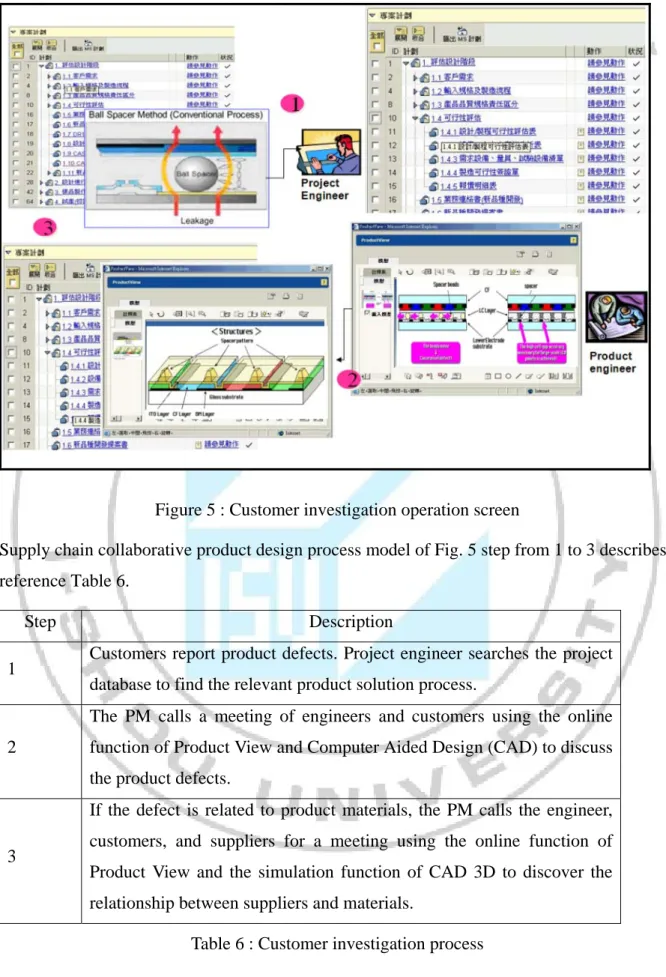
Figure 5 : Customer investigation operation screen ... 60
Figure 6 : Customer product problem resolution operation screen ... 61
Figure 7 : proposed integrated model for PLM systems appropriation ... 66
List of Tables
Table 1 : Common NPD problem and improvement suggestion ... 19
Table 2 : The amount and estimation of shipment of the main applied product of
small and medium size TFT-LCD panel manufacturers ... 39
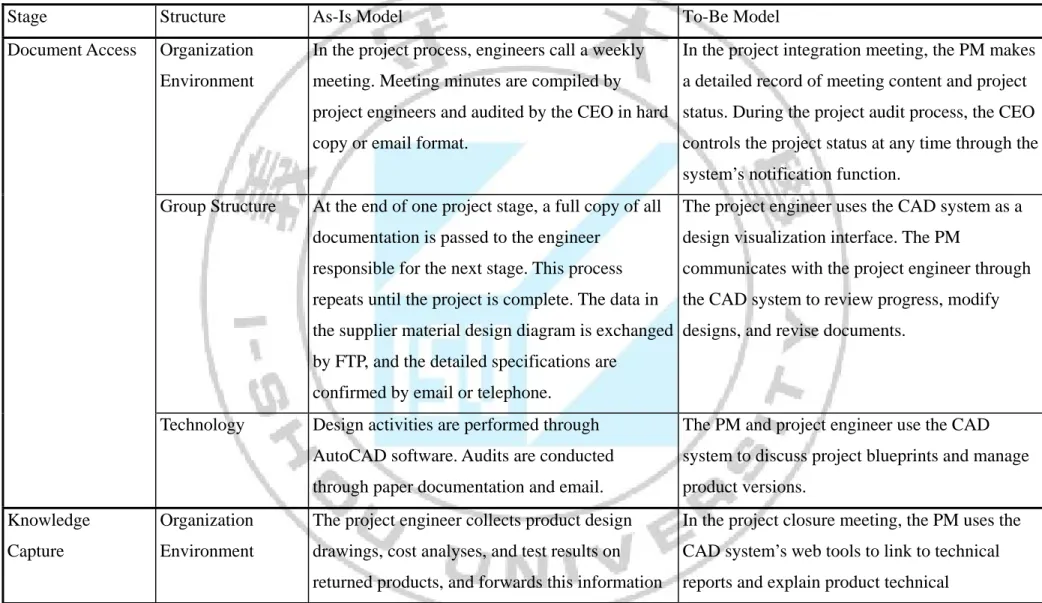
Table 3 : Appropriated Structures from As-Is Model and To-Be Model ... 52
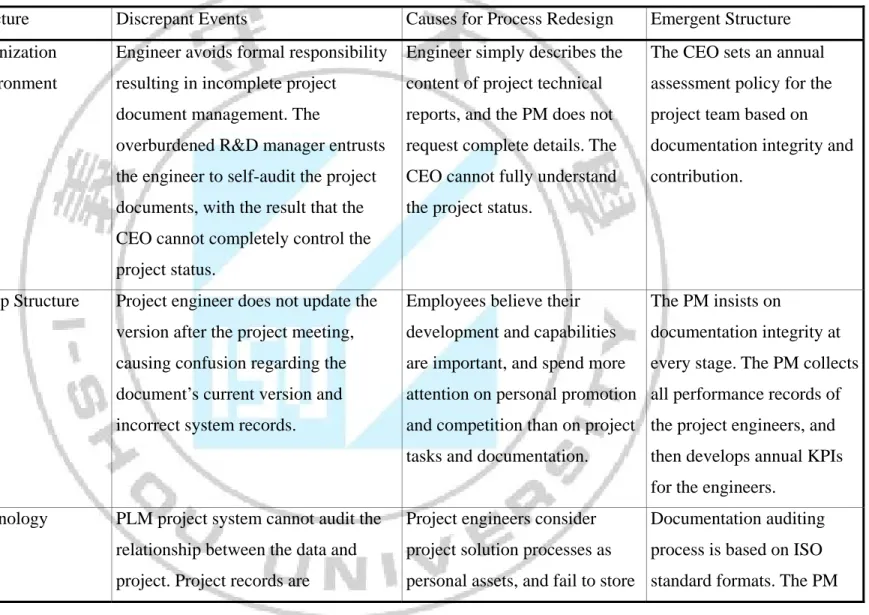
Table 4 : Adaptation of Discrepancies ... 55
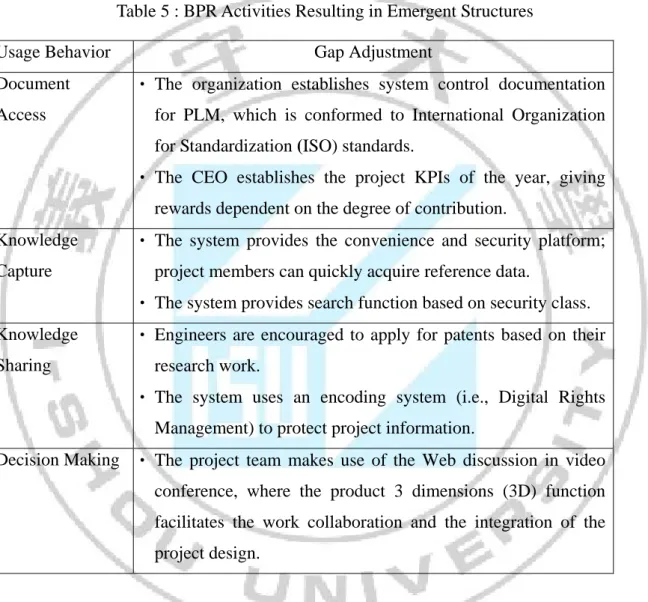
Table 5 : BPR Activities Resulting in Emergent Structures ... 59
Table 6 : Customer investigation process ... 60
Table 7 : Customer product problem resolution process ... 61
1. Introduction
The history of product development research can be traced back to a stream of innovation research focusing at a micro level on how specific products are developed through an organization-oriented approach (Brown & Eisenhardt, 1995), i.e., decisions on product development projects within a single firm. The existing literature on product development is vast, covering perspectives from different research communities including marketing, enterprise organization, engineering design, and operations management (Krishnan & Ulrich, 2001). However, mainstream research still lies in the domain of structures and processes by which individuals create products. These structures and processes emphasize the organizational structures, roles, and processes related to enhancing product development.
The management of a development project entails decisions about the relative priority of development objectives. These include process performance metrics like lead-time and productivity, and financial performance metrics like profit, revenue, and market share. Product development processes are often executed in a development team’s “black box”. The flow of information in research and development (R&D) groups is versatile, and can be changed subject to different organizational requirements in different stages of product design and development. Communication complexity within the project team can result in unpredictable outcomes, requiring managerial intervention to ensure the realization of organizational objectives. The main task of product development is to collect creative ideas and knowledge contributions from team members. The project team is often kept autonomous from the organization to ensure optimal productivity.
The development of new information technologies has the potential to revolutionize product development practices. The most important of these technologies for supporting new product development process is the product lifecycle management (PLM) system. PLM is an inter-organizational system that consists of human resources, operational processes, and information technologies (Grieves, 2006). The technical information generated during the product life cycle is recorded in the enterprise’s PLM knowledge database (Saaksvuori and Immonen, 2004). This knowledge helps enterprises accelerate product development at lower costs (Schuh et al., 2008). Moreover, the PLM system involves supply chain partners (i.e., buyers and suppliers) in the product development process in the early stage, thus reducing the likelihood of technical errors, increasing customer satisfaction, and strengthening the partnership.
Previous studies have examined in detail the benefit of new tools like product lifecycle management (PLM) systems for managing product knowledge and support development decision making within organizations (Krishnan & Ulrich , 2001), but little has been done to investigate the impact of IT on product development (Boland, Lyytinen, & Yoo, 2007; Nambisan, 2003; Pavlou & El Sawy, 2006).
Implementing a large-scale information system requires huge resources and entails certain risks (Robey, Ross, & Boudreau, 2000). PLM is a type of enterprise information system (EIS), and the deployment of large-scale information systems is currently a major corporate trend, driven by forces including the development of the Internet, globalization, and the use of IT for managing and accessing distributed knowledge (Braa & Rolland, 2000). Large-scale information systems imply that work practices and various technologies will become increasingly interconnected and integrated (Braa & Rolland, 2000). Accordingly, management choices are constrained by built-in system functionality. However, even in the most constraining case, managerial choice exists as a separate, independent variable impacting the effective deployment of EIS.
After the system is integrated into the organization, the full value of the information technology can be gained (Liang, Saraf, Hu, & Xue, 2007). However, integrating PLM into existing systems is difficult since enterprises may need to change established knowledge sharing practices to fit the system. The study draws on prior research in the fields of technology adaptation and organizational change innovation to help better understand the potential impact of PLM on product development. Different organizations adopt different approaches in adapting new technologies. An emerging perspective argues that the use of a new technology is not deterministic, but rather that technology has interpretative flexibility and its users are engaged as they develop or use it (Orlikowski, 1992). Technology users are a source of innovation (Hippel, 1988) and reinvention (e.g., Johnson & Rice, 1984). Technologies are modified and appropriated in diverse ways by diverse users. Hence, the way the adaptation process unfolds depends on the nature of the technology and how users interact with it. This emergent perspective only provides a partial explanation as to how technology is used within organizations.
Most organizations are open to a degree of internal manipulation. Management can evaluate the situation and make decisions based on its strategic choice framework (Hrebiniak & Joyce, 1985). Given problematic dependencies on resources, management can purposely enact, define, and otherwise affect the technology appropriation domain and the exogenous conditions under which the system is to operate. Hence, the study conceptualizes PLM
systems as embedded in specific organization and group contexts, and these contexts exert fundamental influences on the way PLM systems are implemented and used. Little research in the field of technology adaptation has been conducted to investigate how the adaptation process unfolds in these contexts.
Organizational change innovation theory provides guidance regarding how managerial influence is exerted down through an organizational hierarchy to product development teams to achieve the organization’s key performance indicators (KPI), while the research stream of technology adaptation characterizes the pattern of adaptation in the movement towards reducing misalignments between users and the technology. Combining these two research streams, adaptation is a dynamic process resulting from the relative strength of management intention in comparison with usage action conducted by the team members. Therefore the EIS system implementation entails a complicated interactive process between the organization and individual users. Yet, previous research has largely failed to deeply investigate adaptation problems among management intervention, the usage model, and the need to fulfill KPIs. Hence this study addresses the following research question:
How does management influence the organizational adaptation process for the appropriation of a PLM system through its interaction with members’ usage behavior?
The rest of this paper is structured as follows. First, I provide a discussion depicting the relationships among new product development (NPD), PLM and the theoretical bases of technology adaptation and organizational change innovation. Second, I present an integrated research model based on theories from technology adaptation and organizational change innovation. Third, I present a research design in which we describe the project team structure, PLM technology, and our data collection methods. Fourth, I conduct analysis for a case study based on the suggested research model. Finally, I discuss the findings from case results and provide implications for academics and practitioners.
2. Literature review
2.1 NPD and PLM
The field of NPD has been defined as including the set of activities "beginning with the perception of a market opportunity and ending in the production, sales, and delivery of a product" (Ulrich and Eppinger 2000, p. 2). Since it covers such wide organizational areas, the dominant models in NPD emphasize an interdisciplinary mode of inquiry and call for contributions from most business functional areas.
Since the Internet technology became widely available in mid 1990s, there have been fundamental changes in organizations. The virtual organization is often described as the one that is replete with external ties (Coyle and Schnarr 1995), managed via teams that are assembled and disassembled according to needs (Grenier and Metes 1995, Lipnack and Stamps 1997), and consisting of employees who are physically dispersed from one another (Clancy 1994, Barner 1996). The result is a "company without walls" (Galbraith 1995) that acts as a "collaborative network of people" working together, regardless of location or who "owns" them (Bleeker 1994, Grenier and Metes 1995, Hedberg et al. 1997). Beginning with these assumptions, it is interesting to study how communication processes and organizational design interplay in the new, "virtual" enterprise (DeSanctis G, Monge P, 1999).
Developing a new product successfully is always a challenge for a firm. For successful NPD, a firm must be able to develop an innovative product that appeals to the customer and manufactures it in large quantity in order to reap profit from the mass market (Verworn et al., 2008). Under the collaborative structure and virtual organizational environment, the major challenge for project team about NPD is how to integrate the technical knowledge in the project to generate the organization’s benefit. In such collaborative structure, the organization can perform two kinds of managerial patterns: Top-down and Bottom-up. In Top-down mode, the management level develops organizational behavior patterns and monitors the project, and makes timely decision on the project. In Bottom-up mode, individual users react and adapt to the system norm.
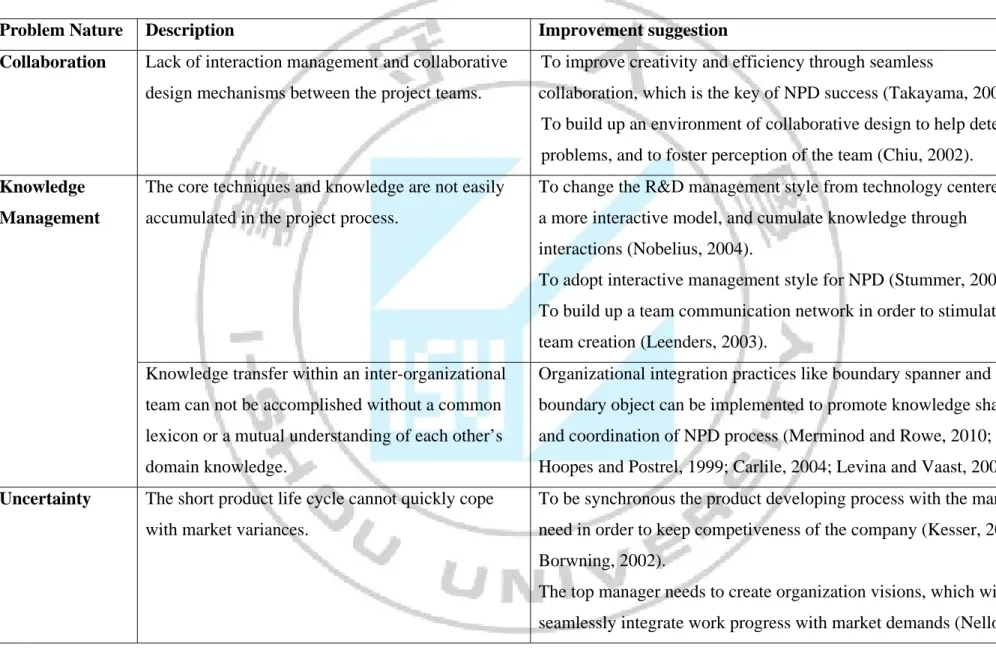
Integrating knowledge for technologies under development faces many challenges. Previous studies have found many unsolved problems in the management of NPD. In Table 1, we can find that the managerial issues of NPD management surrounds by the substantial topics of project integration mechanisms, marketing environment changes, and technology
development. Therefore, the project is with high uncertainty on its information related factors during the NPD development process.
The problems outlined in Table 1 indicate that product development is an interdisciplinary field where IT can serve as a supporting platform for their solution (Nambisan, 2003). In the NPD process the PLM systems link product design information with customer needs, processing data, cost data and resource planning data and make them accessible to everyone inside and outside the firm that requires the information at the right time (Serrano and Fischer, 2007). Therefore, PLM is a powerful approach for breaking through organizational and technical barriers to collaborative New Product Process Development, and it also helps identify and communicate sources of knowledge.
However, the project team members come from different technical backgrounds, and are under the restriction of disclosuring the enterprise technique secrets. Although the knowledge and technologies in various stages of NPD are integrated through the collaboration model embedded in the PLM system, quite often anticipated benefits about collaboration and integration are not achieved. Although operation secrecy has to be maintained in the product development process, people still can make use of the collaborative functions of the PLM system to gain benefits. Thus, using the collaborative functions properly for integrating information and technology resources may lead to solutions for extensibility and maintenance issues in NPD.
Table 1 : Common NPD problem and improvement suggestion
Problem Nature Description Improvement suggestion
Collaboration Lack of interaction management and collaborative
design mechanisms between the project teams.
To improve creativity and efficiency through seamless
collaboration, which is the key of NPD success (Takayama, 2002). To build up an environment of collaborative design to help detect problems, and to foster perception of the team (Chiu, 2002).
Knowledge Management
The core techniques and knowledge are not easily accumulated in the project process.
To change the R&D management style from technology centered to a more interactive model, and cumulate knowledge through
interactions (Nobelius, 2004).
To adopt interactive management style for NPD (Stummer, 2003). To build up a team communication network in order to stimulate team creation (Leenders, 2003).
Knowledge transfer within an inter-organizational team can not be accomplished without a common lexicon or a mutual understanding of each other’s domain knowledge.
Organizational integration practices like boundary spanner and boundary object can be implemented to promote knowledge sharing and coordination of NPD process (Merminod and Rowe, 2010; Hoopes and Postrel, 1999; Carlile, 2004; Levina and Vaast, 2005).
Uncertainty The short product life cycle cannot quickly cope
with market variances.
To be synchronous the product developing process with the market need in order to keep competiveness of the company (Kesser, 2002; Borwning, 2002).
The top manager needs to create organization visions, which will seamlessly integrate work progress with market demands (Nellore,
2001).
The schedule of R&D is hard to control. Due to the high uncertainty in R&D, organizations need to use a comprehensive market development stragegy as the basis for developing the blue print of future product development in order to reduce the uncertainty (Nobelius, 2006).
The manager needs to establish an effective and specialized communication mechanism, suggest correct strategic direction, control and monitor project progress, and adjust project goals timely (Bonner, 2002).
Information Effectively
A lack of necessary information for the new product In the high-tech domain, the core competency directly influences the future competition position of the company, also deciding the way of product line (Quélin, 2000).
To keep on improving the R&D process, strengthen the competitive advantage of new products, and deliberate the future growth of products (Chapman, 2004).
To use the Internet performance measurement tool which can provide synchronously and immediately information to product developers, and thus helps collaborations and obtain latest information for solving product related problems (Shi, 2001) .
Performance Evaluation
R&D performance cannot be immediately assessed. To establish project evaluation mechanisms that can be used to deal with project uncertainty and uncontrolable factors (Loch, 2002).
To establish specific evaluation mechanisms for evaluating R&D performance (Millar, 2001).
To establish four key performance factors in the NPD process: finance, degree of target market acceptance, degree of subjective market acceptance, and levels of product (Huang, 2004).
2.2 Technology adaptation theories
The main research stream in the field of technology adaptation is the pattern of adaptation when a new technology is introduced to the organization. Leonard-Barton (1988) proposed the mutual adaptation model for technology and organizations to reduce misalignment between techniques, delivery systems and performance criteria in the technology adoption process. As there are cycles of disruption in technology use, the performance impact is often the final target for the implementation of a given technology. In terms of the adaptation of performance criteria, the large adaptive cycle involves moving back from the technological mutualization level to strategic level considerations, whereas the small adaptive cycle involves returning from the technological mutualization level to the operational level. In regards to human resources and budgets, the large adaptive cycle is more costly. Thus, Leonard-Barton (1988) suggested that misalignment between technology and organization can be attributed to different alignment statuses such that the degree of adaptation can be estimated. Adaptations occur continuously in response to misalignments, gradually leading to a successful alignment.
By comparison, Tyre and Orlikowski (1994) characterize adaptation as a highly discontinuous process, where discontinuities occur during brief windows of opportunity for revising the organizational system. Leonard-Barton (1988) suggested the technology adaptation model is centered on a large loop or small cycles of adaptation. Majchrzak, Rice, Malhotra, King, & Ba (2000) suggested that the models differ in terms of the continuity presumed to occur in the adaptation process. Grounded in the work of Leonard-Barton (1988) and Tyre and Orlikowski (1994), Majchrzak et al. (2000) applied adaptive structuration theory (AST) to suggest an integrated model of technology adaptation based upon the emergent perspective of technology adaptation (Markus & Robey, 1988). The implementation and use of technology are not deterministic: technology has interpretative flexibility and users of technology are engaged in its constitution during development or use (Orlikowski, 1992). These adaptation models may reflect different conditions in the field rather than invariant theoretical conclusions, i.e., situations in which structures only become malleable at discontinuous intervals. In the adaptation process, discontinuous and discrepant events emerge, indicating that subsequent changes often occur in an episodic manner, triggering adaptations in terms of use and leading to new discoveries by users.
Structuration theory provides a theoretical base for the emergent perspective of technology adaptation. Giddens (1984) argues that social structures are enacted through
recurrent human action and interaction. Such enactment is mediated through a number of elements such as facilities, norms and interpretive schemes that guide human action (Schultze & Orlikowski, 2004). The structuration perspective appeals to information systems in its focus on structure and the processes by which structures are used and modified over time. The field of information systems has a deep-seated concern with the analysis and design of structures for decision making and human-computer interaction. AST investigates variations in organizational change that occur as the result of the introduction of new IT (DeSanctis & Poole, 1994). Specifically, AST emphasizes the impact of technology, work practices and organizational environment on a user group’s structural appropriation behavior. If appropriation accords with technology design concepts, decision making performance is improved.
The structuration perspective suggests that technology is a product of ongoing human action, design, and appropriation (Orlikowski, 2000). Hence technology is contingent on other forces in the organization, most notably powerful human actors. The use of technology is often significantly influenced by the activities of a few individuals playing a major role in shaping the outcome of technology appropriation (Orlikowski, Yates, Okamura, & Fujimoto, 1995). The strategic choice model suggests that technology is influenced by the context and strategies of technology decision makers and users (Child, 1972; Kling & Iacono, 1984; Markus, 1983; Perrow, 1983; Zuboff, 1988).
The social dimension of information systems includes the organization and individual users, and its operation involves the interaction between activities and the individual’s cognition (Jasperson, Carter, & Zmud, 2005). Both the organization and its members commonly have output expectations when adopting a new technology (Jasperson et al., 2005). However, the full value of adoption is only gained when the organization fully recognizes and integrates the system (Liang et al. 2007). The reason is that even if the organization forces users to use the information system, the users still exercise a certain level of self-judgment in how or whether to use it (Hartwick & Barki, 1994; Jasperson et al., 2005). In most cases, a key for the successful diffusion of an information system is the users’s self-motivated behavior, which usually only occurs after the new system has been adopted (Jasperson et al., 2005). Thus, a successful information system adoption involves the adaptation process, and a complete absorption in the organization.
2.3 As-Is and To-Be model in IS implementation
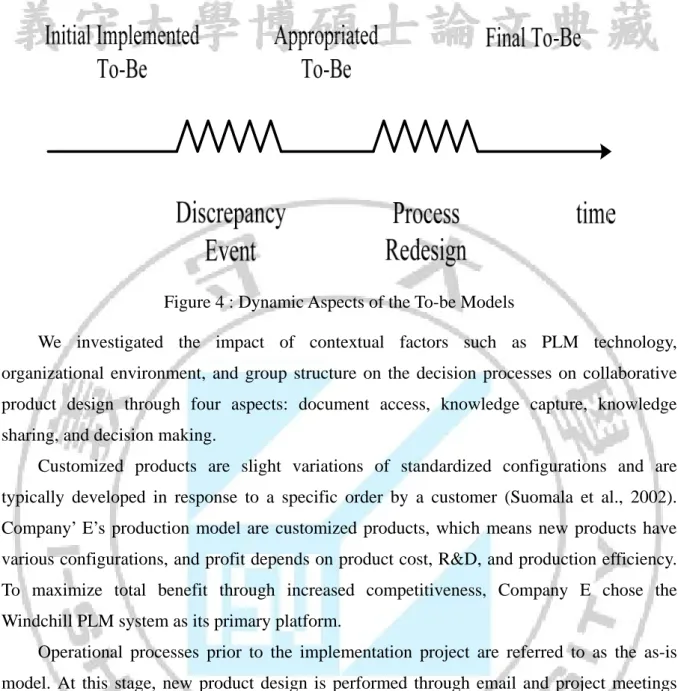
BPR is one of the key success factors in implementing IT projects, such as PLM. It is particularly important in firms that have a strong corporate culture or heavily rely on legacy systems (Grover et al., 1995). BPR should provide dramatic results. The BPR methodology includes the five activities: Prepare for reengineering, Map and Analyze As-Is process, Design To-Be process, Implement reengineered process and Improve continuously (Subramanian Muthu, Larry Whitman, & S. Hossein Cheraghi, 1999). The main objective of As-Is analysis is to identify disconnects that prevents the process from achieving desired results. Having identified the potential improvements to the existing processes, the development of the To-Be models is done using the benchmarking technique, which is the comparison of both the performance of the organization’s processes and the way those processes are conducted with those relevant peer organizations to obtain ideas for improvement. After setting the To-Be model, discrepancy events occur frequently in the organization which means a turning away from the planned scenario as set in the To-Be model. When this happens, how can we make adjustment in order to achieve the organizational objectives? The technology adaptation literature has different views on dealing with this problem. One group believes that the organization will make adjustment automatically (Leonard-Barton, 1988), and some believe a solution plan will be emerged through the interaction between user and the technology (Majchrzak et al., 2000). Yet, a clear adjustment process is missing in both explanations.
2.4 EIS implementation
2.4.1 EIS implementation and organizational change innovation
The PLM system is one part of the EIS System. Previous research in technology adaptation theory emphasizes the nature of adaptations, i.e., whether they are discontinuous (responding to windows of opportunities), or continuous (gradually closing misalignments). It appears that technology properties and contextual contingencies can play critical roles in the outcomes of IT use. The difficulty is that there are no apparent patterns indicating that some technology properties or contingencies consistently lead to either positive or negative outcomes (Orlikowski, 1996).
As EIS grow larger and more complex, such large-scale information systems are more than pure technology and can be considered a type of socio-technical network (Rolland,
2000). These systems can transform a business, but only if the organization is able to reengineer business processes across the entire value chain (Davenport, Harris, & Cantrell, 2004; Dillard, Ruchala, & Yuthas, 2005; Markus, Petrie, & Axline, 2003; Ross, Vitale, & Willcocksm, 2003). Business Process Reengineering (BPR) is a type of organizational change innovation (Currie, 1999), which is concerned with the implementation of new management practices, processes, structures, or techniques that represent a significant departure from the state of the art (Birkinshaw, Hamel, & Mol, 2008). Hamel (2006) in particular has forcefully argued that in modern management, the context-specific nature of innovation makes it one of the most important and sustainable sources of competitive advantage for firms. The field of organizational change innovation provides a theoretical lens for explaining how key individuals deal with organizational contingencies in the process of organizational transformation (Birkinshaw & Mol, 2006).
As advanced technologies have become an important factor in driving innovation, gaps have appeared in the literature focusing on why firms introduce new management practices. Many studies have focused on the diffusion of specific practices across firms over space and time, along with factors conducive to the emergence of organizational change innovations (Damanpour, 1987; Kaplan, 1998; Knights & McCabe, 2000; Strang & Kim, 2005). However, few studies have adopted a firm-centered approach with a view to understanding the mechanism for including both new practices and technologies. Further research efforts are needed to build a theoretical foundation for the integration of management practices and relevant technologies.
2.4.2 EIS implementation and the emergent perspective
According to structuration theory, complex EIS contain their own set of rules which, when implemented, can have a significant impact on extant organizational processes. Business Process Reengineering (BPR) is a type of organizational change innovation. One of the key elements of reengineering is a focus on business processes, which is often linked to the implementation of EIS (Currie, 1999). This is particularly important in firms that have a strong corporate culture or rely heavily on legacy systems (Grover, Jeong, Kettinger, & Teng, 1995).
Conventional EIS implementation methodology relies on the As-Is and To-Be models for BPR (Muthu, Whitman, & Cheraghi, 1999). The main objective of As-Is analysis is to identify disconnects that prevent the process from achieving the desired results. Having
identified the potential improvements to the existing processes, the To-Be model is developed using benchmarking techniques, involving the organization and its peers in terms of both process performance and in terms of how those processes are conducted to obtain ideas for improvement. After the To-Be model is set, discrepancy events occur frequently in the organization which entail turning away from the planned scenario as set in the To-Be model, requiring adjustments to achieve the organizational objectives.
Based on the emergent perspective, EIS practices can be understood as clusters of recurrent human activity informed by shared institutional meanings (Schultze & Orlikowski, 2004). Practices are dynamic and ongoing, and engaged in by people as part of the structuring processes through which organizations and networks are constituted over time (Orlikowski, 2000). By comparison, as derived from benchmarking techniques in a relatively static setting, the As-Is and To-Be models fail to adequately capture the dynamic aspects of technology adaptation processes, and therefore are unable to gain insights into the formation, adjustment, and finalization of strategies.
2.5 Technology’s Spirit — PLM System Architecture
I present a case study in which a project was proposed to “establish a high-efficiency component design service network” in order to establish an electronic R&D team. The enterprise not only plays a role of integrating the R&D value network to raise the efficiency of customer service, but implement the Windchill PLM system, which is excellent in Collaborative Product Commerce (CPC), as the platform for electronic technical support.
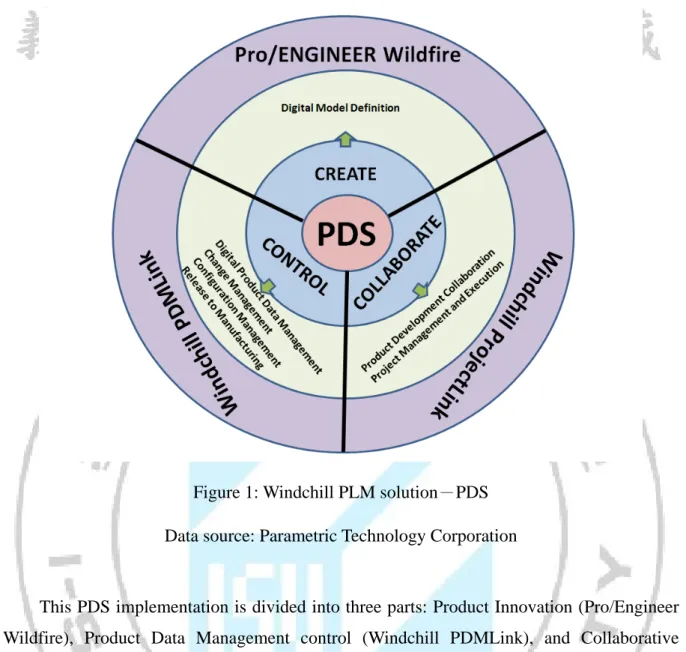
The Parametric Technology Corporation (PTC) uses a Production Development System (PDS) supplied by Windchill as a PLM solution. As shown in Figure 1, PDS manages all forms of interdependency among production information, and easily assists all project members to communicate their various viewpoints and representing how these opinions affect the product as a whole.
Figure 1: Windchill PLM solution-PDS Data source: Parametric Technology Corporation
This PDS implementation is divided into three parts: Product Innovation (Pro/Engineer Wildfire), Product Data Management control (Windchill PDMLink), and Collaborative Product Commerce (Windchill ProjectLink). Case E has already implemented the Pro/E software system for diagram management. Due to the need to integrate PDS, Case E is expected to resolve complicated and tedious issues related to product document management and NPD project management by implementing Windchill PDMLink and Windchill ProjectLink. The system functions are as follows:
(1) Pro/Engineer Wildfire: Integrating solutions from various design data.
The Pro/ENGINEER Mechanica provides engineers with different specifications of design diagrams and product structure simulations, providing engineers with in depth understanding of product performance and product behavior modes in early stages, resulting in improved product quality and reduced time and costs for setting up the actual mold.
(2)Windchill PDMLink: Providing product information and process flow management information.
Through a web-based structure, the enterprise shares a reliable product database, the latest product information, automatic system controls, and the historical product design records, thus avoiding costs from errors arising from the use of incorrect design blueprint versions, and assisting designers to complete the NPD process promptly. Furthermore, it allows for distributed and interorganizational data sharing, and product information collaboration. (3)Windchill ProjectLink: Providing collaboration services for product research and
development projects.
The project members promptly master the project document, Bill Of Material (BOM), and the project plan. A collaborative mechanism reduces a product’s time to market and enhances the business’s creativity. Through this virtual environment one can instantly access accurate product development and management information, integrate team information, and control the progress of the project. The function assists the enterprise in effectively integrating the product information involved in interorganizational activities.
2.6 Change Management and BPR
Previous research in technology adaptation mainly addresses the pattern of adaptation process when new technology is introduced. However, introducing new technology to organizations often accompanies organizational change issues such as process redesign and cultural adjustment. Change management addresses a structured approach to transitioning organizations from a current state to a desired future state. It is an organizational process aimed at empowering employees to accept and embrace changes in their current business environment (Paton and McCalman, 2008). The management of change can be deemed as a process. A generic model of the change process consists of three stages: diagnosis, strategies and plans, and implementation (Hayes, 2007). Diagnosis is about reviewing the present state and identifying the preferred future state. The stage of strategies and plans is about to prepare and plan for implementation. The last stage is to implement change, and the focus shifts from planning to action. Efforts must be given to monitoring and control to ensure that things happen as intended.
BPR is often presented as a “top-down”, organization-wide approach to transforming organizations. It is particularly important in firms that have a strong corporate culture or rely heavily on legacy systems (Grover et al., 1995). BPR should provide dramatic results. The BPR methodology includes the five activities: prepare for reengineering, map and analyze As-Is process, design To-Be process, implement reengineered process and improve continuously (Muthu et al., 1999). The main objective of As-Is analysis is to identify
disconnects that prevent the process from achieving the desired results. Having identified the potential improvements to the existing processes, the To-Be models are developed using the benchmarking technique, which involves comparing both the performance of the organization’s processes and the way those processes are conducted with those of relevant peer organizations to obtain ideas for improvement. After the To-Be model is set, discrepancy events occur frequently in the organization which entail turning away from the planned scenario as set in the To-Be model, requiring adjustments to achieve the organizational objectives. The literature on technology adaptation presents different approaches to dealing with this problem. One group believes that the organization will make adjustments automatically (Leonard-Barton, 1988), and some believe a solution plan will emerge through the user’s interaction with the technology (Majchrzak et al., 2000). However, a clear adjustment process is missing in both explanations.
2.7 Management innovation and BPR
2.7.1 IT implementation and management innovation
Previous research in technology adaptation theory emphasizes the nature of adaptations, whether they are discontinuous, responding to windows of opportunities, or they are
continuous, gradually closing misalignment. In conclusion, the pattern of adaptation depends on the type of technology beinbg studied. This theoretical consensus had implications for bringing change to the organization.As the use of technology is source of innovation, Technological innovations are discrete knowledge assets that can be codified, since they consist of some physical process or product and can be replicated with relative ease. Focusing on technological innovation alone may not attain performance impacts as initially planned.
As EIS grow larger and more complex, they tend to be more shaping of society and less shaped by it. Hence, large-scale information systems are more than pure technology; rather it is a socio-technical network (Rolland, 2000).Management innovation is about the
implementation of a new management practice, process, structure, or technique that represent a significant departure from the state of the art (Birkinshaw et al., 2008). Hamel (2006) in particular has forcefully argued that in today’s age management innovation may represent one of the most important and sustainable sources of competitive advantage for firms because of its context specific nature among others. Management innovations are different from
which they were created, which is usually a highly complex social system with many different actors and relationships.
As advanced technologies have become an important momentum to drive innovations, the literature focusing on why firms introduce new management practices contains gaps. Many studies focus on the diffusion of specific practices across firms over space and time; and factors conducive to the emergence of management innovations (Strang & Kim, 2005; Knights & McCabe, 2000; Damanpour, 1987; Kaplan, 1998); but studies looking specifically at the firm, with a view to understanding the mechanism for including both new practices and technologies, are relatively small and lacking. Further research efforts are needed to build up theoretical foundation concerning the integration of management practices and relevant technologies.
2.7.2 IT implementation and BPR
Complex EIS contain their own set of rules, and when implemented can cause significant impacts to extant organizational processes. Business Process Reengineering (BPR) is a type of management innovation. One of the key elements of re-engineering is a focus on business processes, which is often linked to the implementation of EIS (Currie, 1999). It is particularly important in firms that have a strong corporate culture or rely heavily on legacy systems (Grover et al., 1995).
The BPR methodology includes the five activities: prepare for reengineering, map and analyze As-Is process, design To-Be process, implement reengineered process and improve continuously (Subramanian Muthu, Whitman, & Cheraghi, 1999). The main objective of As-Is analysis is to identify disconnects that prevent the process from achieving the desired results. Having identified the potential improvements to the existing processes, the To-Be models are developed using the benchmarking technique, which involves comparing both the performance of the organization’s processes and the way those processes are conducted with those of relevant peer organizations to obtain ideas for improvement. After the To-Be model is set, discrepancy events occur frequently in the organization which entail turning away from the planned scenario as set in the to-be model, requiring adjustments to achieve the organizational objectives. The literature on technology adaptation presents different approaches to dealing with this problem. One group believes that the organization will make adjustments automatically (Leonard-Barton, 1988), and some believe a solution plan will emerge through the user’s interaction with the technology (Majchrzak et al., 2000). However, a clear adjustment process is missing in both explanations.
2.8 Summary
Among EIS technology models, PLM systems require the highest levels of linkage and interaction within the organization (Serrano & Fischer, 2007; Verworn et al., 2008). However, previous studies of technology adaptation frequently discuss patterns of adaptation behavior in IT implementation, but pay little attention to the details of interaction between organizational levels and the system (Boland et al., 2007; Nambisan, 2003; Pavlou & El Sawy, 2006), leaving them unable to discover a suitable collaborative behavior model for the organization in the whole BPR process, and unable to create a knowledge database providing sustainable competitiveness.
Structuration theory explicitly states that existing structures represent constraints on the adaptation process (Giddens, 1984). Based upon this argument, the emergent perspective holds that the uses and consequences of information technology emerge unpredictably from complex social interactions (Markus & Robey, 1988). Following the emergent perspective, the AST framework addresses how contextual factors, including organizational environment, group structure and technology affect the organization’s adaptation behavior (DeSanctis & Poole, 1994). Hence prior research in technology adaptation focuses on the impacts of structural constraints and the resulting pattern of adaptation to reduce misalignments between technology and organization (Majchrzak et al., 2000). However, Orlikowski and Robey (1991) argue that using technology can be an occasion for restructuring organizations because its presence provokes human interactions that may subsequently bring changes to decision making processes. IT can influence an organization’s decision making processes and, in turn, the attributes of these processes influence humans in their interactions with IT. In light of organizational causal structures, managers are the principal decision makers who determine the fate of the organization (Mellahi & Welkinson, 2004; Pettigrew & Whipp, 1991; Wilson, 1992). This viewpoint is also supported by the strategic choice framework (Hrebiniak & Joyce, 1985).
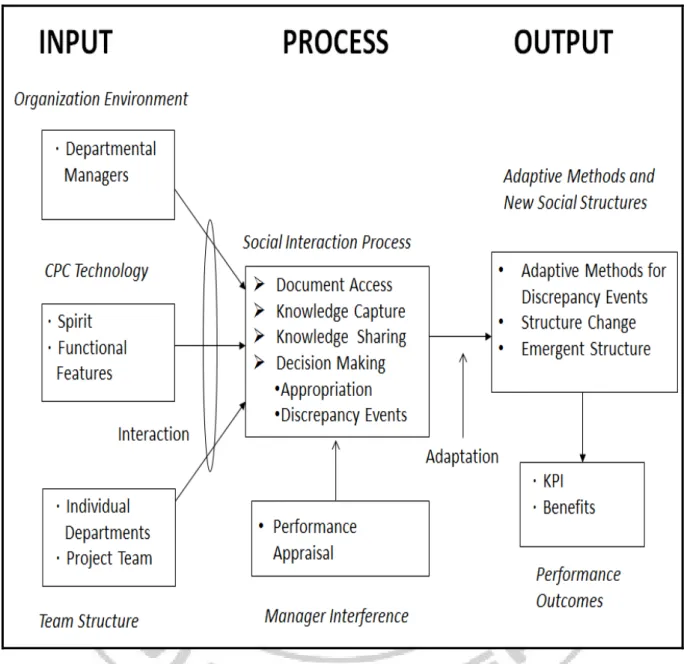
Implementing PLM systems is expensive, and the goal of implementation is to attain preset organizational goals, thus management involvement in the implementation process is inevitable. The field of organizational change innovation provides a theoretical lens for explaining how key individuals deal with organizational contingencies in the process of organizational transformation (Birkinshaw & Mol, 2006). Concerning the organizational consequences of using IT, Figure 2 summarizes the impacts of various contextual factors on PLM system use, represented by document access, knowledge capture, knowledge sharing,
and decision making (Majchrzak et al., 2000). Figure 2 also depicts the role of human agency. Managers can intervene to effect change in ways that will either promote or undermine organizational effectiveness.
Figure 2 : Technology adaptation framework for PLM system usage based on AST, strategic choice, and organizational change innovation perspectives
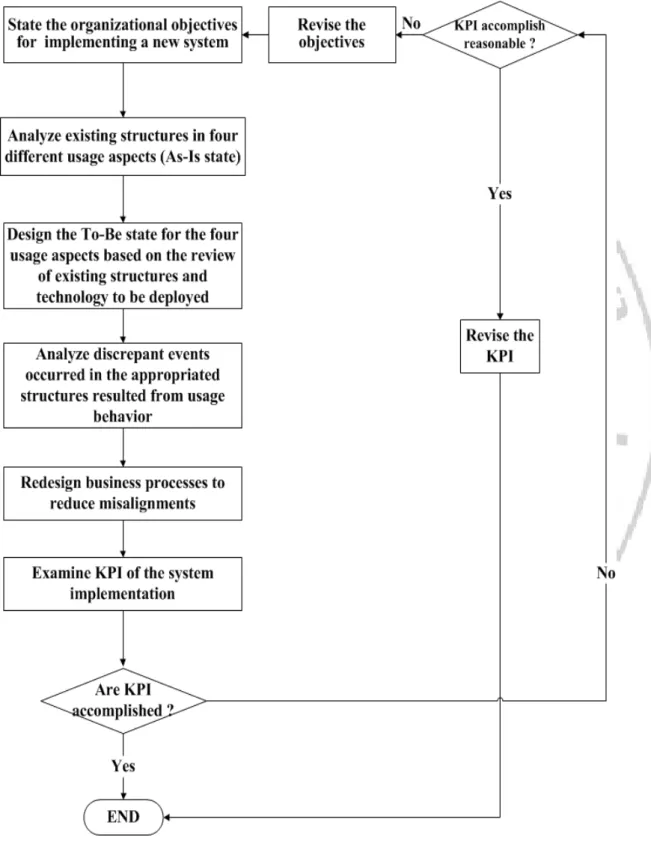
The social interaction phenomena described by the emergent perspective are inherently dynamic and grounded in on-going human action, in which macro phenomena are constituted by micro interactions which, in turn, are shaped by macro influences and effects (Orlikowski, 1996; Orlikowski, 2000; Schultze & Orlikowski, 2004). An organization needs to establish strategic goals in product development to avoid large adaptation cycles (Leonard-Barton, 1988). Hence, the enterprise establishes organizational objectives using BPR in the As-Is phase. The CEO charges the project group with goals through a top-down request, and the
group goes through the BPR processes and installs the required information systems. Finally, standardized appropriation processes to meet the organization’s goals are set in the To-Be phase.
I study discrepancy events using the AST model in the implementation process which indicate how individuals in the organizational hierarchy engage in micro-level interactions in a bottom-up fashion. The solution to discrepancy events sets adaptation patterns in the project team’s usage behavior. The project team uses such adaptation behavior to force the organization to improve organizational performance through developing new managerial rules based on a bottom-up approach. Therefore, the desired structure of the preset goals is formed through the adaptation process involving the top-down and bottom-up approaches. This structure is not only used to attain preset goals, but also fits into the current organizational information system structure. From the perspectives of AST and organizational change innovation, the use of the PLM systems in the NPD process is an adaptation process involving top-down and bottom-up methods to deal with discrepancies between the organization environment, group structure and technology. The results from adapting discrepancy events determine how KPIs are achieved.
3. Research Methodology
Case studies are a universally accepted method for discussing and analyzing complex phenomena involved in the implementation of advanced and complex technologies in an organization (Alavi & Carlson, 1992; Yin, 2002). When AST is employed to analyze the dynamics of structural change, researchers need to collect data regarding various organizational structures at multiple stages over the implementation period. This involves conducting a longitudinal case study, which allows for single-case designs (Yin, 2002). The hidden complexity of the time horizon embedded in the case data leads to AST-based case studies engaged in single case research (DeSanctis & Poole, 1994; Majchrzak et al., 2000).
3.1 Research framework
3.1.1 As-Is and To-Be framework
Successful product development involves relatively autonomous problem solving by cross-functional teams with high communication and organization abilities on work according to the demands of the development task. This perspective also highlights the role of project leaders and senior management in giving problem solving a discipline-a product vision. There is an emphasis on both project and senior management, on one hand, to provide a vision to the development efforts and yet, on the other hand, to provide autonomy to the team. Thus, we may portray product development as a balancing act between product vision developed at the executive level and problem solving found at the project level. The balanced actions must be achieved through the adjustment on the usage behavior of PLM.
The package software implementation usually applies the As-Is and To-Be models in the BPR methodology, and the AST theories then studies the impact made from contextual factors to the behavior of system usage. We combine the two described above, and consider document access, knowledge capture, knowledge sharing, and decision making as usage behavior (Majchrzak et al., 2000). Thus, we propose a technology adaptation model based on formal interventions exercised by the management (Figure 2 shows the structure). This model is used to discuss how enterprise obtains the goals of R&D through the adjustment of the usage behavior on PLM system.
Concerning the system structure, the As-Is model was to describe product development in the pre-installation stage, and then the To-Be model was set for implementation based on the standardized best practices in the PLM system. During the implementation, the actual processes are not matched with planned To-Be model. Discrepancy events occur in various
management levels because the behaviors of organization and groups have to be adjusted mutually to deal with the system installed. Through the resolving of discrepant events, the organization can find out the process that is best fit to the PLM system, and thus attain expectational performance.
3.2 Research design
3.2.1 Case description
The PLM system in Company E was installed to support NPD projects. The NPD is initiated when the sales team receives the customer’s requirements for a new product, and the CEO, project manager (PM), and engineers then work together to draw a product blueprint. Once the customer has approved the blueprint, the scope of the project is determined. We study the most critical and complicated project to generate deeper knowledge about PLM use. In the NPD project, we explore how the technical, organizational, and process aspects of resources are adjusted toward alignment.
3.2.1.1 The cases company description
Company E produces small and medium-sized Liquid Crystal Display (LCD) panels. In 2010, the company had annual revenues of USD$132.1 million and an annual growth rate of 44.89%. The company’s revenue comes from LCDs used in cell phones, consumer electronics, industrial equipment and medical applications. The company adopted a build-to-order (BTO) business model, and is one of the best-performing LCD makers in Taiwan. Customers from a variety of industries are drawn by the company’s highly-customized products. The product earning comprises cellular phone product (33%), the consumption electronics (14%), the industry instruments (40%), and other medical treatment (13%). Company E is the leading small and medium size LCD manufacturer in terms of the quality, technique, and profit earning in Taiwan. In addition to actively heading up to integrating upstream suppliers, it also actively increases its production scale and product sales. Company E major products include medical and consumption electronics. Since 2001, Company E obtained the cellular phone module order from LG. The percentage of cellular phone product has been quickly increased. Yet, the industrial and medical products are with the higher profits and a stable cooperative relation with customers. Thus, the operation strategy of Company E, for the reasons of risk reduction and maintaining certain profit level, chose to produce both cellular phones and other types of products and in even weight. The Taiwanese electronics industry is with the following characteristics: the perpendicular division of labors, the new technique continuously renews, and the consumption electronics product functions being continuously creative. Because enterprises lack of strong integration, the investment of Taiwanese new technique development has been dispersed. Company E product range crosses various industries. In addition to fulfill each
industry customer’s design requirements, its product technique has to satisfy the specification requirements given by different customers and other needs. Therefore Company E proposed the concept of integrating R&D teams vertically with other partners in order to build the development team for small and medium size LCD. Company E plays a role of integrating designers and developers in order to create value. Through the use of PLM system platform, they can provide better customer technique supports, provide better facilitation to supply chain members, and construct integrity of the product line information. Company E also built the “complete solution for the small and medium size panel knowledge base” for dealing with the product demand given from customers. It is hoped that the system can help Company E to become the leader in the industry in the future.
The Taiwanese LCD industry belongs to the structure of the perpendicular division of labor, the design development efficiency of the product components relates to the Company E service efficiency for customer. Continuously weed through the old to bring forth the new in the new technique, the consumption electronics product pursues the footstep of the function innovation to continuously and forward, and investment of the Taiwanese new technique development, dispersion at development of professional technique of each enterprise, lack of the enterprise integrate of strength, by all accounts still more than Korea and Japanese weakly. The Company E company by the information system installation, develop by the perpendicular independent design, integration become system design development resource, build up electronically medium small size flat display design to develop the technique team, play the integration role of the design development value network by the Company E company, and assist with electronically tool, provide to customer the technique service of the medium small size flat display knowledge base, to expect in the world of the future the competition market of the medium small size flat display to can occupy an importance leadership position.
3.2.1.2 Industry environment
The small and medium size panels are applied in numerous product categories in consume market including the cellular phones, digital cameras, game machines, MP3 players, DVD players, portable navigation installations, the automobile displayers and PDAs etc., especially the digital frame, Eee PC, super action computer and Vista small scaled NB that started to be popular in 2007. All these are the downstream applications of the industry. Because many influencing factors, the panel used by these products has been changed from the black and white background used by Super-Twisted Nematic Display (STN) and
Monochrome Super-Twisted Nematic Display (MSTN) cellular phones prior to 2004 to the colorful background used by Color Super Twisted Nematic (CSTN) cellular phones. Due to the significant price fall of the small and medium size Thin Film Transistor Display (TFT-LCD) panels, this kind of panel has gradually replaced Twisted Nematic / Super-Twisted Nematic (TN/STN LCD) for the applications in various electronic products. Recently, the newly arisen Organic Light-Emitting Diode (OLED panel, for its high display quality, is also gradually replacing the small and medium size TFT-LCD panels in the market of cellular phones and MP3 players.
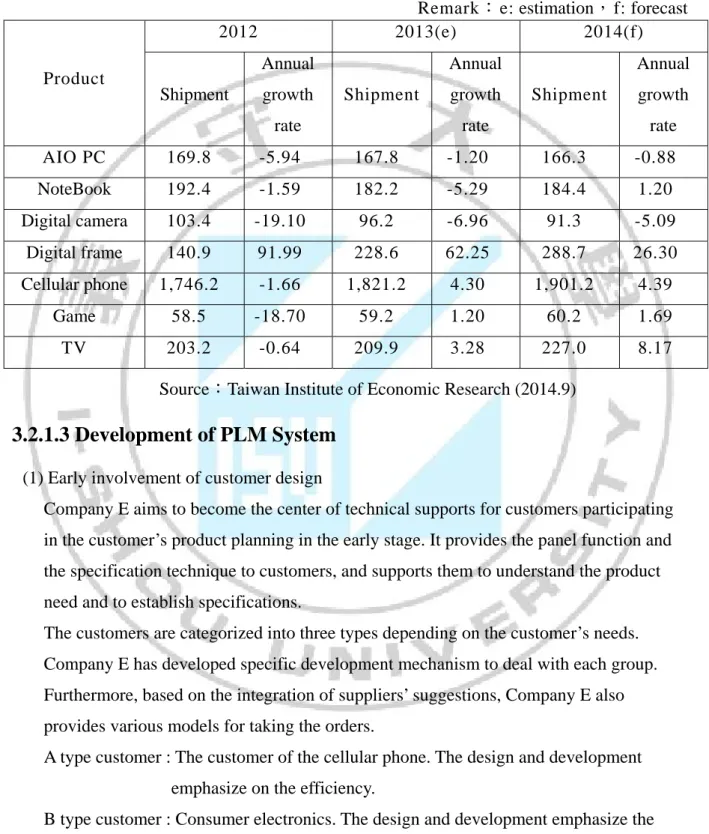
Looking into the future, the demand of downstream IT products will still be a significant growth, such as the digital frame, the automobile display and portable navigation installation etc. Due to the new applications are still continuously proposing (such as the Eee PC, Network device of the action (MID ; Mobile Internet Device) and the super mobile PC (UMPC ;Ultra mobile personal computing)… etc.), in addition, because the small and medium size TFT-LCD panel manufacturers in the world did not appear to obviously and significantly expanding their productivity, it was expected that the demand of small and medium size TFT-LCD panels would slightly exceed supply. Its industry economy would be still in the prosperity stage. Moreover, the Japanese manufacturers were still in merging stage. This had resulted that some of orders have been transferred to Taiwanese manufacturers. In the table 2 the amount and estimation of shipment of the main applied product of small and medium size TFT-LCD panel manufacturers, we can understand the small and medium size TFT-LCD panels will still keep on the growth in the period of 2012 to 2014, and the industry foreground is still positive.
Table 2 : The amount and estimation of shipment of the main applied product of small and medium size TFT-LCD panel manufacturers
unit:M set;% Remark: e: estimation, f: forecast Product 2012 2013(e) 2014(f) Shipment Annual growth rate Shipment Annual growth rate Shipment Annual growth rate AIO PC 169.8 -5.94 167.8 -1.20 166.3 -0.88 NoteBook 192.4 -1.59 182.2 -5.29 184.4 1.20 Digital camera 103.4 -19.10 96.2 -6.96 91.3 -5.09 Digital frame 140.9 91.99 228.6 62.25 288.7 26.30 Cellular phone 1,746.2 -1.66 1,821.2 4.30 1,901.2 4.39 Game 58.5 -18.70 59.2 1.20 60.2 1.69 TV 203.2 -0.64 209.9 3.28 227.0 8.17
Source:Taiwan Institute of Economic Research (2014.9)
3.2.1.3 Development of PLM System
(1) Early involvement of customer design
Company E aims to become the center of technical supports for customers participating in the customer’s product planning in the early stage. It provides the panel function and the specification technique to customers, and supports them to understand the product need and to establish specifications.
The customers are categorized into three types depending on the customer’s needs. Company E has developed specific development mechanism to deal with each group. Furthermore, based on the integration of suppliers’ suggestions, Company E also provides various models for taking the orders.
A type customer : The customer of the cellular phone. The design and development emphasize on the efficiency.
B type customer : Consumer electronics. The design and development emphasize the cost.
C type customer : The industrial instrument. The design and development emphasize the creativity and application.
(2) Value-added chain integration
The establishment of responding mechanism, and providing the business models of “collaborative design”, “the integrated supply”, “collaboration with the IP
management” to the providers in order to establish the business mode based on the concept of “the center of technique supports and service”.
A type mechanism: “Collaborative design” strategy, planning and integrating the sample scheduling of suppliers.
B type mechanism: “Integrated supply” strategy, the planning of the feasibility of design and development, and also integrating a cost down plan with suppliers.
C type mechanism: Designing and development emphasize the innovation of the application. “Collaboration with the IP management” strategy enhances the creativity applied to the design and development.
3.2.1.4 Intellectual Capital Management and Formulation of Strategy
(1) Operate mode
(a) The capability of supply chain integration and collaborative design, cross-industry-support technique and service, increasing the technique’s added value.
(b) Leading the system with the functions and the specifications, supporting customer’s needs and the specification establishment, participating in the customer’s product design in the conceptual stage, and solving the worry of product infringement and uncertainty.
(c) Building up collaborative management in value-added supply chain in order to reduce uncertainty and develop new products in a technique-uncertain
environment.
(2) Process mode
(a) Installing the efficiency, cost, and the innovative-development process modes based on the industrial customer’s cellular phone, consumption electronics, and the industry instrument.
(b) Providing the substantial operation methods for Taiwanese panel-component industry to adapt different types of industrial customers.
(3) Information mode
(a) Building up the cross-industry-technique-support platform to support
single-project-single-customer, multi-organizational unit, and multi-component integration.
(b) Building up the functional and the specific knowledge management system and database in order to help customer’s planning requirement.
(c) Building up the value-added platform for the new materials, new processes, and new pattern development in order to provide total solution for customers.
(d) Building up industrial standardized techniques and support services of cellular phones and consumption electronics in order to deal with customer’s needs speedily.
(4) PLM issue
(a) Analyzing the IPs of supplier’s materials, and developing the IP management map.
(b) Avoiding confrontation with others’ IP in the design level based on computer-based IP information categorization and management, speeding up the technique analysis, and using flexible inflow and outflow of paten matching and knowledge categorization mechanism.
(c) Integrating knowledge database of upstream and downstream partners,
establishing the knowledge database of the “technique support service center”, integrating the new material specification of upstream, integrating knowledge into the customer’s marketing services, making the increase of investment on new products and techniques, and increasing international competitiveness through the integration of knowledge.
3.2.2 Project team structure
Company E’s project management approach is referred to as a lightweight project organization, characterized by weaker project links and relatively stronger functional links. The lightweight PM updates schedules, arranges meetings, and facilitates coordination, but has no actual authority or control in the project organization (Hayes, Wheelwright, & Clark, 1988). Product development is based on a project team, and only the Chief Executive Officer (CEO) has real control and decision-making power. Departments work independently in product development, but engineers cooperate between departments. In this context, project development in Company E predominately consists of the main designers in various departments, and the PMs who are more experienced engineers. All project teams are monitored by the R&D Manager.
The Marketing Department engages with the customer, reviews the requirements and suggests product specifications. After the NPD project begins, the R&D Manager assigns the product PM according to the specifications suggested from the Marketing Department. The PM studies and summarizes related project data and meets with the Chief Information Officer (CIO), R&D Manager, Marketing Department, Procurement Department, Costs Centers and Production Control Department to propose the project schedule, budget plan and required technical resources. The CEO gives high level comments on the cost ceiling bracket, business benefits and special material needs while the R&D Manager assigns appropriate design engineers to conduct the project. Design engineers provide the requirements on specific material specifications to the Procurement Department, and the purchasing engineer gives the design engineers evaluation comments on the specific materials specification. The Accounting Department develops the final cost structure. The CEO and the R&D Manager