民93年12月 頁91-119 國立政治大學公共行政學系
‧91‧
Bridging Systems Thinking to Policy
Networks:
An Application to Developing Network
Accountability of Contracting Out System
Tsuey-Ping Lee
*ABSTRACT
This study intends to propose a combination of systems thinking and policy networks perspective in developing network accountability of contracting out social services. Both systems thinking and policy networks have been applied to public policy analysis for many years. As a perspective that emphasizes the whole rather than fragmented parts, systems thinking has been considered effective in uncovering structural flaws that limit system performance and explaining why a well-intended policy intervention fails to produce expected results. The strength of systems thinking is to offer system actors: 1) an active perspective of their own role in the system, 2) a holistic view of the system, and furthermore, 3) the leverage solutions for improving system performance. On the other hand, the concept of policy networks emphasizes interdependent relations among network participants and their resource exchanges. This concept can help network participants identify themselves as resource holders rather than passive actors merely responding to
Manuscript Submitted 11 August 2004; Final manuscript received 23 November 2004.
*
reality. This paper attempts to examine the similarities and differences between systems thinking and policy networks. This study believes that a system of accountability can be constructed more completely by altering self-recognition of network actors, thus improving system performance.
Keywords: Thinking, Network Learning, Network Accountability, Policy
Networks
I. Introduction
Systems thinking, which attempts to make reliable inferences regarding behavior by exploring the underlying structure of a system, can be particularlyhelpful in analyzing highly dynamic system processes involving multiple stakeholders. As a perspective that emphasizes the whole rather than fragmented parts, systems thinking has been considered effective in uncovering structural flaws that limit system performance and explaining why a well-intended policy intervention fails to produce expected results. These features have made systems thinking a popular approach for problem solving in numerous fields, such as business, engineering, organizational learning, and public policy. Particularly when systems thinking is considered a discipline of learning in Senge’s book, The Fifth Discipline, systems thinking can help system participants shift from being helpless reactors to viewing themselves as active participants in shaping their reality, from reacting to the present to creating the future (Senge, 1990: 69). To summarize, the strength of systems thinking is to offer system actors: 1) an active perspective of their own role in the system, 2) a holistic view of the system, and furthermore, 3) the leverage solutions for improving system performance.
Policy networks, as a perspective rooted in resource interdependent relations among network participants, has been broadly applied in different fields, including political science, sociology, social psychology, and social anthropology. Although this concept has been employed at different levels of analysis, for example referring to interpersonal relations at the micro level, relations between interest groups and government at the meso level, or relationships between the State and civil society at the macro level (Rhodes and Marsh, 1992: 4), the basic agreement is that resource exchanges are necessary for network
‧93‧ participants to achieve their goals. Therefore, a single network actor cannot dominate the network. Accordingly, when a network fails to function as intended, multiple network actors rather than any individual actor should be held responsible. The strength of applying the concept of policy networks in policy analysis is its focus on resource interactions among network participants. This concept can help network participants identify themselves as resource holders rather than passive actors merely responding to reality. Examining the network via the concept of policy networks, participants can see how the resources flow through the network and how the participants themselves, as resource holders, can contribute to the network.
Although systems thinking or policy networks individually can significantly contribute to the field of public policy, this study suggests that combining both approaches can help system participants or network actors to clarify their system function and learn more about the system as a whole. This learning process facilitates the communication among system participants or network actors and also enhances their mutual understanding. Combining both approaches should not encounter too many difficulties because both of them share several perspectives regarding systems (networks), such as interdependence of system parts (network actors), multiple system (network) objectives, power distribution among system parts (network actors), and so on. These perspectives are particularly helpful when they are used to analyze a highly dynamic and complex social system, such as the system of contracting out social services. The system of social service provision is becoming more complicated since “contracting out” was accepted as an alternative method of service delivery. Contractors, usually non-profit organizations, have become key service delivers while governments moved towards a quality control role. This change has made accountability a major system challenge.
This study believes that utilizing systems thinking and the concept of policy networks together to analyze the system of contracting out can help system participants learn why they are accountable and also clarify the system of accountability. This study examined the shared characteristics of both approaches and also identified their differences. With the goal of enhancing the conventional method of public policy analysis, this work intends to explore a strategy for integrating policy networks and systems thinking to develop network accountability.
II. Systems Thinking -- A Tool of Exploring System
Problems
The underlying concept of systems thinking is the belief that system structure determines system behavior. An unintended system behavior will not vanish merely by pushing system parts to work harder, because system structure is the fundamental cause of the problematic system performance. Developing a profound understanding of system structure is necessary for locating the leverage solutions for improving system performance. Emphasizing on leverage solutions is one of the major reasons why systems thinking presently is welcomed in public policy because it helps policy analysts to explain why well intentioned government interventions can not always guarantee well policy results. Systems thinking indicates the possibility that the benefits of the interventions can be offset by the system responses resulting from the interventions per se. Such a mechanism is called the “compensating feedback mechanism”. Senge (1990: 58) vividly described this phenomenon by saying: “The harder you push, the harder the system pushes back.” Obviously, systems thinking focuses on the relationships among system parts, rather than parts themselves. That is, systems thinking intends to provide an overview of a system rather than a fragmented view of system parts. In this section, the definition of a system from the systems thinking perspective is first clarified after which the application of systems thinking in the field of public policy analysis is discussed.
A. What is a system?
A system is a mental construct of a whole that consists of a set of interrelated parts. The word “system” is used for constructs referring to grounded processes emphasizing the coordination of actions (Espejo, 1994: 202-203). Overall, systems cannot be divided into independent parts because they result from interactions among various parts. (Ackoff, 1994: 175). According to Rapoport (1986: 29), identity, organization, and goal-directedness are three fundamental system features. Identity means that the system maintains its stability during change. Organization indicates how the system handles complexity. Finally, goal-directedness denotes system purpose.
To conclude, the general system characteristics are as follows:
1. A system comprises a group of components which are interrelated with each other; 2. System structure not only involves interrelationships among key system variables,
‧95‧ but also involve information flow within the system, goals of system participants, overall system function, strategies employed in the system, time delay, and so on; 3. A system is not the sum of its parts but the result of the meaningful relationships
among its parts;
4. A system is generally goal oriented;
5. A system can generate unexpected behaviors owing to system structure; and 6. A system can generally maintain its stability via its self-correcting mechanism. In sum, this study considers a system as a group of interrelated elements comprising a unified whole. A system can be a procedure for achieving a preset objective, but the objective is not guaranteed to be reached.
The literature on systems thinking and system dynamics has made various insights regarding the nature of systems thinking and what it can do. Richmond (1994: 139) stressed that systems thinking is a paradigm and a learning method. Here “paradigm” means that systems thinking is a vantage point and a set of thinking skills. By learning method, Richmond indicated that systems thinking provides processes, language, and technology for helping people to better understand systems. To summarize, systems thinking is a new perspective focusing on patterns of system behavior over time and the system feedback mechanism. Systems thinking is also a set of analytical tools for analyzing policy problems and predicting possible policy consequences. Furthermore, systems thinking can help to identify a high-leverage solution for improving system performance and policy consequences when policy interventions are involved in a system.
B. Systems thinking as a perspective on perceiving policy problems
Dynamic behavior results from system structure (Richardson and Pugh, 1981: 15). When a policy problem occurs, system thinkers believe that the problem, as an undesirable system behavior, is caused by the system structure. Under this premise, holding exogenous factors responsible for the undesired policy problem is not helpful for solving the problem and enhancing long term system performance. The fundamental solution, known as “leverage”, is believed to exist inside the system. Therefore, the first step in locating leverage is to explore and describe the relevant system that generates the unintended system behavior (Forrester, 1994: 245).
When mapping the system that generates undesired behavior, several principles of systems thinking should be considered. First, implicit or explicit feedback mechanisms
are always embedded in the system. The interdependence of system variables means that holding individual variables accountable for problematic system behavior is a poor long term approach to solving the system. Focusing on individual system variable may temporarily make the system perform better, but the system response can offset the positive short-term effect and make the system perform even worse than before. Therefore, the system, as a whole, should be held accountable for the troubling system behavior. Restated, a “system of responsibility” should replace individual responsibility. Second, time delay is a hidden and easily neglected variable. As Senge (1990: 63) noted, “Cause and effect are not closely related in time and space.” When it takes time for one variable to affect another, system symptoms that initially appeared weak will eventually strengthen. Consequently, even tiny symptoms should never be overlooked when examining a system. Third, a system with feedback mechanisms can have both reinforcing and compensating features. Reinforcing feedback systems display either accelerating growth or accelerating decline. Meanwhile, the behavior of compensating feedback systems is gold-oriented. Several system archetypes offered by Senge (1990) provide good references for policy analysts in identifying the system problems.
Because the policy problems are perceived from a structural perspective, solutions for the problems are also found based on a structural perspective. As noted above, any intention to influence the system behavior using exogenous interventions can only temporarily improve system performance. The worst case scenario is that the system simply pushes back harder in response to pushing by exogenous interventions. The policy effect of a well intentioned intervention can be offset by the system response. Therefore, an endogenous high-leverage solution should be the best method of improving system performance. This high-leverage solution influences the system behavior by utilizing the natural power-flow through the system. The natural power-flow will work just like the movement philosophy of the Chinese martial art Tai-Chi Chuan. As Lao-Tzu noted in his work Tao-Te-Ching, “The soft and the pliable will defeat the hard and strong.” Accordingly, by following the movements of an opponent, absorbing energy from an opponent, and utilizing energy absorbed from the opponent, it is possible to easily defeat a giant opponent with little movement.
C. Systems thinking as a set of analytical tools:
How is system behavior improved?
System Dynamics, as the operational side of systems thinking, provides a set of tools for mapping and exploring dynamic complexity. These tools include causal loop
‧97‧ diagrams, stock and flow diagrams, and simulation models. Causal loop diagrams are helpful in depicting system problems and make system problems easy to communicate across professional barriers. Causal loop description should be converted to a stock (level) and flow (rate) equations (Forrester, 1994) for further problem examination. During model formulation, the model boundary should be sufficiently large to include major variables related to the problematic system behavior. All the parameters and equations should be well documented and ready for public investigation.
Before the model is ready for simulation, system dynamics software offers a logical method of ensuring the variables are well defined and the model is operable. Additionally, numerous model validity tests have been designed for increasing confidence in the model. Each test examines the specific side of the model. For example, the behavior reproduction test investigates whether the model behavior closely reflects reality. Moreover, the extreme condition test examines whether the model is sensitive to extreme situations. The degree of confidence obtained by the model increases with the number of tests it goes through. If model behavior does not closely reflect reality, modelers should review the problem descriptions and refine the equations. This refining process should be repeated until the model behavior approaches reality.
The feedback mechanisms dominating specific system behavior can be located by analyzing the model simulation results and tracing the outcome data. However, dominating power may gradually shift from loop to loop. Via well developed system dynamics software and modeler insights, the shifts between loops can be pinpointed. All of these techniques can help in locating leverage area and thus identifying policy alternatives.
Policy simulation tests whether a policy alternative demonstrates a promising outcome. System Dynamics offer a simulated environment for testing various policy options under different scenarios. This technique is helpful in policy formulation because it can provide more information regarding policy effect than other methods. Public policies take time to be effective. As Senge (1990:57) contended, “today’s problems come from yesterday’s solutions.” ‘Cures’ that alleviate present symptoms may sometimes have long-term side effects. Conversely, policies which appear useless in the short term may not necessarily be unhelpful in the long run. Therefore, knowing the long term effects of a policy intervention is crucial for policy makers. The computer simulation results showing the long term effects of policy interventions can provide a good reference for policy making processes.
Owing to system complexity and limitations of words, it is difficult to accurately and completely verbalize a system story. Here, the causal loop diagrams provided by systems thinking can easily depict the dynamics and complexity of a system. Such causal loop diagrams can be utilized in different situations. Such diagrams can provide a good communication tool among policy stakeholders, including policy analysts, policy makers, and the public. In summary, systems thinking provides a good communicative tool for reaching a consensus prior to policy implementation (Forrester, 1994:247).
III. Policy Networks -- A Tool for Analyzing Public Policy
System
The literature contains various different understandings and applications of policy networks. These perspectives all share a common understanding that a policy network comprises a set of non-hierarchically interdependent actors. Network actors can be tightly or loosely related based upon the resources they need from each other and how they exchange those resources. Network actors may share common interests or embrace differentiated interests of their own. These interests can be pursued by way of resource exchanges among network actors. A policy network usually continues operating until all of the network goals are either reached or forgotten.
Different understandings and applications of policy networks can be divided into two categories. The first category involves viewing policy networks as an approach for analyzing policy making structure, while the second category considers policy networks as a specific form of governance. However, even in the literature conceiving policy networks as a form of governance, the concept of policy networks was still used as an analytical tool by some authors. As Borzel (1997: 4) stated, the concept of policy networks was still utilized to “connote the structural relationships, interdependencies and dynamics between actors in politics and policy-making.” Although several other authors have tried to conceive policy networks as a solution to co-ordination problems typical in modern societies or as a signal of a real change in the structure of public policy processes (Kooiman, 1993; Hanf and O’Toole, 1992; Wellmann, 1988), the concept of policy networks continues to be employed analytically.
As a specific form of governance, a policy network is a resource mobilization mechanism without a governor. That is, the analysis focuses on how resources are mobilized in the network rather than the interdependent relations among network actors. Despite the unit of analysis shifting from individual network actors to the network as a
‧99‧ whole, a policy network is still conceived as a web of “relatively stable and ongoing relationships that mobilize and pool dispersed resources so that collective (or parallel) action can be orchestrated toward the solution of a common policy” (Borzel, 1997: 4). The only difference between these two analytical focuses is that the latter emphasizes the dynamic processes and the self-correction mechanism of the network. A policy network is a panorama of the dynamic policy processes. Obviously, the concept of policy networks is still used as an analytical tool most of the time. Therefore, this study considers policy networks as a tool for describing and analyzing the interdependent and reciprocal relationships among network actors.
Research into the relationships among network actors has long been dominated by different varieties of pluralism. The initiation of this concept can be traced back to American literature in the 1950s (Jordan, 1990). For example, Freeman (1965: 11) argued that most public policies are made in the sub-systems composed of the executive bureau, congressional committees and interest groups. Cater (1964) and McConnell (1966) believed that so called ‘interest groups’ refer only to several privileged groups close to government rather than all social interest groups. These privileged interest groups could be dominant in policy making processes. Following Freeman (1965), Ripley and Franklin (1981) stated that most routine public policies are developed by sub-governments composed of members of the House and/or Senate, members of Congressional staffs, a few bureaucrats and representatives of policy related private groups or organizations. Lowi (1964) designed a rigid metaphor “iron triangle” to represent the relationships among executive agency, congressional committee, and organized interest groups as a closed system, but this view was challenged by pluralists. Heclo (1978) and McFarland (1987) argued that various interests in specific policies could create an open communication network known as the “issue network”. This explains why the number of interest groups has been growing significantly since 1970. In an issue network, public access to public policy making processes is unlimited. All the actors in the issue network can influence policy making processes, but no single interest can dominate the policy issue (Rhodes, 1997: 34).
According to Rhodes (1997: 35-36), Richardson and Jordan (1979) were strongly influenced by the work of Heclo and Wildavsky (1974) conceiving British public expenditure decision making by the Treasury as analogous to a village community. Richardson and Jordan (1979:74) emphasized that public policy is developed in the policy community. In this policy community, limited actors interact frequently and share the same values. Policy making results from negotiations between government agencies and pressure groups in the community. Although observed a marked increase in the number of
interest groups in the society as pluralists stated, Richardson and Jordon (1979) argued that different public policies were produced in different policy networks. Each policy network comprised specific government agencies and related interest groups. Based on transaction theory, Rhodes (1981, 1988) described the network relations between government agencies and social groups as a resource exchange relationship. Unlike Richardson and Jordan, Rhodes focused on the structural relations among different levels of political organizations within the policy networks. The analysis focused on sectors rather than sub-sectors. To summarize, the concept of policy networks is interpreted as a generic term for different forms of relationships among government and various interest groups. This concept could also refer to intergovernmental relationships related to specific policies.
Besides describing the policy structure, various types of policy networks were distinguished based on different dimensions. Analyzing intergovernmental relations, Rhodes (1988, 1997: 38-39) conceived five types of policy networks, ranging along a continuum from tightly integrated policy communities through professional networks, intergovernmental networks, and producer networks to loosely-integrated issue networks. These networks are distinguished based on their members and the distribution of resources among them.
Wilks and Wright (1987: 299-300) analyzed the interpersonal interactions in the network using a societal-centered approach. After observing the relationship between government agencies and industry, Wilks and Wright emphasized that the sub-sectoral level is the crux in the public policy making processes. Therefore, policy networks are divided into four policy levels by Wilks and Wright (1987). These levels include policy area, policy sector, policy sub-sector (policy focus) and policy issue.
Marsh and Rhodes (1992: 251) identified four dimensions for distinguishing policy networks. These dimensions include membership (number of participants, type of interest), integration (frequency of interaction, continuity, consensus), resources (distribution of resources within network, distribution of resources within participating organizations), and power. The typology of Marsh and Rhodes treated policy networks as types of relationships between government and interest groups. Networks can vary along a continuum with highly integrated policy community at one end and loosely integrated issue networks at the other end.
Franz Van Waarden (1992) divided policy networks into 11 types based on seven criteria – actors, function, structure, institutionalization, rules of conduct, power relations, and actor strategies. According to Van Waarden, three of these seven criterions are
‧101‧ especially important, namely number and type of societal actors involved, major network function and balance of power.
Besides the literature above, other European literature also exists regarding typology of existing policy networks (for example, Atkinson and Coleman, 1989; Jordon and Schubert, 1992). All of these discussions clearly indicate that most of the typology literature shares common dimensions, including members (number and type of the members), network structure (stability of the structure), and power distribution. From the above discussion, the concept of policy networks is generally an analytical tool for examining structured resource exchange relations among network actors. Through policy networks analysis, people expect to learn more regarding the distribution of resource/power within the network, and how and why network actors exchanged resources. Furthermore, by analyzing the dynamic mechanism of resource mobilization, people can learn more about how a self-organizing and self-correcting network operates.
IV. Similarities and Differences of Both Approaches
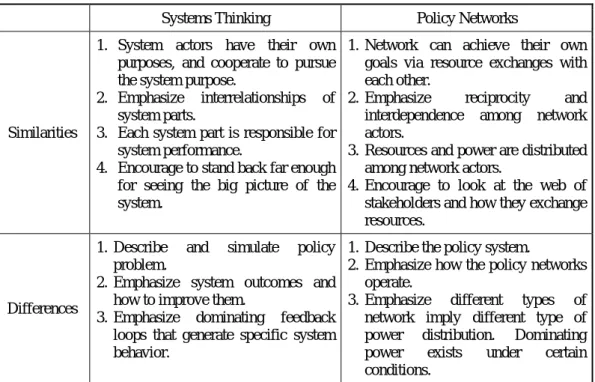
Both systems thinking and policy network approaches share similar characteristics, as shown in table 1.
A. Similarities of both approaches
(A) Multiple objectives in a system/network
In a mechanical or organic system, system elements exist and interrelate as they operate toward a common purpose. System elements do not have individual purposes. However, social systems are different. In social systems, people function individually and collectively. System actors have their own purposes, and cooperate to pursue the system purpose (Ackoff, 1994: 179-180). Similarly, a policy network has its own specific function or purpose. A policy implementation network is operated for carrying out a policy by cooperation among network actors. However, in pursuing network purposes, various network actors can also achieve their own goals via resource exchanges with each other.
(B) Relationship among system/network actors
Rhodes (1997: 57) characterized the relationship among policy network actors by stating that it is one of reciprocity and interdependence, but not competition. In systems thinking, systemic structure concerns the key interrelationships influencing system
behavior over time. Senge (1990: 44) stated that the “interrelationships” are among key variables rather than among people. However, this study argues that people are still the major determinants of the variables. For example, the arms race between the U.S. and the U.S.S.R was caused by the responses of leaders on both sides to the perceived threat from each other. In the systems thinking perspective, system variables are interrelated. A small influence from variable A may be amplified through the whole system (variables B, C, D, and so on) and back to Variable A. These variables may imply strategies or decisions of system actors. That is, the interrelations among system variables indicate the interrelations among system actors.
Table 1. Similarities and Differences of Systems Thinking and Policy Networks
Systems Thinking Policy Networks
Similarities
1. System actors have their own purposes, and cooperate to pursue the system purpose.
2. Emphasize interrelationships of system parts.
3. Each system part is responsible for system performance.
4. Encourage to stand back far enough for seeing the big picture of the system.
1. Network can achieve their own goals via resource exchanges with each other.
2. Emphasize reciprocity and interdependence among network actors.
3. Resources and power are distributed among network actors.
4. Encourage to look at the web of stakeholders and how they exchange resources.
Differences
1. Describe and simulate policy problem.
2. Emphasize system outcomes and how to improve them.
3. Emphasize dominating feedback loops that generate specific system behavior.
1. Describe the policy system.
2. Emphasize how the policy networks operate.
3. Emphasize different types of network imply different type of power distribution. Dominating power exists under certain conditions.
Source: Author.
(C) Power distribution among system/network actors
Policy network perspective conceives that resources are distributed among network actors. Power increases with increasing resources. Although power is dispersed throughout the network, no single network actor dominates the network. From a feedback perspective, systems thinking suggests that everyone shares responsibility for system problems. (Senge, 1990: 78) Although this statement does not necessarily imply that every system actor can exert equal leverage in changing the system, it does imply that levels of influence vary among actors.
‧103‧
(D) Encouraging an aerial view
“You are adopting a system viewpoint when you are standing back far enough – in both space and time – to be able to see the underlying web of ongoing, reciprocal relationships which are cycling to produce the patterns of behavior that a system is exhibiting” (Richmond, 1991: 2). When we are standing back far enough, details fade and patterns appear. The policy networks perspective encourages people to look at the web of stakeholders and how they exchange resources.
B. Differences between two approaches
The major differences between systems thinking and policy networks approaches are as follows. First, systems thinking stresses describing and simulating policy problems, while the concept of policy networks focuses on describing the policy system. When observing a policy problem, system thinkers consider the problem as a result of system structure. Based on this assumption, system thinkers begin to identify stakeholders and possible causes leading to the problem. In summary, the policy problem is the crux in systems thinking and modeling processes. On the other hand, the policy networks perspective encourages people to look into the resource exchanges among network actors and their strategies for interactions. That is, the analysis focuses on how the network operates to achieve the network goals.
Second, systems thinking emphasizes policy outcomes more than the policy networks perspective does. When applied to public policy, systems thinking can help to locate the high leverage area of the system, and accordingly can develop a solution for improving system performance. A system dynamics model simulation can help policy makers better understand possible policy outcomes. That is, systems thinking is expected to reduce problematic system symptoms, solve policy problems, and obtain a better system outcome. Compared to systems thinking, the policy networks perspective does not emphasize much on policy making quality or policy network outcomes. The policy networks approach gives more attention on institutions and the links between them than the network outcomes. As Bennington and Harvey (1994: 954-955) stated: “The general tendency of policy network theory to be employed within a pluralist analysis leads to a preoccupation with the institutional level of analysis and prescription, where, for example, a concern with procedural arrangements is elevated above substantive issues and outcomes.” In fact, it will be more scrupulous to say that discussions regarding network outcomes (Marsh and Rhodes, 1992: 262-264; Rhodes, 1988: 387-406) so far are more descriptive (ex. factors affecting outcomes) than normative (ex. ways improving
outcomes). Several scholars may have contributed to the discussions regarding ways to reach network optimal performance beyond interest reconciliation among network actors (Borzel, 1997: 5), however, compared to the long theoretical development history of policy networks, the amount of the discussions is limited.
Third, although both systems thinking and policy networks believe that power is distributed among system/network actors, systems thinking believes that dominating feedback loops exist that generate specific system behavior while the policy networks perspective does not emphasize the dominating power within a network. A dominating feedback loop may comprise several system actors and variables. This dominating loop is strong enough to influence and even direct the system performance during a certain period of time. The policy networks perspective believes that no single actor can lead the network, and it says little about how a coalition of several network actors can dominate the whole network. However, looking into the typology of policy networks, various types of policy networks imply different characteristics of resource and power distribution among network actors. As mentioned above, Marsh and Rhodes (1992: 251) identified that networks can vary along a continuum according to the closeness of the relationships within them. Policy communities are at the one end and issue networks are at the other end. Although no single network actor can rule the network, the relative power within a policy community is different from the one within an issue network. In a policy community, power is not equally balanced among network actors, but all actors believe that they will all benefit from the network. In other words, a powerful actor may dominate the network only if all actors see themselves as in a positive-sum game (Rhodes, 1997: 44). Opponent to policy community, the distribution among network actors is obviously unequal. Some participants may have resources, but they are limited (Marsh and Rhodes, 1992: 251). Because issue networks are loosely integrated, it is not possible to generate a leader of the network. Obviously, the dominating power is not emphasized in policy network perspectives.
V. Combining Systems Thinking and Policy Networks:
An Application
A. Accountability challenge in contracting out
To explore a method of combining systems thinking and the policy networks approach, this study attempts to apply both approaches to analyze accountability in the
‧105‧ system of contracting out social services. Contracting out has become an alternative means for governments to provide social services. However, concerns in such partnerships between government and the private sector (generally non-profit organizations) for providing social services have raised public concerns regarding accountability. That is, clarifying accountability for the failure of the policy network is a major concern.
Accountability is traditionally defined as the controllability or answerability of public service organizations to controlling bodies. (Gregory and Hicks, 1999) That is, the issue of accountability involves three questions, including “who is accountable?”; “to whom?”; and “for what?” In answering “to whom?” and “for what?” accountability can be classified into three categories, namely: upwards accountability, horizontal accountability, and downwards accountability (Elcock, 1996: 33-37). Upwards accountability is accountability rendered to a higher authority, horizontal accountability describes accountability presented to parallel institutions, while downwards accountability indicates accountability to lower level institutions and groups.
The policy network of contracting out comprises three major network actors, including the government which issues the contract to the contractor, the contractor who physically provide the services, and the clients who receive the services. The contract sets out collaborative and non-hierarchical relations between the government and contractor. Therefore, upwards accountability or downwards accountability are difficult to pinpoint in this relationship. The contracting out network is designed to provide adequate and good quality social services. Accountability should be accessible if the network performance departs from the purpose of contracting out. However, it seems difficult to determine who should be accountable for failures or flaws in the network performance. Because of the complicated relationships and interactions among network actors, the traditional mechanisms of accountability in representative democracy no longer fit multi-organizational and differentiated policy systems. When a contractor fails to adequately service needy clients, that contractor should be held accountable to both government and clients. Meanwhile, the government is accountable to the public (needy clients) for its failure in service quality control including contractor selection and service quality supervision.
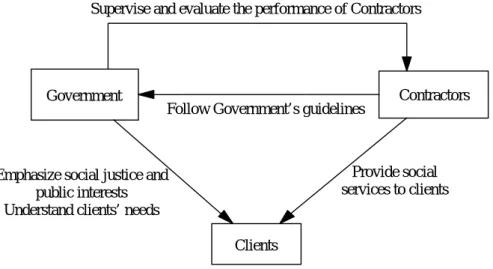
Figure 1 illuminates the policy network of contracting out and the interactions among major network actors. Government supervises contractor administration using various strategies, including financial support, providing clear and adequate guidelines, periodic evaluation, penalization by withholding subsidies, and so on. Contractors should follow government service guidelines, submit periodic accounting reports, provide service plans, and hire related professionals. As for clients, the contractor is responsible for providing adequate and equal services. Although government is no longer in charge of service delivery, it is still obliged to provide a safety net for needy clients.
Figure 1. Policy network of contracting out: Interactions among network actors
Source: Author.
Figure 1 missed the “client oriented” action advocated by the “new public management (NPM)” movement. NPM was developed as “a handy shorthand, a summary description of a way of reorganizing public sector bodies to bring their management, reporting, and accounting approaches closer to (a particular perception of) business methods” (Dunleavy and Hood, 1994: 9). The core belief of NPM is that public service provision will be improved by applying “proven” private sector management tools to the public sector. Restated, NPM intends to make government service delivery more responsive, customer-oriented, and outcome-oriented. Knowing the real needs of clients is essential for making government responsive and customer-oriented. Clients needs should not decided by government. Only clients themselves understand their needs and the help they require. Therefore, such information held by clients is extremely important for both government and contractors. Consequently, this study attempts to identify the important
Government Contractors
Clients
Supervise and evaluate the performance of Contractors
Follow Government’s guidelines
Provide social services to clients Emphasize social justice and
public interests Understand clients’ needs
‧107‧ role of clients in the contracting out network, and moreover introduces informal client accountability into this network.
B. Policy networks perspective for developing network
accountability
From a policy network perspective, Rhodes (1988: 402-406) criticized the concept of calling individual institutions to account for their operations. Rhodes introduced the concept of “system of accountability”, observing that “policy is the responsibility of no one institution but emerges from the interaction of several” (Rhodes, 1988: 404). Concordant with the concept of Rhodes, Barker (1982: 17) argued for the existence of a network of mutual accountability among network actors. In summary, accountability can no longer be specific to an institution, but must fit the policy and its network (Rhodes, 1988: 405; 1997: 21). Bardach (1998) identified three accountability practices in the context of relationships among network actors. First, peer accountability stresses self-monitored or peer-self-monitored mechanisms. Unlike traditional program evaluations based on external standards and result in extrinsic incentives or disincentives, self-evaluation, which details progress towards achieving network purpose, can make the network actors act more responsibly. Second, results-focused accountability stresses that network participants decide what collective results they desire. Third, stakeholder-driven accountability stresses cooperation among network participants, particularly service recipients.
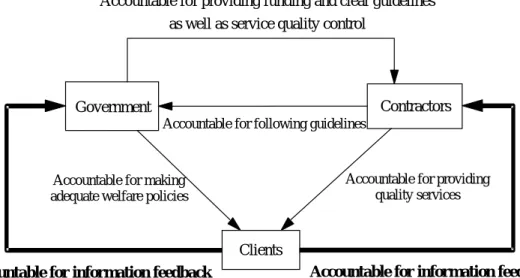
These three accountability practices can be applied in the contracting out network. Self-monitoring or self-evaluation can be employed by both government and contractors. Moreover, the results of the self-evaluation can be publicized for investigation. The performance standard or self-evaluation criterions can be developed with the agreement of network participants. Both government and contractors cooperate to determine what collaborative results are desired and, based on this decision, develop the self-evaluation criterions for both sides. Client feedback and information is valuable in developing the criterions. The main purpose of the social service provision network is to offer high-quality services to needy clients. Real recipient needs are important information for both government and contractors. Stakeholder-driven accountability draws attention to client interests. Eventually, the clients should be held accountable informally to provide adequate information about what they need from the government, how they want to be helped, and how satisfied they feel with the services received. Figure 2 illustrates the adjusted network of accountability. The only difference between Figs.1 and 2 is that Fig.
2 includes client information feedback to both government and contractors. In this adjusted network of accountability, clients are no longer merely service recipients. Instead, clients can become active information providers to both government and contractors.
Figure 2. Policy network of contracting out: Accountability of network actors
Source: Author.
Although the policy networks approach can help network participants realize what resources they have and how they interact with one another, it cannot make participants understand how much an individual network participant can influence the whole system. The more complex and dynamic the system is, the more difficult it is for individual network participants to fully understand the real effect of individual actions. Network participants may overestimate or underestimate their impact on the system, and therefore may respond incorrectly to the system and thus produce a disaster. Therefore, improving network participants’ understanding about themselves and the whole system will make the network perform better. Systems thinking is a good method of helping network participants to shift their mental model and improve their learning process. The following section discusses areas that systems thinking can help.
C. Areas that systems thinking can help
Actually, the policy networks perspective raises an important concept for systems thinking. That is, system actors interact with each other through resource exchanges. Such
Government Contractors
Clients
Accountable for following guidelines
Accountable for providing funding and clear guidelines as well as service quality control
Accountable for providing quality services
Accountable for information feedback Accountable for information feedback
Accountable for making adequate welfare policies
‧109‧ a concept is particularly useful in analyzing public policy. Social systems comprise various groups of people who interact with one another. Any public policy involves different stakeholders who both can benefit from and give back to the system. The policy networks perspective indicates the essence of a social system. However, as mentioned above, the policy networks perspective is not especially helpful in improving participant learning about themselves and the system as a whole. This study believes that systems thinking can offer a tool for improving network learning, and furthermore can structure network accountability.
Contracting out has long been considered a very efficient method for the government to provide social services, however, the quality of social services delivered by contractors recently has become a significant concern. Meanwhile, network accountability is becoming a significant challenge for all network participants. The question thus arises of how systems thinking can help to identify the cause of the problem, improve network learning, and moreover cultivate network accountability. Senge (1990) identified a “limit to growth” system structure behind a stop growing system that may explain why the quality of social services becomes a concern. A “limit to growth” system usually generates a system behavior shown in Fig. 3. The pattern of the system behavior depicted an exponential growth followed by a goal-seeking pattern, which may followed by a downward behavior in some cases. This system behavior can describe how the quality of social services stops improving at some point of time.
Figure 3. “Limit to growth” system behavior
Source: Author.
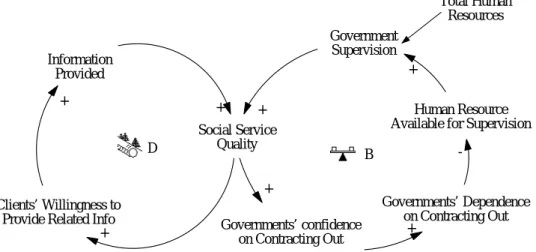
Based on the belief that structure determines behavior, Figs. 4, 5, and 6 show the specific structures that may cause the “stop improving” problems. Figure 4 illustrates one of the reasons why social service quality becomes an issue after decades of contracting out. In loop A, when government confidence in contracting out increases, governments become willing to provide financial support and increase discretion and flexibility to contractors. The more discretion and flexibility the contractors have, the more freedom for contractors to design and plan the service delivery method. Accordingly, social service quality can be expected to be increased. Obviously, loop A is a reinforcing feedback loop. The little image in the middle of the loop, a snowball rolling down a hill, represents loop reinforcing power. In loop B, a compensating feedback mechanism with image of a balance in the middle of the loop, government confidence in contracting out will increase government dependence on the new system. Especially following a long-term contractual relationship, governments will lose their ability to physically deliver social services. Due to limited human resources, the government will withdraw human resources from programs with contractors’ cooperation to those without outside helps. Therefore, government supervision of contractors can become routine and increasingly weak. Service quality then can no longer be guaranteed. Obviously, when loop B begins to offset the effect of loop A, service quality becomes a major concern.
Serv
ice Qu
ality
‧111‧
Figure 4. How social service quality has become a problem
Source: Author.
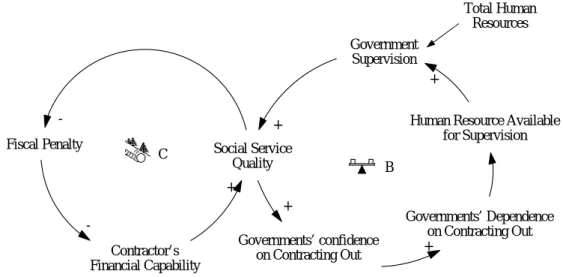
Additionally, governments generally use fiscal penalties to punish contractors who do not follow guideline or reach the expected service standard. Figure 5 illustrates the possible effect of such strategy. Loop C illustrates that when contractors face a fiscal penalty, such as the withholding of government subsidies owing to providing unqualified social services, their situation will be worsened and they may become unable to improve service quality due to limited financial capabilities. Loop B stays at the same position as in Fig. 4. The reinforcing loop C can reduce the service quality until the government returns to a state of high alert and watchfulness.
Figure 5. Possible effect of using fiscal penalty
Source: Author. Social Service Quality Governments’ confidence on Contracting Out Governments’ Dependence on Contracting Out Government Supervision + + + Contractors’ Efficiency of Service Delivery + Governments’ Support (Finance, Discretion) + + Total Human Resources
A B Human ResourceAvailable for
Supervision -+ Social Service Quality Governments’ confidence on Contracting Out Governments’ Dependence on Contracting Out Government Supervision + + + Total Human Resources B
Human Resource Available for Supervision -+ Fiscal Penalty Contractor’s Financial Capability - - C +
To make clients learn more about their active function in the contracting out system, Fig. 6 is a good tool for improving their understanding. Loop D focuses on client willingness to provide related information including the services they really need, and how they expect to be helped, and their satisfaction with services received. The more information clients are willing to provide to contractors, the greater the likelihood of contractors delivering adequate services. When clients perceive that their information provision can positively influence social service quality, they may be motivated to provide more useful information. Loop B in Fig.4, 5, 6 demonstrates the importance of government supervision for social service quality. To improve the behavior of “limit to growth”, maintaining a higher number of professional staff for supervising service quality can provide the leverage solution.
Figure 6. How clients can help in the system
Source: Author.
Observing all the above causal loop diagrams, no single system actor should take complete responsibility for the low quality of social services. The system structure is the cause of the problem. However, these causal-loop diagrams remind all system participants of their specific system roles and functions. Particularly, clients should not always be perceived as passive service receivers. Each client can be an active helper in the contracting out system. Although it is difficult to view client information feedback as a formal responsibility and furthermore include it in written regulations, the help of these simple causal-loop diagrams can enable clients to easily recognize their informal accountability in this system. Additionally, the causal-loop diagram also provides a good tool for efficient network communication. Particularly when network participants need to
Social Service Quality Governments’ confidence on Contracting Out Governments’ Dependence on Contracting Out Government Supervision + + + Total Human Resources B Human Resource Available for Supervision
-+
Clients’ Willingness to Provide Related Info Information Provided + + D +
‧113‧ reach agreement on specific issue, such as evaluation criteria for result-based accountability, it is easier for participants to use the same language for discussion.
Future research related to this study should make the above feedback loop more comprehensive, and moreover should establish a related system dynamic model. System Dynamics provides a series of techniques for model building and simulation. All of the above work can lead to a more comprehensive model conceptualization, which can be followed by model formulation. Complete data collection is very important for this stage. First hand data can be obtained directly from network participants. For example, information that can be obtained from governments’ evaluation criteria for contractor selection, historical data of annual funding to contractors, formal contracts between government and contractors, and so on. The information on street-level service delivery, historical data on number of service recipients, and periodic reports submitted to government can be obtained from the contractors. The information on client satisfaction regarding services received can be gathered from service recipients. The model simulation results are expected to demonstrate the long-term system behavior and policy effects. This information can provide a good reference for both government and contractors to explore the reasons for system failure and identify the leverage solutions. Future research should conduct a case study on contracting out to demonstrate the practical pros and cons of this application.
VI. Summary
Systems thinking and policy networks have long been individually applied to public policy. Unlike the traditional perspective, both approaches emphasize the interdependent relations among network /system actors. Resources and power are dispersed within the network so that each network actor has a larger or smaller impact on network performance. Therefore, no single actor should be held accountable for system failure. Accordingly, the network / system of accountability becomes a major concern.
Because of the different characteristics of the systems thinking and policy networks perspectives, both contribute to the processes of constructing network accountability differently. Both approaches together can establish network accountability more completely. The policy networks perspective can help network actors learn more about the nature of interactions and resource exchanges within the network, and furthermore, identify themselves as active resource owners rather than passive reactors in the system. However, the policy networks perspective can not help network actors realize their
influence on overall system performance. Systems thinking can be very helpful here. Systems thinking focuses on problematic system behavior, and provides and effective approach for network actors to learn more about their function within the system and their influence on the system. This study believes that a system of accountability can be constructed by altering self-recognition of network actors, thus improving system performance.
Acknowledgment
The author would like to thank the National Science Council of the Republic of China, Taiwan for financially supporting this research under Contract No. NSC_92-2414-H-029-009
Reference
Ackoff, R. L.
1994 “Systems Thinking and Thinking Systems,” System Dynamics Review, 10(2-3): 175-188.
Atkinson, M. and W. D. Coleman
1989 “Strong States and Weak States: Sectoral Policy Networks in Advanced Capitalist Economies,” British Journal of Political Science, 14(1): 46-67. Bardach, E.
1998 Managerial Craftsmanship: Getting Agencies to Work Together. Washington, DC: Brookings Institution.
Barker, A.
1982 “Governmental Bodies and Networks of Mutual Accountability,” in A. Barker (ed.), Quangos in Britain, pp.3-33. London: Macmillan.
Benington, J. and J. Harvey
1994 “Spheres or Tiers?: The Significance of Transnational Local Authority Networks,” in J. Lovenduski and J. Stanyer (eds.), Contemporary Political
‧115‧ Borzel, T. A.
1997 “What’s So Special About Policy Networks? – An Exploration of the Concept and Its Usefulness in Studying European Governance,” European Integration
Online Papers, 1(16). http://eiop.or.at/eiop/texte/1997-016a.htm. (Date of
review: 3/10/2004) Cater, D.
1964 Power in Washington. New York: Random House. Dunleavy, P. and C. C. Hood
1994 “From old public administration to new public management,” Public Money and
Management, 14(2): 9-16.
Espejo, R.
1994 “What is Systemic Thinking?” System Dynamics Review, 10(2-3): 199-212. Elcock, H.
1996 “What Price Citizenship? Public Management and the Citizen’s Charter,” in J.A. Chandler (ed.), The Citizen’s Charter, pp. 24-39. Brookfield, VT: Dartmouth Pub. Co.
Forrester, J. W.
1994 “System Dynamics, Systems Thinking, and Soft OR,” System Dynamics
Review, 10(2-3): 245-256.
Freeman, J. L.
1965 The Policy Process. New York: Doubleday. Gregory, R. and C. Hicks
1999 “Promoting Public Service Integrity: A Case for Responsible Accounting,”
Australian Journal of Public Administration, 58(4): 3-15.
Hanf, K. and L. J. O’Toole.
1992 “Revisiting Old Friends: Networks, Implementation Structures and the Management of Inter-organizational Relations” in G. Jordan and K. Schubert (eds.), Policy Network, Special Issue of European Journal of Political
Research, 21(1-2): 163-180.
1978 “Issue Networks And the Executive Establishment” in A. King(ed.), The New
American Political System, pp.87-124. Washington, DC: American Enterprise
Institute.
Heclo, H. and A. Wildavsky
1974 The Private Government of Public Money. London, UK: Macmillan. Jordan, A. G.
1990 “Sub-governments, Policy Communities and Networks. Refilling the Old Bottles?” Journal of Theoretical Politics, 2: 319-338.
Jordan, G. and K. Schubert
1992 “A Preliminary Ordering of Policy Network Labelling,” in G. Jordan and K. Schubert (eds.), Policy Network, Special Issue of European Journal of
Political Research, 21(1-2): 7-28.
Kooiman, J.
1993 “Social-political Governance: Introduction,” in Jan Kooiman (ed.), Modern
Governance. New Government-Society Interactions, pp.1-6. London: Sage
Publication. Lowi, T.
1964 “American Business, Public Policy, Case Studies and Political Theory,” World
Politics, 16: 676-715.
Marsh, D. and R.A.W. Rhodes (eds)
1992 Policy Networks in British Government. Oxford: Clarendon Press. McConnell, A.
1966 Private Power and American Democracy. New York: Knopf. McFarland, A.
1987 “Interest Groups and Theories of Power in America,” British Journal of
Political Science, 17: 129-147.
Rapoport, A.
1986 General System Theory: Essential Concepts and Applications. Cybernetics
and Systems Series, V. 10. Tunbridge Wells, Kent: Cambridge, MA:Abacus
‧117‧ Rhodes, R. A. W.
1981 Control and Power in Central-Local Government Relationships. Farnborough: Gower.
1988 Beyond Westminster and Whitehall. London: Unwin-Hyman.
1997 Understanding Governance: Policy Networks, Governance, Reflexivity and
Accountability. Buckingham, UK: Open University Press.
Rhodes, R. A. W. and D. Marsh
1992 “Policy Networks in British Politics: A Critique of Existing Approaches,” in D. Marsh and R.A.W. Rhodes (eds.), Policy Networks in British Government, pp.1-26. Oxford: Clarendon Press.
Richardson, G. P. and A. L. Pugh III
1981 Introduction to System Dynamics Modeling with DYNAMO. Portland, OR: Productivity Press.
Richardson, J. J. and A. G. Jordan
1979 Governing under Pressure: The Policy Process in a Post-Parliamentary
Democracy. Oxford: Martin Robertson.
Richmond, B.
1991 “Systems Thinking: Four Key Questions,” Lebanan, NH: High Performance Systems, Inc. http://www.hps-inc.com/hps_resources.htm (date of review: 3/25/2004)
1994 “Sytems Thinking/System Dynamics: Let’s Just Get On With It,” System
Dynamics Review, 10(2-3): 135-157.
Ripley, R. and Franklin, G.
1981 Congress, the Bureaucracy and Public Policy. Homewood, IL: Dorsey Press. Senge, P.
1990 The Fifth Discipline: The Art and Practice of the Learning Organization. New York: Doubleday.
Van Waarden, Frans
1992 “Dimensions and Types of Policy Networks,” European Journal of Political
Wellmann, B.
1988 “Structural Analysis: From Method and Metaphor to Theory and Substance,” in B. Wellmann and S. D. Berkowitz (eds.), Social Structure: A Network
Approach. pp. 19-61. Cambridge: Cambridge University Press.
Wilks, S. and M. Wright
1987 “Conclusion: Comparing Government-Industry Relations: States, Sectors, and Networks,” in S. Wilks and M. Wright (eds.), Comparative
government-industry relations: Western Europe, the United States, and Japan, pp.
‧119‧
系統思考與政策網絡之應用:
委外系統網絡課責的建立
李 翠 萍
*《摘要》
系統思考(systems thinking)和政策網絡(policy networks)在公共 政策研究領域中已盛行多年,由於此兩種途徑有許多相似的特質,而同時 二者的相異之處又可在政策研究中達到互補的功能,因此,本研究試圖將 系 統 思 考 與 政 策 網 絡 相 連 結 , 來 探 討 社 會 福 利 委 外 系 統 中 網 絡 課 責 (network accountability)的建構。首先,系統思考在「揭露限制系統績 效的結構性瑕疵」、與「解釋為何意圖良善的的政策會導致非預期的結 果」兩方面,被視為一個有效的工具。同時,系統思考的優點在於提供系 統行動者一個積極的觀點來思考各自在系統中所扮演的角色,並採取全方 位的整體思維來檢視系統,更提供了「槓桿解」以改進系統績效。而另外 一方面,政策網絡的概念強調網絡參與者之間透過資源交換而產生的相互 依賴關係,此一概念能夠幫助網絡參與者視自己為資源的擁有者,而非僅 是消極回應環境的行動者。本研究認為,課責系統能藉由改變網絡行動者 的自我認知(self-recognition)而建構得更為完善,並進而改善系統的績 效。 [關鍵詞]:系統思考、網絡學習、網絡課責、政策網絡 投稿日期:九十三年八月十一日;接受刊登日期:九十三年十一月二十三日。 * 作者為東海大學公共行政學系助理教授。