NATIONAL UNIVERSITY OF KAOHSIUNG
INTERNATIONAL MASTER OF BUSINESS ADMINISTRATION
Master Thesis
A STUDY OF SME’S LOGISTIC SYSTEM PROBLEMS:
THE CASE OF MONGOLIAN SME
中小企業物流管理之問題研究—以蒙古中小企業為例
Graduate Student: Misheel Munkhbaatar
Advisor: Yung-Kai Yang, Ph.D
I
A Study of SME’s Logistic System Problems:
The Case of Mongolian SMEs
Advisor: Dr. Yung-Kai Yang Student: Misheel Munkhbaatar
International Master of Business Administration National University of Kaohsiung
Abstract
This study aimed to investigate the logistic system of Small and Medium Sized Enterprises. What kind of barriers confronts the SME; and appropriate solutions for this challenges. The study contains the background information about logistic system in Mongolia; background information of SMEs in Mongolia. The literature review interprets the general descriptions of important parts of logistic system; the main barriers and solutions in logistic system; we investigated the SMEs most common problems in their Logistics through the Journal and researcher’s report. And the main challenge is the IT competency of logistic system; the appropriate solutions for this barrier are Cloud Computing System and Lean IT competency. The Qualitative research method has been chosen for the further research of this study. Three different types of SMEs of Mongolia have been chosen to evaluate the logistic system of SMEs; to offer the most feasible solution for them. For further investigation we conducted interview with chosen companies. The interview was made through Zoom application with total six employees and the discussion was recorded as a file. The result of this study indicates the major findings which based on interview questionnaire. Interview based on main barrier in logistic system of SME; through the one to one interview appropriate
II
solutions for the barrier were recommended for three types of SME in Mongolia. The most significant result is Mongolian SME companies need appropriate logistic IT system such as Lean IT solution. Conclusion summarizes concluding remarks and suggests areas for future studies.
Key Words:
SME (Small and Medium Sized Enterprise), Logistic System, Information Technology (IT), Lean IT solution.
III
Table of Contents
Chapter One: Introduction ...1
1.1Background Information of Mongolia ...1
1.1.1 Geography...1
1.1.2 Population. ...1
1.1.3 External Trade. ...2
1.1Transport and Logistics in Mongolia ...4
1.1.1Automotive Transport. ...5
1.2.2 Rail Transport. ...6
1.2.3 Air Transport...7
1.2.4 Water Transport. ...8
1.2.5 Logistic System. ...8
1.2Information About Mongolian SMEs ...9
1.4 Purpose of the Study ... 11
1.5Research Procedure ... 12
1.6 Research procedure framework ... 13
Chapter Two: Literature Review ... 14
2.1 General Description of important part of Logistics ... 14
2.1.1 Elements of Logistics. ... 14
2.1.2 Types of Logistics. ... 18
2.2 The Challenge of SME in Logistic Management ... 21
2.3 Solutions for the logistic barrier ... 24
2.3.1 Cloud Computing ... 24
2.3.2 Lean IT Solution ... 27
Chapter three: Case Study Methodology ... 31
3.1 Research framework ... 31
3.2 Questions for the Interview ... 33
3.3 Introduction of Mongolian SMEs ... 34
3.4 Interview steps ... 47
IV
4.1 SME’s Main Directions ... 48
4.2 Company’ s Logistic System ... 49
4.3 Barriers confront in Logistic System ... 50
4.4 IT system advantages in Logistics ... 52
4.5 IT system challenges: High cost software and hardware ... 53
4.6 Application which is used by SMEs in their Logistics ... 55
4.7 Customized IT System for SME ... 56
4.8 The solution: Cloud Computing System ... 57
4.9 Solution - the LEAN IT system ... 59
Chapter Five: Conclusion ... 62
5.1Research Summary ... 62
5.2 Managerial implication ... 63
5.3 Research limitation ... 64
5.4 Future research ... 64
V
List of Table
Table 1. Total SME in Mongolia ...9
Table 2. SMEs main directions ... 10
Table 3. Form of ownership ... 11
Table 4. "Bab Invest" LLC ... 35
Table 5. "EM DJI DI" LLC ... 40
Table 6. " Sarana Goods" LLC ... 43
Table 7. Types of SME ... 48
Table 8. Logistic system and renting truck ... 49
Table 9. Barriers confront in logistic system ... 51
Table 10. IT System and improvement in Logistics ... 52
Table 11. Expensive Software ... 54
Table 12. Training and integration ... 54
Table 13. IT and type of SME ... 54
Table 14. Current application ... 55
Table 15. Mobile Bank ... 55
Table 16. Customized Web Software... 57
Table 17. Cloud Computing System is convenient solution ... 58
Table 18. Crucial responses ... 58
Table 19. Lean IT System is convenient solution ... 60
VI
List of Figure
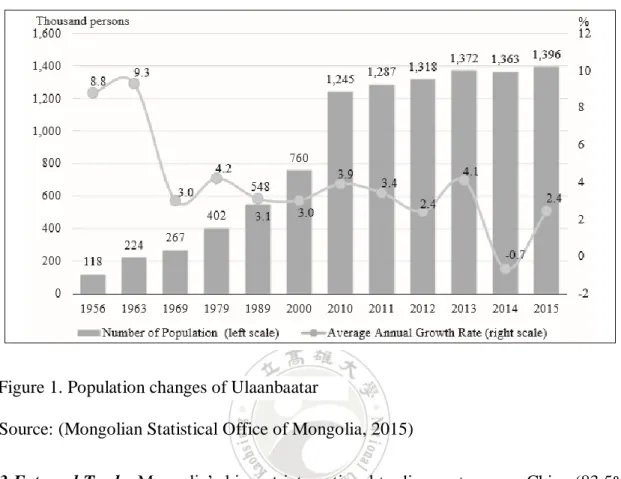
Figure 1. Population changes of Ulaanbaatar ...2
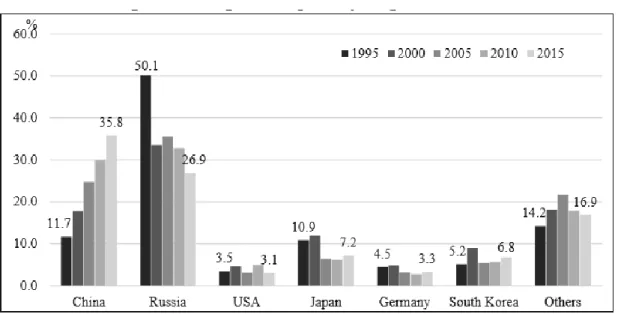
Figure 2. Mongolian Exports by destination ...3
Figure 3. Mongolian Imports by destination ...3
Figure 4.Mongolian Road Network ...5
Figure 5. National Road Network ...6
Figure 6.Current Railway Sector: General information ...7
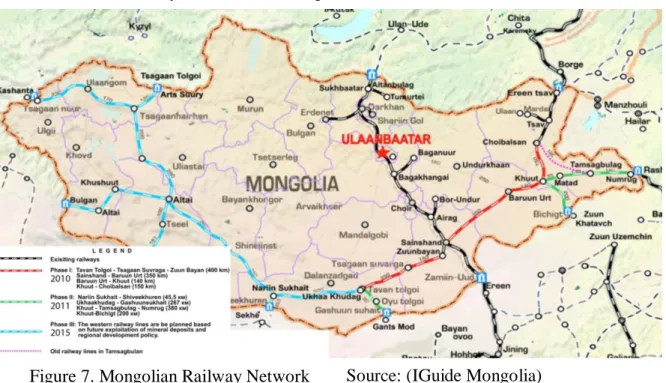
Figure 7. Mongolian Railway Network...7
Figure 8. LPI Rank Comparison ...8
Figure 9. Main directions ... 10
Figure 10. Number of employees... 11
Figure 11. Logistics Information Processing ... 18
Figure 12. Logistics by field ... 19
Figure 13. Cloud Computing host ... 25
Figure 14. Cloud computing ... 27
Figure 15. Requirements of Lean IT System ... 28
Figure 16. Lean It solution ... 29
1
Chapter One: Introduction
1.1 Background Information of Mongolia
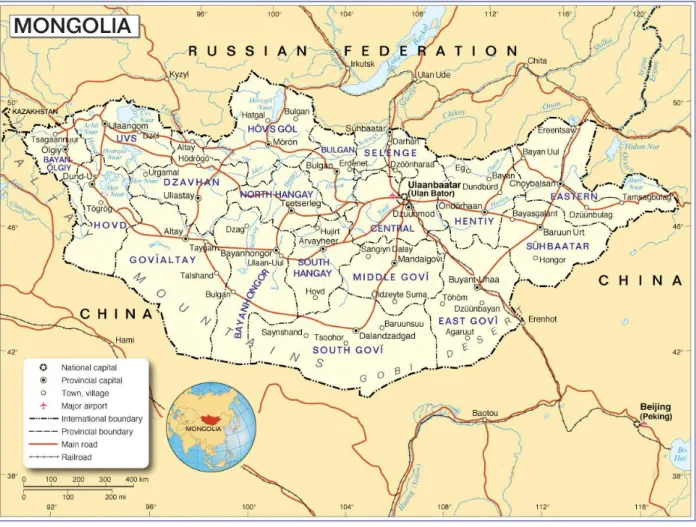
1.1.1 Geography. Mongolia is the 18th largest Country in the World with an area of 1.564 million kilometer2. Mongolia is located between the Russia Federation (RF) and the People’s Republic of China (PRC). Being Landlocked confronts more challenges, such as increased import prices, reduces export profits and increased logistic costs. Poor transport infrastructure, underdeveloped transport and logistic system, and slow and costly procedures for dealing with both exported and imported goods cause high logistic costs in Mongolia (Eldev-Ochir, 2016).
1.1.2 Population. The total population of Mongolia was 3.06 million in 2015, which is increased by 10.8% over five years from 2.76 million in 2010. Mongolia has a population density of 1.8 people per kilometer2 and has high density of population. The capital city is Ulaanbaatar. Migration to Ulaanbaatar started in 1990, highly increasing between 2000 and 2010. In 2000, 32% of total population migrated in Ulaanbaatar, increased to 45.1% in 2010 and subsequently increased to 45.5% in 2015 (Eldev-Ochir, 2016).
In Mongolia, there are three big cities, such as Ulaanbaatar, Erdenet and Darkhan. They are the main locations for business activities. They play an important role in Economic growth of country. However, the capital city Ulaanbaatar refers as a highly concentrated urban area, has serious traffic problems and negative environment impacts, associated with air, water and land pollutions. The Economic competitiveness of a city is reduced by these negative factors and the life quality is declined. City logistics is the process of optimizing the logistics and transport activities by private companies with the support of advanced information system (IT) in urban areas, taking into consideration the traffic environment, congestion, safety, and energy savings
2
within the framework of a market economy (Taniquchi et al., 2001). The logistic system of country has to be developed systematically.
Source: (Mongolian Statistical Office of Mongolia, 2015)
1.1.3 External Trade. Mongolia’s biggest international trading partners are China (83.5% of total exports, 35.8% of total imports) and Russia (1.6% of total exports, 26.9% of total imports). In contrast trade with other countries accounts for only 14.9% of exports and 37,8% of imports. This indication is explained by being a landlocked country with weak infrastructure connecting Mongolia to the world (Asia and Europe Union). The trade relationships with Russia and China is expected to remain durable and grow rapidly (Figure 2 and 3).
3
Source: (General Customs Administration of Mongolia, 2016)
Mongolia ranks 7th in Global resources with around 1,170 known deposits and over 10,000 known instances of 80 different types of minerals have been identified, and the resources of coal, copper, gold, silver and uranium are known to be especially abundant (Mineral Resource Authority of Mongolia, 2016).
Minerals, machinery, and electric and electronic products are Mongolian main imports. Country’s main exports are mineral products: copper concentrate, zinc concentrate, crude oil,
Figure 2. Mongolian Exports by destination
4
coal, and gold. The Economy is too dependent on the mineral resource section; it could call huge risks.
Transportation and infrastructure, especially rail transport in Mongolia, play huge role for the both domestic and foreign trade in mineral products (Eldev-Ochir, 2016).
1.1 Transport and Logistics in Mongolia
Mongolia ranked 119th with a 3.1 rating out of 144 countries in the Global Competitiveness (Schwab, 2016). This indicates that Mongolian Infrastructure is underdeveloped. In Mongolia there are four transportation sub sectors operating, such as road, railway, air and water transports. It’s important that transportation and logistics should survive with escalated demand for their services.
Mongolian domestic economy is relatively small. Mining, livestock and processing industries count as domestic economy. The industrial development’s basis lies on the support and development of infrastructure, ecology, geology, and future planned development in accordance with state policies and sociopolitical factors. Supporting industrial development is involved by rising demand for transport and logistics, including the agricultural sector, and both domestic and foreign trade, including the development of free trade zone and special economic zone. Increasing demand side factors for industrial development is attracting foreigner investors to relocate to Mongolia, in the process increasing transit traffic through the country while participating more economic activity, especially in locations away from Ulaanbaatar. Attracting foreign investors to the three free trade zone’s requires that the compulsory infrastructure in and around these areas made available and that policies are formulated and adopted to provide sufficient economic incentives (Eldev-Ochir, 2016).
5
Furthermore, Mongolian government has to develop transport infrastructure and logistic system.
Source: (Global City Map)
1.1.1 Automotive Transport. The road network in Mongolia is 49,250 km in length, of which 12,722km are national and state roads and 36,528 km are local and provincial roads (including 553 km of mining roads) (Figure 5). The Mongolian road network is classified into the following categories: including international road, local roads, special purpose roads (including mining roads) and private roads. International roads are made up of three Asian Highways (The AH3, AH4, and AH32) (Zagdradnaa, 2016). State roads are intended to connect Ulaanbaatar
6
within the province centers, important towns, and border crossing points designated by government resolutions. The state roads have 33 routes. Local roads are connecting provinces centers and small villages. Mining roads are constructed by private company and consortium agreement, with the condition of the transferring the ownership of roads to the state after the expiration of the mine’s life.
Source: (Ministry of Road and Transportation, 2015)
Mongolian state road construction has made some special contributions, such as improving mobility and transportation safety, enabling economic development, and combating poverty. However, road maintenance is crucial. Unfortunately, road maintenance in Mongolia is often neglected or improperly performed resulting in rapid deterioration of roads and eventual failure from both climatic and vehicle use impacts (Eldev-Ochir, 2016).
1.2.2 Rail Transport. There are small number of stakeholders in the Mongolian railway sector. The current national railway operator of Mongolian is “Ulaanbaatar Railway” (UBTZ), which has a joint venture status between the Mongolian and Russian government, where the countries’ shares are equal, at 50/50. The second largest stakeholder is the state owned “Mongolian Railway” (MTZ) joint stock company. The MTZ was established in 2008 (Eldev-Ochir, 2016).
7
The total length of Mongolian railway lines is 1,908 km, which connecting Mongolia with China and Russia. Country’s main export and imports flow through these line. Mongolia has 182 locomotives and 6,577 wagons (Figure 6 and 7).
Source: (Ministry of Road and Transportation, 2015)
Source: (IGuide Mongolia)
1.2.3 Air Transport. The Mongolian Civil Aviation Authority is managing the operations of Mongolian civil aviation organizations in accordance with the Law on Civil Aviation. There are three main aviation companies, including passenger transportation companies with regular operations such as “MIAT”, “Aero Mongolia” and “Hunnu Air” and eight smaller aviation companies. MIAT is the national courier, the Mongolian Civil Aviation Authority supports it,
Figure 6.Current Railway Sector: General information
8
and gives first choice to MIAT when new routes are plotted and approved by the Ministry of Road and Transportation. Hunnu Air is 100% private company (Eldev-Ochir, 2016). However, the MIAT has the huge right to make international flights, it is dominating the civil aviation sector.
1.2.4 Water Transport. Mongolia has 580 km of waterways. Lake Huvsgul (135 km), the Selenge River (270 km), and the Orkhon River (175 km) offer navigable routes but carry little traffic. Most rivers and lakes freeze over winter time and are only navigate from May to September. As such, waterway transport makes virtually no contribution to Mongolian overall transport industry (Eldev-Ochir, 2016). Mongolia does not have the way to the ocean. That’s why the water transport does not play the huge role in Mongolian transportation.
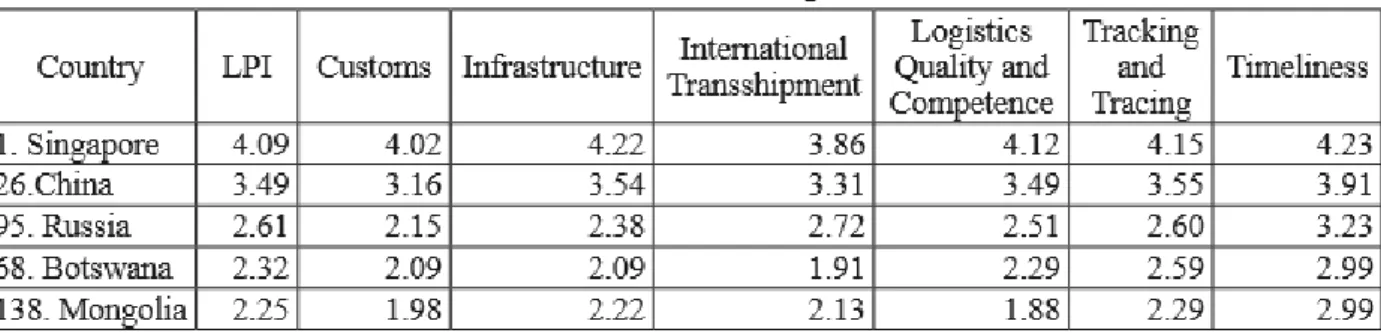
1.2.5 Logistic System. Logistics are not very well developed in Mongolia. There are no regulations or legal frameworks for logistic services. Mongolia does not have any logistic hub including freight terminals, truck decks, cross-docs operations, and distribution centers, etc (Eldev-Ochir, 2016). Imported products to Mongolia are carried from Russia and China by private trucks and drivers through Zamyn-Uud and Altanbulag provinces. Although, there are no appropriate logistics and roadside services to support the Mongolian export and import. The Word Bank has been conducting a Logistic Performance Index (LPI) survey every two years since 2007. Figure 8. indicates that Mongolia Ranks approximately 138-140 out of 156 countries
Source: (World Bank, 2014)
9
Domestic freight transportation and freight forwarding services is underdeveloped, and Mongolia needs a centralized platform or monitoring office, which can control whole logistic processes of the country. Logistics for agriculture, construction, petroleum, and the mineral resource industry should be introduced in Mongolia (Eldev-Ochir, 2016).
1.2 Information About Mongolian SMEs
Small and medium-sized enterprises (SMEs) are the backbone of Asian economies, accounting on average for 98% of all enterprises, 66% of the national labor force, and 38% of gross domestic product (GDP). In Mongolia, SMEs also make up 98% of all enterprises, three-quarters of which are microenterprises. While Mongolian SMEs face many obstacles to unlocking their full potential, 30% cite lack of access to finance as the foremost constraint. Only 10% of about 37,000 Mongolian SMEs regularly access finance through banks (The Asian Development Bank Institute, 2018). SMEs are only responsible for 17% of the GDP, and 2.3% of total export but employ 900,000 people, which is 43% of the total workforce in Mongolia (Jargalsaikhan, 2019).
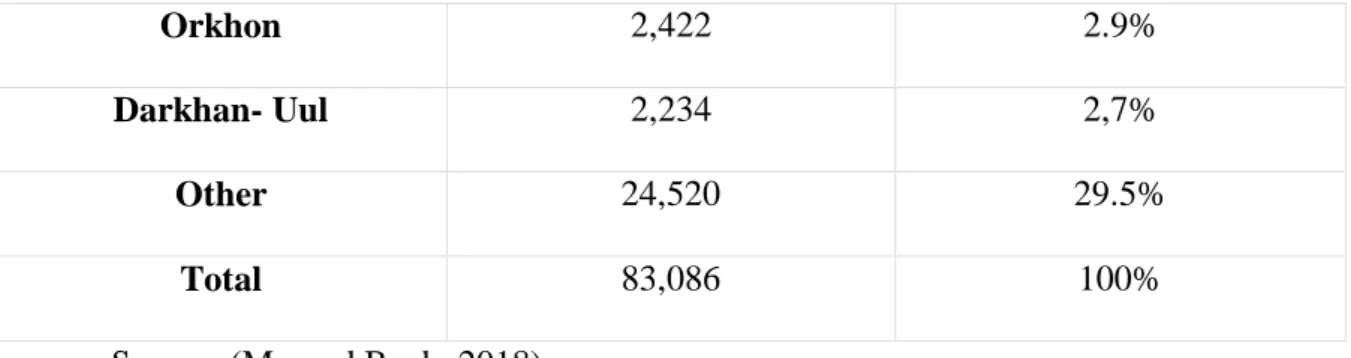
In 2018 Mongol Bank reported that 83,086 small-medium sized enterprises conduct business all over Mongolia. 53,910 of them conduct business in Ulaanbaatar; Capital city (Table 1). 37% of SMEs are conducting business in trading sector; and 34% of them provide services (Table 2; Figure 9). Table 3 indicates that 98% of enterprises are with domestic investment in Mongolia.
Table 1. Total SME in Mongolia
Location Number of SMEs Percentage
10
Orkhon 2,422 2.9%
Darkhan- Uul 2,234 2,7%
Other 24,520 29.5%
Total 83,086 100%
Source: (Mongol Bank, 2018)
Table 2. SMEs main directions
Field Construction Service Trade Production Agriculture Livestock Other
% 2% 34% 37% 21% 3% 2% 2%
Source: (Mongol Bank, 2018)
Source: (Mongol Bank, 2018) Figure 9. Main directions
11
Table 3. Form of ownership
Ownership Domestic Investment Foreign Investment Mixed
% 98% 1% 1%
Source: (Mongol Bank, 2018)
Source: (Mongol Bank, 2018)
98% of total SME companies have less than 50 employees. Only 1% of companies have 100-150 employees (Figure 10).
1.4 Purpose of the Study
This study is a qualitative analysis; the main purpose of this study are as follows: The case study of SME’s logistic management problem and solutions Evaluate the Mongolian SME’s logistic system
12
A study of Information system of logistic management To offer suggestions for Mongolian SME industry
1.5 Research Procedure
With Research Topic of: A Study of SME’s logistic system problems: The Case of Mongolian SMEs. The research process consists of five main steps.
The first step is introduction of background information; transportation and logistics system of Mongolia. General information of Mongolian SME industry. From that view of point, we will propose research problems: What kind of challenges the SMEs confront in their logistic system? What is the accurate solutions to reduce the barriers?
The second Step is Literature Review. Reviewing the necessary background knowledge related to research issues through previous quality journalism and research books. Find and rewrite the suitable content for the research topic in your own way. Based on theories, we will analyze the SMEs challenging problems in logistic system; and accurate solutions of this barriers.
The third Step is Research Methodology. Based on the theories of Literature review, we will arrange interview questions for the employees of Mongolian SMEs.
The fourth Step is Major Findings. All appropriate questions for the employees and outline qualitative answers. Collect data and introduce findings.
The fifth Step is Conclusion. After finishing all analysis, we can write key conclusions for Mongolian SMEs, the limitations of the study and future research proposals.
13 1.6 Research procedure framework
Introduction
Literature review
Research method
Major findings
Concluding Remarks
References
14
Chapter Two: Literature Review
2.1 General Description of important part of Logistics
There are various definitions that have been applied to describe the logistics.
(Daskin, 1985) defined logistics as “the design and operation of the physical, managerial, and informational systems needed to allow goods to overcome time and space”. Another definition promulgated by the Council of Logistics Management is: the process of planning, implementing, and controlling the efficient, cost-effective flow and storage of raw materials, in-process inventory, finished goods and related information from point of origin to point of consumption for the purpose of conforming to customer requirements (Ballou, 1992). Logistic is the process of delivery product from point of raw materials to the point of final product in hand of costumer.
In the past, logistics had a variety of names such as “physical distribution”, “business logistics”, “supply chain”, and so forth. However, “logistics management” is the most widely accepted term among professionals (Lambert et al., 1993). And recently people use the name logistic management.
Logistics is a mixture of a number of professional disciplines, such as: planning, controlling, directing, coordination, forecasting, warehousing and transportation, facility location, and inventory management (Joe, 2017). Above processes of inventory all included in logistics.
2.1.1 Elements of Logistics.
The company Logistic System contains the following elements: Warehousing (storage)
Transportation (delivery)
15 Order Processing (Distribution Center)
Information System and Communication (IT system)
Warehousing. Logistics centers and delivery centers correspond to storage locations and serve to adjust the time difference between producers and consumers to deliver goods in a timely manner. Storage facilities with functions to maintain the quality and value of goods, such as cooler and freezer warehousing or food processing centers, also correspond to storage locations (Keyence Corporation, 2019). During the delivery of goods between industry and costumers; the product has to be kept in storage; to maintain the quality of goods.
The moving process of cargo (goods) in and out of logistics centers and storages is called cargo handling. Cargo handling is classified into six processes: assortment, loading/unloading, transportation, allocation (storage), sorting and picking.
Transportation is also important, because logistics involves the movement of products (raw materials, parts, supplies, finished goods) from a point-of-origin to a point-of consumption.
The functions that send goods from the producer to the consumer are transportation and delivery. Transportation, also called "primary transportation", serves to carry goods from point A to point B; movement of products for long distance. Delivery is also called "secondary transportation" and it serves to carry small amount of goods for short distances. This function varies from transportation in that it is not a simple flow like movement from point A to point B. Instead, it sends goods from point C to more locations. Transportation and delivery are also said to make up about 60% of logistics costs (Keyence Corporation, 2019). Transportation carries goods for long distance; for instance, sending goods from one county to another country between distribution centers. Delivery is the process that carry products in consumer hands.
Inventory Control is about counting the number of goods and products which purchased by
16
Order Processing (Distribution Center) Separating goods that enter a warehouse and
distribution center, and then resorting and packaging them into units that are easy for consumers to purchase. Wrapping products, applying price tags, applying labels to imported goods, and checking clothing for needles are also types of distribution processing. Packaging the process to protect products from physical damage (scratches and breakage) that occurs during the logistics processes (Keyence Corporation, 2019). In distribution centers the goods are packaged into the small amounts ready to deliver. The packaging of product protects it from damage during the delivery and transportation.
Logistics Information Processes. All relevant information of logistic processes is managed by information flowing. This is managed by the logistics information processes and systems of producers, traders, importers and exporters, distribution centers, and freight forwarders or their agents, whose operations vary depending on the sectors and kind of products involved. These processes can include pre-information, warehouses and distribution centers (Logistics Information Processes, 2012).
An important difference between these systems is whether the emphasis is on the content of the goods or on the transport equipment or transport means used. Manufacturers and traders want to monitor the actual products and articles to know whether they will arrive on time and in proper condition at the delivery places, and to be able to take prompt action when incidents happen. Transporters are focused on the progress and status of the transport means and the transport equipment in them. If incidents or delays happen, transporters can report these to their clients but the impact on delivering or restocking can only be understood by the traders and manufacturers. For commercial reasons, the transporter may not actually know the details
of the goods.
Authorities, especially Customs and authorities responsible for security in transport, have an interest in the content of goods, as well as the transport means and equipment used to
17
transport them (Logistics Information Processes, 2012). During the whole logistic process, the information of inventory and other information flows have to be controlled by information system.
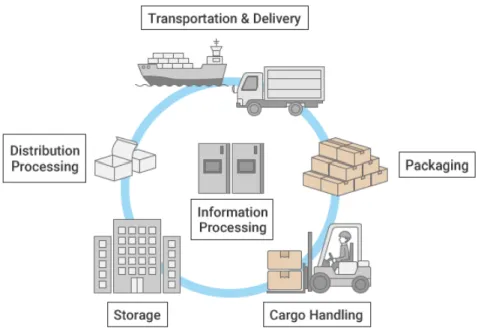
The above definitions imply that there exist four flows in a logistics system (Figure 11). First, material flow is a flow of raw materials from their sources through the important processes, such as storage, retrieval and delivery, then flow to the customer with no delays or expenses. Second, merchandise flow which is related to marketing flows in the distribution channels. It shows a moving process of goods from producers through wholesalers and retailers to customers. The difference between material flow and merchandise flow is that the former is only to move goods from producers or suppliers to customers without considering the paths through which the ownership of goods passes on the way from suppliers to customers. Third, money flow involves pay in advance and money transfer, which can be handled by electronic fund transfer, such as mobile bank. Fourth, the members of logistic system share their information between each other in the logistics channel constitutes information flow. This creates the need for the installation of a logistics information network.
18
Source: (Keyence Corporation, 2019)
2.1.2 Types of Logistics.
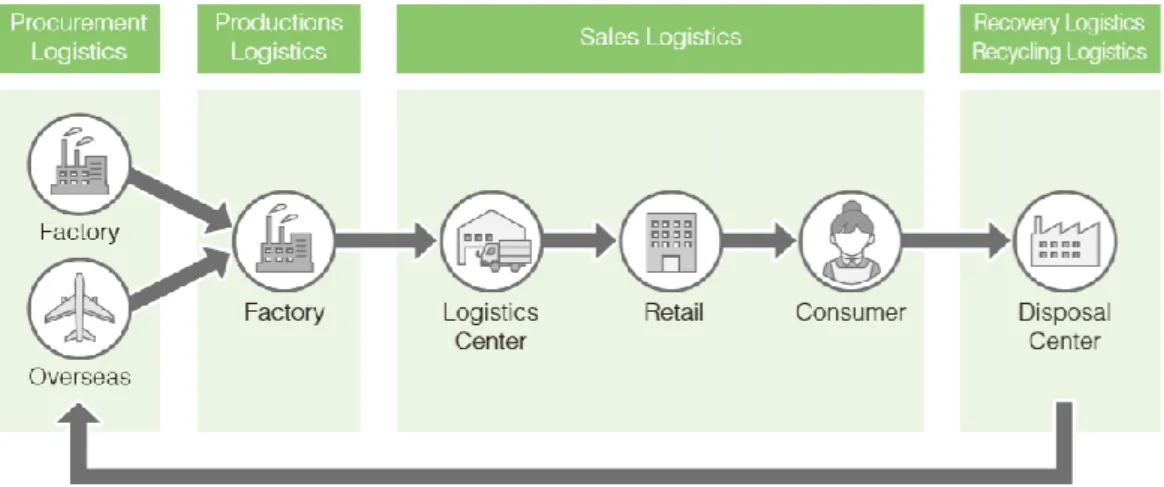
Logistics can be classified into five field (Figure 12): Procurement logistics
Production logistics Sales logistics Recovery logistics Recycling logistics
19 Source: (Keyence Corporation, 2019)
Procurement Logistics: Procuring Raw Materials and Parts
Procurement logistics is the flow of goods when the raw materials and parts necessary for manufacturing are procured from suppliers. This field did not attract much attention before, but now that small-lot production of a variety of models is the main type of production, many firms are actively pursuing production by procuring the necessary materials in only the necessary amounts at the necessary times (the shift to just-in-time production) because it is directly connected to reducing inventory costs (Keyence Corporation, 2019). Procurement logistics refers as delivery of raw materials to the manufactory.
Production Logistics: Materials Management, Distribution in Factories, Product Management, Shipping
Production logistics is the flow of goods that includes the management of procured parts and materials, distribution inside a factory, product management, packaging, and shipping to warehouse. Delivery management, warehouse dispatch management, and shipping
20
management can be optimized and the state of delivery vehicles can be managed by smoothly linking procurement logistics and sales logistics described later (Keyence Corporation, 2019). Delivery of parts of products between manufacturers.
Sales Logistics: Delivery from Warehouse to Wholesalers, Retailers, and Consumers Logistics typically refers to sales logistics. In the past this was mainly delivery from delivery centers and logistics warehouses to distribution points such as wholesalers and retailers. But now direct delivery also makes up a large amount of this volume due to online shopping and e-commerce. Whether delivery through delivery centers and logistics warehouses or direct delivery from production sites, higher efficiency in transportation and delivery and shrinking inventory are indispensable for delivering the necessary goods to the necessary people in the necessary quantities at the necessary time. This also contributes to improving customer satisfaction (Keyence Corporation, 2019). Delivery of final products from distribution centers through wholesalers and retailers to the costumers. It also includes the shipment of goods through e-commerce.
Recovery Logistics: Recovering and Recycling Products, Containers, and Packaging If the flow of goods from production to consumption by procurement logistics, production logistics, and sales logistics is described using the circulatory system of the body, it would be said to be forward logistics. On the other hand, recovery logistics or reverse logistics is the flow that recovers and recycles products, containers, and packaging that have fulfilled their role. Similar to recycling logistics described later, emphasis is being placed on this flow in recycling-oriented societies (Keyence Corporation, 2019). After usage of products, consumer left the box and packages of products and all of them carried to the disposal center, it’s called recovery logistics.
21
Recycling Logistics: Recovering and Recycling Recyclable Products and Containers Typical examples of recycling logistics are recovering and recycling empty cans, plastic bottles, and old paper. Containers, packaging, old computers, and inkjet cartridges can also be recovered and recycled in the same manner. The importance of recycling logistics has been increasing in recent years as measures for the environment and to effectively utilize materials such as minor metals (Keyence Corporation, 2019). In disposal centers the used cans and plastics recovered and prepared to new usage. And they carried as raw materials to the manufactory.
2.2 The Challenge of SME in Logistic Management
Small and Medium Enterprises (SMEs) also confront some challenges in the field of Logistics. Modern logistics companies today rely on advanced ICT solutions for information processing and sharing. Penetrate to data and information about the demand for logistics services and supply opportunities are becoming a key barrier. Unfortunately, only the largest companies can afford advanced IT systems. Small and medium companies have limited or no IT-competence. Tools are therefore needed to facilitate cooperation between smaller logistics companies, which in turn will reduce transaction costs (Kawa, 2012). The main barrier for the SME is they cannot afford the expensive IT system.
The logistics services centers lack solutions that would integrate the services of different operators in one platform. For instance, if a consumer orders goods from Taiwan to the Czech Republic, he must choose several type of transport (e.g. shipping, rail, road) and use the services of logistic companies. A similar problem occurs in regional transport, for example, in a province or country. However, in some countries there are logistic centers (e.g. in Germany,
22
Italy, Spain), the small number of SMEs use them. Individual logistics centers compete, ensuring comparable conditions of infrastructure. The only thing that distinguishes them is value-added services. Information about the availability of services of other businesses located near the center is an example. It includes shared information on schedules for arrivals and departures of regular and charter services, cargo tracking and tracing across organizational borders, real-time business process monitoring and exceptional situations. Unfortunately, SME logistics companies have limited or no IT-competence and investments. They think that they should focus on business competence rather than IT (Kawa, 2012).
IT is a crucial aspect of application of a logistic system of SMEs. An IT solution is crucial for SMEs to support the logistic processes in an effective and efficient way. It is known that a positive relationship exists between IT application and business performance (Rothgang et al., 2006). Company’s business performance can be hold on IT applications.
SME and ICT. There is a Research from the European Union (EU) and US shows that Small and Medium Enterprises (SMEs) do not take advantage of ICT (Information and Communication Technology) and e-Business solutions in the way that large companies do. This makes SMEs more vulnerable to changing economic conditions as they have a relatively lower level of competitiveness (Arendt, 2008). Information Technology is an element of Logistic Management; SMEs also have barriers in their Logistic Systems especially they cannot have their own Information System.
The usage of the Internet by SMEs is still relatively undeveloped. SMEs still use the Internet only to send e-mails, transfer files or documents or gather information. There is no evidence that SMEs use and invest in ICT with an intention to improve services, processes and business automation (Wei Dai, 2009).
23
Most of the SMEs losing their emerging business opportunities depending on that they cannot connect digitally with their business partners and suppliers.
(Maguire et al., 2007) explored how SMEs may use ICT to secure a competitive advantage. The key outcomes of this research were the following:
SMEs considered ICT as a key factor in cost reduction;
ICT could enrich product development and service quality at a very high level in SMEs; SMEs viewed sales forecasting, customer analysis, and pricing as the most effective
ways of utilizing ICT for competitive advantage.
In a recent study (Task-force, 2000), the barriers were classified into two broad categories: macroeconomic and microeconomic.
The first microeconomic barrier was the lack of awareness, knowledge and skills within the SME environments. This makes it difficult for SMEs to select the right technologies as these are changing rapidly. However, they often use the services of external advisors. The second challenge is that existing ICT platforms are not suitable for SMEs’ needs. This increases difficulty on SME owners and managers to train employees for future e-business readiness. It was indicated that the SMEs sector was experiencing huge challenges in finding appropriate IT solutions than large corporations. The reasons of that was a lack of time and the lack of internal information and knowledge. Further, SMEs choose to use the existing and familiar IT models to avoid the risk of transferring to the new ones.
The existing IT system solutions are expensive associated with high cost software. SMEs consequently face entry and infrastructure barriers. Lowering entrance and participation barriers will help SMEs gain access to technologies and to help them instantaneously participate in point-to-multi-point supply value nets (Bovet et al., 2000). For the SME users it is crucial to find inexpensive solutions to penetrate to centralized platform.
24 2.3 Solutions for the logistic barrier
According to the previous research works most convenient solution for the logistic barrier is IT system; between them the cheapest way to access to the network is feasible for the SME company. Logistics companies utilize information technology to increase efficiency and automate their whole process. Thanks to them, numeric data presentation and fast verification and control of costs, revenues, sales and other such data transparent for everyone. Also, all the contracts with partner companies and the transfer between them can be facilitated through the system. Another essential feature of the application of IT system by logistics service providers is to fulfill the expectations of customers. These are the customers who care more and more about the time and safety of delivery and full information about the logistics process than about the price of the services (Ciesielski, 2005).
That is why there is a huge need to create a cheap electronic centralized platform which will enable SMEs to access to network, to get the relevant data about the logistics and suppliers.
2.3.1 Cloud Computing
First solution to these problems which we obtained during the research is cloud computing with web semantic services based on the Internet (Figure 13). It avoids to pay excessive money on hardware and software.
25 Source: (Kawa, 2012)
Cloud computing can be thought of as computing resources sharing information and services delivery which is convenient for users. Cloud computing particularly suggests the following characteristics to support SME’s needs:
1) Services on Demand: it provides with services which users can penetrate to the system anytime and anywhere.
2) Database Sources on Demand: users can gather relevant data (e.g. database) in relation to the application needs;
3) Applications on Demand: necessary applications for the users according to dedicated processes;
4) Platform on Demand: allocation of application environments for users. For SME users, information communication technology infrastructure, platform, equipment of the system and
26
the majority of relevant data can all be taken care through cloud computing system to support SMEs logistic needs. According to the platform user can facilitate the whole logistic processes.
Public Cloud represents a majority of the current market share and is, as it sounds, cloud hosting
that is openly available to the public for use. Anyone from individuals to multi-national
businesses can utilize these offerings. The catch here is that multiple customers could potentially
be sharing the same piece of physical hardware at the data-center level (Baird , 2019). On that
platform all the information is transparent for everyone (Figure 14).
Private Cloud functions similarly to public however the resources are dedicated and isolated
per customer. Ranging from the hardware to sometimes even the physical placement of the
servers in question. This solution is generally ideal for larger and more security focused
organizations (Baird , 2019). Every users of the system have their own individual platform
which can create their own data storages. It is nor transparent for everyone (Figure 14).
Hybrid Cloud is an amalgamation of both public and private solutions. Some businesses may
have a desire to operate their non-critical or sensitive operations to a cheaper public hosting
solution, while also leveraging a private solution for say their sensitive customer information
and proprietary data (Baird , 2019). Compound platform which can be private and public for
27 Source: (Cloud computing Trends, 2019)
Logistic Companies integrated in Cloud Computing System
Another global logistics networks, such as DHL, UPS, FedEx and other suppliers in this market, such as insurance companies, petrol stations, suppliers of car parts have already started to use cheaper access cloud computing system. The members of the platform will be able to optimize their cost of transport, for instance by using common transport, e.g. rail, instead of private road transport (Kawa, 2012).
2.3.2 Lean IT Solution
Other solution for the logistics’ barrier is the application of an effective and inexpensive lean IT. This solution can solve the problem of enabling a logistic network.
28
Lean thinking can provide features for the customer by:
Improving the quality of work processes Reducing errors or defects in work processes Reducing costs
Improving flow of the process Simplifying complex processes Reducing lead time
Improving employee morale (What Is Lean, n.d.)
Figure 15. gives an overview of the basic requirements which has been identified for the lean IT solution.
Figure 15. Requirements of Lean IT System
Source: (Hildebrandt et al., 2007)
(Figure 15) Lead Logistics Provider (LLP) has the role of a central platform that controls the logistic processes of the whole system. The logistical services are provided by sub-contracting companies. The LLP acts only as the organizer of the logistical processes without the need to
29
have own assets. This definition goes in line with (Thomas, 1999): “A supply chain integrator that assembles and manages the resources, capabilities, and technology of its own organization with those of complementary service providers to deliver a comprehensive supply chain solution” (Hildebrandt et al., 2007).
Requirements four and five are central platform and development potential; they are the medium of a virtual LLP. They take over the basic responsibilities of a LLP, and act like central controlling platform and communicate with all of the participants of the system. Furthermore, the system reaches the required size to make them consistent; the solution must arrange potential for additional developments and extensions that are intended to be incorporated. For example, the intended extensions provide with the advanced tracking and tracing features (Figure 16).
Source: (Hildebrandt et al., 2007)
Figure 16. gives an overview of the architecture of the lean IT solution. The information system AmmLog System (ALS) constitutes the core of the solution. The ALS acts as a central communication platform and contact for all the companies within the network, more precisely the participating producers and carriers. Producers communicate with the ALS through one or
30
more of the provided channels, namely web front end, email and Web services. The web front-end channel requires manual interaction, whereas the email channel offers manual interaction as an option. Software operated by the producer can communicate with the ALS through the email and Web services channels to achieve the deepest process integration and the highest degree of automation. Carriers communicate with the ALS in the same way as producers. However, regarding the offered functionality and access rights, the ALS distinguishes between producers and carriers (Hildebrandt et al., 2007).
The ALS sends and receives information through channels. Even though there are different channels that information passes through, all the critical business information is encoded as EDI messages that pass through an internal, real-time EDI (electronic data interchange) interface. Thus, internally, information from all the channels is processed in a uniform manner. The ALS contains software components for selecting a carrier for a given shipment order, bundling freight, calculating freight charges and supporting business intelligence and reporting. Furthermore, the system offers points for future extensions. Information is stored in a centralized database. From a software engineering perspective, the ALS is divided into four tiers in order to assure a clear separation of concerns: client tier (internet browser, email client or producer/carrier software), presentation tier (web front end), business logic tier (core ALS) and data storage tier (Hildebrandt et al., 2007).
Summary. The main factor for the SME companies is to penetrate to data and information about logistic services and get information about supply opportunities. Most of the SME companies have limited or no IT-competence and investments. They mainly focus on business competence rather than IT. The usage of the Internet by SMEs is still relatively undeveloped. SMEs still utilize the Internet only to send e-mails, transfer files or documents or gather information. For SMEs having their own IT system faces such challenges; such as expensive
31
hardware, software and barriers associated with training and integration. Inexpensive solutions, such as Cloud Computing and Lean IT system might reduce the SME’s logistic barriers.
Chapter three: Case Study Methodology
3.1 Research framework
32
Qualitative research techniques include ‘small-group discussions’ for investigating beliefs, attitudes and concepts of normative behavior; ‘semi-structured interviews’, to seek views on a focused topic or, with key informants, for background information or an institutional perspective; ‘in-depth interviews’ to understand a condition, experience, or event from a personal perspective; and ‘analysis of texts and documents’, such as government reports, media articles, websites or diaries, to learn about distributed or private knowledge. (Hammarberg et al., 2016)
In depth interview
Interview questions
(total nine)Interview participants
(total six)Zoom application
(use for the interview)Record the
responses
Conclude final
results
33
For further research we have chosen in depth Interview approach to evaluate the Mongolian SME’s logistic system and suggest them appropriate solutions. Interview questions are based on the literature review. We will interview total six employees through Zoom application, during the interview all responses will be recorded as file. After all interview process; collect the significant answers from recorded file and get the final results.
Six employees from three different types of Mongolian SMEs; two employees from each company:
“Bab Invest” LLC:
Baldandorj Denzen- director and Founder of the company Mandukhai Baldandorj- manager of the company
“EM DJI DI” LLC:
Orgil Shinebayr- director of the company Adil Byambadorj- procurement manager “Sarana Goods” LLC:
Narangua Zorig- human resource manager Ulziidelger Ganbaatar- manager of the company
3.2 Questions for the Interview
1. Briefly introduce about your company.
2. Do you have your own logistic system or not?
34
4. SMEs most common challenge is the IT competency. Will IT competency enhance the Logistic performance of your Company? Why?
5. IT system faces such challenges; high up-front costs associated with hardware, software, training and integration. Could you purchase high cost software? Why? 6. Currently what kind of applications do you use? Is it useful for you? Why?
7. Would you prefer to customize the appropriate web software for your own company? It will cost expensive but once you have your own software it will enhance the efficiency of your logistic system.
8. One of the solutions to these problems is cloud computing with web semantic services based on the Internet network. Is it useful for you or not?
9. How about the LEAN IT system?
3.3 Introduction of Mongolian SMEs
We have chosen “Bab Invest” LLC; “EM DJI DI” LLC; “Sarana Goods” LLC as a representatives of Mongolian SME industries to make our further research in logistic system, hoping to understand SME’s challenging problems in logistic system, to suggest an appropriate solution for them. For this study three different types of SMEs will be investigated. First company is conducting business in construction sector, and operates only from April to October. Second company operates in agricultural and trading field, seasons of operation- whole year. Third company is conducting business in food production sector, operates whole year. All three
35
SMEs have different strategy in logistics. Depending on the different sector of their operations; the logistic system of each companies differs from each other. For better understanding and get appropriate results and different reactions about the logistic system barriers of different types of SME; we had chosen three different sectors.
Table 4. "Bab Invest" LLC
About company
Bab Invest LLC has been established as a building maintenance, construction and production of construction materials company near Sonsgolon Road, Songinokhairkhan District, Ulaanbaatar, Mongolia. Company was founded in 2001. This company has been providing their clients with reliable solutions to their construction projects. It has 4000 m2 field with office building, cement silo, bridge crane and iron workshop. Founder of Bab Invest LLC is Baldandorj Denzin
36 Equipment
38 Products Logistics (final delivery of raw materials, and finished products, storing products, carrying and
Concrete products: Mostly no-shipment. Customers come to the factory to purchase products. Deal with the private truck drivers to carry products. Fresh concrete: one-time deal with private drivers. One trip is around 25,000MNT/m3
Storage: at the site near industry.
39 moving
goods)
They use loader and country crane during the making of the concrete products.
Consumers Internal suppliers of raw materials
External suppliers for equipment components (alibaba.com; amazon.com)
How many Employees, their job descriptions
Director- Operation and sales. Handles procurement. Manager- Advertising, paper works.
Accountant- deal with tax and social insurance offices, payments Book keeper -Manages book keeping.
Production manager- arrange daily activities according to orders. Seasonal workers: 4-6 person
Main directions
Building maintenance Construction
Production of construction materials What they
want to
improve in their Logistic System
Better data management for better production forecasting and planning Reliable raw material sourcing
40 Website
https://www.facebook.com/babinvest/
Table 5. "EM DJI DI" LLC
About company
“The EM DJI DI” LLC was found in 2003. The founder is SH. Shinebayar. He transferred all 100% shares to his son Sh. Orgil in 2018. The subsidiaries:
“EM DJI DI AR and Key” LLC; “Namirlan” LLC; “Altan Zoos Invest” LLS. The board of directors (the head company’s owner and subsidiary’s consultants; executive directors) initiate the current year planning, and approve financial statements. This company has been established as agriculture SME to provide customers with health wheat. At the same time the company imports plant protection products from China.
41 Products
Plant protection products (wheat from insects) Fertilization product
Wheat Equipment
42 Trucks to carry products Tractor Logistics (final delivery of raw materials, and finished products, storing products, carrying and moving goods)
1. Import products and raw materials from China:
by truck through Chinese city Ereen and Mongolian province zamiin-Ud;
by railway from China to Ulan bator; Mongolia.
2. Storing; saving their products in the company’s warehouses
Consumers Farmers from Selenge; Bulgan; Khuvsgul; Darkhan; Tuv; Arkhangai; Uvs; Khovd; Dornod provinces.
Ministry of Food; Agriculture and Small Industry Ministry of Nature; Environment and Tourism Suppliers Raw materials import from china- shanghai; Russia
43
Six Warehouses of the Agriculture Support Funds Companies warehousings,
Company’s rural branches Employees In the office 10 employees;
At the agriculture site 10 employees Main directions Agriculture; foreign trading; transportation; construction;
the plant protecting production trading; the greenhouse industry.
What they want to improve in their Logistic System Mobile application Product tracking system Insurance
Logistic centralized system and monitored by state.
Website Facebook
Currently don’t have web pages
Table 6. " Sarana Goods" LLC
About company
Sarana Goods LLC was established in 2017. One of the national organic product producer as SME. The main production of the company is the organic honey. Currently has seven different types of glass bottled honey supplying it to the Mongolian market.
44
Founder of the “Sarana Goods” LLC is L. Naranzul. Products
Three different types of honey jars Tea flavors (dried lemons; tea leaves) Honey sieve packaged as one spoon Wooden honey spoon2
Wooden bark box
45 Logistics (final delivery of raw materials, and finished products, storing products, carrying and moving goods)
About the logistics: ship every month their raw honey from the Selenge Province by bee breeding factory’s Truck.
Packaging and storing the final products at their own Factory place. Shipment of the glass bottles from China by Train.
Delivery of final Honey Products to the Retail stores by company’s own car.
Consumers Consumers who is preferring organic products
Suppliers Bee breeding factory in Selenge province in Mongolia Glass bottle supplier from China.
Cooperation The retail stores which the company supplies their products:
46
Nomin Hypermarket;
Orgil Supermarket;
Monos pharmacy;
Asia Pharma pharmancy;
Sansar Supermarket;
Emart;
CU convenient stores; three company stores. Employees Sarana Goods LLC has five employees:
Executive Director Accountant Manager Two packers Main directions
Conduct business in Food factory.
Provide consumers with reliable organic honey products. What they
want to
improve in their Logistic System
Tracking delivery goods Facilitate Logistic Process
Constant communication with drivers
Website Facebook
Facebook: Sarana Goods C:\Users\Narangua\Downloads\introduction of zugiin bal.docxC:\Users\Narangua\Downloads\introduction of zugiin bal.docx
47 3.4 Interview steps
This study is aimed to investigate three different types of SME industries. Total six interviewees; from each company two employees will be interviewed by Zoom application. Discussion will be recorded as a file. From final responses we will collect the significant answers to get further Result of the research.
48
Chapter four: Findings
Brief introduction: Total interviewees N=6 (from three SMEs)
For this study we interviewed total three SMEs and six employees (two employees from each company). We made interview questions with each individuals and got different and same responses; we analyzed the responses in table approach; equated them and got the significant results.
Assume that six interviewees cover 100%. Numbers indicates the total of responses; percentage indicates how many interviewees agreed or not agreed out of 100%.
4.1 SME’s Main Directions
Table 7. Types of SME
Company name “Bab Invest” LLC “EM DJI DI” LLC
“Sarana Goods” LLC Business Direction Construction productions Agriculture productions Food products Percentage 33% 33% 33%
From Table 7. We can see that 33% of all company which we interviewed is conducting business in construction field; 33% of company is in agriculture field; and 33% of company conducts business in Food production field. We aimed to do our investigation in to three different type of SME.
49
4.2 Company’ s Logistic System
According to the interview Question: “Do you have your own logistic system or not?” For instance, the employee of the “Sarana” LLC answered: We have own delivery car; which make deliveries of final products (honey) to retail stores which we have contracts. Delivery of raw honey from the bee breeding factory; sometimes need to rent truck and driver.
Table 8. Logistic system and renting truck
Characteristics
Do not rent private driver N; %
Rent private driver and Truck
total
Have logistics (N; %)
2; 33% Em dji di 2; 33% Sarana 4; 67%
Do not have logistics (N; %)
0 2; 33% bab invest 2; 33%
Total 2; 33% 4; 67% 6; 100%
50
From table 8. We can summarize that total 67% of interviewees responded that their company has their own Logistics; and 33% of them responded they don’t rent private drivers and truck; 33% responded they have own company car which make the delivery process but at the same time they rent private driver and truck when it is crucial. Total 33% of interviewees responded they don’t have own logistics and rent private drivers and truck.
From the result we can conclude that SME company have insufficient logistic system whether the company has the own car to deliver products they rent the truck if it’s crucial.
Explanation on own Logistic system: Having own logistics depend on the type of SME company. When the company operates the whole year (4 season) the probability of having their own truck is higher comparing to the company which operates seasonally (construction company). Two companies which were interviewed operates whole year (Sarana Goods; Em DJI DI LLC) have their own truck and car. Bab invest LLC operates seasonally (from March till October) do not have their own truck and rent trucks if it is needed.
4.3 Barriers confront in Logistic System
According to the interview question: “What kind of barrier do you have in your logistic system?”
For instance, the “Bab Invest” LLC director said: Can’t share our information directly with drivers and customers and between employees. Cannot track our logistics.
The “Bab Invest” LLC manager said: It’s challenging that we don’t have the constant drivers and truck and the renting cost is always fluctuating when we plan our delivery and logistics. We have barrier on managing our production and logistics.
The employee of the “Sarana Goods” LLC explained: It is hard to track our shipping to the supermarkets when we make our delivery by own car and with renting truck.
51
Table 9. Barriers confront in logistic system
Barriers Cannot track and manage logistic process The renting Cost always fluctuating Mongolian road infrastructure poor, road traffic The cost of shipment between other countries is unstable Logistic cost is high Responses ( N; %) 6; 100% 1; 17% 2; 33% 1; 17% 1; 17%
The logistic system barriers have been reported by the SME employees. The most significant responses are written in (table 9). All interviewees total 100 % reported that they cannot track and manage logistic process of the company; second significant barrier is that Mongolian road infrastructure is poor; have road traffic during the day time.
From this result we can conclude that most important barrier in logistic system is that SME company in Mongolia don’t have IT systems which can track their logistic processes.
Explanation on the most common barriers in logistics: For the SMEs managing and tracking their logistic process is the most common problem of all issues. During the interview all six interviewees responded that they confront such challenge. For instance, when company makes delivery to retail stores it is hard to track the delivery car and the product quantity which stores (customer) are needed. During logistic process making notes; doing transactions manually are taking time and consuming money.
52 4.4 IT system advantages in Logistics
According to the interview question: “SMEs most common challenge is the IT competency. Will IT competency enhance the Logistic performance of your Company? Why?”
For instance, the “Bab Invest” LLC director answered: Yes, it will enhance our logistics. Because we can manage our logistic process and production. And reduce the cost. If IT logistic system penetrates in Mongolian market.
The “Em Dji DI” LLC director said: Yes, the integrated logistic IT system will facilitate our logistic process, we can get the mobile apps and through that we can decide our international transactions. Because we import our products from china. We can track our process.
Table 10. IT System and improvement in Logistics
Improvements in Logistics through IT system It will improve the logistic process; managing and tracking the process; The mobile application facilitate transaction; process It will improve logistics if company will export products abroad Reduce logistic cost Responses (N; %) 5; 83% 2; 33% 1; 17% 2; 33%
Total 83% of the interviewees responded that IT competency will improve their logistic process by managing and tracking their delivery process. 17% employee responded that they will consider about IT system when company starts to export products abroad. 33% of the interviewees responded IT system will reduce their logistic cost (Table 10).
53
From this result we can conclude that IT system can facilitate the logistic process of Mongolian SME Factories.
Explanation on IT system which can enhance the Logistic process: If the IT System penetrates in Mongolian market it will facilitate the whole logistic process (managing and tracking production and delivery) of the SME. It will reduce cost and save time.
4.5 IT system challenges: High cost software and hardware
According to the interview question: “IT system faces such challenges; high up-front costs associated with hardware, software, training and integration. Could you purchase high cost software? Why?”
For instance, the employee of the “Sarana” LLC said: Our company cannot purchase the expensive software currently, because our business is just getting familiar with customers. And it’s just expanding and nowadays we are not that efficient with profits. But it is getting better day by day. And it will be challenging to learn our employees to the IT system. But further it will be efficient to connect to the IT system and it will facilitate our job.
The “Bab Invest” LLC manager responded: Construction process in Mongolia depends on a season. In Mongolia the cold seasons take about 6 months. That’s why We conduct business for the rest of six months in a year, that’s why we cannot afford expensive hardware and software. We need cheaper way to solve the problem. In Mongolia we don’t have the local logistic IT systems yet. For the international IT system, the price is so high and it will be challenging to train our employees on it.
54
Table 11. Expensive Software Company’s potential Afford the expensive software Cannot afford expensive software Total interviewees Responses (N; %) 1; 17% 5; 83% 6; 100%
Table 11. The interview result indicates about 83 % of employees reported that their company cannot afford the expensive Software and Hardware.
Table 12. Training and integration
Training employees on IT system It is challenging to train employees Not challenging to train employees Total interviewees Responses (N; %) 2; 33% 4; 67% 6; 100%
Table 13. IT and type of SME
Purchasing It won’t depend on type of SME IT depends on type of SME Total responses Responses (N; %) 3; 50% 3; 50% 6; 100%
This investigation shows for the SME company the most challenging problem is high cost software for their Logistic System. Training and integration to the system is reasonable for them. Although 17% of the interviewee responded that company can purchase the IT system (table 11); 50 % of employees said it depends from the Type of the SME (type of products; number of costumers; number of cooperation; suppliers) table 13.
55
Explanation on SME cannot afford the expensive hardware: For small and medium sized company purchasing high cost software is infeasible; the reason is not enough capital, small number of costumers. It also depends on the type of SME; what kind of productions they produce, how many months per year the company operates.
4.6 Application which is used by SMEs in their Logistics
According to the interview question: “Currently what kind of applications do you use? Is it useful for you? Why?”
For instance, the manager of the “Sarana” LLC said: We currently use Facebook page. And have 3000 followers but it is not much affect to our sales and delivery.
The “Bab Invest” LLC director said: We use the Facebook. There are lots of Facebook ads related with the private drivers and trucks.
Table 14. Current application
Application usage Do not use apps Use apps (Facebook) Total interviewees Response
(N; %)
1; 17% 5; 83% 6; 100%
Table 15. Mobile Bank
Mobile bank Usage
Use mobile bank apps
Do not use mobile bank apps
Total interviewees