Abstract
Personalized services, which make customers feel that service employees are
polite, friendly, and exhibit personal warmth, and that customers are unique and
valued, are essential in building good customer relationships. Establishing
personalized relationships on the Internet appears impossible. However, the
characteristics of reduced cues and asychronized communications make email an
effective tool for cultivating relationships between e-retailers and their customers. A
sample of 254 students from a university in Northern Taiwan participated in an
experiment. Structural equation modeling revealed that frequent personalized emails
improve the relationship between e-retailers and their customers, enhance service
quality, and engender customer loyalty. Furthermore, personalized emails enhance
relationship quality more for female customers than for male customers. Finally,
future research and managerial implications are discussed.
Introduction
Relationship marketing has been the subject of extensive academic research
(Alajoutsijärvi, et al., 2000; Berry, 1995; Verhoef, 2003) and is practiced by many
companies (Loveman, 2003). A key component in building good relationship with
customers is personalized services (Kandampully, 1998), which make customers
perceive service employees as polite, friendly, and warm, creating the feeling that the
customer is unique and valued. Personalization, defined as the social content of
interaction between service or retail employees and their customers (Mittal & Lassar,
1996) significantly enhance the relationship between a company and its customers,
improve service quality, and engender customer loyalty. In this definition,
personalization is not limited to face-to-face (FtF) interaction since interaction can
happen in real world as well as in virtual space. However, when examining
personalization in service settings, almost all previous works scrutinized service
encounters, i.e., FtF interaction between service providers and customers (Berry, 1995;
Crosby et al., 1990; Mittal & Lassar, 1996; Price & Arnould, 1999). Given the
self-service nature of Internet commerce, exhibiting politeness, friendliness, and
personal warmth, and making customers feel unique and valued do not appear to be a
major issue. To our knowledge, few previous works have examined the social aspects
Gwinner et al. (1998) suggested that customers in long-term relationships
experience three primary benefits beyond the core service: confidence benefits, social
benefits and special treatment benefits. Confidence benefits describe the reduction of
uncertainty in transactions and the increase in realistic expectations for a service
encounter. Social benefits refer to the emotional aspects of relationships and focus on
personal recognition of customers by employees and the development of friendships
between customers and employees. Special treatment benefits consist of both
economic and customization advantages for the consumer. However, when examining
relational benefits on the Internet, Yen & Gwinner (2003) specifically excluded social
benefits, indicating that no opportunity exists to develop social relational benefits.
Building personalized relationships, and therefore offering social benefits to
customers, without FtF encounter appears difficult if not impossible. However, many
retailing activities now occur on the Internet and the economic importance of
e-retailing is expected to continue to increase. It is important to explore whether
building personalized relationships on the Internet is possible and beneficial to both
e-retailers and cutomers.
The central thesis of this study is that email is an effective service tool via which
e-retailers can offer social benefits to customers. This study thus aims to demonstrate
retailers and their customers, improve service quality, and engender customer loyalty.
Furthermore, since females value relationships more than males do, this work also
shows that personalized emails improve relationship quality more for females than for
males.
The Power of emails
Importance of email in building relationships
Email is the most frequently performed activity on the Internet by consumers
(Schiffman et al., 2003). DoubleClick (2005) shows that email has become an integral
part of the consumer lifestyle. Seventy-eight percent of respondents have made a
purchase as a result of an email. Fifty-nine percent of respondents have redeemed an
email coupon in a store. One third of respondents have clicked on an email and made
an immediate purchase. Furthermore, for 64 percent of consumers, email is the most
popular method for learning about new promotions, products, and services (Martin et
al., 2003).
Email offers numerous benefits to e-retailers in communicating with their
customers. Email is often the sole two-way communication medium between an
e-retailer and a specific customer. Email communication is asynchronized, meaning
that the sender and receiver do not have to present simultaneously when
both parties. Email is also extremely inexpensive, and enables firms to instantly reach
customers in any part of the world. Email traditionally has been considered a
task-oriented medium, for example, sending brief emails to inform a customer that an
order has been received. However, as Panteli (2002) pointed out, within an
organization emails carry power cues. Similarly, emails carry social cues in the
relationship between the e-retailer and the customer. Teo (2005) indicated that
providing personalized services via e-mails can instill a feeling of uniqueness in
customers. This feeling of uniqueness helps differentiate the brand from others and
increase customers’involvement with the brand. Emails thus offer opportunities for
e-retailers to cultivate their relationships with customers.
If an organization sells products on the Internet, customers expect to receive
service through the same channel (Carlson, 2000). Unfortunately, e-service is
generally poor (Burke, 2002; Kolesar & Galbraith, 2000; Zeithaml, 2002). Kolesar &
Galbraith (2000) suggested that this results from the nature of the medium, since the
Internet lacks the capacity for direct personal interaction as in the physical world.
However, the lack of direct personal interaction can present e-retailers with
opportunities to offer thoughtful email responses to customer requests and complaints,
emails as a communication medium can help us understand the potential of email for
relationship building.
The development of relationships via email
To understand power of email, it is imperative to examine the communication
process, which comprises four elements: sender, receiver, medium, and feedback
process (Walther, 1996).
Email participants are not influenced by cues such as physical appearance or
vocalic attributes. They were better able to plan and had increased self-censor
opportunity. Dealing with customers by email, e-retailers do not have to train their
employees to dress, to smile, to look interested or to act appropriately. Service
workers of brick-and-mortar retailers experience tension and discomfort when
required to display non-genuine emotions (Hochschild, 1983). However, employees
of an e-retailer do not experience such tension and discomfort. They can take time and
focus on selecting language that will present the e-retailer in the best possible light of
virtual employee service. Asynchronous interactions thus can be more socially
desirable and effective.
Besides a text message, an email carries few additional cues, leaving the receiver
to produce his or her own mental picture of the sender. Partners in email
are limited, whatever subtle social context cues do appear in emails become extremely
valuable. Lee (1994) argued that email recipients are active producers of meaning.
Since customers take cues from emails and attribute great weight to those cues, an
e-retailer should be able to convey, more easily than its offline counterparts the
message that it cares for and values the customer. These messages enable e-retailers to
build strong relationship with customers.
Theabsenceofparticipants’physicalbeing in CMC increasestheflexibility of
the impression one can make. Chilcoat & DeWine (1985) examined the interpersonal
perceptions individuals had of one another when they communicated via three
synchronous systems that varied in terms of the number of cues presented: FtF,
videoconferencing, or audioconferencing. They found that in the condition in which
they could not see each other, participants perceived their partners as more physically
attractive; i.e., visual contact can negatively affect interpersonal perceptions. Thus,
e-customers are likely to think of e-service employees and e-retailers more favorably
than their offline counterparts.
Snyder et al. (1977) provided a good example of the feedback process. Their
study involved male subjects engaging in telephone conversations with female
subjects. In the experiment, the male subjects were led to believe that their female
were led to believe that they were talking to attractive females acted in a more
sociable, interesting, outgoing and humorous manner than those led to believe they
were talking to unattractive females. Similarly, women who unknowingly were
treated as attractive by their conversational partner displayed greater confidence,
animation, and enjoyment of the conversation than did those in the unattractive
condition. Thus the beliefs of the male subjects regarding their female conversational
partners affected their behaviors, which in turn affected the behaviors of the female
conversational partners. The behaviors of female subjects then affected the behaviors
of the male subjects, completing a loop. This type of behavioral confirmation also
happens in FtF communications. However, the loop in CMC communications may
happen more easily and be intensified by the limited availability of cues.
Bharatia & Bergb (2005) build a model that elucidates the impact of information
systems on service quality. If an e-retailer treats its customers in a polite, warm and
friendly manner by email, customers will feel it, and in turn will provide positive
feedback to online services personnel and the e-retailer, resulting in pleasant feedback.
Thus, e-retailers should exploit text-based interaction to form levels of relationships
that would be more difficult to achieve offline. In e-retailing environments where
repeat purchase is common, time is not constrained. A retailer can take time to build
service employee and a customer is not limited to the duration for which a customer
and service employee are interacting FtF, as for an offline retailer. E-retailers can
initiate a dialogue whenever they believe that such a dialogue can improve customer
relationships.
Personalization, relationship quality and service quality
Personalization in this work concerns the manner in which e-service employees
relate to customers, which can range from people-cold and impersonal at the one end
of the spectrum to warm, friendly and personal at the other (Mittal & Lassar, 1996).
Personalization differs from one-to-one customization and responsiveness, both of
which can be provided impersonally. An e-service employee can be quite responsive,
attending to customer needs promptly and dutifully but mechanically. On the other
hand, an e-service employee can be warm and friendly yet ignore task imperatives of
responsiveness. Thus, task, i.e., the nonsocial component of interpersonal interaction,
may or may not accompany any display of social dialogue.
The prior literature on services marketing has recognized the influence of
interpersonal interaction on customer satisfaction (Crosby et al., 1990; Kandampully,
1998; Solomon et al., 1985). Bitner et al. (1994)stated that“in servicesettings,
customer satisfaction is often influenced by the quality of the interpersonal interaction
the variety of support outcomes that can be produced by positive social interactions
between service providers and customers. These support outcomes can range from
alleviation of mild boredom to venting of anxiety or personal thoughts, confirmation
of personal opinions, receiving comfort to alleviate grief, or simply enjoying the
satisfaction of being liked.
Researchers have recognized the importance of personalization in offline
retailing, but not in e-retailing. If romance and friendship between two individuals and
social support in a community can happen on the Internet (Hagel & Armstrong, 1997;
Godwin, 1994), there is no reason why personal warmth, politeness, and friendly
conversations and various support outcomes such as venting of anxiety or personal
thoughts, confirmation of personal opinions, receiving comfort in response to grief, or
the satisfaction of being liked, as discussed by Adelman et al. (1994), cannot exist
between a service employee and a customer on the Internet. However, in the literature,
customization continues to dominate Internet personalization, i.e., the one-to-one
targeting/marketing perspective (e.g., Peppers & Rogers, 1993). Personalization thus
is often perceived to indicate any form of customization, which is option
personalization, just one of the three forms of personalization discussed by Suprenant
& Solomon (1987). After reviewing more than 30 e-marketing tools and terms,
marketing were sometimes used interchangeably. Recently, Parasuraman et al. (2005)
also identified the personalization/customization dimension (how much and how
easily thesitecan betailored to individualcustomers’preferences,histories, and ways
of shopping) for measuring website e-service quality (E-S-QUAL). Zviran et al.
(2006) examined user satisfaction from commercial web sites. The social dimension
of customer relationships on the Internet was neglected.
The current practice of relationship marketing on the Internet tends to be
task-oriented, and lacks social contents. For example, when shipping an order, most
e-retailers send the customer an email reading something like the following:
“Greetingsfrom xxx (company name).Wethought you would like to know that we
shipped your items today, and that this completes your order. Thanks for shopping at
xxx,and wehopeto seeyou again soon.”Many e-retailers do not even bother to
address the customer by name. If the items are returned to the e-retailer for some
unforeseen reason such as a misspelled delivery address, the e-retailer often simply
credits the account of the customer. Some e-retailers do not even send the customer an
email to ask whether the customer still wants the items and where the customer wants
the items to be sent to. If a customer sends an email to ask the e-retailer why delivery
of the items has taken longer than was promised on their Website, the e-retailer may
little to cultivate customer relationships since customers already know that they can
cancel orders anytime. The customer may merely want a friendly explanation, which,
if done properly by the e-retailer, can enhance customer understanding of the
operation of the retailer. Such understanding may in turn improve the relationships
between the customer and the e-retailer. In an email, a few lines of social interaction
such as small talk, assuring the customer that e-service employees are standing by to
respond to requests and to solve problems regarding the fulfillment of the order can be
of significant assistance in improving e-service.
H1: Compared with emails that lack personalized social content, emails
containing personalized social contents result in perceptions of higher
relationship quality, service quality and loyalty.
Men are typically considered aggressive, competitive, assertive, individualistic,
stoic, task-oriented and focused on material success. Women are considered nurturing,
kind, talkative, warm, emotional, and concerned with the quality of life (Eagly et al.,
2000; Gefen & Straub, 1997; Tannen, 1994). Phillip & Suri (2004) found that women
favor emails as a means of building social contacts more than men do. Therefore, this
study expects women to be more easily satisfied with emails with a social content.
Palmer & Bejou (1995) examined the effects of gender dyad on relationships
and selling orientation of financial advisers as perceived by customers. They found
that the mean value of perceived customer orientation is highest in the female-female
dyad, followed by the male seller-female buyer dyad, while the lowest mean score for
perceived customer orientation occurred in male customers of female sales personnel.
These results suggest that females appreciate salesperson customer-orientation more
than males do.
Compared with men, women have a lower threshold for elaborating on message
cues, and their judgments reflect greater consideration of the message cues. Moreover,
women evoked a greater number of thoughts about the judgment-relevant cues and
more readily accessed such thoughts than did men (Meyers-Levy & Sternthal, 1991).
Thus, personal touch is likely to be more effective for females than for males, leading
to variation in the subsequent purchase intentions of males and females.
H2: Personalized social content in emails enhance relationship quality more for
female customers than male customers
Conceptual Model
Researchers distinguish between two constructs, satisfaction and service quality.
Satisfaction refers to customer evaluations of a specific transaction. Customers reach
satisfaction decisions by comparing product or service performance with prior
service quality corresponds to a global evaluation of the service, rather than to an
evaluation of a specific transaction (Binter, 1990; Bolton & Drew, 1991). Thus,
satisfaction should lead to perceived service quality, not the opposite. Since
satisfaction is a dimension of relationship quality, as will be discussed later,
relationship quality would lead to service quality. Brady & Cronin (2001) suggested a
new framework of service quality, in which interaction quality lead to service quality,
consistent with the view that relationship quality, which concerns the interaction
between customers and the company, leads to service quality.
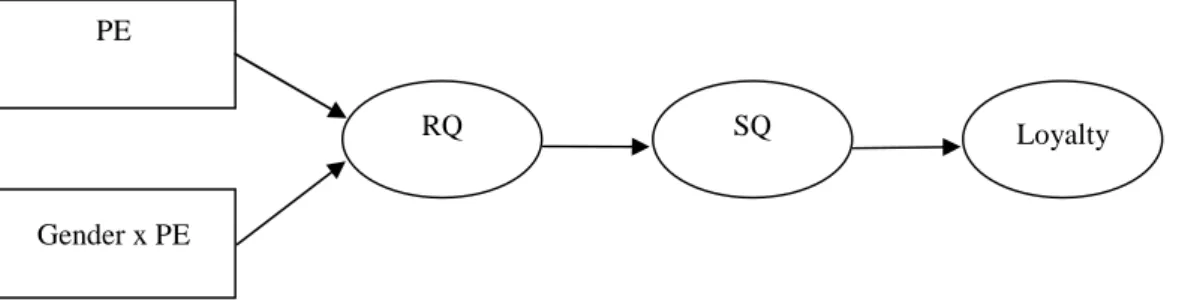
Based on the above literature reviewed, a conceptual model is presented, positing
that personalization of email will enhance relationship quality, thus improving service
quality and ultimately engendering loyalty. Figure 1 exhibits the conceptual model
that links email personalization to relationship quality, service quality and in turn to
loyalty. Personalization of email and gender are the treatments in the experiment
discussed in the following section. Personalization of email and the interaction
between personalization of email and gender are dummy variables in the model. The
model is tested using structural equation modeling. The advantages of using structural
equation modeling with latent variables in experimental research include the ability to
control for measurement error and enhanced ability to test the effects of experimental
Please Insert Fig. 1 Here
Methodology
Research design
Data were gathered using a scenario-based experiment. Weiner (2000) supported
theuseofscenariosto examineserviceencountersbecausescenarios‘‘permit
examination of the variable of most concern and often allow the best theory testing by
enabling theinvestigatorto gatheralltheneeded responses.’’Thescenarios and
elements embedded in emails were constructed to manipulate the personalization
level.
The experimental design comprises two groups: the impersonal group and the
personalized group. Subjects in the impersonal group received emails similar to
emails one would receive when purchasing books online. Subjects in the personalized
group received emails that could be characterized as more friendly, polite, and warm,
closer to emails from a friend or a personal hairdresser. Since a personalized service is
likely to send more emails to their customers than an impersonalized service, subjects
The scenario
Elements of emails, including greetings, the identity of the sender, social chat and
the occasions for sending emails, such as sending a birthday e-card or not, were
manipulated to provide the emails with a particular level of personalization. Online
book purchase was selected as the scenario in this study. Since book purchases are not
dominated by either sex, consumers would not have strong, uniform service employee
gender stereotypes which may influence their preferences and perceptions of service
employees. Additionally, online book purchase is popular among Internet users.
According to a report from the Institute for Information Industry of Taiwan, 47.9% of
online shoppers purchased books in 2005. Moreover, online book purchasing has been
a popular topic of academic research (Evanschitzky et al., 2004). Travel books are
chosen for the current study because they are commonly bought on the Internet and
are familiar to study subjects. Again, purchasing a travel book is gender neutral.
The study scenario assumes that the respondents purchase a travel-related book
from an online bookstore. For the transaction, the retailer sends the respondents
several emails. Upon purchase of the book, the e-retailer sends a confirmation email
indicating that the order has been received and thanking the customer (order
confirmation). At the time of shipping, the e-retailer sends an email telling the
includes an occasion on which the ordered book cannot be shipped according to the
promised schedule, and so the e-retailer sends an email to the customer telling them
that the book will be shipped late (notification of late shipment). In another situation,
the customer ordered a book as a gift for a distant friend. Since the customer
misspelled the shipping address, the book was returned to the e-retailer. Standard
practice for some e-retailers in this situation is to simply credit the account of the
customer without notifying them. Alternatively, the e-retailer can send an email
notifying the customer of the situation and asking the customer what they would like
to do with the book (notification of non-delivery). Without an email notification, the
customer may think that his friend have received and enjoyed reading the book and
only much later discover that the e-retailer has credited his account. A final situation
involves the e-retailer sending a birthday e-card to the customer wishing him a happy
birthday.
Thus, in the online shopping scenario considered, the e-retailer can send five
different types of emails to customers: order confirmation, shipment confirmation,
notification of late delivery, notification of non-delivery and birthday e-card. For the
impersonal level, the e-retailer sends only three emails, i.e., order confirmation,
shipment confirmation, and notification of late delivery. For the personalized level,
Email Contents
Currently, most emails sent by e-retailers to their customers are impersonal. The
absence of two important elements makes emails impersonal: a salutation without the
name of the recipient and a closing without the name of the service employee. In the
presentexperimentalltheimpersonalsalutationswererepresented with “DearValued
Customer”accompanied by theimpersonalclosings“Bestregards,thecompany’s
name.”Furthermore,theemailsincluded no socialinteraction.
Emails that attempt to establish personalized relationships with customers can be
characterized as more similar to emails sent by a friend. Commercial friendship does
exist between customers and their hairstylists (Price & Arnould, 1999). There is no
reason why an e-retailer, when communicating with a customer via the Internet,
cannot be as friendly, or even friendlier than the employee of an offline retailer.
Personalized emails differ from the impersonal ones in several aspects. First,
personalized emails use the name of the recipient name in the initial salutation.
Second, the title and name of the service representative are provided, which conveys
an impression of personal attention. In personalized situations, the consumer knows
the individual who is providing them with services. Moreover, every time the
e-retailer sends an email to the customer, the email is always sent by the same service
for example, a brief explanation is provided as to why the product is in short supply,
such as the author suddenly became very popular because the author just won an
award, and thus will be shipped late. Fourth, a drawback of shopping online as
perceived by consumers is that there is no one to whom questions can be addressed in
the event of a problem. Thus, in their emails the service representative always
reminds the customer that there is a real human being on the other end of the Internet
connection who is ready to help. The purpose is to make the consumers feel that they
have received personal attention from the service employee, rather than just receiving
a task-oriented email generated by the software of the company. Fifth, in the
personalized condition, the service representative also sends a birthday e-card to the
customer.
Subjects and Procedure
Boyer et al. (2002) indicated that print surveys are generally comparable to
electronic surveys. In the present case, a print survey is easier and faster to conduct
than an electronic survey. Emails in the questionnaires were produced in color to
make them resemble the emails respondents would see on a computer screen. The
contents of the emails were first place in Microsoft Outlook and displayed on the
screen. The screens were then captured and reproduced in the questionnaire.
experiment either in the class or in the dormitory lobby. To motivate participation in
the study, each respondent was given a pack of fresh fruit juice, an appropriate
incentive given that the survey was conducted during the hot summer period. Of the
268 questionnaires distributed, 254 complete and usable questionnaires were returned,
representing a 94.7% response rate. The impersonal group consisted of 125
respondents, of which 65 are males and 60 are females. The personalized group
consists of 129 respondents, including 72 males and 57 females. Among the
respondents, 96% of them aged between 19 and 25 years old. Because the university
has high speed connections in every room of the dormitories, three-quarters of
respondents listed surfing the net as their most popular leisure activities.
Participants were randomly assigned to one of the two experimental groups.
Prior to giving a questionnaire to the respondents in the personalized group, the
respondents were asked to indicate their gender preferences for their online service
employee. Respondents were then given a questionnaire in which the service
employee was of the indicated gender. Respondents first read a short description of an
online book purchase scenario followed by email service from the e-retailer. After
reading the scenarios and the associated emails, respondents were asked to complete
Measures
The questionnaire consisted of two sections. Section one explained the scenario
and showed the emails, while section two comprised of measurement items, including
items for manipulation check, and items for measuring relationship quality, service
quality, and loyalty.
Roberts et al. (2003) suggested that relationship quality comprises trust,
satisfaction, commitment and affective conflict. Trust encompasses two essential
elements (Kumar et al., 1995). The first element is trust in the honesty of the company,
namely the belief that the company stands by its word, fulfills promised role
obligations, and is sincere. The second is trust in the benevolence of the partner,
namely the belief that the company is interested in the customer welfare. Items for
measuring trust were taken from Swan et al. (1985), Crosby et al. (1990), and Roberts
et al. (2003). Satisfaction is the summary measure that provides an evaluation of the
quality of all past interactions with the service provider (Crosby et al., 1990). Items
for measuring satisfaction were taken from Crosby et al. (1990) and Roberts et al.
(2003). Commitment indicates an enduring desire to maintain a valued relationship
(Moorman et al., 1992). Items for measuring commitment were taken from Bove &
hostility, frustration and anger towards the company (Kumar et al., 1995). Items for
measuring conflict were obtained from Kumar et al. (1995).
Although SERVQUAL (Parasuraman et al., 1988) is a widely used measure of
service quality, Mittal & Lassar (1996) showed that personalization significantly
influences customer experience and evaluation of service. Thus, the service quality
indicators developed by Mittal & Lassar (1996) provide a basis for evaluating the
influence of service-enhancing factors in this study. Of the four service quality
dimensions proposed by Mittal & Lassar (1996), three are included in this study:
reliability, responsiveness, and personalization. The other dimension, tangibility, was
excluded because subjects had no basis for evaluating the physical environment.
Service quality has been shown to influence consumer loyalty. Items for
measuring consumer loyalty were adapted from Zeithaml et al. (1996). Furthermore,
as most online stores strive for closer communication with virtual customers, two
more additional items were supplemented: the first was the item for measuring
consumer willingness to share information with the firm, while the other was the
measure of consumer willingness to test new services developed by the firm (Roberts
All items were translated into Mandarin and then back translated to ensure the
accuracy of the translation. All items were measured with a seven-point Likert scale,
with -3 indicating strongly disagree and +3 indicating strongly agree.
Results
Manipulation Check
The impersonalized and the personalized groups were presented with different
types and numbers of emails to manipulate different degrees of personalization.
Provided the manipulation was successful, respondents in the two groups should
have different perceptions of email as a medium. Three items: unsociable –sociable,
insensitive –sensitive, cold –warm, which were taken from Short et al. (1976) and
directly related to personalization as defined in this work, were used to check the
manipulation.
The results of manipulation check show that respondents who receive different
emails perceive the email medium differently. Compared with respondents in the
impersonal group, respondents in the personalized group considered email to be more
sociable (on a scale from -3 to 3, mean = -0.10, s.d. = 1.27 vs. mean = 0.26, s.d. =
1.42, t = 2.13, p = .035), more sensitive (mean = -0.23, s.d. = 1.46 vs. mean = 0.54,
s.d. = 1.56, t = 5.06, p = .000). Thus, properly composed emails can be sociable,
sensitive and warm.
Scale Purification
The scales were taken from previous studies to ensure reliability and validity.
However, as Nunnally (1978) noted, one validates not a measuring instrument but
rather some use to which the instrument is put. The instruments still need to be
purified and validated since the items are used in a culture different from that in
which the items originated. Furthermore, the online environment differs from the
offline environments.
Instrument purification began with the computation of coefficient alpha
(Churchill, 1979). The values of the coefficient alpha ranged from 0.81 to .93 across
the dimensions of relationship quality, service quality and loyalty. Despite reasonably
high alpha values when the scales were treated unidimensionally, each of the scales
was factor analyzed. Items with a factor loading below 0.5 and a low item-to-total
correlation were deleted. Table 1 lists the final scales for measuring relationship
quality, service quality and loyalty, along with Cronbach alpha and AVE (average
variance extracted) (Fornell & Larcker, 1981).
Convergent and Discriminant validity
The last column of Table 1 shows that all measures meet the criterion of Fornell
and Larcker (1981) (AVE > 0.5). Since this criterion is conservative, the results show
that the measures have good convergent validity.
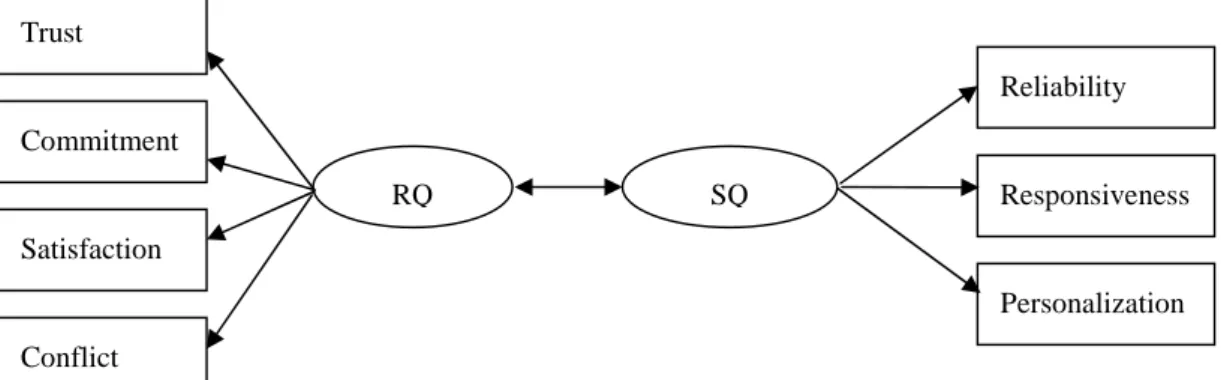
Since relationship quality and service quality are closely related, discriminant
validity has to be established to ensure that relationship quality and service quality are
distinct. The model shown in Fig. 2 was estimated. The model illustrated in Fig. 2 had
good fit with AGFI (adjusted goodness of fit index) of 0.93 and CFI (comparative fit
index) of 0.99, both exceeding the recommended value of 0.9. The Chi-square value
of the model fit is 23.04 with 13 degrees of freedom and p = .041. Two tests can be
employed to check the discriminant validity of the relationship quality and the service
quality scales. First, the latent correlation between relationship quality and service
quality is 0.96 with a standard deviation of 0.1. Since the 95% confidence interval of
the correlation does not include 1 (0.94 to .98), the two constructs are different and
significantly so. Second, a nested model was tested constraining the latent correlation
between relationship quality and service quality to 1. The Chi-square value of the
model fit increased to 33.96 with 14 degrees of freedom, p = .0019. The increase of
loss in model fit. Thus, the two tests demonstrate that relationship quality and service
quality are two distinct constructs.
Please Insert Fig. 2 Here
The Model
The model in Fig. 1 was estimated by reducing the second order models of
relationship quality and service quality to first order models by averaging the items
measuring each of the dimensions of relationship and service quality. This averaging
was made possible by the unidimensionality of the sub-scales (Anderson & Gerbing,
1998). Table 2 lists the covariance matrix of the indicators, along with their means
and standard deviations, which were used to estimate the structural model.
Please Insert Table 2 Here
Model parameters were estimated using the LISREL 8.30 program to test the fit
between the data and the proposed conceptual model. Table 3 presents equations
representing relationships among constructs. The results of the estimation show that
Chi-square = 76.33 with 51 degrees of freedom (p = .012). Since Chi-square is
affected by the large sample size, Chi-square/df = 1.50, which is less than 2,
Approximation (RMSEA) = 0.044, and the p-value for test of close fit (RMSEA < .05)
= .67. Since RMSEA is less than 0.05 and the p-value for test of close fit exceeds 0.5,
the data fit the model well. Other goodness of fit statistics, standardized root mean
square residual = 0.024 (< 0.05), GFI = .95 (> 0.9), AGFI = 0.93 (> 0.9), all indicate
good fit between the data and the model.
Please Insert Table 3 Here
Personalization of email significantly affects relationship quality (γ11= .87, t =
6.45). Relationship quality also significantly affects service quality (β21= 0.97, t =
5.81). Finally, service quality significantly affects loyalty (β32= 0.88, t = 5.47). Thus,
personalization of email results in perceptions of higher relationship quality, service
quality and loyalty, supporting H1.
The interaction effect of the personalization of email and gender on relationship
quality is also significant, though to a lesser degree (γ12= 0.39, t = 2.53). Male gender
was coded as 0, while female gender was coded as 1. Moreover, the group of
impersonal email was coded as 0, while the group of personalized email was coded as
1. The interaction between personalization of emails and gender positively affects
relationship quality, indicating that personalization of emails enhance relationship
Discussions and Implications
Email is a valuable vehicle for enhancing relationships between a company and
its customers, but the role of emails in this area has been neglected by both academic
researchers and practitioners. This study shows that emails can effectively enhance
relationship quality, service quality and loyalty. These results indicate potential areas
for future study. While retail service encounters have received considerable attention,
online interactions between e-retailers and their customers have been relatively
neglected. Previous studies of retail service encounters should be extended to include
e-retail service encounter. Furthermore, social benefits should also be included in
examining the benefits which e-customers in long-term relationships experience.
Though highly correlated, relationship quality and service quality are different
constructs. In the proposed model, personalization of email influences relationship
quality, which in turn influences service quality, and finally loyalty. Some researchers
(e.g., Crosby et al., 1990; Roberts et al., 2003) argued that the service quality
influences relationship quality, rather than the other way around. However, the model
fit indices show poor fit if the data fits a model in which service quality influences
relationship quality (Chi-square = 86.09, RMSEA = .051, p-value for test of close fit
(RMSEA < .05) = .45). The data also show that relationship quality fully mediates the
quality fully mediates the relationship between relationship quality and loyalty. Thus,
a company can build loyal customers only through building good relationships, which
in turn enhance perceived service quality, leading to high loyalty.
In the experiment conducted here, the emails sent to the two experimental groups
differed in whether the emails address the recipient by name, include social chat,
identify the sender, and whether a birthday e-card is sent. Not included in the
experiment is customized personalization, i.e., advising customers on the best form of
service, such as advising the best bank account to use or recommending books based
on customer interests as determined by their previous purchase. Future studies can
examine the impacts of customized personalization on relationship quality, service
quality and loyalty. It is likely that some customers prefer to have customized
personalization while others prefer not to have. Again, asking customers to make a
choice would provide an appropriate means of segmenting the customers.
Nowadays a lot of emails sent by companies to their customers are composed by
software engineers and generated by software in response to an event. The emails
accomplish their purpose of sending a message to a customer. However, these types
of emails are inadequate for a company that wishes to build good customer
relationships. Personalized emails that contain the name of the receipt, a few lines of
Reusable email contents, like reusable software components, can be composed and
reused. Thus, sending personalized emails cost little more than sending impersonal
emails. However, their impacts differ significantly. Thus, it is definitely worthwhile
for companies to personalize their emails.
As predicted, females appreciate their relationship with a company more than
males do. E-retailers thus should pay extra attention to enhancing relationships with
female customers. Since females differ from males in communication style, to
maximize the effectiveness of email communication with customers, emails to
females may be different from those to males; for example, emails to females may be
longer and more frequent than emails to males.
Conclusions
Email is an effective tool for offering social benefits to customers in a
relationship between an e-retailer and its customers. However, in their dealing with
customers, most firms currently consider email simple as a task-oriented
communication medium, neglecting its power in building customer relationships.
From a customer perspective, online shopping thus does not differ significantly from
buying products from a vending machine, completely lack of human touch. However,
online shopping does not have to be this way. This work demonstrates that emails
service quality and engender customer loyalty. Since few e-retailers practice
personalized service, e-retailers who do so can stand out and benefit from improved
References
Adelman, M.B. et al. (1994) Beyond smiling: social support and service quality, in:
R.T. Rust & Oliver (Ed.) Service Quality: New Directions in Theory and Practice,
pp. 139-172 (Thousand Oaks, CA: Sage).
Alajoutsijärvi, K. et al. (2000) Customer relationships and the small software firm: a
framework for understanding challenges faced in marketing, Information &
Management, 37(3), pp. 153-159.
Anderson, J.C., & Gerbing, D.W. (1998) Structural equation modeling in practice: a
review and recommended two-step approach, Psychological Bulletin, 103(3), pp.
411-423.
Berry, L.L. (1995) Relationship marketing of services –growing interest, emerging
perspectives, Journal of the Academy of Marketing Science, 23(4), pp. 236-245.
Bharatia, P., & Bergb, D. (2005) Service quality from the other side: information
systems management at Duquesne Light, International Journal of Information
Management, 25(4), pp. 367-380.
Binter, M.J. (1990) Evaluating service encounters: the effect of physical surroundings
and employee responses, Journal of Marketing, 54(2), pp. 69-82.
Bolton, R.N., & Drew, J.H. (1991) Multistagemodelofcustomers’assessmentsof
Bove,L.L.,&Johnson, L.W.(2001) Customer relationships with service personnel:
do we measure closeness, quality or strength? Journal of Business Research,
54(3), pp. 189-197.
Boyer, K.K. et al. (2002) Print versus electronic surveys: a comparison of two data
collection methodologies, Journal of Operations Management, 20(4), pp.
357-373.
Brady, M.K.,& Cronin, J. Jr. (2001) Some new thoughts on conceptualizing
perceived service quality: a hierarchical approach, Journal of Marketing, 65(3),
pp. 34-49.
Burke, R.R. (2002) Technology and the customer interface: what consumers want in
the physical and virtual store, Journal of the Academy of Marketing Science,
30(4), pp. 411-432.
Carlson, C. (2000) Customer service: an essential component for a successful web site,
Marketing Health Services, 20(2), pp. 28-31.
Chilcoat, Y. & DeWine, S. (1985) Teleconferencing and interpersonal communication
perception, Journal of Applied Communication Research, 13(1), pp. 14-32.
Churchill, G.A. Jr. (1979) A paradigm for developing better measures of marketing
constructs, Journal of Marketing Research, 16(1), pp. 64-73.
influence perspective, Journal of Marketing, 54(3), pp. 68-81.
DoubleClick, (2005) http://www.doubleclick.com/us/about_doubleclick/press_
releases/default.asp?p=534, accessed on Feburary 4, 2007.
Eagly, A.H. et al. (2000) Social role theory of sex differences and similarities: A
current appraisal, In T. Eckes & H.M. Trautner (Ed.) The developmental social
psychology of gender, pp. 123-174 (Mahwah, NJ: Erlbaum).
Evanschitzky, H. et al. (2004) E-satisfaction: a re-examination, Journal of Retailing,
80(3), pp. 239-247.
Fornell, C. & Larcker, D.F. (1981) Evaluating structural equation models with
unobservable variables and measurement error, Journal of Marketing Research,
18(1), pp. 39-50.
Gefen, D. & Straub, D.W. (1997) Gender difference in the perception and use of
e-mail: An extension to the technology acceptance model, MIS Quarterly, 21(4),
pp. 389-400.
Godwin, M. (1994) ASCII is too intimate, Wired, 2.04,
http://wired.com/wired/archive/2.04/idees.fortes1.htmln
Gwinner, K.P. et al. (1998) Relational benefits in services industries: the customer’s
perspective, The Journal of Academy of Marketing Science, 26(2), pp. 101-114.
communities, Harvard Business School Press, Boston, MA.
Hochschild, A.R. (1983) The Managed Heart (Berkeley, CA: University of California
Press).
Kalyanam, K. & Shelby, M. (2002) The E-marketing mix: a contribution of the
E-tailing, Journal of the Academy of Marketing Science, 30(4), pp. 487-499.
Kandampully, J. (1998) Service quality to service loyalty: A relationship which goes
beyond customer services, Total Quality Management, 9(6), pp. pp. 431-443.
Kolesar, M.B. & Galbraith, R.W. (2000) A services-marketing perspective on
e-retailing: implications for e-retailers and directions for further research, Internet
Research: Electronic Networking Applications and Policy, 10(5), pp. 424-438.
Kumar, N. et al. (1995) The effects of supplier fairness on vulnerable resellers,
Journal of Marketing Research, 32(1), pp. 54-65.
Lee A. (1994) Electronic mail as a medium for rich communication: an empirical
investigation using hermeneutic interpretation, MIS Quarterly, 18(2), pp.
143-157.
Loveman, G. (2003) Diamonds in the Data Mine, Harvard Business Review, 81(5), pp.
109-113.
MacKenzie, S.B. (2001) Opportunities for improving consumer research through
28(1), pp. 159-166.
Martin, B.A.S. et al. (2003) Email advertising: exploratory insights from Finland,
Journal of Advertising Research, 43(3), pp. 293-300.
Meyers-Levy, J. & Sternthal, B. (1991) Gender differences in the use of message cues
and judgments, Journal of Marketing Research, 28(1), pp. 84-96.
Mick, D.G. & Fournier, S. (1998) Paradoxes of technology: consumer cognizance,
emotions, and coping strategies, Journal of Consumer Research, 25(2), pp.
123-143.
Mittal, B. & Lassar, W.M. (1996) The role of personalization in service encounters,
Journal of Retailing, 72(1), pp. 95-109.
Moorman, C. et al. (1992) Relationships between providers and users of market
research: The dynamics of trust within and between organizations, Journal of
Marketing Research, 29(3), pp. 314-328.
Nunally, J.C. (1978) Psychometric Theory, 2nd ed., (New York, NY: McGraw-Hill).
Oliver, R.L. (1999) Whence Consumer Loyalty? Journal of Marketing, 63(Special
Issue), pp. 33-44.
Palmer, A. & Bejou, D. (1995) Buyer-seller relationships: A conceptual model and
empirical investigation, Journal of Marketing Management, 10(6), pp. 495-512.
40(2), pp. 75-86.
Parasuraman, A. et al. (1988) SERVAQUAL: a multiple-item scale for measuring
consumer perceptions of service quality, Journal of Retailing, 64(1), pp. 12-40.
Parasuraman, A. et al. (2005) E-S-QUAL: a multiple-item scale for assessing
electronic service quality, Journal of Service Research, 7(3), pp. 213-233.
Peppers, D. & Rogers, M. (1993) The one to one future (New York, NY: Doubleday).
Phillip, M.V. & Suri, R. (2004) Impact of gender differences on the evaluation of
promotional emails, Journal of Advertising Research, 44(6), pp. 360-368.
Price, L.L. & Arnould, E.J. (1999) Commercial friendships: service provider –client
relationships in context, Journal of Marketing, 63(4), pp. 38-56.
Roberts, K. et al. (2003) Measuring the quality of relationships in consumer services:
an empirical study, European Journal of Marketing, 70(1), pp. 169-196.
Schiffman, L.G. et al. (2003) Toward a better understanding of the interplay of
personal values and the Internet, Psychology & Marketing, 20(2), pp. 169-186.
Short, J. et al. (1976) The social psychology of telecommunications (New York, NY:
John Wiley & Sons).
Snyder, M. et al. (1977) Social perception and interpersonal behavior: On the
self-fulfilling nature of social stereotypes, Journal of Personality and Social
Solomon, M.R. et al. (1985) A role theory perspective on dyadic interactions: the
service encounter, Journal of Marketing, 49(1), pp. 99-111.
Surprenant, C.F. & Solomon, M.R. (1987) Predictability and personalization in the
service encounter, Journal of Marketing, 51(2), pp. 86-96.
Swan, J. E. et al. (1985) How industrial salespeople gain customer trust, Industrial
Marketing Management, 14(3), pp. 203-11.
Tannen, D. (1994) Gender & Discourse (New York, NY: Oxford University Press).
Teo, T.S.H. (2005) Usage and effectiveness of online marketing tools among
business-to-consumer (b2c) firms in Singapore, International Journal of
Information Management, 25(3), pp. 203–213.
Verhoef, P.C. (2003) Understanding the effect of customer relationship management
efforts on customer retention and customer share development, Journal of
Marketing, 67(4), pp. 30-45.
Walther, J.B. (1994) Anticipated ongoing interaction versus channel effects on
relational communication in computer-medicated interaction, Human
Communication Research, 20(4), pp. 473-501.
Walther, J.B. (1996) Computer-mediated communication: impersonal, interpersonal,
and hyperpersonal interaction, Communication Research, 23(1), pp. 3-43.
Consumer Research, 27(3), pp. 382–387.
Yen, H.J.R., & Gwinner, K.P. (2003) Internet retail customer loyalty: the mediating
role of relational benefits, International Journal of Service Industry Management,
14(5), pp. 483-500.
Zeithaml, V.A. et al. (1996) The behavioral consequences of service quality, Journal
of Marketing, 60(2), pp. 31-46.
Zeithaml, V.A. (2002) Service excellence in electronic channels, Managing Service
Quality, 12(3), pp. 135–138.
Zviran, M. et al. (2006) User satisfaction from commercial web sites: the effect of
PE = Personalization of email RQ = Relationship Quality SQ = Service Quality
Fig. 1. Conceptual Model PE
RQ SQ Loyalty
Trust= Trust in Integrity Honesty Commitment= Affective Commitment Conflict= Affective Conflict
RQ=Relationship Quality SQ=Service Quality
Fig. 2. Confirmatory factor analysis model for testing discriminant validity RQ Trust Commitment Satisfaction Conflict Reliability Responsiveness Personalization SQ
Table 1
Items for measuring relationship quality, service quality and loyalty and item quality
Items Cronbach
Alpha
AVEa
Relationship Quality
Trust in Integrity Honesty
1. My service provider is honest about problems. 2. My service provider has high integrity.
3. My service provider is trustworthy.
0.91 0.77
Affective Commitment
1. I continue to deal with my service provider because I like being associated with them. 2. I continue to deal with my service provider
because I genuinely enjoy my relationship with them.
0.86 0.76
Satisfaction
1. I am happy with the performance of my service provider.
2. I am content with the performance of my service provider.
0.92 0.86
Affective Conflict
1. I am angry with my service provider. 2. I am frustrated with my service provider. 3. I am annoyed with my service provider.
0.92 0.79
Service Quality Reliability
1. My service provider can provide the promised service dependably.
2. My service provider can perform the promised service accurately.
3. My service provider can perform the service right the first time.
0.87 0.70
Responsiveness
1. My service provider is willing to help customers. 2. My service provider gives me prompt service 3. My service provider is always ready to respond to
your request.
Personalization
1. My service provider is polite and courteous. 2. My service provider display personal warmth 3. My service provider gives customers individual
attention
4. My service provider is friendly and pleasant. 5. My service provider takes the time to know me
personally.
0.95 0.80
Loyalty 0.92 0.81
1. If I had to purchase similar products in the future, I would like to purchase them from this service provider.
2. I regularly consider purchasing additional services from this service provider.
3. I will consider testing new products or services recommended by this service provider.
Table 2
Covariance matrix for analyzing the conceptual model
1 2 3 4 5 6 7 8 9 10 11 12 13 1. Personalization of email 0.251 -0.010 0.111 0.252 0.233 0.319 -0.296 0.210 0.221 0.300 0.253 0.224 0.227 2. Gender -0.010 0.249 0.122 0.033 0.056 0.069 -0.009 0.034 0.051 0.060 0.055 0.044 0.061 3. Interaction of PE and Gender 0.111 0.122 0.175 0.139 0.160 0.209 -0.150 0.143 0.143 0.184 0.155 0.152 0.153 4. Honesty 0.252 0.033 0.139 1.359 1.010 1.187 -0.883 0.896 0.877 1.027 0.893 0.765 0.884 5. Commitment 0.233 0.056 0.160 1.010 1.247 1.172 -0.899 0.891 0.851 1.010 0.959 0.826 0.923 6. Satisfaction 0.319 0.069 0.209 1.187 1.172 1.664 -1.121 1.021 0.961 1.225 1.115 1.007 1.036 7. Conflict -0.296 -0.009 -0.150 -0.883 -0.899 -1.121 1.671 -0.735 -0.752 -0.948 -0.897 -0.731 -0.833 8. Reliability 0.210 0.034 0.143 0.896 0.891 1.021 -0.735 1.230 0.844 0.913 0.914 0.786 0.840 9. Responsiveness 0.221 0.051 0.143 0.877 0.851 0.961 -0.752 0.844 1.149 0.957 0.831 0.740 0.824 10. Personalization 0.300 0.060 0.184 1.027 1.010 1.225 -0.948 0.913 0.957 1.381 1.025 0.888 0.979 11. Loyalty1 0.253 0.055 0.155 0.893 0.959 1.115 -0.897 0.914 0.831 1.025 1.345 1.117 1.113 12. Loyalty2 0.224 0.044 0.152 0.765 0.826 1.007 -0.731 0.786 0.740 0.888 1.117 1.295 1.043 13. Loyalty3 0.227 0.061 0.153 0.884 0.923 1.036 -0.833 0.840 0.824 0.979 1.113 1.043 1.415 Mean 0.508 0.461 0.224 1.358 0.931 1.030 -1.000 0.980 1.018 1.057 1.240 1.220 1.252 Standard Deviation 0.501 0.499 0.418 1.166 1.117 1.290 1.293 1.109 1.072 1.175 1.160 1.138 1.189 Note: Personalization of email is coded as 0 for the impersonal group and 1 for the personalization group
Gender is coded as 0 for male and 1 for female
Table 3
Equations representing relationships among constructs
RQ = 0.87 * PE + 0.39 * (PE x Gender)a R2= 0.29 (0.14)b (0.16) 6.45** 2.53** SQ = 0.97 * RQ R2= 0.93 (0.17) 5.81** Loyalty = 0.88 * SQ R2= 0.77 (0.16) 5.47**
Note: a(PE x Gender) represents the interaction of personalization of email and gender.
b
The number in parenthesis represents the standard deviation.
**