國
立
交
通
大
學
運輸科技與管理學系
博
士
論
文
旅行者潛在構面之量測:車輛使用依賴性
之探索與老年人搭乘公車能力感認之衡量
Measuring the Latent Traits of Travelers:
Exploring the Vehicle Dependence and Evaluating the
Perceived Physical Abilities of the Elderly Bus Passengers
研 究 生:吳舜丞
指導教授:張新立 教授
旅行者潛在構面之量測:車輛使用依賴性
之探索與老年人搭乘公車能力感認之衡量
Measuring the Latent Traits of Travelers: Exploring the Vehicle
Dependence and Evaluating the Perceived Physical Abilities of the
Elderly Bus Passengers
研 究 生:吳舜丞 Student:Shun-Cheng Wu
指導教授:張新立 Advisor:Hsin-Li Chang
國 立 交 通 大 學
運 輸 科 技 與 管 理 學 系
博 士 論 文
A DissertationSubmitted to Department of Transportation Technology and Management College of Management
National Chiao Tung University In Partial Fulfillment of the Requirements
for the Degree of
DOCTOR OF PHILOSOPHY
in
Transportation Technology and Management By
Shun-Cheng Wu
Hsinchu, Taiwan, Republic of China
旅行者潛在構面之量測:車輛使用依賴性之探索與老年人搭乘公車能力感認之衡量 學生:吳舜丞 指導教授:張新立博士 國立交通大學運輸科技與管理學系
摘要
本研究之主要目的是針對文獻上未有完整架構與常模之潛在構面進行探索並加以量 測。包含兩個影響旅行者交通行為之潛在構面之探索。一為一般旅行者對於車輛使用之 依賴性,另一則為老年人對於自己搭乘公車之行為能力感認。 關於車輛使用依賴性之探索,本研究認為該構面乃是一綜合經濟考量、心理偏好與 習慣制約之潛在心理評價。由於旅行者少有察覺並能清楚表示自己之車輛使用依賴程 度,故本研究採用項目反應理論之探討架構,由各種旅次目的設計負面剝奪性問項以刺 激旅行者對於該車輛使用之依賴性。同時以Rasch 模式將收集得資料進行對該依賴性構 面之測量。為驗證本研究提出之測量方法之有效性,實證研究針對台北市機車騎士進行 其對機車使用之依賴性。並將各人所量測得之機車依賴水準連結至其社經變數以作進一 步探討。實證研究中發現台北市民在單人旅次、短程旅次與多停點旅次對機車之依賴行 為較高,而年齡較輕者、收入較低者與無汽車可使用之機車騎士對機車依賴性顯著較 高。由於此欲探討之車輛使用依賴性乃透過有效且可靠的施測方法加以收集並衡量,量 測之結果亦建立在等距尺度上,可直接引入為傳統模型之解釋變數。本研究之探索相信 將可提供傳統個體選擇模型引入心理層面考量為變數探討之借鏡,使模型解釋能力更高 並進而提升其預測能力。 本研究第二個主題則針對老年人對自己搭乘公車之行為能力感認加以探討。由於高 齡化社會慢慢形成,老人之外出行為需求亟需重視並加以安排。受限於身體機能退化, 老人自己駕駛小客車或騎乘機車或自行車之危險性相較於年輕人高出甚多,搭乘公車不 但能確保老人安全,同時亦是較有效率之社會經濟資源配置。本研究以老年人之觀點出 發,藉由搭公車過程所需要完成之各種動作,由老人自行評估其完成各類動作之掌握程 度。藉由測驗理論方法,測度各項動作之相對難度。實證研究結果發現老年人在公車運 行過程中之平衡感之保持與閱讀車站資訊及辨識來車路線號碼上最感到困難。本研究更 針對這些較為老年人感到困難之項目,對公車系統之設施與服務上提出具體之改善建 議。希望能為老人建立一個更為安全且友善之公車搭乘環境,以吸引更多老人利用公車 進行旅行活動。 關鍵詞:潛在構面、心理量測、羅許模型、車輛依賴性、行為能力感認Measuring the Latent Traits of Travelers: Exploring the Vehicle Dependence and Evaluating the Perceived Physical Abilities of the Elderly Bus Passengers
Student: Wu, Shun-Cheng Advisor: Dr. Chang, Hsin-Li
Department of Transportation Technology and Management National Chiao Tung University
ABSTRACT
This study aims to demonstrate the exploration and measurement on two latent traits that underlie the travelers’ considerations. One of these two latent traits is the vehicle dependence of the travelers on a given vehicle usage; the other is the physical ability perceived by elderly travelers when using buses. In the first topic, vehicle dependence is conceptualized as the subjective considerations of individual travelers, including their economic considerations, psychological preference, and habitual behavior. The Rasch model is reviewed, and suggested as an instrument to measure such a latent construct. An empirical analysis of motorcycle dependence was performed using self-rated information about eight items from 321 motorcyclists in Taipei. The empirical results showed that motorcyclists in Taipei depend on their motorcycles to achieve unaccompanied, short-distance, multistop trips; motorcyclists under the age of 25 who were inferior in economic terms and did not use an automobile showed relatively higher measures of motorcycle dependence. This paper robustly conceptualizes vehicle dependence in terms of both its socioeconomic and its psychological nature. The results of exploring vehicle dependence could benefit researchers in modifying their formulations of mode choice, and policy makers in enacting more effective policies.
In the second topic, it is proposed to measure the elderly bus passengers’ abilities and to explore their difficulties in accomplishing the actions and motions required to patronize the bus service. A conceptual framework about the required actions and motions in bus taking was established and a questionnaire with 18 items was designed to test their ability to use buses. A face-to-face survey was conducted to collect the self-rated information from 304 elderly bus passengers in Taipei. The Rasch model was applied to estimate the difficulty of each item and the ability of each person to use buses. Results showed the relatively difficult items are mostly about keeping balance on the moving bus and reading the information or discerning the approaching buses at the stations, and the considered levels of physical ability showed negative associated with respondents’ age. With relating the measures of person ability and item difficulty, the item-person map provides a straightforward and graphical illustration on the corresponding proportion of elderly bus passengers that can achieve in each given item with ease. Results from this study will help the traffic authorities or bus service providers in issuing instructions or enhancing the facilities and service to provide the elderly with a safer and friendlier environment for bus usage.
KeyWords: latent construct, psychometric measure, Rasch model, vehicle dependence, physical ability perception
誌 謝
如果將來的我能有什麼成就,完全得感謝恩師 張新立教授。從我進入研究所階段 開始,張老師便不遺餘力地指導著我。何其漫長的歲月中,甚多時候我曾感到徬徨猶豫, 而老師對我的激勵與不放棄,讓我在這段攻讀博士的過程能一直堅持下去。面對學業與 生活的雙重壓力,老師不但給了我很大的彈性去揮灑,同時仍將最主要的資源挹注在我 身上,並用了最多的時間與精力,指正我的觀念,增修我的論文,才讓我今天有這樣的 成果。張老師對我的付出如再造之恩,學生永銘五內。 論文口試期間,承蒙台灣師大王國川教授、南台科技大學李治綱教授、中央大學陳 惠國教授、本校馮正民教授、卓訓榮教授與任維廉教授的審閱與斧正,使得論文能更加 充實與完備,在此致上最深的謝意。博士攻讀過程中,中興大學蔡明志老師、成功大學 黃國平老師,以及本系吳宗修老師、郭秀貴老師都曾在我跌跌撞撞的時刻給予我扶持與 關心。從就讀運管系大學部開始,本系所有老師對於我在交通專業的啟迪,亦是本篇論 文得以完成之基石。求學過程於交大籃球隊受到本校盛育奎老師與宋濤教練之照顧,尤 其宋教練給予我許多生涯觀念的啟發,亦讓我埋下心理計量研究的種子。此外本系王秀 蔭、鄭幸榮助理,以及許許多多曾經協助過我的人,在此一併致上無盡感謝。 求學階段,研究室成員給予我許多關心與協助。葉純志、葉祖宏、范植谷等在我之 前畢業的學長給我過來人的經驗分享與建議令我十分受用。政樺、賓權、來順、晉光、 馨文、昌谷等博士班同學在一起研討的腦力激盪與思想辯證,亦讓我獲益不少。此外最 後衝刺階段研究室舜棠、美珍、翰澤、祈延、政瑋、維唐、紳富、政凡、士勛、怡安與 哲聖等學弟妹給予我許多支援與協助,讓我深深享受在這個研究團隊裡的美好時光。另 外生活上前後有凱傑、業傑、育婷同學;堂榮、明穎、惟正、允皓、學樺學弟的陪伴, 以及許許多多本校籃球隊與本系的前後期等學弟妹與關心我的朋友們,謝謝你們,才讓 我在這條路上走來感覺到一點都不孤單。 最後,要感謝的是所有關心我的親人,尤其是我的父母。從小給予我無匱乏的成長 環境,讓我跟其他人有相同的競爭基礎。長大後在外求學,一年裡少有幾天能回家陪伴 你們。在同齡的朋友都已成家立業奉養父母的這個年紀,你們不但支持我追尋夢想而毫 無怨言的等待著,還給了我最多的包容與關愛。這份榮耀,是屬於你們的! 吳舜丞 謹誌 中華民國97 年 1 月 29 日Contents
Abstract (Chinese) ...i
Abstract……. ...ii
Acknowledgement...iii
Contents...…. ...iv
List of Figures ...vi
List of Tables. ...vii
CHAPTER 1 Introduction ... - 1 -
1.1 Research Motivations ... - 1 -
1.2 Research Objectives ... - 4 -
1.3 Overview of Thesis... - 7 -
1.4 Research Contributions ... - 7 -
CHAPTER 2 Literature Review ... - 9 -
2.1 Development of the Concept on the Vehicle Dependence ... - 9 -
2.2 Conceptual Framework of the Perceived Physical Ability of the Elderly Passengers When Using Buses ... - 11 -
CHAPTER 3 Methods for Measuring a Latent Trait ... - 15 -
3.1 Review of Item Response Theory ... - 15 -
3.2 Brief Introduction of the Rasch Model... - 17 -
3.2.1 Formulation of the Rasch model ... - 18 -
3.2.2 Parameter estimation of the Rasch model ... - 20 -
3.2.3 Reliability and validity statistics in the Rasch model... - 22 -
CHAPTER 4 Exploring the Vehicle Dependence behind Mode Choice: Empirical Evidence of Motorcycle Dependence in Taipei... - 26 -
4.1 Questionnaire Design for Gathering Vehicle Dependence ... - 26 -
4.2 Concept for Applying the Rasch Model for Measuring the Vehicle Dependence... - 27 -
4.3 Design of the Empirical Exploration on Motorcycle Dependence... - 29 -
4.3.1 Background on transportation in Taipei ... - 30 -
4.3.3 Data collection... - 32 -
4.3.4 Application of Rasch analysis... - 33 -
4.4 Findings and Interpretations ... - 35 -
4.4.1 Findings for item parameters... - 35 -
4.4.2 Findings for person parameters ... - 38 -
4.5 Discussion... - 42 -
CHAPTER 5 Exploring the Elderly Passengers’ Physical Abilities and Difficulties When Using Buses... - 46 -
5.1 Concept for Applying the Rasch Model for Measuring the Perceived Physical Ability of the Elderly Bus Passengers ... - 46 -
5.2 Design of Empirical Study on the Exploration of the Physical Ability Perceived by the Elderly Bus Passengers... - 47 -
5.2.1 Questionnaire design for gathering the latent information... - 48 -
5.2.2 Data collection... - 48 -
5.2.3 Application of the Rasch measurement model ... - 50 -
5.3 Findings and Interpretations ... - 51 -
5.3.1 Findings from item parameters... - 51 -
5.3.2 Findings from person parameters ... - 54 -
5.4 Discussion... - 59 -
CHAPTER 6 Conclusion and Future Study ... - 62 -
6.1 Conclusion... - 62 -
6.2 Suggestion for Future Study ... - 65 -
REFERENCE ... - 68 -
List of Figures
Fig. 1-1 Proportion of mode choice for the Taiwan elderly people at different range
of age ... - 4 - Fig. 4-1 Conceptual example of travelers’ automobile dependence, and inherent
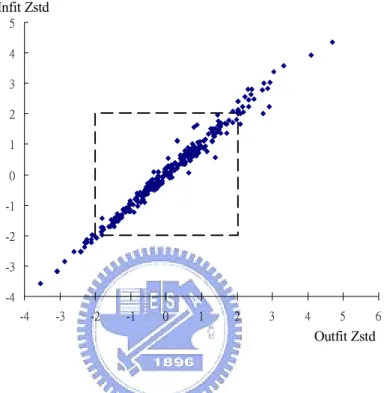
resistance against automobile driving for various trip purposes. ... - 29 - Fig. 4-2. Scatter plot of infit and outfit statistics for estimates of person measures. ... - 40 - Fig. 5-1. Item-person map for the responded elderly bus passengers ... - 55 - Fig. 5-2. Distribution of the ages and ability measures of the responded elderly bus
List of Tables
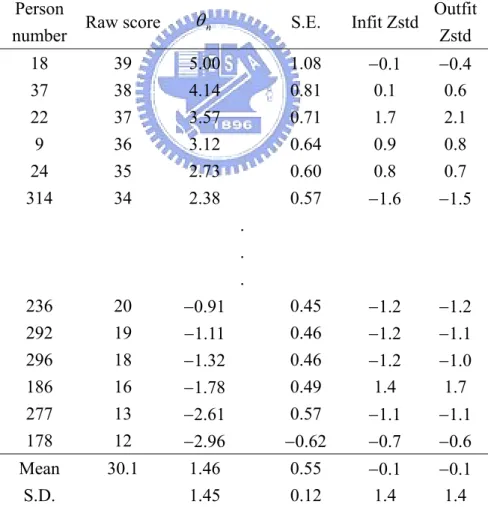
Table 4-1 Content of the questionnaire for motorcycle dependence ... - 31 - Table 4-2 Model estimation and fit statistics obtained from Rasch analysis... - 34 - Table 4-3 Estimates of item measures and fit statistics from Rasch analysis... - 36 - Table 4-4 Summarized estimates of person parameters and fit statistics from Rasch
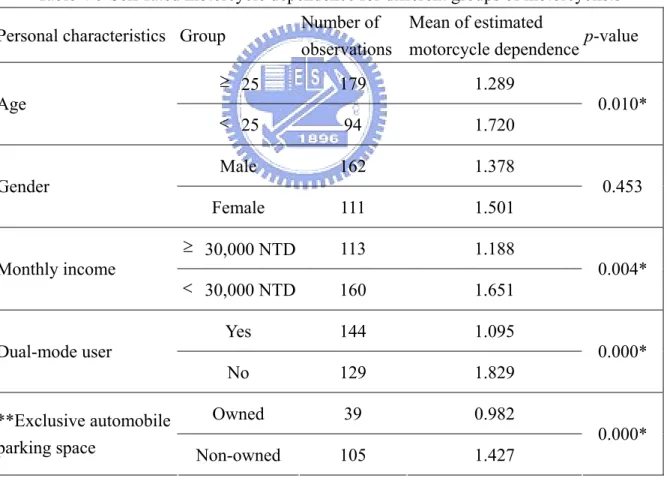
analysis ... - 39 - Table 4-5 Self-rated motorcycle dependence for different groups of motorcyclists ... - 41 - Table 5-1 Content of the questionnaire for perceived physical ability of elderly bus
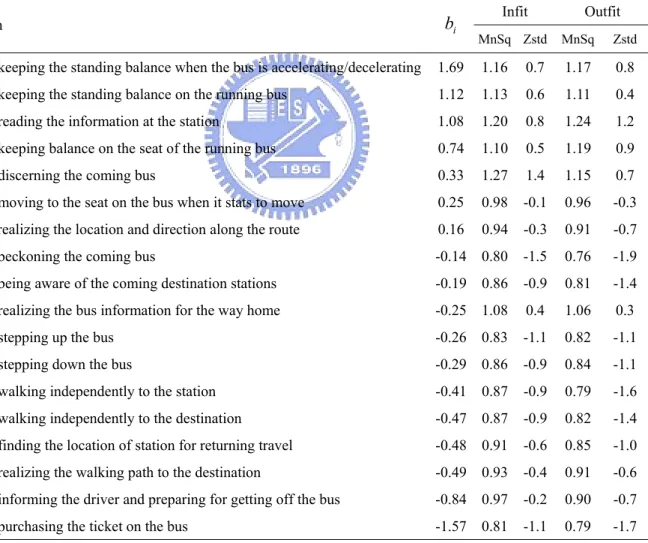
passengers... - 49 - Table 5-2 Model estimation and fit statistics obtained from the Rasch analysis... - 51 - Table 5-3 Estimates of item measures and fit statistics from Rasch analysis... - 52 -
CHAPTER 1
Introduction
This study respectively measures two latent constructs behind travelers’ considerations: the vehicle dependence of motorcyclists and the physical ability perceived by the elderly bus passengers. The first topic is aimed to identify and to measure the generalized latent construct of travelers’ dependence on the given vehicles. It is aimed to conceptualize the vehicle dependence which can be applied in the researches of the mode choice behavior. The second topic is an explorative trial to realize how the senior bus passengers perceive their own physical abilities when using buses. Such a self-assessment of elderly passengers on their own physical abilities plays a critical role on their willingness of bus patronage. Both of these two concerned issues are seldom discussed on the literatures. Thus in the beginning of this thesis, we will start with the introduction of this research, including the motivations, objectives, and contributions of this study in the following parts.
1.1 Research Motivations
In the first topic, the motivation of exploring the vehicle dependence was originated from the mergence of econometric formulations and psychological viewpoints on the mode choice of travelers. The mode choice of travelers has commonly been analyzed in the framework of random utility theory since that theory was introduced (Domencich and McFadden, 1975). However, most mode choice studies have been formulated only in terms of observable economic variables, and this has resulted in a limitation of their predictive abilities. Kahneman et al. (1979) found that individuals facing decision-making tasks in carefully constructed experimental settings often exhibited behavior that was inconsistent with a
prediction based on economic variables, and indicated that some unexplored factors other than the observable economic factors might also influence one’s choice. Gilbert and Foerster (1977) argued that attitudinal variables were important in decisions about mode choice and could significantly increase the explanatory power of mode choice models. Collins and Chambers (2005) tested the relative importance of and relationship between psychological and situational factors in predicting mode choice in commuter transport; they found that psychological beliefs played roles as important as situational conditions. Ben-Akiva et al. (1999) reviewed the literature and pointed out that choice behavior can be characterized as a decision process that is informed by perceptions and beliefs about the available information and is influenced by psychological factors such as affects, attitudes, motives, and preferences. The final choice could be regarded as an outcome of a complicated decision process.
In addition to economic concerns, travelers might be forced to make or willing to make particular mode choices, or could be habituated to those choices. Mode choice could be the combined result of travelers’ economic concerns, psychological preference, and habitual behavior. That is to say, people might have some degree of reliance on the usage of one specific vehicle owing to both objective constraints and subjective considerations. Therefore, the term “vehicle dependence” was defined as people’s reliance on the usage of a specific vehicle in the study described here, and it is expected to provide another auxiliary measure for exploring mode choice. Exploring the vehicle dependence provides valuable knowledge not only for understanding mode choice, but also for implementing transportation policy. This realization provides an insight into the needs of people for achieving their daily activities, and helps to identify the impact on travelers before a new transportation policy is implemented.
The second topic is concerned about the appropriate arrangement or assistance for the senior people in their daily transportation. Population aging commonly occurs in many
developed countries. In these aging societies, it was found that senior people (aged over 65) increasingly participate in some outdoor activities in order to maintain their social connections and receive emotional feedback (Unger & Wandersman, 1985). However, these demands for outdoor activity might not be accomplished because their travel options are somehow constrained. Golob (2000) found that elderly people’s non-home activities and total time spent on traveling are negatively associated with their age. About 21% of Americans aged over 65 do not drive and more than half of these non-drivers aged over 65 (i.e. about 3.6 million Americans) stay at home all day partially due to lack of transportation options (Bailey, 2004). The limitations on elderly people’s travel options might be mainly resulted from the decline in their physical ability. Increased age is associated with declines in some physical abilities such as perceptual mechanism (i.e. vision and hearing), cognitive performance (i.e. memory and attention), and physical strength (i.e. balancing and clutching). Decrease in physical ability deters the elderly from road using in some degree.
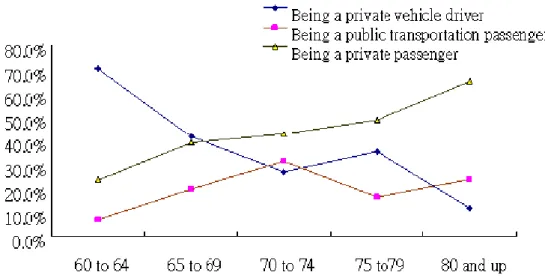
Limitations on physical abilities force the elderly to make some changes in their mode choices. Rosenbloom (1995) found that, as the age of the elderly traveler increased, traveling as a passenger increased significantly, while making trips as a driver decreased. Chang and Wu (2005) also showed that, as the elderly travelers become older, they tend to select some conservative ways to travel such as taking buses, taking taxies, or hitching the rides of their family members or friends (See Fig.1-1). Similar to the other two options, traveling by bus avoids tackling the traffic directly, which will reduce a large proportion of the potential risk of accidents for elderly travelers. Traveling by buses is more economical than by taxies in expense; it also enables the elderly to travel independently without bothering or matching somebody’s trips. Traveling by buses therefore is quite appropriate for the elderly, especially for the younger elderly people (aged 65-75) who might have frequent participation in some outdoor activities.
Fig. 1-1 Proportion of mode choice for the Taiwan elderly people at different range of age (Chang and Wu, 2005)
Encouraging younger elderly people to take buses is also regarded as an efficient management of social resource from the viewpoints of whole society. Elderly travelers are seldom peak-hour commuters; their patronage to bus service will effectively make use of the idled capacity of bus system during off-peak hours and bring about significant marginal benefit in saving the social cost of caring themselves. Most of traffic authorities in developed countries have enacted some fare-discount or free-taking acts for encouraging the elderly to patronize the bus service. However, using fare-discount incentives to encourage the elderly to travel by bus is just a naively unilateral willingness since the decrease of physical abilities might hinder the elderly from taking buses and make them select some ways of travel instead. Elderly people, constrained by some forms of physical disability, might also encounter some difficulties in necessary actions or motions when taking buses. If elderly people’s concerns in these necessary actions or motions for bus taking can be explored, the traffic authorities or bus service providers can then issue instructions or enhance the facilities or service to provide the elderly with a safer and friendlier environment for bus usage.
Traveler behavior is an important issue that has been widely discussed in the transportation research area. The related researchers have paid countless efforts to chase the key for explaining the revealed behavior of an individual. In the 80s, travelers’ behavior was mostly discussed under the framework of the random utility theory. Since the 90s, many studies had recognized that some psychological factors, such as attitude, belief, motives, and perception, also play important roles in explaining the choice of a decision maker (Ben-Akiva et al., 1999). Many psychological factors were thus introduced and discussed as the explanatory variables in the discussion of travelers’ behavior.
Since the psychological constructs have been recognized as significant factors that influence travelers’ behavior, more and more researchers in transportation have put their attentions on the relationship between one’s latent consideration and his/her revealed behavior. After plenty of related studies were conducted, one was left to question that: did we obtain convincible and comparable measures on the related latent constructs? Such a challenge on the measurement is critical, especially for those unexplored latent constructs which have no normalized scales (the norms) to serve as a reference of measurement. In practice, researchers usually measure such latent constructs by collecting the respondents’ opinions, and these opinions are mostly presented by items with ordinal scales (e.g. the Likert scale) in some formed questionnaires. If these ordinal categories in the items were naively assigned with some incremental integers, such integers can only represent the rank among categories in a single item and has limitations in the statistical inference. For this sake, the whole study is aimed to demonstrate the approaches how to measure a new-specified latent construct, especially for ensuring the assessment on the trait level could serve as reasonable and effective factors for further statistical inference.
the concepts on vehicle dependence from the literatures, and then conceptualized our viewpoint on the vehicle dependence. An appropriate approach to measuring travelers’ vehicle dependence was then suggested; we proposed a study based on this approach. For ensuring the idea and the findings would be convincing, an empirical study on the motorcycle dependence of motorcyclists would be then conducted. It was believed that he results of exploring vehicle dependence would benefit researchers in modifying their formulations of mode choice, and policy makers in enacting more effective policies.
In the exploration on perceived physical ability of elderly bus passengers, this study aims to develop an approach to measure the elderly passengers’ ability of taking buses and explore the possible difficulties they will face along their bus-taking trips. A conceptualized framework for the actions and motions required for bus taking was first established, and a questionnaire was then designed to collect the required data to evaluate the relative difficulties of these required actions or motions. With an empirical exploration conducted on elderly bus passengers from Taipei, this study introduces a new approach to explore the elderly bus passengers’ difficulties in bus taking and is expected to share the experience with other transportation authorities worldwide, who are making efforts to provide a safer and friendlier travel option for the elderly.
Consequently, the main objectives of this study are listed as follows:
(1) Developing a conceptual framework of the vehicle dependence.
(2) Designing an appropriate approach to collect and measure the vehicle dependence under the framework of the psychological exploration.
dependence.
(4) Interpreting and discussing the results from the empirical exploration on vehicle dependence.
(5) Conceptualizing the contents and measuring the physical abilities perceived by the elderly passengers by applying the Rasch measurement.
(6) Presenting the findings from exploring the elderly bus passengers’ concerns on their physical abilities, and recommending the improvements on the facilities or service of the bus systems
1.3 Overview of Thesis
This thesis contains six chapters, which are organized as follows. Chapter 1 introduces our research motivations, objectives, and contributions. Chapter2 presents a brief literature review on both of these two concerned issues. Chapter 3 illustrates our methodology for measuring a latent construct. Chapter 4 demonstrates our exploration on the vehicle dependence. An empirical exploration on the motorcycle dependence in Taipei had been conducted to support our conceptual framework. Chapter 4 demonstrates our measurement of the perceived physical ability of elderly bus passengers. We also conducted an empirical study and interpreted the results into practical suggestions for caring such elderly travelers. At the end of the thesis, we conclude our findings and results from these two topic respectively and give some suggestions on the future study in the Chapter 6.
1.4 Research Contributions
(1) The concept of individual’s vehicle dependence in terms of both its socioeconomic and its psychological nature can be conceptualized.
(2) The exploration of vehicle dependence can benefit the related researchers in modifying their formulations of mode choice, and policy makers in enacting more effective policies.
(3) Our concepts and approaches for assessing the level of a single latent construct can serve as a useful example for researchers who have to treat some latent constructs as the influencing variables in their statistical inference.
(4) The realization of the difficulties in the necessary actions or motions that an elderly passenger might encounter when using buses can help to suggest the necessary improvements of facilities and service of bus systems, which provide a safer and friendlier bus service for the elderly travelers.
CHAPTER 2
Literature Review
2.1 Development of the Concept on the Vehicle Dependence
In the Oxford Advanced Learner’s Dictionary, there are two meanings for the word “dependence”: one is “a state of needing the help and support of somebody/something in order to survive or be successful”, and the other is “the state of being addicted to something” Economic considerations are the most common and convincing reasons for travelers’ dependence upon specific vehicles (Koppelman, 1981). That is, some travelers are forced to depend on only a specific vehicle because their choice sets are constrained, i.e. they have no other alternative to choose from or their best alternative is out of their acceptable range. The limitations on their choice set may arise from their own abilities (e.g. their ability to operate other vehicles or their ability to afford the cost of using another vehicle) or from environmental conditions (e.g. the lack of a public transportation service). Such travelers are regarded as having structural dependences on a vehicle (Gray et al., 2001), and they are also called “captive riders” (Abe and Sinha, 1973) of that vehicle.
Psychological preferences or considerations also influence travelers’ dependence on the usage of vehicles (Fujii and Garling, 2003; Vredin Johansson et al., 2006). Some people depend on a specific type of vehicle because they can receive direct feedback from the use of such a vehicle. For instance, travelers with an enthusiasm for driving automobiles would depend on automobile usage to achieve most of their daily trips. Special preferences or beliefs could also lead a traveler to depend on a specific type of vehicle. For example, travelers who emphasize the value of privacy and comfort during trips would tend to drive or ride in automobiles, and travelers with a strong awareness of environmental issues might tend to use
vehicles which produce little pollution.
People’s vehicle dependence is also thought to be a result of habitual behavior (Bamberg et al., 2003; Thogersen, 2006). Habitual behavior can be formulated into two processes: initiation and persistence (Ronis et al., 1989). During the stage of initiation, decisions are still made rationally. However, when the same behavior has been repeated for long enough, decisions that have been made become automatic and habitual as a result of a persistence process. Decision makers then make choices without evaluating any alternatives but just on the basis of their prior experience (Betsch et al., 1998). Chen et al. (2004) showed that travelers’ activity rescheduling behavior is mostly habitual behavior. Travelers who habitually choose one vehicle for routine trips will keep choosing that vehicle until the stimuli (e.g. bad experiences) are strong enough. Travelers’ dependence on such vehicles will thus generate a persistence process.
There have been similar formulations of vehicle dependence (mostly automobile/car dependence) in earlier studies. Dupuy (1999) indicated that the expression “automobile dependence” meant that an individual could not live without a car, just like a smoker who cannot live without cigarettes or a drug addict who is unable to live without drugs. His definition implied that automobile dependence could be an individual’s subjective consideration, somehow beyond full rationality. Goodwin (1995) indicated that the generation of car dependence is a process influenced by travelers’ subjective perception of their daily car usage: if the feedback from their car-driving experience is considered positive, people become more dependent on car usage unawares. His definition is consistent with the argument that vehicle dependence might arise from habitual behavior.
dependence and indicated that car dependence may contain two elements: the absolute need for a car in order to maintain mobility without any other available option, and the perception of reliance on a car without actively considering the alternatives. This viewpoint is similar to our concept that the vehicle dependence of travelers arises from three types of reasons: economic considerations, psychological preferences, and habitual behavior. Overall, vehicle dependence could be interpreted as a level of reliance on a specific vehicle usage which is gradually developed as a consequence of travelers’ economic concerns, psychological preference, and habitual behavior. Although vehicle dependence has been discussed in previous studies, however, no quantitative method to evaluate it among people with various personal characteristics has been tried. This might be the reason why the idea of vehicle dependence has not been applied to provide any useful information in the area of the description and prediction of mode choice.
2.2 Conceptual Framework of the Perceived Physical Ability of the Elderly
Passengers When Using Buses
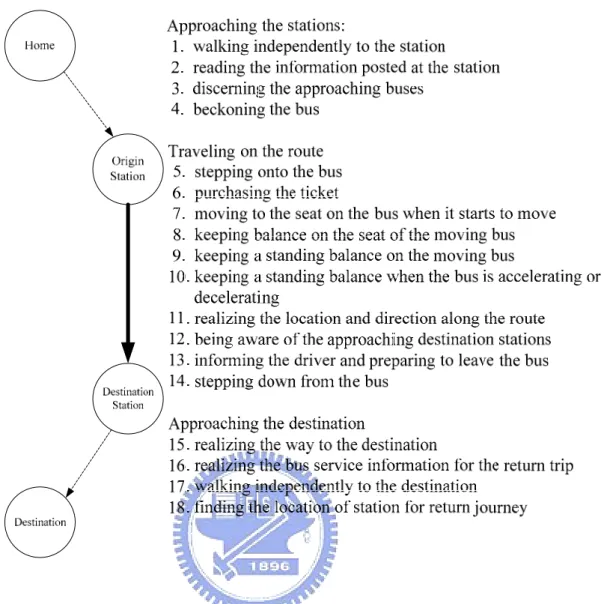
Even though the elderly bus passengers need not deal directly with the complicated traffic; they still have to maintain some physical abilities in order to travel by bus. In other words, if driving an automobile on the road is considered as a tough test for elderly travelers to coordinate the vehicle and traffic conditions with their human factors, then taking buses might be regarded as a relative easy test for them in terms of the necessary actions or motions in approaching the stations, traveling on the routes, and approaching the destination. Based on the required actions or motions on a bus trip, 18 items are conceptually collected and shown in Fig 2-1 for discussions as follows.
Fig 2-1. A conceptual framework for the required actions or motions when using buses
As shown in Fig 2-1, items in the process of bus taking can be simply divided into three stages. At the stage of approaching the station, four items need to be achieved: “walking independently to the station”, “reading the information posted at the station”, “discerning the approaching buses”, and “beckoning the bus”. Items at this stage would mainly demand elderly passengers’ physical strength and their visual abilities. Previous studies have shown that elderly people are proved to have about 12–15% less muscle strength than young people (Blocker, 1992). Arthritis also commonly occurs in the elderly population (Yee, 1985). The muscle strength will influence the elderly people’s ability to walk independently to the station. Older people also tend to have a smaller useful field of vision than younger people (Sekuler
and Ball, 1986), and the gradual degradation of eye muscle over time will influence their ability to focus on the objects at a distance or under a poor lighting condition. As a result, their poor visual ability is expected to worsen the elderly passengers’ ability to read the information at the station and discern the approaching buses, more than that, it might deter them from signaling to the approaching bus drivers.
At the stage of traveling on the route, the elderly travelers might encounter the following ten items to be dealt with: “stepping onto the bus”, “purchasing the ticket”, “moving to the seat on the bus when it starts to move”, “keeping balance on the seat of the moving bus”, “keeping a standing balance on the moving bus”, “keeping a standing balance when the bus is accelerating or decelerating”, “realizing the location and direction along the route”, “being aware of the approaching destination stations”, “informing the driver and preparing to leave the bus”, and “stepping down from the bus”. These ten items will demand the elderly passengers’ physical strength, cognitive abilities, and sense of direction. It has been proved, that the speed of contraction and muscle coordination for elderly people are significantly slower than those of young people (Blocker, 1992), which may influence elderly people’s motion in stepping up and down from the vehicles. Joint flexibility declines by nearly 25% in older adults (Smith and Sethi, 1975), which may decrease their ability to retain their balance on the moving buses. It was found that the general cognitive ability of an elderly person would worsen (Kelsey, 1989), reaction time would become longer (Retchin et al., 1988), and the ability to navigate would probably be reduced by the loss of cognitive abilities (Manton, 1989).
At the stage of approaching the destination, another four possible items need to be achieved: “realizing the way to the destination”, “realizing the bus service information for the return trip”, “walking independently to the destination”, and “finding the location of the
station for the return journey”. These four items will demand elderly passengers’ physical abilities to achieve the final access to the destination and to prepare the necessary information for the return journey. Such physical abilities are also much related to the visual abilities, cognitive abilities, and physical strength that we have already discussed.
CHAPTER 3
Methods for Measuring a Latent Trait
From the illustration of conceptual frameworks, vehicle dependence and perceived physical ability of elderly bus passengers can be respectively conceptualized as two specific latent constructs of the related travelers. In this chapter, we would introduce the psychological viewpoints on measuring a latent construct. The item response theory (IRT), which is a model-based measurement in which trait level estimates depend on both persons’ responses and on the properties of the item that were administered, has become the mainstream of the psychological measurement (Hambleton and Swaminathan, 1991). Among the various models of IRT, the Rasch model is the one which is widely applied for exploring the psychological construct. The review of IRT and Rasch model will be illustrated in the following parts of this chapter.
3.1 Review of Item Response Theory
Psychological constructs are usually conceptualized as latent variables that underlie behavior. Latent variables are assumed as unobservable entities that influence the manifest variables (e.g. test scores or item responses). Thus the observation on these manifest variables can only serve as indicators of a person’s standing on the latent variable. As a result, measurements of psychological constructs are usually indirect, that is, latent variables are measured by observing behavior on relevant tasks or items. A measurement theory in psychology must provide a rationale that both persons and items on a psychological dimension should be inferred from behavior. Based on such a rationale, the item response theory has been elaborated to serve as a methodology in developing or executing a psychological test.
The item response theory is a measurement method which was developed to estimate the values of latent variables on an interval scale from item scores on an ordinal scale. In the original response data, the sum of scores across items for each person is referred to as the person raw score, and the sum of the scores across people for each item is called the item raw score. Discussions of item response theory are based on the Guttman scale (Guttman, 1950). A Guttman scale means that item raw scores are monotonic with item difficulties, and person’s raw scores are monotonic with the person’s abilities. If the raw scores form a unidimensional ordinal scale, then when the data are displayed with the items ordered according to item raw scores, and with the persons ordered according to person raw scores, such a data matrix will conform to a Guttman scale. For a data matrix which fits Guttman scale perfectly, the abilities of people are ranked by the person raw scores and the difficulty of the items are ranked by the item raw scores; the ranking of people will be the same for each item and the ranking of items will be the same for each person. In reality, however, such a rigid rule is hard to achieve because of some unexplored randomness. Thus, in applying item response theory, some violations of Guttman scales are allowed, but the overall statistical pattern of responses should agree with these expectations. The more closely the data fit a Guttman scale, the more likely that the raw scores represent an ordinal scale.
Item response theory begins with a definition of the latent variable,θ , which is supposed to be measured. This variable θn must be an attribute of the respondent and will have a unique value for each respondent n. In item response theory, each item is supposed to require a specific value (threshold) of θ to elicit a particular response from the respondent 50% of the time. Such a response threshold for item i , b , is assumed in the same unit as i θ .
The probability that respondent n will give a particular response to item i , P
( )
θni , can be modeled in a logistic form as Eq (1):( )
( ) 1 ai n bi ni e c d c P − − + − + = θθ
(1)where d is the upper performance asymptote (0< d ≤1), c is the lower performance asymptote (0≤ c<1), and a represents the slope of the item response function (Birnbaum, i
1968). In earlier educational applications, the parameter c usually refers to the chance performance, d usually refers to a possible careless response error, and a is the i
discriminability of item i . In this study in our applications on self-rated responses, there is no
“right” or “wrong” answer; thus we assume that c is equal to 0 and d is equal to 1 in Eq(1). In Birnbaum’s formulations, the parameter of discriminability, a , is designed to i
absorb the variability and to create the illusion of precise estimation of person and item values. As previously illustrated, a perfect Guttman scale is hard to achieve, and minor violations are allowed in practice. Measurement noise can be due to instability in person abilities, in item difficulties, or in both. It can also be attributed to variables that are not being studied. In our case, we define a=1 to keep an invariance across the items, which enables our items to be interpreted as measurements of a single variable.
The simplified item response model (d= 1, c = 0, and a = 1) in our case is identical to i
the probabilistic measurement model developed by Georg Rasch (Rasch, 1960). He deduced his model from the item response theory (Andersen, 1995), and proved that the person and item parameters (θn and b ) are separable, and that item and person raw scores are sufficient i
statistics to estimate the values of the item and person parameters. Since the 1980s, Rasch models have been intensively used to estimate values on an interval scale from raw scores in psychometric studies.
3.2.1 Formulation of the Rasch model
The Rasch model has been intensively used to estimate values on an interval scale from raw ordinal responses in psychometric studies (Fisher et al., 1995; Massof and Fletcher, 2001). To simplify our introduction of the Rasch model, we shall consider only the dichotomous responses to begin with.
Taking the elderly bus passengers’ ability as an example, the questions are assumed to be the type of “Can you easily achieve the following necessary action or motion?” The response is either “yes” or “no”. A score of 1 is assigned to an item to which the traveler responds “yes, I can”; otherwise, a score of 0 is assigned. The probability that an elderly passenger n will respond with “yes, I can” for item i is expressed as
(
)
n ni i b b i n e e b P − − + = θθθ
1 , 1 (2)and the probability that an elderly passenger n will respond with “no, I can’t” for item i is then expressed as
(
n i)
(
n i)
n bi e b P b P − + = − =θ
θθ
1 1 , 1 1 , 0 (3)therefore, the odds ratio that an elderly passenger n can achieve item i is
(
)
(
)
n bi i n i n e b P b P − = θ θ θ , 0 , 1 (4)(
)
(
)
n i i n i n b b P b P − =θ
θ
θ
, 0 , 1 ln (5)which isolates the parameters of interest.
The person and item parameters in the case of dichotomous responses can be estimated from the response odds ratios in the data set using the formulation of Eq. (5). In addition to dichotomous responses, the Rasch model has been modified to be applicable to polytomous rating-scale instruments, such as the five-point Likert scale (Andrich, 1978; Masters, 1982). The modified Rasch model decomposes a polytomous response into several dichotomous responses and formulates one multinomial-choice problem into several binary-choice problems. That is, it assigns b as the value of the item parameter for the rating category ik k to item i , and assumes that Eq. (2) refers to the probability of subject n responding with rating category k rather than k −1 to item i . In other words, we can model the log odds of the probability that a person responds in category k for item i , compared with category
1 −
k , as a linear function of the person parameter θn and the relative parameter of category k, namely b , for item i ik
ik n k ni nik b P P − = ⎟ ⎟ ⎠ ⎞ ⎜ ⎜ ⎝ ⎛ − θ ) 1 ( ln (6)
Following Andrich’s modification of the Rasch model for a polytomous response, two types of formulation are widely applied in assessing the values of item and person parameters, namely the “rating scale model” and the “partial-credit model”. The rating scale model is used only for instruments in which the definition of the rating scale is the same for all items, while the partial-credit model is used when the definition of the rating scale differs from one item to
another. Specifically, the partial-credit model is similar to the rating scale model except that each item i has its own threshold parametersF for each category ik k (Wright, 1977). This is achieved by a reparameterization of Eq. (6)
ik i ik b F
b = + (7)
and the partial-credit model becomes
ik i n k ni nik b F P P − − = ⎟ ⎟ ⎠ ⎞ ⎜ ⎜ ⎝ ⎛ − θ ) 1 ( ln (8)
The partial-credit model (Masters, 1982) is used for items where: (1) credits are given for partially correct answers, (2) there is a hierarchy of cognitive demand on the respondents for each item, (3) each item requires a sequence of tasks to be completed, or (4) there is a batch of ordered response items with individual thresholds for each item. In exploring the latent constructs, it is not necessary to assume that the rating scales of the items are the same, and thus the partial-credit model would be suggested for the proposed empirical studies.
3.2.2 Parameter estimation of the Rasch model
Based on different statistical assumptions, there are several approaches for estimating the parameters of Rasch model. Among them, the joint maximum likelihood (JML) estimation is a relative simple and effective way, which is also the core technique of the related computer programs: the WINSTEPS and FACETS (Linacre and Wright, 1997). A simple introduction of the JML estimation is given as follows.
In JML estimation, unknown construct levels are handled by using provisional trait level estimates as known values. The provisional trait level estimates themselves are
improved by using subsequently estimated item parameters, which are successively improved. In other words, JML estimation is an iterative procedure which typically involves sequential estimates of person and item parameters. In the initial stage, person parameters are estimated. The first iteration of the two-stage procedure involves specifying starting values for the item parameters so that the maximum likelihood estimates of person parameters can be obtained. Then the item parameters are estimated using the first person-parameter estimates. In the following iterations, person and item parameters are iteratively estimated using the improved person or item parameters respectively. The iterations continue until the item parameters change very little between the successive iterations (the convergence status).
JML has been extensively applied in the estimation of many IRT models. It has several advantages in applications. First, this algorithm is easily programmable. Second, JML is applicable to many IRT model. Both the 1PL IRT (e.g. the Rasch model) and 2PL IRT (e.g. the Multi-Facet Rasch Model) can be estimated with JML. Third, JML is efficient on computation. One thing has to be noted in applying the JML estimation that there is a strong limitation of in applying JML algorithm. In JML estimation, the items or persons with perfect scores (all passed or all failed) provides no information about the parameters because there are no constraints are placed on the solution (Holland, 1990). Therefore, estimates of such items or persons with perfect scores are not available in the JML estimation. In fact, such measures of items or persons with perfect scores mostly occur on the data of the educational tests but rarely in the psychological exploration. In the psychological exploration, items with perfect scores are regarded as inappropriate items because they provide no information on evaluating construct levels of the respondents; person with perfect scores can be also considered as a ineffective observation for their construct level are not comparable. It is generally suggested to exclude these items or persons from the original data, or to withdraw the data and redesign the whole investigation program.
3.2.3 Reliability and validity statistics in the Rasch model
In latent construct measurement, reliability indices help us to examine whether or not the model is convincing and the material is replicable, and validity indices help us to examine whether or not the properties of our material are consistent with the assumption of the measurement. In Rasch model, indices of reliability and validity are calibrated respectively via person and item aspects (Wright and Master, 1982) to provide the critical proofs on the quality control of data. We would give a brief introduction of these two indices of Rasch measurement in the following paragraphs.
Reliability in latent construct measurement is commonly defined as the consistency of the responses to a set of items or the consistency of scores from the same instrument. Following such concept, reliability index R in the Rasch model is defined as the degree to
which scores are free from measurement errors (Andrich, 1988). As a result, the reliability estimate for persons (R ) is shown (Bond &Fox, 2001) as follows: p
2 2 p p p SD SA R = (9)
the total person variability ( 2
p
SD ) represents how much respondents differ on the measure of
interest. The adjusted person variability (SA ) represents the reproducible part of this p2
variability (i.e. the amount of variance that can be reproduced by Rasch model). This reproducible variability is divided by the total person variability to obtain the person reliability estimate (R ) with values ranging between 0 and 1, which is consistent to the p
On the other hand, reliability for items (RI) is estimated in the same manner as for persons, with item variance being substituted for person variance:
2 2 I I I SD SA R = (10)
where the total item variability (SD ) represents how much items differ on the measure of I2
interest. The adjusted item variability (SA ) also represents the proportion of total item I2
variability that can be reproduced by the Rasch model.
The Rasch model is regarded as a prescriptive rather than a descriptive approach (Bond, 2001). That is, the data must fit the model, or the assumptions of the model must be rejected for a particular data set, i.e., the degree to which the previously described properties hold depends on how closely the data fit the model. With the comparison between the observed and expected patterns, two fit statistics, namely information-weighted fit (“infit”) and outlier-sensitive fit (“outfit”) (Smith, 1991), are generated to evaluate the validity in the Rasch model. An overview of the derivation of fit statistics is summarized in following paragraphs.
Based on the estimated parameters, each observation for person n on item i with K
categories (denoted asX , ni X = k if the kni th category is chosen), has its expected response value E : ni
∑
= = K k nik ni k P E 1 ) ( (11)where k(k=1,2,…,K) represents the category kof item i and P is the probability of nik
residual Z of each observation ni X are then obtained: ni
∑
= − = K k nik ni ni k E P W 1 2 ) ( (12) ni ni ni ni W E X Z = − (13)These standard residuals are squared and summed to form a chi-square statistic. With divided by total observation numberN , the Mean-square Outfit statistic is then obtained.
∑
= N n N ni Z 1 2 ) ( 2 ~χ (14) Mean-square Outfit = N Z N n ni∑
=1 2 (15)In addition to the Outfit statistic, the Infit statistic weighs the squatted standardized residual Z by their individual variance ni W . It can be calculated as: ni
Mean-square Infit =
∑
∑
= = × N n ni N n ni ni W Z W 1 1 2 (16)The main difference of these two fit-statistics is the outfit statistic place more emphasis on unexpected responses far from a person’s or item’s measure, while infit place more emphasis on unexpected responses near a person or item’s measure (Bonds, 2001). The expected values
of these two Mean-square fit statistics are 1, and the guideline for determining unacceptable departures from expectation remains many discussions (Smith et. al, 1995). To achieve a more generalized standards, both the outfit and infit can be further expressed as normalized residuals (Zstd) via a transformation into a t-statistic with an approximate unit normal distribution (Wright & Stone, 1979). Such a Zstd (Z-standardized fit) statistic has an expected value at 0 and a variance as 1, which has previously been used to select items at the 0.05 significance level and according to the ± 2 criteria.
CHAPTER 4
Exploring the Vehicle Dependence behind Mode Choice: Empirical
Evidence of Motorcycle Dependence in Taipei
According to the prior discussion, vehicle dependence could be thought of as a latent construct of a traveler that represents the traveler’s reliance on a specific vehicle as a consequence of economic concerns, psychological preference, and habitual behavior. How to gather the necessary information and design a measuring tool to evaluate travelers’ vehicle dependence to make our idea operational is another issue, which we consider below.
4.1 Questionnaire Design for Gathering Vehicle Dependence
Latent constructs are commonly explored by means of questionnaires that include appropriate items that respondents can answer on the basis of their daily life experience. Since there was no available questionnaire to follow, we had to design our own questionnaire for our study. Essentially, people use and depend on vehicles to meet the needs of their daily activities, and the significant relations between travelers’ mode usage and their participation in activities have been widely investigated and discussed (Kitamura, 1988; Pas, 1996). As a result, the need to have a specific vehicle to participate in various possible activities was thought to define the appropriate items in the questionnaire to explore a traveler’s dependence on that vehicle. Because the travelers’ answers to the items would be given on the basis of their daily travel experience, and depend on subjective judgment and objective constraints, the responses could then be used to reflect the travelers’ latent trait of dependence on that specific vehicle.
express their real considerations and judgments. Therefore, our questionnaire on vehicle dependence would need to be designed to let the respondents express precisely their reliance on a specific vehicle for performing their daily activities. According to our observations, travelers might find it hard to express how they depend on a specific vehicle for their daily trip purposes because they are unaware of their vehicle dependence. However, it might be easier for them to answer how bothersome it would feel if they were not allowed to use a specific vehicle to undertake specific activities. This provided us with a better measuring tool to gather the information from travelers to capture their dependence on specific vehicles.
Furthermore, respondents’ answers to the questions in our design did not usually have to be simply “yes” or “no”. A well-designed questionnaire should provide an opportunity for respondents to express the degree of their feeling or judgment about the items referred to. Therefore, the questions designed to measure the latent construct of vehicle dependence included suggested answers on an ordinal scale, with several categories that represented the respondent’s possible level of judgment.
4.2 Concept for Applying the Rasch Model for Measuring the Vehicle
Dependence
Presumably, every traveler n has a unique value of his/her dependence on a specific vehicle θn, which is the person parameter to be measured. Such a latent trait can be revealed by the person’s answers. That is, travelers who have higher dependence on a vehicle will respond with high scores (i.e. a high level of vehicle dependence) on a greater number of items than will those with lower dependence. In addition, travelers’ dependence on a specific vehicle could be different for various activities (i.e. trip purposes). Some trip purposes might be more suitable than others for a specific vehicle usage. Thus, travelers’ vehicle dependence for two types of trip purposes could be different (e.g. bicycle riding might be depended on for
achieving in-town travel but not for intercity travel). Such properties for each trip purpose (i.e. the item parameters) can be regarded as an inherent resistance against travelers’ vehicle dependence. It can be assumed that each item (trip purpose) i has a unique resistance
parameter bi. The items with lower resistance parameters bi are those trip purposes which are
inherently suitable for a specific vehicle usage. Therefore, there would be more responses indicating high dependence for those items.
Taking automobile usage as an example, a simplified diagram illustrating this concept is shown in Fig. 4-1. The right-hand side of Fig.4-1 presents the relative levels of automobile dependence of three travelers. Joe has the highest automobile dependence, and Tom has the lowest. The left-hand side of Fig. 4-1 shows the relative inherent resistance against automobile driving for two different trip purposes. This example indicates that commuting in congested traffic has higher resistance against automobile driving than has weekend outdoor travel.
Under the assumption that the item parameters are independent of the person parameters, some conclusions could then be drawn from the information provided in Fig. 4-1. Namely, all three travelers are more likely to drive an automobile for weekend outdoor travel than for commuting in congested traffic, because the former has lower inherent resistance against dependence on automobile driving. On the other hand, the tendencies to drive an automobile are in the order Joe, Mary, and Tom, from high to low, no matter whether for commuting in congested traffic or for weekend outdoor travel, on the basis of the magnitudes of their dependence on an automobile. If we consider the above characteristics, it is apparent that the difference between the person parameter θn and the item parameter b will determine the i
tendency of traveler n to depend on a given vehicle for achieving trip purpose i. This tendency could then be formulated as a function of a probability and determined by the value of
i n −b
θ .
Fig. 4-1 Conceptual example of travelers’ automobile dependence, and inherent resistance against automobile driving for various trip purposes.
In order for us to provide a theoretical basis for comparisons, the person parameters (vehicle dependence) and item parameters (inherent resistance against vehicle dependence) must be measured on a consistent interval scale. However, all of the responses of travelers to the questionnaire were collected on an ordinal scale in order to provide room for respondents to describe their judgments more precisely. Therefore, the Rasch model to convert the ordinal raw data into data on an interval scale was applied in the following analysis.
4.3 Design of the Empirical Exploration on Motorcycle Dependence
To demonstrate our conceptual framework and measurement approach for vehicle dependence, an empirical study was performed to explore motorcyclists’ dependence on
motorcycle usage in Taipei, Taiwan. Motorcycles are used intensively as a mode of daily road transportation in Taiwan and some other Asian countries. In addition to identifying and measuring the motorcycle dependence of motorcyclists, we also expect that our findings for Taipei could serve as reference information for traffic authorities in other areas where motorcycles are intensively used.
4.3.1 Background on transportation in Taipei
Taipei, the political and commercial center of Taiwan, has an area of 272.80 square kilometers, in which nearly 4.5 million people (Official Statistics, 2005) live or travel every day. To provide residents and visitors with efficient travel inside this intensively occupied city, Taipei offers a high-density public transportation service, including mass rapid transit (MRT), commuter rail, buses, and taxis. However, it still encounters daily traffic congestion in rush hours, just like many other metropolises around the world. According to official statistics, households in Taipei possess 1.17 motorcycles and 0.49 automobiles on average; 28.72% of people in Taipei travel by automobile, 32.34% of people travel by motorcycle, 30.58% of people travel by public transportation, and the remainder travel by taxi, bicycle, or walking. The common use of motorcycles results in many problems in traffic engineering, management, and safety (Chang, 2002); worst of all, it reduces the effectiveness of investment in public transportation.
The Taipei traffic authorities have enacted many policies to encourage motorcyclists to travel by public transportation instead of by motorcycle (e.g. exclusive bus lanes, discounts on public transportation fares, and motorcycle parking charges around the commercial area). However, the usage of motorcycles has still been growing steadily in recent years (Chang and Yeh, 2007). This hints that people in Taipei have a strong dependence on motorcycle usage, and such motorcycle dependence might arise not merely from economic considerations, but
also mental preferences or habitual behavior.
4.3.2 Empirical questionnaire design
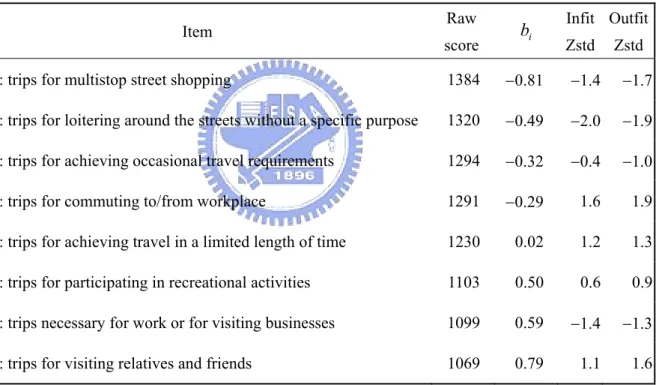
A questionnaire was designed (as shown in Table 4-1), in terms of eight items which represented the most common activities that attracted people to ride motorcycles, in order to explore motorcyclists’ dependence on motorcycle usage in Taipei.
Table 4-1 Content of the questionnaire for motorcycle dependence
Variable/question Type
Items to explore self-rated dependence:
How bothersome will it feel if you cannot ride a motorcycle to achieve the following trips in Taipei city?
Item 1: trips necessary for work or for visiting businesses 5-point scale
Item 2: trips for commuting to/from workplace 5-point scale
Item 3: trips for multistop street shopping 5-point scale
Item 4: trips for participating in recreational activities 5-point scale
Item 5: trips for visiting relatives and friends 5-point scale
Item 6: trips for achieving travel in a limited length of time 5-point scale Item 7: trips for achieving occasional travel requirements 5-point scale
Item 8: trips for loitering around the streets without a specific purpose 5-point scale
Respondent’s personal characteristics
Age Numeric response
Gender (male, 0; female, 1) Binary response
Monthly income (in NTD) Open response
Dual-mode user (yes, 1; no, 0) Binary response
Exclusive automobile parking space (owned, 1; otherwise, 0) Binary response The respondent motorcyclists were asked to answer how bothersome it would feel if they could not ride their motorcycles in Taipei City to achieve the respective eight possible trip purposes. In addition to these items designed to measure motorcycle dependence, some characteristics of the respondents were also included in the questionnaire. These were age, gender, monthly income, whether the respondent was a dual-mode user (i.e. whether he/she
drove an automobile as well or not), and the ownership of exclusive automobile parking space (i.e. whether the respondent motorcyclist had his/her own automobile parking space or not). The reason for investigating dual-mode user status and parking space ownership arises from the competing usage between these two private vehicles. Some people in Taipei own and use both an automobile and a motorcycle for their daily trips; such travelers are referred to as dual-mode users in the following discussion.
Item 1 was designed to explore how motorcyclists depend on motorcycles for trips related to work or to visiting businesses; Item 2 was aimed at collecting information about motorcyclists’ motorcycle dependence for commuting purposes; Item 3 was designed to find out how motorcyclists depend on motorcycles for multistop shopping in the streets; Item 4 was designed to explore motorcyclists’ dependence on motorcycles for participating in recreational activities; Item 5 was designed to show the extent to which motorcyclists need to ride motorcycles to visit their relatives and friends in Taipei; Item 6 was designed to show the extent to which motorcyclists count on motorcycle riding for achieving particular journeys in a limited length of time; Item 7 was designed to explore motorcyclists’ motorcycle dependence for occasional travel demands, such as accessing a transit station or picking up visitors; and Item 8 was designed to see how motorcyclists depended on their motorcycles for no specific trip purpose but just for loitering around the streets. All of these eight items were answered on a five-point Likert scale, namely “not bothersome at all,” “a little bothersome,” “bothersome,” “strongly bothersome,” and “very strongly bothersome.” The responses in these five categories, from “not at all” to “very strongly,” for each item, represented the motorcycle dependence, from low to high, respectively.
4.3.3 Data collection
selected randomly in Taipei. The respondents’ self-rated dependence for each item and their personal characteristics were gathered through completing the questionnaire with the assistance of well-trained investigators. Of these 321 motorcyclists, 187 (58.3%) were male and 134 (41.7%) were female; their average age was 28.7 years; and their average monthly income was about 28,000 NTD. There were 167 (52.0%) respondents who also traveled by driving, and only 43 of them had their own automobile parking spaces. The distributions of the respondent motorcyclists’ gender and age were compared with those of registered motorcyclists published in official statistics, and no significant differences were found at
05 . 0 =
α . It was believed that the sampled motorcyclists could reasonably represent the population. Inspection on the uni-dimensionality of the data via factor analysis was conducted. The first factor explained 81.2% of total variance while the second factor only explained 12.7% of total variance. Thus these collected data are suitable to apply the Rasch model because the information of the responses mainly resulted from one single latent construct.
4.3.4 Application of Rasch analysis
The Rasch measurement model provides a means for constructing interval measures from raw ordinal category data. On the basis of the Rasch model, a value on an interval scale was estimated for each item (i.e. the item parameter) and for each respondent (i.e. the personal parameter). The responses of the 321 motorcyclists for the eight items were analyzed with WINSTEPS (Linacre and Wright, 1997), an iterative computer program, which estimated θn
for motorcyclist n and b for item i in logit units. WINSTEPS helps to deal with i
polytomous responses by applying the Masters–Andrich modification (Masters, 1982) of the Rasch model. The estimated parameters and model fit statistics could be therefore calibrated via a joint maximum-unconditional-likelihood estimating procedure (Wright, 1996).
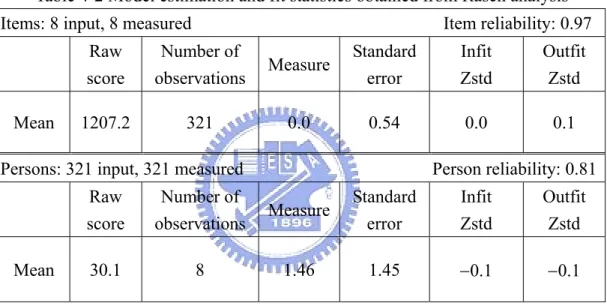
The estimated parameters and fit statistics of our whole Rasch model are shown in Table 4-2. The Rasch assessment fixed the average measure of all item parameters at zero logit to be a comparative basis of the relative interval scale; the average value of the vehicle dependence of all of the motorcyclists was 1.46 logit. Such a positive value indicates that these motorcyclists generally depend on motorcycles highly. Before we start detailed discussions and interpretations of the estimated item and person parameters, however, the reliability and validity of this Rasch model must be discussed first.
Table 4-2 Model estimation and fit statistics obtained from Rasch analysis Items: 8 input, 8 measured Item reliability: 0.97
Raw score Number of observations Measure Standard error Infit Zstd Outfit Zstd Mean 1207.2 321 0.0 0.54 0.0 0.1
Persons: 321 input, 321 measured Person reliability: 0.81 Raw score Number of observations Measure Standard error Infit Zstd Outfit Zstd Mean 30.1 8 1.46 1.45 −0.1 −0.1
Reliability is commonly defined as the consistency of the responses to a set of items or the consistency of scores from the same instrument. It is also defined as the degree to which scores are free from measurement errors. The WINSTEPS program provided reliability information for both items and persons, as shown in Table 2. The person and item reliability coefficients can be interpreted similarly to a Cronbach alpha reliability coefficient for the internal consistency of responses to items (Wright, 1996). The personal reliability index of 0.81 and item reliability index of 0.97 indicate that the data here are consistent with the assumptions of the Rasch model from the viewpoints of both items and persons.