國
立
交
通
大
學
工業工程與管理學系
博士論文
應用 TRIZ 於服務品質創新之研究:
以電子商務產業為例
A Systematic Approach for Service Quality Innovation by TRIZ
with A Case Study on E-Commerce
研 究 生:林敬森
指導教授:蘇朝墩
陳文智
應用 TRIZ 於服務品質創新之研究:以電子商務產業為例
A Systematic Approach for Service Quality Innovation by TRIZ
with A Case Study on E-Commerce
研 究 生:林敬森 Student:Chin-Sen Lin
指導教授:蘇朝墩 Advisor:Chao-Ton Su
陳文智
Wen-Chih Chen
國 立 交 通 大 學
工業工程與管理學系
博士論文
A DissertationSubmitted to Department of Industrial Engineering and Management College of Management
National Chiao Tung University in partial Fulfillment of the Requirements
for the Degree of Doctor of Philosophy
in Industrial Engineering and Management
September 2006
應用 TRIZ 於服務品質創新之研究: 以電子商務產業為例
研究生:林敬森
指導教授:蘇朝墩
國立交通大學
工業工程與管理學系
近年來,TRIZ 理論的獨特見解已顯示是一種結構完整且具創新價值的問題 解決方法,且被廣泛地應用於科技工程與非科技領域。目前一般企業對於所進行 的產品或服務品質之改善及創新,經常是依賴設計人員的靈感或過去經驗,使得 創新或改善的效率及品質不佳,間接影響到顧客的滿意程度。因此,本研究應用 TRIZ 理論的創新模式,提供一個系統性的產生創新服務的架構,使得服務設計 人員更有效率地解決面對的問題,以滿足顧客對服務品質的要求。在應用 TRIZ 進行問題解決過程中,當使用到矛盾矩陣(Contradiction Matrix) 時,常會發生由於 TRIZ 工程參數(Engineering Parameter)選擇的不恰當,而影響 到所選取的發明原則,造成不適當的結果。本研究提出藉由建構一個 39 項 TRIZ 工程參數的對照表,提供使用者在運用 TRIZ 矛盾矩陣解決問題時,可以正確地 找出合適的 TRIZ 參數。首先在確定所面臨問題所屬的產業別之後,針對該項產 業服務品質的可能影響因素,廣泛地進行探索性研究,找出重要之決定因素;接 著藉由影響服務品質的決定因素與 TRIZ 的 39 個工程參數之間的解釋意涵,類 比配對出一個參數對照表;同時,將此參數配對結果,經由該產業與服務品質專 家的問卷調查意見,確定參數配對的合適與否,並利用統計方法,檢定確認專家
對此參數配適結果意見之一致性。於是所建構的參數對照表,可作為使用者在運 用 TRIZ 矛盾矩陣解決問題時,能夠經由影響該問題的主要服務品質要素,快速 且正確地對照出合適的 TRIZ 參數。 此外,在應用 TRIZ 進行問題解決過程中,於探索問題本質的分析階段,對 於客戶的需求,甚至問題的根本原因,常會因為溝通過程中語意的認知不同,造 成無法確切分析出影響顧客滿意的真正要因。因此,本研究建議應用模糊品質機 能展開(Fuzzy Quality Function Deployment)的方法,協助分析顧客需求與服務品 質決定因素之間的關係,以便明確指出與顧客滿意相關的關鍵性服務品質要素, 加上應用所建構的參數對照表,協助有效找出相對應的 TRIZ 工程參數,進而應 用 TRIZ 矛盾矩陣,找出適切的創新原則,尋求有效的創新解決方案。 本研究以一家電子商務公司的服務創新問題改善為例,應用所提出的系統性 創新服務品質方法,解決該公司所面臨的顧客滿意改善問題,其結果說明了本研 究所提出架構的可行性,同時也驗證應用 TRIZ 在特定產業服務品質創新上的實 用價值。 關鍵字:TRIZ,服務品質,創新,模糊品質機能展開,電子商務
A Systematic Approach for Service Quality Innovation by TRIZ
with A Case Study on E-Commerce
Student: Chin-Sen Lin
Advisor: Chao-Ton Su
Department of Industrial Engineering and Management
National Chiao Tung University
In recent years, TRIZ methodology with its unique thinking has proved to be a well-structured and innovative way of problem-solving in technical and non-technical areas. Up to the present time, the practice of generating new products or services has mostly depended on the brainstorming, lateral thinking, or mind mapping methodology of the experienced practitioners; thus, in the starting state of new ideas generation, especially with unknown causes and unknown search directions, it is frequently limited to overcome the psychological inertia inherent in human thinking to strive for generating creative results. With this, this study focuses on proposing a systematic approach to effectively achieve the innovative services and to improve the service quality.
When developing a systematic process integrating with TRIZ methodology, especially with applying the TRIZ contradiction matrix, the inappropriate selection of TRIZ engineering parameters will influence the inadequate reference of inventive principles, and consequently, the infeasible solutions are acquired. Therefore, a parameter corresponding table is constructed to provide practitioners with an efficient way to extract the appropriate TRIZ parameters relating to the specified problem, and enable the indication of effective inventive principles. From this, the parameter
corresponding table is first developed from extracting the determinants of service quality based on a comprehensive qualitative study on the specified sector, then second, the analogical corresponding results between the determinants of service quality in the specified sector and the 39 TRIZ engineering parameters are formulated. After this, a validity test on the parameter corresponding results is conducted by administrating a questionnaire to the experts in the fields of the specified sector, service quality, and TRIZ. Consequently, the parameter corresponding table is validated in terms of its feasibility to be used in the specified sector.
Besides, when the problem solvers focus on the process of formulating the problems, in practice, the uncertain and ambiguous expression of the opinions among them is usually occurred to impede the consensus of the discussion, and it will affect the invention levels of generated solutions consequently. Therefore, in this study, a systematic procedure is proposed to overcome this vagueness in problem formulating period by applying the relationship matrix of Fuzzy QFD (Quality Function Deployment) to analyze the imprecise and subjective problem information, and be able to clarify the dominant determinants within the essentials of the problem, and then by using the parameter corresponding table which we developed aforementioned, the appropriate 39 TRIZ engineering parameters can be effectively acquired. This consequently results to attaining the desired creative outcomes.
Finally, the effectiveness of our proposed framework is illustrated in an e-commerce company. The practical results from the studied company show the effectiveness of our approach in service quality improvement in the e-commerce industry, as well as indicate the valuable contributions of the TRIZ methodology in the service sector.
誌 謝
已過不惑之年再進入校園,秉持的是對自己的承諾,並且有機會回頭
再當學生,更是自己一生的福份,可是這段期間,沒有許多貴人的相
助,個人是無法順利完成學業的。首先要感謝的是恩師蘇朝墩教授,
在剛入學猶處於徬徨之際,有幸能與恩師結緣,讓自己找到一個研究
的方向,並且在恩師不斷的協助與教導下,總算把學業告一段落,在
此,衷心的感謝恩師所賜予的一切。
同時,同門師兄弟們給我的各種關照,也要在此深深地向他們表達感
謝之意,包括志華、俊欽、隆昇、健炘等學長,還有同一實驗室的家
任、宇翔等學弟,他們幫忙解決了自己無法常在學校裡的困擾,也幫
忙自己在許多基本學科上做更進一步的鍛鍊,在此,務必再一次的感
謝他們。還有與同班同學泰盛、建和、昌輔、俊穎等的並肩作戰,在
學校修課的過程中,也都留下了深刻的回憶。
當然,我也要藉此表達對摯愛的妻子喬芳深深的感謝,因為有她的體
諒與支持,在這三年多的日子裡犧牲自己處理家裡的一切事務,加上
家母、岳父母們的協助照顧家庭,才能讓我無後顧之憂,專心的完成
學業。最後,我也希望能將自己今天的一點歡愉,獻給先父,同時也
給兩位可愛的女兒祐如、宴存一個榜樣,所有事情,只要努力不懈、
堅持到底,終究會得到成功的果實。
僅此,再一次的向所有恩典於我的貴人,表達內心最誠摯的謝意!
CONTENTS
摘要 i
ABSTRACT iii
誌謝 v
CONTENTS vi
LIST OF TABLES viii
LIST OF FIGURES ix
CHAPTER 1 INTRODUCTION 1
1.1 Overview 2
1.2 Motivations 2
1.3 Objectives 3
1.4 Organization and Research Framework 4
CHAPTER 2 RELATED WORKS 7
2.1 The Development of Creating New Services 7
2.2 The TRIZ Methodology 9
2.2.1 The Development of TRIZ 9 2.2.2 The General Concept of TRIZ 10 2.2.3 Resolving the Contradictions by TRIZ Contradiction
Matrix
13
2.2.4 The Applications of the TRIZ Methodology 17
2.3 The Fuzzy QFD 19
2.3.1 An Overview of QFD 19 2.3.2 The Concept of Fuzzy QFD 20 2.3.3 The Application of Fuzzy QFD Process 21
CHAPTER 3 METHODOLOGIES 23
3.1 The Systematic Problem-Solving Process 23 3.2 The Statistical Test 31
CHAPTER 4 CASE STUDY 34
4.1 The Problem 34
4.3 Extract the Major Determinants of Service Quality 35 4.4 Develop the Parameter Corresponding Table 44 4.5 Generate Feasible Solutions 56
4.6 Realization 68
CHAPTER 5 CONCLUSIONS 70
REFERENCES 74
LIST OF TABLES
Table 2.1 TRIZ 39 Engineering Parameters and 40 Inventive Principles
14
Table 2.2 A Partial Contradiction Matrix with Suggested Inventive Principles
16
Table 4.1 The Summarized Determinants of E-Business Operation and the Referenced Papers
37
Table 4.2 The Summarized Determinants of the Measurement of E-Service Quality and the Referenced Papers
39
Table 4.3 The Summarized Determinants of E-Service Satisfaction and the Referenced Papers
41
Table 4.4 The Summary of the E-Service Quality Determinants 42 Table 4.5 The Summary of the Referenced Papers for E-Service
Quality Determinants
43
Table 4.6 The Parameter Corresponding Table for E-Commerce 45 Table 4.7 The Results of Questionnaires from Experts 53 Table 4.8 The Computing Data of Questionnaires 55 Table 4.9 The Results of Opinions from Three Managers in
Linguistic Terms, Respectively
59
Table 4.10 The Average Fuzzy Numbers of the Service Quality Determinants
60
Table 4.11 The Integrated Triangular Fuzzy Numbers and the Rankings of their Importance
61
LIST OF FIGURES
Figure 1.1 The Research Framework 6 Figure 2.1 The General TRIZ Process 12 Figure 2.2 The Hierarchical View of TRIZ 13 Figure 2.3 A Modified TRIZ Problem Solving Process 18 Figure 3.1 The Systematic Problem-Solving Process for the
Specified Sector
24
Figure 3.2 The Figure of the Triangular Fuzzy Numbers in the Interval [0,1]
27
Figure 3.3 The Membership Functions of the Triangular Fuzzy Number
28
Figure 4.1 The Function and Attribute Analysis Diagram for the Case Example
CHAPTER 1 INTRODUCTION
1.1 Overview
Service quality has been a frequently studied topic in the service marketing literature. In the last three decades, studies on service quality have been undertaken by researchers to be able to define and understand what service quality really is. Parasuraman et al. (2005) found from early researches that service quality stems from the comparison of what customers feel a company should offer and the company’s actual service performance. However, even though there is an increasing number of companies which are realizing the importance of service quality and customer satisfaction, it is not always clear how to achieve these goals for these companies.
In today’s competitive environment, especially, when the world economy has seen strong growth in the service sector, the pursuit of perceived services to meet customer’s expectation is now considered be essential to get success. Unlike manufacturing sectors, service contains a common theme of intangibility and simultaneous consumption; service sectors typically do not apply rigorous process design standards prior to introducing the new services (Fisk et al., 1993). These characteristics collectively hindered service providing and make it more challenging than physical product manufacturing. Therefore, in order to remain competitive in the service market, a company should actively seek creative ways to generate differentiated services which can satisfy customer’s expectation (Zhang et al., 2005).
From this respect, the main challenge facing companies is the need to continuously provide the service market with advanced services. How should companies go about creating new services? How can this process be made explicitly effective? Hence, the development of a valid methodology for the successful acquisition and provision of
innovative services is the pivotal concern of companies. With this, the dissertation focuses on proposing a systematic approach to effectively achieve the innovative services and to improve the service quality.
1.2 Motivations
The topic of new service development has for a long time been largely neglected, not just in practice but also in service research (Bullinger et al., 2003). In general, it is agreed by most of the service researchers that it is a poor strategy to develop new products only by luck (Zhang et al., 2005). Up to the present time, the practice of generating new products or services has mostly depended on the brainstorming, lateral thinking, or mind mapping methodology of the experienced practitioners; thus, in the starting state of new ideas generation, especially with unknown causes and unknown search directions, it is frequently limited to overcome the psychological inertia inherent in human thinking to strive for generating creative results.
In response, among the corporate structures and processes had been efficiently developed and implemented on the market in recent years, TRIZ researchers have utilized a number of successful process models to validate the method’s effectiveness in creating and improving new services (Ishida, 2003). Although TRIZ was initially proposed for engineers and scientists as a systematic creativity and innovations methodology, recently, it has been applied in a wide range of fields from engineering to biomedicine, agriculture, social relations, business and management, etc.(Mann, 2000; Retseptor, 2003; Lau, 2004).
As a review of the existing literature, Domb and Mann (2001) pointed out that the strength of TRIZ as a method for developing creative solutions to problems is the removal of contradictions rather than the use of the conventional approach by means of compromises or tradeoffs. At this point, there are a number of ways forward, but within
the TRIZ tool set, contradiction analysis is the most frequently and widely used method for the elimination of contradictions which arise from the problem (Webb, 2002). The contradiction analysis process requires a matrix formed by 39 parameters or features of the technological systems and 40 types of inventive principles that originally invented by Altshuller who had investigated and classified over 400,000 patents worldwide (Liu and Chen, 2001). However, there are few researches found to provide a well-structured methodology in eliminating the contradictions of service quality when designed a new service, but TRIZ is unique in that it offers problem solvers a tangible tool to actually eliminate the compromises. From this, by way of developing a systematic approach with integrating TRIZ methodology is considered to be able to effectively enhance the service quality in service industries.
1.3 Objectives
When TRIZ is extended to a wider area of applications, Zhang et al. (2003) found that the 39 generic parameters and the 40 inventive principles are required to be modified in order to reflect their distinct characteristics for a growing diversity of technological areas. As compared to the extensive discussions on the 40 inventive principles of TRIZ, the modification of 39 engineering parameters pertaining to business-type problems is rarely mentioned in academic articles. Mann and Domb (1999) also observed that this modification is lengthy and time-consuming to update from the renewed patent database. Therefore, we are not going to modify the 39 TRIZ engineering parameters in this study, but instead, when developing a systematic process integrating with TRIZ methodology, we attempt to construct a parameter corresponding table to provide practitioners with an efficient way to extract the appropriate TRIZ parameters relating to the specified problem, and enable the indication of effective inventive principles. From this, the frequent discrepancy in mapping up the essentials of
the 39 TRIZ engineering parameters and the dominant determinants of the problem can be resolved.
In addition, Webb (2002) indicated that TRIZ process starts with stripping away the side issues and preconceptions to define the core problem which involves breaking the problem down into its most elementary components, understanding each one and expressing the components in the most elementary or fundamental way, and then, freeing oneself from the constraints of the language in which the problem is expressed. At this point, the TRIZ process relies on the problem solvers to actually look at the essential of the problem and conceptualize the critical characteristics of the problem. From the beginning of TRIZ process, the problem solvers need to clearly discuss and analyze the contradictory relationship within the specified problem. In practice, when the problem solvers focus on the process of formulating the problems, the uncertain and ambiguous expression of the opinions among them is usually occurred to impede the consensus of the discussion, and it will affect the invention levels of generated solutions consequently. Therefore, in this study, a systematic procedure is proposed to overcome this vagueness in problem formulating period by applying the relationship matrix of Fuzzy QFD to analyze the imprecise and subjective problem information (or it can refer to the customer requirements), and be able to clarify the dominant determinants within the essentials of the problem, and then by using the parameter corresponding table which we developed aforementioned, the appropriate 39 TRIZ engineering parameters can be effectively acquired. This consequently results to attaining the desired creative outcomes.
1.4 Organization and Research Framework
The remainder of this study is divided into four sections. The second chapter describes the related works in the development of service innovation, the TRIZ
methodology and the Fuzzy QFD methodology used in our research. The third chapter illustrates the proposed methodologies used in this study. In the chapter 4, as try to demonstrate the practicability of our proposed approach in service quality improvement, we illustrate a case study of an e-commerce company in Taiwan, and following the procedures of our proposed approach, firstly, through a qualitative literature survey in e-commerce, we collect the determinants of e-service quality (it refers to the service quality which is significantly concerned in e-commerce), and extract their characteristic meanings to analogically mapping with TRIZ 39 engineering parameters in interpretation. Then, according to the parameters mapping results, we verify the effectiveness of these results with the opinions from seven experts in the fields of e-commerce, service quality and TRIZ, and base on the experts’ consensus in our parameters mapping results, a parameter mapping table which can be applied in e-commerce is constructed, and finally the creative solutions are acquired by following the TRIZ problem-solving process. The final chapter of this study discusses the managerial implications of our proposed methodology, and derives the conclusions and directions for future research from our study. The research framework is shown in Figure 1.1.
Define the problem.
Apply the relationship matrix of Fuzzy QFD to identify the
critical determinants.
Extract the service quality determinants for the sector under which the problem is
classified.
Examine for the contradict determinants.
Identify the corresponding
TRIZ parameters. Construct a parameter corresponding table.
Examine the TRIZ contradiction matrix.
Apply the TRIZ 40 inventive principles.
Generate the feasible solutions
CHAPTER 2 RELATED WORKS
2.1 The Development of Creating New Services
The importance of creating new services is well emphasized in today’s market. However, many service providers are still limited by their present corporate structures and processes which are not designed to enable new services to be efficiently created and launched in the market in time (Bullinger et al., 2003). During the past few years, some researchers have paid attention to the area of New Service Development (NSD) (Kelly and Storey, 2000; Alam, 2000; Menor et al., 2002). In contrast to the development of tangible products, the literature on tangible product development is rich, but little is known about how new services are actually developed. Aranda and Molina-Fernández (2002) emphasized that the innovation patterns of service industries are different from those of manufacturing industries. Moreover, the critical success factors for the NSD process are explicitly different from those for the development of a new tangible product (Kwaku, 1996; Alam, 2000).
Due to the intangibility of services, it is difficult to verify the applicability of services before their launch. Therefore, when comparing the innovation activities of manufacturing and service firms, Kwaku (1996) found that the perception and evaluation of these activities are different, and that the critical success factors of these two types of firms greatly vary. Kelly and Storey (2000) also discovered in their survey on a group of service companies that only half of the sample has a formal NSD strategy, that generally, they do not have formal mechanisms with which to generate new ideas, and that prevalently, the idea screening process fails to support the NSD strategy. Even though little research is known about how new services are actually developed, Alam (2000) attempted to explore the stages in the NSD process of new business-to-business
service development in a specific service sector. He found that the service provider follows a 10-stage NSD process, and that the most important stages are idea generation and commercialization. Besides, parallel to the concept of NSD in America, Bullinger (2003) indicated that the term service engineering was coined in the mid-1990s in Germany and Israel, and in contrast with NSD, service engineering adopts a more technical-methodological approach, with an attempt made to systematize the development of services.
Recently, relating to the extant literature review on the topic of services and innovation, Zhang et al. (2003) considered service design to be one of the pivotal components of the NSD process, but there is a lack of a systematic and effective problem identification process which contains all service design activities. In their study, a systematic approach based on the TRIZ methodology is developed in order to design new services. With the integration of the TRIZ methodology in the service design, they tried to develop a formal approach which is helpful for service developers to plan and control design activities, and to systematically generate new services. Gao et al. (2005) compared the strengths and weaknesses between many common innovation methodologies and TRIZ, and it was found that TRIZ is the most powerful systematic innovation methodology among the methodologies compared. Furthermore, Zhang et al. (2005) argued that the limitations in existing service design tools in terms of overcoming the psychological inertia have severely affected both the amount and the quality of design solutions. Their approach integrating the TRIZ suggests that companies should seek creative ways to generate new service concepts that can meet customers’ needs. Moreover, Zhang et al. (2005) believed that the effectiveness of using the TRIZ in the service domain can be further enhanced through the incorporation of knowledge on best practices in various fields. All in all, applying the TRIZ in the
service industry has emerged to have a great potential for further discussion and study. 2.2 The TRIZ Methodology
2.2.1 The Development of TRIZ
TRIZ (Teoriya Reshenuya Izobreatatelskikh Zadatch) is a Russian acronym that stands for the “Theory of Inventive Problem Solving” (also named TIPS): a systematic approach to finding innovative solutions to technical problems. The ideas were actually formulated way back in the 1940s, but remained firmly locked behind the Iron Curtain. With the progressive thawing of the old Cold War climate, TRIZ introduced to the West a little over a decade ago when a few American academics began studying its principles and applying them to real situations. Genrich Altshuller, the proponent of TRIZ, started his work in 1946 to develop a way to make significant technical breakthroughs without relying purely on creative processes, and he adopted the premise that most breakthroughs are not really breakthroughs at all, but simply the application of a well understood principle in a new way or in a new field. Altshuller worked in a patent office, so perhaps it was seeing so many inventions that led him to a systematic evaluation of hundreds of thousands of patents in order to uncover patterns of invention that might prove useful when it comes to looking at new problems. In time, this work would grow to an analysis of over 2.5 million patents (Alam, 2000).
Since its birth in Soviet Union and introduction to the world, TRIZ has developed successfully as a powerful problem solving tool, especially for product innovation design in conceptual design phase, to promise the engineers with breakthrough thinking. Before TRIZ, authorized thought about creative and human innovations was based on a paradigm that believed the creation as a unknown phenomena, but Altshuller believed that creation is not an unknown and unreachable function, but creation followed a special and achievable principles, and we can do the inventions with non-inventor
persons, if they learn the innovating principles and algorithms (Saliminamin and Nezafati, 2003). Altshuller analyzed thousands of worldwide patents from leading engineering fields, and he categorized these patents in a novel way by removing the subject matter to identify the problem-solving process rather than classifying the patents by industry. From this, he found that the same problems were often solved over and over again using one of only 40 fundamental inventive principles. With this view, Altshuller developed his algorithm for innovative problem solving.
2.2.2 The General Concept of TRIZ
The TRIZ methodology is a well-structured inventive problem-solving process. The application of TRIZ thinking tools in diverse industries successfully replaces the unsystematic trial-and-error method in the search for solutions in the everyday life of engineers and developers (Ruchti and Livotov, 2001). Thus, Altshuller analyzed a large number of patents, and he found that not every invention is equal in its inventive value, and there were five levels of innovation:
Level #1: A simple improvement of a technical system that requires knowledge available within a trade relevant to that system.
Level #2: An invention that includes the resolution of a technical contradiction that requires knowledge from different areas within an industry relevant to the system.
Level #3: An invention containing a resolution of a physical contradiction that requires knowledge from other industries.
Level #4: A new technology is developed containing a breakthrough solution that requires knowledge from different fields of science.
Level #5: Discovery of new phenomena.
Level #1 is not really innovative, and it provides only an improvement to an existing system without solving any technical problem. Levels #2 and #3 solve
contradictions, and therefore are innovative by definition. Level #4 also improves upon a technical system, but without solving an existing technical problem. Instead, it solves the problem by replacing the original technology with a new technology. Level #5 discovers a new phenomenon that always pushing the existing technology to a higher level. Altshuller concluded from his research that a large number of patents (77%) belong only to Levels #1 and #2. The practical utilization of TRIZ methodology can help inventors elevate their innovative solutions to Levels #3 and #4.
Concerning TRIZ methodology, Hasan et al. (2004) indicated that there are five basic notions of TRIZ, which are ideal final result, psychological inertia, inventive levels, evolution laws and eliminating contradictions. When the TRIZ thinking tools is used, basically, it does not provide the solutions but propose various resolution principles to solve the problem. But through the TRIZ paradigm is proceeded, TRIZ can be recognized as a process framework for problem solving. Besides, Lau (2004) showed that there are five underlying pillars which help to make the TRIZ method distinct from other problem solving strategies, they are: functionality, contradictions, ideality, resources, and shifting perspective. Chang and Chen (2003) also stated that the TRIZ method can be divided into four parts: the contradiction table, the substance-field analysis, the evolution detection, and the technique trend.
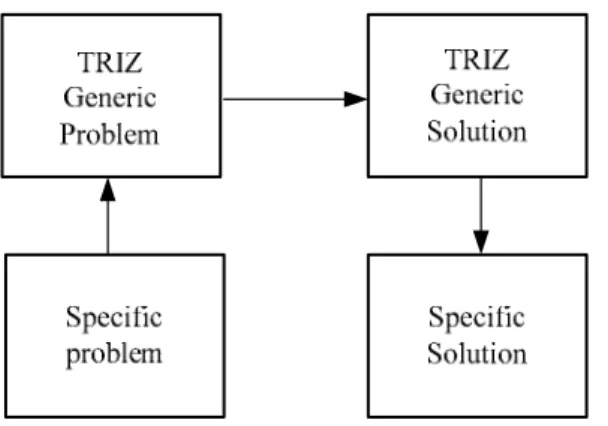
Furthermore, Domb (1998) indicated that TRIZ researchers have encapsulated the principles of good inventive practice and set them onto a general problem-solving structure. The general model for TRIZ problem-solving is shown in Figure 2.1.
Figure 2.1 The General TRIZ Process (Domb, 1998)
Loebmann (2002) explained the general process by which the TRIZ method overcomes the psychological inertia barrier, and this is through the generalization of the specific problem to an analogous TRIZ generic problem. Then through the comparison of this generic TRIZ problem with the analogous generic TRIZ solution in the knowledge database obtained from scientific effects and patents research, one can generate the solutions for the specific problem. TRIZ helps avoid an inefficient route for problem solving, and instead provides a systematic and efficient way to solve the problem. Hence, it is a reliable process that results to systematic innovation.
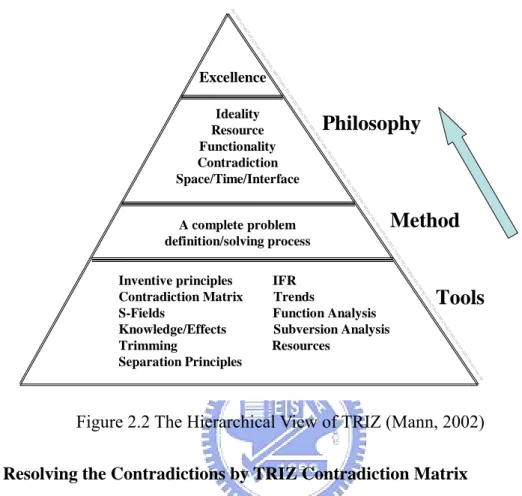
Collectively, TRIZ was illustrated with a triangular pyramid in a hierarchical perspective by Mann (2002) who explored a different way of looking at TRIZ in his study. Figure 2.2 suggested that, at the top of the pyramid, TRIZ may be seen as the systematic study of excellence which was involved in the sciences, arts, business, social sciences and politics. Then, five key philosophical elements have emerged from this study of excellence. The concept of eliminating contradiction can be seen as the primary evolution driver in the systems, which are in terms of space/time/interface, and the functionality was analyzed and then evolved to increasing good and decreasing bad to maximize the effectiveness of resources in the system. At the bottom of the TRIZ hierarchy, there are series of tools and techniques for practically any problem may be encountered. In between the philosophy and this collection of tools is a method to string
the tools together in whatever process they think most appropriate. This hierarchical view of TRIZ depicts the essence of TRIZ technology.
Excellence Ideality Resource Functionality Contradiction Space/Time/Interface A complete problem definition/solving process
Inventive principles IFR Contradiction Matrix Trends
S-Fields Function Analysis Knowledge/Effects Subversion Analysis Trimming Resources
Separation Principles
Philosophy
Method
Tools
Figure 2.2 The Hierarchical View of TRIZ (Mann, 2002)
2.2.3 Resolving the Contradictions by TRIZ Contradiction Matrix
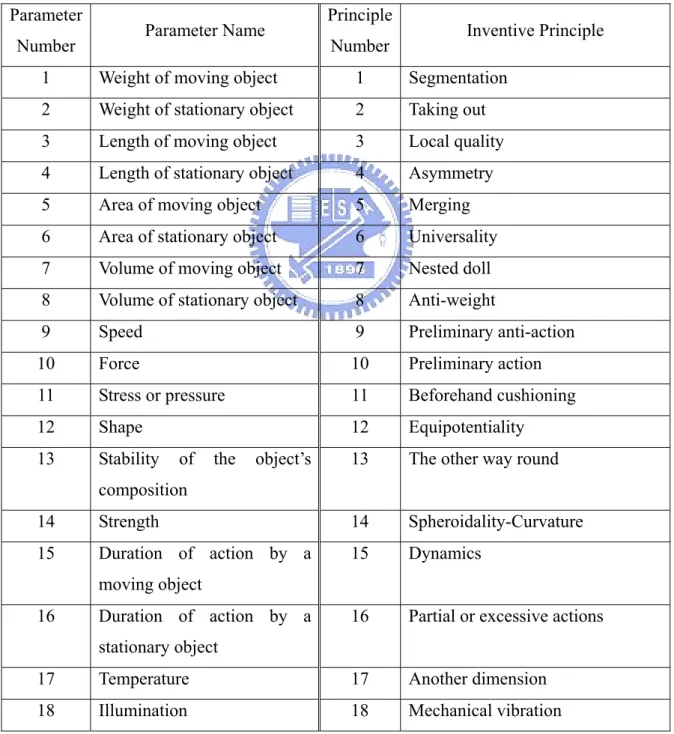
In the TRIZ methodology, the fundamental idea in the conceptual framework is the extraction of the essential conflicts from the problems and the eventual resolution of the conflicts. Altshuller asserted that an invention frequently appears when a contradiction between parameters is resolved. The contradictions can either be technical contradictions which are two mutually conflicting parameters within a system, or physical contradictions which are the direct opposite of two values for a parameter formulated by the same system. With regard to resolving contradictions within a system, one of the most popular tools of TRIZ is the contradiction matrix. This matrix is comprised of 39 engineering parameters and 40 types of inventive principles. The 39 engineering parameters are defined as the behavior or state of a technological system, and most of the engineering products are a compromise between competing features,
that is, trying to improve one feature often degrades another. The 40 inventive principles currently contained within the TRIZ methodology present complete descriptions of the detailed solution thinking contained in each principle, and a few samples of how other problem solvers have used a particular principle to resolve a given situation involving a contradiction. The names of the 39 engineering parameters and the 40 inventive principles are summarized in Table 2.1.
Table 2.1 TRIZ 39 Engineering Parameters and 40 Inventive Principles Parameter
Number Parameter Name
Principle
Number Inventive Principle 1 Weight of moving object 1 Segmentation
2 Weight of stationary object 2 Taking out 3 Length of moving object 3 Local quality 4 Length of stationary object 4 Asymmetry 5 Area of moving object 5 Merging 6 Area of stationary object 6 Universality 7 Volume of moving object 7 Nested doll 8 Volume of stationary object 8 Anti-weight
9 Speed 9 Preliminary anti-action 10 Force 10 Preliminary action 11 Stress or pressure 11 Beforehand cushioning 12 Shape 12 Equipotentiality 13 Stability of the object’s
composition
13 The other way round
14 Strength 14 Spheroidality-Curvature 15 Duration of action by a moving object 15 Dynamics 16 Duration of action by a stationary object
16 Partial or excessive actions
17 Temperature 17 Another dimension 18 Illumination 18 Mechanical vibration
intensity/brightness
19 Use of energy by moving object
19 Periodic action
20 Use of energy by stationary object
20 Continuity of useful action
21 Power 21 Skipping
22 Loss of energy 22 “Blessing in disguise” or “Turn Lemons into Lemonade”
23 Loss of substance 23 Feedback 24 Loss of information 24 Intermediary 25 Loss of time 25 Self-service 26 Amount of substance 26 Copying
27 Reliability 27 Cheap short-living objects
28 Measurement accuracy 28 Mechanics substitution/another sense
29 Manufacturing precision 29 Pneumatics and hydraulics 30 Object affected harmful
factors
30 Flexible shells and thin films
31 Object generated harmful factors
31 Porous materials
32 Ease of manufacture 32 Color changes 33 Ease of operation 33 Homogeneity
34 Ease of repair 34 Discarding and recovering 35 Adaptability or versatility 35 Parameter changes
36 Device complexity 36 Phase transitions 37 Difficulty of detecting and
measuring
37 Thermal expansion
38 Extent of automation 38 Strong oxidants 39 Inert atmosphere 39 Productivity
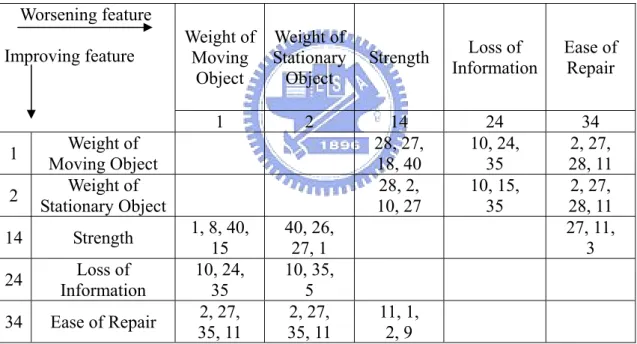
Alshuller arranged these 39 features in each side of a two-dimensional matrix, and at each intersection, some inventive principles are indicated as a reference to resolve the contradictions between these denoted competing features. A sample selection from the TRIZ contradiction matrix is shown in Table 2.2. It can be seen that each of the parameters could either be an improving or a worsening feature. For instance, if one of the improving features of a specified system is strength (14), which is achieved at the expense of a worsening feature with regard to the weight of a moving object (1), then the inventive principles No. 1 (“segmentation”), No. 8 (“anti-weight”), No. 40 (“composite material”), and No. 15 (“dynamics”) might be the applicable suggestions.
Table 2.2 A Partial Contradiction Matrix with Suggested Inventive Principles
Weight of Moving Object Weight of Stationary Object Strength Loss of Information Ease of Repair Worsening feature Improving feature 1 2 14 24 34 1 Weight of Moving Object 28, 27, 18, 40 10, 24, 35 2, 27, 28, 11 2 Stationary Object Weight of 10, 27 28, 2, 10, 15, 35 28, 11 2, 27,
14 Strength 1, 8, 40, 15 40, 26, 27, 1 27, 3 11, 24 Information Loss of 10, 24, 35 10, 35, 5
34 Ease of Repair 35, 11 2, 27, 35, 11 2, 27, 11, 1, 2, 9
Besides, Domb et al. (1998) argued that one barrier in using the matrix is the very brief statement of the lists of improving and worsening features. Thus, in their study, they derived an expanded explanation of the 39 features of the contradiction matrix by comparing several different translations for convenience in using the matrix. Furthermore, in expanding the usage of the 39 engineering parameters of the contradiction matrix, Liu and Chen (2001) tried to develop a green innovation design method by using TRIZ inventive principles without contradiction information, and
examining the relationships between the 39 engineering parameters of TRIZ and each of the major elements of eco-efficiency in the development of non-impacted environmental products or processes for the company. Hasan et al. (2004) also showed considering the correspondence between safety standards and contradictions resolution by means of the TRIZ in order to come up with various resolution principles to assist the equipment or machines designer in his/her task and to take into account safety as soon as possible.
2.2.4 The Applications of the TRIZ Methodology
Recently, there are numerous articles discussing the 40 inventive principles which are examining connections between TRIZ and the frequently used solution of problems involving particular contradictions that are found in quite a few areas, such as business (Mann and Domb, 1999), social examples (Terninko, 2001), software (Rea, 2001), quality management (Retsptor, 2003), service operation management (Zhang et al., 2003), and in marketing, sales and advertising (Retsptor, 2005), etc. This researching results obviously reveal the feasibility of using TRIZ in more areas and a promising future of TRIZ development, but a more important uncovered meaning within TRIZ is the re-explanation of 40 inventive principles in the relating areas of the problems, which can be aiming at the connotation of problems to figure out a more practical solution for the practitioners, it should be more importantly to be further discussed.
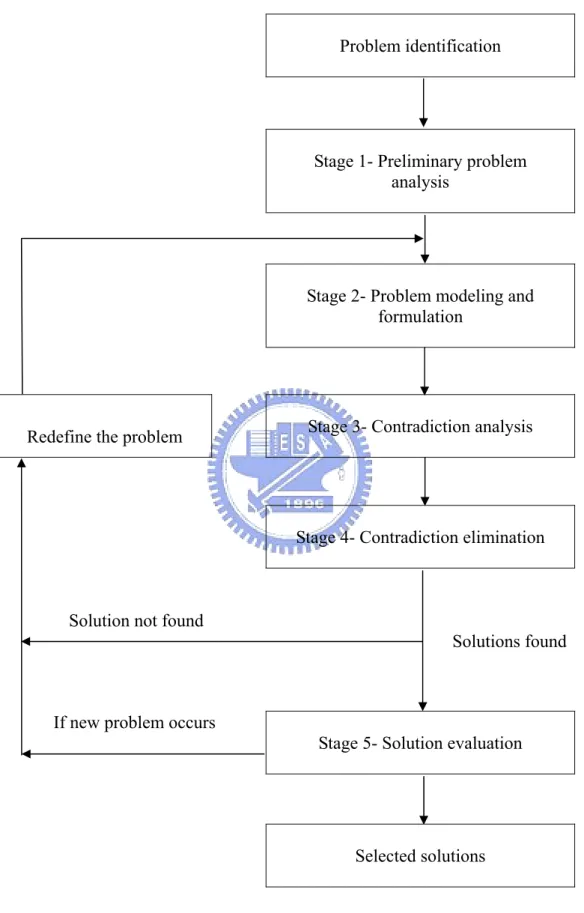
However, there is limited literature discussing the 39 engineering parameters in the TRIZ contradiction matrix for distinct areas, and there is no systematic way to analyze the analogical relationship between the TRIZ 39 engineering parameters and the characteristic features of a specified sector. Besides, the present research on TRIZ focuses on extending TRIZ to a broader application, especially in non-technical areas, Zhang et al. (2003) proposed a modified TRIZ problem solving process to resolve the
problems of innovating new services, the process is shown in Figure 2.3.
Problem identification
Stage 1- Preliminary problem analysis
Stage 2- Problem modeling and formulation
Redefine the problem Stage 3- Contradiction analysis
Stage 4- Contradiction elimination
Solution not found
Solutions found
If new problem occurs
Stage 5- Solution evaluation
Selected solutions
Therefore, the goal of this research is to present a systematic process to resolve the inventive problems in a specified sector and consequently acquire the inventive results. Besides, in the application of the TRIZ methodology, one of the recent trends is to integrate TRIZ with other methods in order to strengthen its strong points (Tan, 2002). Stratton and Warburton (2003) identified how the TRIZ separation principles and TOC (Theory of Constrain) tools may be combined in the integrated development of responsive and efficient supply chains. Petrali (2004) presented a structured workflow, intended mainly for cost reduction, and integrated with different methodologies along with the TRIZ. Most of the methodologies integrated with the TRIZ worked well and have been used by many practitioners. Yamashina et al. (2002) described a new method to systematically integrate QFD with TRIZ, and in the process, enabled the effective and systematic creation of new products.
In our study, we attempt to apply Fuzzy QFD matrix within our problem solving process to analyze the imprecise and subjective problem information in order to clarify the essences of the problem under a fuzzy environment.
2.3 The Fuzzy QFD
2.3.1 An Overview of QFD
Quality Function Development (QFD) is a planning methodology for translating customer needs into appropriate product features. The intents of applying QFD are to incorporate the voice of the customer into the various phases of the product development cycle for a new product or a new version of an existing product. QFD is a complex and very time consuming process, typically QFD consists hierarchically of four House of Quality (HOQ): the first HOQ represents the relationship between the end user’s needs and product design variables; in the second HOQ, design variables of a product are related to those of components; in the third HOQ, design variables of
components are related to job attributes; finally, in the last HOQ, job attributes are related to personnel job assignment (Sohn and Choi, 2001).
QFD is not only a technical tool, but also a managerial philosophy that can help enhance the organizational and managing effects. However, it is difficult to manually record the QFD matrix in a paper form and especially in the qualitative and subjective decision-making process. From this, various quantitative methods, such as analytic hierarchy process, artificial neural networks, and fuzzy logic, are combined with QFD and proposed to provide a more objective and precise approach for its implementation (Yang et al., 2003).
2.3.2 The Concept of Fuzzy QFD
The fuzzy set theory, introduced by Zadeh (Klir and Yuan, 1995), is widely applied to resolve problems that are subjective, uncertain, and imprecise in nature. It provides a strict mathematical framework in which vague conceptual phenomena can be precisely and rigorously studied (Shen et al., 2001). Thus, the QFD method is often used to understand the voice of customers regarding products, and relate them with product design specifications or technical characteristics to be subsequently translated into production requirements. However, when capturing customer requirements from qualitative or linguistic data, for example, human perception, judgment, and evaluation on the importance of customer requirement or relationship strength which are often vague and imprecise in nature, these are difficult to estimate exactly such as numerical data. Thereby, the linguistic data that the conventional QFD process uses can be treated to approximate exactness with the help of the fuzzy set theory (Shen et al., 2001).
Fuzzy QFD has been developed mainly in view of fuzzy relationship between the customers’ needs and design specification. The methodologies using Fuzzy QFD to convert qualitative information into quantitative parameters have been explored in
various applications. Temponi et al. (1999) illustrated their approach, which is a fuzzy logic-based extension to HOQ for capturing imprecise requirements to facilitate communication of team members and the formal representation of requirements, using a textile mill supply business application. Meanwhile, Shen et al. (2001) developed a procedure to deal with the fuzzy data when implemented by the QFD under a fuzzy environment. Their approach allowed QFD users to avoid subjective and arbitrary quantification of linguistic data. Karsak (2004) presented a fuzzy multiple objective programming method which identifies imprecise and subjective information inherent in the QFD planning process to determine the level of fulfillment of design requirement. Finally, Sohn and Choi (2001) constructed a Fuzzy QFD model in order to convey the fuzzy relationship between customer needs and design specification for reliability in the context of Supply Chain Management (SCM). Nevertheless, the application of Fuzzy QFD in TRIZ methodology is rarely discussed; in our study, the relationship matrix of Fuzzy QFD will be applied in analyzing the essentials of the problems in the TRIZ problem solving process.
2.3.3 The Application of Fuzzy QFD Process
To implement the QFD process, the relationship matrix signifies the transition from the semantic of customer requirements or expectations to critical component characteristics. Since semantic data cannot be easily quantified, it is more appropriately to treat them as fuzzy rather than precise. The computational procedure for using relationship matrix of Fuzzy QFD includes the use of the concepts of linguistic variable, fuzzy number, fuzzy arithmetic, and defuzzification. The process introduced in the article of Shen et al. (2001) is summarized in the following:
Step 1: Identification of linguistic terms. The linguistic description of the
important”, instead of using the traditional numerical scale (e.g., 1-5 scale) for determining the degree of importance and strength of the customer requirements or imprecise problem information.
Step 2: Fuzzification of input data. Translate the linguistic data into fuzzy numbers
based on the selected membership functions. Note that the choice of simple membership functions may not represent the exact functions used in the other situations. The triangular fuzzy number is easily illustrated and calculated, and it can be used to capture the vagueness of fuzzy linguistic terms and represents the subjective or uncertain expressions of evaluating results.
Step 3: Applying fuzzy arithmetic. Fuzzy arithmetic, which is a direct application of
the extension principle developed by Zadeh, and by which operations on real numbers are extended to operations on fuzzy numbers (Klir and Yuan, 1995). For instance, let A1
and A2 denote fuzzy numbers and the symbol ⊕ denote the fuzzy addition. Then, A1⊕A2
can be operated with the following equation:
A1=(c1, a1, b1)
A2=(c2, a2, b2)
A1⊕A2=(c1+c2, a1+a2, b1+b2)
Step 4: Defuzzification of output data. Defuzzification is defined as the mapping of
a fuzzy set A to elements of the universe considered significant with respect to A. The results of fuzzy arithmetic calculation, which is expressed in terms of a fuzzy set, will be defuzzified into crisp results which are easy to interpret. A number of defuzzification methods leading to distinct results were proposed in the literature. Each method is based on some rationale. There are three defuzzification methods have been predominant in the literature: center of area method, center of maxima method, and mean of maxima method (Klir and Yuan, 1995).
CHAPTER 3 METHODOLOGIES
3.1 The Systematic Problem-Solving Process
The existing literature on the application of the TRIZ methodology in creating new services is thus far limited. Since Zhang et al. (2003) indicated that TRIZ has already proven its effectiveness in resolving technical problems for tangible products, the present research in TRIZ has put much effort in extending it to a broader application, especially in non-technical areas. Furthermore, in Webb’s (2002) practical experience, he stated that the most easily used method in the TRIZ toolset is the analysis of contradictions. Hence, in this study, we present a systematic process which applies the TRIZ contradiction matrix to identify the corresponding inventive principles. Together with the related standard solutions, the service problems could be more predictably resolved, and consequently, an innovative way to generate services is efficiently acquired.
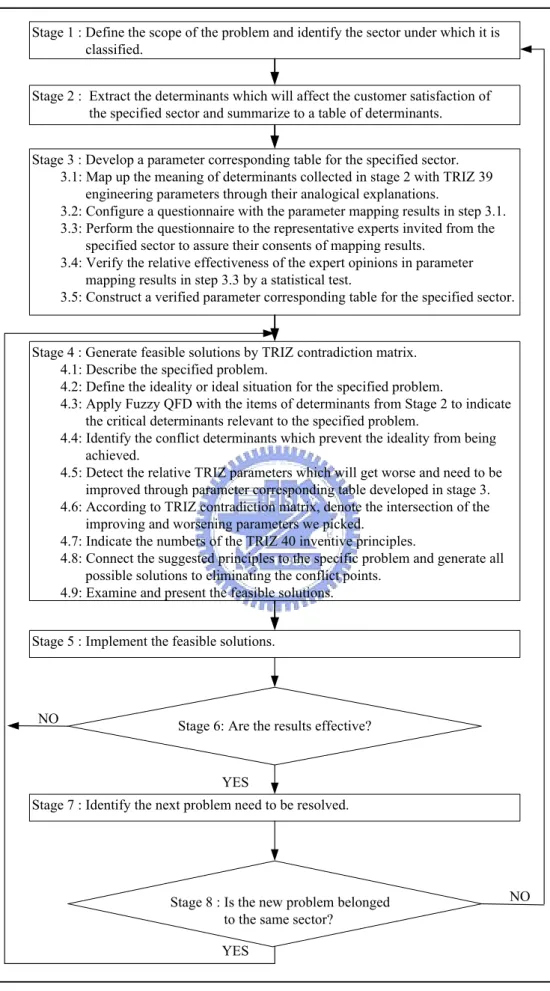
Based on the literature review on service innovation, TRIZ and Fuzzy QFD, and with our main focus on service quality improvement, we follow the conventional way of thinking in TRIZ to be able to create a systematic framework of the problem-solving process for a specified sector. Figure 3.1 depicts the process flow of our proposed approach that comprises of eight main stages which conform to the TRIZ algorithm.
Stage 1: Define the scope of the problem and identify the sector under which it is
classified. It is essential to define the specified industry and preliminarily focus on resolving the problems in the same sector. For example, depending on the service that an ASP (Application Software Provider) company provides, the problems arising from this company can be classified under either the sector of electronic commerce (e-commerce) or electronic business (e-business).
Fig. 3.1 The Systematic Problem-Solving Process for the Specified Sector
Stage 1 : Define the scope of the problem and identify the sector under which it is classified.
Stage 2 : Extract the determinants which will affect the customer satisfaction of the specified sector and summarize to a table of determinants. Stage 3 : Develop a parameter corresponding table for the specified sector. 3.1: Map up the meaning of determinants collected in stage 2 with TRIZ 39 engineering parameters through their analogical explanations.
3.2: Configure a questionnaire with the parameter mapping results in step 3.1. 3.3: Perform the questionnaire to the representative experts invited from the specified sector to assure their consents of mapping results.
3.4: Verify the relative effectiveness of the expert opinions in parameter mapping results in step 3.3 by a statistical test.
3.5: Construct a verified parameter corresponding table for the specified sector. Stage 4 : Generate feasible solutions by TRIZ contradiction matrix.
4.1: Describe the specified problem.
4.2: Define the ideality or ideal situation for the specified problem.
4.3: Apply Fuzzy QFD with the items of determinants from Stage 2 to indicate the critical determinants relevant to the specified problem.
4.4: Identify the conflict determinants which prevent the ideality from being achieved.
4.5: Detect the relative TRIZ parameters which will get worse and need to be improved through parameter corresponding table developed in stage 3. 4.6: According to TRIZ contradiction matrix, denote the intersection of the improving and worsening parameters we picked.
4.7: Indicate the numbers of the TRIZ 40 inventive principles.
4.8: Connect the suggested principles to the specific problem and generate all possible solutions to eliminating the conflict points.
4.9: Examine and present the feasible solutions. Stage 5 : Implement the feasible solutions.
Stage 7 : Identify the next problem need to be resolved.
YES
NO Stage 8 : Is the new problem belonged
to the same sector? Stage 6: Are the results effective?
YES NO
Stage 2: Extract the determinants which will affect the customer satisfaction of the
specified sector and summarize to a table of determinants. The determinants which affect the quality of service and customer satisfaction can be extracted from the review of various perspectives regarding the specified sector. When we focus on service quality improvement especially, the reference materials relating to this sector should be extensively analyzed to find out the dominant characteristics affecting the service quality in this sector.
Stage 3: Develop a parameter corresponding table for the specified sector. There are
five steps to develop a parameter corresponding table for the specified sector, and with this table, we can apply the TRIZ contradiction matrix more effectively. The first step is to map the determinants which are extracted from stage 2 with the analogical explanations of the 39 TRIZ engineering parameters, and through the corresponding relationships, the essential properties of service quality in the specified field are made to reasonably relate to the definitions of the 39 TRIZ engineering parameters. When we apply the TRIZ contradiction matrix in problem solving, the assured TRIZ parameters can be effectively extracted and applied in the contradiction matrix. Furthermore, concerning the applicability and reliability of the parameter mapping results, they are evaluated by a group of experts in the sector from the second to the fourth steps, and then their relative effectiveness is further substantiated by means of a verified statistical test. Cochran’ test which is suited for any dichotomization of the possible treatment results (Conover, 1980) is suggested to be used in this study. Consequently, the resulting parameter corresponding table is constructed to specifically suit the identified sector.
Stage 4: Generate feasible solutions by TRIZ contradiction matrix. Apply the TRIZ
contradiction matrix to resolve the problem step by step according to the TRIZ problem solving process.
Step 4.1 Describe the specified problem with all the customer’s needs and expected
requirements. Collect information on existing situations in the environment of the service operation, strip away the side issues and preconceptions, and analyze to identify the scope of the existing problem or the core requirements from the feedback of customers. Conducting a survey of a focus group is one of the more commonly used tools to accurately gather situation information. Another way to easily collect existing information from the possible problem is to consult the operators of the targeted service operation.
Step 4.2 Define an Ideality or Ideal Final Result (IFR) to achieve, with regard to the
specified problem. First, break the problem down into its most elementary components and conceptualize the basic constituents of the specified problem. This involves expressing the components in their most fundamental state. Then identify the IFR as the ideal situation to achieve without using extra resources when the contradictions within the problem are resolved. There are seven questions which are very helpful in properly defining the IFR in this step. These are the following: what is the final goal of the system, what is the ideal final result, what will prevent us from achieving the ideal final result, why will it prevent us from achieving the ideal final result, how do we vanish those hindrances, what kinds of resources could be used to construct the ideal situation, and is there anyone who has been able to resolve the same problems.
Step 4.3 With the items of determinants developed from stage 2, we apply the
relationship matrix of Fuzzy QFD to indicate the critical determinants relevant to the customer’s requirements specified in step 4.1, and the computational procedures for the fuzzy numbers in the relationship matrix are shown in the following steps:
Step 4.3.1 Identification of linguistic terms: In order to identify the correlative
the sector, we describe the importance of the relationship through linguistic terms with five distinct levels, which are EI (extremely important), VI (very important), I (important), LI (a little important), and NI (not important).
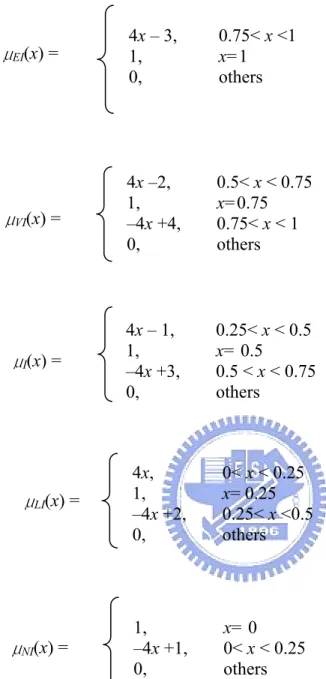
Step 4.3.2 Fuzzification of input data: The triangular fuzzy number which is easier to
interpret is used in this study and all membership functions for the linguistic input data are standardized in the interval [0,1]. The figure of the triangular fuzzy numbers is shown in Figure 3.2, and the membership functions are shown in Figure 3.3.
Figure 3.2 The Figure of the Triangular Fuzzy Numbers in the Interval [0,1] x LI NI I VI EI 0.0 0.25 0.5 0.75 1.00 1.00 Membership Function
Figure 3.3 The Membership Functions of the Triangular Fuzzy Number
Step 4.3.3 Applying fuzzy arithmetic: The fuzzy arithmetic is applied to the calculation
of the priorities of relevant service quality determinants, and the addition and multiplication of fuzzy numbers will be performed for the calculation. Suppose Sitj =
(qitj,oitj,pitj) is the triangular fuzzy number of the jth team member assessing the
correlative importance between the tth customer requirement and the ith category of service quality determinants. Then Sit is defined as the average fuzzy number of the ith
µEI(x) = 4x – 3, 0.75< x <1 1, x=1 0, others µVI(x) = 4x –2, 0.5< x < 0.75 1, x=0.75 –4x +4, 0.75< x < 1 0, others µI(x) = 4x – 1, 0.25< x < 0.5 1, x= 0.5 –4x +3, 0.5 < x < 0.75 0, others µLI(x) = 4x, 0< x < 0.25 1, x= 0.25 –4x +2, 0.25< x <0.5 0, others µNI(x) = 1, x= 0 –4x +1, 0< x < 0.25 0, others
category of the service quality determinant for the tth customer requirement, where n is the number of the team members.
∑
= = n j itj it S n S 1 1 (3.1)We have Sit = (qit,oit,pit) calculated by the following equations:
∑
= = n j itj it q n q 1 1 (3.2)∑
= = n j itj it o n o 1 1 (3.3)∑
= = n j itj it p n p 1 1 (3.4)Suppose there is no weighting difference considered among the determinants of service quality, and the integrated fuzzy number of each service quality determinant for
k team members (Qi,Oi,Pi) can be calculated by the following equations:
∑
= = k t it i k q Q 1 1 (3.5)∑
= = k t it i o k O 1 1 (3.6)∑
= = k t it i p k P 1 1 (3.7)Step 4.3.4 Defuzzification of output data: It is suggested that the output results be
presented in crisp data as they are easier to interpret, and the defuzzification method used in Chen’s research (1996) is applied in the current study. Let X denote the defuzzified value of the integrated fuzzy number for each service quality determinant (Qi,Oi,Pi), and then the defuzzified values can be calculated with the following
4 i i i i O O P Q X = + + + (3.8)
Step 4.3.5 Rank the defuzzified values of service quality determinants: According to the
crisp data calculated from the step 4.3.4, the prioritized importance of each relevant determinant can be sequentially ranked.
Step 4.4 From the most important determinants selected from the rankings, we discuss
to identify all the conflicting determinants which will enhance and prevent the ideal solution to be acquired.
Step 4.5 Detect the relative TRIZ engineering parameters which get worse and need to
be improved from the parameter corresponding table which was developed in stage 3 based on the improving and worsening determinants which were identified from step
4.4.
Step 4.6 According to the TRIZ contradiction matrix, the denoted numbers of the 40
TRIZ inventive principles can be gathered from the intersection of the improving and worsening TRIZ parameters.
Step 4.7 When we indicate the 40 TRIZ inventive principles based on the content of the
specified problem, we suggest that the appropriate reexplanations and examples of the 40 TRIZ inventive principles developed in distinct areas be examined and benchmarked. For instance, when the specified problem is relating to the service sector, the studies of Mann and Domb (1999), Rea (2001), Retseptor (2003), Zhang et al. (2003), and Retseptor (2005) are relevant to service quality in the non-technical field.
Step 4.8 Following the indicated principles and suggested ways, all possible solutions
may be generated through various discussing meetings.
Step 4.9 Examine to obtain the feasible solutions with concerned criteria such as cost,
time, available human resources, technological level, etc.
examined and presented, the confirmed feasible solutions can be implemented in this stage.
Stage 6: Are the results effective? This will be followed by the evaluation of the results
with various specified performance criteria in this stage. If the conflicts of the problem are effectively resolved, we can proceed to the next stage; otherwise, we repeat the fourth stage to examine which step involved the problem.
Stages 7 and 8: Identify the next problem need to be resolved and is the new problem
belonged to the same sector? After resolving the problem, we can continue to identify the next problem, and identify if it belongs to the same sector or not. If it does, we can iterate the procedure back to stage 4 and continue to generate the feasible solutions; otherwise, we can return to the first stage to redefine the scope of the new problem and identify the sector under which it is classified.
3.2 The Statistical Test
In order to verify the effectiveness of parameters corresponding results among the invited experts, it is necessary to perform a defensible validation test. Refer to the article of Saliminamin and Nezafati (2003), Cochran’s test is selected by our study as a statistical hypothetic test which bases on experts’ opinions in the specified sector, and test the consistent agreement of the parameter corresponding results which are developed in our research. Cochran’s test is suitable because of conceptual adoption with our parameters mapping results which are testing reject or accept in expert’s opinions and also are simplifying for answering (yes/no).
In some investigations that utilize the randomized complete block design, the response to a treatment may take on only one of two values. We may arbitrarily designate these two possible outcomes “agree” or “1”, and “disagree” or “0” (Daniel, 1990). In the reference of Conover’s (1980) description, the Cochran Test can be
illustrated in the following elaboration.
Data
Each of c treatment is applied independently to each of r blocks, and the result of each treatment application is recorded as either “1” or “0”, to represent “success” or “failure” or any other dichotomization of the possible treatment results. The results are then given in the form of a table with r rows representing the blocks and c columns representing the c treatments, with entries that are either zeros or ones. Let Ri represent
the row totals, i=1,2,….,r, and let Cj represent the column totals, j=1,2,….,c. Then the
data appears as in the following table, where the Xij are either 0 or 1, and N represents
the total number of ones in the table.
Treatments
Blocks 1 2 c Row Totals
1 X11 X12 … X1c R1
2 X21 X22 … X2c R2
… … … … … …
r Xr1 Xr2 … Xrc Rr
Column Totals C1 C2 Cc N=Grand Totals
Assumptions
1. The blocks were randomly selected from the population of all possible blocks.
2. The outcome of the treatments may be dichotomized in a manner common to all treatments within each block, so the outcomes are listed as either “0” or “1”.
Hypotheses
H0: The treatments are equally effective
Test Statistic
Decision Rule
The exact distribution of T is difficult to tabulate, so the large sample approximation is used instead. The number of blocks r is assumed to be large. Then the critical region of approximate size α corresponds to all values of T greater than x1-α, the
(1-α) quantile of a chi-square random variable with (c-1) degrees of freedom. If T exceeds x1-α, reject H0, otherwise accept the null hypothesis of no differences in the
effectiveness of the various treatments.
∑
∑
= = − − − = r i i i c j j R c R c N C c c T 1 1 2 ) ( ) ( ) 1 (CHAPTER 4 CASE STUDY
4.1 The Problem
The studied company, EC-SERVER.COM, is specializing in development of online database application, and has achieved the largest market share in Taiwan and the largest market share in online database software in Asia. The products of EC-SERVER.COM are designed to help enterprises solve data management problems. In addition, the incorporation of advanced database tools of SYBASE, with the specialty of EC-SERVER.COM in software development helps enterprises to effectively and systematically integrate their internal and external data. With absolute competitive advantages, EC-SERVER.COM’s products have obtained a number of worldwide patents and won appraisal from customers. EC-SERVER.COM has cooperated with domestic and overseas institutions for technical advancement.
The case study focused on providing a systematic way of idea generation to solve EC-SERVER.COM’s problems in service operations and to create valuable services in order to enhance the satisfaction of customers. Since 2002, the company rapidly expanded its versatile services by deploying management and remotely hosted software applications through centrally located services in a rental agreement with the Chinese Communication Corporation Company (Taiwan). However, since the delivery of new information technology services and business solutions to their clients, many of the client companies adopting their services experienced various problems in the areas of convenience and functionality. Hence, the company hoped that the true nature of the problems could be studied in depth, and they endeavored to generate solutions that will provide customers with overall value-added services.
4.2 Recognition
We started from organizing a problem-solving team in EC-SERVER.COM for the first step. Investigations were done on the business map, and interviews with relevant individuals in certain divisions of the company were likewise conducted. Finally, we found that there were various service contradictions contained within the services provided by the company, for instance, the contradiction of “Functionality versus Ease of use” remained unresolved among the division of software design for such a long time, and it might be possible to use TRIZ to resolve the service problems which have embedded contradictions. Therefore, we recognized that our proposed approach is suitable to resolve the problems, and we attempted to follow the steps in Figure 3.1 to generate the inventive solutions to resolve the company’s problems.
In our studied case, the company delivers and manages computer applications and services from remote data centers to multiple users. Boyer et al. (2002) defined e-commerce to be “comprised of all interactive services that are delivered on the Internet using advanced telecommunications, information, and multimedia technologies.” Thereby, depending on the type of services this company provides, the problem of this company can be classified under the scope of the e-commerce industry. 4.3 Extract the Major Determinants of Service Quality
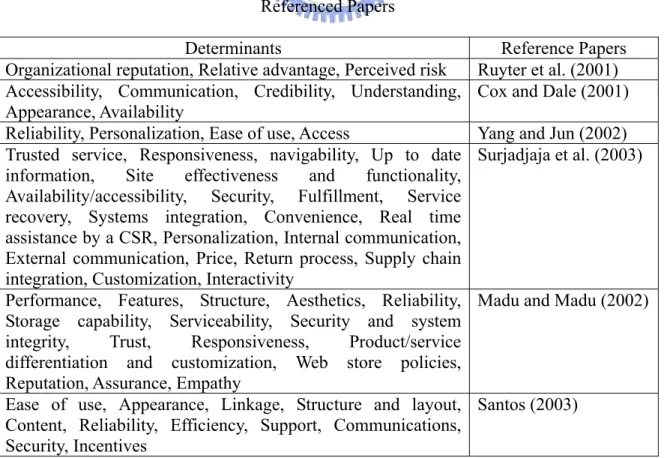
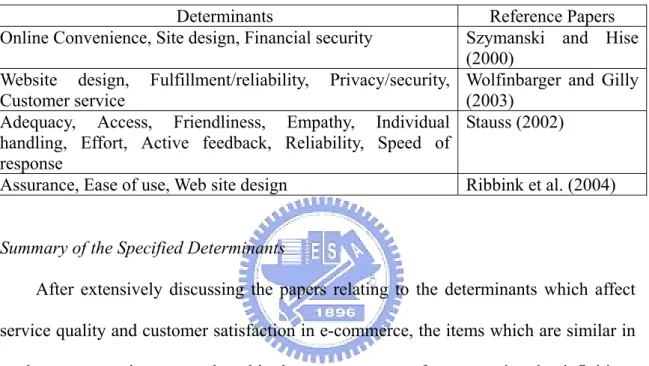
Service quality is indicated as one of the best performance-based measured factors of success (Landrum and Prybutok, 2004). Hence, in stage 2, we studied various perspectives from the existing literature in order to extract the major determinants of service quality in e-commerce. Through categorizing the related academic papers within the scope of the case problem, we concluded that customer satisfaction is influenced by the following through the identification of the dominant characteristics of e-commerce: determinants of e-business operation, the measurement of the determinants of e-service
![Figure 3.2 The Figure of the Triangular Fuzzy Numbers in the Interval [0,1]](https://thumb-ap.123doks.com/thumbv2/9libinfo/8458650.183072/38.892.83.727.445.717/figure-figure-triangular-fuzzy-numbers-interval.webp)