行政院國家科學委員會專題研究計畫 成果報告
性別與傳播科技研究再探:以女性退用/續用網際網路個案
為起點的研究
計畫類別: 個別型計畫 計畫編號: NSC92-2412-H-004-011- 執行期間: 92 年 08 月 01 日至 94 年 01 月 31 日 執行單位: 國立政治大學新聞學系 計畫主持人: 方念萱 計畫參與人員: 施盈廷,田瑞華,陳雅琪 報告類型: 精簡報告 處理方式: 本計畫可公開查詢中 華 民 國 94 年 6 月 10 日
行政院國家科學委員會補助專題研究計畫成果報告
性別與傳播科技研究再探:
以女性退用/續用網際網路個案為起點的研究
計畫類別:個別型計畫
計畫編號:NSC 92-2412-H-004-011
執行期間:92 年 8 月 1 日至 94 年 1 月 31 日
計畫主持人:方念萱
計畫參與人員: 施盈廷、田瑞華、陳雅琪
成果報告類型(依經費核定清單規定繳交):精簡報告
處理方式:除產學合作研究計畫、提升產業技術及人才培育研究計畫、
列管計畫及下列情形者外,得立即公開查詢
□涉及專利或其他智慧財產權,□一年□二年後可公開查詢
執行單位:政治大學新聞系
中 華 民 國 94 年 6 月 7 日
*研究主持人曾於計畫進行中赴國外發表此計畫研究部分成果,但主持人
並未在此計畫提案之初申請「出席國際學術會議」經費。後另行申請得
到出席會議經費,也已於國際學術會議後繳交心得報告。
(二)中英文摘要:請就本計畫要點作一概述,並依本計畫性質自訂關鍵詞。 計劃中文摘要 關鍵詞:性別與資訊傳播科技、網際網路、退用網際網路者、數位落差、家庭性 因為研究者先前國科會研究計劃「數位落差」」當中台北都會區女性退用網際網路者(Internet Dropouts)的研究發現一反傳統男性霸權(male dominance)或是女性賦權(women empowerment)的單一基調,針對三十多位女性退用者的訪談透露出不同的選擇原因、理 念、對於網路的世界觀與人際網絡;性別究竟是不是一個影響傳播科技使用/停用的重要因 素?不只是男女二分的生理性別、社會性屬而已 ──「性別」的什麼構面在這傳播科技運 用與意義的議題上饒具深意?為了進一步追索、深化有關性別與傳播科技的研究議題,本 研究計劃期以修正之後的研究方法收集大台北以外的資料(先前計畫訪談台北都會區女 性),以得到完整資料,俾發展植基於本地經驗的概念與論述。 本研究預計回答以下研究問題: -- 家庭中女性使用/退用網際網路的樣態有哪些?其中,性別是否為重要(決定性)因素? 此處「性別」的內涵與行動的關係? -- 女性使用/退用網路者認為與網際網路的經驗如何挑戰、修整、變化了她們原來的性別經 驗?人際(家人與其他)經驗? -- 具有與性別有關的不同的資本、經驗、世界觀的女性如何在家戶與工作上運用(退用/ 使用)網際網路? -- 使用網際網路之後,家庭傳播中對外聯絡的性別分工的變化? -- 網際網路個人化使用(不同平台)與性別角色的關係?
計劃英文摘要
Keywords: Gender & ICT, Internet, Internet Dropouts, Digital Divide, Domesticity
The findings of the research on the female Internet dropouts in metropolitan Taipei have revealed the multiple layers of the mutual shaping of the Internet and gender; the findings go against the common claims that the Internet constitutes a purely male-dominated or contrarily a women-empowering environment. This urges more in-depth analysis on the mutual shaping of the Internet and the gender that goes beyond the scope of prior research.
This study aims to further explore the nature of mutual shaping of the Internet and gender at the moment of domestication. With the issue of the Internet dropouts still used as the entry points, the analysis will focus on the females’ account on their use/ dropout of the net and explore their reconceptualization of the net and their gender experiences. The gendered division of labor as it comes to family digital communication with relatives and friends demands special analysis since the existing data show the possible rewriting of the traditional gender code in this matter.
(三)報告內容 前言與研究目的 性 別 與 數 位 傳 播 科 技 的 研 究 其 實 與 大 環 境 的 數 位 熱 、 e 化 症 候 群 脫 不 了 關 係;正 是 因 為 數 位 生 活、e 化 社 會 喊 得 震 天 價 響,論 述 中 女 性 ─ ─ 不 同 位 置 、 工 作 、 關 係 、 身 份 、 自 我 標 示 的 女 性 ─ ─ 與 數 位 生 活 的 關 係 是 ? 目 前 女 性 生 活 數 位 化 的「 程 度 」? 意 義 ? 對 於 進 一 步 e 化 的 想 像 、 欲 望 、 憂 慮 、 與 選 擇 ? 這 樣 的 提 問 不 來 自 玄 想,而 這 些 提 問 也 有 其 公 共 政 策 上 的 重 要 意 涵。研 究 提 案 人 於 2001 年 8 月 起 至 2002 年 10 月 底 止 所 進 行 的 國 科 會 專 題 計 劃〈 數 位 落 差: 一 個 參 與 傳 播 觀 點 的 研 究 〉 曾 針 對 大 台 北 都 會 區 退 用 網 際 網 路 ( Internet dropouts)的 女 性( 以 及 用 以 對 照 的 女 性 續 用 者 、 男 性 續 用 與 退 用 者 )進 行 深 訪,退 用 網 際 網 路 的 女 性 並 不 限 於 印 象 中 缺 乏 接 近 使 用 管 道 的 女 性,利 用 滾 雪 球 方 法 聯 絡 上 的 數 十 位 都 會 區 退 用 網 路 的 女 性,家 中 不 乏 電 腦 網 路,退 用 者 更 有 過 往 在 資 訊 傳 播 科 技 產 業 中 任 職、甚 至 擔 任 軟 體 設 計 的 女 性 專 業 從 業 人 員 。 相 對 於 當 前 政 府 政 策 宣 示 的 對 於 弭 平 數 位 落 差、建 立 數 位 社 會 的 圖 像,以 及 圖 像 中 瞠 乎 其 後 的 未 上 網 者 ,顯 然 ,下 網 不 用 的 多 姿 多 樣 的 女 性 ,以 及 她 們 的 各 式 各 樣 對 於 網 際 網 路 這 數 位 科 技 與 相 關 媒 體 的 想 像 在 當 前 e 化 政 策 與 相 關 的 流 行 論 述 中 缺 席 了 。對 於 女 性 或 是 退 用 網 際 網 路 的 人 的 情 境 、生 活 需 求、對 網 路 的 想 像 不 明 白,純 然 以 建 置 傳 統 上 友 善 的 網 路 近 用 環 境 是 尚,固 然 可 以 解 決 近 用 的 問 題 、 普 及 的 問 題 , 但 是 鋪 設 網 路 、 鼓 勵 上 網 , 為 的 不 是 換 個 媒 體 而 已 ─ ─ 畢 竟 為 的 是 建 立 以 一 個 我 們 認 為 更 友 善 、 更 包 容 的 平 台 、 環 境 進 行 溝 通 的 文 化 。 那 麼 , 可 以 進 一 步 提 問 的 是 , 如 果 以 各 種 管 道 進 行 溝 通 不 是 問 題 , 對 於 網 路 與 數 位 管 道 傾 全 國 之 力 ( 媒 體 、 政 府 、 教 育 體 制 等 等 ) 的 強 調 、 對 於 e 化 成 果 齊 一 的 想 像 ( 經 濟 、 政 治 、 教 育 ) , 這 些 論 述 對 於 不 同 的 人 ─ ─ 性 別 、 資 源 、 需 求 、 想 像 ─ ─ 會 不 會 造 成 別 的 影 響 ? 當 退 用 停 用 網 際 網 路 不 是 因 為 無 法 接 近 、無 奈 而 停 ,使 用 者 因 為 過 往 與 當 前 對 於 網 際 網 路 文 化 有 疑 慮 、 不 安 心 而 主 動、積 極 抽 身 離 開 眾 人 搶 搭 的 網 路 列 車,這 提 供 了 什 麼 樣 不 同 於 主 流 的 網 際 網 路 傳 播 科 技 的 建 構 ? 不 同 的 使 用 /停 用 者 認 為 的 網 際 網 路 的 能 供 性 ( affordances) 、 能 動 性 ( dynamics) 是 ? 為 不 同 的 人 而 言 , 網 際 網 路 意 味 著 什 麼 ? 從 性 別 研 究 的 角 度 觀 察,都 會 區 女 性 退 用 者 的 經 驗 不 但 不 是 負 面 退 縮 的 使 用 範 例,反 而 可 能 是 提 供 對 於「 科 技 」不 同 定 義 的 例 證、可 能 是 主 動 選 擇 、 詮 釋 自 身 與 傳 播 科 技 關 係 的 例 證 ( 註 一 ) ( Wyatt, et al., 2002) 。 大 台 北 都 會 區 數 十 位 女 性 退 用 網 路 者 的 證 言 為 性 別 與 傳 播 科 技 研 究 開 了 窗 口,許 多 有 關 性 別 與 科 技 的 問 題 還 沒 有 答 案,而 這 些 現 象 已 經 不 是 傳 統 的 採 取 男 性 霸 權 或 是 女 性 賦 權 的 觀 點 看 待 傳 播 科 技 所 能 解 釋 的 了( 即 使 用 這 些 觀 點 解 釋 也 是 壓 縮 扁 平 化 了 豐 富 的 女 性 自 述 經 驗 ), 因 此 , 研 究 提 案 人 希 望 延 伸 早 先 的 研 究 , 將 深 訪 擴 及 台 北 以 外 生 活 經 驗 不 同 的 女 性 , 同 時 不 單 探 究 「 使 用 」 與 「 消 費 」 , 希 望 能 從 家 戶 與 工 作 場 域 中 發 展 、建 置、與 設 計 網 路 等 過 程 探 究;在 前 一 個 研 究 重 構「 數 位 落 差 」概 念 而 找 到 針 對 性 別 與 科 技 研 究 的 切 入 點 與 個 案( 退 用 網
路 的 女 性 )之 後 , 希 望 能 藉 由 這 一 個 研 究 計 劃 , 進 一 步 收 集 資 料 , 累 積 個 案 , 思 考 、分 析 性 別 與 傳 播 科 技 的 關 係,豐 富 既 有 的 想 像,構 連 實 證 資 料 與 理 論 概 念 , 修 整 可 能 的 理 論 進 路 。 不 同 於 一 年 前 研 究 提 案 人 有 關 數 位 落 差 的 研 究 計 劃 , 本 研 究 並 非 希 望 直 接 「 解 決 」、「 回 答 」弭 平 數 位 落 差 的 問 題 ; 經 由 台 灣 有 關 數 位 落 差 的 流 行 論 述 以 及 政 府 宣 示 彰 顯 的 觀 點,經 由 研 究 者 先 前 針 對 女 性 退 用 者 經 驗 所 發 現 的 有 關 性 別 、 科 技 、 與 家 庭 、 工 作 的 嶄 新 關 係 與 觀 點 , 本 研 究 提 案 再 次 以 數 位 落 差 此 一 議 題 為 觸 媒,而 探 問 有 關 女 性 與 網 際 網 路 這 傳 播 科 技 意 義 建 構 的 基 本 問 題 。 文獻探討、研究方法、結論討論等請見所附結案論文。本論文回應提案中所言之研究目的 與提問: 當 退 用 停 用 網 際 網 路 不 是 因 為 無 法 接 近、無 奈 而 停,使 用 者 因 為 過 往 與 當 前 對 於 網 際 網 路 文 化 有 疑 慮、不 安 心 而 主 動、積 極 抽 身 離 開 眾 人 搶 搭 的 網 路 列 車,這 提 供 了 什 麼 樣 不 同 於 主 流 的 網 際 網 路 傳 播 科 技 的 建 構 ? 不 同 的 使 用 / 停 用 者 認 為 的 網 際 網 路 的 能 供 性( a f f o r d a n c e s )、能 動 性( d y n a m i c s ) 是 ? 為 不 同 的 人 而 言,網 際 網 路 意 味 著 什 麼 ? 從 性 別 研 究 的 角 度 觀 察,都 會 區 女 性 退 用 者 的 經 驗 不 但 不 是 負 面 退 縮 的 使 用 範 例,反 而 可 能 是 提 供 對 於「 科 技 」不 同 定 義 的 例 證 、 可 能 是 主 動 選 擇 、 詮 釋 自 身 與 傳 播 科 技 關 係 的 例 證
選擇從 membership categorization devices(MCD)此一社會語言學上的社會類屬分析方 法角度分析受訪女性述說自身與網路經驗的資料,從中探問不同的女性對於網際網路、對 於資訊化生活所投射的想像,並可由此分析「女性」此一類屬在當前社會的豐富意義以及 在當前主流媒體建構的資訊社會圖像中的侷限性。
Involuntary Divide or Segregated Well-Chosen? The
Analysis of Membership Categorization in Female Internet
Dropouts’
Accounts
Leticia Nien-Hsuan Fang
Associate Professor Department of Journalism College of Communication National Chengchi University
Taipei, Taiwan
Paper submitted for presentation in ‘Gender & Communication’ section in IAMCR Bi-annual conference in Porto Alegre, Brazil, on July 28, 2004.
Abstract
Research has shown that even though the Internet has been taken up as an extension of male territory in the household, women are not totally excluded in using the Net; the mutual shaping of gender and technology needs more in-depth analysis. Regarding the claims on the gender codes and the Internet, some feminist scholars claim that the medium is women-friendly and others believe the Net is dominated by males. At the same time, cyberfeminism states that the Internet facilitates new identities that go beyond gender. This study aims to focus on female Internet dropouts in Taipei, Taiwan. The non-users of the Internet tend to be considered
backward nowadays and popular rhetoric attributes people’s disconnection from the Net to the involuntary reasons such as lack of access and literacy. However, research findings tell the different stories. Former Internet users, especially females, give different accounts. The dynamic relationship between gender and the Net in household contexts in Taiwan will be explored and the research findings help to advance the theory in this aspect.
This study adopts the analytical method of membership categorization devices (MCD) introduced by Sacks (1992) to explore the interview accounts given by 30 female Internet dropouts in metropolitan Taipei, Taiwan. The interviews are conducted during one and a half year period (from 2001 to 2003). The women (mostly housewives) interviewed have multiple accesses to the computer and the Internet at home and most of them have taken courses on the internet literacy before. The reasons that they quit the net vary, but the mere fact that they stop surfing online does not lead to the conclusion that they are weak, passive or their husbands and children always have advantage when it comes to the use of the net at home. As one woman proudly announced that she can always command her husband and kid to look up some information for her online, ‘they are voice-activated; I don’t even have to move a finger’, the internet is the database that she does not bother to work through herself. Instead of emailing each other as usual, one interviewee resumed writing letters to her male friends when she was relocated and had no access to the net at work anymore. ‘ I can always use the computer at home but I no longer logged on to my email account at home either; my husband and I use the same computer and I simply don’t want to worry about the privacy issue. Don’t get me wrong, my husband and I get along pretty well. I don’t want any misunderstanding ruin our partnership.’
Interviewees’ accounts convey their recognition of the social categorizations, motivations and morality that attach to their use(or non-use) of the internet at home. The close reading and analysis of the membership categorizations used as addressing their husband, children, and themselves help to investigate women’s talk as social action and re-draw the complicated picture of the mutual shaping of gender and technology.
Women look at computers and see more than machines. They see the culture that has grown up around them and they ask themselves if they belong. -Turkle, (1988: 42)
Introduction
The discourse revolving around women and computer has its root in the talk about women and ‘computerphobia.’ Women are socialized into taking on certain interactive pattern with technical objects, but the notion ‘computerphobia’ does not tell the whole story of women and computer. Sherry Turkle (1988) posed the concept ‘computer reticence’ to delineate how women wanting to stay away from computer because it has become ‘a personal and cultural symbol of what a woman is not.’ (p. 41) Even computer-competent, women may distant themselves from machines out of the fear of the machine as a potentially destructive force; in womens’ eyes, computers offer the illusion of companionship without the demands of friendship. (Turkle, 1984) Computational reticence suggests women’s deliberate refusal of computers at the pre-Internet era. Technical objects are subject to change. The user-unfriendly computer turns into the interface that connects people in front of the different terminals as computer hooking up to the Internet. The connection mediated by computer and the net has the culture coming along with it. At the same time, more and more research and findings of empirical surveys draw attention to the problematic notion of internet use and non-use. The concern of this study is about the relationships female internet dropouts, one of the non-use patterns, have with the net and with the imagined worlds that grow along relating to their past experience and future
relationships revealed in their accounts. What sense of identity can be created with their internet reticence, internet phobia, or involuntary disconnection with the net?
Computer reticence or internet reticence does not pertain to women only. Research has shown that some people do not intend to use the internet and some choose to drop out from the internet. (Katz and Aspden ,1998; Thomas and Wyatt, 2000; Wyatt, Thomas, & Terranova, 2002) The thought that everyone is willing to be connected to the net dominates the popular discourse and underpins policy-making, but this remains as a wishful thinking. Along the lineage of research on audience/ user of communication technology, it is broadly recognized that users and non-users are active in shaping the meanings of communication technology. However, as Wyatt, et al. have cautioned, ‘by focusing only on use to the neglect of non-use, we are in danger of uncritically accepting the promise of technology.’ (p. 25) In 2003, the US Pew Internet &
American Life Project(2003) released the findings of the national phone survey of 3553 people in March to May 2002 and found that 42% of Americans do not go online. The ‘not online’ group is composed of ‘truly unconnected’ (24%) , ‘net evaders’ (8%) and ‘net dropouts’(10%), and as for ‘online’ group, the ‘ intermittent users’ takes up almost half of the population of the ‘online’ group. The report concluded that net use in the States is much more fluid, and not necessarily progressive or direct. Before the release of the 2003 Pew Internet & American Life Project report, review has shown accumulated findings on the slowdown in internet growth and diversified patterns of internet use and non-use. Based on the empirical analyses, Katz and
Aspden (1998) highlighted the notion of ‘the dropout’—as encountering communication technology, be it mobile phone or internet, some people choose to drop out from the medium and become disconnected. Katz and Aspden’s and the related studies (Wyatt, et al., 2002) reject the normativity of technology and invite more delicate analysis on the internet use and non-use.
Similar to the condition in the States, the growth rate of the internet use seems to reach stagnation in Taiwan also. According to the report released in June, 204, there are 8.88 million net users and the penetration rate is 39%; however, the net population increases only 50,000 since last season; the increase rate is 1%. (ECRC-FIND, 2004) Unlike the current analyses devoting to explore the facets of internet use and non-use, little research has been done to delve into the possible fluidity of internet use and non-use. Among few available surveys and analyses, the report released by Commonwealth stated that among 870,000 internet users who dropped out from the net in 1999, half of them began to get online just a year ago. The dropout rate is 23%. Based on the secondary data analysis, Fang and Lin (2002) found that 33% of internet dropouts are married females while single females compose of the smallest portion of the net dropout population. Scanty as they are, the survey findings reinforce the belief that the relationship between gender and internet is not fixed and the relevant categories are not unitary; gender and technology are constructed in relation to each other.
The current research adopts Harvey Sacks’ theoretical concept ‘membership categorization devices’ to analyze how female internet dropouts’ identity is constructed along with their
experiences and (failed) expectations towards internet. Sacks’ analytical framework falls into the sociological approach to language use in context; as one of the ethnographic approaches of speaking, it tends to focus on the sociological aspects such as culture, community, etc.
Membership categorization devices (MCD) are collections of categories that go together; Sacks states that we all employ an MCD in conversation, which means we tend to allocate people to one specific category of the social groups, and the assumed category-bound activities associated with the category and relational pairs are often addressed or implied in underpinning the points in conversation. (Yates, 2001) These Sacks’ theoretical constructs will be used altogether in this research to examine female dropouts’ accounts.
Gender, discourse, and cyberspace: An analytical review Cyberfeminism
The rising question associated with womens’ fluctuating use/non-use of internet is, what sense of identity can be created for women in cyberculture? The same question can also be posed to women who dropped out from the net involuntarily or voluntarily; what sense of identity can be raised by women who are failed by the cyberculture or decline the cyberculture? The imagined identity associated with the online experience exhibits women’s constraints and
Feminist research of technology mainly focus on the relationship between the gendering of technology and the construction of gendered subjectivities. (Henwood, et al., 2001). As cited in the work of Henwood et al., , Grint and Gill (1995) pointed out the bias in the field – much of the work at early stages only highlighted the practices that reinforce or reproduce the existing
patterns of gender relations. The orientation did not help to expand the horizon of feminist study of technology; technology was either oppressive to women or emancipating in researchers’ polarized interpretative framework. In response to the dichotomy between two camps, third wave of feminist technology studies has emerged (Spilker and Sorensen, 2000, in Henwood, et al., 2001). With ‘cyborg’ as the core concept, cyberfeminism comes forward as the most
representative third wave feminist thoughts on the relationship between gender and technology, especially internet.
Many research turn to cyberfeminism for better understanding of the transformation of identity in Internet age. Cyberfeminism is the philosophy which recognizes the disparity in power between men and women in the digital discourse, and theorize the findings of women’s empirical projects to offer the solutions for the problems women face in digital era. As Nancy Paterson (cited in Hawthorne and Klein, 1999: 4) put it:
Cyberfeminism as a philosophy has the potential to create a poetic, passionate, political identity and unity without relying on a logic and language of exclusion. It offers a route for reconstructing feminist politics through theory and practice with a focus on the implications of new technology rather than on factors which are divisive.
Cyberfeminism deals with technology and gender, and communication and connectivity are pertinent to the formation of identity. Pollock and Sutton (1999, p.35) highlighted the
significance of communication in the relationship between gender and technology:
Women’s groups tend to talk of ‘Communication Technology’ rather than ‘Information Technology’, because communicating is central to feminist work.
Pollock and Sutton(1999) also cited Pauktuutit’s(1997: 96) words to emphasize the point:
The information highway is not about computers or phones or
technology – it’s really about talking to each other for work, for fun, for talking with our families, for developing businesses, running government and for
community action. It’s about using whatever technology is out there to do what we have always done when we need to talk with each other to make something happen – it’s about communicating…
As Hawthorne and Klein(1999) put it, ‘connectivity is at the heart of feminism ( p.5), cyberfeminism highlights the multiple facets of connectivity and new forms of disconnection women experience on and off the Internet. The connection with others will increase women’s capacity to make decisions and take actions, and the disconnection may also be resulted in because of the allocation of the net-related resources at household or working place follows the old rules. Connection or disconnection, the net-related identity revealed by the women other than feminist activists will uncover the socially-constructed technology-shaping ideal images. The analysis of the images will in turn enrich the discourse of cyberfeminism.
Gender categories in talk
As the transformation feminist study on technology has gone through, the paradigm on which feminist linguistic analyses are based has also shifted from the second wave feminism to the third wave. The linguistic work based on the second wave feminism tend to focus on the
stereotypical speech of men and women, and research findings highlight the powerlessness revealed in women’s language. Lakoff(1975), Spender(1980) and Tannen's(1991) second wave feminist research assumed that women's and men's language are necessarily different even though they often disagreed as to the cause of that difference. (Mills, 2004) As Stokoe &
Smithson(2001) put it, the explanations of the differences between men and women are presented as deficit (Lakoff, 1973), dominance (Spender, 1980), and difference (Tannen, 1990). Based on the essentialist standpoint of sex and gender, the aforementioned theoretical frameworks
perpetuate the thought that gender is a property residing within individuals. The findings of the research along these theoretical lineage reinforced the idea of dichotomous gender categories. Challenging the dichotomy, researchers began to take the position that gender in fact locates in interactions, the thoughts range from ‘gender as an emergent property of social interaction’ to ‘people doing gender as a routine accomplishment in conversation’. (Butler, 1990; Stokoe & Smithson, 2001; West and Zimmerman, 1987, 1991) Feminist gender and language research thus take a turn and shift from focusing on gender differences in conversation to studying women’s discursive articulation.
Contrary to the second wave feminist research concerns, a number of feminist linguists (Troemel-Ploetz 1998; Bergvall et al. 1996; Bucholtz, 1999) suggest that what is needed is ‘a form of analysis which is less focused on the individual woman or man and trends of speech in the society as a whole, and more focused on the way that context and individual mutually shape the way that interaction takes place .‘ (Mills, 2004) Mills delineates the transformation,
so that rather than gender being seen as a stable unified variable, to be
considered in addition to race or class, gender is now considered as a variable constrained and constituted by them and in turn defining them in the context of local conditions. Indeed, feminist linguistics now seems to have turned away from
person)' which might be potentially relevant (Swann, 2002:49) Furthermore, identities are now seen as plural and potentially conflicting even within a specific individual in a particular interaction. Third Wave feminist linguistics does not make global statements about women's language but rather focuses on a more punctual analysis, that is one which can analyse the way that one's gendered identity varies from context to context.
The contextualised studies are needed in order to capture identity in transformation along with the emergence of women’s new discourse.
MCD: Harvey Sacks’ theory and methods
Harvey Sacks follows his teacher Harold Garfinkel and analyzes how societal members ‘see’ particular activities. Sacks stresses that researchers don’t take for granted what it is researchers appear to be seeing, it is imperative for researchers to proceed cautiously by examining the
methods members use to produce activities as observable and reportable.(Silverstone, 2001)As Maynard (1989) put it, the ethnographer is ‘in the business of describing culture form the
members’ point of view.’ (p. 130)
In describing the culture from the member’s point of view, Sacks states,
What one ought to seek is to build an apparatus which will provide for how it is that any activities, which members do in such a way as to be recognizable as such to members, are done, and done recognizably. (1992, I: 236)
Sacks develops several conceptual tools to capture how the members categorize people and the relating activities; the enacting methodological approach helps to present the worldview of the people in analysis.
The definition of the concept ‘membership categorization device (or MCD)’ is given as follows:
Membership categorization device Any collection of membership categories, containing at least a category, which may be applied to some population containing at least a member, so as to provide, by the use of some rules of application, for the pairing of at least a population member and a
categorization device member. A device is then a collection plus rules of application. (1972: 332)
Regarding the rules of application, Sacks raises the economy rule which highlights the
that once one category from a given collection had been used to categorize one population member, then other categories from the same collection may be used on other members of the population; this is what Sacks calls consistency rule. The fact that any category can belong to more than one collection results in the third rule of Sacks’ rules of application – hearing rule or
consistency rule corollary. The rule has it that when a speaker uses two or more categories to
describe at least two members of a population and it is possible to hear the categories as belonging to the same collection, we hear them that way. Researchers who treat any set of categories as defining a unit and place members of the population into cases of the unit find the imperative property of the collection, duplicative organization. The recurring paired-up categories and the inferred unit indicate the existence of the specific organization that is duplicated in the talk, and therefore researcher (hearer) should hear it that way. Sacks calls it the hearers’ maxim for duplicative organization. Sacks develops several other devices as tools to capture the elements of categorizing taking place in talks. Standardized relational pairs (SRPs) refers to the pairs of categories linked together in standardized, routine ways;
category-bound activities (CBAs) concerns the activities that are heard as ‘tied’ to certain
categories and the absence of certain activities will thus invite compliment or complaints about the focused categories. (Silverstone, 2001) Sacks has conducted an analysis on a New York Times story regarding an interview with a navy pilot about his missions in the Vietnam
War( 1992, I: 205-22). As asked how he felt when with all the care he took he probably killed someone in targeting military equipments, the navy pilot answered:
I certainly don’t like the idea that I might be killing anybody,’ he replied. ‘But I don’t lose any sleep over it. You have to be impersonal in this business. Over North Vietnam I condition myself to think that I’m a military man being shot at by another military man like myself.’ (1992, I: 205)
With the operation of the membership categorization devices on the interview, the category ‘military man’ emerges and the bombing is described as a category-bound activity. The pilot’s answer gives rise to a standardized relation pair (military man – military man) with obligations. (Silverstone, 2001:148)
Research method
This research aims at exploring the multiple facets of the experiences, problems, and imagination of female internet dropouts in metropolitan Taipei. The research is exploratory in that it starts with the conceptualization and practice of the notion ‘internet dropouts’; it doesn’t mean to generalize the findings to all the dropouts’ experiences and life styles, therefore, the study aims at women in metropolitan Taipei since they have commonalities in most of the conditions in everyday lives. The sampling carries certain implications since that for women who live in metropolitan Taipei, where abundant resources are provided, they ‘choose’ not to use
The researcher collects samples by snowball sampling at the beginning of the research. Through e-mails, the researcher asks people to disseminate the message regarding the research and look for the potential candidates for interview. It takes nearly one year to complete all the interviewees; a total of thirty female Internet dropouts and ten female Internet users are
interviewed. Some male Internet dropouts and users are interviewed as well in order to sensitize the researcher to see the problems and experiences pertaining to women. The interviews with male are not included in the report.
In this study, the researcher try to understand how the female Internet dropouts account for their experiences and interactions with Internet in life, as well as in the context of family, work and other related conditions. It’s not easy to seek for female Internet dropouts and then conduct interviews, which mainly because of the negative impression toward Internet dropouts generated by the dominant groups in the society. Many dropouts humbly insisted that they are “valueless” to be interviewed or “can hardly say anything that makes sense”, which are the exact situations the researcher initially encounters, and has to again explain the aim of the research in order to comfort the interviewees. Due to the same reason to lower the anxiety and worries of the
interviewees, for fear that they may feel being “questioned” with something they “have no idea”, the researcher conducts the interviews alone without the help of any assistant. The transcription is soon made up after each interview. The average time of each interview is around two to three hours, which includes making appointments and interpreting the main ideas and questions of the research on telephone, one to two times face-to-face interview and the follow-up checks via telephone.
The Analysis
Voluntary Segregation?
It is difficult to tell if the interviewees voluntarily drop out from the internet; they are categorized as such if they say so. The ways they explain their dropouts vary, but all of them disconnected themselves from the net now.
The theme of using the internet as a tool emerges in interviews but the life associated with the tool lost its charm gradually in their account. Nancy,1 70, uses the PC and the internet regularly at work. At present, she ‘quitted’ computer and the internet after she has retired from work. She used to be a ‘heavy user’ of the computer and the internet. Nancy works in an international computer company after she has acquired her college degree in the States. As a programmer in early days and manager afterwards in her career, Nancy knows quite well what it is like to be ‘connected,’
I don’t even want to lay my finger on it. I simply want to stay away from it. In
Eighties, the company asked us to set up the ‘terminal’ at home and get connected. Sort of like the intranet nowadays. At times I took a day off and stay at home, the phone rang. And I was told that it would take me only for five minutes to get it done. Five minutes? I guarantee you for five hours! That really ruined my life. I was always at work, even at home. People in the office regretted later that they have set up ’the thing’ at home; you simply won’t have life.
Table 1 Nancy, the female internet dropout’s MCD
(the framework adopted from Sacks, 1992, & Silverstone, 2001)
Concept Explanation Text
MCD (membership categorization device)
Categories are seen as grouped together in collections Work(supervisor and subordinates) CBA (category-bound activities)
Activities may be heard as ‘tied’ to certain categories
Assignment of work, completion of assigned work in time
SRPS (Standardized relational pairs)
Pairs of categories are linked together in
standardized, routine ways
Boss and subordinates assumed to be linked together through order and taking the order and completion of the work.
In Nancy’s account, the obligation and responsibility between relational pair at office are not standardized since the working sphere encroaches into her private realm – be it time or space – along with the computer and the internet, so she couldn’t even shy away from the order. The responsibilities may be standardized later with the intrusive communication technology bringing everyone back to her work as soon as the boss is in need.
Brenda, 46, skilled at using the computer and the internet at work before she got married, says she doesn’t find any reason to use it at home anymore. At the first several years of her marriage, she used spreadsheet to organize all the income and expenses and posted the weekly printout onto the door of the refrigerator, her husband joked about her hyper-organization, ‘it’s not like my husband will check on my management; I really don’t have to do that. Nobody cares anyway.’ Brenda gave up playing with the gadgets since then. She runs workshop on crafts work for women in communities in vicinity now.
To Brenda, before she dropped out from the net, computers and the internet are more than tools that connects her to work, be it household chores or organization of documents at office,
about opera I want. But the website stores a lot of information; it doesn’t have any service like chatrooms…
Brenda was looking for the connection between people with similar interests as the online forums are described in major media. She perceives the internet as a personal and intimate medium and this point of view is quite popular in many internet dropouts’ mind. However, whom does Brenda wish to communicate with? When asked about if she has ever thought about buying her own computer and the other equipments to get online again, Brenda said, ‘I thought about buying
a notebook(computer) for myself, but then I come to think about it, I don’t know whom I can talk to online…’
On the one hand, Brenda is assured that online communication will expand her horizon and extend her interpersonal network; on the other hand, she suspects that there are teenagers or people in their 20s and 30s over the internet, she can hardly find anyone to talk to. As Brenda talks about the idea that to showcase her art work online, she talks about the potential friendship in virtual world again:
My girlfriend’s husband set up the website for her; he used digital camera and took the shots for all her art pieces. All her work is displayed on the website; it’s like an exhibition. I’d love to have one. I asked my son to set up the website for me, but he didn’t have time; he said it’s very time-consuming. After a while, I don’t want one. Who’s gonna come to my website to pay a visit? My friends will. But then what? My girlfriend’s website doesn’t get her any special feedback. As far as I know, she doesn’t get to make any new friends or attract people with similar interests…
According to Brenda’s ideal online friendship, the categorization is presented in Table 2.
Table 2 Brenda, the female internet dropout’s MCD
(the framework adopted from Sacks, 1992, & Silverstone, 2001)
Concept Explanation Text
MCD (membership categorization device)
Categories are seen as grouped together in collections
Friends with similar backgrounds (age-wise, interests-wise,
rhetorics-wise, etc. ) CBA (category-bound
activities)
Activities may be heard as ‘tied’ to certain categories
Chatting on specific topics regarding similar interests SRPS (Standardized
relational pairs)
Pairs of categories are linked together in
standardized, routine ways
Friends assumed to be linked together through conversations online.
Brenda has difficulty in locating the possible soul mate online; she has doubts regarding whether there are people of her age and interests online and would love to make new friends. Probably that’s the reason behind her hazy description of the category ‘friends’ over the net and the category-bound activities. Not to mention it is not easy for married women to talk about ‘making-friends’ uninhibitedly as our culture stereotypes married women in their need for company. The uncertainty associated with the friendship online sets back Brenda’s initiative to re-connect with the internet.
Brenda is a mother of three boys. When talking about the drawbacks of dropping out from the net, Brenda reveals the similar anxiety as other interviewees do. However, the problem may not be solved by simply going online herself again. Brenda talks about her son’s connections with his friends. In ‘the good old days’, as the phone rang at home,
I’ll pick up the phone and ask’ who’s calling? ’ I get to overhear his
conversation with his friends. I’ll have a better idea whom he’s hanging out with lately. Now I have absolutely no idea whom he’s been seeing lately. This is not good. At home, now I won’t even have an idea if he’s online or not.
Table 3 Brenda, the female internet dropout’s MCD
(the framework adopted from Sacks, 1992, & Silverstone, 2001)
Concept Explanation Text
MCD Categories are seen as
grouped together in collections
Family (Mom and sons)
CBA Activities may be heard as
‘tied’ to certain categories
Supervision, control
SRPS Pairs of categories are
linked together in
standardized, routine ways
Mother and sons assumed to be linked together through ‘caring’ and the ‘caring’ is operationalized as mother’s supervision over sons’ interaction with friends
The communication between her son and his friends becomes ‘private’ in that the conversation over the internet bypasses gatekeepers – like parents – and it takes place behind the door and probably outside one’s family. Even Brenda is online, she may not have the idea whom her sons are hanging out with. The expected category-bound activities demand better literacy and
communication online. Dorothy talks about, when her son is away, how she turns on the computer and in windows, she pulls down the ‘websites visited’ menu and gets to see all those websites the former user – her son – has visited. Asked how she learned the trick, she smiled embarrassingly and told me that the first thing she learned in the cramming class on internet is this; she wants to know what her kids are doing over the net. Dorothy no longer goes online; she doesn’t see much need of using the net.
Up until she dropped out from the net, Dorothy shares an email account with her husband; they have the same id and personal code. Dorothy’s girlfriends complained about this; they feel awkward to email her messages with the knowledge that her husband may be the one who reads the message first. Dorothy said she knew that sometimes her friends share jokes with sexual implications via emails. It doesn’t seem to be a loss to her. Dorothy does say that one of her girlfriends engages in some kind of extra-marital relationship with a man via cyberchatting. Being a journalist, Dorothy’s friend is good at locating online information and she stays online when all her family has fallen asleep; she begins to talk to people over the net. Dorothy cited her girlfriend’s words by saying, ‘that doesn’t hurt. It’s over the net anyway. It’s quite
amusing.’ Dorothy claims that she doesn’t have any interests in that type of communication.
Table 4 Female Internet users’ MCD (Dorothy’s girlfriends) (the framework adopted from Sacks, 1992, & Silverstone, 2001)
Concept Explanation Text
MCD Categories are seen as
grouped together in collections
Working women
CBA Activities may be heard as
‘tied’ to certain categories
Emailing as favorite pastimes
SRPS Pairs of categories are
linked together in
standardized, routine ways
Close girlfriends assumed to be linked together through chatting and it is done via the net
Table 5 Dorothy, the female internet dropout’s MCD
(the framework adopted from Sacks, 1992, & Silverstone, 2001)
Concept Explanation Text
MCD Categories are seen as
grouped together in collections
Couple
CBA Activities may be heard as
‘tied’ to certain categories
Sharing resources; having one identity
linked together in
standardized, routine ways
linked together through identical interpersonal network.
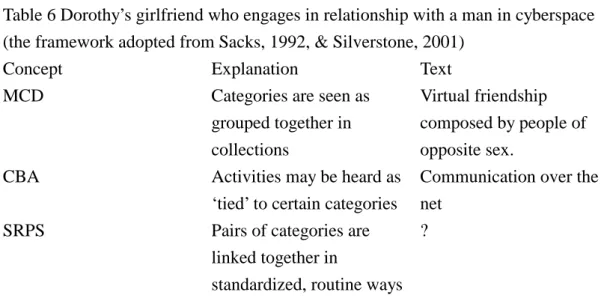
Table 6 Dorothy’s girlfriend who engages in relationship with a man in cyberspace (the framework adopted from Sacks, 1992, & Silverstone, 2001)
Concept Explanation Text
MCD Categories are seen as
grouped together in collections
Virtual friendship composed by people of opposite sex.
CBA Activities may be heard as
‘tied’ to certain categories
Communication over the net
SRPS Pairs of categories are
linked together in
standardized, routine ways ?
Dorothy doesn’t comment on her girlfriend’s internet use. In her account, she didn’t name the categorization clearly and remained vague about the activities and assumed norms. Asked about whether she would consider to get re-connected with the net or not, Dorothy replied that she may go online again in order to get better understanding of her children’s world. Her friend’s story does not seem to have an effect on her decision.
Cathy perceives internet, especially email, as a personal medium and switch the
communication via internet on and off depending on her situation. Cathy, in her early 40s, is an active career woman. She used to use email a lot for business reason and her email-writing earns her some friends. In order to realize her dream, Cathy quitted her job and started to run her own business – running a café – two years ago and since then, she dropped out from the internet. Instead of emailing her male friends as usual, Cathy resumed hand-writing letters to her male friends; she had no access to the net at work anymore,
I can always use the computer at home but I no longer logged on to my email account at home either; my husband and I use the same computer and I simply don’t want to worry about the privacy issue. Don’t get me wrong, my husband and I get along pretty well. I don’t want any misunderstanding ruin our partnership.’
Cathy says with ease that she may pick up internet someday, now it’s fine with her that she stays this way. Cathy talks about people pay compliments to her because she always adds some personal touch to her email messages and the correspondence turns her business partners into her
her friends later and the dropout is her personal decision; she knows pretty well about computer and internet, she doesn’t need these tools right now.
Table 7 Cathy, the female internet dropout’s MCD (Husband and wife) (the framework adopted from Sacks, 1992, & Silverstone, 2001)
Concept Explanation Text
MCD Categories are seen as
grouped together in collections
Family (husband and wife)
CBA Activities may be heard as
‘tied’ to certain categories
Being honest with each other; no need to converse with other friends of opposite-sex
SRPS Pairs of categories are
linked together in
standardized, routine ways
Husband and wife assumed to be linked together through communication
Table 8 Brenda, the female internet dropout’s MCD (Work) (the framework adopted from Sacks, 1992, & Silverstone, 2001)
Concept Explanation Text
MCD Categories are seen as
grouped together in collections
Work (professional relationship with personal touch)
CBA Activities may be heard as
‘tied’ to certain categories
Correspondence via internet
SRPS Pairs of categories are
linked together in
standardized, routine ways
Business partners assumed to be linked together through communication, professional communication
As Cathy changes her job, it seems that she is not legitimate to use personal medium for business reason any more, let alone she’ll have to use it at home, where she and her husband share the computer. It’s just natural that Cathy drops out from the internet.
Involuntary Divide?
As Turkle (1988) put it, ‘To use risk taking as a learning strategy you have to be able to fail without taking it “personally.” ‘(p. 49) Most of the interviewees falling into this category
(involuntary divide) are because of their admitting of lack of personal equipments, resources, and in-time support to remain online. They tend to blame themselves or do not know how to
attribute the problems when something goes wrong with the computer and the connection; they are hesitated to ‘take risks’ on ‘other family members’ ’ computers, even though at home there is open space and equipments available for everyone to use, literally speaking. Gendered codes are encrypted at home.
According to the interviewees’ accounts, the categorization based on the allocation of computer-related resources is presented in Table 9,
Table 9 The female internet dropout’s MCD (family)
(the framework adopted from Sacks, 1992, & Silverstone, 2001)
Concept Explanation Text
MCD Categories are seen as
grouped together in collections
Family
CBA Activities may be heard as
‘tied’ to certain categories
Relocation of resources such as computers and internet connection observes the rules of children first. Certain resources at home are encrypted with codes and only members with literacy know how to maneuver them.
SRPS Pairs of categories are
linked together in
standardized, routine ways
Parents and children assumed to be linked together through
care-taking, need-serving, and trouble-solving.
Basically husband and children resume all the responsibilities of communicating with friends and relatives via the internet and this takes the duty off from women’s shoulders at home. At daytimes, women are busy with house chores and not free to use computer and the internet. Some annoying experiences like ‘got stuck half way through in emailing or web-surfing’ are very disturbing; not knowing how to attribute the problems they encountered, they dropped out from the net with the hope that the equipments remain intact when other family members use computers later. They are not forced to drop out from the net, but the risks, blames, the low
Conclusion
For women who have confidence in their control, experience, and knowledge about the internet, connection with the net is seen not as challenges, not as risks, but as hurdles. It is similar to the interviewees’ comments on taking risks in meddling with computers in Sherry Turkle’s(1988) study. Interviewees in my study don’t want to maintain one good relationship via the net at the expense of their own intimate relationship. The certainty of the situation and the control over what is going on are imperative to their decision. Women can master the computer and the Internet and once the computer-mediated communication is perceived as intruding into their private lives, they saw the potential, upcoming troubles as hurdles and disconnected from the net. Nearly fifteen years ago, the women talked about the risks they are willing to accept responsibility for are risks in relationships; the risks solely associated with playing with machines (computers) and thus disassociating people from real human being are only hurdles. (Turkle, 1988) That has a lot to do with the degree of uncertainty women
experienced in handling computers. Nowadays there are women good at mastering computers and the internet, however, they still don’t like taking risks at the machines, and it is exactly
because the ‘machines’ (computers and the Internet) are associated with people, the strangers who may be perceived – by themselves, or by significant others -- as the hurdle, the threat, to their family.
Do women dropping out from the Internet provide accounts that transform the discourse on gender and formal systems? As Mills(2004) puts it, ‘identities are now seen as plural and
potentially conflicting even within a specific individual in a particular interaction.’ Be it
voluntary divide or involuntary segregation, female internet dropouts who assume different roles and responsibilities such as mother, spouse, working woman, housewife, friend, and adult seeking unceasing growth, present conflicting categorization of social memberships on themselves and others. The internet expands their horizon of imagination, however, risks, efforts, and pleasures associated with the connection are beyond calculation now. In the eyes of the beholders, especially their significant others’, women’s (especially housewives’) connection with internet are stereotyped and suspected; to try on computers and the internet connections are not
legitimized, let alone their try-on may cut short the internet hours other family members can dispose. This repeats the pattern between gender and the use of technology other than internet at home.
Turkle(1988, p. 57) put it, ‘With the computer, there is not “one way.” On the contrary, the range of styles of appropriation suggests the metaphor “computer as Rorschach” (Turkle, 1980).’ So is the women’s internet use and non-use.
References
Advanced e-Commerce Institute-Focus on Internet News & Data in Institute for Information and Industry (2004). Internet Subscriber in Taiwan 2004-Q1. Retrieved from:
http://www.find.org.tw/0105/howmany/howmany_disp.asp?id=79
Butler, J. (1990). Gender Trouble:Feminism and the subversion of Identity. London: Routledge. Cameron, D. (1993). Beyond alienation: An integrational approach to women and language. In J.
Corner & J. Hawthorn (eds.)., Communication studies: An introductory reader, pp. 77-89. New York, NY: Edward Arnold.
Chodorow, N. (1978). The reproduction of mothering: Psychoanalysis and the sociology of
gender. Berkeley, CA: University of California Press.
ECRC-FIND, Available at http://www.find.org.tw/0105/howmany/howmany_disp.asp?id=79 2004
Gilligan, C (1982) In a different voice: psychological theory and women’s development, Cambridge Mass: Harvard University Press
Grint, K. & Gill, R. (eds.)., (1995). The gender-technology relation: Contemporary theory and research. London: Taylor & Francis.
Harcourt, Wendy (ed.), Women@Internet: Creating New Cultures in Cyberspace. New York: Zed Books, 1999
Hawthorne, Susan and Klein, Renate, eds. (1999), CyberFeminism: Connectivity, Critique and Creativity. Melbourne: Spinifex.
Hawthorne, S. & Klein, R. (1999). Cyberfeminism: Introduction, in Hawthorne, S. Klein, R. (eds.)., Cyberfeminism, pp. 1-18. Australia: Spinifex Press.
Hymes (eds.)., Directions in sociolinguistics. New York: Holt, Rinehart & Winston.
Katz, J. and P. Aspden (1998). Internet dropouts in the USA. Telecommunications Policy 22(4/5): 327-339
Kramarae, C. (1988). Technology and women’s voices. New York, NY: Routledge. Lakoff, R. (1972). Language and woman's place. Language in Society 2: 45-79.
Maynard, D. (1989). On the ethnography and analysis of discourse in institutional settings, Perspectives on social problems, 1: 127-146.
Mills, S., (2004, preprint), "Third Wave Feminist Linguistics and the Analysis of Sexism", Discourse Analysis Online, [http://www.shu.ac.uk/daol/]
Pattanaik, B. (1999). Home and the world: The internet as a personal and political tool, in Hawthorne, S. Klein, R. (eds.)., Cyberfeminism, pp. 19-32. Australia: Spinifex Press. Pauktuutit (1997). Communicating for change, in S. Pollock & J. Sutton(eds.)., Women’s
groups using the Internet. Canada: Women’s space.
Pollock, S. & Sutton, J. (1999). Women click: Feminism and the Internet, in Hawthorne, S. Klein, R. (eds.)., Cyberfeminism, pp. 33-50. Australia: Spinifex Press.
Sacks, H. (1972). On the analyzability of stories by children, in J. Gumperz and D. Sacks, H. (1992). Lectures on conversation, vols. I & II, edited by Gail Jefferson with an
interaction. Thousand Oaks, CA: Sage.
Spender, D. (1980) Man Made Language. Routledge & Kegan Paul
Stokoe, E.H. & Smithson, J. (2001). Making gender relevant: Conversation analysis and gender categories in interaction. Discourse and Society 12(2): 243-269.
Tannen, D.. (1990). You Just Don’t Understand: Women and Men in Conversation. New York: Ballantine.
Thomas, G. and Wyatt, S. (2000). Access is not the only problem. in S Wyatt, F Henwood, N Miller and P Senker (eds) Technology and In/equality: questioning the
information society, London: Routledge
Turkle, S. (1988). "Computational reticence: Why women fear the intimate machine". In C. Kramarae (Ed.), Technology and women's voices. New York: Routledge & Kegan Paul: 41-61.
Turkle, S. (1984). The second self: Computers and the human spirit. New York: Simon & Schuster.
The US Pew Internet & American Life Project (2003). Pew Internet &
American Life Project. Retrieved from http://www.pewinternet.org/index.asp
West, Candace and Don H. Zimmerman. (1991). Doing Gender. In Judith Lorber and Susan A. Farrell (Eds.), The Social Construction of Gender. Newbury Park, CA: Sage
West, Candace, and Don H. Zimmerman. (1987). “Doing Gender.” Gender and Society 1: 125-51.
Wyatt, S. Thomas, G. and Terranova, T. (2002). They came, they surfed, they went back to the beach: conceptualising use and non-use of the Internet, in Woolgar, S. Virtual Society? Technology, Cyperbole and Reality, Oxford University Press, Oxford, pp.23-40
Yates, S. (2001). Part two: social interaction, editor’s introduction, in Wetherell, M. et al., (eds.)., Discourse theory and practice, pp. 82-92. Thousand Oaks, CA: Sage.
(四)研究成果自評 本研究成果可從幾個面向反思自評: ── 從理論概念上,過往研究習從科技賦權或科技重覆父權宰制的兩元極化觀點思考性 別與傳播科技的議題,一無新意,二來也窄化了原本豐富多元的女性近用傳播科技的樣 貌。本研究從社會類屬分析入手,是基於先前研究計畫中收集而得的訪談資料所顯露的端 倪,也就是不同位置的女性對網際網路有不同的投射,而這不僅僅與其在社會中的性別位 置有關,這也與其生活經驗、生命歷程與階段、人際網絡等因素緊密相關,而經由其自承 的對科技(網際網路)的想像與經驗,分析整理,更可得見傳播科技與社會的繁複豐富關 係; ── 從研究方法上,本研究一部份的研究成果來自於採行社會類屬分析(membership categorization devices, MCD)分析女性口述資料,此為研究主持人第一次採用此一行之 有年的社會語言學分析工具,這種分析方法的確能凸顯當前資訊社會中中老年女性使用網 際網路的「正當性」的論述的缺乏(這顯示在女性論及自身渴望使用網際網路實難以援引 主流論述以支持自己的想望,這也顯示在家庭中其他成員對於母親、妻子使用網際網路的 嗔怪,尤其是用於交友、社交時)。研究分析實可更進一步收集家庭中其他成員口述經驗 資料,以交相比對。 ──近年美國每年全國網際網路使用普查問卷題項中也將「不用網路者」進行了更細緻的 區分,而「退用網路者」就是其中重要的類別。歐盟相關網際網路研究也看重退用網際網 路者的經驗,因為在各地上網人口日趨飽和的當前,研究發現上網人口不減,但是退網而 去的人口增加,因此上網成長率趨緩。什麼原因使人退網不用?「落差」的問題因著使用 者/前使用者與傳播科技的動態分合關係而日形豐富複雜。這一課題非常值得繼續著力分 析研究。