Energy Vol. 17, No. 10, pp. 983492, 1992 0360-5442/M $5.00 + 0.00 Printed in Great Britain. All rights reserved Copyright @ 1992 Pergamon Press Ltd
APPLICATION OF MULTICRITERIA
DECISION MAKING
TO THE EVALUATION
OF NEW ENERGY SYSTEM
DEVELOPMENT
IN TAIWAN
GWO-HSHIUNG TZENG,~~ TZAY-AN SHIAU,~. and CHIEN-YUAN LIN§
tEnergy Research Group, and Institute of Traffic and Transportation, National Chiao Tung University, 114, 4F, Sec. 1, Chung Hsiao W. Road, Taipei, Taiwan and §Graduate Institute of
Building and Planning, National Taiwan University, Taipei, Taiwan, Republic of China
(Received 2.5 May 1990; received for publication 27 February 1992)
Abstract-The energy crisis in the 1970s and the recent rise in environmental protection- ism have heightened interest in the introduction of new energy systems and the development of techniques to ensure the stability of the energy supply in Taiwan, where more than 90% of the supply is imported. In this study, a multicriteria evaluation method is employed to evaluate comprehensively the alternatives for new energy-system develop- ment. Energy technology, environmental impacts, sociology and economic factors were evaluated and development directions and strategy for future energy systems in Taiwan are proposed.
INTRODUCTION
Over the past two decades, Taiwan has experienced significant changes in its economic structure and rapid industrial development. Energy consumption has increased from 8.5 million kiloliters of oil equivalent (KLOE) in 1968 to 44.9 million KLOE in 1988, at an average annual growth rate of 8.6%. Meanwhile, the proportion of domestically produced energy in the total energy supply has dropped from 54% in 1968 to 8% in 1988. This increased dependence on imported energy increases vulnerability to unstable energy supplies, especially when the dependence on imported oil has reached almost 100%.
Scarcity, uneven geographical distribution and necessity have subjected the oil supply to cartelization and politicization, i.e., its use as a political power source by oil-rich countries. This situation was evident during the past two oil crises. To continue economic growth in Taiwan, the stability of the oil supply has to be ensured. In addition to energy conservation, new energy-supply sources are needed.
New energy systems that are being researched include solar thermal, solar photovoltaics, fuel cells, wind, geothermal, tidal power, biomass, and hydrogen. Development of these potential energy sources is promising since most of them generate less environmental pollution than fossil fuels, and some show good potential for commercialization.
The establishment of the Energy Foundation in Taiwan in 1980 marked the initiation of the development of new energy systems there. The allocation of limited financial resources to diverse new energy developments is the challenging task of the Energy Committee of the Ministry of Economic Affairs. Setting priorities every year for each candidate development project is essential given the uncertainties of future developments. The purpose of this paper is to apply the Multiple Criteria Decision Making (MCDM) method to this priority-setting task. Using this method, expertise is integrated to set priorities for possible development. The results have been forwarded to the Energy Committee to assist its decisions.
$ To whom all correspondence should be addressed. 983
PROSPECTS FOR NEW ENERGY DEVELOPMENTS
New energy developments and prospects are reviewedi as a basis for setting evaluation criteria and developing alternatives.
Solar thermal energy
The solar thermal energy absorbed in the Taiwan area is about 4.46 x 10 El6 KC or 5 billion
KLOE, which is equivalent to about 111 times the total energy consumption in Taiwan in 1977. The development potential for solar thermal energy is high.
About a decade ago, the Departments of Mechanical Engineering at the Tatung Institute of Technology and the National Taiwan University, and the Refinery Research Center of the China Oil Corporation began to research solar energy. Private firms have also begun the promotion of solar heating equipment. Since the establishment of the Energy & Mining Research Organization (EMRO) at the Industrial Technology Research Institute (ITRI) in 1981, small solar heating-system and heat-collector designs have begun to be developed and tested. Their uses cover both homes and factories. With their technological advance and market expansion their cost is expected to decrease, and their payback time should eventually reach 2-3 yr. Compared to traditional water and natural gas heaters, the solar heaters have some important advantages. The future research direction for these heaters is to reduce production costs, improve system design and promote their applications.
Solar photovoltaics
The Nuclear Research Institute of the Atomic Energy Committee began research on solar batteries in 1975 on a small scale. With the establishment of the Energy Research Institute at ITRI, investigations on non-silicon solar batteries began in earnest. The research projects in this area were transferred to the Department of Materials in ITRI in 1987. Some research products have already been transferred to the private sector.
The advantages of solar photovoltaics are (1) automatic production, (2) no pollution, (3) equipment that can be easily expanded, and (4) absence of transmission lines, since the equipment can be set up at the energy-demand site. Almost every country in the world has shown an interest in this potential technology.
At present, due to the high costs of solar-battery components, the development of solar photovoltaics has been limited to special applications. Over the short term, the price of a solar battery is greater than that of oil. For this reason, the development of a non-crystal solar battery should be focused on consumer electronic products. Over the long run, development will shift toward high-efficiency batteries.
Fuel cells
A fuel cell* operates, in a sense, as a slowed-down combustion reaction. The cell structure is similar to that of a battery. It is a device to create electric current using fuel and oxygen. Its advantages include high efficiency, low environmental pollution, short establishment time, waste heat that can be used for cogeneration, and good replacement potential for oil. There are four commonly-used types of fuel cells, namely, the phosphoric acid fuel cell (PAFC), molten carbonate fuel cell (MCFC), solid oxide fuel cell (SOFC), and the alkaline fuel cell (AFC). Among these, the PAFC technology has been used to produce the first generation of fuel cells, which are the most promising for commercialization, but their electric efficiency is the lowest. MCFC, the second generation fuel cell, is expected to be on the market by 1995. Its electric efficiency is 45%, and its fuel use is more extensive and flexible. The third generation of fuel cell, SOFC, is expected to be on the market by the year 2000. Its electric efficiency may reach 50% and the usable fuels are far more widely available. The AFC yields the highest efficiency at 60%; however, its use is limited to special applications.
Energy-system development-MCDM application 985
Fuel cells have been recognized as one of the most promising electricity-generation methods. Given the policy that Taiwan will import large quantities of LNG after 1990, the EMRO at ITRI has recently conducted a feasibility study for a fuel-cell power plant in Taiwan. The authors of this study concluded that, for fuel-cell development, the PAFC should be assigned first priority and the MCFC second priority. To foster the development of a fuel-cell power plant in Taiwan to replace traditional power plants, the Energy Committee of the Ministry of Economic Affairs has contracted with ITRI to prepare a study on the development of fuel-cell technology in Taiwan. The study will be conducted over a 3 yr period beginning in 1989.
Wind energy
Research on wind energy has been conducted in Taiwan since 1965. In the early stages, the Taiwan Power Corporation, Tamkang University, the Academia Sinica, the Agricultural Engineering Research Institute, and Tsing-Hua University were the agencies active in this research. Currently, the EMRO at ITRI is the key energy agency for developing wind-energy devices. Wind-energy devices for 4 and 40 kW have been transferred to industry, and 150 kW wind-energy equipment is being tested.
Wind energy is a nondepleting natural resource. The most significant advantage of its use is the absence of atmospheric pollution. However, the electricity-generation cost is greater than for traditional power-generating methods. In order to lower capital and production costs and improve operational efficiencies, future research should be focused on the development of a low-cost and practical wind-energy conversion system. The generating equipment may also be exportable to other countries.
Bio -fuels
Biomass materials produced with land, sunlight, water, and carbon dioxide offer many advantages as sources of energy. They may be burned directly as solid fuels or else converted to highly-prized gaseous or liquid fuels. Rather than relying on manufactured collectors and converters, biomass collectors may be deployed by spreading seeds. These collectors align themselves toward the sun and also solve the storage problem posed by the intermittent nature of solar energy. Biomass can provide a renewable energy source that requires only periodic harvesting.
The development of bio-fuels in Taiwan has emphasized the utilization of waste materials. Currently, significant progress is being made in this field. The production of agricultural waste is quite large in Taiwan. As the result of the production of industrial waste water and urban wastes, solid-waste and water-pollution problems in Taiwan are very serious. Therefore, determining how to make use of the wastes while solving the pollution problems is the main direction for bio-energy research in Taiwan. Future developments should be focused on the direct burning of solid wastes and on the disposal of oxidized wastes.
Geothermal energy
The development of geothermal energy in Taiwan began in 1962. At this time, the Chin-Sui and Tu-Tsong power plants provide geothermal energy, but their economic value is low. To improve the development feasibility, multi-purpose development for power generation, water heating and sightseeing is being pursued. Potential sites for geothermal development are at Tu-Tsong, Gen-Cho and Chin-Ren.
It is estimated that both Tu-Tsong and Gen-Cho will have 10 MW of power-generating equipment by 1995. When Chin-Sui and Chin-Ren, which will have 15 and 12 MW of generating equipment, respectively, are added, the total geothermal electricity-generating capacity will reach 37 MW or 57.6 KLOE.
Current geothermal-development problems are associated with thermal transmission, gee- thermal resources and working fluids. Another problem is the identification and development of hot-water technology.
Ocean energy
Ocean energy includes mainly tidal power, wave energy and ocean thermal energy. The ocean thermal energy systems may be classified into closed and open systems. One closed system is going to be commercialized and an open system is undergoing prototype testing and scientific investigation. The application technologies for tidal energy and wave energy have been relatively successful and examples of practical applications are available.
Among the ocean energy methods, ocean thermal energy and wave energy are the most promising power-generating systems for Taiwan.
Hydrogen energy
High-yield hydrogen is an ideal fuel for the future. In Japan and the U.S., hydrogen manufacturing technology has been developed with high efficiencies (90%) and hydrogen has been applied in cars on an experimental basis. These cars may reach 100 km/h for a distance of 200 km. Difficulties of hydrogen-energy development include its transmission and storage. Besides, the development costs are high, and opportunities for commercialization are a long way off.
EVALUATION CRITERIA FOR NEW ENERGY SYSTEMS
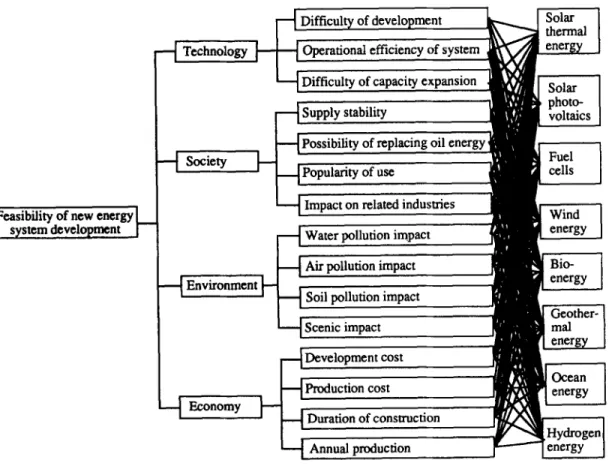
In order to set priorities for these new energy-development alternatives, we have established five principles for the evaluation criteria. These principles are: (1) completeness, (2) decomposability, (3) nonredundancy, (4) operational feasibility, and (5) minimum size. The criteria, shown in Fig. 1, are designed to meet technological, social, environmental, and economic needs.
8-I niffirlll~nfrlhvPlnnmcnt
54
Solar
\ thermal I
Technology l--j Operational efficiency of system Difficulty of capacity expansion s
Supply stability I
Possibility of replacing oil energy
l!EEs
EconomyWater pollution impact / Aii pollution impact
Soil pollution impact --I Scenic imnact Jiivelo~ment cost Bio- energy mal
-A
ener Ocean energyEnergy-system development-MCDM application 987
Table 1. Evaluation scale and performance of the criteria.
Difficulty of development VE E M D VD
Operationalefficiency of system 1 VH 1 H 1 M 1 L I VL Difficulty of capacity expansion
IV4
El MI
D 1 VD Supply stability VH H M L VL Possibility of replacing oil energy VH H M L VL Popularity of use VH H M L VL Impact on related industries 1 HP 1 LP 1 NO 1 LN 1 HN Water pollution impactAir pollution impact Soil pollution impact
NO B M S vs NO B M S vs NO B M S vs Scenic impact 1 HP 1 LP 1 NO 1 LN 1 HN Development cost Production cost VL L M H VH VL L M H VH Duration of construction 1 VSH 1 SH 1 M 1 M 1 VLG Annual production IVHI HI MI L I VL
V= very, M=medium, NO=no. D=difficulty, E=easy, L=low, H= high, p= positive, N= negative, B= bit, S= serious, SH= short, LG= long.
For technology, criteria are generated to reflect difficulty of development, system-operation efficiency, and difficulty of expanding the capacity. Social considerations require supply stability, possibility of replacing oil energy, popularity of use, and impact on related industries. Environmental criteria include the levels of water pollution, air pollution, soil pollution, and scenic-impact. Economic criteria are generated, namely, the development cost, production cost, construction time, and annual output.
Due to uncertainties associated with new energy developments, the performance evaluation is difficult to quantify. To deal with this difficulty, each criterion is measured on a scale from one to five. The measurement scale for each criterion is shown in Table 1.
EVALUATION OF NEW ENERGY-DEVELOPMENT ALTERNATIVES
To evaluate priorities for alternative new energy developments, a group-decision method has been adopted. We invited 14 experts and classified them into 4 groups of different expertise and background for evaluators in new energy development from the Energy Committee, the Taipower company, the Chinese Petroleum Corporation, the Energy Research Institute of the Industrial Technology Research Institute, and the University to evaluate the performance of each alternative for a special area of Taiwan and used an evaluation scale as an example in Table 1 for convenient explanation of our method. The evaluation method is based on the Analytical Hierarchy Process (AHP) and the Preference Ranking Organization METHods for Enrichment Evaluations (PROMETHEE). The evaluation process is described in the following paragraphs.
Application of AHP
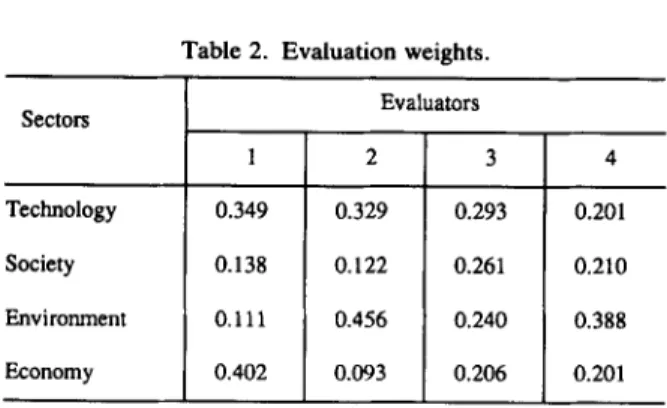
The AHP method*5 is applied to derive weights for each criterion. Pairwise comparison is used in the evaluation for easy comparison of each item by experts. In the consistency test, we follow Saaty’s suggestion that the consistency ratio be no more than 0.1. The evaluation results are shown in Tables 2 and 3.
Table 2. Evaluation weights. Technology Society Environment Economy 1 0.349 0.138 0.111 0.402 Evaluators 2 3 0.329 0.293 0.122 0.261 0.456 0.240 0.093 0.206 4 0.201 0.210 0.388 0.201 Application of PROMETHEE
The PROMETHEE evaluation methods6 consist of four variations. PROMETHEE II
provides a complete order for the evaluation that will help decision makers realize the evaluation results easily. PROMETHEE II is the version used in this paper.
The PROMETHEE process encompasses the following three steps:
(1) Establishment of a preference function for generalized criteria
Generalized criteria are defined by
P(a, b), d =f (a) -f(b) 2 0,
H(d)={P(b,a), d=f(a)-f(b)sO, (1)
where P(a, b) represents the preference advantage of alternative a over alternative b (i.e. the measurable extent by which a is preferred to b), P(b, a) represents the preference advantage of alternative b over alternative, a, f(a) and f(b) represent the assessed values for alternatives a and b, respectively. Greater values off (a) or f (b) are better. Since the information desired by decision makers is difficult to obtain, we have defined the H(d) function as
Table 3. Criteria weights.
Diffkulty of development 0.118 0.135 0.103 0.064 Operational efficiency of system 1 0.147 1 0.089 1 0.090 1 0.078 Difficulty of capacity expansion 1 0.084 1 0.105 1 0.100 1 0.059
Energy-system development-MCDM application 989
(2) Calculation of a multicriteria preference index
A multicriteria preference index z(a, b) indicating the preference advantage of alternative a
over alternative b may be defined as
n(a, b) = - ’ KA(a, b),
; K (3)
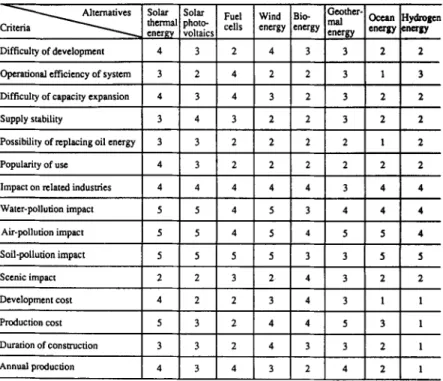
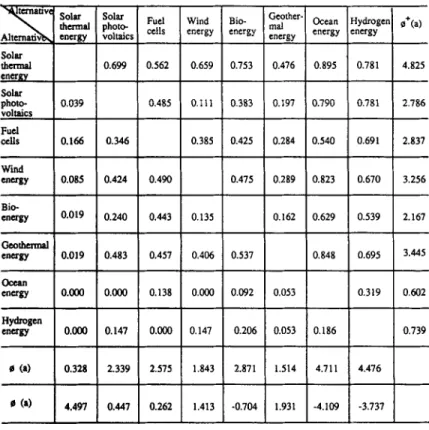
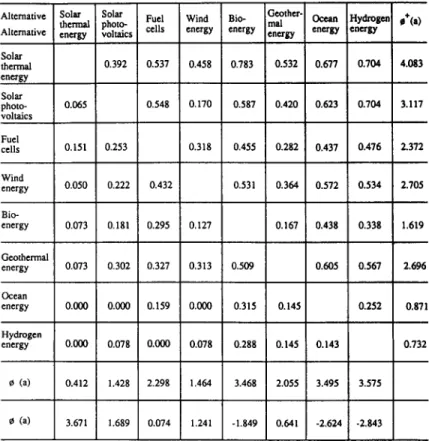
where W, is the weight of criterion b and &(a, b) indicates the superiority of alternative a over alternative b under criterion h. Introducing the assessed values into an evaluation matrix (Table 4) and also into Eqs. (1) and (2), we find &(a, b). After introducing W, (Table 3) into Eq. (3), we obtain n(a, b). The results are shown in Tables 5-8.
From the resulting multiple-criteria preference-index values and according to the network flow concept, we may determine which alternatives are superior. The flow is defined as
@(a) = & n(a, b), (4)
(5)
4W = @+(a) - 9-(a), (6)
where A = set of all alternatives and a, b E A, $+(a) = superiority of alternative a over all other alternatives, $-(a) = inferiority of alternative a compared to all other alternatives, and
+(a) = final score of alternative a. Introducing x(8, b) into Eqs. (4), (5) and (6), we obtain @‘(a), #-(a) and #(a) as given in Tables 5-8.
(3) Ranking of alternatives
PROMETHEE II ranks the alternatives according to the following relation:
aPb if and only if (iff) $(a) > +(b), aIb iff #(a) = @(b) (7)
where aPb means a is preferred to b and aIb means no difference is perceived between alternatives a and b.
Table 4. Evaluation matrix for new energy-development alternatives.
Difficulty of development 4 3 2 4 3 3 2 2 Opemtional efficiency of system 3 2 4 2 2 3 1 3 Difficulty of capacity expansion 4 3 4 3 2 3 2 2 Supply stability 3 4 3 2 2 3 2 2 Possibility of replacing oil energy 131314212121’12
Popularity of “se 1‘4314212121212 Impact on nlated industries I 4 I 4 I 4 1414131414
Water-pollution impact I 5 I 5 I 4 I 5 I 3 I 4 I 4 I 4 Air-pollution impact 5 5 4 5 4 5 5 4 Soil-pollution impact 5 5 5 5 3 3 5 5 Scenic impact 2 2 3 2 4 3 2 2 Development cost 4 2 2 3 4 3 1 1 Production cc~st I 5 13121414151311 Duration of consauction 3 3 2 4 3 3 2 1 Annual production 4 3 4 3 2 4 2 1
Table 5. Multicriteria preference indices and superiority indices for evaluator 1. wii energy 0.085 0.424 0.490 0.475 0.289 0.823 0.670 3.256 Bic- aagy 0.019 0.240 0.443 0.135 0.162 0.629 0.539 2.167 oeothermnl enagy 0.019 0.483 0.457 0.406 0.537 0.848 0.695 3.445 ocean
energy 0.000 O.ooO 0.138 o.cm 0.092 0.053 0.319 0.602
Table 6. Multicriteria preference indices and superiority indices for evaluator 2.
Hydrogen
enagy O.ooO 0.089 0.000 0.089 0.327 0.166 0.101 0.772 0 (1) 0.402 1.384 2.143 1.202 3.697 2.260 3.177 3.387 0 (d 3.448 1.386 0.266 1.701 -2.209 0.312 -2.296 -2.608
Energy-system development-MCDM application 991
Table 7. Multicriteria preference indices and superiority indices for evaluator 3.
ziY 1 0.047 ) 0.262 1 0.386 1 1 0.483 1 0.332 1 0.631 1 0.533 1 2.674 Bio- energy 0.054 0.166 0.316 0.119 0.177 0.476 0.363 1.671 G.COthetlIlal energy 0.054 0.137 0.324 0.306 0.476 0.691 0.593 2.581 ocean energy O.OiKl + Hydrogen CXrgy O.ooO 0.203 0.618 + 0.674 0.367 1.463 2.180~1.629 (3,lOt~ 2.029/ 3.933 3.682 0 (a) 1 4.084 1 1.706 1 0.365 1 1.045 1 -1.429 1 0.552 1 -3.315 1 -3.008
Table 8. Multicriteria preference indices and superiority indices for evaluator 4.
Solar thlxmal :nergy 0.065 Solar photo- Alternative Alternative S&U thermal energy Solar photo- voltaics Fuel cells Wind energy Bio- energy Geothermal energy ocean energy Hydrogen energy 0 (a) 0 (a) %Y energy 0.537 0.458 0.783 0.532 0.677 0.548 0.170 0.587 0.420 0.623 0.318 0.455 0.282 0.437 0.432 0.531 0.364 0.572 0.392 0.704 3.117 0.476 I 2.372 0.151 0.253 0.050 0.222 0.073 0.073 O.COO O.OOO 0.181 0.302 O.OOO 0.078 0.295 0.127 0.167 0.438 0.327 0.313 0.509 0.605 0.159 O.OCO 0.315 0.145 O.ooO 0.078 0.288 0.145 0.143 0.412 3.671 3.575 -2.843
Table 9. Priorities for new energy-development alternatives.
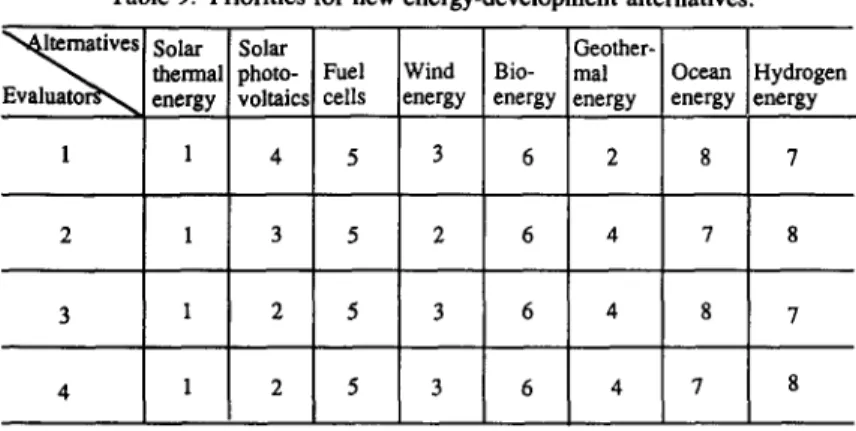
Using the values in Tables 5-8 and Eq. (7), we obtain the rankings of the four evaluators for the alternative forms of energy development shown in Table 9.
Our evaluation shows a consistent preference among the four expert groups for solar thermal energy, fuel cells and bio-energy. The scores for solar photovoltaics, wind energy and geothermal energy are similar (i.e., the ranking order is consistent). Ocean energy and hydrogen energy are ranked at the bottom. The resulting priorities for alternative new energy developments are as follows: (1) solar thermal energy, (2) solar photovoltaics, wind energy and geothermal energy, (3) fuel cells, (4) bio-energy, and (5) ocean energy and hydrogen energy.
CONCLUSIONS
Energy consumption is expected to increase as the Taiwanese economy continues to grow. Determining how to ensure a stable energy supply with the least potential environmental pollution is a challenging task for Taiwan. However, the development of a new energy system entails many uncertainties and requires an abundance of resources to support research and development. In this paper, we have applied multicriteria evaluation to set priorities for alternative new energy systems. The results ranked solar thermal energy as the first priority for development. That was also the choice of all experts participating in the evaluation panel. Solar photovoltaics, wind energy, and geothermal energy were assigned second priorities for future developments.
Acknowledgements-The authors would like to thank S. Penner and P. M. Schonfeld for commenting and correcting the manuscript. 1. 2. 3. 4. 5. 6. REFERENCES
Energy Committee of the Ministry of Economic Affairs, “Energy Master Plan for Taiwan Area (1989-2OOO)“, Taipei, Taiwan, Republic of China (1989).
S. S. Penner, Energy-The International Journal 11, 1 (1986).
T. L. Saaty, The Analytic Hierarchy Process, McGraw-Hill, New York, NY (1980). T. L. Saaty and L. G. Vargas, The Logic of Priorities, Kluwer, Boston, MA (1982). T. L. Saaty and K. P. Keams, Analytical Planning, Pergamon Press, New York, NY (1985).
J. P. Brans, B. Mareschal, and Ph. Vincke, “PROMETHEE: A New Family of Outranking Methods in Multi-criteria Analysis”, pp. 408-421 in J. P. Brans ed. Operational Research, Elsevier Science Publishers B.V., North-Holland (1984).