行政院國家科學委員會專題研究計畫成果報告
電子商務與 Web,VoiceXML 結合的自然語言客戶訂購服務系統
計畫編號:NSC91-2416-H009-012
執行期限:91 年 8 月 1 日至 92 年 7 月 31 日
主持人:蔡銘箴 國立交通大學資訊管理研究所
電子信箱: [email protected]
1. Abstract
The
web-based
application
by
VoiceXML service on the Internet is
gradually
accepted
for
human-machine
interaction
because
it
provides
the
speech-enabled functionality and makes the
telephone access a reality. However, it is not
cost efficient to build voice only stand-alone
web implementation and is more reasonable
that voice interfaces should be retrofitted to
be compatible or collaborated with the
existing HTML or XML based web
applications.
Therefore,
this
research
considers that the web site construction
should be able to incorporate multiple access
modes so that human beings can perceive and
interact with either visual or speech response
simultaneously. Under this principle, our
research develops an integration web based
Mandarin dialog system which adopts ASR,
TTS,
VoiceXML
browser,
and
VoIP
technologies to create user friendly interfaces
for GUI and VUI. The user can use
traditional telephone line, cellular phone
connection, or even VoIP by personal
computer to interact with the VoiceXML
server. In the mean time, browse the web
content from the Internet and access the same
document. The implementation system shows
excellent performance and can be easily
constructed into banks, tourisms, and
e-commerce transactions with VoiceXML for
wide accessibility.
Keywords: VoiceXML, ASR, TTS, VoIP
中文摘要
本研究計畫運用 VoiceXML 的規格與
技術,實做出一個完整的中文語音對話系
統,包含自動語音辨識(ASR,Automatic
Speech Recognition)、文字轉語音(TTS,
TTS, Text-To-Speech)技術以及整合目前
日趨成熟的 VoIP(Voice over IP)網路電
話技術,使整個系統能完全與 PSTN 整合。
另外,本研究計畫運用所提出以 XML 為架
構之 VoiceXML Browser,可讓使用者透過
傳統電話、手機或是網際網路,來與本系
統做語音查詢與瀏覽網頁之功能。進而突
破目前 VoiceXML 只運用在純語音查詢資
料或是語音訂單的應用。
因此,本研究提出一種整合電子商務
與 VoiceXML 的架構,除了結合 VUI(Voice
User Interface ) 與 GUI ( Graphical User
Interface)的人機互動式介面特色,更簡化
傳統 IVR 的複雜語音程序以及降低購買語
音設備之成本,有助於降低客戶服務支援
中心之成本,並同時提升客戶滿意度。對
於使用者而言,本系統也提供更多存取管
道,並藉由互動式的語音介面傳遞資訊給
使用端。因此,相較於按鍵式服務,語音
介面將更易於使用,此應用將適用於銀
行、股票報價與交易之客戶服務系統。透
過語音自動化服務,並藉由此自然且直覺
式的使用者介面來提供更廣泛的存取機制
與功能,亦相對提升語音應用程式的應用
價值。
關鍵詞:語音標記語言、自動語音辨識、
文字轉語音、網路電話
2. Introduction and Motivation
VoiceXML is a XML-based Internet
markup language and can be applied to the
speech interface that enables telephone access
to the PSTN, Internet, or website contents.
Users access VoiceXML by dialing the phone
number of the application. From the usage
point of view, this phone number is similar to
the Uniform Resource Locator (URL) of the
website. In summary, VoiceXML applications
provide another end-to-end telephone system
solution for call centers.
The major encouragement of VoiceXML
development has been the hope of the
telephony industry to make existing telephone
networks an essential component in the
Information Age. However, using dial-up
connection to access the Internet is restricted
by the slow speed and instable connection
quality. Although broadband connection is
developing, it’s not mature enough to replace
the existing, well-dependent, and highly-tuned
capabilities of Plain Old Telephone Service
(POTS) [1].
To sum up, VoiceXML consolidates the
energy of the Internet with the ubiquity of the
telephone, making it possible for businesses
to replace the expensive, and proprietary IVR
(Interactive Voice Retrieval) platforms with a
unified architecture for delivering automated
service from any telecommunication device.
From the cost reduction point of view,
VoiceXML applications have acquired great
acceptance from most of the voice call
centers (e.g., Tellme Networks, INC.) and
many big corporations to improve customer
relationship
management
(e.g.,
AT&T
Corporation, Amazon.com).
In
this
research, we utilize the
VoiceXML properties and capabilities which
integrate voice recognition and synthesis
technologies with markup languages. In
addition, we also incorporate voice and
graphical
interfaces
into
current
web
architectures.
3. Objectives
We establish our major objectives of the
research as the following.
(1) Deploy the end-to-end solution to
combine the VUI and GUI types.
(2) Deploy the new dialog system that
integrates traditional telephony system
and VoiceXML communication system.
(3) Deploy the integration platform to merge
VoiceXML browser with VoIP (Voice
over IP)technologies.
(4) Deploy the integration interfaces to merge
VoiceXML browser with traditional web
browser.
(5) Deploy the VoiceXML Parser and
whatever it does should conform to the
VoiceXML 2.0 Specification by W3C
definition.
4. The System
As we have discussed, we can find out
that the current end-to-end VoiceXML system
architecture has some problems. First, the
existing VoiceXML system just has VUI
representations; it is not suitable for users to
use unless it provides GUI representations.
Second, it just supplies one-way to access the
VoiceXML application through PSTN. It will
be more convenient if end users (e.g., callers
or pc-based users) can access to VoiceXML
application in bi-directional ways through
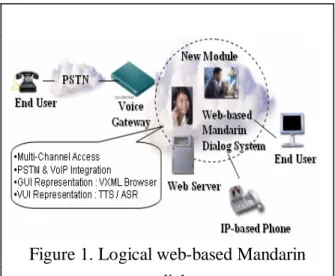
PSTN or Internet. The Figure 1 shows our
logical web-based Mandarin dialog system
prototype. The system we proposed is
platform independent. The key components
Figure 1. Logical web-based Mandarin
dialog system
involve the speech recognition (ASR), speech
synthesis
(TTS),
VoiceXML
Browser,
VoiceXML Parser, and Voice over IP (VoIP)
internet phone[2] [3].
There are two major parts of the whole
Web-based dialog system: The VoiceXML
Browser and VoIP internet phone. The
VoiceXML Browser serves as the traditional
IE/Netscape
browser
and
supports
VoiceXML-format files to be used in the
browser. VoIP internet phone adopts virtual
phone appearances in the left side of Figure 2.
VoIP internet phone provides basic VoIP
functions such that users can call the other
user with the mobile phone or PSTN phone.
Besides, there are TTS、ASR、VoiceXML
Parser and XSL model in the VoiceXML
application. We will explain each component
in details.
The VoiceXML browser needs to parse
vxml pages. The vxml pages are XML
documents essentially. We use the Microsoft
XML core service software - MSXML 4.0
SP1 to offer a number of new features and
improvements
over the MSXML 3.0,
including the support for the XML Schema
language and faster parser and XSLT
engine[4] substantially. Finally, we develop
our own VoiceXML parser by MSXML 4.0
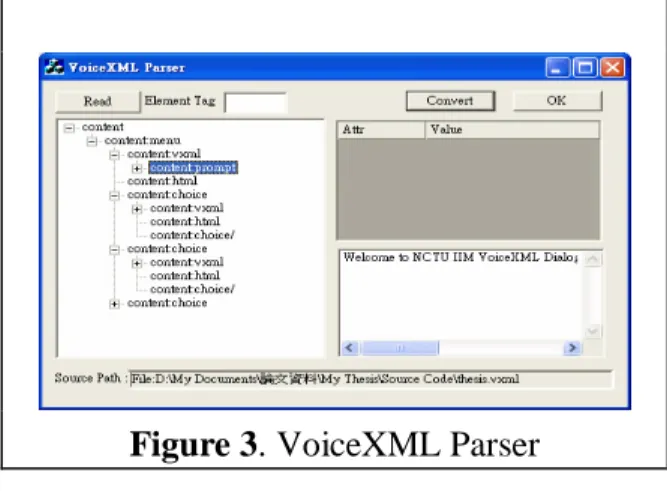
DOM technology. This mode gives a tree like
data-structure for the document in the Figure
3. The Figure 3 shows the usage of the code
to read in an existing file and display the
hierarchy in a tree with the attributes in the
other pane. The VoiceXML parser is used to
parse a VoiceXML document. After parsing
the document, it retrieves the forms and fields
content from the document. Our VoiceXML
Parser supports reading or writing VoiceXML
and none validated XML files. Although it is
very similar to the DOM centric class, each
element it provides may be used alone. The
specific function provides the programmer a
great deal of flexibility in this work.
The prototype of the Web-Based
Mandarin Dialog System demonstrates an
approach in which the static content is written
in a content markup dialogue. It will be
transformed into either HTML or VXML.
The advantage of using this approach is that
the static content is stored in one source file
which improves maintainability. In addition,
each of these contains various attributes and
sub elements that capture all the information
needed to generate HTML or VXML. So the
root element also contains the elements
<html> and <vxml> tag.
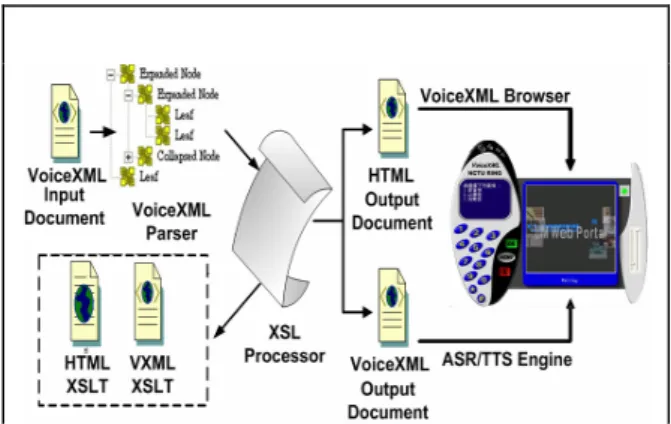
The Figure 4 shows while the
Web-Based
Mandarin
Dialog
System
functions, there is one XSL stylesheet that
transforms any document into HTML format.
In the other hand, there is another stylesheet
that transforms to VXML file. In our
prototype, the system will transform a file
into a HTML file while the original file
Figure 3. VoiceXML Parser
contains a sequence of anchors ( <A
HREF=…>element ) in the choice menu
source code. Otherwise, the system will
output as a VXML file while it contains the
VXML form with <choice> element. We use
different presentation rules to express the
HTML, and VXML file. The <content:html>
element captures more verbose text for GUIs
and transforms to the HTML file. In the other
hand, the <content:vxml> element captures
voice or speech behaviors to the VXML file.
While we start the VoiceXML Dialog
System, it will display the fast food ordering
menu as the example shown in the Figure 2.
As shown in Figure 2(a), whenever the user
makes the connection to the system, he can
simply enter the McDonald’s website by
pronouncing the correct keyword, for
example: McDonald’s, or enter. Then vxml
pages
will
open
the
corresponding
corporation main food ordering menu as
shown in Figure 2(b). The system will display
all the information including commodities
items and price through vxml pages of the
web browser at the user’s browser. For
example, in the McDonald’s food ordering
system, it offers four choices: Big Mac
hamburger, Mac chicken hamburger
, apple pie or ice cream. Customers can speak
the specific keyword to buy what they need.
After Ordering the item and filling the
selection or through dialog by VoiceXML,
the system will summarize the purchase order
and the whole voice dialog transaction
follows in a similar way as mentioned above.
Figure 2(c) illustrates a successful transaction
with a user’s ordering information. Finally,
the user can exit the dialog system.
5. Discussion
We use the Pentium 733 desktop
computer,
512
RAM,
high
quality
microphone / speaker, and Windows 2000
operation
system
as
our
performance
evaluation environment. The recognition and
synthesis of the speech both work on the
ASR and TTS machine. We also invited ten
persons to test our dialog system for the
experiment samples. Half of the experiment
samples are veterans that have been trained
how to operate or control the dialog system.
The others are novices at our VoiceXML
Mandarin dialog system.
There are three fast food restaurants
including McDonald’s [5], Pizza Hut [6], and
Yoshinoya [7] to be chosen in our experiment.
In the mean time, we design our system
performance analysis table and the testing
items with pre-defined keywords. As Table 1
shows, we divide three fast food restaurants
ordering subsystems into three tasks in our
system performance evaluation.
As Figure 5(a) shows, the result
indicates the novices have sometimes speech
recognition errors which are caused by
ambiguous input keywords or unfamiliarity
with the dialog system. On the other hand,
the result indicates the veterans always have
good speech recognition in the Figure 5(b).
Therefore, the consumers or users are better
to be pre-trained to understand how to
interact with the VoiceXML Mandarin dialog
system even though it has better user
interfaces.
6. Conclusion
In this research, we deploy the
web-based Mandarin dialogue system through
the VoiceXML. The user can either use the
telephone channels or VoIP by personal
computer to access the voice server,
simultaneously browse the information on the
web server or enterprise database through the
Internet. This approach provides multi access
mode of directory management scheme for
customer service or business management.
The prototype system showed excellent
performance from the experiments and can be
easily constructed into a large distributed
telephone-based database and voice service
provider (VSP) for widely accessibility. The
techniques and methodology we developed in
this research can be applied to many other
applications by taking the advantages of the
friendly speech interface and the use of our
mother
language,
the
Mandarin,
to
significantly improve the human machine
interaction and communication.
Keywords Recognition Times
1 2 3 4 5 1 2 3 4 5 Keywords No.6 7 8 9 10 11 1 2 13 1 4 15 H ow ma ny t ime s to r ec og ni ze suc ce ss ful
novice 1 novice 2 novice 3 novice 4 novice 5
Figure 5(a). The Novices Keywords
Recognition Times Analysis
Keywords Recognition Times
1
2
3
4
1 2 3 4 5 6 7 8 9 10 11 12 13 14 15
Keywords No.
H o w m a n y t im es t o r e cog n iz e s u c ce s s f u lveteran 1
veteran 2
veteran 3
veteran 4
veteran 5
Figure 5(b). The Veterans Keywords
Recognition Times Analysis Table 1 System Performance Analysis Table
Task-1 McDonald’s
How many the numbers of times to finish the
transactions?
Keywords No.
Keywords
How many times to recognize successful? 1 McDonald’s 2 Big Mac Hamburger 3 Mac Chicken Hamburger 4 Apple Pie 5 Ice Cream
Task-2 Pizza Hut
How many the numbers of times to finish the
transactions? 6 Pizza Hut 7 Fresh Seafood 8 Super Supreme 9 Hawaiian 10 Japanese Task-3 Yoshinoya
How many the numbers of times to finish the
transactions? 11 Yoshinoya
12 Beef Meal 13 Chicken Meal 14 Beef & Chicken 15 Main Menu
七、結果與討論
本研究計劃已獲得相當豐富的研究成
果,由於前一年相關計畫的前導,再加上
這一年孜孜不倦的努力,在本年內,已有
數篇英文會議論文的發表。
第 一 篇 英 文 會 議 論 文 是 發 表 在
ACME,於民國 92 年 7 月 31 日至 8 月
2 日在美國華盛頓州西雅圖市舉行,論文題
目 是
“The Study of Creating Synergy By
Applying
E-Commerce
Strategy
in
Multi-level Marking”,內容請見[8]及附件
一。
第二篇英文會議論文是發表在 ACME,於
民國 92 年 7 月 31 日至 8 月 2 日在美國
華盛頓州西雅圖市舉行,論文題目是“THE
INVESTIGATION
of
CRITICAL
FACTORS of E-LEARNING SYSTEM for
E-BUSINESS”,內容請見[9]及附件二。
八、計劃成果自評
本研究計劃研究成果,已獲得相當具
體及深入的學術成果,並提供電子商務的
實際應用與 mobile-commerce 可延續性的
研究;在此同時,將繼續做更深入的探討
外 ,也努力參與相關學術研討及論文發
表,以達更專精的學術研究為目的。
九、參考文獻
[1] Rick Beasley, Mike Farley, John
O'Reilly,
Leon
Squire,
“Voice
Application
Development
with
VoiceXML”, SAMS, 2001, pp. 10-30.
[2] Min-Jen Tsai, Tien-Hwa Ho, “WWW
and Telecommunication Collaboration
Service
for
Mandarin
Automatic
Personal Phonebook Inquire Dialogue
System”, ICME 2000 conference in
New York, USA, 2000.
[3] “IBM WebSphere Voice Server with
ViaVoice Technology Administrator’s
Guide,
Version
1.0”,
IBM
Corporation.
[4] MSDN
XML
Core,
http://msdn.microsoft.com/xml
[5] McDonald’s
Corporation.,
http://www.mcdonalds.com/
[6] YOSHINOYA
D&C
Co.,
Ltd.,
http://www.yoshinoya-dc.com/n_top.ht
ml
[7] Pizza
Hut
Co.,
Ltd.,
http://www.pizzahut.com.tw
[8] Min-Jen Tsai and Shang-Chun Wang,
“The Study of Creating Synergy By
Applying E-Commerce Strategy in
Multi-level Marking”, ACME, Seattle,
U.S.A. July 31-August 2, 2003.
[9] Tzu-Hsin Yang and Min-Jen Tsai,
“THE
INVESTIGATION
of
CRITICAL
FACTORS
of
E-LEARNING
SYSTEM
for
E-BUSINESS”,
ACME,
Seattle,
U.S.A. July 31-August 2, 2003.
The Study of Creating Synergy By Applying E-Commerce Strategy in
Multi-level Marking
Min-Jen Tsai and Shang-Chun Wang Institute of Information Management National Chiao-Tung University, 1001 Ta Hsueh Rd., Hsin-Chu, Taiwan 300, R.O.C.
Tel : 886-3-571-2121 ext 57406
Abstract: The core of the business in the 21st century can be categorized as e-commerce, chain store, wholesales and multi-level marketing. Among those business models, there are many similarities between e-commerce and multi-level marketing in terms of the essential property of networking in business communication. The goal of this study is to find the similarities between these two business models and discuss the synergy can be created by combining these two business strategies. In this research, we simulated these two-business models at the Yahoo Auction site in Taiwan and the results of click counts and successful trade transactions rate were recorded for analysis. Besides, the investigation and interviews of some direct selling companies are also performed in order to understand how the e-commerce strategies can be implemented in this industry. Therefore, the optimal condition can be derived from both approaches and the better suggestion and well satisfactory return can be provided in the conclusion.
I. INTRODUCTION
The core of the 21st century business can be categorized as e-commerce; chain store; wholesales and multi level marketing. There are so many similarities between e-commerce and multi-level marketing; one of the essential properties is networking. How to build an efficient networking and make it work expandable will be the key for success of these two industries.
The concept of e-commerce is basically about using the Internet to do business. Traditionally, business communication is face to face. Multi-level marketing has advantage of human intervention and just to compromise the weakness of e-commerce since there is no direct human middleman in between. Therefore, if two of them can integrate each other, the synergy can be created.
This research has two objectives:
(1) Create synergy by combining e-commerce and multi-level marketing business strategies. (2) Provide a better solution for individual direct selling distributors as well as the companies.
II. MULTILEVEL MARKETING
Direct selling is a dynamic, vibrant, rapidly expanding channel of distribution for the marketing of products and services directly to consumers. An essential component of the direct selling industry is multi-level marketing. It is also referred to as network marketing, structure marketing or multi-level direct selling, and has proven over many years to be a highly successful and effective method of compensating direct sellers for the marketing and distribution of products and services directly to consumers. [1] Direct selling should not be confused with terms such as direct marketing or distance selling which may be described as an interactive system of marketing that uses one or more advertising media to affect a measurable response and transaction at any location. Some commonly known types of direct marketing and distance selling techniques are telemarketing, direct mail, and direct response.
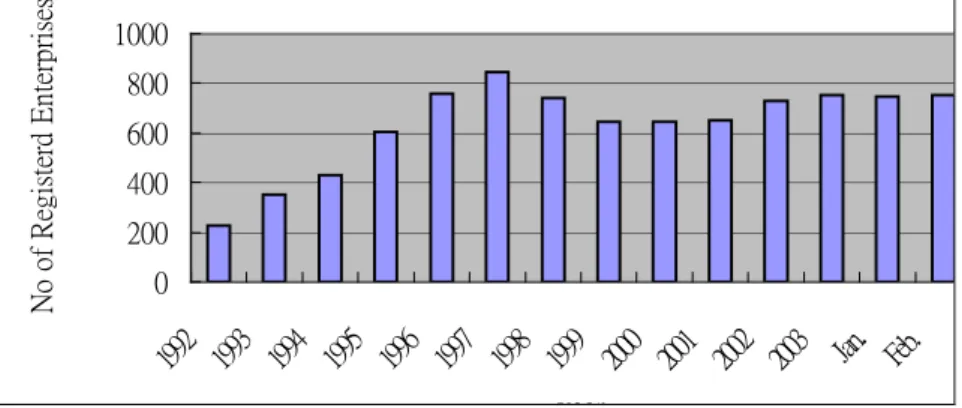
Although direct selling organizations occasionally use some direct marketing or distance selling techniques and technology to enhance their businesses, the primary difference between the two methods of marketing is the face-to-face, or personal presentation that is always an aspect of the direct selling relationship. [1] In addition, any enterprise engaged in multi-level sales is required to register with the Fair Trade Commission (FTC) according to the "Supervisory Regulations for Multi-level Sales." As shown in Table 2.1 is the statistic of registered enterprises by end of current year in Taiwan. We could see the numbers of companies are almost stable after year 2000.
0 200 400 600 800 1000 1992 1993 1994 1995 1996 1997 1998 1999 2000 2001 2002 2003 Jan. Feb. year No o f Re gist erd E nt erp rise s
Table 2.1 Statistic of registered Enterprises by end of current year (Source from FTC Taiwan 2003)
III. POWER OF MULTIPLICATION
One of the successful business strategies for the multi-level marketing is well applying the power of multiplication. One of the practical examples, “Pay it forward” story has been selected to show the power of multiplication and how the network can be developed infinitely.
The “Pay it forward” story: A schoolteacher in a small California town gives his class an extra-credit project: Come up with an idea that can change the world. A boy named Trevor devises a "chain letter" of deeds: One person does a nice thing for, say, three people, with the proviso that they pay it forward, not back -- that is, those three each have to do a nice thing for three other people, those nine each do something nice for another three apiece, and so forth. The geometrical implications are obvious; at the 16th level, about 43 million people are suddenly basking in random acts of kindness. [2]
Figure 3.1 Structure of Pay it forward foundation
The Pay it forward movement is the real-life reaction to the release of the novel in early 2000, followed by the creation of the Pay It Forward Foundation. The structure of Pay it forward foundation is shown in Figure3.1. Catherine Ryan Hyde didn't write the novel expecting a social movement, but it's certainly been exciting to watch it grow. The purpose of the Pay it forward Movement website is to bring together, in one place, as many real stories as we can. This serves several purposes. It helps the cynics see that Pay it forward really is working, not just around the United States but also around the world. It brings much-deserved recognition to those doing the work, and puts the results of their efforts out in the open so others can be inspired. It's also a source of some good news for a change, a way to renew your faith in human nature. [3]
I.V. E-COMMERCE
The term commerce refers to all the activities in which a company or individual engages to complete a transaction. When you use the Internet to engage in some or all of these activities, commerce becomes e-commerce. Therefore, you can define e-commerce as using the Internet to assist in the trading of goods and services. Other terms that refer to doing business over the Internet include e-business, e-tailing, and e-trading. [4].
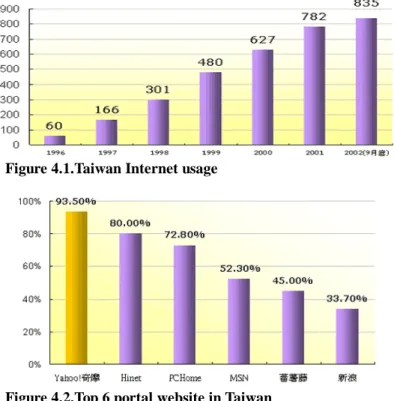
According to Institute for Information Industry ROC, by the end of September 2002, there are more than 8.35 million people online and the network facilities are 37% average provided. As shown in Figure 4.1 the usage statistics are still increasing 1.3 times each year. The Figure 4.2 shows the top six portal website in Taiwan which was surveyed by Netvalue 2002. Currently, Yahoo is the most popular portal site in Taiwan.
Figure 4.1.Taiwan Internet usage
Figure 4.2.Top 6 portal website in Taiwan
In this research, the simulation of e-commerce and multi-level business models on the Internet was choosing Yahoo Auction site as the reasons base on the following:
Most Internet market coverage
As shown in Figure 4.3, Yahoo website has the most Internet market coverage from the study of Netvalue in 2002. More than 100 Million Auction products
Yahoo Auction site has exceeded more than 100 million auction products on site and Yahoo has promoted the website via media.
Cost consideration
Commonly, if you want to build a business website, you have to pay the rental fee for the platform and register your domain name as well as the maintenance fees to be able to start your own e-business. So far, Yahoo Auction site provides free services for the sellers.
V. RESEARCH METHOD
This research phases were divided into three parts, the first part is to interview with four different senior direct selling distributors from four different industries. The discussions are based on the topic of “the vision for e-commerce regarding their enterprises”. The second part involves using questionnaire of the top 30 premium sellers from Yahoo Auction site and the third part provides the simulation of those two-business models on the Internet via Yahoo Auction site, an online auction platform. The results of click counts and successful trade transactions rate are recorded in details. This simulation focuses on the difference between trades only on e-commerce site and how the synergy can be created by apply Multilevel marketing strategy on e-commerce site.
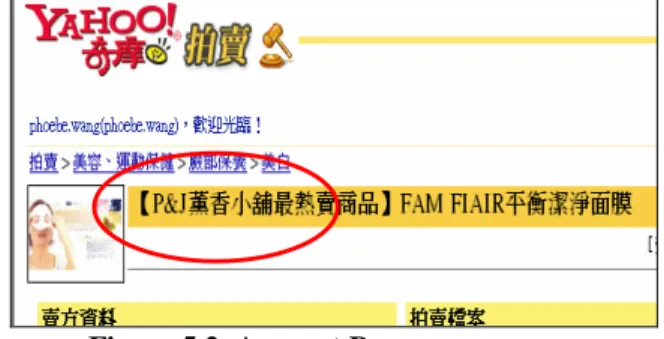
The author has registered two different accounts from Yahoo Auction site to be able to collect the real on-site data and experiences. These two auction accounts are designed under similar conditions including price, product, promotion, and auction period. The only exception is that Account B has applied the multi-level marketing strategy, which includes usage of personal network and the participation of direct selling distributors. Account A is represented for the usage of the e-commerce only which shows in Figure 5.1 and Account B is represented for applying network marketing strategies on e-commerce which shows in Figure 5.2. This research would like to compare with the click count rate and successful trade transaction rate under these two accounts.
However this research has limitation on the variety of products. We only provide some generality consumer products, which include facial masks, essential oils and aroma products to sell on site. Therefore the limited product range will affect the experimental result.
Figure 5.1. Account A Figure 5.2. Account B
V.I. RESULTS
Result One
According to the interviews with four different industries senior direct selling distributors, several discussions are held on the topics of “the e-commerce visions about their enterprises” The four industries are cover cosmetics products; aroma products; health products and travel services provider companies. The interview results are summarized as follows:
1. Most of the direct selling companies do provide the home website for their distributors, but the website only functions as information channel to them.
2. Although those companies think positively about the outcome of e-commerce, neither companies nor individual distributors feel confident to invest in e-commerce now.
3. Some of the companies believe when they have extensive volume of members under their network, it will be easier for them to attract the e-commerce suppliers to corporate with them.
4. The Internet usages for direct selling distributors are increasing daily. Therefore e-commerce should be the fortune for them.
Result Two
The researcher has selected 30 premium sellers out of 14 products categories from Yahoo Auction site. They are all qualified as the premium sellers and do receive medals from Yahoo auction site, which has shown in Figure 6.1. When the seller ‘s reputation and success trading transactions are on the top range of each category, Yahoo will rate the most praised premium sellers out of 14 products categories. [5].
Figure 6.1. Example of a premium seller medal
From the survey of the top 30 premium sellers from Yahoo Auction Site, there are only 20 questionnaires replied. The results have been summarized in the followings with figures 6.2-6.5.
Time period
To be able to qualify as a premium seller, trading period is one of the factors to be considered. We can see from the Figure 6.2, most selected premium sellers are trading under Yahoo Auction at least six months and above.
Working hours
A good service provider is also one of the key factors for the success of e-commerce. To be able to response the questions from the buyers, 75% of the premium seller spend more than 7 hours on the auction site as shown in Figure 6.3.
Personal network
From Figure 6.4, 62% of the premium sellers do apply their personal network to advertise their auction site. The result has once again shown that the personal networking does increase the volume of selling of their products.
Return customer base
The distributors of multilevel marketing are normally the royal customers for the company. Therefore how to remain the return customer base is very important. From Figure 6.5, there are 13 of premium sellers state that 10%-30% customers will return buying goods from them.
Time period for trading on Yahoo Aucion site
0 7 8 5 0 2 4 6 8 10
1-6 month 6-12 month 1-2 years above 2 years Time period N o. of s el ler
Hours spend on the managing aucion site
0 0 5 15 0 5 10 15 20
<1 hours 1-3 hours 4-6 hours >7 hours Time period N o. of s el ler
Figure 6.2.Time period for trading on Figure 6.3.Hours spend on the managing Yahoo Auction Site auction site per day
Send email to advertise the auction site
Yes 62% No
38%
Return customer base
2 13 5 0 0 5 10 15 <10% 10%-30% 30%-50% >50% Return cusomer base %
N o. of pr emi um s ell er
Successful Trading record 0 2 4 6 1 2 3 4 5 6 7 8 9 10 11 12 13 14 15 Test number N o. of tr an sact io ns
TestA Trading records TestB Trading records
the auction site
Result Three
Each experimental test has been set as five days per cycle under Yahoo Auction site. After 15 times run of each 5 days cycle test, we can see the click counter statistic summary records as well as the successful trade transaction statistic records from Figure 6.6 and Figure 6.7 respectively.
The results show that the average click counts of Account A are 8.8 times per cycle and 31.8 times per cycle for Account B. From the above statistical results Account B has 3.6 times more click counts than Account A. As from the successful trade transaction rate, the average rate for Account A is 0.2 times per cycle after 15 test cycles and 1.6 times for Account B. The successful trade transaction rate of Account B is 8 times higher than Account A.
By analyzing the Figure 6.6 in details, we can see that the results remain stable during test cycle number 9 to number 11. One of the reasons is Yahoo has updating his searching method during that phase. Yahoo Auction site starts to charge the sellers if the sellers would like to make their products conspicuous to the auction buyers. Therefore the chance for your auction item to be viewed or searched by the buyers is not high. And the other macroeconomic factors, which could affect the results, are not taking into concern in this experiment. The research is focused in the results of variation between two accounts.
From the experience of selling the products under Yahoo Auction site, which contains more than one million product items under auction site, we can see that Account B has higher click count rate and successful trade transaction rate than Account A. According to the results that we can say the objective of this research has been achieved as combining e-commerce and Multilevel Marketing these two business strategies can create the synergy
Click counter statistic
0 20 40 60 80 100 120 1 2 3 4 5 6 7 8 9 10 11 12 13 14 15 Test number N o. of Cl ick
TestA Click Counter TestB Click Counter
Fig6.6 Click counters statistic records Figure 6.7 Successful trade transaction statistic records CONCLUSIONS
This paper has proposed that the synergy can be created by applying e commerce in multilevel marketing, and has summarized the results of interviewing with different senior direct selling distributors; survey questionnaires of top 30 premium sellers from Yahoo auction site and described the experimental results as simulated on Yahoo Auction site. The results of experiments in a real environment have suggested that
1. The trust relationship between buyer and seller will be the key for the success trading online. Therefore if the buyer knows who the seller is, they will feel more secure and relaxed to trade online.
2. As a direct selling distributor, trading online will expand the business area and meet more potential customers.
3. Return customer details should be recorded and analyzed. Providing the good service to your core customer will maintain your business volume.
4. Everyone has personal relationship network. Whenever they support your business, you can save a lots of money on the advertisement cost.
5. To trade online and managing an e-shop needs lots of the efforts. The volume of the successful trading transaction is proportional to the time spent on the e-commerce.
6. As for the direct selling distributors, they should accept the trend toward the e-commerce instead of against it, as e-commerce should increase the business territory for them.
.
REFERENCES
[1] http://www.dsa.org. (World Federation of Direct Selling Associations, WFDSA) [2] http://payitforward.kingnet.com.tw/index.html
[3] http://www.payitforwardfoundation.org/
[4] Carol M, Cram, E-Commerce Concepts, Course Technology, 2001 [5]http://tw.bid.yahoo.com/phtml/auc/tw/premiumsellers/learnmore.html [6] http://taiwan.cnet.com/
[8] http://www.ftc.gov.tw/mult.htm
THE INVESTIGATION of CRITICAL FACTORS of
E-LEARNING SYSTEM for E-BUSINESS
Tzu-Hsin Yang and Min-Jen Tsai, Institute of Information Management National Chiao-Tung University, 1001 Ta Hsueh Rd., Hsin-Chu, Taiwan 300, R.O.C.
Tel : 886-3-571-2121 ext 57406
Abstract: This study investigates five critical factors of the e-Learning system for e-Business. The factors of interest have been categorized as “four barriers to an e-Learning system for e-Business”, “reasons to implement an e-Learning system for
e-Business”, “vendor consideration”, “success factors” and “challenge factors”. This survey is conducted to examine the attitudes toward these five factors and provide intensive analysis in this study. Acceptance and rejection rates of each factor are calculated and compared. Most of the factors proposed in this study are proven to be acceptable by the participants. Especially “success factors” (94%) and “challenge factors” (93%) accumulate significant acceptance rates, followed by “vendor consideration” (90%) and “reasons for implementation” (89%) which also get high acceptance rates. Lastly, “four barriers” (79%) receives the lowest acceptance rate which means the participants do not think these four barriers to be crucial for the implementation. When taking neutral rate into consideration, we find that “cost too high” (34%) , “solution immaturity” (27%) , “reduce training cost” (27%), “increase revenue” (30%), “ decrease time spending on selling” (35%), “win-win situation with vendors” (27%), “enhance customer satisfaction” (32%) and “fame” (35%) are all around 30%. Approximately one thirds of the participants do not have specific ideas toward all these sub-factors.
Keywords: e-Learning, e-Business, barrier, reason, vendor consideration, success factor, challenge factor
INTRODUCTION
E-Learning is leading a novel way of learning. It enables learning in a more flexible way. Learners can access e-Learning websites, post their feelings and questions, or take learning courses anytime and anywhere. It provides a more effective interface than conventional classroom training which supports the education portions of corporate e-Business practices. B2B e-Learning systems facilitate enterprise inside and outside (i.e. business-to-business) learning mechanisms via the Internet. For example, CISCO, IBM and Microsoft utilize innovative learning technologies and implement their e-Learning systems into e-Business. Therefore, their employees, business partners and customers are capable of accessing the e-Learning portals from any part of the world. However, some other B2C online e-Learning course providers such as Pospo and Englishtown that provide on-line fee-based training courses especially for anyone who can access their e-Learning portals. This study emphasizes the former – the critical factors of B2B e-Learning systems.
This report includes analyzing data that are collected from the survey for “critical factors of an e-Learning system for e-Business”, and hopefully it provides some practical advices for those who are just getting started. Although e-Learning is getting more popular, a few research reports investigation on its critical factors. Why do corporations need to understand all these critical factors clearly? Because by doing so, corporations can save time and avoid money spending in the wrong ways. This survey is based on the previous research of “How to Setup a Successful E-Learning System for E-Business”, which is published in ICEB2002. This survey intends to measure the acceptance, neutral and rejection rate toward the critical factors proposed in the previous study and extract valuable findings inside the results.
EXPLANATION OF FACTORS
There are five main factors under investigation. They are “barriers to an e-Learning system for e-Business”, “reasons to implement an e-Learning system for e-Business”, “vendor consideration”, “success factors” and “challenge factors”. Each factor contains sub-factors. “Barriers to an e-Learning system for e-Business” consists of four sub-factors. “Reasons to implement an e-Learning system for e-Business” consists of twelve reasons, which are the viewpoints of eight stakeholders from my previous research, i.e. CEO, HR, IT, financial, sales departments, employees, vendors and customers. “Vendor consideration” contains six sub-factors. Lastly, “success” and “challenge” factors have eight sub-factors. In order to have a precise understanding of all the critical factors under investigation, this section describes them in details.
Factors of Barriers
Classroom training is not the only choice. Instructors and students can have training courses via the Internet. E-Learning changes the format of learning for e-Business. However, not every corporation implements an e-Learning system for e-Business. There are barriers needed to be overcome before implementation [10]. The first barrier is “cost too high”. There are very few successful e-Learning implementation cases, thus corporations are not willing to spend too much money on it. The second barrier is “technology immaturity”. The average life cycle is too short to motivate corporations to adopt them. The third barrier is the “solution immaturity”. A few vendors finish developing complete solutions, and they are still having experiments. The fourth barrier is “unawareness”. People are used to traditional training, and it is difficult to accept new training ways.
Factors of Reasons for Implementation
Despite the barriers, different stakeholders have their own reasons for setting up e-Learning systems. CEO views it as a way to increase competence effectiveness and stay innovative. HR department uses it to train employees 24 hours a day, and 7 days a week. IT department builds training infrastructure using new technology. Financial department reduces training costs. Employees improve their skills, earn more money, and avoid dull classes. Salesmen use it to increase sales and improve time proficiency. Vendors sell their products and gain feedbacks from corporations. Customers receive their education and services online.
Factors of Vendor Consideration
Vendors of content will sell off-the-shelf courseware. They can work with corporate subject matter experts to produce customized courses. Vendors of technology will build the e-Learning system infrastructures and provide related technologies, for example, installation of LMS / LCMS and integration of chat rooms and virtual rooms. Vendors of service will support training tutors, developing a custom portal, integrating back end systems and so forth. The e-Learning implementation experiences will help to improve their solutions to be stable. The fame of vendors will let corporations know them well.
Success Factors
Eight success factors are investigated [1] [3] [9]. The first one is “organizational support”. If the e-Learning system will be included in the appraisal and salary review process, it will soon be one important part of employees’ daily work. The second one is “virtual project teams”. Members from different departments will create the virtual project teams. They will contribute their unique skills, knowledge, or technologies to setup the e-Learning system. The third one is “measures everything”. Corporations can find out what strategies and objectives should be included by measuring every factors needed. The fourth one is “include independent learners”. Independent attitudes will help them learn online courses by themselves. The fifth one is “include peer interaction”. Peer interaction will give aids to the learners by using message boards, chat rooms, communities and so forth. The sixth one is “provide mentoring”. With the help of instructor mentoring, learners can avoid confusing situations on learning topics or processes. The seventh one is “offer performance feedback”. An e-Learning system can offer performance feedback to learners immediately. The eighth one is “marketing”. A good marketing will facilitate the investment to be adjusted to the directions, which customers need. It will also increase the revenues from profitable customer education.
Challenge Factors
Eight challenge factors are investigated [4]. The first one is “correct target setup”. Different stakeholders must decide what business requirements are – workforce, sales channel, customer education and so forth. The second one is “LMS / LCMS configuration”. Be aware of how the portal and tracking system are built. It will be helpful to keep a good tracking of the audiences. The third one is “tutors and subject matter experts (SMEs) integration”. They will provide good services and helpful courses. The fourth one is “content creation”. Despite the user-friendliness, content will impact learners' attitudes toward an e-Learning system. The fifth one is “multiple modes of learning”. An e-Learning system has different learners ranging from CEO, managers, employees, salesmen, to customers; it has to provide a flexible interface. The sixth one is “back-end systems
system needs to serve many audiences at the same time, it will be important to implement a high-performance web infrastructure. The eighth one is “online lab access”. Corporations need to train learners on how to use an e-Learning system.
APPROACH
The survey utilizes one questionnaire which focuses on the critical factors of an e-Learning system for e-Business. Three different formats of questionnaire are offered, and they are web-base, electronic and hardcopy questionnaires. Majority of participants used the web-based questionnaire which seems to the most convenient interface for them. The questionnaire consists of six sections. Section 1 identifies the demographic information of the participants. Questions include their gender, age, career, department, position and education. Section 2 asks for their views on “four barriers to implement an e-Learning system for e-Business”. Section 3 collects their attitudes toward “twelve reasons to implement an e-Learning system for e-Business”. Section 4 requests them to rate how much they agree/ disagree with “six factors of e-Learning vendor consideration”. Section 5 weights their viewpoints toward “eight e-Learning success factors”. Finally, section 6 weights their attitudes toward “eight e-Learning challenge factors”.
Factors under Investigation
In this survey, five main factors are discussed. Each of the five main factors contains sub-factors. In order to have a clear image, they are listed below by main factors.
Factors of Four Barriers to Implement an E-Learning System for E-Business B1 The cost is very high, so it will be cut very often.
B2 The technology is very new, so it will change in a short period of time.
B3 There are many vendors providing e-Learning solutions, but most of them are on their experiments. B4 Organizations get few ideas of what an e-Learning system will actually benefit them.
Factors of Reasons to Implement an E-Learning System for E-Business R1 Enhance organizational competence effectiveness.
R2 Keep organizational innovative technology. R3 Provide 24 x 7 full time training.
R4 Reduce the time spending on conventional training. R5 Utilize new type of technology to deliver training courses. R6 Reduce the cost spending on conventional training.
R7 Increase organizational revenue by providing fee-based training courses to customers. R8 Decrease the time salesmen spending on selling products to customers.
R9 Keep learning flexible.
R10 Corporations can corporate with vendors of e-Learning systems and reach win-win situations. R11 Provide customers on-line and real-time learning services.
R12 Enhance customers’ satisfaction. Factors of Vendor Consideration
V1 The contents of vendors’ e-Learning systems are very important. V2 The technology integration capabilities of vendors are very important. V3 The service qualities of vendors are very important.
V4 The implementation experiences of vendors are very important. V5 The cost of vendors’ e-Learning system solutions is very important. V6 The fame of vendors is very important.
Success Factors
S1 Organizational Support S2 Virtual Project Teams S3 Measure everything S4 Include independent learners S5 Include peer interaction S6 Provide mentoring S7 Offer performance feedback S8 Marketing
Challenge Factors
C1 Correct target setup C2 LMS configuration C3 Tutors and SMEs integration C4 Content creation C5 Multiple modes of learning C6 Back-end systems integration C7 Web infrastructure C8 Online access capability training
DATA ANALYSIS
The survey was conducted from May 13 to May 17, 2003. A total of 142 participants, including 56 female and 86 male respectively, agreed to participate in this study. Most of them are from Hsin-Chu Industrial Science Park and National Chiao-Tung University. Their ages range from 20 to 56 years old. The majority of them work in electric, electronics, or information technology industries. The second majority of them are students from schools. They are grouped by departments. Most of them are from management, information technology, technical support, or research and design. When analyzing their positions, many of them are from middle-level executives, low-low executives, or engineers. Lastly, when analyzing their educations, they are mostly well-educated. Table 1 lists the detailed amounts of demographic items.
No Item Detailed Amounts of Demographic Items
1 Gender 86 : Male 56 : Female
4 : 20 and below 35 : 21-25 28 : 26-30 43 : 31-35 18 : 36-40
2 Age
8 : 41-45 4 : 46-50 1 : 51-55 1 : 56 and above
42 : Student 23 : Electric and Electronics 33 : Information Technology 2 : Finance 22 : Military, Government and Education 3 Career 12 : Manufacturing and Business 2 : Self-Employmen t 6 : Others 20 : Management 6 : Human Resource 31 : Information Technology 12 : Research and Design 16 : Technical Support 4
Department
1 : Finance 5 : Sales 2 : Customer
Service 49 : Others 4 : High-Level Executive 17 : Middle-Level Executive 18 : Low-Level Executive 30 : Engineer 14 : Staff
5
Position
4 : Technician 55 : Others6
Education
3 : High School 15 : Junior College 72 : University 51 : Master 1 : Doctor Table 1: Demographic InformationAnalysis Equations
Before examining the results, we should define some analysis equations, which indicate how agreement, acceptance, rejection, average agreement, average acceptance and average rejection rates are calculated.
Agreement Rate = Strongly Agree Rate + Agree Rate (1)
Acceptance Rate = Strongly Agree Rate + Agree Rate + Neutral Rate (2)
Rejection Rate = Disagree Rate + Strongly Disagree Rate (3)
Average Agreement Rate = Total Amount of Strongly Agree and Agree Selection / Total Amount of Selection * 100% (4) Average Acceptance Rate = Total Amount of Acceptance Selection / Total Amount of Selection * 100% (5)
Average Rejection Rate = Total Amount of Rejection Selection / Total Amount of Selection * 100% (6) Agreement rate represents the total rate of strongly agree and agree selection. By identifying agreement rate, it is clear that sub-factors are mostly accepted. However, acceptance rate accumulates the total rate of strongly agree, agree and neutral rate. By analyzing acceptance rate, we conclude that sub-factors are mostly accepted. Regarding to rejection rate which represents the total rate of strongly disagree and disagree, the value clearly illustrates which factors are totally rejected without any hesitation.
Analysis Result of Four Barriers
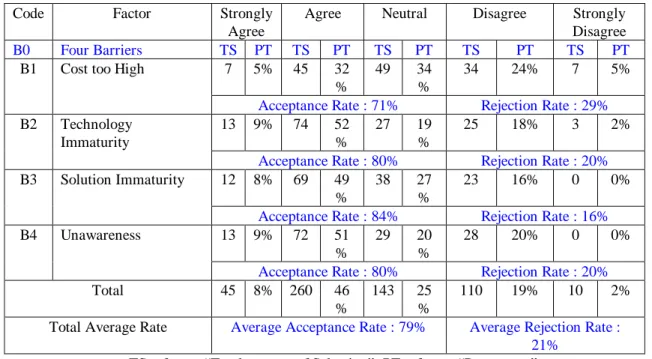
emphasize “solution immaturity”. “Technology immaturity” and “unawareness” are also significant factors. In comparison with other three barrier factors, “cost” of an e-Learning system is the least important factor. However, when comparing the agreement rates of “solution immaturity” (57%), “technology immaturity” (61%) and of “unawareness” (60%), these values show a slight difference which needs to be further analyzed. Table 2 shows the detailed statistical result of barrier factors.
Code Factor Strongly
Agree
Agree Neutral Disagree Strongly
Disagree B0 Four Barriers TS PT TS PT TS PT TS PT TS PT 7 5% 45 32 % 49 34 % 34 24% 7 5%
B1 Cost too High
Acceptance Rate : 71% Rejection Rate : 29%
13 9% 74 52 % 27 19 % 25 18% 3 2% B2 Technology Immaturity
Acceptance Rate : 80% Rejection Rate : 20%
12 8% 69 49 % 38 27 % 23 16% 0 0% B3 Solution Immaturity
Acceptance Rate : 84% Rejection Rate : 16%
13 9% 72 51 % 29 20 % 28 20% 0 0% B4 Unawareness
Acceptance Rate : 80% Rejection Rate : 20%
Total 45 8% 260 46
%
143 25 %
110 19% 10 2%
Total Average Rate Average Acceptance Rate : 79% Average Rejection Rate : 21%
ps: TS refers to “Total amount of Selection”; PT refers to “Percentage”.
Table 2: Factors of Four Barriers to Implement Statistical Result
Analysis Result of Reasons for Implementation
The acceptance rates of “Support 24 x 7 training”, “utilize novel training technology”, “win-win situation with vendors” and “provide customer on-line learning” are 94%, thus we can conclude that all these four factors are the key reasons. “Increase competence”, “Stay innovative”, “reduce training time”, “reduce training cost”, “provide flexible learning” and “enhance customer satisfaction” play significant roles in reasoning for implementation. In contrast, the acceptance rates of “increase revenue” and “decrease time spending on selling” are low (under 80%). Therefore, detailed statistical results of “factors of reasons for implementation”, “factors of vendor consideration”, “success factors” and “challenge factors” are omitted.
Analysis Result of Vendor Consideration
“Technology integration” accumulates its acceptance rate of 95%. “Service quality” also gets an acceptance rate of 94%. Therefore, we conclude that these two factors are key factors for vendor consideration. “Content”, “implementation experience” and “implementation cost” are significant factors, which get acceptance rates around 90%. Lastly, “Fame” seems to be the least important factor when choosing an e-Learning vendor (82%).
Analysis Result of Success Factors
The most acceptable success factors are “measure everything”, “include peer interaction” and “provide mentoring”, and their acceptance rates are all around 94%. “Virtual project teams” and “offer performance feedback” are also crucial which rate 93%. “Organizational support”, “include independent learners” and “marketing” also rated around 90%. In summary, all the eight success factors weight high and are proven to be significant.
Analysis Result of Challenge Factors
All the challenge factors are highly accepted by the participants which are about 94%. The highest one is “correct target setup” which is 96%. “LMS configuration”, “tutors and SMEs integration” and “web infrastructure” are 95%. “Content
creation” and “back-end systems integration” are 94%. Finally, “multiple modes of learning” and “online access capability training” rated 93%. In summary, all the eight challenge factors are proven to be important.
CONCLUSION
All the statistical results in the study provide useful information on how to setup a successful e-Learning system for e-Business. The eight success factors and eight challenge factors give strong evidences of their effectiveness to an e-Learning system. Among the four barriers presented in this study, their average acceptance rate is 79%. It indicates that the participant only regard them as common barriers. Especially, the acceptance rate of “cost too high” is only 71%. It shows most people do not view “cost of an e-Learning system” to be crucial. The average acceptance rate of reason factors is 89%. However, the acceptance rates of “increase revenue” and “decrease time spending on selling” are around 75%. The participants weight these two factors slightly. The average acceptance rate of vendor factors is 90%. The lowest acceptance rate is the fame of vendor (82%). The participants care less about whether the vendors are famous or not. Instead, they emphasize vendors’ technology capabilities.
When analyzing the neutral rate of each sub-factors, we can find that “cost too high”, “solution immaturity” under “barriers”, “reduce training cost”, “increase revenue”, “decrease time spending on selling”, “win-win situation with vendors” and “enhance customer satisfaction” under “reasons for implementation”, “fame” under “vendor consideration” are around 30%. About 1/3 of the participants do not have special ideas about these sub-factors. “Technology immaturity”, “unawareness” under “barriers”, “increase competence”, “stay innovative” under “reasons for implementation”, “implementation cost” under “vendor consideration”, “virtual project teams”, “measure everything”, “include peer interaction”, “marketing” under “success factors” and “back-end systems integration” under “challenge factors” are around 20%. Nearly 1/5 of the participants do not have strong feelings toward these sub-factors.
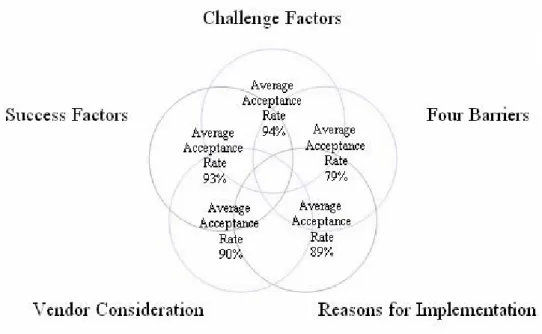
Clear understanding of these results will help corporations to know where they stand. Therefore, they can setup correct strategies and objectives which will lead them to a smooth implementation of an e-Learning system for e-Business. Vendors of e-Learning can view what end-users emphasize the most about their solutions. Different stakeholders can take a look at different perspectives; therefore understanding of what others feel about a better e-Learning system for e-Business is important. Figure 1 depicts the average acceptance rate of five critical factors.
Figure 1: Average Acceptance Rate of Five Critical factors
References
[1] Cisco. E-Learning Solution Implementation Success Factors,2001,http://www.cisco.com/warp/public/10/wwtraining/ elearning/implement/success_factors.html
[2] Darin Hartley. Bankruptcy-Proof Your E-Learning Project, December 2001, http://www.learningcircuits.org/2001/dec2001 /hartley.html
[3] David Price and Patrick von Schlag. Bringing Classroom Curriculum Up to E-Speed, September 2001, http:// www. learningcircuits.org/2001/sep2001/price.html
[6] Harvi Singh. Achieving Interoperability in e-Learning, March 2000, http://www.learningcircuits.org/mar2000 /singh.html
[7] John L. Setaro. Many Happy Returns: Calculating E-Learning ROI, June 2001, http://www.learningcircuits.org /2001/jun2001/elearn.html
[8] Marc J. Rosenberg. E-Learning: strategies for delivering knowledge in the digital age, McGraw-Hill, 2001, 273-277. [9] Michael Brennan, Susan Funke and Cushing Anderson. The Learning Content Management System, 2001, http://www. internettime.com/itimegroup/lcms/IDCLCMSWhitePaper.pdf
[10] Tom Barron. Learning Object Approach Is Making Inroads, May 2002, http://www.learningcircuits.org/2002/may2002 /barron.html