行政院國家科學委員會專題研究計畫 成果報告
改善跨組織資訊系統績效:從企業供應鏈能力著眼
研究成果報告(精簡版)
計 畫 類 別 : 個別型 計 畫 編 號 : NSC 95-2416-H-004-053- 執 行 期 間 : 95 年 08 月 01 日至 96 年 07 月 31 日 執 行 單 位 : 國立政治大學資訊管理學系 計 畫 主 持 人 : 張欣綠 計畫參與人員: 碩士班研究生-兼任助理:蘇澄軒、曾菁美 大學生-兼任助理:張哲瑋、邱奕捷 報 告 附 件 : 出席國際會議研究心得報告及發表論文 處 理 方 式 : 本計畫可公開查詢中 華 民 國 96 年 10 月 29 日
行政院國家科學委員會補助專題研究計畫
█ 成 果 報 告
□期中進度報告
改善跨組織資訊系統績效:從企業供應鏈能力著眼
計畫類別:█ 個別型計畫 □ 整合型計畫
計畫編號:NSC 95-2416-H -004-053-
執行期間: 2006 年 8 月 1 日至 2007 年 7 月 31 日
計畫主持人:張欣綠
共同主持人:
計畫參與人員: 曾菁美、蘇澄軒、張哲瑋、邱奕捷
成果報告類型(依經費核定清單規定繳交):█精簡報告 □完整報告
本成果報告包括以下應繳交之附件:
□赴國外出差或研習心得報告一份
□赴大陸地區出差或研習心得報告一份
█出席國際學術會議心得報告及發表之論文各一份
□國際合作研究計畫國外研究報告書一份
處理方式:除產學合作研究計畫、提升產業技術及人才培育研究計畫、
列管計畫及下列情形者外,得立即公開查詢
□涉及專利或其他智慧財產權,□一年□二年後可公開查詢
執行單位:國立政治大學資訊管理學系張欣綠
中 華 民 國 96 年 10 月 10 日
(一)中英文摘要及關鍵字
ABSTRACT
This research aims to develop a framework for measuring the supply chain capability. The literature review and company interviews allow us to propose four capabilities and relative measurements. A field survey is then conducted in the Taiwan PC industry to assess the measurements. To ensure the measurements are valid, we apply two-step measurement assessments: the factor analysis and initial reliability are first conducted and then followed by item-total correlation, optimal reliability coefficients, convergent validity, and discriminant validity. The resulting model is an 18-item and three-dimension construct. The three dimensions are: (1) reducing transaction related risk, (2) promoting good relationship, and (3) managing environment change. The confirmatory factor analysis then suggests us to arrange the three dimensions in two groups. The first group includes the first dimension, indicating the firm capability, and the second group includes the other two, expressing the inter-firm capability. We further explore the relationships between the supply chain capabilities and IOS adoption, as well as supply chain roles. It is interestingly to note that different IOS requires different capability and so does different supply chain role.
Keywords: Supply Chain Collaboration, Supply Chain Capability, Inter-organizational Systems,
Information Technology, E-Business
摘要 在面對多變的顧客需求、急縮的產品生命週期、以及日新月異的資訊技術,公司必須跟更 多不同類型的供應商合作以應所需,公司的供應鏈體系漸漸從原本的鏈狀架構轉變成網絡 架構。在面對這樣較複雜且易變的供應體系,許多公司開始借重各種不同的資訊系統,譬 如供應商管理系統,電子下單,先進排程系統等,來改善跟這些供應商的聯繫與合作。然 而,由於這一些系統是針對公司及供應商雙方面的流程改善,因此,若要能運作成功,光 靠公司內部的資訊能力及管理能力是不夠的,必須整個供應鏈都要配合才行。在以往的資 管文獻中,對於支援資訊技術的『公司能力』及『管理能力』多有研究,然而對於能支援 供應鏈相關的資訊系統之『供應鏈能力』卻甚少著墨。因此,本研究將致力於建構一套能 衡量公司供應鏈能力的參考指標,以幫助公司導入以及管理供應鏈相關之資訊系統。本研 究結果顯示兩項重要之供應鏈能力:(1) 公司在交易階段中降低交易風險的能力以及(2) 公司互動能力,包含了促進良好的供應商關係的能力以及掌握大環境變動的能力。此研究 也指出一個公司的 IT 能力對於好的跨組織資訊系統並非重大之績效決定要素。 關鍵字:供應鏈協同, 供應鏈能力, 跨組織資訊系統, 資訊技術, 電子企業
(二)報告內容
1. INTRODUCTIONSupplier-customer relationships have undergone radical changes in recent years because the business environment has changed (e.g., volatility in demand, curtailment of product life cycle, changing of information technology, and so forth). Facing this situation, new organizational forms such as the extended or agile enterprise emerge to allow for a tighter link among strategic partners - customers, suppliers, or other third party service providers - that decide to dovetail their capabilities to provide a seamless and electronically enabled closed loop of unimpeded business processes. Corporate supply chains become more network-connected and involve more business partners. Since this kind of supply chain collaboration involves more business partners than traditional inter-firm coordination, the issue such as how to develop good supply chain capabilities to handle the increasing complexity and dynamism is becoming more important than ever.
According to resource-based theory, firm resources and capabilities are the source of sustained competitive advantage (Barney 1991 and Grant 1991). Thus, to make the supply chain collaboration successful, it is important to offer an integrated view of what capabilities a supply chain should obtain in terms of transaction handling capabilities, relationship capabilities, IT capabilities, and so on. Those capabilities may cause the firms to gain more competitive advantages and benefits. We believe that a systematic investigation of these influences could offer significant insights for firms to manage their supply chain network. Thus, this paper seeks to contribute to the literature on supply chain studies through (1) the development and formalization of a framework of supply chain capabilities within the supply chain network; and (2) the operationalization and test of the framework through primary field data obtained in industrial supply chains.
2. LITERATURE REVIEW
Some researchers have recognized the significance of supply chain capabilities. Riggins and Mukhopadhyay (1994) assert that companies with good supply chain capabilities can increase the interdependent benefits. Dyer and Singh (1998) emphasize the impact of relational rents on inter-firm collaboration, the benefits that cannot be generated by either firm in isolation and can only be created through the joint idiosyncratic contributions of the specific alliance. Angeles and Nath (2000) find that focal firms prefer to partner with suppliers that have good capabilities to handle supply chain problems including channel inventory management, manufacturing planning and scheduling, demand forecasting, and distribution and transportation planning. Further, Craighead and Shaw in 2003 argue that supply chain performance is dependent on multiple capabilities: supply chain partners capabilities, manufacturing firm capabilities, information technology capabilities, and operational capabilities. These capabilities, along with final customer’s desire, create and accumulate the value of the supply chain.
Although researchers use different concepts and theories to investigate supply chain capabilities, we derive four levels of supply chain capability according to the resource-based view:
technology level, transaction level, relationship level, and environment level. We discuss each accordingly.
Technology Level. The basic resource-based theory examines the link between a firm's
internal characteristics and performance. It suggests that firm’s IT resources such as IT investment and IT staffs enable a firm to implement successful IT strategies. Some scholars also recognize that firm’s IT capability not only affect firm’s internal performance but also the performance of supply chain. Bensaou and Venkatraman (1995) propose that the greater the multiplicity of channels and the frequency of information exchanges, the greater the information processing capabilities of the dyad. They assert the information processing capabilities of a relationship will increase with greater intensity and scope of the use of the technology between the two firms. In similarly, Riggins and Mukhopadhyay (1994) suggest that the great volume of business communications for which the firm uses EDI and the high degree to which the firm becomes immersed in EDI of doing business as the efficient ways to maintain partner relationship.
Transaction Level. Clemons and Row (1992) propose three major sources of transaction risk:
transaction-specific capital, asymmetries in information, and loss of resources control, and suggest create firm’s capability that better control these resources can resolve these transaction risks. For the transaction-specific capital, Clemons and Row (1992) suggest that the characteristics of software used, such as reusability, modularity, replicability of know-how, coupled with open standards, IT support for conversion and transaction, and intuitive interfaces that reduce the costs of training or re-training can reduce this risk substantially. On the other hand, information asymmetries, the second source of transaction risk, mostly possibly occur in cases of performance measure ambiguity. Kuman and van Dissel (1996) refer that the performance measure ambiguity may be reduced by using information technology to generate and collect monitoring information that would otherwise be too expensive to collect manually. The third transaction risk, loss of resource control, occurs when resources are transferred as part of the relationship and these resources cannot be returned or controlled in the event of the termination of the relationship (Clemons and Row 1992). Information know-how is the most possible resource that may be lost of control, since firms are very difficult to control the access and subsequent utilization of such resources. Previous literature also shows that such resource contention and conflict can be much reduced while conducting pre-established concurrency control and security mechanisms beforehand. Besides, the control of such resource is better placed in the hands of a neutral third party such as a trade association, exchange, government agency, or a joint venture company (Kumar and van Dissel 1996).
Environment Level. Facing the increasing complex and dynamic environment, some RBV
studies find that the successful market players have the capability of timely responsiveness and rapid and flexible product innovation, coupled with the management capability to effectively coordinate and redeploy internal and external competences (Teece 1997). They define the ability to achieve new forms of competitive advantage as “dynamic capabilities”. The focal point is to hold the timing and then to adapt, integrate, and reconfigure internal and external resource to response the rapid technological change and changing business environment. Such capabilities can be mainly divided into two groups based on their focused problems. One is to handle information uncertainties and the other is to task uncertainties. In order to handle information
uncertainty, Clemons and Row (1993) suggest related technologies and systems to gather information surrounding dynamic supply chain environment, for example, a system to help firms gather dynamic information to forecast the customers’ needs. Besides, open and frequent communications between firms and firms’ partners is also a way to handle the information uncertainty risk (Angeles and Nath 2000). Task uncertainty arises due to the specific set of tasks carried out by the organizational agent responsible for the interorganizational relationship. In this work, the task uncertainty refers to the uncertainty of selling/buying activities because our research focuses on selling and buying activities of the supply chain. Bensaou and Venkatraman (1995) suggest that setting up the clearly known way, established practices and procedures employees follow, as well as detail and clear job descriptions are the ways and means to handle the uncertainty of selling/buying activities.
Relationship Level. Besides the dynamic view, some scholars extend the RBV to relational
view while arguing that a firm’s critical resources may extend beyond firm boundaries, and the benefits often linked to the relational network that the firm is embedded (Jeffrey 1998). Applying the relational view to the supply chain context, firms that have capabilities to maintain good relationships with trading partners can reduce transaction costs, negotiation costs, and uncertainty about the opportunistic behavior, thereby having a positive effect on performance. These capabilities include long-term relationship, reputation, investment both sides, complementarity of technology, business practice, goal, and culture, as well as regulations to handle the management dependency (Dwyer et al. 1987, Dyer and Singh 1998, Hart and Saunders 1998, Kumar and van Dissel 1996). We summarize them into three categories: trust, complementarity, and management dependency and describe them in the following paragraphs respectively.
Based on Dwyer, Schurr, and Oh (1987), trust is defined as “the belief that a party’s word or promise is reliable and the party will fulfill his/her obligations in an exchange relationship”. Lewis and Weigert (1985) recognize the significance of trust in uncertain/risky environment and refer that persons involved in a risky course of action can act competently and dutifully while they trust with each other. Therefore, trust is an important concept in understanding expectations for cooperation and planning in a relational contract.
Dyer and Singh (1998) define complementary resource endowments as distinctive resource of alliance partners that collectively generate greater rents than the sum of those obtained from the individual endowments of each partner. Similarly, Bensaou (1997) argue that compatibility in goals and technological capabilities reduce the uncertainty about the partner’s inclination and potential intentions for opportunistic behavior and therefore invite cooperation. Further, cultural differences between two organizations are also likely to exacerbate the transaction risks by increasing the risk of different interpretations of the transaction contract (Kumar and van Dissel 1996).
Management dependency is another important factor to handle the fairness of supply chain relationship. According to Hart and Saunders (1998), relative dependence in a dyadic relationship between customer and supplier is a determinant of power. Often the powerful partners provide software free of charge, long term incentive, risk sharing, education seminar, and cost subsidy to less power company who otherwise may not be able to justify the investment (Riggins et al. 1994, Wang and Seidmann 1995).
external firm resources and shared by relational network partners. These resources and capabilities may result in special competitive advantages or benefits in supply chain collaboration.
3. RESEARCH FRAMEWORK
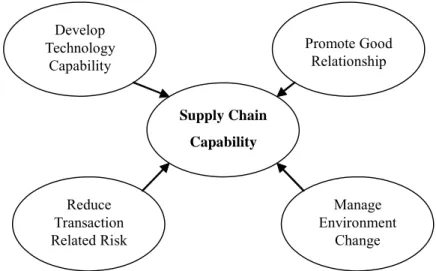
According to our previous discussion, we argue that an enterprise with good supply chain capability should be able to handle the supply chain collaboration more successfully. These views are synthesized into the following definition and are characterized by Figure 1:
Supply chain capability is a company-owned ability to well operate company’s supply chain networks, which can efficiently aid the companies to handle the collaborative activities with their trading partners. The scope of considering the supply chain capability is from the basic technology level to the environment level, which include how to improve the transaction efficiency, how to reduce the transaction risk, how to promote a good relationship, and how to resolve the uncertainty in the dynamic environment. Supply Chain Capability Develop Technology Capability Reduce Transaction Related Risk Promote Good Relationship Manage Environment Change
Figure 1. Research Framework for the Development of Supply Chain Capability Construct
4. RESEARCH METHODOLOGY
The content analysis results in an initial pool of 26 items with at least 4 items in each dimension. Table 1 shows the measures for each dimension, operationalized using the items provided in the referenced studies. Each item is presented on a seven-point Likert scale.
In preparation for large-scale data collection, the resulting questionnaire was pilot-tested by six executives that are directly responsible of IOS collaborations during fall 2004. These six executives come from three different types of firms in Taiwan PC industry: the component supplier, the service provider, and the manufacturer. The findings of pilot-test are consistent with our model.
Factors Items Measures of Develop Technology Capability (TC)
TC1 Percentages of transaction by IOS links (Bensaou and Venkatraman 1995, Riggins and Mukhopadhyay 1994)
TC2 Number of partners that are connected by IOS links (Bensaou and Venkatraman 1995)
TC3 Degree of IOS integration with each process (Bensaou and Venkatraman 1995, Riggins and Mukhopadhyay 1994) TC4
IOS usage and integration
TC5
Degree of IOS integration with current enterprise systems (Bensaou and Venkatraman 1995, Riggins and Mukhopadhyay 1994)
TC6 Degree of technology investment in IOS (Riggins and Mukhopadhyay 1994)
TC7 Establishment of IT infrastructure (Bensaou and Venkatraman 1995, Iskandar, Kurokawa, and LeBlanc 2001)
Information technology infrastructure
TC8 Establishment of applications to support tasks (Bensaou and Venkatraman 1995)
Factors Items Measures of Reduce Transaction Related Risk (TR)
TR1 Successful implementation experience (Clemons and Row 1992) TR2 Modularity and replicability of know-how (Clemons and Row 1992) Reducing
transaction-specific
capital TR3 Following the industrial standard (Clemons and Row 1992) Managing information
asymmetries Managing loss of resource control
TR4 Pre-established security mechanisms (Kumar and van Dissel 1996)
Factors Items Measures of Promote Good Relationship (GR)
GR1 Existed undergoing supply chain collaboration projects (Bensaou 1997) GR2 Establishment of clear norms for business behavior (Bensaou 1997,
Dyer and Sigh 1998)
GR3 Sharing confidential or proprietary information (Angeles and Nath 2000, Dyer and Singh 1998, Soliman and Janz 2003)
Trust
GR4 Open and frequent communications (Angeles and Nath 2000) GR5 Similar IT infrastructure (Konsynski and McFarlan 1990, Kumar and
van Dissel 1996)
GR6 Compatible company culture (Dyer and Singh 1998)
GR7 Similar decision processes to handle transactions (Kumar and van Dissel 1996)
Complementarity
GR8 Providing similar support of cooperative firms by top management (Angeles and Nath 2000, Bensaou 1997)
GR9 Technology support or cost premiums (Riggins and Mukhopadhyay 1994, Wang and Seidann 1995)
Management dependency
GR10 Education seminars or system implementation expertise (Riggins, Kriebel, and Mukhopadhyay 1994)
EC1 Related technologies and systems to help gather information (Clemons and Row 1993)
EC2 Explicit regulations to measure trading performance (Kumar and van Dissel 1996)
Manage information uncertainty
EC3 Sending the timely, accurate, and complete information (Angeles and Nath 2000)
Manage uncertainty of selling/buying activities
EC4 Clearly known practices and procedures in doing inter-firm tasks (Bensaou and Venkatraman 1995)
After pilot test, we conduct a general survey in Taiwan PC industry to validate our proposed framework. Data were collected using a questionnaire instrument. We coordinated with six Taiwan PC firms, three of which have participated in our pilot-test. For each firm, a purchasing and/or engineering senior manager at the central division was first asked to select a set of suppliers under his or her responsibility. Then for each of the selected suppliers these senior managers helped identify the purchasing agent and/or engineer to whom we could send the questionnaire. The total data set constitutes a representative sample of n = 352. Among all returned questionnaires, 55 were found to be complete and usable; this represented a response rate of 15.625 percent.
5. EMPRICIAL ASSESSMENT
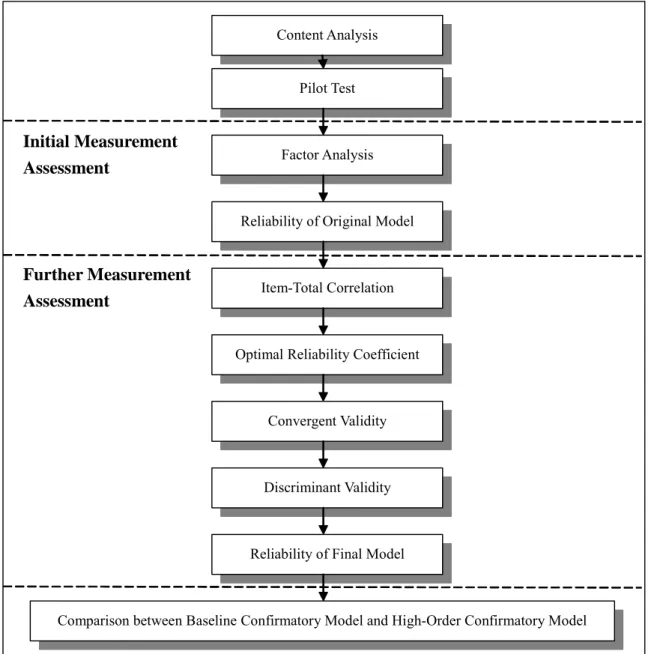
Once the data is collected, the verification of this model is conducted through a series of statistical techniques. From a theoretical standpoint, the measurement properties of a construct can be evaluated using a variety of techniques, including internal and external validity, theoretical meaningfulness, internal consistency of operationalization, convergent validity, discriminant validity, and nomological validity. From an operational standpoint, however, the following minimal subset is considered important: unidimensionality and convergent validity, reliability, and discriminant validity (Byrd and Turner 2000, Sethi and King 1994). The statistical assessments follow the outline given in Figure 2 and the rationale of this outline is described as follows.
Initial Measurement
Assessment Factor Analysis
Reliability of Original Model
Further Measurement Assessment
Content Analysis
Item-Total Correlation
Optimal Reliability Coefficient
Convergent Validity
Discriminant Validity
Reliability of Final Model
Comparison between Baseline Confirmatory Model and High-Order Confirmatory Model Pilot Test
Figure 2. Outline of Statistical Assessments
5.1 Initial Measurement Assessment
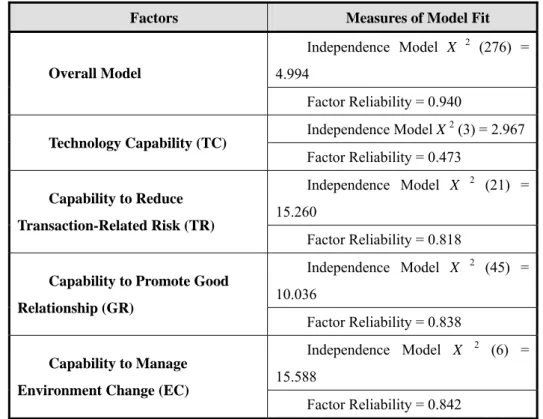
The completeness issue is first investigated. Items in this study were selected based on a broad review of literature which satisfies the content validity. The pilot test was done with six executives that are directly responsible of IOS collaborations. Such methodology assures that the model is complete. We then conduct the factor analysis to identify underlying constructs from a large number of interrelated variables. The result is a solution with four factors, each with eigenvalues greater than 1.0. Two items (TC3 and TC4) are excluded from the original model as their factor loadings are less than 0.4 (0.35 recommended by Churchill (1979)), and three items (TC6, TC7, and TC8) that measure the information technology infrastructure are removed to Factor2, resulting in a 24-item model. According to the results of the factor analysis, we point out that the Factor1 measures the technology capability which related the IOSs, the Factor2 presents the technological and managerial capabilities to reduce the transaction related risk, the Factors3 contributes the abilities to promote the good supply chain relationships, and the Factor4 expresses the capabilities to handle the uncertainties of the environment change. The initial reliability is assessed by Cronbach’s α coefficient for each of the dimensions determined from the factor analysis. The alpha coefficient for each factor is above 0.8 except TC (Table2), indicating an
acceptable reliability (Lewis and Byrd 2003).
Table 2. Measurement Properties of Proposed Model Factors Measures of Model Fit
Independence Model X 2 (276) = 4.994 Overall Model Factor Reliability = 0.940 Independence Model X 2 (3) = 2.967 Technology Capability (TC) Factor Reliability = 0.473 Independence Model X 2 (21) = 15.260 Capability to Reduce Transaction-Related Risk (TR) Factor Reliability = 0.818 Independence Model X 2 (45) = 10.036 Capability to Promote Good
Relationship (GR)
Factor Reliability = 0.838
Independence Model X 2 (6) =
15.588 Capability to Manage
Environment Change (EC)
Factor Reliability = 0.842 5.2 Further Measurement Assessment
To further improve reliability, item-total correlation and optimal reliability coefficients are suggested for use (Mahmood and Soon 1991). Under these two procedures, no items are dropped from the model, and therefore the model is still a 24-item model.
Then, the construct validity of each item is examined to ensure that the items included in the model measure the construct. To establish the construct validity of a measure, the literature suggests that the analysis must determine convergent validity and discriminant validity (Hart and Saunders 1998, Mahmood and Soon 1991). A multi-trait/multi-method (MTMM) is used for convergent and discriminant validity of the model. The smallest within-dimension correlations for TC, TR, GR, and EC are 0.21, 0.38, 0.43, and 0.51. These correlations are significantly higher than zero and indicate convergent validity (Mahmood and Soon 1991).
To establish discriminant validity, the relationship between measures from different dimensions should be very low. Using the MTMM approach, discriminant validity for each item is tested by counting the number of times each inter-correlation more highly with an item of a different variable than with items of its parent dimension (Mahmood and Soon 1991). It is notable that all items of TC are dropped, eliminating the dimension from the model, and one item (TR2) of transaction level and two items (GR4 and GR7) of relationship level are excluded from the model. After above procedures, six items are dropped from the 24-item model, making it an 18-item model.
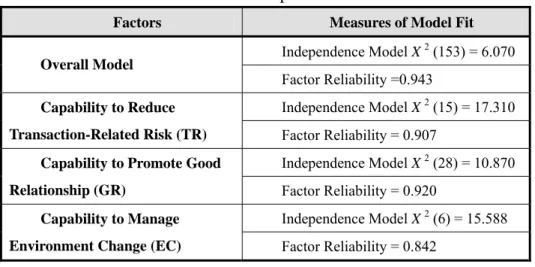
After a series of measurement assessment, Table 3 shows the reliability coefficient values for the final model. The reliability of two factors, TR and GR, is increased and the factor, EC, without adjusted items is leveling off. All the items in the factor TC are dropped because they
violate the discriminant validity. In summary, the adjusted model with an overall reliability of 0.943 represents good instrument validity. The summary of statistical assessment is shown in Figure 3.
Table 3. Measurement Properties of Final Model Factors Measures of Model Fit
Independence Model X 2 (153) = 6.070
Overall Model
Factor Reliability =0.943
Independence Model X 2 (15) = 17.310
Capability to Reduce
Transaction-Related Risk (TR) Factor Reliability = 0.907
Independence Model X 2 (28) = 10.870
Capability to Promote Good
Relationship (GR) Factor Reliability = 0.920
Independence Model X 2 (6) = 15.588
Capability to Manage
Environment Change (EC) Factor Reliability = 0.842
Factor Analysis
Reliability of Original Model Content Analysis
Item-Total Correlation
Optimal Reliability Coefficients
Convergent Validity
Discriminant Validity
Reliability of Final Model Pilot Test Further Measurement Assessment 24-item model 1. Dropping TC3 and TC4 in technology level 2. Moving TC6, TC7, TC8
form technology level to transaction level 18-item model 1. Dropping TC1, TC2 and TC5 2. Dropping TR2 3. Dropping GR4 and GR7 26-item model 24-item model 24-item model 24-item model Initial Measurement Assessment
Figure 3. Summary of Statistical Assessments
5.3 Evaluating a Covariation Model of Supply Chain Capability
The further verification of this model is through the use of confirmatory factor analysis. According to Segars and Grover (1998), the analytical framework of confirmatory factor analysis provides an appropriate means of assessing the efficacy of measurement among scale items and the consistency of a pre-specified structural equation model with its associated network of
theoretical concepts. The EQS for Windows program (Version 6.0) is utilized as the analytical tool for estimating the measurement and structural equation models developed in this study.
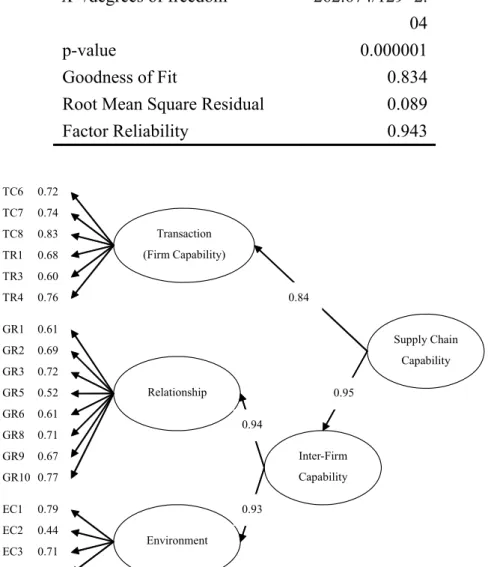
The 18-item model, derived from last section, forms the baseline confirmatory model for the supply chain capability construct. The baseline model suggests that transaction, relationship, as well as environment are independent in their prediction of supply chain capability (Figure 4). Table 4 reports the goodness-of-fit summary for the baseline model. The X 2 divided by its degrees of freedom is 1.99, which is conforming to the recommended 2 (Sethi and King 1994). The goodness-of-fit (GFI) for the baseline model is 0.834, which is below the recommended 0.9 (Sethi and King 1994). However, it is not out of line with other exploratory studies developing measures for complex organizational phenomena. The root mean square residual (RMSR) is 0.089, which is below the recommended 0.1 (Sethi and King 1994), providing further evidence of a good fit for this model. The reliability is above the cutoff of 0.8 that is good for exploratory studies. Overall, the fit indicators seem to suggest that each criterion is capturing a significant amount of variation in the latent dimensions of the supply chain capability construct.
Transaction TR3 TR4 EC2 GR1 GR2 GR3 GR8 GR9 GR10 EC1 EC3 EC4 0.54 0.71 0.79 0.77 0.67 0.71 0.72 0.69 0.61 0.44 0.76 0.60 TC6 0.72 TC7 0.74 TC8 0.83 TR1 0.68 Relationship Environment 0.62 0.56 0.74 GR5 0.52 GR6 0.61
Figure 4. Baseline Confirmatory Model for Supply Chain Capability Construct Table 4. Model Fit Indices for Baseline Model
Number of Latent Variable 3
Total Number of Items 18
X 2/degrees of freedom 262.674/132=1.99
p-value 0.000001
Goodness of Fit 0.834
Factor Reliability 0.943
The comparative methodology contrasts a baseline model with a model featuring a second-order model. The second-order model was iteratively modified to improve its fitness. Table 5 shows the model fit indices for the alternative model and the structure is shown in Figure 5. Overall, the fit indices for the second-order model are satisfactory based on the criteria of X 2 / degrees of freedom (df), GFI, RMSR, and reliability.
Table 5. Model Fit Indices for Second-Order Confirmatory Model
Number of Latent Variable 5
Total Number of Items 18
X 2/degrees of freedom 262.674/129=2.
04 p-value 0.000001
Goodness of Fit 0.834
Root Mean Square Residual 0.089
Factor Reliability 0.943 Transaction (Firm Capability) TR3 TR4 EC2 GR1 GR2 GR3 GR8 GR9 GR10 EC1 EC3 EC4 0.54 0.71 0.79 0.77 0.67 0.71 0.72 0.69 0.61 0.44 0.76 0.60 TC6 0.72 TC7 0.74 TC8 0.83 TR1 0.68 Relationship Environment GR5 0.52 GR6 0.61 Supply Chain Capability 0.93 0.94 0.84 Inter-Firm Capability 0.95
Figure 5. Second-Order Confirmatory Model for Supply Chain Capability Construct
It has been suggested that the efficacy of second-order model be assessed through examination of the target (T) coefficient (T = X 2 (baseline model)/ X 2 (alternative model)) (Segars and Grover 1998). The coefficient has a lower bound of 1.0 if the higher-order model is sufficiently captures the factor in the model. As shown in Table 5, the coefficient between the baseline model and second-order model is 0.98. The value suggests that the addition of the second-order model does increase chi-square. Therefore, the second-order model is a truer
representation of the model structure and that the second-order model can be accepted over the baseline model.
6. DISCUSSION
6.1 Items of the Construct
It is notable that all items of TC were either dropped or moved, eliminating the dimension from the construct. The possible reason is that technology capability is not a performance differentiator for both suppliers and original equipment manufacturers (OEMs) in Taiwan PC industry. Most of the suppliers in Taiwan PC industry are small and medium-sized enterprises (SMEs); therefore the trading means of the interorganizational collaboration may greatly depend on the requests of their customers. The customers choose the suppliers with a long-term relationship so that the quality, cost, and the price of the offerings are trustworthy, rather than choose those simply having better technology abilities. Thus, from the SMEs’ perspective; suppliers do not consider the technology capability as a major ability for supply chain collaboration. On the other hand, from the perspective of OEMs, they are big and powerful in the Taiwan PC market. Due to the government support and similar customer pool, most of them have developed high but similar technology capability to conduct the inter-firm coordination. Technology capability can not generate competitive advantage for them.
The statistical analysis also suggests us to move the items that measure the IT investment to the transaction level, indicating that the investment of IT infrastructure is an important factor to reduce transaction related risks. This change represents that the firms’ IT infrastructure can not directly influence the supply chain capability by itself, but it indirectly affect by reducing the transaction risks. This finding is basically consistent with previous IT research (Bakos 1991, Clemons and Row 1992, 1993, Kumar and van Dissel 1996). For example, Kumar and van Dissel (1996) propose a framework that considers the IT as a supporting role in reducing transaction costs and transaction risks. In order to reduce the transaction risks such as overgrazing of the common, fouling or contaminating, and poaching the commons, Kumar and van Dissel (1996) suggest that IT may be used effectively as the village constable to guard against these risks. According to the results of Clemons and Row (1992), IT is both creating the opportunity for cooperation and providing the monitoring capability to reduce the transaction risk associated with cooperation. Their research shows that the IT increases the amount or timeliness of information transferred across firm boundaries as well as reduces the information asymmetries which result in transaction risks. Therefore, instead of being treated as an independent supply chain capability, IT should be viewed as one of the transaction enablers.
In summary, our research points out the IT capability is not a significant supply chain capability for good supply chain collaboration. This result is contrast with most of past related studies as they treat technology as one of the important factor for inter-firm collaboration. Though this finding may need further justification in the future, it reflects the fact that more and more companies view IT as a foundation for inter-firm transaction, but not a weapon for creating competitive advantage. In our interview, most companies agree that technology is not a major concern while considering supply chain collaboration, other factors like trust or the power of
partners play more important role.
6.2 Structure of the Construct
Another interesting aspect of this study is the discovery of a second-order confirmatory model. The three dimensions are modeled as baseline latent variables, determined by two second-order latent variables. The first label presents the firm capability which can effectively help company handle the transaction related risk with the technical and managerial abilities. The second label expresses the inter-firm capabilities that include the abilities to promote good supply chain relationship and capacity to handle the uncertainties in the dynamic environment. The dimensions of our final model are described as follows.
Firm capability: The dimension consists of a transaction level describing abilities of
reducing transaction risks: degree of technology investment in IOS (TC6), establishment of IT infrastructure (TC7), establishment of applications to support tasks (TC8), successful implementation experience (TR1), following the industrial standard (TR3), and pre-established security mechanisms (TR4). The first three items are from the technical perspective to reduce the transaction risks and the other three items are from the managerial perspective to prevent the transaction risks.
Inter-firm capability: the dimension includes two levels – (1) promote good relationships and (2) manage environment change. The relationship level measures how to well maintain the
supply chain relationships with trading partners, including the items of existed undergoing supply chain collaboration projects (GR1), establishment of clear norms for business behavior (GR2), sharing confidential or proprietary information (GR3), similar IT infrastructure (GR5), compatible company culture (GR6), providing similar support of cooperative firms by top management (GR8), technology support or cost premiums (GR9), and education seminars or system implementation expertise (GR10). The environment level comprises of the capabilities of handling the environment uncertainties: related technologies and systems to help gather information (EC1), explicit regulations to measure trading performance (EC2), sending the timely, accurate, and complete information (EC3), and clearly known practices and procedures in doing inter-firm tasks (EC4).
Thus, to understand firms’ supply chain capability, this study suggests the companies have to consider two dimensions: firm capability and inter-firm capability. The firm capability presents the abilities to reduce the transaction related risks, and the inter-firm capability indicates the abilities to handle the relationships and environment issues. It is interesting to notice that past research seldom considers the ability to handle environment uncertainty as an important supply chain capability. However our study indicates that such capability becomes more and more important in the current e-business environment where customer requests frequently change, product obsoletes quickly, and customization becomes a norm
7. CONCLUSION
Many organizations are reengineering their business processes in order to take full advantage of supply chain collaboration. Our study seeks to uncover the key company-owning capability that can contribute to the supply chain collaboration. The proposed framework measures the supply
chain capability in four levels: (1) the technology capability in terms of IOS usage and integration as well as information technology infrastructure, (2) the transaction risk resolution capability, (3) the capability to maintain good relationships, and (4) the capability to reduce uncertainties of external environment.
To pretest the applicability of this model, we conduct interviews with three companies in Taiwan PC industry. The findings are consistent with our model. To further test the model, we conduct a general survey with main Taiwanese PC firms during spring 2005. After a series of measurement assessment, the supply chain capability construct is adjusted as a second-order model. The model consists of two groups of items. The first group captures the firm capability for resolving the transaction risk. The other group presents the inter-firm capabilities for promoting good relationship and managing the environment uncertainties with trading partners.
As any empirical investigation, weaknesses in our methodology and data are present (Lewis and Byrd 2003). First, the number of observations upon which the analyses are performed is in the barely acceptable range. Although we have cited evidence that our sample size is minimally adequate, we recognize that other researchers might take exception to our small size. Second, the survey data utilized in this study are collected from firms in the Taiwan PC industry. Although the utilized sampling frame has been widely-used in similar studies and contains organizations which likely participate in the activity of interest, no claim of externally validity for this study’s findings can be made. Instead, these findings can only be generalized to the population of firms within the sampling frame.
However, at the very least, the components of supply chain capability and the measurement instrument developed in this study provide a good starting point for further investigations of the supply chain capability construct. Validated supply chain capability measures can help managers better gauge the characteristics of the collaborations. IT researchers can build upon the model developed in this study through further examination of the factors that are discovered. Further research can be conducted by the cross-industry or cross-country survey in the future to verify these results.
REFERENCE
1. Angeles, R., and Nath, R., “An Empirical Study of EDI Trading Partner Selection Criteria in Customer-Supplier Relationships,” Information and Management (37:5), 2000, pp. 241-255. 2. Bakos, J. Y., “Information Links and Electronic Marketplaces,” Journal of Management
Information Systems (8:2), 1991, pp. 31-52.
3. Barney, J. “Firm Resources and Sustained Competitive Advantage,” Journal of Management (17:1), pp. 99-120
4. Bensaou, M., “Interorganizational Cooperation: The Role of Information Technology, An Empirical Comparison of U.S. and Japanese Supplier Relations,” Information Systems
Research (8:2), 1997, pp. 107-123.
5. Bensaou, M., and Venkatraman, N., “Configurations of Interorganizational Relationship: A Comparison between U.S. and Japanese Automakers,” Management Science (41:9), 1995, pp. 1471-1492.
Infrastructure: Exploratory Analysis of a Construct,” Journal of Management Information
Systems (17:1), 2000, pp. 167-208.
7. Clemons, E., and Row, M., “Information Technology and Industrial Cooperation: The Changing Economics of Coordination and Ownership,” Journal of Management Information
Systems (9:2), 1992, pp. 9-28.
8. Clemons, E., and Row, M., “Limits to Interfirm Coordination through Information
Technology: Results of a Field Study in Consumer Packaged Good Distribution,” Journal of
Management Information Systems (10:1), 1993, pp. 73-95.
9. Craighead, C. W., and Shaw, N. G., “E-Commerce Value Creation and Destruction: A
Resource-Based, Supply Chain Perspective,” Database for Advances in Information Systems (34:2), 2003, pp. 39-49.
10. Dwyer, F. R., Scurr, P. H., and Oh, S., “Developing Buyer-Seller Relationships,” Journal of
Marketing (51:2), 1987, pp. 11-27.
11. Dyer, J. H., and Singh, H., “The Relational View: Cooperative Strategy and Sources of Interorganizational Competitive Advantage,” Academy of Management Review (23:4), 1998, pp. 660-679.
12. Hart, P. J., and Saunders, C. S., “Emerging Electronic Partnerships: Antecedents and Dimensions of EDI Use from the Supplier’s Perspective,” Journal of Management
Information Systems (14:4), 1998, pp. 87-111.
13. Iskandar, B., Kurokawa, S., and Leblanc, L., “Adoption of Electronic Data Interchange: The Role of Buyer-Supplier Relationships,” IEEE Transactions on Engineering Management (48:4), 2001, pp. 505-517.
14. Kumar, K., and van Dissel, H. G., “Sustainable Collaboration: Managing Conflict and Cooperation in Interorganizational Systems,” MIS Quarterly (20:3), 1996, pp. 279-300. 15. Lewis, B. R., and Byrd, T. A., “Development of a Measure for the Information Technology
Infrastructure Construct,” European Journal of Information Systems (12:2), 2003, pp. 93-109. 16. Lewis, J. D., and Weigert, A., “Trust as a Social Reality,” Social Forces (63), 1985, pp.
967-985.
17. Mahmood, M. A., and Soon, S. K., “A Comprehensive Model for Measuring the Potential Impact of Information Technology on Organizational Strategic Variables,” Decision Sciences (22:4), 1991, pp. 869-897.
18. Riggins, F. J., Kriebel, C. H., and Mukhopadhyah, T., “The Growth of Interorganizational Systems in the Presence of Network Externalities,” Management Science (40:8), 1994, pp. 984-998.
19. Riggins, F. J., and Mukhopadhyay, T., “Interdependent Benefits from Interorganizational Systems: Opportunities for Business Partner Reengineering,” Journal of Management
Information Systems (11:2), 1994, pp. 37-57.
20. Robert M. Grant, “The Resource-Based Theory of Competitive Advantage: Implications for Strategic Formulation,” California Management Review (33:3), 1991 pp. 114-135
21. Segars, A. H., and Grover, V., “Strategic Information Systems Planning Success: An Investigation of the Construct and Its Measurement,” MIS Quarterly (22:2), 1998, pp. 139-163.
Information Technology Application Providers Competitive Advantage,” Management
Science (40:12), 1994, pp. 1601-1627.
23. Soliman, K. S., and Janz, B. D., “An Exploratory Study to Identify the Critical Factors Affecting the Decision to Establish Internet-based Interorganizational Information Systems,”
Information and Management (41:6), 2004, pp. 697-706.
24. Teece, D.J., Pisano, G., and Shuen, A. “Dynamic capabilities and strategic management,”
Strategic Management Journal (18:7), 1997, pp. 509-533
25. Wang, E., and Seidmann, A., “Electronic Data Interchange: Competitive Externalities and Strategic Implementation Policies,” Management Science (41:3), 1995, pp. 401-418.
(三)計畫成果自評
本研究的成果如下:
(一) 發現優良之技術能力並非關鍵的供應鏈能力
由於大部分在台灣的電腦供應商都屬於中小企業(SME);因此其跨組織的協同交 易經常都要靠其客戶的回應。客戶之所以與供應商有長期的合作關係也是為了 保持品質、成本和價格在供應上的互相信賴,並非只是選擇技術能力好之供應 商。因此,在供應鏈協同上供應商並非將擁有好的技術視為能產生競爭優勢之 主要供應鏈能力。而從 OEM 的角度來看,由於政府的支持及類似的客戶群,他 們大多都發展出一個不錯但相似的技術能力來帶領跨公司的協同合作,所以技 術能力也並不能為他們產生出額外之競爭優勢。這項結果與以往的相關研究視 IT 科技為跨公司協同的重要關鍵因素大有不同。雖然這項發現在未來仍需進一 步的証實,但是其反映出一件事實就是越來越多的公司將 IT 當作是跨公司交易 的基礎,但不是創造競爭優勢的武器。反而是其他的因素像是信任及夥伴的能 力扮演了一個更重要的角色。(二) 提出改善跨組織系統績效之供應鏈能力模型
要了解一家公司的供應鏈能力,這份研究會建議企業要考慮兩個方面:公司能 力以及公司的互動能力。公司能力代表著降低交易風險的能力,而公司互動能 力則指出處理關係以及面對大環境相關議題的能力。在過去的研究中,鮮少有 人把處理大環境的不確定性視為供應鏈中重要的一項能力。儘管如此,我們的 研究顯示此項能力在現今普遍的 E 化企業環境下,也就是當客戶的需求改變愈 來愈頻繁、產品淘汰速率加快、以及客製化儼然成為一個基準規範時是愈來愈 重要了。本計畫之研究成果豐碩。在過去一年中,階段性之研究成果已有兩篇國際會議
論文(Pre-ICIS workshop -- the 5th Workshop on e-Business), 及一篇SSCI
的期刊論文(Information Systems Journal)
行政院國家科學委員會補助國內專家學者出席國際學術會議報告
2007 年 1 月 16 日 報告人姓名 張欣綠 服務機構 及職稱 國立政治大學資管系 時間 會議 地點 2006/12/9-2006/12/13 美國密爾瓦基 本會核定 補助文號 NSC 95-2416-H-004-053- 會議 名稱(中文) 第五屆 Pre-ICIS E-business Workshop 暨 ICIS 2006
(英文) Web 2006 and ICIS 2006 發表 論文 題目 (中文) 1. 評估商業環境和 IT 環境適切度對電子採購系統的影響 2. 從資源理論觀點看跨組織資訊系統能力 (英文)
1. The Assessment of the Business-IT Fit in E-Procurement Systems: A Case Study
2. Resource-based View of the Inter-organizational Information System Capability: A Field Study in Taiwan PC Industry
報告內容包括下列各項: 一、參加會議經過 二、與會心得 三、建議 四、攜回資料名稱及內容 五、發表論文 附件 三
壹、
參加會議經過
This conference started on 12/9 and ended on 12/13. Since I can’t get the returning seat, I
came back one day earlier. The whole trip plan is as follows,
日期
活動行程
12 月 8 日 搭機赴美
12 月 9 日 參加 Web2006 開幕式,發表論文,並會後餐敘
12 月 10 日 參加 ICIS 會議開幕酒會
12 月 11 日 參加 ICIS 會議
12 月 12 日 參加 ICIS 會議,回程
This year, the conference theme is ‘Real-World Impact of e-Business Research.’ A total of 56 papers were accepted for presentation, covering a broad range of technical, empirical, managerial, and economic aspects of e-business. Eight focused sessions were arranged in the conference: security informatics, agent-based information systems, e-business standards development, research opportunities in e-business, web intelligence, web-based services in health care, web services and architectures, and e-market and market engineering. There were also two keynote addresses and two invited talks. The conference was sponsored by AIS
SIGeBIZ, AOL, and Caterpillar. Besides, four universities (i.e. University of Illinois, University of Utah, University of South Florida, and National Sun Yat-Sen University) co-organized the entire program. Combining all the varieties, this conference has significant impacts on e-business and information systems research.
Dr. Krishnan Ramayya gave the keynote speech. He is the W.W. Cooper and Ruth F. Cooper Professor of Information Systems at Carnegie Mellon University. In his speech, he discussed the opportunities for Interdisciplinary research: the Internet, Web2.0 and Beyond. Steve Miller, founding dean of the school of Information Systems at Singapore Management University, gave another keynote afterwards. He introduced an industry-university collaboration for service innovation: the standard chartered iLAB@SMU.
Following the keynote speeches, my two papers were presented on Session 1a and Session 3d. After the series of sessions, a panel discussion is chaired by Raj Veeramani, Robert Ratner Chair Professor from University of Wisconsin-Madison. Four noted scholars were invited to discuss the emerging e-business practices and challenges.
Many interesting papers are discussed in the sessions that I participated. In general, I categorize the topics into three groups and summarize the discussion results.
[E-Business and ERP System Integration]
Hsu and Kraemer from University of California, Irvine built upon resource-based view to investigate the complementary effect between ERP and e-Business technologies. They argued that it is the complementarily use of ERP and e-business technologies to build system and
business integration capabilities that is more likely to create business value. Their results showed that the complementary effect between ERP and e-business technologies in creating business value is stronger than the main effects of ERP or e-business technologies alone.
[Online Dynamic Pricing on Consumer Perceptions and Behaviors]
Lee from University of Illinois raised the question of whether dynamic pricing can actually work in the electronic commerce environment. In her paper, she aimed to fill the gap by examining whether there are tactical ways of implementing dynamic pricing strategies so as to moderate consumers’ negative perceptions. She used different ways of presenting product’s price, in
addition to previous research using price comparisons, to study consumer behavioral responses.
[Operational and Strategic Benefits of IOS]
Ibrahim from Erasmus University and Ribbers and Bettonvil from Tilburg University
demonstrated how different types of IOS-related resources influence the development of IOS capabilities and subsequently the attainment of benefits. The study develops a conceptual model combining multiple theories including transaction cost economics, resource-based view and strategic management. They proposed that the use of specific types of resources positively influences the development of distinctive IOS capabilities and that these IOS capabilities positively influence the attainment of operational and strategic benefits.
參、
建議
The participants made valuable suggestions and comments to our two papers. I summarize their recommendations below.
1. Clarify the operationalization of their measures and why the "level of integration" determines the types of e-procurement system. As one reviewer points out, any of the e-procurement system can be implemented at the different levels of integration.
2. Carefully review the results and reflect upon the implications for their central research question. Make sure that your discussion does not make contradictory statements.
Paper 2: Resource-based View of the Inter-organizational Information System Capability: A Field Study in Taiwan PC Industry
This is an interesting study with the scope for being extended to a large scale investigation of the success of IOS implementations. I recommend accepting this paper after the authors have
addressed the following issues.
1. I do not understand the rationale behind dropping the IOS integration factor. Since IOS integration is accepted as an important factor for its success, was it dropped because of difficulty of measurement? Or is it captured in other factors?
2. The discussion of “Physical Assets” for hypotheses 1 (page 5) is not consistent with the measures they propose in page 7. Are they measuring the extent of physical assets dedicated for IOS or are they measuring the IOS capability? The items themselves, such as “degree of
technology investments in IOS and establishment of IT infrastructure need some elaboration. Or, the authors can consider using IOS infrastructure capability instead of physical assets. The authors have to be consistent with their conceptualization of this variable and its
operationalization. Another minor issue here is the references used for operationalization (page 7) are completely different from the references used in the discussion (page 5).
3. The “path dependency” is very similar to “prior experience with similar implementations.” Their discussion on page 5 focuses on the IOS implementation and learning process (which is a development perspective), whereas the operationalization on page 7 focuses on “EDI usage” (which is a usage perspective). I think the authors have to decide on the perspective they like to use and follow it in the discussion and operationalization.
4. On page 8, the authors mention the use of MTMM for validity assessment and Cronbach’s alpha for reliability assessment. It may be useful to present a small table showing the reliability and factor loadings to give the readers a sense of the measure properties.
肆、
攜回資料名稱及內容
A. Conference paper abstracts B. Conference program outline
C. Revision strategy and comments to my presented paper
伍、
發表論文
The Assessment of the Business-IT Fit in E-Procurement Systems:
A Case Study
表 Y04
Abstract
Because of the influence of globalization and updated information technologies (IT), firms face more and more uncertainties when they conduct daily procurement activities. This research aims to examine the fit of business and IT environment and study its impacts on the performance of
alternative e-procurement systems (EP). A multiple-case study was taken in Taiwan PC-Notebook industry to verify the research framework. We find the firms’ external and internal factors do affect the performance of EP, and the influence is mediated by the levels of system integration.
Low-integrated EP leads to greater performance under lower environment, partnership, and process uncertainty, and lives up to more benefits under lower knowledge skills. We also observe that lack of fit between procurement practices and EP produces extra burdens and costs at both buyer side and supplier side. Therefore, the contribution of this research can be two-folded: first, practitioners who can use this framework to diagnose their environment conditions and then align to the appropriate type of EP. Second, researchers who can build upon this model to further examine the fit impact on EP performance.
Keywords: Business-IT fit, Electronic procurement, IT Alignment, Case Study, E-Business
1. Introduction
With most organizations spending at least one third of their income on purchasing goods and services, procurement holds significant business value (Gebauer and Segev 1998). It is even possible that many organizations spending 50% to 60% of their revenue on purchasing goods and services (Kalakota and Robinson 1999). A close survey on supply chain management made at Forrester Research 2002 revealed that 62% of $1B+ the manufacturing firms surveyed deployed procurement and sourcing packaged applications and 35% of the firms could extend the
applications to partners.
While more and more firms use electronic procurement systems (EP) to achieving purchasing efficiencies, they find IT alone can’t guarantee good performance. This drives us to the question how EP can deliver the promised benefits. A key concern of this question is alignment – applying IT in an appropriate and timely way and in harmony with business strategies, goals, and needs
(Luftman and Brier 1999). The external environment should also be considered into the issue of alignment, since the EP can be viewed as the IT-enabled inter-organizational processes which involve multiple trading partners with a wide range of communication and IT. Although there is no doubt that a good fit between the EP and the requirements of the business environment has positive impact on system performance, how to align is still open to question.
This study attempts to better examine the business-IT alignment, and our focus will be on the EP in direct purchasing. The research questions are as follows:
(1) What impacting factors retard or encourage the successful implementation of corporate procurement systems?
表 Y04
for organizations in terms of the system performance?
2. Literature Review
2.1 Use of Electronic Procurement Systems
In this study, EP is defined as the application of electronic commence in procurement. It involves the use of various forms of Internet technology to automate and streamline the procurement process in business organizations (de Boer et al. 2002, Chan and Lee 2002). Some EPs are implemented as a form of application to application (AP-to-AP) connection, some use EC Turnkey, like EDI, and others are web-based procurement systems. According to Choudhury’s typology (1997), application to application (i.e. AP-to-AP) connection and EC Turnkey are the examples of electronic dyads, where a buyer (seller) establishes individual logical links with each of a selected number of sellers (buyers) for a product. Web-based procurement system, on the other hand, is the example of
multilateral IOISs, which, allows a firm to communicate with a large, potentially unlimited, number of trading partners over a single logical inter-organizational link. The system integration level is usually higher in the former type.
These technologies have been reported to have positive impacts on firm performance by some authors. Mukhopadhyay and Kekre (2002) showed in full detail that how EDI brings strategic and operational benefits for both suppliers and buyers. Other studies explored the value of web-based procurement systems (Baron et al. 2000; Subramaniam and Shaw 2002). Yet how to get these values is still uncertain. Therefore, we can not simply expect that firms can successfully implement EP as long as they have learned about a specific technology and found it valuable for their needs. There should be other factors which impact the performance of EP.
2.2 Studies of IT and Uncertainty
As Yu et al. (2003) argued, EP could create changes in the way organizations conduct business internally and externally and bring many dynamic changes both outside and inside the organization. This creates a high level of turbulence and, as a result huge uncertainty to involved parties. We summarize four major types of uncertainty that could affect EP performance in the following paragraphs.
Environment uncertainty is the most obviously and wildly discussed one in the literature. It stems from the complexity of the environment and dynamism, or the frequency of changes to various environmental variables (Duncan 1972; Premkumar et al. 2005). Thus, Firms competing in an environment that existing higher uncertainty should need more reliable and timely information when they conduct purchasing decision, and therefore, challenge the performance of EP. The second uncertainty is about partnership. Given the interorganizational nature of the EP, partner’s behavior in the future is highly uncertain to firms (Bensaou and Venkatraman 1995).
Usually, firms develop long-term relationships with a few suppliers and make relationship-specific investments to minimize transaction risks (Premkumar et al. 2005). Thus, lower partnership
表 Y04
uncertainty encourages greater information sharing between two firms, and therefore provides a closer collaboration for EP usage.
Process characteristics are categorized as the third uncertainty to EP performance. In their recent research on the value of EP, Subramaniam and Shaw (2004) referred to the fact that not all
transaction processes are similar in terms of their search requirements, processing time and efforts, and errors, and so do their needs to EP. We may, therefore, reasonably expect the characteristics of the B2B process to greatly influence the realization of EP benefits. The last factor we want to emphasize is organizational knowledge. According to Grant (1996), knowledge resides in specialized form among individual organizational members and the essence of organizational capability is the integration of individuals’ specialized knowledge. A close survey on supply chain integration made by Chen et al. (2004) revealed that the technology ability and application level of SMEs would highly constrain the degree of system automation. Thereby, a firm’s knowledge to EP is a key determinant to EP performance.
2.3 The Fit Concept
The notion of fit in IS research has been an object of study for a long time. Over the past few decades a considerable number of studies have been made by using the task-technology fit (TTF) theory (Goodhue 1995, Zigurs and Buckland 1998, Dennis et al. 2001). While TTF is focused on use performance and user evaluation of IT and does not use structural contingency theory of fit as its basis (Khazanchi 2005), some authors argued that there is a need for investigating fit that expands beyond the individual and task levels of analysis to organizational level of analysis. For example, Gribbins et al. (2004) expanded Goodhue and Thompson’s TTF (1995) to
process-technology fit for better understanding of the acceptance and use of EP systems in
organizations. In contrast to TTF, other authors use Galbraith’s information processing theory (1973) to examine the fit between information processing needs and information processing capability. The first scholars to give much attention on information process theory were Bensaou and Venkatraman (1995). Following that, Premkumar et al. (2005) investigated fit in the interorganizational level of analysis and empirically examined its effect on performance.
Although above studies are important to examine the relationship of alignment, there is no comprehensive framework to consider all important factors together. Therefore, we propose that there is a need to consider both internal and external business environment when understanding the usage of EP. There are several reasons for this proposition. First, while TTF scholars focus on internal characteristics, other IOIS scholars give much attention to external characteristics and interaction relationship. Both views are quite unsatisfactory, given that they only consider one perspective of the problems. As EP is an IOIS which creates changes in the way organizations conduct business internally and externally and can bring many dynamic changes both outside and inside the organization (Yu et al. 2003), its performance should be influenced by both internal and external corporate environment.
Second, more and more scholars believe that the individual and task level of analysis are not applicable to EP study (Gribbins et al. 2004; Khazanchi 2005). They argue that organizations usually pursue excellence as a whole, rather than simply at individual’s task. Besides, EP is a process-based IT solution which can consist of a suite of applications that are integrated to support the processes rather than independent tasks (Gribbins et al. 2004). Therefore, it seems reasonable to
表 Y04
examine process rather than task characteristics. Third, to realize the strategic importance of EP, previous research has spent plenty effort to exploit barriers and facilitators. However, organizations differ greatly in their abilities to utilize the application and translate it into tangible benefit.
Adopting a technology is one thing, having the capability to use it is another. Organization’s own knowledge base would be a key part of business environment, but is not well discussed in previous IT alignment studies.
3. Development of the Business-IT Fit Framework
Due to the insufficiencies of previous works which are mentioned above, we aim to synthesize the previous research to develop a comprehensive framework that evaluates the impact of EP usage on firm performance under the consideration of corporate external environment, internal processes, and organizational knowledge. The proposed business-IT fit framework is shown in Figure 1.
Figure 1. Research framework for the development of business-IT fit
As to the type of EP, we have summarized three different EP technologies: AP-to-AP, EC turnkey, and web-based procurement systems, each having different degrees of integration between suppliers and customers. To simplify the analysis, we categorize them into two groups: low-integrated EP and high-integrated EP.
3.1 External Uncertainty vs. IT Environment
3.1.1 Environment Uncertainty
In the procurement context, the changes in demand and supply are the major environment
uncertainty that influences firm’s information need (Premkumar et al. 2005). When the uncertainties are high, firms need to communicate the frequent changes of demand with their suppliers. Under such conditions, EP that provides near-real-time structure information to trading partners is
preferred (Premkumar et al. 2005). On the other hand, product customization is another resource of such uncertainty (Bensaou and Venkatraman 1995). The arrangement of high-integrated EP system reduces coordination costs over those incurred in a market by eliminating the firm’s effort to gather and analyze a great deal of information about different trading partners. Therefore, under high environment uncertainty, we expect that firms with tight integration between their trading partners would reduce more coordination costs and achieve better performance. Therefore, our proposition is
External y Environment Uncertainty y Partnership Uncertainty Business Environment Performance of EP IT Environment Internal y Process Uncertainty y Know-how/Knowledge y Type of EP FIT
表 Y04 as follows,
Proposition 1: A highly integrated EP can lead to greater performance under higher levels of environment uncertainty.
3.1.2 Partnership Uncertainty
According to Son et al. (2005), firms and suppliers are more certain about their partnership when they have made reciprocal investments, because these investments provide a strong signal to the other party about their desire for long-term relationships (Premkumar et al. 2005). In line with reciprocal investments, trust between firms and partners is recognized as an effective mechanism to reduce the partnership uncertainty (Premkumar et al. 2005). As firms have confidence that the behavior of their suppliers conforms to their own expectation, the perception of risk associated with partners’ opportunistic behavior can be highly reduced, and therefore encourages grater information sharing between both. Since both reciprocal investments and trust can promote good relationship, we can derive that, the coordination costs that take into account the costs of gathering information, negotiating contracts, and protecting against the risks of opportunistic bargaining are relatively high in an uncertain partnerships. The previous discussion points out the coordination costs can be highly reduced in the arrangement of highly integrated EP system, thereby we proposing:
Proposition 2: A highly integrated EP can lead to greater performance under higher levels of partnership uncertainty.
3.2 Internal Uncertainty vs. IT Environment
3.2.1 Process Uncertainty
According to Subramaniam and Shaw (2002, 2004), there are following types of procurement on the two ends of a continuum. At the one end is the structured procurement of which processes are highly automated and product specifications do not change frequently. At the other end is the unstructured procurement of which processes are manually initiated and the technical or design requirement for the products are difficult to predict accurately. The needs of EP systems vary in each procurement type (Subramaniam and Shaw 2004). For unstructured procurement, firms need to exchange information more frequently with its trading partners, and trading partners need to deal with several different sources of information to process procurement activities successfully
(Premkumar et al. 2005). Therefore, a more integrated EP which allows firms and trading partners to access relevant information timely is preferred. Since the complexities and dynamisms of processes and underlying products are higher for unstructured procurement than structured procurement, we can propose that,
Proposition 3: A highly integrated EP can lead to greater performance under higher process uncertainty.
3.2.2 Know-how/Knowledge
Past literature recognized that the key skills and know-how of firms have persisting effects on relative performance (Kogut and Zander 1992). The theory of diffusion of innovation helps account for this statement. Rogers (1995) stated that organizations often delay adoption of complex