國立高雄大學國際企業管理碩士學位學程
碩士論文
在臺灣利用海浪發電的可行性分析
A Feasibility Study of Using Sea Wave for Electricity
Generation in Taiwan
研究生:韓昱筠撰
指導教授:李博志教授
趙建雄教授
II
A Feasibility of Using Sea Wave for Electricity
Generation in Taiwan
Advisor: Dr. Lee, Po-Chih
Department of Asia Pacific Industrial and Business Management National University of Kaohsiung
Advisor: Dr. Chao, Chian-Hsueng Department of Information Management
National University of Kaohsiung
Student: Hon, Yu-Jun
International Master of Business Administration National University of Kaohsiung
ABSTRACT
In recent years, the nuclear power plant is facing the demonstration for the termination. If we want to terminate the nuclear power plant, we need to find out the alternative energy, and green energy has attracted much attention. In addition to solar power, Taiwan is actively developing wind power. Solar and wind energy require a lot of lands, but Taiwan is a small island, land use will exhaust in the future, it cannot completely replace nuclear power plant’s output. Taiwan is surrounded by the sea, for the development of sea wave power generation has considered an advantage.
This study is a qualitative analysis; the purpose of this study is to discuss the feasibility of sea wave power generation in Taiwan by using SWOT analysis and PEST analysis. The analysis results show that the construction cost of the sea wave power generation is not high; cost per kWh is also acceptable. For electricity generation from sea wave, it doesn’t need any fuel and it just need 0.5 meters wave height, the operation will not affect the greenhouse gas. But the coastline of Taiwan is governed by the government; the general public cannot use the coastline as a sea wave power generation. Besides this, the research and development will occur huge cost that people cannot afford. Only the government pay attention to the sea wave power generation, the sea wave power generation can successfully develop in Taiwan, and thus make up for Taiwan's energy demand.
III
在臺灣利用海浪發電的可行性分析
指導教授:李博志 博士 國立高雄大學 亞太工商管理學系 指導教授:趙建雄 博士 國立高雄大學 資訊管理學系 學生:韓昱筠 國立高雄大學 國際商業管理碩士學位學程摘要
近年來廢核聲浪四起,希望核能發電廠停機、取消核能供電,並尋找替代 能源,綠色能源因此備受矚目。臺灣目前除了太陽能發電外,正積極發展風力 發電,但太陽能與風能發電都需要大量的土地,臺灣面積狹小,發電量無法完 全取代核能發電,而臺灣四面環海的環境卻對於發展海浪發電具有相當大的優 勢。 本研究以質量分析討論海浪發電在臺灣的可行性,並以 SWOT 分析與 PEST 分析進行研究分析。分析結果指出:海浪發電的建造成本不高,發電成本 也在可以接受的範圍。海浪發電機運作時不需要任何燃料,只需要 5 米高海浪 就觸發發電機運作,運轉時也不會釋放出二氧化碳。但臺灣海岸線受政府管控, 一般企業無法使用海岸線作為發電用途,且研發的成本非一般企業可以承受。 唯有令政府重視海浪發電,海浪發電才能在臺灣發展,進而補足臺灣能源需求。 關鍵詞:海浪發電、SWOT 分析、PEST 分析IV
Table Content
List of Tables ... V List of Figures ... VI
Chapter One: Introduction ... 1
1.1 Background ... 1
1.2 Motivation and objective ... 2
1.3 Research Procedure ... 2
Chapter Two: Literature Review ... 5
2.1 Renewal Energy ... 5
2.2 Nuclear Power ... 11
2.3 Thermal Power Generation ... 13
2.4 SWOT Analysis ... 15
2.5PEST Analysis ... 16
Chapter Three: Research Method ... 19
3.1 Research Framework ... 19
3.2 Qualitative Analysis ... 19
Chapter Four: Method Analysis ... 21
4.1 Brief introduction ... 21
4.2 SWOT Analysis ... 22
4.3 PEST Analysis ... 24
4.4 Synergize ... 30
Chapter Five: Conclusion ... 32
References in English ... 35
V
List of Tables
Table 2-1 Nuclear power plant estimated stop operation table ... 13
Table 4-1 Unit cost of electricity in Taiwan, 2016 ... 26
VI
List of Figures
Figure 1-1 1 Flow Chart ... 4
Figure 2-1 Platform construction ... 6
Figure 2-2 Structure of sea wave power generator in the sea ... 7
Figure 3-1 Research Framework ... 20
1
Chapter One: Introduction
1.1 Background
Nowadays, electricity plays an important role in household using and businesses
running and almost none of the world is able to live without it. As technology
develops, the use of electricity is gradually increasing, and CO2 emission from
combustion of fossil fuel climbs simultaneously. In order to stop pollution causing
environmental damage from energy using, a new, clean and efficient renewable
energy must be in desperately need for substitution of energy. Therefore, Green
energy development will be the coming issue, and alternative energy such as wind
power, solar power, sea wave power gets attention recently.
Due to numerous using demand of electricity, nuclear power plant 4 is built to
solve the problem. However, the critical issue, nuclear power plant 4 needs to be
abandoned or continued, is still not unanimous. People, who resist the working of
nuclear power plant 4, concern the danger of nuclear power and the nuclear waste to
the environment and propose to use alternative power instead of nuclear power.
Countless problems and costs have occurred since the nuclear power plant 4 was built.
Taiwan has already developed some kinds of alternative energy including wind
power, solar power, and hydroelectric power. After the Democratic Progressive Party
(DPP) becomes the ruling party in 2016, it strongly supports alternative energy
instead of nuclear power and has made some new policies to run the project. But,
wind power, solar power are going to be saturated. And dam is mainly for agriculture
and people’s livelihood water using. Hydropower generation is just supplementary.
Relatively, ocean energy is not developed yet. Surrounded by sea, Taiwan is rich in
ocean resources. The government should look highly on this part and start taking a try
on it.
Wave energy is harmless and environment-friendly, and it can also be exchanged
for electrical use. Sea wave power has the following advantage: 1) an infinite resource:
2
the war; 3) Reliable power supply: 24 hours continuous in void lack of raw materials;
4) Clean energy: no environment pollution; 5) Easy to operate; 6) Regular supply
since the power source is sea wave; 7) One plant can expand to generate 200MW
electric power; 8) Can completely setup within 8~10 months.
1.2 Motivation and objective
Due to extreme weather change, human beings are facing economic loss,
environmental problem, and creature extinction. People around the world currently
are forced to figure out a solution to cope with it. Urban development causes
Greenhouse gas emission because economic growth makes energy consumption that
creates lots of Greenhouse gas. If human beings can use energy from nature with low
pollution, it will diminish Greenhouse gas emission and truly implements
environment-friendly policy. However, in the process of environment-friendly policy
implement, investment cost and using efficiency are vital factors to influence energy
generator chosen and development. So, investment cost and using efficiency of
energy generator need consideration and analysis deliberately. Electricity is most
common energy used by human beings, and there are two general
environment-friendly electricity generators used in Taiwan. One is wind electric power generation,
and another one is solar electric power generation. However, Owing to saturation of
solar and wind power development, we need to find other alternative energy out to
cope with this problem. Besides, Taiwan government did not pay attention to the
development of sea wave power; this study is to discuss the sea wave power is
feasibility energy. The study will focus on the sea wave power generation and uses
SWOT and PEST to analyze sea wave developing feasibility and also synthesize its
advantages and disadvantages. In the end, the study tells sea wave power generator
development in Taiwan good or not.
1.3 Research Procedure
3
power generation in Taiwan. The related issue of the reusable and
environmental-friendly resource has been discussed and studied. A literature review is considered as
a resource to study more about the reusable power issue. From the literature review,
we are able to get some information that some researchers have already put forward
and discussed the problems and advantages of all kinds of renewable energy.
According to the information, we can analyze the benefit and loss between wave
energy and other energies, and make a conclusion whether wave energy is suitable in
Taiwan or not. About research method, we use SOWT and PEST, which are based on
subjective judgment from the unquantifiable information. SWOT includes analysis the
strengths, weaknesses, opportunities, and threats of this reusable energy. The PEST
analysis includes political, economical, social and technical factors. After finishing
the study of analysis, we can decide whether the wave energy proposal of wave
energy is feasible or not. Last, the discussion and study will conform that whether
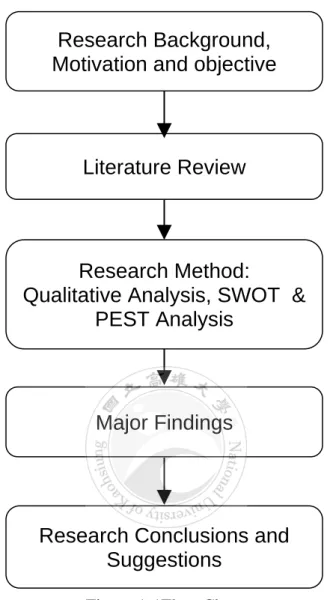
wave energy needs to develop in Taiwan or not. The flow chart of this study is as
4
Research Background,
Motivation and objective
Literature Review
Research Method:
Qualitative Analysis, SWOT &
PEST Analysis
Major Findings
Research Conclusions and
Suggestions
5
Chapter Two: Literature Review
2.1 Renewal Energy
2.1.1 Sea Wave Energy
The growing demand for energy is fueling a drive for the extraction of
sustainable sources. The oceans, which cover 70 per cent of the world, harbor a vast
untapped source of renewable energy in the form of waves (Anthony T. Jones, 2002).
Wave energy has long been considered one of the most promising renewable
technologies. Not only is the energy resource vast, but it is more dependable than
most renewable energy resources—wave power at a given site is available up to 90
percent of the time, while solar and wind availability tend to be available just 20~30
percent of the time (Power buoys, 2011).
There are more than 1000 different patented proposals for sea wave energy
devices in the world (Falnes J, Lovseth J., 1991), and several have demonstrated the
potential for commercially viable electricity generation (Baird S.,1993).The first
commercial wave plant in the world, Limpet 500 MW, was installed on the island of
Islay, Scotland, in 2000, and has been providing power to the grid for the UK since
late November 2000. Also on the island of Islay, Ocean Power Delivery Ltd. Of
Edinburgh, Scotland is installing a small offshore wave power device, which will
power up to 200 homes (R. Pelc, R.M. Fujita, 2002).
At the end of 2014, global ocean energy capacity remained at about 530 MW,
with most of this coming under the category of tidal power, and specifically tidal
barrages across bays and estuaries (Renewables 2015 Global Status Report,2015).
According to the World Energy Council, the global energy available from wave
energy conversion is 2000 TWh per year. Tapping just 0.2 per cent of this energy
would satisfy the current global demand for electricity. Energy resource use is one of
the most important and contentious issues of our time. Investments in energy
efficiency and increased conservation may be the best way to tackle energy use. (R.
6
In Taiwan, the chairman of EZE Energy Ceylon (PVT) Ltd, Hui-Hsiung, Yang
has built up a sea wave power plant in the year 2014. The Company aims to promote
the energy saving solution for any country in the world by providing a considerable
energy (6 MW) just using the sea wave kinetic energy. A machine capable of
supplying this need will be placed at a precise location to meet the expected
effectiveness of the technology. The preliminarily suggested location of the sea wave
grid shall be carefully selected at a sea shore which has a continuous 0.5 m wave high.
Generation of power and maintenance of the project will be done under the company
and the electric output will be connected to the electrical network of any country to
provide solutions for the power crisis.
The company’s power solution provides sea wave energy from nature, or from
earth running and solar heat; energy can be extracted for local use. Taiwan is located
at the Eurasian continent plate and surrounded by the sea, the coastline is about 1500
kilometers in length. Every 80 meters of coastline can build a 6 MW plant equal to 75
kW/meter can be obtained from the marine. The cost of a 6MW plant only cost US$
20 million and it can completely setup within 8~10 months.
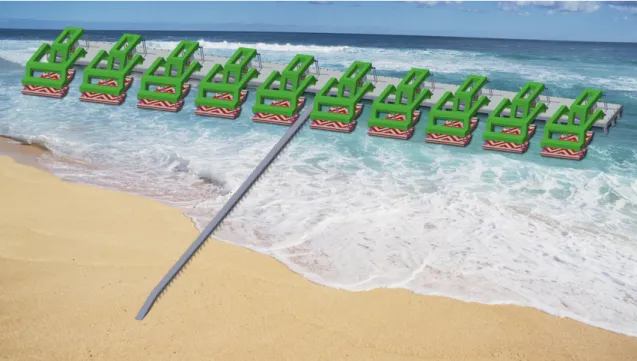
Build the base of the excavation on the seabed and the laying pipe inside the
platform. Sea water deep requires 3 meters (at low tide), under the sea bed with PVC
pilling. Platform dimensions are 60×30 meters, the bridge can load 300T of the
construction machine and it’s the connection to the beach coast.
Source: Obtain from EZE Energy Company
7
Source: Obtain from EZE Energy Company
2.1.2 Solar Power Structure of sea wave power generator in the sea
In recent years, the global solar power capacity has grown substantially. Taiwan
has also actively set up the promotion target of solar power and plans to implement
the related promotion plan.
Solar power is a variable renewable energy, high cost of power generation, the
capacity factor is small, with power supply uncertainty and variability, regional
characteristics. The demand to set the area, the initial investment cost is still high and
the land in Taiwan is limited, but its advantages are safe and carbon reduction. While
actively developing solar power in Taiwan, it is necessary to further explore and
evaluate whether it is necessary to set up large-scale solar power plants, residential
solar power facilities, or people's livelihood applications, it must have a certain goal
and strategy.
As the solar cell production technology and domestic solid foundation of the
semiconductor industry process technology resemble, and the existing of industrial
technology and R &D capabilities in Taiwan nowadays, development of solar
technology is just around the corner. However, in the current domestic solar power Figure 2-2 Structure of sea wave power generator in the sea
8
market is still small; attracting domestic semiconductor industry to join the
development of the production of the solar photovoltaic industry is not easy. But not
entirely impossible, recently several domestic semiconductor industries are optimistic
about solar energy rapid growth of the optoelectronic market, semiconductor
manufacturers have invested in the development of solar cell wafer materials and
production, and it will make the domestic upper solar photovoltaic industry supply
chain more stable. That is the advantage of the domestic industry.
The use of silicon materials to develop solar power technology is rapid and can
not only be affirmed but hard to be replaced in short time. After a few years
development of solar technology, prices of the cost have dropped by 30~40%, but in
order to manage market requiring, further cost reduction is truly needed.
While Taiwan's domestic market is too small, the installment of solar energy is
negligible. Although the Ministry of Economic Affairs promote the development of
renewable energy and subsidize solar power generation devices per watt Ten NT
dollars, expect to be able to increase some demand in the market.
However, if the solar industry prospect is built on government subsidies, it will
be a risk to develop. According to the research institutions, they pointed out that the
current cost of solar photovoltaic power generation is equivalent to oil price
US$130dollars more than normal oil price US$ 45dollars.
The total installed capacity of solar power energy in Taiwan is 438MW in the
year 2014, and the total power generation is 512 million kWh (Taiwan Power
Company). Taiwan due to long sunshine, the solar deflection angle is small; it is
suitable for the development of solar energy. Although Taiwan is the world's second
largest producer of silicon solar cells, due to the narrow land, installation capacity is
greatly limited. The Ministry of Economic Affairs Energy Bureau actively promotes
the “Million Sunshine Roof” plan. In 2030, the solar photovoltaic device capacity
plans to reach 6,200MW, if reached on schedule, the total annual generating capacity
is about 8 billion kWh.
9
generate about 19.3 billion kWh, the estimated solar power to completely replace the
nuclear power generation is about 15GW, it must rely on a ground-based power plant
to achieve. Without considering the cost of land, 1MW of the current construction
cost is about NT dollar 5.2 billion, the land area of about 1 hectare (0.01 square
kilometers).If completely replace the nuclear power (Factory No.4), the installation
cost is around NT $ 780 billion, and the required land area is about 150 square
kilometers. In the land of the high cost of land in Taiwan, and the need to consider
food security, to find such a large area of land to build solar power generation system,
the difficulty is extremely high (Energy Information Platform, 2014).
2.1.3 Wind Power
Wind energy has received a lot of attention lately as one of the most promising
and economically feasible technologies for clean power generation (Robin Pelc, Rod
M.Fujita, 2002). Very strong winds regularly blow over the oceans; development of
offshore wind energy is growing. There is a fairly large potential for offshore wind
and many possible sites.
The major characteristic defining power available in the wind is its speed,
(Elistratov, 2008). Power is generated from the wind by converting the force of the
wind on the rotor 7 blades into a torque. Wind speed depends on height aboveground
level (Wikipedia, 2016). Close to the earth, the wind is slowed down at the expense of
a friction about a terrestrial surface. For agricultural fields and deserted territories
when height increase over an earth surface twice the increase in speed of the wind
approximately on 12 % is observed (Kargiev, et al., 2001).
Geographical conditions and character of a terrestrial surface, including various
natural and artificial obstacles, such, as hills and so forth, and also trees and buildings,
have considerable influence on wind speed(A. Minina, 2009). For this reason,
windmills dispose of, whenever possible, on ennobled and removed from high trees,
apartment houses and other constructions places since such obstacles reduce the speed
10
wind power. (Kargiev, et al., 2001)
In connection with the variability of parameters of a wind, windmills are
recommended to be used in the productions permitting discontinuation of electricity
supply. If the guaranteed support of electric power is required, then it is necessary to
apply energy systems, including, along with windmills, accumulators or duplicating
power plant (Elistratov, 2008).
Most wind energy comes from turbines that can be as tall as a 20-story building
and have three 200-foot-long (60-meter-long) blades. These contraptions look like
giant airplane propellers on a stick. The biggest wind turbines generate enough
electricity to supply about 600 U.S. homes (National Geographic).
Renewable energy power generation technology in Taiwan, in addition to
hydroelectric power, solar power, and wind power generation technology is quite
mature. As Taiwan is located in the continental plate and ocean junction, the annual
strong northeast monsoon makes Taiwan has the annual average wind speed of more
than 4 meters per second, the wind energy is abundant, and making Taiwan has great
wind power potential.
Since 2000, Taiwan has actively promoted the development and application of
wind power. Through resource exploration, technical guidance, research, and
investigation, demonstration subsidies and publicity and promotion, preliminary
results have been achieved, and Taiwan Power Company and private sector
companies have been put into wind energy development. By the end of March 2016,
the land completed the construction of a total of 28 wind farms, which has to turn a
total of 28 wind farms up to 649MW, including 331 wind generator. The total power
generation in the year 2014 was 1,486 million kWh. Another approximately 560 MW
wind generator are in the construction and planning stage (Thousand Wind Turbines
Project, 2015).
The new government attaches great importance to green energy; the highest
efficiency county of green energy includes solar and wind energy in Taiwan is
11
Power Company; Taiwan Power Company will invest NT$ 200 billion, to set up a
Taiwan Wind Power Operation Center (Changhua County Government, 2016.12.20
news).
2.2 Nuclear Power
The science of atomic radiation, atomic change, and nuclear fission was
developed from 1895 to 1945, much of it in the last six of those years. Over 1939-45,
most developments were focused on the atomic bomb. From 1945 attention was given
to harnessing this energy in a controlled fashion for naval propulsion and for making
electricity. Since 1956 the prime focus has been on the technological evolution of
reliable nuclear power plants (World Nuclear Association, 2014).
Due to the special nature of nuclear power generation, nuclear power generation
has the following three kinds of operations on the special norms: transport operations,
recycling operations, and overhaul scheduling operations. Raw materials and
recycling waste of nuclear power is a high pollution and radioactive substances. All
operations need some special treatment methods and processes. According to the
World Nuclear Association (WNA), the most significant high-level waste from a
nuclear reactor is the used nuclear fuel left after it has spent about three years in the
reactor generating heat for electricity. Low-level waste is made up of
lightly-contaminated items like tools and work clothing from power plant operation and
makes up the bulk of radioactive wastes. Items disposed of as intermediate-level
wastes might include used filters, steel components from within the reactor and some
effluents from reprocessing.
Used nuclear fuel is very hot and radioactive. Handling and storing it safely can
be done as long as it is cooled and plant workers are shielded from the radiation it
produces a dense material like concrete or steel, or by a few meters of water.
The high-level wastes (whether as used fuel after 50 years cooling or the
separated 3% of reprocessed fuel) will be disposed of deep underground in geological
12
in many established repositories. Low-level waste disposal sites are purpose built but
are not much different from normal municipal waste sites (World Nuclear Associate).
High-level wastes can remain highly radioactive for thousands of years. They
need to be disposed of deep underground in engineered facilities built in stable
geological formations. While no such facilities for high-level wastes currently operate,
their feasibility has been demonstrated and there are several countries now in the
process of designing and constructing them (World Nuclear Associate).
Taiwan currently has three nuclear power plants with 6 units in operation. The
plant I located at Shimen District called Jinshan Nuclear power plant, Plant II located
at Wanli District, called Kuosheng Nuclear Power Plant, Plant III located near South
Bay, Hengchun, called Maanshan Nuclear Power Plant. The total installed capacity of
nuclear power was 5,144MW; the total power generation was 40,809 GWH in the
year 2014 (Wikipedia, April 27, 2017).
Taiwan will have the opportunity to experience the dream of a "nuclear-free
home" in advance next summer, when two of the three nuclear power plants will
cease to generate electricity, several years earlier than scheduled. The spent fuel rods
in the cooling pond of the Jinshan Power Plant (Nuclear Plant I) and the Shengheng
Plant (Nuclear Plant II) were almost full and could not be replenished because of the
inability to accommodate more spent fuel rods, the nuclear plant can only force shut
down.
Nuclear Plant II reactors had to decommission on 2021 to 2023, but because of
the need to replace the fuel rod, it may have to shut down on November 20, 2016.
According to the Atomic Energy Council, the Nuclear Plant I in the near future will
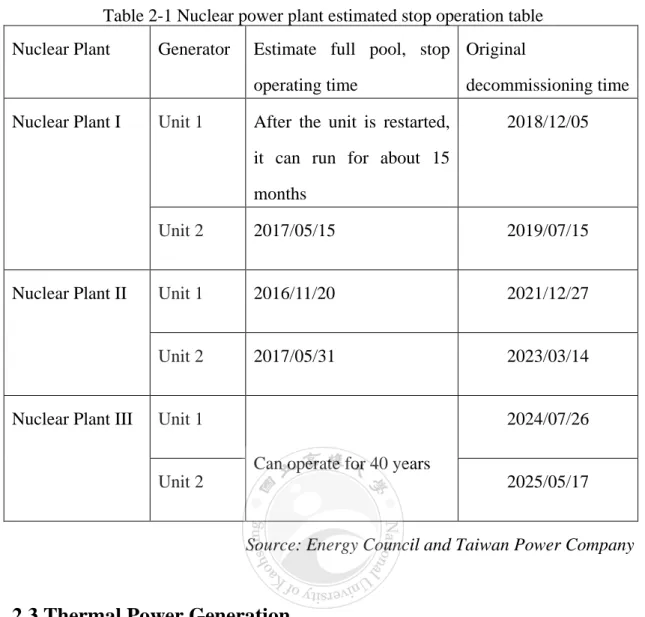
also face the same situation. By May 15, 2017, the nuclear plant cooling pool capacity
13
Table 2-1 Nuclear power plant estimated stop operation table
Nuclear Plant Generator Estimate full pool, stop
operating time
Original
decommissioning time
Nuclear Plant I Unit 1 After the unit is restarted,
it can run for about 15
months
2018/12/05
Unit 2 2017/05/15 2019/07/15
Nuclear Plant II Unit 1 2016/11/20 2021/12/27
Unit 2 2017/05/31 2023/03/14
Nuclear Plant III Unit 1
Can operate for 40 years
2024/07/26
Unit 2 2025/05/17
Source: Energy Council and Taiwan Power Company
2.3 Thermal Power Generation
The theory of thermal power station or working of the thermal power station is
very simple. A power generation plant mainly consists of alternator runs with help of
steam turbine. The steam is obtained from high-pressure boilers. Generally, in India,
bituminous coal, brown coal and peat are used as fuel of boiler. The bituminous coal
is used as boiler fuel has volatile matter from 8 to 33 % and ash content 5 to 16 %. To
increase the thermal efficiency, the coal is used in the boiler in powder form
(Electrical4u).
The following are the location condition of thermal power plant:
1. The electric power generation plant must be constructed at such a place where the
cost of land is quite reasonable.
14
3. A large quantity of cooling water is required for the condensers etc of thermal
power generation plant, hence the plant should preferably situate beside the big
source of a natural water source such as a big river.
4. Availability of huge amount of fuel at a reasonable cost is one of the major criteria
for choosing plant location.
5. The plant should be established on plane land.
6. The soil should be such that it should provide the good and firm foundation of plant
and buildings.
7. The thermal power plant location should not be very nearer to dense locality as
there are smoke, noise steam, water vapors etc.
8. There must be ample scope of development of future demand.
9. A place for ash handling plant for thermal power station should also be available
very nearby.
10. The Very tall chimney of power station should not obstruct the traffics of airships.
The total installed capacity of thermal power was 29,890 MW; the total power
generation was 169,021 GWH in the year 2014. It is around 77% of power generated
by thermal power in Taiwan (Taiwan Power Company).
At present, more than 70% of Taiwan's electricity sources rely on fossil fuels
such as coal, oil, and natural gas to generate more than 170 million tons of greenhouse
gasses each year, it is 65% of the total annual pollution (Environmental Protection
Administration Taiwan, 2013).
Air pollution also accelerates the environmental warming. Before the renewable
energy technology has not been widely used, the government wants to increase the
proportion of natural gas with lower carbon emission. However, the high cost of
natural gas is bound to impact the price structure.
In Taichung, 4×250-meter of colorful chimneys is Taichung’s thermal power
plant eye-catching landmark, is currently the second largest thermal power plant in
Asia, the total generating capacity is up to 5.78 million Wh, it equivalent to two
15
supply 77% of the country's electricity. A usage of 10 unit of electricity and 7 degrees
is fueled by coal-fired fuels and natural gas. When we enjoy the convenience of
electricity, at the same time, also produce air pollution and greenhouse gas problems.
2.4 SWOT Analysis
The external environment has a profound impact on educational institutions.
During this final decade of the twentieth century, America's institutions, economy,
society, political structures, and even individual lifestyles are poised for new changes.
Recent shifts from an industrial to an information-based society and from a
manufacturing to a service-oriented economy have significantly impacted the
demands made on vocational E-Journals Digital Library and University Libraries
Search Addison Off Campus Sign in Ask a librarian program offerings (Martin, 1989).
Vocational programs in comprehensive schools generally cover a broad spectrum of
service areas, but they provide fewer overall programs within each of these areas than
are provided in either vocational or specialty schools (Weber, 1989). Existing
programs and those planned for the future irrespective of the type of school should be
based on a careful consideration of future trends in society.
Vocational administrators should become initiators in shaping the future of their
institutions. Strategies must be developed to ensure that institutions will be
responsible to the needs of the people in the year 2000 and beyond. To do so requires
among other things an examination of not only the individual college environment but
also the external environment (Brodhead, 1991). The Strengths, Weaknesses,
Opportunities, and Threats (SWOT) analysis (also referred to as the TOWS analysis
in some management texts), provides a framework for educational administrators to
focus better on serving the needs of their communities.
Although originally intended for use in business applications, the idea of using
this tool in educational settings is not altogether new. For example, Gorski (1991)
suggested this approach increase minority enrollment in community and other
16
frequently be tailored for application in education due to fundamental similarities in
the administrative duties of the respective chief executive officers.
SWOT is a simple, easy to understand the technique. It can be used in
formulating strategies and policies for the administrator; however, it is by no means
an end in itself. The purpose of this paper is to demonstrate how SWOT can be used
by administrators to analyze and initiate new program offerings in vocational
education.
SWOT analysis can be simply understood as the examination of an
organization's internal strengths and weaknesses, and its environments, opportunities,
and threats. It is a general tool designed to be used in the preliminary stages of
decision-making and as a precursor to strategic planning in various kinds of
applications (Johnson et al., 1989; Bartol et al., 1991). When correctly applied, it is
possible for a vocational school to get an overall picture of its present situation in
relation to its community, other colleges, and the industries its students will enter. An
understanding of the external factors (comprised of threats and opportunities),
coupled with an internal examination of strengths and weaknesses assists in forming a
vision of the future. Such foresight would translate to initiating competent programs
or replace redundant, irrelevant programs with innovative and relevant ones
(Radha&John C, 1995).
The first step in a SWOT analysis is to make a worksheet by drawing a cross,
creating four sectors, and one each for strengths, weaknesses, opportunities, and
threats. An outline of a worksheet is shown in Figure 1. The next step is to list
specific items related to the problem at hand, under the appropriate heading in the
worksheet. It is best to limit the list to 10 or fewer points per heading and to avoid
over-generalizations (Johnson et al., 1989).
2.5 PEST Analysis
The PEST analysis is including political, economic, social and technical factors.
17
operates. The term PEST has been used widely in marketing and business circles over
the last 20 years and as a result, its true history is difficult to establish (Mike M.,
2012).
The earliest known reference to tools and techniques for ‘Scanning the Business
Environment’ appears to be by Francis J. Aguilar (1967) who discusses ‘ETPS’ – a
mnemonic for the four sectors of his taxonomy of the environment: Economic,
Technical, Political, and Social. Sometime after its publication, Arnold Brown for the
Institute of Life Insurance (in the US) reorganized it as ‘STEP’ (Strategic Trend
Evaluation Process) as a way to organize the results of his environmental scanning
(RapidBi, 2007).
It is a useful strategic tool for understanding market growth or decline, business
position, potential and direction for operations. So as already mentioned PEST
acronym includes specific categories and variables that are being considered and
analyzed. Hereby quick theoretical overview of the factors that are connected with
PEST concept can be observed.
Political factors represent to what degree the government intervenes in the economy. Furthermore, this category includes areas such as tax policy,
labor legislation, environmental law, trade restrictions, tariffs and overall
political stability/instability. Under political factors, I assume goods and
services that are subsidized by the local government.
Economic factors are of great importance for the given analysis since they consider variables and categories like economic growth, interest rates,
exchange rates, inflation rate etc. Getting familiar with this kind of
information is imposed as a necessity for one company, regardless if it
wants to get abroad. Moreover, this indicator represents the overall
economic situation in the country.
Social factors on the other side include the cultural/religious/language context of the given country. Nowadays factors like population growth rate,
18
operating to a huge extent.
Technological factors include technological aspects such as research and development investments, technology incentives, the rate of technological
change etc. These factors could determine and shape barriers for entry,
efficient production level, and further influence outsourcing decisions
(Wikipedia, 2017).
Without using the PEST and SWOT analysis combined or separated it is very
difficult to have relevant insight and clear picture of the whole situation. That is one
of the reasons why the majority of authors recommend usage of these tools in order to get most proper outcome (Mladenović Dušan, 2013).
19
Chapter Three: Research Method
3.1 Research Framework
The study focuses on the feasibility of wave power and synthesizes all kinds of
energy in Taiwan. The overall research model is illustrated in Figure 3.1. Taiwan
electricity comes from nuclear power, Thermal power, hydroelectric power and
renewable energy. The renewable power included solar power and wind power. Via
sufficient consideration to all situations, we can make a conclusion about wave energy
in Taiwan.
3.2 Qualitative Analysis
The study method is based on qualitative analysis. After we look through the
practical situation of nuclear power, thermal power, hydroelectric power, solar power
and wind power in Taiwan, using SWOT and PEST analysis that mentioned in
chapter two to analyze the efficient and benefit of sea wave power generation. The
SWOT analysis includes strengths, weaknesses, opportunities, and threats. The PEST
analysis includes political, economic, social and technical factors. These factors all
affect a business running and operating. We will analyze and discuss the situation of
sea wave power in each factor. With global warming, carbon dioxide produced by
thermal power generation has a serious impact on the environment and needs ceasing
operating. And according to the new policy announced by the new government,
Taiwan would like to establish "Non-nuclear Homeland", and the government
claimed there is no longer nuclear power existing. In order to replace the nuclear
power plant's electricity generation and thermal power, Taiwan government has
invested a lot of money in developing wind power and solar power. However, to
completely replace nuclear power, only wind power and solar power are not enough
to handle considerable electrical using demand. In addition, both of them are facing
the problem of saturation and solar power considerably depends on weather and
20
by the sea, Taiwan has nature geographical environment advantage for the
development of the ocean resource in Taiwan. Thus, sea wave power generation really
deserves developing and is bound to bring great benefits to Taiwan.
Figure3-1 Research Framework Figure 3-1 Research Framework Taiwan Electricity Supply
21
Chapter Four: Method Analysis
4.1 Brief introduction
Industrial Revolution is a significant breakthrough for human civilization it
brings human beings convenient and cozy life, leading to a new mechanical
generation. The way of agriculture, medical treatment, wars and so on has changed,
and people are getting used to working with the machine. Nowadays, people scarcely
handle matters alone without mechanical assistance. However, the operation of the
machine needs combustion of fossil fuel to generate power, and combustion comes
about Greenhouse gas, which brings about environmental damage and serious climate
change. In order to stop environmental damage continuing, we should look highly on
alternative energy and begin to figure out a good way to transform nature power into
our daily power using.
Hydropower is the earliest development of green energy projects in Taiwan.
However, due to geography weakness and climate restriction, it is really not suitable
to develop hydropower instead of fossil fuel. Furthermore, a dam in Taiwan is mainly
for agriculture and people’s livelihood water using. Hydropower generation is just
supplementary.
Solar cells must use high purity semiconductors, and in the course of production
of semiconductor consumes a lot of energy, resulting in environmental pollution. In
other words, although the use of solar energy would not produce pollution, in the
manufacturing process still produces environmental pollution.
Taiwan government currently focuses on the wind power development projects.
The government invested huge amounts of money in developing wind power. Wind
power generation equipment is much cheaper than solar energy equipment, and it is
inexhaustible. But, due to the wind energy are from the air flow and the air density is
very small,it is only 1/816 of hydraulic power. Moreover, the air flow changes greatly and unstable.
22
continuous 0.5-meter wave high running the machine. We suggest and accept the
project because we are able to take an advantage of location of Taiwan surrounded by
sea.
4.2 SWOT Analysis
This section will analyze the Strengths, Weaknesses, Opportunities, and Threats of the feasibility of the sea wave power generator of EZE Energy Company in Taiwan.
4.2.1 Strengths
Taiwan has a perfect natural geographical location, which is surrounded by the sea and the total length of coastline was 1,985,315 meters. The Taiwan coastline is currently used for fishing, military, and harbor. Roughly see how many areas can be used for sea wave electric generation, we may estimate 1% of this coastline can
install1,489 MW �1,985,315m×0.01
80m ×6MW = 14,88.98MW� of electric power.
Compared with other countries, Taiwan's geographical position occupies an advantage, which suitable for the development of the sea wave power generation.
The process of operating sea wave power generation is without any materials or
fuel consumed, and it just relies on tidal fluctuations to run the axle of generation. It is
a very clean energy. In addition, the tide is 24 hours without interruption, the waves
fluctuate on the shore, and only with the0.5 meters of wave fluctuations and wave
frequency less than 12 seconds is enough to make the generator operation.
The time of construction of the plant only needs 12 months. A group of wave
power generation can produce 6MW of electricity with a length of 80 meters. The
cost of each plant is US$ 20 million.
4.2.2 Weaknesses
The generator needs to be built along with the coastline. It will be a great
problem because coast in Taiwan almost controlled by the government. Moreover,
Taiwan is famous for the beauty of the coastline, and much position is suitable for the
23
In addition, when the waves are converting into electrical energy, it occurs
with some segment, it is low power efficiency, which is also one of the main reason
affecting the large-scale development and utilization of sea wave power generation in
Taiwan.
One of the difficulties to build the power plant is the difference structure of the
sea base; a new construction plan has to build for the new sea base. In addition, the
construction cost is huge, if there is no government support, there is no one can afford
the huge construction costs.
4.2.3 Opportunities
In the 20th century is oil industry boom, but in the 21st century will be
transferred to the companies which provide renewable energy solution or a team. In
the Middle East, for example, has become one of the world’s richest cities, but once
the oil reserves gradually dried up, if not dance to another tune, the Middle East may
no longer be able to maintain the current bright and beautiful scenery.
A fascinating place in the sea wave generating market is "equal opportunities in
the world". In the other words, who can take the lead in research and development,
which can be turned to the wave of power generation "flagship" models, and make all
kinds of patent layout, who will have the opportunity to monopolize the world's wave
power generation market. This is why the countries around the world are smashing a
lot of money for the development of the sea wave power generator.
Taiwan government advocacy energy subsidies propose is to recover the nuclear
power plant. It is now a perfect time to invest in the sea wave power plant as it is
clean and green.
4.2.4 Threats
As Taiwan's current electricity price remains low, it is a very
unfavorable factor for renewable energy developing. It needs to raise the
24
to subsidize renewable energy generating. Thus, people would increase
willing to make an investment in the sea wave power generation.
In Taiwan, the ocean electricity faces severe typhoons, earthquakes,
and other natural environment challenges. Furthermore, the sea wave plant
may suffer fishermen blindly protest.
In the operating technology, seawater corrosion and bad walrus easily leading to
wave energy generator components failure is another serious problem.
4.3 PEST Analysis
This section will analyze the Political factors, Economic factors, Social factors
and Technological factors of the feasibility of the sea wave power generator of EZE
Energy Company in Taiwan.
4.3.1 Political factors
In 2007, Taiwan government has legislated the act of ‘‘Renewable Energy
Development Regulations”. Government spares no effort to increase willing of people
from all society to use alternative energy development instead of fossil fuel energy.
Not only companies’, but also households’ benefits from the regulation. And the
renewable energies include solar energy, bio-energy, geothermal energy, ocean
energy, wind energy, hydro energy, and other energies admitted by the authority.
Although there are numerous subsidies and benefits from the legislation, most of them
are prone to solar energy development. Due to the fact that government policy is
doomed to connect with realistic benefits from beginning to end, there is no real help
to the entire renewable progress of technology and development.
The cost of renewable is also higher than fossil fuel and nuclear cost. Although
the policy of subsidy and benefit is aim at inducing people to invest in renewable
energy, the cruel is the fact that government promotion is just put forward to win the
election. They barely look highly on how to realize what they said before. For
25
materials and in order to draw entrepreneurs to support the government, the
‘‘Renewable Energy Development Enforcement Rules’’ from Ministry of Economic
Affairs of the Republic of China runs almost for solar energy and benefit just for
companies instead of household hold user.
Furthermore, policy focuses on the output of electricity from renewable energy
and there is no subsidy and benefit for research and development of renewable energy. Doubtlessly, there is no enough incentive to push people to create and innovate new
technology, and all people definitely put themselves into solar energy instead.
In 2016, Democratic Progressive Party (DDP) in Taiwan wins the presidential
election and members of the Legislative are more than fifty percentile. That means
they have the authority to make law without a hitch. Before the election, DDP
strongly promoted ‘No nuclear homeland’ and supports energy generating
transformation. The members of DDP have brought up many amendments to cope
with the alternative energy problems. Nevertheless, there is still no operative law and
incentive to stimulate people to engage in alternative energy creation and innovation
in these new amendments.
Although it relaxes restrictions to household renewable energy limit from
500KW to 2000KW, decreases the limit to household energy using, it still has no real
help for energy generating transformation. After all, within the technology and
creation of alternative energy so far in Taiwan, only solar energy is developed and
mass invested, the cost has dramatically dropped. Compared to solar energy, other
alternative energy is in developing, cost still stays high, and normal family and
household basically have no enough money to afford. People hardly get started
investing in wave energy generation unless the technology and creation progress and
advance, which make cost down enough to draw people’s willing.
As a result, wave energy in political factor is still confronted with a great barrier.
People would rather choose low-cost solar energy than high-cost wave energy. Wave
26
4.3.2 Economic factors
Due to policy focuses on alternative energy output subsidy, nobody is willing to
invest in new alternative energy which stays on the step of research and feasibility is
unknown, not to mention entrepreneurs. As an entrepreneur, considering the balance
between risk and benefit is a priority issue. Entrepreneurs are unwilling to choose
high risk, high investment and benefit unknown unless the government offers great
induce and subsidy to increase their willing or wave energy generating technology has
improved with low cost and high benefit. Thus, investing in alternative energy
generating technology is a challenge and obstacle in Taiwan nowadays. Some
companies in other countries were even bankrupt because of the high cost of wave
energy. Doubtlessly, technology and cost are both obstructions need facing and
breakthrough.
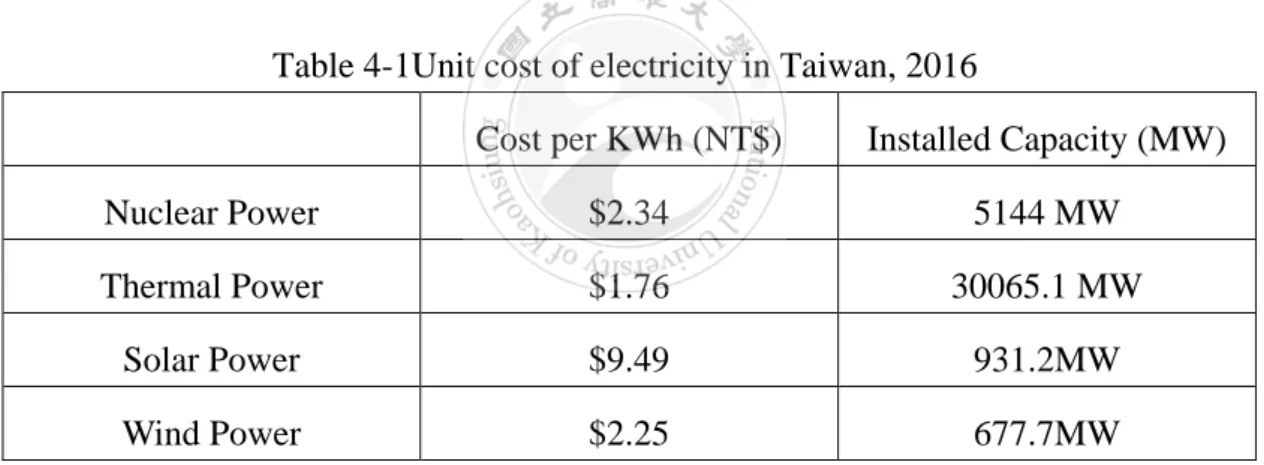
Table 4-1Unit cost of electricity in Taiwan, 2016
Cost per KWh (NT$) Installed Capacity (MW)
Nuclear Power $2.34 5144 MW
Thermal Power $1.76 30065.1 MW
Solar Power $9.49 931.2MW
Wind Power $2.25 677.7MW
Source: Taiwan Power Company
Currently, Taiwan’s renewable energy only has solar power and wind power.
Table 4-1 shows the unit cost of electricity in Taiwan, 2016. According to the Taiwan
Power Company, wind power energy cost per unit is NT $2.25 dollars, installed
capacity 677.7MW in the year 2016. Solar power energy cost per unit is NT $9.49
dollars, installed capacity 931.2MW in the year 2016. Sea wave energy in EZE
company technology is able to generate a 6MW generator with the US $20 million
27
is leverage, a 6MW power plant can expand to generate 600MW of electric and it just
required 8 kilometers of coastline.
Following is the green power cost comparison from EZE Energy Company.
Table 4-1Green Power Cost Comparison
Power Generation Solar Wind Sea Wave
Installation Cost/ KW NT$ 10,230 NT$ 83,700 NT$ 108,500
Maintenance Cost/ KW 20 years NT$ 31,000 NT$ 167,400 NT$ 31,000
Maximum Daily Output/ KWh 2.5 kWh 4.8 kWh 24 kWh
Maximum Annual Output/ KWh 912.5 kWh 1,752 kWh 8,760 kWh
Maximum Output in 20 years 18,250 kWh 35,040 kWh 175,200 kWh
Power Cost per KWh/ 20 years NT$ 7.44 NT$ 7.13 NT$ 0.81
Source: EZE Energy Company
According to EZE company report, the three green power ratios are based on the
status of renewable energy in Taiwan data source.
Taiwan government currently emphasizes solar and wind power, butsolar energy
and wind energy takes too much land space in generating and compared to other
countries with plenty of land resources, solar energy development is easily saturated.
On the contrary, Taiwan is rich in ocean resources, and sea wave energy is for 24
hours, unlike the wind and solar energy restricted to weather, climate and out of work
with claim air or at night time. Solar energy is just supplementary and unable to
replace electricity generating for human beings 24 hours using. Therefore, if we want
to thoroughly implement ‘No nuclear homeland’, ocean energy must be the core of
the development of alternative energy.
4.3.3 Social factors
Since the development of thermal power and nuclear power generation, local
28
nuclear radiation risk problems, problems even involve the people's land property on
the collection and compensation issues. After the operation has started, some external
costs have occurred; resulting in the countless reincarnation of the struggle and
coordination, taxpayers had to foot the bill.
Solar panels require a lot of land area to set up; the location needs to consider the
sunshine angle. On the economic side of the analysis, a 20-million of the investment
will need about 1,250 square meters of setting area. Taiwan considers a small island,
not bigger as foreign land area; the use of land is very intensive. Under the limited
land usage, solar energy’s development saturation is relatively fast; development is
limited in the future. The usage on the ocean will not involve peoples’ property rights.
The technology doesn’t produce heat pollution to the ocean to harm the marine life
cycle, it is low external cost. Taiwan is surrounded by the sea; the overall usage area
of the sea wave generator is small. The generator design breaks through the strength
of sea wave disparity. The generator can work with only 50 centimeters of the tide.
The generator almost applicable to the coastline in Taiwan except for the cliff coastal
terrain. In the overall social assessment, it has a considerable advantage.
4.3.4 Technological factors
Technical factor is the cornerstone of sea wave energy and plays a great role in
investing and developing. It is an essential point to decide whether to go into
operation or not.
The types of ocean energy technique at the present time in Taiwan separately are
ocean thermal energy, wave energy, tidal energy, ocean current energy respectively.
Synthesizing our country current technology and situation of Taiwan’s ocean, ocean
thermal energy, wave energy, and ocean current energy are feasible and possible. In
these energies, we focus on sea wave energy and discuss its advantage and
disadvantage.
According to amazing ‘Scientific Development, April 2015, period 508’,
29
(1) In the initial operating technology, seawater corrosion and bad weather
easily lead to wave energy generator components failure.
(2) Random wave condition makes it more difficult to effectively run
wave generator and the efficiency of the component is unsure.
(3) Unstable wave energy causes the generator unstable power applying,
making the user's inconvenience.
In addition, to solve the aforementioned problems, EZE Energy Company has
made a breakthrough in technology solution in sea wave energy.
Source: Obtain from EZE Energy Company
First, solve random and unstable wave problems.EZE new technique improves
disparity of wave. Compared to 2 to 6 meters disparity in normal wave energy
generation, the new technique needs only 0.5 meters that will do the generation. The
breakthrough is not only stable but also makes generation suitable to many coastlines
in Taiwan.
Second, on the anti-seawater corrosion and rust, compared to traditional
materials, it used different materials to make a better protection. The buoy will
contact with sea water, it is high-strength and anti-corrosion. The generator machine
is set on the platform to visual control the operation and maintenance.Compared to Figure4-1 Sea Wave Power Generation
30
other offshore wave power generation in the sea project, which reduces the difficulty
and obstacle on the installation.
The third, sea wave energy generator may restrict by natural climate, typhoon or
serious weather conditions which lead to short-term operation stop. When typhoon
invasion, the buoy will automatically submerge in the water. The generator will force
shut down.
4.4 Synergize
Taiwan coastline is 1,985,315 meters. It is estimated that at least 1%
of them can be used for sea wave power generation, which means 19,853
meters. If 80 meters sea shore an installed capacity of 6MW electric power,
then total sea wave install capacity will be 1,489MW, accounting for 4%
of the total electric power installed capacity in Taiwan (Total installed
capacity in the year 2016 was 42,132.5MW). This amount of sea wave
power will help Taiwan to achieve a target of 20% of renewable energy in
the future.
In terms of cost of construction, total cost is estimated to be US$4,963
million dollars�1,489
6 ×𝑈𝑈𝑈𝑈$ 20 𝑚𝑚𝑚𝑚𝑚𝑚𝑚𝑚𝑚𝑚𝑚𝑚𝑚𝑚𝑚𝑚� , which is much cheaper than that of
constructing the same size of nuclear station.
A levelized-bus-bar cost of production from sea wave power is estimated to be around NT$2.55 per KWh, following are the calculations:
Total output =1,489,000,000 W×8,760 h×0.5 = 6521.82 GW;
Total cost = (1,489MW ÷ 6MW)×20𝑚𝑚𝑚𝑚𝑚𝑚𝑚𝑚𝑚𝑚𝑚𝑚𝑚𝑚 = 𝑈𝑈𝑈𝑈$4,963𝑚𝑚𝑚𝑚𝑚𝑚𝑚𝑚𝑚𝑚𝑚𝑚𝑚𝑚 𝑑𝑑𝑚𝑚𝑚𝑚𝑚𝑚𝑑𝑑𝑑𝑑𝑚𝑚 Fixed expense factor = 10.8% (7+3.3+0.3+0.2);
Annual fixed change = US$4,963×0.108 = US$ 536 million dollars Unit per cost = 𝑈𝑈𝑈𝑈$ 536,000,000×31
31
Which is more expensive than current thermal power generation of
NT$1.76 dollars. However, sea wave power is renewable energy and it
32
Chapter Five: Conclusion
According to the data from Taiwan Power Company, the installed capacity of
renewable energy in Taiwan has increased to 4,321.4MWin 2016. However, most of
them were generated by the solar power plant and wind power in the land.This study
is to discuss the feasibility of using sea wave power generation in Taiwan, and the
conclusion is described in this chapter.
5.1 Major Findings
According to the literature review and method analysis in previous chapters, we
found that sea wave power generation is feasible in Taiwan as follows:
1. EZE Energy Company has built up a mature technology function, and its
“capacity factor” of generation is for 24-hour working. Compare to nuclear power,
it is zero pollution and the process of operating sea wave power generation is
without any materials or fuel consuming.
2. The generator needs only 0.5 meters wave height running and the buoy contacting
sea water is with high-strength and anti-corrosion materials. The generator
machine doesn’t be set in sea water. Compared to traditional sea power generation,
the platform is above the water, which leads to easy operation and maintenance.
Moreover, the design of the generator is also considered to face bad weather
situation, such as typhoon.
3. The time of setting of a sea wave power plant is within one year. A Nuclear Power
Plant needs at least six years to build up. The cost of the construction is US$ 20
million for a 6MW generator and it is economically acceptable. If we expanded
the installed capacity of sea wave power generator equal to Nuclear Plant Ⅳ, the
construction cost is US$ 8,833 million, the construction cost is lower than Nuclear
Plant Ⅳ, with a total cost of US$ 8,900 million.
33
higher than the wind power NT$ 2.25 per kWh.
5. In addition to zero fuel cost and pollution, sea wave power also has advantages of
free wasted fuel in decommissioning.
5.2 Suggestion
Base on the major findings, there are some research suggestions for the government.
1. The right of use of the coastline in Taiwan is entirely controlled by the
government. If we want to successfully run the sea wave power generation, we
need to obtain the permission and support from the government. Only the
government pays attentions to the sea wave power of renewable energy, sea wave
power is able to be developed in Taiwan.
2. The divergence between DPP and KTM administrations on nuclear policy causes
a waste of about NT $400 billion in construction cost in the past. And the NT
$400 billion will be paid by all taxpayers in Taiwan. If the government paid
attention to the development of marine energy and developed it early, there would
not be numerous wastes like NT $400 billion and social cost, which led to
needless wastes and expenses afforded by people in Taiwan.
3. Due to the strong development of alternative energy of the wind and solar power
by the Taiwan Power Company, the land used in solar and wind power is almost
saturated, which means there is no room in developing solar power plant and wind
power in the land. Taiwan should seriously consider developing the sea wave
power.
4. According to the research result, Taiwan has expansion capacity for the sea wave
power.
5. Sea wave power is considered a competitive energy, it has a chance to help
Taiwan archive the goal of 20% electricity supply from renewable energy by the
34
5.3 Research Restriction
In the marine energy, it includes ocean thermal energy, tidal energy, marine
current energy, etc. This study just only discusses the sea wave power generation in
Taiwan due to available data for sea wave power technology.
5.4 Future Studies
Finally, to conclude the major findings, suggestion, and restriction, there are some
future studies for the government and industries.
1. The more comparative analysis is needed in the section of marine energy to
support the feasibility of sea wave power.
2. To estimate the optimal coastline in Taiwan in addition to develop the appropriate
35
References in English
Alena Minina. (2009). Technical Wind Energy Potential.
Anthony T. Jones. (2002).Oceans of energy.Power Engineering International.
Baird S. (1993). Energy fact sheet: ocean energy systems. ICLEI. Retrieved from http://www.iclei.org/efacts/ocean.htm.
Boundless, (2016). The PESTEL and SCP Frameworks. Retrieved from
https://www.boundless.com/management/textbooks/boundless-management- textbook/strategic-management-12/external-inputs-to-strategy-87/the-pestel-and-scp-frameworks-422-4020/
Broadhead, C. W. (1991). Image 2000: A vision for vocational education. Vocational Education Journal, 66(1), 22-25.
Electrical4u.com. Thermal Power Generation Plant, Retrieved from
https://www.electrical4u.com/thermal-power-generation-plant-or-thermal-power-station/ Elistratov V. V. (2008). Использованиевозобновляемойэнергетики. [Using of renewable energy]. Elistratov V. V., Kuznetsov M. V.(2004) Теоретическиеосновынетрадиционнойивозобновляемойэнергетики. Часть 1. Определениеветроэнергетическихресурсоврегиона. Учебноепособие.
[Theoretical bases of untraditional and renewable energy.
Falnes J & Lovseth J.Ocean. (1991). Wave energy. Energy Policy, 19(8):68–775.
Francis J. Aguilar. (1967). Scanning the Business Environment.
Gorski, S. E. (1991). The SWOT team - Focusing on minorities. Community, Technical, and Junior College Journal, 61(3), 30-33.
Johnson, G., Scholes, K., & Sexty, R. W. (1989). Exploring strategic management. Scarborough, Ontario: Prentice-Hall.
Kargiev, et al. (2001). Generating energy from ocean waves. The Futurist 2001, 35(3):2
Martin, W. R. (1989). Handbook on marketing vocational education. Westerville: Ohio State Council on Vocational Education
Mike Morrison. (June 11, 2012). History of PEST Analysis. Retrieved from https://rapidbi.com/history-of-pest-analysis/
36
National Geographic. Wind power. Retrieved from
http://environment.nationalgeographic.com/environment/global-warming/wind-power-profile/
Radha Balamuralikrishna and John C. Dugger. (1995). SWOT Analysis: A
management tool for Initiating New Programs In Vocational Schools. Journal of Career and Technical Education, Vol12, No 1(1995)
RapidBi. (Jan. 29, 2007). PEST Analysis tool. Retrieved from https://rapidbi.com/the-pestle-analysis-tool/
REN21, (2015). RENEWABLES 2015 GLOBAL STATUS REPORT, France
Rio Grande do Sul. (1996). Market And Industry Trends
Robin Pelc & Rod M.Fujita. (2002). Renewable energy from the ocean
The Economist. (May 17, 2001). Power buoys: electricity from waves. The Economist 2001; May:78–79. Retrieved from http://www.economist.com/node/623883
Weber, J. M. (1989). Variations in selected characteristics across three types of high schools that offer vocational programs. Journal of Industrial Teacher Education, 26(4), 5-37.
Wikipedia, Nov. 2016. Wind gradient. Retrieved from https://en.wikipedia.org/wiki/Wind_gradient
Wikipedia, April 27, 2017. Retrieved from
https://en.wikipedia.org/wiki/Nuclear_power_in_Taiwan
Wikipedia, 2017. PEST Analysis. Retrieved
fromhttps://en.wikipedia.org/wiki/PEST_analysis
World Nuclear Association, Mar. 2014. Outline History of Nuclear Energy. Retrieved
fromhttp://www.world-nuclear.org/information-library/current-and-future-generation/outline-history-of-nuclear-energy.aspx
World Nuclear Association. What are nuclear wastes and how are they managed? Retrieved fromhttp://www.world-nuclear.org/nuclear-basics/what-are-nuclear-wastes.aspx
Yang, Hui-Hsiung. (2016). Project Feasibility. EZE Energy Corporation Limited Company.
Yang, Hui-Hsiung. (2016). Project Execution Procedure. EZE Energy Corporation Limited Company.
Yang, Hui-Hsiung. (April 2016). Sea Wave Integration Power Generation, Project Feasibility. EZE Energy Corporation Limited Company.
37
Yang, Hui-Hsiung. (Dec. 2016). Sea Wave Power Project Introduction. EZE Energy Corporation Limited Company.
References in Chinese
呂錫明. (2016). 台灣發展波浪能的評估. 科學發展(Scientific Development), 2015 年 4 月, 508 期. 邵仁中. (2016). 金門海浪發電可行性之研究 郭成聰. (2014). 臺灣太陽能發展的現況、問題、解決方案或建議. Energy Information Platform.Changhua County Government 彰化縣政府. (Dec. 20, 2016). 台電首度與地方政府 簽署 MOU 彰化縣政府與台灣電力公司共同推動綠能電力建設合作意向書 [News]. Retrieved from
http://www.chcg.gov.tw/ch/03news/01view.asp?kind=3&bull_id=235541
Environmental Protection Administration Taiwan 行政院環境保護署. (May 1, 2013). 台灣電力來源逾 7 成依賴火力發電[News]. Retrieved from
http://ghgregistry.epa.gov.tw/Information/Information_Infor.aspx?r_id=1556
Taiwan Power Company 台灣電力公司. Retrieved from http://www.taipower.com.tw/index.aspx
Thousand Wind Turbines Project 風力資訊整合平台. Dec. 2015. 陸域風力推動現 況. Retrieved from http://www.twtpo.org.tw/onshore_list.aspx?category_id=139 Tim Ferry. (Oct 10, 2016). 無核家園提早到來. Taiwan Business Top