Ionic liquid supported multistep divergent synthesis of benzimidazole linked
pyrrolo-/pyrido-/isoindolo-benzimidazolones
Suman Thummanagoti, Gorakh S. Yellol, Chung-Ming Sun
⇑Department of Applied Chemistry, National Chiao Tung University, Hsinchu 300-10, Taiwan, ROC
a r t i c l e
i n f o
Article history: Received 9 January 2011 Revised 26 February 2011 Accepted 10 March 2011 Available online 30 March 2011 Keywords:
Ionic liquid support Microwave synthesis Cascade reaction Bis-heterocycles Benzimidazoles
a b s t r a c t
Diversity oriented parallel synthesis for bis-heterocyclic skeletal novel benzimidazole linked pyrrolo-/ pyrido-benzimidazolones and benzimidazole linked isoindolo-benzimidazolones has been developed on ionic liquid support under microwave irradiation by utilizing the cascade cyclization. The key tandem transformation comprises (i) amino-alkylation of immobilized o-phenylenediamine with ketoacids, (ii) intramolecular cyclization through secondary amine on electrophilic imine carbon toward pentacyclic aza-ring and (iii) second amido-cyclization to deliver cycloamide ring. The synergy arises by combined use of microwave heating with ionic liquid support which is very effectively used to speed up multistep synthesis of biological interesting heterocycles.
Ó 2011 Elsevier Ltd. All rights reserved.
1. Introduction
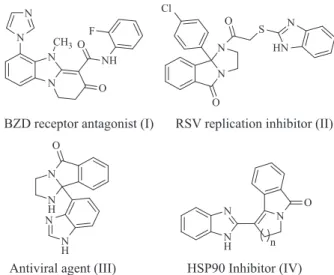
It is well known that heterocyclic compounds are the major constituents of pharmaceutical ingredients and has embraced sig-nificant space in medicinal chemistry, synthetic chemistry, and natural products. Highly functionalized various ring size bis-het-erocycles with different hetero atoms and substitution patterns are of major interest in the drug discovery process.1 Bis-heterocy-clic compounds offer better binding opportunities with enzyme ac-tive site owing to its three dimensional special arrangement and consequently depict many intrinsic biological properties.2 Particu-larly, bis-heterocycles comprising pyridobenzimidazoles (I) are li-gands for the BZD site on GABA-A receptors and are thus useful for the treatment of disorders of the central nervous system includ-ing convulsion such as epileptic seizures, anxiety, depression, mus-cular spams, and attention deficit hyperactivity disorder (Fig. 1).3 Polycyclic bis-heterocycles containing imidazopyridine, imidazo-pyridine, or imidazoisoindole moieties (II) constitute basic struc-tural frameworks of potent inhibitors of respiratory syncytical virus while some imidazoisoindoles (III) show antiviral activity.4 Benzimidazoles in combination with the pyrrolo–isoidolones (IV) exhibit anticancer activity via the inhibition of the ATPase-type catalytic activity of the Hsp90 chaperone protein.5The geometric assembly of bis-heterocycles characterized by the benzimidazole, as a core connected to various fused heterocycles, is apparently interesting to explore. Despite the broad range of biological
activities associated with the pyrrolo[1,2-a]benzimidazole, pyr-ido[1,2-a]benzimidazole, and imidazo[2,1-a]isoindole, there are still very few reports for the construction of aforementioned three classes linked with benzimidazole motif in linear fashion as bis-heterocycles.6Hence, interest remains strong to develop new ap-proaches to produce novel bis-heterocyclic molecules and further exploration of their biological applications.
0040-4039/$ - see front matter Ó 2011 Elsevier Ltd. All rights reserved. doi:10.1016/j.tetlet.2011.03.046
⇑Corresponding author. Tel.: +886 3 5131511; fax: +886 3 5736007. E-mail address:[email protected](C.-M. Sun).
N H N N O N O N O S Cl HN N N N H O N N H
RSV replication inhibitor (II)
Antiviral agent (III)
N N N N O NH F O CH3
BZD receptor antagonist (I)
HSP90 Inhibitor (IV)
n
Figure 1. Biologically active bis-heterocyclic molecules. Contents lists available atScienceDirect
Tetrahedron Letters
Integrating a variety of advanced technologies for the rapid syn-thesis of numerous multi-functionalized heterocyclic molecules is of high interest to provide rapid path for modern drug discovery. Owing to the disadvantages like heterogeneous reaction conditions of solid phase synthesis7and low loading capacity of soluble poly-mer supported synthesis,8successful implementation of ionic li-quid supported synthesis in small molecule synthesis retained advantages over conventional solution phase chemistry.9 Depend-ing on the choice of anions and cations, the solubility of the ionic liquids can be tuned readily to control the phase trafficking in or-ganic and aqueous phase. Ionic liquid supported synthesis has be-come a very effective method for the production of combinatorial libraries with high degree of chemical diversity.10 The numerous advantages associated with the ionic liquid as a support has been strongly appealing for the green synthesis.11 In addition to the advantages like high loading capacity and recyclability of ionic li-quid support, ionic lili-quids absorb microwave irradiation extremely well due to the ionic conduction and thus reactions can be run in non-polar solvents.12Hence, application of microwave heating in ionic liquid supported synthesis is a fast growing research area.
In continuation with our effort to develop multidisciplinary synergetic approaches for rapid synthesis of medicinally interest-ing compounds,13here we report the efficient synthesis of bis-het-erocyclic skeletal benzimidazole linked pyrrolo-/pyrido-/ isoindolone-benzimidazolones on ionic liquid support under microwave conditions.
2. Results and discussion
The readily available 3-hydroxyethyl-(1-methylimidazolium)-tetrafluoroborate 1 is selected as a suitable ionic liquid (IL) support for multistep synthesis. The present strategy commenced with the synthesis of IL immobilized ortho-phenylenediamine 3 from 4-flu-oro-3-nitrobenzoic acid 2 with built-in structural diversity (R1) through three step protocol. The ionic liquid 1 was attached to 4-fluoro-3-nitrobenzoic acid 2 by esterification followed by ipso-flu-oro substitution of primary amines and subsequent reduction of nitro-group provided IL immobilized ortho-phenylenediamine 3 in overall good yields (Scheme 1). In an effort to attain the target molecule, compound 3 was further N-acylated at the primary amine functionality with 4-fluoro-3-nitrobenzoic acid 2.
Accord-ingly, anilide conjugates 4 were obtained by the condensation of acid 2 with IL conjugates 3 in presence of pyridine within 12 h in refluxing dichloroethane. However, the application of microwave irradiation at 100 °C reduced the reaction time to 10 min. By taking the distinct solubility features of the ionic liquids, purification has been carried out by precipitation of IL bound amide 4 in the low polar solvent such as ether. The IL bound amide 4 was further cy-clized to benzimidazole derivative 5 in the presence of trifluoro-acetic acid and magnesium sulfate under microwave irradiation in 5 min at 100 °C. However, it took 14 h to complete cyclization under refluxing conditions. The progression of this transformation was monitored directly on ionic liquid tag by the observation on the chemical shift of aromatic region in proton NMR spectrum.
IL supported fluoronitrobenzoate 5 was further treated with various primary amines in order to create second substitutional diversity in the present skeleton by ipso-fluoro displacement reac-tion. This reaction was performed in microwave conditions (100 °C) for 5 min to offer ionic liquid attached conjugate 6, while same reaction took 5 h in refluxing condition. Here it is noteworthy to mention that primary amines did not cleave ionic liquid tag un-der microwave harsh condition. Further nitro-group of IL conjugate 6 was reduced by treatment with zinc and ammonium formate for 5 min under microwave irradiations at 80 °C to furnish IL conju-gate diamine 7. After completion of the reaction the IL supported conjugates 7 was precipitated with ether and obtained in pure form with good yields.
IL immobilized ortho-phenylenediamine 7 was used as a com-mon scaffold to generate skeletal diversity in targeted bis-hetero-cyclic molecules by one pot tandem transformation using various ketoacids. The various 3-keto-acids were used to provide the pyr-rolo fused benzimidazolone tricyclic skeleton while 4-keto-acids were used to achieve skeletally different tricyclic framework of pyrido fused benzimidazolones along with the substitutional diversity depending on the groups present on the ketoacids. Accordingly, IL immobilized ortho-phenylenediamine 7 was trea-ted with various 3- and 4-keto-acids 8 in presence of TFA under microwave irradiations. It is noteworthy to mention that the selec-tive product generated in the coupling of ketoacid with o-phenyl-enediamine is dependent on the quantity of TFA used in the reaction mixture. With the stoichometric amount of TFA, diamine groups of 7 cyclized with acid functionality of 8 afforded 2-alkyl
HO O NO2 F O O NH2 NH R1 IL 2, Pyridine ClCH2CH2Cl MW, 100 oC, 10 min O O NH H N O R1 NO2 F 4 3 TFA, MgSO4 MW,100 oC, 5 min O O N N R1 NO2 F 5 IL IL CH2Cl2 MW, 100 oC, 5 min O O N N R1 NO2 6 NH R2 IL O O N N R1 NH2 7 NH R2 IL MW, 80 oC, 5 min Zn, NH4COOH MeOH ClCH2CH2Cl N N OH H3C BF4 R1 NH2 1 2 R2NH2
substituted bis-benzimidazoles 9a. The formation of compound 9a was attributed to activation of acid functionality in presence of sto-ichometric amount of TFA. The structure of compound 9a was later confirmed as 9b by removal of ionic liquid support in sodium methoxide solution. Alternatively, the intended cascade cyclization of IL diamine conjugate 7 with ketoacids 8 was successfully achieved in 20 mole % TFA in the presence of magnesium sulfate and dichloroethane under focused microwave irradiation at 110 °C for 10 min (Scheme 2). The reaction mixture was purified by precipitation, filtration, and washing to furnish IL immobilized benzimidazole linked pyrrolo/pyrido-benzimidazolone derivatives 10 with good yields (72–85%). The same reaction was carried out under conventional refluxing for 24 h to furnish the same product which clearly depicts the superiority of microwave heating over conventional heating reaction. The synthetic pathway leading to pyrrolo/pyrido-benzimidazolones through one pot cascade reac-tions includes (i) amino-alkylation of ionic liquid immobilized benzimidazole linked diamine with ketoacids, (ii) intramolecular cyclization through attack of secondary amine on electrophilic imine carbon toward pentacyclic aza-ring formation and (iii) intra-molecular cyclization to deliver second cyclic amine ring. A variety of 4-ketoacids and 5-ketoacids were used in combination with the N-alkyl substitution on diamine moiety for this tandem transfor-mation to furnish pyrrolo-/pyrido-benzimidazoles with substitu-tional diversity as depicted inTable 1. The formation of pyrrolo/ pyrido-benzimidazolone derivatives 10 was confirmed by proton NMR spectrum and mass spectrum directly with IL support. The io-nic liquid support was cleaved from 10 using sodium methoxide methanol solution under microwave irradiation at 110 °C in 10 min to obtain benzimidazole linked
pyrrolo/pyrido-benzimi-dazolone derivatives 11 and 12. The ionic liquid was removed from the reaction mixtures through precipitation by ether and filtration. The characterization of recovered ionic liquid shows 96% purity and 68% recovery after first cycle. The recovered ionic liquid was recycled in the synthetic process. The separated desired products were subjected to HPLC analysis for crude purity. Further column chromatography purification furnished benzimidazole linked rolo[1,2-a]benzimidazolones 11 and benzimidazole linked pyr-ido[1,2-a]benzimidazolones 12 in good yields14 (Table 1). The structure of final products was confirmed by spectroscopic analy-sis. The appearance of the peaks due to alkyl protons present on ketoacid moiety and the absence of peaks corresponding to amine and acid protons were observed in the proton NMR spectrum of compound 11 and 12. Additionally, the stereogenic quaternary car-bon has appeared around 89.5 ppm in the13C NMR spectrum along with the amide carbonyl carbon absorbance peak at 175 ppm. The formation of amide bond is further confirmed by the IR spectros-copy which depicts amide frequency band around 1720 cm 1; par-ticularly little higher due to the ketonic nature of tert-aminde carbonyl functionality.
In order to expand the intended diversity profile of resulting bis-heterocyclic molecules, the additional sulfur element was incorporated in the skeleton. The IL supported benzimidazole linked pyrido-benzimidazolone 10 was treated with Lawesson’s re-agent in toluene under focused microwave conditions at 150 °C. The thio derivative of IL supported pyrido-benzimidazolone 13 was obtained in good yield in 15 min while the same reaction took 18 h under the refluxing condition in toluene (Scheme 2). Further removal of IL support affords the benzimidazole linked thiopyri-do-benzimidazolone 14. R3 O 8, 20 mol% TFA MW, 130 oC, 10min 10 O O N N R1
1 eq. TFA, MgSO4
MW,130 oC,10min O O N N R1 N N R2 9a Lawesson's reagent MW,150 oC,15 min 13 IL IL 8 O O N N R1 NH2 7 NH R2 IL OH O n R 3 O n N N O R2 n O O N N R1 IL N N S R2 n ClCH2CH2Cl 11: n =0; 12: n =1 O O H3C N N R1 N N O R2 n 14: n = 1, R1 = 2-phenylethyl, R2 = 2-cyclohexenylethyl, R3=CH 3 O O H3C N N R1 N N S R2 n NaOMe, MeOH MW, 80 oC, 10 min NaOMe, MeOH MW, 80 oC, 10 min R3 R3 R3 R3 ClCH2CH2Cl 9b NaOMe, MeOH MW, 80 oC, 10 min n = 1, R1 = 2-phenylethyl, R2 = 2-cyclohexenylethyl, R3 = CH 3 MgSO4,ClCH2CH2Cl
The scope of present cascade process was further extended by exploring ortho-ketobenzoic acids with selective ionic liquid conju-gated diamines under the same reaction conditions to offer skele-tally distinct bis-heterocyclic molecules. The IL immobilized diamine 7 was treated with 2-acetylbenzoic acid with 20 mole % TFA in dichloroethane under microwave irradiation at 110 °C (Scheme 3). After 10 min, an IL supported isoindolo-benzimidazol-ones 15 were obtained in good yields which were purified by
simple precipitation and washing in ether. The same reaction re-quired 24 h for complete cyclization in the refluxing condition. The outcome of tandem transformation on aromatic ketobenzoic acid is confirmed by analyzing the structure of compound 15 di-rectly on ionic liquid support. The successive removal of ionic li-quid support from 15 furnishes benzimidazole linked isoindolo-benzimidazolones 16 with good yield (Scheme 3). The structure of 18 was confirmed by observing the absence of peaks corre-Table 1
Benzimidazole linked pyrrolo-/pyrido-benzimidazolones
11 (n=0); 12 (n=1) O O H3C N N R1 N N R2 O n R3
Entry R1 R2 R3 MASSa Yields (%)b
11a O CH3 476 80 11b CH3 526 82 11c O CH3 528 85 11d 636 75 11e O F 570 78 11f O F 570 75 11g O F 582 73 11h O Et 580 72 11i O Et 580 75 11j O Et 592 76 12a O CH3 490 80 12b CH3 588 81 12c CH3 536 80 12d O 566 78 12e O 566 75 12f O 578 77 a
Mass (LRMS) were detected as M+
.
b
sponding to amine and acid protons together with the emergence of the new peaks due to aromatic protons of 2-acetyl benzoic acid moiety in the proton NMR spectrum of compound 16 along with amide frequency band around 1720 cm 1in the IR spectra.
It is noteworthy to mention that the ionic liquid support is sta-ble in microwave harsh conditions. Owing to high polar microwave absorbance medium created by the ionic liquid support, time taken to attain the desired reaction temperatures for all the reactions un-der microwave exposure has substantially shortened and reactions can run in low polar solvent media. The monitoring reaction pro-gress is practicable by conventional spectroscopic methods with ionic liquid support.
3. Conclusion
We have successfully developed rapid and efficient solution phase approach to synthesize benzimidazole linked pyrrolo[1,2-a]benzimidazolones, pyrido[1,2-pyrrolo[1,2-a]benzimidazolones, and isoindo-lo[1,2-a]benzimidazoles with three sets of diversity on ionic liquid support under microwave conditions. A cascade reaction was systematically applied to furnish skeletally diverse bis-heterocyclic molecular libraries. This tandem transformation involves amino-alkylation, intramolecular cyclization to form benzimidazole, and successive cyclization to furnish fused cycloamide ring. Use of ionic
liquid as support for multistep organic synthesis possesses the advantages like high loading soluble support, homogeneous reac-tion phase, and recyclability. The powerful potential of multidisci-plinary synthetic approach, integrating ionic liquid support, and microwave synthesis with multistep synthesis has great potential to produce biologically interesting molecules for drug discovery. Acknowledgments
We thank the NSC (National Science Council) and the NCTU (National Chiao Tung University) at Taiwan for financial support of this work.
References and notes
1. (a) Jian, C.; Xian, H. J. Comb. Chem. 2010, 12, 1–4; (b) Dolle, R. E.; Le Bourdonnec, B.; Goodman, A. J.; Morales, G. A.; Thomas, C. J.; Zhang, W. J. Comb. Chem. 2008, 10, 753–802.
2. (a) Carta, A.; Piras, S.; Loriga, G.; Paglietti, G. Mini-Rev. Med. Chem. 2006, 6, 1179–1200; (b) Zambrowicz, B. P.; Sands, A. T. Nat. Rev. Drug Disc. 2003, 2, 38– 51.
3. Ohta, S.; Naita, Y.; Yuasa, T.; Hatakeyama, S.; Kobayashi, M.; Kaibe, K.; Kawasaki, I.; Yamashita, M. Chem. Pharm. Bull. 1991, 39, 2787.
4. Kuo-Long, Y.; Civiello, R. L.; Combrink, K. D.; Gulgeze, H. B.; Sin, N.; Wang, X.; Nicholas, A. Venables, B. L. WO Patent 2001/95910 A1, 2001.
5. Smith, D. F. et al Pharmcol. Rev. 1998, 50, 493–513.
6. (a) Soural, M.; Bouillon, I.; Krchnak, V. J. Comb. Chem. 2008, 10, 923–933; (b) Nefzi, A.; Giulianotti, M. A.; Houghten, R. A. J. Comb. Chem. 2001, 3, 68–70. 7. (a) Sears, P.; Wong, C. H. Science 2001, 291, 2344–2350; (b) Seeberger, P. H.;
Danishefsky, S. J. Acc. Chem. Res. 1998, 31, 685–695.
8. (a) Wentworth, P., Jr.; Janda, K. D. Chem. Commun. 1999, 1917–1918; (b) Gravert, D. J.; Janda, K. D. Chem. Rev. 1997, 97, 489–509.
9. (a) Ni, B.; Headley, A. D. Chem. Eur. J. 2010, 16, 4426–4436; (b) Miao, W.; Chan, T. H. Org. Lett. 2003, 5, 5003–5005.
10. (a) Legeay, J. C.; Goujon, J. Y.; Vanden Eynde, J. J.; Toupet, L.; Bazureau, J. P. J. Comb. Chem. 2006, 8, 829–833; (b) Yi, F. P.; Peng, Y. Q.; Song, G. H. Tetrahedron Lett. 2005, 46, 3931–3933.
11. (a) Miao, W. S.; Chan, T. H. Acc. Chem. Res. 2006, 39, 897–908; (b) Yao, Q.; Zhang, Y. Angew. Chem. Int. Ed. 2003, 42, 3395–3398.
12. Roberts, B. A.; Strauss, C. R. Acc. Chem. Res. 2005, 38, 653–661.
13. (a) Yellol, G. S.; Chung, T. W.; Sun, C. M. Chem. Commun. 2010, 46, 9170–9172; (b) Lai, J. J.; Salunke, D. B.; Sun, C. M. Org. Lett. 2010, 12, 2174–2177; (c) Maiti, B.; Chanda, K.; Sun, C. M. Org. Lett. 2009, 11, 4826–4829.
14. General procedure: (All microwave experiments performed under CEM Discover Microwave system at the frequency of 2450 Hz and 0–300 W power in closed vessel system.) To the solution of 7 in ethylenedichloride (9 mL), various aliphatic 3- or 4-keto-acids 8 (1.5 equiv) were added, followed by addition of dry MgSO4 and 20 mole % trifluoroacetic acid. The reaction mixture was
subjected to microwave irradiation for 10 min at 110 °C. The reaction mixture was filtered and then precipitated by ether (60 mL). The precipitate was filtered and washed with ether to get the IL immobilized benzimidazole linked pyrrolo/pyrido-benzimidazoles 10. The solution of 0.1 M NaOMe in MeOH (10 mL) was added to the solution of 10 in methanol. The reaction mixture was subjected to microwave irradiation for 10 min at 110 °C. The cleaved ionic liquid was precipitated by addition of ether solution and separated by filtration. The filtrates were concentrated and subjected to HPLC analysis (68–99%). The products were further purified by column chromatography over silica gel using ethyl acetate/n-hexane (1:1) as eluent to obtain pure benzimidazole linked pyrrolo/pyrido-benzimidazoles 11 and 12 in good yields (72–85%). Compound 11a: 1H NMR (300 MHz, CDCl
3) d 8.63 (d, J = 2.1 Hz, 1H), 8.17 (dd, J = 8.7, 2.1 Hz, 1H), 7.73 (d, J = 8.7 Hz, 1H), 7.63 (d, J = 2.0 Hz, 1H), 7.56 (d, J = 8.7 Hz, 1H), 6.65 (d, J = 8.7 Hz, 1H), 4.33–4.28 (m, 2H), 3.97 (s, 3H), 3.62–3.52 (m, 4H), 3.39 (s, 3H), 2.84 (m, 1H), 2.63–2.52 (m, 2H), 2.43 (m, 1H), 2.26 (pent, J = 6.4 Hz, 1H), 1.55 (s, 3H), 0.91 (d, J = 6.4 Hz, 3H), 0.89 (d, J = 6.4 Hz, 3H);13 C NMR (75 MHz, CDCl3) d 175.0, 166.6, 154.1, 147.4, 136.5, 133.6, 130.9, 128.9, 126.8, 118.7, 114.3, 111.8, 111.4, 106.8, 89.8, 70.7, 67.1, 59.4, 53.3, 52.9, 43.4, 37.0, 33.4, 29.3, 23.5, 20.4, 20.22; MS (ESI): m/z 476 (M)+
; HRMS (ESI): calcd for C27H32N4O4: m/z 476.2424; found 490.2588 (M)+;
IR (neat): 2360, 1712, 1658 cm1 . 15 O O N N R1 N N O R2 IL 7 R 3 20 mol% TFA, MgSO4
MW, 130oC, 10 min COOH O R3 NaOMe, MeOH MW, 80oC, 10 min 16 O O H3C N N R1 N N O R2 R3 16a O 16b Entry R1 R3 Massa CH3 CH3 574 572 16c 16d CH3 CH3 570 622 Yieldsb 79 80 80 82 R2 ClCH2CH2Cl
Scheme 3. Synthesis of benzimidazole linked isoindolo-benzimidazolones.aMass
(LRMS) were detected as M+.bThe overall yields were determined on the weight of