Impact Specific Essential Work of Fracture of Compatibilized
Polyamide-6 (PAG)/Poly(phenylene ether) (PPE) Blends
KUO-CHAN CHIOU'
and FENG-CHIH CHANG'
'Institute
of Applied Chemistry, National Chiao-Tung University
Hsin-Chu, Taiwan
and
YIU-WING N y u 2 v 3 *
2Centre for Advanced MateriaIs Technology (CAMlJ
&
Department of Mechanical
and
Mechatronic Engineering
507University of Sydney, Sydney,
NSW 2006,Australia
3*MEEW,
City Unwersity of Hong
Kong
Tat Chee Avenue, Kowloon,
Hong Kong
The essential work of fracture (EWF) method has aroused great interest and has been used to characterize the fracture toughness for a range of ductile metals, poly- mers and composites. In the plastics industry, for purposes of practical design and
ranking of candidate materials, it is important to evaluate the impact essential work of fracture at high-rate testing of polymers and polymer blends. In this paper, the EWF method has been utilized to determine the high-rate specific essential fracture work,
we,
for elastomer-modified PAG/PPE/SMA ( 5 0 / 5 0 / 5 ) blends by notched Charpy tests. It is found that w e increases with testing temperature and elastomer content for a given specimen thickness. Morphologically, there are twofailure mechanisms: shear yielding and pullout of second phase dispersed parti- cles. Shear yielding is dominant in ductile fracture, whereas particle pullout is pre- dominant in brittle fracture.
INTRODUCTION
he assessment of fracture toughness of ductile
T
polymers by nonlinear or plastic fracture mechan- its is currently of great interest. The J-integral tech- nique has been widely adopted to overcome the inade- quacy of linear elastic fracture mechanics(LEFM)
that the formation of a large plastic zone prior to crack ini-tiation violates the limit of small scale yielding, a nec- essary condition for the validity of LEFM. Although theoretical analysis (1-3) and experimental proce- dures have been standardized (4, 5) for J-integral evaluation, some aspects of the method still remain controversial for ductile polymers. For example, the nature of the standardized experimental procedure for J-R curve construction restricts the application of the J-integral method to static loading tests only. Its ex- tension to determine the high-rate impact fracture
'Correspondtng author.
toughness is difficult. Moreover, to obtain the plane- strain J-integral value, the size requirements make the application of the J-integral method to polymeric
thin
specimens or films impossible. Despite many important proposals to overcome these problems, most are fo- cused on modifications of J-integral evaluation for sta-tic loading tests (6-13). Hence, the development of a
new and different experimental technique for high-rate fracture toughness characterization is needed.
Methods of measuring the impact resistance of polymers have always been of great interest. Many ductile polymeric materials can become brittle under impact loading conditions, so it is essential to deter- mine the impact resistance of these materials when designing plastic parts. The most widely used meth- ods to characterize impact fracture toughness of poly- meric materials are the notched Charpy or Izod im- pact tests because of their convenience, simplicity and ready acceptance by plastics manufacturers and end users. In these tests, analytical methods based on fracture mechanics have been developed with the
Kuo-Chan Chwu, F e q - C h i h C h q , and Yiu-Wing Mai
*I1
W 2 31h
T
W 2 31D the d e d h of the ulastic zone
surface
P P
(a) deeply single edge-notched specimen (DSEN) (b) a fractured specimen (fully yielded)
Ftg. 1. Schemafics of (3 DSEN geometry and (b) afractured sample.
objective of providing a quantitative description of the impact fracture process. Though these notched impct- resistance tests are inherently flawed since a basic ma-
terial property cannot be determined, they are consid- ered the most severe fracture toughness tests. Besides the dynarmc effect in impact tests, the mode of fracture involved could result in complication of the fracture en- ergies measured. Thus, there are interesting and prac- tical benefits to determine better fi-acture characteriza- tion parameters with these simple impact tests.
method for de- termining the specific essential work of fracture w, of a
ductile polymeric m a t d in plane-stress is now gener- ally accepted by many researchers. It was recently pro- posed as a European Structural Integrity Society (ESIS) Test Protocol for Essential Work of Fracture under quasi-static loading conditions. There have been con- siderable interest and debate on the impact EWF method and testing methodology since Wu, Mai and Cotterell (14) extended the EWF concept to impact frac-
ture of ductile polymer blends several years ago. Marti- ~ t t i and Ricco (15) showed that it is valid to apply the EWF method to evaluate the high-rate plane-strain fracture toughness of polypropylene-based materials. Vu-Khanh (16). however, has argued that the EWF method is invalid by carrying out some tests and also using data of other hestigators to show that pw, is a
negative quantity, which is physically meaningless. To clarify the applications and usefulness of the
EWF
method to ductile polymer blends, this study in- tends to test its validity in determining the specific es- sential fracture work of PAG/PPE/SMA/G 165 1 blends using Charpy impact tests at different temperature. The fi-acture surfaces of the specimens are also investi- gated by scanning electron microscopy (SEM) and the relationship between the depth of the plastic deforma- tion zone and the ligament length is investigated. Thispaper should be read in conjunction with other related studies concerned about the impact essential work of fracture measurements of ductile polymers (17-19).
The essential work of fracture
EXPERNHENTAL WORK Materials
Polyamide-6 (PA6), trademark 1010C2, was obtained from Mitsubishi Kasei Co. Ltd. (Japan). Poly(pheny1ene
ether) (PPE), trademark HPP-820, with intrinsic vis-
cosity of 0.4
dl/g
was supplied by General Electrical Co.(USA).
The compatibilizer, poly(styrene-co-maleic anhydride), trademark Dylark 232, with 8% MA and Mw = 2 Xlo5,
was supplied by Arc0 Chemical Co. (USA). The elastomer, G1651, SEBS copolymer with styrene end-block, is a product of Shell Chemical Co. (USA).Experimental Procedure
All blends were prepared in the CAMT at Sydney University on a co-rotating 30.85 mm twin-screw ex- truder (L/D = 43.5, ZSK-30, Werner & Pfleiderer Co., USA) with a rotational speed of 250 rpm. The barrel temperatures were set at 210 to 290°C. Three-mil- limeter-thick specimen plaques were prepared on a Boy-22s injection molding machine (L/D = 18). The injection molding temperature was between 270 to 290°C. Deeply single-edge-notched (DSEN) bend spec- imens with dimensions 83(S) X 1 7 . 5 0 X 3(t) mm were c u t from these injection-molded plaques. A notch was introduced on the mid-length of one side using a guillotine-like apparatus with a fresh razor blade driven by a screw with 1 mm pitch. Pre-cracks with the required length (4
-
16 mm) could be easily made. To avoid possible plastic deformation at the crack tip, the razor should be always fresh and the pushing speed as slow as practical. Fracture mechan- ics evaluation was carried out on pre-cracked DSEN specimens with different notch depth, Rg. la, at dif- ferent temperature using a Zwick 5102 Charpy im- pact tester with an impact velocity of 3 m/s. Fracture surfaces of specimens were studied with a Philips X L 30 scanning electron microscope (SEM).
Total Impact Work of Fracture XUeaeuremants
Fracture toughness evaluation was carried out on pre-cracked SEN specimens with varying notch depth utilizing a Charpy impact tester at different temperature. The impact tester was equipped with a
specimen holder that allowed three-point bending to be carried out. The impact fracture energies U were read directly from the scale on the machine. These values were then corrected for the kinetic energy KE according to the methods described in (14, 19) to give
Wf
for each ligament length at a given temperature.I m p a c t SpeciR EWF
RESULTS AND DISCUSSION
Background of Theory
The essential work of fracture (EWF) concept was origmally suggested by Broberg (20, 21) and later de- veloped by Cotterell, Mai and their co-workers (22- 27). This concept proposes that when a cracked duc- tile solid, such as a toughened polymer blend, is being loaded, the fracture process and the plastic deforma- tion take place in two different regions: the inner frac- ture process zone and the outer plastic zone. During crack propagation, a large fraction of the total fracture work is dissipated in the plastic deformation zone; this fracton is not directly related with the fracture process. Only the work dissipated in the inner frac- ture process zone is a material constant. Hence, the total work is composed of the two components: essen- tial work of fracture (We) and non-essential work of fracture (Wp) as follows:
(1)
Theoretically, the specific essential work of mode I fracture can be defined as (25, 26):
w,
=w e
+ w,.
where d is the fracture process zone width which is approximately the same as the specimen thickness t.
u and Fare true stress and true strain, respectively. E , and E, are true and engineering necking strains. u and A1 are the stress and crack tip opening displace- ment within the fracture process zone.
&
is the mode I critical value of A]. The first term of Eq 2 represents the plastic flow work to form a neck and the second term is the additional work required to tear the neck to initiate fracture propagation.W e is surface-related and proportional to ligament length, 1 =
(W
-4,
for a given specimen thickness t, whereasWp
is volume-related and proportional toZ2.
Thus, Wf can be given by the specific related work terms (we and wp):
- -
Wf = we It
+
pwp = 12 t (3)w f =
Wf/lt
= we+
pwpl (4)where
p is
a shape factor for the plastic deformation zone. Hence, it can be seen from Eq 4 that there is a linear relationship between wf and 1 as long asp
re- mains constant. The applicability of the EWF method depends on the following conditions being satisfied(17, 19): (a) The full ligament should yield prior to fracture initiation. (b) There should be geometric simi- larity between specimens of different ligament length during crack growth. (c) The essential work of fracture dissipated in the inner fracture process zone is pro- portional to 1 and the non-essential work of fracture dissipated in the outer plastic deformation zone is proportional to
f,
irrespective of the shape of the plas- tic zone. For ligament length significantly longer thanthe specimen thickness, a ductile polymer blend will always be in a state of pure plane-stress. As the liga- ment length is reduced to values comparable to the specimen thickness, the stress state wilI become mixed mode having both plane-stress and plane-strain char- acteristics. To avoid mixed-mode fracture, the essen- tial work of fracture experiments must be restricted to ligament lengths greater than 3
-
5 times the speci- men thickness (22-24, 28). In the present study, the ligament lengths were lessthan
5t and hence are in the plane-strain/plane-stress regime. As shown by Wu, Mai and Cotterell (14). a linear relationship given by Eq 4 may still hold in this region ifthe conditions described for plane-stress above are obeyed. The in- tercept will then give a mixed mode specific essential work of fracture value, we. For this to be a true plane- strain fracture toughness, then the specimen thick- ness t must satisfj the condition thatt
2 25 we/u, (5)where cry is yield stress. Saleemi and Naim (28) have given a different methodology to evaluate the plane strain we value from the wf experimental data in the mixed-mode region by assuming pwp to be invariant with t and hence the same as for plane stress defor- mation. However, this methodology cannot be adopted in the present study due to the limited range of liga- ment length investigated.
High-Rate Impact Fractum Toughnema
Figure 2 shows the effect of temperature on the cor- rected impact energies of the elastomer-modified
PAG/PPE/SMA (50/50/5) blends with a 14 mm
liga-
ment length. The corrected impact energies (U-K,) of all blends increase with increasing temperature and elastomer content. The fracture behavior is brittle up to 80°C for the blend with 15 phr elastomer, up to 60°C for the blend with 20 phr elastomer and at 20°C for the blend with 25 phr elastomer. The blend with30 phr elastomer shows a ductile fracture mode in the temperature range tested. For blends with brittle frac- ture behavior, their toughness values were evaluated by LEFM (by plotting Wf vs
tW@)
in accordance with Williams’ analysis (29); the results are listed in Table I where applicable. Clearly, the strain energy release rates (GJ increase with temperature and elastomer content. A check on the thickness requirement for plane strain shows that this is not satisfied. Hence, the G, values obtained are really mixed-mode tough- ness values. For blends that failed in a ductile mode, the EWF method was used to determine the h@-rate specific essential work of fracture according to Eq 4. Qpical plots are given for the PA6/PPE/SMA/G1651 (50/50/5/30) blends at four different temperatures in Flg. 3. Least squares lines are drawn through the data below 15 mm ligament length. That is, I<
5t The spe- cific essential works of fracture (we) of all other duc- tile blends that have met the required conditions for the EWF method are summanzed * in Table 1. It is notedKuo-Chan Chwu, F e y - C h i h Chang, and Yiu-Wing M a i 3.2
-
-D- PA6IPPEISMAIG1651= 50/50/5phr/lSphr-
-a- PA6IPPE/SMAIG1651= 50/50/5phr/20phr -A- PA6/PPE/SMA/G1651= 50/50/5phr/25phr 0 20 40 60 80 100 120 Temperature (“C)m.
2. Effect of temperature on the corrected impact energy absorption (W”) of elastom-mod@ed PAG/PPE/SMA (50/50/5] blends.temperature for a given sheet thickness.
Again,
thesewe values measured do not satisfy the thickness re- quired for plane strain as determined from Eq 5. They
should be regarded as mixed-mode specific essential works for the blends with a sheet thickness of 3 mm.
For those blends whose ligaments are not fully yielded, that is, blends with 25 phr elastomer at 20°C
and 20 phr elastomer at 4OoC, their fracture behavior is ductile
tearing
with plastic flow confined to a smallcircular region ahead of the notch tip, followed by fast
Table 1. Summary of Impact Fracture Toughness Analyzed by Different Methods.
Composition we ( kJ/m2)’ pw, (MJ/m3) GdkJ/n?)* 4.73 10.58 .**** ***** ..*** *.*** t*ttt ***** ***** 20°C PA6IPPWSMNGl651 = 5015015115 PAGlPPWSMNG1651 = 5015015120 PAGIPPEISMNG1651 = 5015015125 PA6lPPWSMNG1651 = 5015015130 21.76 1.99 40°C PAGIPPEISMNG1651 = 5015015115 PAGlPPWSMNG1651 = 50150l5120 ***** ***.* ***** PA6lPPWSMNGl651 = 5015015125 18.42 1.40 PA6lPPWSMNG1651 = 5015015130 22.25 2.35 70°C PAGlPPWSMNG1651 = 5015015115 PA6IPPEISMAIG1651 = 5015015120 18.53 1.80 PA6IPPWSMNG1651 = 5015015125 20.74 1.78 PA6IPPEISMNG1651 = 5015015130 22.97 2.54 PAGlPPWSMNG1651 = 5015015115 20.00 1.30 PA6lPPWSMNG1651 = 5015015120 22.00 1.62 PA6lPPWSMNG1651 = 5015015125 24.95 1.53 PA6lPPEISMNG1651 = 5015015130 26.26 2.13 ..**it 17.80 t*t*t ***** ***** ***** 8.61 .*ttt ***** .**** ***** ***** 100°C ***** ***** ttttt ***** *w,= we+ pwb. bW, = G,W@t.
***** Method of analysis inapplicable
70 60 50 30
-
PA6/PPEISMA/G1651= 50/50/5phr/30phr-
We=21.76KJ/m2 Temperature = 20 "C-
I I I I I I 1 I I 0 2 4 6 8 10 12 14 Ligament, 1 (mm)(a)
16 PA6/PPE/SMA/G1651= 50/50/5phr/30phr We = 22.25 KJ/m* Temperature = 40°C 70 60 0 5Od
Es;
8
40 30 20 10 0c
/
E
I
I 1 1 I 1 I I I 1 I 0 2 4 6 8 10 12 14 16 18 Ligament, I (mm) (b)F Q . 3. plots of corrected impact energy absorption W,) against ligament 2 for elastomer-&@d PAG/PPE/SMA (50/50/5) blends at dizment temperature. (4 Z O T , b) 40°C. (c) 70°C (d) 100°C.
80 I 10
1
PA6/PPE/SMA/G1651 = 50/50/5phr/30phr L-
a I 1 I I 1 I I I I 80 701
601
t
.
4
30 PA61PPE/SMAIG1651= 50/50/5phr/30phr We = 26.26 KJlm2 Temperature = 100°C1
-
PA61PPE/SMAIG1651= 50/50/5phr/30phr 70-
We=26.26KJlm2 Temperature = 100°C 60-
50-
rc.
E M - 10 2oi
O i I I L I I I 1 I I I1
0 2 4 6 8 10 12 14 16 Ligament length, 1 (mm)(d)
Fig.3. ContinuedImpact Specim
EWF
(a)
PAG/PPE/SM
A/G
1651
=
50/50/5phr/lSphr
Brittle (3,SOOX)
(b) PA6/PPE/SMA/G1(,51
=50/50/Sphr/20phr
Brittle (3,SOOX)
(c)
PA6/PPE/SMA/G
165 1
(d) PA6/PPE/SMA/G
16S1
=50/50/5phr/25phr
=50/50/5phr/30phr
Brittle (3,SOOX)
Ductile (3,500X)
F'ig. 4. SEM minographs o f j k t u r e swmes by Charpy impact tests at 20°C.
unstable fracture with a finite yield strip on either surface. The EWF method cannot be applied for these
two blends as shown in Table 1 . If Eq 4 is forced to plot the corrected impact energies against the liga- ment length, a straight line with a negative slope will
be obtained. This is because the energy absorption in the stress-whitened or plastically deformed zone is ap- proximately independent of ligament length so that the specific total work of fracture decreases as the lig- ament length increases. Similar results supported by
photographic evidence (of the stress-whitened zone in the ligament) have also been reported for a random PP copolymer subjected to impact testing in (17, 19).
It is interesting to note that Pw, generally increases with elastomer content for a given temperature. This
indicates that the slope of the EWF plot may be re- garded as a useful measure of the fracture resistance
to crack growth and it reflects the compositional dif- ference of these blends provided the same specimen geometry is used for comparison.
Morphologies of Fracture Surfaces
Before discussing the morphology of the fracture surfaces, we need to explain the microstructure of the blends. In the PAG/PPE/SMA (50/50/5) blends, the continuous matrix is PA6 and the dispersed particles are PPE. Elastomer G1651 is not distinguishable from the fracture surfaces by SEM and it is embedded in the dispersed PPE phase since G1651 is a SEBS co- polymer that is compatible with PPE but incompatible with the PA6 matrix. Fracture surfaces from the im- pact specimens at different temperatures and elasto- mer contents show
three
distinctly different features: brittle, semi-brittle and ductile. Figure 4 shows SEM micrographs of elastomer-modified PAG/PPE/SMA (50/50/5) blends fractured by Charpy impact tests at 20°C. Figures 4a and 4b present fast-fracture brittle surfaces where the dispersed PPE particles includ- ing G1651 elastomer particles are pulled out from the matrix. When shear yielding of the PA6 matrix slowlyKuo-Chan Chwu, Feng-Chih Chang, and Yiu-Wing Mai increases with elastomer content as shown in
a.
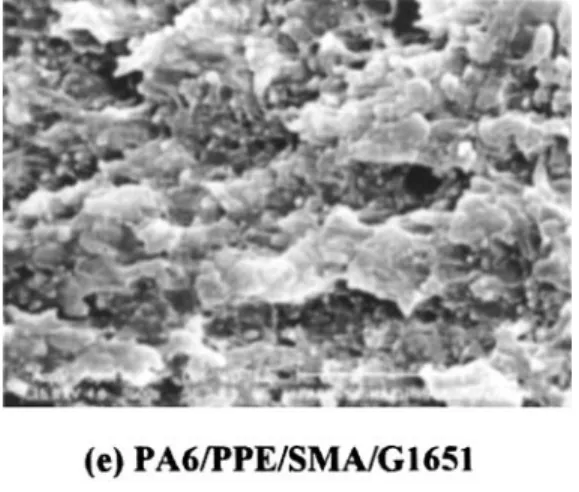
4c,the dispersed PPE particle pullout mechanism becomes less dominant. Rgure 4d shows the ductile fracture surface of the PA6/PPE/SMA/G1651 (50/50/5/30) blend where shear yielding becomes the dominant mechanism. SEM micrographs of the impact-fractured specimens at 40°C are illustrated in Fig. 5. Figure 5a shows a brittle fracture surface dominated by dis- persed particle pullout mechanism in a blend with 15 phr elastomer. Figures 5b to d show the three regions of semi-brittle fracture, ductile-brittle transition, and ductile fracture, respectively, in a blend with 20 phr elastomer. In the ductile region it can be seen that both shear yielding and particle pullout co-exist. As the elastomer content is increased to 30 phr, Fig. 5e, fracture remains ductile but the extent of shear yield- ing on the fracture surface is more extensive when compared to Rg. 5d.
(a) PA6/PPE/SMA/G1651
=
50/50/5phr/lSphr
Brittle (3,500X)
There also exists a ductile-brittle transition at test-
ing
temperature of 70°C for the PA6/PPE/SMA/S1651 (50/50/5/15) blend. As shown in Fig. 6% brittle frac- ture is controlled by the particle pullout mechanism. mure 6b shows the fracture surface profile including the regions of pre-crack, damage zone and fast crackgrowth for this blend for which the ligaments have not been fully yielded. There is a distinguishable ductile- brittle transition between the two regions where a short stable crack growth (damage zone) is followed by unstable fast crack propagation. A high m e c a t i o n of the damage zone is shown in Fig. 6c. Though there are many micro-voids on the fracture surface, mas- sive matrix
tearing
dominates its fracture behavior.Again as the elastomer contents are increased to 20 and 30 phr in the blends, ductile fracture surfaces be- come predominant as illustrated in Figs. 6d and 6e, where the ratio of shear yielding to particle pullout
(b)
PA61PPEISMAIG165
1
Semi-Brittle (3,500X)
=
SO/SO/Sphr/20phr
(c)
PA6/PPE/SMA/G1651
(d) PA6/PPE/SMA/G1651
=
SO/SO/5
ph
rl20ph r
(3,500X)
=50/50/Sphr/20phr
Ductile-Brittle transition
Ductile
(3,500X)
Flg. 5. SEM micrographs offiacture surfms by Charpy impact tests at 40°C.
Impact Spec@
EWF
(e) PA6/PPE/SMA/G1651
=
50/50/5phr/30phr
Ductile (3,500X)
Fig.5. Continued.
also increases. At 100°C all blends possess high im- pact energies and their fracture behavior is completely ductile. Flgure 7 shows their h c t u r e surfaces. Matrix shear yielding is dominant in these blends and dis- persed particle pullout becomes insignificant and fi-
nally disappears as elastomer content increases to 30 phr. To s u m up, these two fracture mechanisms, ma- trix shear yielding and particle pullout, compete with each other in the elastomer-modified PAG/PPE/SMA (50/50/5) blends. Shear yielding is pre-dominant in ductile fracture and particle pullout in brittle fracture. Impact fracture toughness can be evaluated by the EWF method to determine the specific essential work
of fracture, we.
The depth of the outer plastic zone, D, as defmed in Rg. l b , is typified in Flg. 8a and b for the blends at
40°C and 1OO"C, respectively. There is an approxi- mately linear relationship between D and the ligament length 2 hence supporting the postulate that the non- essential work is proportional to
a
in deriving Eq 4. (Similar plots of D vs. 2 are obtained for the blends at other test temperatures used in this study). It is also noted that the depth of the plastic deformation zone increases with temperature; but the effect of the elas- tomer content is not so easily discernible. However, these results confirm that high temperature and gen- erally high elastomer content will impart high energy absorption to these blends during impact fracture.CONCLUSIONS
There is a need to establish a standardized method to measure the impact fracture resistance of newer and tougher polymeric materials. The essential frac- ture work
(m)
method can be utilized to determine the high-rate specific essential work of fracture,we,
for the elastomer-modified PAG/PPE/SMA (50/50/5) blends by Charpy notched impact tests if all require- ments for the validity of the method are met. For a fully yielded specimen, the essential fracture work is
proportional to the ligament length and the non-es- sential work of fracture to the square of the ligament length. It is found that w e increases with testing tem- perature and elastomer content for a given sheet thickness. Morphologically, there are two fracture mechanisms, PA6 matrix shear yielding and pullout of second phase dispersed particles of PPE, that compete against each other. Shear yielding is dominant for ductile failure and particle pullout is typical of brittle fracture. Moreover, the depth of the plastic deforma- tion zone increases linearly with ligament length for those blends that exhibit ductile failure, hence sup- porting the essential work of fracture method for im- pact toughness characterization.
-+fast crack propagation
--+
ductile-brittle interface --+damage zone -+pre-crack (b) PA6/PPE/SMA/G1651 = 50/50/5phr/l5phr(a) PA6/PPE/SMA/G16Sl
=SO/SO/Sphr/lSphr
Brittle (3,SOOX)
Brittle, precrrck+drmage
zone
(1,OOOX)1016
Kuo-Chan Chwu, Feng-Chih Chang, and Yiu-Wing M a i
(c)
PA6lPPE/SMA/C16SI
damage
zone
(3,SOOX)
=
SO/SO/Sphr/l Sphr
(d) PA6fPPEISMAlG1651
=SO/SO/Sphr/20phr
Ductile
(3,SOOX)
(e) PA6/PPE/SMA/G16SI
=SO/SO/Sphr/30phr
Ductile (3,SOOX)
Q. 6. Continued(a) PA6/PPE/SMA/G
1651
(b)
PA61PPEISMAIG 1651
=
SO/SO/Sphr/lSphr
=50/501Sp h rI2Op h r
Ductile
(3,SOOX)
Ductile (3,SOOX)
Fig. 7. SEM micrographs offracture s u r j a e s by Chwpy impact tests at 100°C.
Impact Specific EWF
REFERENCES
1. J. R. Rice, J. AppL Me&, S5, 379 (1968).
2. J . A . Begleyand J. D. Landes,ASTMSTP514, l(1972). 3. J. D. Landes and J. A. Begley, ASTM STP 560, 170
(1974).
4. ASTM Standard E813-81 in An n ua l Book of A mStan-
dards, part 10, ASTM, Philadelphia, PA, 810 (1981).
5. ASTM S t a n d a r d E813-89 in Annual Book of ASTM Standards, part 10. ASTM, Philadelphia, PA, 700 (1989).
6. W. N. Chung and J. G. Williams, ASTM STP 11 14, 320 (199 1).
7. Y.-W. Mai and B. Cotterell, Ink J. fiack, 32. 105 (1986). 8. B. C. Lee, M. L. Lu. and F. C. Chang, J. AppL Polyrn.
Sci, 47, 1867 (1993).
9. S. Seidler a n d W. G r e l l m n , J. Mater. Sci, 28, 4078 (1993).
10. 2. Zhou, J. D. Landes, and D. D. Huang, Polyym Eng. Sci. 94, 128 (1994).
11. M. L. Lu, K. C. Chiou, and F. C. Chang, Polym Eng. Sci, 36,2289 (1996).
12. M. L. Lu, K. C. Chiou, and F. C. Chang, J. Appl. Polyym
Sci, 62, 863 (1996).
13. ASTM, Testing Protocol f o r Conducting J-Crack Growth Resistance C mTests on Plastic, Philadelphia (March
1992).
14. J.-S. Wu, Y.-W. Mai, and B. Cotterell. J. M&. Sci, 28, 3373 (1993).
15. F. Martinatti and T. Ricco, Impact and Dynamic Fracture of Polymers and Composites, ESIS 19.83 (1995). 16. T. Vu-Khanh, 'Itends in Polymer Science, 6,356 (1997). 17. Y.-W. Mai, S.-C. Wong, and X-H. Chen, -Application of
Fracture Mechanics for Characterisation of Toughness of Polymer Blends," in Polymer Blends, Volume 2: Perfor- mance, pp. 17-58, D. R. Paul and C. B. Bucknall, eds., John Wiley & Sons, Inc., New York (2000).
( e )
YA6/PPE/SMA/G1651
=
50/50/5phr130phr
Ductile (3,SOOX)
Q. 7. Continued.
ACKNOWLEDGIUENTS
The financial support of a scholarship from the
Ministry of Education, Taiwan, Republic of China, to
one of the authors (K.-C. Chiou) is greatly appreciated. Y.-W.
Mai
is supported by the Australian Research Council (ARC) for his work on toughening mechanismsand mechanics of ductile polymer blends.
3
1.5 1.o
n fn
P 6 4 Ct
3.5-=-
PA6IPPE/SMAIG1651= 50/50/5phr/25phr 4- PA6/PPE/SMA/G1651 = 50/50/5phr/JOphr Temperature = 40 "C 3.0-
0.0*
1 1 2 4 6 8 10 12 14 16 0 Ligament, I(mm)
(a)Kuo-Chan Chwu, Few-Chih Chary, and Yiu-Wing Mai 0.5
-
n.n
1 I I 1 I I 1 I I 2 4 6 8 Ligament, I(mm)
(b) Fig.8. Continued18. E. C. Y. Ching, R. K. Y. Li, andY.-W. Mai, Polym Eng.
19. L. Fasce, C. B e d , P. Frontini, and Y.-W. Mai, Polym
20. K. B. Broberg, J. Mech Pfys. Solids, l@, 407 (1971). 21. K. B. Broberg, J. Mech Pfys. Solids, 29, 215 (1975). 22. B. Cotterell and J. K. Reddel, ht. J. Fract., IS, 267
23. Y.-W. Mai a n d B. Cotterell,
J.
Mater. Sci, 1s. 2296Sci, 40, 310 (2000). Eng. Sci., 41, l(2001). (1977). ( 1980). 1018 10 12 14 16
24. 0. F. Yap, Y.-W. Mai, and B. Cotterell, J. Mater. Sci, 18, 25. Y.-W. Mai and P. Powell, J. Polym Sci: Part B Polym.
657 (1983).
Phys.,
a@,
785 (1991).26. Y.-W. MA, Int. J. M W h Sci. 36, 995 (1993).
27. J.-S. Wu and Y.-W. Mai. Polym. Eng. Sci., 86. 2275
28. A. S. Saleemi and J. A. N a b , Polyrn Eng. Sci, SO, 2 1 1 29. J. G. Williams, Fracture Mechanics of Polymers, Ellis
(1996).
(1990).
Horwood/John Wiley (1984).