Aromatherapy benefits autonomic nervous system regulation for
elementary school faculty in Taiwan
Kang-Ming Chang1,2 Chuh-Wei Shen1,3 1
Department of Photonics and Communication Engineering, Asia University, Taichung, Taiwan, ROC.
2
Graduate Institute of Clinical Medical Science, China Medical University, Taichung, Taiwan, ROC.
3
Ming-Chien Elementary School of Nantou County, Taiwan, ROC.
Corresponding author: Dr. Kang-Ming Chang
Address: 500, Lioufeng Rd., Wufeng, Taichung County, 41354, Taiwan Tel: +886-4-23323456 ext. 6280
Fax: +886-4-23316699
E-mail: [email protected]
Running head: Aromatherapy enhanced parasympathetic activity for elementary school faculty
Abstract: Workplace stress related illness is a serious issue and consequently many stress reduction methods have been investigated. Aromatherapy, which consists of either inhaling steam volatile oil or a massage treatment, is widely being used, especially for populations that work under high stress. Elementary school teachers are a high-stress working population in Taiwan. In this study, fifty-four elementary school teachers from three schools were recruited to evaluate aromatherapy performance on stress reduction. Subjects with a history of asthma, high blood pressure or heart disease were excluded. Bergamot essential oil was used for aromatherapy spray for 10 minutes. Blood pressure and autonomic nervous system parameters were recorded 5 minutes before and after the application of the aroma spray. Results showed that there were significant decreases in blood pressure, heart rate, LF power percentage and LF/HF while there were increases in heart rate variability and HF power percentage (p<0.001***) after application of the aromatherapy spray. Further analysis was investigated by dividing subjects into three background variables (position variables, age variables, gender variables) and anxiety degree groups. Anxiety degree groups were determined by the Beck Anxiety Inventory (BAI). All parameters were significantly different for most sub-groups, except for the substitute teachers and the light-anxiety group. The above results show that aromatherapy is very effective for parasympathetic nervous system activation. It will be beneficial for other high-stress working populations.
1. Introduction
Workplace stress has attracted much attention recently [1]. In Taiwan, working stress is increasing among elementary school teachers, as a result of declining school roles and
education reform. Local studies have indicated that there is higher job stress and interpersonal stress in male elementary teachers than in female teachers. Young teachers feel much stress on
income and time scheduling; while senior teachers feel much stress on colleague relationships [2]. Thus, appropriate stress coping methods are also highly desirable.
Various approaches have been involved in workplace stress management [3]. Aromatherapy, due to easy implementation and effectiveness, is one of them, [4]. Essential
oils are used to reduce body tension and emotional stress. The most common types of essential oils are bergamot, lavender and geranium [5]. Use of lavender and rosemary scented
candles has been found to reduce the test pressure of nursing school students [6]. Aromatherapy was widely used for stress adaptation. Komarova & Avilov’s results showed
that regular used of fragrant scented candles can increase students’ parasympathetic rhythm [7]. Seo thought inhalation aromatherapy was an effective stress management method. Their
study included 36 female high school students, and stress levels were significantly lower when the students received the aroma treatment [8]. In addition, Hur et al. applied aromatherapy
massage in Korean climacteric women. Lavender rose geranium, rose and jasminein almond
and primrose oils were used for massage once a week. Eight-week massage showed a significantly lowertotal menopausal index than that in wait-listed controls. These findings
suggest that aromatherapy massagecan be an effective treatment of menopausal symptoms
such ashot flushes, depression and pain in climacteric women [9]. Bagetta et al. examined the brain wave spectrum power and found that bergamot essential oil correlate well with its exocytotic and carrier-mediated release of discrete amino acids endowed with neurotransmitter function in the mammalian hippocampus. Bergamot essential oil was able to interfere with normal and pathological synaptic plasticity. Therefore, Bergamot essential oil
was effective for anxiety reduction of mild depression subjects, and it also had the effect of reducing pain in cancer subjects [10].
Therefore bergamot essential oil is used in this study, with the aid of a sprayer for aromatherapy. Many essential oils have seductive effect, such as bergamot, lavender,
chamomile and other essential oils [5]. However, chamomile was at a high price, and lavender odor was irritating and allergic to part of the subjects. Therefore, bergamot essential oil was chosen in this study.
The autonomic nervous system response well when a person experiences stress or anxiety. When people feel anxious, heart rate and sympathetic activity will increase, together
with decreasing parasympathetic activity. Narita et al. found that there were higher
sympathetic activities for depressed and anxious subjects than for normal subjects [11]. Similar results were also shown on swimmers [12]. Autonomic nervous system activities can
be monitored from heart rate variability, which was derived from heartbeat interval time series. With further discrete Fourier transform applied to the heartbeat interval time series, two specific power spectrum ranges were defined. One is low frequency range (LF, 0.04-0.15 Hz), and the other is high frequency range (HF, 0.15-0.4 Hz).
Therefore, significant HRV variation was expected after aromatherapy. Sympathetic activity is accompanied with increases in low frequency power (LF) of the heart rate
variability (HRV) spectrum, while parasympathetic activity is associated with high frequency power (HF). Duan et al.’s results indicated that after the inhalation of lavender, there was a
significant increase in HF and LF/HF values [13]. Anxiety caused by edited films was reduced with the aid of lavender aromatherapy, and there was an increase in HRV [14].
Therefore HRV was used as an indicator to measure the effect of aromatherapy on elementary school teachers.
2.1 Subjects:
Fifty-four elementary school teachers from three different schools were enrolled.
Possible asthma, hypertension or heart disease patients were excluded. The reason to exclude
asthma is that aromatherapy spray may induce asthma, so the items excluded in this experimental study on asthma patients. Furthermore, many studies indicate that heart rate variability is closely related to heart disease, myocardial infarction and heart failure, so the subjects with heart disease and hypertension are also excluded from this study.
Further subgroups were divided by gender, position, age and anxiety degree. The Beck
Anxiety Inventory (BAI) was used by qualified expert to estimate the degree of anxiety in each volunteer. Based on the BAI result, subjects were scored as light anxiety, mild anxiety or
moderate anxiety. Detail subject information is listed in Table 1. 2.2 Experimental procedures:
Aromatherapy was conducted once a week. Physiological recordings were taken during the second week in the school’s health center. An Ultrasonic Ionizer Aromatherapy Diffuser
was used for aroma evaporation (type YHL668/I, ultrasound frequency 2.5MHz, Nature Creart Co. Ltd, made in Taiwan). 100 % pure bergamot essential oil was used and diluted to
2%. Physiological parameters were recorded by an ANSWatch® monitor (TS-0411 type, Taiwan Scientific Ltd., which has been approved by ISO 13485, and EU CE Mark). Each
session was recorded for seven minutes. Average blood pressure and HRV parameters were shown on the panel ofANSWatch® monitor. Detail experimental procedures were as follows.
IRB was approved by Asia University Medical Research Ethics committee.
A. Basic subject information was collected (height, weight, BMI, age range). Each subject
was required to fill in a consent form and a BAI survey. First and second aromatherapies were conducted on the same weekday and at the same time. Smoking, alcohol drinking and coffee
were forbidden before 6 hours of aromatherapy.
recording of 7 minutes was made (sitting, eyes open, not doing any activity)
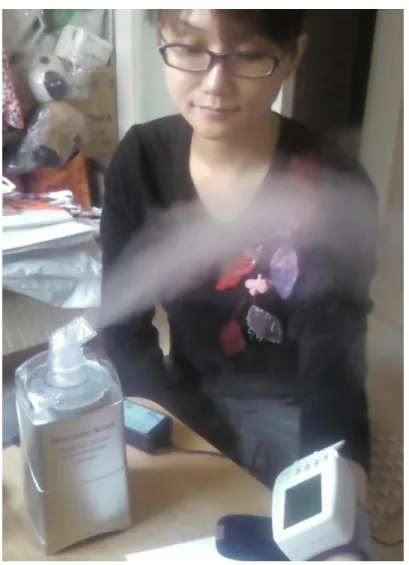
C. Ten minutes aromatherapy intervention was conducted by the same nurse, as demonstrated
in Figure 1.
D. Post-test recording for another 7 minutes.
2.3 Physiological parameter collection.
ANSWatch® monitor records two blood pressure parameters and five HRV parameters,
as shown below:
A. SYS (mmHg): Systolic blood pressure.
B. DIA (mmHg): Diastolic blood pressure.
C. HR (BPM): Average heart beat in terms of beats per minutes (BPM).
D. HRV (ms): Heart rate variability, a similar term to SDNN, defined as standard derivation of RR interval sequence.
E. HF(%): High frequency power percentage. HF frequency range was between 0.15-0.4 Hz on heart rate variability spectrum.
F. LF(%): Low frequency power percentage. LF frequency range was between 0.04-0.15 Hz on heart rate variability spectrum.
G. LF/HF: Ratio of LF power to HF power. 2.4 Statistics
In this study, the SPSS 12.0 software package was used to conduct data analysis. Significance test for the alpha value was set at 0.05. Several statistical methods were used, as
follows:
A. Descriptive statistics: Personal information on subjects are represented as mean ± standard
deviation (mean ± SD).
B. Paired t-test: Intra-group differences among three background variables "gender", "age"
and "position" were compared. Seven parameters within each group, SYS , DIA, HR, HRV, HF%, LF% and LF/HF were examined.
C. Analysis of Covariance (ANCOVA): Pretest was used as covariates, inter-group difference among position, age, gender and anxiety degree was examined by ANCOVA. The Scheffe
method and the Post hoc test for least significance difference test were used for post hoc test. A three-way ANCOVA was also used to examine the interaction effect among the three
background variables "gender", "age" and "position".
3. Results
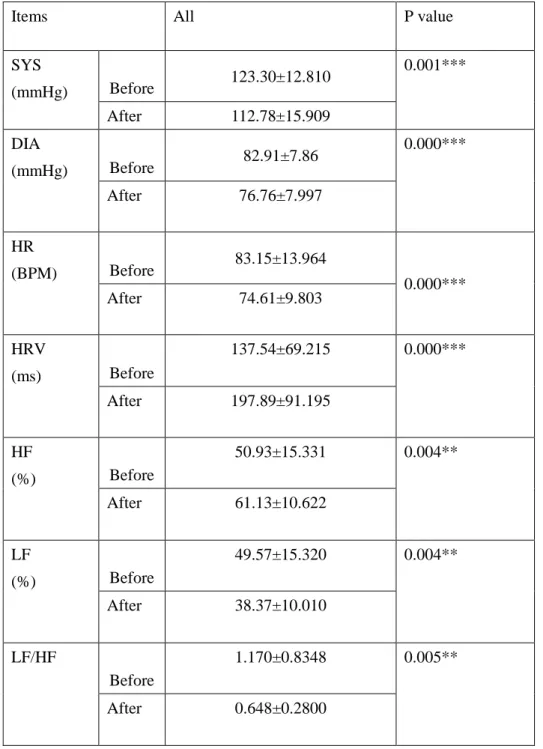
Paired t-test results for aroma for all subjects are listed in Table 2. According to Table 2, it is apparent that after the aromatherapy treatment blood pressure is reduced, both on SYS
and on DIA. There was also a decrease in heart rate, LF % and LF/HF. Apparently, treatment
of aromatherapy increases parasympathetic nervous activity, therefore HF and HRV
parameters will increase.
Further analysis of subgroups is shown in the following. The position group result is
shown in Table-3. Similar to Table 2, there were significant differences on all physiological parameters for administrative staff and for home-room teachers. Although there was also a
significant reduction in blood pressure and heart rate, there was not enough statistical difference on HF% and LF% for the substitute teachers. According to further in-depth
interviews with substitute teachers, that may be associated with the coming annual faculty entrance test. Substitute teachers had to prepare for the test in their spare time, they cannot relax and therefore aromatherapy’s performance is reduced.
Subgroup results for age and gender are listed in Table 4 and Table 5, respectively. There
were significant differences due to aromatherapy for all subgroup on all physiological parameters. The subgroup with anxiety is also tested and shown in Table 6. The high anxiety
and moderate anxiety groups had similar results to those shown in Table 2. Aromatherapy was effective for high anxiety and moderate anxiety groups. The light anxiety group had the same
LF%, but there were significant differences for the other five parameters (p=0.06). After further checking of population distribution, there was no population overlap between the light
anxiety group and the substitutive teacher group. The light anxiety was not fully affected by aromatherapy. A possible reason may be the stable autonomic nervous system for the light
anxiety group. Therefore there was no further activation of parasympathetic activity.
Analysis of covariance between age and position groups was evaluated. There was no
significant difference for all seven physiological parameters. Similar results were also shown for the covariance analysis between gender and anxiety degree groups. In other words,
aromatherapy performance was similar for all these groups.
4. Discussion
High workplace stress is an important personal health risk factor; it is also harmful for an enterprise’s benefits. It will be a win-win situation to provide a comfortable workplace for
employees. The enterprise's benefit was with healthier employees, that would reduce the extra
cost due to high stress employees and support better education service for students.
Elementary school teachers are chosen in this study as the experimental groups due to being a
high work-stress group. In this study, physiological signals were measured at the second weekend after twice weekly aromatherapy treatment. This experiment focused on the
short-term stress relaxing effect instead of tracking the long term effect of aromatherapy. Data showed that that aromatherapy would be effective in promoting parasympathetic activation,
reducing blood pressure and heart rate. Therefore aromatherapy was useful to relax and provide relieve from working stress. Further subgroup analysis revealed that aromatherapy
was also effective on groups arranged by gender, age and positions.
What personal characteristics were in found in association with aromatherapy
performance? Degree of anxiety was considered and measured by BAI. This study also found that aromatherapy was effective for moderate to severe anxiety groups. However, there was
no significant statistical effect for the light anxiety group, which was stable for autonomic nervous activity. The function of aromatherapy is to drive the autonomic nervous activity
toward a balanced state; therefore there was limited physiological change after aromatherapy treatment. Whether aromatherapy is beneficial for long-term anxiety reduction is still an open
issue.
Bergamot essential oil is a good choice for aromatherapy, although there are many studies using lavender oil. Lavender oil was not chosen due to some subject’s report of allergy
to lavender oil. Bergamot essential oil is more moderate for users and is a lower price. In the
future, aroma within air-conditioning will be beneficial to create a better working environment.
Many studies have confirmed that aromatherapy was useful for stress reduction, which is not only limited to the spray inhalation way, but also been used by transdermal application experiment [15]-[16]. Therefore, this study further investigated aromatherapy on different variables on faculty, such as gender, age, position and level of anxiety. The control group with water spray as a placebo was expected in the future study. The other factor that may affect aromatherapy performance is the odor preferences of different individuals. The factor that subjects are disgusted with certain smell, which was not considered in this study, could lead to different results. This factor is also interesting to be examined in the further experiment.
5. Conclusion
With strict control of experimental environment, including subject’s posture, measurement location and time, and experimental procedures, this study rules out many possible factors that affect the body's physiological signals. we believe that this article provide some useful information about aromatherapy stress reduction performance on different faculty groups.
After two 10-minute Aromatherapy sprays with Bergamot essential oil on elementary school teachers, parasympathetic nervous system was enhanced and shown on corresponding
physiological parameters. Short-time working stress was relieved with lower blood pressure and heart rate. Aromatherapy seems to drive autonomic nervous activity toward a balanced
state. Subjects with moderate and high degrees of anxiety benefited more than the light anxiety group. This study showed that aromatherapy was beneficial for a high stress working
population.
References
[1] Whalen KS. Work-related stressors experienced by part-time clinical affiliate nursing
faculty in baccalaureate education. Int J Nurs Educ Scholarsh 2009; 6(1): Article30.
[2] Hawng IL. Study on the Elementary the Part-time Administrative Teachers Work-load
Pressure and Their Methods of Accommodation. Master thesis, National Pingtung University of Education, Taiwan 1999.
[3] Shader K, Broome ME, Broome CD, West ME, Nash M. Factors influencing satisfaction and anticipated turnover for nurses in an academic medical center. J Nurs Adm
2001;31(4):210-216.
[4] Viktor B, Gretchen S. Aromatherapy: Avon Books 1993.
[5] Carolyn LM. Releasing Emotional Patterns with Essential Oils: Vision Ware Press 1998. [6] McCaffrey R, Thomas DJ, Kinzelman AO. The effects of lavender and rosemary essential
oils on test-taking anxiety among graduate nursing students. Holist Nurs Pract 2009; 23(2): 88-93.
[7] Komarova IA, Avilov OV. Individual olfactory responses of students repeatedly exposed
to essential oils. Vopr Kurortol Fizioter Lech Fiz Kult 2009; (2): 33-36.
Korean Acad Nurs 2009; 39(3): 357-365.
[9]. Hur MH, Yang YS, Lee MS. Aromatherapy Massage Affects Menopausal symptoms in Korean Climacteric Women: A Pilot-Controlled Clinical Trial. eCAM 2008; 5(3): 325-328.
[10] Bagetta G, Morrone LA, Rombolà L, Amantea D, Russo R, Berliocchi L, et al. Neuropharmacology of the essential oil of bergamot. Fitoterapia 2010; 81(6): 453-461.
[11] Narita K, Murata T, Hamada T, Takahashi T, Omori M, Suganuma N, et al. Interactions
among higher trait anxiety, sympathetic activity, and endothelial function in the elderly. J
Psychiatr Res 2007; 41(5): 418-427.
[12] Cervantes Blásquez JC, Rodas Font G, Capdevila Ortís L. Heart-rate variability and
precompetitive anxiety in swimmers. Psicothema 2009; 21(4): 531-536.
[13] Duan X, Tashiro M, Wu D, Yambe T, Wang Q, Sasaki T, et al. Autonomic nervous function and localization of cerebral activity during lavender aromatic immersion. Technol
Health Care 2007; 15(2): 69-78.
[14] Bradley BF, Brown SL, Chu S, Lea RW. Effects of orally administered lavender essential oil on responses to anxiety-provoking film clips. Hum Psychopharmacol 2009; 24(4):
319-330.
[15] Heuberger E, Ilmberger J, Hartter E, Buchbauer G. Physiological and behavioral effects of 1,8-cineole and (±)-linalool: a comparison of inhalation and massage aromatherapy. Nat
Product Commun 2008; 3(7): 1103-1110.
[16] Hongratanaworakit T. Relaxing effect of rose oil on humans. Nat Product Commun 2009; 4(2): 291-296.
Table 1: Subject information (n=54) Position
Administrative staff
(n=19);Homeroom Teacher
(n=21);Substitute Teacher
(n=14) Gender Male (n=25); Female (n=29) Age Below 34 (n=21); 35-44 (n=19); Above 45 (n=14) Anxiety Degree Light(n=26); Mild (n=17); Moderate (n=11)Table 2: Paired t-test result for aroma for all subjects
Items All P value
SYS (mmHg) Before 123.30±12.810 0.001*** After 112.78±15.909 DIA (mmHg) Before 82.91±7.86 0.000*** After 76.76±7.997 HR (BPM) Before 83.15±13.964 0.000*** After 74.61±9.803 HRV (ms) Before 137.54±69.215 0.000*** After 197.89±91.195 HF (%) Before 50.93±15.331 0.004** After 61.13±10.622 LF (%) Before 49.57±15.320 0.004** After 38.37±10.010 LF/HF Before 1.170±0.8348 0.005** After 0.648±0.2800
Table-3: Position subgroup paired t-test result for aroma items Administrative staff (n=19) Homeroom Teacher(n=21) Substitute Teacher(n=14) SYS (mmHg) Before 123.16±11.34 123.10±14.74* 123.79±12.50** After 111.16±15.74 113.43±17.10 114.00±15.27 DIA (mmHg) Before 82.37±7.32** 82.00±8.78** 85.00±7.26** After 76.68±9.05 76.10±7.91 77.86±7.02 HR (BPM) Before 83.42±12.37 ** 84.71±17.78* 80.43±9.21** After 73.42±9.71 76.57±10.34 73.29±9.29 HRV (ms) Before 138.84±79.54** 147.38±63.93** 121.00±63.48** After 216.26±108.82** 205.67±71.53 161.29±87.21 HF (%) Before 48.95±16.54** 52.86±12.23* 50.71±18.37 After 64.58±6.19 60.10±8.01 59.07±16.04 LF (%) Before 51.05±16.54** 47.14±12.23* 49.29±18.37 After 35.42±6.19 39.90±8.01 40.93±16.04 LF/HF Before 1.33±.99** 0.99±0.48* 1.22±1.02* After 0.56±0.146 0.71±0.25 0.72±0.48 p<0.05*; p<0.01**; p<0.001***
Table-4: Age subgroup paired t-test result for aroma
items Below 34 (n=21) 35-44 (n=19) Above 45 (n=14)
SYS (mmHg) Before 124.43±10.06** 119.32±15.26* 127.00±12.29** After 114.24±11.49 109.26±20.99 115.36±13.78 DIA (mmHg) Before 82.62±7.18 ** 81.11±7.26** 85.79±9.26** After 77.48±6.19 73.95±7.95 79.50±9.69 HR (BPM) Before 80.71±10.52** 87.42±18.04* 81.00±11.52** After 72.29±8.36 77.00±11.16 74.86±9.74 HRV (ms) Before 131.86±70.25** 172.37±72.99** 98.79±33.48** After 190.10±98.56 232.84±97.32 162.14±50.86 HF (%) Before 51.52±16.46* 51.89±15.51* 48.71±14.18* After 62.33±10.03 60.95±11.22 61.36±8.64 LF (%) Before 48.48±16.46* 48.11±15.51* 51.29±14.18* After 37.67±10.03 39.05±11.22 38.64±8.64 LF/HF Before 1.200±0.87** 1.12±0.962* 1.200±0.618** After 0.66±0.35 0.62±0.21 0.679±0.27 p<0.05*; p<0.01**; p<0.001***
Table-5: Gender subgroup paired t-test result for aroma
items Male (n=25) Female (n=29)
SYS (mmHg) Before 124.52±11.31 ** 122.24±14.086** After 114.04±17.29 111.69±14.837 DIA (mmHg) Before 82.00±6.89** 83.69±8.652** After 77.32±8.72 76.28±7.440 HR (BPM) Before 81.28±11.50** 84.76±15.813** After 73.24±8.82 75.79±10.584 HRV (ms) Before 124.08±71.86** 149.14±65.883** After 191.56±102.44 203.34±81.740 HF (%) Before 49.12±17.74** 53.28±12.029** After 61.08±11.84 61.24±8.967 LF (%) Before 50.88±17.74** 46.72±12.029** After 38.92±11.84 38.76±8.967 LF/HF Before 1.30±1.017** 0.993±0.5451** After 0.66±0.35 0.672±0.2658 p<0.05*; p<0.01**; p<0.001***
Table-6: Anxiety degree subgroup paired t-test result for aroma
items Light(n=26) Mild (n=17) Moderate (n=11)
SYS (mmHg) Before 119.19±11.90* 121.94±13.08** 135.09±6.49* After 110.19±18.84 111.88±12.47 120.27±11.16 DIA (mmHg) Before 82.92±7.63** 80.88±8.63** 86.00±6.72* After 76.73±8.19 75.47±7.238 78.82±8.94 HR (BPM) Before 85.77±16.22** 81.82±13.12** 79.00±7.77* After 76.19±10.25 74.00±9.507 71.82±9.30 HRV (ms) Before 160.19±64.25** 112.65±71.38** 122.45±65.42** After 222.65±95.88 178.47±85.98 169.36±78.34 HF (%) Before 54.19±17.28 49.94±11.64** 44.73±14.52** After 61.35±10.96 63.41±6.90 59.36±11.80 LF (%) Before 45.81±17.28 50.06±11.64** 55.27±14.52** After 38.65±10.96 36.59±6.90 40.64±11.80 LF/HF Before 1.09±1.02* 1.13±0.58** 1.418±0.67** After 0.627±0.23 0.61±0. 18 0.764±0.45 p<0.05*; p<0.01**; p<0.001***