行政院國家科學委員會專題研究計畫 成果報告
國際關鍵客戶管理的前項與結果:台灣資訊電子廠商與國
際代工客戶的對偶分析(第 2 年)
研究成果報告(完整版)
計 畫 類 別 : 個別型 計 畫 編 號 : NSC 99-2410-H-004-002-MY2 執 行 期 間 : 99 年 11 月 01 日至 100 年 10 月 31 日 執 行 單 位 : 國立政治大學國際貿易學系 計 畫 主 持 人 : 簡睿哲 計畫參與人員: -兼任助理人員:黃靜文 報 告 附 件 : 國外研究心得報告 公 開 資 訊 : 本計畫涉及專利或其他智慧財產權,2 年後可公開查詢中 華 民 國 101 年 04 月 17 日
中 文 摘 要 : 國際關鍵客戶管理是學術與實務上很重要的議題,然而,實 證研究對此議題的探討非常有限。本研究針對國際關鍵客戶 管理能力作一探討,分析其前項影響因素與對於公司績效的 影響,同時並檢視資訊科技與文化距離對於此一程序的干擾 效果,以台灣資訊電子業為實證對象,本研究結果對於假說 大多支持。本研究對於國際企業與國際行銷理論做出貢獻。 中文關鍵詞: 國際關鍵客戶管理能力,資訊科技,文化距離,市場導向 英 文 摘 要 : Key account management plays a pivotal role for
managers and practitioners in maintaining successful customer-supplier relationships. Yet, little is known conceptually and empirically as to how suppliers can move beyond customer orientation and should develop international key account management capabilities in international customer-supplier relationships.
Drawing from resource-based view and relational exchange literature, we develop and test a model of antecedents and performance implications of supplier international key account management capabilities. In addition, the moderating effects of cultural distance and supplier information technology advancement are examined. An analysis of 246 Taiwanese electronics suppliers reveals that customer orientation and trust are recognized as being critical to develop supplier international key account management capabilities. Moreover, these key account management capabilities can facilitate supplier market performance.
Importantly, cultural distance and supplier IT advancement moderate the impact of customer orientation on the development of key account
management in international exchange relationships. 英文關鍵詞: International key account management capabilities,
Information technology, Cultural distance, Market orientation
國
國
科
科
會
會
專
專
題
題
研
研
究
究
計
計
畫
畫
成
成
果
果
報
報
告
告
撰
撰
寫
寫
格
格
式
式
99 年 5 月 5 日本會第 304 次學術會報修正通過 一、說明 國科會基於學術公開之立場,鼓勵一般專題研究計畫主持人發表其研究成 果,但主持人對於研究成果之內容應負完全責任。計畫內容及研究成果如涉及 專利或其他智慧財產權、違異現行醫藥衛生規範、影響公序良俗或政治社會安 定等顧慮者,應事先通知國科會不宜將所繳交之成果報告蒐錄於學門成果報告 彙編或公開查詢,以免造成無謂之困擾。另外,各學門在製作成果報告彙編時, 將直接使用主持人提供的成果報告,因此主持人在繳交報告之前,應對內容詳 細校對,以確定其正確性。 本格式說明之目的為統一成果報告之格式,精簡報告內容之篇幅以 4 至 10 頁為原則,完整報告內容之篇幅不得少於 10 頁。 成果報告繳交之期限及種類(精簡報告、完整報告、期中精簡報告、期中 完整報告等),應依本會補助專題研究計畫作業要點及專題研究計畫經費核定清 單之規定辦理。 二、報告格式:依序為封面、目錄(精簡報告得省略)、中英文摘要及關鍵詞、報告 內容、參考文獻、計畫成果自評、可供推廣之研發成果資料表、附錄。 (一)報告封面:請至本會網站(http://www.nsc.gov.tw)線上製作(格式如附件 一)。 (二)中、英文摘要及關鍵詞 (keywords)。 (三)報告內容:包括前言、研究目的、文獻探討、研究方法、結果與討論(含 結論與建議)…等。 (四)計畫成果自評部分:請就研究內容與原計畫相符程度、達成預期目標情況、 研究成果之學術或應用價值(簡要敘述成果所代表之意義、價值、影響或進 一步發展之可能性)、是否適合在學術期刊發表或申請專利、主要發現或其 他有關價值等,作一綜合評估,並請至本會網站線上製作。(格式如附件二) (五)頁碼編寫:請對摘要及目錄部分用羅馬字 I 、II、 III……標在每頁下方中 央;報告內容至附錄部分請以阿拉伯數字 1.2.3.……順序標在每頁下方中 央。 (六)附表及附圖可列在文中或參考文獻之後,各表、圖請說明內容。 (七)可供推廣之研發成果資料表: 1. 研 究 計 畫 所 產 生 之 研 發 成 果 , 應 至 國 科 會 科 技 研 發 成 果 資 訊 系 統 (STRIKE 系統,https://nscnt66.nsc.gov.tw/strike/)填列研發成果資料表(如 附件三),循執行機構行政程序,由研發成果推廣單位(如技轉中心)線 上繳交送出。 2.每項研發成果填寫一份。(八)若該計畫已有論文發表者(須於論文致謝部分註明補助計畫編號),得作為成 果報告內容或附錄,並請註明發表刊物名稱、卷期及出版日期。若有與執 行本計畫相關之著作、專利、技術報告、或學生畢業論文等,請在參考文 獻內註明之。 三、計畫中獲補助國外或大陸地區差旅費、出席國際學術會議差旅費或國際合作研 究計畫差旅費者,須依規定分別撰寫心得報告,並至本會網站線上繳交電子 檔,心得報告格式如附件四、五、六。 四、報告編排注意事項 (一)版面設定:A4 紙,即長 29.7 公分,寬 21 公分。 (二)格式:中文打字規格為每行繕打(行間不另留間距),英文打字規格為
Single
Space
。(三)字體:以中英文撰寫均可。英文使用
Times New Roman Font
,中文使用 標楷體,字體大小以 12 號為主。行政院國家科學委員會補助專題研究計畫
□成果報告
□期中進度報告
(計畫名稱)
計畫類別:■個別型計畫 □整合型計畫
計畫編號:NSC 99-2410-H-004-002-MY2
執行期間: 2010 年 1 月 1 日至 2011 年 10 月 31 日
執行機構及系所:政大國貿系
計畫主持人:簡睿哲
共同主持人:
計畫參與人員:黃靜文
附件一成果報告類型(依經費核定清單規定繳交):□精簡報告 ■完整報告
本計畫除繳交成果報告外,另須繳交以下出國心得報告:
□赴國外出差或研習心得報告
□赴大陸地區出差或研習心得報告
■出席國際學術會議心得報告
□國際合作研究計畫國外研究報告
處理方式:
除列管計畫及下列情形者外,得立即公開查詢
■涉及專利或其他智慧財產權,□一年■二年後可公開查
詢
中 華 民 國 101 年 4 月 1 日
國科會補助專題研究計畫成果報告自評表
請就研究內容與原計畫相符程度、達成預期目標情況、研究成果之學術或應用價
值(簡要敘述成果所代表之意義、價值、影響或進一步發展之可能性)
、是否適
合在學術期刊發表或申請專利、主要發現或其他有關價值等,作一綜合評估。
附件二1. 請就研究內容與原計畫相符程度、達成預期目標情況作一綜合評估
■達成目標
□ 未達成目標(請說明,以 100 字為限)
□ 實驗失敗
□ 因故實驗中斷
□ 其他原因
說明:
2. 研究成果在學術期刊發表或申請專利等情形:
論文:□已發表 ■未發表之文稿 □撰寫中 □無
專利:□已獲得 □申請中 □無
技轉:□已技轉 □洽談中 □無
其他:
(以 100 字為限)
3. 請依學術成就、技術創新、社會影響等方面,評估研究成果之學術或應用價
值(簡要敘述成果所代表之意義、價值、影響或進一步發展之可能性)(以
500 字為限)
國際關鍵客戶管理是學術與實務上很重要的議題,然而,實證研究對此議題
的探討非常有限。本研究針對國際關鍵客戶管理能力作一探討,分析其前項
影響因素與對於公司績效的影響,同時並檢視資訊科技與文化距離對於此一
程序的干擾效果,以台灣資訊電子業為實證對象,本研究結果對於假說大多
支持。本研究對於國際企業與國際行銷理論做出貢獻。
Do Culture and Information Technology Moderate International Key Account Management in International Customer-Supplier Relationships?
Do Culture and Information Technology Moderate International Key Account Management in International Customer-Supplier Relationships?
ABSTRACT
Key account management plays a pivotal role for managers and practitioners in maintaining successful customer-supplier relationships. Yet, little is known conceptually and empirically as to how suppliers can move beyond customer orientation and should develop international key account management capabilities in international customer-supplier relationships. Drawing from resource-based view and relational exchange literature, we develop and test a model of antecedents and performance implications of supplier international key account management capabilities. In addition, the moderating effects of cultural distance and supplier information technology advancement are examined. An analysis of 246 Taiwanese electronics suppliers reveals that customer orientation and trust are recognized as being critical to develop supplier international key account management capabilities. Moreover, these key account management capabilities can facilitate supplier market performance. Importantly, cultural distance and supplier IT advancement moderate the impact of customer orientation on the development of key account management in international exchange relationships.
KEYWORDS: International key account management capabilities, customer orientation, cultural distance, information technology, international exchange relationships
Do Culture and Information Technology Moderate International Key Account Management in International Customer-Supplier Relationships?
1 Introduction
Driven by globalization-related competitive pressures, many multinational enterprises (MNEs) outsource part of their value-adding activities including manufacturing and innovation functions to external suppliers. As more economic activity takes place through alliances and outsourcing, managing interorganizational relationships becomes vitally important (Mayer & Salomon, 2006). Also, many MNEs have centralized procurement and expect from their suppliers similarly coordinated selling activities such as uniform pricing, logistics and service on a global basis (Birkinshaw, Toulan, & Arnold, 2001). In response to increasing
demands from international customers, many suppliers have rethought how to manage their relationships with significant customers and how to design their internal organization in order to be optimally responsive. Companies view key account management (KAM hereafter) as a healthy approach to serve their key customers effectively. For example, KAM has been suggested to serve as a new frontier of relationship marketing (Yip, 1996). Key account management features dedicated cross-functional teams, specializing coordinating activities for specific customers, and formalized structures and processes (Homburg, Workman, & Jensen, 2002, Shi, Zou, White, McNally, & Cavusgil, 2005).
Despite the importance of KAM in practice, academic research on KAM is still rather patchy, limited and under-researched. Although some prior studies focused on this issue, the existing literature has several
shortcomings. First, research is fragmented and lacks of a coherent theoretically-based integrative framework which can help us understand KAM strategies and the contingent conditions that impact on their effectiveness (Shi, White, Zou, & Cavusgil, 2009). Moreover, while some anecdotal evidence exists, KAM literature has been primarily conceptual and descriptive. So far, relatively little empirical studies have engaged in
hypothesis testing to explain how KAM affects performance (Workman, Homburg, & Jensen, 2003). Third, most of the previous work has been conducted in the domestic context and mainly focused on US and
European firms’ perspectives. To this end, this paper also adheres to the call for more research on KAM in the international context (Wengler, Ehret, & Saab, 2006).
Given the state of knowledge about KAM, the main objective of this article is twofold: First, we develop and empirically test a conceptual framework based on resource-based (Barney, 1991) and relational exchange literature (Macneil, 1980). This framework integrates drivers and performance outcomes of international KAM capabilities in international customer-suppliers relationships. Trust, supplier dependence and Customer orientation are defined as key drivers of the international KAM capabilities in the model. Second, we test the moderating effect of cultural distance and information technology (IT) capability of suppliers on the link between these drivers and KAM capabilities. We specifically focus on IT advancement as a key IT capability for suppliers in international exchange relationships (Wu, Yeniyurt, Kim, & Cavusgil, 2006). IT advancement refers to the extent to which the supplier adopts the most advanced IT in the context of supply chain
relationships (Bstieler & Hemmert, 2008, Erumban & de Jong, 2006), we explore the moderating effects of these two variables.
The proposed contributions to extant knowledge on KAM are as follows: Fir st, drawing from RBV, we develop and conceptualize international KAM capabilities, which are defined as the specific and idiosyncratic cross-functional and interorganizational processes to address rapidly changing needs of key international customers and environmental changes (Shi, Zou, White, McNally, & Cavusgil, 2005). Moreover, using a unique, survey-based data set, a comprehensive model of drivers and performance outcomes of international KAM capabilities in international exchange relationships is proposed and empirically tested. Hence, we conceptualize international KAM as organizational capabilities and empirically examine their drivers and performance implications. Second, through examining the moderating effect of cultural distance and supplier IT advancement on the impact of different antecedents on international KAM capabilities, this research helps to understand the contingent condition of the development international KAM capabilities. There is a lack of empirical research that examines the contingent situation of the drivers of KAM in the international context.
The reminder of this article is organized as follows. A conceptual model is developed that delineates the relationships among key constructs. The literature from resource-based view (RBV) (Barney, 1991) and relational governance (Macneil, 1980, Zhang, Cavusgil, & Roath, 2003) is reviewed to provide support for the links among each construct. Predictions regarding the antecedents and consequences of international KAM capabilities are offered. We then explore the moderating effect of supplier IT advancement and cultural distance. These hypotheses are tested empirically, and the results are presented. This paper concludes with a discussion of findings and directions for future research.
2 Conceptual framework
2.1 Resource-based view and international key account management capabilities
A key aspect of the RBV is its focus on the unique resource and capabilities within a firm which are drivers of a firm’s competitive advantage (Barney, 1991). Researchers have argued that these critical resources and capabilities can span the firm’s boundaries and be embedded within interorganizational process and activities (Dyer & Singh, 1998; Jap, 1999). In this study, we focus on international KAM capabilities, which are defined as specific and idiosyncratic cross-functional business processes to address rapidly changing needs of key international customers and changes in the environments (Shi, Zou, White, McNally, & Cavusgil, 2005). It has been argued that the ability to create and deliver superior customer value through efficient and
fast-responding processes can contribute to a firm’s financial performance (Day, 1994). Based on a review of KAM and global account management (GAM) literature (Shi et al., 2009; Shi et al., 2005), we focus two specific organizational processes which are critically important for a supplier in effectively managing its key international customers: coordination and reconfiguration. We select these capabilities because prior
researcher have identified them as fundamental and important to a supplier’s decision making and task
accomplishment in serving international key customers (Shi, 2005, Shi, Zou, & Cavusgil, 2004). Coordination has been considered as an important aspect of KAM. The development of multilevel coordination processes such as cross-functional and cross-cultural coordination played crucial role in achieving successful KAM in
international exchange relationships. According to Shi (2005) and her colleagues, KAM coordination in international exchange relationships includes interorganizational and cross-country coordination.
Interorganizational coordination requires communication and joint action not only between cross-functional operations from the supplier and the customer, but also between top executives from both organizations (Homburg, Workman, & Jensen, 2002). Cross-country coordination refers to the process of the supplier’s use of its worldwide strategic resources to achieve coordination and flexibility in order to serve its key customer around the world. For example,
KAM reconfiguration has been identified as another key process of successful KAM (Harvey, Novicevic, Hench, & Myers, 2003, Shi, Zou, White, McNally, & Cavusgil, 2005). This refers to the processes that suppliers adopt in order to adapt to the changing environment (Shi, Zou, White, McNally, & Cavusgil, 2005). Because global environments change constantly, suppliers must be able to keep modifying their product offering, services and processes in order to adapt to changing customer needs. The dynamic nature of KAM reconfiguration enables firms to leverage their relational capabilities through formation of key account relationships with their international customers (Harvey, Novicevic, Hench, & Myers, 2003). According to Teece et al. (1997), reconfiguration has been identified as one of the most fundamental capabilities in business processes. Recent studies also identify firm reconfiguration and adaptive capabilities as crucial and important firm capabilities to enhance international performance (Lu, Zhou, Bruton, & Li, 2010). Therefore, we consider reconfiguration as one of the key dimensions of a firm’s KAM capabilities.
2.2 Hypotheses development
Following an RBV perspective, we argue that international KAM capabilities, which enable the supplier to coordinate efficiently at different levels with the international customer and thus become more responsive to market changes, are the drivers for the supplier’s market performance. Prior studies have demonstrated that developing international KAM capabilities can be a driver of supplier performance (Shi, 2005, Shi, White, Zou, & Cavusgil, 2009). In terms of the antecedents of KAM capabilities, we focus on three variables including Customer orientation, supplier dependence and trust. The RBV literature also links organizational culture with capability-building (Fang & Zou, 2009). We focus on one specific organizational culture, Customer orientation. This is defined as the process of scanning the key account needs and environmental needs (Jaworski & Kohli, 1993). The literature on KAM also suggested that dependence is associated with the development of KAM, which can serve as a dependence-balancing strategy (Birkinshaw, Toulan, & Arnold, 2001). Moreover, the literature on relational exchange and RBV reveal that trusting relationship plays a crucial role in developing firm capabilities in international exchange relationships (Wu, Sinkovics, Cavusgil, & Roath, 2007).
In addition, we argue that the relationship between KAM capabilities and their antecedents is moderated by cultural distance and supplier IT advancement. Cultural characteristics and IT play a crucial role in the development of KAM capabilities in international exchange relationships (Shi et al., 2009; Shi et al., 2005), although, empirical evidence on their effects is very limited. What follows is a series of detailed discussion on the model and research hypotheses.
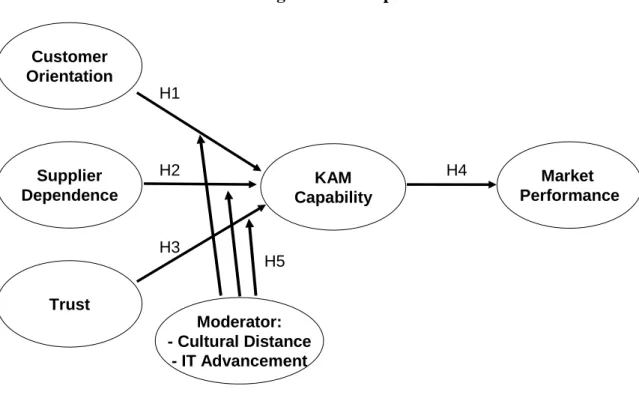
Insert Figure 1 here
2.2.1
The development of an organizational culture that supports key customers is recognized as an important factor for successful KAM (Workman, Homburg, & Jensen, 2003). Research has argued that strategic orientation of a supplier is crucial for the development of KAM (Abratt & Kelly, 2002). We conceptualize customer
orientation, which refers to the process of scanning the key account needs and environmental needs. Customer orientation is a key driver for suppliers to develop strong relationship with their most valuable customers. A customer oriented supplier will be engaging in activities geared toward gathering information about their key customers and competitors. This process can help suppliers to identify the customer needs and thus enable a supplier’s coordination capabilities. Moreover, a customer oriented supplier can continuously sense
environmental changes and thus adapt their internatonal KAM strategies to serve the key account more quickly. According to RBV, an organization culture is a firm resource which can facilitate
capabilities-building processes (Barney, 1986). In Fang and Zou’s (2009) recent study, they find that a learning culture in international joint venture partners can improve the development of marketing dynamic capabilities. This is also in line with information processing view that argued KAM as an information
processing mechanisms (Birkinshaw, Toulan, & Arnold, 2001). Customer orientation can facilitate a supplier’s information processing capabilities and thus enhance the development of international KAM processes.
Supplier’s customer orientation and international KAM capabilities
Literature on relationship marketing and market orientation suggested that customer orientation can facilitate the development of successful interorganizational relationships (Hsieh, Chiu, & Hsu, 2008; Zhao & Cavusgil, 2006) (Deshpandé, Farley, & Webster Jr, 1993). In their study of the strategies used by suppliers to improve long-term orientation with their manufacturers, Zhao and Cavusgil (2006) find that a market oriented supplier is more able to build up a customer’s trust in the exchange relationship. Hsieh and colleagues (2008) also recognized that a market-oriented supplier is able to develop a better customer adaption strategy by deploying flexibility and relationship specific investments, which in turn, enhances customer satisfaction. This stream of research indirectly supports that a supplier’s customer orientation is positively related to its KAM capabilities. Therefore,
H1: Supplier’s cusotmer orientation is positively related to the supplier’s international KAM capabilities.
2.2.2
Dependence has been identified as an important factor in interorganizational relationships (Handfield & Bechtel, 2002). A supplier is more dependent on the customer when the supplier has limited alternative resources when judged against the customer. Resource-dependence theory (Pfeffer & Salancik, 1978) argues that a dependent party should pursue dependence-balancing strategies such as coordination, cooperation and vertical integration to reduce its dependence.
International customer-supplier relationships such as e.g. contracting suppliers and their MNE customers, the relationships is characterized by significant asymmetry (Chang & Gotcher, 2007). In such situations, a supplier is highly dependent on the international customer due to lack of brand and channel-expertise. The customer can potentially exploit this market power and put the supplier in a more disadvantageous position. Literature on relational exchange suggests that suppliers can use relational governance strategies such as joint action in governing an asymmetric relationship (Subramani & Venkatraman, 2003). In the study on the
manufacturer and its foreign distributor relationship, Zhang et al. (2003) argue that manufactures will be more likely to commit resources and employ relational norm as a dependence-balancing strategies against their foreign distributors when the manufacturer is highly dependent on the foreign distributor. Following on this logic, we argue that the supplier is more willing to invest resources to develop KAM capabilities to serve the key customer when the supplier is more dependent on the international customer. Because the supplier is more likely to invest proprietary resources in a relationship it perceive as valuable. Therefore:
H2: Supplier’s dependence is positively related to the supplier’s international KAM capabilities.
2.2.3
In this study, trust is defined as the confidence that exchange parties have for each other’s reliability and integrity (Doney & Cannon, 1997, Zhang, Cavusgil, & Roath, 2003). According to relational exchange theory, a significant level of trust can be viewed as a relational governance mechanism that helps deter opportunistic behavior because trust can operate as a self-enforcing contract that helps to lessen the perceived vulnerability between partners (Cavusgil, Deligonul, & Zhang, 2004). Specifically, the literature highlights that trust provides better capability in governing cross-border relationships because physical and cultural distance undermine the ability of a formal contract to identify and cover each contingency (Cavusgil, Deligonul, & Zhang, 2004; Wu et al., 2007).
Trust and international KAM capabilities
In the context of KAM, prior studies also highlighted the key role of trusting relationships in a successful KAM program (Abratt & Kelly, 2002). Trust can be a good foundation for the development of KAM capabilities because a supplier is more willing to commit resources in specific organizational processes to serve a trustworthy key customer. Due to potential concerns of the abuse of power in the buyer-supplier relationship, a supplier is not willing to develop greater resources such as KAM teams to coordinate their key customer unless a great extent of trust exists in the exchange relationship. Further, a trusting relationship signals transparency and openness. Therefore, a supplier is more likely to go beyond contractual agreements and become more adaptable and responsive to unforeseen environmental and customer changes in a trusting relationship. Prior empirical research on relational exchange has argued that trust can facilitate the
development of organizational capabilities for a firm in interorganizational relationship. Drawing from RBV, trust has been seen as a relational capital which can drive firm capabilities development. For example, Wu et al. (2007) find that trust can enhance market competence for exporting manufactures in relationship with foreign distributors. Recently, Griffth et al.(2010) also recognize that trust is positively related to development of firm marketing capabilities in the global market. Thus, we hypothesize that:
2.2.4
According to RBV (e.g. Barney, 1991), rare and inimitable organizational capabilities, can by their very nature be a valuable source of a firm’s competitive advantage. Extending firm resources to an
interorganizational level, research has argued that interorganizational capabilities embedded in an exchange relationship can also create value for the firm (Dyer & Singh, 1998). In line with this perspective, we propose that developing supplier’s KAM capabilities is fundamental to realizing the potential value attainable through collaboration with international customers. Specifically, we focus on market performance as the supplier’s outcome. We define it as the extent to which the firm achieves market-related goals such as revenue growth, market share and profitability (Workman, Homburg, & Jensen, 2003).
Supplier international KAM capabilities and supplier market performance
We conceptualize KAM capabilities as a supplier’s organizational processes including coordination and reconfiguration with the key customer. KAM capabilities thus incorporate not a single but a complex set of organizational capabilities that are developed through a dynamic and interactive process with key customers. The nature of KAM capabilities is in line with the conceptualization of interactive capabilities (Johnsen & Ford, 2006) and dynamic capabilities (Teece, Pisano, & Shuen, 1997). The dynamic nature of the KAM capabilities can serve as the basis for sustained competitive advantage for suppliers in relationships with key international customers, which in turn, enhance the supplier’s market performance. (Fang & Zou, 2009; Teece, Pisano, & Shuen, 1997). For international supplier-customer relationships, a supplier’s coordination
capabilities allow them to manage selling activities at each level of the organization on a global basis in order to serve the international customer’s needs. Moreover, a responsive and flexible supplier can alter its
organizational structure and process and redeploy its strategic resources accordingly (Shi, Zou, White, McNally, & Cavusgil, 2005). Some empirical work demonstrates that KAM capabilities related constructs including coordination and reconfiguration can enhance firm performance in the exchange relationship (Buvik & John, 2000, Kim, Cavusgil, & Calantone, 2006). On the basis of the above arguments and empirical
evidence, we argue that when a suppliers’ KAM capabilities are grater, the supplier is in a better position to perform well in the market in relation with the key customer. Thus:
H4: International KAM capabilities are positively related to the supplier’s market performance.
2.2.5
As discussed previously, the development of a supplier’s KAM capabilities is dependent on the supplier’s KAM orientation, supplier dependence, and trust in the international exchange relationship. Given the
significant cultural difference present in the international exchange relationship, it is expected that the effects of customer orientation, supplier dependence, and trust on developing KAM capabilities in the international customer-supplier relationship is also influenced by cultural distance. Moreover, with increased IT adoption and IT advancement in international supplier-customer relationships, it can be argued that a supplier’s IT capability can also influence the process of cultivating KAM capabilities through customer orientation, supplier dependence, and trust.
Moderating effects: supplier IT advancement and cultural distance
Although a supplier’s customer orientation motivates the development of KAM capabilities, it is contended that developing a KAM oriented culture including customer and competitor information generation imposes
significant costs (Yip & Bink, 2007). Because IT can significantly enhance information processing capability and reduce coordination cost, the supplier’s IT capability is expected to enhance the development of KAM capabilities from customer orientation.
Literature on market orientation finds that IT capabilities can facilitate a market orientation culture. In our study, we focus on one specific IT capability: supplier’s IT advancement, which is defined as the extent to which the supplier adopts the most advanced IT in the context of supply chain management systems (SCMs) with the key customer (Wu, Yeniyurt, Kim, & Cavusgil, 2006). IT advancement in SCMs can help the supplier to exchange timely information with the key customer and thus enhance the information quality and quantity. This can provide the supplier with incentives to continuously collect information about the key customer’s operations. Therefore, it is argued that when a supplier’s IT advancement is high; the supplier can process more information gaining from market and customers, which in turn, can enhance the positive effect of customer orientation on supplier’s KAM capabilities. Thus,
H5a: The positive relationship between the supplier’s customer orientation and international KAM capabilities is enhanced when the suppliers’ IT advancement is high.
It has been argued that national culture plays a crucial role in shaping the process in managing international key account relationships (Yip & Bink, 2007). In our study, we adopt Hofstede’s conceptualization of culture and follow Kogut and Singh’s (1988) operationalization of culture distance. The supplier and the international customer in our study are assumed to belong to diverse cultures, as they are from different countries. Recent studies suggest that national culture can impact on a firm’s market-oriented culture and behavior (Kirca, Cavusgil, & Hult, 2009, Nakata & Sivakumar, 2001). In their conceptual framework, for example, Nakata and Sivakumar (2001) suggest that higher degrees of individualism relate to greater market intelligence generation. Culture distance creates significant uncertainty for a firm in processing market information. Prior studies have shown that environmental uncertainty can moderate a firm’s market orientation behavior. Therefore, it is logical to argue that the more distant the cultures between supplier and buyer, the greater the extent to which the supplier will employ Customer orientation in order to serve the key customer to achieve consistent service on a global basis through KAM capability. This is because that the needs for converting market information into key customer coordination and reconfiguration rise when complexity and uncertainty increase in the exchange relationship. Hence,
H5b: The positive relationship between the supplier’s customer orientation and international KAM capabilities is enhanced when cultural distance is high in the international customer-supplier relationship.
The relationship between supplier’s dependence and KAM capabilities are moderated by supplier IT advancement and cultural distance as well. Prior research argues that supplier’s IT advancement as relationship specific commitment can increase the supplier’s transactional specificity in the exchange relationship and was regarded as a dependence-balancing strategy. In his seminal work, Subramani (2004) finds that a supplier can use SCM systems for instance, as a token of commitment, to strengthen the
relationship with the key customer and create relationship value. In a committed relationship which features high IT advancement, the role of supplier dependence in cultivating KAM capability is likely weakened, as the commitment level signaled through IT advancement for the relationship suppresses the expected role of dependence in cultivating KAM capability, given the high level of commitment. Therefore, it is argued that a supplier’s IT advancement will reduce the impact of a supplier’s dependence on KAM capabilities.
The relationship between supplier dependence and KAM capabilities is expected to be moderated by cultural distance as well. In a high cultural distance relationship, a supplier is more difficult to predict the key
customer’s preference and behaviors. Therefore, a supplier’s KAM capabilities become more important in that situation. Research on relational exchange already discusses the interaction effect of environmental
uncertainty and interdependence structure in the exchange relationship (Ryu & Eyuboglu, 2007). Resource-dependence theory further argues that the need for coordination increases when uncertainty increases (Pfeffer & Salancik, 1978). Therefore, a dependent supplier is more likely to develop KAM capability when cultural distance is high. The logic is that cultural distance incurs extra uncertainty and complexity that drive a dependent supplier to develop greater KAM capabilities in terms of interfirm coordination and reconfiguration activities.
H5c: The positive relationship between supplier dependence and international KAM capabilities is reduced when supplier IT advancement is high.
H5d: The positive relationship between supplier dependence and international KAM capabilities is enhanced when cultural distance is high in the international customer-supplier relationship. Regarding the relationship between trust and KAM capabilities, studies indicated that trust functions
differently in different cultural environment. Moreover, IT in interfirm relationships can serve as a governance enabler and is expected to influence the effect of trust on KAM capabilities.
It has been argued that trust can help develop relational behaviors such as coordination and knowledge sharing. However, research also shows that developing trusting relationship requires certain costs and has potential risks. Selnes and Sallis (2003) find that the effectiveness of relationship learning reduces as a result of hidden cost of trust. Accordingly, when a supplier strengthens the IT advancement in SCMs, information exchange between the supplier and the key customer will increase significantly (Wu, Yeniyurt, Kim, & Cavusgil, 2006). Transparent information sharing creates an environment which can facilitate the development of trust in interfirm relationships. Literature on communication strategies shows that communication quality and quantity can enhance trust development (Mohr & Nevin, 1990). Moreover, a supplier’s IT advancement can be seen as a relationship specific investment which signals commitment in the exchange relationship (Kim & Mahoney, 2006). It has been argued that trust plays a more important role in a committed relationship
(Morgan & Hunt, 1994). Therefore, we argue that when a supplier’s IT advancement is high, the supplier will be more willing to develop KAM capabilities, given the level of trust in the relationship.
In terms of the moderating effect of cultural distance, literature on relational exchange argued that trust provides better capability in governing interfirm relationships when cultural distance is high (Cavusgil, Deligonul, & Zhang, 2004, Zhang, Cavusgil, & Roath, 2003). The logic is that the more distant the cultures,
the greater the effort the two organizations must exert to bridge the gap, and the greater the reliance on trust in building exchange relationships. Therefore, trust plays a more crucial role in developing supplier customer orientation in an international exchange relationship facing high cultural distance. In other words, a supplier is expected to commit more resources to develop international KAM capabilities in a trusting relationship when cultural distance is high. Hence,
H5e: The positive relationship between trust and international KAM capabilities is enhanced when the supplier IT advancement is high.
H5f: The positive relationship between trust and international KAM capabilities is enhanced when cultural distance is high in international customer-supplier relationship.
3 Method
3.1 Unit of analysis
For the empirical context of this study, the specific international exchange relationship between Taiwanese suppliers and their international-OEM buyers was chosen. This was a deliberate choice as we aimed to examine KAM capabilities as a strategic dimension in managing cross-border relationships. The relationship between Taiwanese suppliers and their international-OEM customers in the electronics industry are
significantly asymmetric. Most of the buyers feature well-established international brands with superior bargaining position. According to the 2005 International Procurement Office (IPO) in Taiwan survey, the top five IPO (HP, Dell, Sony, Apple and IBM) purchasing companies accounted for 73 percent of total
international information technology purchasing in Taiwan. Thus, a high degree of power asymmetry is considered a key feature of the OEM supplying networks we examine. Given the increasing demand from their dominant international customers, Taiwanese contracting suppliers have developed key account
management strategies in response to customer needs. Given that most of extant literature on KAM focusing on European and American market, an Asian-Pacific perspective of KAM strategies offers a valuable
empirical contribution to this stream of research.
3.2 Sampling frame and data collection
Senior account managers, directly involved in international OEM relationships with branded firms were chosen as key informants and contributed to this research. A survey methodology was used in the data collection. The sampling frame constituted all electronic companies from the year 2007 directory of the Top 5000 Largest Firms in Taiwan, published by China Credit Information Service Ltd (a total of 1069 companies). All firms in the database were contacted to assess their eligibility and to locate additional appropriate
informants for the study. Following Workman et al.’s (2003) approach, we define key customer as the
supplier’s most important international customer in terms largest sales volume. Respondents were specifically asked to identify the most important international OEM customers.
account and/or marketing managers or directors from Taiwanese suppliers. This qualitative approach helped in further calibrating the questionnaire, which was subsequently developed to the industry context and it served as a-priori test of key constructs with respect to usefulness and appropriateness. In the second stage, the final survey instrument was mailed out in a large scale to those Taiwanese electronics companies from the directory. Yu and Cooper’s (1983) suggestions to maximize response rates were applied and multiple contact points (Dillman, 2000) via telephone and personal contacts were established to solicit contributions to the study. Moreover, we also sent out questionnaires via e-mail to accommodate respondents’ preferences regarding response options. For the telephone and e-mail surveys, each informant who agreed to participate in this study was faxed or emailed a questionnaire packet.
3.3 Survey response and informant evaluation
246 useable questionnaires were returned, resulting in an effective response rate of 23.01% (246/1069). Respondent characteristics are presented in. In the dataset, international-OEM buyers originated from the USA, Japan, Germany, China and France. Taiwanese electronics suppliers are involved in computer
components, semiconductors, communication products, computer peripherals and optoelectronics. Over 67% of Taiwanese suppliers are small and medium size (i.e. employee number less than 250). Our survey
instrument also allowed us to identify the level of the supplier’s dependence on international OEM buyers, both in terms of resource-endowment and potential to be replaced with another buyer.
Non-response bias was assessed by classifying responses into two groups, early responses and late responses (Armstrong & Overton, 1977). Furthermore, independent t-tests on demographic variables such as revenue and employee number were performed. No significant differences were identified for these descriptive variables between early and late respondents. We also ran additional t-tests on key variables such as IT advancements in the proposed conceptual model between these two groups. Again, no significant difference emerged.
As a reliable assessment of non-response bias can only be achieved via feedback from non-respondents themselves, we identified ten non-respondents and called them to obtain explanations for their non-response. In all ten cases reasons provided were related to time-pressures in filling in the questionnaire and the general notion that too many requests for questionnaire feedback had landed on their desk. Taken together, it seems that non-response bias does not pose a significant threat to the study.
Insert Table 1 about here
3.4 Measurements
Multi-item scales and seven-point response formats were used to operationalize all constructs and variables. The measures in this study were mostly adapted from previous studies and refined on the basis of feedback from experienced researchers and practitioners in the area of inquiry.
We conceptualized KAM capabilities as the complex bundles of knowledge and skills deeply embedded in interorganizational routines and processes and deployed through the joint idiosyncratic contributions of the specific international key customer. We operationalized KAM capabilities with a five item scale, adapted from Shi et al. (2005, 2009).
Supplier’s customer orientation was operationalized as the supplier’s process of scanning the key account needs and environmental needs. We measured customer orientation with a four-item scale, adapted from the work of Li and Calantone (1998) and Deshpandé et al. (1993). A three-item scale was used to measure trust. The trust measure was taken from Doney and Cannon (1997) and adapted to our context. Trust measures the supplier’s perception of the credibility and benevolence of their international customers in the cross-border customer-supplier partnerships. IT advancement was conceptualized as the extent to which a firm is proactive in adopting or using the most advanced IT to build new technical solutions to answer partner’s needs ahead of competitors (Wu, Yeniyurt, Kim, & Cavusgil, 2006) and measured using a five-item scale.
For supplier market performance, we adopted Venkatraman and Ramanujam’s (1986) conceptualization of market performance, namely market share, sales growth, and profitability (see also Sarkar, Echambadi, & Harrison, 2001).
Finally, we used cultural distance measures suggested by Kogut and Singh (1988) to test for the moderating effect of cultural distance on the impact of three antecedents on KAM capabilities.
3.5 Measurement model results
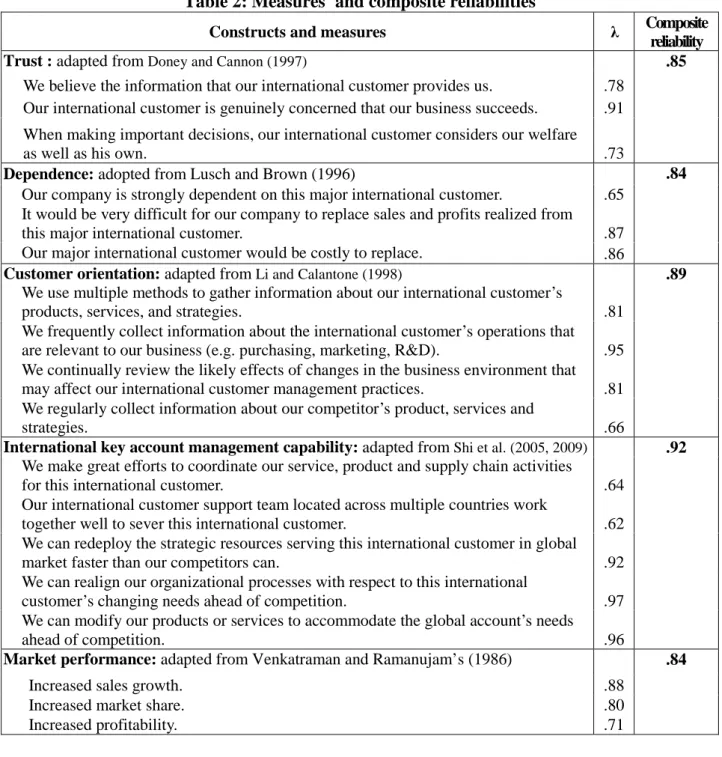
We conducted confirmatory factor analysis (CFA) using EQS for Windows 6.1 to evaluate the measurement model. The CFA model includes all six study constructs including IT advancement, as moderator. As a part of the measurement purification process, items with a loading less than .5 were eliminated to increase convergent validity. Furthermore, item scales linked to more than one construct were removed to improve discriminant validity. The purification resulted in at least three items for each construct. As shown in Table 2, the CFA model revealed a good fit with the covariances provided by the dataset with χ2
= 566.46 on 215 d.f., NNFI = .907, CFI = .921, and RMSEA = .082 (Bentler & Chou, 1987).
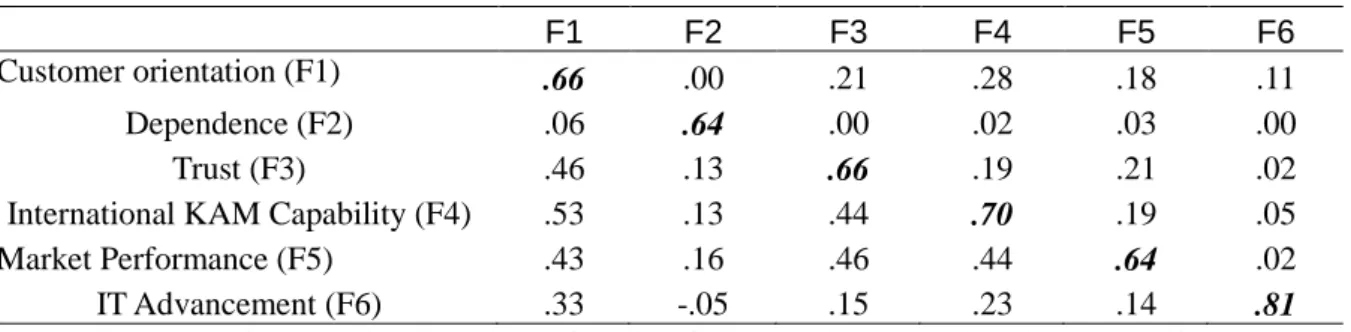
Next, the unidimensionality of constructs was assessed with the largest standardized residuals reported. According to the results, there is no significant threat to the unidimensionality of constructs with the largest standardized residual of less than .20 (Fornell & Larcker, 1981). Further, all items are significantly loaded on their corresponding factor (p < .01) and their loadings are greater than .5 as shown in Table 2. This indicates an adequate level of convergent validity (Nunnally & Bernstein, 1994). The composite reliability of each construct is calculated and reported in Table 2 along with the standardized parameters of measurement items. All composite reliabilities are greater than .84, far above the acceptable level of .7 (Nunnally & Bernstein, 1994). For discriminant validity average variance extracted should be greater than shared variances of each construct (Fornell & Larcker, 1981). We report the average variance extracted (AVE) for each construct, ranging from .64 to .81, in Table 3 and the shared variances among constructs, ranging from .00 to .53, in the upper triangle of Table 3. These results demonstrate a good level of discriminant validity between the study’s constructs.
Insert Tables 2 & 3 Here
3.6 Common method bias assessment
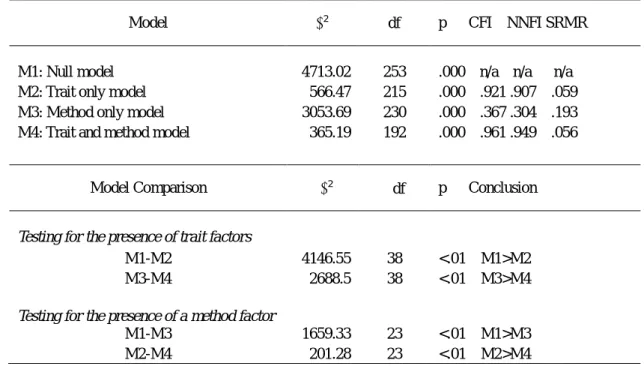
Since this study relies on a single source of information, it is possible that our survey data reflects some degree of common method bias. Consequently, we assessed common method bias in the dataset using hierarchically nested covariance structure model offered in the literature (e,g., Cote & Buckley, 1987). Following the process suggested in the literature, we estimated three models: trait only model (M2), method only model (M3), and trait and method model (M4). The results are reported in Table 4 along with the results of testing for the presence of trait factors and testing for the presence of a method factor. According to the results, the variances from both construct items (or traits) and method are present. This suggests that a portion of the covariance originates from the method used in data collection.
Subsequently, we assess its impact by calculating the mean percentages of variance explained by the construct items and by the common method factor (Cote & Buckley, 1987). The results show that the mean percentage of variance explained by the construct items is 68.8% while that of the common method factor is only 2.5%, indicating that the impact of common method bias in this study is minor (Lee, Sirgy, Brown, & Bird, 2004). Therefore, we conclude that common method bias is not posing a major threat to the study.
Insert Table 4 Here
4 Analysis and results
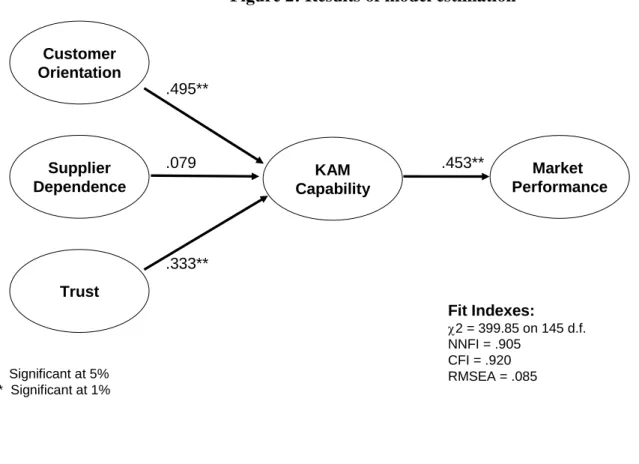
To test hypotheses one to four, the proposed structural model without the moderators is estimated with all measurement items from the CFA model, using EQS for Windows 6.1. The results show a good fit of the model with the empirical covariance provided by the data with χ2
= 399.85 on 145 d.f., NNFI = .905, CFI = .920, and RMSEA = .085. Based on the good fit of the structural model, the proposed hypotheses 1 through 4 are tested. Specifically, Hypothesis 1, which claims that a firm’s customer orientation affects KAM
capability positively, is supported (b = .495, p < .01). In Hypothesis 2, it is posited that supplier dependence cultivates KAM capability. However, it is not supported (b=.079, p >.10). In Hypothesis 3, we contended that trust enhances KAM capability and it is supported by the results (b=.333, p<.01). We also claimed
(Hypothesis 4) that KAM capability enhances a firm’s market performance and it is supported (b=.453, p <.01). These results are summarized in Figure 2.
Insert Figure 2 Here
To test the moderating effects of IT advancement and cultural distance between the supplier and buyers, two additional models are estimated. First, for the moderating effects of IT advancement on the three paths between KAM capability and customer orientation, supplier dependence, and trust, the observations are split
around the mean into two groups based on the level of IT advancement for a two group analysis. Then, all three paths hypothesized were equal-constrained across the groups to test the moderating effects of IT advancement. The estimation results reveal a good fit of the model with the data with χ2
= 481.87 on 258 d.f., NNFI = .909, CFI = .923, and RMSEA = .084. The results further show that the path between customer orientation and KAM capability is moderated by IT advancement (p < .10, blow= .347 and bhigh= .456).
However, the moderating effects of IT advancement on other two paths between KAM capability, and supplier dependence (p>.10, blow= .070 and bhigh= .047) and trust (p>.10, blow= .215 and bhigh= .289) are not significant.
Therefore, hypothesis 5a is supported but hypotheses 5c and 5e are not.
To test hypotheses 5b, 5d, and 5f that are about the moderating effects of cultural distance, another two group analysis is carried out by grouping all the observations into two groups (e.g., high vs. low groups) using mean split according to calculated cultural distance between the supplier and buyer. The formula suggested by Kogut and Singh (1988) was used. And, then the three paths between KAM capability and customer orientation, supplier dependence, and trust were equality-constrained across the groups for the moderating effects of cultural distance. The estimation results indicate a goof fit of the model with the data with χ2
= 439.33 on 258 d.f., NNFI = .928, CFI = .939, and RMSEA = .076. The results also show that the path between customer orientation and international KAM capability is moderated by cultural distance between the supplier and buyer (p < .10, blow= .371 and bhigh= .479). However, the moderating effects of cultural distance on other
two paths between KAM capability, and supplier dependence (p>.10, blow= .067 and bhigh= .064) and trust
(p>.10, blow= .230 and bhigh= .233) are not significant. Therefore, hypothesis 5b is supported but hypotheses 5d
and 5f are not.
5 Discussion
With a tremendous increase in outsourcing and a substantial shift towards demand-driven global supply chains, suppliers are charged with higher value adding activities and required to develop specific dynamic capabilities (Shi, Zou, White, McNally, & Cavusgil, 2005) in order to serve their demanding global customers. This study sought to gain a greater understanding on how suppliers can enhance international KAM capabilities in
international customer-supplier relationships and the resultant influence on the supplier’s market performance. Drawing on RBV and relational exchange theory and taking a supplier’s perspective, this study develops and empirically tests an integrative model that delineates the antecedents and performance outcomes of KAM capabilities in an international customer-supplier relationship. Moreover, we examined the moderating effect of IT advancement and cultural distance on the development of international KAM capabilities. Our research can serve as an initial effort to understand how suppliers can develop international KAM capabilities
capability and create competitiveness in international exchange relationships with key customers.
5.1 Theoretical implications
5.1.1
Following a shift in KAM research towards a better understanding of resources and capabilities dimensions of KAM (Kim & Umanath, 2005; Workman, Homburg, & Jensen, 2003), we contribute to KAM and GAM
research in terms of international KAM conceptualization and empirical assessment relating to supplier
performance. Drawing from resource-based view, we conceptualize international KAM capabilities as a firm’s interorganizational capabilities to effectively coordinate and reconfigure organizational processes to serve key customers in international exchange relationships. Our data show that international KAM capabilities enhance market performance for suppliers positively. Therefore, international KAM is an effective interaction and organizational capability. It serves as a governance mechanism for suppliers to reduce transaction cost and enhance transaction value with key customers. Moreover, consistent with RBV and dynamic capability views, dynamic organizational capabilities developed through effective cross-border coordination and
reconfiguration can create competitive advantage for suppliers in international exchange relationships in the face of intensifying global competitions. This study also contributes to KAM research by linking international KAM capabilities to supplier market performance. Despite the importance of performance implications of international KAM strategies, empirical evidence on this issue is scarce in the extant literature (Workman, Homburg, & Jensen, 2003). Therefore, this study sheds lights on this important gaps in international marketing and international business field.
5.1.2
In terms of antecedents to KAM capabilities in international exchange relationships, our findings demonstrate that supplier customer orientation and trust enhance KAM capabilities. Moreover, we find that customer orientation has the strongest effect on the development of KAM capabilities, followed by trust in international exchange relationships. However, against our expectations, the supplier dependence was found not
significantly and directly linked to KAM capabilities. This research thus contributes to the call for research on the facilitating conditions n the formulation of international KAM capabilities (Shi, Zou, & Cavusgil, 2004).
Antecedents of KAM capabilities
The strength of the impact of customer orientation on international KAM capabilities is consistent with prior findings and thus reinforces the importance of key customer-orientated culture as a key foundation of
effective KAM strategies in the exchange relationship (Workman, Homburg, & Jensen, 2003). KAM literature has emphasized that successful KAM requires obtaining information from customers, environment and
competitors. Development of an organizational culture that supports customers plays a key role in the success of KAM strategies (Shi, White, Zou, & Cavusgil, 2009). Further,. the results of our study show the mediating effect of international KAM capabilities on the relationships between customer orientation and supplier market performance. The results indicated that suppliers should move beyond cultivating customer-driven culture and focusing on developing international KAM capabilities. Customer-oriented culture is necessary but not sufficient to help suppliers in developing successful international exchange relationships. Complex routines and skills for coordination and reconfiguration in international customer-supplier relationships are more vital to creating sustainable competitive advantage and leads to superior performance for suppliers. This finding lends support to the capability-building view, which argues the important of the development of distinctive capabilities to enhance the productivity of other resources possessed by the firm (Teece, Pisano, & Shuen, 1997) (Griffith, Yalcinkaya, & Calantone, 2010).
This study proposed another potential driver of KAM capabilities: supplier dependence. H2 postulated that the higher the supplier dependence on the international key customer, the greater is the supplier deploying KAM
capabilities. In other words, asymmetry in the exchange relationship may motivate the supplier to adopt KAM as a dependence-balancing strategy. Empirical does not support this relationship. This may indicate that, when a suppler is dependent on the international key customer, its perceived vulnerability and uncertainty of the focal relationships increase as well. Recent study argued that focusing on a key account creates strategic vulnerabilities and shared business risk for suppliers (Piercy & Lane, 2006). The concerns of potential risks may offset the incentives of adopting KAM strategies for suppliers. This is consistent with literature on relational exchange which argued that a weaker party may not be willing to adopt relational governance strategies in an asymmetric interorganizational relationship.
The findings also show that trust can enhance KAM capabilities in an international exchange relationship. The finding indicates that a trusting relationship set up a foundation of developing supplier’s KAM capabilities. Instead of using power to ask supplier to provide consistent KAM programs in the exchange relationship, bilateral governance mechanism like trust is a more powerful tool in facilitating the process of developing KAM strategies. Trust can reduce the risk of opportunistic behaviors and therefore can serve as signal of in pursuit of long term relationships (Zhang, Cavusgil, & Roath, 2003). A trusting relationship results in the willingness of the supplier to commit resources to design a KAM program to deliver superior value to the customer.
5.1.3
This study also examines the moderating effect of supplier IT advancement and cultural distance, two important but under-research dimensions on the process of developing KAM capabilities. Regarding the moderating effect of supplier IT advancement on the development of KAM capabilities, our study finds that supplier IT advancement can shape the development of KAM process. In particular, the two-group analysis results indicate the enhancement in the influence of customer orientation on KAM capabilities when a suppler possesses greater IT advancement in SCMs. The findings demonstrate that a supplier’s IT capabilities in supply chain management can facilitate information process capabilities and thus enhance the driving effects of key customer orientation on KAM capabilities. Customer orientation, an information intensive
organizational culture, can be facilitated by adopting effective IT infrastructure in supply chain relationships. This finding provides some empirical evidence on the potential power of IT in developing successful
international KAM strategies.
Moderating role of IT advancement and cultural distance
Further, the moderating effect analysis also reveals that the influence of customer orientation on KAM capabilities is stronger and significant when an international business relationship is characterized by high cultural distance. The results are interesting and demonstrate that culture differences between exchange partners can complement the extent of key account orientation and result in shaping KAM capabilities development in the relationships. That is, when a supplier is in relationship with a high cultural distance customer, uncertainties and cultural difference can drive the supplier to convert more customer and market information into developing specific interorganizational capabilities in order to create greater customer value. This is one of the first empirical studies to demonstrate the importance of national culture in shaping the process of KAM in international exchange relationships.
5.2 Managerial implications
Managerially, these research findings suggest that suppliers need to develop specific interorganizational capabilities through effective coordination and reconfiguration with key customer in international markets. Despite time and resource consuming in terms of developing specific interorganizational capabilities to serve the key customer, our empirical results show that KAM capabilities do have a significant and positive impact on supplier’s market performance. As globalization increases pressure on suppliers to serve their demanding customer beyond their home market, suppliers must employ KAM strategies to develop specific dynamic capabilities in response to customer needs and ahead of competition. KAM can be seen as a specific interaction capability which acts as a leveraging mechanism to stimulate supplier’s market performance.
Our study further demonstrates some drivers of KAM capabilities. Imbalanced bargaining power and cultural distance in cross-border relationships increase barriers and costs for effective managing interfirm relationships. Managers should understand and develop specific mechanisms to drive KAM strategies. In addition, the
supplier’s key account management orientation also plays a crucial role in facilitating KAM in international exchange relationships. This suggests to managers the importance to develop a supplier’s organizational culture emphasizing key customer priority. Firms that place a strategic priority on key customers are more likely to keep using various resources to collect customer and market information to address customer
concerns. In addition, trust between exchange partners serves as a key foundation to stimulate effective KAM capabilities. Thus, maintaining a trusting instead of adversary relationship play an important role in
developing successful KAM strategies. Instead, power and dependence do no seem to play an important role in driving effective KAM strategies. Managers should realize the dark side of asymmetric power in the interfirm relationship which can discourage suppliers to commit their resources in developing specific KAM strategies for the key customers.
Moreover, the findings suggest that managers should recognize that the advanced of IT in SCMs can stimulate KAM strategies. The more a supplier deploy state-of art IT infrastructure, the more the supplier can enhance KAM capabilities through enhancing customer-oriented organizational culture.
Finally, managers should be careful in dealing with cultural differences in the development of KAM capabilities. Particularly, our research shows that different cultural distance can shape the process of KAM capabilities. A key customer oriented supplier can develop greater KAM capabilities with the customer from a high cultural distance country.
6 Limitations and further research
Several limitations of this study can be addressed in future research. First, this study relies on cross-sectional data. Future research may consider validating the findings of this research using a time-series data. Second, the study only explored three antecedents of KAM capabilities. Other antecedents such as environmental uncertainty, competitive intensity or partner goal congruence may prove valuable as potential additional drivers of KAM capabilities. Further, this study conceptualizes KAM capabilities including coordination and reconfiguration. Other dimensions of KAM capabilities such as standardization or global integration deserve further research attention. In terms of the impact of cultural different on KAM, this study explores the
influence of cultural distance based on Hofstede’s conceptualization. As key account managers increasingly develop global mindsets in terms of managing their key customer relationship, other cultural dimensions such as manager’s cultural sensitivity deserve consideration. Finally, this study only focuses on one supplier IT resources: IT advancement. Other types of IT resources could influence a firm’s KAM capabilities as well. For example, IT integration and IT flexibility, among others, are possible IT-related resources that could have the effects on KAM capabilities. Future research should incorporate these in exploring the developing KAM strategies as well as firm performance implications.
7 References
Abratt, Russell & Phillip Michael Kelly. 2002. Customer-supplier partnerships: Perceptions of a successful key account management program. Industrial Marketing Management, 31(5): 467-76.
Armstrong, J. Scott & Terry S. Overton. 1977. Estimating Nonresponse Bias in Mail Surveys. Journal of Marketing Research, 14(3): 396-402.
Barney, Jay. 1991. Firm Resources and Sustained Competitive Advantage. Journal of Management, 17(1): 99-120.
Barney, Jay B. 1986. Organizational Culture: Can It Be a Source of Sustained Competitive Advantage? Academy of Management Review, 11(3): 656-65.
Bensaou, M Ben. 1997. Interorganizational cooperation: The role of information technology an empirical comparison of US and Japanese supplier relations. Information Systems Research, 8(2): 107-24. Bentler, P. M. & Chih-Ping Chou. 1987. Practical Issues in Structural Modeling. Sociological Methods
Research, 16(1): 78-117.
Birkinshaw, Julian, Omar Toulan, & David Arnold. 2001. Global Account Management in Multinational Corporations: Theory and Evidence. Journal of International Business Studies, 32(2): 231-48.
Bstieler, Ludwig & Martin Hemmert. 2008. Developing trust in vertical product development partnerships: A comparison of South Korea and Austria. Journal of World Business, 43(1): 35-46.
Buvik, Arnt & George John. 2000. When Does Vertical Coordination Improve Industrial Purchasing Relationships? Journal of Marketing, 64(4): 52-64.
Carr, Nicholas G. 2003. IT doesn't matter. Harvard Business Review, 81(5): 41-49.
Cavusgil, S. Tamer, Seyda Deligonul, & Chun Zhang. 2004. Curbing Foreign Distributor Opportunism: An Examination of Trust, Contracts, and the Legal Environment in International Channel Relationships. Journal of International Marketing, 12(2): 7-27.
Chang, Kuo-Hsiung & Donald F. Gotcher. 2007. Safeguarding investments and creation of transaction value in asymmetric international subcontracting relationships: The role of relationship learning and relational capital. Journal of World Business, 42(4): 477-88.
Cote, Joseph A. & M. Ronald Buckley. 1987. Estimating Trait, Method, and Error Variance: Generalizing Across 70 Construct Validation Studies. Journal of Marketing Research, 24(3): 315-18.
Day, George S. 1994. The capabilities of market-driven organizations. Journal of Marketing, 58(4): 37-52. Deshpandé, Rohit, John U. Farley, & Frederick E. Webster Jr. 1993. Corporate Culture Customer Orientation,
and Innovativeness in Japanese Firms: A Quadrad Analysis. Journal of Marketing, 57(1): 23-37.
Dillman, Don A. 2000. Mail and Internet Surveys: The Tailored Design Method. New York, NY: John Wiley & Sons.
Doney, Patricia M. & Joseph P. Cannon. 1997. An examination of the nature of trust in buyer-seller relationships. Journal of Marketing, 61(2): 35-51.
Dyer, Jeffrey H & Harbir Singh. 1998. The relational view: Cooperative strategy and sources of interorganizational competitive advantage. Academy of Management Review, 23(4): 660-79.