期末報告
高涉入人力資源管理活動與創新策略契合、角色壓力與員工反
應:一個跨層次研究(第2年)
計 畫 類 別 : 個別型計畫 計 畫 編 號 : NSC 102-2410-H-004-149-SS2 執 行 期 間 : 103年08月01日至104年07月31日 執 行 單 位 : 國立政治大學企業管理學系 計 畫 主 持 人 : 黃家齊 計畫參與人員: 學士級-專任助理人員:廖珮吟 處 理 方 式 : 1.公開資訊:本計畫涉及專利或其他智慧財產權,2年後可公開查詢 2.「本研究」是否已有嚴重損及公共利益之發現:否 3.「本報告」是否建議提供政府單位施政參考:否中 華 民 國 104 年 11 月 10 日
relationship between the alignment of high-involvement HRM management practices with innovative strategy and employee reactions and performance, including job satisfaction and burnout, innovative behavior, and task performance. A sample of 347 respondents, belonging to 62 SBUs, was used to test our hypothesis. Results showed that the fit between organizational innovative strategy and high-involvement HRM practices are significant negatively related to role
ambiguity and role conflict. Further, organizational innovative strategy and high-involvement HRM practices is fit which significant positively related to innovative performance and job satisfaction, and negatively related to emotion burnout via role ambiguity. These patterns also demonstrated via role conflict mediating. The implications of our findings for theory and research on goal orientation in teams are discussed.
中 文 關 鍵 詞 : 策略性人力資源管理、高涉入人力資源管理、角色壓力、跨層次研 究、創新
英 文 摘 要 : Based on role theory, this study examine how role stress, including role ambiguity and role conflict, mediate the relationship between the alignment of high-involvement HRM management practices with innovative strategy and employee reactions and performance, including job satisfaction and burnout, innovative behavior, and task performance. A sample of 347 respondents, belonging to 62 SBUs, was used to test our hypothesis. Results showed that the fit between organizational innovative strategy and high-involvement HRM practices are significant negatively related to role
ambiguity and role conflict. Further, organizational innovative strategy and high-involvement HRM practices is fit which significant positively related to innovative performance and job satisfaction, and negatively related to emotion burnout via role ambiguity. These patterns also demonstrated via role conflict mediating. The implications of our findings for theory and research on goal orientation in teams are discussed.
英 文 關 鍵 詞 : Strategic human resource management, high-involvement human resource practices, role theory, role stress, multilevel study, creativity
行政院國家科學委員會補助專題研究計畫 ■成果報告
□期中進度報告
高涉入人力資源管理活動與創新策略契合、角色壓力與員工
反應:一個跨層次研究
計畫類別:■個別型計畫 □整合型計畫
計畫編號:NSC 102 -2410-H-004-149-SS2
執行期間: 102年8 月1 日至 104年7月31日
執行機構及系所:國立政治大學企業管理學系
計畫主持人:黃家齊
共同主持人:
計畫參與人員:廖珮吟
成果報告類型(依經費核定清單規定繳交):■精簡報告 □完整報告
本計畫除繳交成果報告外,另須繳交以下出國心得報告:
□赴國外出差或研習心得報告
□赴大陸地區出差或研習心得報告
□出席國際學術會議心得報告
□國際合作研究計畫國外研究報告
處理方式:除列管計畫及下列情形者外,得立即公開查詢
□涉及專利或其他智慧財產權,□一年□二年後可公開查詢
中 華 民 國 104 年 10 月 30 日
The alignment between high-involvement human resource management practices and innovative strategy, role stress and employee outcomes: A multilevel study
ABSTRACT
Based on role theory, this study examine how role stress, including role ambiguity and role conflict, mediate the relationship between the alignment of high-involvement HRM management practices with innovative strategy and employee reactions and performance, including job satisfaction and burnout, innovative behavior, and task performance. A sample of 347 respondents, belonging to 62 SBUs, was used to test our hypothesis. Results showed that the fit between organizational innovative strategy and high-involvement HRM practices are significant negatively related to role ambiguity and role conflict. Further, organizational innovative strategy and high-involvement HRM practices is fit which significant positively related to innovative performance and job satisfaction, and negatively related to emotion burnout via role ambiguity. These patterns also demonstrated via role conflict mediating. The implications of our findings for theory and research on goal orientation in teams are discussed.
Keywords: Strategic human resource management, role theory, role stress, multilevel study, creativity
INTRODUCTION
Previous strategic human resource management research of HRM-firm performance relationship predominantly adopted two perspectives ([26]).One is universalistic perspective and focus on the linkage between HRM practices and firm performance ([3] [11] [26] [27] [32][40] [42][43] [44]). The other is contingency perspective and focus on the linkage of the complementarity or fit between HRM practices and organization’s strategy on firm performance ([18] [25] [76] [77] [85] [89]). Taken together, these two trends on HRM-firm performance relationship help stage the influence of HRM practices on desired outcomes, such as productivity, financial performance, and competitive advantage, at organization level. However, this research has limitation to our theoretical understanding of why HRM practices and performance is related ([84]).
Responding to call for opening the black box to explain the relationship between HRM practices and performance, quite a few research explore varieties of mediating mechanisms link HRM practices and performance([12] [29] [31] [39] [67] [87]), such as organizational structure ([17] [67]), internal social structure ([31]), organizational climate ([14]) and psychological availability ([31]). For example, a study confirms that organizations with differentiation strategies are more likely to implement high involvement work practices, and this relationship is mediated by organization structures as socialization, centralization and formalization ([17]). Comparatively, these researches have explored the organization strategy -mediation mechanism-performance or HRM practice-mediation mechanism-performance relationships, but the mediating mechanism explaining linkage of the fit between HRM practices and strategy on performance or outcomes is still unclear.
Furthermore, in terms of the fit pattern between HRM practices and strategy, most of previous researches focus on how the alignment between HRM practices and strategy relate to
organizational level outcomes ([3][4] [27] [28] [32][40] [42][43] [44] [76][77][85] [86] [89]). More attention taking a multi-level approach to understanding SHRM is needed ([84]), but several studies are proposition and lack empirical evidences ([16] [84]). Thus, the current study tries to fill these theoretical gaps, focuses on the fit between high-involvement HRM and innovative strategy and examine a multilevel model to explain why the congruence of HRM practice and strategy link to individual outcomes, including satisfaction, burnout, innovative behavior and task performance.
Base on role behavior perspective ([75]), this study proposed role perception of employee induced by HRM practices and strategy plays important role to explain the relationship between HRM practice-strategy fit and outcomes. According to role theory ([47] [48]), an organizational role is a set of activities that are expected to be performed by an employee occupying a certain position in the organization (i.e. the role incumbent) ([47]). Often, however, employees are confronted with unclear information about role expectations or incongruity of the different role expectations. The former situation is referred to as “role ambiguity”, the latter as “role conflict”. Role ambiguity and role conflict are two important mediating processes between stressors and outcomes ([41] [47]). The antecedents and consequences of role ambiguity and role conflict have a long tradition in OB literatures ([19] [35] [37] [45] [46] [71]). Among these, environment stress perception of employee is an important antecedent to induce employee role stress perception. Thus, the study argued that the strategy and HRM practices convey role expectation or requirement to employee respectively. The misfit between HRM practices and strategy would influence employee role stress perceptions, two role stress in which role ambiguity and role conflict, and final influence employee affective responses and outcomes.
The current research adopting role theory to identify the mechanism between the HRM practices-strategy alignment and performance. The study would enrich understanding of how the alignment of HRM practices and strategy influence outcomes through role stress. The study also proposed a multi-level framework to integrate organizational level variable of fit between HRM practices and strategy on individual level variables of role stress and outcomes. That will contribute to understanding about the multilevel impact of HRM practice-strategy fit on individual employee.
LITERATURES
Role theory and role stress
Roles refer to a set of expectations about behaviors for a position in a social structure ([81] [82]). Applying role theory into organization setting ([47] [48]), organizations are seen as open social role systems, which consist of the “role behaviors of its members, the norms prescribing and sanctioning these behaviors and the values in which the norms are embedded” ([48, p.43]).From this viewpoint, the unique properties of an organization are not its physical components, but rather its norms, values, behaviors and roles. Individuals in organizations are located in the total set of ongoing relationships and behaviors. Each position in organization is associated with activities and behaviors (role expectation) which are formalized in job descriptions and informally communicated by other members (role senders). His/her behaviors show the role senders whether he/she complies with role expectations ([47]). Hence, the role is a set of
expectations applied to the incumbent of a particular position by the incumbent and by role senders within and beyond an organization’s boundaries ([83]).
As long as the role behavior of employees reflects expectations of others within the organization, the role system is considered to be in balance ([47]). Often, however, employees are confronted with unclear information about role expectations or incongruity of the different role expectations. The former situation is referred to as role ambiguity, the latter as role conflict. These two constructs were called as role stress.
Role ambiguity occurs when the set of behaviors expected for a role is unclear. More specifically, the behaviors expectation with required information about what is the rights and duties of the work, how work related activities can be performed, what behaviors is rewarded and punished, is not clear. Lack of clear information on the so called action-reward relationship creates ambiguity, which inherently leads to psychological stress ([47]). Role conflict occurs when there is incompatibility between the expected set of behaviors perceived by the employee and those perceived by organization ([48]). It exists when an employee faces incompatible expectations such that compliance with one expectation would make it difficult or impossible to effectively comply with the other expectations ([47]).
Role stress and employees’ outcomes
Employee often experience psychological stress when they encounter role ambiguity and role conflict within organization. Psychological stress is the individual’s reaction to a cognitive appraisal of environmental opportunities, demands, and constraints, compared to that person’s resources and abilities to cope with expectations successfully ([6] [51]). The role literature ([47] [50] [52]) suggested that job-related tension is a direct function of role conflict and role ambiguity. Thus, role ambiguity and role conflict should increase the probability that individuals experience job-induced tension ([13] [60]).
Role ambiguity would impede the opportunity to improve performance because they do not have exactly requirements and criteria from organization ([41] [47]). Role conflict of lack agreement information between received roles can be expected would produce an uncomfortable overall attitude toward the job because it diminishes employees’ perceived effectiveness in their work position. It has been generally argued that role ambiguity and role conflict causes high psychological tension for employees in the performance of job duties results in decrease job satisfaction ([47] [57] [58] [61] [66]).
Role ambiguity and role conflict are also expected to increase the level of burnout. Burnout is a term used in both common and professional parlance to refer to a host of symptoms associated with one's work. These symptoms include both physical fatigue and emotional exhaustion. According to [68, p.223] defined burnout as a syndrome of physical and emotion exhaustion, involving the development of a negative self-concept, negative job attitudes, and a loss of concern and feeling for clients. Individuals who experienced role ambiguity and role conflict suffered from lower job satisfaction, higher job-related tension and lower confidence in the employing organization. Under these continue circumstance, these cause poor interpersonal relations and reduced trust and respect for each other and in turn increase burnout. As [48] suggested that burnout may be related to the role ambiguity and role conflict. Some evidence
supported that role ambiguity and role conflict positively related to burnout ([10] [61] [74] [79]).Further, ambiguous and conflict role requirements which constrain employees’ creative-thinking skills in executing their job, thus negatively impacting on innovation performance ([20] [53]). Hence, the following hypotheses are proposed:
Hypothesis 1a: Employee Role ambiguity negatively related to job satisfaction and innovative behavior, but positively related to burnout.
Hypothesis 1b: Employee Role conflict negatively related to job satisfaction and innovative behavior, but positively related to burnout.
Alignment between high-involvement HRM practices and innovative strategy and role stress
Numerous previous researches have examined the antecedents result in psychological stress perception of role ambiguity and role conflict ([13] [23] [47] [66]). As [47] proposed role episode model which depicts organizational, personal, and interpersonal factors which affect the role episode as role ambiguity and role conflict. Transactional theories of stress ([50] [52]) proposed organizational factor is an important predictor of role stress. These organizational factors include organizations’ regulations and requirements of an employee’s task ([36]). [74] proposed that consistent patterns of organizational variables, specifically task design, organizational structure, and technology, were associated with lower levels of role conflict and ambiguity than inconsistent patterns of those variables ([83]). HRM practices and strategy both convey regulations and requirements of employees’ task role. The misalignment between HRM practices and strategy should result in role stress. In this study, we proposed that the innovative strategy should be paired with high-involvement human resource management practices to reduce role stress.
High-involvement HRM practices, a unified system of human resources practices thought to enhance employees’ levels of skill, motivation, information, and empowerment, and then final promote organizational productivity ([40] [49] [54]). High-involvement HRM practices include extensive training programs, empowerment, highly employee participation, highly selective staffing, performance-based pay, incentive compensation, and broad job design ([8] [26]). As [15] found that cost leadership organizational strategies work best with traditional, high-control HRM strategies and that differentiation strategies work best with high-involvement HRM strategies. Different sets of HRM practices should be designed according to organizational strategies, based on the contingency perspective of strategic human resource management ([3] [18] [25] [27] [76] [77]). HRM practices being implemented based on what is needed from employees, normally including the specific knowledge, skills, and abilities (KSAs) required to perform a specific task ([73]). Rather than emphasizing task-specific KSAs, the focus of this study is on what is required behavior for an employee who works with other employees in a social environment ([34] [48]). These required employee behaviors can be considered as role behaviors.
When organizations adopting innovative strategy represent organizations want to sustain competitive advantage through differentiation. Organizations’ innovative strategy would work best with a set of high value of high-involvement HRM practices ([8] [17]), such as extensive training programs, highly employee participation, highly selective staffing and broad job design.
These bundle practices would form a working framework toward organizational innovation strategy goal. For example, organization invest into extensive training to train employees knowledge, skills, and ability which related to fulfill innovative requirement such as creative thinking training and team building focusing creativity. The employee with these “new” KSAs capabilities would achieve organizational innovation goal finally. For another example, organizations encourage employee highly participation in work using some policies as incentive bonus and promote positive and participative climate, these would motivate employee have willingness to contribute their capacities and highly task involvement and final increase the probability to employee performance and innovation. If innovative strategy does not link with high-involvement HRM practices, that might be a critical source of role ambiguity and role conflict ([65] [71]).
According to social information processing perspective which proposed by [72]. They claimed that one can learn about individual behavior by studying the informational and social environment within which that behavior occurs and to which it adapts. One important source of information is the person’s immediate social environment. Social environment provides information cues which individuals use to construct and interpret events. It also provides information about what a person’s attitudes and opinions should be. Furthermore, the social context also provides norms and expectations ([72]). Adapting this perspective into here, organization’s HRM practice fit with strategy collectively creates an organization operation framework as social environment that provide a direct construction of meaning guides to organizational acceptable beliefs, attitudes and acceptable reason for action, and finally shape employees holding actual requirement behaviors and attitudes. Hence, organizations shape employee attitudes and behavior toward organizational expectation through HRM practices ([42] [88] [89]. Human resource management practices help organization translate their vision and strategy into a working plan, thus enabling a strategic alignment via a reinforcing set of practices. As [16] suggested that HRM practices serves as organizational communications mechanism signaling employees to engage in certain behaviors. [84] also proposed organizational HRM practices influence employees’ attitudes and perception through social information processing mechanism.
When organizational innovative strategy fit with high-involvement HRM practices, it represents organizations convey consistent information to employee. This guiding logic is that a firm’s high-involvement HRM practices develop employees’ skill, knowledge, and motivation emphasizing on creative and innovative such that employees behave in ways that are instrumental to fit with a firm’s innovative strategy. Employees understand their exact position, and receive consistent role expectation under this circumstance, thus reducing perception of role ambiguity and role conflict.
On the contrary, when the organizational innovative strategy and high-involvement HRM practices is not congruent, that is high innovative strategy pair with low-involvement HRM practice or low innovative strategy pair with high-involvement HRM practices. ([8]), which represents organization transfer non-consistent information to employee. Misfit is a conflict situation information or ambiguous or unclear, or multiple information situation. This incongruency leads employees with different interpretations and perceptions within organization. For instance, an organization adopts an innovation strategy which requires match with high participation and extensive training ([8] [75]), however, this organization instead of using low
participation and limited training. Under this circumstance, employees were required to be creative thinking and conduct creative behavior but HRM practices seem not support these behaviors. Because of the organization convey inconsistent information to employees, employees receive conflict information and perceive their environment as ambiguous and complex, these increase the need to make constant adjustments to meet work demands and allows employees to channel their energies toward the job ([7]). Thus, misfit between organizational strategy and HRM practices provide unclear work environment through socialization tactics would positive relate to stress symptoms among employee, as they increase role ambiguity and role conflict ([5]). Thus, the following hypotheses are proposed:
Hypothesis 2a: The alignment between HRM practices and innovative strategy is negatively related to role ambiguity. Which means innovative strategy negatively moderates the relationship between high-involvement HRM and role ambiguity, such that the relationship is negative under high innovative strategy, and positive under low innovative strategy.
Hypothesis 2b: The alignment between HRM practices and innovative strategy is negatively related to role conflict. Which means innovative strategy negatively moderates the relationship between high-involvement HRM and role conflict, such that the relationship is negative under high innovative strategy, and positive under low innovative strategy.
Role stress as a mediator of the relationship of HRM-strategy fit and individual outcomes.
Mediating variable play a critical role in organizational studies, as they help us to gain a better understanding the processes underlying organizational phenomena ([56]). Standing on the above evidences, the current study also proposed that role stress plays mediating roles between the linkage of alignment between high-involvement HRM practices and innovative strategy with individual outcomes.
When high-involvement HRM management practices are congruent with innovative strategy, that means high-involvement HRM management practices pair with innovative strategy or low-involvement HRM management practices pair with low innovative strategy, and sent consistent organizational information and role requirement to employee, role ambiguity and role conflict would decrease. Then, low degree of role ambiguity and role conflict represents employees no doubt about how to achieve their job duties to fulfill organizational role expectation. Through the low role stress, finally increase employee’s job satisfaction and innovative behavior, and decrease burnout.
On the contrary, when the innovative strategy and high-involvement HRM management practices is misalignment, that means high-involvement HRM management practices pair with low innovative strategy or low-involvement HRM management practices pair with innovative strategy. That sends conflict organizational information to employee. Hence, this mixed information and expectation would increase role ambiguity and role conflict, and thus decrease employee’s job satisfaction and innovative performance, and increase burnout. Hence, the following hypotheses are proposed:
Hypothesis 3a: The innovative strategy moderates the indirect relationship that high-involvement HRM with job satisfaction, burnout, and innovative behavior, respectively, via role ambiguity, such that the indirect relationship that high-involvement HRM with job satisfaction and innovative behavior are positive under high innovative strategy and negative under low innovative strategy, the indirect relationship that high-involvement HRM with burnout is negative under high innovative strategy and positive under low innovative strategy.
Hypothesis 3b: The innovative strategy moderates the indirect relationship that high-involvement HRM with job satisfaction, burnout, and innovative behavior respectively, via role conflict, such that the indirect relationship that high-involvement HRM with job satisfaction and innovative behavior are positive under high innovative strategy and negative under low innovative strategy, the indirect relationship that high-involvement HRM with burnout is negative under high innovative strategy and positive under low innovative strategy.
METHODS
Data and sample
In order to examine our hypotheses, the study will use cross-sectional data collection emphasizing on strategic business units (abbreviated as SBU) in Taiwan. The collection procedure will contact managers who are belonging to a program class for executive master of business administration and sought approval for participation in the survey. After the agents identified the number of SBUs in their company and informed the SBU supervisors about the survey, the study will base on the surveys packing of questionnaires material to mail the questionnaires packages to SBU supervisors. The survey package will consists of an examination description by pink color, a SBU manager questionnaire by yellow color and some (corresponding the number of the class survey) SBU members questionnaires by white color. We sent questionnaires packages to SBU supervisors, who were asked to complete the questionnaire themselves as well as distribute the questionnaires to SBUs members. Member questionnaires contain with our main predictor variables, including the role ambiguity, role conflict, job satisfaction, emotion burnout, and individual demographic data, while the SBU manager evaluates the organizational HRM practices, organizational innovative strategy, SBU basic information, and evaluates each members’ individual task/innovative performance, respectively. The study total surveyed 490 members of 74 SBU leaders from 55 companies. After excluding 12 invalid questionnaires with insufficient data and deleting 12 SBUs consisting of 119 SBU members and 12 SBU managers with the response rate under two thirds of the SBU members, remaining valid samples consisted of 347 members and 62 SBU managers of 62 SBUs from 47 companies. The valid response rate for members was 70.8% and for SBU manager was 83.7%.
The final valid SBU samples of 62 SBU managers and 347 members, 32.3% was manufacturing industry, 30.8% was banking and insurance industry, 12.3% was service industry, 18.5% was high-technology industry, and 6.1% was other industry (i.e., attributed to government research center). Among the SBU managers, 78.5% were male, 85.9% were married, 43.1% held graduate degree or upper degree, and 52.3% held university/college degree. The average age was 44.8 (SD=8.01) and average tenure with the organization was 14.4 years (SD=9.1). Among the SBU
members, the average age was 45, 79% were male, 60% were married, 20.2% held graduate or upper degree, 64.6% held university/college degree and 15.3% had no college degree. Average tenure with the organization was 8.6 years (SD=7.9).
Measures
The following measures were administered in the survey questionnaire.
High involvement HRM. The scale will adopt from [8]. It total contained 27 items which consisted of five sub-dimensions: extensive training, empowerment, high selective staffing, performance-based pay, and broad job design. The scale was scored on a 5-point scale ranging from 1 (strongly disagree) to 5(strongly agree). Sample items include: “In our SBU, high priority on training”, “extensive transference of tasks and responsibilities”, and “great effort to select right person”. SBU manager will ask to rate the extent to which they agree that their SBU offered high involvement HRM to their employees.
Innovative strategy. The items will adopt from [71]. It contained five items and was scored on a 5-point scale ranging from 1 (strongly not important) to 5 (strongly important). The items will be measured by the SBU leader to capture the degree to which the SBU emphasized over past five years. Sample items include: “new product development” and “innovation in manufacturing process”.
Role ambiguity. The measurement contained 11 items developed by [71]. It was scored on a 5-point scale ranging from 1 (strongly disagree) to 5(strongly agree). The sample items were: “I know exactly what is expected of me” and “Clear, planned goals and objectives for my job”. Role conflict. The measurement contained 13 items developed by [71]. It was scored on a 5-point scale ranging from 1 (never) to 5(frequently). Sample items include: “I have to do things that should be done differently” and “I receive incompatible requests from two or more people”. Innovative behaviors. Six items were adopted from [80] to measure innovation performance. The scale was evaluated by the SBU leader to evaluate each members’ innovation performance respectively on a 7-point scale ranging from 1 (strongly disagree) to 7 (strongly agree). Sample items example was “this person generates creative idea” and “the person develops adequate plans and schedules for the implementation of new ideas”.
Job satisfaction. We will measure job satisfaction based on a 6-item scale used by [1]. It was scored on a 5-point scale ranging from 1 (strongly disagree) to 5(strongly agree). Sample items include: “I find real enjoyment in my job” and “I feel fairly well satisfied with my job”.
Burnout. We adopted the emotional exhaustion dimension from Maslach Burnout Inventory ([55]). It contained nine items and was scored on a 6-point scale ranging from 1 (never) to 6 (frequently). The items were measured by the SBU members to capture their feelings or attitudes on workday. Sample items include: “I feel emotionally drained from my work” and “I feel used up at the end of the workday”.
Control Variables. To reduce potential confounding effects, we will control for several variables known to correlate with various individual-related and organizational-related variables.
Demographic variables of age, education, and tenure ([33] [38]) will control at individual level (level 1) for as they had been demonstrated to potentially affect their psychological reactions. Furthermore, we also control SBU size and organization age at SBU level (level 2) for as the factors can affect organizational HRM practices variety ([90]). SBU size and organization age will be calculated by a logarithm ([42]).
Analytical strategy
The data in the study is multilevel in nature, with high involvement HRM practices and innovative strategy at the SBU level, and role ambiguity, role conflict, individual task performance, innovation performance, job satisfaction, and emotion burnout at the individual level. We will apply hierarchical linear modeling (HLM) analyses with the software HLM 6.02 to test the hypotheses ([70]). We first ran null models with no predictors but role ambiguity, role conflict, job satisfaction, and emotion burnout as the dependent variable. The test results show significant between-SBUs variances in role ambiguity (ICC2=.71,χ2= 219.09, df =61, p <.001; ICC1 = .32, indicating 32% of variance residing in between SBUs), role conflict (ICC2=.59,χ2= 152.34, df =61, p <.001; ICC1 = .21, indicating 21% of variance residing in between SBUs), innovative behaviors (ICC2=.79,χ2= 312.53, df =61, p <.001; ICC1 = .43, indicating 43% of
variance residing in between SBUs), job satisfaction (ICC2=.55,χ2= 140.01, df =61, p <.001; ICC1 = .19, indicating 19% of variance residing in between SBUs), and emotion burnout (ICC2=.68,χ2= 209.22, df =61, p <.001; ICC1 = .28, indicating 28% of variance residing in between SBUs), justifying HLM as the appropriate analytic technique.
RESULTS
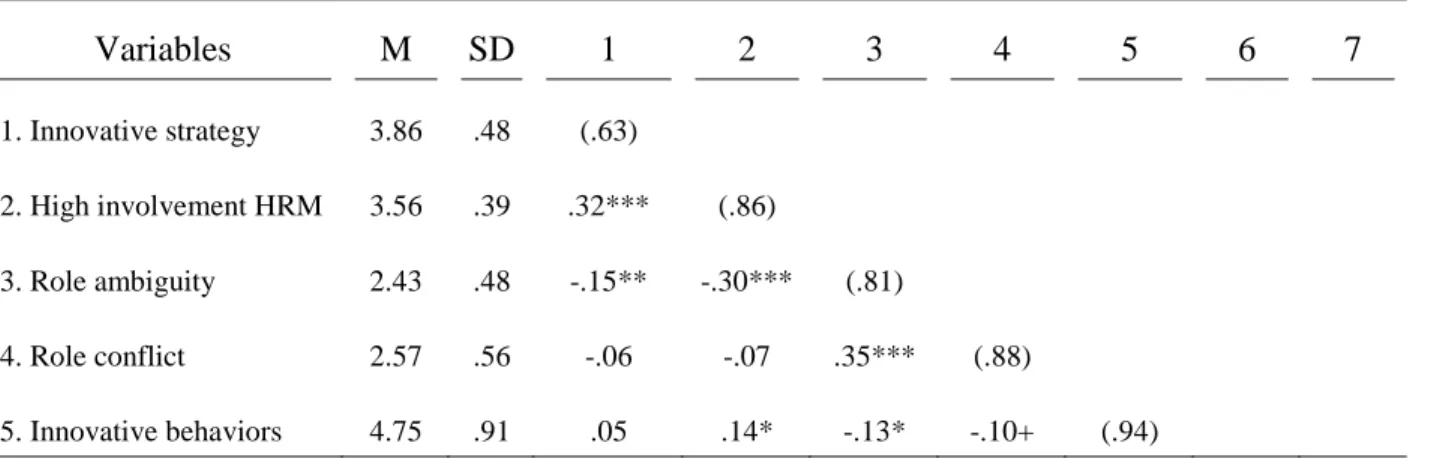
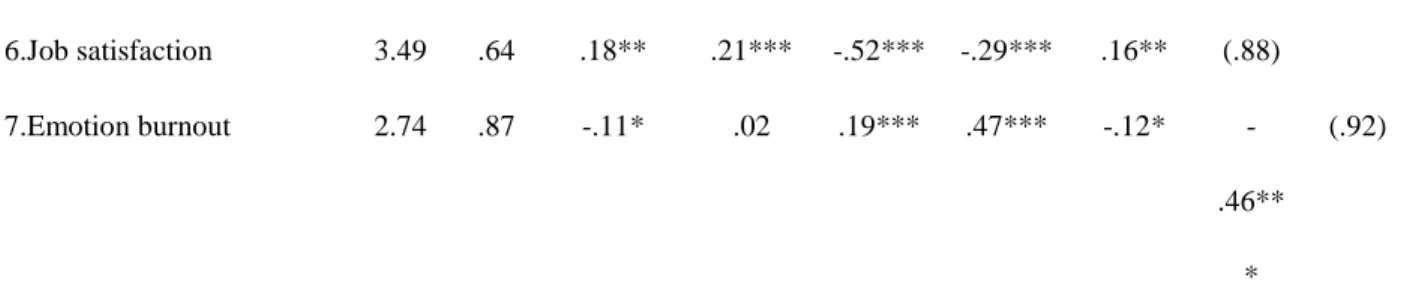
The descriptive statistics, reliability estimates, and correlations were shown in Table1. We found high involvement HRM was significantly correlated to individual innovative behaviors (r =.14, p<.05) and job satisfaction (r =.21, p<.001), but no significantly related to emotion burnout (r =.02, n.s.). Role ambiguity was significantly correlated to individual innovative behaviors (r =.13, P<.05), job satisfaction (r = -.52, p<.001) and emotion burnout (r =.19, p<.001). Further, Role conflict was significantly correlated to individual innovative behaviors (r =-.10, p<.10), job satisfaction (r = -.29, p<.001) and emotion burnout (r =.47, p<.001).
Table 1: Descriptive statistics, reliability coefficients, and correlation coefficients at individual level
Variables M SD 1 2 3 4 5 6 7 1. Innovative strategy 3.86 .48 (.63) 2. High involvement HRM 3.56 .39 .32*** (.86) 3. Role ambiguity 2.43 .48 -.15** -.30*** (.81) 4. Role conflict 2.57 .56 -.06 -.07 .35*** (.88) 5. Innovative behaviors 4.75 .91 .05 .14* -.13* -.10+ (.94)
6.Job satisfaction 3.49 .64 .18** .21*** -.52*** -.29*** .16** (.88)
7.Emotion burnout 2.74 .87 -.11* .02 .19*** .47*** -.12*
-.46** *
(.92)
Note: a. Cronbach’s alphas appear in parentheses along the diagonal. b. N= 347. “+” p<.10, “*” p<.05, “**” p<.01, “***” p<.001
c. Innovative strategy and high involvement HRM were assigned to individuals of the same variables to calculate the individual-level correlations.
Moderating effects of innovative strategy
Hypothesis 2a proposed that innovative strategy moderated the relationship between high involvement HRM and role ambiguity. The results of model 1 in Table 2 identified that the interaction of high involvement HRM and innovative strategy was significantly negative related to role ambiguity (γ= -.63, p <.01). Therefore, Hypothesis 2a was supported. We plotted this negative moderating effect and conducted simple slope test ([2]). Figure 1 showed that with high innovative strategy (1 standard deviation above the mean), high involvement HRM was
negatively related to role ambiguity (γ= -.63, p<.01), whereas when innovative strategy was low (1 standard deviation below the mean), the relationship between them was non-significant (γ= -.03, n.s.).
Table 2: Hierarchical Linear Modeling Results: Main and Interactive Effects Role
Ambiguity
Role Conflict
Innovative
behaviors Job satisfaction Emotion burnout
Variables Model1 Model2 Model3 Model4 Model5 Model6 Model7 Model8
Intercept 2.99*** 2.42*** 4.56** * 4.45** * 3.83** * 3.38*** 2.57** * 2.84** * Level 1 control variables
Age -.01+ -.00 .01 .01 .00 .01 -.01 -.01 Education .04 .06+ .07 .08 -.06* -.06 .03 .00 Tenure .01 .01 -.01 -.00 .00 .00 .02* .01 Role ambiguity -.18* -.63*** .37** Role conflict -.04 -.27*** .72*** Level 2 independent variables SBU size -.08+ -.01 .39*** .38*** .06 .12** -.07 -.07 Organization tenure -.12 .03 -.70** -.63*** -.23+ -.18 .43+ .30
High involvement HRM -.33*** -.17+ .28 .32+ .08 .31** -.19 .02 Innovative strategy .00 -.02 IH × IS -.63* -.62* n (level 1) 347 347 347 347 347 347 347 347 n (level 2) 62 62 62 62 62 62 62 62 Model deviancea 419.30 578.97 820.77 822.49 572.72 628.31 828.51 722.87
Notes: a. in all model, level 2 variables were grand-mean centered. Entries corresponding to the predicting variables are estimations of the fixed effects, γs, with robust standard errors.
b. IH= high involvement, IS=innovative strategy.
c. a= deviance is a measure of model fit; the smaller the deviance is, the better the model fit. Deviance = -2×log-likelihood of the full maximum--2×log-likelihood estimate.
d. Control variables: L1: age, education, tenure, and social desirability, L2: SBU size and Organization tenure. e. “+” p<.10, “*” p<.05, “**” p<.01, “***” p<.001
Hypothesis 2b stated that innovative strategy moderates the relationship between high
involvement HRM and role conflict. As expected, the results of model 2 in Table 2 showed that interaction of high involvement HRM and innovative strategy was significantly related to role conflict (γ= -.62, p <.01). Therefore, Hypothesis 1b was supported. We generated Figure 2 to graphically present this negative moderating effect. It indicated that high involvement HRM was negative related to role conflict (γ= -.47, p<.01) with high innovative strategy (1 standard deviation above the mean), whereas when innovative strategy was low (1 standard deviation below the mean), the relationship became positive relation but non-significant (γ=.13, n.s.).
Figure2: Interaction effect of HRM practices and strategy on role conflict
Moderated indirect effects by innovative strategy
Hypotheses 3a predicted that innovative strategy would positively moderated the indirect effect of high involvement HRM on innovative behaviors, job satisfaction and emotion burnout via role ambiguity. [30] procedure was used to examine whether the moderated indirect relationship (i.e., the first-stage moderation model) were significant. The moderated path analytic procedure showed that the link from the high involvement HRM to role ambiguity and then to innovative behaviors varied significantly as a function of the innovative strategy (i.e., the first stage moderation). Specifically, the simple slope of the indirect relationship that the high involvement HRM had with innovative behaviors via role ambiguity was significant (simple slope = .11, p<.05) when the innovative strategy was high, but non-significant (simple slope= .01, n.s.) when it was low. The difference in the simple slope was significant (△γ= .10, p<.05). Further, the moderated path analytic procedure also showed that the indirect effect of high involvement HRM on job satisfaction via role ambiguity was significant (simple slope=.39, p<.01) when innovative strategy was high, but non-significant (simple slope= .01, n.s.) when innovative strategy was low. The difference in the indirect effects of high involvement HRM was significant (△γ=.38, p <.01). Finally, the result also indicate that the indirect effect of high involvement HRM on emotion burnout via role ambiguity was significant (simple slope = -.23, p < .05) under high innovative strategy, whereas it was non-significant (simple slope = -.01, n.s.) under low innovative strategy. Overall, the difference in the indirect effects of high involvement HRM was significant (△γ= -.22, p <.05).Thus, Hypothesis 2a wassupported.
In addition, hypotheses 2b predicted that innovative strategy would negatively moderated the indirect effect of high involvement HRM on innovative behaviors, job satisfaction and emotion burnout via role conflict. We also according to the moderated path analysis approach to test the
hypothesis ([30]). The results revealed the indirect effect of high involvement HRM on innovative behaviors via role conflict was significant (simple slope = .02, p < .05) when innovative strategy was high, but non-significant (simple slope = -.005, n.s.) when innovative strategy was low. The difference in the indirect effects of high involvement HRM was significant (△γ= .025, p <.05). The results also indicated that the indirect effect of high involvement HRM on job satisfaction via role conflict was significant (simple slope = .13, p < .01) under high innovative strategy, whereas it was slightly significant (simple slope = -.03, p < .10) under low innovative strategy. Overall, the difference in the indirect effects of high involvement HRM was significant (△γ=.16, p <.01). Further, the results also indicated that the indirect effect of high involvement HRM on emotion burnout via role conflict was significant (simple slope = -.34, p < .01) under high innovative strategy, whereas it was slightly -significant (simple slope = .09, p < .10) under low innovative strategy. Overall, the difference in the indirect effects of high involvement HRM was significant (△γ= -.43, p <.01).Thus, Hypothesis 2b was supported.
DISCUSSIONS
Crucial to a firm’s growth and prosperity is the ability to gain and retain competitive advantage. One way to do this is through organizational strategic initiative and it is done through their on HRM practices. Strategy focus determines which HRM practices are needed for implementation to be successful. According to contingency perspective, the fit between strategy and HRM practices promote organizational to success. Further, organizational strategy and HRM practices transfer to a series of role behavior expectation requirement. Employees’ behaviors are actual best when they perform as needed role behaviors. The important potential dysfunction for employee in organization is role ambiguity and role conflict. The study standing these viewpoints to examine the fit between strategy and HRM practices can influence employee perceptions as role ambiguity and role conflict. As a sample of 347 members and 62 SBU managers of 62 SBUs, the study identified that innovative strategy negatively moderated the relationship between high-involvement HRM and role ambiguity. When the innovative strategy is high match with high high-involvement HRM practices, it was called as fit, employees’ role ambiguity is lowest. Further, when the innovative strategy is high match with low high-involvement HRM practices, it was called as not fit, employees’ role ambiguity is highest. But, employees’ role ambiguity is slightly higher under the fit between low innovative strategy and low high-involvement HRM practices than under not fit between low innovative strategy and high high-involvement HRM practices. Although this part is not consistent with hypothesis, the study still believed the assumption that not fit condition causes higher role ambiguity than fit condition according by contingency theoretical framework of strategy and HRM ([75] [77]). It means more empirical study is needed.
Furthermore, the study also identified that innovative strategy negatively moderated the relationship between high-involvement HRM and role conflict. Employees’ role conflict is lower under the fit between high innovative strategy and high high-involvement HRM practices than under the not fit between high innovative strategy and low high-involvement HRM practices. Further, Employees’ role conflict is lower under the fit between low innovative strategy and low high-involvement HRM practices than under the not fit between low innovative strategy and
high high-involvement HRM practices. This finding demonstrated previous research proposition that congruous of organizational variables are associated with lower levels of role ambiguity and role conflict than incongruous patterns of those variables ([75] [77]).
The view from organizational behavior of stress literature, organizations need to understand what factor would cause employee stress and reduce work place stressors, because stress can be a major threat at both the individual and system levels ([6] [21]). In the line with the adage that “prevention is better than cure” ([22]), the more stable and consistent work environment, the more likely employees will feel capable of coping with their work demands successfully. The study proposed that the fit between organizational innovative strategy and high-involvement HRM practices can be seen as a situation stressor which employee faced. This stressor of fit and not fit situation would cross-down influence employees’ stress perception of role ambiguity and role conflict.
In addition, the study also identified role ambiguity and role conflict are important mediating mechanisms between the fit of innovative strategy and high-involvement HRM practices and individual outcomes which including as innovative behaviors, job satisfaction, and emotion burnout. The study findings showed that when innovative strategy and high-involvement HRM practices is fit which positively related to innovative behaviors and job satisfaction via role ambiguity and which negatively related to emotion burnout via role ambiguity. The study also showed that when innovative strategy and high-involvement HRM practices is fit which positively related to innovative behaviors and job satisfaction via role conflict and which negatively related to emotion burnout via role conflict. These findings are corresponding to the assertion according to stress theoretical framework, role ambiguity and role conflict are important mediating processes between the organizational stressors and outcomes form psychological literatures ([41] [47]). As a novelty, we proposed the variable of fit pattern between innovative strategy and high-involvement HRM practices as an antecedent from SHRM literatures try to links to the relationship between role ambiguity and role conflict and outcomes from traditional OB literatures. This finding also consist to past research said the study result can increase to understand the “black box” between HR practices and performance ([16] [62] [63] [64]).
Theoretical contributions
Our findings contribute to SHRM research and theory in a number of important ways. First, although a number of scholars have suggested that some mediating variables to link the relationship between HR practices and performance ([12] [29] [39] [87]), the study proposed role ambiguity and role conflict are key mediating roles in the relationship between HR practice and performance. Our finding suggested role ambiguity and role conflict are key mediating processes in the relationship between the congruous pattern between innovative strategy and HRM practices, and individual outcomes as innovative performance, job satisfaction, and emotion burnout. The study findings offer an available answer to release the “black box” of how the relationship between HRM practices and outcomes is work.
Second, the study adopts role theory from OB literatures and proposed role ambiguity and role conflict as a mediating role in the relationship between HRM practices and outcomes. The linkage between the congruous of innovative strategy and high-involvement HRM practices and
role stress perception of role ambiguity and role conflict elicits a number of interesting questions about the SHRM process, and illustrate the potential for integrating OB theories/ literatures into the SHRM literature.
Third, several researcher have suggested most research about the relationship between HRM practices and outcomes are at organizational level, but multi-level research is rare which is limited understanding the scope of SHRM framework ([16] [84]). The study broaden SHRM literatures from the exploration of the congruous between innovative strategy and high-involvement HRM practices as situation with represent to higher level (as SBU level) which cross-down influence the perception of employee as role ambiguity and role conflict with represent to lower level (as individual level).
Limitations and suggestions for future research
Although the present investigation adds to our understanding of the fit between innovative strategy and high-involvement HRM practices and subsequent employee perceptions and behavioral outcomes, limitations do exist.
First, cross-sectional design with self-reported data to assess our hypothesis is in the study. This design element limits our ability to make causal assertions about links between the congruous pattern of innovative strategy and high-involvement HRM practices and subsequent outcomes. Future research may use a temporally lagged design and collect independent and dependent variables at different times, enabling clarification of the lines of causality.
Second, self-reported data may suffer from the halo effect ([69]). However, recent research suggests that self-reported data are not as limited as commonly expected ([9]).
Third, common method variance is a potential problem due to some studied variables emerged from the same survey instrument. However, the variables of innovative strategy and high-involvement HRM practices were measured by SBU manager, and every employee’s innovative performance was also evaluated by SBU manager. This may decrease the probability of common method variance.
REFERENCES
[1] Agho, A. O., Price, J. L., & Mueller, C. W. Discriminant Validity of Measures of Job Satisfaction, Positive Affectivity and Negative Affectivity. Journal of Occupational and Organizational Psychology, 1992, 5, 185-196.
[2] Aiken, L. S., & West, S. G. Multiple Regression: Testing and Interpreting Interactions. Newbury Park, CA: Sage, 1991.
[3] Arthur, J. B. The Link between Business Strategy and Industrial Relations Systems in American Steel Mini-Mills. Industrial and Labor Relations Review, 1992, 45, 488-506.
[4] Arthur, J. B. Effects of Human Resource Systems on Manufacturing Performance and Turnover. Academy of Management Journal, 1994, 37, 670-687.
[5] Ashforth, B. K., & Saks, A. M. Socialization Tactics: Longitudinal Effects on Newcomer Adjustment. Academy of Management Journal, 1996, 39, 149-178.
[6] Avey, J. B., Luthans, F., & Jensen, S. M. Psychological Capital: A Positive Resource for Combating Employee Stress and Turnover. Human Resource Management, 2009, 48, 677-693. [7] Baba, V. V., & Jamal, M. Routinization of Job Context and Job Content as Related Employees’ Quality of Working Life: A Study of Canadian Nurse. Journal of Organizational Behavior, 1991, 12, 379-386.
[8] Bae, J., & Lawler, J. J. Organizational and HRM Strategies in Korea: Impact on Firm Performance in an Emerging Economy. Academy of Management Journal, 2000, 43, 502-517. [9] Balzer, W. K., & Sulky, L. M. Halo and Performance Appraisal: A Critical Examination. Journal of Applied Psychology, 1992, 77, 975-985.
[10] Barber, C. E., & Iwai, M. Role Conflict and Role Ambiguity as Predictors of Burnout among Staff Caring for Elderly Dementia Patients. Journal of Gerontological Social Work, 1996, 26, 101-116.
[11] Batt, R. Managing customer services: Human Resource Practices, Quit Rates, and Sales Growth. Academy of Management Journal, 2002, 45, 587-597.
[12] Becker, B., & Gerhart, B. Special Research Forum: Human Resource Management and Organizational Performance. Academy of Management Journal, 1996, 39, 777-985.
[13] Beehr, T. A., & Newman, J. E. Job Stress, Employee Health, and Organizational Effectiveness: A Facet Analysis, Model, and Literature Review. Personnel Psychology, 1978, 31, 665-699.
[14] Binyamin, G., & Carmeli, A. Does Structuring Of Human Resource Management Processes Enhance Employee Creativity? The Mediation Role of Psychological Availability. Human Resource Management, 2010, 49, 999-1024.
[15] Bird, A., & Beechler, S. Links between Business Strategy and Human Resource Management Strategy in U.S.-Based Japanese Subsidiaries: An Empirical Investigation. Journal of International Business Studies, 1994, 26, 23-46.
[16] Bowen, D. E., & Ostroff, C. Understanding HRM-Firm Performance Linkages: The Role of the “Strength” of the HRM System. Academy of Management Review, 2004, 29, 203-221.
[17] Camps, J., & Luna-Arocas, R. High Involvement Work Practices and Firm Performance. International Journal of Human Resource Management, 2009, 20, 1056-1077.
[18] Chang, W. A., & Huang, T. C. Relationship between Strategic Human Resource Management and Firm Performance: A Contingency Perspective. International Journal of Management, 2005, 26, 434-449.
[19] Clazer, S., & Beehr, T. A. Consistency of Implications of Three Role Stressors across Four Countries. Journal of Organizational Behvaior, 2005, 26, 467-487.
[20] Coelho, F., Augusto, M., & Lages, L. F. Contextual Factors and the Creativity of Frontline Employees: The Mediating Effects of Role Stress and Intrinsic Motivation. Journal of Retailing, 2011, 87, 31-45.
[21] Colligan, T. W., & Higgins, E. M. Workplace Stress: Etiology and Consequence. Journal of Workplace Behavioral Health, 2006, 21, 89-97.
[22] Cooper, C. L. & Cartwright, S. Health Mind; Healthy Organization: A Proactive Approach to Occupational Stress. Human Relation, 1994, 47, 455-471.
[23] Cooper, C. L., & Marshall, J. Occupational Sources of Stress: A Review of the Literature Relating to Coronary Heart Disease and Mental Ill Health. Journal of Occupational Psychology, 1976, 49, 11-28.
[24] Crane, S. J., & Iwanicki, E. F. Perceived Role Conflict, Role Ambiguity, and Burnout among Special Education Teachers. Remedial and Special Education, 1986, 7, 24-31.
[25] Datta, D. K., Guthrie, J. P., & Wright, P. M. Human Resource Management and Labor Productivity: Does Industry Matter?. Academy of Management Journal, 2005, 48, 135-145. [26] Delaney, J. T., & Huselid, M. A. The Impact of Human Resource Management Practices on Perception of Organizational Performance. Academy of Management Journal, 1996, 39, 949-969.
[27] Delery, J. E. Issue of Fit in Strategic Human Resource Management: Implications for Research. Human Resource Management Review, 1998, 8, 289-309.
[28] Delery, J. E., & Doty, D. H. Modes of Theorizing in Strategic Human Resource Managemenet: Tests of Universalistic, Contingency, and Configurational Performance Predictions. Academy of Management Journal, 1996, 39, 802-835.
[29] Dyer, L., & Reeves, T. Human Resource Strategies and Firm Performance: What Do We Know and Where for We Need to Go? International Journal of Human Resource Management, 1995, 6, 656-670.
[30] Edwards, J. R., & Lambert, L. S. Methods or Integrating Moderation and Mediation: A General Analytical Framework Using Moderated Path Analysis. Psychological Methods, 2007, 12, 1-22.
[31] Evans, W. R., & Davis, W. D. High-Performance Work Systems and Organizational Performance: The Mediating Role of Internal Social Structure, Journal of Management, 2005, 31, 758-775.
[32] Ferris, G. R., Arthur, M. M., Berkson, H. M., Kaplan, D. M., Harrell-Cook, G., & Frink, D. D. Toward a Social Context Theory of the Human Resource Management Organization Effectiveness Relationship. Human Resource Management Review, 1998, 8, 235-264.
[33] Fisher, C. D., & Gitelson, R. (1983). A Meta-Analysis of the Correlations of Role Conflict and Ambiguity. Journal of Applied Psychology, 1983, 68, 320-333.
[34] Funder, D. C. On the Accuracy of Dispositional vs. Situational Attributions. Social Cognition, 1982, 1, 205-222.
[35] Gaither, C. A., Kahaleh, A. A., Doucette, W. R., Mott, D. A., Pederson, C. A., & Schommer, J. C. A Modified Model of Pharmacists’ Job Stress: The Role of Organizational, Extra-Role, and Individual Factors on Work-Related Outcomes. Administrative Pharmacy, 2008, 4, 231-243. [36] Gilbert, C., Winne, S. D., & Sels, L. Antecedents of Front-Line Managers’ Perceptions of HR Role Stressors. Personnel Review, 2011, 40, 549-569.
[37] Gilboa, S., Shirom, A., Fried, Y., & Cooper, C. A Meta-Analysis of Work Demand Stressors and Job Performance: Examining Main and Moderating Effects. Personnel Psychology, 2008, 61, 227-271.
[38] Gladstein, D. L., Groups in Context: A Model of Task Group Effectiveness. Administrative Science Quarterly, 1984, 29, 499-517.
[39] Guest, D. E. Human Resource Management and Performance: A Review and Research Agenda. International Journal of Human Resource Management, 1997, 8, 263-276.
[40] Guthrie, J. High-Involvement Work Practices, Turnover and Productivity: Evidence from New Zealand. Academy of Management Journal, 2001, 44, 180-192.
[41] House, R. J., & Rizzo, J. R. Role Conflict and Ambiguity as Critical Variables in a Model of Organizational Behavior. Organizational Behavior and Human Performance, 1972, 7, 467-505. [42] Huselid, M. A. The Impact of Human Resource Management Practices on Turnover, Productivity, and Corporate Financial Performance. Academy of Management Journal, 1995, 38, 635-672.
[43] Huselid, M. A., & Becker, B. E. Methodological Issues in Cross-Sectional and Panel Estimates of the Human Resource Management-Firm Performance Link. Industrial Relations, 1996, 35, 400-422.
[44] Ichniowski, C., Shaw, K., & Prennushi, G. The Effect of Human Resource Management Practices on Productivity: A Study of Steel Finishing Lines. American Economic Review, 1997, 87, 291-313.
[45] Jackson, S. E., & Schuler, R. S. A Meta-Analysis and Conceptual Critique of Research of Role Ambiguity and Role Conflict in Work Setting. Organizational Behavior and Human Decision Processes, 1985, 36, 16-78.
[46] Jones, E., Chonko, L., Rangarajan, D., & Roberts, J. The Role of Overload on Job Attitudes, Turnover Intentions, and Salesperson Performance. Journal of Business Research, 2007, 60, 663-671.
[47] Kahn, R. L., Wolfe, D. M., Quinn R. P., & Snoek, J. D. Organizational Stress: Studies in Role Conflict and Ambiguity. Robert E: Krieger Publishing Company, Florida, 1964.
[48] Katz, D., & Kahn, R. L. The social psychology of organizations (2nd ed.), New York: John Wiley, 1978.
[49] Lawler, E. The Ultimate Advantage: Creating the High-Involvement Organization. San Francisco: Jossey-Bass, 1992.
[50] Lazarus, R. S. Psychological Stress and the Coping Process. New York: McGraw-Hill, 1966. [51] Lazarus, R. S. From Psychological Stress to The Emotions: A History of Changing Outlook. Annual Review of Psychology, 1993, 44, 1-21.
[52] Lazarus, R. S., & Folkman, S. Stress, Appraisal, and Coping. New York: Springer, 1984. [53] Leung, K., Huang, K. L., Su, C. H., & Lu, L. Curvilinear Relationship between Role Stress and Innovative Performance: Moderating Effects of Perceived Support for Innovation. Journal of Occupational and Organizational Psychology, 2011, 84, 741-758.
[54] Levine, D. Reinventing the Workplace: How Business and Employers Can Both Win. Washington, DC: Brookings Istitution, 1995.
[55] Maslach, C., Jackson, S. E. The Measurement of Experienced Burnout. Journal of Occupational Behavior, 1981, 2, 99-113.
[56] Mathieu, J. E., DeShon, R. P., & Bergh, D. D. Mediational Inferences in Organizational Research. Organizational Research Methods, 2008, 11, 203-223.
[57] Miles, R. H. An Empirical Test of Causal Inference between Role Perceptions of Conflict and Ambiguity and Various Personal Outcomes. Journal of Applied Psychology, 1976, 59, 330-334.
[58] Mohr, A. T., & Puck, J. F. Role Conflict, General Manager Job Satisfaction and Stress and the Performance of IJVs. European Management Journal, 2007, 25, 25-35.
[59] Motowidlo, S., & Van Scotter, J. R. Evidence that Task Performance Should Be Distinguished from Contextual Performance. Journal of Applied Psychology, 1994, 79, 475-480. [60] Netemeyer, R. G., Johnston, M. W., & Burton, S. Analysis of Role Conflict and Role Ambiguity in a Structural Equations Framework. Journal of Applied Psychology, 1990, 75, 148-157.
[61] Ngo, H. Y., Foley, S., & Loi, R. Work Role Stressors and Turnover Intentions: A Study of Pressional Clergy in Hong Kong. International Journal of Human Resource Management, 2005, 161, 2133-2146.
[62] Nishii, L. H., & Lepak, B. S. Employee Attributions of the “Why” of HR Practices: Their Effects on Employee Attitudes and Behaviors, and Customer Satisfaction. (CAHRS Working Paper). Ithaca, NY: Cornell University, School of Industrial and Labor Relations, Center for Advanced Human Resource Studies, 2008.
[63] Nishii, L. H., & Wright, P. M. Variability within Organizations: Implications for Strategic Human Resource Management. (CAHRS Working Paper). Ithaca, NY: Cornell University, School of Industrial and Labor Relations, Center for Advanced Human Resource Studies, 2007. [64] Ostroff, C., & Bowen, D. E. Moving HR to A Higher Level: Human Resource Practices and Organizational Effectiveness. In K. J. Klein & S. W. J. Kozlowski (Eds.), Multilevel Theory, Research, and Methods in Organizations (pp. 211-266). San Francisco: Jessey-Bass, 2000.
[65] Parker, D. F., & DeCotiis, T. A. Organizational Determinants of Job Stress. Organizational Behavior and Human Performance, 1983, 32, 160-177.
[66] Parasuramn, S., & Alutto, J. A. Source and Outcomes of Stress in Organizational Settings: Toward the Develop of a Structure Model. Academy of Management Journal, 1984, 27, 330-350. [67] Pelham, A. M., Wilson, D. T. A Longitudinal Study of the Impact of Market Structure, Firm Structure, Strategy, and Market Orientation Culture on Dimensions of Small-Firm Performance. Journal of the Academy of Marketing Science, 1996, 24, 27-43.
[68] Pines, A., & Maslach, C. Characteristics of Staff Burnout in Mental Health Settings. Hospital & Community Psychiatry, 1978, 29, 233-237.
[69] Posakoff, P. M., & Organ, D. W. Self-Reports in Organizational Research: Problems And Prospects. Journal of Management, 1986, 12, 531-544.
[70] Raudenbush, S. W., Bryk, A. S., Cheong, Y. F., & Congdon, R. Hierarchical Linear and Nonlinear Modeling. Chicago, IL: Scientific Software International, 2004.
[71] Rizzo, J. L., House, R. J., & Lirtzman, S. Role Conflict and Ambiguity in Complex Organizations. Administrative Science Quarterly, 1970, 15, 150-169.
[72] Salancik, G. R., & Pfeffer, J. A Social Information Processing Approach to Job Attitudes and Task Design. Administrative Science Quarterly, 1978, 23, 224-253.
[73] Schneider, B. Organizational Behavior. Annual Review of Psychology, 1985, 36, 573-611. [74] Schuler, R. S. Role Conflict and Ambiguity as a Function of the Task-Structure-Technology Interaction. Organizational Behavior and Human Performance, 1977, 20, 66-74.
[75] Schuler, R. S. Strategic Human Resource Management and Industrial Relations. Human Relations, 1989, 42, 157-184.
[76] Schuler, R. S., & Jackson, S. E. Organizational Strategy and Organization Level as Determinants of Human Resource Management Practices. Human Resource Planning, 1987a, 10, 125-141.
[77] Schuler, R. S., & Jackson, S. E. Linking Competitive Strategies with Human Resource Management Practices. Academy of Management Executive, 1987b, 1, 207-219.
[78] Schuler, R. S., & Jackson, S. E. Understanding Human Resource Management in the Context of Organizations and Their Environment. Annual Review of Psychology, 1995, 46, 237-264.
[79] Schwab, R. L., & Iwanicki, E. F. Perceived Role Conflict, Role Ambiguity, and Teacher Burnout. Educational Administration Quarterly, 1982, 18, 60-74.
[80] Scott, S. G., & Bruce, R. A. Determinants of innovative behavior: A path model of individual innovation in the workplace. Academy of Management Journal, 1994, 37, 580-607. [81] Shaw, M., & Costanzo, P. Theories of Social Psychology (2nd ed.). New York: McGraw-Hill, 1982.
[82] Sherif, M., & Sherif, C. W. Groups in Harmony and Tension: An Integration of Studies of Intergroup Relations. Oxford, England: Harper & Brothers, 1953.
[83] Van Sell, M., Brief, A. P., & Schuler, R. S. Role Conflict and Ambiguity: Integration of the Literature and Direction for Future Research. Human Relations, 1981, 34, 43-91.
[84] Wright, P. M., & Nishii, L. H. Strategic HRM and Organizational Behavior: Integrating Multiple Levels of Analysis. (CAHRS Working Paper). Ithaca, NY: Cornell University, School of Industrial and Labor Relations, Center for Advanced Human Resource Studies, 2007.
[85] Wright, P. M., & Snell, S. A. Toward an Integrative View of Strategic Human Resource Management. Human Resource Management Review, 1991, 1, 203-225.
[86] Wright, P. M., & Snell, S. A. Toward a Unifying Framework for Exploring Fit and Flexibility in Strategic Human Resource Management. Academy of Management Review, 1994, 23, 756-772.
[87] Wright, P. M., Gardner, T. M., & Moynihan, L. The Impact of Human Resource Practices on Business Unit. Human Resource Management Journal, 2003, 21-36.
[88] Wright, P. M., Mccormick, B., Sherman, W. S., & McMahan, G. C. The Role of Human Resource Practices in Petrochemical Refinery Performance. International Journal of Human Resource Management, 1999, 10, 551-571.
[89] Wright, P. M., McMahan, G. C., & McWilliams, A. Human Resources and Sustained Competitive Advantage: A Resource-Based Perspective. International Journal of Human Resource Management, 1994, 5, 301-326.
[90] Youndt, M., Snell, S., Dean, J., & Lepak, D. Human Resource Management, Manufacturing Strategy, and Firm Performance. Academy of Management Journal, 1996, 39, 836-866.
日期:2015/11/10
科技部補助計畫
計畫名稱: 高涉入人力資源管理活動與創新策略契合、角色壓力與員工反應:一個跨層 次研究 計畫主持人: 黃家齊 計畫編號: 102-2410-H-004-149-SS2 學門領域: 人力資源管理無研發成果推廣資料
計畫主持人:黃家齊 計畫編號:102-2410-H-004-149-SS2 計畫名稱:高涉入人力資源管理活動與創新策略契合、角色壓力與員工反應:一個跨層次研究 成果項目 量化 單位 備註(質化說明 :如數個計畫共 同成果、成果列 為該期刊之封面 故事...等) 實際已達成 數(被接受 或已發表) 預期總達成 數(含實際 已達成數) 本計畫實 際貢獻百 分比 國內 論文著作 期刊論文 0 0 100% 篇 研究報告/技術報告 0 0 100% 研討會論文 0 0 100% 專書 0 0 100% 章/本 專利 申請中件數 0 0 100% 件 已獲得件數 0 0 100% 技術移轉 件數 0 0 100% 件 權利金 0 0 100% 千元 參與計畫人力 (本國籍) 碩士生 0 0 100% 人次 博士生 0 0 100% 博士後研究員 0 0 100% 專任助理 0 0 100% 國外 論文著作 期刊論文 0 1 100% 篇 研究報告/技術報告 1 1 100% 研討會論文 1 1 100% 專書 0 0 100% 章/本 專利 申請中件數 0 0 100% 件 已獲得件數 0 0 100% 技術移轉 件數 0 0 100% 件 權利金 0 0 100% 千元 參與計畫人力 (外國籍) 碩士生 0 0 100% 人次 博士生 0 0 100% 博士後研究員 0 0 100% 專任助理 1 1 100% 其他成果 (無法以量化表達之 成果如辦理學術活動 、獲得獎項、重要國 際合作、研究成果國 際影響力及其他協助 產業技術發展之具體 效益事項等,請以文 字敘述填列。) 在理論上,本研究填補了策略性人力資源管理跨層次研究的缺口,同時與壓力 理論結合,在理論上作出了明顯的貢獻。
科 教 處 計 畫 加 填 項 目 課程/模組 0 電腦及網路系統或工具 0 教材 0 舉辦之活動/競賽 0 研討會/工作坊 0 電子報、網站 0 計畫成果推廣之參與(閱聽)人數 0