
教師回饋對新竹縣國小六年級學童英文句型寫作影響之研究 - 政大學術集成
132
0
0
全文
(2) An Investigation into the Effects of Teacher Feedback on English Sentence Writing of Grade Six Elementary School Students in Hsin Chu County. A Master Thesis Presented to Department of English,. 學. National Chengchi University. Nat. n. al. er. io. sit. y. ‧. ‧ 國. 立. 政 治 大. Ch. engchi. i n U. v. In Partial Fulfillment Of the Requirements for the Degree of Master of Arts. by Shu-Fen Hsu March, 2013.
(3) To My Dear Parents & Ping-Huang Sheu, PhD. 獻給我親愛的爸媽及恩師許炳煌教授. 立. 政 治 大. ‧. ‧ 國. 學. n. er. io. sit. y. Nat. al. Ch. engchi. iii. i n U. v.
(4) Acknowledgments. It would not have been possible to finish the thesis without all the support and help of the generous people around me, to only some of whom it is possible to give particular mention here. First of all, I am thankful to my professor Ping-huang Sheu, who always guides. 政 治 大. me patiently and leads me to think in different perspectives. I am also grateful to. 立. dear committee members, Ming-chung Yu and Yi-ti Lin, for offering me great. ‧ 國. 學. advice and precious comments.. Secondly, I deeply appreciate the help from my dear colleague, Lee-ron Wong. ‧. for changing the teaching schedule and handling all the students during the. y. Nat. sit. experimental process. I also thank the enormous help of my dear brother-in-law,. n. al. er. io. Duan-ren Lee for the statistic counseling.. i n U. v. Finally, my sincere thanks to my dear parents, Yin-fu Hsu and Mei-yu Chang,. Ch. engchi. this thesis is the result of your support and encouragement. Special love and thanks must go to my dear husband, Ren-hong Wang, who always believe in me.. iv.
(5) Table of Contents Dedication Page………………………………………………………………………iii Acknowledgments……………………………………………………………………iv Table of Contents……………………………………………………………………..v List of Tables……………………………………...………..……………...…...….....viii List of Figures……………………………………………...……………….…...….…ix Chinese Abstract…………………………………………………………..……..……x English Abstract…………………………………..…………..…………..………......xi Chapter One: Introduction…………………………………………………………….1. 政 治 大. Background and Motivation…………………………………………………….1. 立. Purpose of the Study……………………………………………………………5. ‧ 國. 學. Research Questions……………………………………….…………………….7. ‧. Definition of Terms……………………………………….……………………..8 Significance of the Study………………………………………………………10. y. Nat. io. sit. Chapter Two: Literature Review……………………………………………………...13. n. al. er. The Concept of Writing………………………………………………………..13. Ch. i n U. v. Writing Models………………………………………………………….15. engchi. Writing Pedagogy in Taiwan……………………………………………20 Grammatical Errors and Corrections ………………………………………….22 Common Grammatical Errors in EFL Writing …………………………23 Different Correction Ways of Grammatical Errors……………………..26 Teacher feedback ……………………………………………………………...29 The Concept of Teacher feedback……………….………………...……29 The Error-oriented Feedbacks…………………………………………..30 The Content-oriented Feedbacks………………………………..………32 The Combination of Two Feedback Types……………………...………33 v.
(6) Different Teacher Feedback Formats………………………...…………35 Related Studies on Teacher Feedback…………………………………………38 Studies in ESL Context…………………………………………..…..……39 Studies in EFL Context……………………….………….…………….….43 Studies Related to Students’ Attitudes…….………….…………….……..47 Chapter Summary……………………………………………………….………49 Chapter Three: Methodology………………………………………………………...51 Participants……………………………………...…………………….……….51 Instrument…………………………………………..………………………….52. 政 治 大. English Writing Proficiency Test (EWPT) ………………………………52. 立. English Learning Attitudes Questionnaire (ELAQ) ……………………..57. ‧ 國. 學. Procedures..…………………………………………………….……………...60. ‧. Treatment………………………………………………………………………65 Five Targeted Errors……………………………………………………...65. y. Nat. io. sit. Two Types of Teacher Feedback…………………………………………66. n. al. er. Data Analysis………………………………………………….………………..68. Ch. i n U. v. Chapter Four: Results………………..……………………………………………….69. engchi. The Effect of Indirect Teacher Feedback(IDF)…………………………………69 The Effect of Direct Teacher Feedback(DF)……………………………………73 The Comparison on Post- and Retention Test of IDF and DF Groups…...……..76 The Comparison of the Student Attitudes toward Two Feedback Types………..77 Chapter Five: Discussion…………………………………..……………...………….87 Research Question1: Did the DF group perform better in the post-EWPT than in the pre-EWPT? In addition, did the group perform better in the retention EWPT than in the post-EWPT? If yes, in what ways?....................................................................87 Research Question2: Did the DF group perform better in the post-EWPT than in vi.
(7) the pre-EWPT? In addition, did the group perform better in the retention EWPT than in the post-EWPT? If yes, in what ways? ……………...……………………………90 Research Question3: Did the IDF group and the DF group perform differently in the post EWPT? Besides, did the two groups perform differently in the retention EWPT? If yes, in what ways?......................................................................................91 Research Question4: Did the IDF group and the DF group express different attitudes toward the treatment? If yes, in what ways?.........………...…....………….92 Chapter Six: Conclusions………………………………………………...…………..97 Main Findings………………………………………………..............................97. 政 治 大. Pedagogical Implications…………………………..…………………………...97. 立. Limitation and Suggestions…………………………………...………………..99. ‧ 國. 學. References…………………………………………………………….……………..102. ‧. Appendixes………………………………………………………………..………...112 Appendix A: English Writing Proficiency Test………………...……………...113. y. Nat. io. sit. Appendix B: English Learning Attitudes Questionnaire (Chinese Version)......115. n. al. er. Appendix C: English Learning Attitudes Questionnaire (English Version).......117. Ch. i n U. v. Appendix D: Suggestions for English Writing Proficiency Test…………..…..119. engchi. Appendix E: Suggestions for English Learning Attitudes Questionnaire..........120 Appendix F: Essay Correction Code (ECC)……………….…………………..121. vii.
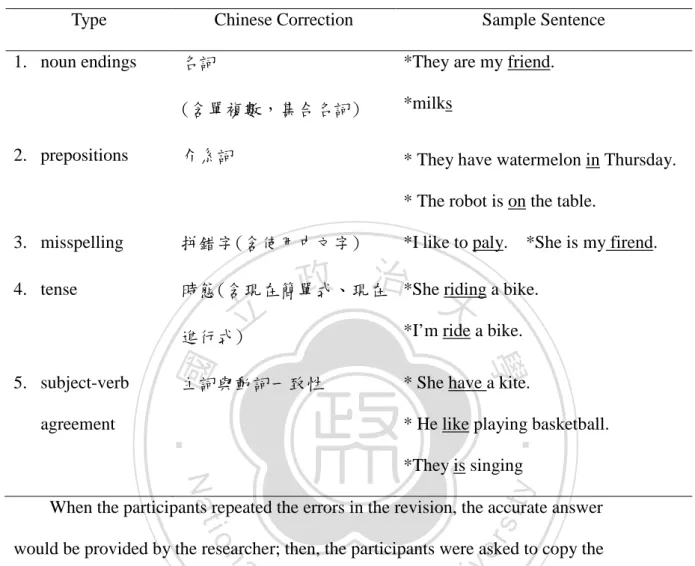
(8) List of Tables Table 1 Sample Questions of EWPT…………….………….…...……………...…….55 Table 2 A Correction Guide.…………………………..……………………………...62 Table 3 Paired T-Test on Pre- and Post-EWPT of IDF Group………….……......…...70 Table 4 Paired T-Test of Each Error Type on Pre- and Post-EWPT of IDF Group.......71 Table 5 Paired T-Test on Post- and Retention EWPT of IDF Group……………...…..72 Table 6 Paired T-Test of Each Error Type on Post- and Retention EWPT of IDF Group………………………………………………………………………….73 Table 7 Paired T-Test on Pre- and Post-EWPT of DF Group…………………............74. 政 治 大. Table 8 Paired T-Test on Post- and Retention EWPT of DF Group………….…….....74. 立. Table 9 Independent Sample T-Test on Post- Tests of IDF and DF groups……...…...76. ‧ 國. 學. Table 10 Independent Sample T-Test on Retention Tests of IDF and DF Groups…....77. ‧. Table 11 Independent Sample T-Test on Main Section of IDF and DF Groups…....…78 Table 12 Independent Sample T-Test on Section 1 of ELAQ of IDF and DF. y. Nat. io. sit. Groups…………………………………………………………..………..….79. n. al. er. Table 13 Independent Sample T-Test on Section 2 of ELAQ of IDF and DF Groups..80. Ch. i n U. v. Table 14 Independent Sample T-Test on Section 3 and 4 of ELAQ of IDF and DF. engchi. Groups……………………………………………………………………….82 Table 15 Independent Sample T-Test on Section 5 of ELAQ of IDF and DF Groups..83 Table 16 Independent Sample T-Test on Section 6 of ELAQ of IDF and DF Groups..84 Table 17 Independent Sample T-Test on Section 7 of ELAQ of IDF and DF Groups...............................................................................................................85. viii.
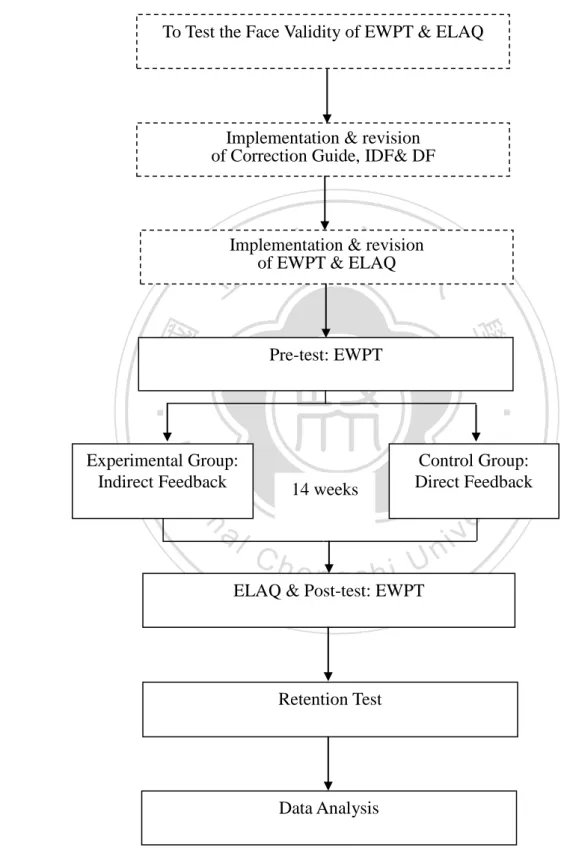
(9) List of Figures Figure 1 Flow Chart of the Study…………………………….……………..…….…..60 Figure 2 Revising Procedure of the Unsuccessful Revision………..……………...….62 Figure 3 A Sample of IDF………………………………...………..….………………67 Figure 4 A Sample of DF………………………………….……….……...….……….67. 立. 政 治 大. ‧. ‧ 國. 學. n. er. io. sit. y. Nat. al. Ch. engchi. ix. i n U. v.
(10) 國立政治大學英國語文學系碩士在職專班 碩士論文提要. 論文名稱: 教師回饋對新竹縣國小六年級學童英文句型寫作影響之研究. 指導教授: 許炳煌 博士. 研究生: 許淑芬. 立. 政 治 大. ‧ 國. 學. 論文提要內容:. ‧. 本研究在探討兩種不同教師回饋對新竹縣國小六年級學童英文句型寫. y. Nat. 作之影響以及此兩種回饋對學生英語學習態度與動機的影響。此研究以來自. er. io. sit. 新竹縣某國小六年級兩個班級學生為研究對象,此二班級隨機指派為實驗組 及控制組。實驗組實施習作批改時的間接回饋而對照組則實施傳統直接回. al. n. v i n 饋,每週均批改一次習作。經過 C h 14 週的回饋後,兩組皆進行英文句型寫作 engchi U 測驗並施以英語學習態度與動機問卷;3 週後再進行英文句型寫作延宕測. 驗。研究結果顯示,學生受過教師的間接回饋批改後在英文句型寫作之正確 率上有顯著進步,此顯著進步也表現在延宕測驗中的介系詞題型;但其對訂 正習作上錯誤則表現顯著焦慮。希望本研究能為英語老師在教學實務上提供 助益。. x.
(11) Abstract. The present study mainly aimed at investigating the effects of two different types of teacher feedback on English sentence writing accuracy. Meanwhile this paper also aimed at examining learners’ attitudes of the two different types of teacher feedback, and the changes of learners’ attitudes and motivation towards English learning after. 政 治 大. the implementation of different teacher feedbacks.. 立. Two sixth-grade classes in Hsin Chu County were randomly assigned to be. ‧ 國. 學. the experimental group and the control group. The experimental group received indirect feedback (IDF) on their workbook while the control group received. ‧. traditional direct feedback (DF) once a week. After the 14-week treatment, an. y. Nat. sit. English writing proficiency test and an English learning attitudes and motivation. n. al. er. io. questionnaire were administrated to examine learners’ sentence writing accuracy. i n U. v. and their learning attitudes and motivations respectively. Finally, a retention test. Ch. engchi. was conducted in 3 weeks later to know the retention effect of two types of teacher feedback. The findings showed that the IDF had helped students gained significant progress on sentence writing accuracy. Moreover, the significant improvement was also presented on the aspect of preposition in the retention test. However, the IDF group expressed significant anxiety towards correcting errors on workbooks after the treatment of IDF. Hopefully, the findings of the present study may provide English teachers with some useful pedagogical implications.. xi.
(12) CHAPTER ONE INTRODUCTION The study aimed at investigating the effects of different teacher feedbacks on students’ sentence writing performance and their attitudes. This chapter consists of four sections. The first section explains the background and motivation. The second section states the purpose of the study, followed by the research questions and the definition of terms; the significance of the study is listed out at the last section. Background and Motivation. 政 治 大 2000). Since writing requires a variety of skills, such as generating ideas, spelling 立. Writing is regarded as the most difficult language skill (Celce-Murcia & Olshtain,. ‧ 國. 學. words, completing sentences with accurate grammar and organizing information properly, writing becomes an uneasy task for learners (Martlew, 1983). Though writing. ‧. is hard work, it is important for communication (Kent, 2002). Writers need to integrate. sit. y. Nat. the above skills precisely; otherwise, the inaccurate writing may hinder the reader’s. io. er. understanding and cause the communication breakdown (Kent, 2002). While writing. al. v i n C h place while students effective grammar learning takes e n g c h i U receive teachers’ error n. with correct grammar is an essence of communication, it has been suggested that. correction on their writing works (Ferris, 1995b; Rahimi, 2008; Ehrlich & Zoltek, 2006; Santos, López-Serrano & Manchón, 2010). When learners access to teacher’s error correction and revise their grammatical errors accordingly, the grammatical knowledge thus will be learned (Chandler, 2003; Frantzen, 1995). In view of this, it is better to provide the teacher feedback on their grammatical errors (Chandler, 2003; Ehrlich & Zoltek, 2006;Ferris, 1997; 1999), and help students figure out the correct forms by themselves (Ferris, 2004), so that they can learn the accurate grammar usage better. 1.
(13) Although the important concept of offering error correction is widely known to primary school English teachers in Taiwan, most of their feedback is still direct and teacher-centered, giving students the correct answer to follow, without leading them to think. Copying and memorizing teachers’ feedback dominate the process of correction. On student workbooks nowadays, learners just receive markings and correct answers from teachers without being involved in active thinking and learning process. The memorized grammatical knowledge consequently is easily forgotten and is hardly maintained by learners. To solve this problem, more effective error correction way. 政 治 大 In recent years, researchers (Truscott, 1996; Sheppard, 1992; Burstein, Chodorow 立. should be adopted to provide students with a meaningful revising process.. ‧ 國. 學. & Leacock, 2004) have been discovering effective ways to help learners with different types of error correction. They found two major issues: one was the repeating. ‧. correction on grammatical errors (Truscott, 1996; Sheppard, 1992; Burstein,. sit. y. Nat. Chodorow & Leacock, 2004). In other words, students tend to repeat the same. io. er. grammatical errors after receiving correction. Teachers constantly corrected the same. al. v i n C hbecame a labor-intensive Correcting the similar errors over again e n g c h i U correcting process n. grammatical errors because students made errors in the original and rewriting works.. (Burstein, Chodorow & Leacock, 2004).The other was the effect of their feedback (Polio, 1998; Semke, 1984; Sheppard, 1992; Truscott, 1996). That is, the doubt on the effect of teacher feedback came after the repeating grammatical errors; since students duplicated the similar grammatical errors, teachers started to question the effect of teacher feedback (Polio, 1998; Sheppard, 1992) and considered it was ineffective (Truscott, 1996; Semke, 1984).. 2.
(14) In Taiwan, some studies have dealt with the relationship between teachers’ error correction and student revision. Huang (2009) noted senior high school students did not have significant improvement on overall writing accuracy after receiving teacher error correction in both indirect and direct ways on grammatical features for 5 months. But on tense and punctuation, students did have a little improvement. On the contrary, Chang (2005) found that the feedback on form and the feedback on content both facilitate senior high students’ writing. Huang (2006) corresponded to the similar idea that college students improved significantly in accuracy after receiving underlining. 政 治 大 correction from 16 to 22 years-old learners and reported the positive and negative 立. with coded feedback. These related studies in Taiwan discussed the effect of error. ‧ 國. 學. outcomes from different experiments.. Moreover, while student attitude towards error correction was taken into. ‧. consideration, Huang (2009) noted that students appreciated the coded correction and. sit. y. Nat. considered themselves learned well from it. Besides, Wu (2006) proposed that students. io. er. showed their preference on teacher feedback than the peer feedback the content or. al. v i n teachers’ feedback into theirC revisions. U grammatical errors, learners h e n To h i the g creduce n. grammatical errors and also reported that participants were willing to incorporate. acknowledge the value of the error correction, expect it from their teachers (Hedgcock & Lefkowitz, 1994; Leki, 1990) and demonstrate a desire and a consistent expectation from their teachers (Radecki & Swales, 1988). Having the results of prior studies in mind, whether to offer error correction or not is still controversial. Learners highly value the error correction but the effect of it remains uncertain. Additionally, the previous research focused on junior high to adult learners but those young participants aged 7 to 12 years-old have not received attention. Also, the attitudes of young participants towards different teacher feedback 3.
(15) types still need to be investigated. Thus, the current study attended to conduct teacher feedback in primary school in EFL context, explore its influence on the sentence writing accuracy of young learners and probe into their attitudes toward such feedback.. 立. 政 治 大. ‧. ‧ 國. 學. n. er. io. sit. y. Nat. al. Ch. engchi. 4. i n U. v.
(16) Purpose of the Study The study explored the effect of two different teacher feedbacks on young students’ sentence writing performance and their attitudes. In the present study, two types of feedback were conducted; the direct feedback (DF) with underlines on target errors and circles only on untargeted errors, and the indirect feedback (IDF) under the underline with concept feedback in Chinese. The pre- and post- writing tests were employed before and after a 15-week treatment to know the different improvements from the IDF and DF groups; one questionnaire was. 政 治 大. utilized after the experiment to know the difference of the participants’ attitudes. 立. between the two groups.. ‧ 國. retention effect of different feedback types.. 學. Finally, a retention test was held three weeks after the treatment to probe into the. ‧. Two main purposes of the present study were included in the current study. The. sit. y. Nat. first purpose was to find a more beneficial teacher feedback between IDF and DF. As. io. er. mentioned in the previous section, students repeat the same error and this phenomenon. al. v i n score changes of two phases,Cfrom U and from the post to the h ethenpreg ctohthei post-test n. leads teachers to doubt the effect of the teacher feedback. This study analyzed the. retention test, to know either IDF or DF helped students with more improvement and less backslides during the different phases. In addition, this study compared the results of the post-tests to see if two types of teacher feedback help participants perform differently. The comparison of the retention tests was also conducted for the same purpose. The students’ sentence writing accuracy was examined and compared in both groups to see if there was any significant change after the treatment. In short, to explore the more beneficial teacher feedback for reducing more grammatical errors and helping students learn more efficiently was the first purpose of this study. 5.
(17) The second purpose of the current study was to know about the student attitude towards IDF and DF. Knowing about the attitude could be helpful to detect the relationship between the effect of teacher feedback and the attitudes of participants. According to Wu (2006), the efficacy of teacher feedback is varied by the student belief and attitude, when learners highly value the feedback, the teacher feedback becomes more influential. Liu (2010) also noted the related idea towards the teacher feedback, while the participants fully understood; the effect of teacher feedback is great. Thus, the current study included the questions about the learning motivation of. 政 治 大 the study also checked if the participants understood the teacher feedback from their 立 students, anxiety of them, and the student attitude towards IDF and DF. In addition,. ‧ 國. 學. perspectives. To know from the view of students, the study investigated the relationship between the effect of teacher feedback and the attitudes of participants.. ‧. n. er. io. sit. y. Nat. al. Ch. engchi. 6. i n U. v.
(18) Research Questions The purpose of the current study was to investigate the effect of teacher indirect feedback (IDF) and direct feedback (DF) on elementary school students’ sentence writing accuracy. The study also aimed at examining their attitudes toward English learning after the treatment. The questions of the study were as follows: 1. Did the IDF group perform better in the post EWPT than in the pre-EWPT? In addition, did the group perform better in the retention EWPT than in the post-EWPT? If yes, in what ways?. 政 治 大 addition, did the group perform better in the retention EWPT than in the post-EWPT? 立 2. Did the DF group perform better in the post-EWPT than in the pre-EWPT? In. ‧ 國. 學. If yes, in what ways?. 3. Did the IDF group and DF group perform differently in the post-EWPT?. sit. y. Nat. ways?. ‧. Besides, did the two groups perform differently in the retention EWPT? If yes, in what. io. al. er. 4. Did the IDF group and the DF group express different attitudes toward the. n. treatment? If yes, in what ways?. Ch. engchi. 7. i n U. v.
(19) Definition of Terms Teacher Feedback Teacher feedback is defined as any response from the instructor to inform learners that what the right or the wrong was (Kepner, 1991). The similar definition is proposed that teacher feedback is any response a teacher may give for the students’ need (Ferris, 2006). Teacher feedback in the current study was defined as the written feedback from the researcher on student workbooks. The format of teacher feedback was. 政 治 大 target errors and provided Chinese concept hint beside the errors. While in the DF 立. differentiated by different groups. In the IDF group, the researcher underlined five. ‧ 國. 學. group, the correct answer was directly provided beside the underlines. The untargeted errors were marked with circles without any other feedbacks in both two groups.. ‧. Since the present study focused on sentence writing accuracy, the teacher. sit. y. Nat. feedback was provided on the sentence exercise on the workbook, including filling in. io. er. the blanks and short questions.. al. n. v i n A sentence is defined as a groupCofhwords that included eng c h i Ua subject and a verb, and. English Sentence Writing. it also presents a complete thought (Hartmann & Stork, 1972). Meanwhile, writing is defined as a process including various skills such as handwriting, spelling words, contextualizing the conventions, planning ideas and segmenting information properly (Martlew, 1983). Combining these two definitions together, sentence writing is to generate a group of words with conventions and express a complete idea (Crystal, 1980). In the current study, English sentence writing was referred to produce a complete and correct English sentence; it was defined as a sentence in English consisting of a subject and verb with 8.
(20) correct spelling and proper conventions.. 立. 政 治 大. ‧. ‧ 國. 學. n. er. io. sit. y. Nat. al. Ch. engchi. 9. i n U. v.
(21) Significance of the Study This study was conducted to explore the effect of different teacher feedback types and to investigate the attitudes of the young participants. The results of the research provided the following contributions to English language teaching and learning field. First, the study provided a pedagogical contribution to the primary school English teaching field; it suggested teachers in primary schools to apply IDF in sentence writing teaching. Since IDF had significant effect on three grammatical error aspects, such as plural/ singular noun, verb tense and spelling; English teachers can try to apply. 政 治 大. IDF on more specific grammatical errors to help students with more efficient. 立. feedback.. ‧ 國. 學. Second, from the perspective of research field, the study provided a new vision for the future study since it narrowed down writing from the whole passage to the. ‧. small parts. Most of previous research investigated the effect of teacher feedback on. sit. y. Nat. the whole writing work, the study was different from others because it concentrated on. io. er. the accuracy of sentences instead of the accuracy of the whole passage; it offered the. al. v i n Ctests. of participants with grammar-focused h eInnall, i U offered researchers a g cthishresearch n. teacher feedback only on the targeted grammatical errors and tested the improvement. new way to detect the effect of teacher feedback. Finally, the result of this study suggested that the attitudes of the primary school students were not in accordance with their improvement, thus, the result implied that the teachers could adopt the IDF into an easier format in the authentic teaching context, implement the IDF for a longer time or apply the clearer explanation on IDF concept hint during lessons to help student become accustomed to the IDF and gain more improvement in English sentence writing in the meantime. To be clearer, though participants showed more anxiety receiving the IDF during the 15-week treatment, 10.
(22) they presented better improvement than the DF group; this result showed that it was worthwhile trying IDF again with more care about the primary school students’ anxiety.. 立. 政 治 大. ‧. ‧ 國. 學. n. er. io. sit. y. Nat. al. Ch. engchi. 11. i n U. v.
(23) 立. 政 治 大. ‧. ‧ 國. 學. n. er. io. sit. y. Nat. al. Ch. engchi. 12. i n U. v.
(24) CHAPTER TWO LITERATURE REVIEW Human beings are not born with writing competence (Martlew, 1983). Whether native or foreign language users, people develop their writing competence via learning (Kent, 2002). To know more about writing, this chapter consists of four sections. The first section defines writing, reviews the change and development of writing models and refers to the implementation of writing pedagogy in Taiwan. The second section discusses the grammatical errors in writing works and lists out common grammatical. 政 治 大 teacher feedback, analyzes the types of teacher feedback and at last presents the 立. errors and different correction ways. The third section defines the concept of the. ‧ 國. 學. related studies on teacher feedback by different characteristics in the fourth section. The Concept of Writing. ‧. Writing is defined as a complex process involving various skills such as. sit. y. Nat. handwriting, spelling words, contextualizing the conventions, planning ideas and. io. er. segmenting information properly (Martlew, 1983). Instead of incorporating these skills. al. v i n C for through a series of procedures U of work. h ecomposing n g c ha ipiece n. and applying the words, conventions and their ideas into writing, writers have to go. Hayes and Flower (1980) propose the three main steps to composing written passages to be planning, generating and reviewing (cited in Martlew, 1983). Planning is the process of creating new ideas, arranging related ideas sequentially and setting goals for the writer to achieve while composing text. Generating includes producing words and selecting the proper ones in the authentic language context and organizing sentences. Reviewing refers to reading the text again, editing the paragraphs, revising the errors that were found and to rechecking the cohesion of context. To compose the written works, writers need to utilize the three-staged writing process aptly (Hyland, 13.
(25) 2003). However, the inexperienced writers seem to be incapable of managing the process with ease (Stoke, 2007), because they cannot generate writing ideas clearly, cannot separate the writing information appropriately and cannot revise their statement to meet the cohesion in their written works (Shaughnessy, 1979). As a result, writing pedagogy becomes important to help them improve their writing competence. Furthermore, writing in a foreign language involves the knowledge of foreign language. Writers need to be familiar with the foreign linguistic knowledge such as knowing about foreign words, syntactic patterns and cohesive devices that link up the. 政 治 大 knowledge, writers need to convert their thoughts into the target language with 立. key sentences and main ideas in contexts (Hyland, 2003). Beside word and syntax. ‧ 國. 學. appropriate grammar rules (Anderson, 1985). This means, to write in a foreign language, writers need not only go through the three-staged writing procedure with. ‧. various writing skills, but also know the foreign language well. These two tasks are. sit. y. Nat. challenging for foreign language writers (Hung, 2007), and thus, writing in a foreign. io. er. language depends on the instruction to know where to and how to improve the writing. al. v i n knowledge, be skillful at the writingC procedure h e n gandccompose h i U articles matching their n. skills (Purves, 1987). Writing instruction helps writers deal with the foreign linguistic. intellectual abilities (Leki, 2005); for these reasons, writing instruction is essential to learners. A system of instruction teaching students how to write (Zamel, 1987) and improving writing skills efficiently (Leki, 2005) is defined as writing pedagogy. According to Badger and White (2000), the writing pedagogy consists of two main teaching models: the product and the process models.. 14.
(26) Writing Models In the past 30 years, product and process approaches have been taken as two influential models for writing instruction in the EFL classroom (Badger & White, 2000). The following section defines these two models and then discusses their strengths and weaknesses respectively. Product Model. In this model, writing is seen as using the linguistic knowledge accurately, including the vocabulary, syntax and cohesive devices (Pincas, 1982b). Learning to apply the linguistic knowledge appropriately, students develop their. 政 治 大. writing skills in four steps: familiarization, controlled writing, guided writing and free. 立. writing (Pincas, 1982a).. ‧ 國. 學. During the first stage, familiarization, students become familiar with particular traits of the writing format, for example, the format is suggested as three parts,. ‧. introduction, body and conclusion (Williams, 1998). Learners are taught with the fixed. sit. y. Nat. formats at the start. In the second stage, controlled writing, students practice writing. io. er. with the instructor’s support. The instructor may offer partial information about the. al. v i n C hwriting. It means students genre. The third stage is guided e n g c h i U gain increasing writing n. writing topic, such as the first paragraph, and the learners continue writing in the same. freedom with teachers’ guidance. Teachers provide the instruction before writing and learners try to compose articles with the guide. In the last stage, the free writing stage, students express themselves in the writing passages without instructions from teachers. In the first three stages, students practice writing skills under teachers’ instruction, learn the designed context and try to practice new words. That is, learners construct sentences in set-up patterns and arrange cohesive devices with their instructors’ support. Moving on to next stages, writers become more skillful and gain increasing freedom to write; for instance, writers start to generate their own writing ideas and 15.
(27) develop their own voice (Pincas, 1982b). The main concern of this model is the structure of language (Badger & White, 2000). In other words, good writing means correct writing (Williams, 1998). Teachers emphasize the correct usage on the sentence level, focus on the exercise of grammar drilling and expect that students can learn from the error correction provided by teachers (Applebee, 1986). Since teachers focus on training students to write accurately and expect them to follow the writing format; this model is considered teacher-centered and product-oriented (Huang, 2009). Students can learn from. 政 治 大 their competence. In the product model, teachers provide the text form and language 立. teachers’ samples, duplicate the format and add their thought into the writing work by. ‧ 國. 學. input, acting as a presenter demonstrating the accurate format while learners are the followers to learn what teachers provided (Pincas, 1982b). With teachers’ instruction,. sit. Nat. and under control as products (Huang, 2009).. y. ‧. writing ability is developed and the students’ written works are monitored by teachers. io. er. The advantage of this model is that students can learn to write via teachers’. al. v i n C hon the smaller andUmanageable parts, focusing burden of learners and helps them work engchi n. prescription (Zamel, 1985). Under this condition, this model mitigates the cognitive. on language structures, receiving error correction, and revising their written work according to teachers’ feedback first (Camhi & Ebsworth, 2008). While inexperienced writers concentrated on one issue at a time, their learning load is eased off. Students concentrate learning on language structures and after they can handle the grammar rules, students work on the content and add new ideas when these issues are cognitively affordable to learners. That is to say, this model supports learners with error correction feedback and helps them first work on the manageable part, the sentence level (Camhi & Ebsworth, 2008). 16.
(28) However, two disadvantages are proposed (Applebee, 1986; Hyland, 2000; Sokolik, 2003; William, 1998; Zamel, 1985; 1987) as below. The first disadvantage of the product model is that students learned limited understanding of writing (Zamel, 1985). Because the product model focuses on the correct usage of grammar, students’ writing work turns in mainly for the purpose of correction (William, 1998). Students do not receive the feedback on the content at the beginning of learning writing so they gain limited understanding of writing (Zamel, 1985; Sokolik, 2003). This model is criticized for the overt emphasis on the sentence-level errors instead of improving the. 政 治 大 grades (Zamel, 1987), students keep receiving the error correction pointing out 立. content (Applebee, 1986). Secondly, since teachers mainly provide the corrections and. ‧ 國. 學. weaknesses of their writing work. Gradually, in students’ perceptions, the error correction is connected to their negative feeling (Hyland, 2000). The negative feeling. ‧. lessens learners’ confidence and interest toward writing (Zamel, 1987) because they. sit. y. Nat. always receive the corrections instead of the encouraging comments (Sokolik, 2003).. io. er. Process Model. In this model, writing is considered as a process of discovery. al. v i n linguistic skills and student C writing the exercise for sharpening linguistic h eisnregarded g c h ias U n. (Zamel, 1985). Badger and White (2000) define writing as a procedure to apply. skills in this model. As the writing works are composed, the writing competence is developed unconsciously (William, 1998). A 3-staged writing procedure is proposed as follow: pre-writing, while-writing and post-writing (Winterowd & Murray, 1985). First, in the pre-writing stage, writers planned ideas for the specific purpose and the audience; then, in the while-writing stage, the planned ideas are written into words and the articles are composed as drafts. Writers pause, review and revise the content if it does not correspond to the main purpose. At last, in the post-writing stage, writers do the final review and fix the errors 17.
(29) on the sentence-level. The process model focuses more about the process of writing than the outcome of writing (Sokolik, 2003). This model emphasizes on the function of communication and fixes the grammatical errors in the last writing stage (Camhi & Ebsworth, 2008). When writers are able to express their ideas clearly and to communicate with the readers, the writing work is considered successful and acceptable. During the while-writing stage, the revision is made if the content does not match the main purpose (Winterowd & Murray, 1985). In this stage, both the teacher and the peers act. 政 治 大 their feedback as the audience, they offer their background knowledge, e.g. the writing 立 as the audience to offer feedback to the writers (Kroll, 2001). While the peers provide. ‧ 國. 學. ideas or their feeling after reading. With various backgrounds and different viewpoints, students bring diverse information into the classroom (Kroll, 2011). Because of the. ‧. feedbacks, multiple drafts are needed for the global changes, such as the changes on. sit. y. Nat. the content or on the organization (William, 1998). In the revising process, students. io. er. develop their writing skills (Badger & White, 2000) and the student texts are. al. v i n student revisions are emphasized in C thishmodel (Applebee, eng c h i U1986). n. considered works in progress (Zamel, 1985). In the other words, the content and the. The merit of this model is providing opportunities for learners to develop the metalinguistic ability while composing. Metalinguistic ability refers to the awareness of the writers have toward the knowledge of language (Gombert, 1992). Camhi and Ebsworth (2008) noted the metalinguistic principles are put into practice via analysis and exploration. In this model, students analyze the peers’ writing work with teachers and offer feedback. At the same time, they receive the feedback from others and improve their writing work. They explore their writing skills in the revising process, and help learning process become more efficient. Thus, in the process model, students 18.
(30) enhance their metalinguistic abilities while receiving feedback from teachers and peers (Kroll, 2011). The process model acknowledges the contribution of what learners bring into the classrooms, such as the background knowledge and metalinguistic ability; this model considers the knowledge besides the linguistics as beneficial and realizes the importance of the revision process, and thus, positive outcomes are showed on writing fluency and comprehensibility (Camhi & Ebsworth, 2008). On the opposite end, the weakness of this model is regarding all writings as being. 政 治 大 post-writing. Zamel (1985) pointed out that the process model did not offer fixed 立 produced by one uniform set of procedure as pre-writing, while-writing and. ‧ 國. 學. writing forms but expected learners to learn from experience and revisions. Badger and White (2000) even argued that any corrective feedback was pointless and any. ‧. overt concern to linguistic form was needless (Camhi, 2004). That is, it has been. sit. y. Nat. criticized of offering inadequate input to learners and neglecting the value of writing. io. er. accuracy and rhetorical clarity.. al. v i n C1985), and error corrections (Zamel, h e nemphasize g c h itheUwriting outcome (Pincas, 1982b) n. In conclusion, in the product model, students learn with teachers’ prescriptions. and care about the accuracy of sentence structures. While in the process model, writers develop writing skills by receiving feedback on content (Kroll, 2001), emphasize the revision process (William, 1998) and fix the grammatical errors on the sentence level in the last writing stage (Winterowd & Murray, 1985). Therefore, these two models differentiated from what they emphasized and the main concerns were affected by the writing procedures.. 19.
(31) Writing Pedagogy in Taiwan In Taiwan, writing pedagogy was implemented more often from junior high schools to colleges than in primary schools (Hung, 2007). Unlike the primary school students, the students from junior high schools to universities know more vocabulary and have authentic purposes for writing, such as preparing for entrance exams, writing reports, and practicing writing skills in the composition classes (Hammill & Larsen, 1988). Thus, teachers implement writing pedagogy more often from junior high to university level than in the primary grades (Hung, 2007).. 政 治 大 process model, but when carrying out the writing classes, teachers put the product 立. From junior high schools to college, most teachers admitted the benefit of the. ‧ 國. 學. model into practice more often in classrooms (Huang, 2009). Most teachers acknowledged the main features of the process model such as peer feedback and the. ‧. revision process (Kuo, 2004); they also considered teachers should play different roles. sit. y. Nat. in the writing class, such as the roles of the audience and the instructor (Wu, 2006).. io. er. However, in the in-class observation, the product model activities, played the main. al. v i n C2005; correction on the sentence-level (Hsu, h e nKuo, h i InUother words, teachers g c2004). n. role such as grammatical drilling practice, discussion of the writing format and error. agreed upon the value of the process model but conducted more activities related to the product model (Huang, 2009). Taiwanese teachers chose to carry out the product model which offered more samples and focused more on grammatical error correction for two possible reasons below (Chen, 2001; Kuo, 2004; Wu, 2006; Huang, 2009; Ferris, 1995b): First, both instructors and learners in Taiwan considered that error correction should be done and had an expectation for it (Chen, 2001; Kuo, 2004; Wu, 2006; Huang, 2009). Chen (2001) noted that most Taiwanese teachers considered that error 20.
(32) correction could help students write better. About seventy percent of Taiwanese teachers believed that the grammatical errors should be corrected (Kuo, 2004; Wu, 2006) and students took a positive view toward error correction (Huang, 2009; Leki, 1990). Second, if teachers do not focus on grammatical errors, the ignorance toward errors leads students to undervalue the importance of accuracy and have them lose the opportunity to develop their error-detection skills (Ferris, 1995b). To prevent students from typical grammar errors, Taiwanese teachers tend to point out the grammatical. 政 治 大 Because of these two main reasons, grammatical instruction and error correction 立. errors more often than working on the content (Kuo, 2004).. ‧ 國. 學. received attention in writing pedagogy in Taiwan. Though teachers agreed with the advantages of the process model (Huang, 2009), they still modified their teaching into. ‧. a grammar-focused way and altered their feedback to meet students’ expectations (Kuo,. sit. y. Nat. 2004; Wu, 2006).. io. er. Teachers who choose to carry out the process model and apply the recursive. al. v i n grammatical errors in every C draft. U gain good grades on writing h eSince n gstudents c h i cannot n. revision process might face confused parents asking the reason for not pointing out the. exams, the teachers are also questioning the effect of the process model. As a result, how to deal with grammatical errors becomes a crucial issue.. 21.
(33) Grammatical Errors and Corrections After discussing the concept of writing and the discussion of writing models, this section defines grammatical errors, common grammatical errors in EFL writing and different ways toward correcting. According to Weinreich (1953), errors are considered as the phenomenon of interlingual identifications, and thus, are defined as interlanguage (IL). It is the misuse of the phonemic, grammatical or semantic features between two languages (Lennon, 1991). That is, errors happen in phonemic, grammatical or semantic ways.. 政 治 大 errors in relation to the syntax, word structures and semantic rules (Huddleston & 立. For example, when errors happened in grammatical aspects, they were considered as. ‧ 國. 學. Pullum, 2002), and often were the inaccurate language production that reflected the language competence of the learners (Corder, 1967). If a student repeated the same. sit. Nat. repeated error then caused the concern of fossilization (Han, 2001).. y. ‧. error, this means that he or she does not understand one certain grammar rule, and this. io. er. The concept of fossilization emerged from repeating errors (Han, 2001), and is. al. v i n grammatical conceptions (Selinker, C 1972). happens U h eThe n gincorrect c h i application n. defined as a lasting mental and behavioral status representing linguistic segments and. habitually in productive competence, especially speaking and writing; in a long term, even when it seems eliminated, it still returns incidentally (Selinker, 1972). Furthermore, Selinker (1972) noted that if errors are not corrected on time, learners might internalize the incorrect forms. The incorrect usage becomes a rhetoric habit and will be reproduced unconsciously again and again. The main concern of fossilization is to greatly hinder the comprehension of readers and block the written communication (Liu & Qi, 2010). To reduce this phenomenon, Li (2009) proposed one solution: to offer the accurate language input. 22.
(34) Offering the accurate input refers to pointing out the students’ grammatical errors and reinforcing their awareness of errors. While errors are pointed out repeatedly in written works, learners can more easily see the fact that they are duplicating the similar errors again and again. For this reason, teachers tend to point out the grammatical errors in students’ writing. Common Grammatical Errors in EFL Writing Students made different types of grammatical errors at different ages or competence levels (Chiang, 1992; Ferris & Roberts, 2001). In this part, the writing. 政 治 大 out, and then, those grammatical errors are compared in order to show the most 立. errors from university, senior high, junior high and primary school students are listed. ‧ 國. 學. common error in different contexts.. In a university context, Ferris and Roberts (2001) proposed that the most. ‧. common error in university students’ writing was in the verb category. The verb. sit. y. Nat. category refers to all errors related to verb tense, form and subject-verb agreement, e.g.. io. er. He go swimming yesterday; the cake is eat by the boy and she want the flowers. Since. al. v i n Ch the most common error means thatethe university U lack the knowledge of verb n g c h i students n. different errors stand for particular domains of language knowledge (Corder, 1967),. utilization the most. In a senior high school context, Huang (2009) proposed that the most frequent error was misspelling. Misspelling contained the misspellings of past tense verbs, past participle verbs, plural nouns, blanks for missing words and Chinese characters, e.g. John want hiking yesterday. In Huang’s (2009) study, the error ratio of misspelling, ranking the greatest number, was 3.14 words per 100 words; this number almost doubled the second error type, tense. Furthermore, the misspelling errors were not decreased after the teacher feedback treatment; on the contrary, it increased to 3.66 23.
(35) words; it showed that the teacher feedback did little to help with students’ spelling abilities. From the junior high school contexts, Huang (1994) and Chiou (2005) noticed that the errors related to the future perfect construction are the most frequent errors; the future perfect construction is used to express what will occur by a particular time in the future, for example, we’ll have finished the assignment by tomorrow. According to Huang (1994), the possible reason for the most common error is due to the interference of L1 and the suggested solution is to clarify the relationship between the. 政 治 大 As to the primary school context, Hung (2007) analyzed the common errors 立. notional time and linguistic time to learners.. ‧ 國. 學. related to students’ writing work in a primary school and categorized the errors according to James’ (1980) classification, such as the substance, the text and the. ‧. discourse level. According to Hung (2007), the grammatical errors found in the text. sit. y. Nat. level had the greatest proportion among all the errors; furthermore, the grammatical. io. er. errors were analyzed again and divided into seven morphological features, e.g.. al. v i n C h was defined as theUerrors on either the conjunction. The subject-verb agreement engchi n. subject-verb agreement, article, preposition and adjective, infinitive, noun and. subject or the verb, for example, he like carrots or where are he going? The errors in articles focused on a and an since these two articles were emphasized in the teaching content such as a apple or a uniform. The errors of preposition and adverb were in the same category, i.e. he happy danced in the beach. The adjective errors meant the misuse of adjectives, for instance, she likes flowers dresses. The infinitive errors were the omission or redundancy of infinitives, e.g. go to camping or Billy wants go swimming. The noun errors were defined as the inaccurate use of plural or singular noun; such as, an ice creams or two tree. The errors of conjunction were the omission 24.
(36) or improper use of conjunctions, for instance, she studied hard and got a bad grade. Among these seven error types, Hung (2007) concluded the error of the subject-verb agreement was 28.5 percent, reaching the maximum frequency of all the errors, followed by the error regarding article, preposition and adverb, representing 16 and 10 percent respectively. Besides, Hung (2007) also included two types of error from the substance level, punctuation and misspelling, named as the most common errors since these two types were 43% and 34% of all the errors from the substance level. Punctuation errors were. 政 治 大 commonly found in primary students’ writing, i.e. this is my brother. The misspelling 立. defined as the misuse or omission of the punctuation. The lack of the period was most. ‧ 國. 學. meant the erroneous spelling of the words, such as, Firday and teather. Taking the errors from the text and substance levels into account, the eight most. ‧. common errors in the primary school context were listed in a descending order as. sit. y. Nat. follows: punctuation, misspelling, subject-verb agreement, article, preposition and. io. er. adjective, infinitive, noun, and conjunction. Since the primary school students did. al. v i n discourse errors were foundC in h theestudy. To reduce n g c h i Uthe top eight common errors, Hung n. sentence writing instead of paragraph writing in most of the time (Hung, 2007), fewer. (2007) suggested teachers to do more spelling exercises to improve students’ spelling ability and to point out the common errors to clarify the accurate grammatical rules. Though the error categories differentiate between different ages and competence levels in different contexts, the similarity of all the learners was that writers in different levels tend to make errors in their writing works (Ferris, 2004). Comparing these four contexts in Taiwan, the researcher found that the errors related to verbs were the most common errors in three contexts, the primary, the junior high and the university. Misspelling errors were also found in the senior high and the primary 25.
(37) school levels. To deal with those similar grammatical errors, teachers have been trying to identify them and provide corrections in different ways (Ferris, 2004). Different Correction Ways of Grammatical Errors According to Chandrasegaran (1986), the correction of grammatical errors was to correct the inaccurate usages in writing works, e.g. the misuse of tense and verb forms. Corrections of the grammatical errors were highly valued by students (Wu, 2006; Leki, 1990) and widely provided by teachers in different contexts (Furneaux, Paran & Fairfax, 2007). In this section, three different error correction ways are discussed first;. 政 治 大 The first correction way (Chandrasegaran, 1986), can be divided into two steps: 立. then, the differences among them are compared.. ‧ 國. 學. one was to identify the defects of the text, and the other was to correct and compose the new content which is grammatically and coherently acceptable. The purpose of this. ‧. correction way was to confirm that the learners know what the error was, had them. sit. y. Nat. replace the error with accurate words and help learners revise their original writing.. io. er. In the second correction way, the procedure (William, 1998) is that teachers. al. v i n C teachers purpose of this correction way was for h e n gto cpoint h ioutUthe errors, for instance, n. marked the errors on student text, gave summative comments, and offered grades. The. teachers circled the error in the writing passages. In this way, teachers provided grades presenting how students have done in the writing piece, such as, an A for a fine piece and an A plus for a well-done writing work. The instructors also provided the overall feedback to the learners and the feedback aimed mostly on the content of the work, for example, rich details or full of creativity. The third correction way (Krashen, 2005) is that teachers discussed the errors with the whole class without pointing out the individual errors on the student writing work; in this way, writers discovered and corrected their own errors by themselves; the 26.
(38) purpose was for learners to explore errors on their writing works on their own while teachers played a minor role in this way. Comparing these three correction ways, they are different in purpose, teachers’ role and procedures. First, regarding the purposes, the first correction way aimed on confirming that students know the accurate usage (Chandrasegaran, 1986); the purpose of the second correction way was to let students know where the error is (William, 1998); and the third correction way focused on helping learners explore errors and accurate usages by themselves (Krashen, 2005).. 政 治 大 these three correction ways. In the first two means, learners modified their work with 立. Secondly, teachers were involved in different levels and played different roles in. ‧ 國. 學. written instructions from teachers and corrected errors with teachers help (Chandrasegaran, 1986; William, 1998). But in the last correction way, the teacher. ‧. played a role of facilitator (Krashen, 2005) and only discussed the common errors. sit. y. Nat. which teachers considered important with the whole class; in this way, teachers told. io. er. students to think and revise according to the discussion instead of pointing errors out. al. v i n C h can be seen in these Thirdly, different procedures e n g c h i U three correction ways. In the n. for specific students.. first correction way, errors were identified and the accurate usages were written by teachers; in the second correction way, the errors were marked without the accurate usages but the comment and grade were given by teachers for helping students know how to revise. In the third correction way, the discussion was held and students handed in their revisions for several times. Among these differences, teachers tended to choose one of the correction ways and modify it for the students’ needs (Ferris, 2006). Besides the different correction ways on the grammatical errors, students need not only the corrections but also the 27.
(39) teacher feedback on the content (Huang, 2004; Huang, 2009; Kepner, 1991). For meeting students’ needs, teacher feedback is not only for error correction but also for offering comment and suggestions, thus, various kinds of feedback are provided for helping students with their writing works.. 立. 政 治 大. ‧. ‧ 國. 學. n. er. io. sit. y. Nat. al. Ch. engchi. 28. i n U. v.
(40) Teacher Feedback Teacher feedback refers to teachers’ written words after reading students’ writing works. The section defines the concept of teacher feedback, explains the error-oriented feedback, the content-oriented feedback and the combination of two feedback types. In addition, the different teacher feedback formats are reviewed at last. The Concept of Teacher Feedback To meet students’ needs, teacher feedback is an important pedagogical tool in writing teaching (Beanson, 1993, cited in Ferris, 1997) and can result in successful. 政 治 大 from the instructor to inform learners of what the right usage or the wrong one is 立. revision (Hedgcock & Lefkowitz, 1992). Teacher feedback is defined as any response. ‧ 國. 學. (Kepner, 1991; Huang, 2004). Ferris (2006) propose the similar definition that the teacher feedback was any response a teacher may give for the students’ needs. Teacher. ‧. feedback serves a function of raising the learners’ achievement and moving them into. sit. y. Nat. the Zone of Proximal Development (ZPD) (Sheppard, 2005; Vygotsky, 1978).. io. er. Revising with the feedback from teachers, learners can reach a higher level of. al. v i n other words, feedback from C teachers h e nhelps h i Uknow how they have done and g cstudents n. accomplishment, like better organization of text or more skillful writing ability. In. what they have to do to be in line with the main ideas they intended to express (Goldstein, 2004). When it comes to writing in a foreign language, teacher feedback becomes more important because foreign language learners are not familiar with the linguistic knowledge and the writing process. Without the teacher feedback, students are unable to see their errors and do not know how to improve their writing (Liu, 2010; Huang, 2004); for example, students tend to think in their native language and translate into the target language, hence it results in awkward expressions and the writing idea 29.
(41) becomes unclear. If teachers do not point out the grammatical errors and the unclear points, students might take them for granted and cannot find out by themselves. According to the students’ needs, teacher feedback consists of two main types: the error-oriented and the content-oriented feedback (Hyland, 2003). The focus of the feedback is affected by the trend of writing models and shifts with the change of the product and process models. As the trend goes on, a combination of the error-oriented and the content-oriented feedback is proposed as follows; the advantages and disadvantages of these three types of teacher feedback are reviewed as well.. 政 治 大 In the 1980s, writing was understood according to the product model and 立. The Error-oriented Feedbacks. ‧ 國. 學. feedback in this model was defined as error identification (Freedman, 1984, cited in Liu, 2010). Since the main idea of the product model was to follow proper linguistic. ‧. form, the feedback tried to meet the accurate grammar rules (Brown, 2000). Thus, it. sit. y. Nat. targeted the grammatical features on the surface form and the sentence-level; because. io. er. of its focus, it was named error-oriented feedback (Hyland, 2003).. al. v i n C hand emphasized theUaccuracy of student writing 1985). It dealt with the syntactic forms engchi n. Error-oriented feedback focused on grammatical and lexical features (Zamel,. in a foreign language. Since the grammatical errors hindered the readers’ understanding toward writing passages (Ferris, 1995b), feedback on form played an important role in solving such problems (Ferris, 2006; Zamel, 1985). The advantage of the error-oriented feedback was to offer precise feedback toward grammatical errors (Sheppard, 1992). Error-oriented feedback pointed out where the error was and offered the accurate usage beside the error (Kim, 2004). This feedback helped students identify the errors consciously and know how to solve the erroneous usage (Freedman, 1984, cited in Liu, 2010). Therefore, learners could easily 30.
(42) understand and apply the teacher feedback (Sheppard, 1992). While learners were offered error-oriented feedback, they gained significant progress in eliminating grammatical errors (Bitchener, Young & Cameron, 2005; Chandler, 2003; Ferris, 1997; Ferris & Roberts, 2001). Ferris (2004) notes the error-oriented feedback did help student writers with immediate improvement and it also provided opportunities for students to learn to self-correct. However, error-oriented feedback was considered to have the disadvantage of being judgmental (Kasper, 1995). Since the teacher feedback focused on the errors,. 政 治 大 feedback, they received the discouraging signal telling them that their writing passages 立 more feedback meant more errors (Truscott, 2001). When students saw teacher’s. ‧ 國. 學. were not fine works. More errors connected to the inferior writing performance (Ehrlich & Zoltek, 2006). The teacher feedback became judgmental because it judged. ‧. the writing work as right or wrong (Kasper, 1995; Dinnen & Collopy, 2009).. sit. y. Nat. Representing the negative association, the error-oriented feedback hurt learners’. io. al. er. feelings (Truscott,1996), made them less confident, reduced interest to write (Zamel,. v. n. 1987; Ehrlich & Zoltek, 2006) and persuaded students to reduce the complexity of. Ch. sentences (Sheppard, 1992).. engchi. i n U. In conclusion, both advantages and disadvantages of the error-oriented feedback could be seen in the reviewed research. The error-oriented feedback had its credits for the clear and easily-applied feedback, significant improvement after utilizing it, and for enhancing the ability to self-correct. However, it was criticized for being judgmental, hurting learners’ feelings and persuading learners to reduce the sentence complexity.. 31.
(43) The Content-oriented Feedbacks During 1990s, writing was understood according to the process model. The main concern in this model was to communicate through writing. In this way, the feedback was defined as offering comments on the content of writing; hence, it was called the content-oriented feedback (Hyland, 2003). For improving the content of students’ writing work, the content-oriented feedback gave praise, criticisms and suggestions on writing ideas, organization, and paragraph arrangement (Ashwell, 2000). Content-oriented feedback emphasized more. 政 治 大 express their own opinion for communicating with audience via writing (Hyland, 立. on the meaning of the text than grammar accuracy and it also encouraged writers to. ‧ 國. 學. 2003).. Three advantages of the content-oriented feedback were proposed as follows.. ‧. First, the content-oriented feedback guided learners to revise from holistic aspects. sit. y. Nat. (Goldstein, 2004). In the process model, the content-oriented feedback saw writing as. io. er. a whole, and suggested advice for improving the content, such as clarifying the idea in. al. v i n C htheir own perspectives feedback encouraged writers to express e n g c h i U more clearly to avoid n. the paragraph by using examples (Hyland, 2003). Secondly, the content-oriented. vague writing ideas (Goldstein, 2004). It took the writing as a means of communication with the audience, and encouraged the clear writing ideas to help successful communication (Ashwell, 2000). Thirdly, writers know their writings better from readers’ viewpoints through the content-oriented feedback (Harmer, 2001). The content-oriented feedback expressed empathy and appreciation to the content (Harmer, 2001) and it also highly motivated writers to write (Zamel, 1985). With these three advantages, most related studies reported positive results while implementing the content-oriented feedback (Ferris, 1997; Zamel, 1985; Huang, 2009). 32.
(44) The weakness of the content-oriented feedback was its inability to create the successful revision. Some students could not apply the content-oriented feedback into their revision when the feedback was beyond students’ comprehension level (Wu, 2006). Specifically, underachievers could hardly realize the content-oriented feedback and then they did not pay attention on it. To facilitate the efficiency of the content-oriented feedback, Wu (2006) suggested a face-to-face conference between teachers and underachievers to help them compose better revisions. In sum, content-oriented feedback was well-known for providing suggestions. 政 治 大 opinion (Hyland, 2003; Goldstein, 2004; Ashwell, 2000) and guiding writers to know 立 from the holistic aspect (Goldstein, 2004), encouraging writers to express their own. ‧ 國. 學. the feedback from the audience (Harmer, 2001). On the other hand, the drawback was that the feedback could not be understood and utilized by the underachievers (Wu,. sit. Nat. The Combination of Two Feedback Types. y. ‧. 2006).. io. er. Since both the error-oriented and the content-oriented feedback had their own. al. v i n C h Camhi, 2001; Camhi, feedback types (Ashewell, 2000; e n g c h i U 2004; Fathman & Whalley, n. merits and defects, researchers proposed a type of feedback that combines these two. 1990 ; Zamel, 1985). The combination feedback was considered to concentrate equally on the sentence-level grammar and the content (Camhi, 2004) and provided suggestions on both the form and the content (Camhi & Ebsworth, 2008). One advantage of the combination feedback was being flexible (Eisenstein, 1983). It could be adjusted for various student types. The combination feedback varied for fitting in different learners’ background knowledge and learning habits, for example, for inductive learners, the combination feedback offered samples for them to explore the rules and skills; on the other hand, for those who learned deductively, it provided 33.
數據
相關文件
1.4 For education of students with SEN, EMB has held a series of consultative meetings with schools, teachers, parents and professional bodies to solicit feedback on
• Is the school able to make reference to different sources of assessment data and provide timely and effective feedback to students according to their performance in order
1.5 In addition, EMB organised a total of 58 forums and briefings (45 on COS and 13 on special education) to explain the proposals in detail and to collect feedback from
Basing on the observation and assessment results, this study analyzes and discusses the effects and problems of learning the polynomial derivatives on different level students
This study aims at evaluating the learning effects on the part of students from the teacher-designed concrete vector classroom-teaching approach in Plane Vector course on the basis
[r]
• Utilize feedback from school administrations, teachers, and students to continuously make improvements. • Jointly interpret and make sense of data and generate ways to use
This study aimed to explore the effectiveness of the classroom management of the homeroom teacher by analyzing the process of the formation of the classroom management and
