Impact-Resistant Polypropylene/Short Glass Fiber Composites with
Far-Infrared Emission:Manufacturing Technique and Property Evaluation
Jia-Horng Lin
1, 2, 3, Zheng-Yan Lin
1, Jin-Mao Chen
1, b, Chen-Hung Huang
4and
Ching-Wen Lou
5, a1Laboratory of Fiber Application and Manufacturing, Department of Fiber and Composite Materials,
Feng Chia University, Taichung City 407, Taiwan, R.O.C.
2School of Chinese Medicine, China Medical University, Taichung 40402, Taiwan, R.O.C. 3Department of Biotechnology, Asia University, Taichung 41354, Taiwan, R.O.C.
4Department of Aerospace and Systems Engineering, Feng Chia University, Taichung City 407,
Taiwan, R.O.C
5Institute of Biomedical Engineering and Material Science, Central Taiwan University of Science
and Technology, Taichung 406, Taiwan, R.O.C.
Corresponding email: a[email protected], b[email protected]
Keywords: impact-resistant polypropylene, short glass fiber, far-infrared emission, composite
Abstract. This study produces the far-infrared emitting composites by using impact-resistant polypropylene, short glass fibers, and far-infrared masterbatches. The addition of short glass fiber and far-infrared masterbatches is then evaluated to determine their influence on the mechanical properties and far-infrared emissivity of the resulting composites. The experimental results show that with an increase in the content of short glass fibers, the tensile strength increases from 34 MPa to 56 MPa, the far-infrared emissivity increases from 0.85 to 0.93, but the impact strength decreases from 1037 J/m to 197 J/m, proving that the resulting composites have desired mechanical properties and far-infrared emission.
Introduction
Following the development of composite industry, composites have been commonly used in all trades, particularly polymeric composite. Melt extrusion and injection molding are most frequently used to manufacture composites [1]. Due to easy processability and low production cost, polymeric composites are gaining more and more popularity. Polymeric composites synthesize polymer as matrix and fibers as reinforcement. Polypropylene (PP), a common material for polymeric composites [2, 3], possesses low density, excellent processability, and good mechanical properties, and is heat resistant, chemical resistant and wear resistant. The primary reinforcing fibers used in polymeric composites include glass fibers [4] and carbon fibers [5]. Having competitive mechanical properties as engineering plastic does, these two fibers also have low production cost, and thus have been widely used in automobile, appliance, and construction fields. This study uses impact-resistant PP as matrix, short glass fiber as reinforcement, and far-infrared masterbatches to produce the impact-resistant polypropylene (PP)/short glass fiber (SGF) composites that can emit far-infrared
rays.
Experimental Materials
Impact-resistant polypropylene (K8009, Formosa Chemicals & Fiber Corporation, Taiwan, R.O.C.) has a tensile strength of 30.06 MPa, an elongation at break of 415 %, a flexural strength of 32.86 MPa, and an impact strength of 1088 J/m. Short glass fiber (Taiwan Glass Ind. Corp., Taiwan, R.O.C.) has a length of 3.2 mm, and is treated with Silane coupling agent. Far-infrared masterbatches (TAN AP 9008, Hua Mao Nano-Tech Co., Ltd., Taiwan, R.O.C.) is composed of polypropylene and ceramic powder.
Methods
This experiment is divided into two stages. At the first stage, the impact-resistant PP and 5, 10, 15, or 20 wt% short glass fibers (SGF) are blended, and then made into compound pellets on a single screw extruder. Three zones of the barrel have temperatures of 190, 200, and 210 ℃, and the temperature of the die is 220 ℃. After being dried in oven at 70 ℃ for 8 hours, the compound pellets are made into specimens by an injection molding machine. The temperatures of the three areas of the barrel of the injection molding machine are 190, 200, and 210 ℃, and the temperature of the nozzle is 220°C. The specimens are tested for mechanical properties, and their fractured surfaces are observed, thereby determining the optimum blending ratio of PP to SGF. At the second stage, PP and SGF with the optimum ratio are further added with 2, 4, 6, 8, or 10 wt% far-infrared masterbatches to give the PP/SGF composites far-infrared emission, after which the far-infrared emission of the resulting composites are evaluated.
Tests
Tensile Strength Test
This test is performed as specified in ASTM D638. Samples are prepared according to ASTM D618. The distance between the gauges is 25 mm, the tensile speed is 5 mm/min, and five samples of each specification are tested.
Notched Izod Impact Test
According to ASTM D256, specimens with a V-shape notch of 0.25 R ± 0.05 mm are tested. The size of specimens is 63.5 mm × 12.85 mm × 3.2 mm, and the number of specimens is five.
Observation of a Scanning Electron Microscopy (SEM)
After the impact strength test, the fractured specimens are observed. After being coated with a thin gold layer, the surface of the specimens is observed by a SEM (S3000N, Hitachi, Japan) with a voltage of 15 kV, and the results are discussed with mechanical properties.
Far-Infrared Emissivity
This test is performed with an emissivity measure (TSS-5X, Japan Sensor Corporation, Japan). The range of emission is between 0.00 and 1.00, the size of the specimens is φ 15 mm, and the distance between the main body and specimens is 12 mm.
Results and discussion
Tensile Strength of the PP/SGF Composites
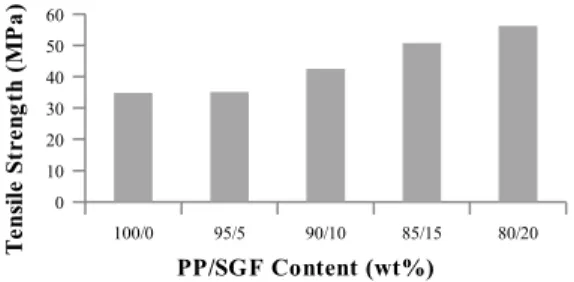
Figure 1 shows that the tensile strength of the PP/SGF composites increases from 34 MPa to 56 MPa when the content of SGF increases. This increase is due to short glass fibers, which are stiff materials and able to resist the deformation brought by an external force. The contact area of the SGF in the PP matrix increases as a result of its ever-increasing content, thereby absorbing more force than the PP matrix does and reinforcing the composites.
100/0 95/5 90/10 85/15 80/20 0 10 20 30 40 50 60 PP/SGF Content (wt%) T en si le S tr en g th ( M P a )
Figure 1. The tensile strength of the PP/SGF composites as related to the content of the short glass fibers.
Impact Strength of the PP/SGF Composites
Figure 2 shows that when SGF increase, the impact strength of the PP/SGF composites decreases from 1037 MPa to 197 MPa. During the melt-blending process, SGF fractures and becomes shorter, and thus decreasing the impact strength of the resulting composites. As can be seen from Figure 3, the SGF comes off the matrix, fractures, and is pulled out, which shows that both poor interfacial compatibility between the SGF and the PP matrix, and uneven fibers distribution are responsible for an interfacial failure that results in a lower toughness.
100/0 95/5 90/10 85/15 80/20 0 200 400 600 800 1000 1200 PP/SGF Content (wt%) Im p a ct S te n gt h ( J /m )
Figure 2. Impact strength of the PP/SGF composite as related to the content of short glass fibers.
Figure 3. SEM images (×150) of the fractured surface of the PP/SGF composites that are mixed in a PP/SGF ratio of a) 95/5, b) 90/10, c) 85/15, and d) 80/20 wt%.
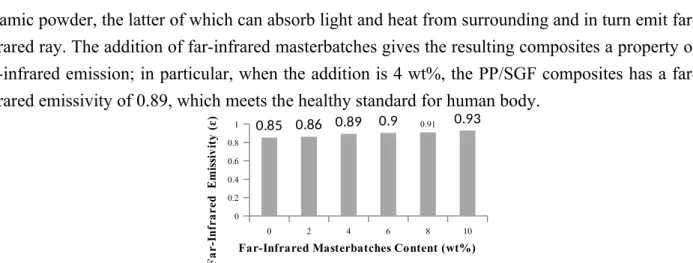
Far-Infrared Emissivity of PP/SGF Composites Containing Far-Infrared Masterbatches Figure 4 shows that the ever-increasing infrared masterbatches helps to increase the far-infrared emissivity of PP/SGF composites. The masterbatches are composed of polypropylene and
D C
B A
ceramic powder, the latter of which can absorb light and heat from surrounding and in turn emit far-infrared ray. The addition of far-far-infrared masterbatches gives the resulting composites a property of infrared emission; in particular, when the addition is 4 wt%, the PP/SGF composites has a far-infrared emissivity of 0.89, which meets the healthy standard for human body.
0 2 4 6 8 10 0 0.2 0.4 0.6 0.8 1 0.85 0.86 0.89 0.9 0.91 0.93
Far-Infrared Masterbatches Content (wt%)
F a r-In fr a re d E m is si v it y ( ɛ)
Figure 4. Far-infrared emissivity of the PP/SGF composites as related to the additional content of far-infrared masterbatches.
Conclusion
Increasing addition of short glass fibers in the PP/SGF composites results in an increase in the tensile strength but a decrease in the impact strength. SEM images show the interfacial failure of PP/SGF composites after the impact strength test. In addition, when being added with 4 wt% far-infrared masterbatches, the PP/SGF composites have a far-far-infrared emissivity of 0.89, reaching the healthy standard for human body.
Acknowledgement
The authors would like to thank the National Science Council of the Republic of China for financially supporting this research under Contract NSC-101-2622-E-035-004-CC3.
References
[1] Zehev Tadmor, Costas G. Gogos, Principles of Polymer Processing, Second ed., John Wiley & Sons, Inc. New Jersey, 1985.
[2] H. Tan, L. Li, Z.Chen, Y. Song and Q. Zeng, Phase morphology and impact toughness of impact polypropylene copolymer, Polymer. 46 (2005) 3522-3527.
[3] J. Tocha´cek, J. Jancar, J. Kalfus, P. Zborˇilova and Z. Bura´n, Degradation of polypropylene impact-copolymer during processing, Polym. Degrad. Stabil. 93 (2008) 770-775.
[4] S. Jacob, K.K. Suma, J.M. Mendaz, A George, K.E. George, Modification of Polypropylene/Glass Fiber Composites with Nanosilica, Macromol. Symp. 277 (2009) 138-143.
[5] F. Rezaei, R. Yunus, N.A. Ibrahim, Effect of fiber length on thermomechanical properties of short carbon fiber reinforced polypropylene composites, Mater. Design. 30 (2009) 260-263