First Light-Emitting Neutral Molecular Rectangles
T. Rajendran,†,‡Bala Manimaran,†Fang-Yuan Lee,†Gene-Hsiang Lee,§Shie-Ming Peng,§Chong Mou Wang,|and Kuang-Lieh Lu*,†
Institute of Chemistry, Academia Sinica, Taipei 115, Taiwan, ROC, Department of Chemistry, National Taiwan University, Taipei 107, Taiwan, ROC, and Department of Chemistry, National Taiwan Normal University, Taipei 117, Taiwan, ROC
ReceiVed October 25, 1999
Supramolecular structures containing transition metal ions with potential inclusion and host-guest applications have been
ex-tensively explored in recent years.1-4 Stang and co-workers
contributed to the formation of a combinatorial library of cyclic molecular polygons via the systematic combination of building
blocks with predetermined angles.5The initial focus was directed
toward molecular squares, i.e., macrocycles fabricated by cis-coordinated transition metal corners and rigid or semirigid
bifunctional ligand edges.6-8Subsequent efforts were devoted to
the synthesis of molecular rectangles to improve selectivity and
sensitivity in molecular recognition and separation.9-12Hupp et
al. were the first to report the preparation of rhenium
thiolate-based rectangles that exhibited interesting electrochemistry.9,10
Subsequent work by the same group led to the synthesis, characterization, and preliminary binding properties of a new class
of tetracationic rectangular molecules with triflate as counterion.10
To tune the cavity size, Sullivan et al. recently also reported the
preparation of a series of molecular rectangles based on
fac-Re-(CO)3corners containing 4,4′-bipyridine as one side and twoη2
-alkoxy or hydroxy bridges as the other.12
We report herein the synthesis and characterization of a new class of molecular rectangles 3 (Scheme 1) that exhibit lumines-cence in solution at room temperature. Unlike earlier “rectangles”, compounds 3 are neutral, possess larger cavities, and have no counterions inside the channels.
Activation of Re(CO)5Br (1) with Me3NO at 0°C followed
by addition of 0.5 equiv of 4,4′-bipyridine in toluene gave a
pale-yellow, shiny product{Re(CO)4Br}2(µ-bpy) (2a) in 58% yield.
Further treatment of 2a at 5°C in CH2Cl2with 2 equiv of Me3
-NO and a required amount of acetonitrile yielded
intermediate-{(Re(CO)3(NCMe)Br}2(µ-bpy), which produced the molecular
rectangle 3a (14% yield) after subsequent titration with pyrazine. Following a similar strategy, the bimetallic edges 2b and 2c were synthesized from trans-1,2-bis(4-pyridyl)ethylene and pyrazine, respectively. Compounds 2a and 2b were then converted into 3b and 3c by reacting with trans-1,2-bis-(4-pyridyl)ethylene and pyrazine, respectively.
Rectangles 3 and their corresponding edges 2 were character-ized spectroscopically. The FAB-MS analyses of 3a and 2a exhibit signals corresponding to the molecular ions at m/z ) 1880 and m/z ) 916, respectively, with the experimental isotope pattern
matching the calculated values. The 1H NMR spectrum of 3a
shows the presence of two predominant isomeric forms in solution at room temperature, most likely due to the orientation of the CO/Br trans-ligand pairs with respect to the plane containing the Re atoms.
Yellow single crystals of 3a were grown from acetone, and
X-ray diffraction studies were carried out.13An ORTEP diagram
of 3a is shown in Figure 1. The structure consists of a molecular
rectangle in which two Br(CO)4Re-bpy-Re(CO)4Br edges are
* To whom correspondence should be addressed. Fax: international code
+ (2)27831237. E-mail: [email protected].
†Academia Sinica.
‡Permanent Address: Department of Chemistry, Vivekananda college, Tiruvedakam West, Madurai, 625 217, India.
§National Taiwan University. |National Taiwan Normal University.
(1) (a) Stang, P. J.; Fan, J.; Olenyuk, B. J. Chem. Soc., Chem. Commun.
1997, 1453-1454. (b) Stang, P. J.; Cao, D. H.; Saito, S.; Arif, A. M. J. Am. Chem. Soc. 1995, 117, 6273-6283. (c) Stang, P. J.; Whiteford, J. A. Organometallics 1994, 13, 3776-3777.
(2) Caulder, D. L.; Raymond, K. N. J. Chem. Soc., Dalton Trans. 1999, 1185-1200.
(3) (a) Fujita, M.; Ogura, K. Bull. Chem. Soc. Jpn. 1996, 69, 1471-1482. (b) Fujita, M.; Yazaki, J.; Ogura, K. Tetrahedron Lett. 1991, 32, 5589-5592.
(4) (a) Lehn, J.-M. Supramolecular Chemistry: Concepts and PerspectiVes; VCH: Weinheim, 1995. (b) Drain, C. M.; Lehn, J.-M. J. Chem. Soc., Chem. Commun. 1994, 2313-2315.
(5) Olenyuk, B.; Fechtenkotter, A.; Stang, P. J. J. Chem. Soc., Dalton Trans.
1998, 1707-1728.
(6) (a) Fan, J.; Whiteford, J. A.; Olenyuk, B.; Levin, M. D.; Stang, P. J.; Fleischer, E. B. J. Am. Chem. Soc. 1999, 121, 2741-2752. (b) Stang, P. J.; Olenyuk, B. Angew. Chem., Int. Ed. Engl. 1996, 35, 732-736. (c) Stang, P. J.; Olenyuk, B. Acc. Chem. Res. 1997, 30, 502-518. (7) (a) Belanger, S.; Hupp, J. T.; Stern, C. L.; Slone, R. V.; Watson, D. F.;
Carrell, T. G. J. Am. Chem. Soc. 1999, 121, 557-563. (b) Slone, R. V.; Benkstein, K. D.; Belanger, S.; Hupp, J. T.; Guzei, I. A.; Rheingold, A. L. Coord. Chem. ReV. 1998, 171, 221-243. (c) Slone, R. V.; Yoon, D. I.; Calhoun, R. M.; Hupp, J. T. J. Am. Chem. Soc. 1995, 117, 11813-11814.
(8) Sun, S.-S.; Lees, A. J. Inorg. Chem. 1999, 38, 4181-4182.
(9) Benkstein, K. D.; Hupp, J. T.; Stern, C. L. Inorg. Chem. 1998, 37, 5404-5405.
(10) Benkstein, K. D.; Hupp, J. T.; Stern, C. L. J. Am. Chem. Soc. 1998, 120, 12982-12983.
(11) Slone, R. V.; Hupp, J. T.; Stern, C. L.; Schmitt, T. E. A. Inorg. Chem.
1996, 35, 4096-4097.
(12) Woessner, S. M.; Helms, J. B.; Shen, Y.; Sullivan, B. P. Inorg. Chem.
1998, 37, 5406-5407.
(13) Crystal data for 3a: monoclinic, space group ) P21/c, a ) 12.0890(2) Å, b ) 24.2982(2) Å, c ) 12.8721(2) Å,β ) 107.923(1)°, V ) 3597.57-(9) Å3, F ) 2.051 Mg/m3, Z ) 2, T ) 150 K; of 18 370 reflections (2θ
< 52°) measured, 7285 with I > 2σ(I) were used to refine 451 parameters. R ) 0.0356 and wR(F2) ) 0.0693.
Scheme 1
2016 Inorg. Chem. 2000, 39, 2016-2017
10.1021/ic9912474 CCC: $19.00 © 2000 American Chemical Society Published on Web 04/19/2000
Downloaded by NATIONAL TAIWAN UNIV on August 18, 2009
bridged by two pyrazine moieties. In each bipyridine moiety, one of the aromatic rings is found to have a canted configuration with respect to the plane of other rings. The Br(1) and Br(2) are disordered with the CO group in 73/27 occupancy, which is
substantiated by the isomeric 1H NMR spectral pattern of 3a.
Average bond distances are as follows: C(CO), 1.92 Å;
Re-N(4,4′-bpy), 2.22 Å; Re-N(pz), 2.21 Å. They are similar to those
found for a number of other Re(I) complexes.7a,b,12The molecular
rectangle 3a consists of a cavity with the dimensions of 11.44 Å × 7.21 Å. Since no steric hindrance exists between the Re metal centers, fine-tuning of the cavity size is possible. For example,
in 3b, a cavity with dimensions of 11.38 Å× 13.17 Å could be
achieved, as revealed by molecular modeling. The packing
diagram of 3a shows the effectiveπ staking of the aromatic rings
that ensures the close packing of the molecules to form an infinite number of open-end channels.
IR spectroscopy showed that the CO stretching (νCO) shifted
bathochromically from 2113 to 2032 cm-1when 2a was converted
into 3a. This red shift in νCO indicates that new linkages are
formed between the additionalπ ligands and the metal center. In
addition, compounds 2 and 3 exhibit two absorption bands in the near-UV region. We attribute the absorption band at higher energy
(251-265 nm) to aπ-π* transition and the lower one
(315-342 nm) to the MLCT transition.14-16Control experiments showed
that the MLCT bands of 2 or 3 are insensitive to the variation of
the halide,14whereas a substitution of CO with other ligands would
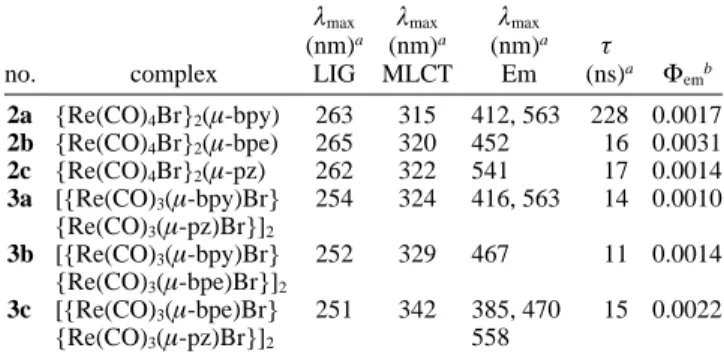
shift the MLCT band bathochromically. Examination of the UV-vis absorption spectra showed that the MLCT maximum of 2a is centered at 315 nm, whereas for 3a it is at 324 nm. This spectral difference suggests that the ground state of 2a has been raised to a higher level after conversion to 3a.
Because compounds 2 and 3 were brought to their MLCT excited states photochemically, both molecules fluoresced with
quantum yield of ca. 0.002 relative to Ru(bpy)32+.17-19 The
lifetimes measured for 2 and 3 are on the order of nanoseconds (Table 1). On the other hand, cyclic voltammetry revealed that electron exchange through an electrode such as glassy carbon occurred near the potential of E g 1.0 V vs SCE. Therefore, compounds 2 and 3 are expected to be strong reducing agents upon photoexcitation. Combining the energy gap between the ground state and the MLCT excited state as well as the formal
potentials of 3+/0, we estimated formal potentials for 3 at their
excited states of about -1 V vs SCE. Thus, these compounds
are capable of reducing methyl viologen (MV2+, E0′
1≈ -0.4 V; E0′
2 ≈ -0.7 V vs SCE) or tetracyanoquinodimethane (TCNQ, E0′≈ -0.3 V vs SCE). Preliminary results with 3a are in full accord with this hypothesis. The excited state of 3a can be oxidatively quenched by TCNQ; the Stern-Volmer quenching
rate constant is estimated to be 105M-1s-1 at 25°C.
Further experiments showed that these molecular rectangles can form thin films on many electrodes, such as gold and glassy carbon, and showed interesting ability to differentiate substrates of different sizes. With these unique properties, rectangles 3 should find many applications, including ultrafiltration, molecular separation, and optical rectification.
Acknowledgment. We thank Academia Sinica and the National Science Council of the Republic of China for financial support. We are also grateful to Professor Sunney I. Chan for valuable discussions.
Supporting Information Available: Experimental details, tables listing molecular modeling data of interatomic distances (Re‚‚‚Re), electrochemical data, crystallographic data, isotopic distribution patterns of the M+peaks for 2a and 3a, packing diagram of 3a. This material is available free of charge via the Internet at http://pubs.acs.org. IC9912474
(14) Giordano, P. J.; Wrighton, M. S. J. Am. Chem. Soc. 1979, 101, 2888-2897.
(15) Kalyanasundaram, K. Photochemistry of polypyridine and porphyrin complexes; Academic Press: London, 1992.
(16) Meyer, T. J. Pure Appl. Chem. 1986, 58, 1193-1206.
(17) Sahai, R.; Rillema, D. P.; Shaver, R.; Wallendael, S. V.; Jackman, D. C.; Boldaji, M. Inorg. Chem. 1989, 28, 1022-1028.
(18) Lees, A. J. Chem. ReV. 1987, 87, 711-743.
(19) Baitalik, S.; Florke. U.; Nag, K. Inorg. Chem. 1999, 38, 3296-3308.
Figure 1. ORTEP diagram of 3a. Selected bond distances (Å) and angles (deg) are the following: Re(1)-N(1) 2.212(5), Re(1)-N(3) 2.221(5), Re(1)-C(1) 1.929(7), Re(1)-C(2) 1.922(6), Re(1)-C(3) 1.92(2), Re-(2)-N(2) 2.212(4), N(4) 2.218(5), C(4) 1.919(6), Re(2)-C(5) 1.924(7), Re(2)-C(6) 1.92(1), N(1)-Re(1)-N(3) 84.5(2), N(2)-Re(2)-N(4) 82.4(2).
Table 1. Electronic Absorption Maxima, Excited-State Emission Maxima, Emission Lifetimes, and Emission Quantum Yields
no. complex λmax (nm)a LIG λmax (nm)a MLCT λmax (nm)a Em τ (ns)a Φ emb 2a {Re(CO)4Br}2(µ-bpy) 263 315 412, 563 228 0.0017 2b {Re(CO)4Br}2(µ-bpe) 265 320 452 16 0.0031 2c {Re(CO)4Br}2(µ-pz) 262 322 541 17 0.0014 3a [{Re(CO)3(µ-bpy)Br} 254 324 416, 563 14 0.0010 {Re(CO)3(µ-pz)Br}]2 3b [{Re(CO)3(µ-bpy)Br} 252 329 467 11 0.0014 {Re(CO)3(µ-bpe)Br}]2 3c [{Re(CO)3(µ-bpe)Br} 251 342 385, 470 15 0.0022 {Re(CO)3(µ-pz)Br}]2 558 aMeasured in deoxygenated CH 3CN at 298 K.bEmission quantum yield measured at 298 K.λex) 436 nm with reference to [Ru(bpy)3]2+ (Φem) 0.0420); error is (10%.
Communications Inorganic Chemistry, Vol. 39, No. 10, 2000 2017
Downloaded by NATIONAL TAIWAN UNIV on August 18, 2009