
中國經濟成長於拉丁美洲及加勒比海地區之影響:以秘魯為例(1990-2011) - 政大學術集成
127
0
0
全文
(2) 論文題目 中國經濟成長於拉丁美洲及加勒比海區域之影響: 以祕魯為例(1990-2011) The Impact of China’s Economic Growth in Latin America and the Caribbean Region: The Peruvian Case (1990-2011) 研究生: 克里斯缇 Student: Christie Lucila Campos Conde 指導教授:邱稔壤. Advisor: Dr. Roberto Ren-rang Chyou. 國立政治大學 亞太研究英語碩士學位學程 碩士論文. A Thesis Submitted to International Master’s Program in Asia-Pacific Studies National Chengchi University In partial fulfillment of the Requirement For the degree of Master in China Studies. 中華民國 102 年 8 月. August 2013 2.
(3) Acknowledgement First, I would like to express my sincere gratitude to Taipei Representative Office in Lima, Peru for granting me a scholarship and thus gave me the opportunity to pursue my post graduate studies in Taiwan. For the patience, support, trust, and helpful guidance, I would like to thanks my advisor and mentor Dr. Roberto Ren-Rang Chyou. As well, I also want to thanks the committee members, Dr. Chung-Chian Teng and Dr. Antonio Hsiang who have supported and given me much valuable inputs and advices. Moreover, I want to express my appreciation to Dr. Carlos Aquino because he has always been open to share his knowledge and views with me and he has provided enriching background for my thesis elaboration. Special thanks to Dr. Antonio Padilla and Dr. Rosa Campos, and Ph.D.c. Juan Uriburu because aside of their academic and professional sharedknowledge, they have inspired me to always go after my goals and never give up. I want to thanks to my family and my friends for their continuous encouragement and support. Despite distance, they have always made me feel close to them. I also feel really grateful to those who have always helped me under any circumstance during my stay in Taiwan and have always made me feel at home: Kyungeon Yoon, Wan-Chi Hsu, Geng-Ci Zhang, Fu-Yu Yang, Daniela Vaida, Vherenyz Yamani, Yu-Wei Lai, and Zhi-Xuan Ding. I would like to thanks other friends who cannot be mentioned individually but contributed a lot to my study.. Taipei, August 2013. 3.
(4) Abstract Some decades ago, we wouldn’t have imagined that this Asian giant, China, would be categorized as the most attractive markets in the world. The business and economic environment is under investigation, not just because of its faster economic growth but also due to the nature of its success. Nowadays, the economic world is focusing in establishing closer ties with China because the future perspectives ensure us that it will have direct implications in business directions, academic arena, trade policy decisions, and investments directions. This thesis attempts to study the case of Peruvian economic, political and social reforms during the 1990s as a way to establish closer economic and trade relations with China. The impact of China’s rise will be analyzed from a more general case, meaning China’s economic impact in the Latin American and the Caribbean region as a whole, followed by the impact in the specific case of the Peruvian economy. The Peruvian case will focus in the trade opportunities before and after the FTA Peru-China and the current economic relations of both countries. In order to see the complementary relation in matters of trade policies, the research will include a brief analysis of China’s “going global” policy to the Latin American and the Caribbean region and the opportunities it will bring to the region. The study found enough evidence to confirm the fact that China’s position in the international market enabled the Peruvian economic growth during the period 1991-2011. Second, the opening trade policies raised by Peru during the 1990s enabled it to take advantage of the opportunities offered by the Chinese market. Finally, we corroborated that the growing demand of goods and services from China has influenced Peruvian exports of traditional and non-traditional products in a positive way. Keywords: Peru, Latin America and the Caribbean, Taiwan, China, Asia, investment inflows, competitive relationship, foreign direct investment. 4.
(5) 摘要 數十年以前我們可能無法想像亞洲巨人-中國,會被視為世界上最具吸引力的 市場,而中國商業和經濟環境備受關注,不單由於該國快速的經濟成長,更因其成功 的本質。現今世界經濟聚焦於如何與中國建立更緊密的關係。從未來的觀點看來,將 直接影響我們商業方向、學術舞台、貿易政策決策和投資方向。 本論文試圖研析秘魯 90 年代的經濟,政治和社會改革,做為和中國建立更緊密 經貿關係的一途徑。從較普遍的案例著手,分析中國崛起所帶來的影響,以拉丁美洲 和加勒比地區作為一個整體,討論中國的經濟在此區域的影響力,更以秘魯做為案例 來研究。於探討秘魯的案例時,將著眼於秘魯-中國自由貿易區建立前後的貿易機會 和現今兩國間的經濟關係。為了研究雙方貿易政策問題上的互補關係,我將簡要分析 中國在拉丁美洲及加勒比海地區的「走出去」戰略,以及此戰略為區域間帶來的機會。 此份論文佐證了中國在國際市場上的地位,使秘魯經濟在 1991-2011 年間增長。 其次,秘魯在 90 年代提出的貿易開放政策,使其能夠充分利用中國市場提供的機會。 最後,證實了來自中國的商品和服務的需求不斷增長,積極的影響了秘魯的傳統和非 傳統產品的出口。 關鍵詞:秘魯、拉丁美洲及加勒比地區、台灣、中國、亞洲、投資流入、競爭關係、 外國直接投資。. 5.
(6) Table of Contents Acknowledgement ..................................................................................................................... 3 Abstract ...................................................................................................................................... 4 Chapter 1: Research’s Basic Characteristics.............................................................................. 8 1.1 Introduction ................................................................................................................... 10 1.2 Research Topic .............................................................................................................. 10 1.3 Statement of the Research Problem............................................................................... 10 1.4 Formulation of the Research Problem ........................................................................... 14 1.5 Research Objectives ...................................................................................................... 14 1.6 Research Justification .................................................................................................... 15 1.7 Theoretical Framework ................................................................................................. 15 1.8 Research Hypothesis ..................................................................................................... 19 1.9 Variables and Indicators ................................................................................................ 19 1.10 Research Type .............................................................................................................. 20 1.11Research Method ........................................................................................................... 20 1.12Information Collection and Processing ......................................................................... 20 1.13Research Design ............................................................................................................ 21 Chapter 2: Research Results .................................................................................................... 23 2.1 Introduction ................................................................................................................... 23 2.2 General Hypothesis Testing .......................................................................................... 23 2.3 Testing Specific Hypothesis 1 ....................................................................................... 26 2.4 Testing Specific Hypothesis 2 ....................................................................................... 28 2.5 Analysis and Interpretation of Hypothesis Testing ....................................................... 30 Chapter 3: China’s Position in the International Market ......................................................... 32 3.1 Introduction ................................................................................................................... 32 3.2 China’s Economic Development ................................................................................... 32 3.3 China’s Foreign Policy to the Latin American and the Caribbean Region ................... 37 3.3.1 China’s ODI policy.................................................................................................. 38 3.3.2 China's Policy Paper on Latin America and the Caribbean ..................................... 41 3.3.3 China’s Energy Policy ............................................................................................. 44 Chapter 4: China’s Economic Growth Impact in Latin America and the Caribbean .............. 46 4.1 Introduction ................................................................................................................... 46. 6.
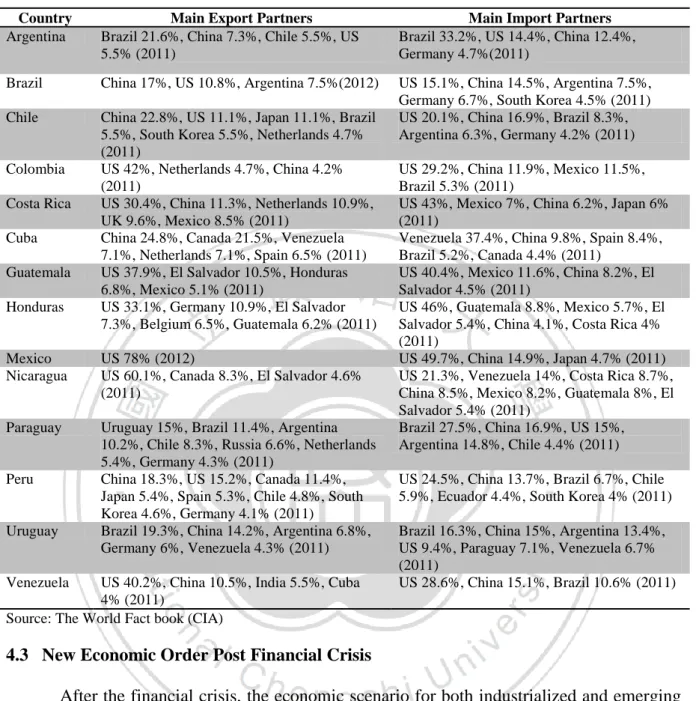
(7) 4.2 Economic Triangular Relations: China-Latin America-USA ....................................... 46 4.3 New Economic Order Post Financial Crisis .................................................................. 48 4.4 Economic Relations between China and Latin America and the Caribbean Region .... 51 4.5 China and Latin America: Competitive or Complementary Relations ......................... 58 4.6 China’s FDI to Latin America and the Caribbean region ............................................. 62 Chapter 5: China’s Economic Growth Impact in the Peruvian Economy ............................... 68 5.1 Introduction ................................................................................................................... 68 5.2 Peruvian Economic Development in the 1990s ............................................................ 68 5.3 Peruvian Economic Development in the 2000s ............................................................ 76 5.4 Bilateral Relations between China and Peru ................................................................. 81 5.5 Bilateral Relations between China and Peru after Free Trade Agreement .................... 85 5.6 China’s Market opportunities for Peruvian companies ................................................. 91 Chapter 6: Conclusions and Suggestions ................................................................................. 96 6.1 Conclusion ..................................................................................................................... 96 6.2 Suggestions .................................................................................................................... 97 Bibliography .......................................................................................................................... 100 Appendix ................................................................................................................................ 108. 7.
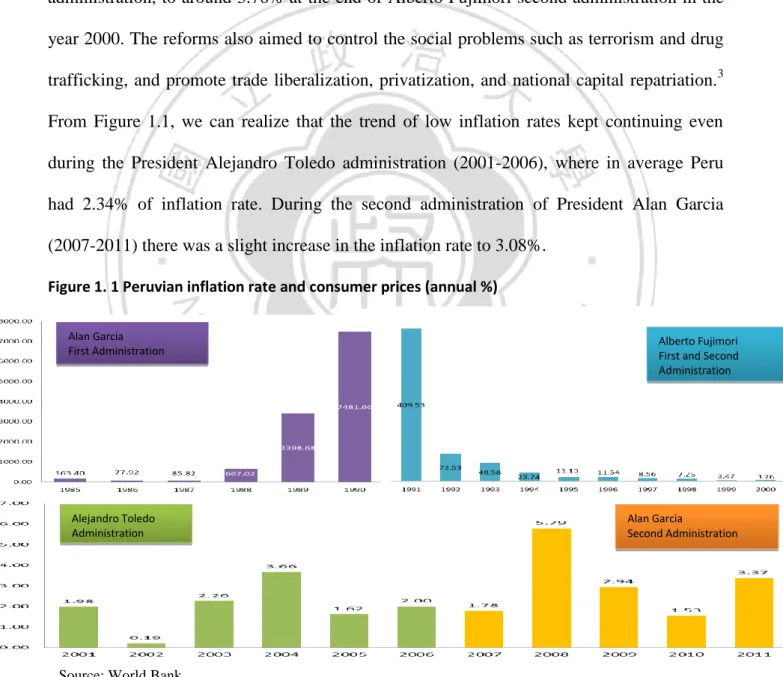
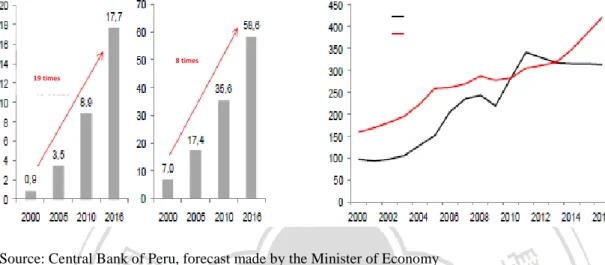
(8) List of Figures Figure 1. 1 Peruvian inflation rate and consumer prices (annual %)………………...………11 Figure 1. 2 GDP real growth rate (%) according to the different presidential administration period………………………………………………………………………………………....12 Figure 3. 1 China’s GDP growth 1990-2011…………………………………...……………34 Figure 3. 2 World main economies GDP growth 2000-2012………………………….……..34 Figure 3.3 Projects value and number of projects from China to Brazil-2012………………40 Figure 4. 1 Growth and composition of global demand…………………………...………....50 Figure 4. 2 Principal Latin American exports and leading exporting countries to China in 2008………………………………………………………………………………………..…55 Figure 4.3 Chinese trade competence with some countries, 1998-2001 and 2001-2004...…..60 Figure 5. 1 FDI to Peru during 1991-1998, by sector and by country of origin………….….75 Figure 5.2 Evolution of international indicators (1980-2004)…………………………...…..76 Figure 5.3 GDP and output gap……………………..………………………………………..77 Figure 5.4 Peruvian exports development and forecast (2000-2016)…………………….….78 Figure 5.5 Peruvian imports (2000-2016)……………………………………………………78 Figure 5.6 GDP by type of expenses…………………………………………………………79 Figure 5.7 Main investment projects by Peruvian region……………………………………80 Figure 5.8 Public debt forecast…………………………………………………………...…..81 Figure 5.9 Peru-China trade balance, 2008-2012………………..………………………...…82 Figure 5.10 Exports Peru-China, 2008-2012………………...…………………………….…83 Figure 5.11 Imports Peru-China, 2008-2012…………………………………………….…84. 8.
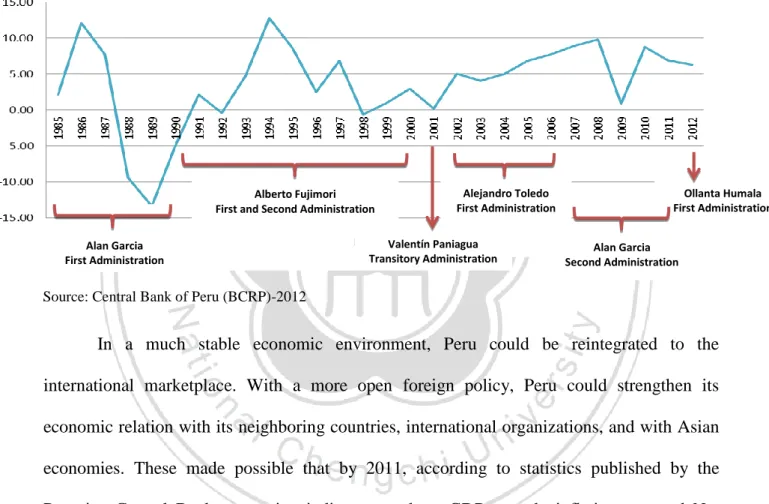
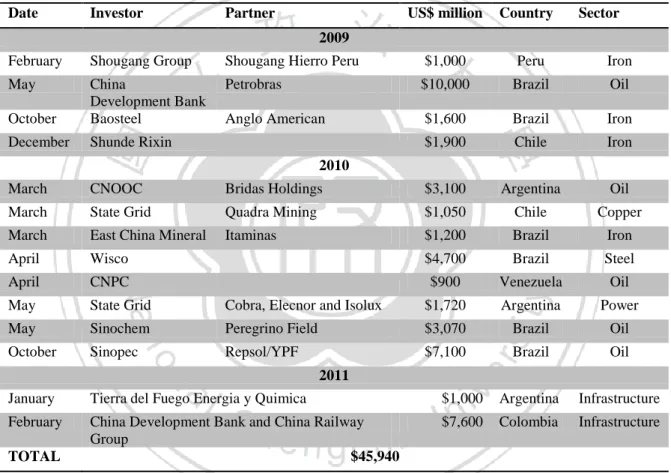
(9) List of Tables Table 4. 1 Main export and import partners for Latin America and the Caribbean countries 2011……………………………………………………………………………………….….48 Table 4.2 Five countries, eight sectors, dominate LAC trade to China (2009)………….…55 Table 4.3 Major Chinese investments projects in Latin America 2009-2011……………….63 Table 5. 1 Capital Income by public privatized enterprises (US$ million)………………….74 Table 5.2 Exports Peru-China, by sector- (1st year of operation Peru-China FTA)……...….86 Table 5.3 Peru-China imports, tariffs paid in the 1st year of Peru-China FTA……………...87 Table 5.4 Exports Peru-China, by sector (1st and 2nd year of operation Peru-China FTA)...90 Table 5.5 Peru-China imports, tariffs paid in the 1st and 2nd year of Peru-China FTA…….91 Table 5.6 Exports Peru-China, number of new exporting companies, participation and value exported by sales rank……………………………………………………………………….92 Table 5.7 New exporting companies to China during 1st and 2nd year of Peru-China FTA………………………………………………………………………………………….93 Table 5.8 Peruvian products of most Chinese interest, by regions………………………….93 Table 5.9 Main Peruvian exporting companies to China…………………………………….93. 9.
(10) Chapter 1: Research’s Basic Characteristics. 1.1 Introduction In this chapter we will present the research procedure, starting with a brief background of the research problem which will provide a general idea of the research scenario. This will allow us to see the context in which the topic of this thesis is developed. It will be followed by the general and specific research objectives, research justification, and theoretical framework. These objectives will be the milestone to derive the general and specific hypothesis, and the correspondent variables and indicators for each one of them. The last part of the chapter will include the research type, research method, information collection and processing, and the research design. This last will introduce briefly the contents of every chapter in which the thesis is composed. 1.2 Research Topic China’s Economic Growth Impact in Latin America and the Caribbean Region: The Peruvian Case (1990-2011) 1.3 Statement of the Research Problem In the early 90s, due to the high level of an interventionist policy leaded by President Alan Garcia, the Peruvian economy was left as one with highest inflation rate in the region, over 7000%. Peru was also embedded in the most extended recession, isolated from the international system due to the external debt crisis with impairment of financial intermediation. Besides, the country experienced high unemployment rates with fiscal imbalances.1. 1. Alberto Pascó-Font and Jaime Saavedra. "Reformas Estructurales y Bienestar: Una mirada al Perú de los noventa". Grupo de Análisis para el Desarrollo-GRADE (2001):30-34 10.
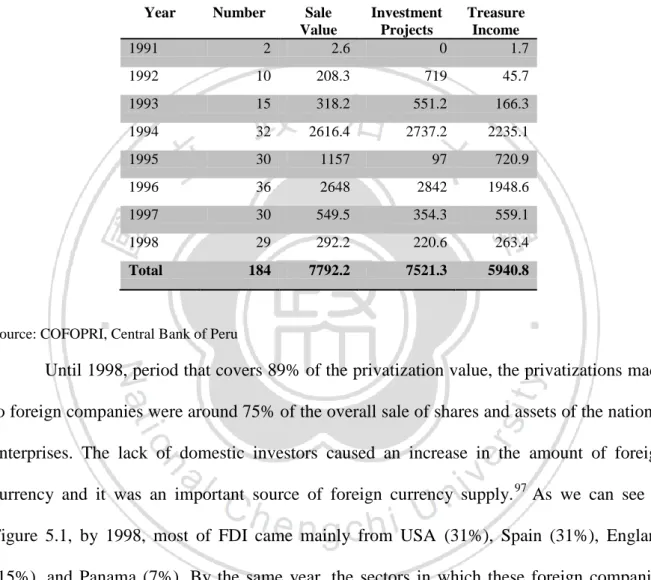
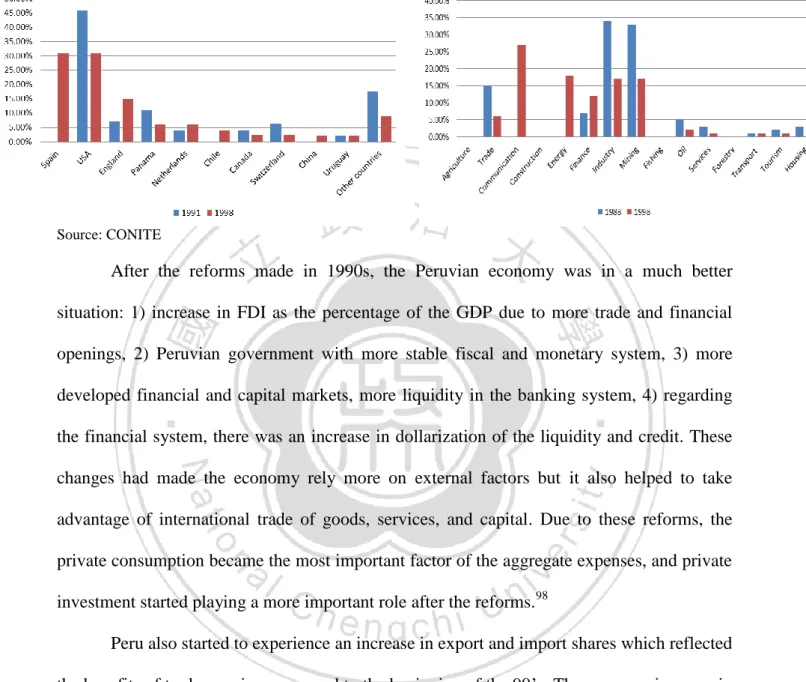
(11) Under this catastrophic context left by the Alan Garcia first administration, a figure little known in the political environment won the presidential elections of 19902. In July 28th, 1990 the President Alberto Fujimori started his first administration and it was then when the Peruvian economy started to align to the path of a more open and market driven economy. During the first year of the new administration, the government led several radical reform policies to control the hyperinflation. It went from 7481%, at the end of Alan Garcia’s first administration, to around 3.76% at the end of Alberto Fujimori second administration in the year 2000. The reforms also aimed to control the social problems such as terrorism and drug trafficking, and promote trade liberalization, privatization, and national capital repatriation.3 From Figure 1.1, we can realize that the trend of low inflation rates kept continuing even during the President Alejandro Toledo administration (2001-2006), where in average Peru had 2.34% of inflation rate. During the second administration of President Alan Garcia (2007-2011) there was a slight increase in the inflation rate to 3.08%. Figure 1. 1 Peruvian inflation rate and consumer prices (annual %) Alan Garcia First Administration. Alberto Fujimori First and Second Administration. Alejandro Toledo Administration. Alan Garcia Second Administration. Source: World Bank 2. Peruvian presidential elections are held every five years, where the president takes officially its position on July 28th, during a commemoration ceremony of Peruvians’ national day. 3. Oscar Dancourt, “Reformas Estructurales y Politica Macroeconomica en el Peru: 1990-96," Consorcio de Investigacion Economica (1997): 9-11. 11.
(12) From Figure 1.2, we can see that Peruvian economic growth during 1990-2011, represented by GDP growth rate, reflects a cyclic behavior which starts at the end of the 90s. This shows that from 2001-2008 the Peruvian economic growth was almost sustainable. There were two slowdowns, the first in 2001 due to the political instability due to presidential elections, and in 2009 due to the financial crisis, but this last with a fast recover during 2011. Figure 1. 2 GDP real growth rate (%) according to the different presidential administration period. Alberto Fujimori First and Second Administration Alan Garcia First Administration. Alejandro Toledo First Administration. Valentín Paniagua Transitory Administration. Ollanta Humala First Administration Alan Garcia Second Administration. Source: Central Bank of Peru (BCRP)-2012. In a much stable economic environment, Peru could be reintegrated to the international marketplace. With a more open foreign policy, Peru could strengthen its economic relation with its neighboring countries, international organizations, and with Asian economies. These made possible that by 2011, according to statistics published by the Peruvian Central Bank comparing indicators such as GDP growth, inflation rate and Net International Reserves, Peru had a better performance4. The economic prosperity experienced may be a result of favorable changes in the international scenario derived from big opportunities from better economic integration among countries. This is measure by the. 4. For the year 2011 the GDP for some Latin American countries was: Mexico (1.6%), Brazil (4.2%), Colombia (4.2%), Chile (3.7%), and Peru (5.9%). The Inflation rate for the same countries was: Mexico (3.7%), Brazil (5.1%), Colombia (3.3%), Chile (3.3%), and Peru (3.1%). And the Net International Reserves (%GDP) were: Mexico (12.3%), Brazil (14.1%), Colombia (12.3%), Chile (16.9%), and Peru (27.6%). 12.
(13) several number of Free Trade Agreements (FTA) signed. Another reason is the emergence of new economic powers such as China. Over the past several decades, we have been witnesses of how the world has been experiencing changes in the economic map, where China has reemerged as a global power and thus becoming the main character of the new economic era 5 . Under these new circumstances, Peru is in a better position to take advantage of China’s economic approach to the Latin American region. China, as the main player in the economic environment, is not only attracting more and more foreign business looking forward to establish their branches in China, but also is causing that the global demand of production inputs increase beyond measures. This fact has been prompting China to look beyond its borders in order to meet its increasing demand. The spread of Chinese trade out of the Asian region has reached the limits of the Latin American region as a source of more affordable production inputs for their industrialization process.6 For some countries such as Mexico and Brazil, which have achieved a moderate industrialization stage and are, by far away, more developed than the rest of the countries in the region, the shift of China’s interest in the region has caused struggles and destabilization in their trade policies towards their main trading partners.7 On contrary, for the other group of countries, like Peru, the huge demand of commodities represented by the rise of China, has led to a platform of opportunities to increase the amount of export of traditional and non-. 5. We use the term “reemergence” because by the early 1078, China was the world’s major producer of steel, world’s leader in technical innovations in the textile manufacturing sector. China was also the leader in trading with other nations due its outstanding navigation system, and China’s agricultural revolution and productivity had surpassed the West by the 18th century. Thus, China’s last century rise is actually a renascence rather than a new event. 6. Gustavo Bittencourt, "El impacto de China en América Latina: comercio e inversiones," Red Mercosur de Investigaciones Económicas (2012): 50. 7. Lidoy Blázquez et al., “¿Á ngel o demonio? Los efectos del comercio chino," Revista de la CEPAL 90 ( 2006): 20-22. 13.
(14) traditional products, products with more value added, more technology transfer, and the attraction of more foreign investment.8 After a general idea provided, we are able to have a better understanding about the scenario that will enable us to research “China’s Economic Growth Impact in Latin America and the Caribbean Region: The Peruvian Case (1990-2011)” 1.4 Formulation of the Research Problem General Problem What are China’s economic growth impact in the Latin American and the Caribbean region? What is the impact in the specific case of the Peruvian economy? Specific Problems Do Peruvian opening policies enable it to take advantage of the opportunities that the Chinese market offers? What is the probability to increase traditional and non-traditional exports to the Chinese market? 1.5 Research Objectives General Objective Evaluate the effects of China’s economic growth in the Latin America and the Caribbean region, specifying its impact in the Peruvian economic during 1990-2011. Specific Objectives Analyze Peruvian opening policies implemented in order to take advantage of the opportunities that the Chinese market offers. Explain the possibilities that Peruvian companies have to increase exports of traditional and non-traditional products to the Chinese market.. 8. María Alejandra Calle, “A brief note about the China-Latin American Trade Partnership," Revista de Negocios Internacionales. Vol. 3 Nº 2 - Universidad EAFIT (2010): 60-61. 14.
(15) 1.6 Research Justification The research’ raison d'etre is to analyze the importance of a leading China in the Latin American and the Caribbean region and its impact in emerging economies such as Peru. Under this case, through trade opening policies Peru can benefit by increasing its traditional and non-traditional products exported to China, which will also have a strong multiplier effect in a better standard of living of the Peruvian population. 1.7 Theoretical Framework China’s development impact in the Latin America and the Caribbean region has made this last to once again rely its economic development in commodities and natural resources exports. However, the region can still manage to diversify this revenue engine and develop its own industry and start its process of industrialization. Successful cases in Asia like the one in China, Taiwan, India, and South Korea teach us that the adoption of Import Substitution Industrialization model (ISI) in an open economy can become a strategic tool for a further development. These economies have shown the world that even though the ISI sometimes is contrasted with the export-oriented industrialization. These two are not mutually exclusive and many countries' policies can combine elements of both models. The specific case of Taiwan industrialization is a good example of this trend.9 According to the basic conceptions of the ISI model mainly represented by the economists Raul Prebisch and Hans Singer, poor countries whose economic development is mainly based on exporting primary goods and products would always face a deteriorating terms of trade vis-à-vis rich countries.10 With a declining real price for primary goods after. 9. Alice Amsden, "La sustitución de importaciones en las industrias de alta tecnología: Prebisch renace en Asia," Revista de la CEPAL 82, (2004): 2, accessed June 2013, http://www.eclac.cl/publicaciones/xml/9/19409/lcg2220e-Amsden.pdf. 10. International Relations and Security Network (ISM), "So What Kind of Economic Growth?," International Relations and Security Network (ISM), (February 9, 2012), accessed June 2013, http://www.isn.ethz.ch/Digital-Library/Articles/SpecialFeature/Detail/?lng=en&id=136933&contextid774=136933&contextid775=136932&tabid=136932. 15.
(16) the World War II, the countries that specialized in commodities production received less revenues and foreign exchange but they had to pay more for manufactured goods bought from industrialized countries. This disadvantage position deteriorates the term of trade and made most Latin American countries promote domestic industrialization to reduce their dependence and vulnerability to the first world. Thus, the ISI was adopted by those Latin American countries in order to gain their independence. However, we have been witnessed that the ISI model in the region didn’t have the effects they did had in Asia.11 In the Asian case, the shift in the industrialization model by substituting domestically manufactured products for foreign imports was reflected in a better way to develop their infant industries. These industries initially could not compete in the global market by themselves and the government protection was needed at least during the initial period. 12 This government intervention was made through sponsored protective tariffs, import quotas, exchange rate controls, special preferential licensing for capital goods imports, subsidized loans, and the maintenance of a strong currency. These measures are not limited to Asian countries but with the notable exception of the United Kingdom, every country that industrialized before World War II followed a variation of the ISI model.13 The ISI model was criticized during the 1980s and was not regarded as a great success. Indeed, by the 1980s it had been mostly abandoned in favor of the export-substitution (ESI) model. Under this model the countries were encouraged to have more economic openness. 11. Kanayo Ogujiuba et al, "Import Substitution Industrialization as Learning Process: Sub Saharan African Experience as Distortion of the “Good” Business Model," Business and Management Review Vol. 1(6) , (2011): 2, accessed June 2013, http://www.businessjournalz.org/articlepdf/bmrn61513.pdf. 12. International Relations and Security Network (ISM), "So What Kind of Economic Growth?," International Relations and Security Network (ISM), (February 9, 2012), accessed June 2013, http://www.isn.ethz.ch/Digital-Library/Articles/SpecialFeature/Detail/?lng=en&id=136933&contextid774=136933&contextid775=136932&tabid=136932 . 13. Kanayo Ogujiuba et al, "Import Substitution Industrialization as Learning Process: Sub Saharan African Experience as Distortion of the “Good” Business Model," Business and Management Review Vol. 1(6) , (2011): 1, accessed June 2013, http://www.businessjournalz.org/articlepdf/bmrn61513.pdf. 16.
(17) rather than shielding infant domestic industries from foreign competition. It was believed that by opening itself up to competition, the country would quickly adopt current best practices, encourage the diffusion of technology, and enhance its productivity.14 If we look to the information provided, we may wonder what was wrong with the ISI model adopted by Latin American countries and why it did succeed for the Asian economies like Taiwan, China, South Korea, and India. This actually is one of the most debated questions in the development literature. According to the literature the different effects of the ISI model in these two regions is not based on the type of policy instrument employed to create rents and promote industrial entrepreneurship but what made the difference was how the rents created by the government policy intervention was managed. Thus, the key issue was the efficient government intervention policies compromised to create a productive entrepreneurship. Latin American countries’ entrepreneurship is not considered productive because there is still lead by weak and inefficient governments composed by rent-seeking groups who undermine markets and consider public sector as a source to distribute patronage and increase their own incomes. This rent-seeking behavior caused reduction in productive investments but increase in their personal budget.15 In case of these Asian countries, the whole private and public organizations were aware that in order to establish high tech industries, it was needed a solid entrepreneurship with specialized human resources capable to create a multiplier effect. Since the risk to train people and keep their loyalty was high, thus, there were just two options to get well-qualified employees. The first option was to rely on private companies and their efforts to hold their. 14. International Relations and Security Network (ISM), "So What Kind of Economic Growth?," International Relations and Security Network (ISM), (February 9, 2012), accessed June 2013, http://www.isn.ethz.ch/Digital-Library/Articles/SpecialFeature/Detail/?lng=en&id=136933&contextid774=136933&contextid775=136932&tabid=136932. 15. Kanayo Ogujiuba et al, "Import Substitution Industrialization as Learning Process: Sub Saharan African Experience as Distortion of the “Good” Business Model," Business and Management Review Vol. 1(6) , (2011): 2-3, accessed June 2013, http://www.businessjournalz.org/articlepdf/bmrn61513.pdf. 17.
(18) qualified human resources. The second option relied on the government as a platform to train expertise and spread the created capacities to the private sector. This last option was the most successful in Asia.16 Besides human resources, private sector also needed useful and updated information about the market trends so the products can arrive on time and before the profitability decline. National organizations were the ones with less opportunity costs, more knowledge about the market and more probability to take advantage of the fixed assets in local related industries and to become the ones with major incentives and lead this process. With a qualified human resources and government support in information supply, the government also engaged in the provision of research and development facilities and laboratories as scientific parks in India and Taiwan which were of government property. Thus there is no doubt that the pioneers of high technology industry in these Asian countries have been the state owned enterprises.17 The ISI model applied to the Asian economies has never underestimate the importance of international relations because in a globalized world the governments have to emphasize the role played by the private firms as a way to use indirect mechanism to promote technological upgrading which means to attract FDI and develop local technological capabilities.18 Taking the experience of the Asian countries, the Latin America and the Caribbean region needs to explore the more structural economic and political trends of ISI to see whether the governments in the region should reshape their activist industrial policy. In order to make the catching up industrialization process much effective, the ISI must be considered as an entry route that serves as basis for technological learning for dynamic export 16. Alice Amsden, "La sustitución de importaciones en las industrias de alta tecnología: Prebisch renace en Asia," Revista de la CEPAL 82, (2004): 3, accessed June 2013, http://www.eclac.cl/publicaciones/xml/9/19409/lcg2220e-Amsden.pdf. 17. Ibid., 5.. 18. Kanayo Ogujiuba et al, "Import Substitution Industrialization as Learning Process: Sub Saharan African Experience as Distortion of the “Good” Business Model," Business and Management Review Vol. 1(6), (2011): 4, accessed June 2013, http://www.businessjournalz.org/articlepdf/bmrn61513.pdf. 18.
(19) industrialization. For this purpose it’s important to have; 1) solid, qualified, educated and capable entrepreneurship, 2) government policies committed to facilitate the transition from natural-resource based economy to high tech industries, 3) stronger engage with the global market place to ease technology transfer and, 4) control regulated openness policies in order to maximize the benefits and minimize the potential destabilizing forces. The political and social counterpart should have the capacity to 1) supply the strategic public goods‘ and externalities that can influence the private sector to engage in productive entrepreneurship, 2) develop programs to increase and diversify exports with controls on the imports of good and inflows of strategic FDI and foreign capital, 3) pursue a complementarity relation of public and private-sector entrepreneurial initiatives, and 4) include elements to expand domestic demand and selective ISI based on competitiveness on the world market.19 1.8 Research Hypothesis General Hypothesis China’s position in the international market enabled Peruvian economic growth 1991-2011. Specific Hypothesis The opening trade policies raised by Peru during the 90s enabled it to take advantage of the opportunities offered by the Chinese market. The growing demand of goods and services from China has influenced Peruvian exports of traditional and non-traditional goods. 1.9 Variables and indicators Peruvian economic growth. China’s position in the Latin American and the Caribbean. GENERAL HYPOTHESIS. VARIABLES. INDICATORS. China’s position in the international market enabled the Peruvian economic growth 1991-2011.. Production Exports. - GDP -Traditional products exports -Non-traditional products exports. Foreign Exchange. Foreign Exchange coming from China. 19. Ibid.,12-14. 19.
(20) SPECIFIC HYPOTHESIS 1 The opening trade policies raised by Peru enabled it to take advantage of the opportunities offered by the Chinese market. SPECIFIC HYPOTHESIS 2 The growing demand of goods and services from China has influenced Peruvian exports of traditional and non-traditional exports.. 1.10. VARIABLES. INDICATORS. Governance. -Number of trade opening policies. - Level of legal security.. VARIABLES. INDICATORS. China’s demand of goods and services.. Volume of goods and services offered to China.. Research Type. Descriptive Research: Because the research tries to analyze and interpret the impact of the Chinese global market position in the economic growth of Peru, considering exports of traditional and non-traditional products during the period 1990-2011. Correlative Research: This research has as purpose to evaluate the relationship between two or more concepts, categories and variables, for example the Peruvian GDP growth rate in relation to the exports to China. 1.11 Research Method Scientific Method: Because the research will use scientific instruments for hypothesis demonstration. Logical-inductive method: We will analyze macroeconomic variables behavior based on Peruvian trade liberalization policies, especially the ones that emphasize better trade flows with China. 1.12 Information Collection and Processing The information will be obtained through literature reviews on the economic behavior of Peru in the foreign market; and reports of entities in charge of exports and imports. This last will be taken from annual reports of the Ministry of External Trade and Tourism (MINCETUR), Peruvian Central Bank (BCRP), Ministry of Economy (MEF). The statistical data for China will be taken mainly from international organizations such as the World Trade Organization (WTO), International Monetary Fund (IMF), Central Intelligence Agency (CIA), 20.
(21) The World Bank, etc. For the processing part, we will use mathematical and statistical tools. The information will come from primary and secondary sources. Information’s Interpretation and Analysis The analysis of the information will be holistic, considering hypothesis demonstration. 1.13 Research Design The first chapter of the research will start with a brief introduction of the study; it will be followed by the research’s basic characteristics. This will include research statements, research problem, objectives, justification, background, theoretical framework, hypothesis, variables and indicators, research type, research method, and information about the collection and processing procedures. The second chapter will present the research results, for which the general and specific hypothesis will be contrasted and analyzed. In the third chapter we will analyze China’s position in the international market, in which we will emphasize the analysis of the following topics: China’s economic development, and China’s foreign policy to the Latin American and the Caribbean region. In this last section we will analyze China’s ODI policy, China’s Policy Paper on Latin America and the Caribbean and China’s energy policy. The fourth chapter will cover China’s economic growth impact in the Latin American and the Caribbean region. This chapter will have six subdivisions which are 1) Economic triangular relations: China-Latin America-USA, 2) New economic order post financial crisis, 3) Economic relations between China and the Latin American and the Caribbean region. 4) China and Latin America: competitive or complementary relations, and 5) China’s FDI to the Latin American and the Caribbean region. Chapter five will focus on China’s economic growth impact in the Peruvian economy taking as time framework the period from 1991 to 2001. This chapter will be divided in the following subdivisions: 1) Peruvian economic development in the 1990s, 2) Peruvian. 21.
(22) economic development in the 2000s, 3) Bilateral relations between China and Peru, 4) Bilateral relations between China and Peru after the Free Trade Agreement (FTA), and 5) China’s market opportunities for Peruvian companies. Finally, in chapter six we will include the concluding part followed by suggestions, bibliography and the appendix.. 22.
(23) Chapter 2: Research Results. 2.1 Introduction This chapter will summarize all the literature findings which have enabled us to accept or reject the hypothesis raised in the first chapter. The results of the research will be divided according to the general and specific hypothesis order. The first section will contain the testing of the general hypothesis, which is: China’s position in the international market enabled Peruvian economic growth 1991-2011. The second section will be focused in contrasting the first of the two specific hypotheses the opening trade policies raised by Peru enabled it to take advantage of the opportunities offered by the Chinese market. In the third section we will test the second and final hypothesis, which is the growing demand of goods and services from China has influenced Peruvian exports of traditional and non-traditional exports. Finally, in the last section we will make a brief analysis and interpretation of the overall hypothesis testing, from which we will be able to know which hypothesis have been accepted and which have been rejected. 2.2 General Hypothesis Testing The research general hypothesis is whether China’s position in the international market enabled the Peruvian economic growth 1991-2011. In order to have a better understanding of the explanation, the argument will be divided in two parts: China’s perspective which is broadly explained in chapter four, and Peruvian perspective which is broadly explained in chapter five. China’s perspective Chinese economic development of the last decades has boosted its demand for several kinds of commodities, natural resources, and source of energy. As we will detail in Chapter. 23.
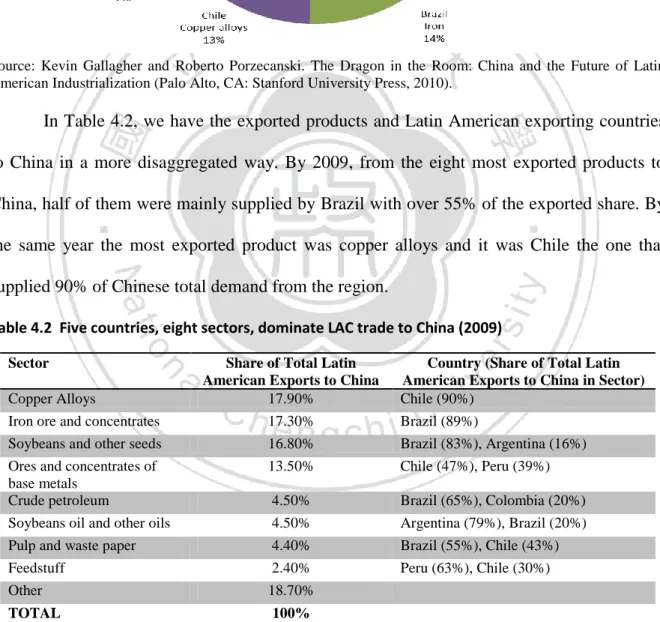
(24) third, by 2010, China consumed about 20% of non-renewable energy resources, 23% of major agricultural crops, and 40% of base metals.20 Even though China is dotted with these resource; the big amounts of Chinese demand has exceeded their own supply. Besides, due to China is currently becoming a more industrial and service oriented economy, environmental contamination has negatively impacted its agriculture sector and reduced the amount of domestic supply. These are some of the reasons China started to look other regions as a way to satisfy its present and future resource demand. Latin America and the Caribbean region has become an alternative as source of natural resources and energy to China. By 2008, commodities demanded from China came mainly from Chile (main exporter of copper alloys and ores), Brazil (main exporter of iron, crude, and soybean), and Peru (main exporter of feedstuff).21 On the other hand, China’s economic development mainly based on exports has made more vulnerable its economy during international unbalance and has caused some struggles during the financial crisis. This is why China now is in the process of diversifying its economic engine and has started to develop its own market and its domestic brand. A measure that helped to assure this new step is the “going out” policy in which Chinese government is encouraging domestic companies to settle down in foreign regions. The Latin America and the Caribbean region can become a perfect place to direct this Chinese ODI because it provides abundant natural resources and energy. Besides, the region has been experiencing an outstanding economic development in the last few decades. In 2002, China represented 12.70%, of the world GDP growth and Latin America as a region represented 7.9%. By 2020, China’s share will be 40.10% and Latin America will be 8%. Besides, Latin. 20. Shaun Roache, "China's Impact on World Commodity Markets," International Monetary Fund (IMF),Working Paper (2012): 4, accessed April 2013, http://www.imf.org/external/pubs/ft/wp/2012/wp12115.pdf. 21. Kevin Gallagher, “China and the Future of Latin American Industrialization," Issues in Brief No. 18. (2010): 2. 24.
(25) America represents by itself a big market with an increasing middle class population. According to BBVA research center, middle class in Latin America reached 109, 8 million by 2010, which is a growth of 48% compared with 2009. Taking into consideration Latin America proximity to USA, it can also become a bridge to such a big market because China can be benefited from FTA signed by several Latin American countries with USA. Peruvian perspective After the Peruvian reforms of 1990s, the country was in a better economic, political and social situation to receive foreign investors through the privatization process. According to Peruvian Central Bank (BCRP) statistics, on 1990 Peruvian GDP growth rate was -5.14% and inflation rate was 7481.6% while ten years later due to the economic reforms and a more open and friendly market, by 2011 Peruvian GDP growth rate was 6.8% and the inflation rate was 3.37%. The privatization of several companies related to the export of traditional products, especially in the mining sector started to increase annual production due to China’s big demand. Under the increase in minerals and agriculture production, industrialized Asian countries also started to see the country as a source for their demand. Since China by that period was in the middle of its economic reforms and due to its size, the demand of commodities increased even more. Thus, prices of the most demanded products, especially from China, started to pick up; from 2006 to 2010 the increasing demand for primary products has boosted the prices of metals and foods in 35%.22 The perfect combination in time and diversity, meaning Peruvian increase in commodities production and exports was aligned with China’s increasing in demand of the same products which made possible Peruvian trade surplus.. 22. Alejandro Izquierdo and Ernesto Talvi, "One Region Two Speeds? Challenges of the New Global Economic Order for the Latin American and the Caribbean," Inter-American Development Bank, Latin America Research Network, Working Paper IDB-MG-109 ( 2011): 10-11, accessed March 2013, http://idbdocs.iadb.org/wsdocs/getdocument.aspx?docnum=35816781. 25.
(26) Under an increase in commodities demand and increase in commodities price, the revenue of exporting Peruvian companies and tax income from this trade started to help the fast recovery from 1980s domestic economic instability. Peru started to have enough resources to deal with international debt pressure, domestic investment, government expenses, and social programs. With an FTA Peru-China, it’s expected that the situation will keep its current trend of high commodities demand and its influence in the price; however, the FTA also makes space to go further and direct Chinese overseas investment in developing Peruvian own industry sector. We can see that China’s perspective of increasing commodities demand to continue its economic development was perfectly complementary with Peruvian need to direct its own production. This situation benefited Peru because the amount of revenue from this tradeoff has provided enough liquidity to overcome international and domestic pressures. The trade surplus dimension, which according to SUNAT statistics for 2011 was US$503.5 million, and the Peruvian economic and political policies have also allowed the country to deal and recover successfully from the last financial crisis. Finally, due to the complementary relations showed forehead, we accept the hypothesis China’s economic position, indeed, has impacted positively the Peruvian economy, especially in the last decade (1992-2011). China’s direct tradeoff with the country and China’s positive externalities has enabled Peru to enjoy better economic situation and have enough economic resources to maintain its economic stability even during the financial crisis. 2.3 Testing Specific Hypothesis 1 The first specific hypothesis is whether the opening trade policies raised by Peru enabled it to take advantage of the opportunities offered by the Chinese market. Looking to the several number of economic trade agreements signed during the 2000s that made possible the country be in a better economic and political position and a better situation with the. 26.
(27) international environment. We can see that, indeed, the reforms in the 1990s were the cause of the increase in trade flows during the 2000s because even though China’s demand had a big impact in Peruvian economy, this wouldn’t have been possible if Peru would have been experiencing an economic and political instability with a close economy under unstable political, economic, and social situation the chance to attract foreign interest in trading and investing in the country is very low. Just look to the case of Bolivia, Venezuela and Cuba, countries with rich natural resources; however, their political instability and close economy have been harming its image as preferable trade partner. Due to the opening policies in the 1990s, currently Peru has eighteen trade agreements, two trade agreements with Venezuela and Guatemala will come into effect soon, and five trade agreements with DOHA, TPP, Honduras, El Salvador, and the Pacific Alliance are under negotiation. The first trade agreement was with the Andean Community in 1969; the second was with the WTO from which Peru has been a founder member since 1995. In 1998 Peru was accepted by APEC and being part of APEC has become a milestone for further international approach and opening steps because APEC served as a unique platform in which Peru could raise and deep international relations. As a matter of fact, after Peru became part of APEC the number of economic agreements increased, especially with Asian countries. So far Peru has signed FTA with Singapore (2008), China (2009), South Korea (2011), and Thailand (2011); and an economic partnership agreement with Japan (2011). Aside the Asian region, Peru has FTA with USA (2006), Chile (2006), Canada (2008), EFTA (2010), Panama (2011), and Costa Rica (2011). Besides, Peru has an economic complementation agreement with Cuba (2000), an economic complementation agreement. 27.
(28) with the MERCOSUR (2005), a trade agreement with the EU (2010), and a trade integration agreement with Mexico (2011).23 As mentioned in this section and the detailed information in chapter five, we accept the first specific hypothesis of the research. We accept the fact that the opening trade policies raised by Peru in the 1990s enabled the country to take advantage of not only the opportunity to have access to Chinese market but also to have access to other markets outside and within the region. A solid economic and political situation, added to a successful opening policies and a better understanding with the international organizations, all have helped Peru to be attractive for foreign investments and establishment of economic partnerships as the one with China, consolidated by the FTA Peru-China. 2.4 Testing Specific Hypothesis 2 The second specific hypothesis is whether the growing demand of goods and services from China has influenced Peruvian exports of traditional and non-traditional products. In order to see the evidence that can prove this hypothesis, we will summarize the information that will be provided in chapter four and chapter five of the research. To have a better understanding we will make a comparison of Chinese demand and the Peruvian supply. From the demand side, according to CAPECHI statistics, by 2007 China consumed 25% of the world’ tin, 23% of zinc, 22% of soy, 20% of aluminum, 18% of copper, 20% of petroleum, and 8% of world’ sugar. These indicators have increased in a big extend in the last decade because just in three years, by 2010, China consumed about 20% of non-renewable energy resources, 23% of major agricultural crops, and 40% of base metals.24 We can see that. 23. Ministerio de Comercio Exterior y Turismo (MINCETUR),«Acuerdos Comerciales del Perú,» Ministerio de Comercio Exterior y Turismo, accessed Jan. 2013, http://www.acuerdoscomerciales.gob.pe/index.php?option=com_aicontactsafe&view=message&layout=messag e&pf=1&Itemid=183. 24. Shaun Roache, "China's Impact on World Commodity Markets," International Monetary Fund (IMF),Working Paper (2012), 3-5, accessed April 2013, http://www.imf.org/external/pubs/ft/wp/2012/wp12115.pdf. 28.
(29) from these main consumed products, most of them are the kind of products that the Latin American region and Peru exports.25 According to CAPECHI, by 2006 Peru was the fourth country in the rank of main Latin American exporters to China with a total amount of US$ 2 875.4 thousands of dollars and Brazil ranked first with almost six times the Peruvian amount. Among other exported products from the Latin American region to China, we can find iron concentrate, copper wrought, rolled copper, electronic technology, crude, integrated circuits and microelectronic modules, fishmeal, and oil. The increasing Peruvian exports to China are composed mainly by traditional goods. For 2012, traditional exports represented 95.8% of the overall exports to China while the nontraditional exports represented only 4.2%. From the traditional Peruvian products exported to China, the majority of them are in the mining and fishing category, which for 2012 represented 87.6% and 12.4% of the overall traditional exports, respectively. Among the nontraditional products, most of them are in the fishing and woods & papers category, which by 2012 represented 52.5% and 15.6% of the overall non-traditional exports, respectively. From this category, the main exported products for 2012 were copper ores & concentrates (46.4%), fishmeal (12%), iron ores & concentrates (11.6%), and lead ores & concentrates (10.9%). In case of non-traditional exported products to China, by 2012, the main products in this category were cuttlefish & squid (33.8%), strips and friezes for parquet (9.8%), fresh grapes (8.7%), and nonedible seaweeds (7%).26 On the other hand, the imports coming from China are mainly manufacturing products. By 2012, the same products share of the overall imports from China to Peru were mobile phones and other wireless devices (6.9%),automatic machines for data processing, portable, 25. Kevin Gallagher, “China and the Future of Latin American Industrialization," Issues in Brief No. 18. (2010): 2. 26. Ministerio de Comercio Exterior y Turismo (MINCETUR), Oficina General de Estudios Económicos, "Estudio de Aprovechamiento del TLC Perú – China: Segundo Año de Vigencia del TLC,"MINCETUR (2012) : 16, accessed May 2013, http://www.acuerdoscomerciales.gob.pe/images/stories/china/tlc_peru_china_2_ano_ogee_oeei_mayo_12.pdf. 29.
(30) weighing less than 10 kg (5.5%), motorcycles & cycles with auxiliary motor (2.1%), and other motor vehicles assembled (1.4%).27 Not only trade flows but also FDI amount from China to Latin America is increasing, by 2009, there was an increase to 1880%. Most of the FDI, meaning 22%, went to the British Islands and 73% to the Cayman Islands because these tax heavens enable China to reinvest again in China after take advantage of tax breaks. Aside these islands, the other main receptors of China’s FDI by 2010 were Brazil (41%), Venezuela (15%), Peru (12%), Argentina (11%), and Chile (2%). China’s FDI main purposes are: resource acquisition, market access, and efficiency seeking. From these areas, by 2010, 90% of Chinese FDI went to natural resource extraction.28 By looking to the Chinese demand and Peruvian supply showed in this section, we can confirm and accept the second hypothesis of the research. In fact, the growing demand of goods and services from China has influenced Peruvian exports of traditional and nontraditional products in a positively way, and with the FTA between these two countries, the trade flows of these products have increased even more. 2.5 Analysis and Interpretation of Hypothesis Testing From the information provided in this chapter and the detailed quantitative and qualitative date in the following chapters, we accept the general hypothesis and confirm the fact that China’s position in the international market enabled the Peruvian economic growth during the period 1991-2011. The first specific hypothesis is also accepted, so, we agree with the statement that the opening trade policies raised by Peru enabled it to take advantage if the opportunities offered by the Chinese market. In case of the last specific hypothesis, it’s also accepted, so, we corroborate that the growing demand of goods and services from China has 27. Ibid., 24-25.. 28. Katherine Koleski, «Backgrounder: China in Latin America,» U.S-China Economic and Security Review Commission (2011): 9-10, accessed March 2013, http://origin.www.uscc.gov/sites/default/files/Research/Backgrounder_China_in_Latin_America.pdf . 30.
(31) influenced Peruvian exports of traditional and non-traditional products. Thus, after the hypothesis testing discussion, the general hypothesis and the two specific hypotheses are accepted.. 31.
(32) Chapter 3: China’s Position in the International Market. 3.1 Introduction This chapter covers the analysis of China’s economic development in the last decades, emphasizing the time framework 1990-2011. For that purpose, we will provide statistical information in order to have a closer look to the main economic indicators and its comparison with other emerging and developed economies. Besides, the first section will also provide some brief information about the economic reforms made by 1949, which enabled China to get the economic position that it currently has. In the second section of the chapter we will analyze Chinese foreign policies to Latin America and the Caribbean region which have been playing an important starting point for the closer relations between these two regions. This last part will also summarize the main Chinese foreign policies including China’s ODI policy in which we will provide some general insights of the “going global” policy and its impact in the Latin America and the Caribbean region. This will be followed by a brief description of China’s policy paper to the Latin American and the Caribbean region and China’s energy policy. 3.1 China’s Economic Development It was by the end of 1949 when China, an isolated and closed country, started looking to the rest of the world, not only as a source of inspiration for its future development but also looking for potential economic partners. In 1949, the socialist transition to a socialist market economy, also called Socialist Economy with Chinese Characteristics, was taking place. This new step in China’s economy was followed by series of effective economic policies implemented after Deng Xiaoping begun the path of reforms and opening up. The most important area in which governmental policies put much emphasis was exports, because of its. 32.
(33) relation cause-effect with accumulation of foreign exchange that would allow them raise the amount of domestic investments. The other key areas were the introduction of advance technologies and the use of foreign capital in different ways and purposes.29 Since the implementation of opening up measure, the Chinese economy policies that were related to exports expansion were the most attractive ones. For this reason, the development strategy has strong relation with the increasing quality of China’s product structure. This last was promoted by the regional and local government, through taxes, and implementation of technological development zones, exports processing zones, and the especial economic zones (SEZ) all over the coast part of the country. 30 In 2001, with China’s admission to the WTO, its export and imports grew rapidly because they went from an opening up that had a limited scope to a multi-level and wide- ranging opening up. This fact were complemented by some changes regarding a more open service sector including finance, construction, telecommunications, distribution, tourism, law, and transportation.31 In order to contrast the Chinese economic jump in the last century, in Figure 3.1, we can see that in just two years from 1990 to 1992, China’s GDP growth rate quadruplicated. In 1990, China’s GDP was 3.8% and in 1992 was 14.3%, the highest rate in the last century. From 1992 to 2012 China has been experiencing high levels of GDP annual rate with a slowdown during the Asian crisis and the last financial crisis. By looking Figure 3.2, we can see that even during the last financial crisis (2008-2009), China had a positive GDP growth rate of 9.2%, while most advance economies experienced recession. By 2012, China’s GDP growth rate was 7.8%, which is far away higher than developed economies such as China, Japan, Korea, Germany, USA, and Taiwan. From these two figures, we can corroborate that 29. Li Wu and Fumin Sui. China's Economy (Singapore: Cengage Learning Asia Pte Ltd, 2010).. 30. Barry Eichengreen et al, Emerging Giants: China and India in the World Economy (New York: Oxford University Press, 2010). 31. Li Wu and Fumin Sui. China's Economy (Singapore: Cengage Learning Asia Pte Ltd, 2010). 33.
(34) China’s economic development has been doing much better than the rest of the other economies. Figure 3. 1 China’s GDP growth 1990-2011. Figure 3. 2 World main economies GDP (Annual %). growth 2000-2012. Source: The World Bank Databank. As shown in the previous paragraphs, although China is not considered to have a completely market driven economy; its drastic institutional reforms implementation focused on its trade liberalization and openness has played an important role in the improvement of its business and trade environment. This is a stage that most of democratic and market driven economies have not achieved yet. This interesting way of economic growth is causing changes in scholars’ views, and is making the eyes of the economic world’s members to focus more in learning from China’s experience. The Chinese planned economy has contributed significantly in China’s current economic boom. The partial private participation in some key areas has enabled China to develop some important economic areas where a lot of international capital and technology was needed. Since domestic investments neither state companies were able to invest big amounts of money for those large-scale projects; private intervention, through a welldeveloped agreement between the two parts, was the key point in this success. On political regard, the characteristics of China’s political leadership is considered as one of the pillars of Chinese success in attracting foreign investments and thus develop good infrastructures, 34.
(35) which has had a meaningful contribution in China’s growth. China’s political leadership is mainly considered to have a strong commitment with their established goal, be open mind, be well-educated, capable and pragmatic, and eager to improve China’s great integration to global economy.32 Even with the particular political characteristic of the Chinese society, economically speaking, China has progressively followed the three stages of economic transformation. This last tell us that a country’s transformation process starts with the agricultural sector, followed by the manufacturing or industry sector, and finally the service sector; and China has followed these three stages step by step. Since the 50s, the primary industry participation in the GDP growth was 42.15%, it means that almost a half of its GDP was composed by agricultural products; however, in the latest 60s this proportion changed. By 1980, the secondary industry, which is composed by manufacturing products, showed a remarkable upward trend and it contributed in 48.22% to the GDP growth. This trend has been holding steady until 2008, when the participation of this sector has started to decrease slowly. By 2012, this indicator was reduced to 45.3% in the overall participation of Chinese GDP. The reduction in the secondary sector is due to a slight increase in the tertiary sector which is composed by business services, particularly in software and ICT-enabled services. By the end of 2012 the service sector composed 44.6% of the overall GDP. 33 The increase of service sector during the last years is a consequence of perspective changes during the 1990’s, when the importance of tertiary sector that include communication technology (CT), ICTeS, information, telecommunication and other commercial service, started to become more important. This change was mainly due to its. 32. Diego Quer et al, "Negocios y Dirección Estratégica de Empresas en China e India," Universidad Complutense de Madrid. Boletin Economico de ICE Vols. 2957 (2009): 39-54. 33. The World Bank,. "World Development Indicators 2011," The World Bank, accessed Feb. 2013. http://data.worldbank.org/data-catalog/world-development-indicators?cid=GPD_WDI. 35.
(36) lucrative results, which is making China and other countries such as India to have a structural shift into this sector. Comparing China and the undeniable India’s world success in the service sector, China’s trade is substantially larger, which has allowed it to increase steadily the share of employment in this sector. Nowadays its service sector employs more labour than India’s, where the decline in service employment has been accompanied by an increase in labor productivity because the growth in services in sub-sectors employs more skilled labour.34 From the last paragraph we can see that China is currently in process of shifting its economic engine by experiencing a process of deindustrialization, meaning going from industrial sector to service sector. The efficient political and economic matter adopted by China in economic, enabled it to have a very dynamic trade in manufacturing products with the main markets of the world. By 2012, China’s main export partners were USA (17.2%), Hong Kong (15.8%), Japan (7.4%), South Korea (4.3%), and Germany (3.4%). The main exported products were electrical and other machinery, including data processing equipment, apparel, radio telephone handsets, textiles, and integrated circuits. Just from the list of exported products we can see that china’s exports are diversifying and including more high tech products. This differs so much with the preconceived idea that we have about China as a producer of cheap, low quality, and limited technological goods. On the other hand, China’s main import partners by 2012 were Japan (9.8%), South Korea (9.3%), USA (7.3%), Germany (5.1%), and Australia (4.6%). The leading imported products were electrical and other machinery, oil and mineral fuels, optical and medical equipment, metal ores, and motor vehicles.35. 34. Jhon Whalley and Shekhar Tanmaya,"The Rapidly Deepening India-China Economic Relationship," Ifo Institute – Leibniz Institute for Economic Research at the University of Munich (2010):1-34, accessed Dec. 2012, https://www.econstor.eu/dspace/bitstream/10419/46571/1/638963591.pdf. 35. Central Intelligence Agency (CIA), "The World Factbook 2011," Central Intelligence Agency, accessed Jan. 2013, https://www.cia.gov/library/publications/the-world-factbook/geos/tw.html. 36.
(37) As shown in this section, China’s economic development is a mixture of public and private initiatives guided by the government in order to develop some key sectors for a more stable and sustainable economic development. Statistical data provided showed the new position of China in the economic map is making China to compete head to head with developed economies. There are many concerns about the Chinese economic boom stability and the ways used to achieve their goal. However, no matter how would be China’s economic future, the fact is that Chinese strategic steps toward fully economic development is causing a drag effect for many emerging countries and developed ones. The decision to maximize the Chinese economic growth multiplier effects or criticize them depends on the economic and political measures of the other countries toward China. After all, the opportunities and possible risk are on the table and is up to each country to take it or not. 3.3 China’s Foreign Policy to the Latin American and the Caribbean Region After we have mentioned the economic development of China and the influence it has been having on several countries in the world, we now will look briefly into China’s foreign policies because they represent an important instrument of China’s relation with the international world. China’s foreign policies represent China’s key connection with the Latin American and the Caribbean region because without Chinese government’s initiatives in narrowing trade, economic, political, cultural and social ties with the region, the countries that belong to the Latin American and the Caribbean wouldn’t get benefited from China’s economic development. In the following division, we will first explain China’s ODI development and its connection to the Latin American and the Caribbean region. Then, we will explain the particular case of China's Policy Paper on Latin America and the Caribbean and China’s energy policy.. 37.
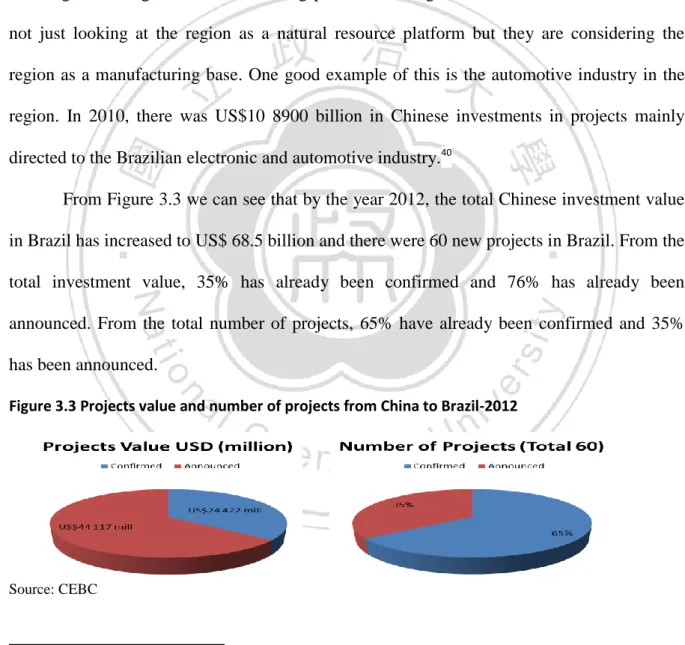
(38) 3.3.1 China’s ODI Policy In 1997, the Asian financial crisis changed the global economic landscape and it was one of the strongest reasons why in the same year China released its 15th party congress report. The main point of this report was the switch in vision of China economic growth because it was through that report that China decided to engage and encourage Chinese investors to invest abroad. Through this report we can see that China has started to show more interest in enhance its comparative advantages as an important economic player and thus enable China to make better use of both Chinese and foreign markets and resources. In order to adjust China’s Overseas Direct Investment (ODI) strategy, in 1999, China issued a directive to encourage direct investment abroad and promote China’s exports via “processing trade” investment.36 The directive meant an important shift in China’s policy which is aimed to go from promoting overseas investment to directing ODI. By 2002, the Chinese authorities pushed the currently known as “going global” or “stepping out” strategy to sustain the economic reform process and to promote global industry. In the same year, China’s 16th party congress report emphasized its “going out” strategy by doing a better job in opening up by “bringing in” and “going out”. As a way to promote their domestic brands and decrease its dependence on foreign FDI, China manifested its interest to encourage and help relatively competitive enterprises with various forms of ownership to invest abroad. Through investing abroad, China aims to keep increasing exports of goods and labor services and bring out China’s strong multinational enterprises and brand names.37 In the 11th China’s Five-year Plan (2006-2010), China’s intention was focused in the implementation of its “going-out” strategy. China’s main concern was to provide support to domestic enterprises with mature conditions to conduct direct foreign investments and 36. Xinhuanet.com, "XV National PRCs Congress Report,” Xinhuanet.com, accessed Jun. 2013, http://big5.xinhuanet.com/gate/big5/news.xinhuanet.com/ziliao/2003-01/20/content_697173.htm. 37. Xinhuanet.com, "XVI National PRCs Congress Report,” Xinhuanet.com, accessed Jun. 2013, http://big5.xinhuanet.com/gate/big5/news.xinhuanet.com/ziliao/2003-01/20/content_697330.htm. 38.
(39) transnational operations. They believed that a superior industry can represent a key point for guiding more Chinese enterprises to carry out overseas processing trade and promote domestic products. These Chinese foreign investments are planned to be made through transnational merge and acquisition, equity participation, listing, restructuring and association, etc., but without losing focus that their main purpose which is to foster and develop China’s trans-national companies. In China’s 17th party congress report published in 2007 and China’s 18th party congress report published in 2012, China showed its commitment to strengthen overseas investment and R&D cooperation, production and marketing, and accelerate the growth of Chinese multinational corporations and Chinese brand names in the world market. China expressed openly its desire that Chinese companies should expand overseas presence at a faster pace, enhance their operation in an international environment, and develop a number of world-class multinational corporations. This goal can be also seen in China’s 12th Five-year Plan (2011-2015). In this last release China reaffirmed its concern about overseas investment environment and reiterates its interest in strengthen scientific assessment of investment projects, improvement integrated ability, improvement of crosssectorial coordination mechanism, strengthen the implementation of the strategy of “goingout” to a more macroscopically guidance and service.38 Due to the Chinese “going global” policy, there have been several Chinese companies that started to be interested in investing in varieties of industries. In the last decade there have been some Chinese companies that have settled down their manufacturing plants in the Latin American and the Caribbean region. Chery, which is China’s leading automobile manufacture, has plants in Uruguay since 2007 and in Brazil since 2009. Lenovo, one of the world’s computer manufacturers has its plants in Mexico since 2009. China’s telecommunication firms as Huawei and ZTE also succeed due to their cheap price 38. China.com.cn, "XVII National PRCs Congress Report,” China.com.cn, accessed Jun. 2013, http://www.china.com.cn/17da/node_7032458.htm. 39.
數據

+7
Outline
China’s ODI policy
China's Policy Paper on Latin America and the Caribbean
New Economic Order Post Financial Crisis
Economic Relations between China and Latin America and the Caribbean Region
China’s FDI to Latin America and the Caribbean region
Peruvian Economic Development in the 1990s
Peruvian Economic Development in the 2000s
Bilateral Relations between China and Peru
Bilateral Relations between China and Peru after Free Trade Agreement
相關文件
• Children from this parenting style are more responsive, able to recover quickly from stress; they also have better emotional responsiveness and self- control; they can notice
Seeing other good project videos from classmates may motivate students to prepare better. No excuses for “sudden” technical
• One of the main problems of using pre-trained word embeddings is that they are unable to deal with out-of- vocabulary (OOV) words, i.e.. words that have not been seen
We have presented a numerical model for multiphase com- pressible flows involving the liquid and vapor phases of one species and one or more inert gaseous phases, extending the
Promote Hong Kong economic growth 促進香港經濟增長 Earn foreign exchange to pay for imports賺取外匯支付進口貨品 Government can have more profit tax 政府利得稅收入增加
An additional senior teacher post, to be offset by a post in the rank of APSM, is provided to each primary special school/special school with primary section that operates six or
An additional senior teacher post, to be offset by a post in the rank of APSM, is provided to each primary special school/special school with primary section that operates six or
*More able students and those who have interest may further study the development of popular culture (pop music, cartoons, movies, television, etc.) in post-war Hong Kong to
