國立交通大學
電子工程學系電子研究所碩士班
碩 士 論 文
隨機競爭的資源分配方法用於考慮服務品質的移
動式無線近身網路
Random Contention Based Resource Allocation for QoS
Concerned Mobile Wireless Body Area Network
研 究 生:劉美伶 指導教授:黃經堯 博士
隨機競爭的資源分配方法用於考慮服務品質的移動式無線近身網路
Random Contention Based Resource Allocation for QoS Concerned Mobile
Wireless Body Area Network
研究生:劉美伶 Student:Mei-Ling Liu 指導教授:黃經堯 Advisor:Ching-Yao Huang 國 立 交 通 大 學 電子工程學系電子研究所碩士班 碩 士 論 文 A Thesis
Submitted to Department of Electronics Engineering & Institute of Electronics College of Electrical and Computer Engineering
National Chiao Tung University in partial Fulfillment of the Requirements
for the Degree of Master
in
Electronics Engineering July 2010
Hsinchu, Taiwan, Republic of China
中華民國九十九年七月
i 隨機競爭的資源分配方法用於考慮服務品質的移動式無線近身網路 學生: 劉美伶 指導教授:黃經堯 博士 國立交通大學電子工程學系電子研究所碩士班
摘 要
無線近身網路目前主要被應用在遠距醫療照護用以提供病人在醫 療院所之外的全天候醫療生理監控服務。因其生理訊號對訊號正確性的 敏感度與生命相關的重要性,在資料傳輸的過程中,對於無線近身網路 的服務品質(QoS)需要更多重視與注意,以提供緊急狀況的即時傳輸, 保證資料持續穩定地送達醫院端。 在本論文中,將針對可移動無線近身網路,考慮其服務品質的需求, 提出一個以隨機競爭的資源分配的方法 (RACOON) 來提供服務品質 的保證。除了考慮單一網路服務品質的控制,所提出之演算法也針對不 同無線近身網路的使用者進行等級分類的考慮。當頻寬資源不足夠時, 高風險等級的無線近身網路使用者會比低風險等級的使用者有更多的 傳輸機會,以保證緊急的訊號可以即時的傳送給醫生做診斷。在模擬平 台方面是使用 MATLAB 來測試隨機競爭的資源分配方法的效能。最後 的模擬結果顯示所提出的隨機競爭式資源分配方法可以有效地分配頻 寬資源給每一個不同的無線近身網路使用者,並符合其風險等級和頻寬 的需求。ii
Random Contention based Resource Allocation for QoS Concerned Mobile Wireless Body Area Network
Student: Mei-Ling Liu Advisor: Ching-Yao Huang
Department of Electronics Engineering Institute of Electronics
National Chiao Tung University
ABSTRACT
The mobile wireless body area network which is mainly applied to remote health care system provides the ubiquitous medical services of patients’ health monitoring beyond the confines of hospitals and clinics. For the monitoring of vital signals which is sensitive and important, the quality of service (QoS) should be considered to provide the critical level of operations.
In this thesis, we propose a resource allocation scheme, random contention based resource allocation (RACOON) algorithm, for QoS concerned wireless body area network (WBAN). Besides of the quality of service control in a single WBAN, the proposed algorithm also considers the issues of the priority difference between WBANs. The algorithm provides the high risk WBAN users have more transmission opportunities than low risk WBAN users to guarantee the real time transmission of critical packets when the bandwidth resource is not enough. A MATLAB simulation platform is built to evaluate the performance of resource allocation of RACOON. Simulation results show that RACOON algorithm can
iii
effectively allocate data slots to each WBAN to meet both of its risk level and bandwidth requirements.
iv
誌 謝
時光匆匆,轉眼間兩年的研究生生涯即將接近尾聲,能夠順利畢業,真 的要感謝很多人給我的幫助,沒有你們,一個人的我是辦不到的。首先 感謝老師 黃經堯教授不厭其煩的指導。從研究一開始的模糊摸索到後 來慢慢找到方向的過程中,雖然辛苦,但是也學到了許多,像是思考問 題的所在與判斷的能力。在每次的報告中,老師都能以他專業的角度提 出我所忽略的地方,並提供參考的意見,我才能在研究的過程中慢慢進 步學習,讓研究內容更完整。在這段時間當中,真的是謝謝老師的照顧。 接著,非常榮幸可以遇到實驗室裡的每一個人,我很喜歡和大家在一起 時快樂的氣氛,因為有了你們,在研究所的這兩年裡,我不覺得孤單。 先謝謝非常辛苦指導我的士恆和子宗學長,當研究上遇到難關或是程式 有問題時,總是能撥空出來幫助我;或提供我研究上寶貴的意見,讓我 可以勇往直前接受更多的挑戰,真的很感激。再來是一起研究的好夥伴, 怡萱、英昌、裕華,謝謝你們的陪伴與鼓勵,還有 Jack 學長、阿勇學 長、鴻輝學長、家弘學長、CGI 學長、理詮學長、東祐學長,烜立、Gary、 明憲、周緯,這兩年的生活裡面,有苦有樂,遇到你們真的是件開心的 事,讓苦悶的研究生活不再那麼的枯燥乏味。還有我親愛的大學室友們, 佳慧、香如、阿花,雖然畢業後各奔東西,但是每當收到你們的問候關 心,讓一個人在新竹的我,特別覺得溫暖窩心,你們真好。 最後,感謝一直在背後支持我的爸爸媽媽,無論我遇到什麼事情,你們 總是最在乎我過得好不好的。尤其是之前住院開刀,你們不眠的照顧陪 伴,還有之後耐心的陪我復健,讓我可以很快的回到學校繼續研究,真 的是很謝謝我的家人,從小到大對我的照顧與栽培。我能夠有今天的成 績,都要歸功於我偉大的爸爸媽媽,並在此獻上無限的感激。 劉美伶 謹誌 2010 夏 於 Wintech 新竹交通大學v
CONTENTS
摘 要 ... i Abstract ... ii 誌 謝 ... iv Contents ... v Figures ... vi Table ... viii Chapter 1 Introduction ... 1Chapter 2 Overview of Wireless Body Area Network... 4
2.1 The positioning of WBAN in wireless network ... 4
2.2 WBAN infrastructure ... 6
2.3 WBAN application ... 8
2.3.1 Remote health care ... 8
2.3.2 Assisted living ... 11
2.3.3 Entertainment and sport ... 12
2.4 Mac protocol ... 13
2.4.1 Scheduled TDMA Mac protocol ... 14
2.4.2 Random access Mac protocol ... 15
2.5 QoS of WBAN ... 16
2.5.1 QoS issues with wireless body area network ... 17
2.5.2 Pri-arts 0f WBAN QoS : Probing based WBAN merging ... 19
Chapter 3 Random contention based resource allocation algorithm ... 23
3.1 System model ... 23
3.2 Proposed framework ... 24
3.3 Two-level priority structure ... 25
3.4 Network bandwidth allocation ... 29
3.5 WSN’s transmission schedule... 32
Chapter 4 Computer Simulation and Result ... 36
4.1 Dense WBAN scenario ... 36
4.2 Emergency scenario ... 40
4.3 Heterogeneous WBAN traffics scenario ... 42
4.4 Mobile WBAN scenario ... 47
Chapter 5 Conclusion ... 51
Reference ... 53
vi
FIGURES
Figure 2-1 Positioning of a Wireless Body Area Network ... 5
Figure 2-2 The WBAN infrastructure for medical application ... 7
Figure 2-3 Scenario of remote health care applications ... 10
Figure 2-4 How the artificial retina works ... 12
Figure 2-5 the retina prosthesis chips: ... 12
Figure 2-6 The WBAN application of entertainment and sport ... 13
Figure 2-7 The superframe and slot structure ... 14
Figure 2-8 Framing structure of PWM ... 20
Figure 2-9 Power consumption of WSN in Dense WBAN topology ... 22
Figure 2-10 Drop rate of WSN in walking test ... 22
Figure 3-1 Topology of WBAN and the traffic flow ... 24
Figure 3-2 The basic operation modules of CPN ... 25
Figure 3-3 Generating random number for pseudo competition ... 32
Figure 3-4 Basic concept of WSN’s transmission schedule ... 33
Figure 3-5 The structure of Priority Queue ... 34
Figure 4-1 The schematic diagram of increasing WBAN density ... 37
Figure 4-2 System throughput of dense WBAN scenario ... 38
Figure 4-3 Available bandwidth ratio ... 38
Figure 4-4 WBAN’s group delay ... 39
Figure 4-5 The delay performance of different priority WSNs ... 40
Figure 4-6 Immediate report ratio of high risk WBAN ... 41
Figure 4-7 Immediate report ratio of low risk WBAN ... 42
Figure 4-8 ECG traffic’s delay performance ... 44
vii
Figure 4-10 The heterogeneous traffic’s delay performance in high risk WBAN ... 46
Figure 4-11 The heterogeneous traffic’s delay performance in low risk WBAN ... 46
Figure 4-12 Delay’s statistical characteristic without QoS ... 49
Figure 4-13 Delay’s statistical characteristic of high risk WBAN ... 49
viii
TABLE
Table 2-1 Classification of wireless networks according to their coverage ... 5
Table 2-2 Physiological signals and its characteristics ... 10
Table 2-3 The classification of the telemedical data ... 11
Table 2-4 Features of WBAN MAC protocols ... 16
Table 3-1 The delay requirement of WBAN’s heterogeneous data ... 26
Table 3-2 The reference value of normal vital data ... 28
Table 4-1 Simulation setting parameters ... 37
Table 4-2 The heterogeneous traffic setting ... 43
CHAPTER 1
INTRODUCTION
With advances in wireless sensor technology, wireless devices and wearable sensors become more miniature and cost effective than before so that they have been widely applied to detect and monitor data in many fields (e.g. military, environment, medical treatment, entertainment, etc) [1] [2]. As the idea of telemedicine has been brought up, the wireless sensors are increasingly deployed on people for healthcare application. Therefore, wireless body area network has been proposed and become one of the popular research areas in recent years.
Wireless body area network (WBAN), consists of a group of wireless sensor nodes and a central processing node, is a short range communication network (3~5m).The wireless sensor nodes which could be the on-body sensors or implanted sensors are used to monitor the vital signals or activities of human body, and the central processing node which could be the PDA or cell phone is used to collect the vital signals from the wireless sensor node. Since WBAN can monitor physiological signals without wire-line limitation so that the measurement setting environment will be less troublesome and the user can freely move around. In this way, WBAN realizes the transmission of medical data from mobile patients to hospitals or clinics to provide ubiquitous health monitoring.
Due to WBAN’s medical purpose, it involves with the critical level of operation. WBAN needs reliable transmissions to make sure the physiological signals are accuracy and timeliness, so the quality of service (QoS) for WBAN is more necessary and important than other wireless sensor network. Works on WBAN’s QoS haven’t done much yet. Most studies of QoS are concerned about the single WBAN scenario, but don’t consider the multiple WBANs scenario that will happen when WBAN user moves and meets with other WBAN users. Furthermore, the QoS issues in WBAN still have the power consumption, the bandwidth limitation, and heterogeneous traffic types, etc. For these reasons, the QoS for WBAN still need to investigate.
The objective of this thesis is to provide a method to ensure the critical level of WBAN signal can meet its quality requirement and have reliable transmission including the bandwidth requirement and the real time transmission. Also, it can adaptively assign the bandwidth to heterogeneous traffic types according to its data generation rate and have low power consumption by using the probing based network merging [18]. Simulation result shows that the proposed QoS can not only prioritize the different traffic types, but also provide the important WBAN users desired bandwidth requirement and critical data real time transmission.
The remaining sections are organized as follows: Chapter 2 is the related work about issues and pri-arts of WBAN QoS. In chapter 3, we
detailed introduce the proposed method of QoS. Chapter 4 shows the simulation results in four scenarios to see the capability of the proposed QoS algorithm. Finally, the conclusions are included in chapter 5.
CHAPTER 2
OVERVIEW OF WIRELESS BODY AREA
NETWORK
2.1 The positioning of WBAN in wireless network
The communications of wireless networks get rid of the restriction of wire so that transmission range and the mobility are freer than the wired network. It could be done by using radio or infrared propagation. Wireless networks can be classified according to its transmission coverage, and WBAN is one of them. Hence, to understand the positioning of WBAN in wireless networks, we should know about the relations and differences between WBAN and other types of wireless networks.
There are five classifications of wireless network according to its transmission coverage: wireless body area network (WBAN), wireless personal area network (WPAN), wireless local area network (WLAN), wireless metropolitan network (WMAN), and wireless wide area network (WWAN). Figure 2-1 [3] shows the relative coverage of each network and the WBAN’s position in the whole wireless network. Different from other wireless networks, WBAN has the smallest coverage range due to the transmissions only surrounding the body of a human. The difference of transmission range also causes each network to have different applications and technologies to match with it. A simple classification of wireless network is listed in Table 2-1 [4]. Since WBAN is an emerging
network, there is no standard especially for it right now. However, Bluetooth [5] and IEEE 802.15.4 [6] sometimes are used in WBAN due to the characteristic of low power consumption even these have longer transmission range.
Figure 2‐1 Positioning of a Wireless Body Area Network
Table 2‐1 Classification of wireless networks according to their coverage
Network Coverage Data Rate Application Technologies
WWAN > 10 km < 10 Mbps Mobile Internet, telephony
Satellite, GSM, UMTS
WMAN < 10 km < 100 Mbps Broadband IEEE802.16
WLAN < 1 km < 100 Mbps Hot spot, Ethernet replacement
IEEE802.11
WPAN < 10 m < 10 Mbps Data transfer Bluetooth, IEEE 802.15.4
The relation of each network is that the small coverage network can be connected to the larger coverage network through a gateway which can convert between two different network technologies. Therefore, WBAN can be bridged to any of the networks mentioned before for delivering data to the remote medical server. The combination with other wireless networks can make the medical service of WBAN more complete. The smallest transmission scale and human-centric application make WBAN intrinsically different from other networks. The devices of WBAN which are on or in the body will make the communication more difficult. So far, WBAN is not fully developed, and it is still requires special attentions.
2.2 WBAN infrastructure
The wireless body area network is an imbalanced architecture. The WBAN is mainly formed by a group of wireless sensor nodes (WSNs) and a central processing node (CPN). The WSNs can be in-body or on-body sensor nodes which used to monitor the physiological signals of WBAN user, and the CPN is an aggregator such like PDA or cell phone which can collect data from the WSNs, serve as a user interface, and bridge the vital signals to hospitals or clinics for further diagnosis and tracking. Figure 2-2 shows the proposed WBAN infrastructure for medical application.
Figure 2‐2
The WBAN infrastructure for medical application
WBAN’s another characteristic is star topology. All the WSNs are connected to the CPN by using one single hop connection. Therefore, its traffic loading is asymmetric and most traffic is uplink. WBAN’s traffic is classified into 3 types [7]: on-demand, emergency, and normal traffic. On demand traffic is down link (CPN->WSNs), which is initiated when the doctors need to acquire certain information for more detailed diagnosis. Emergency and normal traffic is both uplink traffic (WSNs->CPN). Emergency traffic is initiated by the WSNs when the vital signal is not in the normal range and it is unpredictable and sporadic. Normal traffic indicates the normal data which is generated periodically by WSNs with no issue of time critical. These three traffics illustrate how the data flows in the WBAN and the asymmetric traffic loading. Different from other wireless network, WBAN has the smallest coverage range due to the transmissions only surrounding the body of a human.
Blood Pressure ECG Motion Body Area Aggregator Network
Wireless Body Area Network Medical Platform
1. Diagnosis 2. Storage 3. Alarm Service 4. …… Information Assistance, Treatment
A WBAN uses unlicensed ISM (Industrial, Scientific, and Medical) bands [8] [9], MICS (Medical Implant Communication Service) [10], WMTS (Wireless Medical Telemetry Service) [11] [12], and UWB (ultra-wideband) [13] for data transmission. ISM uses 2.4GHz band and it includes guard bands to prevent adjacent channel interference. WMTS uses 14MHz band and is a licensed band which only allows authorized users to use. It permits all type of communications related to medical care except voice and video transmission. MICS uses a frequency around 400MHz and is dedicated to the implanted medical communication. UWB could be used for WBAN applications due to its low transmission power.
2.3 WBAN application
WBAN is a special purpose sensor network which is designed to be a body-centric network with the limited and short transmission range around a person. With the help of portable and miniaturized WSNs, monitoring and sampling the body signals can be more convenient and ubiquitous, so the locations and the mobility of people are not the restrictions on monitoring anymore. Hence, the applications of WBAN mainly focus on providing improvements and assistances for people to have a better life. So far, there are many potential applications can be put in use in the WBAN and some of them are introduced in the following. 2.3.1 Remote health care
The remote health care is the most general and popular application in the WBAN due to demonstrated need and market demand. According to
the statistics of the department of health, the chronic disease is the foremost cause of death in Taiwan in recent years. This phenomenon also happens at every country in the world. Therefore, tracking and monitoring the health status of these high risk patients is important to avoid any unexpected casualty. WBAN can transmit the patient’s medical data to hospitals or clinics for diagnosis. Through the remote health care, patients could have personalized and individual care no matter where they are (ex. Hospital, home). It not only enhances the quality of medical treatment but also avoids the wastage of medical resource in hospital.
In remote health care, the main tasks of WSNs are to collect the patient’s data and send them to the CPN. Different WSNs are used to collect different types of data for different purposes. For medical application, there are three categories of data which can help the doctor to know more information about the patients.
The first one is the physiological signals monitoring which is the most important one in the remote health diagnosis. The physiological signals can show the health status of the patient and help doctor do the diagnosis. For example, electrocardiography (ECG) is used for cardiac disease diagnosing. Typical physiological signals and characteristics of them are show in Table 2-2 [14]. The second one is assistant signals. It is used for doctor’s further diagnosis when the patient is in emergency state on the way to the hospital. It helps doctors can have more accurate information of the patient and give some directions immediately. The kinds of signals are such like medical image, diagnosis audio, etc. The
last one is the context-aware data which are used to do some position tracing of patients. But the function is only available at certain places where are deployed with the position detective sensors.
Table 2‐2 Physiological signals and its characteristics
Lastly, Figure 2-3 shows the scenario of the remote health care application with different types of data, and Table 2-3 lists the classification of the telemedical data.
Figure 2‐3 Scenario of remote health care applications ECG Heart rate Temperature Emergency needs more diagnosis help! Image Audio Position Context‐aware sensor
Signal Frequency Range Signal Range
Electrocardiograph (ECG) 0.05~100Hz 0.01~5mV
Electroencephalograph (EEG) 0.5~60Hz 15~100mV
Electrooculograph (EOG) 0.5~50Hz N/A
Electromyogram (EMG) 0.5~60Hz N/A
Heart Rate 45~200 beats/min N/A
Breath Rate 12~40 breaths/min N/A
Table 2‐3 The classification of the telemedical data
2.3.2 Assisted living
Assisted living applications are used to help the disabled person to make up the deficiency of body and to improve the quality of life. The artificial retina technology [15] is developed for blind people. The image captured by camera will be wirelessly transmitted to the retina prosthesis chips implanted in the human eyes and convert the data to electronic signals. Figure 2-4 [15] and Figure 2-5 [15] briefly show how the artificial retina works. With this application, it can help people who lose their sights to see at an adequate level such as reading and facial recognition. Except this, the applications in assisted living still have hearing aid, asthma detection, artificial hands, etc.
Data Classification Description Application
Physiological parameters monitoring.
Periodic and delay
sensitive. (Sporadic nature of emergency data.)
ECG, heart rate, blood pressure, temperature… For doctor’s
further diagnosis.
Help diagnosis and medical decision. Diagnostic audio, image… Context-aware data. Environmental context: in bed or mobile, alone or not…
2.3.3 Entertainment and sport
The physiological and kinetic sensing of WBAN bring about the applications in this interesting filed. The gaming system has been different than before; instead, it is integrated with motion sensors, and mobile motion game is emerging. Personal fitness monitoring can collect and display data that are related to the exercise. Therefore, it can be used to monitor athletes during training and races, or track fitness data while going on a diet. Figure 2-6 shows the scenario of entertainment and sport application. Figure 2‐4 How the artificial retina works Figure 2‐5 the retina prosthesis chips: A retinal prosthesis contains a small implantable chip with electrodes. These electrodes stimulate the retina and help people regain limited vision.
Figure 2‐6 The WBAN application of entertainment and sport
2.4 Mac protocol
Media access control (MAC) layer determines how the packets access the channel and make it possible for numerous network nodes to communicate within a multi-point network. Hence, the MAC layer plays an important role to determine some performance metrics such as power consumption, network efficiency, packet loss probability, latency, and resource utilization. Different classes of MAC protocols may have different performance results under the same environment.
A suitable MAC protocol for wireless body area network should provide reliability which is related to the packet loss probability and the packet transmission delay, power efficiency, and scalability to meet WBAN’s specific requirements. Two basic classes of MAC protocols which can be applied in WBAN are scheduled TDMA (Time Division Multiple Access) and random access protocols. Each of them has
different features for WBAN applications. The following will briefly introduce the two protocols and their features.
2.4.1 Scheduled TDMA Mac protocol
The time division multiple access is a channel access method which uses the time slots to differentiate between the transmissions of different packets. Therefore, a time slot is only dedicated to a packet’s transmission. A central controller which is CPN in the case of WBAN can schedule time slots to the wireless sensor nodes for their data transmission. Figure 2-7 is the TDMA frame and slot structure.
Figure 2‐7 The superframe and slot structure
With the features of the scheduled TDMA protocol, WBAN can has low power consumption with sleeping mechanism. The WSN only has to wake up in the specified slot and goes to sleeping mode for power saving when it’s not the time to transmit. Also, the WSN doesn’t need to listen to the channel and wait for transmission all the time. Therefore, it can make WBAN more power efficiency. Besides, the scheduled TDMA can provide the deterministic transmission delay and no packet loss which is caused by packet collisions. These features are suitable for WBAN’s reliability. On the other hand, the scheduled TDMA must have a good
scheduling mechanism to utilize transmission resource efficiently due to the heterogeneous traffic of WBAN. Also, the scalability is not as convenient as distributed control architecture since the scheduled TDMA is central control architecture. The central controller of the network needs reconfiguration to accommodate new sensor nodes. Consequently, Scheduled TDMA MAC protocol is good for WBAN’s reliability and power efficiency.
2.4.2 Random access Mac protocol
The random access protocol is suitable for distributed system because it doesn’t need a central controller in the network to schedule the transmissions. Basically, it accesses the channel only when there is packet to be transmitted. Hence, it is a contention based transmission. ALOHA, slotted ALOHA, and CSMA/CA (Carrier sense multiple access with collision avoidance) are some examples of random access MAC protocol. With the contention nature of random access protocol, the packet collision may happen when two or more nodes transmit the packet at almost the same time. It needs the retransmission to successfully transmit the packet. The features of the distributed control and contention base transmission make it easy to scale the nodes of WBAN, have lower signaling overhead, and are suitable for WBAN’s heterogeneous traffic. When the traffic loading is not heavy, random access can transmit data immediately with no retransmission. It can also have short transmission delay. However, the performance of power and network’s reliability become worse when the traffic load is high. Because the probability of
collision increases, it could bring the variable transmission delay and packet losses. Also, the retransmission consumes more power on a packet. Finally, random access is suitable for WBAN’s requirements when the traffic loading is not high. Table 2-4 [16] shows the features of these two WBAN MAC protocols.
Table 2‐4 Features of WBAN MAC protocols
MAC Features
Scheduled MAC: TDMA
Random Access MAC : CSMA/CA
Packet Delay Deterministic and fixed Variable with network traffic load
Packet loss Deterministic and fixed Variable with network traffic load Traffic handing capability Efficiently handle periodic traffic Efficiently handle
non-periodic traffic than scheduled MAC
Energy Efficiency
Energy efficient due to only activated in the specified slot
Energy efficiency could be low if the traffic load is high due to higher collision
probability Network Scalability Normal Good
2.5 QoS of WBAN
WBAN is widely applied to medical applications which require stringent QoS demands. Since the applications are life-related, the
transmissions of medical signals should be more reliable than non-medical signals. Most studies on WBAN are mostly devoted to low power design and implementation, but the studies on WBAN’s QoS are few. Therefore, the QoS issues in WBAN require more attentions and should be taken up more seriously.
2.5.1 QoS issues with wireless body area network
WBAN is a special kind of wireless sensor network. Its network architecture and application scenario make it have some challenges to QoS support in WBAN. The following lists some QoS issues [17] that should be considered in WBAN scenario.
A. Resource limitations
In the wireless environment, the miniature and wearable WSNs face some resource limitations such as limited bandwidth of wireless channel, limited memory, and battery power. Therefore, the QoS should support overcoming bandwidth limitation, handling buffer size, and saving power consumption.
B. Heterogeneous traffic types
In medical application, the monitoring signals may be different kinds of physiological signals in a WBAN. It makes WSNs has different sampling rates to collect data. The heterogeneous traffics make QoS support more complex and challenging.
C. Unpredictable traffic pattern
The traffic of WBAN is different from traditional network. The emergency traffic occurs when the vital data is out of normal range. It is unpredictable and aperiodic. The nature of the unpredictable traffic pattern should be carefully considered in QoS support for emergency event.
D. Network instability and dynamics
One characteristic of WBAN is its instability and dynamics. The network topology might change due to node mobility, failure, and addition of new nodes. The walking scenarios of WBAN users also cause the problem of multiple WBAN’s interference. Besides, the unreliable nature of wireless network may have a negative influence in emergency data transfer. Hence, the instability and dynamics increase the complexity of QoS.
E. Packet criticality
Some data in WBAN are very critical and it needs real time attention. It depends on the patient’s disease or whether the vital data have some abnormal occurrence. For example, a patient’s heart activity information is more important than the body temperature data when the patient has cardiac disease, or the sudden clinical change of vital signal should be deeply concerned when it happens. QoS mechanisms should set up a priority structure to differentiate packet importance.
2.5.2 Priarts 0f WBAN QoS : Probing based WBAN merging So far, the studies of WBAN QoS are only considered about single WBAN scenario to have reliable transmission such as packet loss and data latency. To fulfill the above-mentioned WBAN QoS issue, the multiple WBANs scenario and the network mobility should be taken into account. Besides, the power efficiency is equally important while maintaining the desired reliability. Probing based WBAN merging control [18] is proposed to reduce the power consumption and overcome the inter-WBAN interference in mobile WBAN topology. It can efficiently decrease the power consumption in mobile WBAN scenario to overcome the QoS issue of power limitation and network dynamics.
Probing based WBAN merging algorithm combines the concepts of neighborhood detection and distributed spatial TDMA. Neighborhood detection ensures fast reaction to dynamic WBAN topology, and distributed spatial TDMA provides collision free resource assignment.
Dual-channel Neighborhood Detection
The dual-channel neighborhood detection includes a probing channel and a local channel, illustrated in Figure 2-8. The probing channel is used to detect and exchange messages with its neighbors. The local channel is designed for intra-WBAN transmission including the uplink vital signals (WSNs->CPN) and downlink control messages, ex. beacon (CPN->WSNs). For early detection of neighbor WBANs, the probing channel is designed to have wider transmission range than local channel.
Thus, WBANs can resolve the inter-WBAN interference through the probing channel before WBANs collides with each other in the local channel. CPN is the only node that has the dual channel function, and it can detect and resolve neighbor interference while two WBAN merge. The inter-WBAN interference is resolved by the early detection, and the intra-WBAN transmission can have collision free operation by applying a two-step WBAN resource allocation. Step 1: CPN contends radio resource by spatial TDMA for its WBAN. Step 2: CPN then schedules obtained resources to its WSNs in the local channel. Thus, the dual-channel neighborhood detection resolves the inter-WBAN interference and removes the detection operation from its WSNs.
Figure 2‐8 Framing structure of PWM
Random Prioritized Spatial TDMA
CPNs contend radio resource by spatial TDMA for its WBAN. The Inter-WBAN Contention Message which contains a series of random number is created for resource contention. CPN directly exchanges IWCMsg with neighbors through the probing channel. Every superframe, each CPN broadcasts the IWCMsg carrying random numbers for each resource unit to contend the resource. For a slot data period, IWCMsg carries random numbers for slot contention, and the biggest number wins the slot. Consequently, the slot winners are decided after CPN compares the random numbers of its IWCMsg with the random numbers from all neighbors’ IWCMsg. It can achieve fair resource allocation of each WBAN and fast converging speed.
Figure 2-9 [18] shows that the algorithm can keep low power consumption and is independent to network density. Figure 2-10 [18] shows the drop rate is zero in the mobility scenario since it has the collision avoidance strategy. These results shows the probing based network merging can have low power consumption in mobile WBAN. However, it still needs more complete control mechanism to ensure the transmission reliability to meet medical data’s requirements. Hence, we further develop a random contention based resource allocation algorithm to provide medical data more reliable guarantee in mobile WBAN scenario based on the probing based network merging algorithm.
Figure 2‐9 Power consumption of WSN in Dense WBAN topology Figure 2‐10 Drop rate of WSN in walking test 0 20 40 60 80 100 120 140 160 180 1 2 3 4 5 6 7 8 9 10 Po we r C o ns um pt io n of WS N (m W ) Numbers of WBANs RWM 802.11 802.11(NoRTS/CTS) 0 5 10 15 20 25 30 35 40 45 50 ‐10 ‐5 0 5 10 15
Dr
op
ra
te
(%
)
Radar channel power (dbm) RWM(All Speed) 802.11‐0.5m/s 802.11‐5m/s 802.11(NoRtsCts)‐0.5m/s 802.11(NoRtsCts)‐5m/sCHAPTER 3
RANDOM CONTENTION BASED RESOURCE
ALLOCATION ALGORITHM
In this thesis, we focus on providing QoS for medical data transmission by designing a two-level priority structure and network bandwidth allocation algorithm in mobile WBAN scenario. The proposed random contention based resource allocation (RACOON) for QoS concerned mobile wireless body area network could provide the important WBAN users more reliable data communication including the bandwidth requirement and the real time transmission of critical signal due to the adaptively resource contention between prioritized WBANs. Besides, taking the advantage of probing based network merging can have low power consumption in mobile WBAN topology.
3.1 System model
WBAN is an imbalanced architecture formed by a central processing node (CPN) and a group of wireless sensor nodes (WSNs). CPN is capable of collecting vital signals and context aware data, processing, and further transmitting the data to remote diagnosis center. The WSNs measure the heterogeneous traffic types which contain the vital data, image, diagnosis audio, and context-aware data, and transmit them to the CPN. The transmission of WBAN uses CPN based scheduling TDMA algorithm which probing based WBAN merging introduced before. Figure 3-1 shows WBAN’s topology and its traffic flow.
Figure 3‐1 Topology of WBAN and the traffic flow
3.2 Proposed framework
CPN is in charge of controlling and scheduling the transmission flow of WBAN to mitigate the operation complexity of WSNs. The proposed framework is the basic operation modules of CPN to provide the QoS over the heterogeneous traffic data, which is shown in Figure 3-2. The basic idea of the proposed random contention based resource allocation algorithm is as follows. First, the WSN data classification module is to classify the importance of each WSN’s data depending on the data type and the data status. This is the intra-WBAN priority classification. And the WBAN risk assignment module is used to indicate the WBAN users’ risk level according to their health status. Hence, this is the inter-WBAN priority assignment. The WSN’s importance and WBAN’s risk level would be determined at every superframe. These two modules constitute a two-level priority structure. Then, the network bandwidth allocation module is used to contend the bandwidth resource with neighbor WBAN users according to its risk level and bandwidth requirement. Finally, in WSNs’ transmission schedule module, CPN assigns and schedules the
available bandwidth to WSNs. These modules basically show the procedure of providing QoS. The detailed algorithm will be introduced below.
Figure 3‐2 The basic operation modules of CPN
3.3 Two-level priority structure
The two-level priority structure is proposed to differentiate the packet criticality with more detailed classification because the status of WBAN user is very different. Each WBAN contains different priority WSNs, and different priority definitions for different WBANs. Besides, the WBAN user’s health status should be considered to provide the critical patient more reliable data transmission.
Intra-WBAN priority: The WSN data classification
It is important to differentiate the WSN data’s importance in QoS supporting. Different data have their special requirements (ex. delay)
Vital signal
from WSN voice Image
Context aware data
WSN data classification
WBAN risk assignment
Network bandwidth
allocation
WSN’s transmission
schedule
based on the data category and data status. In the remote health care application, the vital signals is much important than other assistant signals, and the vital signals sometimes are very critical and they need real time attention. Table 3-1 briefly shows the delay requirement of heterogeneous data.
Table 3‐1 The delay requirement of WBAN’s heterogeneous data
The WSN data priority scheduling is decided by static priority and dynamic priority. The assignment of static priority is based on the data’s latency requirement. The physiological signals need shorter delay than other assistant signals so that the physiological signals’ static priority are assigned to 1 and other assistant signals’ static priority are assigned to 0. The static priority will not change since it is based on the natural of data’s delay requirement. On the other hand, the dynamic priority is set to 0 initially. The dynamic priority will change into 1 in two cases during data monitoring. One case is the vital data is specified as important by the doctor, and the other one case is the vital data occur a clinic change. The vital signals in these two cases require more attentions so that the dynamic priority will increase to 1. Thus, the dynamic priority will change depend on the vital signal’s status to reflect the dynamic characteristic of vital signal. The total priority is determined by summing up both static and dynamic priority. Therefore, the intra-WBAN priority
Delay Sensitivity Telemedical data Delay bound
Delay sensitive ECG, Heart rate,
Blood pressure ….
Emergency :<250ms Normal :500‐1000ms
has three levels for WSN data classification: 0 for low, 1 for high, and 2 for critical. The overall algorithm of WSN data classification is shown in ALGORITHM 1.
Input: The Ref_Rangei is the reference value of normal vital data shown in Table 3-2. The dpi denotes the dynamic priority and the spi
denotes the static priority.
Output: The intra-WBAN priority for WSNi, priorityi: 0 for low, 1 for high, 2 for critical.
begin
for every WSNi do spi ← 0
dpi ← 0
if(WSNi is vital signal) spi ← 1
if(WSNi is specified as important by doctor) dpi ← 1
endif endif
for every superframe do for every WSN do
currenti = current data value from WSNi if(currenti is out of Ref_Rangei)
dpi ← 1 else dpi ← 0 endif priorityi = spi + dpi endfor endfor end Algorithm 1 WSN data classification
Table 3‐2 The reference value of normal vital data
InterWBAN priority : WBAN risk assignment
WBAN risk assignment is used to differentiate the WBAN user’s importance by evaluating the health status according to the vital signals. When the patient’s health status gets worse, the number of abnormal vital signals may increase. This situation will reflect in the dynamic priority defined in WSN data classification module. The more the signals whose dynamic priority is 1 means the WBAN user may be in a critical condition. Hence, the WBAN risk assignment is related to the numbers of WSNs whose dynamic priority is 1. The inter-WBAN priority algorithm has two parameters: the risk index (RI) and the pre-defined risk
index threshold (RIth). We assume the numbers of WSNs in a WBAN are
N, and the numbers of WSNs whose dynamic priority is 1 are n. The risk index of WBAN is defined as n/N which means the proportion of
important data in total WBAN data. The RIth is a threshold to differentiate
the WBAN’s risk level is high or low, and it is specified by the doctors according to their professional evaluation. The algorithm is shown in ALGORITHM 2.
In the WBAN risk assignment module, the high risk WBAN means that the WBAN user’s health status is relatively dangerous and the vital signals from WSNs are relatively important and need timely transmission. The low risk WBAN is less important than the high risk WBAN when the bandwidth resource is not enough. It only guarantees some important data real time transmission and sacrifices less important data’s bandwidth requirement. It is a compromise when the available bandwidth is not enough for every WBAN user.
3.4 Network bandwidth allocation
The network bandwidth allocation is used to distribute the limited available bandwidth to different WBAN users. In our previous work in probing based network merging, the bandwidth allocation is through the
Input: The numbers of WSNs in WBAN are N, and the numbers of high dynamic priority are n. A pre-defined risk index threshold is RIth and risk index is RI.
Output: The WBAN_risk denotes the risk level of WBAN group. for every superframe do
RI = n/N if(RI >= RIth) WBAN_risk = High else WBAN_risk = Low endif endfor Algorithm 2 WBAN risk assignment
random number contention. Every CPN exchanges the Inter-WBAN Contention Message which contains random generated numbers for bandwidth contending. The CPN having the largest random number wins the transmission slot. By the uniform generated random number, every WBAN wins the bandwidth resource with almost the same probability. It is a fair bandwidth allocation between WBANs. However, we prioritize WBANs into different levels for QoS supporting. The fair bandwidth allocation should be modified.
Neighborhood-aware Contention Resolution algorithm provides the idea of the prioritized resource allocation. The prioritized resource allocation can be realized by pseudo contention of each CPN. A CPN first generates its uniform random numbers and picks the largest one for contention. The portion of resource that CPN can obtain is proportional to the numbers of random numbers, , used in pseudo contention. The probability of winning the bandwidth contention is
∑ , ,
where is the set of neighbors of CPN . Thus, the prioritized
bandwidth allocation can be achieved by using the pseudo contention of each CPN. The CPN can base on WBAN’s priority level to generate the numbers of random number for its pseudo contention.
In the bandwidth allocation algorithm, CPN is a central processing node which knows the bandwidth requirement of each WSN in the WBAN. According to the classification of WSN priority, CPN has two parameters for the WBAN bandwidth demand, required bandwidth (BWrequired) and desired bandwidth (BWdesired). Required bandwidth is the
total bandwidth that all WSNs with critical and high priority need in the WBAN. Desired bandwidth is the total bandwidth that all WSNs need in the WBAN. Depending on these two parameters, CPN can adaptively adjust the numbers of random numbers based on its WBAN risk level for the bandwidth contention. The algorithm of network bandwidth allocation is shown in ALGORITHM 3 and Figure 3-3.
Input: A set of BWrequired and BWdesired values that represent the WBAN’s
required bandwidth and desired bandwidth which will be updated by CPN if there are changes in WSNs’ dynamic priority. Available bandwidth, BWavailable, is the bandwidth which is obtained from
random number contention by CPN.
Output: The numbers of random numbers (Nrandom) is adaptively
generated for the pseudo competition of CPN based on the status of BWavailable.
begin
Nrandom ← 1.
for every superframe do if (BWavailable <=BWrequired)
if (WBAN risk == high) Nrandom ← Nrandom +2
else
Nrandom ← Nrandom +1
endif
else if (BWrequired <BWavailable < BWdesired)
if (WBAN risk == high) Nrandom ← Nrandom +1 else Nrandom ← Nrandom endif else if (Nrandom >1) Nrandom ← Nrandom -- else Nrandom ← 1 endif endif endfor end ALGORITHM 3
Figure 3‐3 Generating random number for pseudo competition
3.5
WSN’s transmission schedule
After CPN gets the available bandwidth from the collision-free resource allocation, it is important to assign the available bandwidth to its WSNs. CPN schedules the available transmission slots for the WSNs and sends the transmission schedule to WSNs through the beacon. By considering the priority of WSNs and the emergency case of medical data, the scheduling procedure has two steps: reserving bandwidth for medical data and priority queue. Figure 3-4 shows the basic scheduling concept.
start Available bandwidth case3 case2 case1 if (num of random >1) Nrnd‐‐ ; else Nrnd =1; Risk level? Nrnd ++ high low Nrnd =remain Risk level? Num of random =Nrnd Nrnd ++ Nrnd +=2 high end BWavb<= BWrequired BWdesired<= BWavb
Figure 3‐4 Basic concept of WSN’s transmission schedule
Reserving bandwidth for medical data
During the monitoring of physiological data, the emergency event is unpredictable and sporadic. When the abnormal data is monitored, the WSN is able to give it the priority of transmission over the preceding data in the queue. To make sure that CPN can immediately receive the abnormal data and increase the level of priority, reserving bandwidth for medical data is essential. CPN assigns one transmission slot for each WSN to guarantee each of them has the transmission opportunity in every superframe. The portion of reserving bandwidth is not much in total available bandwidth, but it is necessary for timely response of the emergency event.
CPN
Schedule
resource
Available transmission slots
CPN
Reserved
Priority Queue
Hybrid scheduling
Priority Queue
Figure 3‐5 The structure of Priority Queue
Priority Queue is the main portion of the intra-WBAN’s bandwidth allocation. The basic concept of Priority Queue is that CPN schedules the WSN’s transmission according to the WSN priority level. Figure 3-5 shows the structure of Priority Queue. The transmission slots are first assigned to the WSN which is critical priority level, and then switched to lower priority level while the higher priority level’s queue is empty. The WSN with higher level of priority would be processed early, and the WSN with lower level of priority may be waiting for processing when the bandwidth resource isn’t enough. The WSN priority level reflects the length of waiting time for transmission schedule. For the same priority WSNs, CPN checks whether the remaining bandwidth is enough or not to plan the transmission schedule. CPN assign the slots according to each WSN’s requirement bandwidth if the remaining bandwidth is enough. If not, CPN assign the remaining bandwidth in proportion to the WSNs’ requirement bandwidth. Hence, the intra-WBAN bandwidth allocation of three priority levels of WSNs can be expressed by the following equation.
classifier WSN data in critical high low WSN data out Switching to lower priority queue while the higher priority queue is empty. (Critical‐>high‐>low)
Therefore, Prioirty Queue provides prioritized bandwidth scheduler for different WSNs.
The WSN priority scheduler is divided the WSNs of WBAN into 3 levels (critical, high, and low). The CPN has the required bandwidth of each level: BWcritical, BWhigh, and BWlow.
Therefore, the total available bandwidth of WBAN can be expressed: BWavailable= αBWcritical +βBWhigh +γBWlow + BWexcess.
if (BWavailable < BWcritical)
α = BWBW , β= 0, γ=0, BWexcess=0;
else if(BWavailable > BWcritical & BWavailable ‐ BWcritical < BWhigh) α =1, β= BW BW BW , γ=0, BWexcess=0;
else if(BWavailable > BWcritical+ BWhigh & BWavailable ‐ BWcritical ‐ BWhigh< BWlow) α =1, β=1, γ= BW BWBW BW , BWexcess=0;
else
CHAPTER 4
COMPUTER SIMULATION AND RESULT
In order to verify the effectiveness of the proposed QoS algorithm, we design several simulation scenarios. The QoS should provide the medical data of WBAN reliable transmission which is related to the packet loss probability and the packet transmission delay. In our previous work of probing based network merging, it has shown that there is no packet loss in the mobile WBAN scenario due to the collision avoidance strategy. Therefore, the transmission delay is what we care about here. Four simulations are set up to see the characteristic of the proposed random contention based resource allocation algorithm.4.1 Dense WBAN scenario
Simulation Model
The dense WBAN scenario is used to test the inter-WBAN bandwidth allocation algorithm between two priority levels of WBAN groups under different WBAN density. It is assumed that several WBANs are randomly placed in a 3×3 meter square. Each WBAN is formed by a CPN and twelve WSNs. Two WBAN risk levels are in the system. The numbers of each WBAN risk level are increased from one to five which is illustrated in Figure 4-1 to test the limit of system throughput and the available bandwidth of each WBAN risk level. The constant bit rate
(CBR) traffic is applied in each WSN. Table 4-1 lists the detailed simulation settings in the Dense WBAN scenario.
Figure 4‐1 The schematic diagram of increasing WBAN density Table 4‐1 Simulation setting parameters Parameter Value Num of WSN/WBAN 12 Num of WBAN 1~10 (each WBAN risk level : 1~5) Traffic of WSN 64kbps CBR traffic. 512 byte packet size PHY rate 6Mbps Framing structure Beacon Period:20 slots/Data Periods:480 slots Slot duration:1 ms/Superframe duration: 0.5 s Simulation Result
In the dense WBAN scenario, we increase the numbers of WBAN to test the limit of system throughput. When too many WBANs are in the same area, the limited bandwidth resource is not enough for each WBAN’s requirement. The system throughput of the dense WBAN scenario is shown in Figure 4-2. The system throughput is saturated when WBAN numbers are more than five. In Figure 4-3, it shows the available bandwidth of each WBAN can get in the dense WBAN scenario under
different WBAN risk levels. Each WBAN obtains the available bandwidth by random number contention and use the available bandwidth to transmit the physiological data.
Figure 4‐2 System throughput of dense WBAN scenario Figure 4‐3 Available bandwidth ratio 0 100 200 300 400 500 600 2 4 6 8 10 slot s/ Sup e rf ram e numbers of group in the system System throughput 0 20 40 60 80 100 120 2 4 6 8 10 slo ts/ S u p e rf ra me
Number of WBANs (High/Low Risk)
Available Bandwidth
High Risk WBAN Low Risk WBAN No QoS
In no QoS condition, every WBAN’s available bandwidth degraded when the numbers of WBAN groups are more than five. With the proposed QoS algorithm, high risk WBAN can remain enough desired bandwidth until the numbers of high risk WBAN are five. The low risk WBAN has fewer available bandwidth when the WBAN number excesses the system’s limit. This result shows high risk WBANs can get as much as possible bandwidth they need to have reliable transmission of medical data. The data of low risk WBAN is less urgent than high risk WBAN so that it makes a concession and gets less bandwidth. Thus, the proposed QoS assigns the WBAN risk level according to the user’s health status and provides the important WBAN user the required bandwidth as much as possible to meet the delay requirement.
Figure 4‐4 WBAN’s group delay 0 5000 10000 15000 20000 25000 30000 35000 40000 2 4 6 8 10 ms numbers of WBANs in the system
WBAN group delay
High Risk WBAN Low Risk WBAN
Figure 4‐5 The delay performance of different priority WSNs
Figure 4-4 shows the WBAN group delay of two risk levels. High risk WBAN group can have short transmission delay even when it is in a dense WBAN system. Figure 4-5 further shows the high risk WBAN whose important WSN data can have timely transmission. Low risk WBAN don’t need timely transmission when the available bandwidth is not enough because its data may storage in the buffer and transmit as soon as the bandwidth is enough.
4.2 Emergency scenario
The emergency event is unexpected and sporadic. To handle this emergency case, the proposed QoS algorithm has the reserving bandwidth mechanism for medical data. Therefore, CPN can immediately increase the WSN’s priority level when it receives the abnormal data from the WSNs and provide the high level WSNs timely transmission.
0 2000 4000 6000 8000 10000 12000 14000 16000 2 4 6 8 10 ms Numbers of WBANs in the system
Delay of high risk WBAN
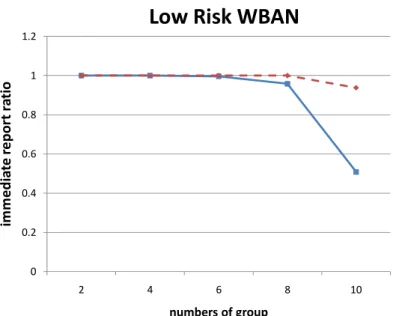
Critical High LowThis scenario is used to test the probability of transmission when WSN has emergency case in one superframe, the immediate report probability. The system model is as same as the dense WBAN scenario. We generate an unexpected emergency event to simulate the case. Figure 4-6 and Figure 4-7 show the result of the immediate report probability. We can see the fact that the WSNs can have large immediate report probability than without bandwidth reservation mechanism. Hence, the bandwidth reservation for medical data is essential to make CPN aware of the emergency event of the WSNs so that CPN can assign more bandwidth to the WSNs for reliable data transmission.
Figure 4‐6 Immediate report ratio of high risk WBAN 0 0.2 0.4 0.6 0.8 1 1.2 2 4 6 8 10 im m e d iat e re p o rt ra ti o numbers of group
High Risk WBAN
Without Reservation Bandwidth reservationFigure 4‐7 Immediate report ratio of low risk WBAN
4.3 Heterogeneous WBAN traffics scenario
Simulation ModelContinue with dense WBAN scenario, this scenario is to test the delay performance of each WSN in the WBAN with the characteristic of heterogeneous traffics. The heterogeneous traffics of WSNs are composed of various medical data types. Each data type has its corresponding data rate, numbers of node and the priority assignment. Table 4-2 lists some common medical data and the setting used in the simulation. 0 0.2 0.4 0.6 0.8 1 1.2 2 4 6 8 10 im m e d ia te re p o rt ra ti o numbers of group
Low Risk WBAN
Without Reservation Bandwidth ReservationTable 4‐2 The heterogeneous traffic setting
Simulation Result
In the heterogeneous WBAN traffic scenario, we test CPN’s capability of the intra-WBAN bandwidth allocation and the delay performance of two WBAN risk levels. To test the CPN’s capability of intra-WBAN bandwidth allocation, we compare the proposed algorithm with two common scheduling methods, round robin and earliest deadline first. We pick ECG and video among the heterogeneous traffics to represent the different degrees of traffic loading. Figure 4-8 and Figure 4-9 respectively show the delay performance of ECG and video data. Round robin has small delay in ECG traffic but large delay in video traffic because it fairly assigns the bandwidth to each WSN and doesn’t consider the heterogeneous traffic problem. Thus, round robin causes some bandwidth wastage on low traffic loading data and hardly satisfies high traffic loading data’s requirement. Earliest deadline first assign the transmission slots to WSN whose packet is closest to its deadline. Hence, the low traffic loading data gets less bandwidth and has large delay when the WBAN group’s available bandwidth is not enough. The proposed method’s delay performance shows it can be the best choice among these
Data Type Data rate The number in WBAN WSN Priority Assignment Temperature Pulse oximeter ECG Heart rate Blood pressure Diagnosis audio Video 2.4bps 2kbps/2channel 38.4kbps/12channel 4kbps 4kbps 32kbps 64kbps 1 1 6 1 1 2 2
For physiological data, Emergency: Critical Normal: High
For assistant data, Low
three scheduling methods because we consider the heterogeneous traffic issue and WSN data priority.
Figure 4‐8 ECG traffic’s delay performance 0 500 1000 1500 2000 2500 3000 10 14 18 22 26 30 34 38 delay(ms) numbers of group
Traffic : ECG(3.2kbps
)
Priority Round Robin Early Deadline FirstFigure 4‐9 Video traffic’s delay performance
The delay performance of WBAN’s heterogeneous traffic by using the RACOON algorithm is showed in Figure 4-10 and Figure 4-11. The delay performance in high risk WBAN can have real time transmission and also the important WSN data in low risk WBAN. The assistant data (audio and video) in low risk WBAN is less important so it has large delay performance. 0 5000 10000 15000 20000 25000 10 14 18 22 26 30 34 38 d e lay(ms ) numbers of group
Traffic : Video(64kbps)
Priority Round Robin Early Deadline FirstFigure 4‐10 The heterogeneous traffic’s delay performance in high risk WBAN Figure 4‐11 The heterogeneous traffic’s delay performance in low risk WBAN 0 50 100 150 200 250 300 10 12 14 16 18 20 22 De la y (ms ) Numbers of WBANs in the system
High Risk WBAN
Temperature Pulse Oximeter ECG Heart Rate Blood Pressure Audio Video 0 100 200 300 400 500 600 700 800 900 1000 10 12 14 16 18 20 22 De la y (ms ) Numbers of WBANs in the systemLow Risk WBAN
Temperatue Pulse Oximeter ECG Heart Rate Blood Pressure Audio Video4.4 Mobile WBAN scenario
Simulation Model
The mobile WBAN scenario is used to test the delay performance when many WBAN users randomly walk in a specific size of area. Each WBAN is formed by a CPN and twelve WSNs. We increase the WBAN users from 4 to 16 to increase the density of mobile WBANs. The area size is 20×20 meter square and the probing channel coverage range is 6 meter from the CPN. Table 4-3 lists the parameter setting about mobile WBAN scenario. Table 4‐3 Mobile WBAN’s parameter setting Parameter Value Num of WSN/WBAN 12 Num of WBAN 4~16 Traffic of WSN 64kbps CBR traffic. 512 byte packet size Walking velocity 4m/s Area Size 400 m2 Probing channel coverage rage 6m Simulation Result
In the walking simulation process, we collect the delay time of each WSN and analysis the statistical characteristic including the average and
the standard deviation. Figure 4-12 ~ Figure 4-14 show the delay statistic of NoQoS, high risk WBAN with proposed QoS, and low risk WBAN with proposed QoS. The delay average and standard deviation of NoQoS increase dramatically when the WBAN users increase to 14 in the specific area. The delay distribution shows the instable and dynamic features of random walking. Therefore, the delay time varies with the unpredictable WBAN walking and has no guarantee for the important medical data. On the other hand, the delay average and standard deviation of high risk WBAN is small even when the WBAN number is large. This means the important WBAN users can have relatively stable and reliable transmission during the walking scenario. The critical data in low risk WBAN is also guaranteed the smooth-going transmission of delay time. The less important data which has large delay standard deviation is the trade-off to other important data.
Figure 4‐12 Delay’s statistical characteristic without QoS Figure 4‐13 Delay’s statistical characteristic of high risk WBAN 2 4 6 8 10 12 14 16 18 0 200 400 600 800 1000 1200 1400 1600 numbers of groups D el ay( m s) NoQoS 2 4 6 8 10 12 14 16 18 0 50 100 150 200 250 300 350 400 450 500 numbers of groups De la y (m s )
High WBAN Priority
Critical High Low
Figure 4‐14 Delay’s statistical characteristic of low risk WBAN 2 4 6 8 10 12 14 16 18 0 2000 4000 6000 8000 10000 12000 numbers of group D el ay( m s)
Low WBAN Priority
Critical High Low
CHAPTER 5
CONCLUSION
In this thesis, we propose the random contention based resource allocation method (RACCON) for mobile WBAN to provide reliable transmission for the critical vital signals. At the beginning, we analyze the features of two basic MAC protocols and the QoS issues with mobile WBAN, and introduce the probing based network merging protocol which shows its advantage in power consumption in mobile WBAN scenario. Then, we design a two-level priority structure according to different critical levels of WBAN users and physiological signals. Finally, the CPN of WBAN manages the bandwidth allocation between multiple WBANs and the transmission schedule of its WSNs for differentiated services when the available bandwidth is not enough for each WBAN.
The random contention based resource allocation for mobile WBAN is designed to solve the unique QoS issues that WBAN application has. First, we use the imbalanced CPN/WSNs architecture to mitigate the processing loading from resource limited WSNs to resourceful CPN and control the transmission schedule of the heterogeneous traffic types. Second, the interference of dynamic network due to WBAN’s mobile feature is avoided by using probing based network merging protocol. Third, the packet critically and unpredictable traffic can be taken care by the two-level priority structure and cooperation of inter-WBAN and intra-WBAN bandwidth allocation. This
makes the important WBAN users have sufficient bandwidth for detailed diagnosis of the assistant signals and the critical packet can have timely data transmission. The performance evaluation shows the random contention based resource allocation algorithm provides the reliability of vital signal’s transmission no matter in the dense WBAN scenario or in the random walk scenario. Hence, the mobile WBAN can have low power consumption and reliable data transmission including the packet loss and delay.
REFERENCE
[1] Stefan Drude, Member, IEEE, "Requirements and Application Scenarios for Body Area Networks," Mobile and Wireless Communications Summit, 2007. 16th IST
[2] Mark A. Hanson, Harry C. Powell Jr., Adam T. Barth, Kyle Ringgenberg, Benton H. Calhoun, James H. Aylor, and John Lach, "Body Area Sensor Networks: Challenges and Opportunities," IEEE Computer, Vol. 42, No. 1, pages 58-65, January 2009
[3] Benoît Latré, Ingrid Moerman, Piet Demeester, "A Survey on Wireless Body Area Networks", Wireless Networks
[4] Katrin Bilstrup, "A Preliminary Study of Wireless Body Area Networks", Technical Report IDE0854, August 2008
[5] IEEE 802.15.1, "Wireless medium access control and physical layer specifications for wireless personal area networks, "2002, http://www.ieee802.org/15/pub/TG1.html
[6] IEEE 802.15.4, " Wireless medium access control and physical layer specifications for low-rate wireless personal area networks," 2003, http://www.ieee802.org/15/pub/TG4.html
[7] Sana Ullah Member IAENG, Pervez Khan, and Kyung Sup Kwak, " On The Development of Low-power MAC Protocol for WBANs", Proceedings of the International MultiConference of Engineers and Computer Scientists 2009 Vol I, IMECS 2009, March 18-20, 2009, Hong Kong
[8] Wikipedia, "ISM band," http://en.wikipedia.org/wiki/ISM_band
[9] Sana ULLAH, Pervez KHAN, Niamat ULLAH, Shahnaz SALEEM, Henry HIGGINS, Kyung Sup KWAK "A Review of Wireless Body Area Network for Medical Applications" International Journal of Communications, Network and System Sciences. Vol. 2, no. 8, pp. 797. Nov. 2009
[10] Federal Communications Commission, “Medical Device Radio communications Service,”http://wireless.fcc.gov/services/index.htm?job=service_home&id=medi cal_implant
[11] Federal Communications Commission, ”Wireless medical telemetry”, http://wireless.fcc.gov/services/index.htm?job=service_home&id=wireless_medi cal_telemetry
[12] Wikipedia,” Wireless Medical Telemetry Service,” http://en.wikipedia.org/wiki/Wireless_Medical_Telemetry_Service