行政院國家科學委員會專題研究計畫 成果報告
牛樟芝菌絲體發酵過濾液對人類肝癌細胞株細胞週期之影
響
計畫類別: 個別型計畫
計畫編號: NSC91-2316-B-002-010-
執行期間: 91 年 08 月 01 日至 92 年 07 月 31 日
執行單位: 國立臺灣大學食品科技研究所
計畫主持人: 沈立言
報告類型: 精簡報告
處理方式: 本計畫可公開查詢
中 華 民 國 93 年 2 月 10 日
行政院國家科學委員會專題研究計畫期末成果報告
牛樟芝菌絲體發酵過濾液對人類肝癌細胞株
細胞週期之影響
Effect of the filtrate of fermented mycelia of Antrodia camphorata on
the cell cycle of human liver tumor cell line
計畫編號:NSC91-2316-13-002-010
執行期限:91 年 8 月 1 日至 92 年 7 月 31 日
主持人:沈立言 國立台灣大學食品科技研究所
共同主持人:蔣丙煌
一、中文摘要 癌症近年來為國人十大死亡原因之首, 其 中 肝 癌 更 是 男 性 癌 症 罹 患 率 之 首 位 。 近 來,以天然食物來達到預防癌症之功效已成 為世界性熱門的研究課題。本研究分別以食 工所研發之牛樟芝菌絲體發酵過濾液 (filtrate of fermented mycelia of Antrodia camphorata, FFMA) 及 自 行 發 酵 之 牛 樟 芝 菌 絲 體 萃 取 液 (extract of fermented mycelia of Antrodiacamphorata, EFMA) 探討對肝癌細胞株 之影
響。在細胞生存力方面,實驗結果顯示以食 工所 FFMA 處理 Hep G2 及 Hep 3B 肝癌細 胞,其 IC50分別為 447 及 244µg/ml;當以自
行發酵之 EFMA 處理 Hep G2 及 Hep 3B 肝癌 細胞時,IC50分別為 24.6 及 48.1µg/ml。而在
細胞形態方面,以 500µg/ml 食工所 FFMA 及 自行發酵 EFMA 處理 Hep G2 與 Hep 3B 肝癌 細 胞 , 發 現 其 細 胞 形 態 與 控 制 組 有 明 顯 差 異,處理組之肝癌細胞皆有皺縮情況發生, 且增加細胞懸浮現象。在細胞週期的影響方 面,利用 500µg/ml 食工所 FFMA 處理,Hep G2 有被滯留在 G0/G1 期的現象,而 Hep 3B 在 300 及 500µg/ml 食工所 FFMA 濃度處理 下,壞死細胞增加,有部分細胞被滯留在 S 期;而以 50µg/ml 自行發酵 EFMA 處理肝癌 細胞時,則使 Hep G2 被滯留於 G2/M 期,而 Hep 3B 被滯留於 S 期。 關 鍵 詞 : 牛 樟 芝 、 菌 絲 體 、 過 濾 液 、 萃 取 液、人類肝癌細胞株、細胞週期 Abstract
Cancer is the number one of the ten leading death causes in Taiwan in recent years. Among the leading causes of cancer death, liver cancer is the first one for male. Cancer chemoprevention by natural edible products is a hot topic for researchers worldwide recently. In this study, the
effects of filtrate of fermented mycelia of
Antrodia camphorata (FFMA) from Food
Industry Research and Development Institute (FIRDI) and extract of fermented mycelia of
Antrodia camphorata (EFMA) from our lab on
the human liver tumor cell lines, i.e. Hep G2 and Hep 3B, were investigated. In terms of cell viability, the IC50 of Hep G2 and Hep 3B treated
with FFMA from FIRDI was 447 and 244µg/ml, respectively. The IC50 of Hep G2 and Hep 3B
cells treated with EFMA from our lab was 24.6 and 48.1µg/ml, respectively. In addition, the cell morphologies of Hep G2 and Hep 3B cells treated with 500 µg/ml FFMA from FIRDI and EFMA from our lab showed the cell shrinkage and cell suspension in medium, with significant difference as compared to the control group. The cell cycle of Hep G2 was arrested in G0/G1 phase by the treatment with 500µg/ml FFMA from FIRDI. While with the treatments of 300 and 500µg/ml FFMA from FIRDI, the number of necrotic cells of Hep 3B was increased, and some of Hep 3B cells were arrested in S phase.
However, the cell cycles of Hep G2 and Hep 3B were arrested in G2/M and S phase, respectively, when those liver tumor cells were treated with 50µg/ml EFMA from our lab.
Key words: Antrodia camphorata, mycelium, filtrate, extract, human liver tumor cell line, cell cycle
二、緣由與目的
牛 樟 芝 ( Antrodia camphorata; niu-chang-chih)又稱樟芝或牛樟菇,為本省特有 種 真 菌 , 僅 生 長 於 台 灣 特 有 之 牛 樟 樹 (Cinnamomum kanehirai Hay)。目前民間認 為牛樟芝具有解毒、抗癌及止癢作用,為一 本土性非常具有經濟效益的保健食品材料。 牛樟芝生長於老齡牛樟樹,由其中空樹幹內
面生長出真菌之子實體,著生的木頭有褐腐 之 現 象 , 因 此 樟 芝 可 能 是 褐 腐 的 木 材 腐 生 菌。數十年來,有不少人力、物力研究樟芝 的人工栽培,卻始終無法成功。樟芝菌種在 木層上生長極緩慢甚至停滯,更遑論其子實 體的長出。目前食品工業界已成功的利用高 科技之生物技術生產出牛樟芝菌絲體發酵過 濾液,提供此一高價值、高潛力之保健食品 材料。然而,其諸多醫療保健效用當需更多 生化、營養、藥物及毒理等基礎研究驗證。 在抑癌機轉方面,牛樟芝菌絲體發酵過 濾液究竟對癌細胞之細胞週期如何影響,是 一非常重要的研究課題。因此深入瞭解牛樟 芝菌絲體發酵過濾液對於細胞週期或細胞凋 亡之調控機制,將有助於癌症預防方法之研 究及抗癌食物或藥物之開發(Funk, 1999)。 本研究之樣品為 FFMA 由食品工業發展 研究所菌種保存及研究中心提供或自行發酵 生產 EFMA。探討以不同濃度之 FFMA 及 EFMA 處理人類肝癌細胞株後,對肝癌細胞 之細胞生存力、細胞形態之影響,以找出較 適當之 FFMA 及 EFMA 處理濃度;並以流式 細 胞 儀 ( flow cytometer ) 研 究 FFMA 及 EFMA 對 於 人 類 肝 癌 細 胞 株 細 胞 週 期 之 影 響。 三、結果與討論 (一) 篩選自行發酵牛樟芝菌絲體發酵萃取液 (EFMA)之條件 本 研 究 採 用 的 牛 樟 芝 菌 株 為 BCRC 35716,進行發酵的基本條件: 22℃,培養基 含 2 % glucose 、 2 % malt extract 、 0.1 % peptone,搖瓶轉速為 100rpm 。以 MTT 方法 篩選分析抑制 Hep G2 肝癌細胞株生存力。由 表一之結果顯示,不同發酵條件下,抑制 Hep G2 肝癌細胞株生存力之較佳發酵時間為二個 月。以此條件所生產之 EFMA 處理 Hep G2 肝 癌細胞株,其細胞之生存力為 6.9±0.4%。因 此後續之研究工作均採用此發酵條件所自行 生產之 EFMA 及食工所提供之 FFMA 進行對 人類肝癌細胞株 Hep G2 與 Hep 3B 影響之探 討。 (二)在肝癌細胞生存力方面 圖一及圖二為探討食工所 FFMA 及自行 發酵 EFMA 對於抑制 Hep G2 及 Hep 3B 生存 力的影響。以食工所 FFMA 處理濃度為 100、 300、500、600µg/ml 時,結果發現以食工所 FFMA 處理 Hep G2 與 Hep 3B 細胞,其 IC50
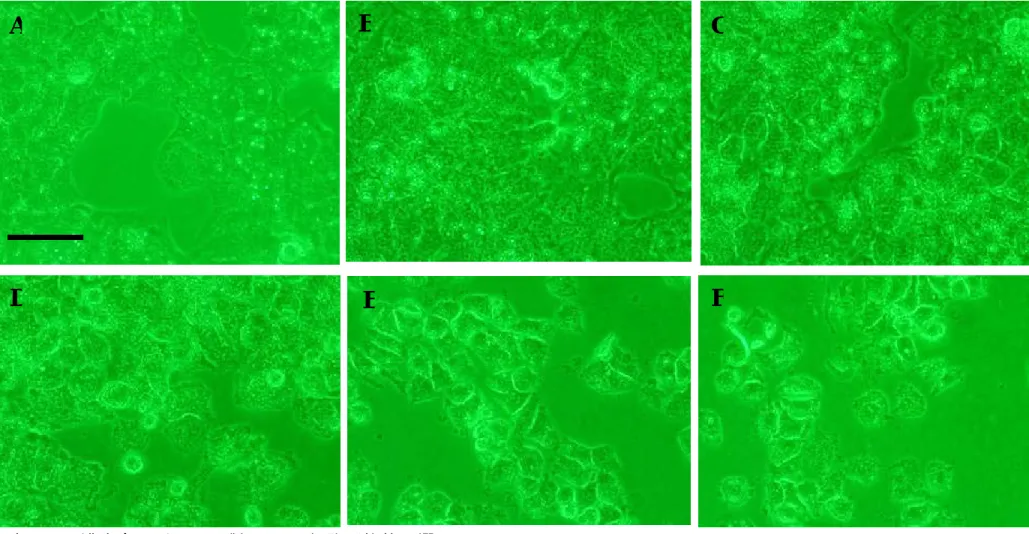
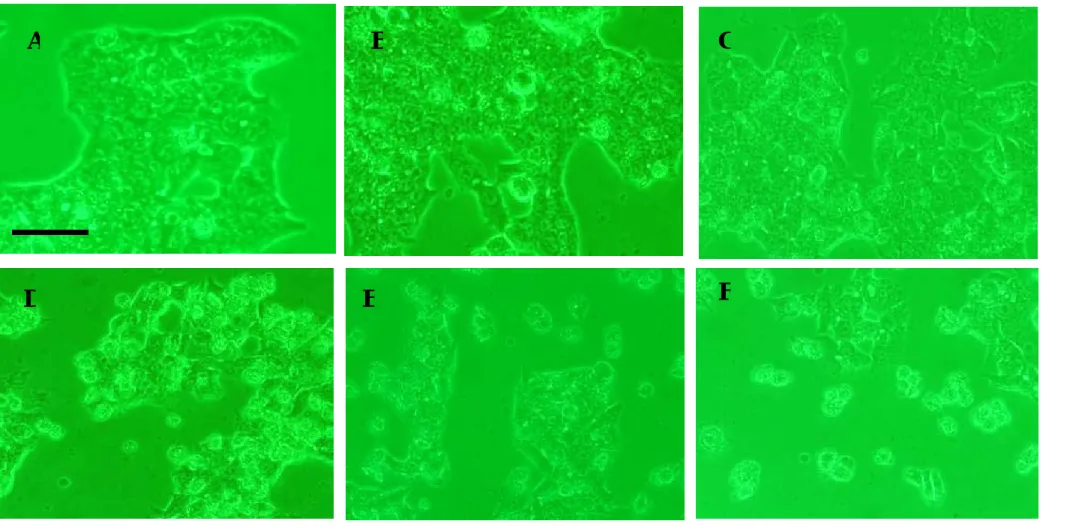
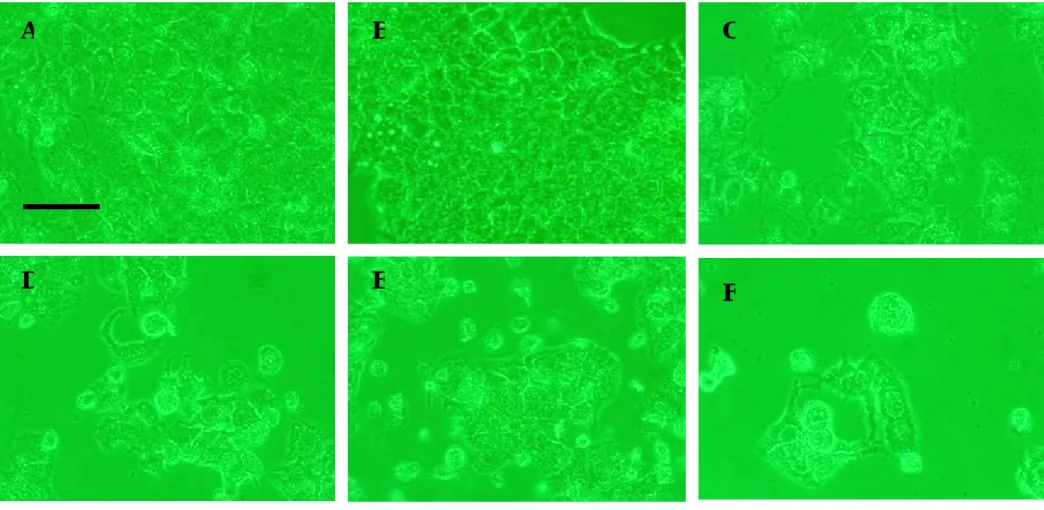
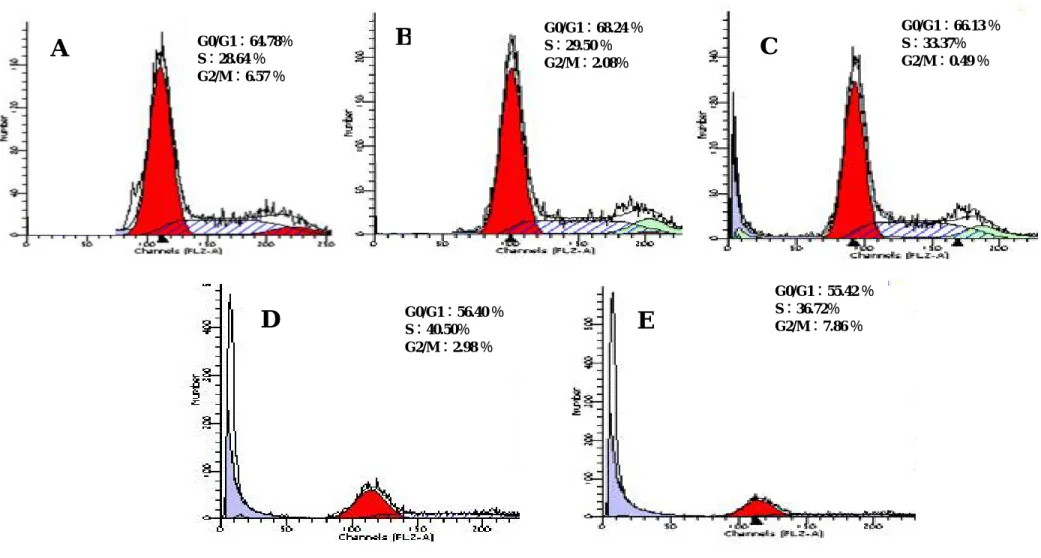
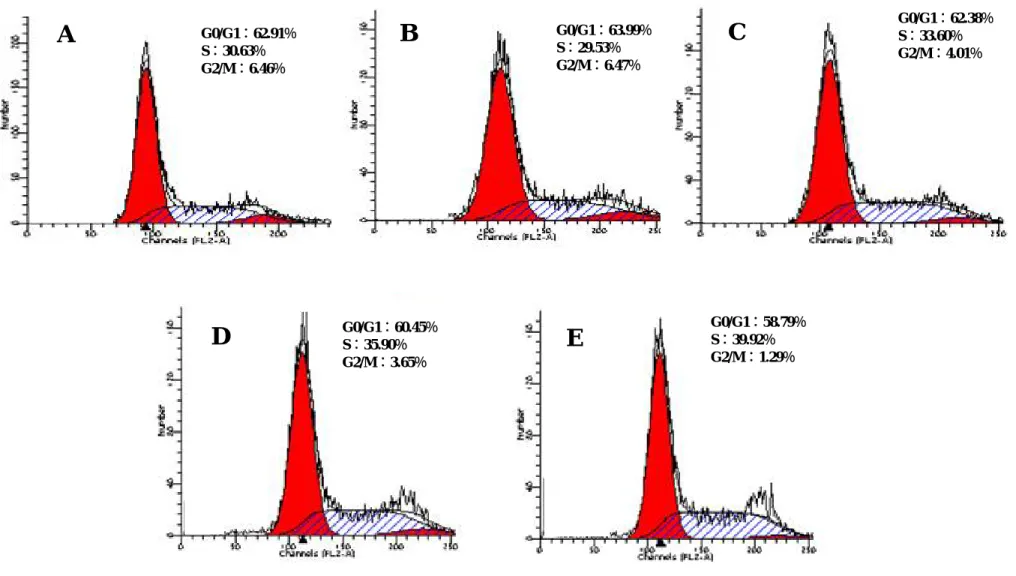
分別為 447 及 244µg/ml,與對照組有顯著性 差異(p < 0.01)。而以自行發酵 EFMA 10、 與圖四)。 (三) 在肝癌細胞形態方面 探討食工所 FFMA 及自行發酵 EFMA 對 於 Hep G2 及 Hep 3B 細胞形態之影響。以食 工所 FFMA 100、300、500、600µg/ml 處理 時,結果如圖五及圖六所示,發現以 100 及 300µg/ml FFMA 處理 72 小時後,其細胞形態 與控制組之形態並無顯著改變。然而,以 500 與 600µg/ml FFMA 處理 72 小時後,Hep G2 及 Hep 3B 之細胞形態發生了相當程度之變 化,包括:形狀變形(shape deformation)、單 層細胞崩潰(destruction of cell monolayer)、細 胞核模糊且細胞皺縮死亡與懸浮,此結果與 上述之細胞生存力結果相呼應。而以自行發 酵 EFMA 30 與 50µg/ml 的劑量處理時,Hep G2 及 Hep 3B 細胞在培養 72 小時後,其細胞 形態也發生類似的變化(圖七與圖八)。 (四) 在肝癌細胞週期方面 圖九、圖十、圖十一及圖十二為細胞流 式儀(Flow cytometer)分析食工所 FFMA 及自 行發酵 EFMA 對 Hep G2 及 Hep 3B 細胞週期 影響之結果。以 500µg/ml 的食工所 FFMA 處 理時,Hep G2 肝癌細胞株有明顯被滯留在 G0/G1 期的現象,此表示細胞在染色體合成時 受到抑制;而在 Hep 3B 肝癌細胞株方面,以 食工所 FFMA 處理濃度為 300 及 500µg/ml 時,發現大量細胞壞死 (necrosis)之現象,少 部分細胞被滯留於 S 期,顯示食工所 FFMA 對於 Hep 3B 肝癌細胞株有很強的毒殺效果, 並使少部分細胞無法進行細胞分裂。另外, 在自行發酵 EFMA 方面,如圖十一及圖十二 所示,隨著 EFMA 處理濃度增加,Hep G2 肝 癌細胞株被滯留於 G2/M 期的細胞有增加之趨 勢,這表示細胞是處於染色體為 4N 但不進行 有絲分裂期之狀態(圖十一);而 Hep 3B 肝 癌細胞株之細胞則有被滯留於 S 期之趨勢。 四、計畫成果自評 目前本研究室已成功篩選出具有較佳抑 制肝癌細胞生存力之牛樟芝菌絲體過濾液之 發酵條件,並已瞭解食工所FFMA及自行發酵 EFMA對人類肝癌細胞株Hep G2及Hep 3B在 生 存 力 、 細 胞 形 態 及 細 胞 週 期 等 方 面 之 影 響。 五、參考文獻 沈珝琲,方福德。1999。細胞週期的基因調 控。真核基因表達調控。沈珝琲,方福 德編 pp. 159-181。九州圖書文物有限公 司,台北市。
new lanostanoids from Ganoderma lucidum. J Nat Prod 49: 621-625.
Chang TT, Chou WN. 1995. Mycol Res 99: 756. Chen CH, Yang SW. 1995. New steroid acids
from Antrodia cinnamomea, a fungal parasite of Cinnamomum micranthum. J Nat Prod 58: 1655-1661.
Funk JO. 1999. Cancer cell cycle control. Anticancer Res. 19: 4772-4780.
Gray NS, Wodicka L, Thunnissen AM, Norman T C, Kwon S, Esponoza F, Morgan DO, Barnes G, LeClere S, Meijer L, Kim SH, Lockhart DJ, Schultz PG. 1998. Exploiting chemical libaries, structure, and genomics in the search for kinase inhibitors. Science 281: 533-538. Hartwell LH, Kastan MB. 1994. Cell cycle
control and cancer. Science 266:1821-1828. Lin SB, Li CH, Lee SS, Kan LS. 2003.
Triterpene-enriched extracts from Ganoderma
lucidum inhibit growth of hepatoma cells via
suppressing protein kinase C, activating mitogen-activated protein kinases and G2-phase cell cycle arrest. Life Sci 72:2381-2390. Mu Z, Su Q. 1990. Acta Bot Yunnan 12: 395. Norbury C, Nurse P. 1992. Animal cell cycles and their control. Annual Rev Biochem 61: 441-470.
Pines J. 1994. Arresting developments in cell-cycle control. Trends Biochem Sci 19: 143-145. Wattenberg LW. 1985. Chemoprevention of
cancer. Cancer Res 45: 1-8.
Weinstein IB. 1981. The scientific basis for carcinogen detection and primary cancer prevention. Cancer 47:1133-1141.
Wu CC, Sheen LY, Chen HW, Kuo WW, Tsai SJ, Lii CK. 2001. Differential effects of garlic oil and its three major organosulfur components on hepatic detoxification system in rats. J Agri Food Chem 50: 378-383.
Yang SW, Shen YC, Chen CH. 1996. Steroids and triterpenoids of Antrodia cinnamomea – a fungus parasitic on Cinnamomun micranthum. Phytochemistry 41: 1389-1392.
Young DS, Chiang HC, Liu LK. 1998. Identification of bioactive components in
Antrodia cinnamomea by MS/MS via EI
ionization. J Chin Chem Soc 45: 123-129. Laemmli UK. 1970. Cleavage of structural
proteins during the assembly of the head of bacteriophage T4. Nature 277: 680-685. Lowry OH, Rosebrough NJ, Farr AL, Randall RJ.
1951. Protein measurement with Folin phenol reagent. J Biol Chem 193: 265-275.
Towbin H, Staehelin T, Gordan J. 1979. Electrophororetic transfer proteins from polyacrylamide gels to nitrocellulose sheets: procedure and some applications. Proc. Natl. Acad. Sci USA 76: 4350-4356.
Yang JJ, Krauss RS.1997. Extracellular ATP induces anchorage-independent expression of
cyclin A and rescues the transformed phenotype of Ras-resistant mutant cell line. J Biol Chem 272: 3103-3108.
表一、不同發酵條件生產之牛樟芝菌絲體發酵萃取液對 Hep G2 肝癌細胞株生存
力的影響
Table 1. Effects of extract of fermented mycelia of Antrodia camphorata from various
fermentation conditions on the cell viability of Hep G2
Fermentation conditions
cell viability (%)
Fermentation time 1 week
114.9
2
54.5
3
40.4
1 month
12.6
2
6.9
2% lactose instead of 2% glucose
17.5
30℃ instead of 22℃
70.1
1. 100ml fermentation broth was added into the 250 ml flask.
2. Standard fermentation condition: 22℃; fermented medium containing 2%
glucose, 2% malt extract, and 0.1% peptone; 100rpm
圖一、不同濃度食工所 FFMA 處理 Hep G2 細胞 72 小時後對其生存力的影響
Figure 1. Effects of various concentrations of FFMA from FIRDI on the cell viability
of Hep G2 cells for 72 hr treatment. *Significantly different (p<0.01)
between treatment and control.
0
20
40
60
80
100
120
FFMA medium
DMEM
100
300
500
600
c
e
ll v
ia
b
il
it
y
,
%
*
*
*
FFMA ( µg/ml )
medium
50μl/ml
cont
rol
圖二、不同濃度食工所 FFMA 處理 Hep 3B 細胞 72 小時對其生存力的影響
Figure 2. Effects of various concentrations of FFMA from FIRDI on the cell viability
of Hep 3B cells for 72 hr treatment. *Significantly different (p<0.01)
between treatment and control.
圖三、不同濃度自行發酵 EFMA 處理 Hep G2 細胞 72 小時對其生存力的影響
Figure 3. Effects of various concentrations of EFMA from our lab on the cell viability
of Hep G2 cells for 72 hr treatment. *Significantly different (p<0.01)
0
20
40
60
80
100
120
140
medium
50µl/ml
control
10
30
50
ce
ll viab
ilit
y,
%
*
*
EFMA ( µg/ml )
0
20
40
60
80
100
120
FFMA
medium
DMEM
10
30
50
60
ce
ll v
ia
b
ilit
y
,
%
*
*
*
FFMA ( µg/ml )
medium
50μl/ml
control
100
300
500
600
between treatment and control.
圖四、不同濃度自行發酵 EFMA 處理 Hep 3B 細胞 72 小時對其生存力的影響
Figure 4. Effects of various concentrations of EFMA from our lab on the cell viability
of Hep 3B cells for 72 hr treatment. *Significantly different (p<0.01)
between treatment and control.
0
20
40
60
80
100
120
140
medium
50µl/ml
control
10
30
50
60
c
e
ll v
iab
il
it
y
,
%
*
*
*
FFMA (
µ
g/ml )
圖五、不同濃度食工所 FFMA 對 Hep G2 細胞形態的影響。
Figure 5. Effects of various concentrations of FFMA from FIRDI on the morphology of Hep G2 cells (200X under inverted stage microscope
equipped with phase contrast). A-F, Hep G2 cells were cultured for 72 hr after treatment with 50µl/ml medium and 0, 100, 300, 500 or
600µg/ml FFMA, respectively. - = 50 µm.
A
B
C
圖六、不同濃度食工所 FFMA 對 Hep 3B 細胞形態的影響
Figure 6. Effects of various concentrations of FFMA from FIRDI on the morphology of Hep 3B cells (200X under inverted stage microscope
equipped with phase contrast). A-F, Hep 3B cells were cultured for 72 hr after treatment with 50µl/ml medium and 0, 100, 300, 500 or
A
B
C
F
E
圖七、不同濃度自行發酵 EFMA 對 Hep G2 細胞形態的影響
Figure 7. Effects of various concentrations of EFMA from our lab on the morphology of Hep G2 cells (200X under inverted stage microscope
equipped with phase contrast). A-F, Hep G2 cells were cultured for 72 hr after treatment with 50µl/ml medium and 0, 10, 30, 50 or
60µg/ml EFMA, respectively. - = 50 µm.
D
A
B
C
F
E
圖八、不同濃度自行發酵 EFMA 對 Hep 3B 細胞形態的影響
Figure 8. Effects of various concentrations of EFMA from our lab on the morphology of Hep 3B cells (200X under inverted stage microscope
equipped with phase contrast). A-F, Hep 3B cells were cultured for 72 hr after treatment with 50µl/ml medium and 0, 10, 30, 50 or
D
A
B
C
F
E
圖九、不同濃度之食工所 FFMA 對 Hep G2 細胞週期之影響
Figure 9. Effects of various concentrations of FFMA from FIRDI on the cell cycle of Hep G2 cells. A-E, Hep G2 cells were cultured for 72 hr
after treatment with 0, 50, 100, 300, or 500µg/ml FFMA, respectively.
Channels G0/G1:55.10 % S:39.06 % G2/M:5.85 %
A
ChannelsB
G0/G1:59.26 % S:34.16 % G2/M:6.58% Channels G0/G1:59.06 % S:37.36 % G2/M:3.58 %C
Channels G0/G1:55.10 % S:39.06 % G2/M:5.84 %D
G0/G1:70.55 % S:18.18 % G2/M:17.21 %E
Channels圖十、不同濃度食工所 FFMA 對 Hep 3B 細胞週期之影響
Figure 10. Effects of various concentrations of FFMA from FIRDI on the cell cycle of Hep 3B cells. A-E, Hep 3B cells were cultured for 72 hr
G0/G1:66.13 % S:33.37% G2/M:0.49 %C
G0/G1:68.24 % S:29.50 % G2/M:2.08%B
A
G0/G1:64.78% S:28.64 % G2/M:6.57 %E
G0/G1:55.42 % S:36.72% G2/M:7.86 % G0/G1:56.40 % S:40.50% G2/M:2.98 %D
圖十一、不同濃度之自行發酵 EFMA 對 Hep G2 細胞週期之影響
Figure 11. Effect of various concentrations of EFMA from our lab on the cell cycle of Hep G2 cells. A-E, Hep G2 cells were cultured for 72hr
after treatment with 0, 5, 10, 30, or 50µg/ml EFMA, respectively.
G0/G1:55.4% S:27.55% G2/M:16.74%