國立臺灣大學電機資訊學院資訊網路與多媒體研究所 碩士論文
Graduate Institute of Networking and Multimedia College of Electrical Engineering and Computer Science
National Taiwan University Master Thesis
使用高效能遠端虛擬記憶體聚合未使用之記憶體空間 Aggregating Unused Memory with Efficient Remote
Swapping
高至賢 Tzu-Hsien Kao
指導教授:洪士灝 博士 Advisor: Shih-Hao Hung, Ph.D.
中華民國 106 年 7 月
July, 2017
謝
碩士班的學習,我認為是學習如何從接受、使用知識的角色轉變成 如何站在巨人的肩膀上向前更加邁進一步的角色的過程。
在這個過程中,首先需要感謝洪教授的指導。因為有老師從題目開 始到研究完成這整個過程中的建議與指點,讓我可以有機會了解系統 研究的方法,得以一窺這個領域的大門。也是因為有老師在研究方法 上的指導,我才終於可以完成碩士的學業。謝謝老師給我的這些機會 和包容,讓我在碩士班的這段時間沒有白廢,能帶回在研究、學習、
做事方法上的豐碩收穫。
其次要感謝的是博士班的阮渥豪學長與劉政岳學長。兩位學長在研 究的過程中不厭其煩地回應我的問題,並且多次與我討論研究的方向 與呈現的表現方式。學長們的經驗與著眼點不僅是我學習的榜樣,也 幫助我減少研究過程中可能會遇到的狀況。少了這些協助,我是不可 能完成這一切的。
再來,要感謝 PAS Lab. 的各位同學。和各位一起學習討論的過程 中我得到相當多的良性刺激,同學們堅強的精神和開朗的個性也總是 讓我得到相當大的鼓勵。
最後要感謝我的家人與女友的陪伴和支持,在我遇到低潮時你們總 是在我身邊。學習做研究有很多需要克服的難題,少了你們作我的後 盾、我走不到這一步。
要
近年來因為大數據分析的需求,資料中心與叢集內部高速網路效能 朝向高頻寬、低延遲的方向急遽成長。比起過去,利用高速網路技術 共享伺服器間的資源的效率變得前所未有地高。在這篇論文中,我們 研究透過高速內部網路伺服器間遠端共享記憶體的技術,透過虛擬記 憶體系統將遠端伺服器的記憶體作為交換空間使用。我們提出以的高 度可移植的交換記憶體架構,是使用產業標準的開放原始碼系統程式 和硬體架構所完成。故只需要進行軟硬體的配置與安裝,不需要對作 業系統加上特殊的修改,我們相信這樣的架構可以廣泛應用在各領域 中。
我們用簡單的測試程式與實際的應用作為此遠端記憶體機制的 驗證,包含記憶體內快取系統(memcached)、訓練機械學習模型
(Tensorflow)與基因定序(MUMmer)於 50Gbps 的高速乙太網路環 境。實驗結果顯示我們的機制可以提供高效率的遠端虛擬記憶體存 取:跟使用傳統硬碟的記憶體交換機制比起來,我們不需要為了避免 虛擬記憶體的猛移現象(thrashing)而付出高昂的記憶體採購成本。舉 例來說,使用我們的方式,TensorFlow 訓練深度學習模型時,效能可 以僅低於使用足夠放進所有資料的實體記憶體時 1.24 倍、並發揮比傳 統硬碟快 16 倍的效能。而且因為使用 RDMA over Converged Ethernet
(RoCE)網路,我們的機制只造成雙方伺服器間極低的間接成本。
: 交換空間、遠端交換空間、RDMA、RoCE
Abstract
In recent years, the performance of interconnection networks in the data- center have been vastly improved with higher bandwidth and lower latency, driven by the demand of big data analytics. With the high-speed network technologies, sharing of resources among different servers becomes more ef- ficient than ever. In this thesis, we study remote swap memory technologies which allows one server to utilize the memory on a remote server as the swap memory for the virtual memory system via a high-speed interconnection net- work. We propose a portable remote memory swap mechanism with reliable open-source system software and industrial standard hardware components.
The construction of the mechanism is done by configuring the software and hardware beyond the operating system without level vendor-specific modi- fications, so we believe the methodology is generic and is useful to a wide range of applications.
To evaluate the performance of our proposed mechanism, we carry out mi- crobenchmarks as well as realistic applications, including in-memory cache (memcached), machine learning model training (Tensorflow), and genome sequence alignment (MUMmer), on a setup with two servers connected via 50Gbps Ethernet. The experimental results show the efficiency of the our mechanism. The remote memory swap mechanism is faster than traditional memory swap mechanism with hard disks and saves the cost of adding physi- cal memory to avoid thrashing of virtual memory. In our experimental results, using our remote swap mechanism, TensorFlow training deep learning mod-
els was accelerated by 16 times, compared to swapping using local disk. It ran only 1.24 times slower than running on a server with larger physical memory to hold the entire data set. Due to the use of RDMA over Converged Ethernet (RoCE), our remote memory swap mechanism caused little overhead to both servers.
Keywords: Swap, Remote Swap, RDMA, RoCE
Contents
謝 i
要 ii
Abstract iii
Chapter 1 Introduction 1
Chapter 2 Background 4
2.1 High-Speed Network and RDMA . . . 4
2.2 Linux Memory Swap Mechanism . . . 5
2.3 Linux SCSI Target . . . 6
Chapter 3 Related Work 7 Chapter 4 Remote Memory Swap Framework 9 4.1 Designing the Remote Memory Swap Framework . . . 9
4.2 Performance Issues . . . 11
Chapter 5 Performance and Evaluation 12 5.1 Experimental Setup . . . 13
5.2 Performance Results of Micro-benchmark . . . 13
5.3 Application Performance Results . . . 14
5.3.1 Memcached . . . 14
5.3.2 TensorFlow . . . 14
5.3.3 MUMmer . . . 18
Chapter 6 Conclusion and Future Work 19
Bibliography 21
List of Figures
4.1 Remote Memory Swap Framework Architecture . . . 10
5.1 Results of the Memcached Tests . . . 15
5.2 Results of the TensorFlow Model Training Tests . . . 16
5.3 Swap Usage Comparison of Training Different Models . . . 17
5.4 Results of the MUMmer Sequence Alignment Test . . . 18
List of Tables
3.1 Modern work in designing remote memory system . . . 8
5.1 Results of the Micro-benchmark Test . . . 14 5.2 The Memory Usage of TensorFlow Models Training . . . 16
Chapter 1 Introduction
Modern systems process large amount of data in memory with an improved through- put. Such big-memory workloads seldom use the virtual memory because of the high cost of swapping[4]. Swapping to disk may severely impinge on the overall performance for these workloads. In recent years, the performance of interconnection networks in the dat- acenter continues to increase. Modern networking technologies such as Infiniband [10]
features low latency (in the order of microseconds), high throughput (up to 200Gbps), and the support of Remote Direct Memory Access (RDMA) [17] operations to reduce CPU utilization.
The advent of high-speed networking leads us to fine-grain sharing of various re- sources in the datacenter, including the memories. In a traditional datacenter, certain resources become underutilized because of mismatching workload requirements. For ex- ample, compute cycles may be exhausted before memory capacity is reached, leaving a fraction of the memory unused. Data gathered from datacenters show that server memory is unused as much as 50% [2]. Therefore, disaggregating memories and placing them in pools will be beneficial.
In order to use high-speed interconnects to access remote memory, the clients can naively use remote memory pools as block pseudo-devices, and the server need to make local memory available for clients. However this kind of implementation, need to be modify both client and server side systems. These modifications make system unportable, and hard to use.
In this thesis, we study remote swap memory technologies which allows one server to utilize the memory on a remote server as the swap space for the virtual memory system via a high-speed network. We designed a framework that enables one server to utilize the memory in another server to execute large-scale memory-intensive applications that de- mand more memory than the server can provide by its physical memory. Via a high-speed network, page faults in the virtual memory system can be satisfied quickly by swapping infrequently used pages into the memory on a remote server.
To maximize the applicability of the framework, we set the following goals:
• The framework should be as portable as possible. To achieve this goal, we choose to construct the framework with open source software and commodity hardware components.
• The framework should be as efficient as possible. The remote memory swap mech- anism should outperform traditional swap mechanism with hard disks and be com- parable to solid-state disks (SSD).
• The framework should enable unmodified applications to benefit from remote swap- ping over RDMA networks without operating system modifications.
Note that, while parallelizing the application and divide the data to run on multiple servers should be able to achieve better performance and scalability than our approach.
Our framework aims to provide a convenient, transparent way to mitigate the problem of resource fragmentation.
Other storage devices like SSD may have comparable performance to remote memory system via high-speed network, but the price of high-performance SSD and the lifetime of SSD have been issues for adopting SSD as swap devices in practice [14, 3, 22].
As a result, our proposed framework provides a portable remote memory swap mech- anism with reliable open-source system software and industrial standard hardware com- ponents. The construction of the mechanism is done by configuring the software and hardware beyond the operating system without level vendor-specific modifications, so we believe the methodology is generic and is useful to a wide range of applications.
To evaluate the performance of our proposed mechanism, we carry out micro-benchmarks as well as realistic applications, including in-memory cache (memcached), machine learn- ing model training (Tensorflow), and genome sequence alignment (MUMmer), on a setup with two servers connected via 50Gbps Ethernet. The RDMA over Converged Ethernet [20] (RoCE) protocol allows RDMA operations over an Ethernet network.
The experimental results show the efficiency of the our mechanism. First, the remote memory swap mechanism is faster than traditional memory swap mechanism with hard disks. The cost of additional physical memory for virtual memory thrashing avoidance can be saved. Our experiment results from our micro-benchmark reveal the worst case, where our remote swapping mechanism outperformed hard disk setup by 3.4 times and ran only 3 times slower than running on a big-memory server with larger physical memory to hold the entire data set.
From the proposed remote swap mechanism, applications are also benefited. For ex- ample, when using our remote swap mechanism, training time of TensorFlow models was accelerated by 16 times, compared to swapping using local disk. It ran only 1.24 times slower than running on a server with sufficient physical memory to hold the entire data set.
Finally, due to the use of RoCE, our remote memory swap mechanism caused little overhead to both servers. By using the low CPU utilization RDMA operations, our re- mote memory swap mechanism provide a new vision to utilize remote memories for local system performance improvement.
The rest of the thesis is organized as follows. Chapter 2 discusses the related work.
Chapter 3 provides the relevant background. Chapter 4 present the design and implemen- tation. An experimental evaluation of the remote memory pager is discussed in Chapter 5. We conclude our work in Chapter 6.
Chapter 2 Background
In this chapter we overview necessary background and explain the benefits from re- mote memory swapping. Remote memory swapping is composed of three main compo- nents: high-speed interconnect network, Linux memory swap mechanism, and network block storage device.
The latency of swapping is determined by software processing time and hardware transfer time. First, high-speed interconnect network provides low response time and high bandwidth which can transfer data many times faster than traditional disks, and us- ing RDMA operations can reduce the CPU processing time of network protocol, which is discussed in Chapter 2.1 Then, in Chapter 2.2 we introduce the Linux memory swap mechanism and compare the pros and cons between the traditional swapping methods like swapping memory to disks, and swapping memory to remote memory. Finally we overview the Linux SCSI target, a block storage networking standard which supports a rapidly growing number of fabric modules, and all existing Linux block devices as back- stores. We explain how and why we use this network block storage for remote memory swapping in Chapter 2.3.
2.1 High-Speed Network and RDMA
Over the years, Ethernet speed has increased from 10 megabits per second (Mbps) to 200 gigabits per second (Gbps) and researchers are already planning to scale up to 1 ter-
abits per second (Tbps). Since 10 gigabit Ethernet (10GbE) or faster interconnections has become an inexpensive commodity with a growing installation base, servers with 10GbE network interfaces have been around. Due to more efficient processors, a faster PCI Ex- press (PCIe) bus, and more sophisticated transfer protocols, the capability to have a single file transfer saturate a link become more common.
As centralized services, such as backup servers, often need to handle parallel data transfers contending for bandwidth, there is a need to deploy faster technologies to ac- commodate the aggregation of those flows[16, 7, 11]. Dell’Oro Group predicts in its recently released Ethernet Switch—Data Center Five Year Forecast Report[6] that 400- Gbps switch ports will begin to ramp strongly in 2019. Meanwhile, more than half of data center switch ports will operate at either 25Gbps or 100 Gbps in 2020, the market research firm believes. While it is possible to get TCP to saturate 40Gbps or faster connections, it is very sensitive and requires careful tuning. Even then requires significant CPU power to achieve.
RDMA protocol is a well-proven data center technology offering high performance and efficiency. RDMA protocol supports zero-copy networking. It is designed for com- munication within interconnected compute nodes, I/O nodes and devices in a system area network. RDMA operations allow one side of the communication parties to exchange in- formation directly with the remote memory without the involvement of the remote host.
This enables better computation and communication overlap, thus provide potentials for performance improvements.
Latency of RDMA operations between two nodes is quite comparable to local memory access latency[12]. Thus using RDMA operations provides the potential of significant performance improvement for remote memory swapping.
2.2 Linux Memory Swap Mechanism
Linux virtual memory system manages all physical memory resources. When free pages available to virtual memory system fall below a threshold, pageout requests are
triggered by the kernel thread kswapd to swap pages out to swap devices. Page-in requests are invoked on demand as page faults occur. Page-out data are placed to these devices based on their priorities[5].
Any block device can be used as a swap space, e.g., Hard Disk Drives (HDDs) and Solid State Drives (SSDs). Swapping devices such as HDDs or even SSDs operate at several orders of magnitude slower than main memory modules. Excessive paging activity to and from the swapping device renders a system crawling as the CPU is mostly waiting for I/O activity.
For remote memory swapping, pre-allocated RAM disks on remote nodes perform this role. Although swapping to RAM disks performs worse than running with enough local memory, it still performs much better than swapping to HDDs. The CPU utilization can downgrade to 20% while swapping to a local RAM disk, 8% while swapping to remote memory, and less than 1% while swapping to local disk[21].
2.3 Linux SCSI Target
iSCSI (Internet Small Computer System Interface) provides SCSI accesses over IP net- works. iSCSI Extensions for RDMA [18] (iSER) is a network protocol that extends iSCSI to use RDMA. iSER permits data to be transferred directly into and out of remote SCSI computer memory buffers over InfiniBand and Ethernet networks without intermediate data copies by using RDMA.
LinuxIO [13] (LIO) is the standard open-source SCSI target in Linux. It supports al- most all prevalent storage fabrics. LIO supports kernel level RAM disk as backstore, which implement the methods of accessing data on disk. A backstore subsystem plugin is a physical storage object that provides the block device underlying a SCSI endpoint. Us- ing the kernel level RAM disk can avoid the high memory protection overhead of using the user level RAM disk.
By using the kernel level RAM disk supported by LIO and iSCSI with the iSER proto- col, the high CPU utilization of using the remote RAM disk as swap space can be avoided.
Chapter 3
Related Work
Studies of memory disaggregation deal with the remote memory as an extension to the local memory space. Remote memory swapping, a disaggregation approach which considers remote memory as swap space, have demonstrated the ability to be deployed transparently with little/no modification to the OS or the running applications.
However, the performance and promises were often limited by slow networks and high CPU overheads. Several works have studied the remote memory swapping for different purposes as shown in Table 3.1. We differentiate them by network technology, bandwidth and portability.
Nswap [25] proposed a block device driver which combines networks and swap de- vices to allow cluster nodes with over-committed memory to use idle memory and to swap its pages over the network. They used slow 100Base-T Ethernet and hard disks to examine their remote memory swap mechanism. Performance of the Nswap is limited due to the low hard disks and the lack of high-speed network. Also, operating system on both client and server sides need to be modified.
HPBD [12] proposed the design and implementation of a high performance network- ing block device (HPBD) over 10Gbps InfiniBand fabric, which serves as a swap device of kernel Virtual Memory (VM) system for page transfer to/from remote memory servers. To deploy HPBD, installation of the kernel module and the management daemon are needed.
The applications they used for experiments like qsort, which access remote memory not so frequently. Nuzura [8] measured the performance of some HPC applications instead,
Network Bandwidth Modification of OS
Nswap[25] TCP 100Mbps needed
HPBD[12] InfiniBand 10Gbps needed
Nuzura[8] RoCE 10Gbps needed
INFINISWAP[9] InfiniBand 56Gbps needed Table 3.1: Modern work in designing remote memory system
which required several times of local memory on their system. Nuzura proposed an ap- proach similar to HPBD. They implemented a remote memory swap system and examined the availability of remote memory swapping via their own UZURA 10Gbps RoCE inter- connects.
INFINISWAP [9] implemented a remote memory swap system on a 56Gbps, 32-machine InfiniBand interconnected RDMA cluster and evaluated it using multiple unmodified memory- intensive applications. It shows that when working sets do not fit in memory, applications performance degrade linearly using INFINISWAP instead of experiencing a super-linear drop. INFINISWAP implemented their mechanism by implementing a kernel module and a user space daemon, which should be installed when deploying the cluster environment.
Our work are tested on the 50Gbps Ethernet which is becoming around in datacen- ters. The framework we proposed is different from the previous works in that operating system and system software we used are not modified. When deploying servers, using our remote memory swap mechanism is not necessary to install special device driver or modified kernel to support applications which require pages from remote memory. Ser- vice providers can use the stable version operating system and system software to serve big-memory workloads reliably.
Chapter 4
Remote Memory Swap Framework
The main goal of remote memory swapping is to efficiently expose remote memories to user applications without any modifications to those applications or the OSes of indi- vidual machines. It must also be reliable and low operation overhead so that application performance on remote machines remains unaffected. Thus, the purpose of our work is to design an efficient, portable framework for swapping memory to remote memory, which means we should use existing reliable software to contribute our framework instead of implementing new kernel modules or system daemons.
In this chapter, we present the design and analysis of the performance issues in our framework. We propose the main design and discuss the design issues in Chapter 4.1. In Chapter 4.2 we discuss the potential performance issues and the trade-offs.
4.1 Designing the Remote Memory Swap Framework
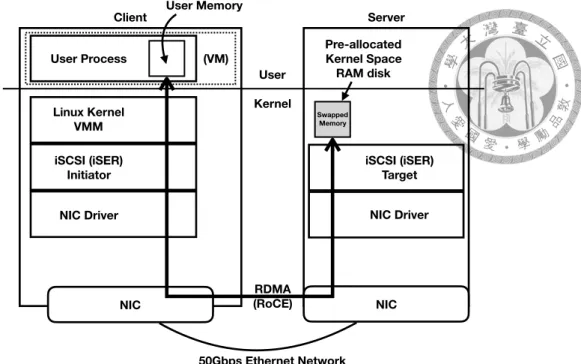
As shown in Figure 4.1, our remote memory swap mechanism serves the kernel’s paging requests by communicating with remote memory servers. The client is direct con- nected to server via 50Gbps RoCE network without network switch.
The client is an iSCSI initiator, which serves I/O requests stream from the virtual mem- ory system by sending requests to the remote memory servers. The server is a RAM disk iSCSI target, which provides its own local memory for paging store and push/pull pages from client using RDMA operations with the iSER protocol.
User Kernel (VM)
NIC NIC
User Process
Linux Kernel VMM iSCSI (iSER)
Initiator NIC Driver
iSCSI (iSER) Target NIC Driver
50Gbps Ethernet Network User Memory
Pre-allocated Kernel Space
RAM disk
RDMA (RoCE)
Swapped Memory
Client Server
Figure 4.1: Remote Memory Swap Framework Architecture
Using the iSCSI, a reliable software emulation for local block storage, remote resources at the block level can be used efficiently. We use iSCSI because it is widely used in file systems for data storage. Introduced in Chapter 2.3, when using the remote RAM disk as swap space, low memory protection overhead is promised by the kernel level RAM disk supported by iSCSI, and low operation overhead is promised by using iSER protocol.
In our framework, user processes can run natively or in virtual machine (VM) environ- ments. User applications can access remote swap space as the extension of local memory, and VMs can use remote swap space as their VRAM by Linux Kernel-based Virtual Ma- chine (KVM) memory overcommiting[19]. Remote memory swapping capability allows VMs to take the benefits of remote memory transparently by allocating more virtualized memory than there are physical memory on the system. Therefore, cloud computing envi- ronments and data centers can utilize their unused memory in RoCE interconnected clus- ters.
4.2 Performance Issues
Asynchronous Communication: In a client-server architecture, the swapping pro- cess sends out paging requests to remote memory swap server and waits to be served. In the swap-in (page-in) case, the client user process/thread which requires remote pages is blocked until the server responses. RDMA operations can reduce asynchronous commu- nication overhead by its low CPU utilization and fast response time.
Remote Memory Overhead: RDMA operations implement zero-copy remote DMA, but virtual memory system copy pages to/from remote swap space. Linux kernel uses 4KB page size for x86/x64 architecture. In 50Gbps interconnected cluster, a client may requests up to 1600K pages per second to remote memory servers, but due to the RAM disk emulation overhead, a memory server can only serve 160K pages requests by our measurement. We trade off portability of applications and OSes against the utilization of RDMA operations for performance in this work.
Chapter 5
Performance and Evaluation
In this chapter, we evaluate the performance of the proposed framework comparing to a traditional system with HDDs swapping, to a system with our remote memory swap mechanism.
We use 4 different test programs. One is a micro-benchmark, which allocates a 8 GB array and sequentially write integers into this array. Because writing memory sequentially performs traditional HDDs the best due to the locality, this test reveal the worst case of our mechanism compared to the disk swapping. The second application is memcached.
Memcached is a frequently used in-memory cache for various applications. Improvements of in-memory cache performance from remote swapping may provide a ground for bene- fits of other workloads using memcached. The third application is TensorFlow. Training large deep learning models using TensorFlow may demand more memory than the server can provide by its physical memory. The last application is MUMmer, which is a sys- tem for rapidly aligning entire genomes, whether in complete or draft form. Aligning entire genomes sequence data will require very high-performance computers, of the type currently available only at the largest sequencing and bioinformatics centers.
For each of the tests, we run these applications 10 times and report the average per- formance number.
5.1 Experimental Setup
The experiments are conducted on two Intel Core i7-5930K servers with 32GB DDR3- 1333 RAM on each server. Server and client nodes are connected to RoCE network using Mellanox MT27708A0 with opensource OFED Linux driver. The HDD configuration on each node is WESTERN DIGITAL WD10EZEX 1TB SATA600. The operating system is CentOS 7.3 with Linux kernel version is 3.10.0.
To compare the performance impact of remote paging with local memory performance, we change the total local memory size available to the OS and vary the swapping devices.
Three testing applications and one micro-benchmark test are used in our evaluation. In each test, we test our mechanism with 3 setups: enough local memory, remote memory swapping and local disk swapping. We use the performance of applications running with enough memory as the baseline for evaluation. We use all of the 32GB memory physically available for the local memory setup test.
5.2 Performance Results of Micro-benchmark
Our micro-benchmark program allocates a 8 GB array and sequentially write integers into this array. In this test, we set the local memory size as 4GB and a RAM disk at remote server as swap area.
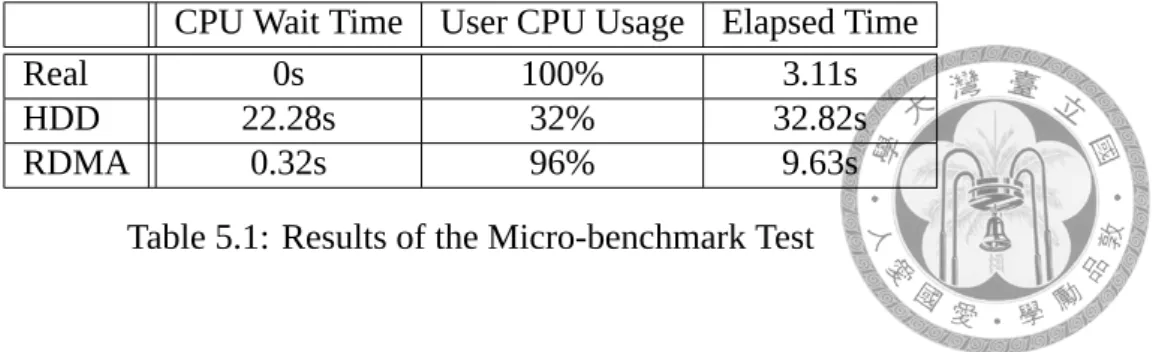
As shown in Table 5.1, the performance of remote-swap setup is only 3 times slower than the local memory setup, and is 3.4 times faster than the disk-swap setup even in the worst case. Also, the low CPU utilization of remote-swap setup is benefited from our remote memory swap mechanism. The results of micro-benchmark show that our remote memory swap mechanism can perform much better than traditional disk swapping even in the worst case.
Due to the asynchrony of different components in the operating system, an accurate measurement is not possible without thorough analysis of the swapping mechanism of the kernel, which is beyond the scope of this work. We have measured and profiled the behavior of the proposed mechanism in another work.
CPU Wait Time User CPU Usage Elapsed Time
Real 0s 100% 3.11s
HDD 22.28s 32% 32.82s
RDMA 0.32s 96% 9.63s
Table 5.1: Results of the Micro-benchmark Test
5.3 Application Performance Results
5.3.1 Memcached
Memcached is an in-memory object caching system that provides a simple key-value interface. We use twemperf [26], a tool to measure memcached server performance. Our experiments request the local memcached server for 19.5GB data in different block size from 32 to 1024 KB. We use 200 clients to generate requests for each block size test. In this test, we set the local memory size as 12GB and a RAM disk at remote server as swap area.
As shown in Figure 5.1, the results of the response rates of the remote-swap setup are lower from only 1.46 times to 4 times than local memory while the response rates of using disk setup are lower from 2 times to 68.5 times than local memory setup. The results of P99 response time and duration time also show that our remote memory swap mechanism performs tolerably in some cases for in-memory caching system.
5.3.2 TensorFlow
TensorFlow is an open source software library for machine learning using data flow graphs. Even though the deep learning on GPU runs much faster than on CPU, for the tasks which are not critical, CPU may be a smart, cost-effective choice. In cloud computing environment, some deep learning tasks on the cheaper CPU instances instead of GPU instances run only slightly slower with about 2/3rds of the cost of the GPU instance[15].
With remote swapping, throughput of TensorFlow may be improved in an interconnected cluster.
We choose 2 famous deep learning applications: image classification and text summa-
Response Rates
32K
64K
128K
256K
512K
1024K
0rsp/s 7500rsp/s 15000rsp/s 22500rsp/s 30000rsp/s
169.9 237.8 357.9 493.7 479.2 421.2
222.7 410.2 822.8
2,211.3 4,660.2
7,172.4
326.7 697.1
1,610 4,661.7
16,374.2
28,848.6
Real RDMA HDD
(a) Response Rates P99 Response Time
32K
64K
128K
256K
512K
1024K
0ms 1000ms 2000ms 3000ms 4000ms
3,053 2,282
1,631 2,081
2,353 2,689
2,183 870
439 219 153 130
604 284 122 43 24 13
Real RDMA HDD
(b) P99 Response Time Duration Time
32K
64K
128K
256K
512K
1024K
0s 400s 800s 1200s 1600s
117.7 168.2
223.6 324.1
667.8
1519.4
89.8 97.5 97.2 72.4 68.7 89.2
61.2 57.4 49.7 34.3 19.5 22.2
Real RDMA HDD
(c) Duration Time
Figure 5.1: Results of the Memcached Tests
rization. For image classification test, we use two different models in TensorFlow models:
Resnet and Inception, which are two Convolutional Neural Network (CNN) image classi- fication models. We uses the textsum model to test the text summarization traingng perfor- mance. Textsum is a sequence-to-sequence with attention model for text summarization, for our tests.
We follow the example code for training the models[1]. The ImageNet[24] dataset is used for image classification tests, and we use the official toy data and vocab examples to run the textsum training. Training runs 50 steps for each test.
Inception Resnet Textsum 6.8GB 8.5GB 9.6GB
Table 5.2: The Memory Usage of TensorFlow Models Training
Duration Time
Real Inception2G Inception4G InceptionHDD Resnet2G Resnet4G ResnetHDD textsum4G textsum8G textsumHDD
Duration Time Relative to Local Memory Setup
5.0x 10.0x 15.0x 20.0x
1.051.081.241.631.731.872.02 10.80 19.91 1.00
1.0x
(a) Duration Time Relative to Local Memory Setup Average CPU Usage
Real Inception2G Inception4G InceptionHDD Resnet2G Resnet4G ResnetHDD textsum4G textsum8G textsumHDD
CPU Usage Relative to Local Memory Setup
0.3x 0.5x 0.8x 1.0x
0.64 0.96
0.100.12 0.500.550.61 0.750.86 1.00 1.0x
(b) CPU Usage Relative to Local Memory Setup
Figure 5.2: Results of the TensorFlow Model Training Tests
In the tests, we set the local memory size as 2GB, 4GB for image classification tests and 4GB, 8GB for text summarization to examine the performance of different swapping usage. Our machine freezes when we run the 2GB for classification and the 4GB for text summarization using disk setup, so we only have the 2GB image classification and 8GB text summarization results for disk setup. Table 5.2 shows the memory usage measured when using the local memory setup.
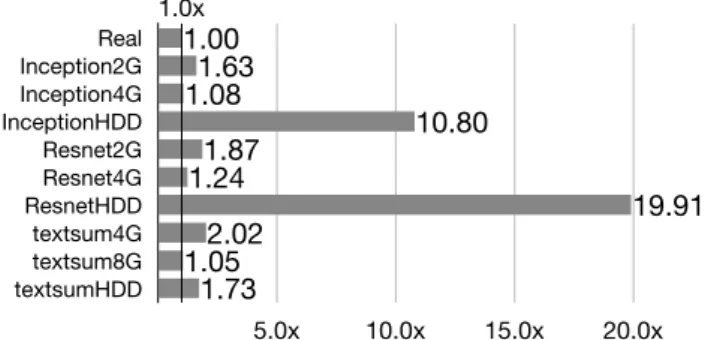
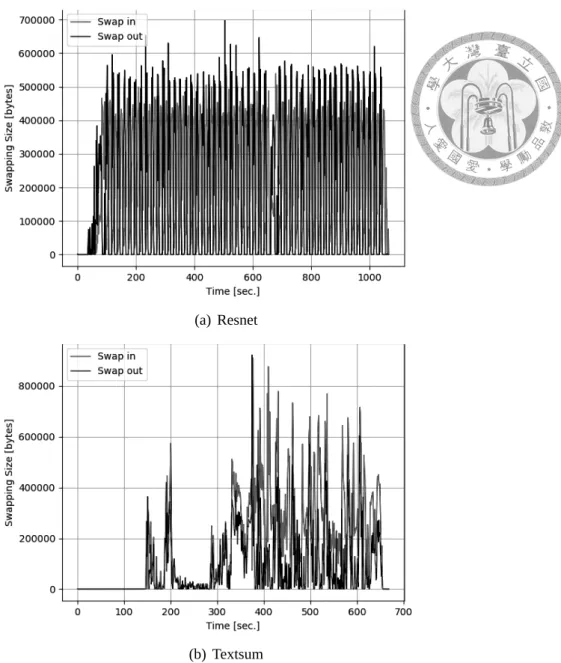
As shown in Figure 5.2, the performance of remote-swap setup is 16 times faster than disk-swap setup and is only 1.24 times slower than local memory setup in Resnet training test. Training models is memory-intensive as shown in Figure 5.3(a). When training the
(a) Resnet
(b) Textsum
Figure 5.3: Swap Usage Comparison of Training Different Models
big models like Resnet, the slow swap device like HDD impinges on the overall perfor- mance.
The performance downgrade is not significant in training the textsum model when using a slow disk swap because the concentrative swap usage of textsum model training as shown in Figure 5.3(b). The result showed that the overhead was varied depended on the application memory access pattern.
5.3.3 MUMmer
In bioinformatics, a sequence alignment is a way of arranging the sequences of DNA, RNA, or protein to identify regions of similarity that may be a consequence of functional, structural, or evolutionary relationships between the sequences. One of the most success- ful algorithms for computing alignments between genome sequences is MUMmer[23].
The test reads 100-character substrings sampled from the Bacillus anthracis genome (GenBank ID: NC_003997.3 ). Thus, each read exactly aligns to the genome end-to-end at least once, and possibly more depending on the repeat content of the genome. In this test, we set the local memory size as 8GB and a RAM disk at remote server as swap area.
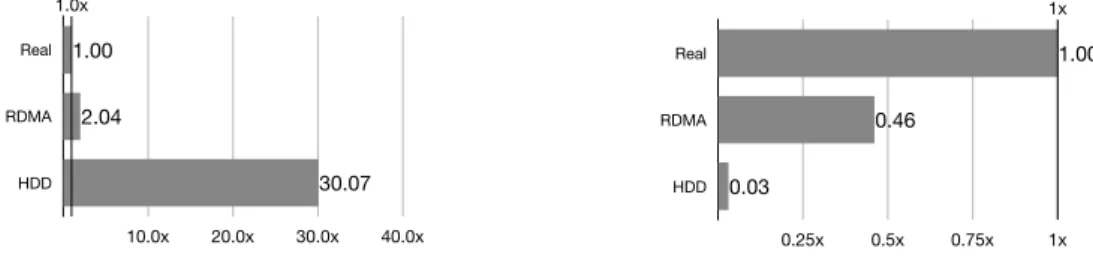
On average, the local memory setup for our genome sequence aligning test uses aver- age 94% CPU and requires 13GB memory space which is accessed frequently. As shown in Figure 5.4, performance of the disk-swap setup is 30 times slower than the local mem- ory setup. The experimental results show that disk-swap setup is too slow to satisfy page faults from the application. Performance of the remote-swap is only 2 times slower than local memory setup, which means our remote memory swap system can provide tolerable virtual memory performance for a high performance application like sequence alignment.
Duration Time
Real
RDMA
HDD
Duration Time Relative to Local Memory Setup 10.0x 20.0x 30.0x 40.0x
30.07 2.04
1.00 1.0x
(a) Duration Time Relative to Local Memory Setup
Average CPU Usage
Real
RDMA
HDD
CPU Usage Relative to Local Memory Setup
0.25x 0.5x 0.75x 1x
0.03
0.46
1.00 1x
(b) CPU Usage Relative to Local Memory Setup
Figure 5.4: Results of the MUMmer Sequence Alignment Test
Chapter 6
Conclusion and Future Work
In this thesis, we study the availability of utilizing remote memory in RoCE intercon- nected environment. We proposed a portable, efficient remote memory swap mechanism and evaluate the performance of 3 big-memory memory-intensive applications. Our ex- perimental results showed that using our remote memory swap mechanism, TensorFlow training deep learning models can run up to 16 times than swapping using local disk, and runs only 1.24 times slower than local memory system. Our solution allows remote mem- ory swapping to enhance local memory hierarchy by the virtual memory system via a high-speed network by configuring the software and hardware, without operating system modifications.
Because of the hardware limitations, we experimented our remote memory swap frame- work in a direct connected network environment without network switches. Therefore, performance of swapping memory to multiple remote memory pools is not available, and fault-tolerance of remote memory swapping is also unavailable with only one swap device.
In our future work, we plan to enable the remote memory swap mechanism with multi- client/multi-server architecture with fault-tolerance. We also intend to investigate designs that can automatically set up and manage the remote memory swap mechanism in a RoCE cluster effectively without modifications of system software and operating system to uti- lize remote memory and interconnected high-speed network bandwidth.
Bibliography
[1] TensorFlow Models. https://github.com/tensorflow/models.
[2] B. Abali, R. J. Eickemeyer, H. Franke, C. Li, and M. Taubenblatt. Disaggregated and optically interconnected memory: when will it be cost effective? CoRR, abs/1503.01416, 2015.
[3] A. Badam. Bridging the Memory-Storage Gap. PhD thesis, October 2012.
[4] A. Basu, J. Gandhi, J. Chang, M. D. Hill, and M. M. Swift. Efficient virtual memory for big memory servers. In Proceedings of the 40th Annual International Symposium on Computer Architecture, ISCA ’13, pages 237–248, New York, NY, USA, 2013.
ACM.
[5] David A Rusling. Linux memory management.http://www.tldp.org/LDP/tlk/
mm/memory.html.
[6] Dell’Oro Group. Ethernet Switch —Data Center Five Year Forecast Report.
http://www.delloro.com/products-and-services/ethernet-switch- data-center.
[7] Gilad Shainer. 100 Gbps Headed For The Data Center. http:
//www.networkcomputing.com/data-centers/100-gbps-headed-data- center/407619707.
[8] M. GOTO, M. SATO, K. NAKASHIMA, and K. KUMON. Implementing remote swap memory using rdma over 10gb ethernet. IEICE technical report. Computer systems, 106(287):7–12, oct 2006.
[9] J. Gu, Y. Lee, Y. Zhang, M. Chowdhury, and K. G. Shin. Efficient memory disaggre- gation with infiniswap. In 14th USENIX Symposium on Networked Systems Design and Implementation (NSDI 17), pages 649–667, Boston, MA, 2017. USENIX Asso- ciation.
[10] InfiniBand Trade Association. The InfiniBand Architecture. http://www.
infinibandta.org/specs.
[11] E. Kissel, M. Swany, B. Tierney, and E. Pouyoul. Efficient wide area data transfer protocols for 100 gbps networks and beyond. In Proceedings of the Third Interna- tional Workshop on Network-Aware Data Management, NDM ’13, pages 3:1–3:10, New York, NY, USA, 2013. ACM.
[12] S. Liang, R. Noronha, and D. K. Panda. Swapping to remote memory over infini- band: An approach using a high performance network block device. In 2005 IEEE International Conference on Cluster Computing, pages 1–10, Sept 2005.
[13] Linux SCSI Target. LinuxIO. http://linux-iscsi.org.
[14] K. Liu, X. Zhang, K. Davis, and S. Jiang. Synergistic coupling of ssd and hard disk for qos-aware virtual memory. In 2013 IEEE International Symposium on Perfor- mance Analysis of Systems and Software (ISPASS), pages 24–33, April 2013.
[15] Max Woolf. Benchmarking TensorFlow on Cloud CPUs: Cheaper Deep Learning than Cloud GPUs. http://minimaxir.com/2017/07/cpu-or-gpu/.
[16] H. S. S. Nichole Boscia. Comparison of 40g rdma and traditional ethernet technolo- gies. NAS Technical Report: NAS, 01 2014.
[17] RDMA Consortium. An RDMA Protocol Specification (Version 1.0).http://www.
rdmaconsortium.org/home/draft-recio-iwarp-rdmap-v1.0.pdf.
[18] RDMA Consortium. iSCSI Extensions for RDMA Specification (Version 1.0).
http://www.rdmaconsortium.org/home/draft-ko-iwarp-iser-v1.PDF.
[19] Red Hat, Inc. Overcommitting with KVM. https://access.redhat.
com/documentation/en-US/Red_Hat_Enterprise_Linux/6/html/
Virtualization_Administration_Guide/chap-Virtualization- Tips_and_tricks-Overcommitting_with_KVM.html.
[20] RoCE Initiative. RoCE Introduction. http://www.roceinitiative.org/roce- introduction/.
[21] A. Samih, R. Wang, C. Maciocco, T. Y. C. Tai, R. Duan, J. Duan, and Y. Solihin.
Evaluating dynamics and bottlenecks of memory collaboration in cluster systems. In 2012 12th IEEE/ACM International Symposium on Cluster, Cloud and Grid Com- puting (ccgrid 2012), pages 107–114, May 2012.
[22] M. Saxena and M. M. Swift. Flashvm: Virtual memory management on flash. In Pro- ceedings of the 2010 USENIX Conference on USENIX Annual Technical Conference, USENIXATC’10, pages 14–14, Berkeley, CA, USA, 2010. USENIX Association.
[23] M. C. Schatz, C. Trapnell, A. L. Delcher, and A. Varshney. High-throughput se- quence alignment using graphics processing units. BMC Bioinformatics, 8:474 – 474, 2007.
[24] Stanford Vision Lab. ImageNet. http://image-net.org/.
[25] K. G. Tia Newhall, Sean Finney and M. Spiegel. Nswap: A network swapping module for linux clusters. In Proceedings of Euro-Par’03 International Conference on Parallel and Distributed Computing (Klagenfurt, Austria, August 2003), volume 2790 of Lecture Notes in Computer Science. Springer, 2003.
[26] Twitter. twemperf (mcperf). https://github.com/twitter/twemperf.