行政院國家科學委員會專題研究計畫 成果報告
從形狀辨識理論建構標誌圖像設計類目與視認性研究 研究成果報告(精簡版)
計 畫 類 別 : 個別型
計 畫 編 號 : NSC 96-2411-H-011-004-
執 行 期 間 : 96 年 08 月 01 日至 97 年 07 月 31 日 執 行 單 位 : 國立臺灣科技大學工商業設計系
計 畫 主 持 人 : 王韋堯
計畫參與人員: 碩士班研究生-兼任助理人員:林江輝 博士班研究生-兼任助理人員:王瓊芬
報 告 附 件 : 出席國際會議研究心得報告及發表論文
處 理 方 式 : 本計畫涉及專利或其他智慧財產權,2 年後可公開查詢
中 華 民 國 97 年 09 月 23 日
行政院國家科學委員會補助專題研究計畫成果報告
※※※※※※※※※※※※※※※※※※※※※※※※
※ ※
※ ※
※ 以從形狀辨識理論建構標誌圖像設計類目 ※
※ 與視認性研究 ※
※ ※
※ ※
※※※※※※※※※※※※※※※※※※※※※※※※
計畫類別:□個別型計畫 □整合型計畫 計畫編號: NSC 96-2411 -H-011 -004-
執行期間:96 年 08 月 01 日至 97 年 07 月 31 日
計畫主持人:王韋堯
計畫參與人員:王瓊芬、林江輝
本成果報告包括以下應繳交之附件:
□赴國外出差或研習心得報告一份
□赴大陸地區出差或研習心得報告一份
□出席國際學術會議心得報告及發表之論文各一份
□國際合作研究計畫國外研究報告書一份
執行單位:國立台灣科技大學 工商業設計系
中 華 民 國 97 年 09 月 10 日
行政院國家科學委員會專題研究計畫成果報告
從形狀辨識理論建構標誌圖像設計類目與視認性研究
A Study on Legibility and Design Categories of Pictogram With Pattern Recognition Model
計畫編號:NSC 96-2411 -H-011 -004- 執行期限:96 年 8 月 1 日至 97 年 7 月 31 日
主持人:王韋堯 國立台灣科技大學工商設計系
計畫參與人員:王瓊芬、林江輝 國立台灣科技大學工商設計系
一、中文摘要
形狀辨識(pattern recognition)的過程是將刺 激物與記憶中已有的形狀進行匹配,進而達到確認 形狀的過程,運用記憶中已經儲存的信息對當前出 現的刺激造形做出有效的解釋過程。本研究運用
「單元語意圖像」、「設計類目」與「形狀辨識模 式」來建立標誌圖像的識認模式。本研究分為三個 階段:(1)標誌圖像設計類目建立。(2)標誌圖 像設計的形狀辨識模式解構。(3)標誌圖像辨識 混淆調查。研究結果發現:(1) 「設計類目建立」
歸納的分類標準,提出「物件」、「情境」、「功 能」、「動作」、「場域」五大設計類目。(2)
「設計類目」與「形狀辨識模式」交互運用來看:
辨識「物件類目」多數採用「特徵匹配」模式來進 行;「情境類目」採取「特徵匹配」;「功能類目」
採取「模板匹配」;「動作類目」採取「原型匹配」;
「場域類目」採取「模板匹配」。(3)高辨識率 標誌圖像之設計類目與形狀辨識模式組合的排 名,與現有交通運輸場站標誌圖像的排名呈現相同 結果。
關鍵詞:
標誌圖像、單元語意圖像、設計類目、形狀辨識、
形狀辨識模式組合 Abstract
Pattern recognition is the process of matching stimulants with shapes in one’s memory and then confirming its shape. In other words, it’s the explanation process for using messages stored in memory to effectively outline the present stimulants.
The research applies graphical elements, pattern recognition model and design categories to establish pattern recognition of pictograms. First stage of the research is establishment of pictogram design categories which is followed by stage two- appreciation to pattern recognition from pictogram design. Followings are findings from the research:
(1) Articles, situation, function, action and site are the five major design categories based on standard classification of design categories. (2) From
reciprocations between design categories and pattern recognition model, feature matching is not only often used for identifying article category but also for situation category, while function category and site
category both result from template matching. And action category is chosen from prototype matching(3)
The degrees of recognition for "design category combination” and “pattern recognition model combination” in the pictograms with enjoying high user recognition rate that appear to have similar results in rank and combinations with the "design category combination” and “pattern recognition model combination” in the pictograms currently and
commonly used in transportation sites.
Keywords : pictogram, graphical element, design categories, pattern recognition, pattern recognition model combinations 二、緣由與目的
標誌圖像不僅可以作為形象的代表,更富有指 示和引導的功能。一套識認性佳的交通標誌系統,
可以連貫各硬體設施提供乘客資訊,提供乘客有效 尋路的服務。良好的圖像設計應該重視觀者的認知 基礎,認知心理學對人類資訊處理的觀點,便是著 重於資訊「輸入」、「處理」與「輸出」(Metzger,
2006;張悟非,1992;Solso,1991)。觀看標誌 圖像時將標誌圖像如何成功輸入圖形資訊,辨識圖 像成為首要工作。本研究運用認知心理學中形狀辨 識(pattern recognition)模式來分析標誌圖像 上物件的形狀,來建構標誌圖像設計辨識的方法,
希冀藉由分析的結果建立符合標誌圖像設計辨識 模式的解構準則。
當人們在看到標誌圖像時,標誌圖像的造形與 腦中曾經建立的圖像進行匹配,並做出正確判斷的 過程,稱為「標誌圖像的辨識」(Bő cker,1996;
Ritter, Stein, and Janssen,1995)。而形狀辨 識(pattern recognition)的過程就是將刺激物 與頭腦中已有的形狀進行匹配,進而達到確認一個 形狀的過程(Kellogg,2002;Eysenck,2001;
Solso,1991),換句話說,是運用記憶中已經儲 存的信息對當前出現的刺激造形做出有效的解釋 過程(鄭昭明,1993)。本研究以形狀辨識理論中 的模式匹配、原型匹配、特徵匹配三個理論來探討 標誌圖像設計的形狀辨識。
本研究目的為(1)調查大眾運輸系統中標誌 圖像的使用設計表現形式。(2)提出交通運輸場 站標誌圖像設計之「單元語意圖像」與「設計類目」
概念建立。第二階段為標誌圖像設計的形狀辨識模 式分析,目的是調查標誌圖像辨識模式的組合與設 計評估的準則建立。瞭解使用者對標誌圖像的視認 情況。
三、研究方法
本研究分成二部份(1)交通運輸場站標誌圖 像之設計類目建立與辨識模式分析。(2)交通運 輸場站標誌圖像辨識混淆調查。本研究收集所有捷 運台北車站、台鐵台北火車站、國道客運公路總 站、及國光客運等具有轉運乘客功能之場域的標誌 系統,共 119 種標誌圖像作為調查研究樣本。研究 方法如下:
3-1.交通運輸場站標誌圖像之設計類目建立與辨 識模式分析
1. 步驟一:透過焦點團體的協助,運用所蒐集 整理之交通運輸場站標誌圖像圖卡 119 張,
作為 4 位焦點團體成員進行分析的樣本來 源。焦點團體參考標誌系統中的文字說明及 語意,與標誌圖像進行比對,並對標誌圖像 進行拆解,發展出「單元語意」以及該語意 所表示的「單元語意圖像」(見圖 1)。
圖 1: 標誌圖像之單元圖像語意拆解 2. 步驟二:本階段設計類目的建立以內容分析法
(content analysis)來建構設計類目,將標 誌圖像拆解之單元語意圖像 312 個,藉由焦點 團體[註 1]的協助建立設計類目(見圖 2),提 出「物件」、「情境」、「功能」、「動作」、
「場域」等五大類目,作為分析標誌圖像表現 之依據,並以「設計類目」通稱之。
圖 2: 標誌圖像之單元圖像語意拆解 3. 步驟三:設計類目分類方式為焦點團體依據「單
元語意」所表示的單元語意圖像,歸類於各所 屬計類目中,再交由研究者進行紀錄與調查分
析。
4. 步驟四:將單元語意圖像歸類於各形狀辨識模 式中。焦點團體 12 位成員透過討論方式,依照 模板匹配、原型匹配、特徵匹配等三種辨識模 式的定義,將識別單元語意圖像時可能運用的 辨識模式,選擇最適當的理論解釋作為標準,
並將單元語意圖像加以分類判定,其標誌圖像 之「形狀辨識模式」分類表格範例如表 1。
表 1: 標誌圖像之「形狀辨識模式」分類表格範例
編
號 標誌圖像
文字
說明 單元語意
單元語意 圖像
設計 類目
形狀 辨識 模式 人物
(成人) 動作 原型
人物
(孩童) 動作 原型
月台 情境 特徵
釣鉤 物件 特徵
04 7
當 物 品 掉 落 軌 道 時 請 洽 站 務 人 員 處理
物品
(帽子) 物件 特徵
3-2. 交通運輸場站標誌圖像辨識混淆調查 本研究在標誌圖像評估階段中運用配對測 試,瞭解標誌圖像與文字意義的相符合狀況,藉由 混淆矩陣的分析方式,瞭解該圖像是和其他哪些圖 像產出混淆,找出混淆圖像的相似或相異之處。其 方法以問卷調查方式進行,讓受測者作配對的測 試。所有標誌圖像以編號的方式呈現在問卷上,標 誌圖像的文字意義則以原來的中文說明,隨機方式 重新排列;另附一張測試說明。受測者在看完測試 說明之後,就問卷中的圖像選取適當的文字意義,
將其號碼填入圖像旁的空格中,時間沒有限制。本 研究設定受測者的條件為一年之內過台北火車站 周圍交通場站轉乘交通運輸不超過三次為限,作為 本研究之受測者,共計 30 人。
四、結果與討論
1.整體交通運輸場站之「設計類目組合」運用 從整體交通運輸場站標誌圖像,所使用的「設 計類目組合」來看,共可有十五種組合運用方式,
包含:以【物件類目+動作類目】組合、單純使用
【物件類目】、【物件類目+功能類目】組合、【情 境類目+功能類目+動作類目】組合、單純使用【場 域類目】、【物件類目+情境類目+動作類目】組 合、【物件類目+功能類目+動作類目】組合、單 純使用【動作類目】、單純使用【功能類目】、【情 境類目+動作類目】組合、【物件類目+情境類目
+功能類目+動作類目】組合、【功能類目+動作 類目】組合、【物件類目+情境類目】組合、【物 件類目+動作類目+場域類目】組合、【物件類目
+場域類目】組合等。
整體交通運輸場站的標誌圖像部分,排名前三 名的「設計類目組合」,便佔整體交通運輸場站標 誌圖像的 63.88%。標誌圖像所使用的「設計類目 組合」,以【物件類目+動作類目】組合和單純使 用【物件類目】兩者佔最多數,在 119 個標誌圖像 中分別各佔 17 個,分別佔整體標誌圖像百分比的 14.29%,排名並列第一;其次為,【物件類目+
功能類目】組合和【情境類目+功能類目+動作類 目】組合,在 119 個標誌圖像中分別各佔 15 個,
分別佔整體標誌圖像百分比的 12.61%,排名並列 第二;單純使用【場域類目】,在 119 個標誌圖像 中佔有 12 個,佔整體標誌圖像百分比的 10.08%,
排名第三。
2.整體交通運輸場站之「形狀辨識模式組合」運用 從整體交通運輸場站收集的 119 種標誌圖像 中分析結果,以辨識標誌圖像所使用的辨識模式運 用來看,整體交通運輸場站標誌圖像之形狀辨識模 式組合運用,共可分以下七種組合模式:包含【原 型匹配+特徵匹配】組合運用、【模板匹配+原型 匹配+特徵匹配】組合運用、單純運用【原型匹 配】、單純運用【模板匹配】、【模板匹配+原型 匹配】組合運用、單純運用【特徵匹配】以及【模 板匹配+特徵匹配】組合運用等組合方式(參見表 2、表 3)。辨識標誌圖像時所採取的「形狀辨識模 式組合」運用,以【原型匹配+特徵匹配】組合運 用佔最多數,排名第一。
表 2: 整體交通運輸場站標誌圖像之形狀辨識模式 組合運用百分比
模板 匹配
原型 匹配
特徵 匹配
總類
數量 百分比%
○ ○ 34 28.57%
○ ○ ○ 34 28.57%
○ 18 15.13%
○ 18 15.13%
○ ○ 11 9.24%
○ 3 2.52%
整體交通運 輸場站標誌 圖像 之形狀辨識 模式組合運
用 ○ ○ 1 0.84%
合計 119 100%
“○"代表交通運輸場站標誌圖像運用的形狀辨識模式 表 3:整體交通運輸場站標誌圖像最常見之「形狀 辨識模式組合」圖例
形狀辨識
模式組合 圖例 原型匹配
+特徵匹 配
模板匹配
+原型匹 配+特徵 匹配
3. 高辨識率標誌圖像之設計類目組合
達到國際標準組織所建議的合格正確辨識率 67%的標誌圖像,在 119 個標誌圖像中佔有 99 個,
佔整體標誌圖像百分比的 83.19%。從整體交通運 輸場站之高辨識率標誌圖像,所使用的設計類目組 合來看,共可有十五種組合運用方式,包含:以【物 件類目+動作類目】組合、單純使用【物件類目】、
【物件類目+功能類目】組合、【情境類目+功能 類目+動作類目】組合、單純使用【場域類目】、
【物件類目+功能類目+動作類目】組合、單純使 用【動作類目】、單純使用【功能類目】、【物件 類目+情境類目+動作類目】組合、【情境類目+
動作類目】組合、【物件類目+情境類目+功能類 目+動作類目】組合、【功能類目+動作類目】組 合、【物件類目+情境類目】組合、【物件類目+
動作類目+場域類目】組合、【物件類目+場域類 目】組合等。
整體交通運輸場站的高辨識率標誌圖像部 分,達到國際標準組織建議合格標準的標誌圖像總 數共為 99 個,排名前五名的設計類目組合,便佔 整體高辨識率標誌圖像的 63.63%。高辨識率標誌 圖像所使用的設計類目組合,以【物件類目+動作 類目】組合佔最多數,在 99 個標誌圖像中佔有 16 個,佔整體高辨識率標誌圖像百分比的 16.16%,
排名第一;依序為單純使用【物件類目】,在 99 個標誌圖像中佔有 15 個,佔整體高辨識率標誌圖 像百分比的 15.15%,排名第二;【物件類目+功 能類目】組合,在 99 個標誌圖像中佔有 13 個,佔 整體高辨識率標誌圖像百分比的 13.13%,排名第 三;然而【情境類目+功能類目+動作類目】組合,
在 99 個標誌圖像中佔有 11 個,佔整體高辨識率標 誌圖像百分比的 11.11%,排名第四;單純使用【場 域類目】,在 99 個標誌圖像中佔有 8 個,佔整體 高辨識率標誌圖像百分比的 8.08%,排名第五。
整體來看,使用者正確辨識率高的標誌圖像
「設計類目組合」,與現有交通運輸場站標誌圖像 普遍運用的「設計類目組合」的排名大抵一致。現 有交通運輸場站所的標誌圖像所使用的「設計類目 組合」排名,前五名為【物件類目+動作類目】組 合、單純使用【物件類目】、【物件類目+功能類 目】組合、【情境類目+功能類目+動作類目】組 合,和單純使用【場域類目】。然而,使用者正確 辨識的高辨識率標誌圖像,其「設計類目組合」也 是呈現相同的組合和相同的排名順序。上述事實顯 示,現有交通運輸場站標誌圖像的設計運用偏好,
和使用者正確辨識的「設計類目組合」呈現相同的 結果。
4. 高辨識率標誌圖像之形狀辨識模式組合
達到國際標準組織所建議的合格正確辨識率 67%的標誌圖像,在 119 個標誌圖像中佔有 99 個,
佔整體標誌圖像百分比的 83.19%。從整體交通運 輸場站之高辨識率標誌圖像所使用的辨識模式運 用來看,共可分以下六種組合運用模式:包含【原 型匹配+特徵匹配】組合、【模板匹配+原型匹配
+特徵匹配】組合、單純運用【原型匹配】、單純 運用【模板匹配】、【模板匹配+原型匹配】組合、
以及單純運用【特徵匹配】等組合方式。
整體交通運輸場站的高辨識率標誌圖像部 分,達到國際標準組織建議合格標準的標誌圖像總 數共為 99 個,辨識標誌圖像時所採取的「形狀辨 識模式組合」,以【原型匹配+特徵匹配】組合運 用佔最多數,在 99 個標誌圖像中佔有 31 個,佔整 體高辨識率標誌圖像百分比的 31.31%,排名第 一;其次為,採取【模板匹配+原型匹配+特徵匹 配】組合運用的標誌圖像,在 99 個標誌圖像中佔 有 27 個,佔整體高辨識率標誌圖像百分比的 27.27
%,排名第二;然而,單純運用【原型匹配】和單 純運用【模板匹配】的標誌圖像,在 99 個標誌圖 像中分別各佔有 14 個,佔整體高辨識率標誌圖像 百分比的 14.14%,排名並列第三;辨識標誌圖像 時採【模板匹配+原型匹配】組合運用的標誌圖 像,在 99 個標誌圖像中佔有 10 個,佔整體高辨識 率標誌圖像百分比的 10.17%,排名第四;辨識標 誌圖像時採單純運用【特徵匹配】的標誌圖像,在 99 個標誌圖像中佔有 3 個,佔整體百分比的 3.03
%,排名最後。
整體來看,使用者正確辨識率高的標誌圖像
「形狀辨識模式組合」,與現有交通運輸場站標誌 圖像所偏好運用的「形狀辨識模式組合」排名一 致。現有交通運輸場站標誌圖像所運用的「形狀辨 識模式組合」排名,以【原型匹配+特徵匹配】和
【模板匹配+原型匹配+特徵匹配】組合運用的標 誌圖像佔最多數。然而,使用者正確辨識的高辨識 率標誌圖像的「形狀辨識模式組合」,同樣是以【原 型匹配+特徵匹配】和採取【模板匹配+原型匹配
+特徵匹配】組合運用的標誌圖像佔最多數。因此 由上述事實顯示,現有交通運輸場站標誌圖像的
「形狀辨識模式組合」運用,和使用者在正確辨識 標誌圖像時所運用的「形狀辨識模式組合」,排名 和組合均呈現相同結果。
五、參考文獻
1. Bőcker, M.(1996). A Multiple index approach for the evaluation of pictograms and icons.
Computer standards & interfaces , 18, 107-115.
2. Bordens, K. S., & Abbott, B. B.(2001)Research design and method (5th ed.). Boston:The McGraw-Hill Companies.
3. Eysenck, M. W. (2001). Principles of cognitive psychology (2nd ed.).East Sussex, UK:
Psychology Press.
4. Gibson, E.(1969).Principles of perceptual learning and development. New York:
Appleton-Century-Crofts.
5. Horton, W. (1994). The icon book. Toronto:
John Wiley & Sons.
6. Kellogg, R. T.(2002). Cognitive psychology (2th ed.). Thousand Oaks, CA:Sage
publications.
7. Lin, R. T.(1994)A study of Visual Features for Icon Design. Design studies, 15(2),185-196.
8. McBurney, D. H., & White, T.L.(2007)
Research methods (7th ed.).Belmont, CA:
Thomson.
9. Metzger, W. (2006). Laws of seeing. London:
The MIT Press.
10. Neisser, U.(1967).Cognitive psychology. New York:Appleton-Century-Crofts.
11. Neisser, U.(1976).Cognition and realiy : principles and implications of cognitive psychology. San Francisco: W. H. Freeman.
12. Solso, R. L.(1991). Cognitive psychology (3th ed.). Boston:Allyn and Bacon.
13. Solso, R. L.(1996). Cognition and visual art.
Cambridge:MIT Press.
14. Ritter, W., Stein, F., & Janssen, R. (1995).
Traffic sign recognition using color information.
Mathl. Comput modeling, 22(4-7),149-161.
15. Rosch, E. H.(1973).Natural categories. conitive psychology , 4, 328-350.
16. 太田幸夫(Yukio Ota)(1987)。Pictogram Design, Tokyo:Kashiwashobo Publishers, Ltd.
17. 王甦、汪安聖(2004)。認知心理學。台北:
五南。
18. 李新富(2003)。英國倫敦運輸局視覺識別 設計發展源流之研究。設計研究,3,94-113。
19. 村越愛策(1987)。圖記號的語言。東京:
日本規格協會。
20. 林品章(1996)。商業設計。台北市:藝術 家。
21. 張悟非(1992)。從認知心裡觀點來探討視 覺資訊設計的方向。工業設計,21(1),4。
22. 楊孝榮(1998)。內容分析,收錄於社會及 行為科學研究法,楊國樞等(編)
(809-831)。台北:東華書局。
23. 劉家銘(2000)。圖像式功能介面開發模式 之研究-以護理記錄系統為例。未出版之碩 士論文,國立成功大學工業設計學系研究所 碩士論文,台南市。
24. 鄭昭明(1993)。認知心理學:理論與實踐。
台北市:桂冠。
25. 鄭麗玉(1993)。認知心理學。台北市:五 南圖書。
26. 薛月琴、曾瑞嫺(2000)。捷運系統標誌設 計與管理。捷運技術半年刊,23。
六、計畫成果自評
計畫成果達到計畫研究目標,運用認知心理學中 形狀辨識模式來分析標誌圖像上物件的形狀,分析
的結果建立符合標誌圖像設計辨識模式的解構準 則。研究成果適合作學術期刊發表與實際設計參考 規範。
RESEARCH ON FORMS OF COMPREHENSION DERIVED FROM VISUAL COMMUNICATION OF PACKAGE DESIGNS
Regina W.Y. Wang ¹ and Mu-Chien Chou ¹
¹Graduate School of Design, National Taiwan University of Science and Technology, Taipei, Taiwan, [email protected]; [email protected]
ABSTRACT:
During the sourcing stage, how would consumers first determine what they want amongst a vast array of products to then gain further comprehension? Undoubtedly, visual communication of package design plays a major role in conveying messages to consumers.
In order to explore how well consumers comprehend messages that underlie the package designs of food and beverages, this research is designed to conduct in two phases. Phase One involves gathering samples of food and beverage packaging; Phase Two consists of holding Focus Group interviews, where we categorized the samples into mini-groups based on their shopping frequency, and interviews were then conducted.
Thirteen forms of comprehension were identified from the focus group study. The research results are: (a) focus group members would study more than two design elements to comprehend the packaging; (b) brand name and product image are the best sources to understand product messages; (c) brand name, product name, product image, package shape, color association all contributed to the comprehension of products; however, design elements such as manufacture trademark, package size and its texture do not facilitate in the understanding of products. The findings above can be used as reference when planning product marketing and designing packages.
Keywords: Food and Beverage Package, Visual Communication Design, Comprehension
1. INTRODUCTION
Recent researches show two-thirds of consumers’ buying decisions were made on the actual site of purchasing (Schoormans and Robben, 1997; Weinberg and Gottwald, 1982; Rettie, 2000), making products stand out thus become the common goal sought by marketing personnel and package designers. “Packaging” plays the important role of a “silent salesman”, it’s a self- promoting marketing tool that attracts consumers’ attention (Sara, 1990), and has proven to be stimulating sales volume. Examples can be seen from Dr. Bronner’s shampoo, which did not undergo any advertising, yet its sales volume and market share continues to grow, all because of its packaging (Godin, 2003).
Good package design can correctly convey product messages, making it comprehensive for consumers. Designers formulate product packaging by using various design elements (e.g. texts, images, colors, trademarks, shapes, size and textures), making the products easy to recognize for consumers. Therefore, comprehensibility is the basic requirement for all package designs (Chen, 2005).
Product packaging is the most immediate stimulation that consumers come across. Consumers are selective of how different package designs stimulate them, the level of attention they pay to those packages are possibly different, furthermore, so are the level of information comprehended and retained. Even if the same product package was shown before the consumers, they could each have different interpretations during the comprehension stage. For example, when
consumers see the “Coca-Cola” package design, some would register in the product by its brand:
“Coca-Cola”; while some would register in the “Red color and the shape of the bottle”. Designers
thus combine different design elements to convey messages through product packaging, on the other hand, consumers would interpret these stimuli based on their actual requirements and attitudes, different consumers would have comprehended differently.
This research aims at exploring how consumers comprehend product packaging based on their personal experiences, with a special focus and interest in establishing the relationship between visual design of packaging and comprehension.
By conducting focus group interview, this research collects information on how focus group members comprehend food products through different elements of visual package designs.
Information gathered were then categorized and analyzed, to explore whether different package design would make any differences in consumers’ level of comprehension. There are three main objectives in this research:
a Explore by means of a focus group interview on how group members comprehend the visual messages conveyed through product packaging designs.
b Taking results from abovementioned interview to further investigate which design elements when combined can deliver a more comprehensive message.
c Establish the level of significance these design elements play when focus group members interpret the messages conveyed during the comprehension phase.
2. LITERATURE REVIEW
In view of exploring how consumers comprehend product designs, this research also looked into relevant literatures on consumers’ “perceptual process” and “information processing”, findings from these literatures were then further analyzed to facilitate the proceedings of this research.
2. 1. PERCEPTUAL PROCESS OF HOW CONSUMERS COMPREHEND PRODUCT MESSAGES
Marketing personnel and designers manipulate package design elements to convey product messages, those messages have to be crystal clear to the consumers, whether they’d be concrete or abstract messages. Most consumers come across a certain product in a very swift
product-searching process, they need to have an understanding on the product based on some comprehensive messages. For consumers, product package designs must visually communicate what needs to be known in a glance.
Generally consumers would search for information they deemed helpful in reaching their own goals. They each favor different forms of visual communication types, format and ways of appearance. Some only focus on the price information, while some rely on the visual
communication of product appearance, and some pay more attention to the after service, quality assurance and easy-to-use information (McClure and Ryans, 1968; Bauer and Greyser 1969;
Hawkins, Best and Coney, 2004). In other words, consumers decide by themselves what forms of information they would see and notice, as well as associate certain meanings to these messages.
Obviously, when marketing personnel and designers wish to convey product messages to consumers through packaging design, they would have to grab potential customers’ attention by coming up with comprehensive designs.
Basically, consumers’ perceptual process can be divided into three phases: exposure, attention and comprehension. Marketing personnel and designers display products by means of package designs, hoping to grab consumers’ attention. Through visual messages conveyed by the combination of package design elements, consumers were stimulated to comprehend the actual product. Hence, if the product packaging can effectively expose the product, consumers can then proceed with the information processing. Once consumers were stimulated by the messages conveyed through package design elements, they would organize and categorize the information, to then elaborate on it and form an interpretation on the product, thus taking them to the
comprehension phrase (Drever, 1965; Wilkie, 1994; Engel, Blackwell and Miniard, 1995).
2. 2. INFORMATION PROCESSING OF PACKAGE DESIGN IN COMPREHENSION PHRASE
Package design can stimulate consumers’ attention, giving them a chance to comprehend the product. Consumers comprehend a product by taking the visual messages conveyed through packaging design elements and “interpret” them. This interpretation process involves three basic procedures: organizing, categorizing and elaboration. Only through these three procedures, would the interpretation process be compete (Wilkie, 1994).
When package design (a) has been exposed (b), thus attracting attention (c), consumers would take the visual stimulation gained from specific design elements or combinations of these elements, organize the information and categorize it. Then, they would base on their personal experiences and elaborate on some certain characteristics of stimuli (d), to thus help them in comprehending the product (Hawkins, Best and Coney, 2004). Furthermore, while memories can influence the information we’re exposed and attracted to, as well as our interpretation on the information received, the information we received would also generate new memories (e) (Hawkins, Best and Coney, 2004). This can prove that the interpretation process stimulated by the messages is highly related to the memory function, when consumers receive the messages and formulated them to form impressions, this impression would also help to interpret further information or be used for making purchase decisions (f) (Engel, Blackwell and Miniard, 1995).
This research utilizes the information processing flow of how consumers perceive product package designs (Fig. 1) as the theory basis for further research on the forms of comprehension derived from product visual communication designs.
Figure 1: Information Processing Procedure of how consumers perceive product package designs (Drawn based on findings from literature review)
3. RESEARCH METHOD
For any new product packaging, regardless of whether it’s at the initial concept stage or final formulation stage, focus groups are usually used to get feedbacks from consumers. In other words, focus groups are used to gather information on consumers’ demands, as well as
maintaining objectivity in identifying the good and the bad in package design elements (Stewart and Shamdasani, 1990; Greenbaum, 1993).
This research is aimed at finding out how consumers comprehend a product when they first come in contact with it. The intuition and experience consumers rely on for comprehending products are thus the results this research is set out to find. With this in mind, this research takes food package design as an example, through focus group interviews, explores “the forms of comprehension
derived from Visual Communication of Package Designs”. This research is conducted in two phases: Phase One involves collecting food package samples; Phase Two consists of conducting focus group interviews. Respective details are as follows.
3. 1. COLLECTING FOOD PACKAGE SAMPLES
This research takes food package design as the sample source for exploring consumers’
comprehension behavior. Samples were collected from foodstuffs sold in RT-MART, a retail chain store in Taiwan owned by the 5th biggest retailer in Europe: Auchan Trading Co.. Due to the fact that retail stores sell vast number of foodstuffs, this research adopts the stratified sampling method in collecting the actual samples. Below is a summary of where the package sources were collected, time of sampling and sampling procedures:
a Package sources were collected from “Top Eighty Percent Best Selling Normal Products Chart”1 referred by Foodstuff Department, RT-MART Branch.
b Above information was obtained for December 2006 (1st ~ 31st Dec.).
c This research adopts the stratified sampling method to identify 90 samples from a pool of 2,867 products in the “Top Eighty Percent Best Selling Normal Products Chart”.
i ) Sources can be divided into 30 product categories and 166 product classes, totaling 2,867 items.
ii ) The number of product classes were first identified based on product category, the number of items in each product class was then further classified (Table 1). The class with most items was selected from each category as the sampling
representative for that particular category.
iii ) From the sampling representatives, top 3 best sellers of the product class were selected as the actual samples of this research, totaling 90 food packages.
Table 1: Summary of Food Package Samples
Class [Item Number]
Category
Sampling Representative
1 Refrigerated Foodstuffs Wheat Products [25] Vegetarian food [22] Bean Products [16]
Refrigerated Seasoning [13] Rice Products [9]
Vegetable Products [5]
2 Fresh Juice Fresh Juice [36] Tea &Coffee [18] Soy/Rice & Peanut Milk [12] Jelly [8]
Pudding [6]
3 Milk Fresh Milk [22] UHT Milk [13]
4 Yoghurt Fermented Milk [21] Yoghurt Jelly [18] lactic acid drinks [9]
5 Cheese & Dairy Products Sliced Cheese [16] Blocked Cheese [12] Normal Butter/Paste [12]
Processed Cheese [7] Others [5] Fresh Cream [4]
6 Egg Processed Egg [10] Egg [3]
7 Processed Meat Products
Sausage & hot dog [15] Ham/Bacon [10] Gift Box [1]
8 Frozen Foodstuff Pot [29] Meat Bun, Steamed bun [29] Snack [22] Pots [20]
Processed Meat [19] Dumpling [16] pastry [15]
Wheat Products [14] Vegetarian Food [14] Meat Ball [14]
Processed Seafood [14] Flavor Pak [13]
Sticky Rice Ball [10]
9 Ice Ice Cream [29] Ice Stick [9] Ice Snack [8] Other Ice Products [5]
Gift Box [3]
10 Tea & Coffee Green Tea [15] Milk Tea [12] Flavored Tea [12] Coffee [9] Oolong Tea [8]
Jasmine Tea [8] Black Tea [6] Lemon Tea [5] Tea [5]
11 Juice Juice [31] Fruit & Vegetable Juice [12] Pure Juice [7]
12 Longer Lasting Products Flavored UHT Milk [17] Soy Milk [12] lactic acid drinks [8] UHT Milk [7]
Instant Sweets[5] Gift Box[2] Nutritional Milk Products [1]
13 Beverage Soda [25] Mineral Water [20] Vinegar drinks [12] Sports Drinks [9]
Cola [8] Functional Drinks [8]
14 Candy Chocolate [72] Candy [42] Chewy Candy [26] Chewing Gum [19]
Gift Box [7] Counter[1]
15 Cookie Multigrain Cookie [94] Corn & Potato Snacks [80] Waffle [73] Rice Cookies [21]
Gift Box [5]
16 Oriental Snacks Fish [28] Jelly [26] Bean Curd [21] Preserved Fruits [20] Nuts [20]
Western Nuts [16] Meat [14] Gift Box [4]
17 Wheat Products Instant Noodles [96] Noodles [42] Flavor Pak [22] Instant Soup [16]
Rice Noodles or Green Bean Noodles [14]
Instant Rice Noodles or Green Bean Noodles [3]
Instant Congee [3]
18 Alcohol Red Wine [69] Whisky [44] Sweet Wine/Base Wine [32] White Wine [29]
Gift Box [24] Brandy [14] Chinese White Wine [11]
Beer [9] Sake [6] Medicated wine [3]
19 Soy Sauce Seasoning Soy Sauce[44] Chili Sauce [25] Seasoning [20] Noodle Sauce [17]
Mayonnaise [11] Tomato Sauce [3]
20 Flavor Seasoning Seasoning [55] Monosodium Glutamate [18] Sugar[16] Vinegar [12]
Honey [11] Seasame Oil [10] Fructose [5] Salt [4]
21 Oil Oil [17] Olive Oil [7 ] Sunflower Oil [5] Grape Seed Oil [5]
Salad Oil [4] Vegetable Oil [3] Peanut Oil [3] Animal Oil [1]
Others [1]
22 Canned Foodstuff Fish[41] Pickles [25] Fruits [13] Soup [12] Others [12] Gluten [11]
Vegetable [11] Meat [8] Dried Meat Flakes [10]
23 Rice Rice [29] Others [22] Flour [6]
24 Milk Powder for Adults Functional Milk Powder [25] Non-/No Fat Milk Powder [8] Whole Milk Powder [7]
25 Baby Food Baby Foodstuff [14] Baby Flour [13] Follow-Up Milk Powder [10]
Baby Milk Powder [9] Infant Milk Powder [8]
Nutritional Supplements [6]
26 Flour Paste [27] Rolled Oats [22]
27 Tea Leaf Bagged Tea [51] Canned Tea [42]
28 Nutritional Foodstuff Healthcare [33] Chicken Essence [19] Vitamins [11] Four Herbs Drinks [9]
Biochemials [1]
29 Coffee 3-in-1 Coffee [36] Coffee Beans [15] Instant Coffee [12] Cream [8]
30 Other Flavored Foodstuff Multigrain Powdered Drink [44] Instant Drinks[10] Gift Box [9]
Source: Products in Bold are sample representatives.
3. 2. CONDUCTING FOCUS GROUP INTERVIEWS
This research adopts the “focus group interview” method to gather personal experiences and perception of group members on the subject of “Forms of comprehension derived from Visual Communication of Package Designs”. Focus group members discussed amongst themselves on what forms of food packaging elements would influence their comprehension. Through
categorizing and analyzing research data, the relationship between visual communication of package designs and consumers’ comprehension was thus identified. The details of how focus group interview was conducted are as follows.
3. 2. 1. SELECTION OF FOCUS GROUP MEMBERS
The mini group members were selected based on their shopping frequency (those who shops at retail stores at least once a week were chosen), six members aged 20-25 volunteered to
participate in the focus group. Before focus group interview was conducted, pre-test was done to ensure group members are able to distinguish between different forms of products.
3. 2. 2. CONDUCT FOCUS GROUP INTERVIEW
The researcher act as the moderator in this interview, guiding focus group members through the discussion on visual communication of food package designs. Photos of samples were taken and shown through the computer screen, one food package is discussed at a time, totaling 90 times.
The focus group interview conducted by this research lasted for approximately 120 minutes.
Outline of the interview is as per Table 2.
Table 2: Interview Outlines on Comprehending Visual Communication of Product Package Designs
◎ Interview Outline
a You all should have the experience of buying a product, let’s talk about what kind of things would affect your comprehension when you see a food product package? (If the group fails to engage in a discussion, ask for the importance of each of the following elements):
. texts on the package . images on the package
. color coordination on the package . manufacture trademark on the package
. shape of the package . size of the package
. texture of the package
b Let’s look at the picture of the real samples, please tell me how you comprehend Product #1? (Further question: “Why?”, and collect by what design elements do group members comprehend through group discussion. Repeat this process for 90 times)
c Do you have any other personal comprehension experiences which we haven’t talked about that you’d like to share with us?
3. 2. 3. ANALYZE FOCUS GROUP INTERVIEW DATA
The proceeding of this interview has been documented by the researcher who is also responsible for the data collection. After the focus group interview, the record of how these six group
members comprehend information was coded and entered into the computer. Two data analysts then proceed with the categorization of data independently, who then discussed after they have each finished their own categorization to make sure of the categories. Finally, the research aim was reconfirmed to see if it is in line with these categories.
4. RESEARCH RESULTS
Focus group starts their discussion from elements that affect their comprehension of food
packaging. In the event that group members didn’t voluntarily share other design element factors, the moderator has to name a few elements accordingly and prompt for discussion, so to provide a more complete selection of choices for the group members on the subject of comprehending visual communication of food package designs. Group members all have a chance in voluntarily discussing the most important factor for them in comprehending products, or the method by which they comprehend products.
Focus group members provided a generous amount of their personal experiences and understanding on the 90 food package samples. From this research, we found information
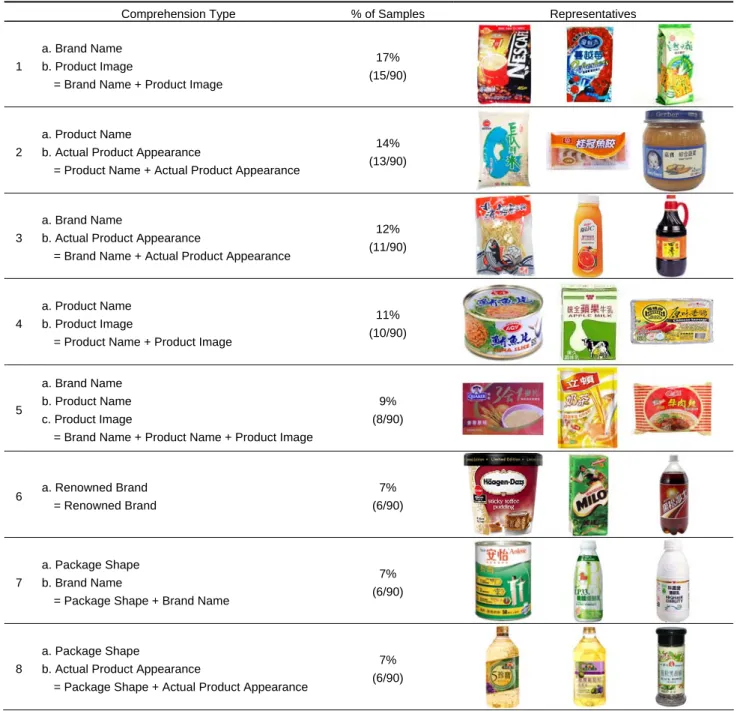
exposed on brand name or product name plays a major role in the comprehension of food packages. As to what product design elements form a more comprehensive visual message, the answer varies from category to category. This research result is based on the majority of opinion gathered from the focus group interview. There are thirteen forms of comprehension derived from the food package samples, summarized in Table 3.
Table 3: Summary on forms of comprehension by focus group on visual communication of food package design
Comprehension Type % of Samples Representatives
1
a. Brand Name b. Product Image
= Brand Name + Product Image
17%
(15/90)
2
a. Product Name
b. Actual Product Appearance
= Product Name + Actual Product Appearance
14%
(13/90)
3
a. Brand Name
b. Actual Product Appearance
= Brand Name + Actual Product Appearance
12%
(11/90)
4
a. Product Name b. Product Image
= Product Name + Product Image
11%
(10/90)
5
a. Brand Name b. Product Name c. Product Image
= Brand Name + Product Name + Product Image
9%
(8/90)
6 a. Renowned Brand
= Renowned Brand
7%
(6/90)
7
a. Package Shape b. Brand Name
= Package Shape + Brand Name
7%
(6/90)
8
a. Package Shape
b. Actual Product Appearance
= Package Shape + Actual Product Appearance
7%
(6/90)
9 a. Actual Product Appearance
= Actual Product Appearance
6%
(5/90)
10
a. Package Shape b. Color Association
= Package Shape + Color Association
3%
(3/90)
11 a. Package Shape
= Package Shape
3%
(3/90)
12
a. Package Shape b. Product Image
= Package Shape + Product Image
2%
(2/90)
13
a. Product Name b. Package Shape
= Product Name + Package Shape
2%
(2/90)
a “x/90” shows out of the 90 samples, x number of items belong to a certain comprehension type.
b “a” and “b” in the table above shows the first comprehension type is based on the visual communication messages formed by the combination of “a+b” design elements.
Several findings can be drawn from Table 3: In the process of comprehending food packages, the majority of focus group would rely on the visual message formed by more than 2 package design elements in order to comprehend a product. Apart from the cases where food packages have easy-to-understand design elements (e.g.: renowned brand, actual product appearance, shape of package…etc.), focus group members were unable to comprehend sufficiently based on any single package design elements (e.g. product image). Amongst all forms of comprehension on the visual messages of food product package designs, the combination of design elements:
“brand name and product image” is most effective in delivering product messages. Thus we can conclude that food package designs when adopts the above combination would enhance consumers’ comprehension towards products.
As can be seen from the samples, the top six either had brand name or product name as the primary element for comprehending a product. When focus group members were comprehending food packages, seventy-two percent of them rely more on the “Text” form of comprehension in the design elements. Furthermore, if the food package has a certain “package shape”, it would be an
element that’s easier to comprehend for focus group members. This research also shows that twenty-two percent of the members rely more on the “package shape” design element, while the rest six percent rely on the actual appearance of the food itself, and shows no direct association with the package design.
Amongst the different forms of comprehension sources, focus group members found design elements such as texts(brand name, product name), images(product images), shape(package shape) and color(color association) contribute to the comprehension of products; while design elements such as manufacture trademarks, package size and its texture would not make such comprehension easier. The findings above can be used as reference for related industries when formulating product marketing plans and designing packages.
5. CONCLUSION
Through conducting the focus group interview, how group members comprehend the visual message delivered by package design has been identified. Furthermore, from collecting and analyzing the data, which design elements when combined can enhance consumers’
comprehension has also been examined. From the discussion result by focus group members on the 90 food package design samples, thirteen forms of comprehension sources can be identified, and the summary of the research findings can be drawn as follows:
a For most group members, comprehending a food package would require more than two design elements. For example, product message delivered through the combination of “brand name and product image” is best comprehended.
b Brand name, product name, product image, package shape, color association all contributed to the comprehension of products; however, design elements such as manufacture trademark, package size and its texture do not facilitate in the understanding of products.
As the abovementioned results show, message formed by different combination of design elements would influence the understanding of focus group members. Different forms of
comprehension also illustrated the percentage adopted by the samples in this research. Thus, if marketing personnel and designers were to use packaging as a form of marketing tool to induce consumers’ buying demand, it would be advisable to take into consideration how design elements were to be combined in order to attract consumers’ attention and to enhance their comprehension.
Although the procedures, method and analysis strategy of this research can be used as a reference for marketing and package design people, there are a few issues this research has neglected to consider, stated here as reference for future researches: (a) In view of the vast number of food packages, this research adopts the stratified sampling method and selected 90 samples for discussion; even though there were thirteen forms of comprehension been identified through focus group discussions, it is possible that when taking into account more samples, other forms of comprehension would also emerge. This should be further thought out in future
researches. (b) This research identified package design elements such as texts, images, shape and color as helpful to the comprehension of products by focus group members, however it failed to further identify which combination of design elements can be comprehended in the shortest period of time. This would provide a further area of study for fellow researchers to conduct a more in-depth experiment.
FOOTNOTE:
1 “Top Eighty Percent Best Selling Normal Products Chart” for Dec. 1st ~ 31st, 2006 refers to the sales ranking of products not undergoing any promotion events. Contents of the items sold, market share, product preference and turn over rate can be seen from the summary chart.
REFERENCES:
Bauer, R. and Greyser, S. (1969). What Americans Think of Advertising. New York: Dow Jones-Irwin.
Chen, Y. C. (2005). A Study on Comprehensibility and Interestingness of Design from Visual Trope. Journal of National Taiwan College of Arts, Vol. 77, 1-11.
Drever, J. (1965). A Dictionary of Psychology. Baltimore, Maryland: Penguin Books, 42.
Engel, J. F., Blackwell, R. D. and Miniard, P. W. (1995). Consumer Behavior, eighth edition. New York:
Dryden Press.
Godin, S. (2003). Purple Cow: Transform Your Business by Being Remarkable. New York: Penguin Group.
Greenbaum, T. L. (1993). The Handbook for Focus Group Research, edition rev. and expanded ed.. New York: Lexington Books.
Hawkins, D. I., Best, R. J. and Coney, K. A. (2004). Consumer Behavior: Building Marketing Strategy, ninth edition. Boston: McGraw-Hill, Irwin.
McClure, P. J. and Ryans, J. K., Jr. (1968). Differences between Retailers' and Consumers' Perceptions.
Journal of Marketing Research, Vol. 5, Iss. 1, 35-40.
Rettie, R. and Brewer, C. (2000). The Verbal and Visual Components of Package Design. Journal of Product and Brand Management, Vol. 9, No. 1, 56-70.
Sara, R. (1990). Packaging as a Retail Marketing Tool. International Journal of Physical Distribution &
Logistics Management, Vol. 20, No. 8, 29-30.
Schoormans, J. P.L. and Robben, H. S.J. (1997). The Effect of New Package Design on Product Attention, Categorization and Evaluation. Journal of Economic Psychology, vol. 18, 271-287.
Stewart, D. W. and Shamdasani, P. N. (1990). Focus Groups: Theory and Practice. Newbury Park, CA:
Sage Publications.
Weinberg, P. and Gottwald, W. (1982). Impulsive Consumer Buying as a Result of Emotions. Journal of Business Research, Vol. 10, Iss. 1, 43-57.
Wilkie, W. L. (1994), Consumer Behavior, third edition. New York: John Wiley & Sons, Inc.