Table of Contents
Chinese Abstract---2
English Abstract---3
1. Introduction---4
2. Research Purpose---5
3. Literature Review---5
4. Research Method---9
5. Results---15
6. Discussions---23
7. Conclusions---24
8. References--- --25
9. Appendices---28
10. Self-Evaluation of This Research---37
行 政 院 國 家 科 學 委 員 會 補 助 專 題 研 究 計 畫 成 果 報 告
大一英文於整合教室與網路之課程的發展、建置與評量
計畫編號:NSC 94-2411-H-006-030-
執行期間: 94 年 8 月 1 日至 95 年 7 月 31 日
計畫主持人:劉繼仁
中文摘要
近年來已有許多關於電腦輔助語文教學與學習的研究,而電腦科技的日新月異,使得語文 的學習比以前更方便和更多元。然而在台灣目前甚少有關結合教室與網路的英語教學設計 理論及其應用。本計畫承接 93 年度國科會計畫: 大一英文於台灣混合型網路教學課程之設 計理論及應用。根據教學理論發展出教學實例,並使用教學平台,分別適用於初級、中級、
高級等三個不同程度的班級,符合在所進行研究的大學中的大一英文實施現況。此研究使 用形成性研究法(為主)和行動研究法(為輔),來收集及分析資料。請三位大一英文老師在 其所教的班級中實施一年,進行授課老師的心得訪談與學生的反應調查,並做教學評量。
而此研究強化所改良之設計理論的效果、建構有效性和普遍性,並提供混合型英文課程之 應用。
中文關鍵詞: 大一英文,教學設計,英語教學, 混合型課程,教學平台
Abstract
There is little research or design theory available to college instructors in Taiwan concerning approaches or methods for EFL instruction in a hybrid course (including both classroom and Web-based context). This research project is intended to further develop, implement, and
evaluate an instructional design theory (IDT) and its various applications in three different levels of Freshman English in hybrid courses at a university. The 2004-2005 NSC-sponsored research that the principal investigator has completed focuses only on the development of instructional scenarios in hybrid courses for college freshmen of the intermediate proficiency level of English at a university in central Taiwan. It is treated as a pilot study of the applications of the refined IDT for teaching Freshman English in a hybrid course, and its result of practices should be used to suggest improvements for further research of its kind. Addressing to the needs mentioned above, this study aims to (a) develop three different instructional practices of teaching Freshman English in hybrid courses,based on Liu’s(2003)instructionaldesign theory (IDT)and the 2004-2005 NSC-sponsored research project, for college freshmen of low proficiency level, mid proficiency level, and high proficiency level, respectively, (b) implement the developed
instructional practices into one class of low proficiency level, one class of mid proficiency level, and one class of high proficiency level in the academic year 2005-2006, and (c) evaluate the effectiveness, construct validity, and generalizability of the instructional practices applied in the three different proficiency-level classes, as well as further refine the IDT in parallel if needed. In addition, the researcher can make sure the construct validity of the further refined instructional design theory and its authentic applications in three different levels of Freshman English in hybrid courses.
Keywords: Freshman English, instructional design, English teaching, hybrid course, learning management system
1. Introduction
Researchers, pre-service and in-service teachers, or interested scholars of CALL need to think about and discuss what role advanced technologies could play in facilitating language learning, and to explore, develop, and integrate current knowledge of language teaching and learning processes with various types of technologies in different contexts. Bax (2003) in his paper CALL—past, present, and future argues that language teachers, when applying the computer technology to their teaching, should aim at the state of normalization “in which the technology is invisible and truly integrated”(p. 13). In his perspective the ultimate goal of CALL is that each user gets used to applying his/her computer to learn the target language without difficulties or inconveniences, just like wearing a watch in daily life. The ideal state of CALL development is nearly impossible for CALL practitioners or researchers to carry out in a short period of time or with few individuals’efforts. However, in order to realize this ideal state in the near future as the computer technology has been evolving, research-proven theories and research-tested applications are needed to persuade both CALL and non-CALL language teachers to adopt these innovative and useful applications in their instruction. In the meantime, the normalization of CALL use also raises several questions that need to be answered. For example, how effective and efficient the innovative application is? Is the innovative application better than any other applications, including traditional ways? How can both CALL as well as non-CALL language teachers take advantage of it? Are there any disadvantages when using it? If so, how to avoid or decrease the disadvantage? The developer and pioneer of the innovative application should think about these questions and answer them when teaching the target language as well as promoting the use of the research-proven application.
The principal investigator of this study, however, would like to further test the effectiveness, construct validity, and generalizability of a research-based instructional design theory (IDT) (Liu, 2003) and its applications for facilitating freshman students’English learning in hybrid courses.
The IDT development was first conducted in his doctoral dissertation research in 2001-2003. The hybrid course approach (Ko & Rossen, 2001) combines the advantages of face-to-face instruction in the classroom with the features and tools of Web-based instruction on the Internet. Liu’s (2003) study utilized the broad framework of the instructional design theory (Reigeluth, 1999) to develop guidelines for teaching EFL in a hybrid course, and used the formative research methodology (Reigeluth & Frick, 1999) to collect and analyze data to refine the guidelines of the theory in a four-stage process. Liu used Omaggio-Hadley (2001) to combine the instruction of skills (speaking, listening, reading, and writing) into integrative, communicative language use through the provision of integrated instructional guidelines in the study. He followed the three communicative modes —“the interpretive mode,” “the presentational mode,” and “the interpersonal mode”—to develop tentative guidelines for teaching Freshman English using the intermediate level of the ACTFL Proficiency Guidelines.
According to the result of one round of expert review in Liu’s (2003) study and the result of the other round of expert review in the principal investigator’s ongoing NSC-sponsored research project, all EFL/ESL experts agree that the hybrid course approach is the trend for teaching EFL in Taiwan and other places in the Information Age. Hence, since the hybrid course approach is
new in the field of teaching English as a foreign language (TEFL), more profound, insightful studies are needed to continue to strengthen the current and cutting-edge knowledge of its field and provide various research-tested applications for its value.
2. Research Purpose
Addressing to the needs mentioned above, this study aims to (a) develop three different instructional practices of teaching Freshman English in hybrid courses, based on Liu’s (2003) instructional design theory (IDT) and the ongoing 2004-2005 NSC-sponsored research project, for college freshmen of low proficiency level, mid proficiency level, and high proficiency level, respectively, (b) implement the developed instructional practices into one class of low proficiency level, one class of mid proficiency level, and one class of high proficiency level in the academic year 2005-2006, and (c) evaluate the effectiveness, construct validity, and generalizability of the instructional practices applied in the three different proficiency-level classes, as well as further refine the IDT in parallel if needed. In addition, the researcher can make sure the construct validity of the further refined instructional design theory and its authentic applications in three different levels of Freshman English in hybrid courses. Moreover, various types of applications of the hybrid course approach can be developed and evaluated for teaching Freshman English through the uses of different instructors in a formal higher educational institution.
3. Literature Review
In this section, the relevant literature review of this study is divided into three parts, including (a) the current development of computer-assisted language learning (CALL), (b) the current use of the integration of the learning management system into the classroom, and (c) the summary of Liu’s (2003) study.
A. The Current Development of Computer-Assisted Language Learning (CALL)
Beatty (2003) defines CALL as “any process in which a learner uses a computer and, as a result, improves his or her language”(p. 7). He maintains that the development of computer technology drives the improvements of CALL. “But this progress has not been purely linear and, in terms of pedagogy, the new and improved have not always replaced the old and tired. Instead, many programs being produced today feature little more than visually stimulating variations on the same gap-filling exercises used 40 years ago”(p. 11). In addition, Beatty mentions that current CALL software is yet to show significant advantages with regards to speech synthesis and voice recognition. The author argues that the recent research in CALL has moved from “the need for computers in the classroom”(p. 13) to the analysis of the effectiveness of CALL software compared to traditional language learning, to the analysis of “special features of computer’s organization and presentation of information”, to “learner centered opportunities to explore different links or paths of inquiry”, and, finally, to “the appropriateness of multimedia models for accommodating different learners’learning styles and even gender”(p. 15). Beatty reviews relevant publications to make this comment that “CALL is now seen to be complementary to classroom activities”(p. 15). This argument supports the need of this research that more studies and applications of the integration of the innovative use of CALL in the classroom are desired.
As Kern and Warschauer (2000) indicate, the new technology not only serves the new teaching/learning paradigms, but also helps shape the new paradigms. Beatty (2003) defines the features of the computer—hypertext, hypermedia, and multimedia—as well as describes how some of their applications are different from traditional learning materials. For example, he argues that hypertext provides a different way that traditional language texts cannot do. He comments that “the development of hypertext has been associated most closely with a constructivist model of learning and aspects of schema theory”(p. 38). Beatty also talks about different language teaching approaches/methods for some computer applications and simulations.
He desires his readers to be aware that each CALL application or simulation—has its possibilities and limitations—should be used under a specifically defined instructional condition in order to foster desired learning outcomes.
In sum, current CALL practitioners are encouraged to emphasize autonomy in language learning, design learner-centered and individualized curriculum, and promote the development of communicative and linguistic competence. To use CALL to facilitate human language learning, it is suggested that the learner’s “critical needs”(the theme of the CALICO 2005 Conference) should be identified first in order to choose or design a CALL program for him/her. Bax (2003) yields (a) a need of conducting “in-depth ethnographic studies of individual environments to elucidate the relationship”(p. 27) between the computer and the users (teachers and students), and (b) a need of conducting action research “in individual environments to identify barriers to normalization and ways of overcoming them”(p. 27). This study is intended to investigate how participating students can benefit from the innovative application of the hybrid course as well as how participating teachers of Freshman English in this study can take advantage of it. It is also a kind of action research, trying to improve the current instruction of Freshman English and develop three scenarios based on Liu’s researched-tested IDT for various levels of Freshman English classes in the hybrid course of the Information Age.
B. The Current Use of the integration of the learning management system into the classroom In recent years, a number of studies (Chen, Belkada & Okamoto, 2004; Chun & Plass, 2000;
Corda & Jager, 2004; Meskill & Ranglova, 2000; Schultz, 2000; Shetzer & Warschaur, 2000;
Torii-Williams, 2004; Warschauer, 2000) have investigated the applications of computer networks in language teaching, and explored several attributes of Web-based EFL learning. Despite the capabilities of online learning found in the CALL literature, more studies are needed concerning the pedagogical development of the hybrid course targeted at teaching EFL in order to strengthen the value of application. In this section, important information regarding (a) the use of a systems approach to curriculum design process of the hybrid course, and (b) the integration of the learning management system into the classroom, are discussed as follows.
(A) The Use of a Systems Approach to Curriculum Design Process of the Hybrid Course According to Graves (2000), “course design is a system in the sense that planning for one componentwillcontributeto others;changesto onecomponentwillinfluencealltheothers”(p.
4). For example, if one changes the content of the curriculum, the objectives of the course will need to be changed to reflect the changes to the content. In a hybrid course of Freshman English, there are more components than those of a fully online course or a classroom-based course. Thus,
carefully decide the sequence of English learning activities in both the classroom and the online context to foster meaningful language development. Kazeroni (2002) comments the situation that
There is very little research on language teacher decision making processes which should be of major interest to CALL methodologists since most forms of computer-based language instruction assume that teaching and learning are uniform and non-dynamic processes given the normative nature of language learning is a social and group activity is totally overlooked (p. 100).
Kazeroni (2002) also argues that if CALL practitioners desire to bring positive influence to classroom teaching, they should mindfully consider teacher needs as well as teaching as a decision making process. This research, however, is intended to help instructors, who teach different levels of Freshman English, arrange English learning activities in a systematic way and choose appropriate methods among a set of research-based instructional guidelines with their methods, in accordance with their individual needs and the features of the level of their Freshman English courses. The whole set of instructional guidelines, which are developed according to the Liu’s (2003) revised instructional design theory after two rounds of expert review, is considered a systems approach for teaching Freshman English in the Information Age. Of course, there are elements of decision-making processes in the whole set of instructional guidelines for teachers to choose (Liu, 2003), depending upon various instructional conditions in the course and desired learning outcomes (Reigeluth, 1999).
(B) The integration of the learning management system into the Classroom
Gould (2003) argues that “the integration of hybrid course instruction will benefit both the institution and the students. Institutions will be able to maximize their available physical resources, and students will be able to maximize their potential”(p. 54). The learning management system, such as those on blackboard.com, webct.com, and ecollege.com, provides two-way synchronous and asynchronous communications tools for the instructor and the student, an online space for course materials, and an online space for students to submit their papers and projects. There are also assessment tools and resources that students can use at any time, at any place. Students still can go to the class to have face-to-face discussions and interactions with the instructor and other students. In this way, the total learning environment is expanded. However, how can one mix both the classroom and the learning management system becomes an important issue. This study would like to tackle this issue and see how the great potential of the hybrid course approach can maximize the learning effectiveness in three different levels of Freshman English classes.
In a study conducted by Chen, Belkada, & Okamoto (2004), the learning effectiveness was examined in a class of twenty Japanese college students learning English in a fully online course.
The findings indicate that (a) “the modes of communication (negotiation via inter-personal or intra-personal tasks) were equally effective in promoting listening comprehension and L2 development”(p. 47), and (b) “there is no data revealing that negotiation of meaning facilitates comprehension and production”(p. 47) in an online environment. They make a conclusion that
“although learning language through communication has been proven to be successful in face-to-face language learning situations for facilitating the restructuring of the student’s
linguistic knowledge, it is not yet been successfully transferred to the new educational environment, the Web”(p. 47). Of course, they argue that there is still a lot of room for improvement of transferring the successful face-to-face language learning experiences to the fully Web-based context. However, it also means that at this moment, the integration of the learning management system into the classroom is a safe way to do. In this way, some problems of the fully online course can be solved by taking advantage of the face-to-face classroom environment.
This is indeed the intention of this study.
C. The Summary of Liu’s (2003) Study
To provide the reader of this research important information regarding Liu’s (2003) instructional design theory for teaching Freshman English in the hybrid course in Taiwan, the following is adapted from the conclusions section in chapter 6 “(The Revised Version of the Theory, Limitations, Recommendations and Conclusions) of Liu’s (2003) doctoral dissertation.
The purpose of this study was to develop a tentative theory that should be applicable to current and cutting-edge reality for teaching EFL to first-year undergraduate students in a hybrid Web-based instruction course (combining both classroom and online contexts) in Taiwan. This study utilized the broad framework of instructional design theory (Reigeluth, 1999) to develop tentative guidelines for teaching EFL in a hybrid WBI course, and used the formative research methodology (Reigeluth & Frick, 1999) to collect and analyze data to refine the guidelines in the theory. Liu (2003) developed tentative guidelines that can be applied to both the classroom and a learning platform on the Internet for teaching Freshman English in Taiwan. These tentative guidelines were critically reviewed by four American and one Taiwanese expert-practitioners in the TEFL and TESL fields. The tentative guidelines in this study have been theoretically validated through one round of expert review. This study examined the possibilities of designing EFL instruction in a hybrid Web-based instruction environment and of integrating the four language skills with a communicative focus in various teaching agendas. This is a new trial of combining both the perspective of language skills and more integrative, communicative language use with technology imbedded in the learning contexts. This study used Omaggio-Hadley (2001) to combine the instruction of skills (speaking, listening, reading, and writing) into integrative, communicative language use through the provision of integrated instructor guidelines in this study. The IDT applied the three communicative modes —“the interpretive mode,”“the presentational mode,”and “the interpersonal mode”(NSFLLP, 1996)—to develop tentative guidelines for teaching Freshman English using the intermediate level of the ACTFL Proficiency Guidelines.
In addition, this IDT focuses on appropriate scaffolding with informative feedback in the EFL instruction, and on the active role of students and the guiding, facilitating role of instructors.
Both ideas pay attention to the needs of “learning”in the new paradigm of instruction in the information age. In this IDT, learning is placed above teaching. In this way, therefore, Taiwanese EFL students can explore and construct their English knowledge and skills, as well as develop their communicative competence actively. At the same time, the instructor should pay more attention to the effective and efficient design of EFL learning for students, as well as to update himself/herself with the latest language teaching ideas and available technology. Further, this IDT
as a combined application of integrative Computer-Assisted Language Learning (CALL) and classroom instruction at Taiwanese universities designed to improve the current educational situation of TEFL. This IDT is a kind of network-based language teaching (Kern & Warschauer, 2000) that focuses on interpersonal communication by using networked computers. In addition, the IDT demonstrates what Warschauer and Healey (1998) maintain: that the use of CLT has shifted to a socio-cognitive view that emphasizes real language use in meaningful social contexts.
As Huang (1998) points out, Taiwanese non-English-major college students desire more class hours and opportunities for listening and speaking in EFL curricula. So EFL instructors in Taiwan need to positively react to the voice of students by providing balanced, sound EFL instruction that utilizes both classroom and online contexts for freshman students to learn their English in the global village of the Internet.
From the reviewed literature, it is found that there is little research-based instructional design theory/model and its practices available to EFL instructors and help them facilitate college freshmen’English learning in the hybrid course in Taiwan. Kern and Warschauer (2000) observe that there has been relatively little published research exploring the relationship between the use of computer networks and language learning as well as teaching. Bax (2003) yields (a) a need of conducting “in-depth ethnographic studies of individual environments to elucidate the
relationship”(p. 27) between the computer and the users (teachers and students), and (b) a need of conducting action research “in individual environments to identify barriers to normalization and ways of overcoming them”(p. 27). This study investigated how participating students could benefit from the innovative application of the hybrid course as well as how participating teachers of Freshman English in this study can take advantage it. This research is also a kind of action research, trying to improve the current instruction of Freshman English and develop three
scenarios based on Liu’s researched-tested IDT for various levels of Freshman English classes in the hybrid course of the Information Age.
4. The Research Method
A. Research Questions of This Study
The researcher sought to address the following five questions for this study:
(1) What are the further refinement and applications after the two rounds of expert review of Liu’s instructional design theory (IDT) for teaching Freshman English at a university under the following conditions?
Reading, writing, listening, and speaking
The low level of Freshman English class, the mid level of Freshman English class, and the high level of Freshman English class, respectively
A hybrid course approach for teaching English using both the classroom and the learning platform on the Internet
25-30 students appropriate for a course designed for the class discussions, and for asynchronous collaboration on the Internet
(2) Is the participating students’overall English achievement of three different levels of Freshman English in hybrid courses better than those of the same levels in traditional Freshman English courses with the same instructional objectives? If so, how is the result?
(3) How do the three participating teachers of Freshman English in this study think about the
applications of the hybrid course in accordance with the revised Liu’s IDT?
(4) How do students of three different levels of Freshman English courses in this study think about the applications of the hybrid course in accordance with the revised Liu’s IDT?
(5) What are the challenges and issues when teaching the three different levels of Freshman English in the hybrid course which are developed in accordance with the revised Liu’s IDT?
B. Research Design of This Study
This research focused on three parts: (a) developing three instructional practices (scenarios) for teaching EFL to first-year undergraduate students in three different levels—A, B, C (high, mid, and low)—of Freshman English in hybrid courses at a comprehensive university in southern Taiwan, (b) implementing the three instructional practices in three levels of Freshman English classes, which was taught by three teachers, and (c) evaluating the effectiveness, construct validity, and generalizability of the three instructional practices based on the refined Liu’s instructional design theory for teaching Freshman English in the hybrid course. The formative research methodology (Reigeluth & Frick, 1999) was applied in this study to refine the instructional applications based on the collected data. In addition, the action research were applied to strengthen the methodological procedure and construct validity of the study.
C. Methodological Procedures
There were three phases for the principal investigator and the three participating instructors of Freshman English to work together to complete this study. They needed to (a) develop English learning activities as an instructional application in accordance with Liu’s refined instructional guidelines for teaching Freshman English in the hybrid course (see Appendix A, B, and C), (b) implement the instructional application into their Freshman English classes for the whole academic year 2005-2006, and (c) evaluate the use of the instructional application after each of the two semesters. Each phase is described as follows.
(A) Develop the Instructional Application of Freshman English in the Hybrid Course
Design in curriculum refers to what “shape and direction” that teachers or instructional designers want their courses to be (Ko & Rossen, 2001). Designing a hybrid course for teaching a subject might involve the consideration of design and arrangement of instructional goals, textbooks, resources, methods, techniques, assignments, exams, and learning activities in the classroom and online contexts. The three participating teachers of the three different levels of Freshman English courses in this study were asked to (a) attend a brief workshop conducted by the principal investigator in the beginning of the semester in 2005-2006, and (b) adopt some of the main instructional guidelines of Liu’s refined instructional design theory (see Appendix C) to develop their own instructional applications, reflecting the needs and features of their own levels of Freshman English classes. The three teachers developed their Freshman English curricula based on the materials offered by the researcher.
In the introduction session of the study, the principal investigator informed the three teachers of the design models and the revised guidelines with their methods and components, and the course design process of the hybrid course. For designing a hybrid course for teaching EFL to Taiwanese freshmen, the seven stages of design process (Liu, 2004) are as follows.
1. Identify or choose an appropriate proficiency level for a Freshman English class (ACTFL, 1986).
2. Identify instructional objectives for the course.
3. Identify the strengths of teaching English in a classroom learning environment and an online environment based on the available resources, respectively.
4. Identify available resources for designing a hybrid course. A hybrid course is comprised of both classroom and Internet-based learning contexts.
5. Use an existing learning platform on the Internet or create a Web site for asynchronous and synchronous communications.
6. Design or select appropriate textbooks and resources for the course.
7. Apply the identified strengths as a basis to design learning activities and tasks in both classroom learning context and Web-based context by using the instructional guidelines of the IDT.
In the development (planning) stage, just like the action research (Beatty, 2003) suggests, the three teachers should figure out a way to improve the current learning condition or promote more language use and communication in the hybrid course. In the curriculum development process, the principal investigator provided a brief workshop and consultation to the participating teachers, and the three teachers were encouraged to be open-minded to adjusting the lessons and learning activities, depending upon the needs and features of the level of Freshman English classes. In the implementation (the acting stage in the action research) stage, the three teachers were expected to put what they had developed into practice. The information regarding the implementation of the instructional applications is described as follows.
(B) Implement the Instructional Application into Their Freshman English Classes for the Whole Academic Year 2005-2006
The context the researcher selected for this study is the National Cheng Kung University (NCKU) (URL: http://www.ncku.edu.tw) in Tainan City, Taiwan, at which the researcher has become a full-time faculty member in the Department of Foreign Languages and Literatures since the 2005-2006 academic year. There are nine colleges, more than 50 departments and 30 graduate institutes at the NCKU, and the total enrollment is over 18,500 in 2005-2006. Every faculty member can connect to the Internet from his/her research room, and students can access to the Internet from their dormitory rooms and computer labs. The learning management system that NCKU has been using allows the instructor to place handouts, syllabuses, and announcements. In addition, it provides both synchronous and asynchronous discussion boards for the instructor and students to communicate. Students can submit their papers onto the learning management system and the instructor can download the papers and give grades and comments. This context for this case allows both synchronous and asynchronous methods for teaching the four language skills in EFL.
Currently at NCKU, a freshman student needs to take an English placement test in order to attend a Freshman English class appropriate for his or her proficiency level. If a freshman has passed the intermediate proficiency level of one of the four standardized tests (GEPT, IELTS, TOEIC, and TOEFL) or the equivalent academic ability test, the Freshman English course can be
waived. There were thirty full-time professors/instructors and thirty-eight part-time professors/instructors in the Department of Foreign Languages and Literatures during the academic year 2005-2006. In that academic year, there were more than 3,100 freshman students at NCKU. Each Freshman English class was composed of 15-65 students, depending upon the enrollment of students and the level of the class. In fact, the range of student number in a class was quite flexible.
Scenarios— instructional applications of Liu’s refined instructional design theory. Scenarios in this study were defined as the authentic instructional practices with detailed teaching plans that an instructor can apply in facilitating students’academic development for a certain subject. For this research, the researcher worked with the three teachers to develop one scenario for unit-based EFL learning activities and one scenario for project-based EFL learning activities in the hybrid course for each of the three levels of Freshman English classes. Scenarios were created in accordance with the Integrated Model for teaching Freshman English in Hybrid web-based instruction context (see Appendix A & B), and the refined instructional guidelines (see Appendix C). The purpose of the scenarios in this study is to reflect the realizable instructional practices of the design theory in an organized manner.
In Liu’s (2003) study, the unit-based activities were designed to occur within each unit, which was an independent and organized set of lessons in the textbook, such as the suggested book Passages (Richards & Sandy, 1998) that spanned two weeks. In the chosen textbook for the designed case in this theory, one unit includes a topic that could be used to integrate the four languages skills of reading, listening, writing and speaking, and there were seven units to be completed in a semester. Each unit went through the three modules—Module 1:
interpretive/receptive activities, Module 2: presentational/ productive activities and Module 3:
interpersonal/communicative activities—which were developed based on the three communicative modes in order to teach EFL in the whole year.
In a team-based project, learning activities were designed to be integrated into instruction for the semester. The project was designed for teams (each of which includes three or four students) to work throughout the semester. The instructor informed the students of the project-based activities and prepared students for them in the beginning of the semester. Thus students had the whole semester to work on the project. In project-based activities EFL learners needed to integrate the four language skills to complete learning tasks by using problem-solving abilities.
Problem-solving is a higher level of critical thinking (NSFLLP, 1996) and is utilized to help EFL students further develop their English in the learning activities.
Further, the researcher helped the three teachers take advantage of the useful Internet-based tools and communication features of the learning management system—iteach at NCKU—to design and conduct EFL learning activities by integrating the four language skills with a communicative focus in various teaching agendas. The scenarios combined both the perspective of language skills and more integrative, communicative language use with technology imbedded in the learning contexts (Omaggio-Hadley, 2001). The three teachers applied the instructional applications in their courses for the whole academic year 2005-2006. When the three teachers had any questions or problems, the principal investigator tried to help them overcome the difficulties
and solve the problems. In few cases the principal investigator could not help improve the situation, he sought consultation from other senior or experienced instructor/researchers.
C. Evaluate The Use Of The Instructional Application After Each Of The Two Semesters.
(A) Participants
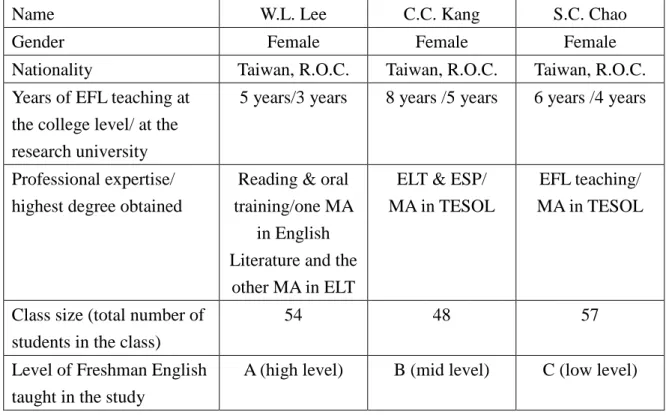
There were two types of participants for the implementation and evaluation of the scenarios in this study: the teachers and the students. Teachers, who teach EFL at NCKU, were selected according to a sampling procedure referred to as “theoreticalsampling”(Glaser& Strauss,1967) or purposeful sampling, whereby participants were selected because of certain characteristics they possess (Bogdan & Biklen, 1982). The three EFL instructors, who were chosen to be the primary teachers to use the scenarios to teach Freshman English, needed to have at least two years of teaching EFL at college level and at least one year of using the Internet as a supplement to their EFL courses (see Table 1: Summary of Professional Backgrounds of English Instructors in this Study). As to the student participants in this study, ten from each class will be chosen based on convenience sampling, which is more available and convenient but least expensive and least time-consuming, to reflect learner perspectives on the scenarios. Ten students out of a class of twenty or more would reflect a certain percentage of the class.
Table 1: Summary of Professional Backgrounds of English Instructors in this Study
Name W.L. Lee C.C. Kang S.C. Chao
Gender Female Female Female
Nationality Taiwan, R.O.C. Taiwan, R.O.C. Taiwan, R.O.C.
Years of EFL teaching at the college level/ at the research university
5 years/3 years 8 years /5 years 6 years /4 years
Professional expertise/
highest degree obtained
Reading & oral training/one MA
in English Literature and the
other MA in ELT
ELT & ESP/
MA in TESOL
EFL teaching/
MA in TESOL
Class size (total number of students in the class)
54 48 57
Level of Freshman English taught in the study
A (high level) B (mid level) C (low level)
The researcher and the research assistant observed the real practices of the scenarios. The research assistant videotaped the use of one scenario of the unit-based learning activities and one scenario for the project-based learning activities in each of the two semesters. Videotaped learning activities in the class were conducted to help collect data. In addition, the researcher interviewed the teachers to collect direct data from the participants. According to Reigeluth and Frick (1999), the most useful data usually come from participants (teachers and students in this study). The formative data were analyzed.
(B) The Instruments
One scenario of the unit-based learning activities and one scenario for the project-based learning activities for each of the three levels of Freshman English classes, samples of the video-taped learning activities, a set of questions for the teacher and a set of questionnaire for the students were the instruments for this research. In addition, there was one uniform exam on grammar, reading comprehension, and listening comprehension for all classes of Freshman English in every semester at NCKU. The average score of each of the three classes in this study was used to compare with those of the same levels of the traditional Freshman English classes to understand if the hybrid course approach was better than the traditional way. According to one reviewer of the project proposal of this study, there were other factors that might influence the learning outcomes, such as the instructional goals, the chosen textbook, available resources, the instructional methods, etc. The researcher accepted the thoughtful advise and asked the participating instructors to use the same instructional methods out of Liu’IDT, set the same instructional goals, and use almost the same resources. However, the textbooks in the three Freshman English were different because of the different level of the English classes.
At the end of the first semester, the three teachers and all their students were asked with the questions (see Appendices D & E) to reflect their perspectives. Then the researcher refined the instructional applications based on the feedback of the given questions. In the second semester, the three teachers used the refined instructional applications in their classes after the discussion with the researcher. At the end of the second semester, the same teachers were asked with the same questions again to reflect their perspectives. Their suggestions were used to improve the instructional applications for the second time..
(C) The Procedures for Analyzing Formative Data
When analyzing the formative data, Reigeluth and Frick (1999) suggest that the researcher should identify the primary strengths and weaknesses in the instruction (the three instructional applications in this study) and what improvements could be made to the initial theory. The researcher used the methods of “directinterpretation”and “categoricalaggregation”(Stake,1995) to analyzethedatain thisstudy.Stakearguesthat,“two strategicwaysthatresearchersreach new meaning about cases are through direct interpretation of the individual instance and through aggregation of instances until something can be said about them as a class”(p.74).
Categorical aggregation was done by analyzing the formative data from the interview, and categorizing them based on the research questions. The researcher looked for recurring, emerging themes, using the questions as a guide and tried to find correspondence among the themes (Stake, 1995). The data analysis process was inductive; the researcher used the general procedures outlined by Miles and Huberman (1984) and followed the basic dimensions of data analysis:
“selecting,focusing,simplifying,abstracting,and transforming thedata”(p.21).
Direct interpretation, which is discussed by Stake (1995), was done by the researcher’s drawing preliminary conclusions based on the emerging themes and correspondence from the data.
Stake suggests that the next step should be to re-read the data, identify rival interpretations, and refine original interpretations accordingly. Moreover, according to Stake’s guidelines, the
researcher’s re-reading, identifying, and refining process would go on until he was unable to find supportive evidence for the rival interpretations.
At the end of the first semester, the three teachers and the students were asked with questions to reflect their perspectives. Once the analyses were completed, the researcher sent the three teachers the electronic file of the document attached to an email in order to get their feedback. This action provided triangulation of the data. The researcher emailed the refined version of the instructional applications to the three teachers in this study to ask for their feedback and suggestions. Their feedback was be used to enhance reliability. This method was intended to ensure accuracy of the data and trustworthiness of my interpretations. In addition, at the end of the second semester, the same teachers and same students were asked with the same questions again to reflect their perspectives. Furthermore, the researcher refined the categories, developed the assertions, and constructed a rationale or model to illuminate the understanding of the relationship between teaching EFL to undergraduate students and the two teaching environments.
5. Results
In this section, three types of preliminarily divided data are presented, including (a) teachers’
answers to the interview questions, (b) students’perspectives towards their English learning, and (c) students’average scores of the uniform exam in each of the two semesters in 2005-2006. Here I only provide the basic results. Detailed explanations will be presented in published works.
A.Teachers’Answers To the Interview Questions
1. What do you think about the guidelines for teaching the four language skills (speaking, listening, reading, and writing) in EFL to undergraduate students in a hybrid course?
Similar positive answers from the three teachers (A means the Level-A-class teacher in this study, B means the Level-B-class teacher, C means the Level-C-class teacher):
A clear, simple, easy to carry out B useful, practical, and clear C effective and clear
A different point from the Level B teacher: “This approach is a bit complex. What is a standard hybrid course? How many hours should be engaged through the internet? And, how to evaluatestudents’academicachievement?”
2. From your viewpoint, what is the value of teaching EFL in a hybrid course?
Similar positive answers from the three teachers:
A To break up the limits of time and space, so that both teaching and learning can take place anytime and anywhere. To learn English in and out of the classroom.
B A learner-centered, active, interactive and discovering learning process. It enables the EFL teaching diversified and creative.
C Students are likely to be more motivated to work on the target language. A lifetime pursuit or a learning pattern of the target language learning would be built.
A different point from the Level B teacher: “The teaching and learning loads became double, even treble. Some teachers might get intimated by this new approach since time pressure is a big concern formany college teachersnowadays.”
3. After reviewing the documents, what questions do you have?
Similar answers from the three teachers:
A N/A
B How many hours should I adopt classroom instruction per week/ per semester?
How many hours should I focus on WBI in a week/ in one semester?
C Our current class sizes and weekly hours of the English classes seem to make it hard to implement all the guidelines well.
Different answers from the three teachers:
A If we expect the unit-based activities to occur within each unit, is it better for us to choose the ELT textbooks that integrate all the four language skills?
B How to evaluatethelearners’academicachievementon theWBI?
C Curious about the effectiveness of those guidelines after they have been actually carried out. Students who come in different language competence and performance usually end up staying in one class. Should teachers offer suggestions on who to be divided in which group? Should students with similar language competence or performance work as one group? Or should the group be comprised of students whose language abilities are incrementally varied?
4. How well do the scenarios incorporate the major knowledge of your professional field?
A I think they incorporate my knowledge of English language teaching very well. For example, reading activities precede writing ones, and listening activities precede speaking ones.
B Ok.
C Some scenarios, like the three modules of the unit-based activities, are familiar.
Others, like the incorporation of the Internet and writing, are what have not been tried before.
5. What do you find to be strengths of the guidelines with instructional methods for the unit-based activities?
Similar positive answers from the three teachers:
A The use of the three modules, which are repeated in each unit to help students get a clearer and clearer picture of the topic in each unit and then to use the knowledge of what they read or listen to complete relevant writing and speaking activities
individually and then in pairs or groups.
B The guidelines are clearly stated and useful.
C For teachers, the guidelines provide a step-by-step process for teachers to follow easily.
The Level C class teacher: “For students, the unit-based activities are likely to make the units covered in the textbook more appealing to them. And the unit-based activities could provide students with more chances to work on the context of the lessons extensively. Besides, with several units being assigned as their activities, students are less likely to feel frustrated if they get
stuck on one certain unit. Variety of the units would also make the activities less boring. As for the three modules, those modules can expose students to a target-language environment in which students’fourskillswillbeexpected to develop steadily.”
6. What do you find to be strengths of the guidelines with instructional methods for the project-based activities?
A These project-based activities give students the opportunity to complete a task in groups and the freedom to choose the topic they love to work on and the way they want to present their project.
B They are quite challenging.
C For teachers, the guidelines provide a step-by-step process to follow easily. On the other hand, for students, they are likely to be more motivated through peer
collaboration (and maybe alittlebit“competition”),with theirbeing divided into separate groups to focus on what they find to feel interested in.
While being asked to brainstorm to come up with something, students are offered a chanceto “problem-solving”styleofteam-based work, which offers students to play a more active role in their learning.
As compared to the unit-based activities, students would be able to explore the related project more deeply and thoroughly.
7. What improvements would you suggest for guidelines with instructional methods for the unit-based activities?
A The guidelines for the activities of each module are simple and clear, but if they can be put into a chart, or given a proper title or sample for each component method (e.g., brainstorming), it will be easier for the instructor to get the points and decide what is needed and what isn’t when dealing with different topics and materials.
B N/A
C Since the unit from the chosen textbook for a class will serve as a basis of the unit-based activities, I think it might be helpful for teacher to call forth a
“textbooks-evaluation”meeting, during which teachers can exchange their ideas about the textbooks available on the market.
8. What improvements would you suggest for guidelines with instructional methods for the project-based activities?
A I think it’s perfectly-designed and it would work very well.
B Provide more methods.
C There is no improvement needed so far. Nevertheless, as for various sources from which students receive their information, should teachers regard any pieces of the information students obtain by P2P downloading “unacceptable”?
9. What method of the guidelines with instructional methods for the unit-based activities do you think would work well?
The same answers from the three teachers A 1-2 1B-2
B 1-2 1B-2
C N/A
Different answers from the three teachers A 1-2 1A-2, 1-3 1A-3, 1-3 1B-3
B 1-1 1A-1 (1-1-2: 1A-1-1, 1A-1-2; 1-1-3: 1A-1-3), 1-2 1B-2 (1-2-4: 1A-2-4; 1-2-6:
1A-2-6), 2-2 2A-2 (2-2-1: 2A-2-1), 3 3A (3-3:3A-3), 1-1 1B-1 (1-1-1:1B-1-1;
1-1-3: 1B-1-3), 1-2 1B-2 (1-2-2: 1B-2-2), 2-1 2B-1 (2-1-1: 2B-1-1), 2-2 2B-2 (2-2-1: 2B-2-1; 2-2-2: 2B-2-2; 2-2-3: 2B-2-3; 2-2-4: 2B-2-4), 3 3B (3-4: 3B-4) C It is difficult for this method to be effectively used, judging from the actual class
size we have at NCKU. In the 3 modules, one specific method is to encourage students to linguistically perform in public nearly any way they prefer. However, as far as my teaching experience is concerned, a large number of students would either feel embarrassed or remain lukewarm about the performance. There have been cases(aswellasmy personalexperiences)to indicatethatsomestudentsjustwon’t give out their linguistic performance under any circumstances. Though great
encouragement, friendly atmosphere, and comfortable environment certainly work for students to decrease their fear and barrier to a certain extent, teachers have to spend time coping with the situation. As a teacher, he/she has to carefully plan ahead to distribute the in-class time efficiently to each student while keeping to the class schedule.
10. What methods of the guidelines with instructional methods for the project-based activities do you think would work well?
A All methods would work well, especially Component method PB6, which can make the whole project and the whole course reach a climax before it’s over. Besides, students love to have their stage in class and present their hard work proudly B Component method PB1, PB3 and PB4 would work well.
C Component method PB2 where an interactive discussion forum is established for students to join would work well. On the technical level, students would hardly encounterany problems;on thelearning level,students’senseoffamiliarity (using the Internet and Web-links to locate information they need) and curiosity (at what other students have worked out) would likely be aroused to keep them going with the curriculum outside the classroom.
11. What methods of the guidelines with instructional methods for the unit-based activities do you think would not work well?
A None.
B Teacher B thinks that (2-3. The Guideline for Module 2a-3: Provide feedback and guide students to reflect on the writing-focused activities. 2-3-2. Component method 2a-3-2) “Encouragestudentsto send theirwritten worksto localoronline publisher”would not work well. (She doesn’tthink she will try this in the
Freshman English class. It is too early and too difficult for learners.)
C The module that involves speaking skill indicates a higher level of difficulty and challenge to both of students and teachers. Especially when it comes to asking them to practice the target language in public, some students find it hard to utter what they have in mind precisely, or they simply are afraid of making mistakes. In terms of the method, teachers will have to make more efforts during this phase.
Besides, class size matters.
12. What methods of the guidelines with instructional methods for the project-based activities do you think would not work well?
A N/A
B PB2
C Teacher C thinks that PB4 could be the part that she will encounter difficulty and barriers, mainly due to one possible situation in which inadequate amount of time is the key. To communicate with students and guide them through the whole process takes time. So far, she is afraid she wouldn’thavealotofchancesto achievethe goal.
13. Do you have any other suggestions or comments?
Similar answers from the three teachers
A (1) Connecting speed of the Blackboard was too slow. → students would get board and impatient easily.
(2) I strongly suggest that the whole project be done through the e-learning platform developed by NCKU instead of Blackboard.
B
C (1) Language courses should be conducted in language labs equipped with easy access to the internet and good language learning facilities.
Different opinions from the three teachers
A N/A
B (1) insufficient facilities:
a. Some students didn’thave their own computers or internet service and also the connecting speed is a big problem.
b. The functions and services at iteach which teacher B used are quite limited, many activities suggested by the guidelines could not be carried out.
(2) Time pressure: Teaching and learning loads become heavier.
(3) Assessment: It’s difficult to make a fair assessment.
C (2) Class size should be cut down.
B.Students’Perspectivestowards Their English Learning
The More Satisfying Abilities of the Three Classes
0%
20%
40%
60%
80%
Listening Speaking Reading Writing Vocabulary Grammar Culture All
A B C
Analysis of the More Satisfying Abilities
0.00%
20.00%
40.00%
60.00%
80.00%
Listening Speaking Reading Writing Vocabulary Grammar Culture All
%
The Less Satisfying Abilities of the Three Classes
0%
20%
40%
60%
80%
Listening Speaking Reading Writing Vocabulary Grammar Culture All
A B C
Percentage of the Less Satisfying Abilities of the Three Classes
0.00%
20.00%
40.00%
60.00%
80.00%
Listening Speaking Reading Writing Vocabulary Grammar Culture All
%
Average Years of Learning English
7.4 7.6 7.8 8 8.2 8.4 8.6
A B C
Years
Percentage of People Who Ever Use E-mail to Learn English
0%
10%
20%
30%
40%
50%
A B C
%
Percentage of People Who Ever Use Supplementary Softwares to Learn English
0%
20%
40%
60%
80%
A B C
%
Percentage of the Abilities That Can Be Enhanced By the Internet-based English Learning Platform of the Three Classes
0%
10%
20%
30%
40%
50%
Listening Speaking Reading Writing Vocabulary Grammar Culture
A B C
Total Analysis of the Abilities That Can Be Enhanced By the Internet-based English Learning Platform
0.00%
10.00%
20.00%
30.00%
40.00%
Listening Speaking Reading Writing Vocabulary Grammar Culture
%
Total Analysis of the Abilities That Can Be Enhanced By the Supplementary Softwares
0.00%
10.00%
20.00%
30.00%
40.00%
50.00%
60.00%
Listening Speaking Reading Writing Vocabulary Grammar Culture
%
Percentage of People Who Likes to Have Classes Totally At Classroom
0%
5%
10%
15%
20%
25%
30%
A B C
%
Percentage of People Who Likes Hybrid Courses
0%
20%
40%
60%
80%
100%
A B C
A B C
Percentage of Preferred Traditional Activities
0.00%
10.00%
20.00%
30.00%
40.00%
50.00%
Reading Writing Speaking Listening Discussion Games Drama
%
Percentage of Abilities That the Three Classes Hope Can Be Improved Through Internet
0%
20%
40%
60%
80%
Listening Speaking Reading Writing Vocabulary Grammar Culture
A B C
Total Analysis of Abilities That Hope Can Be Improved Through Internet
0.00%
20.00%
40.00%
60.00%
80.00%
Listening Speaking Reading Writing Vocabulary Grammar Culture
%
Percentage of People Who Think That Learning Through Internet is a Trend
0%
20%
40%
60%
80%
A B C
%
Average Hours That Students Would Like To Devote To English Learning Through Internet Everyweek in the Future
0 1 2 3
A B C
Hours
C. Students’AverageScoresof the uniform exam in each of the Two Semesters in 2005-2006 There is a uniform exam for all students of Freshman English in December in the 1st semester, and the other one in May in the 2ndsemester at NCKU. The mean and S.D. of each of the three classes in the two semesters are presented below.
Mean in the 1st semester
S.D. in the 1st semester
Mean in the 2nd semester
S.D. in the 2nd semester
Level A Class 68.83 9.09 68.38 10.28
Level B Class 59.24 11.36 57.56 10.60
Level C Class 53.67 10.11 49.12 11.39
6. Discussions
Here I summarize the main points from the preliminarily divided data. More detailed discussions will be provided in published works. We can conclude that
a. All the three participating instructors of Freshman English agree that the guidelines for teaching the four language skills to undergraduate students in the hybrid course are clear, effective, and practical. The guidelines are designed to fit their needs with few shortcomings.
b. All the three instructors think that teaching EFL in the hybrid course can motivate students to
learn English, and can allow teachers to be more flexible.
c. Two of the three teachers are concerned about the online preparation time as well as the teaching hours on the learning management system.
d. Two of the three teachers would like to learn how to evaluate students’performance in the online learning activities.
e. All the three teachers were not satisfied with the learning management system via blackboard.com mainly because of its slow connection speed on campus. So all of them turned to the NCKU-developed iteach learning management system. However, iteach was not ideal because of its limited functions and the Chinese interface.
f. The class size of all the three classes in this study was too big. Therefore, two teachers suggest that the class size should be cut down in order to promote desired learning outcomes.
g. Participating students in the three classes are satisfied with their reading ability in English and dissatisfied with their listening comprehension in English.
h. Low-proficiency-level students prefer totally classroom-based English courses. However, mid- and high-proficiency-level learners prefer hybrid English courses.
i. All three proficiency levels of freshmen prefer to develop their reading and oral discussion abilities rather than develop their writing skills in the classroom-based learning context.
j. About 75% of all students in the study think that learning English in the hybrid course is the trend.
k. High-proficiency-level students would like to spend more time online to improve their English than low-proficiency-level students.
l. Compared with other language skills, listening comprehension is considered the ability in which students can make progress most on the Internet.
7. Conclusions
In this study the researcher took the opportunity to further develop, implement, and evaluate the various applications of the IDT in three different levels (high, mid, and low) of Freshman English classes at a university in southern Taiwan. In order to realize the ideal state of normalization in the near future as the computer technology has been evolving (Bax, 2003) and to help students become proficient in written and oral communications in English through the integrative utilization of the classroom and the online learning context (Liu, 2005), more research-proven theories and research-tested applications are needed to persuade both CALL and non-CALL language teachers to adopt these innovative and useful applications in their instruction.
It is hoped that the various applications of Liu’s refined instructional design theory can provide EFL teachers with some design knowledge in the hybrid course in order to assist students in developing English for various purposes.
8. References
American Council on the Teaching of Foreign Languages (ACTFL), Council of Editors. (1986).
ACTFL Proficiency Guidelines. Hastins-on-Hudson, NY: American Council on the Teaching
of Foreign Languages.
Bax, S. (2003). CALL—past, present and future. System, 31, 13-28.
Beatty, K. (2003). Researching and teaching computer-assisted language learning. London:
Pearson Education Limited.
Bogdan, R. C., & Biklen, S. K. (1982). Qualitative research for education: An introduction to theory and methods. Boston: Allyn and Bacon.
Chen, J., Belkada, S., & Okamoto, T. (2004). How a web-based course facilitates acquisition of English for academic purposes. Language Learning & Technology, 8, 2, 33-49.
Chun, D. M. & Plass, J. L. (2000). Networked multimedia environments for second language acquisition. In Network-based language teaching: Concepts and practice (pp. 151-170).
New York: Cambridge University Press.
Corda, A. & Jager, S. (2004). HLLIPS: Providing web-based language learning for higher education in the Netherlands. ReCALL, 16, 1, 225-236.
Davis, B. & Thiede, R. (2000). Writing into change: Style shifting in asynchronous electronic discourse. In Network-based language teaching: Concepts and practice (pp. 87-120). New York: Cambridge University Press.
Glaser, B. & Strauss, A. (1967). The Discovery of Grounded Theory. New York, NY: Aldine Publishing.
Gould, T. (2003). Hybrid classes: Maximizing institutional resources and student learning.
Proceedings of the 2003 ASCUE Conference, South Carolina, USA, 2003, 54-59.
Graves, K. (2000). Designing language courses: A guide for teachers. Boston, MA: Heinle &
Heinle Publishers.
Hegelheimer, V. & Tower, D. (2004). Using CALL in the classroom: Analyzing student interactions in an authentic classroom. System, 32, 185-205.
Huang, S.Y. (1998). Are freshman English programs for non-English majors at universities in
Taiwan meeting the expectation of students and teachers? National Science Council (ROC) Project Report, 9(2), 201-211. Taipei, Republic of China (ROC): National Science Council
Press.
Kazeroni, A. (2002). Guest editorial. Computer Assisted Language Learning, 15(2), 99-108.
Kern, R. & Warschauer, M. (2000). Theory and practice of network-based language teaching. In Network-based language teaching: Concepts and practice (pp. 1-19). New York:
Cambridge University Press.
Ko, S. & Rossen, S. (2001). Teaching online: A practical guide. Boston, MA: Houghton Mifflin Co.
Liu, G.-Z. (2003). An Instructional Design Theory for Teaching Freshman English in a Hybrid Web-Based Instruction Course in Taiwan. Doctoral Dissertation, Indiana University:
Bloomington, IN, USA. 315 pages.
Liu, G.-Z. (2004). The Curriculum Design Process of Hybrid Instruction for EFL Learning. Paper presented at The Thirteenth International Symposium and Book Fair on English Teaching, Taipei, Taiwan. November 12- 14, 2004.
Liu, G.-Z. (2005). The Trend and Challenge for Teaching EFL at Taiwanese Universities. RELC Journal, 36(2), 211-221.
Meskill, C. & Ranglova, K. (2000). Sociocollaborative language learning in Bulgaria. In Network-based language teaching: Concepts and practice (pp. 20-40). New York:
Cambridge University Press.
Miles, M.B., & Huberman, A.M. (1984). Analyzing qualitative data: A source book for new methods. Beverly Hills, CA: Sage Publications.
National Standards in Foreign Language Education Project (NSFLEP). (1999). Standards for foreign language learning in the 21st century. Lawrence, KS: Allen Press, Inc.
Omaggio-Hadley, A. (2001). Teaching language in context. Boston, MA: Heinle & Heinle Publishers.
Reigeluth, C.M. (1999). What is instructional-design theory and how is it changing? In
Instructional-design theories and models: A new paradigm of instructional theory (Vol. 2,
pp. 5-29). Mahwah, NJ: Lawrence Erlbaum Associates, Inc., Publishers.
Reigeluth, C.M. & Frick, T.W. (1999). Formative research: A methodology for improving educational theories and models. In Instructional-design theories and models: A new paradigm of instructional theory (Vol. 2, pp. 633-651). Mahwah, NJ: Lawrence Erlbaum
Associates, Inc., Publishers.
Richards, J. C. & Sandy, C. (1998). Passages. New York, NY: Cambridge University Press.
Schultz, J. M. (2000). Computers and collaborative writing in the foreign language curriculum. In Network-based language teaching: Concepts and practice (pp. 121-150). New York:
Cambridge University Press.
Shetzer, H. & Warschauer, M. (2000). An electronic literacy approach to network-based language teaching. In Network-based language teaching: Concepts and practice (pp. 171-185). New York: Cambridge University Press.
Stake, R. E. (1995). The art of case study research. Thousand Oaks, CA: Sage Publications.
Torii-Williams, E. (2004). Incorporating the use of e-mail into a language program.
Computer-assisted language learning, 17, 1, 109-122.
Warschauer, M. & Healey, D. (1998). Computer and language learning: An overview [Electronic version]. Language Teaching, 31, 57-71.
Warschauer, M. (2000). On-line learning in second language classrooms: An ethnographic study.
In Network-based language teaching: Concepts and practice (pp. 41-58). New York:
Cambridge University Press.
9. Appendices
Appendix A: Figure 1: The Sequence of the Integrated Instructor Guidelines for Teaching EFL based on the Three Communicative Modes (Liu, 2003)
Appendix B:Figure 2: Integrated Model for Teaching EFL in a Hybrid Course based on the three communicative modes (Liu, 2003)