CHAPTER FIVE DISCUSSION
The results presented in Chapter Four will be discussed in detail in this chapter.
An overview of the study will be presented first, followed by discussions on online reading strategy patterns, the effects of strategy use on reading comprehension, and feedback on English Reading Online.
Overview of the Study
The purpose of this study is to explore the reading strategies used by EFL learners in Taiwan when reading on the Internet. It focuses on identifying and explaining the reading strategies used by higher proficient and lower proficient students based on their navigating behaviors captured within English Reading Online.
It is hoped that the data and subsequent interpretation will significantly contribute to the recent discussion of research about online reading. It is also expected to provide suggestions for teachers who aim at helping their students become skillful readers on the Internet.
To collect comprehensive data about learners’ online reading behaviors, multiple tools were adopted. Two groups of students whose proficiency was differentiated via a TOEFL sample test were asked to read four articles with four different topics and with two levels of difficulty within a web-based reading program, English Reading Online.
This online reading program, whose design was based on L2 reading strategy theories, provided 15 strategy tools to facilitate students’ reading. During the course of their reading, their use of the strategy buttons and navigation history were tracked by the computer system. After reading each article, students were asked to (1) write written recalls, (2) complete post-task surveys, and (3) attend semi-structured interviews.
The Chi-square analysis was used to see if students’ online reading strategy
patterns were influenced by language proficiency, text topics, and text difficulty levels.
In addition, written recalls were scored by a combination of pausal unit and global scoring methods. The relationship between students’ strategy use and comprehension was computed using multiple regression to analyze which strategy can better predict recall scores. Furthermore, the results from the post-task survey were analyzed using descriptive statistics to show students’ feedback on English Reading Online. Finally, qualitative investigation of four case studies gathered from videotaping and semi-structured interviews was used to backup the quantitative strategy use data mentioned above. The following section will discuss online reading strategy patterns used by EFL learners
Online Reading Strategy Patterns
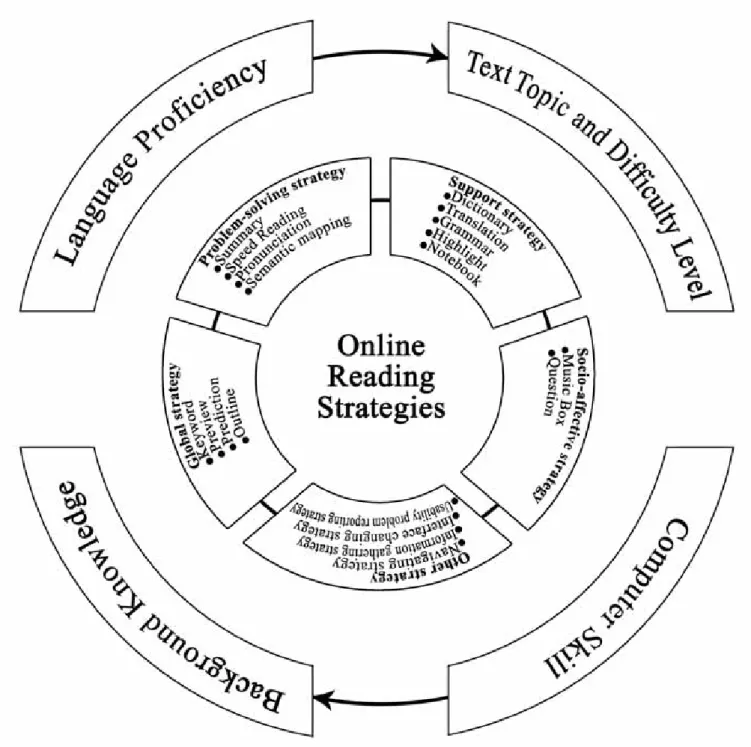
The online reading strategy model shown in Figure 24 has been constructed
based on the results of strategy button usage and provides the central framework for
organizing the findings of this study. In Figure 24, the overall strategy types are
depicted in the inner circle, whereas factors influencing strategy use are shown in the
outer circle. First of all, four types of reading strategies (Global, Problem-solving,
Support, and Socio-affective strategies) were the center of investigation on EFL
learners’ online reading patterns. The results of overall strategy patterns used by 30
participants showed that language proficiency influenced strategy use. In addition,
text topic and difficulty level affected strategy use only under the interaction with
language proficiency. Second, further qualitative investigation on four case studies
regarding their online reading strategy use showed that better computer skills
determined their fluent navigation of online reading and facilitated their acquisition of
background knowledge, which in turn contributed to effective online reading strategy
use.
Figure 24. A Model of Online Reading Strategies
The following discussion will first center on online strategy types, followed by
the four factors that influenced strategy use. These factors included language
proficiency and text topic and difficulty level as well as computer skills and
background knowledge.
Online Reading Strategy Types
In light of strategy types depicted in the inner circle of the model (see Figure 24), four pre-defined strategies, which included Global strategies, Problem-solving strategies, Support strategies, and Socio-affective strategies, will be discussed first.
Other strategies yielded by qualitative investigation, including Navigating strategies, Information gathering strategies, Interface changing strategies, and Usability reporting strategies, are the next focus.
Global, Problem-Solving, Support, and Socio-Affective Strategies
An analysis of the pre-defined reading strategy use revealed the following patterns: (1) Support strategies were the single category that made up the overwhelming proportion of the strategy use, (2) Individual strategies under Support strategies (e.g. Translation, Dictionary, and Highlight) were also the most frequently used strategies, (3) Problem-solving strategies were scarcely used, and (4) Support and Problem-solving strategy use differed not only in terms of frequencies, but also in time sequences.
In this study, students used Support strategies much more than any other available strategy. It seems that strategies that serve as basic support mechanisms to aid comprehension such as Dictionary and that require little conceptual processing such as Translation emerge as dominant factors in these students’ strategy choice. As strategies defined in this study are skills and techniques employed by the readers to fulfill reading tasks, it is not surprising to see that strategies that help readers efficiently achieve reading tasks are most widely used.
The finding that Support strategies dominated students’ strategy use corroborates
Shen’s (2003) study that both high and low proficient learners use predominantly
local strategies, especially translation (word-by-word). This study’s findings are also
in agreement with Huang’s study (1999) that local strategies, especially translating,
prevailed in both more or less proficient students’ choices. It seems that learners mainly depend on support mechanisms, such as translating, using dictionaries, or highlighting, to aid comprehension. The reason behind this dominant use of Support strategies leading all students’ strategy use may be due to the convenience and instant feedback that students can have by using them (Mokhtari & Reichard, 2004). For example, Translation, the most frequently used strategy, can easily turn a three-page long article into L1 equivalents within only a few seconds. It appears that support strategy mechanisms shorten the time for decoding the text and are especially helpful to students who are intimidated by the lengthy online articles. In an online reading environment of vast information resources, strategies that can help online readers quickly find, evaluate, use, and communicate information are likely to be widely accepted and adopted (Leu, et al., 2004).
Another possible explanation of the dominant usage of Support strategies is that in a typical Chinese reading class where vocabulary acquisition or reading for details is emphasized (Yeh & Wang, 2004), it is likely to find students constantly employ strategies related to vocabulary learning (Dictionary strategy button) and explanation of each sentence and word (Translation strategy button). The cultural factor of Chinese reading classes may explain the heavy use of Support strategies found in this study.
Despite that the dominant usage of Support strategies is confirmed in the
aforementioned L2 studies, findings of this study contradict a series of studies
completed by Sheorey and Mokhtari (2001) and Mokhtari and Sheorey (2002) on the
identification of metacognitive reading strategies of L2 learners. For example,
Sheorey and Mokhtari’s (2001) study has shown that both native speakers and ESL
learners attribute the same rank order of importance to Problem-solving strategies,
Global strategies, and Support strategies in reading academic texts. One possible
explanation is that reported strategy use found in Sheorey and Mokhtari’s (2001) study does not necessarily translate into actual usage of the strategies concerned in this study. Using questionnaires to collect students’ strategy use data in Sheorey and Mokhtari’s (2001) study may be different from utilizing a web-based reading program (English Reading Online) with built-in strategy functions to investigate the actual online strategy patterns in this study. Another possible explanation is that different instructional settings, such as an ESL environment in Sheorey and Mokhtari’s (2001) versus an EFL environment in this study, may contribute to the differences of strategy use.
Looking closely into each individual strategy button, it was found that the three most frequently used strategies all belonged to the category of Support strategies. For example, Translation, one of the Support strategy mechanisms, was mostly favored and most frequently used. In light of its heavy use, it is worthwhile to question if the convenience of translators can really help students arrive at the meaning. Also, special attention should be addressed to the abuses of meaning technologies, defined as tools that are based on technology and make the meaning of language items accessible on demand (Hubbard, 2004). The pedagogical implication will be discussed in detail later.
In addition to Translation, Dictionary was also a frequently used Support reading
strategy among the 15 strategy buttons. This finding is consistent with L2 reading
research that vocabulary is perceived to be the most difficult part among EFL learners
and thus looking up new words in the dictionaries is the most frequently employed
strategies when encountering difficulties (Cheng, 1998; Chi & Chern, 1989). This is
especially true for students with limited proficiency in a technical/vocational school
setting in Taiwan (Lin, 1996; Yang et al., 1994). Additionally, in a web-based reading
environment, L2 readers often seek help from annotations to compensate for their
challenged language proficiency (Chun, 2001; Ercetin, 2003). The possible explanation is that students feel frustrated about reading something incomprehensible;
therefore, the natural inclination for students is to stop reading and resort to dictionaries for help. However, one thing worthy of our attention is that it is equally frustrating to consult dictionaries for every unknown word because the act of looking up words would interrupt reading (Hubbard, 2000, 2004). The pedagogical implication is that students need to learn to strike a balance between reading for the gist and reading for improving vocabulary during the process of reading.
Highlight, a device of taking notes on unknown words, was another commonly used strategy. One interpretation for the frequent use of Highlight strategy is that users tended to lose track of what they read and they needed to conquer the fear of losing the information (Mokhtari & Sheorey, 2002; O’Malley & Chamot, 1990; Oxford, 1990). Taking down notes is a safety measure that ensures retention and stability of information. In addition, the heavy use of Highlight may be due to the traditionally teacher-centered reading classes where students have cultivated the habits of taking down notes of what is said (Yeh & Wang, 2004). Students in this study seem to transfer the act of taking notes of teachers’ lectures in class into the scenario of reading on their own.
In contrast with the dominant use of Support strategies (62.32%), the least used
strategy was Problem-solving strategies (7.18%), which included the bottom three
strategies—Semantic Mapping, Pronunciation, and Speed Reading. Participants in
this study failed to apply focused techniques, such as adopting audio aids, visualizing
information that had been read, and adjusting reading rates to solve reading
comprehension problems. The rare use Problem-solving strategies might be because
the efforts involved in directly dealing with the text such as drawing semantic maps,
reading aloud, and testing reading speed may be more demanding than those related to
support mechanisms such as consulting dictionaries and translating into L1. In an online reading environment where immediacy and speed are online users’ primary concerns (Chapelle, 2005; Hubbard, 2004; Leu et al., 2004), it may appear reasonable that Problem-solving strategies were least adopted in this study.
This finding regarding the scarce use of Problem-solving strategies is inconsistent with Anderson’s (2003) study which finds that among the 38 online reading strategies stated in the questionnaire, the top 12 strategies are mostly Problem-solving strategies. It also contradicts Sheorey and Mokhtari’s study (2001) on self-reported reading strategies where Problem-solving strategies are mostly favored by ESL and native speaking students. One possible explanation is that different data collection tools may bring about different results of strategy use.
Self-reported strategy data in previous studies such as Sheorey and Mokhtari’s and Anderson’s (2003) may differ from students’ actual online behaviors found in this study. Besides, the under-use of Problem-solving strategies observed in the current study may suggest that students would rather rely on single criteria for textual understanding, i.e., understanding of individual words by using Translation and Dictionary, than work directly with the text, i.e., re-examining the text via Semantic Mapping and re-reading for better comprehension via Pronunciation.
The differences between Support strategies and Problem-solving strategies can
be found not only in their frequencies of strategy use, but also in the sequences of
their strategy use. Support strategies, which were used most frequently, were also
employed prior to the least-used Problem-solving strategies. According to strategy
sequence analyses and the questionnaire results on strategy preference, Support
strategies were the most frequently used, were most favored, and were first used
strategies. Frequency of strategy use is positively related to sequence. This finding on
time sequence sheds additional light on online reading strategy use. Frequency and
time sequence of strategy use seem to go hand in hand in determining readers’ choice of reading strategies. Strategy use is not only a matter of “what;” “when” to use strategies is equally important (Anderson, 1991).
In summary, Support strategies, with features of instant feedback and quick reference, dominate strategy use. The most frequently used individual strategy buttons, like Translation, Dictionary, and Highlight, also belong to Support strategies.
Problem-solving strategies that require direct attention to work with textual information are scarcely used. The stunning differences of Support and Problem-solving strategy use found in both frequencies of strategy use and strategy use sequences may suggest that readers’ choices of strategy use are affected by their needs for immediate feedback in an online reading environment.
This section has discussed the use of Support strategies and Problem-solving strategies. The next section will discuss other strategies emerging from case studies.
The effects of Global and Socio-affective strategy use among different proficiency groups will be presented later.
Other Strategies: Navigating, Information Gathering, Interface Changing, and Usability Problem Reporting Strategies
Aside from the four pre-defined strategy types (Global, Problem-solving, Support, and Socio-affective), qualitative investigation into these four chosen participants yielded four additional strategy types, labeled as “Other strategies,”
including Navigating strategies, Information gathering strategies, Interface changing strategies, and Usability problem reporting strategies as shown in Figure 24. These strategies were unique assets in assisting readers in approaching online texts.
For example, Navigating strategies helped readers navigate online texts smoothly
by moving between pages patiently, connecting pictures with the text, adjusting
scrolling range, switching between windows, and moving the cursor along the words.
These strategies helped readers successfully access online texts where chunks of information were linked multi-sequentially (Konishi, 2003; McNabb, 2006; Rouet et al., 1996).
Information gathering strategies allowed readers to critically evaluate information on a Web page, monitor their pathways, and reduce the chance of becoming disoriented amid the irrelevant information (Coiro, 2005; Shetzer &
Warschauer, 2000). With the tactics of using special keywords to search websites, readers had a better chance finding information they wanted and engaging themselves in the Internet text with deeper understanding. One interesting phenomenon was that these types of strategies were mostly adopted by more experienced computer users because prior knowledge of hypertext structures brought by better computer skills helped them know the way around while reading online texts (Aleksander, 2001).
Interface changing strategies, on the other hand, assisted readers in building up a pleasant reading environment for their own preference. By loading the software they were familiar with and using the browser they were accustomed to, readers made their online reading experience more comfortable and in turn increased their motivation for reading (Guthrie & Wigfield, 2000; O’Mally & Chamot, 1990; Oxford, 1990).
Usability problem reporting strategies provided readers a gateway to let out their complaints about ill-designed websites and to express their needs for a more user-friendly web design. The occurrence of Usability problem reporting strategies also confirmed previous usability research that usability problems, such as non-adjustable font sizes, flashy pop-up advertisements, disorganized links, and overly literal search engines could affect reading performance (Nielsen, 1994, 1997;
Nielsen & Morkes, 1997). These strategies have reminded web designers to improve
ease-of-use during the design process (Elshair, 2002). Aside from the unique
contribution to web navigation, the use of the above four additional strategies were
influenced more by students’ computer skills and background knowledge than by proficiency levels.
The above section discussed the major strategy patterns. The following sections will discuss factors influencing strategy use, including language proficiency, the text topic and difficulty level, computer skill, and background knowledge.
Language Proficiency
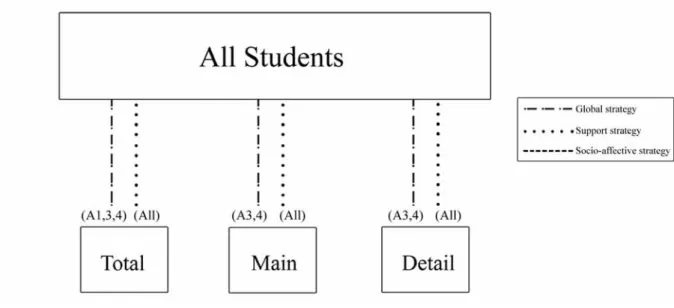
Elements influencing online reading strategy use are depicted in the outer layers of the circle in Figure 24. The first factor, language proficiency, accounted for differences in strategy use. The differences were: (1) Strategy types varied with language proficiency, with the High proficiency group tending to use Global strategies, whereas the Low proficiency group resorting to Socio-affective strategies. (2) Sequences of strategy use differed with language proficiency, with the High group using strategies more effectively than the Low group. (3) Purposes for using Support strategies differed with language proficiency, with the High proficiency group using strategies more appropriately.
First of all, data concerning distribution of strategy use for the High and the Low
proficiency groups in this study show that language proficiency influenced strategy
use. Overall, the High proficiency group used more Global strategies than the Low
proficiency group, whereas the Low proficiency group used more Socio-affective
strategies than the High proficiency group. When further investigation was carried out
to determine if students with different proficiency levels used different strategies in
reading easy and difficult texts, similar tendencies were found—the High proficiency
group tended to use more Global strategies but less Socio-affective strategies than the
Low proficiency group. The High proficiency group disliked to use Socio-affective
strategies, especially when they were reading difficult texts. Additionally, the High
proficiency group used Keyword, Prediction, Preview, and Outline more frequently
than the Low proficiency group. It appears that these Global strategies give the High proficiency group a general understanding of the text prior to actual reading and therefore a careful preparation of what to read next. In contrast, the Low proficiency group tended to use Socio-affective mechanism like Music Box and Chatroom more often than the High proficiency group. It appears that less proficient readers like to use music to lower their anxiety and used Chatroom to engage themselves in communication with peers.
Similar to the overall findings on the total participants, in general, the four case studies also show that James and Chris, both from the High proficiency group used comparatively more Global strategies than Amber and Tim, both from the Low proficiency group. On the other hand, the use of Socio-affective strategies like Chatroom and Music Box was more important to the Low proficiency group than to the High proficiency group. For example, the use of Chatroom was found among the Low group students, such as Amber and Tim. However, the act of logging onto chatrooms was virtually absent for James, a student from the High group. James, with his own confidence in language, read text directly without discussing with peers.
Amber and Tim, on the other hand, heavily relied on chatroom in the process of
reading. To Amber, her major confidence and interest in continuing to read the text
was from her discussion with classmates. Likewise, the strategy of listening to music
was used by Amber and Tim, but was not utilized by James. It seems that music
released the tension in these two low EFL proficiency learners. In conclusion, the
chatroom’s capabilities in bringing global peers together in brainstorming ideas and in
creating a socially supportive environment (Beauvois, 1997; Chun, 1994; Warschauer,
1996) and healing power of music to relieve tension (Oxford, 1990) seem to be most
appreciated by low achievers. High achievers, on the other hand, would rather adopt
careful mental planning and monitoring of their reading than interact with others.
The findings of this study showed students with different proficiency levels used different strategies. This confirms previous research on comprehension strategies which shows that readers’ proficiency influences strategy use (Block, 1986, 1992), with the High proficiency group using more global/top-down strategies than the Low proficiency group (Huang, 1999; Shen, 2003; Mokhtari & Reichard, 2002). The employment of reading strategies can differentiate good readers from poor ones. For example, this study found more Global strategy use among higher proficient students.
This finding is similar to Huang’s (1999) study which shows that more proficient readers use more top-down strategies, whereas less proficient readers use more bottom-up strategies. This also corroborates Mokhtari and Reichard’s (2002) research which states that readers who rate themselves as good readers have a significantly higher use of global reading strategies than those who rate themselves as poor readers.
In addition, this study also found that the High proficiency group displayed more Global strategy use in approaching difficult texts. This is consistent with Shen’s (2003) study where in reading more challenging texts, the high proficiency students use more global strategies, while low proficiency students use more local strategies. In short, the use of Global strategies among more proficient readers is confirmed both in this study and the literature.
However, subtle differences exist between global-local distinctions about the High and the Low proficiency groups in previous studies and global-socio/affective variations in this study. Unlike previous studies that reveal the Low group’s predominant use of local strategies, this study has shown that the High group and the Low group appeared to use the same amount of so-called local strategies
1, and the
1