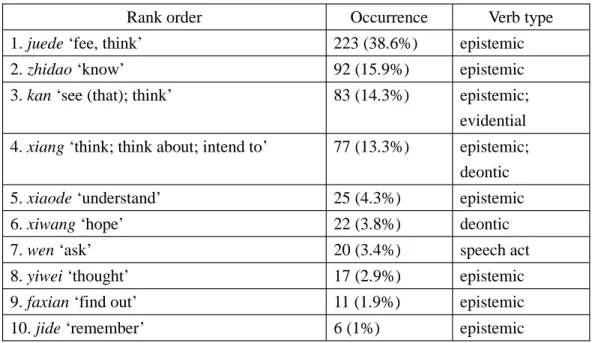
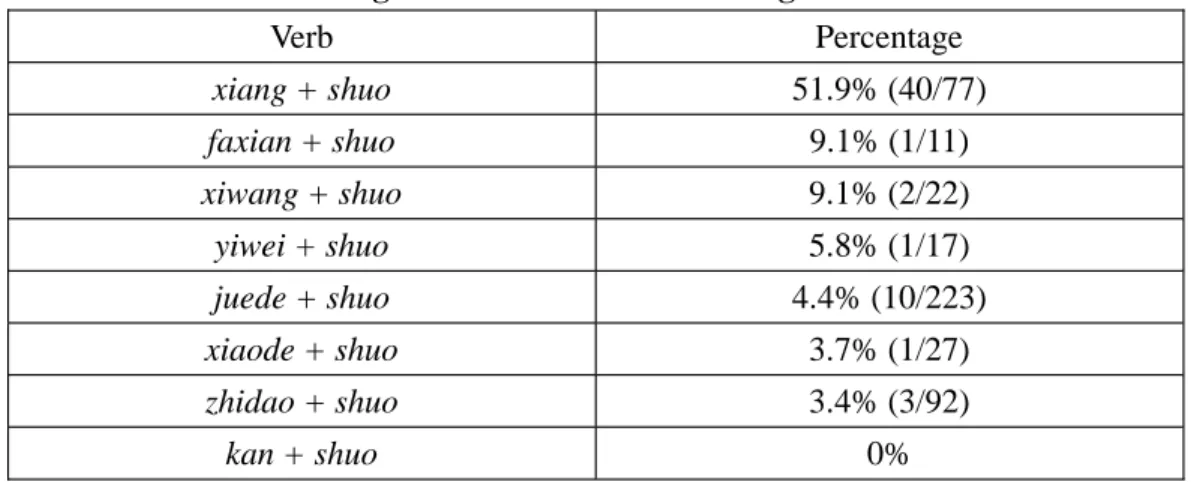
Chapter Two Literature Review
In this chapter, we will first focus on how past studies view the roles of complementizers in English. Secondly, we will discuss on how complementizers are grammaticalized from verbs of saying in different languages. Then, we will proceed to review how the verb of saying shuo in Chinese grammaticalizes into a complementizer.
2.1 Complementizers in English
Previous researchers have attempted to account for how complementizers in English are used from both the structural and functional perspectives.
2.1.1 The Structural Approach
Generative grammarians attempt to explain how complementizers in English are manifested in a sentence structure. While the earlier structural linguists argued for the transformational approach in analyzing the status of complementizers, the later linguists argued for the base-generated approach.
2.1.1.1 The Traditional Transformational Account
The earlier generative grammarians (Lakoff 1965, Kajita 1967) maintain that complementizers are neither syntactically significant nor semantically substantial. In terms of the syntactic role, the presence of a complementizer results from a transformational rule of insertion. That is, complementizers are not distinguishable in the underlying structure; instead, it is inserted into the underlying structure through transformation. For example, the following three sentences all derive from the same underlying structure (4) (see Bresnan 1970:297).
(1) It may distress John for Mary to see his relatives.
(2) It may distress John that Mary sees his relatives.
(3) Mary’s seeing his relatives may distress John.
(4) S
NP M VP
N S V NP
It Mary sees his relatives may distress John
In the underlying structure (4), complementizers are not specified. Then, through the transformation of insertion, a specific complementizer should be selected to insert into the underlying structure as shown in (5). The selection of a specific complementizer is determined by the higher predicate, which is termed as a “rule feature” [+ R] (Lakoff 1965).1
(5)
S
NP M VP
N S V NP
It for-to may distress John [+R]
Mary sees his relatives
1 If the transformation introduces for-to is ruled as [+R], then another transformation introducing that should be viewed as [-R].
After the procedure of “rule feature” is completed, movement can then be performed as we can see in (6) and a sentence containing a complement and a complementizer is thus formed.
(6)
S
NP M VP S
N V NP for-to
Mary sees his relatives It may distress John
[+R]
However, the above claim would be confronted with two counter-arguments First of all, the proposal that complementizers are inserted into the underlying structure counters Chomsky’s (1965:146) claim that no transformational insertion of morphological materials can be performed within an embedded sentence. Moreover, this perspective maintains that complementizers serve only grammatical/functional purposes, are determined by the predicate verbs and have no semantic value themselves. Nonetheless, if this is indeed the case, this approach then fails to account for the differences among grammatical sentences (1), (2) and (3) which all have the same predicate verb “distress” (supposedly the same rule feature) but contain different complementizers.
2.1.1.2 Complementizers as Based-Generated
In order to improve the traditional transformational account on complementizers, Bresnan (1970) proposes that the presence of complementizers is not a result of
transformation but that of “the phrase-structure hypothesis” and that complementizers actually have semantic value. By the phrase-structure hypothesis, Bresnan maintains that there should be a node COMP which distinguishes complementizers in the underlying structure. This phrase-structure rule looks as:
(7) S’ COMP S
With this phrase-structure rule, the transformations of insertion and movement are no longer needed and thus Chomsky’s claim that universally any insertion into the embedded clause is not permitted can be observed. As the illustration of this phrase-structure rule, the underlying structure of (1) would be revised into (8).
(8)
S
NP M VP
S’
N V NP COMP S
It may distress John for Mary sees his relatives
On the other hand, Bresnan proposes that transformational rules and rule features are not able to account for the differences among the complementizers in the following sentences while verb subcategorization can (1970:304).
(9) That he eats cabbage means nothing.
(10) This means that he is of low birth.
(11) * This means for him to eat cabbage.
(12) That he eats cabbage means that he is of low birth.
(13) For him to eat cabbage means nothing.
= It means nothing for him to eat cabbage.
(14) * For him to eat cabbage means that he is of low birth.
Examples (9)-(12) show that the that-complement can occur both as a subject and as an object whereas the for-to complement cannot function as an object, and examples (12)-(14) show that that that-complement can occur as an object while for-to can never occur in the subject position. Therefore, Bresnan contends that the traditional transformational rules or rule features cannot explain why some sentences with a particular complementizer are well-formed while some are not. Also, she proposes that if COMP is a node in the underlying structure, these complementizers would be selected via subcategorization of verbs.
Bresnan furthermore points out that complementizers are not semantically empty as argued by traditional transformationalists. The strongest evidence is that WH words are also complementizers as illustrated by the following comparison between (15) and (16) (1970:302).
(15) He doesn’t care that she is a doctor.
(16) He doesn’t care whether/if she is a doctor.
If complementizers are indeed semantically empty as suggested by the traditional transformational grammarians, there should be no difference between (15) and (16) in terms of their sentence meanings. Yet, these two sentences carry very different meanings, and the meaning difference obviously results from the difference choice of complementizers that or if/whether.
Bresnan has featured her study by proposing that complementizers are base-generated and are thus semantically significant. Unlike the traditional transformational grammarians, Bresnan attended to the semantic aspects of
complementizers and she also foreshadowed the significance of semantic studies of complementizer functions.
2.1.2 Semantic Features of Complementizers
While early generative studies concentrate more on the role of complementizers in the syntactic structure, linguists later attempt to take semantics into account when trying to explain why one rather than another complementizer is employed in the complementation structure.
Bresnan (1972), for example, elaborates the distinction between that-complement and for-to complement by claiming that the semantics of that-complement is associated with definiteness while for-to complement is related to subjectivity, intention and motivation. She claims that that-complement serves the function of “definitizing” the complement. This function can be clearly manifested in the comparison of the following examples (1972:70):
(17) a. It has already been decided whether you can go – but I can’t tell you the outcome.
b. It has already been decided that you can go – *but I can’t tell you the outcome.
The difference between (17a) and (17b) lies in the definiteness of that-complement in (17b), which entails that the proposition contained in that-complement has already been established and cannot be rejected. However, the WH-complement in (17a) yields an interpretation of probability of the complement proposition. Therefore, it is still possible to negate the WH-complement. Moreover, the definiteness or specificity carried in that-complement can also be shown in the comparison between that-complement and for-to complement as illustrated below (1970:76-77):
(18) a. ?John made one proposal after another that funds be raised.
b. John made one proposal after another for funds to be raised.
(19) a. ?We ignored his repeated plea that we help him.
b. We ignored his repeated plea for us to help him.
Bresnan maintains that the unacceptability of (18a) and (19a) results from the incompatibility between the specificity carried in that-complement and the indefinite apposition “one proposal after another.” However, for-to complement does not provide a specific description, which allows indefinite co-reference.
Furthermore, the distinction between that-complement and for-to complement can also be shown in terms of factivity. The definiteness carried in that-complement renders it a presupposition that the complement has been realized; on the other hand, for-to complement does not preserve such a presupposition as shown in (20) (1970:85):
(20) a. I would be surprised that she said that (if I hadn’t heard it already).
b. I would be surprised for her to have said that.
In summary, that-complement is used to signal definiteness and factivity whereas for-to complement does not function in the same way.
In discussing the semantics of for-to complement, Bresnan draws attention to the inherent meaning of the word for. The inherent meaning of for is to express
“subjective reason or cause” (1972:81) as we can see below (1972:80):
(21) a. He considers her a fool for her generosity.
b. He considers her a fool for being so generous to him c. He considers it foolish for her to help him.
Examples (21a) and (21b) both show the reasons why “she” is considered a fool and the reason is presented with the word for. Furthermore, the reason presented with for
also carries the speaker’s subjective judgment and motivation/intention to assert this claim. Thus, for-to complement is more likely to be compatible with predicates which signal subjective judgments or emotive reactions as exemplified in (22) and it is usually incompatible with predicates which mark objective knowledge as exemplified in (23) (1972:84).
(22) It is right for God to punish sinners.
It is wrong for there to be such inequalities.
It is illegal for these houses to be occupied.
I consider it unfair for them to win all the time.
(23) * It is true for God to exist.
* It is false for there to be only finitely many primes.
* It is clear for these houses to be occupied.
To summarize, Bresnan (1972) has pointed out that semantic factors including definiteness, factivity, cause/reason, motivation and subjectivity should be taken into account in differentiating that-complement from for-to complement2.
Along a similar line, Noonan (1985) attributes the difference to two factors: the dependence/independence of time reference of the complement and the state/action distinction of the complement. First of all, he proposes that infinitival complementizer (for-)to is usually associated with the so-called dependent time reference (DTR) contexts while indicative complementizer that with independent time reference (ITR).
That is, the time reference of that-complement does not have to agree with that of the matrix clause whereas the time reference of infinitival (for-)to complements is bound to that of the matrix clause as we can see below:
2 Bresnan (1972) also discusses the difference of WH-complements from that-complements and for-to complement.
(24) I don’t believe that Floyd skipped town.
I don’t believe that Floyd is skipping town.
I don’t believe that Floyd will skip town. (1985:97) (25) I believe Zeke to be an idiot. (1985:101)
The time reference of that-complement clauses as shown in (24) is not controlled by the matrix clause. However, in (25), there is only one interpretation of the time reference of the (for-)to complement. Namely, the time reference of “Zeke to be an idiot” must be identical with that of the predicate verb “believe.”
The other semantic difference between complementizers that and (for-)to lies in the interpretation of state or activity. Noonan maintains that given the same predicate, that-complement carries the interpretation of state while (for-)to complement yield the interpretation of activity as shown in (26)-a & (27)-a and (26)-b & (27)-b respectively.
(26) a. Floyd remembered that he was a nice boy. (state) b. Floyd remembered to be a nice boy. (activity) (27) a. Max convinced Floyd that he was a nice boy. (state)
b. Max convinced Floyd to be a nice boy. (activity)
In summary, Noonan (1985) also focuses on the semantic differences between complementizer that and complementizer for-to by attributing to the semantic factors of time reference and the interpretation of state/activity.
2.1.3 Functional Domains of Complementizers: De dicto vs. De re
In the same attempt to further probe into the semantic differences among different complementizers, Frajzyngier proposes the notions of de dicto and de re (Frajzyngier 1991, 1995, Frajzyngier and Jasperson 1991).
First, Frajzyngier explains how the notions de dicto and de re are defined. The concept of de dicto refers to the semantic domain in which the reference of the proposition is made to the speech world, while that of de re refers to the domain of
reality.
A clause is in the domain de dicto only when it is presented to the hearer as such, i.e., not as a direct description of an event but rather as a fragment of speech, or a fragment of linguistic representation which may contain a description of an event.
Thus a proposition is in the domain de dicto when it has a metalinguistic function, viz., when it is presented as an object of discourse (1991:136).
With the distinction made between de dicto and de re, Frajzyngier and Jasperson go on to argue that complementizer that marks the domain of de dicto while complementizers -ing and (for)-to belong to the domain of de re. They propose two arguments to support that complementizer that marks the de dicto domain. Firstly, a language that has a complementizer deriving from a demonstrative usually marks the non-deontic (epistemic) complements of verbs of saying and thinking as shown in the following example (Frajzyngier and Jasperson 1991:137, Frajzyngier 1991:225)3.
(28) Harold claimed that the apartment wasn’t clean.
(Frajzyngier and Jasperson 1991:137)
In (28), it can be observed that the complement “the apartment wasn’t clean” should not be referred to any fact in the real world where the apartment was truly not clean, but to an epistemic judgment deriving from the verb of saying “claim.” This verb of saying claim creates the speech world. Therefore, when that-complement follows verbs of saying and thinking which yield the world of speech, the referent of that-complement belongs to the domain of de dicto.
Secondly, when that is used alone as a demonstrative pronoun without any following complement, it marks the reference to belong to the domain of speech as
3 Supporting Frajzyngier’s proposal, Suzuki (2000) points out that Japanese complementizers deriving from demonstratives such as to tend to function as de dicto complementizers since this type of complementizers are used to mark the complements of verbs of saying and thinking whereas other complementizers like koto or no mark the domain of de re.
shown in the comparison between (29) and (30) (1991:137).
(29) I don’t believe that.
(30) I don’t believe this.
Demonstrative pronoun that in (29) refers to a proposition expressed in the previous utterance while this in (30) refers to something here and now. Things occurring here and now are usually visible and real. For example, a person may say (29) when referring to a statement he or she has heard previously, while a person may use (30) to refer to something he or she just sees. In sum, it can be concluded that complementizer that indeed functions to mark a domain of speech.
Furthermore, Frajzyngier (1991) points out one more characteristic of de dicto complementizers. De dicto complementizers tend to indicate indirect evidence. Since de dicto complementizers usually co-occur with verbs of saying, they would also carry the intrinsic epistemic value of verbs of saying; that is, the information obtained from speech is not as reliable as that obtained from the direct perception. Therefore, the de dicto complementizers usually function to signal less reliable information value4.
Complementizer that differs from gerund complementizer -ing and infinitival complementizer (for-)to in that the latter two signal that the complement belongs to the domain of reality. Frajzyngier and Jasperson maintain that gerund complementizer -ing marks the complement to carry an interpretation of actuality while infinitival (for-)to, that of potentiality. The following two examples illustrate the difference between that-complement and -ing complement.
(31) His eating broccoli was reported by the campus press.
4 In some languages, as Frajzyngier (1991) has proven, a sentence without such a complementizer denotes direct evidence whereas a sentence with a complementizer signals indirect evidence.
(32) That he eats broccoli was reported by the campus press. (1991:142)
When the verb report takes different complements, different interpretations would be yielded. The -ing complement in (31) creates a factive meaning and refers to the event itself. On the other hand, if the event is marked by that-complement, what is being reported is the news about the event instead of the specific event itself. Therefore, what distinguishes -ing complement from that-complement is that the former signals an actual event while the latter marks a reported event.
Frajzyngier contends that the difference between that-complement and (for-)to complement can be attributed to potentiality. The potentiality marked by infinitival to-complement means that the complement belong to the world of reality though the fact is not yet present but forthcoming, whereas the expressed proposition marked by that-complement shows that the complement is in the domain of speech, as illustrated in (33) and (34):
(33) He believes Bacon to be the real author.
(34) He believes that Bacon is the real author. (1991:143)
The infinitival to in example (33) indicates the futurity of the complement event; that is, it expresses the subject’s belief that a certain potential affair is going to happen. On the other hand, that-complement in example (34) expresses the subject’s belief about a certain proposition.
A conclusion can thus be drawn from the previous examples. That is, the semantic differences among different complementizers do not result from the predicate verbs such as report or believe, but from the use of different complementizers, which mark the complements to belong to either the de dicto domain or the de re domain.
2.1.4 Complementizer that in Discourse
Thompson adopts the approach of discourse analysis to conduct a series of studies to examine the omission of complementizer that (Thompson and Mulac 1991-a, 1991-b). She also argues that the matrix clauses of that-clause complement should be deemed as an epistemic formulaic expression (Thompson 2002).
Thompson and Mulac (1991-a, 1991-b) investigate how discourse factors condition the omission of English complementizer that. Although previous works maintained that the presence or the absence of complementizer that does not render any grammatical difference5, Thompson and Mulac propose that the presence and the absence of complementizer that are actually conditioned by discourse factors and should be deemed different. First, the use of personal pronoun plays a significant role in determining the omission of complementizer that. Their studies prove that complementizer that is likely to be omitted when the subject is the first person I (90%) or the second person you (91%), as illustrated in the following example.
(35) So what do you think you’re going to major in now that you’re down here?
(Thompson and Mulac 1991-a:244)
The use of the first person and the second person subjects gives rise to the speaker ’s commitment and subjective evaluation. That is to say, the main clause behaves like an epistemic phrase. As exemplified in (35), the main clause “what do you think” in nature functions to express the speaker’s invitational attitude instead of uttering any substantial proposition. It is the invitational attitude that makes the main clause an epistemic phrase.
Furthermore, the subject of the complement clause also plays a role in
5 Noonan (1985) claims that the following two sentences should be deemed exactly identical:
(i) Perry knows that Hugh is vulnerable.
(ii) Perry knows Hugh is vulnerable. (Noonan 1985:45)
determining the omission of complementizer that. When the subject of the complement clause is a pronoun, the complement clause holds more discourse topicality, so the omission of complementizer that is more likely. In contrast, when the subject of the complement clause is a full NP, the complement clause would be less topical. So, it is more likely that the main clause is treated as a unitary epistemic phrase and that is thus retained.
Secondly, Thompson and Mulac claim that complementizer that tends to be omitted when the main verbs are cognition verbs expressing epistemicity such as think or guess. When these two verbs are employed, the matrix clauses are meant to illustrate strong epistemicity because the semantics of these two verbs involve more subjective evaluation. Thus, if the matrix clause contains either one of these two verbs, the matrix clause mostly functions like an epistemic phrase and therefore complementizer that tends to be omitted as exemplified below.
(36) I think it’s going to rain, isn’t it? (Thompson and Mulac 1991-a:239)
As the matrix clause “I think” mainly aims to convey the speaker’s subjective evaluation, the main clause serves as an epistemic unit to lead in the following complement clause in which complementizer that is omitted.
Moreover, the occurrence of auxiliaries, indirect objects and adverbs in main clauses also has a lot to do with the occurrence of complementizer that. These variables can add more information value to the matrix clause and thus render the matrix clause less like an epistemic phrase. Therefore, complementizer that tends to be present in order to serve as a boundary between the information-loaded matrix clause and the complement clause. In the following examples, complementizer that is used to set a border between the non-epistemic-unit matrix clause and the complement clause.
(37) …people who should know you know that you don’t just walk down the street and shake hands with them.
(38) I wanted to show her that I … she got the points.
(39) I just figured out that I’d walk to class at that time, just stay in the library…
(Thompson and Mulac 1991-a:246-247)
Thompson (2002) further examines more spoken data and attributes the strong tendency of complementizer-that omission to the semantics of the predicate verbs.
She reports that most of the matrix clauses in spoken data function as epistemic formulaic units in that their matrix predicates carry epistemic interpretation. Most of these matrix predicates fall into three categories: epistemic complement-taking predicates such as believe, feel or think, evidential complement-taking predicates like find, tell or can tell and evaluative complement-taking predicates like be (be) glad, like it or (doesn’t) matter. Thompson argues that in a conversation what really matters is the proposition uttered in the complement clause instead of the epistemic matrix clause. In other words, the real function of the matrix clause is to express the subjective attitude toward the proposition manifested in the complement clause.
Thompson’s claim can be further supported by the finding that most of the subjects in the matrix clauses are either the first person I or the second person you, who are the primary interlocutors in the conversation. As the matrix subjects correspond with the interlocutors, the matrix clauses are more likely to function to convey the subjective attitude, evaluation or judgment. As there is no strong need to mark the information boundary when the matrix clause serves as an epistemic unit, complementizer that is thus omitted.
What features Thompson and Mulac’s research and Thompson’s study is their concern about discoursal factors: the epistemicity and the topicality of the main clause
which function as the determining factors in the omission of English complementizer that.
2.2 Saying Verbs as Complementizers
It has been documented that complementizers in a number of languages derive from verbs of saying (Lord 1976, Jacobsen 1986, Ransom 1988, Saxena 1988, Klamer 2000)6. Lord (1976) investigates how a verb of saying evolves into a complementizer or subordinator in Kwa. She reports that when a verb of saying undergoes grammaticalization, the content meaning of the verb would be bleached before it becomes a grammatical morpheme to mark the relationship between clauses. Jacobsen (1986) points out that Basque, a language spoken in west Europe, has an evidential marker omen deriving from a hearsay verb. In addition to functioning as a complementizer, omen can also be used as an impersonal quotative or be used to signal general inferenced meanings from indirect evidence such as “reportedly,” “as they say” or “it seems,” as illustrated in the following example (1986:7)7:
(40) etorri omen da
“He is said to have come” or “He seems to have come”
Saxena (1988) also examines different grammaticalized functions of verbs of saying. In the investigation on a number of South Asian languages and Tibeto-Burman languages, she concludes with three historical stages of the development of the grammaticalized functions of verbs of saying. At the first stage, the verbs of saying
6 Ransom (1988) investigates the issue that to what extent the current meanings of complementizers in different languages are correlated with their lexical sources and their particular stage of development.
The lexical sources can be divided into three types: full lexical content words such as nouns or verbs (be “say” in Ewe), lexical function words such as determiners or pronouns (that in English) and bound forms with abstract functions such as mood-like clitics (-ela in Basque).
7 Aksu-Koc and Slobin (1986) observes that in Turkish, -mIs, which derives from a verb of saying contains basic functions to convey both inference and hearsay. That is, -mIs can be used to indicate that the asserted event is outside of the speaker ’s direct observation; rather, the information is obtained through inferencing through indirect evidence.
(such as bhanera in the following example) function as a quotative linker to associate the complement with the matrix clause, as exemplified in the following sentence of one South Asian languages -- Newari (1988:376).
(41) ram-le saroj calak cha bhanera bhay-o Ram-ERG Saroj intelligent is say-PART say-PD
“Ram said that Saroj is intelligent.”
At the second stage, the verbs of saying can be employed not only as a complementizer but also as a linker between the adverbial clause and the matrix clause. To be more specific, these verbs of saying can perform the functions as purpose conjunctions, causal conjunctions or conditional conjunctions, as shown in (42), (43) and (44) respectively. (1988:379-382)
(42) Purpose conjunction
ji kamala yato napal-e dha-k-a-a woy-a I Kamala DAT meet-NAP say-CAUSE-PART-NF come-PD
“I came to meet Kamala.”
(43) Causal conjunction
chi-pi- cho-mho murkho kho chae-dha-e-sa tho dhorohora mo-khu you-PI one-CL fools are why-say-INF-if this tower NEG-is
“One of you is a fool because this is not a tower.”
(44) Conditional conjunction
cho ji-to kapi byu-sa dha-k-a-a ji ch-to kalam by-i you I-DAT copy give-COND say-CAUSE-PART-NF I you-DAT-pen give-PD
“If you will give me a copy then I will give you a pen.”
When the verbs of saying have evolved into Stage III, they can then serve as comparative markers between two noun phrases.
To conclude her examination on the South Asian languages and Tibeto-Burman languages, Saxena (1988) maintains that most of the verbs of saying can grammaticalize into a complementizer which also serves as a quotative linker, a
causal conjunction, a purpose conjunction, a conditional conjunction or a comparative marker. Her proposal of the historical sequence for the grammaticalization path of the verbs of saying paves the way for further examination of the evolution of verbs of saying in other languages.
2.3 Previous Works on Shuo in Chinese
2.3.1 Shuo as a Main Verb of Saying
In most of the Chinese dictionaries, shuo is deemed as a typical verb of saying because its content meaning is to signal an act of speech. In what follows, we will examine four studies which focus on the content meaning of shuo: Lu (1980), Meng (1982), Liu (1983) and Lin (1998, 2004).
2.3.1.1 Lu’s (1980) Account
Lu (1980) argues that shuo, when used as a verb of saying, has two meanings.
The first one is to orally express meanings with words. When this meaning is adopted, shuo can be followed by nouns, verbs, adjective and clauses as shown in the following examples (1980:509-510).
(45) shuo + noun shuo shihua
SHUO truth
“Say the truth.”
(46) shuo + verb wo shuo qu I SHUO go
“I say let’s/I’ll go.”
(47) shuo + adjective
ta shuo tai tian le he SHUO too sweet ASP
“He said it is too sweet.”
(48) shuo + clause
Lao Li shuo Xiao Huang yijing kao shang daxue le old LiSHUO little Huang already test on university ASP
“Mr. Li said Mr. Huang has been admitted to a university.”
The second verbal meaning of shuo is to criticize or to blame. When used with this meaning, shuo can only take noun objects as shown in the examples below (1980:510).
(49) wo yijing shuo guo ta le I already SHUO PER he ASP
“I have blamed him.”
Lu has attempted to explain the polysemous uses of shuo as a verb of saying, claiming that shuo at least has two content meanings. One is to express an act of uttering words and the other is to indicate that the uttered words are meant to criticize.
However, Lu focuses merely on the content meaning of shuo and does not take into interaction into account.
2.3.1.2 Meng’s (1982) Account
Meng (1982) classifies the functions of shuo into seven categories: shuo taking objects, shuo taking no objects, shuo as connectors, shuo as an adverb, shuo used in a prepositional phrase, shuo used to indicate interjection and others.
When shuo is used as a verb, it can take either objects or no objects.8 Meng contends that when shuo takes objects, it is used as a reported speech frame which can be followed by a direct quote or an indirect quote, as shown in the following (1982:337-338).
8 Only the verbal meanings will be presented in this section. Other functions of shuo will be discussed in the following sections.
(50) Direct Quote
suhua shuo e you e bao shan you shan bao sayingSHUO evil have evil revenge kindness have kindness revenge
“It is said that the bad have bad things in return while the good have good things in return”
(51) Indirect Quote
wo shuo wo neng you guoqu ta bu xin I SHUO I can swim over he not believe
“I said I could swim there; he did not believe me.”
When there is no object following shuo, the main function of shuo is either to get the listeners’ attention or to express the speaker’s thought. As shuo serves as an attention getter, the subject co-occurring with shuo is very likely the first person pronoun wo “I”. Moreover, since the phrase wo shuo “I say” functions as an attention getter, there is usually a pause or an interjection like hei which is positioned between the phrase wo shuo and the proposition as exemplified in (8) (1980:339).
(52) Getting Attention
wo shuo [pause] wode nakozi zai jia ne I SHUO [pause] my wife/husband stay home PAT
“I say, is my husband/wife at home?”
When shuo takes no object, it is actually meant to explicitly express the speaker’s thought and is usually preceded by the second person subject nin or ni.
Although the subject is the second person nin or ni, the subject phrase does not aim to elicit the listener’s act of responding an opinion as the form of the sentence superficially manifests. What’s more is that the proposition following shuo is not really what is being said. Instead, shuo serves as a means to strongly assert the speaker’s opinion, as shown below in (9) (1980:339) and ninshuo “you say” actually means “(don’t) you think”.
(53) Asserting the Speaker’s Thought
nin shuo dajia zheyangde bangmang wo, you SHUO everybody like this help I
bu shi wei le gaizheng wode cuowu ma noBE for ASP correct my mistake QUE
“You say, isn’t the reason why everybody helps me like this is to correct my mistakes?”
In summary, Meng reports that shuo may have two main verbal meanings. When followed by an object, shuo usually functions as a reported speech frame. When it is used in conversation and is not followed by an object, it tends to perform more interactional discourse functions such as getting attention with “wo shuo” and expressing the speaker’s thought with “ni shuo.” Meng’s analysis has shown that shuo, when used as a verb, conveys not only the meaning of saying with words but also the meaning of thinking. The meaning extension from a verb of saying to a verb of thinking takes place only in a conversational context. Therefore, the meaning and function extension of shuo in speech interaction deserves more discussion.
2.3.1.3 Liu’s (1983) Account
While Meng (1982) has found that the verb of saying shuo can perform conversational functions, Liu (1983) attempts to probe more into the conversational functions performed by wo shuo “I say” and ni shuo “you say”. Liu proposes that in conversation, wo shuo “I say” performs not only the function of getting attention but also that of making a suggestion and that of asserting the speaker ’s opinion which is different from the other interlocutors, as shown in (54) and (55) respectively (1983:168).
(54) Making a Suggestion
wo shuo zamen dou bie qu le I SHUO we all not go ASP
“I suggest let’s not go there.”
(55) Asserting a Different Opinion
wo shuo zheyang zuo ke bu dui, I SHUO like this do very not correct ni bie wang le ni shi laoshi you not forget ASP you BE teacher
“I say/mean doing something like this is not correct. Don’t forget you are a teacher.”
The conversational functions of ni shuo “you say,” are classified into two types:
inviting listeners’ positive feedback to support the speaker’s thought and asserting the speaker’s thought by sparing no floor for the listener to speak. Firstly, when ni shuo is used to invite listener’s feedback, the speaker’s actual intention is to seek the listener’s agreement. In other words, when shuo is used in this manner, the complement clause following ni shuo is often a question and the desired and typical response is supposed to be “Yes!” as shown in (12).
(56) Inviting Listeners’ Positive Feedback
ni shuo zhe shen yifu wo chuan zhe bu cuo ba you SHUO this body clothes I wear PER not bad PAT
“You say, it is not bad to wear this piece of clothes, right?
Another conversational function performed by ni shuo is to assert the speaker’s thought instead of inviting the listener to offer any response (cf. Meng 1982). When the speaker uses ni shuo in this manner, his/her actual intention is to continue his/her own turn and, therefore, no floor is indeed given to the listener for any feedback. That is to say, this type of conversational function of ni shuo aims to convey the interpretation of wo shuo “I say”. The word choice of ni shuo instead of wo shuo reflects the concern of politeness in face-to-face conversation (Brown and Levinson
1987). Take example (57) for example. Although the speaker says ni shuo “you say”
explicitly, what he is trying to express is actually wo shuo “I say/think.” In other words, the listener of (57) would naturally interpret this sentence into “(The speaker) I want to say/I think how nice a person he is!” Ni is chosen instead of wo because of the speaker’s intention to seek the listener’s agreement with his/her judgment. The speaker does not want to sound self-centered or judgmental in this conversation and therefore chooses to involve the listener as a way to show politeness.
(57) Asserting the Speaker’s Thought
ni shuo ta zhege ren you duo hao, you SHUO he this person have very good
bierende shi ta zhong ji zai xin shang others’ thing he always remember in mind on
“You say, how nice a person he is! He always remembers others’ business.”
Similar to Meng (1982), Liu’s study on the verbal use of shuo also investigates the conversational functions of wo shuo “I say” and ni shuo “you say.” She points out that in conversations, wo shuo can function either to make a suggestion or to assert the speaker’s different opinion, while ni shuo is employed either to invite the listener’s positive feedback or to assert the speaker ’s thought without actually offering the listener a chance to respond. Both Meng and Liu take conversational contexts into account in analyzing the verbal meaning of shuo, and they have found that shuo has not only its literal meaning as orally expressing oneself with words but also different discourse meanings, especially in conversations where interlocutors have to take politeness in interaction into consideration.
2.3.1.4 Lin’s (1998, 2004) Account
Also focusing on the conversational functions of wo shuo and ni shuo, Lin (1998, 2004) examines how interaction between interlocutors trigger these two speech
frames to undergo grammaticalization. First of all, wo shuo and ni shuo can be used as prototypical reported speech frames. Wo shuo, as a reported speech frame, functions to report a speech event occurring in a different context some time ago or to report a prior speech event in the same context as the following example shows (2004:159).
(58) H: ..oh benlai shi shuo yao taida de,-
PAT originally BE SHUO want Taida POSS
<XX>shuo chinghua de ye keyi.\
SHUO Chinghua POSS also do (H)(0.6)ranhou wo jiu shuo,-
then I jiu SHUO
...(0.8)wo shuo,-
I SHUO
<Q..haohaohao.\
okay-okay-okay ..ni zheme luosuo.\
you so long-winded
..wo gei ni yi ge gen ni yiyang xonghang de ren.\Q> (Matchmaking) I give you oneGE with you same tough POSS person
H: ‘Originally, he wanted someone who had graduated from Taiwan University. But then he said graduates from Tsinghua University will also do. Then I said, I said, “Okay okay, since you set up so many stringent requirements, I’ll introduce someone as tough as you are for you.”’
Instead of uttering a here-and-now statement, the utterance following wo shuo is actually meant to refer to a there-and-then statement.
As ni shuo serves as a reported speech frame, the speaker’s actual attempt is to reinforce the credibility of the information and also to seek the listener’s confirmation.
This type of conversational function has also been documented by the previous researchers (Meng 1982, Liu 1986).
Furthermore, Lin proposes that due to the mechanism of simultaneous interaction, the canonical reported speech frames wo shuo and ni shuo can also be employed as
reported thought frames. Due to the publicization effect of the act of saying, an act of saying can actually indicate an expression of making the speaker ’s thought
“publicized” (2004:163). For example, when the speaker senses that the listener might
misunderstand him/her and a clarification is thus needed, the use of wo shuo “I say”
would mean “I mean” as shown in (59) (2004:160). In this example, the first wo shuo functions as a reported speech frame indicating a previous speech event while the second occurrence of wo shuo helps L clarify his meaning so as not to cause J’s misunderstanding. Therefore, the second wo shuo in fact serves as a reported thought frame.
(59) J: …wo shuo I SHUO
.. Kaixi Wulong cha <@ ruguo keyi fang ai dehua Kaixi Wulong tea if able to prevent cancer dehua (if) .. women jia zhende he henduo.\@>
our family really drink a lot L: .. <P deyi fang ai.\P>
able to prevent cancer J: …zhende a
really PAT
L: .. <F meyou la F>
no PAT
.. wo shi shuo I BE SHUO
… ruguo <MRC keyi MRC> dehua if able dehua (if)
J: I say, if Kaixi Wulong tea is able to prevent cancer, we really drink a lot of it.
L: It prevents cancer.
J: Really?
L: No, I mean (I said) if it does.
While wo shuo is intended to provide a clarification of the speaker ’s intention, ni shuo, when used as a reported thought frame, aims to seek a confirmation of the
interlocutor’s intention (2004:171). In the following conversation, T’s use of ni shuo actually means “you mean” instead of “you say” because what T really wants to convey is the meaning of the proposition which needs confirmation rather than the act of speech.
(60) B: ..yaoshi tai dali jiu hui ba ta da xialai if too strength just will ba it hit down T: .. <@zheyangzi a@>
this wayPAT
.. o oh
.. ni shuo nimen hui wangxing you SHUO you will get carried away .. hui yiwei ta shi zhende lankuang
will think it BE real basketball backboard B: If we hit it too hard, it would drop.
T: I see. Oh, you said (you mean) you would get so carried away that you would regard it (the class plate) as a real basketball backboard?
In addition to serving as the reported speech frame and the reported thought frame, wo shuo and ni shuo also derive pragmatic meanings due to the interaction between the speaker and the hearer in conversation. Wo shuo has grammaticalized to be a pragmatic marker of attention getting and a pragmatic marker of self-assertion to hold the speaker’s floor in order to secure the addressee’s attention. Both types of pragmatic functions of shuo have also been documented by Meng (1982) and Liu (1986).
As for ni shuo, when used in conversation, it can function as a concessive conditional marker9, a contrastive marker or a discourse marker of getting attention through metonymy and pragmatic inferencing. The conditional interpretation derives
9 It is believed that the verbs of saying are closely related to conditionals, which according to Lyons (1995) can be used to express a subjective epistemic modality.
from the speaker’s seeming command nishuo “you speak” to the listener to give a comment without giving the addressee a chance to say it (cf. Meng 1982, Liu 1986).
That is to say, both the speaker and the addressee know that the command is not a real command but a hypothetical context in which the listener is not held responsible to be engaged to provide any response. In the following example, the use of (ni) shuo “set a metalinguistic conditional situation for the following statements (2004:173)”
(61) (ni) shuo ta lan, ta dushu you man younggong de, youSHUO he lazy he study yet kind of hardworking POSS
(ni) shuo ta qinlao, ta you changchang toulan.
youSHUO he diligent he yet often get lazy
“(You) say he is lazy, yet he studies quite hard; (you) say he is diligent, yet he fools around a lot”
Along the path of grammaticalization, a concessive conditional marker of ni shuo can evolve to be a pragmatic marker of contrast. It is argued that in the interaction of conversation, the concessive reading is well understood and thus gradually deleted.
Instead of being a conditional marker, ni shuo, while containing a commanding and challenging reading, serves to get the listener’s attention and also to hedge the speaker’s claim. This use is particularly conspicuous when ni shuo co-occurs with contrastive markers such as keshi “but” and qushi “in fact” as shown in (62) (2004:175).
(62) wo zhi chi le shala mianbao I only eat ASP salad bread
ni shuo qishi tang limian ye mei sheme dongxi youSHUO actually soup inside also not have what thing
“(For lunch), I only had salad, bread and you say, in fact, there was not much in the soup.”
Also due to the interactional context, ni shuo has been conventionalized into a
discourse marker of getting attention. It is used to hold the floor and in the meanwhile to get the listener’s attention. It functions just like another typical attention getter ni kan “you see” as we can see in the example (62) (2004:176):
(63) B: ..zhende ne really PAT
.. ni shuo you SHUO
.. ni kan ta lingxian si fen you see he lead four scores .. youmeiyou
have-not-have
“Really! You see, you see, he has been ahead by four scores, hasn’t he?”
Like Meng (1982) and Liu (1986), Lin (1998, 2004) also concentrates on the conversational functions of wo shuo and ni shuo. The synchronic data collected in her studies has shown a grammaticalization path which wo shuo and ni shuo have undergone. Along the grammaticalization path, both wo shuo and ni shuo function originally as reported speech frames, then as reported thought frames and later as pragmatic markers. Lin has put a lot of efforts in qualitative analysis of the grammaticalization path of reported speech frames wo shuo and ni shuo. Along this line, the future studies should pay more attention to both the qualitative and quantitative analysis of the discourse functions of shuo.
2.3.2 Shuo as the Second Verb of a Serial Verb Construction
In addition to the verbal uses, shuo is also used in the serial verb construction and the complementation structure10 in Mandarin Chinese.
10 Chao (1968) has attempted to differentiate complement clauses from adverbial clauses in Mandarin Chinese. He proposed that, unlike adverbial clauses, there is usually no pause or interjection between the matrix clause and the complement clause unless the complement clause is very long as shown in the following example:
(i) women dou yiwei a ta you shi yige ren na le ben xiaoshuo
Li and Thompson (1981) examine the function of shuo as part of the serial verb construction. It is observed that the whole construction serves as an indirect discourse frame because the verbal meaning of shuo indicates that the following verb phrase or clause actually represents something being spoken or reported, as shown in (64), (65) and (66) (1981:602).
(64) ta gaosu wo (shuo) ni tou teng he tell I SHUO you head ache
“S/He told me that you had a headache.”
(65) women wen ta (shuo) Jiefang Lu zai nar we ask he SHUO Liberation Road at where
“We asked him/her where Liberation Road was.”
(66) meimei lai xin (shuo) xia ge yue lai younger sister arrive letter SHUO next GE month come
“(My) younger sister wrote (me) that she’d be here next month.”
The matrix verbs gaosu “tell,” wen “ask” and laixin “write to” are speech-act verbs.
Since shuo is also a verb of saying, its co-occurrence with gaosu, wen or laixin thus form a reported speech frame. In other words, shuo tends to co-occur with speech-act verbs, forming serial verb constructions to signal the following phrase or clause as a reported speech.
Other studies (Chao 1968, Liu 1983) point out that in addition to co-occuring with speech act verbs, shuo also tends to co-occur with verbs of perception and cognition such as juede “think” or ting “hear”. In brief, the verb of saying shuo is likely to form a serial verb construction together with speech act verbs, perception verbs and cognition verbs. How they are different deserves more investigation.
We all think PAT he also BE one person takeASP book novel duo de na kan qu le.
hide de there read go ASP
On the other hand, both Chao (1968) and Liu (1983) argue that complement clauses in Chinese usually follow matrix verbs of perception or of cognition such as shuo “say,” xiang “think,” ting
“listen,” kan “look,” juede “think,” yiwei “thought” and so on.
2.3.3 Shuo as a Complementizer
Shuo as a verb of saying in Mandarin Chinese has grammaticalized into a complementizer, which has been documented by Huang (1982, 2003), Hwang (1998), Wang et al. (2000, 2003) and Su (2002, 2004).
2.3.3.1 Huang’s (1982) Account
Huang proposes that there is a close relation between mental verbs and verbs of saying. It is argued that since people think in words, people’s thought can also be put into words and be presented in speech act. Therefore, due to the homogeneity of saying verbs and mental verbs, the verb of saying shuo can co-occur with mental verbs such as xiang ‘think’, zhidao ‘know’, liaojie ‘understand’, huaiyi ‘doubt’, xiwang ‘hope’ so as to perform the function of presenting the proposition of thoughts, as we can see in (67)-(70) (1982:173):
(67) Wo xiang [shuo] ta bu hui lai.
I think SHUO he not will come
“I don’t think he will come.”
(68) Wo zhidao [shuo] ta bu hui lai.
I know SHUO he not will come
“I know he will not come.”
(69) Wo liaojie [shuo] ta bu hui lai.
I understand SHUO he not will come
“I understand that he will not come.”
(70) Wo huaiyi [shuo] ta bu hui lai.
I doubt SHUO he not will come
“I doubt he will come.”
The co-occurrence of mental verbs and shuo makes it behave like a complementizer. When shuo immediately follows mental verbs, what matters more to the speaker is the proposition expressed by the mental verbs instead of the act of saying. Therefore, shuo loses its verbal meaning and should be regarded as only a
conjunction or a punctuation (1982:176). In other words, as its content meaning is bleached, shuo fulfills the function of introducing the proposition expressed in the complement clause. Therefore, shuo can be viewed as a complementizer.
Huang concludes that the semantics of shuo has gone through from stages A to C in a diachronic order (1982:178):
A. [shuo] as an autonomous and general verb of saying B. [shuo] forming a compound with other verbs of saying
C. [shuo] attached to any mental verbs by analogy, because of deep similarity between the two classes of verbs.
The semantic change from Stage A to Stage C manifests the change of functions of shuo: Originally, it serves as a verb of saying to express meanings with words. Then, shuo can co-occur with other verbs of saying such as gaosu “tell” or wen “ask” to form serial verb constructions as discussed by Li and Thompson (1981). Next, when shuo co-occurs with mental verbs, it has lost the verbal reading of saying and thus functions more like a complementizer.
Although Huang has documented the occurrence of shuo as a complementizer, he also proposes two conditions in which shuo tends not to occur: when the subject is the third person and when the complement clause is preposed or otherwise deleted by a rule. Huang argues that shuo is usually not employed when the matrix subject is the third person in that the thought of other minds is less accessible compared with the first person’s. Since the speaker can never speak or think on behalf of the third person, he/she tends not to use shuo so as to sound more impersonal.
Furthermore, sentences in which complement clauses are preposed or deleted, as shown in (71) and (72), will result in ungrammatical sentences (1982:178).
(71) Preposing the complement clause
*“Shihuo le” ta zheme han shuo on fire ASP he like this shout SHUO
“ ‘It’s on fire’ shouted him.”
(72) Deleting the complement clause
*wo xiangxin [shuo] ta buhui lai, ni ye ruci xiangxin shuo I believe say he not come you also like this believe SHUO
“I believe he will not come and you also believe so.”
In summary, Huang’s (1982) study argues that in the cases where shuo co-occurs with mental or cognitive verbs, shuo has lost its verbal content meaning and performs the function of linking the complement clause to the main clause, resembling a typical complementizer. Huang also attempts to account for the cases where shuo is not used as a complementizer. Most of the data presented in his study is constituted from constructed sentences. Therefore, for further study, more authentic language data is desired for the analysis on how shuo functions as a complementizer and the optionality of shuo.
2.3.3.2 Hwang’s (1998) Account
Hwang (1998) categorizes the complementizer uses of shuo into two types: a complementizer following informative or saying verbs and a complementizer following subordinators. Like Huang (1982), Hwang maintains that as a typical complementizer shuo can follow verbs of saying such as jiang “talk” or cognition verbs such as renwei “think”. Besides, Hwang proposes that shuo can also co-occur with subordinators such as ruguo “if,” yaoshi “if” or jiaru “assuming” to form adverbial conjunctions, as shown in the following examples (1998:579).
(73) Suiran (shuo) xuesheng dao gongsi though (SHUO) student arrive company
“Although after students were employed…”
(74) Biru (shuo) Rueishi…
for-instance (SHUO) Switzerland…
“For example, Switzerland…”
Hwang is probably the first to carefully examine the adverbial use of shuo which co-occur with adverbial sentence connectives such as ruguo “if,” yaoshi “if,” jiaru
“assuming” suiran “although” or adverbial discourse connective such as biru “for
instance.” However, she has not provided an explanation on the function of shuo when co-occurring with adverbial connectives, or on how this function of shuo is related to the other functions of shuo including being as a verb of saying and being as a complementizer. Furthermore, it can be observed in Hwang’s examples that shuo can be optional when serving as an adverbial connective. The optionality of shuo either as a complementizer or as an adverbial connective deserves more investigation.
2.3.3.3 Wang et al.’s (2000, 2003) Account
Wang et al. (2000, 2003) conduct quantitative studies on the use of shuo in the BBS and conversation data. They observe that shuo is more likely to be employed as a complementizer in conversation (90.35%) than in BBS (11.04%). They argue that this contrast results from the fact that face-to-face conversations involve interlocutors in a turn-by-turn interaction in which negotiation and face (Brown and Levinson 1987) are engaged, whereas in BBS communication negotiation and face are not the main concern. This suggests that the occurrence of shuo as a complementizer is strongly associated with the concerns of negotiation and face engaged in conversations.
Wang et al. also find that as a complementizer, shuo can follow mental/cognitive verbs and speech-act/reportative verbs.
(75) wo xiang shuo CHANEL keneng hui bang ren xiuli … I think SHUO CHANEL probably would help people fix
“I think that CHANEL can fix their products…”
(76) shanghui tade jinjiren bu shi chulai zhegshi shuo last time her agent not BE go out verify SHUO
ta yijin huaiyun le ma…
she already pregnant ASP QUE
“Didn’t her agent verify that she was already pregnant the last time?”
Wang et al.’s studies differ from the previous ones in that they find that complementizer shuo can also co-occur with other types of verbs aside from mental/cognitive verbs and speech-act/reportative verbs as shown in (77).
(77) ta jiu faxian shuo aiya…
he just find SHUO PAT
“She found that…”
In this sentence, faxian “find” is neither a speech act verb nor a mental verb.
Therefore, it can be observed that the complementizer use of shuo has been extended to verbs other than speech act verbs and mental verbs.
In addition, the co-occurrence of shuo with these types of verbs reveals different distributions in BBS and conversation data. Most of the tokens of shuo in conversation data follow mental verbs (64.08%) while most of the occurrences of shuo in BBS data follow speech-act verbs (73.68%).
Wang et al. maintain that when complementizer shuo is used, a sense of reported speech is derived. Their data shows that most matrix subjects co-occurring with shuo are in the third person, such as ta(men) jiang shuo “he (they) speak(s) say”. By reporting the proposition as stated by the third person, the speaker tries to avoid the responsibility of verifying the information in the proposition. In other words, shuo functions to indicate lower degree of certainty on the part of the speaker.
To summarize, Wang et al.’s studies have shown a tendency that as a complementizer, shuo not only goes with speech-act/reportative verbs and mental/cognitive verbs but also other types of verbs. Their quantitative analysis has proved the different use of shuo in different genres such as face-to-face conversations and BBS communication.
2.3.3.4 Su’s (2002, 2004) Account
Many linguists have attempted to examine the grammaticalization path of the verbs of saying in Mandarin Chinese and in its dialects. Chui (1994) probes into the grammaticalization of the verb of saying wa in Cantonese. Cheng (1997) and Chang (1998) investigate the grammaticalization path of the verb of saying kong in Taiwanese. Su (2002, 2004) focuses on the grammaticalization of shuo and has provided two models of grammaticalization path at three levels:
Along the first path, shuo, as a verb, originally functions to tell something or talk about something with utterances. In the second step of Path I, the hearsay function of
Propositional Level Textual Level Expressive Level
Shuo as a matrix verb
Impersonal reportative 1
2
Sentence-medial complementizer
Sentence-initial Counter-expectation
marker
Hypothetical marker
Sentence-final particle Sentence-final
complementizer
shuo is developed and it behaves like an impersonal reportative marker as termed by Chang (1998). The following example manifests this function of shuo (2002:79).
(78) wo ting renjia shuo guo de, shuo ni you ge nuer I hear people SHUO ASP POSS SHUO you have GE daughter
“I heard people say it is said that you have a daughter.”
There are two choices for Step 3 along the first grammaticalization path. The first type of Step 3 signals the counter-expectation meaning of sentence-initial shuo. When the speaker lacks direct evidence and commitment to the information in the utterance, he/she tends to drop the subject identity, leaving shuo positioned sentence-initially.
Therefore, this type of shuo is reanalyzed as a sentence-initial particle indicating counter-expectation as illustrated in (79).
(79) ba geren chouli chulai hold individual draw out
gei ta renquan gei ta baozhang give he human right give he insurance shuo shi renmin zuo zhu
SHUO BE people make master
“They isolate individuals, give them human right and insurance. It is said to make people the master of the country.”
(Su 2002:79)
The second type of Step 3 serves as a hypothetical shuo. Because the information obtained through speech is not reliable, the reading of hypotheticality is thus yielded.
In this case, shuo can co-occur with hypothetical markers such as ruguo “if” as shown below (2002:80):
(80) ruguo (shuo), wo lai le jiu daibiao wode jingyi…
if SHUO I come ASP just represent my respect
“If my coming represents my respect…”
The other grammaticalization path of shuo explains how verb of saying shuo develops into a sentence-medial complementizer, a sentence-final complementizer and then a sentence-final particle. At the first step, shuo functions as a saying verb.
Then it evolves from a saying verb to a sentence-medial complementizer following saying verbs and mental verbs, as exemplified below:
(81) ni hen keneng bu hui zai jianchi shuo you very possible not will again insist SHUO
zhexie dongxi pingdanwuqi le these things boring ASP
“You may not again insist that these things are boring.”
(Su 2002:80)
Then, resembling the use of kong in Taiwanese, shuo has grammaticalized into a sentence-final complementizer which incorporates more subjectivity into its meaning as shown in (82) (2002:80):
(82) B: Dui a!
yes PAT
Wo juede Xushuyuan hao kelian shuo…
I feel Xushuyuan good pathetic SHUO
“Yes! I feel that Xushuyuan is very pathetic.”
The last step of Path II indicates that a sentence-final complementizer is likely to develop into a sentence-final particle to express epistemicity.
Su (2002, 2004) has conducted a fairly thorough investigation on the grammaticalization paths of shuo at propositional level, textual level and expressive level. Unlike the past studies, she has elaborated the functions of shuo at the textual level and the expressive level and reports that shuo in different positions of a sentence performs different epistemic functions. Furthermore, she also points out the