行政院國家科學委員會專題研究計畫 成果報告
中國西北柴北緣及北祈連造山帶變質岩及其原岩之化學成
份在構造演化與隱沒帶元素分化之應用(III)
研究成果報告(精簡版)
計 畫 類 別 : 個別型
計 畫 編 號 : NSC 98-2116-M-006-013-
執 行 期 間 : 98 年 08 月 01 日至 99 年 08 月 31 日 執 行 單 位 : 國立成功大學地球科學系(所)
計 畫 主 持 人 : 楊懷仁
計畫參與人員: 博士班研究生-兼任助理人員:郭春滿
報 告 附 件 : 國外研究心得報告
出席國際會議研究心得報告及發表論文
處 理 方 式 : 本計畫可公開查詢
中 華 民 國 99 年 12 月 06 日
國科會研究計畫 期末報告
計畫名稱:中國西北柴北緣及北祈連造山帶變質岩及其原岩之化學成份在構造演 化與隱沒帶元素分化之應用 Compositions of metamorphic lithologies and corresponding protoliths in the North Qaidam and North Qilian orogenic belts, NW China: Implications on regional tectonic evolution and chemical fractionation at convergent margins (3/3)
計畫編號:NSC 98-2116-M-006-013 執行期間:2009/08/01 ~ 2010/8/31
Objectives, reports, and publications
The main goal of this project is to characterize major and trace element compositions and Sr-Nd-Hf isotope ratios of eclogites from Baijingsi at north Qilian and Xitieshan at north Qaidam. It was proposed that the results provide constraints on the chemical consequences of HP-UHP metamorphism and tectonic evolution of the Qilian and Qaidam orogenic belts. The results from the Xitieshan eclogites have been filed in an earlier NSC report except for the Hf isotope data. This report focuses on the Baijingsi (BJS) eclogites with the significance of the Hf isotope data from the Xitieshan eclogites briefly addressed. The outcomes have been presented in several international conferences (AGU, WPGM, and IMA). Additionally, supports from this project led to the publication of three papers, Tseng et al. (2009, 2010) and Liu et al.
(2010) related to the Qilian orogenic belt and eclogites from the Sulu UHP metamorphic terrane.
Geochemical variations: controls of protoliths and metamorphic processes Major element compositions
All the BJS eclogitic samples have SiO2 contents in the range of 46–51%, except for two samples from outcrop A with > 60% SiO2. The absence of systematic variations between concentrations of MgO and other major oxides is inconsistent with the control of magmatic processes but can be explained by metamorphic modifications, such as metamorphic segregation and fluid infiltration, superimposed on the igneous trends. The metamorphic changes however did not vary the mafic compositional characteristics of the protoliths.
Trace element compositions
The concentration of La is generally correlated with Nb, Th, Ce, Nd contents.
The scattering in the La versus Ba, Rb, and Sr plots can be attributed to the mobility of the large-ion-lithophile elements. Samples from three outcrops show distinct trace element variation patterns as described below.
Outcrop A samples
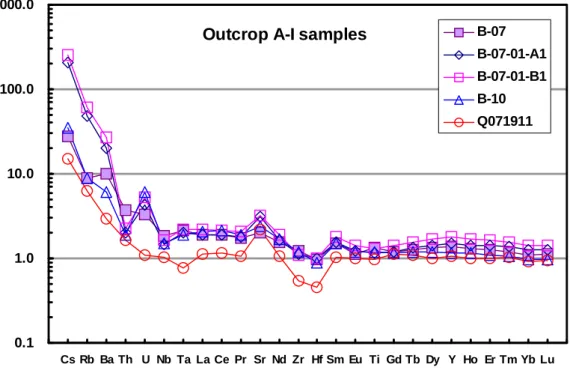
Six eclogitic samples are classified into two geochemically distinct groups (Fig.
1). Outcrop A-I includes four samples, B-07-01-A1, B-07-01-B1, and B-10 characterized by slightly LREE-enriched pattern (La/Yb ratio about two times of averaged N-MORB) with highly enriched Ca, Rb, Ba, and U. Their HREE contents spread between 1–2 times of the averaged MORB values and LREE contents are not as variable, clustering around 2 times of the averaged MORB values. These features are inconsistent with magmatic trends but in agreement with the control of garnet proportion. The LILE contents reach 200 times of the average MORB values, mostly reflecting the controls of metamorphic modification. The two outcropA-II samples, B-06 and B-08, have high SiO2 contents of 61–63%, moderate MgO and total iron contents of 4.51–5.33% and 6.86–8.60%, and prominent Nb-Ta-Ti depletions. These are characteristics of arc andesitic rocks.
Outcrop B samples
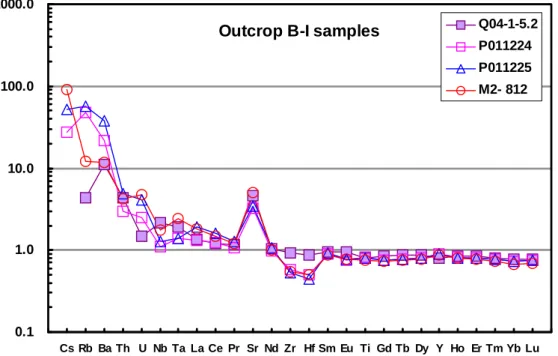
Being referred to as outcrop B-I samples, five of seven eclogites collected from outcrop B show trace element variation patterns mimicking that of the outcrop A-I samples with slightly lower REE contents (HREE = 0.9 averaged MORB; LREE = 1–2 averaged MORB), however, with LREE contents more variable than HREE contents (Fig. 2). A outcrop B-I sample, Q-04-1-6.1, is distinctive for having higher a Rb content of 62.2 ppm, resulting a high 87Rb/86Sr ratio of ~0.64. Samples Q-04-1-9 and B-03 are classified into outcrop B-II samples. They show Nb-Ta-Ti depletions relative to the concentrations of REE with similar compatibility during mantle melting (Fig. 2). Such a variation patter is similar to that of the outcrop A-II samples (Fig. 2).
However, the major oxide contents of the outcrop B-II samples are of basaltic compositions. The trace element variation patterns and the major oxide contents of the outcrop B-I and outcrop B-II samples are similar to the compositions of MORB and arc basalts, implying the dominance of protolith control over metamorphic modification on the compositions of these eclogites.
Outcrop C samples
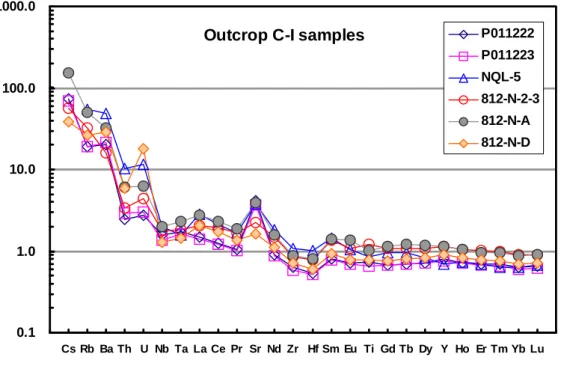
Six of the eight samples from outcrop C, referred to as outcrop C-I samples, have trace element abundances and variation patterns similar to that of the outcrop B-I samples (Figs. 1, 3). They are characterized by slight enrichment in LREE relative to HREE (Fig. 3). Samples 812-N-D and NQL-5 are distinctive for a U content three times higher than other samples. Other two samples, B-04 and 812-NR-2, have Nb-Ta-Ti depletions similar to the groups A-II and B-II samples (Fig. 3). They are referred to as outcrop C-II samples.
Sr, Nd, and Hf isotope ratios
Groups A-I, B-I, and C-I samples have Nd values varying from 3.8 to 7.2, except for two outcrop C-I samples, NQL-5 and 812-N-D with low values of 2.8 and 1.4, respectively. Their Nd(480) values, Nd values calculated to the time of metamorphism using measured Sm/Nd ratios, are in the range of 4.7–6.8, except for the slightly lower values of 4.2 for sample NQL-5 and 3.8 for sample 812-N-D. Two samples with andesitic major oxide compositions, B-06 and B-08, have distinctively lower Nd and Nd(480) values of -10.9–-9.9 and -6.4–-4.9, respectively. Hf and
Nd(480) values distribute in similar patterns to that of Nd and Nd(480) values. The
Nd(480) > 4.5 and Hf(480) values > 6 are consistent with N-MORB protoliths and the lower values indicate protoliths of arc lavas. The 87Sr/86Sr ratios of the eclogites distribute in the range of 0.706720–0.713721, mostly 0.706720–0.709680. The
87Sr/86Sr(480) values of the all samples are ~0.705–0.707, typical of basalts subjected to interaction with seawater. Given the peak metamorphic temperatures of 400–500℃, it is inferred that the Nd and Hf isotope ratios were not re-equilibrated during the HP metamorphism but the Sr isotope did. The evidence for the Sr isotope re-equilibration and its implications are addressed as following.
Spatial scale of Rb-Sr isotope system re-equilibration: evidence for significant amounts of metamorphic fluids
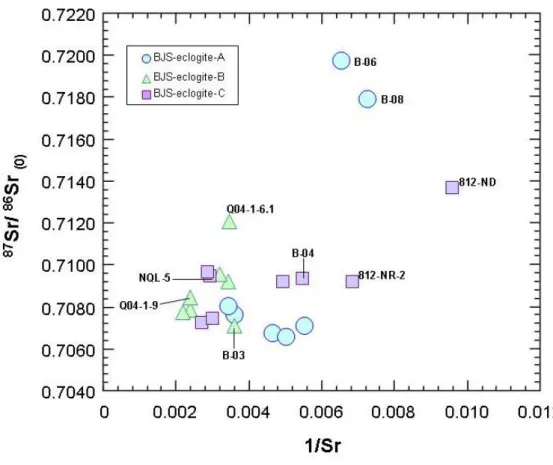
All the 22 BJS eclogitic samples collected from three outcrops define a coherent
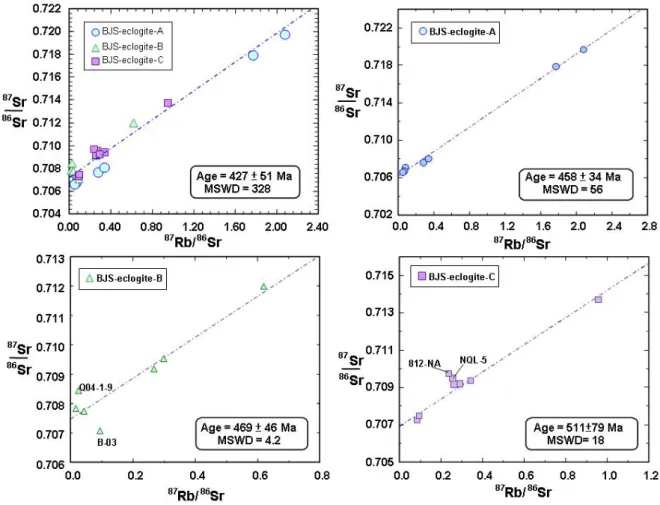
87Rb/86Sr-87Sr/86Sr trend, which can be either a two-component mixing line or an isochron (or errorchron; Brooks et al., 1972). Given the scattering in the 87Sr/86Sr versus 1/Sr plot, the 87Rb/86Sr-87Sr/86Sr linearity defined by all BJS eclogitic samples (Fig. 4) is preferentially interpreted as an isochron or errorchron. This inference is
evaluated by the age calculated from the 87Rb/86Sr-87Sr/86Sr linearity. The regression
87Rb/86Sr-87Sr/86Sr linearity yields an age of 427 ± 51 Ma with a Mean Squared Weighted Deviates (MSWD) value of 328 (Fig. 5); therefore, it should be referred to as an errorchron age (MSWD > 2.5; Brooks et al., 1972). The errorchron age is more tightly constrained when samples from individual outcrops are considered and the major outliers are removed. Specifically, samples from outcrop A, B, and C respectively define errorchron ages of 458±34 Ma (MSWD = 56), 469±46 Ma (MSWD = 4.2; samples Q04-1-9 and B-03 removed) , and 511±79 Ma (MSWD = 11;
samples NQL-5 and 812-N-A removed) (Fig. 5). These errorchron ages overlap with the metamorphic ages of the Qililan eclogites, 449-489 Ma dated by the U-Pb system of zircon (Song et al., 2006; Zhang et al., 2007). The relatively large uncertainty from the whole-rock errorchrons is not a surprise because both isotope disequilibrium between peak and retrograde phases and post-metamorphism alteration contribute to the uncertainty. The removal of the outliers is justified. For example, samples Q04-1-9 and B-03 are distinct from other outcrop B samples for prominent Nb-Ta-Ti depletions (Fig. 2) and samples NQL-5 and 812-N-A have Rb/Sr ratios lower than other outcrop C samples with similar 87Sr/86Sr ratios (Fig. 3).
Despite the relatively large uncertainty, the general isotope equilibration between MORB-like and arc-like eclogitic samples in outcrops A and C implies the spatial scale of Sr isotope re-equilibration during metamorphism have exceed the size of hand specimen possibly reaching several tens to hundreds meters. Estimated by the simplified form of the solution for the equation of Fick’s second law (x ≒ √Dt), solid state diffusion for an element with a diffusion coefficient (D) of ~1×10-15 m2/sec, such as Sr, to a distance (x) of > 1 meter requires > 500 Ma (t). This time scale is much longer than that for peak metamorphism. The discrepancy can only be reconciled by increasing the diffusion coefficient with the presence of fluids during metamorphism. In sharp contrast to the Dabie-Sulu UHP eclogites formed by subduction and exhumation of continental lithosphere, the BJS eclogitic rocks are products from subduction and exhumation of oceanic lithosphere, which contained higher water contents, facilitating the attainment of larger scales of isotope re-equilibration during metamorphism, provided that the metamorphic temperature exceeded the closure temperatures of the isotope system, a case well-justified for the Rb-Sr isotope system in the BJS eclogitic rocks.
Protolith characteristics inferred from trace element variations and Nd-Hf isotopic systematic
Given the proof on the role of fluids during the ~480 Ma metamorphism forming the BJS eclogitic rocks, it is evident that the trace element compositions of these eclogitic rocks might be subjected to metamorphic modifications; therefore, are not reliable tracers to protolith characteristics. Nd isotope has been used for identifying the nature of protoliths. To avoid complication from inclusions on the mineral isotope data, whole-rock Nd isotope ratios corrected for in-situ radiogenic growth to the age of metamorphism, denoted as εNd(T) with T indicating metamorphic ages, have been used as a discriminator distinguishing oceanic and continental affinities of eclogites.
For example, the positive εNd(T) values for the Variscan (or Hercynian) eclogites indicate an oceanic affinity (e.g., Bernard-Griffiths and Cornichet, 1985; Stosch and Lugmair, 1990; Beard et al., 1992; Medaris et al., 1995) whereas the negative values from the Norwegian, Scottish, and Dabie-Sulu eclogites sign for a continental affinity (e.g., Griffin and Brueckner, 1980; Mearns, 1986; Mork and Mearns, 1986; Jamtveit et al., 1991; Chavagnac and Jahn, 1996; Jahn et al., 2003). However, Nd isotope along cannot distinguish protoliths of arc origin from others. The combination of Nd and Hf isotope ratios provides a scheme to pinpoint protoliths of arc and continental origins using the combination of Nd and Hf isotope ratios. Because the parent and daughter nuclides in the Sm–Nd and Lu–Hf isotope system are fractionated in a same way during most geological processes, the εNd and εHf values of most igneous rocks and sediments are positively correlated, forming the so-called “terrestrial array” (Vervoort et al., 1999). While continental basalts, MORB, and back-arc basin basalts define the
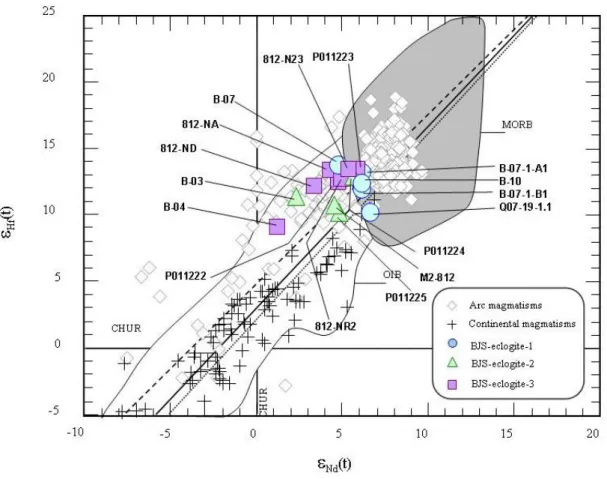
“terrestrial array”, arc lavas form a sub-parallel “IAV-array” with higher εHf values at a given εNd value (Fig. 6), reflecting their higher Lu/Hf ratios. After corrected for in-situ radioactive growth to the metamorphic age of ~480 Ma, the BJS eclogites, as a whole, straddle the fields for MORB and arc lavas in the εHf - εNd space (Fig. 6).
Samples with prominent Nb-Ta-Ti depletions plot well within the field for oceanic arc while those with flat patterns in the primitive mantle normalized diagram are on the edge of MORB (back-arc basalts) field (Fig. 6). It is then suggested that the trace element variation patterns of the BJS eclogitic rocks still reflect protolith characteristics, although they were subjected to metamorphic modification. In comparison, the Xitieshan eclogites have slightly lower εHf(480) and εHf(480) values, plotting within the field of continental and ocean island basalts (Fig. 6). The trace
element variation patterns of the Xitieshan eclogites and the in-situ occurrence of these eclogites to their host gneiss favor protoliths of continental basalts.
Tectonic significance of the BJS eclogites
The tectonic evolution on the Qilian-Qaidam has been an issue of debate. Yang et al. (2006) advocated two rifting and convergence events. The first rifting event created a small ocean basin (Fig 2a, I-II), a part of which was obducted to the adjacent Qaidam craton forming the protoliths of the Qaidam eclogites (Fig. 2a, III). The second rifting event created the Paleo Qilian Ocean (Fig. 2a, IV), the protoliths of the Qilian eclogites. Subducting the Paleo Qilian Ocean also dragged the protoliths of the Qaidam eclogites to depth (Fig. 2a, V-VI). In contrast, Song et al. (2006) suggested that the eclogites from these two structure lineaments were metamorphosed from a common oceanic protolith, the Paleo Qilian Ocean (Fig. 2b). The convergence of this ocean basin (Fig 2b, I-II) also pulled the attached Qaidam-Qilian Craton to underthrust beneath the northern North China Craton and the subducted oceanic lithosphere might be mingled into the attached continental materials (Fig. 2b, II). The subsequent exhumation of former accretionary sediments and the underlying crustal materials formed the metamorphic rocks in the North Qilian and the North Qaidam orogenic belts, respectively (Fig. 2b, III). In the model of Song et al. (2006), it was emphasized that the North Qaidam and North Qilian orogenic belts were formed by a single subduction event that evolved from oceanic subduction to continental collision.
Such completed mountain building records are rarely preserved in orogenic belts.
However, both models were built upon geochroniological data without robust supports from protolith characteristics. Specifically, the model of Song et al. (2006) requires a common protolith for the North Qaidam and North Qilian eclogites whereas two distinct oceanic protoliths were proposed by Yang et al (2006). Without protolith constraints, these two models remain highly speculated and can only be considered as
“inferences”.
More recent debates are on the polarity of subduction. Based on the occurrence 460–480 Ma granites on the north and south of Qilian orogenic belt, Wu et al. (2011) proposed an early Palaeozoic double-suduction model for the North Qilian oceanic plate. Considering the lithological lineaments in the Qilian orogenic belt, Xiao et al.
(2009) postulated a multiple-accretionary model which involves several subduction events with different polarity. However, subduction of island arcs as constrained by
the results from this project was not considered. The subducted arc protoliths of the BJS eclogites appear distinct from the accreted arc systems. Therefore, at least two arc systems were developed on the paleo-ocean that separated the Alex and South Qilian Blocks. This in turns requires at least two isolated oceanic lithospheres between the the Alex and South Qilian Blocks. The present-day analogue of such a tectonic environment exists in the Molucca Sea between East Sulawesi and Halmahera arcs in Indonesian (Bader et al., 1999) and the early Eocene arc-continental collision reconstructed from the Kamchatka Orogenic Belt, NE Russia (Konstantinovskaia, 2001).
Conclusions
(1) The absence of igneous trend for the major oxides of the BJS eclogites indicates disturbs of the metamorphic modifications on the basaltic protoliths.
(2) Samples with trace element variation patterns mimicking that of MORB have εHf(480) and εNd(480) values within the ranges for MORB. Samples depleted in Nb-Ta-Ti have relatively lower εHf(480) values at a given εNd(480) value, consistent with arc protoliths. Evidently, the trace element compositions largely preserve protolith characteristics.
(3) The systematic variations between εNd(480) values and Nb/La ratios cannot be modeled by two-component mixing; therefore, reflecting the control of protolith characteristics.
(4) The Rb/Sr-87Sr/86Sr lineation resulted from metamorphic re-equilibration, consistent with the metamorphic temperature of ~450℃.
(5) The association of arc protoliths for BJS eclogites with the occurrence of accreted arc fragments on the Qilian orogenic system implies the existence of at least two distinct arc systems, requiring at least two isolated oceanic lithospheres between the the Alex and South Qilian Blocks.
References
Bader, A.C., Pbuellier, M., Rangin, M., Deplus, C., Louat, R., 1999. Active slivering of oceanic crust along the Molucca ridge (Indonesia-Philippine): implications for ophiolite incorporation in a subduction wedge? Tectonics 18, 606–620.
Beard, B.L., Medaris, L.G., Johnson, C.M., Bruechner, H.K., Misar, Z., 1992. Petrogenesis of Variscan
high-temperature Group A eclogites from the Moldanubian zone of the Bohemian Massif, Czechoslovakia. Contribution to Mineralogy and Petrology 111, 468–483.
Bernard-Griffiths, J., Cornichet, J., 1985. Origin of eclogites from South Britiany, France: A Sm-Nd isotopic and REE study. Chemical Geology 52, 185–201.
Brooks, C., Hart, S. R. and Wendt, I. (1972). Realistic use of two-error regression treatments as applied to rubidium-strontium data. Reviews of Geophysics and Space Physics 10, 551–577.
Chavagnac V., Jahn B.-M., 1996. Coesite-bearing eclogites from the Bixiling Complex, Dabie Mountains, China: Sm-Nd ages, geochemical characteristics and tectonic implications. Chemical Geology 133, 29–51.
Griffin, W.L., Brueckner, H.K., 1980. Caledonian Sm-Nd ages and a crustal origin for Norwegian eclogites. Nature 285, 319–321.
Jahn, B.-M., Fan, Q.-C., Yang, J.-J., Henin, O., 2003. Petrogenesis of the Maowu pyroxenite–eclogite body from the UHP metamorphic terrane of Dabieshan: chemical and isotopic constraints. Lithos 70, 243–267.
Jamtveit, B., Carswell, D.A., Mearns, E.W., 1991. Chronology of the high-pressure metamorphism of Norwegian garnet peridotites/pyroxenites. Journal of Metamorphic Geology 9, 125–139.
Konstantinovskaia, E.A., 2001. Arc-continental collision and subduction reversal in the Cenozoic evolution of the Northwest Pacific: an example from Kamchatka (NE) Russia. Tectonophysics 325, 87 – 105.
Mearns, E.W., 1986. Sm-Nd ages for Norwegian garnet peridotite. Lithos 19, 269–278.
Medaris, L.G., Jr., Beard, B.L., Johnson, C.M., Valley, J.W., Spicuzza, M.J., Jelinek, E., Misar, Z., 1995.
Garnet pyroxenite and eclogite in the Bohemian Massif : Geochemical evidence for Variscan recycling of subducted lithosphere. Geol. Rundesch 84, 489–505.
Mork, M.B.E., Mearns, E.W., 1986. Sm-Nd isotopic systematics of a gabbro-eclogite transition. Lithos 19, 255–267.
Song, S., Zhang, L., Niu, Y., Su, L., Song, B., Liu, D., 2006. Evolution from oceanic subduction to continental collision: A case study from the Northern Tibetan Plateau based on geochemical and geochronological data. Journal of Petrology 47, 435–455.
Stosch, H.G., Lugmair, G.W., 1990. Geochemistry and evolution of MORB-type eclogites from the Münchberg Massif, southern Germany: Earth and Planetary Science Letters 99, 230–249.
Vervoort, J.D., Patchett, P.J., Blichert-Toft, J., Albarède, F., 1999. Relationships between Lu–Hf and Sm–Nd isotopic systems in the global sedimentary system. Earth and Planetary Science Letters 168, 79–99.
Wu, C.L., Gao, Y.-H., Frost, B.R., Robinson, P.T., Wooden, J.L., Wu, S.-P., Chen, Q.-L., Lei, M., 2011.
An early Palaeozoic double-subduction model for the North Qilian oceanic plate: evidence from zircon SHRIMP dating of granites. International Geological Review 53, 157–181.
Xiao, W.-J., Windley, B.F., Yong, Y., Yan, Z., Yuan, C., Liu, C.-Z., Li, J.-L., 2009. Early Paleozoic to Devonian multiple-accretionary model for the Qilian Shan, NW China. Journal of Asian Earth Sciences 35, 323–333.
Yang, J. S., Wu, C. L., Zhang, J. X., Shi, R. D., Meng, F. C., Wooden, J., Yang, H. Y., 2006. Protolith of eclogites in the north Qaidam and Altun UHP terrane, NW China: Earlier oceanic crust?
Journal of Asian Earth Sciences 28, 185–205.
Zhang, J.X., Meng, F.C., Wan, Y.S., 2007. A cold early Palaeozoic subduction zone in the North Qilian Mountains, NW China: Petrological and U-Pb geochronological constraints. Journal of Metamorphic Geology 25, 285–304.
Fig. 1 Concentrations of incompatible element normalized to MORB values for the BJS outcrop A eclogitic samples. The outcrop A-I samples (upper panel) have MREE and HREE contents comparable to that of MORB with enrichment in LREE (~2 MORB) and LILE (> 2 MORB).
The outcrop A-II samples (lower panel) have REE and LILE contents similar to that of outcrop A-I samples. They are however distinct from the outcrop A-I samples for depletions in Nb, Ta, and Ti.
Outcrop A-I samples
0.1 1.0 10.0 100.0 1000.0
Cs Rb Ba Th U Nb Ta La Ce Pr Sr Nd Zr Hf Sm Eu Ti Gd Tb Dy Y Ho Er Tm Yb Lu B-07 B-07-01-A1 B-07-01-B1 B-10 Q071911
Outcrop A-II samples
0.1 1.0 10.0 100.0 1000.0
Cs Rb Ba Th U Nb Ta La Ce Pr Sr Nd Zr Hf Sm Eu Ti Gd Tb Dy Y Ho Er Tm Yb Lu B-06 B-08
Fig. 2 Concentrations of incompatible element normalized to MORB values for the BJS outcrop B eclogitic samples. The outcrop B-I samples (upper panel) have abundances and variation patterns similar to that of the outcrop A-I samples. The outcrop B-II samples (lower panel) have REE and LILE contents similar to that of outcrop B-I samples. They are however distinct from the outcrop B-I samples for depletions in Nb, Ta, and Ti. The extents of Nb-Ta-Ti depletions are less than those for the outcrop A-II samples.
Outcrop B-I samples
0.1 1.0 10.0 100.0 1000.0
Cs Rb Ba Th U Nb Ta La Ce Pr Sr Nd Zr Hf Sm Eu Ti Gd Tb Dy Y Ho Er Tm Yb Lu Q04-1-5.2 P011224 P011225 M2- 812
Outcrop B-II samples
0.1 1.0 10.0 100.0 1000.0
Cs Rb Ba Th U Nb Ta La Ce Pr Sr Nd Zr Hf Sm Eu Ti Gd Tb Dy Y Ho Er Tm Yb Lu Q04-1-9 B-03
0.1 1.0 10.0 100.0 1000.0
Cs Rb Ba Th U Nb Ta La Ce Pr Sr Nd Zr Hf Sm Eu Ti Gd Tb Dy Y Ho Er Tm Yb Lu P011222 P011223 NQL-5 812-N-2-3 812-N-A 812-N-D
Outcrop C-I samples
0.1 1.0 10.0 100.0 1000.0
Cs Rb Ba Th U Nb Ta La Ce Pr Sr Nd Zr Hf Sm Eu Ti Gd Tb Dy Y Ho Er Tm Yb Lu
B-04 812-NR-2 Outcrop C-II samples
Fig. 3 Concentrations of incompatible element normalized to MORB values for the BJS outcrop C eclogitic samples. The outcrop C-I samples (upper panel) have abundances and variation patterns similar to that of the outcrop A-I and B-I samples. The outcrop C-II samples (lower panel) are characterized by Nb-Ta-Ti depletions similar to that of the outcrop A-II and B-II samples.
Fig. 4 87Sr/86Sr ratio versus 1/Sr for the BJS eclogitic rocks with the samples having Nb-Ta-Ti depletions labeled. The absence of a correlation between 87Sr/86Sr and 1/Sr argues against two-component mixing. Consequently, the 87Rb/86Sr–87Sr/86Sr lineation in figures reflects age control.
Fig. 5 87Rb/86Srversus 87Sr/86Sr for the BJS eclogitic rocks. The ages are calculated from IsoPlot. The labeled samples are excluded from age calculations. See text descriptions for the composition of the outliers. The calculated ages are consistent with the metamorphic ages from zircon SHRIMP dating, implying re-equilibrium of the Rb-Sr isotope system in these samples.
Fig. 6 Plot of εNd(480) versus εHf(480) showing that the BJS eclogitic rocks straddle the fields for MORB and arc lavas. Those within the arc lavas are also characterized by depletions in Nb, Ta, and Ti, whereas those in the MORB field have MREE and HREE contents comparable to that of MORB. Also shown are the data for arc and continental basalts for comparison.
榴輝岩、北祈連、造山帶、地球化學、同位素
本三年期計畫之第三年工作重點為分析北祈連造山帶百經寺附近榴輝岩之 Hf 同位素,再配合先前分析之 Sr 及 Nd 同位素數據與微量元素之變化特性,對 百經寺榴輝岩之原岩特性提出制約,以探討高壓變質作用對變質岩原岩化學成份 之影響,進而建構一較完整之變質與地體構造演化史,主要結論如下。
北祈連造山帶百經寺榴輝岩之主要元素含量屬玄武岩質。兩標本除外,為花 岡安山岩質。MgO 與其他主要氧化物含量間並無明顯相關性,此為非火成作用 之特徵,應是受變質作用影響之結果。依微量元素含量變化趨勢可將百經寺榴輝 岩分為兩群,分具洋脊玄武岩及島弧玄武岩之特徵。Rb-Sr 同位素系統明顯受變 質作用影響,於~470 Ma 前重達同位素平衡。手標本間同位素系統系統之重新平 衡指示平衡之空間約為數公尺至數百公尺,此種平衡尺度在無水系統耗時逾千萬 年,故形成百經寺榴輝岩之變質系統應有流體介入,為海洋岩石圈隱沒之特徵。
Sm-Nd 及 Lu-Hf 同位素系統而則未受此變質事件影響,故可推估變質溫度介於 攝氏450-700 之間,未達超高壓變質之深度,此估計之變質溫度範圍與由礦物相 平衡計算結果相符。143Nd/144Nd(500 Ma) 比值與不相容微量元素含量(Na, Th, La) 成負變關係,而與Nb/Th, Ti/Eu 比值成正相關。此現象無法用兩端成分混合解釋,
故應反映原岩特徵。Nd 及 Hf 同位素之相關性及微量元素含量變化趨勢明顯指示 百經寺榴輝岩之原岩主要為洋脊玄武岩伴隨少量島弧玄武岩及安山-石英安山 岩。此原岩組合之判定對北祈連造山帶古地體構造之演化提供一關鍵制約,因隱 沒變質之島弧與仰衝之島弧應屬兩個獨立之地體構造系統,暗示阿拉善地塊與中 南祈連地塊於古生代早期是被至少兩個分屬不同構造單元之海洋所分隔,此種地 體構造與現今東北亞堪察佳造山帶相似,但本計畫根據百經寺榴輝岩之原岩特 性,首先將其用於解釋北祈連造山帶之地體構造演化。
2009 年日本新瀉大學實驗工作成果報告書
計畫名稱
同位素及微量元素在環境樣品的紀錄:追溯人類活動對全
球變遷的衝擊-鍶-釹-鉛-鋰-硼同位素在地球物質循環與
水岩反應之應用:以隱沒帶作用為研究重點(2/4、3/4)
計畫編號 NSC 97-2628-M-006-017
NSC 98-2116-M-006-013 會計編號 A97-1017
A98-0931
院別/系所 理學院/地球科學所 計畫主持人 楊懷仁
計畫參與人員 徐櫻瑞 (研究助理)、黃 珮庭 (碩士班一年級)、劉永欣(博
士後研究員)
目的:進行電子微探儀(EPMA)分析工作
出差地點:日本 新瀉市
實驗工作地點:新瀉大學 理學部 地質科學科
合作對象:高澤榮一 (Takazawa Eiichi) 副教授
日期:民國 98 年 10 月 1 日至 10 月 14 日
出差人員:劉永欣 (博士後研究員)
徐櫻瑞 (研究助理)
黃珮庭 (碩士班一年級)
一、目的
前往日本新瀉大學理學部-地質科學系針對已獲得全岩地球化學數據之綠島 火山岩(玄武岩、玄武質安山岩、安山岩等)與祁連山高壓榴輝岩及藍閃石片岩進 行電子微探儀(EMPA)分析,以取得發展雷射剝蝕分析所需之礦物主要成分數 據。台灣僅中央研究院,地球科學研究所有相同儀器,因該設備使用者眾,因而 所分配之使用時數受限,但此為全世界電子探針實驗室之共通運作模式。幾經協 調安排,新瀉大學慨然應允為本計劃提供連續九天之機時,實屬難得。
所得之數據除為雷射剝蝕分析礦物微量元素之基本資料外,亦將與中研院地
球所及中山大學 EDS 的數據比對,以檢驗各實驗室分析之準確度,以提升此三
實驗室之國際聲望。
二、工作項目及進度
1. 電子微探儀
此次實驗使用新瀉大學理學部地質科學科之電子微探儀,型號為JEOL JXA - 8600(圖一),其分析條件為加速電壓15 kV,電子束電流強度為 1.30 × 10⁻⁸ A,
電子束直徑約1-2 μm。該儀器優點在於藉由分析樣本表面微米大小(µm)的區
域,可獲得主要元素之含量與分布情形,其中X 光射線波長散佈分析儀(WDS)
對分析元素具有高解析度及精確度。此次所分析的元素包括SiO2、TiO2、Al2O3、 Cr2O3、FeO、MnO、MgO、CaO、Na2O、K2O、NiO,所有元素偵測極限為 0.01 wt%。
圖一 新瀉大學理學部地質科學科設置之電子微探儀。
2. 實驗步驟
(1) 樣本經拋光、尋找欲分析目標、定點、拍照後需蒸鍍碳膜,不同類型之樣 本(薄片或厚片)均需確認其碳膜厚度需與標準樣品一致(圖二 a)。
(2) 校正儀器之燈絲電流使電流些許低於飽和電流,確保儀器可達最穩定之狀 態。
(3) 因要進行定量分析,必須先進行標準樣品分析,確認標準樣品欲分析元素
之峰值強度,以獲得高精確度之定量分析數據(圖二b)。
(4) 放入已知成份之自然礦物樣本(Working Standard,包括石榴子石、輝石、
角閃石及橄欖石)以確認儀器設定及標準樣本選用適合欲分析之礦物相。
(5) 放入樣本並設定欲分析之位置(點座標),利用光學顯微鏡確定欲分析位 置之表面平整度及正確對焦,以預設分析點模式(Preset mode)進行分析。
(6) 所得之數據使用 Oxide ZAF Correction 方法校正基質效應後,可求得礦物 各氧化物之百分比。利用各礦物不同之氧原子個數進一步計算各礦物之陽 離子數。
圖二 (a)左圖為樣本拋光後進行鍍碳之流程,分析前需確認碳磨厚度與標準樣本一致。
(b)右圖新瀉大學所使用之標準樣品,利用此類標準樣本可進行準確定量分析。
此次實驗針對綠島火山岩及祁連變質岩光薄片與光厚片進行電子微探儀分 析,成功建立兩種類型樣本之分析方法,並獲得石榴子石、輝石、長石、角閃石 等礦物之主要元素含量,共完成分析11 個光薄片樣本與 3 個光厚片樣本,每個 樣本約分析40 至 120 的點不等,總計約 1000 點之點分析數據,逐日工作內容見 表一。
表一、行程及工作內容
Oct. 1 ArrivalOct. 2 Get samples carbon-coated Oct. 3 University electricity shut-down
Oct. 4 Learn EMPA operation and standardization procedure Oct. 5 LT 6-3 (52)
Oct. 6 LT 5-2 (57), YKH-04A (32)
Oct. 7 LT 2-1 (72), YKH-04A, LT 6-1 (44) Oct. 8 LT 6-1(46), LT 1-1 (82)
Oct. 9 Standardization, LT 1-1 (64), LT 2-2 (41), LT 4-1 (27) Oct. 10 LT 3-1 (118)
Oct. 11 M2-812 (5), B-03 (9), Standardization, LT 2-2, 4-1 (62) Oct. 12 LT 6-5 (50), B-03 (91)
Oct. 13 B-08 (50), M2 812, Q7-19-1.1 (100) Oct. 14 Leave
Numbers in parentheses indicate amounts of analyzed spots.
Samples names with underline indicate unsatisfied data quality.
Sample names in green color: grain mount; sample names in green color: thin section (total of analyzed points ~1000 data sets)
三、結果
本次實驗期間共計分析祁連地區榴輝岩及藍閃石片岩中石榴子石、綠輝 石、角閃石及藍閃石等礦物相共計~287 個點位,所得結果詳述如下。
藍閃石片岩(B-08)中石榴子石 CaO 含量(6.2~7.6 wt%)較同區域榴輝岩 中石榴子石(8.4~10.8 wt%)高(圖三),此成份差異可能反映全岩成份或峰期
變質條件不同。各樣本中石榴子石變質斑晶具核心至邊緣MgO 含量增加、MnO
含量減少之趨勢(圖三、表二),為典型記錄前進變質過程之生長環帶。榴輝岩
樣本中鈣角閃石包裹綠輝石及藍閃石之組構(表二)則為岩體於後期抬升階段所 形成,此過程亦使樣本M2 812 及 Q7-19-1.1 中石榴子石變質斑晶邊緣被綠泥石 取代,故此類石榴子石之化學環帶變化較小(表二),為降級變質階段之擴散作 用使成份趨於均質。
圖三 本研究分析之祁連地區榴輝岩(B-03、M2 812、Q07-19-1.1)及藍閃石片岩(B-08)
石榴子石成份圖。藍閃石片岩中石榴子石鈣含量較高(Grs)。石榴子石於同一樣 本中鈣含量變化小,但鐵與錳總量及鎂含量呈反比關係,大致上核心部份鎂含量
(Pyp)低、錳含量(Sps)高,邊緣部份則反之。
表二 祁連山地區榴輝岩(B-03, M2 812, Q07-19.1.1)及藍閃石片岩(B-08)礦物成份
Garnet Omphacite Glaucophane Amphibole
B-08 B-03 M2 812 Q07-19-1.1 B-08 B-03 M2 812 Q07-19-1.1 B-08 B-03 B-03
B8-2.6 B8-2.7 B8-2.8 B3-3.3 B3-3.1 B3-3.2 M2-1.1 M2-1.2 M2-1.5 Q7-1.1 Q7-1.2 Q7-1.4 B8-4.8 B3-5.10 M2-4.5 Q7-4.9 B8-1.7 B3-7.12 B3-7.13 core mantle rim core rim Rim core mantle rim mantle mantle rim core rim SiO2 38.6 38.5 39.7 38.9 39.5 39.4 39.2 39.3 39.7 39.1 39.5 39.7 56.7 56.8 55.9 56.7 58.9 59.5 55.0 TiO2 0.108 0.091 0.039 0.078 0.076 0.058 0.106 0.109 0.11 0.121 0.102 0.000 0.04 0.037 0.037 0.068 0.162 0.001 0.06 Al2O3 20.4 20.8 21.8 21.5 21.6 21.9 21.7 21.8 21.9 21.7 21.7 22.2 10.0 10.2 9.9 10.4 10.9 11.3 4.2 FeO 24.0 26.6 28.0 26.3 27.1 24.9 25.8 26.0 25.1 26.7 26.0 25.3 8.71 3.89 4.24 4.53 8.18 6.66 9.61 MnO 6.84 4.66 0.289 1.52 0.428 0.49 0.552 0.699 0.599 0.273 0.249 0.466 0.034 0.026 0.006 0.02 0.026 0.037 0.145 MgO 1.42 1.89 4.98 2.58 3.76 3.92 4.42 4.49 5.20 3.16 3.82 4.61 5.93 8.96 8.77 8.57 11.2 12.5 16.5 CaO 7.64 6.75 6.51 9.83 8.89 9.85 9.04 8.03 8.34 10.1 9.78 9.33 9.22 13.8 14.1 13.9 0.579 1.49 10.3 Na2O 0.012 0.005 0.005 0.019 0.027 0.019 0.006 0.041 0.017 0.025 0.008 0.013 8.90 6.64 6.19 6.23 7.25 6.71 1.7 K2O ― ― ― ― ― ― ― ― ― ― ― ― 0.000 0.000 0.000 0.000 0.000 0.000 0.042 Total 99.1 99.4 101.4 100.8 101.5 100.6 101.1 100.6 101.1 101.3 101.2 101.6 99.6 100.5 99.2 100.5 97.4 98.3 97.5
O 12 12 12 12 12 12 12 12 12 12 12 12 6 6 6 6 23 23 23
Si 3.096 3.075 3.049 3.039 3.046 3.047 3.027 3.043 3.041 3.028 3.046 3.032 2.053 2.009 2.006 2.008 8.039 7.98 7.77 Ti 0.007 0.005 0.002 0.005 0.004 0.003 0.006 0.006 0.006 0.007 0.006 0.000 0.001 0.001 0.001 0.002 0.017 0 0.006 Al 1.927 1.96 1.972 1.983 1.964 1.991 1.977 1.989 1.976 1.982 1.976 1.995 0.425 0.427 0.42 0.435 1.748 1.793 0.693 Fe 1.607 1.775 1.8 1.718 1.749 1.609 1.666 1.682 1.612 1.731 1.674 1.618 0.263 0.115 0.127 0.134 0.933 0.748 1.134 Mn 0.465 0.315 0.019 0.101 0.028 0.032 0.036 0.046 0.039 0.018 0.016 0.03 0.001 0.001 0.000 0.001 0.003 0.004 0.017 Mg 0.17 0.225 0.571 0.301 0.432 0.451 0.509 0.518 0.594 0.364 0.439 0.525 0.32 0.472 0.469 0.452 2.277 2.502 3.462 Ca 0.656 0.577 0.536 0.822 0.735 0.816 0.748 0.666 0.685 0.834 0.807 0.764 0.358 0.524 0.541 0.526 0.085 0.214 1.564 Na 0.002 0.001 0.001 0.003 0.004 0.003 0.001 0.006 0.003 0.004 0.001 0.002 0.624 0.455 0.431 0.428 1.917 1.745 0.465 K ― ― ― ― ― ― ― ― ― ― ― ― 0.000 0.000 0.000 0.000 0.000 0.000 0.008 Total 7.938 7.941 7.962 7.971 7.97 7.957 7.98 7.964 7.967 7.979 7.966 7.97 4.047 4.006 3.999 3.987 15.038 14.993 15.12 Alm 55.4 61.4 61.5 58.4 59.4 55.3 56.3 57.8 55 58.7 57 55.1
Sps 16.0 10.9 0.6 3.4 1.0 1.1 1.2 1.6 1.3 0.6 0.6 1.0 Pyp 5.9 7.8 19.5 10.2 14.7 15.5 17.2 17.8 20.3 12.4 14.9 17.9 Grs 22.7 20 18.3 28 25 28 25.3 22.9 23.4 28.3 27.5 26.0
本實驗分析九個綠島安山岩、玄武岩及石英安山岩,共計約~713 個分析數
據,且近九成以上之礦物分析皆獲得合理的結果(主要氧化物總量於長石、輝石 及橄欖石皆在100±1 wt% 之範圍內,角閃石、黑雲母及玻璃相分別為~97 wt %、
~96 wt%及~97 wt %;除玻璃相外各礦物之離子配位數皆符合礦物之結構式)。
綠島火山岩依全岩主要、微量元素含量及 Sr-Nf-Hf 同位素比值可分作七群,
本次實驗已分析其中六群樣本之岩象(表三)及礦物化學特性。富化型玄武岩
(BE,樣本 LT2-1、LT2-2 及 LT3-1)含大量角閃石、斜輝石及斜長石斑晶,以 斜長石、斜輝石、直輝石、橄欖石及磁鐵礦為基質,部份樣本含方解石。玄武質 安山岩(BA,樣本 LT6-1)特徵為大量斜輝石斑晶(1~4 mm)但不含角閃石,
基質已受後期蝕變作用影響形成皂石。石英安山岩(D,樣本 LT4-1 及 LT1-1)
及安山岩(A,樣本 LT5-2)含大量斜長石及角閃石斑晶但不含輝石斑晶,兩者 均具邊緣熔蝕之石英顆粒,文獻認為此現象為岩漿受大陸物質污染之證據。此 外,部份石英安山岩含黑雲母,而安山岩則有大量由角閃石、斜長石及尖晶石組 成之擄獲岩塊。富化型安山岩(AE,樣本 LT6-5)以斜輝石、直輝石及斜長石 斑晶為主不含角閃石,斜輝石斑晶邊緣含大量磷灰石包裹體,基質為花崗岩質玻 璃(SiO2 ~74 wt%)。虧損型安山岩(AD,樣本 LT6-3)主要由斜長石、角閃石 及黑雲母斑晶組成,基質為細粒之斜長石、斜輝石、直輝石、石英、磁鐵礦及磷 灰石。
斜長石可於不同成份之岩漿中及廣泛之溫壓條件下結晶生成,且斜長石晶體
化學成份通常可忠實反映形成當時與其平衡之岩漿物理及化學特性;由於其主要 元素擴散速率慢,故不易受後期熱事件改變成份。有別於全岩化學成份反映多期 地質作用之綜合結果,斜長石斑晶之主要及微量元素環帶變化可作為解析岩漿演 化過程之利器。以下分別詳述本研究分析六群樣本中不同組構斜長石之化學特性
(圖四)。富化型玄武岩斜長石斑晶(> 0.7 mm)及微斑晶(0.1~0.7 mm)均具 複雜之振盪環帶(Oscillatory zoning),兩者鈣長石莫耳百分比(An)為 93~68。
玄武質安山岩斜長石斑晶成份(An )與富化型玄武岩相似,但斑晶大致以正
常環帶(Normal zoning)為主,即核心部位鈣含量高而邊緣之鈣含量趨於減少。
但於斜輝石斑晶中之斜長石包裹體鈣含量變化大,且與斑晶相比略微偏低
(An79~42)。安山岩中部份斜長石斑晶不具明顯之化學環帶,但含大量熔融物包
裹體(melt inclusion)使其呈現篩網狀組織(sieve texture,圖五 a),應為早期 斜長石晶體受後期岩漿熔蝕之結果。此樣本群斜長石斑晶(An71~53)鈣含量較微 斑晶高(An46~38)但低於擄獲岩中斜長石顆粒(An87~80),而擄獲岩斜長石顆粒 成份與玄武岩樣本斜長石斑晶相似。富化型安山岩斜長石斑晶(An85~58)具正常 環帶,其成份與斜輝石中包裹體相似(An82~67)。虧損型安山岩中斑晶核心部份
(An92~66)含大量熔融物包裹體且鈣含量較邊緣(An74~52)高(圖五b),微斑
晶(An80~51)相對而言缺少熔融物包裹體且成份與斑晶邊緣相似。故推測斑晶核
心為岩漿早期結晶之礦物相,被後期安山岩質岩漿擄獲並熔蝕保留於核部,而斑 晶邊緣及微斑晶是岩漿後期生長之產物。石英安山岩斜長石成份變化與組構間關 係與虧損型安山岩相似,其斑晶核心、邊緣及微斑晶鈣長石莫耳百分比分別為 93~71、79~41 及 75~48。綠島六群岩樣中角閃石斑晶、微斑晶或擄獲岩中顆粒 之mg#(Fe/[Fe+Mg] × 100)均介於 83 及 60 間,角閃石斑晶邊緣均具細粒斜長 石、斜輝石及磁鐵礦組成之反應圈,代表角閃石斑晶非結晶自主岩之岩漿中而為 早期形成之礦物相。
由本次實驗結果瞭解綠島火山岩之岩漿演化歷史複雜,各群岩樣所經歷之地
質事件不同。富化型玄武岩中斜長石震盪環帶可能單純反映斜長石斑晶於岩漿庫 中對流時周遭物化特性(岩漿庫中具溫度、壓力及含水量梯度)改變之結果;或 可能代表此岩漿庫非封閉系統,後期有岩漿再注入事件。此議題需進一步以原位 微量元素甚至鍶同位素數據已釐清環帶變化之主因。玄武質安山岩及富化型安山 岩中斜長石為正常環帶且不含角閃石斑晶,但安山岩、虧損型安山岩及石英安山 岩中斜長石斑晶之高鈣含量核心及篩網狀組織及大量角閃石斑晶均為早期結晶 礦物相被後期岩漿擄獲之證據。而此類礦物來源為岩漿庫早期堆晶岩或下部地殼 物質仍須釐清,並需考慮其對於全岩成份之影響。
表三 綠島火山岩礦物組合
Samples Plag2 Amph Cpx Opx Ol Bt Cal Qtz Mag Ap G Sp Sap
BE1 LT2-2 ○△3 ○ ○△ △ △ △
LT3-1 ○△ ○ ○△ △ △ △
LT2-1 ○△ ○ ○ △ △
BA LT6-1 ○△ ○△ △ △ △ △
A LT5-2 ○△◇ ○◇ ○△ △ ◇
AE LT6-5 ○ △ ○△ ○△ △ △ △ △ △☆
AD LT6-3 ○△ ○ △ △ ○ △ △ △
D LT4-1 ○△ ○ ☆ △
LT1-1 ○△ ○ ☆ ○ ○△ △ △
1 本研究綠島火山岩可分為BE:富化型玄武岩,BA:玄武質安山岩,A:安山岩,AE:富化型
安山岩,AD:虧損型安山岩,D:石英安山岩。
2 Plag:斜長石,Amph:角閃石,Cpx:斜輝石,Opx:直輝石,Ol:橄欖石,Bt:黑雲母,Cal:
方解石,Qtz:石英,Mag:磁鐵礦,Ap:磷灰石,G:玻璃質,Sp:尖晶石,Sap:皂石。
3 符號空心圓代表此礦物相以斑晶或微斑晶,三角形為基質,星形為包裹體於角閃石或斜輝石斑
晶中,而菱形為擄獲岩之礦物相。
圖四 綠島火山岩中不同組構之斜長石中鈣長石(An)莫耳百分比變化圖。樣本分群簡 稱參見表三說明,括弧中數字為全岩二氧化矽含量,各樣本群接續之解說為斜長 石斑晶組織及化學環帶特性。
圖五 偏光顯微鏡平行消光影像顯示(a)安山岩(LT5-2)及(b)虧損型安山岩(LT6-3)
斜長石斑晶均含大量之熔融物包裹體呈現篩網狀組織。圖中紅點為電子微探
儀分析之位置而鄰近之藍色數字代表其鈣長石莫耳百分比;結果顯示安山
岩斑晶成份變化不明顯,而虧損型安山岩具正常環帶現象。
四、心得結語
電子微探儀並非可快速瞭解並上手之精密儀器,此行須感謝高澤榮一教授 耐心指導及在我們遇到困難時之建議與協助;尤其在建立光厚片樣本分析方法、
討論不同礦物相之數據、樣本鍍碳厚度、儀器狀態等方面均花費許多心力力求完 美,讓我們學習到更嚴謹的實驗方式,與高澤教授的討論也讓我們對於數據的解 釋有更進一步的瞭解。此外,高澤教授的學生們,也在實驗及生活上給予我們很 多幫助,金澤晉太郎與佐藤力樹陪我們一次又一次的鍍碳、拋光;杏奈與草野有 紀毫不吝嗇的與我們分享他們的研究成果;更是感謝赤井純一教授邀請我們參與 其礦物學實驗室之討論,在言談中使我們更加了解日本學生的學習方式與文化上 的交流;這些都將成為此行的寶貴經驗,高澤榮一教授也期許雙方未來能有更進 一步的合作與交流活動,諸如邀請兩系的教授們到系上參觀設備、實驗室及其教 學設施等,藉由系上交換學生等活動,開拓學生視野並增進彼此合作機會。
此行之後亦感慨台灣地球科學界之電子顯微鏡設備不足以滿足使用者需 求,且集中於北台灣研究單位,滯礙南部學生學習成效,甚至整體礦物岩石研究 之發展,希望此情況能有所改善。最後,感謝國科會補助此行的費用,能夠在 14 天將分析實驗工作順利完成,得以累積學術研究之豐碩成果。
附錄-經費使用明細
項目 細目 經費 經費來源
高雄-東京來
回機票
徐櫻瑞 共 14300 元
黃珮庭 共 14300 元
劉永欣 共 14300 元
交通費
東京-新瀉新
幹線鐵路(來
回)
徐櫻瑞 共 3600 元
黃珮庭 共 3600 元
劉永欣 共 3600 元
生活費 日支生活費
徐櫻瑞 (共 14 天)
共 42100 元
黃珮庭 (共 14 天)
共 22100 元
劉永欣 (共 14 天)
共 22100 元
1. 徐櫻瑞、黃珮庭由 97
計畫 (差旅費)支付。
2. 劉永欣由 98 計畫 (差
旅費)支付。
3. 生活費依國科會日支
標準辦理。
個人總計
徐櫻瑞 共 60000 元
黃珮庭 共 40000 元
劉永欣 共 40000 元
總計 共 140000 元
研究生出席國際學術會議報告
99 年 9 月 14 日 報告人姓名:
郭春滿
就讀校院:
(科系所)
■博士班研究生 國立成功大學地球科學系
□碩士班研究生 時間:
會議
地點:
99 年 8 月 21 至 99 年 8 月 27 Budapest, Hungary
布達佩斯,匈牙利
計劃編號: A98-0931
會議 名稱
(中文) 國際礦物學會第 20 屆會議
(英文) 20th General Meeting of the International Mineralogical Association 論文
題目
(英文) Protolith nature of Baijingsi eclogites from the North Qilian Mountains in NW China and its tectonic significance.
報告內容:
一、會議性質
2010 年第 20 屆國際礦物學會會議(20th General Meeting of the International Mineralogical Association, 2010;簡稱:IMA 2010)固定每 4 年於世界各國不同的城市舉行,為期 7 天;今年於 匈牙利的布達佩斯城舉辦。上一屆為 2006 年於日本的神戶市舉行,下一屆 2014 年則是座落在南非。
該會議包含各個礦物岩石科學等相關課題,如地質學、蛇綠岩、礦物化學、地球化學、超高壓研究、
礦場廢棄物處理、經濟礦物、工業礦物、成礦作用等數十種專業的學術議題及其附屬的子議題,與 會人數有近萬人,是全球重要的地質學術會議之ㄧ。因此每 4 年都吸引來自世界各國的專家學者共 聚一堂,發表數上萬篇的優秀論文,並邀請地球科學相關領域聲明卓著之專家學者參與其中發表專 題演講。展示目前地球科學領域中最新的研究成果及未來的展望,可說是每四年一度的礦物岩石學 界的一大盛事。學生因此藉此機會參與 2010 年度的 IMA 會議,希望藉由此國際會議將自己的研究 成果與國際上的研究接軌,以增廣見聞,開闊視野。此外更希望可以藉由其他相關領域的專家學者 幫忙,解決目前研究上所遭遇的問題,並提升自身的學術水平。
二、參加會議經過
8 月 21 日下午離開台灣經香港,德國轉機,於 8 月 22 日中午抵達布達佩斯,下午旋即抵達會 場註冊,並即刻前往會場參觀海報展覽。口頭報告議程於 8 月 23 日,期間每天均有口頭報告議程,
期間則於各議程中聽口頭報告與會議準備之演講等。此外,也舉辦了一系列專題演講,邀請各個領 域的專家學者針對特殊的題目做專題報告。會議於 8/25 設置晚宴歡迎所有的來賓;此外學生還自 費參加 8/26 會議期間所舉辦之付費野外活動,前往 Csodi Hill 礦場進行野外地質考察,8/27 IMA 2010 會議結束,8/28 啟程返台。
三、與會心得
國際礦物學會會議的會場非常大,主要可分為三個大區域:即(1)口頭報告演講區、(2)海報張
日程,每天的議程從早上八點半開始到下午六點半結束,議程期間都有會不同性質的主題演講及海 報展示,內容包羅萬象。可以因應個人的學術領域相關及所感興趣的主題來選擇個人的議程。
學生此次是以 [Protolith nature of Baijingsi eclogites from the North Qilian Mountains in NW China and its tectonic significance.] 為主題進行研究成果海報展示。由於海報議程及展出時段為兩批 次:前三天為 season1,後三天為 season2,需張貼滿三天並依規定時間於海報前回答問題至少兩小 時。因學生的本次發表海報期間為 8/25-8/27 是屬於 season2,因此將於第 4 天時在規定位置張貼海 報,並於 8/27 下午兩點至四點於海報前參與討論並回答相關問題。本海報成果主要展示北祁連高 壓(HP)/低溫 LT 變質帶中低溫榴輝岩系統性的研究。由於北祁連隱沒-增生雜岩帶是目前中國大陸 最具代表性的變質岩帶,因此本研究針對 19 個來至北祁連造山帶百經寺地區的榴輝岩進行全岩主 要元素、微量元素及 Nd 同位素的測定,以瞭解其化學組成變化、原岩性質及環境,再配合年代學 證據來釐清北祁連造山帶的區域構造意義。
由於HP/LT榴輝岩經歷了複雜的變質歷史,其原岩恢復和生成環境的制約是一項複雜和困難的 工作,因此除了野外、岩相學、年代學的研究外,地球化學也是非常重要的證據,尤其同位素的制 約。本研究基於野外和岩相學研究的基礎上,針對北祁連東側百經寺地區的低溫榴輝岩進行全岩主 要、微量元素及Sr-Nd同位素的研究,探討其原岩特徵及成岩構造環境,為區域構造演化模式提 供更強而有力的制約。於會議海報討論期間,學生與來自中國大陸、日本、美國的學者互相討論許 多相關之議題,例如: 榴輝岩原岩判別的局限、各個同位素系統所代表的意義、大地構造模式的 探討與相關問題、榴輝岩原岩的生成構造環境等等,獲得許多研究學者的寶貴意見。除此之外,有 多位學者對於本研究表示興趣。於海報討論過程中獲得許多建議,使得本研究更趨完整,從中獲益 良多。此外,他們也提供了許多寶貴的意見,可作為未來論文研究的方向。因此在這短短幾天的會 議中,可說是獲益良多;不但對許多國外專家學者最新的研究有所暸解,更對目前地球科學界的研 究方向及主要課題有了更深一層的瞭解,從中也認知到自身研究工作不足之處和還需改進的地方。
會議期間學生挑選岩石學、地球化學、地球歷史演化等與論文相關之演講議題仔細聆聽,詳細 地做筆記,並把握演講之間空閒的時間瀏覽展示海報,並於海報展示的學者進行交流;海報區每天 約有 100 多篇展示,有各領域相關學者最近的研究心得。在這短短幾天的會議中,可說是獲益良多;
不但對許多國外專家學者最新的研究有所暸解,更對目前地球科學界的研究方向及主要課題有了更 深一層的瞭解,從中也認知到自身研究工作不足之處和還需改進的地方。
四、野外考察活動
會議期間學生參與一項野外考察活動,前往 Csodi Hill 礦場進行野外地質考察,此為一石英安 山岩侵入沉積岩之礦區,主要開採安山岩做為石材。礦區主要為石英安山岩,並含石榴子石結晶,
岩漿侵入砂岩層中,因熱接觸變質作用與熱水反應,使礦區內含豐富沸石礦物。該區常年開挖,露 出一完整之熱接觸變質帶,為相當完整之熱接觸變質教育區,並可近距離觀察熱變質與岩漿侵入引 起之構造變化。於礦場內也可以發現一些變質構造接觸帶,也是研究低度-中度變質作用的理想地 點。
五、其他
最後,感謝國科會補助研究生此行的費用,使學生在會議期間的經費不虞匱乏;讓學生能夠無 後顧之憂的盡情參與會議,努力吸取各國學者的研究經驗及成果,進而在短短的五天會議中自覺成
無研發成果推廣資料
98 年度專題研究計畫研究成果彙整表
計畫主持人:楊懷仁 計畫編號:98-2116-M-006-013-
計畫名稱:中國西北柴北緣及北祈連造山帶變質岩及其原岩之化學成份在構造演化與隱沒帶元素分化 之應用(III)
量化
成果項目 實際已達成
數(被接受 或已發表)
預期總達成 數(含實際已
達成數)
本計畫實 際貢獻百
分比 單位
備 註 ( 質 化 說 明:如 數 個 計 畫 共 同 成 果、成 果 列 為 該 期 刊 之 封 面 故 事 ...
等)
期刊論文 0 0 100%
研究報告/技術報告 0 0 100%
研討會論文 1 1 100%
論文著作 篇
專書 0 0 100%
申請中件數 0 0 100%
專利 已獲得件數 0 0 100% 件
件數 0 0 100% 件
技術移轉
權利金 0 0 100% 千元
碩士生 0 0 100%
博士生 0 0 100%
博士後研究員 0 0 100%
國內
參與計畫人力
(本國籍)
專任助理 0 0 100%
人次
期刊論文 0 2 100%
研究報告/技術報告 0 0 100%
研討會論文 1 1 100%
論文著作 篇
專書 0 0 100% 章/本
申請中件數 0 0 100%
專利 已獲得件數 0 0 100% 件
件數 0 0 100% 件
技術移轉
權利金 0 0 100% 千元
碩士生 0 0 100%
博士生 0 0 100%
博士後研究員 0 0 100%
國外
參與計畫人力
(外國籍)
專任助理 0 0 100%
人次
其他成果
(
無法以量化表達之成 果如辦理學術活動、獲 得獎項、重要國際合 作、研究成果國際影響 力及其他協助產業技 術發展之具體效益事 項等,請以文字敘述填 列。)待填
成果項目 量化 名稱或內容性質簡述
測驗工具(含質性與量性) 0
課程/模組 0
電腦及網路系統或工具 0
教材 0
舉辦之活動/競賽 0
研討會/工作坊 0
電子報、網站 0
科 教 處 計 畫 加 填 項
目 計畫成果推廣之參與(閱聽)人數 0
國科會補助專題研究計畫成果報告自評表
請就研究內容與原計畫相符程度、達成預期目標情況、研究成果之學術或應用價
值(簡要敘述成果所代表之意義、價值、影響或進一步發展之可能性) 、是否適
合在學術期刊發表或申請專利、主要發現或其他有關價值等,作一綜合評估。
1. 請就研究內容與原計畫相符程度、達成預期目標情況作一綜合評估
■達成目標
□未達成目標(請說明,以 100 字為限)
□實驗失敗
□因故實驗中斷
□其他原因
說明:
2. 研究成果在學術期刊發表或申請專利等情形:
論文:□已發表 □未發表之文稿 ■撰寫中 □無
專利:□已獲得 □申請中 ■無
技轉:□已技轉 □洽談中 ■無
其他:(以 100 字為限)
已發表論文三篇 主要成果正於撰寫中
3. 請依學術成就、技術創新、社會影響等方面,評估研究成果之學術或應用價
值(簡要敘述成果所代表之意義、價值、影響或進一步發展之可能性)(以
500 字為限)
Nd 及 Hf 同位素之相關性及微量元素含量變化趨勢明顯指示百經寺榴輝岩之原岩主要為洋 脊玄武岩伴隨少量島弧玄武岩及安山-石英安山岩。此原岩組合之判定對北祈連造山帶古 地體構造之演化提供一關鍵制約,因隱沒變質之島弧與仰衝之島弧應屬兩個獨立之地體構 造系統,暗示阿拉善地塊與中南祈連地塊於古生代早期是被至少兩個分屬不同構造單元之 海洋所分隔,此種地體構造與現今東北亞堪察佳造山帶相似,但本計畫根據百經寺榴輝岩 之原岩特性,首先將其用於解釋北祈連造山帶之地體構造演化。