Exact connections between effective magnetostriction and effective elastic moduli of fibrous composites and polycrystals
T. Chen
a)Department of Civil Engineering, National Cheng Kung University, Tainan 70101, Taiwan, Republic of China
C.-W. Nan
Department of Materials Science & Engineering, Tsinghua University, Beijing 100084, People’s Republic of China
G. J. Weng
Department of Mechanical & Aerospace Engineering, Rutgers University, New Brunswick, New Jersey 08903
共Received 2 January 2003; accepted 27 March 2003兲
The effective magnetostriction of a two-phase fibrous composite and a two-dimensional polycrystal assembled from cylindrical magnetostrictive cubic crystals is studied. For the considered systems, we show that there exist exact microstructure-independent relations between the effective magnetostriction and the effective elastic moduli. The fibers could be aligned identically or randomly oriented in the transverse plane. There is no restriction on the cross-sectional shapes of the fibers, nor on the arrangement of transverse geometry of the composite aggregate. These connections imply that knowledge of the effective elastic moduli will readily provide the effective magnetostriction of the composite medium. © 2003 American Institute of Physics.
关DOI: 10.1063/1.1576512兴
I. INTRODUCTION
When an object is subjected to a magnetic field, its di- mensions change. This deformation is referred to as a mag- netostriction strain, denoted by
.1The magnetostriction
varies nonlinearly with the applied magnetic field H and at- tains a saturation value for a sufficiently large H.
2In this work, we are concerned with the magnetostrictive response associated with the saturation state of composite aggregates.
Magnetostrictive composites are mixtures of a magnetostric- tive phase together with a nonmagnetostrictive
共or magneto-strictive
兲 matrix to gain magnetostrictive effect and, at thesame time, to possess good mechanical toughness and strength. These composites are of potential applications in a few technological devices, such as magnetoactive sensors and actuators. To gain insights into the understanding of their physical behavior, it is important to characterize the overall magnetostriction of composites in terms of their constituent properties and microstructure information in a rigorous man- ner. In the analysis, typically one may regard the magneto- striction as a stress free strain due to a magnetic field, much like the spirit of the thermal strain induced from the uniform temperature change. Nevertheless, the determination of the effective magnetostriction and the effective thermal expan- sion of composites is not exactly alike. The magnetostriction is intrinsically orientation dependent, while the thermal strain is not. Much progress has been made in the last few years, including some experimental works.
3–5Among the analytical studies, one branch is directed toward the deriva-
tion of the upper and lower bounds for the effective magne- tostriction of polycrystals
5and composites. The other branch is to provide an estimate for the effective
based on variousmicromechanical schemes.
6 –10This article, on the other hand, is to pursue exact microstructure independent relations on the effective magnetostriction. Specifically, we find that there are situations in which the effective magnetostriction can be exactly linked with the effective elastic moduli of a composite medium. Explicit connections are derived for a two-phase composite made of an elastic matrix with fibrous magnetostrictive phase, or a polycrystal assembled from cy- lindrical magnetostrictive cubic crystals. The fibers could be aligned identically or randomly oriented in the transverse plane. There is no restriction on the cross-sectional shapes of the fibers, nor on the transverse arrangement of the compos- ite. The derivation is based on a construction of uniform fields,
11,12originally devised for finding effective thermal ex- pansions of two-phase composites and later generalized to polycrystals.
13,14We derive exact connections for three dif- ferent preferential orientations, with one of the crystallo- graphic axes
具100
典,
具111
典and
具112
典of the cubic magneto- strictive crystal being placed along the x
3direction. These results are theoretically rigorous and microstructurally inde- pendent. They are of particular value in that knowledge of the effective elastic moduli, either by theoretical analysis or through experimental measurement, will readily provide an estimate for the effective magnetostriction.
II. DERIVATION OF THE EXACT CONNECTIONS We consider a magnetostrictive crystal with cubic sym- metry, which corresponds to the most commonly reported
a兲Author to whom correspondence should be addressed; electronic mail:
491
0021-8979/2003/94(1)/491/5/$20.00 © 2003 American Institute of Physics
class with giant magnetostriction. The constitutive equation can be written as, based on the crystallographic coordinate x
⬘
⬘⫽L⬘共
⬘⫺⬘兲, 共1兲where
⬘is the stress,
⬘is the strain and L
⬘is the elastic moduli. The term
⬘is the magnetostriction which depends on the magnetic field intensity H. As the crystal possesses cubic symmetry, the elastic moduli can be characterized by three independent moduli,
15which are conveniently defined as L
11⬘⬅a, L12⬘⬅b, L44⬘ ⬅c. Let us now consider a materialcoordinate x
iwhich is related to the crystallographic axes x
i⬘by the transformation x
i⫽␣
i jx
⬘j. For an external magnetic field H
3applied along the x
3axis of the material sample, the magnetostrictive strain along the crystallographic axes of a microcrystallite is given as
16i j⬘⫽再
3 2 3 2
100111冉␣ ␣
3i3i2␣
⫺3 j, 1 3
冊, for i for i
⫽ j,⫽ j, 共2兲where
100and
111are the magnetostriction constants of the cubic microcrystallite. The constitutive Eq.
共1兲 can be recastas
⫽L共
⫺兲, 共3兲based on the material coordinate x, in which all field vari- ables are represented by unprimed quantities and their com- ponents follow the tensor transformation rules, L
i jkl⫽
␣
i p␣
jq␣
km␣
lnL
pqmn⬘and
i j⫽␣
i p␣
jqpq⬘. If the phase is isotropic, then L ÄL
⬘and there exists a further reduction on the elastic constants, a
⫽b⫹2c. In the absence of bodyforce, the stresses must fulfill the divergence free equation.
At interfaces, perfect bonding conditions require that the dis- placement and traction be continuous across the interfaces. If the composite is statistically homogeneous, the aggregate can be regarded as a macroscopically homogeneous medium, whose constitutive equations, based on x, can be character- ized by similar relations
¯
⫽L*
共 ¯
⫺*
兲, 共4兲where the over bar denotes the volume average over the rep- resentative volume element and the asterisked quantities are the effective physical constants.
We first consider a two-phase particle reinforced com- posite consisting of inclusions and matrix. Both phases could be magnetostrictive. The constitutive relation of the inclu- sions is given by Eq.
共3兲 and the matrix follows the sameform, but with its field quantities distinguished by a subscript
‘‘0.’’ Crystallites are all identically aligned. We now separate the phases of the fiber and the matrix apart and apply a sufficiently large magnetic intensity field in the x
3axis, to reach the saturation state in both phases. This will cause a stress-free strain
in the fiber and 0in the matrix. Since the two quantities are in general different, the phases cannot be assembled together without inducing stresses. Let us now apply a constant strain ˆ through a homogeneous displace- ment condition on the boundaries of the fiber and of the matrix, and at the same time require that
⫽
0⬅ ˆ . This
will automatically guarantee the satisfaction of stress equi- librium and displacement compatibility throughout the me- dium. By simple algebra it is found that
ˆ Ä共L⫺L
0兲⫺1共L⫺L00兲. 共5兲Now with the applied mechanical strain ˆ together with the phase magnetostriction, the whole composite medium has a uniform strain ˆ and stress ˆ throughout. This constitutes a particular set of uniform field solution, valid without any regard to the transverse microstructure of the composite. Use of ˆ and ˆ in Eq.
共4兲 will give an exact link between effec-tive magnetostriction and effective moduli
L *
*
⫽L⫹共L*
⫺L兲共L⫺L0兲⫺1共L⫺L00兲. 共6兲The exact correspondence
共6兲 is valid for two-phase compos-ites, without any restriction on the geometric shapes of the particles nor on the elastic symmetry of constituent materi- als. It is noted that Eq.
共6兲 takes the same form as the well-known exact correspondence between the effective thermal and mechanical effects found by Levin,
17Benveniste and Dvorak,
18and Milton,
19among others. This is due to our assumption that the reinforced particles are all aligned iden- tically, and thus each inclusion has a constant magnetostric- tion with respect to x, similar to the thermal expansion tensor.
For technological applications the assumption that all magnetostrictive crystallites are all identically aligned is quite restrictive, and indeed not very realistic. To explore its potential for wider applications we now consider two com- posite systems:
共i兲 two-dimensional polycrystals made of cy-lindrical magnetostrictive cubic crystallites and
共ii兲 two-phase fibrous
共or rod-like兲 composites consisting ofmagnetostrictive fibers and isotropic matrix. The fibers, with one of the preferential crystallographic axes being aligned in the x
3axis, are randomly oriented in the transverse x
1⫺x2plane. The transverse cross sections of the fibers could be arbitrary in shape. Thus on a macroscopic scale the hetero- geneous medium is effectively transversely isotropic. Again, we start from the constitutive Eq.
共3兲 based on the materialaxes x, in which the components of L and
can be written interms of a,b,c,
100,
111. Let us now separate each fiber and the matrix apart and apply a sufficiently large magnetic intensity field in the x
3direction to attain the saturation state.
Now since each fiber has its own orientation with respect to the x
3axis, its magnetostriction is generally a function of one rotation angle versus the x
3axis, say . This will cause a stress-free magnetostriction strain
( ) in each fiber and
⬘
in the matrix. Apparently, they are not compatible and cannot be assembled together. Since the fibers are arbitrarily oriented, to ensure the conditions of stress equilibrium and compatibility conditions at the interfaces, the fields need to be hydrostatic in the transverse plane. Thus, we now apply a homogeneous strain field ˆ
⫽关ˆ1,
ˆ1,
ˆ3,0,0,0
兴, in which1⫽2⫽1 0⫽2
0⫽ˆ1
,
3⫽3 0⫽ˆ3,
4⫽5⫽6⫽4 共7兲
0⫽5 0⫽6
0⫽0.
In the same time, we request that
1⫽
2⫽
1 0⫽
20⫽
ˆ
1,
4⫽
5⫽
6⫽
4 共8兲0⫽
5 0⫽
60⫽0
throughout the composite. Satisfaction of Eqs.
共7兲 and 共8兲will constitute an admissible uniform field solution for the considered system. Evidently, these uniform fields are ex- actly the volume average field quantities in Eq.
共4兲. The com-ponent ¯
3simple follows
3⫹
0
30
, where and
0are the volume fraction of the fiber and the matrix, respectively.
For two-dimensional polycrystals, the quantities associated with the matrix phase in Eqs.
共7兲 and 共8兲 are taken out and
¯
3simple follows
3. Upon substituting the uniform field solutions in Eq.
共4兲, one will find the exact connections be-tween
* and L * and, in some cases, we also construct exact connections between the components of L * . One of the fa- mous known results of the latter kind is the universal con- nection found by Hill,
20in which he showed that among the five effective constants of an effective transversely isotropic fibrous composite only three of them are independent. See also Ref. 21 for a unified generalization to a broader context.
We now give exact connections for three different cases, with one of the crystallographic directions
具100
典,
具111
典and
具112
典of the cubic crystals being placed along the x
3direc- tion. For simplicity, we define the following short notations:
⌬
⬅
⫺
0and
具
典⬅
⫹
0
0.
共A兲具
100
典along the x
3axis. We find that the components of L * are not all independent, which are necessarily con- nected by
␣
1共L11*
⫹L12*
兲⫺L13*
⫽␣
1共a⫹b兲⫺b,2 ␣
1L
13*
⫺L33*
⫽2␣
1具b
典⫺具a
典.
共9兲Further
* can be directly linked with L * through
冋共L11
* 2L
⫹L13*
12*
兲 LL
13*
33*
册冋1*
⫹3* ␣
2册⫽冋␣ 2
2共a⫹b兲⫺␣
2具b
典⫹
100100共a⫺b兲/2共a⫺b兲 册,
共10兲
where
␣
1⫽ ⌬b⌬共a⫹b兲
, ␣
2⫽100共a⫺b兲2
⌬共a⫹b兲.
共11兲If the matrix is absent and the aggregate becomes a two- dimensional polycrystal, the following exact results can be identified: L
11*
⫹L12*
⫽a⫹b, L13*
⫽b, L33*
⫽a, 1*
⫽2*
⫽⫺100
/2,
3*
⫽100.
共B兲具
111
典along the x
3axis. We find that
␣
3共L11*
⫹L12*
兲⫺L13*
⫽23␣
3共a⫹2b⫹c兲⫺13共a⫹2b⫺2c兲,2 ␣
3L
13*
⫺L33*
⫽23␣
3具a
⫹2b⫺2c典⫺13具a
⫹2b⫹4c典,
共12兲冋共L11
* 2L
⫹L13*
12*
兲 LL
13*
33*
册冋1*
⫹33* ␣
4册⫽冋
2 ␣
4共a⫹2b⫹c兲⫺c1112 ␣
4具a
⫹2b⫺2c典⫹2 c
111册,
共13兲where
␣
3⫽ ⌬共a⫹2b⫺2c兲⌬共2a⫹4b⫹2c兲
, ␣
4⫽c
111⌬共2a⫹4b⫹2c兲
.
共14兲For two-dimensional polycrystals, namely
⫽1, exactmoduli are determined as
1*
⫽⫺111/2,
3*
⫽111, L
11*
⫹L12
*
⫽23(a
⫹2b⫹c), L13*
⫽13(a
⫹2b⫺2c), L33*
⫽13(a
⫹2b⫹4c).
共C兲 具
112
典along the x
3axis. Only the magneto- mechanical correspondence can be found
冋共L11
* 2L
⫹L13*
12*
兲 LL
13*
33*
册冋共共1*
3*
⫹⫺␣ ␣
56兲兲册⫽冋冉
2 3 a
⫹冓a 2 4 3
⫹b
⫹3b 2 2 3
⫺cc
冊␣
冔5␣
⫺5⫺冉1 3
冓a a 2
⫹⫹2 3 b 2 b
⫹c⫺2 3
冔c ␣
冊6␣
⫹6⫺c
0
111,
册,
共15兲
where
␣
5⫽p 2
⌬共a⫹2b⫺2c兲
⌬共a⫹2b兲 100⫹q ⌬b
⌬共a⫹2b兲 111
,
共16兲
␣
6⫽p⌬共a⫹2b⫹c兲⌬共a⫹2b兲 100⫹q ⌬共a⫹b兲
⌬共a⫹2b兲 111
and 
0⫽100(a
⫺b)/4⫹3c111/2, p
⫽(a⫺b)/(a⫺b⫺2c),q
⫽⫺3c/(a⫺b⫺2c).For two-dimensional polycrystals, we have L
11*
⫹L12*
⫹L13
*
⫽2L13*
⫹L33*
⫽a⫹2b, and冋
L
11* 2L
⫹L13*
12* L L
13*
33*
册冋1*
⫹3*
册⫽冋
p
共a⫹2b⫹c兲p
共a⫹2b⫺2c兲100⫹q共a⫹b兲100⫹2bq111111册,
共17兲where
⫽32p
100⫹q111.
In all three cases the effective magnetostriction of the composites can be exactly calculated once the effective moduli of L
11*
⫹L12* , L
13* , L
33* are known. This linkage is theoretically exact and is independent of the micromechani- cal models used to evaluate the effective moduli. For ex- ample, if one uses Voigt’s estimate to calculate L * , our Eqs.
共10兲, 共13兲 and 共15兲 will give exactly Voigt’s effective
* which was previously formulated as
22Voigt
*
⫽
共
具L
典orien⫹
0L
0兲⫺1具L
典orien.
共18兲Here
具L
典orienmeans the orientational average of all crystal- lites about the axial axis. Likewise, if one uses Mori–Tanaka or self-consistent method to calculate L * , our
共10兲, 共13兲 and 共15兲 will give, respectively, MT and self-consistent * . In fact, an experimental measurement of these moduli L
11*
⫹L12
* , L
13* , L
33* will readily provide a quick estimate for
* .
Note, however, that in the construction of uniform fields we
have enforced that the axial strain in the crystallites be the
same with that of the matrix to ensure the required axial
compatibility for fibrous aggregates. Thus, the Reuss model,
which assumes constant stress, apparently violates this re-
quirement and should not be adopted in our connections.
Any other micromechanical models, which employ Green’s function and/or Eshelby’s tensors, as well as Voigt’s model, will automatically fulfill the equal axial strain requirement and thus will provide reasonable estimates for
* through Eqs.
共10兲, 共13兲 and 共15兲.III. RESULTS AND DISCUSSION
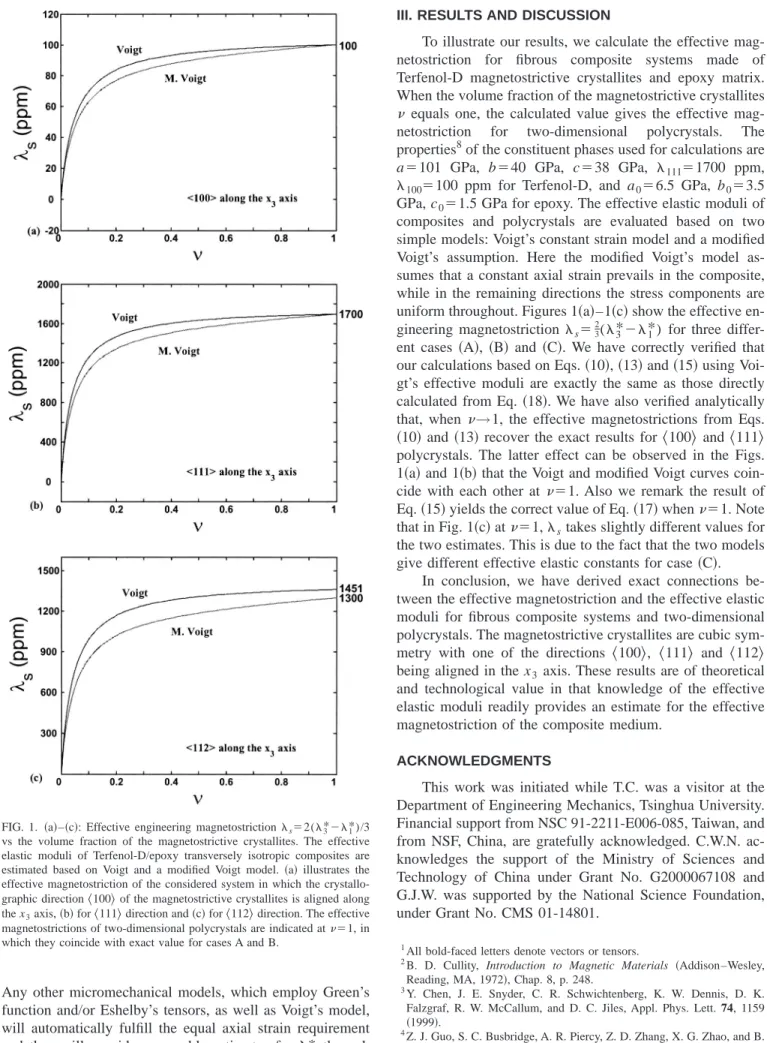
To illustrate our results, we calculate the effective mag- netostriction for fibrous composite systems made of Terfenol-D magnetostrictive crystallites and epoxy matrix.
When the volume fraction of the magnetostrictive crystallites
equals one, the calculated value gives the effective mag- netostriction for two-dimensional polycrystals. The properties
8of the constituent phases used for calculations are a
⫽101 GPa, b⫽40 GPa, c⫽38 GPa, 111⫽1700 ppm,100⫽100 ppm for Terfenol-D, and a0⫽6.5 GPa, b0⫽3.5
GPa, c
0⫽1.5 GPa for epoxy. The effective elastic moduli ofcomposites and polycrystals are evaluated based on two simple models: Voigt’s constant strain model and a modified Voigt’s assumption. Here the modified Voigt’s model as- sumes that a constant axial strain prevails in the composite, while in the remaining directions the stress components are uniform throughout. Figures 1
共a兲–1共c兲 show the effective en-gineering magnetostriction
s⫽23(
3*
⫺1* ) for three differ- ent cases
共A兲, 共B兲 and 共C兲. We have correctly verified thatour calculations based on Eqs.
共10兲, 共13兲 and 共15兲 using Voi-gt’s effective moduli are exactly the same as those directly calculated from Eq.
共18兲. We have also verified analyticallythat, when →1, the effective magnetostrictions from Eqs.
共10兲 and 共13兲 recover the exact results for 具
100
典and
具111
典polycrystals. The latter effect can be observed in the Figs.
1
共a兲 and 1共b兲 that the Voigt and modified Voigt curves coin-cide with each other at
⫽1. Also we remark the result ofEq.
共15兲 yields the correct value of Eq. 共17兲 when
⫽1. Notethat in Fig. 1
共c兲 at
⫽1, stakes slightly different values for the two estimates. This is due to the fact that the two models give different effective elastic constants for case
共C兲.In conclusion, we have derived exact connections be- tween the effective magnetostriction and the effective elastic moduli for fibrous composite systems and two-dimensional polycrystals. The magnetostrictive crystallites are cubic sym- metry with one of the directions
具100
典,
具111
典and
具112
典being aligned in the x
3axis. These results are of theoretical and technological value in that knowledge of the effective elastic moduli readily provides an estimate for the effective magnetostriction of the composite medium.
ACKNOWLEDGMENTS
This work was initiated while T.C. was a visitor at the Department of Engineering Mechanics, Tsinghua University.
Financial support from NSC 91-2211-E006-085, Taiwan, and from NSF, China, are gratefully acknowledged. C.W.N. ac- knowledges the support of the Ministry of Sciences and Technology of China under Grant No. G2000067108 and G.J.W. was supported by the National Science Foundation, under Grant No. CMS 01-14801.
1All bold-faced letters denote vectors or tensors.
2B. D. Cullity, Introduction to Magnetic Materials 共Addison–Wesley, Reading, MA, 1972兲, Chap. 8, p. 248.
3Y. Chen, J. E. Snyder, C. R. Schwichtenberg, K. W. Dennis, D. K.
Falzgraf, R. W. McCallum, and D. C. Jiles, Appl. Phys. Lett. 74, 1159 共1999兲.
4Z. J. Guo, S. C. Busbridge, A. R. Piercy, Z. D. Zhang, X. G. Zhao, and B.
W. Wang, Appl. Phys. Lett. 78, 3490共2001兲.
5M. Birsan, J. Appl. Phys. 82, 6138共1997兲.
FIG. 1. 共a兲–共c兲: Effective engineering magnetostriction s⫽2(3*⫺1*)/3 vs the volume fraction of the magnetostrictive crystallites. The effective elastic moduli of Terfenol-D/epoxy transversely isotropic composites are estimated based on Voigt and a modified Voigt model. 共a兲 illustrates the effective magnetostriction of the considered system in which the crystallo- graphic direction具100典of the magnetostrictive crystallites is aligned along the x3axis,共b兲 for具111典direction and共c兲 for具112典direction. The effective magnetostrictions of two-dimensional polycrystals are indicated at⫽1, in which they coincide with exact value for cases A and B.
6J. F. Herbst, T. W. Capehart, and F. E. Pinkerton, Appl. Phys. Lett. 70, 3041共1997兲.
7C. W. Nan, Appl. Phys. Lett. 72, 2897共1998兲.
8C. W. Nan and G. J. Weng, Phys. Rev. B 60, 6723共1999兲.
9W. D. Armstrong, J. Appl. Phys. 87, 3027共2000兲.
10J. H. Huang, C. W. Nan, and R. M. Li, J. Appl. Phys. 91, 9261共2002兲.
11J. L. Cribb, Nature共London兲 220, 576 共1968兲.
12G. J. Dvorak, Proc. R. Soc. London, Ser. A 431, 89共1990兲.
13K. Sculgasser, J. Mater. Sci. Lett. 8, 228共1989兲.
14T. Chen, J. Mater. Sci. Lett. 13, 1175共1994兲.
15J. F. Nye, Physical Properties of Crystals共Clarendon, Oxford, 1985兲, p.
296.
16C. Kittel, Rev. Mod. Phys. 21, 541共1949兲.
17V. M. Levin, Mechanics of Solids 2, 58共1967兲; 关Mekh. Tverdogo Tela 1, 88共1967兲兴.
18Y. Benveniste and G. J. Dvorak, J. Mech. Phys. Solids 40, 1295共1992兲.
19G. W. Milton, The Theory of Composites 共Cambridge University Press, Cambridge, 2002兲.
20R. Hill, J. Mech. Phys. Solids 12, 199共1964兲.
21T. Chen, Proc. R. Soc. London, Ser. A 454, 873共1998兲.
22C. W. Nan, Y. Huang, and G. J. Weng, J. Appl. Phys. 88, 339共2000兲.