行政院國家科學委員會專題研究計畫 成果報告
探討在 Web 2.0 環境下影響個人持續分享與付費行為之因 素(第 2 年)
研究成果報告(完整版)
計 畫 類 別 : 個別型
計 畫 編 號 : NSC 97-2410-H-011-010-MY2
執 行 期 間 : 98 年 08 月 01 日至 99 年 07 月 31 日 執 行 單 位 : 國立臺灣科技大學資訊管理系
計 畫 主 持 人 : 盧希鵬
計畫參與人員: 碩士班研究生-兼任助理人員:魏貝珊 碩士班研究生-兼任助理人員:莊懿馨 碩士班研究生-兼任助理人員:林忠儀 碩士班研究生-兼任助理人員:郭顓毅 碩士班研究生-兼任助理人員:吳俊賢 碩士班研究生-兼任助理人員:李日嬋 博士班研究生-兼任助理人員:周昭臣
處 理 方 式 : 本計畫可公開查詢
中 華 民 國 99 年 10 月 06 日
The Influence of Extro/Introversion on the Intention to Pay for Social Networking Sites
摘要
雖然社交網站近年來已吸引越來越多的會員與網友們的注意,但少有研究探討哪 些因素以及內外向特質會如何影響使用者的付費意願。因此,本研究從認知價值與滿 意度的觀點提出研究模型,並透過收集到的 288 個付費使用者的回覆來驗證研究模 型,同時,探索內外向使用者在認知價值上的差異。研究模型以 PLS-Graph 3.0 軟體 進行驗證,在所有 8 個假設中,有 6 個假設是支持的,研究結果指出,認知價值顯著 的影響使用者付費的意願,而滿意度則無法顯著的影響付費意願,此外,本研究發現 外向使用者較重視社交價值,而內向使用者較重視情感與金錢價值,最後,本研究提 供一些學術及實務上的意涵。
關鍵字:社交網站、認知價值、滿意度、內向與外向
Abstract
Although social networking sites (SNSs) have attracted increased attention and members in recent years, there is little research on what factors and how extroversion or introversion mightinfluencemembers’intention to pay fortheseservices.Therefore,the present study proposed a model from value and satisfaction perspectives and tested the model to examine the influence of these factors on the payment intention through an empirical survey of 288 SNS members. At the same time, the differences in the perceived value between extroverts and introverts were explored. The causal model was validated using PLS-Graph 3.0; and 6 out of 8 study hypotheses were supported. The results indicated that perceived value significantly influenced the intention to pay SNS the subscription fees while satisfaction did not. Moreover, it was found that extroverts thought more highly of the social value of the SNS, whereas introverts placed more importance on the emotional and price value of the SNS. Finally, the implications for academic researchers and SNS providers of these findings are discussed.
Keywords: Social networking sites (SNSs); Perceived value; Satisfaction; Extroversion and introversion
Table of Content
摘要 ...I Abstract...I Table of Content... II List of Tables... III List of Figures... IV
Introduction and Research Purpose ... 1
Research Model and Hypotheses... 1
Methodology ... 2
Research instrument ... 2
Results... 3
Discussion... 7
Limitations and Future Research ... 8
Self-evaluation of achievement... 8
References... 9
List of Tables
Table 1: Comparison of corresponding path coefficients...6 Table 2: Summary of testing results...6
List of Figures
Fig. 1 Research model ...2
Fig. 2 Research model for combined dataset...4
Fig. 3 Research model for extroverts...4
Fig. 4 Research model for introverts. ...5
Introduction and Research Purpose
Although social networking sites continuously provide new services for their users, such asblogs,photos,music,and videos,in hopesto increasetheusers’intention to update their content on these services or pay for the services, many members are still reluctant to pay for subscription fees to SNSs, and SNSs so far lack a viable revenue model [7].
Recently, there have been a few studies exploring the motivation for paying for Internet services [5,9]. Based on the studies, two of the major motivation for paying for digital products or services were value and satisfaction. Similarly, before making a decision to pay for the subscription, the members of an SNS would consider their past experiences and compare what they obtained from the subscription with what they gave to an SNS.
Consequently, one of the research purposes is to investigate the influence of these two factors on the intention to pay for the subscription of an SNS.
In addition, people with different personality types may have different needs for communication and interaction on an SNS. Particularly, the differences between extroverted and introverted types have been explored [3,11]. Researchers believe that personalities influence users’purchasing decisions on the Internet [6]. For instance, it has been shown that extroverted types are more likely to be influenced by their peers than introverted type when making a purchasing decision in a virtual environment [1]. One possible explanation is that extroverts prefer to discuss and exchange opinions with other people online. A recent study also found that extroverts tend to belong to more online groups on an SNS than introverts [8]. Accordingly, extrovert people may think highly of the social values of an SNS. As a result, for SNS service developers, understanding the values of SNS services which appeal to different personality types will help them design features not only for a target groups of particular users, but a target personality as well.
Therefore, this research also explores the impact of extroversion/introversion type on the perceived value and the intention to pay for an SNS.
Research Model and Hypotheses
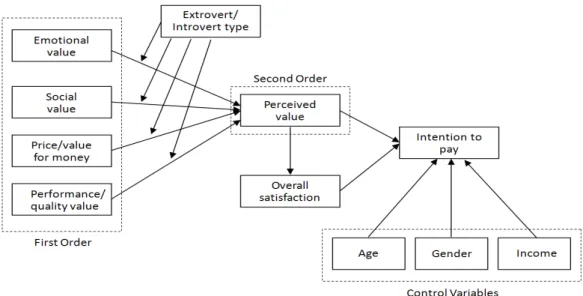
In developing our research model, we reviewed the literature which is relevant to our research focus. Fig. 1 presents the model and its constructs as derived from previous research. Particularly, this study proposes that extroversion/introversion would moderate the relationships between overall perceived value and its’four dimensions. The constructs and hypotheses are detailed below.
Fig. 1 Research model
Methodology
The proposed research model was tested by using the method of partial least squares regression (PLS). Most of the items measuring the concerned constructs were adapted from prior related research with slight modifications to fit the SNS context. For all the measures, a five-point Likert scale was used.
VIP members of iPartment (www.i-part.com.tw), who pay subscription fees for advanced services, are the population of this study. iPartment is the most popular avatar SNS in Taiwan and China (www.ipart.cn). Different from most web service providers, the profits of iPartment come mainly from subscription fees and the sale of virtual items, rather from advertising.
The samples were selected by the random visit function provided by iPartment. We posted a private invitation message of the online questionnaire survey on the guest book of 1200 VIP members. Consequently, 288 responses of the members were received and used to test our hypotheses.
Research instrument
The questionnaire consisted of two parts. The first part was the Chinese version of MBTI (Form G) test, which is certified by (Consulting Psychologists Press) CPP Inc. and used to testindividuals’personality,and contains94 forced-choice items. The second part
of the questionnaire involved a 16-item measure of perceived value, 2-item measure of the intention to repurchase and 4-item measure of overall satisfaction with the services. The items were adapted or modified from past research and were examined by two experts in SNSs to make sure that the items fit the context of this study. The 16-item measure of perceived value, which was modified from the scale items of Sweendy and Soutar, revealed four dimensions of perceived value, including emotional value, social value, price/value for money, and performance/quality value. The 2-item measure of the intention was adapted from the items of Venkatesh and Davis [10]. Similarly, the four items measuring overall satisfaction were adapted from Cronin et al.. The 22 items were measured on a five-point Likert scale, ranging from “disagree strongly” (1) to “agree strongly” (5). The appendix presents a list of the items used. The four dimensions of perceived value were described as follows:
1. Emotional value: the utility derived from the feelings or affective states that the product/service of iPartment generates.
2. Socialvalue:theutility derived from theproduct’s/service’sability ofiPartmentto enhance social self-concept.
3. Price/value for money: the utility derived from the service of iPartment due to the reduction of its perceived short-term and long-terms costs.
4. Performance/quality value: the utility derived from the perceived quality and expected performance of the product/service of iPartment.
Results
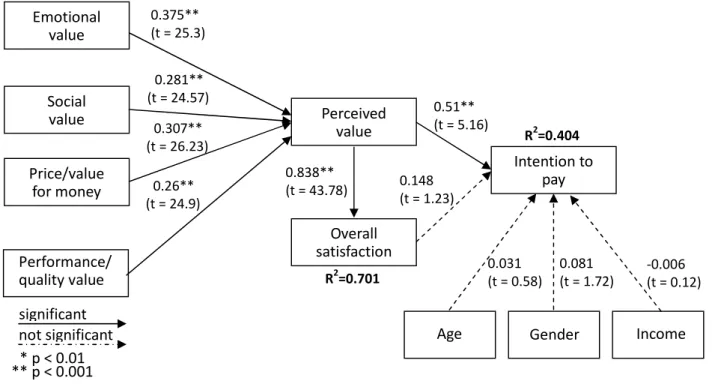
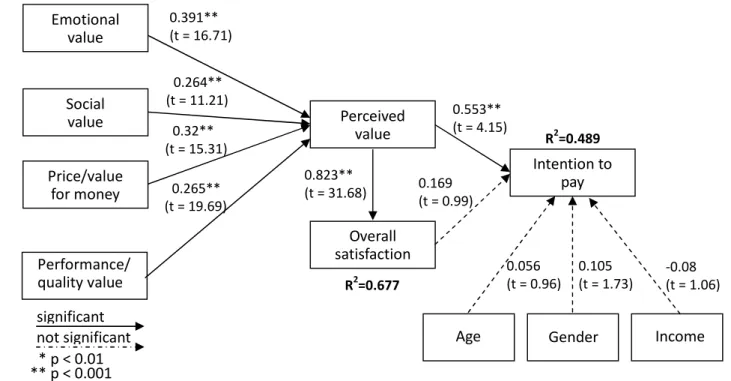
The Bootstrap resembling procedure was performed to derive t-statistics for the path coefficients. Figures 2, 3 and 4 show the results of the sign and significance of the path coefficients, the t-values, the R2values, and the difference test of the path coefficients. The R2 values indicate how well the antecedents explain an endogenous variable. For all respondents (Figure 2), the model explained 70.1% and 40.4% of the variance in overall satisfaction and repurchase intention respectively. In terms of hypotheses, perceived value significantly affected overall satisfaction and intention to repurchase. Within the extroverts and introverts sub-sample (Figures 3 and 4), perceived value had significant impacts on overall satisfaction and repurchase intention as well. H2 and H4 were supported accordingly. However, the effect of overall satisfaction on the intention was not significant within the combined dataset and sub-samples. Hence, H5 was not supported. In addition, none of the three control variablessignificantly influenced members’intention,which was
contrary to our proposition. Surprisingly, only 32.4% of the variance on extroverts’ intention wasexplained while48.9% ofthevarianceon introverts’intention wasexplained.
Fig. 2 Research model for combined dataset.
Fig. 3 Research model for extroverts.
** p < 0.001 Emotional
value
Social value
Price/value for money
Performance/
quality value
Perceived value
Overall satisfaction
Intention to pay
Age Gender Income
0.838**
(t = 43.78)
0.51**
(t = 5.16)
0.148 (t = 1.23) 0.375**
(t = 25.3)
0.281**
(t = 24.57) 0.307**
(t = 26.23)
0.26**
(t = 24.9)
0.081 (t = 1.72) 0.031
(t = 0.58) -0.006
(t = 0.12) R2=0.404
* p < 0.01
R2=0.701 significant
not significant
** p < 0.001 Emotional
value
Social value
Price/value for money
Performance/
quality value
Perceived value
Overall satisfaction
Intention to pay
Age Gender Income
0.85**
(t = 33.79)
0.475*
(t = 2.86)
0.089 (t = 0.50) 0.359**
(t = 17.97)
0.297**
(t = 18.51) 0.295**
(t = 17.65)
0.261**
(t = 22.68)
0.063 (t = 0.89) -0.038
(t = 0.56) 0.112
(t = 1.50) R2=0.324
* p < 0.01
R2=0.722 significant
not significant
Fig. 4 Research model for introverts.
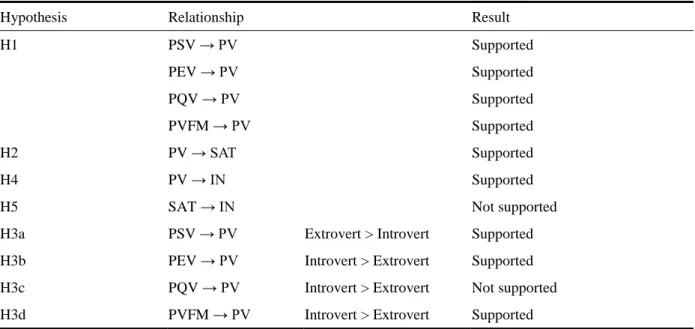
As predicted in H1, among the combined dataset and subsamples, PEV, PSV, PQV and PVFM were positively associated with the overall perceived value. Therefore, H1 was supported. Within the extrovert sub-sample, perceived emotional value and perceived social value had the strongest and the second strongest positive association with the overall perceived value respectively. Within the introvert sub-sample, the first two strong predictors of their overall perceived value were perceived emotional value and perceived price/value for money.H3 on thedifferencesbetween introverts’and extroverts’perceived value was tested by statistically comparing corresponding path coefficients in these structural models. The procedure for the statistical comparison suggested by Chin [2] was used to develop a multi-group analysis, which was implemented in the past research [4].
According to the comparison results (shown in Table 1), wefound thatintroverts’PEV and PVFM had strongerimpactson theiroverallperceived valuewhileextroverts’PSV had more influence on their overall perceived value. This shows that the impact of the three dimensions of perceived value on the overall perceived value differed because of personalities. Hence, H3a, H3b and H3d were supported. Opposite to our expectation, the test result of H3c was not significant, which means the influence of PQV on overall perceived value did not have a statistical difference between introverts and extroverts. The
** p < 0.001 Emotional
value
Social value
Price/value for money
Performance/
quality value
Perceived value
Overall satisfaction
Intention to pay
Age Gender Income
0.823**
(t = 31.68)
0.553**
(t = 4.15)
0.169 (t = 0.99) 0.391**
(t = 16.71)
0.264**
(t = 11.21) 0.32**
(t = 15.31)
0.265**
(t = 19.69)
0.105 (t = 1.73) 0.056
(t = 0.96) -0.08
(t = 1.06) R2=0.489
* p < 0.01
R2=0.677 significant
not significant
summary of the testing results are showed in Table 2.
Table 1: Comparison of corresponding path coefficients
PEV: Perceived emotional value; PSV: Perceived social value;
PVFM: Perceived price/value for money; PQV: Perceived performance/quality value;
PV: Overall perceived value
*Significant at the 0.05 level; t-value (1-tailed) = 1.645.
**Significant at the 0.025 level; t-value (1-tailed) = 1.96.
ns. Non-significant
Table 2: Summary of testing results
Hypothesis Relationship Result
H1 PSV → PV Supported
PEV → PV Supported
PQV → PV Supported
PVFM → PV Supported
H2 PV → SAT Supported
H4 PV → IN Supported
H5 SAT → IN Not supported
H3a PSV → PV Extrovert > Introvert Supported
H3b PEV → PV Introvert > Extrovert Supported
H3c PQV → PV Introvert > Extrovert Not supported
H3d PVFM → PV Introvert > Extrovert Supported
PEV: Perceived emotional value; PSV: Perceived social value;
PVFM: Perceived price/value for money; PQV: Perceived performance/quality value;
PV: Overall perceived value; SAT: Overall satisfaction; IN: Intention to pay Extrovert Introvert Difference
Beta Beta t-value Result
PEV → PV 0.359 0.391 -1.98** I > E
PSV → PV 0.297 0.264 1.74* E > I
PQV → PV 0.261 0.265 -0.17 ns.
PVFM → PV 0.295 0.320 -1.69* I > E
Number 136 152
Discussion
According to the PLS results, all hypotheses were supported except for H3c and H5.
The discussion of the findings is presented as follow. First, the findings revealed that perceived valueofweb serviceswasan importantpredictorofusers’overallsatisfaction and behavioral intention. People might have more intention to pay for the subscription if provided with a higher value of web service. Additionally, overall satisfaction will be increased with a raise in perceived value. Inconsistent with prior research, it was found that overall satisfaction did not have a significant effect on intention. The reason may be that satisfaction is both market- and context-sensitive. In the web service context, various web services are provided, and most of them are free of charge. Merely increasing customer satisfaction may not lead to the intention to pay for the subscription. Customers will not risk effort and money in web services unless the value is assured. Therefore, the value of the services is a more important factor than satisfaction. Web service providers should make more effort to increase the value of services that members can readily perceive.
Second, for all respondents, perceived emotional value, social value, price/value for money and performance/quality value had strong effects on the perceived value of web services. In particular, emotional value had the strongest indirect effect (0.375×0.499=0.187) on intention to pay for subscription. This finding demonstrates that people would be more willing to pay for web services if using the web services could generate positive feelings, such as pleasure or relaxation. This finding is consistent with other recent studies. In addition, the results reveal that users consider not only the price/value for money but also the quality and social value. Although past research has found that social value had no or less impact on the intention to purchase, it showed that social value was an important factor of the intention to pay for the subscription of an SNS.
Third, although past research found that control variables, which are gender, age and personalincome,would influenceusers’behaviorson websites,thisstudy did notidentify their effects on payment intention. These results highlight the importance of the perceived valueto users’intention to pay.Themain reason why peoplepay forSNS servicesmay be that SNSs provide worthy services for their members. People would not pay for a less valuable service even though they have higher personal income.
Finally, introverts and extroverts focused on different values. This study shows that social value is a more important factor for extroverts than for introverts. Extroverts will have more intention to pay for web services if the web services can enhance their social self-concept.Onepossiblereason isthatSNSscan satisfy extroverts’need to interactwith people and help them gain energy from outer world of people. Compared to extroverts, introverts put more emphasis on the price/value for money and emotional value. This
implied that introverts are more cost-sensitive about virtual items and care more about the pleasure that web services provide them. Contrary to hypothesis 3c, the influence of performance/quality value on introverts’ and extroverts’ intention is not significantly different, which showed that introverts’ and extroverts’ concerns about the performance/quality of SNS services were approximately.
Limitations and Future Research
This study has some limitations as most field surveys have suffered and should be interpreted. First, this study focuses exclusively on the effect of perceived value and satisfaction on the intention of SNS members to pay for subscription. Other relational constructs likely affecting the intention to pay for subscription, such as switching barriers of services, should also be examined in the future. Second, the discussed findings and implications were acquired from one single study that was targeted to a specific user group, iPartment users. Caution must be taken when generalizing these research results to other different types of services or contexts. Third, this study only focuses on VIP members because the number of the responses of non-VIP members was small. The explanation may be that most VIP members are active users and will usually check their guest books to reply to othermembers’messages.However,theperceptionsofnon-VIP members may be different and therefore merit exploration. Future research could compare the differences in the payment intention between paid members and unpaid members of an SNS. Fourth, this study was cross-sectional. Additional research effort is needed to evaluate the validity of the model. Finally, the sample may have been biased since all the sample members participated voluntarily in the survey.
Self-evaluation of achievement
Self-evaluation Similarity
between the original proposal and the final project
The final research project is similar with the original proposal. The revised model focuses on the influence of perceived value, satisfaction and personality. Only some research constructs are slightly revised.
Achievement of the
expected goals
The expected goals are fully achieved. We developed and tested the research model. The factors influencing users’ intention to for SNS services were verified. Most of the hypotheses were supported.
Implications for academic researchers
The results of this study provide researchers with an insight into factors contributing to intention to pay for the subscription to the SNS. It also showsthatperceived valueisakey factorin determining acustomer’s intention to pay. The findings can help academic researchers develop value-intention-based theory on Internet services in the future.
Furthermore, the results indicate that extroverted and introverted personalities have different preferences over SNS services and emphasize different values of web services. This suggests that academic researchers could take personality differences into consideration not only in analyzing individual behavior or preferences for an SNS but also exploring the intention to pay for the services, in particular, extro/introversion.
Is it suitable to be
published in academic journals?
Yes!
References
[1] R. Barkhi, and L. Wallace, The impact of personality type on purchasing decisions in virtual stores, Information Technology and Management 8 (4), 2007, pp. 313-330.
[2] W.W. Chin, Frequently Asked Questions - Partial Least Squares and PLS-Graph, http://disc-nt.cba.uh.edu/chin/plsfaq/plsfaq.htm, accessed May 8, 2008.
[3] V.P. Goby, Personality and Online/Offline Choices: MBTI Profiles and Favored Communication Modes in a Singapore Study, CyberPsychology & Behavior 9 (1), 2006, pp. 5-13.
[4] M. Keil, B.C.Y. Tan, K.K. Wei, T. Saarinen, V. Tuunainen, and A. Wassenaar, A cross-cultural study on escalation of commitment behavior in software projects, MIS Quarterly 24 (2), 2000, pp. 299-325.
[5] H.-W. Kim, H.C. Chan, and S. Gupta, Value-based Adoption of Mobile Internet: An
empirical investigation, Decision Support Systems 43 (1), 2007, pp. 111-126.
[6] J.C. McElroy, A.R. Kendrickson, A.M. Townsend, and S.M. Demarie, Dispositional Factors in Interent Use: Personality Versus Cognitive Style, MIS Quarterly 31 (4), 2007, pp. 809-820.
[7] I.O. Murchu, J.G. Breslin, and S. Decker, Online Social and Business Networking Communities, http://www.deri.ie/fileadmin/documents/DERI-TR-2004-08-11.pdf, accessed May 29, 2008.
[8] C. Ross, E.S. Orr, M. Sisic, J.M. Arseneault, M.G. Simmering, and R.R. Orr, Personality and motivations associated with Facebook use, Computers in Human Behavior 25 (2), 2009, pp. 578-586.
[9] O. Turel, and A. Serenko, Satisfaction with mobile services in Canada: An empirical investigation, Telecommunications Policy 30 (5-6), 2006, pp. 314-331.
[10] V. Venkatesh, and F.D. Davis, A theoretical extension of the technology acceptance model: four longitudinal field studies, Management Science 46 (2), 2000, pp.
186-204.
[11] R.E. Yellen, M. Winniford, and C.C. Sanford, Extraversion and Introversion in electronically-supported meetings, Information & Management 28 (1), 1995, pp.
63-74.
無研發成果推廣資料
97 年度專題研究計畫研究成果彙整表
計畫主持人:盧希鵬 計畫編號:97-2410-H-011-010-MY2 計畫名稱:探討在 Web 2.0 環境下影響個人持續分享與付費行為之因素
量化
成果項目 實際已達成
數(被接受 或已發表)
預期總達成 數(含實際已
達成數)
本計畫實 際貢獻百
分比
單位
備 註 ( 質 化 說 明:如 數 個 計 畫 共 同 成 果、成 果 列 為 該 期 刊 之 封 面 故 事 ...
等)
期刊論文 1 1 100%
研究報告/技術報告 0 0 100%
研討會論文 0 0 100%
論文著作 篇
專書 0 0 100%
申請中件數 0 0 100%
專利 已獲得件數 0 0 100% 件
件數 0 0 100% 件
技術移轉
權利金 0 0 100% 千元
碩士生 0 0 100%
博士生 0 0 100%
博士後研究員 0 0 100%
國內
參與計畫人力
(本國籍)
專任助理 0 0 100%
人次
期刊論文 0 0 100%
研究報告/技術報告 0 0 100%
研討會論文 0 0 100%
論文著作 篇
專書 0 0 100% 章/本
申請中件數 0 0 100%
專利 已獲得件數 0 0 100% 件
件數 0 0 100% 件
技術移轉
權利金 0 0 100% 千元
碩士生 0 0 100%
博士生 0 0 100%
博士後研究員 0 0 100%
國外
參與計畫人力
(外國籍)
專任助理 0 0 100%
人次
其他成果
(無法以量化表達之成
果如辦理學術活動、獲 得獎項、重要國際合 作、研究成果國際影響 力及其他協助產業技 術發展之具體效益事 項等,請以文字敘述填 列。)
無
成果項目 量化 名稱或內容性質簡述
測驗工具(含質性與量性) 0
課程/模組 0
電腦及網路系統或工具 0
教材 0
舉辦之活動/競賽 0
研討會/工作坊 0
電子報、網站 0
科 教 處 計 畫 加 填 項
目 計畫成果推廣之參與(閱聽)人數 0
國科會補助專題研究計畫成果報告自評表
請就研究內容與原計畫相符程度、達成預期目標情況、研究成果之學術或應用價 值(簡要敘述成果所代表之意義、價值、影響或進一步發展之可能性)、是否適 合在學術期刊發表或申請專利、主要發現或其他有關價值等,作一綜合評估。
1. 請就研究內容與原計畫相符程度、達成預期目標情況作一綜合評估
■達成目標
□未達成目標(請說明,以 100 字為限)
□實驗失敗
□因故實驗中斷
□其他原因 說明:
2. 研究成果在學術期刊發表或申請專利等情形:
論文:■已發表 □未發表之文稿 □撰寫中 □無 專利:□已獲得 □申請中 ■無
技轉:□已技轉 □洽談中 ■無 其他:(以 100 字為限)
3. 請依學術成就、技術創新、社會影響等方面,評估研究成果之學術或應用價 值(簡要敘述成果所代表之意義、價值、影響或進一步發展之可能性)(以 500 字為限)
The findings can help academic researchers develop value-intention-based theory on Internet services in the future. Furthermore, the results indicate that extroverted and introverted personalities have different preferences over SNS services and emphasize different values of web services. This suggests that academic researchers could take personality differences into consideration not only in analyzing individual behavior or preferences for an SNS but also exploring the intention to pay for the services, in particular, extro/introversion.