
行政院國家科學委員會專題研究計畫 成果報告
氧化釕氧化銥導電氧化物奈米桿(3/3) 研究成果報告(完整版)
計 畫 類 別 : 整合型
計 畫 編 號 : NSC 95-2120-M-011-001-
執 行 期 間 : 95 年 08 月 01 日至 96 年 10 月 31 日 執 行 單 位 : 國立臺灣科技大學化學工程系
計 畫 主 持 人 : 蔡大翔
共 同 主 持 人 : 黃鶯聲、劉進興、江志強
計畫參與人員: 博士班研究生-兼任助理:陳瑞山、鐘文宏、Diah Susanti、
王嘉慶、陳信言
碩士班研究生-兼任助理:趙子維、謝安和、王璽凱、蔡宗 穎、陳亭傑、單啟齊、黃世惠、鄭佑章、王仁君、柯元富 博士後研究:Alexandru Korotcov、M.V. Madhava Rao、周 宏隆
主持人:蔡大翔、黃鶯聲 協同主持人:劉進興、江志強
報 告 附 件 : 出席國際會議研究心得報告及發表論文
處 理 方 式 : 本計畫涉及專利或其他智慧財產權,1 年後可公開查詢
中 華 民 國 96 年 10 月 11 日
行政院國家科學委員會補助專題研究計畫 ■ 成 果 報 告
□期中進度報告
氧化釕氧化銥導電氧化物奈米桿(3/3)
Nanorods of RuO
2and IrO
2conducting oxides
計畫類別:□ 個別型計畫 ■ 整合型計畫計畫編號:NSC 95-2120-M-011-001
執行期間: 95 年 8 月 1 日至 96 年 10 月 31 日
計畫主持人:蔡大翔(DST)、黃鶯聲(YSH) 共同主持人:劉進興(CJL)、江志強(JCJ)
計畫參與人員: Dr. Alexandru Korotcov, Dr. M. V. Rao, Dr. 周宏隆 (postdoc), Dr. 陳瑞山 Reui-San Chen, 蔡宗穎、張弘民、梁雅閔、謝志松、王仁君、謝育 淇、柯元富、趙子維、周立維、王嘉慶、鐘文宏、單啟齊、黃世惠、鄭家樑、
Diah Susanti、謝安和、陳亭傑、鄭佑章、蔡順如、王璽凱、簡劦宏、李威德、
洪文鍾、蔡佳珊、沈明逸、梁嘉文、斐紹凱、陳宜民、陳麒安、許宏彬 (以上 人員屬台科大) 、陳信言(淡江)、Prof. Kwong-Kau Tiong(海大電機)、Prof. W. F.
Pong(淡江物理)、Prof. Wen-Chang Yeh (台科大電子)。
成果報告類型(依經費核定清單規定繳交):□精簡報告 ■完整報告 本成果報告包括以下應繳交之附件:
■赴國外出差或研習心得報告一份
□赴大陸地區出差或研習心得報告一份
□出席國際學術會議心得報告及發表之論文各一份
□國際合作研究計畫國外研究報告書一份
處理方式:除產學合作研究計畫、提升產業技術及人才培育研究計畫、
列管計畫及下列情形者外,得立即公開查詢
□涉及專利或其他智慧財產權,■一年□二年後可公開查詢
執行單位:台灣科技大學
中 華 民 國 九十六 年 十 月 日
中文摘要
過去三年研究計畫期間,我們探討導電氧化物氧化釕(RuO2)氧化銥(IrO2) 奈米相,分析其一維結構,及量測設定目標的相關性質,此奈米相材料是首先 在台灣科技大學發現並廣泛研究的。氧化釕氧化銥奈米相的潛在應用與其氧化 物特性息息相關,也深值於其微小的尖端與管狀的圍繞空間幾何形狀。
我們發展出兩種成長氧化釕氧化銥奈米相的方法,有機金屬化學氣相沉積 (MOCVD)與反應性濺鍍(reactive sputtering),並發現這兩種氧化物與其下基材 間的磊晶關係,這些奈米相晶體可利用它沿 c 軸成長晶癖與晶格匹配特性排成
陣列,而且奈米相的幾何形狀可用成長速率控制。除一般的X 光繞射分析、X
光電子能譜術、掃描式電鏡術、穿透式電鏡術分析奈米相之外,我們也以拉曼 光譜術分析一維材料,並發展一修正理論描述受一維材料局限的聲子散射。在 潛在應用方面,我們研究氧化釕氧化銥奈米桿的場發射特性,由氧化銥奈米管 衍生的PtIr-IrO2電化學觸媒,包裹在水合氧化釕內RuRuO2奈米桿的電化學電 容,IrO2的氣體感測,及PtRu-RuO2奈米桿電化學觸媒。
關鍵詞:氧化釕、氧化銥、一維奈米相、場發射、電化學觸媒、電化學電容、
氣體感測。
ABSTRACT
In the three-year program, we studied growth mechanisms of the nanophase of the conductive oxides RuO2 and IrO2 discovered at NTUST, analyzed their one-dimensional (1-D) structures, and measured those properties related to targeted applications. The potential applications of RuO2 and IrO2 nanophases are deeply rooted in the oxide nature of the two materials and the tiny tips or enclosures provided by their unique geometries.
We have developed two methods in growing RuO2 and IrO2 1D materials, metalorganic chemical vapor deposition and reactive sputtering. We have found the epitaxial growth relation between two oxides and the underlying substrate. The 1D materials can be aligned by taking advantage of lattice matching and c-axis growth habit. The geometry of 1D materials can be controlled by the growth rate. In addition to the characterization of RuO2 and IrO2 nanocrystals by X-ray diffraction, X-ray photoelectron spectroscopy, scanning electron microscopy, transmission electron microscopy, we also analyzed the 1D materials using Raman spectroscopy, and developed a modified theory to characterize the phonon confinement in these 1D materials. Among their potential applications, we studied the field emission of RuO2 and IrO2 nanorods, the electrocatalytic properties of PtIr-IrO2 thin wall catalysts derived from nanotubes, the capactive properties of RuRuO2 nanorods encased in hydrous RuO2, the gas sensing properties of IrO2 sensors, and PtRu-RuO2 nanorods electrocatalysts.
Keywords: RuO2, IrO2, one dimensional nanophase, field emission, electrocatalyst, electrochemical capacitor, gas sensing.
Content
Introduction ………. 5
Research goals ………..8
Methodology and experimental details ……….9
1. Synthesis of RuO2 and IrO2 nanophases………...9
2. Chemicals and substrates used in this projects……….10
Results and discussion ……….13
1. Synthesis of RuO2 IrO2 nanophase and its structure characterization…13 2. Field emission of vertically aligned IrO2 and RuO2 nanorods…………14
3. An organic vapor sensor based on nanostructured IrO2………..15
4. Pt-Ir-IrO2 electrocatalyst for methanol oxidation………15
5. Electrochemical capacitors derived from RuO2 nanorods………15
Self-evaluation of the nanoproject on RuO2 and IrO2……….17
1. Achievements……….17
2. List of published papers………..18
3. Attachments……….21
Figures and tables……….29
Introduction
The element Ru is at the center of the periodic table, one of six platinum group metals. Ruthenium is a rather rare element, comprising approximately 10-8% of the earth’s crust. Because of its electron configuration [Kr]4d75s1, Ru can form compounds with valences up to +8. Most of its compounds are six-coordinated in regular or distorted octahedrons. Five and seven-coordinated compounds are known but they are uncommon [1]. Ru metal and its compounds find applications in electrodes used in chlor-alkali industry and other electrochemical processes [2,3], bifunctional catalyst (PtRu, PtRuOxHy) in anodes of the direct fuel cells for oxidation of small organic molecules [4,5], and hardener (in Pt or Pd alloy) or electrodes in electrical circuits [6]. Dimensionally stable anode (DSA) of RuO2/Ti is the first large-scale application of Ru compounds, one of the rare cases which technological innovations are ahead of scientific investigations [2,3].
Ruthenium is not as noble as other platinum group metals, except osmium.
Many binary oxides of ruthenium have been claimed, including RuO, Ru2O3, RuO2, Ru2O5, RuO3, RuO4. But ruthenium dioxide RuO2 is the only solid phase of sufficient stability for device applications.
RuO2 crystal adopts the tetragonal rutile structure with space group P42/mnm and lattice parameter a=4.4968Å, c=3.1049Å [7]. It is also the only crystal structure for RuO2, excluding the CaCl2-type and cubic phases at high pressure [8-10]. The rutile structure may be described as a network of RuO6 octahedrons sharing common edges and forming infinite chains along the c-axis, these chains share corners in the diagonal direction of ab plane, illustrated in Fig. 1.
Alternatively, the structure is viewed as a distorted hexagonal close packed oxygen anion array with one half of its octahedral sites being occupied by Ru4+. RuO2
exhibits metallic conductivity over its entire existence temperature range, a low bulk resistivity 35 μΩ-cm at room temperature and a strong negative temperature coefficient [11]. The metal-like conductivity originates from cation-anion-cation sub-bands, which are formed by overlapping of 4d-orbitals of Ru with 2p orbitals of oxygen [12,13].
IrO2 is also a member of the conducting oxide family that crystallizes in rutile structure [12]. Its lattice parameter is a=4.5051Å, c=3.1586Å [7], similar to RuO2. IrO2 has been an attractive materials for pH sensors [14-16], for acidity and basicity determination in an non-aqueous industrial lubricant environment [17], durable electrodes for chlorine and oxygen evolution [18-20], excellent diffusion barrier and suitable electrode material for ferroelectric nonvolatile memory devices [21-23], optical switching layers in electrochromic displays [24-25], also as an emitter material for field emission cathode of vacuume microelectronic devices and field emission displays [26-29].
Recently, nanoscaled materials such as wires, rods, belts, and tubes have become the focus of intensive research owing to their fundamental interests in science and potential in the fabrication of nanodevices [30-32]. The development of nanodevices might benefit from the unique morphology, huge surface area, and high aspect ratio of nanocrystals. A wide range of the nanosized oxide materials is currently the center of a rapidly growing scientific community. The electrically insulating and/or semiconducting oxides of nanostructured SiO2 [33], TiO2 [34], SnO2 [35], GeO2 [36], Ga2O3 [37], and VOx [38] have been prepared and studied.
Among the numberous metallic oxides, the electrically conducting RuO2 and IrO2 possess unique properties, whose nanophases have been explored in this three year project.
Prof. YS Huang started the research on RuO2 and IrO2 single crystals since
1982. Figure 2 displays 5 pieces of RuO2 single crystal, grown by chemical vapor transport technique [39,40]. These single crystal studies have been the foundation for us to understand the nanophases of RuO2 and IrO2.
Figure 1 Rutile structure of RuO6 (IrO6) octahedra.
Figure 2 Single crystals of RuO2.
Research goals
In the three-year project, we were set to study the growth and control of the nanophases of the conductive oxides RuO2 and IrO2, their one-dimensional 1-D structure characterization, and measurement of those properties related to targeted applications. More specifically, the following items are the research targets:
(A) Synthesis and control of RuO2 and IrO2 nanostructures;
(B) Thermal annealing and other modifications to improve the targeted properties of nanosized RuO2 and IrO2 crystals;
(C) Structure characterization using X-ray diffraction, X-ray photoelectron spectroscopy, Raman spectroscopy, scanning electron microscopy, transmission electron microscopy;
(D) Field emission of nanostructured crystals;
(E) Electrocatalytic properties of modified catalysts derived from RuO2 and IrO2
one dimensional crystals;
(F) Electrochemical capacitive properties of modified materials derived from RuO2
and IrO2 one dimensional crystals;
(G) Gas sensing capability of IrO2 one dimensional crystals.
Methodology and experimental details 1. Synthesis of RuO2 and IrO2 1D nanophases
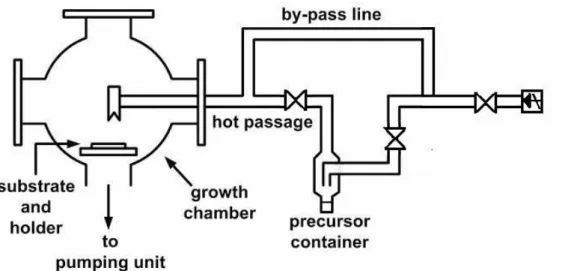
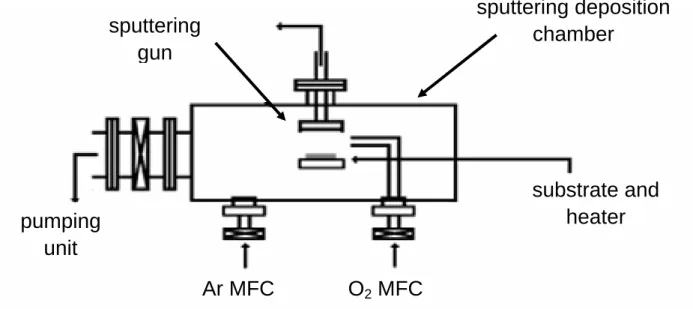
Figure 3 illustrates a schematic diagram of metalorganic chemical vapor deposition (MOCVD) reactor employed in this study. Figure 4 displays a diagram for reactive sputtering. Both methods are used in synthesis of RuO2 and IrO2 1D nanophases with different degrees of freedom in control. These two apparatus and the associated pipelines were designed and assembled by our research group members. They have demonstrated great flexibility and unique capability in synthesis.
Fig. 3 A schematic diagram of MOCVD reactor for RuO2, IrO2 nanophase growth.
Fig. 4 A schematic diagram for reactive sputtering of RuO2 and IrO2 nanophases.
Other structure characterization equipments for microRaman, XPS, SEM, TEM, XRD are not listed here, we either went through the common procedures to approach them, or to cooperate with the persons in charge to access these instruments. It has been a great experience to interact and discuss these materials with other scientists and applied scientists.
2. Chemicals and substrates used in this project (2a) Sapphire substrates
2 – inch Sapphire wafer (single side polished), M-plane(100) and R-plane(012), thickness 0.5 mm, Rhombohedral crystal,lattice constant are a = b = 4.758Å,c
= 12.992 Å.
(2b) SiO2/Si substrates
4-inch p-type Si(100) wafer, thickness 525±25 μm, thermally oxidized in high temperature furnace. The surface SiO2 thickness is 500 nm.
(2c) LiNbO3 (100) substrates, 76.2 mm in diameter, and 0.35 mm in thickness;
substrate and heater
Ar MFC O2 MFC pumping
unit
sputtering gun
sputtering deposition chamber
LiTaO3(012) substrates.
Precursors for MOCVD
(2d) (Methylcyclopentadienyl)(1,5cyclooctadiene)Ir, purchased from Strem Chemicals.
(2e) bis(ethyl cyclopentadienyl)Ru, liquid precursor, purchased from Strem Chemicals.
(2f) Bis(cyclopentadienyl)ruthenium, or ruthenocene, purchased from Strem chemicals.
(2g) Sputtering target - Ru target (purity > 99.95%), 1 inch in diameter and 2.5 mm in thickness.
(2h) Sputtering target - Ir target (purity > 99.95%), 1 inch in diameter and 2.5 mm in thickness.
(2i) Silicon target – Si target (purity > 99.999%), 2 inch in diameter and 6 mm in thickness.
(2j) Hydrogen hexachloroplatinate(IV) hydrate, H2PtCl6, purity > 99.9%;
Ruthenium(III) chloride hydrate, RuCl3•xH2O, purity > 99.9%, Molybdenum(V) chloride, MoCl5, purity > 99.9%; WCl6, purity > 99.9%. These chemicals are used in modifying the reduced RuO2 or IrO2 nanophases.
(2k) High purity gases for growth, protection, and carrier. High purity argon of 99.999%; high purity oxygen of 99.999%; and high purity nitrogen of 99.99%.
(2l) Solvent for cleaning purpose, including acetone (99.95%), ethyl alcohol (99.9%), and nanopure water specific resistance > 18.0 MΩ-cm.
(2m) Methanol, ethanol, formic acid, ethylene glycol were used as fuel for measuring the electro-oxidation activity of the derived electrocatalysts.
(2n) Sulfuric acid H2SO4 and perchloric acid HClO4 were used as the electrolyte in measuring the catalytic properties of electrocatalyst.
(2o) Microostop was used for sealing purposes in packaging the electocatalysts in measurement; conducting silver paste for electrical connection.
(2p) Platinum plates as counter electrodes; platinum wires for electrical connection.
(2q) Reference electrodes including 2 electrodes of Ag/AgCl/3M KCl and 2 electrodes of Ag/AgCl/sat. KCl.
(2r) Photoresist and photomasks for patterning.
(2s) Piezoelectric quartz crystal, and volatile organic vapors including pentane, hexane, heptane, octane, formic acid, acetic acid, propionic acid, methanol, ethanol, propanol, benzene, toluene, m-xylene, methylamine, ethylamine, butylamine, amylamine, hexylamine. These are chemicals for gas sensing measurement.
(2t) Precision balance for weighing chemicals.
(2u) Miscellaneous tools, including tweezers, diamond or tungsten carbide cutters, crucibles, and home-made resistive heaters.
Results and discussion
1. Synthesis of RuO2 IrO2 nanophase and its structure characterization
In three year period, we have developed various control schemes in growing RuO2 and IrO2 nanophases. The control schemes can be categorized in the following three items.
(1a) geometry control of 1D IrO2
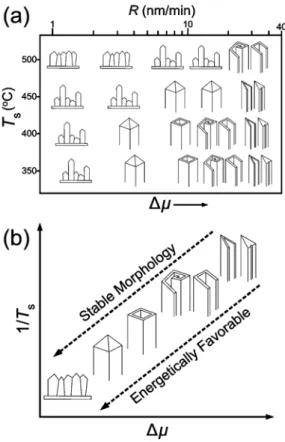
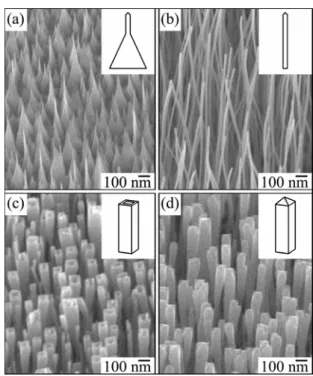
Generally speaking, MOCVD is more versatile than reactive sputtering in growing the nanophases. MOCVD is a kinetics controlling process. The geometry of RuO2 and IrO2 nanophases can be controlled by adjusting the growth kinetics, which were seldom reported in literature. In 1D IrO2 MOCVD growth experiments, decreasing interfacial stability of gas-solid can be used to control the geometry of 1D nanophase. The morphological evolution starts from the most stable thin film, sequentially shift into rods, square tubes, incompletely enclosed tubes, scrolled tubes, wedged shape nanorods with a decreasing interfacial stability. Fig. 5 indicates that the interfacial stability can be manipulated by the growth temperature and the precursor vapor pressure. Fig. 6 shows the SEM images of various geometries of IrO2 nanophase. Please note the nanophases of RuO2 and IrO2 tend to be square in diameter. The square tube of IrO2 is truly unique discovery.
(1b) Alignment and control of RuO2 and IrO2 nanophases
The alignment and the orientation of RuO2 and IrO2 1D structures can be achieved on single crystal substrates. The epitaxial relation between the rutile structure and sapphire crystal planes dictate one of the three distinctive orientations, namely, vertical, 35° tilted, and in-plane orientation, as illustrated in Figs. 7, 8, 9. Figure 10 displays SEM images of aligned nanorods of these three orientations. We can form
three types of array using this epitaxial relation. If the seeding (for example Au seeding) technique is applied, the alignment will be lost.
(1c) Area-selective growth of RuO2 and IrO2 nanorods
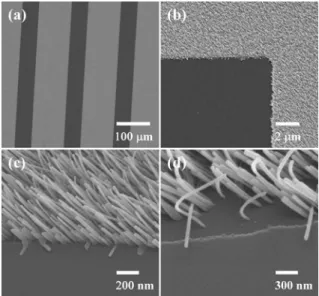
Patterning the nanostructure often requires the technique of area-selective growth, especially for those materials are difficult to etch away. Area-selective growth of RuO2 and IrO2 using CVD has been developed in this research group. We have found that it is the combination of nucleation barrier on SiO2 surface and sublimation of high oxides makes the selective growth feasible. Fig.11 illustrates the patterned 35° tilted IrO2 nanorods, selectively grown on SA(012) substrate. Fig.
12 illustrates the vertically aligned IrO2 nanorods, selectively grown on SA(100) substrate. The selective growth technique can be combined with the alignment control, but it is very difficult to combine with the geometry control.
2. Field emission of vertically aligned IrO2 and RuO2 nanorods
A nanorod with a pyramidal tip is the favorite geometry for field emission applications. As advocated by B. R. Chalamala (Flat Panel Display Division, Motorola), IrO2 has been studied as an emitter material for vacuum electronics. Our discovery of IrO2 nanophases and the reported FE properties have inspired the research interests of the team of Sharp Laboratories of America and Washington State Univ. to work on FE of IrO2 nanorods (Jpn J. Appl. Phys.2005, Nanotechnology, 2005). Fig. 13 shows the IrO2 vertially aligned arrays for field emission measurement, while Figs. 14 and 15 illustrate its field emission characteristics.
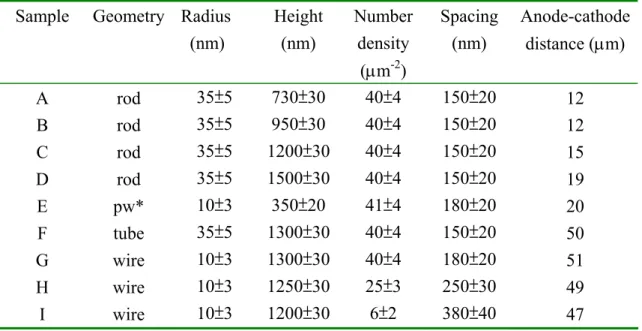
We further explored the field emission properties of RuO2 nanophases and found the wire has the best field emission properties. Fig. 16 shows the morphology
of RuO2 nanocrystals used in FE experiments. Table 1 lists the geometry features of the RuO2 nanophase and their field emission property constants. The length/diameter ratio was found to be an important factor.
3. An organic vapor sensor based on nanostructured IrO2
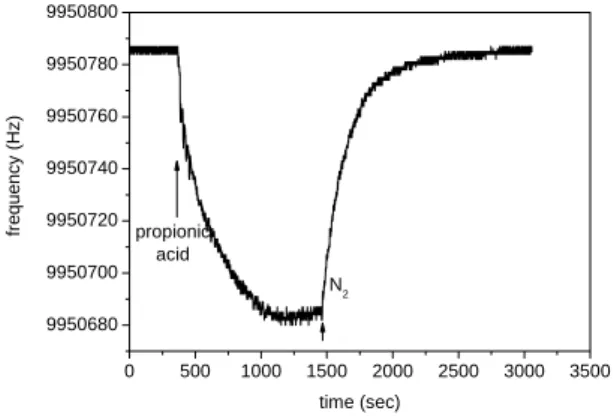
The capability of sensing organic vapor by implementing the quartz crystal microbalance technique was studied using nanostructure IrO2. An IrO2 QCM sensor sensitive to ppm propionic acid and operated at room temperature is demonstrated.
Fig. 17 shows the reversibility of propionic acid signal, while Fig. 18 compares the sensitivity in detection of this organic gas sensor.
4. Pt-Ir-IrO2 electrocatalyst for methanol oxidation
We have prepared PtIr structural electrocatalyst of high activity which was synthesized using IrO2 thin-wall nanotubes grown in CVD. The IrO2 single-crystal wall constrains the Ir grains nucleated in lattice oxygen removal to a preferred direction (Fig. 19) so that the synthesized PtIr catalysts exhibit the structural characteristics of Ir(110) plane (Fig. 20). Its activity in methanol oxidation experiments is illustrated in Fig. 21.
5. Electrochemical capacitors derived from RuO2 nanorods
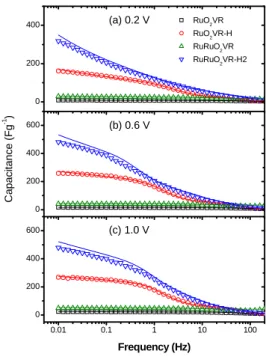
Structural electrodes of anhydrous RuO2 vertical nanorods encased in hydrous RuO2 have been prepared via chemical vapor deposition (CVD) followed by electrochemical deposition. The composite structures are studied using scanning electron microscopy, transmission electron microscopy, X-ray diffraction, X-ray photoelectron spectroscopy. The capacitive properties are measured using cyclic voltammetry and impedance spectroscopy. In a miniaturized configuration, the CVD grown structure provides a connecting backbone of electron paths and open
electrodeposited hydrous RuO2 of high pseudocapacitance. The morphological features are illustrated in Fig. 22. The specific capacitances and their variations can be measured using impedance spectroscopy, shown in Fig. 23.
6. Development of a modified spatial correlation model for Raman spectra
Raman scattering lines position and line shape are sensitive to the nanocrystal size, stress, and alignment. Since we can control the alignment of IrO2 and RuO2, the spatial correlation model for Raman has been modified and applied to the spectra of IrO2 and RuO2.
Self-evaluation of the nanoproject on RuO2 and IrO2
I. Achievements of this project
We have achieved 95% of the research targets in the proposal, if not 100%. We also did something unexpected at the proposal stage (2004), for example, electrochemical capacitor. The details can be found in 29 papers have been published in these three years. Among them, 28 papers were done through the cooperation of YSH and DST. One paper on gas sensing was carried out by C. J.
Liu. J. C. Jiang worked on the computational chemistry problems of RuO2 and IrO2 surfaces, he have not publish yet. These articles in pdf file are listed below and can be found at the end.
Because of the unique results that we found, we were invited to write a review article in Journal of Nanomaterials. The e-mail letter was listed as attachment 1.
The review paper has been accepted and in press, see attachment 2. One PhD
student (Susanti) was awarded travel grant to publish a paper inICAC2007. Diah Susanti, Dah-Shyang Tsai, Ying-Sheng Huang, Alexandru Korotcov, Chia-Liang Cheng, “Electrochemical capacitor behavior of vertically assembled RuO2 rods filled with hydrous RuO2”, P.123 Extended Abstract, International Conference on Advanced Capacitors, May 28-30, 2007, Kyoto, Japan. The e-mail letter is also attached, attachment 3.
In the earlier years of this research project, our students also won a couple of awards. 民國 93 年第三屆兩岸奈米科技會議最佳壁報論文,陳瑞山、黃鶯聲、
蔡大翔,”Self-assembled growth of one-dimensional nanosized IrO2 crystals and their field emission characteristics”, 花蓮東華大學 4 月 27 日- 4 月 29 日民國 92 年中華民國物理學會年會壁報論文獎 – 陳瑞山、黃鶯聲、梁雅閔、蔡大翔、
廖培成,Growth of well-aligned IrO2 nanorods by metalorganic chemical vapor deposition。
II. Papers published in the refereed international jounal
1. Alexandru Korotcov, Ruei-San Chen, Hung-Pin Hsu, Ying-Sheng Huang,
Dah-Shyang Tsai, Kwong-Kau Tiong, “Well-aligned IrO2 nanocrystals”, Journal of Nanomaterials (2007 accepted). 計劃編號 NSC93, 94, 95-2120-M011-001 2. Diah Susanti, Dah-Shyang Tsai, Ying-Sheng Huang, Alexandru Korotcov,
Wen-Hung Chung, (2007) “Structures and Electrochemical Capacitive Properties of RuO2 Vertical Nanorods Encased in Hydrous RuO2”, J. Phys.
Chem. C, 111 (26) 9530-9537. 計劃編號 NSC95-2120-M011-001 3. Y. M. Chen, A. Korotcov, H. P. Hsu, Y. S. Huang, and D. S. Tsai, (2007)
“Raman scattering characterization of well-aligned RuO2 nanocrystals grown on sapphire substrates”, New Journal of Physics, 9,130. 計劃編號
NSC95-2120-M011-001
4. Chi-Chi Shan, Dah-Shyang Tsai, Ying-Sheng Huang, Sie-Hong Jian,
Chia-Liang Cheng, (2007) “Pt-Ir-IrO2NT Thin-wall Electrocatalysts Derived from IrO2 Nanotubes and Their Catalytic Activities in Methanol Oxidation”, Chem. Mater., 19 (3) 424-431. 計劃編號 NSC94-2120-M011-001
5. P. C. Liao, A. Korotcov, C. W. Huang, Y. S. Huang, D. S. Tsai, K. K. Tiong, (2007) “Synthesis of IrO2 nanocrystals on sapphire via metal-organic chemical vapor deposition”, J. Alloys and Compounds, 442, 313-315. 計劃編號
NSC94-2120-M011-001
6. A. Korotcov, H. P. Hsu, Y. S. Huang, P. C. Liao, D. S. Tsai, K. K. Tiong, (2007)
“Deposition and characterization of 1-D RuO2 nanocrystals by reactive sputtering”, J. Alloys and Compounds, 442, 310-312. 計劃編號
NSC94-2120-M011-001
7. H. M. Tsai, P. D. Babu, C. W. Pao, J. W. Chiou, J. C. Jan, K. P. Krishna Kumar, F. Z. Chien, W. F. Pong, M. H. Tsai, C. H. Chan, L. Y. Jang, J. F. Lee, R. S.
Chen, Y. S. Huang, D. S. Tsai, (2007) “Comparison of electronic structures of RuO2 and IrO2 nanorods investigated by X-ray adsorption and scanning photoelectron microscopy” Appl. Phys. Lett., 90, 042108. 計劃編號 NSC94-2120-M011-001
8. Alexandru Korotcov, Ying-Sheng Huang, Kwang-Kau Tiong, Dah-Shyang Tsai, (2007) “Raman scattering characterization of well aligned RuO2 and IrO2
nanocrystals”, J. Raman Spectrosc., 38, 737-749. 計劃編號 NSC94-2120-M011-001
9. T. W. Chao, C. J. Liu, A. H. Hsieh, H. M. Chang,Y. S. Huangand D. S. Tsai, (2007) “Quartz crystal microbalance sensor based on nanostructured IrO2”, Sensors and Actuactors B, 122, 95-100. 計劃編號 NSC93-2120-M011-001 10. Alexandru Korotcov, Hung-Pin Hsu, Ying-Sheng Huang, Dah-Shyang Tsai,
Kwang-Kau Tiong, (2006) “ Growth and characterization of well-aligned RuO2 nanocrystals on oxide substrates via reactive sputtering”, Crystal Growth and Design, 6 [11] 2501-2506. 計劃編號 NSC94-2120-M011-001
11. Alexandru Korotov, Ying-Sheng Huang, Tsung-Ying Tsai, Dah-Shyang Tsai, and Kwong-Kau Tiong, (2006) “Effect of length, spacing, and morphology of vertically aligned RuO2 nanostructures on field emission properties”,
Nanotechnology, 17, 3149-3153. 計劃編號 NSC93-2120-M011-001 12. Alexandru Korotcov, Hung-Pin Hsu,Ying-Sheng Huang, Dah-Shyang Tsai,
(2006) “Raman scattering characterization of well aligned IrO2 nanocrystals grown on sapphire substrates via reactive sputtering,” J. Raman Spectrosc., 37, 1411-1415. 計劃編號 NSC93-2120-M011-001
13. Reui-San Chen, Alexandru Korotcov, Ying-Sheng Huang, Dah-Shyang Tsai, (2006) “One-dimensional conductive IrO2 nanocrystals”, Nanotechnology, 17, R67-R87. 計劃編號 NSC93-2120-M011-001
14. Alexandru Korotcov , Ying-Sheng Huang, Dah-Shyang Tsai , Kwong-Kau Tiong (2006) “Growth and characterization of well-aligned densely packed IrO2 nanocrystals on sapphire via reactive sputtering”, J. Phys.: Condens. Matter, 18, 1121-1136. 計劃編號 NSC94-2120-M011-001
15. Ginny Wang, Dah-Shyang Tsai, Ying-Sheng Huang, Alexandru Korotocov, Wen-Chang Yeh, and Diah Susanti, (2006) “Selective growth of IrO2 nanorods using metalorganic chemical vapor deposition, “ J. Mater. Chem., 16, 780-786.
計劃編號 NSC93-2120-M011-001
16. A. V. Korotcov, Y. S. Huang, D. S. Tsai, K. K. Tiong, (2006) “Growth and characterization of vertically aligned IrO2 one dimensional nanocrystals on LiNbO3(100) via reactive sputtering”, Thin Solid Films, 503, 96-102. 計劃編 號 NSC93-2120-M011-001
17. Alexandru V. Korotcov, Ying-Sheng Huang, Dah-Shyang Tsai, Kwong-Kau Tiong, (2006) “Raman scattering characterization of vertical aligned 1D IrO2 nanocrystals grown on single crystal oxide substrates”, Solid State Commun., 137, 310-314. 計劃編號 NSC93-2120-M011-001
18. Chih-Sung Hsieh, Ginny Wang, Dah-Shyang Tsai, Reui-San Chen, Ying-Sheng Huang, (2005) “Field emission characteristics of ruthenium dioxide nanorods”, Nanotechnology, 16, 1885-1891. 計劃編號 NSC93-2120-M011-001
19. Yuan-Fu Ke, Dah-Shyang Tsai, Ying-Sheng Huang, (2005) “Electrochemical capacitors of RuO2 nanophase grown on LiNbO3(100) and sapphire(0001) substrates”, J. Mater. Chem., 15, 2122-2127. 計劃編號
NSC93-2120-M011-001
20. R. S. Chen, H. M. Chang, Y. S. Huang, D. S. Tsai, K. C. Chiu, (2005)
“Morphological evolution of self-assembled IrO2 one-dimensional
21. C. C. Chen, R. S. Chen, T. Y. Tsai, Y. S. Huang, D. S. Tsai, and K. K. Tiong, (2004) “The growth and characterization of well aligned RuO2 nanorods on sapphire substrates”, J. Phys.: Condens. Matter., 16, 8475-8484. 計劃編號 NSC93-2120-M011-001
22. Chih-Sung Hsieh, Dah-Shyang Tsai, Reui-San Chen, Ying-Sheng Huang, (2004)
“Preparation of ruthenium dioxide nanorods and their field emission characteristics”, Appl. Phys. Lett., 85, 3860-3862. 計劃編號
NSC93-2120-M011-001
23. G. Wang, C. S. Hsieh, D. S. Tsai, R. S. Chen, Y. S. Huang, (2004)
“Area-selective growth of ruthenium dioxide nanorods on LiNbO3(100) and Zn/Si substrates”, J. Mater. Chem., 14, 3503-3508. 計劃編號
NSC93-2120-M011-001
24. R. S. Chen, H. M. Chang, Y. S. Huang, D. S. Tsai, S. Chattopadhyay, K. H.
Chen, (2004) “Growth and characterization of vertically aligned self-assembled IrO2 nanotubes on oxide substrates”, J. Cryst. Growth, 271, 105-112. 計劃編號 NSC93-2120-M011-001
25. R. S. Chen, C. C. Chen, Y. S. Huang, C. T. Chia, H. P. Chen, D. S. Tsai, K. K.
Tiong, (2004) “A comparative study of microstructure of RuO2 nanorods via raman scattering and field emission scanning electron microscopy”, Solid State Commun., 131, 349-353. 計劃編號 NSC93-2120-M011-001
26. Reui-San Chen, Ying-Sheng Huang, Dah-Shyang Tsai, S. Chattopadhyay, C. T.
Wu, Z. H. Lan, K. H. Chen, (2004) “Growth of Well Aligned IrO2 Nanotubes on LiTaO3(012) Substrate”, Chem. Mater., 16, 2457-2462. 計劃編號
NSC93-2120-M011-001
27. Reui-San Chen, Ying-Sheng Huang, Ya-Ming Liang, Chim-Sung Hsieh, Dah-Shyang Tsai, Kwong-Kau Tiong, (2004) “Field emission from vertically aligned conductive IrO2 nanorods”, Appl. Phys. Lett., 84, 1552-1554. 計劃編 號 NSC93-2120-M011-001
28. R. S. Chen, Y. S. Huang, Y. M. Liang, Dah-Shyang Tsai, K. K Tiong, (2004)
“Growth and Characterization of Iridium Dioxide Nanorods”, J. Alloys and Compounds, 383, 273-276. 計劃編號 NSC93-2120-M011-001
29. Reui-San Chen, Ying-Sheng Huang, Ya-Min Liang, Dah-Shyang Tsai, Yun Chi and Ji-Jung Kai (2003) “Growth Control and Characterization of Vertically Aligned IrO2 Nanorods”, J. Mater. Chem., 13, 2525-2529. 計劃編號 NSC93-2120-M011-001
Attachment 1
Re: Writing a review paper
I am editing a special issue to the Journal of Nanomaterials (JNM) entitled: "Architecture of Crystallographic Oriented Nanocrystals". The main focus in this issue is given to various processes that enable controlling the crystallographic orientation of nanocrystals. Using MOCVD technique as a mean of controlling the crystallographic orientation of nanocrystals is of interest to me in this issue. In light of your experience and knowledge with this technique ( e.g. IrO2
nanocrystals), I would be grateful if you agree to write a review paper to this issue. In general, the paper should describe the technique emphasizing the ability to control the crystallographic orientation of the nano-crystals, its generality in various materials systems supported by experimental examples, and finally advantages and disadvantages compared to other fabrication methods.
I would be very happy for your contribution.
Thank you and best wishes,
Dr. S. Berger
Materials Science and Engineering Technion, Haifa, 32000 ISREAL Fax:972-4-8205677
e-mail: [email protected]
Attachment 2 Dear Prof. Huang,
The review of manuscript "84845" Review Article entitled "Well-aligned IrO2 nanocrystals" by
"Alexandru Korotcov, Ruei-San Chen, Ruei-San Chen, Hung-Pin Hsu, Ying-Sheng Huang Huang, Dah-Shyang Tsai and Kwong-Kau Tiong" submitted to the Journal of Nanomaterials, has now been completed.
I am pleased to inform you that your manuscript has now been accepted for publication. I congratulate you on the impending publication of your work.
Please check the Manuscript Tracking System if there are further review reports available, and -if so- prepare the final version of your paper based on the suggestions and corrections pointed out
by the reviewers.
To upload all the electronic files of your final paper to the MTS, please access "Manuscripts currently in press" in your account and upload the following within 2-3 days:
1- Source file (TeX/LaTeX or Word).
2- Final PDF file of the accepted manuscript.
3- Figure files (each figure in a separate eps/postscript/word file), if any.
Thank you again for submitting your paper to Journal of Nanomaterials.
Best regards,
Michael Z. Hu Editor-in-Chief [email protected]
Journal of Nanomaterials
Attachment 3
Dear applicants for the ICAC2007 Student Grant
I am pleased to announce that based on the application from you for the ICAC2007 Student Grant, your student has been selected by the organizing committee.
Your student will be awarded a grant of 30,000 JPY.
He/she will recieve the prize at the conference.
The awardees will be anounced on the website and at the meeting.
list of awardees Ms. Diah Susanti
National Taiwan University of Science & Technology (supervisor Prof. Dah-Shyang Tsai)
Mr. Kuo-Hsin Chang
National Chung Cheng University
(supervisor Prof. Chi-Chang Hu, Professor) Mr. Sang-Bok Ma
Yonsei University
(supervisor Prof. Kwang B. Kim)
Mr. Yuichi Honda Kansai University
(supervisor Prof. Masashi Ishikawa) Mr. Keisuke Matsuura
Yamaguchi University
(supervisor Prof. Masayuki Morita) Mr. Yukihiro Hara
Shinshu University
(supervisor Prof. Yoshio Takasu)
Best regards, Wataru Sugimoto
Committee of Capacitor Technology, The Electrochemical Society Shinshu Univ. Dept. Fine Mater. Engineer.
Tokida 3-15-1 Ueda 386-8567 JAPAN Tel: +81-268-21-5455
Fax: +81-268-21-5452
http://capacitor.electrochem.jp/ICAC2007
Wataru SUGIMOTO Ph. D General Secretary
E-mail: [email protected]
Attachment 4
Reports on attending the international conferences
美國化學工程師學會(AIChE)2006 年會記要
Hilton Hotel, San Francisco, CA, Nov. 12 - Nov.17, 2006
國立台灣科技大學化工系 蔡大翔 教授
Department of Chemical Engineering, National Taiwan Univ. Sci. Tech., Prof. Dah-Shyang Tsai
論文發表
[75b] Electrochemical capacitor behavior of RuO2 vertically aligned rods filled with RuO2•xH2O (poster) -163az
[212b] Structure of Pt/Ir/IrO2tubes and their electrocatalytic properties in oxidation of small organic molecules (poster) – 277e
ICOOPMA2007
國際會議報告 黃鶯聲教授台灣科技大學電子系
Aug. 24, 2007
前言:
AIChE2006 年會在 San Francisco, California 城中鬧區 Hilton Hotel 舉行,十
一月十二日至十七日,這裡是AIChE 學會舉辦年會的經常地點,今年當地氣
候變化大,星期一大雨後放晴,頗增加一些往返會場的不便。今年主要的領域 是生化生醫工程(biological, biomedical engineering), 奈米材料與技術
(nanomaterials and nanotechnology)與能源(Energy),才僅僅一年的時間,論文 數目就顯著減少,似乎並不是化工人專長的項目,生化生醫工程論文數目明顯
象較深刻的論文。
論文摘記︰
[36a] A general approach to hierachical carbon - Prof. Lu Yunfeng 從 Tulane Univ
轉到UCLA,他學生講如何用 sucrose 作碳源,或者一步驟或者兩步驟將能以
self-assembled 的氧化矽,作模板,sucrose 裂解成微孔碳(microporous carbon) 或中孔(mesoporous)碳材。方法中氧化矽骨架用 TEOS 為多,偶用 silicic acid,
凝膠化完成後,燒成型,再用鹼或HF 將氧化矽骨架洗除。
[36b] Titania nanotubes as templates for the solar production of H2 – 這是相關於 photovoltaics 方面的研究,試圖利用氧化鈦奈米管,讓光子在材料中多次折射 充份吸收,作為分解水的材料,作者合成氧化鈦奈米管的方法是用電化學沉 積,對於所得到極長的奈米管甚為自負。但似乎沒有必要對此應用使用幾十微 米長的奈米管。
[36c] Effect of Hydrophilic Layer Property on the Activity of Pulse Deposited Pt Catalyst in Pem Fuel Cells – 作者強調脈衝式電流 pulse deposition 參數設定對 MEA 性質的影響 其中脈衝有沉積時間與間隔時間 間隔時間應該要留相當量 才會得到好的脈衝沉積白金效果 另外作者亦強調被沉積的親水性碳 親水性
的適當配合才能得到高比表面積 作者所報告的CV 結果來看是很不錯的
PEMFC MEA。
[36d] Nanostructures for Micro and Miniature Fuel Cells by Template Wetting – 本
文看起來是剛開始利用氧化鋁或氧化矽模板進行Pt、Pd 微結構控制的研究,
所以許多結果都是初步的,另一研究上的盲點,是不論是微奈米管或線,都會 受到微粒子的嚴重挑戰,對於一維材料而言,若是反應催化的應用,只想有高 表面積,是難敵得過微粒子層材料的表現。
[36e] Fabrication of Chalcogenide Nanowire Thin Films for Solid State Energy
Conversion – 熱門的 photovoltaics 研究風也吹進 AIChE,此研究群強調
Evaporation Induced Self-Assembly (EISA)技術的應用,做為控制孔矽結構的方 法,BiTe 與 CuInSe
2奈米線(<10 nm)的熱電應用。[36f] Surface-Mediated Growth of Oriented and Well-Defined Nanocrystalline
Anatase Titania Films – 王博士前次 AIChE 碰面時仍是博士生,現在畢業後轉 到
Pacific Northwest National Laboratory 工作,他表示這是跟著資深研究員的研究成果,改善基材表面之後沉積氧化鈦,得到anatase 相的(001)優選方向膜,
他也承認原本想得到一維材料,但目前未成功。
[31f] Oxygen Separation Using Mixed Ionic-Electronic Conducting Perovskite
Membranes: Present and Prospects – Prof. H. J. M. Bouwmeester 回顧已發展超 過二十年的氧化物混合導體氧分離膜(主要是集中於(LaSr)(Co0.8Fe0.2)O3-d ,LSCF),同時也介紹新發展的高離子導體 Ba05Sr0.5Co0.8Fe0.2O3-d (BSCF),
強調它的高氧通量,可惜因為穩定性的緣故,使用的範圍受到很多限制。
[196g] Nucleation and Crystal Growth of Insulin as a Fundamental Mechanism of Regulation in Mammalian Organisms - Peter G. Vekilov 是 Univ Huston 新教授,
所提出的機制在物理學的磊晶成長研究中已有很多,當然我並不清楚是否對胰 島素的結晶而言,這是新的。他講得快,強調胰島素結晶成長速率高在糖尿中 的轉換機制彈性的角色,然後是用AFM 研究看胰島素的晶體 Kink 與 ledge 相 互轉換的過程,基本上是在terrain 上形成許多 cluster,這些 cluster 快速移動 (two dimensional gas),碰到 ledge 吸附,然後 cluster 散成新的一層 ledge,因 此step 向前移動,在物理學磊晶成長領域中稱作 lateral flow (他所導到的 S-shape curve 似乎是新穎的)。
[196f] Polymorph Selection during Crystal Nucleation and Growth –
作者所討論 的cross nucleation 問題很有趣,可惜他只做到用 MD 模擬 hcp 與 fcc 之間的 cross nucleation,並強調想在 hcp、 bcc 間,有 cross nucleation 很不容易發生,這個結論看來太理所當然了一些。
[496a] Microfabricated Electrochemical Organophosphate Sensor Based on Oxime Chemistry – Prof. Masel 研究有機磷毒劑偵測,強調自從東京地鐵沙林毒氣事件 後,有機磷毒劑對公共安全的威脅,雖然氣相色層分析與質譜儀的分析能力很 強,但它們都不是可移動式的儀器,高感度的可移動式偵測設備發展有其必要 性,他們研究群提出一個薄膜式多孔的結構可吸收微量(ppb) 有機磷毒劑,以 電化學方式感測,感測器內電解質與其它電極以micro- fluidics 方式集積化,
以縮小設備與重量。
[513a] Towards Tailoring of Highly Active and Stable Nanocomposite Catalysts – 作者強調將貴金屬微粒分散於氧化物表面,增加金屬觸媒的適用溫度範圍,作 者的分散方式用耐熱分子(hexaaluminate)锚定金屬微粒。
[513b] Infusion of Pre-Synthesized Iridium Nanocrystals into Mesoporous Silica for High Catalyst Activity - 作者討論如何利用 tetraoctylammonium bromide ligands 穩定銥金屬微粒,並灌入中孔氧化矽材料(氧化碳超臨界流體),這些 ligand 的聯接力弱, 所以不必用高溫去除它們與金屬連結,用於1-decene 氫 化反應的活性很高,比Pd-alumina 的活性高一倍。
[605a] Development of Iron-Based Perovskite Materials as Carbon and Sulfur Tolerant Solid Oxide Fuel Cell Anodes – 雖然 SOFC 的高溫使得反應速率夠快,
而觸媒需求極低,但作者強調低溫 SOFC 仍需要觸媒,而且鐵系鈣鈦礦系觸媒
價格低廉,所以發展碳與硫容忍性高的鈣鈦礦系觸媒。[605d] Novel Non Noble Metal Catalysts for Oxygen Reduction Reaction – 因為 PGM 金屬太貴, 所以取代 ORR 反應的含鈷觸媒材料(Co macrocyclic 化合物),
被作者視為可能的PEMFC 陰極觸媒,研究方向來自於 SOFC,含鈷觸媒對酸
的容忍性是值得注意的。
[605e] Oxygen Electroreduction on Bifunctional Gold-Cobalt Oxide Nanocluster Catalysts – 這份論文的考慮點與前一篇有極大的類似性, 用 Co-Au 而非 Co based macrocyclic compounds,作者並提出一個四電子的反應機制說明研究結 果。
[650f] Ethanol Conversion on Pt and Pt-Sn Alloys: Surface Reactions and
Intermediates – 這是紀念 Prof. R. J. Madix 的討論會論文之一, Prof. B. Koel
討論著名的雙金屬觸媒PtSn,對氧化乙醇的表面化學過程,其中可能中間物 (ethanol, acetaldehyde, and ethylene oxide)的吸附與反應,在高真空技術的協助 下,猜測這些基元反應對整個過程的影響,尤其是當錫在氧化狀態時與它吸附 氧後。
[700b] Resolving the Active Sites for Methanol and Formic Acid Oxidation on Cu(110) by STM – Prof. Michael Bowker 跟隨
Prof. R. J. Madix 的研究,以 STM證實甲醇分子在Cu(110)上氧化,若沒有氧在銅表面,氧化速率極低,但銅氧
化後,甲醇分子的氧化速率急速提高。
[639b] Stability of Platinum-Based Alloy Cathode Catalysts in Pem Fuel Cells – 論
文討論PEMFC 的 ORR 反應觸媒,是否能找到取代部份白金的合金觸媒,研
究的主要對象是PtCo, PtCr, PtV, PtNi, PtFe,重點在於溶解與失去活性的原 因,這些非白金族過渡金屬都有相當溶於酸的現象,導致活性下降,鈷甚至
可觀察到它溶解量進入MEA 的擴散。
[639c] The Effects of Cationic Contamination on Pem Hydrogen Fuel Cells – 一些
輕金屬陽離子經由各種管道進入PEMFC,它們降低 PEMFC 的發電效率,主
要原因在於這些鈉或鈣金屬離子對於高分子膜的sulfonic acid group,比氫離子 的親和力強,因而降低分離膜的功能。研究建立個別指標對於影響量化處理。
我們發表的兩篇壁報有不少觀眾,電容器一文所在的 session 有壁報競賽,評 審問我是不是研究生,可以參加比賽,我告訴他我已畢業很久了,參與研究的
博士班學生八月才生小孩,準備的期間都在休息,所以沒有來AIChE2006。
Attachment 5
本人(黃鶯聲教授)與博士班研究生陳麒安,化工系博士班研究生鐘文宏,海 洋大學電機系主任程光蛟及東華大學材料系主任何清華一同前往倫敦參加 The International Conference on Optical, Optoelectronic and Photonic Materials and Applications 2007(ICOOPMA 2007)國際研討會。
此研討會於七月三十日開始至八月三日中午結束。此會議屬中型之光電材 料與其應用之研討會。與會人士來自英、美、德、加、日本、韓國、台灣等國,
每天第一場為 plenary talk,講員為知名科學家如
Day 1 : P. St. J. Russell : Enhancing light-matter interactions with photonic crystal fibres
Day 2 : David Lockwood : Luminescence in Silicon Nanostructures
Day 3 : Osamu Wada : Semiconductor quantum dots and nanostructures for photonic device applications
Day 4 : Sajeev John : Photonic Band Gap Materials: Localization of Light Day 5 : Shuji Nakamura : Current Progress of Solid State Lighting
之後分三個場地,分別就不同主題如 :
Nonlinear Optical Effects and Applications, Nanophotonics and Nano-Optoelectronics, Photovoltaics, Nanotubes and quantum dots, Polycrystaline bulk and film, Nanostructures, Novel phenomena, Organic photonics, Semiconductors for Optoelectronics, Modelling Waveguides, Fibers and Applications, Imaging devices materials and physics, Sol gel optoelectronics, Experimental Techniques, Optoelectronic Materials and Devices, Luminescence and Excitonic Processes, Quantum Dots, Nanophotonics, Organics optoelectronics, Transparent Electrodes, Thin Films, Semiconductors for Optoelectronics and Thin Films, Optical properties of materials, Phosphors and Applications and selected topics, Waveguides and Fibers, Optoelectronic Devices, Polycrystalline bulk and Amorphous, Wide bandgap materials 等發表成果。主題分散包羅萬象,包括奈 米材料、光子晶體、光顯示器元件、太陽能電池等。其中最特別的是第三天中 午由 10 位高中生發表他們的專題成果。與會人士們給予高中生相當的鼓勵與 期待他們日後能加入行列。
此外於第一天及第二天傍晚作 Poster presentations。本人與學生及程光蛟 主任和何清華主任共同發表四個壁報,題目分別為 :
1. Raman spectroscopy study of the phase transformation on nanocrystalline titania films prepared via metal organic vapour deposition.
2. Growth and characterization of well-aligned rutile TiO2 nanocrystals on sapphire substrates via metal organic vapour deposition.
3. In-Plane anisotropic electrical and optical properties of gold–doped rhenium disulphide
4. Structural and luminescent property of gallium chalcogenides GaSe1-XSx layer compounds
已 將 此 成 果 寫 成 論 文 希 望 能 發 表 於 Journal of Materials Science : Materials in Electronics 之 專 輯 。 研 討 會 結 束 後 順 道 參 訪 Reading University、York University 及 Scottish Highlands,英國係屬近代科技文 明大國,有許多值得台灣學習之處。
Fig. 5 IrO2 nanocrystal geometry control.
Fig. 6 Geometry variation with a decreasing
Fig. 7 Eptaxial relation between SA(100) and RuO2(001), which is the closest lattice match that one can find on SA(100).
Fig. 8 Eptaxial relation between SA(012) and RuO2(101), the closest matching RuO2 crystal plane matching SA(012).
10]
[0
0]1[0
Fig. 9 Eptaxial relation between SA(100) and RuO2(001), the closest matching RuO2 crystal plane matching SA(100).
Fig. 10 SEM images of three aligned RuO2
nanorods.
Fig.11 Selectively grown IrO2 nanorods on SA(012).
Fig. 12 Selectively grown IrO2 nanorods on SA(100).
Fig. 13 IrO2 tip and the vertically aligned IrO2
array for field emission measurement.
Fig. 14 Field emission characteristics of IrO2
vertically aligned array.
Fig. 15 The field emission current stability for IrO2 vertically aligned array.
Fig. 16 Morphology of RuO2 nanophases used in field emission.
0 24 48 72 96 120 144 168 192
1 10 100 1m 10m 100m
E = 28.8 V/ μm
J (A/cm2 )
Time (h)
0 500 1000 1500 2000 2500 3000 3500 9950680
9950700 9950720 9950740 9950760 9950780 9950800
propionic acid
N2
frequency (Hz)
time (sec)
Fig. 17 Reversibility of propionic acid signal of IrO2 nanophase loaded QCM.
0.0 1.0 2.0 3.0
pentane hexane heptane octane formic acid acetic acid propionic acid methanol ethanol propanol benzene toluene m-xylene methylamine ethylamine butylamine amylamine hexylamine
VOC Am
Fig. 18 Sensing signal of organic vapors.
Fig. 19 HRTEM image of Ir-IrO2 thin-wall nanotube. Note the nucleated Ir grains are oriented parallel to the IrO2 growth direction.
Fig. 20 TEM image of Pt-Ir-IrO2 thin-wall nanotube of methanol oxidation electro- catalysts.
-0.2 0.0 0.2 0.4 0.6 0.8 1.0
0 80 160 240 320
0.0 0.4 0.8
-2 0 2
Current /mAmg-1
Potential / V f) Ir(11.3nm)NT g) Ir(4.5nm)-IrO2NT h) IrO2NT
f) h)g)
Mass specific current /mAmg-1
Potential /V (vs Ag/AgCl) a) Pt(2.9nm)-Ir(4.5nm)-IrO2NT b) Pt(3.2nm)-Ir(4.5nm)-IrO2NT c) Pt(5.1nm)-Ir(11.3nm)NT d) Pt(5.5nm)-IrO2NT e) JM PtRu(<4 nm)
a)
b)
c) d)
e)
Fig. 21 Methanol oxidation activity of various electrocatalysts derived from IrO2 nanotubes.
Johnson-Matthey PtRu is listed for comparison.

![HPSH [ 氧化數平衡反應式係數 ]](data:image/gif;base64,R0lGODlhAQABAIAAAP///wAAACH5BAEAAAAALAAAAAABAAEAAAICRAEAOw==)