1
行政院國家科學委員會補助專題研究計畫 期末完整報告
網絡社群界定與經營策略之研究
計畫類別:5 個別型計畫 □ 整合型計畫 計畫編號:NSC 97-2410-H-011-026-MY2
執行期間: 97 年 8 月 1 日至 99 年 7 月 31 日
計畫主持人:曾盛恕 共同主持人:
計畫參與人員: 黃韻如、王淑樺、呂雅婷、李秀君、吳昭彥
成果報告類型(依經費核定清單規定繳交):5完整報告
執行單位:台灣科技大學企管系
中 華 民 國 99 年 10 月 31 日
2
中、英文摘要及關鍵詞(keywords)
[報告 1]社會線索(social cues)在人類社會的互動裡是重要的基本一環,但網 絡裡的匿名性剝奪了這項線索,可想而知網絡的社群在互動時往往是沒有(或少 數)社會線索的,因此網絡裡互動的流暢性因而可能受阻;也因此藉由 avatar 來提供社會線索逐漸受到採用以補匿名的不足,本研究嘗試探索 avatar 在提升 網絡社群互動的機制所在。在架構上本研究採用 Okazaki's (2009) 的 Use and Gratification 理論 (Katz, Blumler, & Gurevitch, 1974) 與 Tajfel (1974) 的 Social Identity 理論,並用實證數據驗證假說。結果顯示網絡社群的會員 使用 avatar 的意圖正向的影響社雲的參與意願。此外 avatar 的使用意圖受到網 站的價值(包括目的價值、增進社交與內在樂趣)的正面影響。
關鍵字:虛擬社群、社會認同、Avatar
Social cues are important elements in social interactions. The embedded anonymity within internet however deprives the cues; consequently the virtual community is a circumstance without (or with the least) social cues. Not surprisingly it oppresses the fluency of social interactions. Therefore, new cues, such as the ones associated with avatars, arise to compensate the anonymity. This study aims to investigate the avatar mechanism in enhancing members’ commitment for community. Okazaki’s (2009) framework that combines the Use and Gratification theory (Katz, Blumler, &
Gurevitch, 1974) and the Social Identity theory (Tajfel, 1974) is adapted into a construct to explore the avatar affect with survey data. The results show that the members’ adoption of avatars while interacting with other members in virtual communities positively affects members’ desires for community participation. In addition, the intention of avatar adoption is positively attributed to the values
(purposive value, social enhancement and intrinsic enjoyment) and social identity that the virtual community is meant for. Implications for virtual community management are drawn.
Keywords: virtual community, social identity, avatar
3
[報告 2] 隨著社會工業化的腳步個人與工作組織的互動日益頻繁,因此工作壓力 成為壓力的主要來源。對於工作壓力的調適,除了採取相關的壓力管理因應外,
個體也會尋求社會網絡中的相關資源與社會支持緩衝壓力。但關於網絡是透過何 種組織機制來達到工作壓力的降低,在文獻裡並不多見,本研究嘗試以社會網絡 分析(Social Network Analysis)探討網絡如何對組織的公民行為產生影響,進而改 變工作壓力使工作的滿意度得到提升。
由於護理人員的工作壓力大於一般行業(Rodney, 2000),並且女性比男性 更注重社會支持(Umberson, Chen, House, Hopkins, & Slaten, 1996),本研究針對以 女性為主的護理行業進行探討,受測樣本為台北某醫學中心的血液透析室的六十 位護理人員。結果發現,因工作關係而連結成的社會網絡,與最多人有互動連結 的護理人員(例如:護理長)感受到的工作壓力愈低;而私底下與愈多人有互動(例 如:資淺人員)的反而其工作壓力愈高。另外本研究亦發現工作網絡中被孤立在外 的護理人員工作壓力顯著高於參與者,甚至佔據組織裡中介角色的護理人員工作 壓力比孤立者還要高。網絡裡的孤立者,因為缺乏資源與社會支持,導致工作壓 力有較高的傾向。但意料之外的是在組織中扮演中介的護理人員,因同時要符合 其他人的期待及壓力,反而工作壓力高於孤立者。
關鍵字:社會網絡、工作壓力 、組織公民行為
Industrialization induces the interactions of ones with work organizations. Work stress becomes one of the major sources of stress. To incorporate with the unavoidable work stress one may look for social supports to ease the work stresses in addition to certain stress management caviars. Nevertheless, the mechanism of how social network reducing work stress is rarely addressed in the literature. The present study adopts the Social Network Analysis to test hypotheses drawn on network structure,
organizational citizenship behavior, work stress and work satisfaction.
Since nursing work is with higher stress than others(Rodney, 2000) and female usually looks for the social supports than male (Umberson et al., 1996), 60 nurses of a dialysis center in Taipei were surveyed. The results show that the nurse of more job ties with others undertakes less work stress whereas the one of more casual ties undertakes more work stress. For those who are isolated from job relations undertake higher work stress than others, however, their pressure is lower than the ones that act as bridge between groups. Implications are proposed with respect to the results.
Keyword:Social network analysis, working stress, organizational citizenship behavior
1
The social cues of avatar and virtual community participation
1. Introduction
The rise of virtual communities becomes new venues for social interactions among web users. Hagel III & Armstrong (1997) sketch this new venue as a place where web users can be easily facilitated with social interactions beyond the physical world. This is particularly attributable to the anonymity of the internet environment. Sproull &
Kiesler (1986) show that the lack of social cues enables one to reveal true profiles and cast less prejudices toward others in computer-mediated communication. Nevertheless, while interacting with others in virtual communities, web users do not only search for information or exchange information, but also looks for community participation (Dholakia, Bagozzi, & Pearo, 2004; Okazaki, 2009). To facilitate this participation, web users may wish to add virtual social cues onto their deindividualized identity in cyberspace. This would require a holder to carry the new social cues and avatars are often the appropriate carriers in virtual environment(Vasalou & Joinson, 2009).
Because the use of avatars are not limited by the users’ physical social cues and the purposes of the use are mainly for social interactions in virtual communities, the choices of social cues for the avatars may hinge on the characteristics of the communities. That is, the avatar used to fit community profiles and present ones to be
2
recognizable and memorable by other users. Although the design factors of avatar has been addressed in the literature (e.g., Kim, 2009; Vasalou & Joinson, 2009; Vasalou, Joinson, Banziger, Goldie, & Pitt, 2008), the mechanism between the use and community participation behavior is not clear. To this end, the present study incorporates the Social Identity Model (Bagozzi & Dholakia, 2002; Dholakia et al., 2004; Tajfel, 1974) and the Uses and Gratifications Theory (Okazaki, 2009; Tajfel, 1974) to build a avatar usage construct and test derived hypotheses with survey data.
2. Literature
Adding social cues onto anonymous beings in the internet environment is an innovative process. First of all, it needs a holder to undertake the cues and naturally avatar that replicates physical body is the immediate candidate. The next are the cues chosen to be attached with the avatar. Self-presentation (Vasalou & Joinson, 2009;
Vasalou et al., 2008) and group identity (Kim, 2009) are the two categories of social cues for individual-level and group-level purposes. To investigate the impact of both on the participation behavior of virtual community, Okazaki’s (2009) framework that combines the Use and Gratification theory (Katz, Blumler, & Gurevitch, 1974) and the Social Identity theory (Tajfel, 1974) meets the research questions well. They are reviewed as follows.
3
2.1. Avatar choices in virtual communities
Avatar (अवतार – Avatāra) is derived from Indian language Sanskrit, meaning incarnation or embodiment. For our purposes, it means a pictorial representation of an entity (mostly of a human) in an online (virtual) environment. This is very much close to the definition in the literature (e.g., Holzwarth, Janiszewski, & Neumann, 2006) where “embody” and “personify” (Encarta, Microsoft,2009) are the main concerns.
A less addressed issue about the embodiment in virtual environment is the link between the avatar’s use motives and the purposes in pursuing. When wandering online, users are not limited to their social demographics. If users like to freely flow in the net, anonymity obviously suits the purpose well.
However, Schroeder (2002) shows that users like to include pictorial icons (i.e., avatars) in addition to account names. These avatars may not at all close to their off-line appearance (Benford, Bowers, Fahlen, Greenhalgh, & Snowdon, 1995). The choice of avatars to interact with others in internet is so much similar to one picking the dresses for a social events(Oravec, 1996). Vasalou et al.(2008) show that the choice is sometimes made to display self-attributes, or to be free from social rules due to self-attributes, or to use as proxy to convey messages. And it is not unusual that users carry several avatars in internet(Becker & Mark, 2002). For instance, Vasalou &
4
Joinson (2009) show that community participants create avatars to accurately reflect own physical appearance, lifestyle and preferences in blogging communities, to look more attractive in dating communities, and to look more intellectual in gaming communities.
In addition to the motive for self-presentation above, the avatar may also reflect a need for a unique identity with respect to the virtual community circumstances. Kim (2009) show that users may adopt avatars that share certain level of similarity. And the motive behind this adoption behavior attributes to users’ need for community inclusion.
2.2. Desires for virtual community participation
While those motives for avatar use are increasingly clarified, how may it transcend to users’ community participation is rarely addressed. There are two generic motives for virtual community participation: the values that the sites can accrue and the group feelings of belonging that the sites can induce (Bagozzi & Dholakia, 2002). Since these two motives are not mutually exclusive, both are often addressed collectively (Dholakia et al., 2004).
Accrued values for virtual community participation are often multifold. For
5
instrumental purpose, perceived value (Zeithaml, 1988) is a widely adopted concept which is composed with two elements: the perceived benefit (the economic, social and relationship interests) and the perceived sacrifice (the spent price, time and efforts, the risk and the loss of convenience, and so on). The ratio of the two elements forms the perceived value (Cronin, Brady, Brand, Hightower, & Shemwell, 1997; Cronin Jr, Brady, & Hult, 2000; Oh, 2003; Sánchez, Callarisa, Rodríguez, & Moliner, 2006).
This value is shown indicative for consumer’s repurchase intention (Parasuraman &
Grewal, 2000).
For the internet environment the perceived sacrifices such as the price and risk are minimal, hence it is the perceived benefit dominating the perceived value for virtual community participation. Dholakia et al. (2004) adopt a five values framework to present the participation perceived value including the purposive value, self-discovery value, maintaining interpersonal connectivity, social enhancement and entertainment value. The five values are not all significantly affecting users’
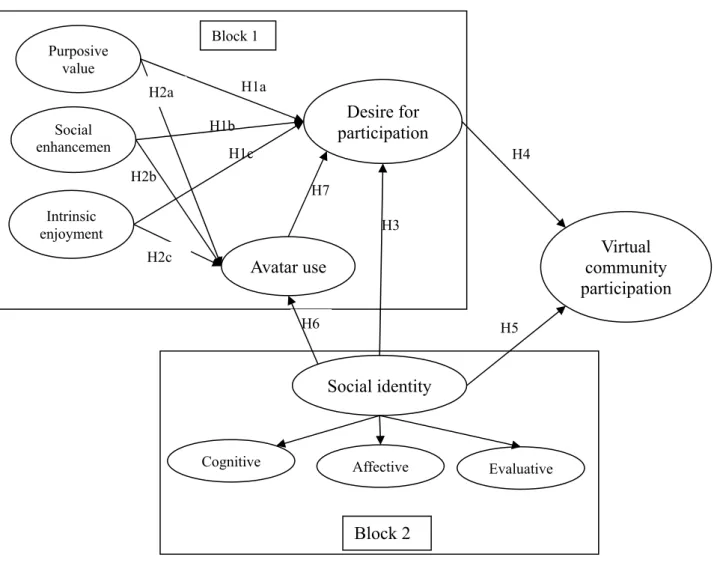
participation desire (Dholakia et al., 2004), Okazaki (2009) hence revise it according to the uses and gratification theory (Katz et al., 1974). The revised framework is a three values system composed of purposive value, social enhancement and intrinsic enjoyment. The block 1 in Figure 1 summarizes the relationships between values and desire, and between values and avatar use.
6
2.3. Group feeling for virtual community participation
Group feeling is another motive that triggers web users’ desire for virtual community participation. Tajfel(1974) proposes a model about social identity to address the arise of group-feeling. Through the four stages: categorization (labeling), identification, comparison and psychological distinctiveness, ones may be induced with a vivid distinction of in-group and out-group feelings. The group knowledge and inclusion let in-group members endow with emotional attachment and value significance(Abrams
& Hogg, 1990). For instrumental purpose, the model is proposed to be measured by three elements: cognitive, affective and evaluative social identities (Bergami &
Bagozzi, 2000; Ellemers, Kortekaas, & Ouwerkerk, 1999). Block 2 in Figure 1 summarizes the relationships of social identities and sub items.
2.4. Hypotheses
Previous studies have shown the casuals among desire, social identity and community participation (H3, H4, H5) (Dholakia et al., 2004; Okazaki, 2009) although in different contexts. The present study aims to investigate the avatar effect by adding it onto the construct. If the adding of avatar in the virtual community environment is similar to building social cues onto anonymous beings, two competitive arguments
7
may arise.
Firstly, according to the limited social cue perspective (Dubrovsky, Kiesler, &
Sethna, 1991; Kiesler, Siegel, & McGuire, 1984; Sproull & Kiesler, 1993) when social cues are under presented, less chance the one can be identified and therefore is willing to share his/her true thinking. Besides, less revelation of one’s social cues may induce less prejudice; therefore, equivalence among members (that is beyond the economic, cultural and racial differences) may provide a better platform for communication; hence more community participation. As a result, the inclusion of avatar reduces the community participation.
Nevertheless, the SIDE theory(SIDE, Social Identity model of Deindividuation Effects)may argue that the minimization of individual physical profiles may help the emergence of group identities. Social identities at the group-level may replace the individual-level identities constituting the social cues in virtual community environment. The inclusion of avatar as a result induces more participation. This argument is supported with Kim’s (2009) study that in virtual environment the need to belong (Markus & Kitayama, 1991; Singelis, 1994) positively affects group identity whereas the need for uniqueness(Snyder & Fromkin, 1980) does not.
Based on the literature review above, the relationship is summarized in Figure 1.
Of the hypotheses, H1 and H3-H5 are similar to previous studies (Dholakia et al.,
8
2004; Okazaki, 2009). H2 is about the positive impact on avatar use attributed to website values. H6 and H7 show the mediating effect of avatar use on the desire for community participation.
3. Method
3.1. Survey
To test the hypotheses, online survey technique was adopted and conducted in PTT which is the leader of the social networking sites of bulletin boards in Taiwan market.
The pilot test was conducted between March 25th and April 4th, 2010. One hundred PTT virtual coins per sample were awarded for gratitude. The formal survey was launched in PTT from April 10th to May 1st, 2010. Lottery of convenient store coupons was incorporated to boost the survey turnout rate. To avoid duplicates, email addresses and users IP are screened. The pilot test stopped with 52 responses and 42 valid ones. The formal survey stopped with 135 responses and 109 valid ones. The demographic statistics of the 109 valid respondents are shown in Table 1.
[Insert Table 1 here]
9
3.2. Measures
Each of the measures in Figure 1 is evaluated with multiple items and each item is in Likert five-point scales. The following detail the questions related to each measure and their literature sources.
3.2.1. Values for virtual community participation
According to the literature (Dholakia et al., 2004; Hagel III & Armstrong, 1997;
Okazaki, 2009) the values of virtual community participation may attribute to purposive values, social enhancement and intrinsic enjoyment.
3.2.2. Social Identity
The social identity is measured with a structure of two levels. The primary level is composed with three social identities: cognitive, affective and evaluative social identities. The measure items are derived from Moon, Li, Jo, & Sanders (2006).
3.2.3. Intention to use avatar
There is no existing measure for the intention measurement hence we create nine items to this end. We develop the items with respect to the founding purposes of virtual communities. Several papers have tried to categorize the increasing numbers of
10
virtual communities. Hagel III & Armstrong (1997) propose to categorize in terms of the objectives: Interest, relationship, fantasy and transaction. Kozinets (1999) adopts two dimensions (group focus and social structure) to derive four categories: Bulletin boards (focus on information exchange and loosely structured), chat rooms (focus on social interactions and loosely structured), rings & lists (focus on information exchange and tightly structured) and the chat rooms specifically for certain objects, such as the online games(focus on social interactions and tightly structured). Dholakia et al.(2004) extend this categorization to seven venues: E-mail lists, website bulletin boards, usenet newsgroup, real-time online-chat system, web-based chat rooms, multiplayer virtual games and MUDs (Multi-user Domains). For all the variations above, Hagel III &
Armstrong ‘s typology which includes interest, relationship, fantasy and transaction sustains by facts and was adopted for the measures development.
3.2.4. Participation behavior
Six measure items were used for this measurement. These items were adopted from Koh & Kim (2003).
11
3.3. Path analysis
The structural paths were examined with partial least squares path modeling (PLS).
This method has been shown advantageous in path modeling (Pirouz & Student, 2006) with less demanding on sample size (Barclay, Higgins, & Thompson, 1995). The PLS is a method for structural equation modeling which is similar to LISREL for path analysis (Gefen, Straub, & Boudreau, 2000). The (M3) Beta version of the SmartPLS 2.0 by Ringle, Wende, Will(2005) was used for the analysis and the bootstrapping algorithm (Efron, 1979) which is shown robust (Zhang, Pantula, & Boos, 1991) is adopted for significance testing.
4. Results
4.1. Validity check
Composite reliability is shown in the second column of table 2. The range is from 0.780 to 0.895 which is above the common threshold of 0.7 (Fornell & Larcker, 1981;
Okazaki, 2009). Cronbach’sαis shown in the third column of table 2. The range is from 0.625 to 0.860. The common threshold is 0.7 (Nunnally, Bernstein, & Berge,
12
1994), thus the purposive value (0.625) and the cognitive social identity (0.681) are below the threshold. Given this, correlations were checked for the two measures and they are 0.295 for purposive value and 0.416 for social identity which are close to the acceptance range of 0.2 to 0.4 (Briggs & Cheek, 1986) hence are marginally qualified to the path modeling.
[Insert Table 2 here]
4.2. PLS modeling
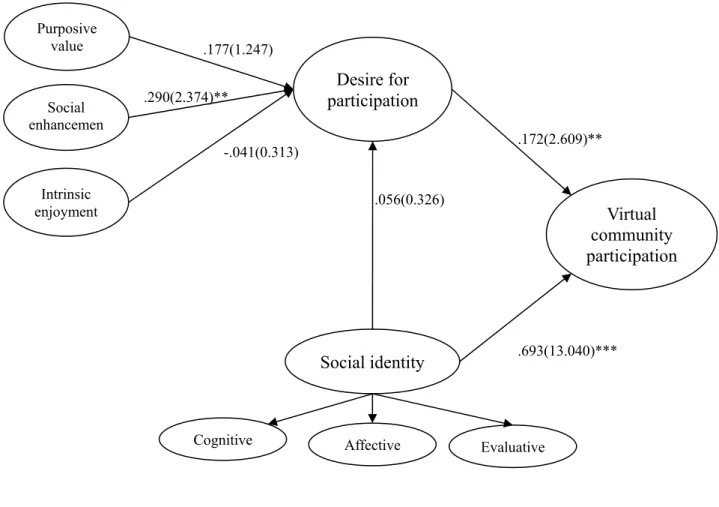
The path analysis results are shown in Figure 2 and Figure 3. The difference of the two is that Figure 2 excludes avatar use in between the desire and social identity whereas the avatar factor is included in Figure 3 model. The regression R2 s in participation behavior for both cases are both 0.596. This value (60%) shows strong support for the path modeling.
[Insert Figure 2 here]
[insert Figure 3 here]
13
4.3. Hypothesis testing
By comparing the modeling results in Figure 2 and Figure 3, we have two major findings regarding social identity. Firstly, the direct effect of social identity to desire is not significant (Figure 2: β =0.326, t-value=0.056; Figure 3: β =-0.002, t-value=0.012). secondly, when the avatar use is included in Figure 3, the impact of social identity becomes significant (from social identity to avatar use:β=0.555, t-value=4.557; from avatar use to desire: β=0.247, t-value=1.864). H6 and H7 are supported with survey data whereas H3 is not. It shows that while social identity is an important factor for desire to accrue, it needs a mediator to transcend this affect.
5. Conclusions
The present study aims to investigate the mechanism of avatar use in triggering users’
desire for community participation in virtual environment. We make the avatar use as a factor and investigate it in a framework where the virtual community’s gratification values and social identity are assumed the antecedents for user’s community participation(Dholakia et al., 2004; Okazaki, 2009). We test the construct with internet survey data. The following are our findings.
14
Our path analyses show that the direct impact of social identity on desire (H3) is not significant as in previous studies(Dholakia et al., 2004; Okazaki, 2009), however, with the inclusion of avatar use, this missing link is back again. This may imply that for social interaction such as the virtual community social cues is needed and should endow on certain objects (such as avatars); this endowment may stays with the beings for longer time to become an identity in the virtual environment. After all who would like to interact with a ghost that has no social cues?
This may have important managerial implications for website design and management, such as the Facebook in providing avatar customization. Firstly, avatar matters. Kim (2009) has shown that the need-to-belong is an important antecedent for group identity. Our finding may extend his result that while users are picking social cues to be added onto their avatars the cues are meant to share some similarities among them instead of being unique for each others. Users use avatar similarity to gain the feelings of belonging. Secondly, users who use avatars end up with higher participation. Online game industry has shown in-game item sale a sustainable revenue model. In competitive market, such as China, because game playing is free, the in-game item sale becomes the major source for profit. This implies that the users of virtual communities may be willing to spend some money to dress their avatars with different apparels.
15
Reference
Abrams, D. & Hogg, M. 1990. Social identity theory: Constructive and critical advances. New York, NY: Springer-Verlag.
Bagozzi, R. & Dholakia, U. 2002. Intentional social action in virtual communities.
Journal of Direct Marketing, 16(2): 2-21.
Barclay, D., Higgins, C., & Thompson, R. 1995. The partial least squares (PLS) approach to causal modeling: Personal computer adoption and use as an illustration.
Technology studies, 2(2): 285-309.
Becker, B. & Mark, G. 2002. Social conventions in computer-mediated communication:
A comparison of three online shared virtual environments. In R. Schroeder (Ed.), The social life of avatars: Presence and interaction in shared virtual environments:
19–39. London, UK: Springer-Verlag.
Benford, S., Bowers, J., Fahlen, L. E., Greenhalgh, C., & Snowdon, D. 1995. User embodiment in collaborative virtual environments.
Bergami, M. & Bagozzi, R. 2000. Self-categorization, affective commitment and group self-esteem as distinct aspects of social identity in the organization. British Journal of Social Psychology, 39(4): 555-577.
Briggs, S. & Cheek, J. 1986. The role of factor analysis in the development and evaluation of personality scales. Journal of Personality, 54(1): 106-148.
Cronin, J., Brady, M., Brand, R., Hightower, R., & Shemwell, D. 1997. A cross-sectional test of the effect and conceptualization of service value. Journal of services Marketing, 11(6): 375-391.
Cronin Jr, J., Brady, M., & Hult, G. 2000. Assessing the effects of quality, value, and
16
customer satisfaction on consumer behavioral intentions in service environments.
Journal of Retailing, 76(2): 193-218.
Dholakia, U., Bagozzi, R., & Pearo, L. 2004. A social influence model of consumer participation in network-and small-group-based virtual communities. International Journal of Research in Marketing, 21(3): 241-263.
Dubrovsky, V., Kiesler, S., & Sethna, B. 1991. The equalization phenomenon: Status effects in computer-mediated and face-to-face decision-making groups.
Human-Computer Interaction, 6(2): 119-146.
Efron, B. 1979. Bootstrap methods: another look at the jackknife. The annals of statistics, 7(1): 1-26.
Ellemers, N., Kortekaas, P., & Ouwerkerk, J. 1999. Self-categorisation, commitment to the group and group self-esteem as related but distinct aspects of social identity.
European Journal of Social Psychology, 29(23): 371-389.
Fornell, C. & Larcker, D. 1981. Evaluating structural equation models with unobservable variables and measurement error. Journal of marketing research, 18:
39-50.
Gefen, D., Straub, D., & Boudreau, M. 2000. Structural equation modeling and regression: Guidelines for research practice. Communications of the Association for Information Systems, 4(1): 2-79.
Hagel III, J. & Armstrong, A. 1997. Net Gain: Expanding markets through virtual communities. Boston, MA: Harvard Business School Press.
Holzwarth, M., Janiszewski, C., & Neumann, M. 2006. The influence of avatars on online consumer shopping behavior. Journal of Marketing, 70(4): 19-36.
Katz, E., Blumler, J., & Gurevitch, M. 1974. Utilization of Mass Media by the Individual. In J. Blumler & E. Katz (Eds.), The uses of mass communications:
17
Current perspectives on gratifications research: 19-32. Beverly Hills, CA: Sage.
Kiesler, S., Siegel, J., & McGuire, T. 1984. Social psychological aspects of computer-mediated communication. American Psychologist, 39(10): 1123-1134.
Kim, J. 2009. 'I want to be different from others in cyberspace': The role of visual similarity in virtual group identity. Computers in Human Behavior, 25(1): 88-95.
Koh, J. & Kim, Y. 2003. Sense of virtual community: A conceptual framework and empirical validation. International Journal of Electronic Commerce, 8(2): 75-94.
Kozinets, R. 1999. E-tribalized marketing?: The strategic implications of virtual communities of consumption. European Management Journal, 17(3): 252-264.
Markus, H. & Kitayama, S. 1991. Culture and the self: Implications for cognition, emotion, and motivation. Psychological review, 98(2): 224-253.
Moon, J., Li, J., Jo, S., & Sanders, G. 2006. Improving Quality of Life Via Blogs and Development of a Virtual Social Identity. Journal of Information Technology Management, 17(3): 26-37.
Nunnally, J., Bernstein, I., & Berge, J. 1994. Psychometric theory. New York, NY:
McGraw-Hill New York.
Oh, H. 2003. Price fairness and its asymmetric effects on overall price, quality, and value judgments: the case of an upscale hotel. Tourism Management, 24(4): 387-399.
Okazaki, S. 2009. Social influence model and electronic word of mouth: PC versus mobile internet. International Journal of Advertising, 28(3): 439-472.
Oravec, J. 1996. Virtual individuals, virtual groups: human dimensions of groupware and computer networking. Cambridge, UK: Cambridge University Press.
Parasuraman, A. & Grewal, D. 2000. The impact of technology on the quality-value-loyalty chain: a research agenda. Journal of the Academy of Marketing Science, 28(1): 168-174.
18
Pirouz, D. & Student, D.; An Overview of Partial Least Squares;
http://www.dantepirouz.com/research/pls/.
Ringle, C. M., Wende, S., & Will, S. 2005. SmartPLS 2.0 (M3) Beta. Hamburg, Germany.
Sánchez, J., Callarisa, L., Rodríguez, R., & Moliner, M. 2006. Perceived value of the purchase of a tourism product. Tourism Management, 27(3): 394-409.
Schroeder, R. 2002. Social interaction in virtual environments: Key issues, common themes, and a framework for research. In R. Schroeder (Ed.), The social life of avatars:
Presence and interaction in shared virtual environments: 1–18. London, UK:
Springer-Verlag.
Singelis, T. 1994. The measurement of independent and interdependent self-construals.
Personality and Social Psychology Bulletin, 20(5): 580-591.
Snyder, C. & Fromkin, H. 1980. Uniqueness, the human pursuit of difference. New York, NY: Plenum Pub Corp.
Sproull, L. & Kiesler, S. 1986. Reducing Social Context Cues: Electronic Mail in Organizational Communication. Management Science, 32(11): 1492-1512.
Sproull, L. & Kiesler, S. (Eds.). 1993. Computers, networks and work. Cambridge, MA: The MIT Press.
Tajfel, H. 1974. Social identity and intergroup behaviour. Social science information, 13(2): 65-93.
Vasalou, A., Joinson, A., Banziger, T., Goldie, P., & Pitt, J. 2008. Avatars in social media: Balancing accuracy, playfulness and embodied messages. International Journal of Human-Computer Studies, 66(11): 801-811.
Vasalou, A. & Joinson, A. 2009. Me, myself and I: The role of interactional context on self-presentation through avatars. Computers in Human Behavior, 25(2): 510-520.
19
Zeithaml, V. 1988. Consumer perceptions of price, quality, and value: a means-end model and synthesis of evidence. The Journal of Marketing, 52(3): 2-22.
Zhang, J., Pantula, S., & Boos, D. 1991. Robust methods for testing the pattern of a single covariance matrix. Biometrika, 78(4): 787-795.
20
Table 1
Sample profiles.
Survey sample characteristics n %
Gender Male 66 60.6%
Female 43 39.4%
Age 16~20 12 11.3%
21~25 67 61.5%
26~30 27 24.4%
31~35 3 2.8%
Education High school 6 5.5%
College 67 61.5%
Graduate 35 32.0%
Doctoral 1 1.0%
Occupation Student 71 65.1%
Business services 20 18.3%
others 18 2.8%
Marriage Single 80 73.3%
Seeing someone 28 25.7%
Married 1 1.0%
Averaged time spend on web daily
< 2 hr 7 6.4%
2 hr<..<4 hr 30 27.6%
4 hr<..<6 hr 24 22.0%
6 hr<..<8 hr 20 18.3%
8 hr<..<10 hr 10 9.2%
10 hr< 18 16.5%
21
Table 1
Composite Reliability and Cronbach's α
Measures Composite Reliability Cronbach's α Avatar use intention 0.884 0.851
Intrinsic Enjoyment 0.874 0.804 Participation Behavior 0.895 0.860 Participation Desire 0.881 0.733 Purposive Value 0.780 0.625
Social identity 0.864
Affective SI 0.861 0.797 Cognitive SI 0.825 0.681 Evaluative SI 0.893 0.821 Social Enhancement 0.880 0.727
22
Figure 1. Proposed model for avatar mechanism
H5 H4 H7
H6 H2b
H1b H1c
H1a
H3 Social
enhancemen Purposive
value
Intrinsic enjoyment
Desire for participation
Avatar use Virtual
community participation
Cognitive Affective Evaluative
Social identity
H2a
H2c
Block 1
Block 2
23
Figure 2.PLS modeling without the avatar factor.
Note: Coefficients are shown along the paths with t-values in parentheses; *p<0.05 (t>1.645);**p<0.01 (t>2.326);***p<0.001 (t>3.090)。
.693(13.040)***
.172(2.609)**
.056(0.326) .290(2.374)**
-.041(0.313) .177(1.247)
Social enhancemen
Purposive value
Intrinsic enjoyment
Desire for participation
Virtual community participation
Cognitive Affective Evaluative
Social identity
24
.692(12.621)***
.172(2.318)*
.247(1.864)*
H6 .073(0.761)
.273(2.481)***
-.115(0.930) .075(0.458)
-.002(0.012) Social
enhancemen Purposive
value
Intrinsic enjoyment
Desire for participation
Avatar use
Virtual community participation
Cognitive Affective Evaluative
Social identity
.555(4.557)***
.0181(1.738)*
.027(0.193)
25
Figure 3. PLS modeling with the avatar factor.
Note: Coefficients are shown along the paths with t-values in parentheses; *p<0.05 (t>1.645);**p<0.01 (t>2.326);***p<0.001 (t>3.090)。
- 1 -
組織網絡結構對組織公民行為與工作壓力之影響
1. 緒論
在眾多的職業別中,護理人員所要擔負的責任及工作壓力遠比其他行業要重的多 (Rodney, 2000; 張和美、陳昭惠、藍麗美, 2003)。中華民國護理師護士公會分析 顯示截至 2010 年 2 月止擁有護士執照的人數是 217,267 人,而實際執業的人數 卻只有 129,413 人,顯示出仍有四成左右的人不願意投入護理工作行列,造成人 力不足。也因為護理工作的輪班性質及越來越複雜的照顧需求及工作負荷,有一 半以上的護理人員考慮改變工作(陳月枝、余玉眉、江東亮、陳心耕、張丹蓉, 1992)。
目前台灣地區透析總患者達五萬人(中華民國腎臟基金會, 2007),號稱是洗腎王 國。而透析病患之治療不同於一般病患,一旦罹患尿毒症,除非進行腎臟移植,
否則就必須面臨終生洗腎,尤其必須至血液透析中心洗腎的患者,已經是末期情 況,病人因病情而導致的心理壓力反應,如憂鬱、甚至有自殺傾向,非當事人所 能感受(周麗華, 2009)。而護理人員通常都是第一線照顧病患的人員,與患者之 關係是密切而長久的,日積月累,護理人員也會從病患身上感受到工作壓力。有 鑑於其工作壓力的沉重,本研究以某醫學中心血液透析為例,探討影響護理人員 工作壓力的組織因素。
就護理工作而言,女性從業人員相對居多,如果兼具職業婦女身份時,還必 須面對來自學業的壓力、家庭的壓力(楊秋月, 2007),因此女性護理人員比男性 更注重社會支持(Umberson, Chen, House, Hopkins, & Slaten, 1996);藉人際關係網 絡得到社會支持,進而降低工作壓力。蔡欣玲、林小玲(2001)指出互動良好的人 際關係對於工作滿意度有正向的加持作用,但人際關係也可能是工作壓力的來源 (錢美月, 2005)。換言之人際關係的良窳影響工作的滿意度,但這兩者之間的探 討並不多見於文獻。除了兩者的直接關係外,Barnard(2003)的研究顯示組織的成
功需仰賴「成員間的合作」,當組織裡的利他人或利組織的(組織公民)行為愈多,
就更能促進組織的運行。故本研究利用社會網絡分析(Social Network Analysis),
從組織的角度來探討組織的網絡結構與形成之組織公民行為對工作壓力的影 響。
結果顯示因工作關係而連結成的社會網絡,與最多人有互動連結的護理人員 (例如:護理長)感受到的工作壓力愈低;但意外的是工作之餘的互動,與多人有 互動連結的護理人員(例如:資淺人員)的其工作壓力反而愈高。此外亦發現工作 網絡中被孤立在外的護理人員工作壓力顯著高於參與者,甚至佔據組織裡中介角 色的護理人員工作壓力比孤立者還要高。本文結構如后,繼緒論後,第二節探討 關於工作壓力、社會網絡、組織公民行為的文獻,第三節為研究方法包括樣本、
問卷設計與分析工具等,第四節為分析結果包括樣本的描述統計、PLS(Partial Least Squares)結果,結論與管理意涵載於第五節。
2. 文獻探討 2.1. 工作壓力
個體面臨的情境、環境或刺激,都可能是壓力的來源,常見壓力來源包括重大生 活變動、災難事件、經濟不景氣,甚至生活中的小困擾(Katerndahl & Parchman, 2002)。隨著工業社會的普遍化,組織成為壓力的另一重要來源,一般稱為工作 壓力。French(2001)認為工作壓力是指工作上適應不良所產生的負面感受,其可 能的原因是來自於工作本身、工作環境及工作者自身能力無法相互配合。陸洛等 (2005)認為舉凡在工作上、職場上的不當、不適的壓迫或負擔,或與工作有關的 因素,以致影響工作者本身的生理狀況失調、心理狀況失衡的現象,亦即凡因工 作的關係所引起的任何令人心神困擾、緊張鬱悶等不愉快的感覺,都歸因於工作 壓力。楊秋月(2007)針對婦女因同時具有學生及職業婦女的多重角色,對於扮演 的角色壓力造成影響。王穎駿(2006)研究我國機場安檢人員工作壓力及其因應策 略研究發現壓力主要來自人際互動、設備及法令規章、工作自主權、工作負荷及 組織氣氛。
就本文的研究對象--護理人員而言, 由於護理工作的複雜及高度緊張性,同 時面臨疾病痛苦及死亡威脅的精神刺激,嚴格的等級制度導致壓抑感,長期輪值 三班的生活不規律,人際關係複雜及身為女性的身份有多重關係(如家事勞動、
教養子女、家庭關係等),使護理人員在家庭與工作雙重緊張疲勞之下,易於產 生負面的情緒,所以護理人員是慢性職業身心症侯群的高危群(朱曉華、任學榮、
朱秀琴, 2005)。蔡欣玲等(1996)發現一年以內之護理人員,其工作壓力較大。潘 致弘、吳明蒼(2008)針對輪班護理人員的工作壓力,發現不同班別的工作壓力有 顯著的差異。徐滿琳(2005)探討某醫學中心及區域教學醫院的護理人員工作壓力,
其研究結果發現在醫學中心工作、年齡 25 歲以下、已婚者、年資為 1~2 年間、
職位是護理師者,其工作壓力較其他者高。以台北市醫學中心 143 位護理人員為 對象的研究顯示,年齡、急診服務年資、平均月薪、固定班別與升學進修狀況等 因素對工作壓力有顯著影響差異(楊晨均, 2006)。李葆瑋(2006)研究護理人員工作 壓力與自覺身心健康狀況的相關性,其研究結果亦顯示護理人員的人口統計變項 中,年齡與職位對於工作壓力有顯著影響。王靜琳等(2005)探討教學醫院護理人 員之工作壓力,其結果顯示護理人員的婚姻狀況、工作年資對工作壓力有顯著影 響,而年齡越低、年資越少、子女數越少者工作壓力越高。由於人口統計因素的 管理意涵(implications) 有限,之後的文獻其重點逐漸轉到組織構面。
2.2. 組織公民行為
組織管理的研究指出人員是組織內最重要的資本,當員工願意自發性的為組 織做出貢獻時,會為組織帶來更高的績效。Barnard(1938)指出組織的成功須仰賴
「成員間的合作」,例如在工作中自動自發、調節與配合他人(同事、主管、其 他部門的人員)工作上的需求的利他社會行為,此合作行為可以使組織的運作更 順暢、更協調,而組織公民行為便是觀察組織內自發性利他行為的重要指標 (Organ & Konovsky, 1989; Smith, Organ, & Near, 1983)。
組織公民行為的衡量,經歷不同學者的增刪。Organ(1990)將組織公民行為 細分為五個構面:利他行為(altruism)、盡職行為(conscientiousness)、運動家精神 (sportsmanship)、謙恭有禮(courtesy)、公民美德(civil virtue)等。Farh 等(1997)針 對中國人的特性發展為:(1)認同公司(identification with the company):即組織成 員願意主動告訴外界關於公司的正面消息,以維護公司的形象,以及主動提出建 設性的改善方案。(2)協助同事(altruism toward colleagues):指組織成員 願意協助同事處理工作上問題。(3)勤勉審慎(conscientiousness):指組織成
員自發性的行為超越組織所要求的行為,並遵守組織的規定,努力工作。(4)人
際和諧(interpersonal harmony):指組織成員不會謀取個人利益,而從事各 種可能破壞組織和諧的政治行為。如在背後論他人是非。(5)保護公司資源
(protecting company resources):指組織成員不會利用上班時間或使用公司 資源來處理其私人的事務。
文獻中對於組織公民行為與工作壓力的相關性的看法並不一致,李翠華 (2007)探討工程師之組織公民行為,發現其工作壓力對於組織公民行為並沒有顯 著的影響。但潘蕙韶(2007)指出當個人主動行使愈多的有利組織的公民行為時,
組織的運作將更順暢、更有效率,所以此時個人感受到的工作壓力較低。因此本 研究試圖將其納入研究架構中,提出假說 1。
假說 1:組織公民行為導致工作壓力的降低 2.3. 社會網絡與中心性
除組織公民行為之外,社會網絡亦是探討組織的重要概念與工具。在概念上社會 網絡分析藉由個人在社會網絡中的位置,彌補了只用個人的屬性或人口統計變項 在解釋社會或組織行為的不足(Coleman, 1990)。實證研究顯示社會支持是社會 網絡的一項功能,在人際互動中,能提供個人生活需要的滿足,以協助個人適應 生活的各種壓力;當人們感受到問題或壓力情境,透過社會網絡關係的運作,可 以得到不同形式的援助與支持(黃仁峰, 2003)。對護理人員而言,若獲得的社會
支持愈多,則工作壓力感受愈低(王靜琳、黃瓊玉、呂桂雲、何美瑤, 2007)。故 本研究延續此概念,以護理人員為分析的對象,分析個人在社會網絡中的位置,
對其可能展現的組織公民行為以及感受到的工作壓力,進而對工作滿意度的影 響。
其次在工具上,社會網絡裡藉節點(node)代表成員,用線段代表成員之間的 關係(ties),以社會網絡分析(social network analysis)方法分析其結構特性
(Wasserman & Faust, 1994)。一般來說,組織的網絡類型可以分成諮詢網絡(advice network)以及友誼網絡(friendship network)。諮詢網絡旨在提供工作上的技術資詢 (Krackhardt & Hanson, 1993),在組織情境中,諮詢網絡雖是一種弱關係(weak ties),
但卻可以帶來日常工作中所需要的大部份資源(Krackhardt, 1992)。當許多同事 都向一個人尋求諮詢或建議,那麼這個人在一般情況下就會掌握正式的權力,掌 握了正式權力的人可以更好地控制環境中的不確定性,並且更傾向於信任自己的 同事(Coleman, 1990)。友誼網絡,顧名思義比諮詢網絡的關係更強,包含了親 密的談話和行為(Masden & Campbell, 1984),因此能提供情感性的社會支持 (Krackhardt & Hanson, 1993)。
網絡的中心性是最早被用來分析社會網絡的指標,中心性高的人代表了與他 人之間有許多的網絡連結(Wasserman & Faust, 1994)。網絡中心性如同正式化職 權一般,在階層中的高地位,也就是在工作網絡結構中處於較高的職位或社會地 位(Burt, 1992),而位居網絡中心的成員,往往擁有較多的知識資本(Ibarra, 1990),
並且能夠得到較多的資訊以及社會支持(Adler & Kwon, 2002),甚至顯現於成員 的能見度及名氣上(Kenis & Knoke, 2002)。對此社會網絡分析提出程度中心性 (degree centrality)、親近中心性(closeness centrality)與居中中心性(betweenness centrality)等做為測量指標(Degenne & Forse, 1999)。
程度中心性(degree centrality)旨在量測行動者與其他行動者直接連結的數量。
在王志宏(2003)指出程度中心性的測量可藉由計算網絡中每一行為者關係維持 的數量,或是計算社會關係圖中特定點其線連進或連出的數量,而擁有最多線的
行為者即表示最具中心性,也就是說其網絡中心性就會高於其他成員,就像是網 絡中的明星(star),可以被視為最受歡迎的人(Brass, 1995);相反地,當行為者在 網絡中與其他行為者之間並無連結其可稱為孤立(isolate)。
親近中心性(closeness centrality)量測行動者與其他每一位行動者間最短的路 徑總和,以觀察特定行動者與他人之間各種訊息傳遞的距離來判定行動者與他人 的親密程度,也就是指特定行動者到達網絡所有其他行動者的路徑距離,以直接 連繫為 1,間接連繫則做適當比率(Degenne & Forse, 1999)。
中介中心性(betweenness centrality)量測介於其他兩個行為者連結之間最短路 徑的中介位置,可用來觀察網絡中行動者所處位置的重要性,也代表對資源的可 近性以及控制。當個體居中中心性愈高,表示此節點是最常被經過的節點,許多 訊息的傳遞必須透過此節點才可到達網絡的另一端,所以居於網絡居中位置的行 動者,通常是資訊的交換站,在 Burt(1992)結構洞理論中解釋,中介性高的人掌 握了訊息流通及商業機會,進而可以操控兩個不同團體的人,從中獲得利益。
組織內部人際網絡與工作滿意度間的關係經實證研究顯示,工作諮詢網絡中 心性愈高的員工,其工作滿意感也愈高(羅家德 & 朱慶忠, 2004)。此外余維宗 (2008)對大台北地區護理人員的研究也顯示諮詢網絡中心性愈高時其生活品質 愈滿意。緣此本研究以網絡中心性的觀點進一步探討網絡關係與工作壓力的直接 關係以及網絡關係經組織公民行為與工作壓力的間接關係。
就護理工作壓力而言,Anderson(1991)藉社會網絡結構觀點發現護士自社會 網絡中得到同感壓力的同事支持時,有利於工作壓力的減少。Achat(1998)針對社 會網絡對於壓力及健康生活品質影響的研究,發現在社會網絡裡較孤立的人,其 心理健康情形較差;社會網絡結構的中心性與心理健康程度呈現顯著的正相關係。
本研究嘗試將社會網絡關係分為工作諮詢網絡以及友誼網絡。前者為正式的社會 支持網絡,亦即因工作關係而形成網絡。在工作諮詢網絡中心性愈高的人表示個 體在工作組織或團體中有愈多的關係,容易被大家當成諮訽或建議的對象,也表 示其掌握了較多的權力及影響力,獲得的社會支持愈多,所以工作壓力的感受愈
低。友誼網絡為非正式的社會支持網絡,則偏重個人日常生活中的人際互動,非 正式的社會支持網絡亦是個人遭遇困難時最快也最容易尋求援助的資源,當友誼 網絡中心性愈高即表示個體在私底下得到較多人的情感支持,所以感受到的工作 壓力也愈低。提出假說 2-1 及假說 2-2。
假說 2-1:工作諮詢網絡中心性程度愈高影響工作壓力愈低 假說 2-2:友誼網絡中心性程度愈高影響工作壓力愈低
結合社會網絡結構與組織公民行為的論述,Lin, Hung, & Chiu (2008)的研究 顯示社會結構與忠誠度、參與性、利他行為等組織公民行為呈現顯著的相關;甚 至其社會網絡中心性程度對其組織公民行為有正向影響(Sparrowe, Liden, Wayne,
& Kraimer, 2001)。因此提出假說 3。
假說 3:社會網絡中心性程度愈高則組織公民行為愈高
2.4. 工作滿意度
工作滿意度亦是護理文獻中的一個重要的研究標的(Strachota, Normandin, O'Brien, Clary, & Krukow, 2003),除衡量護理人員的績效(Ma, Samuels, &
Alexander, 2003)之外,更被用來預測護理人員的離職率(Coomber & Barriball, 2007; Larrabee et al., 2003; 李逸, 2004)。文獻顯示當個人愈融入專業護理領域,
個人會離開專業的機會就愈少,承諾愈高的護理人員對工作滿意度也愈高(Teng, Shyu, & Chang, 2007)。反之當護理人員的工作滿意度愈低,離職傾向愈明顯 (Coomber & Barriball, 2007; Larrabee et al., 2003; 李逸, 2004)。護理人員的工作滿 意度如果低落時,不但嚴重影響病患的照顧品質及醫院形象,同時增加醫院之營 運成本,並且可能引發群體倦勤等惡性循環(Adams & Bond, 2000)。
根據文獻,影響工作滿意度的因素眾多,包含性別、職位高低、工作年資等。
潘錫君(2008)研究結果發現年齡、年資、職位和工作滿意度呈現正相關。年齡越 高或是工作年資越久或是職位較高者其工作滿意度較高。陳麗資(2005)研究醫院 護理人員的工作滿意度,研究結果發現護理人員的個人屬性(婚姻狀況、薪資層 級、目前服務科別、宗教信仰)會影響工作滿意度。而張華蘋(2006)的研究中則顯 示除性別因素外,其餘個人屬性皆會影響護理人員之工作滿意度,包含年齡、工 作年資、教育程度、婚姻狀況、子女數、職務階級。同樣的由於人口統計因素的 管理意涵有限,之後的文獻其重點亦逐漸轉到組織因素,例如工作壓力。
關於工作壓力與工作滿意度的研究甚多,黃寶園(2009)採用統合分析法整理 了 70 篇相關論文,結果指出工作壓力負向影響工作滿意度。以護理工作為對象,
Jamal(1990)針對大型醫院內 215 位全職護士工作壓力的調查顯示工作壓力與工 作滿意度呈現顯著的負相關。因此本研究提出假說 4。
假說 4:工作壓力愈低則工作滿意度愈高 2.5. 組織公民行為與工作滿意度
Murphy 等(2002)研究關於工作滿意度以及組織公民行為之相關,發現工作 滿意度對組織公民行為以及參與度呈現顯著性正相關。Smith 等(1983)也提出工 作滿意度可直接預測員工人際間的利他行為。蔡秋月(2001)研究護理人員工作滿 意度與組織公民行為,顯示護理人員的工作滿意度與組織公民行為中的組織公民 行為呈正相關。許耀峰(2005)發現護理人員的工作滿意度會透過組織公民行為中 介影響工作績效。Tsai 與 Huang(2008)研究台灣地區的護理人員,工作滿意度與 組織承諾對組織公民行為有顯著正向影響。故本研究提出假說 5。
假說 5:組織公民行為愈高工作滿意度愈高
綜合以上的論述本研究藉圖 1 結合以上的研究觀點形成本研究的研究架 構:
圖 1 研究架構
3. 研究方法
接下來說明本研究之研究對象、變數操作型定義、問卷設計與信度與效度分析。
3.1. 研究對象
本研究針對台北某醫學中心血液透析為例,透析護理單位是專為末期腎病變之尿 毒症病患提供洗腎醫療的專科單位,透析護理師具有之資格為:(1)領有護士或 護理師證書;(2)接受台灣腎臟醫學會與中華民國護理學會共同舉辦之血液透析 訓練班受訓,且筆試合格者;(3)符合在台灣腎臟醫學會認定之血液透析護理人 員訓練指定醫院接受三個月(含)以上訓練者(台灣腎臟醫學會)
本研究問卷於民國九十九年四月十六日發放,在問卷發放前先舉行問卷說明 會,當天血液透析中心共有 28 位護理人員參加說明會,會中由研究者說明研究 目的及問卷填寫的注意事項,澄清護理人員對於填寫問卷的相關疑惑,並請有參 與說明會的護理人員協會問卷填寫方式告知未參加說明會的護理同仁。在說明會 完成之後,立刻發放問卷,每位護理人員填寫問卷的時間約為 10 至 15 分鐘,填 寫完之後統一收回並且彌封,再於指定時間回收問卷。本研究問卷設計分為工作
H4 H1 H3
工作壓力
工作滿意度 社會網絡結構
組織公民行為 H2
H5
壓力、工作滿意度、組織公民行為、社會網絡以及基本資料,另外社會網絡部份,
事先請裡面的一位護理人員將此單位裡所有的護理人員之名字列出加上編號,成 為一張同事代號表,請受訪者以代碼填寫。
3.2. 研究變數操作型定義
本研究紀錄的人口統計變數包括年齡(25~35 歲、36~40 歲、41~45 歲、46-50 歲、
50 歲以上)、婚姻狀態(未婚、已婚無小孩、已婚有小孩)、教育程度(專科、大學、
研究所以上)、年資部份分為二種:護理服務年資、本院服務年資 (5~10 年、10~15 年、15~20 年、20 年以上)、護理進階職級(N1、N2、N3、N4)、職稱(護士、護 理師、副護理長、護理長)、是否在職進修、任用身份(正職人員、約聘人員)、年 薪(80-89 萬、90-99 萬、100-109 萬、110-119 萬、120 萬以上)。
其次關於工作滿意度的衡量工具眾多,例如明尼蘇達滿意度問卷(Minnesota satisfaction questionnaire,MSQ)、工作描述指標(Job descriptive index,JDI)、密 西根組織評價量表(Michigan organizational assessment questionnaire)、工作滿意調 查量表(Job satisfaction survey,JSS)、工作診斷調查表(Job diagnosis survey,JDS) 等。因明尼蘇達滿意度問卷(MSQ)裡有特別為護理人員編製的工作滿意度,故本 研究採用此 MSQ 做為工作滿意之衡量工具。此問卷是由 Weiss 等人設計而成,
分為長式量表(100 題)及短式量表(20 題)(Weiss, 1966)。本研究採用短式量表,將 工作滿意度分為四構面,分別是工作成長性、工作條件、主管能力以及獨立自主 性共 19 題。採用 Likert 五點量表:「非常不同意」、「不同意」、「沒意見」、「同意」、
「非常同意」。
組織公民行為的量測則參考 Farh 等(1997)所編製的華人組織公民行為量表。
共有五個向度,分別是認同公司(identification with the company)、利他(altruism toward colleagues)、盡職行為(conscientiousness)、人際和諧(interpersonal harmony)、
保護公司資源(protecting company resource),共 20 題,採用 Likert 五點量尺,分 別是「非常不符合」、「不符合」、「符合」、「有點符合」、「非常符合」(Farh et al.,
1997)
工作壓力變項本研究以 Nursing Stress Scale (NSS)量表測量醫護人員之工作 壓力。將護理人員的工作壓力分為四大部分:死亡以及瀕臨死亡、和醫師產生衝 突、缺乏支持、工作負擔。共 33 題,採 Likert 五點量表:「從不」、「偶而」、「有 時」、「經常」、「非常頻繁」。
社會網絡中心性:本研究將網絡依其性質分為「工作諮詢網絡中心性」,藉
「您會經常與哪些同事分享有關工作的資訊、知識及經驗」、「在工作上遭遇困 難,哪些同事會主動指導您」、「在工作上遭困難、您會向哪些同事請教」、「您 在執行工作時,必須與哪些同學有很多的溝通協調、密切配合,方能順利完成」
等問項請受測者作答。與「友誼網絡中心性」,藉「您會非常樂意的將畢生累積
的經驗與智慧傳授給哪些同事」、「若您聽說某人將有職位異動或想離職的消息,
您會先告訴哪些同事」、「哪些同事可以讓你很放心地告訴他一些個人的想法、
私事、心事」、「除了正式的同事關係,哪些同事也是您私底下很要好的朋友」
等問項請受測者作答。再使用 UCINET 軟體計算程度中心性(degree of centrality)、
接近中心性(closeness of centrality)、中介中心性(betweenness of centrality)等三種 中心性指標。
3.3. 信度與效度分析
為使受檢測者對問卷中的題目是否清楚明瞭,預測資料收集過程的可能問題,並 針對填答結果對問卷修與調整預試為目的,於 99 年 3 月 23 日至 3 月 30 日,於 台北某醫學中心進行前測工作,共發出 10 份問卷,回收 10 份,回收率 100%,
針對預試所得到的結果,分別以量表效度分析以及量表信度分析三項作為統計數 據之說明。
效度(Validity)是指衡量工具是否能正確測量出研究者所欲衡量之特質或功 能的程度。本研究以因素分析來建構效度,將社會網絡量表、工作滿意量表、組 織公民行為量表以及工作壓力量表進行因素分析。將各量表輸入資料進行