心理認知與漠字閱讀
PSYCH工L工NFU工 ST工C 工 NTERFERENCE OF CHARACTERS IN READING CH工NESE
by Teh-ming .Yeh
Abstract
工 n recent years neurolinguists have made quite a number of experiments in chinese character recognition. particular attenton is g-iven to experiments and hypothese concernig ce-rebral domination and reading and writing ability. According to these theories
,
language and other analytic functions are located on the left side of the brain,
while spatial and configurational abilities are located on the right side. There is some evidence,
however,
to support the claim that in learning a language,
the use of both hemispheresof the brain is required. The right hemisphere dominates the ability to memorize Chinese characters do not go through an initial .process of phonetic recognition before being fully recognized,
as may be the case with English writing. 工 nsteadthey are interpreted directly for meaning
,
as pictures are,
so Chinese is often easier to recall than English.師大學報第卅二期 CONTENTS L 工 ST OF TABLES... '. • . . . • . • . • . • • • . • . . • . . • • . • • • • • • • . • • • • • • • i i L 工 ST OF FIGURES... •••••.•.•.•.•.•.•.•••.•.•.••.•.•.•••. . . i i i
. . .
. . .
.
.
. .
.
.
. . .
. . . .
. . . .
. . .
. .
. . . .
. . .
. .
.
.
. . .
..
.
. . .
. . .
Chapter 工.工 ntroduction...1 工工. The Lateralization Effect in Reading ChineseChara-c t e r s . . . . . . 2
工工工 .Aphasia Resear'ch and 工 ts 工 mplications for Left-right
Hemisphere Functions...~...4 工 v. Differences between Aphasia in English Speakers and
Aphasia in Chinese Speakers...11 1. A p h a s i a . . . .11 2. Areas 。 f the Brain wi th Re'la ted Language
Functions..~... 啥﹒.
• • • • • • • • • • • • • • • • • • • • • • •
1 2 3.Types of Aphasia and the Nature of the Deficits12 4. F 1 uency vs ,Nonf 1 uency. • • • • • • • • • • • • ., • • • • • • • • • • • 1 4 5. Boston Test Patterns for English Speaker'gApha-s ia • • • • • • • • • • .' • • . • • • • • • • • • • • • • • • • • • • • • • • ., • • • • .1 4 6. Rehabilitation Success for English-Speaking
Aphasic Patients...、.
• • •
.20 7. A Clinical Test for Chinese Speakers Wh。Experience A p h a s i a . . . 21
v.
Efficacy of Logographic Writing Systems forMemor i za tion. • • • • • • • • • • • . • • • • • • • • • • • • • • • • • • • • • • • .26 1. American Children with Read 土 ng Problems can
Easily Learn to Read English Represented by Chinese Characters...29 2. The Lateratization Effects...30 ι
3. Differing Patterns of Memory...31 VI. C o n c l u s i o n . . . 32
心理認知與漢字閱讀
L 工 ST OF TABLES
Table
1. Comparison of English Aphasics...20
2. Therapeutic Effects of Aphasics...2-3
L 工 ST OF F 工 GURES
Figure
1. Relation of Orthographies to Meaning...2
2. Diagram of the Areas of the Brain with Related
Language F u n c t i o n s . . . 1 3 3. Character-Picture 工 mitation Test (Sample Test
師大學報第卅二期
PSYCHOLINGU工 STIC INTERFERENCE OF CHARACTERS 工 N
READING CHINESE
工.工 ntroduction
Chinese writing is a system of visual symbolsi in order to sho~ that visual lateralization affects reading
,
this paper will consider three major questioris in the study of reading Chinese characters from the viewpoint of experimental psychology. These are:1.The lateralization effect inreading Chinese characters.
2. Differences between aphasia in English speakers and aphasia in Chi~ese speakers.
3. The Efficacy of logogr~phic writing systems for mem-orization.
Explicit treatment of these topics has been reported in a series of contrólled research projects. Literature about aphasia and experiments in the limitingofιcerebral
laterization gives evidenc~ for lateralization in Language and perception. In addition the recognition of logographic symbolsby recovered aphasics Can give info~mation on a person's capacity for learning Chinese characters. There-fore
,
i t is not difficult to develop test hypoteses and experiments which illuminate the learning of Chinese characters.This paper will follow these three questions as above'
,
giving some evidence to support the interpretation tqat learning a lang~ag~ , including speech and recognizing of symbols,
~ay be related to functions of the whole brain,
but that the right hemisphere dominates the ability to memorize Chinese characters.心理認知與漢字閱讀
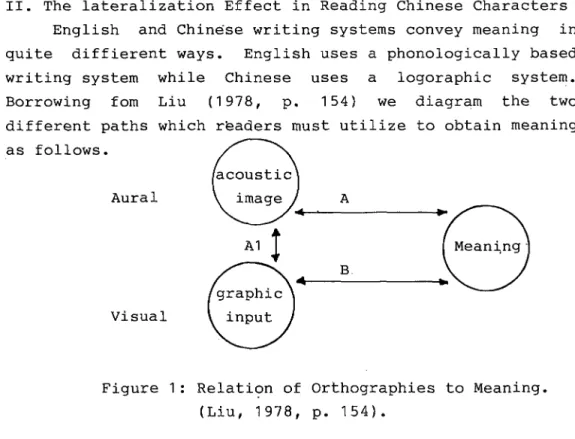
工工. The lateralization Effect in Reading Chinese Characters English and Chinese writing systems convey meaning in quite diffierent ways. English uses a phonologically based writing system while Chinese uses a logoraphic system. Borrowing fom Liu (1978
,
p. 154) we diagram the two different paths which readers must utilize to obtain meaning as follows. Aural \ imaqe / A:0
B “‘ ( '::JL a. νU .LL:1
VisualFigure 1: Relation of Orthographies to Meaning. (Liu
,
1978,
p. 154).Path A
,
t~e path followed by an English reader associate the graphic input witÞ a mediated process,
such as word identification through some acoustic image. The meaning of the graph is assessed via the sound image,
which serves as an intermediary. Path B,
the path used by a Chinese reader leads directly from the graph to the mean~ng without an intermediary,
Japanese writing interestingly uses both path A for kana (phonetic writing" transcription) and path B for kanji (borrowßd Chine~e characters used for writing in Japanese) •The logical question that follows from this diagrm is whether or not these different path ways have' a physiolog-ical reflection. 工 n other words
,
does the brain use diff-erent mechani~ms or areas to process logographic and phono-logical writing? As the resuts cited below will show,
the師大學報第卅二期
answer to this question is yes. English writing and by extensidn phonologically based writing system in general are processed in the left hemisphere of the brain. Chinese writing is processed in the right hemesphere.
This result is consistent with what is known of the way in which the brain functions in general are divided. As Geschwind (1979) in his Specializations of the Human Brain said 'Certain higher faculties
,
such as language,
depend on speciaized regions in the humam brain.On a larger scale the two cerebral hemispheres are specialized for different kinds。f mental activity' (p. 110). Kimura (1973) found in a dichötic listening experiment that speech sounds that were received in the left hemisphere were processed quick~r and more accurately thansounds processed in the right hemisphere.
In contrast
,
Geschwind said:There is reason to believe the right side of the brain is more important for the perception of melodies
,
one itemof evidencebeing the ease with which .aphasic patients with left-hemisphere damage can sing. The per-ception and analysis of nonverbal visual patterns such as perspective drawings,
is largely a function of the right hemisphere (p. 141).Young
,
Bion,
and Ellis (1980) reportl
n A Model of Laterality Effects for Picture and Word Namin9 that .large right visual hemifield (RVF) superiorities were found to arise from both first and second reports for naming nouns and consonant-vowel-consonant (CVC) nonwords. Drawing and picturáble nouns,
however,
produced only a small RVF superiority arising entirely from subjects.
second reports(p. 54)w The results of the experiments
,
according to the proposed model,
arise from the extent to which the right心理認知與漢字閱讀
hemisphere is aþ1e to process different types of visua1 stimu1i. Pictures and s~mp1e nouns can be identified by the right hemisphere
,
and produce an RVF superiority arising from subjects' second reports on1y.Aphasia Research and Its 工 mp1ications for Left-Right Hemis-phere Functions
Solid evidence for the differing functions of the 1eft anà right hemispheres can a1so be found in recent work with aphasic patients. First we wi11 consider the work of Wapner and Gardner (1981). They conducted a unitary and p1uralistic experiment using fifty-seven patients who had organic brain damage. The hypotheses considered were: a unitary schoo1 of thought that views ã11 symbo1ic competences as c1ose1y re1ated
,
and a riva1 (p1uralistic) approach that emphasizes the re1ative differences among modes of symbo1ic processing. To study these ,competing hypotheses,
matched groups of1eft-and right-hemisphere brain damaged patients were given a visua1 symbo1-recognition test. Subjects were required to choose the correct1y depicted symbo1 among a set of four. The resu1ts do not strong1y support the 'unitary'
hypothesis. 工 nstead , the symbo1 system is expressed as a continuum: 're1ative1y 1inguistic symbo1 systems prove cha11enging for 1eft-hemisphere patients
,
re1ative1ynon1ingu 土 s 七 ic systems pOse comparable difficu1ties for right-hemisphere brain damaged patients' (p. 303). Contrary to the hypotesis
,
the processing of numerica1 symbo1sposes specïa1 difficu1ty for right-hemisphere brain damaged patients. Performance on, trademarks 一 -it~ms which ca~ be processed 1inguistica11y or nonlinguistica11y--suggests that brain damaged patients withdiffering impairments wi11 process the same physica1 stimu1i with different strategies.師大學報第卅二期
It was further hypothesizèd that the right-hemisphere patients,' decoding of visua1. symbo1s wou1d benefitfrom the avai1abi1ity of 1inguistic cues (e. g. words
,
a1phabetic trademarks),
whereas marked difficu1ties wou1d be exhibited with reference to thpse visua1 symbo1s which lack linguisticinformation(~.g. depicted objects
,
pictoria1 trademarks). In contrast,
aphasic subject,'
were expected to demonstrate greater faci1ity with picturab1e symbo1s than with symbo1s requiring linguistic processing. 工 n addition,
i t was hypothesized that 1eft- and right-hemisphere patients wou1d exhibit different strategies in the processing of symbols: right-hemisphere patients wou1d uti1ize 1inguistic strategies whenever possib1e,
left-hemisphere patients would give up these in favor of pictographic modes of identification.Resu1ts of this experiment Show that right-hemisphere damage patients achieved 1ess success with purely pictoria1 trademarks than with 10gos composed of 1etters
,
while the opposite pattern was obtained among 1eft-hemisphere damage patients. This finding a1so suggests that the two groups mightbe decoding certain symbols by differentgiven the option
,
the 1ef~-hemisphere group trademarks as if they are pictorial symbols,
processesi
approaches while the right-hemisphere patients seek to process them as linguistic or notational symbols (cf. Gardner et al.
,
Sasanuma,
1975). This also supports the hypothesis that the right-hemisphere dominates the abi1ity to memori;ze Chinese characters._Japaneselangùage research provides some addi tional data. The Japanese 1anguage used two types of nonalphabetic symbols
,
主盟主 and 捏盟主 in its writing system. 主盟主 arephonetic symbols forsyllables
,
and all Japanese words can be written in this form. However,
usually'only grammatical心理認知與漢字閱讀
morphemes
,
adjectives,
and function words are written in kana,
while the lexi~al morphemes are written in 坦盟主Kanji are nonphonetic logographic symbols
,
which are Chinese characters.Two main approaches have been used to study the ceiebal lateralizations for processing Chiriese characters. The first is to study the effects of brain lesions on reading behavior and thereby infer the psychological functions of the corresponding. structures of the nervous system. This approach had been used by Sasanuma (1972
,
1974 a,
b,
c,
1975) in sevetal studies of Jaspanese aphasics. She has found that impairment of a phonetic-baseù orthography was accompanied by a syndrome known as Brocal.s aphasia,
whilelogographic symbol impairment was characterized by word meaning aphasia. Another approach is to use a visual hεlf
field experimental paradigm with normal 'subjects. The dependent measures are identification accuracy scores and/or reaction time required for mak 土 ng a certain decision. With this paradigm
,
superior performance of the right hemisphere in recognition of logographic symbols has been Teported by Hatta (1977) with Japanese subjects. He reported an experiment measuring recognition accuracy of 垣盟主characters. Left visual field superiority was found for both high and low familiarity kanji characters
,
suggesting that kanji chara'Cters are processed in the right hemisphere.However~ a similar experimental study was made of the visual lateralization effects with logo~raphical symbols. Sasanuma
,
工 toh , Mori and Kobayashi (1977) have experimented with 主呈旦~
and kanji words tachistoscopically exposed in the left and right visual fields in normal right-handed subjects. They found counter-evidence
,
that there existed a significant RVF superiority for the recognition of kana words but a師大學報 第卅二期
The discrepancy between the resul
.t
s of Hatta and Sasanuma could possibly be explained by methodological difference in the twoexperiments. The Hatta experiments used either kana or kanji characters for individual subjects whereas Sasanuma et al. presented a mixed list of kana and kanji to all subjects. 工 t is possible that in the Hatta study the hemisphere most apropriate for thetask was primed to handle the stimuli. Furthermore,
in the Sasanuma èt al. study,
subjects were asked to identify 主且~ and 主盟主主together may involve somé phonetic recoding
,
and involve both hemispheres,
thus reducing the LVF advantage,
and making the data hard to ihterpret. More research is necessary to specify the locus of these differences. For the present,
i t suffices to conclude from all these experimental results the 主盟主 and 主且斗 symbols are differentially processed with respect to laterality (Sasanuma at al.,
1977) •Moving beyond these Japanese results
,
other experiments show clearly the different functions in cerebral lateralization for the recogition of Chinese characters.Tzeng
,
Hung-,
and Garro (1978) asked Chinese subj ects t 。read Chinese characters which contain phonetic components
(Hsing~sheng) and characters which are pictographic in
órigin (Hsiang-Hsing). Regardless of the type of characters
,
a definite and significant left visual field superiority in subjects' recognition performance was obtained,
suggesting that both types of characters are processedfirst in the right hemisphere.Tzeng and Waqg (1983) conducted a T-scope experiment 't 。
prove that the wayqifferent languages reduce speech t。
script affects how visual information is processed in the brain. They have applied the visual half-field technique t。
study the process of word recognition in various scripts. The results are affirmative for our hypotheses here. For alphaoetic 'scripts such as English and Spanish
,
and RVF心理認知與漢字閱讀
superiority is consistently found
,
suggesting a greater involvement of functions in the left hemisphere. This RVF superiority obtains as well for scripts like Arabic and Hebrew,
even though in these cases the letters runright to left across the"page. 工 n contrast to these scripts,
an LVF advantage is observed when they present Chinese readers with single logographs,
suggesting that their right hemisphere is more active (Tzeng and Wang,
1983,
p. 214). This result proves that different neurolinguistic pathways are used to transform different scripts into different hemispheres.In summary
,
in the s 七udy of reading Chinese characters from the viewpoint of experimental psychology,
one can find . that ~he function of brain lateralization,
in the recognition of a Chinese character,
~ay be dominated by the right hemisphere,
but that maximum speech ability is dominated by the left hemisphere. That means that to learn or to memorize those pictorial like symbols in the cognitive process,
based on the above results obtained in Japan and at the Tzeng et al. laboratory (U.C. Riverside). i t is clear that the dominance 'is in the right hemesphere.Diff~rences Between Aphasia in English Spe~kers and Aphasia in Chinese Speakers a- -1- s- a- h-PL A 一
Unilateral cerebral damage to either the left or the right hemisphere can result in acquired language disorders
,
'Tbese language disorders can cause the patients to havedif-ficultes in the comprehension and production of spoken and written language. Aphasia
,
which is defined as a 'linguistic deficit which causes...difficulty in the comprehension and/or formulation of language symbols' (Halþern,
1972),
is one such disorder,
usually associated with left hemisphere師大學報 第卅二期
damage~ The person with right hemisphere damage may look and act normal on casual observation. The changes in behavior that occur are generally not dramatic and can be dismissed
、 as personality changes
,
6onfusion or dementia (Brookshire,
1978) .工 nmany instances,
the patient's command of grammar and of sound structure seem unchanged,
but the relationship between his knowledge of the world and his use of language is impaired. When aphasia results from a cerebrovascular accident (CVA) or storke,
there is general agreement that i t may, consist of varying degre9s Of impairment to linguisticperformance. These variations are usually influenced by the location and extent of brain dàmage (Goodglass and 'Kaplan
,
1972) •Areas of the biainwith related language funcions
Buckingbam (1982) gave a diagram oftheareas of. the brain with related language functiòns and language defects caused by destructive lesion. (Refer to the next page).
No~mal langualge may depend on a complex interaction between sensory-motor skills
,
habitual syntactic patterns.
symbolic associations
,
and These are controlled by the speaker's own developed intellectual capacity,
and his or her desire to cbmmunicate. Aphasia 1s a disturbane of any or all of the skills,
aspociation and habits of spoken or written language,
resulting from an injury to certain brain areas which are specialized for these functions. Not all disturbances are aphasic: someare caused vy intellectual impairment,
paralysis or poor coordina 色宜。n of the ,speech orwriting muscles~ or by poor vision or poor hearing. Aphasia patients often have these complicating disorders which makes i t difficult for the doctors to analyze (Goodglass and Kaplan
,
1972).心理認知與澳字閱讀
Types of aphasia and the nature of the deficits
There are many different symptoms in aphasia
,
which include extreme,
se~ective disorders of auditory comprehesion Figure 2 Diagram of the Areas of the Briün with RelatedLanguage Functions (Buckingham
,
1982) Area oe pr sp rn f-ee 。 tk en 。 ngip oas --ud ntqnf o--na 。 e -lnaqd tqllna colou ncna--q ueectn FRKeaa Rtl a e r A S -e 2 申JK 4-c -l &n r 們-h
21 & 22 a e r A s a c 。 4.-r AME-RULanguage Defects cause.d by DestructiVeLesion" Auditory Verbal
Agnosia
Loss of Verbal Recal1
Memory of motor
patternsυf speech I Motor Aphasia
立2 Recall of names and
I
AnomiaAmnesi Aphasia wordsi language
formulation
主~ Isymbols for reading
,
I AlexiaAngular Gyrus Iwiiting and arithme- I Agraphia (Spelling) tic (letters and I Acalculia
師大學報第卅二期
8
&
9 Exner'sI
Knowledge of howWriting Center I to make movements
。 f hands and fingers in writing
Agraphia (Motor)
17
&
18 Visual perception and IVisual Verbal Agnosiarècognition Iwithout agraphia (cau-sed by subcortical lesion between 17 and 39)
object-naming
,
articulation,
reading or repetition. Most doctors observe and report the same individual component deficits and also the same common clusters of deficits (that is the ma)or aphasic syndromes),
although they often use different names for these deficits,
based on their own theoretical biases. Since the purpose of this study is t。distinguish ' the difference in aph
a:
sic symptoms between English speakers and Chinese speakers,
the detailed specific deficits in pphas 土 a are disregarded. Instead some o r t h e generaldefici ts in verbal comprehension" speech,
reading,
andwriting are discussed in this section.Fluency vs Nonfluencγ
According to the clinical analysis in Learning About 8troke (1982) there are two types of aphasia: receptive and expressive (also called fluent and nonfluent). 工 n receptive aphasia
,
the individual can hear what is s~id but cannot linderstand the words. Neither language symbols nor written words make any sense. 工 n ßxpressive aphasia,
the indiv~dualknows what he or she wants to pay but cannot form words that have any meaning. The ability to write may also beimpaired.
工 n some cases
,
aphasia is both receptivè and expressive. An aphasic patient may not be ableto speak or to understand words,
but his or her thinking may be perfectly'normal.心理認知與曝字閱讀
B。 ston Test Patterns for 'English Speakers' Aphasia
Many soldiers in World War 工工 had injuries to their brains
,
which result~d in aphasia problerns. The Aphasia Research Center,
and the Departrnent of Neurologywas estab-lished at Boston University to rehabilitate these patients. This center,
with the Boston Veterans Adrninistration Hospital,
developed the Boston Diagnostic Aphasia Test t。analyze different kinds of aphasia. According to different aphasic patients" syndrornes in the Boston Test
,
aphasic patterns can be divided into the following conditions(Goodglass and Kaplan
,
1972).t. Broca's Aphasia (Nonfluent Aphasia)~
工 ts essential characteristics are awkward articulation
,
restricted vocabulary,
restriction of grarnrnar to the sirnplest,
rnost overlearned forrns,.
and relative preservation of auditory cornprehension. Written language follows.the Pßttern 。吏 .speech in that wrtting is usually at least as severely irnpaired as speech,
while reading is only rnildly affected. The patient rnay sirnplify difficult sounds(e~g. ts for ch~ p for p l )
,
in addition to distorting。 ther sounds (e.g. 'pelsil' for 'pencil').
In the Boston Test of a Broca's aphasic
,
the patient's listening ánd reading abilities are rnuch higher than his or her speaking fluency. Also. his control of the rnechanics of writing rates a higher score than his actual writing of rneaningful words.2. Wern~cke's Aphasia (Fluent Aphasia):
The critical features of this syndrorne are irnpaired auditory cornprehension and fluently articulated
,
but para-phasic speech. The irnpairrnent of auditory cornprehension is evident even at the one-word level. The patient rnay be able to repeat the exarniner's words verbatirn~ how~ver , he is clue-less as to the actual rneaning of the word. At severe levels,
auditory cornprehension is zero,
and paraphasic,
~peech is s 。師大學報第卅二期
meaningless jargoh. Paraphasia may include both sound trans-positions (-literal paraphasia) and word substitutions
(verbal paraphasia). In addition
,
word-finding difficulty is an. almost constant feature bf this disorder,
while reading and writing' are usuallysevérely impaired as. well. The grammar of these patientβis often incorrect; they oftenuse complex verb tenses,
embedded subordinate clauses,
and other complicated structures,
but when they use this style of expression,
people óannot understand them. Their syntax is,
therefore,
desc:tibed a s . 'patagrammatic,'
rather 'than'agrarilmatic.'
工 n the Boston Test of Wernicke's aphasia
,
the patient's verbal fluency is very high,
bu 仁 his or herauditory comprehension,
writing skills and reading comprehension are much lower.3. Anomic Aphasia:
The major feature of anomia is the prominence of word-finding difficulty in the context of fluent,,, grammatically well-formed spe~ch. I t i s differènt from Wernicke's aphasia; patients dö nòt have literal and verbal paraphasia and their auditory comprehension is much better than the 'Wernicke apha~ic's. They speak freelY7 using function words correctly ,一 but do not use meaningful substance words
,
e. g. for '工 had an operation on my head,'
。ne may say ,工 had one of them up there , 'or ,工 had a thing
done up where your hair is.'
工 n th~ Boston Tesr of anomic aphasic
,
the patient's verbal fluency and aud,itory comprehension arevery good,
but their reading comprension and writ.ing' abilities are weak.4. Conduction Aphasia:
This is also considered one of the "fluent' aphasiasi sometimes the victim's fluent utterances are ~f
very short duration. 工 n thèse cases
,
the patients are unlike Broca's aphasics; theý usually produce well-articulated心理認知與漠字閱讀
s~quences öf English 阱lonernes and will use a variety of syntactic patterns with norrnal intonation. Their speech difficulty is in the proper choice and sequencing of their phonernes
,
so that literal paraphasia constantly interferes with production. 工 n addition,
errors with nurnber repetition take the forrn of verbal paraphasia (word-substitution) rather than literal paraphasia. Reading and writing rnay vary over a wide range frorn patient to patient. The patients are rnost sensitive to disturbance's of written language; sorne patients read at functional level. and write as they speak.工 n the Boston Test of a conductive aphasia
,
the patient's speaking fluency is very high and auditory cornprehe.nsion is very good. Also reading cornprehension is higher than writing ability.5. Transcortical Sensory Aphasia:
Typical patients with this disorder do not autornati-cally begin speaking. When sorneone talks to thern
,
they can repeat what they hear and if sorneone asks thern a question,
they acan answer in the sarne grarnrnatical construction; often they rnerely repeat the words they hear. These patients are able to. use long and cornplex sentences,
but they.cannot read or write.In the Boston Test of a transcortical sensory aphasic
,
the patient's speaking ability is good,
but his auditory cornprehension is low. Neither reading nor writing ability i5 any good.6. Alexia with Agraphia:
These patients have lost the abLlity to read and write. However
,
their speech and cornprehension are cornpletely exernpt frorn irnpairrnent. They cannot rnatèh letters or words across styles of writing. Letter recognition i5 spared,
patients perforrn inconstantly with three-to four-letter prirner words,
and they cannot write letters frorn dictation or transcribe print into longhartd,
although師大學報第卅二期
slavish copying is usually possible. 工 n mild cases
,
elementary writing is preserved but gross errors in spelling are common. 工 n the effort of writing,
the patient lóses track of grammatical features and omits or misuses samll words and inflectional endings.From the result of the Boston Test
,
as in Broca's Aphasia,
Wernicke's Aphasia,
Anomic Aphasia,
Conduction Aphasia,
Transcortical Sensory Aphasia,
and Alexia with Agraphia,
one can See that in the following table of comparison (refer to the next page),
aphasia in speakers of English genera11'y causes more deficiency in patients,'
reading and writing abilities than in their speaking and listening abilities.
Some prominent phenoinena in the Boston Test highlight the fact that reading with pictures and writing or drawihg with pictures (that means pictoral representationsof some real visible articles) can remain stored in an aphasic's right hemisphere
,
even though s/he has lost his/her' speech abili ty.TABLE 1
COMPAR 工 SON OF ENGLISH APHAS 工 CS
Aphasics Abilities of
Listening。 Speaking Reading Writing
Broca V X O X Wernick
x
v
X X Anomicv
v
Xx
Conduction V V Ox
Transcortical ?ι V Xx
Sensory Alexia with V V X X Agraphia 、心理認知與漢字閱讀
Rehabilitation Success for English-Speaking Aphasic Patients
Some investigations have concluded that patients with different types of aphasic syndromes recover differently. Aphasiologists generally consider that the effects of aphasia rehabilitation are positive. However
,
the limits of spontaneous recovery and the relative influence of many variables on the outcome are still not definitive.Lomas and Kertesz (1978) analyzed recovery patterns in 31 aphasic patients and found equal improvement on all laguage tasks for the patie~ts who have good auditory comprehension.
ReiNnang and Engvik (1980) concluded that the profile of linguisticimpairment tended to be maintained during a 2-6-month period of rehabilitation. Half of the patients showed a global impairment
,
and þalf showed a pattern of specific impairment. The most significant improvement was noted in the patients' oral language and in the clini~alrating of the patients' communication ability. Patients made
。nly moderate improvement in writing. With regard tQ auditory comprehension
,
patirnts showed improvement in following commands,
but there was nót a significant compre-hensive or conceptual improvement.A Clinical Test foI ' Chinese Speakers Who Experience Aphasia
The study of aphasia in Taiwan
,
the Republic of China,
。nly began around 1976; until then one could not find much material or data about aphasia. 1:he Journal of Rehabilitation Medicine No. 6
,
1978 included a research paper 'about aphasia: 'Preliminary Evaluation of Severity and Therapeutic Effects of Aphasics.' 工 n this report,
there are 100 aphasic subjects (89 males and 11 females,
average age is 55.9 years). The research was conducted from July 1977 to師大學報第卅二期
April 1978. The results gen~Ldlly are very similat to th~
American Boston Test. The deficiencies of aphasia patients in speaking and listening abilities are much less severe than in their reading and writing abilities; but aftèr ten months in rehabilitation
,
the results were quite different from the American aphasics.Table 2 shows the preliminary evaluation of severity and therapeutic èffects of those 100 aphasic patients. The mean of original deficits is 5.25; after ten months of treatment
,
the mean is 6.29,
showing a mean improvement of 1 .04. 工 n the twelve different abilities tests,
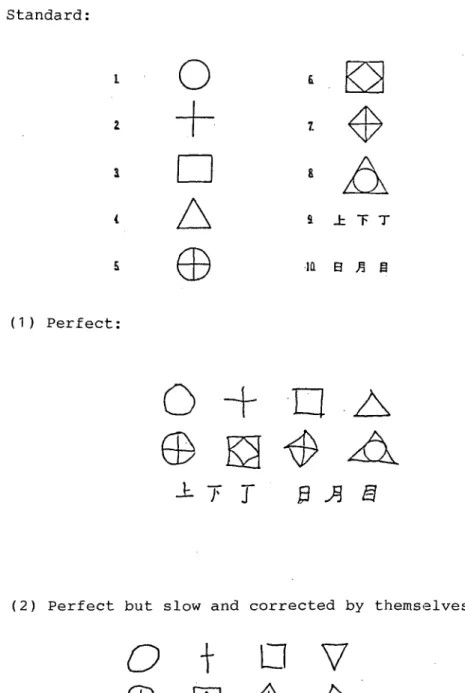
the most improved item is word-picture matching for ~eading; the least improved is verbal ability.Two prominent phenomena are improvement in word-picturs 'matching for reading and character-picture imitation for writing. Table 2 shows that the posttherapeutic performance is much higher for these abilities
,
with a mean improvement of 1.77 and 1,.10. This phenomenon is quite different fromthe English speakers' recovery records that are discussed in the Boston study.
心理認知與漠字閱讀
TABLE 2
THERAPEUT 工 C EFFECTS OF CHINESE APHAS 工 CS
Prethera- Postthera-Test Iterns peutic peutic
Mean 1I1ean Gesture 工 ndentification 7.17 8.25 1 .08 Word-Picture Matching 7.04 8.81 1 .77 Response Narning 6.42 7.33 0.91 Articulation Rating 5.70 6.66 0.96 Verbal 工 dentification 5.16 6.41 1 .25 Verbal Ability 5.04 5.88 0.44 Matherna~ic Ability 4.90 5.90 1 .00 Sentence Reading 4.69 5.52 0.83 Character-Picture Irnitation 4.59 5.69 1 .10 Repetition of Sentences 4.58 5.26 0.68 Dercription of Article Uses 4.36 5.38 1 .02 Original Writing 3.52 4.41 0.89 Total Mean 5.25 6.29 1 .04 N=100 Level: frorn 1 to 10. Source: Hsu
,
1978,
p.21Figure 3 shows that rnany Chinese-speaking aphasia patients can recover their ability to draw figures and sirnple ehinese characters.
師大學報第卅二期
Figure 3 Character-picture Initation Test (Sarnple test Question)
Standard: l
O
已囝
z
十
t。
2口
a
A
4A
a
土不丁 E6
10. 日后自 (1) Perfect:O 寸口 A
@圈。 A
-hJ土
日月 E(2) Perfect but slow and corrected by thernselves:
。
口
γ
@
國
命
A
(3) Not correct but related:
6γ
o
口
正下\
口 A
田 A
心理認知與漠字閱讀(4) Not correct and unrelated
,
spontaneous writing:口
斗罔
口 íll
vad
北
TAγ
叫
師大學報第卅二期
Makita (1968) has reported that Japanese children rarely have reading disabilities
,
in contrast to the situation in the United States. (This is usually attributed to the 主主旦旦之) Erickson et al . (1972),
howeVer,
provide data that the phonetic associations of 坦且主 may be stronger than their graphic association.Rozin et al. (1971) report success with students who have reading problems by teaching them to read English represented by Chinese characters. They suggest that the succèas of their program can be attributed to the fact that 'Chinese orthography maps directly into the meaningful unit' (Rozin
,
1971,
p. )264). That is,
the characters interpret into speech at the level of words rater than of phonemes. Therefore,
they have come to the conclusion,
that since logographic writing has printed forms that do not contain information about pronunciation,
people must be able to read without speech recoding.Efficacy of Logoraphic Writing Systems_
:f
or MemorizationMemory is defined as the power of 'reproducing and identifying what has been learned or experienced' (Webster's Dictionary). Memory has many aspects. 工 t requires the employment of more than one mechanism within the brain.
The nerve cells and nerve branches of some parts of the brain
,
or perhaps the synapses which join the branch of one cell to the body of another cell,
are altered by the preserve of different chemical neurotrausmitters and by the passageof a stream of electrical potentials.
This is what makes permanent patterns possible. This is the basis of all memory (Penfield and Roberts,
1959,
p. 228).Some aphasics have a memory disσrder which produces what appears to be a reading disability. These people cannot remember much of what they read so that by the time they have read through a short paragraph they have forgotten how
心理認知與漢字閱謂
i t started. They cannot be interested in reading a book or even a newspaper artic1e because they cannot retain enough to deve10p any continuity. There are some aphasics who read a10ud perfect1y
,
even with inf1ection at times,
and who d。not understand a sing1e word they have read. These same words can be spoken to them by others and they may understand :them we11 when they hear othe'rs say them
,
depending upon their abi1ity to comprehend speech. Meaning,
however,
seems to be 'disconnected from the words' when they read a10ud or si1ient1y by themse1ves (Broida,
1979,
p.60-61) Treatment för reading abi1ity for aphasia patients invo1ves the reading of actua1 pictures. Either objects or pictures of objects can be used with their names on cards.工 f action picture,s are used when verbs are slected as the task
,
a verb is printed on the card instead of a noun. When working on prepositions,
the card can read simp1y: 'on the chair' or 'under the box.' The desired response is for the patient to p1ace the 'cards according to what the words meanifor exa呻 1e , 'run
,'
þy a picture of a boy running. When a p?-.tient becomes competent in enough parts of speech and sentences so that he can be introduced to paragraphs,
his memory span must be carefu11y checked. 工 f that seems to present no prob1em and he hand1es paragraphs we11(therapists check for this competence with true anu fa1se questions presented after .every paragraph)
,
then he may be ready for short stories or newspaper artic1es (Broida,
1979,
p. 66-67).From Broida's exp1anation one can see that Eng1ish reading a'bi1i ty whioh was 10st in the memory of the aphas1c can be reca11ed gradua11y by using objects or pictures of objects. Yet even if one can read the Eng1ish words a10ud perfect1y
,
this do 包 s not prove s/h8 can understand what s/he reads. The words have to be re1ated to some visib1e rea1 objects or pictures in order to be restored to memory. On the other hand,
in re1ation to Chinese characters there are師大學報第卅二期
at least three experiments that support the idea that the logographic writing system is more efficient for memorization than an alphabetic writing system: Rozin
,
et al.,
(1971),
Liberman et al.,
(1970),
Bruce and Kinsbourne (1974),
Hardyck,
Tzeng,
and Wang (1978),
Tzeng and Wang ( 1983) •American Children with Reading Problems can Easily Leé!rn_tQ Read English Represented by Chinese Characters
Rozin~ Poritsky
,
and Sotskydecided to teacha group of secon,
d-grade school children wïth serious reading problems some ideographic scripts. They summarize the reading disabl-lities of the children as follows:They (the children) had diffiçulty (i) in identifying words by initial or final sounds and (i1) i~ combining a sequence of letters into a known English word. Many
。 f the children did not know all the alphabetic symbol-sound correspondences
,
which was surprising since they seemed .to have excellent memories ánd could be taught arbitrary new symbols rather quickly (p. 1264).They . hypothesized that since logographic scripts such as Chinese characters have a one-tö-one correspondence between imageand meaning
,
children would not need to break down the word into phonemesin order tσsound i t outiconsequently
,
they should be able to read Chinese with little difficulty. Their results support their hypothesie. They suggested that the success of .their program can be attributed to the fact that Chinese characters‘
mapinto speech at the level of words rather than of phonemes'(p.1264).
Liberman gives further evidence both from speech output (articulation) and input (perception) that the alphabetic unit or phoneme is unnatural or at least highly abstract (Liberman et al.
,
1970). But the Chinese logographic ~ystem ,which 'maps directly into themeaningful units
,'
can be more efficient for memorization.心理認知與摸字閱讀
The Lateratization Effects
Bruce and Kinsbourne (1974) reported an experiment in which subjects were asked to remember comlex visual forms. When done as a direct recognition task
,
left visual field-right hemisphere performance was slightly superior. However,
when subjects had to perform the figure recognition task while retaining a list of words in memory,
right visual field performace was superior.Hardyck
,
.Tzeng,
and Wang (1978) conducted an exp目 rimentutilizing tachistoscopic presentation of verbal an~ spatial stimuli to visual half-~ields. A basic premise is that verbal stimuli are process 色 d in the left. hemisphere and visuospatial stimuli in the right hemisphere. stimuli presented exclusively in the 'right visual field serving the left hemisphere (RVF-LH) are processed more quickly and with fewer errors because they are received directly at a central verbal processor in the left hemisphere. Visuospatial problems such as pattern recognition are processed most effectively in the right hemisphere
,
allowing an advantage in processing speed and accuracy for stimuli shown to the left visual field projecting to the right hemisphere(RVF-RH). The subjects were twenty fluent Chinese-English bilinguals (17 Chines
,
3 Americans),
who were asked t。compare semantic judgments of same-different across the tw。
languages. The mean number of Chinese characters recalled was 5.40 for the right visual field-left hemisphere and' 3.67 for the left visual field-right hemisphere. The right visual field-left hemisphere and 2.40 for the left visual field-right hemisphere. Words most often recalled were those
。 riginally presented in the right visual field-left
hemisphere (p. 65).
工 n the Hardyck et al. experiment onecan see very clearly that the number of Chinese characters is larger than the number of English words recalled by Chinese-Eng工 ish
師大學報第卅二期
bilinguals. This is furtber evidence that the Chinese Characters may be more efficient for memorization.
Differing Patterns of Memory
Tzeng and Wang (1983) reported a color experiment and a number experiments conducted by J. R. stroop in 1935
,
which supports the contention that the relation between script and speech underlying all types of writing systems plays an important role in the reading process. 'A reader of a particular script must assimilate the orthographic characteristics of that system.' That is to say,
if the organization of the components of a logograph is important for understanding,
then the reader had to pay special attention to the position of every element in the logograph. Therefore,
the proces~ing of logographs should involve more visual memory than the processing of alphabetie scrip1三﹒V1. Conclusion
When viewed together the visual laterali~ation effect
,
the aphasic study,
and the efficiency of memorization,
äll gives . evidence to show thβt speech abilities are dominated by the left hemisphere,
and other adilities 5~ch as musice r-ue 卡』 r ce --h pp S -l dm ne
a-hu recognition which are dominated by the right
The special characteristics of the Chihese language are tones and its pictographic characters. From the psycholinguistic point of view therefore
,
~earning the Chinese language involves not pnly the left hemisphere for usual language learnin~. fuhctions,
but also the right hemispherefor th色 .picture-visual functions reguired to read Chinese writing. Because the Chinese character is a good~xample of ideographic or morphemic writing in which. each symbol represents a unit meaning
,
i t l S more efficient for心理認知與漢字閱讀
Therefore
,
in teaching Chlnese as a second language,
one has to emphasize the pictorïal feature; thus leading students to learn the chinese written language efficeintly.REFERENCES
Broida
,
Helen. 1979,
Communication breakdown of brain injure adults. College Hill Press.Brookshire
,
R. H. 1978. An introduction to aphasia (second edition). Minniapolis: BRK publishers.Bruce
,
R. & M. Kinsbourne. 1979. Orientational model of perceptual Asymmetry. Paper presented a 15th Convention of the Psychonomic Society,
Boston,
Mass.Buckingham
,
Hugh W. Jr. 1982. Neuropsychological model of language. Speech Language and Hearing Vol. 1,
327. Erickson,
D. ,工 G. Mattingly and M. T. Tuvey. 1972.Phonetic activity in reading--An experiment with 主且其
Journal of Acoustical Society of America
,
Vol. 52,
132. Gardner,
H.,
p.
Ling,
L. Flamm and S. Silverman. 1975. ComprehenSion and appreciation fo humorous material fo Jlowing' brain damage. Brain,
Vo 工. 98,
399-412.Geschwind
,
Norman. 1979. Specialization of the human Brain,
Human communication,
Language and its psychobiological bases,
with 工 ntroductions by Wil 工 iam S. Y. Wang.Goodglass H. and E. Kaplan. 1972. The Assessment of Aphasia and related Disorder. Philadelphia: Lea & Fehiger. Halpern
,
H. 1972. Âdult aphasia. 工 ndianapllis , Indiana:Bobb-Merill.
Hardyck
,
C.、, Ovid J. L. Tzeng and Willian S. Y. Wang. 1978. Cerebral lateralization of function and bilingual decision processes: 工 s thinking lateralized? Brain. and Language,
Vol. 5,
56 一 7 1.Hatta
,
Takeshi. 1977. Recognition of Japanese 旦旦旦主i in th司師大學報 第 1付二期
685-688
Kimura
,
D. 1973. On the track of prehistoric man. New York: Random House,
trans.Liberman
,
A.,
F. S. Cooper" D.P. Shankweiler,
M.. Studdert-Kennedy. 1967. Psychol . Rev. 74,
431; 'H. Savin and T. Bever,
J. 1970. Verbal Learn. Behav. 9,
295.Liberman ,工 Y. , D. Shankweiler
,
A. M. L,ibe'rman,
C. Fowlerand F. W. Fischer. 1977. Phonetic Segmentation and Recoding in the Beginnig Reader. 工 n A. S. Reber and D.
Sc~rborough , Eds. Toward a Psychology of Reading: The Proceeding of the CUNY Conferences. Hillsdale
,
N. N.: Lawrence Erlbaum.Liu
,
Stella S. F.1978. Decoding and comprehension in reading CHinese cross-cultural perspetives on reading research. Dina Peitelson,
Editor. 144-156.Lomas
,
A. & A. Dertesz.
1978. Patterns of spontaneous recovery in aphasic group: A study of Adult Stroke Patterns. Brain and Language,
Vol. 5,
388~401.Makita
,
K. 1968. The 'rarity of reading disorders in Japanese childern. American Jour.nal of Orthopsychiatry,
Vol. 38,
599-614.Penfield
,
Wilder and Lamar Roberts. 1959. Speech and Brain-mechanisms. Princeton University Press.Reinvang ,工& E. Engvik. 1980. Language recovery in aphasia from 3-6 month after stroke ,工 n M. T. Sarno &
o
Hook Eds. Aphasia: Assessment and Treatment. Stockholm,
Almquist & Wiksell,
and New York: Masson. Rozin,
P.,
S. Poritsky and R. Sotsky. 1971. Americanchildren with Reading problems caneasily leàrn to read English represented by Chinese character. Science
,
Vol. 171,
1264-1267.Sasanuma
,
S. 1972. An analysis of writing errors in Japanese aphasic patients: 但且斗 vs. 主盟呈 Words. Cortex,
Vol. 8,
256-282.心理認知與漢字閱讀
• 1974a. 監控立主 vs. !s.旦旦旦 processing in alexia with transient agraphia~ A Case Report. Cortex
,
Vol. 10,
89-97.1974b. Impairment of written language in Japanese aphasics: 主旦旦 vs. 旦旦主 Processing Journal of Chinese Linguistics
,
Vol. 2,
141-157.1974c
.
豆豆旦旦 and 堅盟主 processing in Japanese aphasics. Brain and Language,
Vol. 2,
369-383.Sausanuma
,
S. and Hi Monoi. 1975."The syndrome cf Goji (word meaning) aphasia. Neurology,
Vol. 25,
627-632.Sasanuma
,
S.,
M. 工 toh , K. Mori,
and Y. Kobayashi. 1977. Tachistoscopic recognition of Kana and Kanji words. Neuropsychologia,
Vol. 15,
547-553.Sroop
,
J.R. 1935. Studies of interference in serial verbal reactions. Journal of Experimental Psychology,
Vol. 18,
643-662.Tzeng
,
Ovid J. L. Researvh onLinda Garro
,
and Daisy L. Chinese characters: A Hung. 1977. Call for Interdisciplinary Endeavor. Linguistics,
Vol. 5,
349-353. Journal of ChineseTzeng
,
Ovid J. L.and William S. Y. Wang. 1983. The first two Rs. American Scientist,
Vol. 71,
238-243Wapner
,
W~ and H. Gardner. 1981. Profiles of symbol-reading skills in organic patients. Brain and Language,
Vol. 12,
303-312.Young
,
Andrew W. Bion,
Pamela and Ellis,
~ndrew W. 1980 Studies toward a model of laterality effects for picture and word naming. Brain and Language,
Vol. 11,
54-65.師大學報第卅二期