Master’s Thesis
National Innovation Policy in Biotechnology –
New Zealand and Taiwan
國家創新政策比較: 以紐西蘭與台灣之生物科技業為例
Advisor:
Dr. Grace Lin
Student:
Ben Hall
9335532A Thesis
Submitted to Department of Management of Technology College of Management
National Chiao Tung University in partial Fulfillment of the Requirements
for the Degree of Master
in
Business Administration June 2007
Abstract
As we move further into the 21st century, innovation, and knowledge in general, are now regarded as two of the key drivers of economy. As both innovation and knowledge move to the forefront of national agendas, the big picture of the national innovation systems (NIS) affecting both the science and technology infrastructure and the public as a whole has to be addressed.
There are a number of similarities between New Zealand and Taiwan, which allow for meaningful policy comparisons. Both countries are geographically small, with limited natural resources and population. Both have strong agricultural bases. Over the last few decades the governments of the two countries have transformed their respective societies from agrarian economies to industrialized, free market economies that can compete globally. Importantly, both countries have well established NISs and have earmarked biotechnology as a key area for their country’s future.
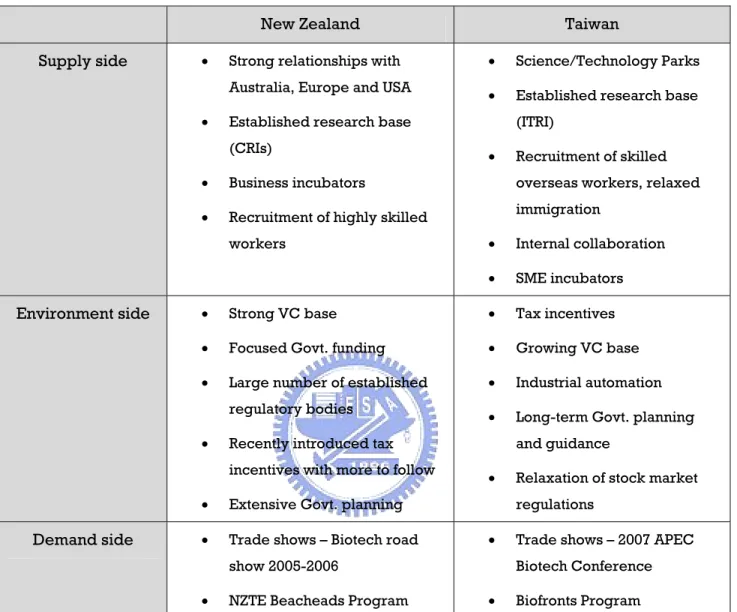
Having singled out biotechnology, how is each country attempting to promote its growth? Have they implemented appropriate and focused policies? Using a framework designed to classify national policy tools, this paper sets out to determine the various policy approaches taken both in New Zealand and in Taiwan in the emerging biotechnology industry, the value of these transformation policies, and any major issues or areas which require attention.
Table of Contents
1. Introduction ... 1 2. Literature Review ... 3 3. What is Innovation? ... 29 3.1 Systemic innovation ... 30 3.2 Sources of Innovation... 30 3.3 Goals of Innovation ... 31 3.4 Failure of Innovation ... 32 4. National Innovation ... 354.1 National Innovation Systems (NIS) ... 35
4.2 Overview of NZ’s NIS ... 42
4.3 Overview of Taiwan’s NIS ... 44
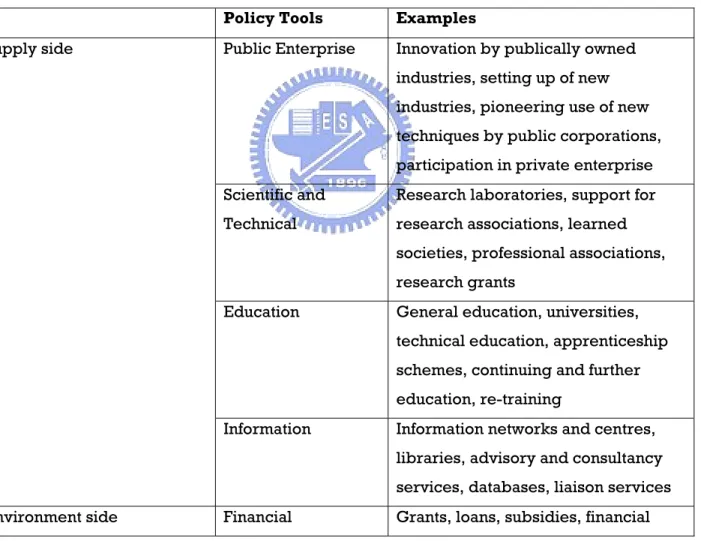
5. Assessing Innovation Policy... 47
5.1 Supply side ... 47
5.2 Environment Side... 47
5.3 Demand Side ... 48
6. Overview of Biotechnology... 50
6.1 The OECD’s definition of biotechnology ... 51
6.2 Definition of a biotechnology firm ... 52
7. Case Study: New Zealand and Taiwan ... 55
7.1 National Context and Background (following information and statistics taken from the CIA website, https://www.cia.gov/library/publications/the-world-factbook/countrylisting.html#n) ... 56
7.1.1 New Zealand... 56
7.1.2 Taiwan ... 69
7.2 The Biotech Industry – Statistics... 83
7.2.2 Taiwan ... 85
7.3 Innovation Policy (analyzed as per section 4) ... 87
7.3.1 New Zealand... 87
7.3.2 Taiwan ... 96
8. Discussion and Findings ...106
8.1 The New Zealand Situation...106
8.2 The Taiwanese Situation...108
9. Conclusion ...112
1.
Introduction
Innovation can be defined as anything new. It may be a completely novel idea, or a concept transferred from another field which has an exciting new application. In this sense, ideas, knowledge and innovation have always been fundamental to the economic transformation process of inputs and outputs. The differences for the new paradigm are the explicit and more integrated systems of exploiting the explosion of new knowledge, through diverse interactions and linkages.
Current information and communications technologies (ICT) are a tool in this process. This has resulted in better interactions between science, technology, market and organisation, aiding innovation.1 Within this new paradigm, America is the prime example. The economic evolution into the new paradigm and the resulting economic benefits has forced many other countries to re-evaluate current policies and national infrastructure, to fit these systems into their economic strategies.
Essentially the relationship between technological progress, innovation and growth has changed since the early 1990s.2 For a knowledge economy, technology and innovation become key drivers of increased growth performance. In this environment, innovation becomes more market driven, more rapid and intense, more closely linked to scientific progress, and wider spread throughout the economy. Certain countries have proved better able to respond to and benefit from these changes than others.
As technology and knowledge move further to the forefront of the national agenda, the big picture of the national innovation systems (NIS) affecting both the science and technology infrastructure and the public as a whole has to be addressed. Using a framework designed
1 Grimaldi, R. and Grandi, A. (2001). Leveraging research and technology through academic spin-offs:
the influence of science, market, technology and organisation. Department of Management, Via Saragozza, Italy.
2 OECD (1996). The knowledge based economy. Report for the Organisation for economic
to classify national policy tools, this paper sets out to determine the various policy approaches taken both in New Zealand and in Taiwan in the emerging biotechnology industry, the value of these transformation policies, and any major issues or areas which require attention.
2.
Literature Review
The Ministry of Research and Development, Research and Development in New Zealand - A Decade in Review, 2006.
This report provides a long term perspective of changes to the New Zealand science system. Designed as a tool for science managers, policy makers, politicians, researchers and
educators, it seeks to measure NZ’s successes and recognise where it can improve. The results show that over the past ten years, NZ has seen a 60 per cent increase in the number of scientific positions. The amount of R&D carried out in NZ has almost doubled and it has seen 11 per cent growth in business R&D per annum since 2000.
As the report points out; the measurement of R&D is defined by the Organisation for Economic Co-operation and Development (OECD) in the Frascati Manual1 as:
‘creative work undertaken on a systematic basis in order to increase the stock of knowledge. It is characterised by originality, where investigation is a primary objective’.3
Research and development encompasses basic or untargeted research, as well as research supporting identified sectors and needs (sometimes called strategic research). Operational research and routine data collection and monitoring activities are excluded from the OECD definition of R&D, although they are recognised as important activities of the science system that often provide input to research. The report notes that some types of research, such as market research, are outside the scope of OECD R&D and therefore are outside the context of the report.
The report provides comparable information for all sectors of the New Zealand science system, and provides detail not previously released. Specifically, business enterprise R&D is discussed in detail, with results for the primary, manufacturing, scientific research and other services industries shown separately over time. R&D performed by Crown Research Institutes (CRIs), which was previously reported as a part of government R&D, is also
3The Ministry of Research and Development, Research and Development in New Zealand - A Decade in
discussed in detail. In addition, contributions made by each of the CRIs and universities have been individually identified.
OECD (2005), Innovation Policy and Performance: A Cross-Country Comparison, OECD, Paris.
The OECD is a unique forum where the governments of 30 democracies work together to address the economic, social and environmental challenges of globalisation. OECD
Publishing disseminates the results of the organisation’s statistics gathering and research on economic, social and environmental issues, as well as the conventions, guidelines and standards agreed by its members.
Taking a national innovation systems (NIS) perspective, this report examines innovation policy and performance in six OECD countries – Austria, Finland, Japan, the Netherlands, Sweden and the United Kingdom. In-depth analyses, based on a common framework using quantitative indicators and qualitative information, highlight countries’ strengths and weaknesses in innovation, as well as the effectiveness of their innovation systems and innovation policies in driving economic performance.
The research effort summarised here is devoted to the twofold task of assessing both countries’ innovation performance, highlighting their specific strengths and weaknesses, and the effectiveness of their innovation policies in the specific economic and institutional context in which they operate. The underlying hypothesis is that the benefits of countries’ science, technology and innovation policies, including specific policy instruments, cannot be adequately assessed outside the specific context of the national innovation system (NIS) for which they are designed. To accomplish this task, a new approach based on NIS
concepts has been applied drawing on both quantitative and qualitative information (this is explained in Annex 1 of the report which I have included below). National experts from selected countries – Austria,
Finland, Japan, the Netherlands, Sweden, and the United Kingdom – provided short country studies containing an overall assessment of the relative strengths and weaknesses of the country’s NIS and of the relationship between its innovation performance and innovation
policies. The economies and innovation systems of participating countries vary widely with respect to their structural features and governance mechanisms, providing scope for deriving sufficiently general conclusions.
The report concludes that the methodology of combining quantitative information with informed judgment and interpretation was necessary and successful. The country studies provided evidence that the specific economic and institutional conditions of each country, need to be taken into account in order to be able to assess countries’ innovation policy and make their experience applicable to others.
Even amongst the OECD member countries who participated in the study – which were relatively homogenous in terms of income per capita – NIS vary greatly in their structural features and modes of governance. Accordingly there is no single “optimal” policy in terms of the design of either individual instruments or the mix of policies readily transferable to different contexts.
OECD (2005), Innovation Policy and Performance – Annex 1: GUIDELINES FOR PREPARING COUNTRY NOTES
Participating countries were asked to prepare short accounts of their own innovation
performance, using a set of qualitative and quantitative indicators. They were asked to give their own overall assessment of the relative strengths/weaknesses of their national
innovation system (NIS) and of the relationship between their innovation performance relates and the overall stance of the country’s innovation and RTD policy, including the implementation of specific policy instruments (e.g. government-funded R&D, patenting and licensing policies for public research organisations, public/private partnership
programmes, cluster policies). The OECD Secretariat provided countries with a
standardized set of quantitative indicators of innovation activities and performance (e.g. R&D expenditure, human resources, innovative outputs, economic performance) so that country experts could concentrate their efforts on more qualitative aspects of the analysis and assessments of policy efficiency (see Annex 2 for a set of country-specific indicators).
Set out below are some notes on how participating countries were asked to assess economic performance, innovation output and the performance of the various elements of the NIS. They attempt to identify the links between policy and performance and to outline the factors
that influence policy effectiveness in the national context. Innovation policies of particular interest are those outlined in the OECD Growth Study, including policies related knowledge creation, industry-science linkages and industrial innovation.
The notes below are not intended to provide a comprehensive guide, but provide a broad indication of how countries might undertake the exercise. The notes should be read in conjunction with the main text. The notes include references to quantitative indicators and such indicators should be used wherever available and relevant. However they are rarely able to tell the full story and participating countries should also use relevant qualitative analysis from the full range of available sources. The aim should be to combine the two to produce an account of innovation performance which is coherent and convincing within the context of the overall economic and social situation of the country concerned.
Measuring innovation outputs
Direct output measures of innovation performance fall into three types:
• Overall measures of economic performance such as the level and rate of growth of GDP per head.
• Measures from innovation surveys such as the proportion of business turnover accounted for by products or processes introduced in the last three years.
• Surveys of the diffusion of new technologies, processes and business methods.
It should be noted that a successful performance at the second and third of these measures does not automatically translate into a successful performance as measured by the first. Any apparent discrepancy needs to carefully analysed and explained. Where such a
discrepancy exists this may be due to a variety of factors such as, for example, weaknesses in downstream business processes which inhibit firms from capitalising fully on new
products introduced or of recent innovations adopted.
Patents are often used in assessments of innovation performance, but they mainly measure invention not innovation and are therefore an intermediate rather than a final indicator of innovation performance. It will often be the case, however, that a countries patenting performance will often be closely correlated with its overall innovation performance.
The same may also be true of other intermediate and input indicators of innovation performance (e.g. R&D expenditures, human resources for science and technology), but such ‘reduced form’ correlations however well corroborated by each other should not be regarded as an adequate substitute for a thorough behavioural and structural analysis of how well a country is performing at innovation and the exploitation of new science and technology.
Possible indicators are other evidence which can be used to assess innovation performance are set out below:
• Economic performance. Growth of GDP and productivity. Proportion of output in high-tech sectors. What structural factors strongly influence recent economic performance? To what extent is innovation policy linked to overall economic policy?
• Innovation output. Proportion of turnover consisting of newly introduced products and processes. Speed of adoption of new technologies, technological processes and business best practice. Patents as a measure of inventive activity. In which areas is innovation concentrated? What is the role of innovation in the service sector?
• Innovation diffusion. Surveys of the adoption of particular new technologies or business practices particularly those which cover a number of comparable countries (since
innovations take considerable time to diffuse surveys covering only a single country need very careful interpretation). Innovation surveys may include questions about the adoption of new technologies and practices. In the current situation surveys of the adoption of
information and communication technologies are of particular interest but are primarily a matter for ICCP.
Determinants of innovation performance: the national innovation systems (NIS) perspective For policy making purposes it is not sufficient to measure the outputs of a country’s
innovation performance; it is also necessary to ascertain how that performance was determined. There is a considerable academic and business literature on the innovation process, but for policy purposes it is best considered within the framework of a national
innovation system (NIS). A good deal of analysis and description has been undertaken of the NIS, and there is an element of choice about different descriptions of the NIS. For the
purposes of assessing national innovation performance it can be assumed to include the following ten main elements or drivers. The first item covers the markets for innovative goods and services, the next four cover the inputs to the innovation process within the firm, the sixth the firm itself and the last four the environment in which firms operate.
They encompass the wide range of factors which are now held to determine innovation performance:
a) Demand. The willingness and ability of consumers, firms and public sector organisations to be intelligent and demanding customers and to purchase novel products and services. Ability to sell new products and services abroad will be
vital if necessary economies of scale are to be realised. The propensity of consumers to buy novel products and services is a function of national culture, per capita income etc., while that of firms will be much more endogenous to the NIS; the more innovative are firms the more they will buy innovative inputs from their suppliers. However innovation policy makers will be particular interested in public procurement where governments have direct influence on markets and can create demand for innovative products and services.
b) Human resources, including the supply of qualified scientists and engineers, trained craftsmen and technicians, and well educated and trained managers. This is an area where the OECD is currently trying to improve the availability of internationally comparable data. Government policies related to higher education, training and university research can have a strong influence on the availability of domestically produced human resources. Polices related to immigration can influence international mobility and the inflow and outflows of workers.
c) Finance. The ability of firms (a) to generate sufficient internal finance and allocate it effectively to innovation activities, (b) to raise external finance for innovation on appropriate terms and conditions and which meets their particular needs. Governments often provide financing for business innovation, either directly though R&D and innovation subsidies (sometimes linked to specific government needs) or indirectly through tax incentives and
other means. A range of government policies can influence the availability of external financing, especially for new technology-based firms.
d) Physical inputs. The ease with which domestically based firms can obtain supplies of components, materials, services, capital equipment and software. Inevitably all firms will rely significantly on supplies from abroad, although in the case of some OECD countries these may be obtained within regional clusters which span international frontiers.
e) Access to science, technology and business best practice. The sources of technological, scientific and technological knowledge and related knowledge of business best practice and the means by which firms can access them. Sources will include universities, R&D service companies, national, regional and local R&D support organisations, customers, suppliers, other firms generally, international collaborative programmes, business support organisations such as chambers of commerce, as well as a variety of government
programmes. Means will include networks and clusters, supply chains, seminars,
exhibitions, licensing, publications, mobility of qualified personnel, government support programmes, etc.
f) Ability and propensity of firms to innovate. The ability of firms to use external resources (people, finance, technology, bought in supplies) to develop high value added products, processes and services that meet customers’ needs and generate the revenues needed to finance its activities. This will include the effectiveness of internal innovation and other business processes as well as the ability of firms to develop effective organisational structures, ways of working and culture which allows and encourages managers and
employees to give of their best. The ability of firms to interact effectively with their external environment, to identify and seek out the inputs they require and to formulate appropriate strategies for survival, growth and coping with change is also crucial.
g) Effectiveness of market processes. This is the extent to which the interaction of firms and other factors in the market place is conducive to innovation. In particular competition provides an important stimulus to innovation while innovation is one of the most important ways in which firms compete. Similarly while the removal of entry barriers to markets is conducive to innovation, firms will try and innovate in ways that make it difficult for other firms to match them in the market place. Even if they succeed the advantage will only be temporary or until the associated IPR expire. Radical innovation is one way in which existing
entry barriers can be overcome and the competitive advantage of incumbent firms eroded. The ability of an economy to foster the creation of new firms and encourage their
subsequent growth and development plays a vital role in innovation and the ability to adapt to changing economic circumstances and exploit new opportunities. These processes will be affected by competition policy, other regulatory policies particularly those affecting new firm creation, standards and the IPR regime as well as by trade policy.
h) Networks, collaboration and clusters. Markets are one way in which firms and other agents interact, networking and collaboration are the others. Networks play a key role in the transmission of knowledge and information because markets are not very effective in doing this. Collaboration enables firms to share risks and costs and give them access to
complementary capabilities which they do not possess themselves. Clusters involve both market relationships and networking, typically require geographical proximity, and give firms the advantage of external economies of scale and scope including externalities.
Analysis carried by the TIP Working Party and by Michael Porter suggests that the degree to which the NIS is networked and exhibits inter-firm collaboration and clusters has a
significant effect on the rate of successful innovation. Numerous policies have been pursued in OECD countries to foster networking and collaboration.
i) Institutions and infrastructure. This covers a wide range of organisations, facilities and systems. Most important to innovation are universities, public research organizations (PROs), organisations which provide R&D support and/or links with the research base, education and training institutions, professional societies, government departments, transport and communications, a range of business support organizations, financial institutions, etc.
j) Business environment. This covers framework conditions such as macroeconomic stability, company and commercial law, etc. It should also include non-firm specific aspects of
business culture, the lore and practice and unwritten rules which govern how business is done. Corporate governance which may have significant impacts on corporate strategy and attitudes to innovation and risk is also included. Attitudes towards starting a business, bankruptcy, etc., are also important.
A country’s innovation performance will depend not only on its how it performs on each individual element of the NIS, but how these separate elements interact. Previous OECD work indicates that there are several different configurations which can result in a successful overall innovation performance. This is similar to a pipe organ where there are number of different settings of the stops which can produce a pleasing sound. It suggests that it is the cohesiveness of the NIS which matters for a successful innovation performance, as well as how well the country does against each of the main elements. It follows that rating a number of countries against a list of the main influences on innovation performance and adding up each country’s score may give misleading results.
It also follows that policy measures need to be tuned to suit the national context, including institutional factors, industry specialisation and size. As a result, policy instruments that may be effective in improving innovative performance in one country may be less effective or even inappropriate in another.
The above list of innovation determinants should be regarded as a check list to help countries make sure that they have covered all the main factors which drive their own innovation performance. They should not be regarded as a list of sets of variables which make up a formal mathematical model of how innovation happens – our knowledge of the innovation process is too incomplete and fragmented to make this possible. The relationship between these various elements of the NIS and any given aspect of innovation is often very complex and caution must be exercised in distinguishing what determines what.
In the case of the UK, for example, an indifferent record of firms investing in business enterprise R&D (BERD) may be a fundamental cause of weaknesses in the UK’s innovation performance due perhaps to the short-term interests of shareholders or it could be symptom of other problems such as an ex ante shortage of skilled labour which is depressing the rate of return which UK firms could achieve from additional R&D projects. From the point of view of the policy maker it is very important to diagnose the correct causes of individual aspects of innovation performance.
Discussion of earlier versions of this document raised the question of which of the ten determinants is most important. This can be answered in several ways. For an individual
country which the most important determinants will be those which are holding back national innovation performance and therefore need to be the main focus of policy.
Secondly individual innovations will be driven by different combinations of the
determinants as will innovation in particular sectors or firms. Currently there is a course at the University of Utrecht where a similar description of the innovation system is used as a heuristic device to enable students to analyse the origins of particular innovations thus enabling them to learn what innovation is about.
However the essence of innovation is the matching of existing and possible future market needs with technological possibilities by firms and entrepreneurs and, in that sense, a), e) and f) are fundamental. The existence of a very large relative unified market with very demanding customers together the world’s strongest science and technology base and the existence of a large core of technologically sophisticated and enterprising firms and entrepreneurs clearly lies at the heart of the United States’ impressive innovation performance.
For smaller countries the world market must be their target and their innovation
performance will primarily depend on the competences of their national firms, on the extent to which those competences are rooted in national conditions which are not easily
reproduced elsewhere and on the extent to which the country offers an attractive
environment for internationally mobile innovation activities. The country’s stock of highly qualified and trained manpower is clearly crucial element in all this as the national ability to create and grow/develop new high-technology firms. Individual elements or particular combinations of the NIS may only operate on innovation performance with a significant lag. Thus an assessment made today of NIS performance may imply changes both for better or worse in a number of aspects of performance in the future.
In addition the global environment in which the NIS functions will also be changing and a configuration of the various elements of the NIS which yields successful innovation and economic performance in the present and near future may not be successful in the longer term. The capacity of individual firms and other institutions to cope with the pace and
direction of longer term change as well as the ability of the NIS as a whole to adapt is crucial for the long term future of the country concerned and should be assessed as far as it is possible to do so.
A full assessment of a country’s NIS is a major undertaking. The recent analysis by Lewis Branscomb and Philip Auerswald of funding for early-stage technology
development in the US, “Between Invention and Innovation”, runs nearly 150 pages and covers just one aspect of one of the ten elements of the NIS listed above (availability of financing). In these circumstances each country will wish to focus on those aspects of the NIS which it believes are most significant for its innovation performance and to draw on pre-existing material as much as possible. However some coverage of each of the main influences on innovation performance needs to be attempted.
As a guide some of the questions which should be addressed when considering innovation under each of the ten factors are set out below:
1) Demand. Qualitative assessment of the propensity of consumers, firms, institutions and government to buy novel products and services. Growth of high-tech imports and exports. What policies have proven effective in stimulating demand (e.g. product market regulations, environmental or other quality regulation, government procurement)?
2) Human resources. A variety of indicators are available e.g. qualified scientists and engineers as a proportion of the total labour force, proportions of the labour force with particular levels of qualifications and/or number of people achieving these qualifications in any given year. What types policies contribute to strengths or weaknesses in human
resources for S&T? Consider policies to educate scientists and engineers and to foster their mobility i) among firms (e.g. within networks and clusters), ii) among institutional sectors (e.g. between public and private sectors), and iii) internationally.
3) Finance. An assessment should be built up from available qualitative and quantitative information. Key elements should include the proportion of firms reporting difficulty in raising finance for innovation activities, propensity of mainstream financial institutions to finance innovation and existence and role of specialist lenders, venture capital provided to high-tech SMES as a percentage of GDP, role of business angels, government support for BERD, etc. Financing of the early stage development of research based technologies needs particular attention because of the increasing importance of science based innovation.
4) Physical inputs. Qualitative assessment of the access of nationally based firms to geographically local sources of novel components, materials, and services. Domestic sourcing by locally based MNEs may provide one guide to this.
5) Access to S&T. Strength of national science systems using usual indicators such as publications, citations, output of PhDs, etc. Strength of independent research institutions public and private. Strength of links between business on the one hand and universities and other research institutions on the other. Indicators of the last include business funding of HERD, patenting, licensing and start-up companies by universities and research institutions and citations from patents to scientific articles. The publication Benchmarking Industry-Science Relations (OECD, 2001) is an invaluable guide. Transfer of technology within industry is even more important but much harder to map though some useful academic research is being done, e.g. by using citations from one patent to another. Policy changes related to the funding and governance of public research institutions to enhance their ability to address socio-economic. Steps taken to strengthen industry-science relationships (e.g. by promoting patenting and licensing, collaborative research, industryfinanced research, worker mobility) and estimates of their relative effectiveness have they been? Factors contribute to their relative success.
6) Ability of firms to innovate. Quantitative indicators include number of patents in triadic patent families, proportion of firms introducing new or technologically improved products or processes and expenditure on business enterprise R&D (BERD). Employment of qualified scientists and engineers is an important measure of firms ability to seek out and absorb S&T. Case study and survey data may permit an assessment of how far management, firm strategy and firm culture are conducive to innovation. Creation of new high-tech firms indicates how far the system as opposed to individual firms can adapt to new S&T. Discuss the
contributions of government policies for boosting firm-level innovation (e.g. government financing of R&D and innovation, cluster and network promotion policies).
7) Effectiveness of market processes. How far does competition policy, exposure to international competition, regulation, the IPR regime, market structure, etc., interact with national business culture and to produce inter firm rivalry and competition which is conducive to innovation? The main source of information will be academic research.
8) Networks, collaboration and clusters. Academics have investigated the extent of inter firm collaboration within and between a number of OECD countries. Research into inter firm networks and clusters is also available for some countries. Participation in national and international collaborative research programmes will be a useful indicator. What policies are in place to stimulate network and cluster formation? How have they been utilised by different types of firms in different industry sectors? How successful have they been in stimulating technology and knowledge diffusion?
9) Institutions and infrastructure. This requires a discussion of the variety, coverage and effectiveness of organisations which provide advice, assistance on technology, business best practice and on the business environment to firms and sectors. Such organisations will include chambers of commerce, industrial research centres, technological advice centres, consultants, national standards bodies, etc.
10) Business environment. Various aspects of wider ‘framework’ conditions need to be covered including macro-economic conditions. Emphasis should be placed on those aspects which are thought to affect innovation most.
Information sources for assessing innovation performance: qualitative and quantitative It is not the purpose of this document to describe in detail how innovation performance might be measured using the NIS framework; such a description would have to run to many hundreds of pages. However, it is appropriate to draw attention to some key considerations: • First, while there is a wide range of numerical data sources which can be used in assessing innovation performance quantitative indicators cannot tell the whole story. Many of the factors which determine innovation do not lend themselves to quantitative measurement and this is equally true of the relationships between them. Although econometric analysis can often estimate the correlation between quantitative measures of innovation related variables estimating the structural relationships which determine that correlation is typically rather difficult.
• Second, it is a fundamental problem of innovation policy that it lacks anything even vaguely resembling the fully specified dynamic general equilibrium model of innovation, which would be required to allow the numerical computation of an optimal innovation policy.
In some cases innovation policy makers and analysis even lack good qualitative
descriptions of how given aspects of innovation performance are brought about. In these circumstances one must rely heavily on qualitative assessment, plausible but incompletely tested hypotheses and a significant measure of informed judgment.
• Third, the need to rely on qualitative assessment is reinforced by the significant role which national institutions and culture unique to the country concerned appear to play in
innovation performance. Such institutions are often hard to describe analytically let only measure but cannot be ignored in any thorough systematic assessment of innovation performance. They must be taken into account when one country considers adopting the policies or programmes of another.
What is clear is that assessing a country’s innovation performance should not merely be based on international comparisons but should also use information or analysis which reveals existing strengths and weaknesses. For example, if innovating firms persistently face difficulties in raising external finance this should be of concern to policy makers whatever the situation in other OECD countries. The purpose of innovation policy is not to rise to the top of international league tables but to improve the economic and social well-being of the country concerned.
A wide range of information sources can be drawn on in assessing innovation performance. As well as the wide range of numerical indicators produced and collated by the OECD, it is will be possible to draw on a range of other statistical sources, academic research,
consultants reports, analyses carried out in house, by business associations, by the OECD and other international bodies. Something too may be learned from studies of innovation performance carried out by other countries provided that due allowance is made for cultural and institutional differences. Evaluations of past an existing policies and programmes can often produce useful information about the operation of the NIS. Consultations with NIS actors may draw attention to issues not fully covered by formal analysis. While composite indicators may often be hard to interpret they can characterize the NIS in interesting and useful ways.
The overall aim of the assessment should be not just to determine how well a country is doing but also why. Which policies contribute to overall innovation performance and to
strengths in particular areas? What structural, institutional or other national factors influence the effectiveness of the policy instruments and/or determine their effectiveness
in the country of study? Such questions must be addressed in order to produce cost-effective policies.
Jacques Mairesse and Pierre Mohnen, Accounting for Innovation and Measuring Innovativeness: An Illustrative Framework and an Application, 2002.
The purpose of the paper is to propose and illustrate an accounting framework for
innovation. The authors characterize the intensity of innovation by a sales-weighted measure of innovation: the share of sales in innovative products.
They select a certain number of explanatory variables for the propensity to innovate and the intensity of innovation, and then specify and estimate an innovation function as a generalized tobit model. Based on this model, they compute the expected share of innovative sales and define innovativeness as the part of the observed share of innovative sales that remains unexplained and corresponds to the notion of productivity, in the standard growth accounting framework and production function analysis.
An unpublished work that was hard to follow and limited by only using data from one section of the European Community Innovation Survey.
Kuen-Hung Tsai and Jiann-Chyuan Wang, An examination of Taiwan’s innovation policy measures and their effects, Int. J. Technology and Globalisation, Vol. 1, No. 2, 2005. During the past few decades, the Taiwan government has implemented a number of policy measures aimed at enhancing firms’ innovative investment, the most notable of which focus on speeding up the development of the high-tech sector. Such policies have included: • establishing the Hsinchu Science-based Industrial Park to provide an environment conducive to the high-tech industry
• organising innovation alliances to spread out firms’ R&D risks and secure first mover advantages
• expanding the government – sponsored research institutes to serve as a technology transfer channel for the private sector
• providing tax incentives to absorb some of the costs of firms’ R&D activities • providing access to sources of venture capital.
More specifically, the report tells of how these policy measures were designed to enhance firms’ innovative activities and to seek to reduce the likelihood of market failure, beginning firstly, with the establishment of Hsinchu Science-based Industrial Park (HSIP) to provide an environment conducive to the development of the island’s high-tech industry.
Secondly, innovation alliances have been organised as a means of spreading the R&D risk between firms and securing first mover advantages.
Thirdly, the scope of the government-sponsored Industrial Technology Research Institute (ITRI) has been expanded to serve as a channel for technology transfer within the private sector; the majority of the budget for the National Science and Technology Projects (NSTPs) has also been allocated to ITRI in an effort to boost the Institute’s innovative capacity. Fourthly, tax incentives have been made available to absorb some of the R&D costs of firms and to encourage them to engage in R&D activities.
Finally, a venture capital industry has been established, with the growth of this sector having already helped to speed up the overall development of the high-tech sector.
The report examines the effects of these policy measures on productivity at firm level, since these policy measures are aimed at boosting the innovative environment within industry as a whole, promoting innovative activities and further enhancing firm productivity. Based upon a fixed-effects model extended from the Cobb-Douglas production function, and a sample of 136 manufacturing firms listed in the Taiwan Stock Exchange during the period 1994–2000, the results demonstrate that government innovation policy has had a significant effect on productivity within firms.
The report also addresses the question of whether Taiwan’s economy would have performed as well as it has if these policy enactments had not taken place. This question is answered from two perspectives. Firstly, from a theoretical perspective and also later, from a more quantitative perspective using evidence of Taiwan’s overall performance.
European Commission, Annual Innovation Policy Trends Report for Japan, China, Korea, Taiwan, Singapore, India, Malaysia Thailand, Indonesia, European Trend Chart on Innovation, 2005.
The report starts of by giving a snapshot of the NISs of each country under study (it claims the national innovation systems approach is widely recognised as a model and policy tool in the region, as demonstrated both by policy papers and academic work).
In the four most developed countries of the group (Japan, Korea, Taiwan and Singapore) there is a very strong emphasis on long term innovation policies, supported by the
necessary institutions. A reorganisation of research establishments and universities to match with the needs of the economy is under way. Japan, Korea and to a lesser extent Taiwan have a dense system of universities and research organizations as well as a number of successful multinationals originating in the country and demonstrating international competitiveness in high tech sectors.
However, the linkages between the well performing research system and the business sector are reported to be less dense than the current government strategy wishes them to be. In all three countries policies focus on strong top-down efforts to improve the academic-business interaction.
Of interest in the early stages of the report are the following two tables: The first attempts to summarize each country in terms of the state of their NIS.
The bulk of the remaining report focuses on developments and recent trends in innovation policy, although a lot of the information on Taiwan is missing or “not available”.
Jebamalai Vinanchiarachi, International Comparison of National Policy Instruments and Innovation Systems for Technology Development, not formally edited, 2005. The report commences with a discussion of what is required for a national system of
innovation to be successful; namely, educational systems that are continually restructured, with an accent on technical and vocational education providing a growing pool of skilled workers and technicians, and fostering rapid expansion of engineering, business and computer education, and fiscal incentives like grants and tax incentives. In addition, the State should encourage positive spillovers from foreign companies through a variety of instruments.
However, a high level of education alone does not necessarily mean the automatic creation of technological dynamism and productivity catch-up. What is needed is a system that facilitates new knowledge being generated by universities, exploited by laboratories and commercialized by firms.
The author feels a comprehensive analysis of policy instruments across selected countries reveals the effectiveness of the public innovation policy instruments, both fiscal and non-fiscal, that each country employs to stimulate investments in R&D in the enterprise sector. While the paper does briefly discuss the Taiwanese situation, the report mainly focuses on lessons gleaned from the examples provided by Singapore, Malaysia and India. The final chapter of the report includes an agenda for action where several key areas are highlighted which are apparently essential for a successful NIS.
Stephen Feinson, National Innovation Systems: Overview and Country Cases, Knowledge Flows, Innovation, and Learning in Developing Countries, 2002.
This paper provides a great, succinct analysis of the concept of NIS.
It then goes on to talk about NISs in developing countries, and how these should be conceptualized from the outset (focusing especially on the supposed functions of the NIS). Also provided is information on the players (or actors) in an NIS:
Part II of the paper includes two case studies focusing on the NIS approach of Brazil and South Korea.
Meng-chun Liu and Shin-Horng Chen, International R&D Deployment And Locational Advantage: A Case Study Of Taiwan, NBER Working Paper Series, National Bureau Of Economic Research, Dec. 2003.
The paper proposes to examin R&D internationalization within a newly-industrializing
economy (for which purpose the choose Taiwan), and focus especially on factors underlying locational advantage in attracting multinationals’ offshore R&D.
They begin with an examination of the literature on R&D internationalization and globalization, based upon which they emphasize the significance of ‘first-tier supplier advantage’ in a Taiwanese context.
They also make use of an official database to reveal the patterns of foreign corporate R&D in Taiwan and systematically examine the determinants of the R&D intensity of foreign affiliates at industry level.
Their empirical results show that within Taiwan, foreign affiliates with higher R&D intensity tend to be more export oriented, are localized within Taiwan in terms of their sourcing of materials and capital goods, and belong to sectors with a larger pool of R&D labor. Much of the report deals with fitting their empirical data into their chosen model and is perhaps beyond the realm of the current thesis proposal, but much of the background information and discussion is of use.
OECD (2005), Economic Survey of New Zealand, 2005, Paris
This policy brief presents the assessment and recommendations of the 2005 OECD
Economic Survey of New Zealand. It suggests that while the economy has continued on its strong upward course and living standards – measured as real GDP per person – have risen steadily over the past decade, capacity has become increasingly strained, and monetary policy has been tightened to ensure inflation remains well anchored.
Nevertheless, the country’s prospects are bright, with potential growth projected to remain comfortably above 3% per year over the medium term. Against this favourable backdrop, the key policy challenges are: first, to raise productivity growth, which remains relatively weak by OECD standards; second, to lift participation rates in the pockets where they are still relatively low; and, third, to enhance the management of public finances.
The brief includes an interesting but short section entitled, “How can innovation policies be improved?”
Soren Eriksson, Innovation Policies In South Korea & Taiwan, VINNOVA - Swedish Agency for Innovation Systems / Verket för Innovatonssystem, July 2005.
Eriksson succinctly outlines his paper’s focus in the introduction: “The objectives of this study are:
• To give an update overview of South Korea’s and Taiwan’s policies concerning innovation and technology.
• To compare between these two economies, main point of strength and weakness regarding innovation systems, mainly based on institutional framework of the Triple Helix model.
Chapter 2 gives an account of various parts of national competitiveness, focusing on innovation systems, knowledge-based economy and state polices.
Chapter 3 and 4 deals with South Korea and Taiwan respectively, providing an account of their development policies, innovation and technology policies. In the case of Taiwan two industry-specific perspectives have are included, the IT-sector and the efforts to develop a commercial aerospace cluster and innovation system in the economy.
Chapter 5 gives an overall evaluation and comparative perspectives of strength and weakness of South Korea’s and Taiwan’s innovation systems.
Jasmina Galevska, Innovation and Globalization Policy in Small Transition Countries Case study: Macedonia and Slovenia, Inaugural Dissertation, Universität Kassel, 2005. This dissertation focuses on innovation policy in small transition countries. Because of the characteristics of small countries, the approach towards innovation policy differs from that in big countries. The size of the companies, the markets and the general environment, as well as the limited options for policy action, lead the policy architects to take different directions in the development of the policy.
The author believes that for small countries it is not ideal to concentrate on supporting specific industries and projects, since by doing so, it might limit the general development of the industry and make the country dependent on the success of one or a small number of sectors or even projects. Instead, it should concentrate on the environment and the creation of broad conditions for innovativeness.
Creation of a national system of innovation is the goal of innovation policy and is important for small as well as big countries. It is of special importance for transitional countries, which find themselves in the middle of structural changes and need to redesign and redefine their organization.
The report focuses on Macedonia for the analysis of the status of the innovation policy in small transition countries and uses Slovenia as an additional reference country. When analyzing the present state of the innovation policy in the reference countries, the report concentrates on the following questions:
How advanced is the innovation process in the country? How is the system organized for conducting research?
How does the system acquire knowledge about new innovations and the innovation process?
What are the mechanisms for promoting technology transfer within the system? Are the technological support organisations doing the right things and doing them
reasonably well?
What is the role that the networking among private firms, as well as between private firms and public sector play in the innovation system?
How can the relationships between organisations be influenced in order to facilitate innovation?
How responsive is the system as a whole in terms of monitoring its successes or correcting its failures?
To what extent, and in what manner, can public efforts substitute for market innovative processes?
What types of support do the public organisations give to innovation? Is there a need for new public organisations to be created?
3.
What is Innovation?
Innovation has been studied in a variety of contexts, including in relation to technology, commerce, social systems, economic development, and policy construction. There are, therefore, naturally a wide range of approaches to conceptualising innovation in the scholarly literature.
There are many definitions for innovation. The Miriam online dictionary defines innovation as “a new idea, method or device”4, while Peter Drucker sees it as a “change that creates a new dimension of performance”5.
For the purposes of the current study, the definition provided by John Kao in his paper The Innovation Manifesto is perhaps most apt. He describes innovation as “the capability of continuously realizing a desired future state”6
The differences for the new paradigm are the explicit and more integrated systems of exploiting the explosion of new knowledge, through diverse interactions and linkages. Current information and communications technologies (ICT) are a tool in this process. This has resulted in better interactions between science, technology, market and organisation, aiding innovation (Grimaldi et al. 2001).
The term innovation may refer to both radical and incremental changes to products, processes or services. The often unspoken goal of innovation is to solve a problem.
Innovation is an important topic in the study of economics, business, technology, sociology, and engineering. Since innovation is also considered a major driver of the economy, the factors that lead to innovation are also considered to be critical to policy makers.
While innovation typically adds value, innovation may also have a negative or destructive effect as new developments clear away or change old organisational forms and practices. Organisations that do not innovate effectively may be destroyed by those that do. Hence innovation typically involves risk. A key challenge in innovation is maintaining a balance
4 www.miriam-online.com
5 Peter Drucker, Hesselbein, 2002
between process and product innovations where process innovations tend to involve a business model which may develop shareholder satisfaction through improved efficiencies while product innovations develop customer support however at the risk of costly R&D that can erode shareholder returns.
3.1 Systemic innovation
Importantly for the current research, scholars have proposed two levels of innovation that are important at an industry or economy level:
New Technological Systems (Systemic Innovations) that may give rise to new industrial sectors, and induce major change across several branches of the economy. These systemic innovations are based on a range of radical and incremental socio-technical innovation. Technological Revolutions or New Techno-Economic Paradigms - clusters of innovations that can change the whole economy, corresponding to Joseph Schumpeter's 'creative gales of destruction'. These revolutions can take decades to occur, as they involve massive
innovation of economic, social and cultural practices.
3.2 Sources of Innovation
There are two main sources of innovation. In the linear model the traditionally recognized source is manufacturer innovation. This is where an agent (person or business) innovates in order to sell the innovation. The other source of innovation, only now becoming widely recognized, is end-user innovation. This is where an agent (person or company) develops an innovation for their own (personal or in-house) use because existing products do not meet their needs. Eric von Hippel has identified end-user innovation as, by far, the most important and critical source of innovation in his classic book on the subject, Sources of Innovation.7
Innovation by businesses is achieved in many ways, with much attention now given to formal research and development for "breakthrough innovations." But innovations may be
developed by less formal on-the-job modifications of practice, through exchange and combination of professional experience and by many other routes. The more radical and
revolutionary innovations tend to emerge from R&D, while more incremental innovations may emerge from practice - but there are many exceptions to each of these trends.
Regarding user innovation; rarely user innovators may become entrepreneurs, selling their product, or more often they may choose to trade their innovation in exchange for other innovations. Nowadays, they may also choose to freely reveal their innovations, using methods like open source. In such networks of innovation the creativity of the users or communities of users can further develop technologies and their use.
Whether innovation is mainly supply-pushed (based on new technological possibilities) or demand-led (based on social needs and market requirements) has been a hotly debated topic. Similarly, what exactly drives innovation in organizations and economies remains an open question.
More recent theoretical work moves beyond this simple dualistic problem, and through empirical work shows that innovation does not just happen within the industrial supply-side, or as a result of the articulation of user demand, but through a complex process that links many different players together - not only developers and users, but a wide variety of intermediary organizations such as consultancies, standards bodies etc. Work on social networks suggests that much of the most successful innovation occurs at the boundaries of organizations and industries where the problems and needs of users and the potential of technologies can be linked together in a creative process that challenges both.
3.3 Goals of Innovation
Programs of organizational innovation are typically tightly linked to organizational goals and objectives, to the business plan, and to market competitive positioning.
In general, business organisations spend a significant amount of their turnover on innovation i.e. making changes to their established products, processes and services. The amount of investment can vary from as low as a half a percent of turnover for organisations with a low rate of change to anything over twenty percent of turnover for organisations with a high rate of change.
The average investment across all types of organizations is four percent. For an organisation with a turnover of say one billion currency units, this represents an investment of forty
million units. This budget will typically be spread across various functions including marketing, product design, information systems, manufacturing systems and quality assurance.
One survey across a large number of manufacturing and services organizations, ranked in decreasing order of popularity, found that systematic programs of organizational innovation are most frequently driven by:
a. Improved quality
b. Creation of new markets c. Extension of the product range d. Reduced labour costs
e. Improved production processes f. Reduced materials
g. Reduced environmental damage h. Replacement of products/services i. Reduced energy consumption j. Conformance to regulations
These goals vary between improvements to products, processes and services and dispel a popular myth that innovation deals mainly with new product development. Most of the goals could apply to any organisation be it a manufacturing facility, marketing firm, hospital or local government.
3.4 Failure of Innovation
Attaining goals must be the ultimate objective of the innovation process. Unfortunately, most innovation fails to meet organisational goals.
Figures vary considerably depending on the research. Some research quotes failure rates of fifty percent while other research claims 90% of innovation has no impact on organisational goals. Failure is an inevitable part of the innovation process, and most successful
organisations factor in an appropriate level of risk. Perhaps it is because all organisations experience failure that many choose not to monitor the level of failure very closely. The impact of failure goes beyond the simple loss of investment. Failure can also lead to loss of morale among employees, an increase in cynicism and even higher resistance to change in the future.
Innovations that fail are often potentially ‘good’ ideas but have been rejected or ‘shelved’ due to budgetary constraints, lack of skills or poor fit with current goals. Failures should be identified and screened out as early in the process as possible. Early screening avoids unsuitable ideas devouring scarce resources that are needed to progress more beneficial ones. Organizations can learn how to avoid failure when it is openly discussed and debated. The lessons learned from failure often reside longer in the organisational consciousness than lessons learned from success. While learning is important, high failure rates throughout the innovation process are wasteful and a threat to the organisation's future.
The causes of failure have been widely researched and can vary considerably. Some causes will be external to the organisation and outside its influence of control. Others will be
internal and ultimately within the control of the organisation. Internal causes of failure can be divided into causes associated with the cultural infrastructure and causes associated with the innovation process itself. Failure in the cultural infrastructure varies between
organisations but the following are common across all organisations at some stage in their life cycle (O'Sullivan, 2002):
a. Poor Leadership b. Poor Organisation c. Poor Communication d. Poor Empowerment
e. Poor Knowledge Management
Common causes of failure within the innovation process in most organisations can be distilled into five types:
b. Poor alignment of actions to goals c. Poor participation in teams
d. Poor monitoring of results
e. Poor communication and access to information
Poor goal definition requires that organisations state explicitly what their goals are in terms understandable to everyone involved in the innovation process. This often involves stating goals in a number of ways. Poor alignment of actions to goals means linking explicit actions such as ideas and projects to specific goals. It also implies effective management of action portfolios. Poor participation in teams refers to the behaviour of individuals and teams. It also refers to the explicit allocation of responsibility to individuals regarding their role in goals and actions and the payment and rewards systems that link individuals to goal attainment. Finally, poor monitoring of results refers to monitoring all goals, actions and teams involved in the innovation process.
Innovation can fail if seen as an organisational process whose success stems from a
mechanistic approach i.e. 'pull lever obtain result'. While 'driving' change has an emphasis on control, enforcement and structure, it is only a partial truth in achieving innovation. Organisational gatekeepers frame the organisational environment that "enables" innovation; however innovation is "enacted" - recognised, developed, applied and adopted - through individuals.
Individuals are the 'atom' of the organisation close to the minutiae of daily activities. Within individuals gritty appreciation of the small detail combines with a sense of desired
organisational objectives to deliver (and innovate for) a product/service offer. From this perspective innovation succeeds from strategic structures that engage the individual to the organisation's benefit. Innovation pivots on intrinsically motivated individuals, within a supportive culture, informed by a broad sense of the future.
4.
National Innovation
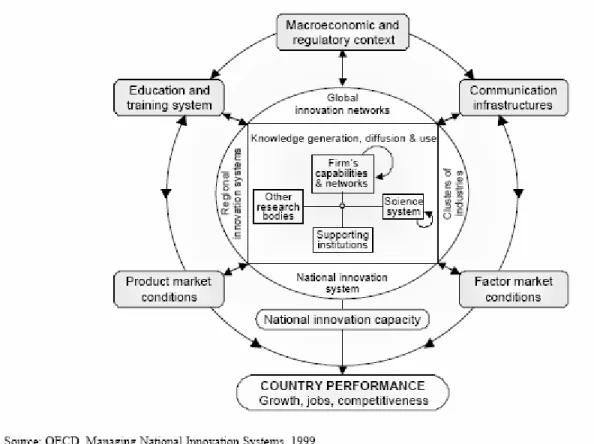
4.1 National Innovation Systems (NIS)
“In advanced industrial countries, innovation and exploitation of scientific discoveries and new technology have been the principle source of long-run economic growth and increasing social well-being. In the future, the innovation performance of a country is likely to be even more crucial to its economic and social progress. Countries whose firms fail to innovate will increasingly find themselves in direct competition with newly industrialising countries with lower labour costs and an increasing mastery of existing technologies and business methods. The development and exploitation of novel products, processes, services and systems, and the constant upgrading of those which a country already produces, is the only way in which OECD countries can maintain and increase their relative high levels of economic and social well-being”.8
The concept of National Innovation Systems (NIS) has been gaining intellectual and practical coherence over a number of decades, enjoying initial strong adoption by OECD and
developed countries, and more recently becoming the focus of increased attention as a means to address some of the more profound issues for developing nations. As the divide between the developed and developing world becomes increasingly stark, economists and policy makers view NIS as having great potential both as a source of understanding of the roots and primary causes of the gulf in economic development, as well as a powerful conceptual framework that can produce policies and institutions capable of bridging that gulf.
This section will describe the recent history of NIS and its use as an organizing frame - work for understanding and promoting innovation and economic development within developed
countries. It will describe the main components typically associated with NIS, the mix of institutions, policies and practices that comprise the system, as well as the boundaries of these components.
Although there are a number of historical antecedents to the NIS concept, “its main background should be found in the needs of policy makers and students of innovation”9, representing an evolutionary process incorporating observation with economic theory. Following World War II, “a linear model of science and technology ‘push’ was often
dominant in the new science councils that advised governments. It seemed so obvious that the Atom Bomb was the outcome of a chain reaction: basic physics => large-scale
development in big labs => applications and innovations (whether military or civil)”.10
While this linear perspective loomed large as an organizing principle for policy-makers, it proved unable to account for differential rates of technological innovation and economic development experienced by industrialized countries.
Despite similarly large investments in R&D by various industrialized and semi-industrialized countries starting in the 1950’s and 60’s “evidence accumulated that the rate of technical change and of economic growth depended more on efficient diffusion than on being first in the world with radical innovations and as much on social innovations as on technical
innovations”.11
This evidence, gathered in numerous studies at the level of the firm and industry, was reinforced “by two contrasting experiences [in the 1980’s]…on the one hand the
extraordinary success of first Japan and then South Korea in technological and economic catch-up; and on the other hand the collapse of the Socialist economies of Eastern
9 Lundvall,(2002). Towards a learning society, Conceição, P., Heitor, M., and Lundvall, BA., eds.,
Innovation, Competence Building And Social Cohesion In Europe: Towards a Learning Society,
al and sub-national innovation systems—complementarity and
, Research Policy, 31.
Edward Elgar Publishing, Cheltenham, UK, 2000.
10 Freeman, C. (2002). Continental, nation economic growth
Europe”.12 Lundvall and colleagues speculate that NIS thinking gained ground in part due the fact that “mainstream macroeconomic theory and policy have failed to deliver an understanding and control of the factors behind international competitiveness
development”.
to
and economic
13
The increase in practices and policies that focused on innovation and its sources became a central theme for international and national economic bodies, most notably the OECD, which introduced Country Reports on ‘Innovation’ and spent more and more ink emphasizing the importance of diffusion and innovation for economic growth .14
The OECD’s NIS Project “stresses the need for domestic policies to adjust their objectives and instruments to the new paradigm for technological innovation, based upon more systematic and intensive exploitation of available knowledge bases and strategies of
recombination and integration for the generation of novelty [and]…identifies many areas for potential international economic liberalization and cooperation that would serve to
strengthen the respective national innovation systems”.15
This type of effort involves cataloguing and analyzing innovation as it appears within
national systems, identifying best-practices, and advocating policies for member countries, and indeed the broader international communities. Similar efforts have been undertaken by the European Commission and the United States National Science and Technology Council.
12 ibid, p.11 13 Lundvall p.215 14 Freeman p.10
15OECD (1994). Accessing and Expanding the Science and Technology Knowledge Base,
Box 1. Definitions of NIS
with
ly complicated bundle of actors, behaviors, and flows, it is seful to unpack the term itself.
generally, it is a process which involves continuous interactivity between suppliers, clients,
Theories on innovation have gradually expanded their focus and complexity, beginning the individual firm or entrepreneur, broadening out to the environment and industry in which that firm operates, and finally encompassing the national system of regulations, institutions, human capital and government programs as well.16 Since the NIS perspective attempts to explain an increasing
u
As we have seen in the previous section, innovation can have a variety of meanings, but
16 Niosi, J., Saviotti, P., Bellon, B., and Crow, M. (1993) National systems of innovation: In search of a workable concept. Technology in Society, Vol. 15.