科技部補助專題研究計畫成果報告
期末報告
網站服務特徵對電子零售商績效之影響
計 畫 類 別 : 個別型計畫 計 畫 編 號 : NSC 102-2410-H-004-234- 執 行 期 間 : 102 年 10 月 01 日至 103 年 09 月 30 日 執 行 單 位 : 國立政治大學資訊管理學系 計 畫 主 持 人 : 莊皓鈞 計畫參與人員: 碩士班研究生-兼任助理人員:楊智博 大專生-兼任助理人員:陳仁綸 處 理 方 式 : 1.公開資訊:本計畫可公開查詢 2.「本研究」是否已有嚴重損及公共利益之發現:否 3.「本報告」是否建議提供政府單位施政參考:否中 華 民 國 103 年 12 月 11 日
中 文 摘 要 : 立基於 Voss(2003)的電子化服務沙堆模型(e-service sand cone model)以及服務和不確定性理論(the theory of service and uncertainty),本研究提出數個假說以實證上 檢視三種群組的網站功能(website functions)對電子零售業 者營運績效的影響。 這三組功能分為基礎型
(foundational)、顧客導向型(customer-centered)和加值型 (value-added)。根據社會感染(social contagion)的文獻和 同化對比理論(the assimilation contrast theory),我們 認為建置額外的加值型服務特徵(service features)會對績 效有遞減的邊際影響。我們預計使用 2007-2009 年間超過 600 間頂尖北美電子零售業者的次級追蹤資料(secondary panel data)來測試研究假說。本研究除了指出 Voss(2003) 的概念模型對實證研究的效用,我們應用 Q 方法(Q-sort method)到電子零售商服務特徵的追蹤資料,創新地結合心理 計量(psychometric)與計量經濟(econometric)方法。考量到 電子零售績效會有其他解釋因素,我們在模型中控制了公司 和時間的固定效果(fixed effects)、商業模式、產品類型和 訂單補貨策略。本研究除了希望讓經理人了解電子零售系統 開發應著重的網站功能,主要的論點在於加值型(value-added)服務特徵未必多多益善,投入過多能力在探索性和實 驗性的加值服務特徵可能會有反效果(backfire),造成相對 較差的電子零售績效。 中文關鍵詞: 電子零售、網站功能、沙堆模型、Q 方法、計量經濟學 英 文 摘 要 : 英文關鍵詞:
Impact of Value-Added Service Features in e-Retailing Processes:
An Econometric Analysis of Website Functions
ABSTRACT
We examine the impact of three classes of website functions (foundational, customer-centered, and value-added) upon e-retailer performance. Using secondary panel data for 2007-2009 on operating characteristics of over 600 e-retailers, our econometric analysis finds that only the value-added service functions are positively associated with changes in e-retail sales revenues across time. We also observe a decreasing marginal impact of deploying additional value-added service features. To account for possible alternate explanations, we control for firm- and time-specific fixed effects, merchant types, merchandise categories, and order fulfillment strategies. By further decomposing e-retail sales revenues into website traffic, conversion rate, and average order value, we find that website functions affect e-retail sales revenues mainly through their impact on website traffic. Our investigation demonstrates the empirical research usefulness of the Voss (2003) conceptual e-service sand cone model. Our results identify for managers where to focus ongoing e-retailing system development efforts, yet suggest that focusing too many retailing capabilities on exploratory and experimental valuadded service features may backfire, potentially leading to worsening e-retailer performance.
Keywords: E-retailing, econometrics, Q-sort, ‘sand cone’ model, website functions.
INTRODUCTION
E-commerce websites enable customers to browse a variety of goods and services to identify the exact product they want and to find a retailer offering the prices they expect. Selling products and services over the Internet is believed to generate a massive potential for retail sales (Keeney, 1999). Such prospects came true in recent years as numerous e-retailers strove to offer unique value propositions to different customer segments (Grewal & Levy, 2009). According to the U.S. Census Bureau, online retail sales as a percent of total U.S. retail sales increased from 1.2% in 2002 to 4.2% in 2011. U.S. retail e-commerce sales reached $48.2 billion in the third quarter of 2011, a 13.7% increase from the same period of 2010, and $54.8 billion by the second quarter of 2012 (United States Census Bureau, 2012).
Modern online retailing systems enable customer service encounters that drive online as well as brick-and-mortar retail transactions. Retailers use many types of Internet e-commerce technologies to create service processes through which to sell either exclusively online, or through both online and offline channels (Chircu & Mahajan, 2006). Those e-commerce process technologies allow retailers to transact information-intensive sales, fulfill orders, and track delivery processes automatically. Having noted the emergence of e-retailing, scholars from several domains have been trying to understand the antecedents and consequences of successful Internet retailing (Grewal, Iyer, & Levy, 2004), including aspects arising from process technology (De, Hu, & Rahman, 2010)
Most findings on e-retailing to date focus on psychometric models of customer perceptions about service quality or their behavioral intentions (Janda, Trocchia, & Gwinner, 2002; Boyer & Hult, 2006). Studies on operational execution of e-retail stores mainly focus on order fulfillment (Rao, Griffis, & Goldsby, 2011; Rabinovich & Bailey, 2004) without paying much attention to how process characteristics arising from website functions enhance the delivery of services and the generation of sales. Much less literature examines the critical linkage between service process capabilities and e-retail performance at the firm level.
Seamless e-retail operations rely on portfolios of website functions to enable and optimize consumer shopping experiences. Consequently, as consumer e-retailing expectations become
2
more stringent, e-retailers are apt to keep expanding their website functions (Lightner, 2004). Ayanso and Yoogalingam (2009) report that some e-retailers increased their customer conversion rates and revenues by improving website functions. Heim and Field (2007) identify several website functions that may drive perceived service quality. Overall, while prior studies uncover the positive impact of customer perceptions of website functions on perceived customer satisfaction, researchers still need to investigate whether and what associations exist between specific investments in website functions and favorable business outcomes (Randall, Netessine, & Rudi, 2006). Thus, some important research questions are: What is the overall impact of e-service process capabilities (as represented by website functions) on e-retailer revenues? Does having a more comprehensive set of website functions enhance sales performance? Or, have certain subsets of website functions become more important today for driving revenue?
To examine these research questions, we capitalize on a previously proposed “sand cone” model for e-service (Voss, 2003) that explains why e-retailers need to invest in several categories of website technologies to provide better, broader sets of service features. This theoretical framework proposes three categories of e-service functions: foundation of service, customer-centered, and value-added. Customer-centered are proposed to rely upon foundations of service, while value-added build upon customer-centered functions. The conceptual model provides a theoretical foundation for our study and enables us to categorize website functions for further analysis. We test our research hypotheses pertaining to these categories using longitudinal data on top Internet retailers from the United States as ranked by their annual on-line sales. We hope to shed light on the issue because e-retailers should not invest in updating website functions simply for the sake of jumping on a bandwagon. Rather, gaining a better understanding of how website functions tend to affect sales should enable e-retail managers to make better decisions.
Utilizing a three-year panel data set for calendar years 2007-2009, we show that only the value-added website functions exhibit a direct and sizable effect on website sales. As hypothesized, we also observe that the effect of value-added functions can be characterized as an inverted U-shape, which is seemingly surprising but actually well-grounded on the social contagion literature and assimilation-contrast theory. We reflect on this counterintuitive finding and offer an additional ex post explanation for the implications of expanding value-added functions too much. The effects of foundation of service website functions and customer-centered website functions on e-retailer sales revenues appear to be non-substantial in our data. Our findings suggest that only the value-added website functions act as a particularly strong driver of website sales. In contrast, the other two categories are necessary, as e-retailers usually must implement them to facilitate customer transactions, but they are not significantly associated with achieving better sales performance.
Our work has three major contributions. First, while existing literature tends to evaluate e-service as an aggregate process, there is a limited understanding about how different types of individual functions affect on-line retail performance. We fill in the gap by assessing documented e-retailer process functions and revealing an inverted U-shaped association between value-added functions and website sales. The finding implies that too much is not necessarily a good thing in Internet retailing and suggests that technology sophistication needs to be optimized. While the negative impact of overly pursuing technology sophistication has been identified for tangible products, how much those insights carry over to digital services remains largely unknown (Baird, 2012). The non-linear association uncovered in our study is worth investigating and provides theoretical as well as practical implications for e-service operations.
Second, unlike service quality, e-retailing research seldom studies actual sales performance (Pentina & Hasty, 2009). Our study is distinct in that it adopts the Voss (2003)
e-3
service sand cone model as the theoretical framework to examine drivers of this important yet under-studied metric. Our findings for the impact of website functions on e-retail sales performance are robust in that we explicitly control for differences in fulfillment, merchant types, and merchandise categories, which also may affect e-retail sales. Third, in addition to assessing e-retail sales, we decompose website sales into three underlying components – website traffic, conversion rate, and average order value – to assess the impact of website functions on the three elements respectively. We find that website functions affect e-retail sales revenues mainly through their impact on website traffic, which has a determinant effect on the success of e-retailing (Nikolaeva, 2005). Our finding sheds light on the essential reasons why website functions are critical to e-retailing and provide opportunities for managers to adjust website operations in order to boost performance.
Our study also carries two methodological implications. First, most prior studies on e-service operations use cross-sectional/primary customer survey data to measure consumer perceptions (Ba & Johansson, 2008). As such, actual service process attributes of e-retailers are evaluated mainly on a perceptual basis (Palmer, 2002), making their real-world implications comparatively under-researched. We take a different perspective and use multi-year panel data to examine the impact of e-service process. The use of panel data enables us to econometrically address unobserved heterogeneity across the e-retailers, an issue that cannot be overlooked because e-retailers are different in many ways (e.g., managerial decisions about policies, products, markets, business models). Second, we present an innovative use of both psychometric and econometric techniques. To operationalize the Voss (2003) conceptual model, we apply the Q-sorting procedure to classify individual website functions that cannot be appropriately categorized via ordinary factor analysis. We compare and contrast our Q-sorting results with an external group of experts to build confidence in using the constructed website function indices. After adopting the psychometric technique to operationalize key regressors, we carefully specify econometric models to make the best use of panel data. Specifically, we employ the Hausman-Taylor model to ensure consistent parameter estimation and to elicit more information from the data (Wooldridge, 2001). Our study provides a prototypical example for empirical researchers who intend to make complementary use of qualitative and quantitative methods.
The article is organized as follows. Section 2 reviews literature, formulates a conceptual model, and puts forward three hypotheses. Section 3 describes the data, operationalization of variables, and estimation methodology. Section 4 presents results, discussion, and additional analyses. We conclude with research limitations and potential directions.
THEORY DEVELOPMENT The E-Service Sand Cone Model
The original sand cone model for manufacturing has been widely applied to analyze firm capabilities. First introduced by Nakane (1986) and Ferdows and De Meyer (1990), the model asserts that firms may be able to develop multiple capabilities that build upon lower-level foundational capabilities (Ferdows & De Meyer, 1990). In the context of e-service operations, firm capabilities are primarily manifested through technology-based website functions (Piccoli, Brohman, Watson, & Parasuraman, 2004). Website functions improve e-retail operations by facilitating front-end customer transactions and coordinating back-end order fulfillment and distribution activities. These functions are built to ensure reliable order-processing and order-fulfillment because most on-line customers desire to use their time efficiently and effectively (Randall et al., 2006). Thus, improving website functions is a relevant service management task in the e-retailing domain.
To support this argument, we adopt a ‘sand cone’ model of e-service (Voss, 2003) as our theoretical foundation (see Figure 1), to explain the necessity of enhancing e-retailer processes. The sand cone model of e-service suggests that e-retailers should develop their
process centered similar suggest Expand function in whic also hig to close Foll into fo Founda Essentia expecte they pr addition centered deliveri advance (Sriniva e-retaile ongoing noticed Faceboo and serv The another cross-fe cone m realize t can be t level of 2012 d grounde differen A co e-servic of servi s functions d functions to the oper ts advanced ding the mo ns should a h simple pa gh-end e-ret e a sale. Figure 1: A lowing the oundational ational func ally website ed” by custo rovide rudim n to meeting d functions ing “what d ed search t asan, Ander ers to prov g manner in the rise o ok and Twi vice update eoretically, r lower-leve ertilize each model of e-that, due to tomorrow’s f the mode distinctive c ed for hypo nt levels of w omplementa ce sand con ices and un following a s, and then rations con d functions del to the c ffect e-retai ayment func tailers for w A “sand con Voss (2003 l functions ctions must b es are supp omers. For mentary wa g the basic
for the sak differentiate technology rson, & Pon vide value-a n order to of online so itter to exte s. the effectiv el set of fun h other and services pr o the fast ev s foundation l may vary capabilities) othesis deve website fun ary theoreti ne model (i. ncertainty (C a certain se value-adde cept of ord will not b context of on iler sales di ctions are su which advan ne” model o 3) e-service , customer be in place posed to be example, b ays to allow service requ ke of maxim es.” Some to make c nnavolu, 20 added funct create “wh ocial netwo nd their con ve exploitat nctions alrea support we ovides a co volving natu nal function y over time ). The Voss elopment, a nctions. ical explana e., from fou Cusumano, 4 equence: fo ed function der qualifier e fully effe n-line retail ifferently. F ufficient to e nced paymen of e-service e sand cone r-centered before a ret responsive basic search w customer uirements, e mizing custo e-retailers customer na 002). Finally tions and to hat excites” orking servi nsumer bas tion of a s ady in place ebsite opera oncise way ure of web t ns. Thus, the (i.e., 1995 s (2003) m allowing re
ation for the undational t Karl, & Su undation of s. The und rs and orde ective until ling, we arg For example execute tran nt and perso (adapted fro e model, we functions, tailer can su e and reliab h functions w rs quickly e-retailers a omer efficien differentiat avigation m y, the comp o enhance (Voss, 200 ices and fo se and proac set of funct e (Voss, 200 ations in a y to group technology, e functions/ 5 distinctive model is fle esearchers t e continuous to value-add uarez, 2009 f service fu erlying logi er winners. basic func gue that the e, there are b nsactions. In onalized ser om Voss, 20 e categorize and value ustain a pre ble so that t will be of g to locate w also need to
ncy (Xue & te themselv more intuiti etitive envi these webs 03). For ex ormed corp ctively anno tions is con 03). Those f reinforcing website fu today’s val /capabilities e capabilitie exible and o capture th s improvem ded) is grou 9; Suarez, C unctions, cu gic of this m That is, th ctions are i e three categ basic e-reta n contrast, t rvices are ne 003, p. 100) e website fu e-added fu sence (Voss they meet “ great impor what they w increase cu & Harker, 20 ves by inve ive and con ironment m site function xample, som porate pages ounce their ntingent on functions m g manner. T unctions. On lue-added fu s embedded es may diff conceptual the impact ment specifie unded in th Cusumano, ustomer-model is e model n place. gories of ail stores there are ecessary ) functions unctions. s, 2003). “what is rtance as want. In ustomer-002) and esting in nvenient may force ns in an me firms s within product n having may even The sand ne must functions d in each fer from ly well-of these ed in the e notion & Kahl,
5
2013). Theoretically, high market uncertainty will force companies to offer more and better services. Internet environments are changing rapidly and causing high uncertainty for e-retailers (Grewal & Levy, 2009). Internet e-retailers hence must update technological and operational capabilities to provide a higher level of service. Specifically, enhancing website functions provides a means to achieve continuous service improvement, since the outcomes of online shopping usually depend on the quality, interface, satisfaction, and experience provided by the website (Darley, Balnkson, & Luethge, 2010). The uncertainty-driven viewpoint helps to clarify the bottom-up movement illustrated in the Voss (2003) e-service model.
Before presenting specific research hypotheses, we point out that the dependent variable used in this study measures sales revenue, which is a critical measure of e-retail performance. To the best of our knowledge, few existing studies have scrutinized the direct impact of website process functions on e-retailer sales revenues. Although sales revenue may also be affected by a number of factors, identifying website functions that significantly contribute to a marginal increase in sales revenue is still valuable to e-retailers (De et al., 2010). The breadth of potential alternative drivers of sales revenue also suggests the need for researchers to use econometric methods that can carefully control for such factors in order to reliably estimate the individual contributions of the three classes of website functions.
Research Hypotheses
Foundational functions
Foundational functions include basic attributes involved in the shopping process, ease of ordering attributes, and order fulfillment attributes. Functions such as gift certificates and on-line coupons/rebates have become foundational in Internet retailing because of intense price/channel competition. As for ordering activities, most retailers design certain website features to streamline the ordering process. For example, nearly all catalog retailers now allow customers to place orders by entering the item number on-line instead of asking customers to fill out and mail a paper order form back to the company. Regarding fulfillment, numerous retailers provide reliable delivery service features such as precisely estimated shipment and arrival dates and allowing customers to buy items on-line and pick them up in-store.
While these website functions often correlate positively with customer satisfaction, a “crisis of dilution” may still occur (Piccoli et al., 2004). That is, customers may begin to take these website functions for granted. As a result, the ability of those functions to attract customers and drive additional sales becomes weaker. Consequently, those foundational website functions are seen as an “order qualifier” (Hill, 1989) – a necessary feature to do business, but not one that wins the customer order. Eventually, e-retailers would have to equip themselves with those very basic functions simply to be considered by customers as a reasonable place to shop. From an e-service standpoint, foundational functions mainly support the initial stage of online experience that leaves customers with the impression that “the site works well” (Forbes, Kelley, & Hoffman, 2005). Although those functions can mitigate the risks of losing online shoppers due to unsatisfied basic requirements (Voss, 2003), over the long-run they are not likely to substantially increase sales. While foundational website functions provide the basic core of e-retailing processes, the above reasoning leads us to hypothesize:
H1: Foundational functions will have a non-negative impact on sales revenues. Customer-centered functions
Customer-centered functions are mainly about providing tailored services and needed information (Khalifa & Limayem, 2003). Information content is extremely important because when retail websites provide bad and confusing information it can make shopping experiences frustrating (Forbes et al., 2005). The customer-centered functions help increase
6
ease of navigation and save customer time since navigation efficiency affects transaction efficiency and customer contact interactivity (Ba & Johansson, 2008). Customer-centered functions such as product comparisons and lists of top sellers can help customers make more-informed decisions. Additionally, reviews provided by prior customers will digitize word-of-mouth comments that can drive future customer purchasing on many occasions (Dellarocas, 2003). While providing abundant product and service information to customers may be helpful, such an act will not be sufficient without having features that ensure convenient and effective interactions with customers (Piccoli et al., 2004). In short, customization at this level of the service sand cone model offers a better sense of personalization. From an e-service perspective, these website functions can transition customers from the impression that “this site works well” into “this site understands me” and “it is part of me” (Forbes et al., 2005). This intimacy and internalization eventually should increase the chance of a customer buying, which directly contributes to sales revenue. Hence, we propose:
H2: Customer-centered functions will have a positive impact on sales revenues. Value-added functions
Value-added functions help e-retailing systems to be proactive and optimize on-line customer experiences. These functions need to be innovative to maximize service effectiveness (Voss, 2003). For instance, the rise of online social networking and the increasing use of Internet-enabled mobile devices today provide great opportunities for e-retailers to step in and expand their value-added functions. Web stores connect with social networking services such as Facebook and Twitter to seek customer and revenue growth through relationships, which is an advanced phase of evolution in website functions (Piccoli et al., 2004). These website features are considered value-added because they facilitate value co-production in e-services (Xue & Harker, 2002) and help e-retailers to build a positive image for themselves in the minds of customers (Srinivasan et al., 2002). Therefore, we expect value-added functions to contribute positively to customer purchase interactions and thus to sales revenues.
However, we also expect the relationship between value-added functions and website sales to exhibit decreasing marginal returns past some point of deployment. The social cognition literature suggests that the positive image of e-retailers will reach a turning point beyond which any further efforts to improve website functions do not further generate customer attention (Fiske & Taylor, 1991; Starbuck & Milliken, 1988). In addition, the degree to which customers will use an attribute depends on its utility, which is mainly determined by the function’s non-redundancy as compared with other functions (Anderson, 1981). The potential redundancy may not be salient for foundational functions or customer-centered functions, which are considered necessary to close a sale. However, redundancy can be a major concern for the value-added functions. For example, social networking enables customers to generate and share product reviews quickly and effectively. The benefits derived from this added function, however, may decrease with the use of other similar value-added functions, which potentially contribute to website sales in an overlapping manner. Such functional redundancy leads to a “utility decrement,” diminishing the effect of additional value-added functions.
Moreover, some value-added functions are arguably somewhat “self-tailored” to customers. For example, consumer-specific pre-orders favor only individuals who presume to have an overflowing enthusiasm to own new products at the first moment those products become available. As a result, the effects of adding these value-added functions may benefit a reduced customer base and thus generate diminishing gains on website sales revenues. Also, some advanced functions may be beyond the technological readiness of certain customers and offset the intended advantages offered by these functions. One such example is that offering sophisticated decision aids does not lead to increased purchases (Sismeiro & Bucklin, 2004).
7
This example can be rationalized by the assimilation-contrast theory, which posits that within a given context consumers assimilate toward products/services that are deemed useful/positive and contrast away from products/services that are deemed unnecessary/negative (Meyers-Levy & Sternthal, 1993). In our case, moderate levels of value-added functions may contribute to customers’ perceived usefulness of these website functions whereas extreme levels of value-added functions may increase customers’ perceived complexity of the e-retail store and eventually compromise online sales performance. Taken together, we hypothesize:
H3: Value-added functions will have a positive yet diminishing impact on sales revenues.
DATA AND MODEL SPECIFICATION Data
We collected data about website functions, online sales, and other metrics (e.g., conversion rate, website traffic) pertaining to e-retailers from a data service company (Internet Retailer, 2011). The company gathers detailed information about website features and operating performance of the top e-retailers in North America, as ranked by their annual online sales. The data set we have is a three-year panel (2007-2009). The panel is unbalanced because some retailers drop out of the top 500 sales ranking during that period. Missing data problems occur due to a decline in sales performance as opposed to random reasons. The missing data results in a potential attrition issue that ideally should be remediated (Wooldridge, 2001). Ignoring the effects of attrition may bias the statistical analysis. We discuss how we address this issue in the methodology section.
The Internet Retailer data includes 96 website functions. However, it is neither reasonable nor practical to include all of the functions in our analysis. First, some website functions are designed for specific products (e.g., videocasts designed for value or high-complexity products) and thus are not representative across all e-retailers. Second, a number of website functions perform the same task but are called by different names (e.g., enlarged product view and zoom). Finally, some of the website functions are not collected in every year. Based on a thorough review of e-retailing literature, we adopt Ayanso and Yoogalingam’s (2009) approach and study a subset of attributes that cover multiple website dimensions such as account maintenance, product recommendation, website search, and so forth. Each attribute can take on two possible values (0 = not implemented/1 = implemented) and represents a state-of-the-art website function that facilitates on-line shopping. We aim to use a comprehensive list of relevant functions, yet one should realize that any such list is by no means exhaustive.
We initially performed exploratory factor analyses (EFA) to relate the website function indicators to the three Voss (2003) categories. We analyzed the binary website function variables using several different extraction methods and estimators that are robust to binary variables but obtained numerous trivial factors. Moreover, most variables exhibited weak loadings or cross loadings that were hard to interpret. While those findings are not surprising as we noted previously that a set of functions may build on other functions, they did motivate us to rethink the appropriateness of using EFA. We realized that, theoretically, website functions should be better modeled as formative indicators mainly because each selected website function performs a unique task, and thus they are not interchangeable (Damantopoulos & Winklhofer, 2001). With formative indicators, researchers can neither expect that the indicators exhibit high correlation with each other, nor require these indicators to hold together as a single factor. As such, we opt to construct three aggregated indices (Bollen & Lennox, 1991; Diamantopoulos & Winklhofer, 2001) that map the functions to the three levels of the e-service sand cone model.
To ensure the validity of the three aggregated indices, we employed the Q-sort method (Stephenson, 1953) to determine the “content domain” of each class of website functions. The
8
Q-sort method is appropriate because it can capture the extent of agreement between people in how they employ concepts (Block, 1961), in our case whether people view a website function as foundational, customer-centered, or value-added. The use of ranking, rather than rating numerically in Q-sorting, is meant to capture the point that people think about ideas in relation to other ideas, rather than in isolation. More importantly, this way of encoding subjective rankings can make a rich but complicated information resource fruitful for research (Block, 1961). The key concern with this method is that the Q-sorter may frequently experience doubt, indecision, or despair over the actions requested of him. Nevertheless, Frank (1956) shows that the behavior of the Q-sorter is highly repeatable.
We use forced Q-sorting (i.e., we constrained the number of groups for classifying website functions to be three) because (i) unforced Q-sorting provides fewer discriminations and may suffer from the Barnum effect (Meehl, 1956), (ii) the unforced procedure is not more reliable than the forced (Block, 1961), and (iii) the three-group setting is consistent with the e-service sand cone model. A panel consisting of the four authors, each having sufficient experience in operations management and cognizant of the e-retailing market, ranked the dichotomous variables into three groups based on the extent to which a website function may affect the online customer shopping experience. If disagreements existed among the panel members concerning a website function, a discussion followed, and panel members re-ranked the functions after discussion. The process went through two iterations until consensus was achieved for the website functions belonging to the three groups. Note that a Q method study requires only a limited number of Q-sorters. The reason for this is that increasing the number of Q-sorters will introduce unnecessary variation and potentially taint the Q-sorting results in some cases. As Brown put it, “…all that is required are enough subjects to establish the existence of a factor for purposes of comparing one factor with another” (Brown 1980, p192). In addition, the Q-sorters must be knowledgeable about the research context which limits the potential candidates who can serve as a Q-sorter. Therefore, it is not uncommon that the authors serve as the Q-sorters for their studies (e.g., McKenzie et al., 2011).
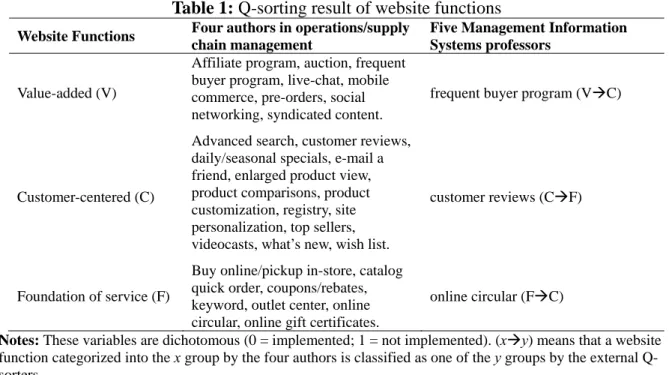
The second column of Table 1 shows the Q-sorting results reached by the four authors specializing in operations management. The objectivity of the Q-sorting process should not be a concern as Q-sorting results are highly replicable (Brown, 1980; Thomas & Baas, 1992). Nevertheless, in order to build confidence in using the constructed indices, we invited an external group of Q-sorters to perform Q-sorting under the same condition of instruction. The group includes five MIS professors who are familiar with the e-retailing market. A short briefing of the e-service sand cone model was provided to the MIS professors. The third column of Table 1 shows their Q-sorting results. While the sorting outcomes are not totally identical, they are fairly consistent and stable. The majority of website functions in each category remain unchanged. Moreover, we find that results of hypothesis testing stay the same when using the extra Q-sorting results to construct the three indices. This robustness check ensures the results are not dependent upon one Q-sort group or sensitive to minor pairwise exchanges in website functions between the categories, as prior literature recommends (Angst, Devaraj, Queenan, & Greenwood, 2011)
---Insert Table 1 Here---
We thus constructed three index variables based on these groupings. A simplistic approach is to construct each index as an unweighted sum of several binary variables (0/1). This approach is adopted by several e-retailing studies (e.g., Spiller & Lohse, 1997; Ayanso & Yoogalingam, 2009; Pentina & Hasty, 2009), which devise an aggregate feature score by summing binary variables for website functions. However, such a rudimentary aggregation implicitly assumes that all website functions are equally critical, which may not be a reasonable assumption since some functions may be more important/rare than others. To address the deficiency, we adopt the adjustment approach proposed by Chou (2013) and Tsai
9
et al. (2013). Specifically, for each binary website function we first take the ratio of 1 (if the firm has the feature) over the total number of firms that have the same function in a particular year. Such an adjustment assigns more weights to less-adopted website functions since they may create scarcity effects. Then according to the groupings shown in Table 1, we sum up those ratios by year to create an index for each of the three groups, i.e., foundational, customer-centered, and value-added. This ratio sum index is then transformed into a Z score to show firms’ relative advancement compared with their peers. Note that even though using the unweighted sum of dichotomous variables does not change results of hypothesis testing, we posit that the weighted adjustment is more appropriate since each of the three website function indices take into account average and variation of peers.
We approximated the sales performance of Internet retailers using annual website sales. For pure e-retailers, website sales are their total annual sales. For multi-channel retailers, website sales are the proportion of total sales gained from the Internet outlet. As mentioned-earlier, e-retailer sales are comparatively under-studied. Most past findings on e-service/e-retail performance are derived from survey-based research, which primarily focuses on metrics regarding customer satisfaction, loyalty, and other perceptual metrics. Xia and Zhang (2010) argue that due to the self-reporting nature of the survey approach, the obtained measures may lack objectivity. In response to their call for using objective measures, we assess sales revenue using public data to better understand the financial impact of website functions.
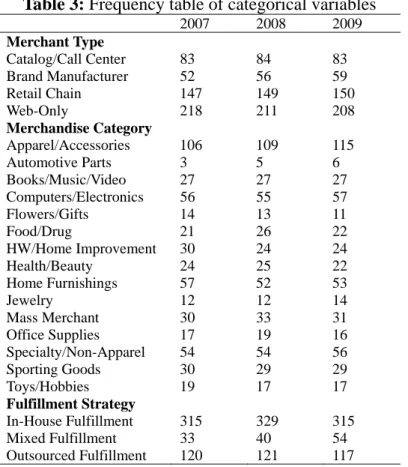
In addition to the three key index variables of interest, we devised several control variables. E-retailer sales performance is largely affected by business models, product characteristics, and order fulfillment. Since website functions alone cannot determine sales revenue, omitting other relevant factors that contribute to sales revenues may inflate the impact of website functions (Serrano-Cinca, Fuertes-Callen, & Mar-Molinero, 2005). Regarding business models, we applied the taxonomy devised by the data service company to classify e-retailers into four merchant types: Catalog/Call Center (e.g., CDW Corp., Avon Inc.), Brand Manufacturer (e.g., Dell.com, Apple.com), Retail Chain (e.g., Macys.com, Sears.com), and Web-Only (e.g., Amazon.com, Rakuten.com). We construct three merchant dummies where web-only serves as the base. Using the Merchant Type as a control is necessary because the type reflects a retailer’s choice of business model and correlates with the scale and scope of its operations.
Product characteristics are also a major determinant of website sales. Hence, we need to control for Merchandise Category based on each firm's major product market. In line with the data source (Internet Retailer, 2011), we specify 15 merchandise categories: apparel/accessories, automotive parts/accessories, books/music/video, computers/electronics, flowers/gifts, food/drug, hardware/home improvement, health/beauty, housewares/home furnishings, jewelry, mass merchant, office supplies, specialty/non-apparel, sporting goods, and toys/hobbies. We construct 14 merchandise dummies where the toys/hobbies category serves as the base. On the one hand, controlling for merchandise category accommodates the fact that a virtual assortment can be very different among online retailers who sell diversified products. On the other hand, including the merchandise control can partially account for the effects of price on sales because some product types are likely to be more expensive than others. In a nutshell, we find it essential to control for merchant type and merchandise category since customer requirements differ across e-retail segments (Piccoli et al., 2004).
Lastly, we control for fulfillment strategy since Voss (2003) puts a strong emphasis on fulfillment in the e-service sand cone model. Several papers (e.g., Rabinovich & Bailey, 2004; Boyer & Hult, 2006) demonstrate that reliable order fulfillment is critical to the success of e-retailers. Due to the inherent complexity of physical distribution, some e-retailers tend to fully outsource order fulfillment and seek assistance from logistics service providers (Xia &
10
Zhang, 2010). Contrary to these outsourcing initiatives, Randall et al. (2006) find that keeping order fulfillment in-house ensures the inventory ownership and has a positive impact on firm revenues. Pentina and Hasty (2009) also report that many e-retailers like to handle fulfillment in-house. Therefore, it is not uncommon to see e-retailers take charge of order fulfillment themselves. Interestingly, instead of completely outsourcing or operating in-house, we observe some firms that choose to adopt a mixed fulfillment strategy, using both internal and outsourced fulfillment. Seeing the diversity in fulfillment initiatives, we construct two dummy variables (Outsourced Fulfillment and Mixed Fulfillment) to isolate the impacts of distribution on sales from website functions while assessing whether those strategies do make a difference in website sales revenues.
Table 2 reports the summary statistics and correlation coefficients of the key continuous variables. Table 3 presents frequencies of categorical variables – Merchant Type, Merchandise Category, and Fulfillment Strategy – by year.
---Insert Table 2 & Table 3 Here---
Model Specification
Performing an econometric panel data analysis enables researchers to tackle unobserved individual observational unit heterogeneity, which can greatly enhance validity of findings. The standard econometric model is specified as
y =
itx β
it/+α +ε
i it in which αi is theintrinsic ability/heterogeneity of each e-retailer. The fixed effects (FE) model assumes corr(
x
it,
αi)0 whereas the random effects (RE) model assumes corr(x
it,
αi) = 0. Arguablythe assumption of the RE model may be too strong, as the distinct characteristic (αi) of each
firm should affect its decisions about time-variant website functions (xit). Therefore, we
performed a Hausman test (Cameron & Trivedi, 2009), which suggests the FE model to be more appropriate. The advantage of the FE method is that it solves the omitted variable bias and gives consistent estimates in the presence of endogenous heterogeneity (i.e.,
corr(
x
it,
αi)0) (Wooldridge, 2001). The drawback of the FE method is that all time-invariant regressors along with the heterogeneity are cancelled out due to the time-demeaning “within” transformation, which results in a tremendous loss of information. If one wants to see the effects of time-invariant merchant types and product categories, the basic FE estimation will not be a reasonable technique. Therefore, we use the Hausman-Taylor (HT) model (Wooldridge, 2001):are time-variant exogenous regressors, corr( ) = 0
are time-variant endogenous regressors, corr( ) 0
are time-invariant exogenous regre
,
,
i i it i it α αy =
+
+
+
+α +ε
1it 1it 2it 2it 1it / / / /1it 1 2it 2 1it 1 2it 2
x β
x β
w γ
w γ
x
x
x
x
w
ssors, corr( ) = 0are time-invariant endogenous regressors, corr( ) 0
,
,
i i α α 1it 2it 2itw
w
w
The HT model preserves the merits of both FE and RE estimators. Essentially the HT model is an instrumental variable approach and could potentially mitigate the endogeneity that often arises in non-experimental studies (Cameron & Trivedi, 2009). The HT method is popular among economists because it allows for correlation between individual effects and explanatory variables (FE) while being able to identify the effects of time-constant regressors (RE). Our econometric model is specified as:
11 1 2 3 4 5 6 7 8 9 10 11 Ln( ) * * * it i t t it it it it i i it i it i it
WebsiteSales Year2008 Year2009
Foundational CustomerCentered ValueAdded ValueAddedSquared Attrition Att Foundational Att Customer Att Value
Mixed F it 12 it it
ullfillment Outsourced Fullfillment
MerchantTypei MerchandiseCategoryi
Table 4 summarizes definitions of variables in the model. The model contains two time-variant exogenous variables (Year2008 and Year2009), which are period dummies added to account for time effects (e.g., economic conditions). The vector of three merchant dummies and 14 merchandise dummies are time-invariant exogenous variables since those characteristics are just part of firm-specific effects but unidentifiable in the ordinary FE modeling. The remaining variables with subscript it are all time-variant endogenous variables (i.e., correlated with αi). The attrition dummy (Attrition=1 if attrition occurs during
2007-2009) is a time-invariant endogenous since arguably, the attrition of e-retailers (i.e., dropping out of the top 500 list during 2007-2009) could be attributed to unobserved individual heterogeneity (αi). Even though an attrition process correlated with αi should not bias the HT
estimates (Bruderl, 2005), for completeness we assess the impact of attrition following the BGLW test procedure (Becketti, Gould, Lillard, & Welch, 1988) and interacting the attrition dummy with the three website function indices. Non-significance of those interaction terms (β8, β9, and β10) would suggest that the key explanatory variables (i.e., website functions) do
not differ systematically between firms with and without attrition. Note that as an instrumental variable approach, the HT model requires assuming a subset of regressors to be exogenous and uncorrelated with the firm-specific fixed effect. In addition to verifying that the model meets the order condition for identification (Wooldridge, 2001), we explicitly test the exogeneity assumption in our analysis to avoid generating misleading results based on biased estimates.
---Insert Table 4 Here---
EMPIRICAL FINDINGS Results
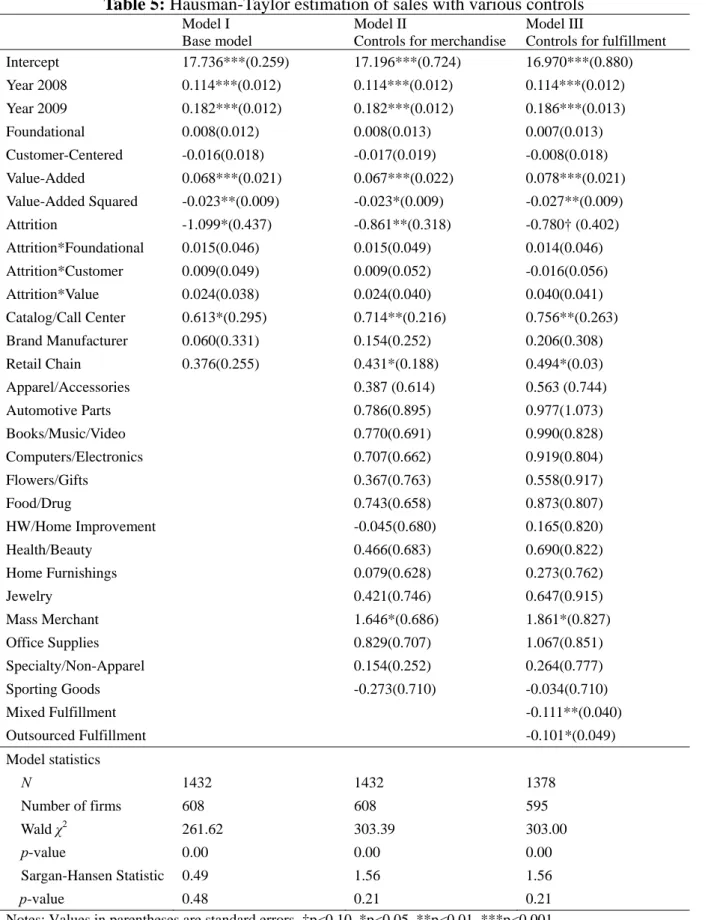
We estimated the model using the XTHTAYLOR command in Stata 12 (StataCorp, 2012). Table 5 illustrates the regression results. Controlling for merchant type, time, and attrition, all of the three models have significantly good fit according to the Wald chi-square test. The Sargan-Hansen Statistics and associated p-values (all >> 0.05) suggest that the exogeneity assumptions are not violated. In all models, the time controls (Year2008 and Year2009) are significant and exhibit an upward trend in sales, which is consistent with the general increase in retail e-commerce sales reported earlier. Not surprisingly, attrition is negatively associated with sales across all models. We jointly test the interaction terms between attrition and the three function indices and find no significant evidence of attrition biases. In other words, website functions have a statistically identical impact on firms with and without attrition. We also find that two merchant types – catalog/call center and retail chain – tend to have higher website sales (web-only as the base). This finding may arise from the fact that the two types have relatively wider scopes of operations and benefit from product variety.
Model I presents the base model. Foundational website functions show no significant associations with website sales, as we expected (H1). Next, H2 is not supported since customer-centered functions do not have a significant impact on e-retailer sales of firms in our sample. Value-added functions, as hypothesized, have a positive yet diminishing impact on sales revenue due to the negative sign of the quadratic term, and thus these findings support H3.
12
Model II controls for 14 merchandise categories (toys/hobbies as the base) in which only the mass merchant category exhibits significantly higher website sales. The impact of different website functions remains nearly the same. Model III further controls for fulfillment strategy. Note that the sample size reduces to 1,378 because we do not have access to fulfillment information for all firms in our sample. Interestingly, the website sales of firms who adopt a mixed fulfillment approach are on average lower than firms who go for either in-house fulfillment or outsourced fulfillment. With that being said, the non-linear impact of value-added functions is still highly significant even after controlling for numerous factors that could drive website sales. The estimation results across the three models are quite stable and suggest consistent support for H3.
Discussion and Additional Analyses
Our results suggest that some website functions still do have a strong impact on e-retailer sales today, nearly 20 years into the e-commerce era. That effect is robust given the fact that many other relevant factors are controlled for in our models. Specifically, value-added website functions turn out to be a prominent factor that drives sales performance over the 2007-2009 period. Interestingly, the foundational and customer-centered functions exhibit insignificant effects. As website technology advanced and customers became familiar with on-line shopping, basic website attributes perhaps could no longer serve as a differentiator for attracting customer interest. Even though the parameters of the foundational and customer-centered functions are not statistically significant at the firm-year level, one cannot fully rule out their potential impacts. For example, in 1999 several firms’ ineffective basic order-generating functions made the 1999 Christmas shopping season a nightmare for both customers and e-retailers. Customers had to face delayed or wrong deliveries and deal with frustrating return procedures, whereas e-retailers found their profit shrank as operating costs skyrocketed after the selling season (Pyke, Johnson, & Desmond, 2001). In reality, the rudimentary functions will always be required to make shopping reliable and convenient and to enable e-retailers to deploy complementary value-added functions for e-retailers to reap the rewards of service features that excite customers.
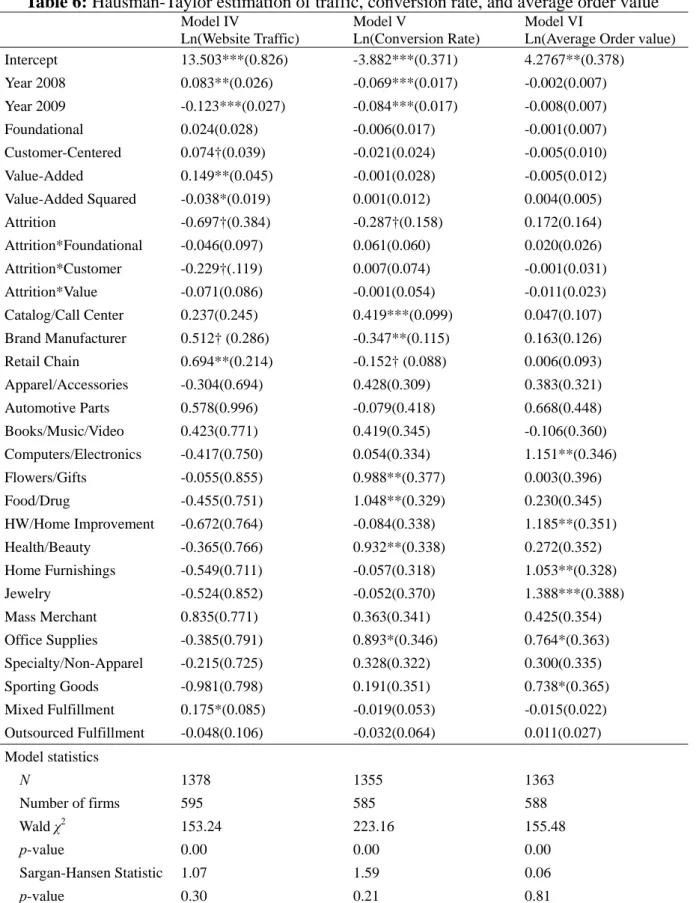
To obtain a deeper understanding about the impact of website functions on e-retailer sales, we further decompose website sales into three underlying components – website traffic, conversion rate (i.e., visitor to purchaser ratio), and average order value – since by construction website sales is the product of the three elements. From the same data service company (Internet Retailer, 2011), we obtain data on the conversion rate and average order value. We approximate website traffic as an e-retailer’s average monthly unique visitors, which is defined as an unduplicated count of individually identifiable customers (Serrano-Cinca et al., 2005). Using the same set of website function indexes and controls, we perform the HT estimation for exploratory purposes and report the results in Table 6.
The left column of Table 6 shows that value-added website functions also exhibit an inverted U-shaped association with website traffic. Customer-centered website functions, interestingly, show a marginally significant positive association with website traffic. It is somewhat intriguing that the effect of value-added website functions is pivotal only upon website traffic whereas value-added functions have no significant association with conversion rate and average order value. Although the literature suggests that better service process attributes lower purchase-related anxiety and thus improve conversion rate (Putsis & Srinivasan, 1994; Moe & Fader, 2004), our sets of website functions surprisingly reveal no impact on conversion rate. In addition, although practitioners (e.g., Adobe Consulting, 2011) claim that value-added website functions can enhance average order value by directing on-line shoppers to additional items, we find no significant association between website functions and average order value.
13
offering, which is a critical determinant of price as well as shopping volume. The main effect of website functions may be absorbed by our controls for merchant and merchandise since those controls cover a fair amount of differences in products and services. Conversion rate is very complex and involves various behavior dynamics. For example, Moe and Fader (2004) propose six components that drive conversion behavior. In addition to e-retail store design features (i.e., website functions), various factors including demographics, panelist behavior at other websites, and the sequence of pageviews (e.g., duration, type of pages examined) all affect the likelihood of converting website visits into purchases (Moe & Fader, 2004). Given the complexity of on-line conversion behavior, the seemingly surprising finding on conversion rate is not unreasonable.
The insignificant impact of website functions on conversion rate and average order value perhaps suggests that the online retailers in our sample operate under the condition of mutatis mutandis (i.e., “The necessary changes having been made.”). As top Internet retailers, they have surpassed the bar in implementing website functions in order to reduce purchaser-related anxiety or to recommend automatically the best products possible. Nonetheless, our analysis of website traffic implies that building a visitor-friendly platform through value-added and customer-centered website functions is essential for online retail channels. Such website functions allow customers to enjoy all the conveniences and experiences of shopping in a store through any computer and mobile devices from any locations, which eventually drive website traffic.
---Insert Table 6 Here---
A major takeaway associated with this supplemental analysis is that value-added website functions affect e-retail sales mainly via their impact on website traffic. Nevertheless, the positive effect of value-added website functions on traffic is unlikely to monotonically increase. As discussed earlier, the positive image of advanced website functions will reach a turning point beyond which any additional efforts may not receive further customer attention to generate website traffic. Adding more value-added website functions after the turning point would increase consumers’ cognitive load and even hurt website traffic as on-line shoppers may start to feel overwhelmed and turn away from those convoluted website functions.
To better illustrate the diminishing impact of the value-added website functions, we plot the impact of those functions on Ln(sales) and Ln(traffic) using parameters estimated from Model III in Table 5 and Model IV in Table 6 while holding everything else constant. Figure 2 shows the expected concave shapes. Since the value-added index on the x-axis of Figure 2 is a normalized Z score with mean=0 and standard deviation=1, the figure allows us to assess the impact of moving above or below a certain number of standard deviations. As shown in the left panel of Figure 2, the positive impact of value-added functions on website sales keeps increasing until the e-retailer reaches about 1.5 standard deviations above the industry average. Moving to the extreme (e.g., 2 or 3 standard deviations above the industry average) starts to hamper sales performance. The right panel exhibits a similar curvature in website traffic, although the diminishing rate caused by going far above average seems to be weaker. Nevertheless, both panels of Figure 2 suggest that when the number of value-added functions an e-retailer possesses is below average (i.e., value-added<<0), the firm may end up having much lower website sales and traffic on average.
Vo challeng to excel challeng powerfu the valu Such a eventua phenom Beaty, 2 As point m these te should d certain maintai value o capabili CONCL Ou complem rational categor technol why e-sophisti of resea and spe influenc certainl e-retaile their ex Ou retail m oss (2003) ges upon fir l in all thos ges to the s ul law of di ue-added di distraction ally may ha menon show 2003; Rao e s the returns may not be echnologica do is to sub level so th ined. To su of website fu ities may un LUSION ur paper cap ment prior lize those ize website ogical attrib -retailers k icated featu arch hypoth ecify an em ce of websit ly here to st ers and clic xisting webs ur findings managers mu Figu points ou rms and not se advanced uccessful d iminishing mension ma may dilute arm sales p wn to hurt p et al., 2011) s from valu justifiable al efforts st bjectively an hat custom m up, whil functions, w ndermine th ptures the c r research functions. e functions butes for cu keep adopti
ures into the heses, apply mpirical mo te functions tay (Grewal ck-and-mor site function carry usefu ust be awar ure 2: Impa t that e-se t all value-a d e-service d delivery of e marginal re ay become their engag performance purchase in . ue-added attr by their ma tarts turning nd carefully er dissatisf le we do no we are conv he performa contempora by bringin We employ s and exam ustomer ser ing advanc eir online re y Q-sorting odel to be t s on Interne l & Levy, 2 tar retailers ns. ful manager e of the dir 14 act of value-ervice as a added functi dimensions e-services (B eturns, e-ret distracted b gement in c e through ntentions in tributes star arginal reve g downwar y measure th faction can ot intend to vinced that a ance of Inter ary impact ng econom y an e-serv mine the n rvice encou ced informa etail stores g to categor tested. The et sales. Sinc 2009), our f s who aim rial implica rect impact -added func a proactive
ions are suc and some t Ba & Johan tailers who by explorato arrying out service fail n different s t decreasing enue contri rd in Figure he need to m be averted o exaggerat a failure to rnet retailer of many di etric rigor vice sand necessity an unters. The ation techn (Spiller & rize individ econometr ce selling o finding is of to revamp ations. First of certain c tions e experienc ccessful. It i technologic nsson, 2009) overstretch ory/experim basic retail lures, which service cont g, investmen butions. As e 2, what m maintain the d and econ te or excess grasp the i s. ifferent web and a the cone mode nd payback theoretical nologies an Lohse, 199 dual e-retail ic analysis n-line is stil f pragmatic their webs t, our analy classes of w ce imposes is difficult f cal interface ). In additio h their effor mental techn ling tasks w h is a wel ntexts (Holl ent beyond a s the net im managers p eir web serv nomic effic sively disco importance bsite functi eoretical m el (Voss, 2 k of havin model rati nd designin 98). We deri l service fu sheds ligh ll a rising tr c value to bo sites or con ysis implies website attrib s severe for firms es create on to the rts along nologies. well, and l-known oway & a certain mpact of probably vices at a iency is ount the of such ons. We model to 2003) to ng those ionalizes ng more ive a set unctions, t on the rend and oth pure nsolidate s that e-butes on
15
website sales revenues, and thereby allocate necessary resources to improve their website operations. Yet the investment in website functions is not simply a matter of trying to deploy every single function. According to our findings, top-level “value-added” website functions that inspire customers should be the contemporary focus, since they are most strongly related to marginal revenue gains and website traffic elicitation. Second, we want to point out that the continuous improvement of website operations is an art of balancing the exploitation of foundational functions against the exploration for and experimentation with value-added functions. On the one hand, firms that lag in basic website functions often have to step up their foundational functions in order to create an appropriate platform for later deploying value-added functions. On the other hand, Internet retailers that excel in offering value-added functions must still ensure that foundational functions do not deteriorate and lead to breakdowns in the surrounding system, in order to exploit the beneficial value-added functions to the greatest extent possible.
This study has four potential limitations. First, total online sales are critical but cannot fully represent all of the performance outcomes in an e-retail business. Our analysis of website traffic, conversion rate, and average order value is exploratory. More formal theorizing and modeling efforts are needed to articulate the dynamics between the three fundamental components of website sales revenues. Second, although the way we aggregate the binary website attributes is shown to be valid in previous studies (Chou, 2013; Tsai et al., 2013), our construction of foundational, customer-centered, and value-added indices does not address potential within-group interactions among those binary website attributes, which is a challenging empirical issue. We encourage future studies to employ a complimentary use of quantitative and qualitative methods to explore the mutual dependencies of individual website functions. Third, it is possible for the linkage between website functions and website sales to be mediated by other factors such as operational effectiveness, or customer satisfaction. Our exploratory analysis of decomposing website sales into three underlying components to some extent covers the intermediate process of sales generation. Although formally testing mediation hypotheses is beyond the scope of our study, we encourage subsequent studies to analyze mediating relationships to gain a holistic understanding of how technological features affect sales performance. Lastly, our panel is somewhat short, meaning that intertemporal structural changes are difficult to identify econometrically. We aim to get data sets covering an even longer timespan in order to fully exploit the process dynamics over time. We encourage other researchers to do the same.
REFERENCES
Adobe Consulting, (2011). Boosting average order value with automated recommendations. Available at:
http://success.adobe.com/en/na/programs/products/digitalmarketing/migration12/1208_21408_bo ost_average_order_value_with_recommendations.html. [last accessed 04-24-2013].
Anderson, N. (1981). Foundations of information integration theory. New York: Academic Press. Angst, C.M., Devaraj, S., Queenan, C.C., Greenwood, B., 2011. Performance effects related to the
sequence of integration of healthcare technologies. Production and Operations Management 20(3), 319-333.
Ayanso, A., & Yoogalingam, R. (2009). Profiling retail web site functionalities and conversion rates: A cluster analysis. International Journal of Electronic Commerce, 14(1), 79-113.
Ba, S., & Johansson, W. C. (2008). An exploratory study of the impact of e-service process on online customer satisfaction. Production and Operations Management, 17(1), 107-119.
Baird, A. (2012). Extending diffusion of innovation theory with consumer influence the case of
personal health records (PHRs) and patient portals. PhD Dissertation, Arizona State
University.
Becketti, S., Gould, W., Lilliard, L., & Welch, F. (1988). The panel study of income dynamics after fourteen years: An evaluation. Journal of Labor Economics, 6(4), 472-492.
16
Block, J. (1961). The Q-sort method in personality assessment and psychiatric research. Springfield, IL: Charles C. Thomas.
Bollen, K., & Lennox, R. (1991). Conventional wisdom on measurement: A structural equation perspective. Psychological Bulletin, 110(2), 305-314.
Boyer, K. K., & Hult, T. M. (2006). Customer behavioral intentions for online purchases: An examination of fulfillment method and customer experience level. Journal of Operations
Management, 24(2), 124-147.
Bruderl, J. (2005). Panel data analysis, Teaching Note, University of Mannheim.
Brown, S.R. (1980). Political subjectivity: Applications of Q methodology in political science. Yale University Press.
Cameron, A. C., & Trivedi, P. K. (2009). Microeconometrics using STATA, Stata Press, College Station, TX.
Chircu, A. M., & Mahajan, V. (2006). Managing electronic commerce retail transaction costs for customer value. Decision Support Systems, 42(2), 898-914.
Chou, Y. C. (2013). Adoption and business value of mobile retail channel: A dependency perspective
on mobile commerce. PhD Dissertation, Arizona State University.
Cusumano, M. A., Kahl, S., & Suarez, F. (2009). A theory of services in product industries. CDB
Research Brief, 11(1), 1-6.
Darley, W. K., Balnkson, C., & Luethge, D. J. (1990). Toward an integrated framework for online consumer behavior and decision making process: A review. Psychology & Marketing, 27(2), 94-116.
De P., Hu, Y. J., & Rahman, M. S. (2010). Technology usage and online sales: An empirical study.
Management Science, 56(11), 1930-1945.
Diamantopoulos, A., & Winklhofer, H.M. (2001). Index construction with formative indicators: An alternative to scale development. Journal of Marketing Research, 38(2), 269-277.
Ferdows, K., & De Meyer, A. (1990). Lasting improvement in manufacturing performance: In search of a new theory. Journal of Operations Management, 9(2), 168-184.
Fiske, S. T., & Taylor, S. E. (1991). Social cognition (2nd ed.). New York: McGraw-Hill.
Forbes, L. P., Kelley, S. W., & Hoffman, K. D. (2005). Typologies of e-commerce retail failure recovery strategies. Journal of Services Marketing, 19(5), 280-292.
Frank, G. H. (1956). Note on the reliability of Q-sort data. Psychological Reports, 2(3), 182.
Grewal, D., Iyer, G. R., & Levy, M. (2004). Internet retailing: Enablers, limiters and market consequences. Journal of Business Research, 57(7), 703-713.
Grewal, D., & Levy, M. (2009). Emerging issues in retailing. Journal of Retailing, 85(4), 522-526. Heim, G. R., & Field, J. M. (2007). Process drivers of e-service quality: Analysis of data from an
online rating site. Journal of Operations Management, 25(5), 962-984.
Holloway, B. B., & Beaty, S. E. (2003). Service failure in online retailing: A recover opportunity.
Journal of Service Research, 6(1), 92-105.
Internet Retailer Top 500 Guide®. 2011. http://www.internetretailer.com/top500/.
Janda, S., Trocchia, P. J., & Gwinner, K. P. (2002). Consumer perceptions of Internet retail service quality. International Journal of Service Industry Management, 13(5), 412–431.
Khalifa, M., & Limayem, M. (2003). Drivers of Internet shopping. Communications of the ACM, 46(12), 233-239.
Keeney, R. L. (1999). The value of Internet commerce to the customer. Management Science, 45(4), 533-542.
Kong, X. (2011). Exploring online customer experience: Website features, customer activities and
repurchase intentions. PhD Thesis, University of Warwick.
Lightner, N. J. (2004). Evaluating e-commerce functionality with a focus on customer service.
Communications of the ACM, 47(10), 88-92.
McKenzie, J., Braswell, B., Jelsma, J., & Naidoo, N., (2011). A case for the use of Q-methodology in disability research: Lessons learned from a training workshop. Perspectives in Rehabilitation, 33(21–22), 2134–2141.
Meehl, P. E. (1956). Wanted – a good cookbook. American Psychologist, 11(6), 263-272.
Meyers-Levy, J., & Sternthal, B. (1993). A two-factor explanation of assimilation and contrast effects.
17
Moe, W. W., & Fader, P. S. (2004). Dynamic conversion behavior at e-commerce sites. Management
Science, 50(3), 326-335.
Nakane, J. (1986). Manufacturing futures survey in Japan, a comparative survey 1983-1986. Tokyo: Waseda University, System Science Institute.
Nikolaeva, R. (2005). Strategic determinants of web site traffic in on-line retailing. International
Journal of Electronic Commerce, 9(4), 113-132.
Palmer, J. (2002). Web site usability, design, and performance metrics. Information Systems Research, 13(2), 151-167.
Pentina, I., & Hasty, R. W. (2009). Effects of multichannel coordination and e-commerce outsourcing on online retail performance. Journal of Marketing Channels, 16(4), 359-374.
Piccoli, G., Brohman, M. K., Watson, R. T., & Parasuraman, A. (2004). Net-based customer service systems: Evolution and revolution in web site functionalities. Decision Sciences, 35(3), 423-455. Putsis, W. P. Jr., & Srinivasan, N. (1994). Buying or just browsing? The duration of purchase
deliberation. Journal of Marketing Research, 31(3), 393-402.
Pyke, D. F., Johnson M. E., & Desmond, P. (2001). E-fulfillment: It is harder than it looks. Supply
Chain Management Review, 5(1), 26-32.
Rabinovich, E., & Bailey, J. (2004). Physical distribution service quality in Internet retailing: Service pricing, transaction attributes, and firm attributes. Journal of Operations Management, 21(6), 641-672.
Randall, T., Netessine, S., & Rudi, N. (2006). An empirical examination of the decision to invest in fulfillment capabilities: A study of Internet retailers. Management Science, 52(4), 567-580.
Rao, S., Griffis, S. E., & Goldsby, T. J. (2011). Failure to deliver? Linking online order fulfillment glitches with future purchase behavior. Journal of Operations Management, 29(7-8), 692-703. Serrano-Cinca, C., Fuertes-Callen Y., & Mar-Molinero, C. (2005). Measuring DEA efficiency in
internet companies. Decision Support Systems, 38(4), 557-573.
Sismeiro C., & Bucklin, R. E. (2004). Modeling purchase behavior at an e-commerce web site: A task-completion approach. Journal of Marketing Research, 41(3), 306-323.
Spiller, P., & Lohse, G. (1997). A classification of Internet retail stores. International Journal of
Electronic Commerce, 2(2), 29-56.
Srinivasan, S.S., Anderson, R., & Ponnavolu, K. (2002). Customer loyalty in e-commerce: An exploration of its antecedents and consequences. Journal of Retailing, 78(1), 41-50.
StataCorp. (2012). Stata Statistical Software: Release 12. College Station, TX.
Starbuck, W., & Milliken, F. (1988). Executive perceptual filters: What they notice and how they make
sense. In D. Hambrick (Ed.) The executive effect: Concepts and methods for studying top
managers: 35–65. Greenwich, CT: JAI Press.
Stephenson, W. (1953). The study of behavior: Q-technique and its methodology. University of Chicago Press: Chicago.
Suarez, F. F., Cusamano, M. A., & Kahl, S. J. (2013). Services and the business models of product firms: An empirical analysis of the software industry. Management Science, 59(4), 420-435. Thomas, D.B., & Baas, L.R. (1992). The issue of generelization in Q methodology: "Reliable
schematics" revisited. Operant Subjectivity, 16(1), 18-36.
Tsai, J. Y., Raghu, T. S., & Shao, B. B. M. (2013). Information systems and technology sourcing strategies of e-retailers for value chain enablement. Journal of Operations Management, forthcoming.
United States Census Bureau. (2012). Quarterly retail e-commerce sales, 2nd quarter 2012. August 16. Accessed September 12, 2012, [http://www.census.gov/retail/mrts/www/data/pdf/ec_current.pdf]. Voss, C. A. (2003). Rethinking paradigms of service: Service in a virtual environment. International
Journal of Operations and Production Management, 23(1), 88-104.
Wooldridge, J. M. (2001). Econometric analysis of cross section and panel data, MIT Press.
Xia, Y., & Zhang, G. P. (2010). The impact of the online channel on retailers’ performances: An empirical investigation. Decision Sciences, 41(3), 517-546.
Xue, M., & Harker, P. T. (2002). Customer efficiency – concept and its impact on e-business management. Journal of Service Research, 4(4): 253-267.