行政院國家科學委員會專題研究計畫第二年期中進度
報告
網路學習之形成性評量與學習診斷工具發展與研究
計畫主持人:陳志銘 副教授
計畫執行單位:國立政治大學圖書資訊與檔案學研究所
計畫編號:
97-2628-S-004-001-MY3
計畫執行期間:97 年 8 月 1 日~100 年 7 月 31 日
摘要
自律學習是一種以目標為導向的學習策略,它非 常適合應用在自我管理的學習上,以促進學習者在 網路學習環境中的個人學習表現。相對於傳統的課 堂學習,自律學習屬於以學習者為中心的學習。本 研究提出一適性化網路學習系統,並在此適性學習 系統上發展能夠提昇學習者自律學習的輔助機制, 進而幫助學習者提高他們的自律學習能力。而此自 律學習機制的建置目的是為了幫助學生成為終身學 習者,且擁有自律學習的能力。此外,本研究提出 以自律學習成效指標及自律學習指標評量學習者的 自律型態,並據此將學習者分成四個具有不同自律 型態的學習類型,並在學習過程中自動提示其個人 自律學習的表現,以促進個人自律學習能力。實驗 結果顯示,自律學習輔助機制不僅可以幫助學習者 在適性化學習環境中提昇自律學習能力,也提昇了 其學習的成效。 關鍵字:網路學習、自律學習、個人化學習Abstract
The self-regulated learning is a goal-oriented learning strategy and it is very suitable to be applied in self-management learning for promoting learning performance of individual learner in a web-based learning environment. Compared to the traditional classroom learning, learners are served as center of learning in a web-based learning environment. This study proposes a personalized e-learning system with self-regulated learning assisted mechanisms to help learners promote their self-regulated learning abilities. The proposed self-regulated learning mechanisms aim at guiding learners to become as lifelong learners who own autonomous self-regulated learning abilities. Besides, four self-regulated learning types based on
regulated learning competence index and self-regulated learning performance index are also proposed in this paper. The experimental results indicated that the proposed self-regulated learning assisted mechanisms not only aid learners to speed up their self-regulated learning abilities in the personalized e-learning system, but also promote their learning performances.
Keywords: Web-based learning, Self-regulated
learning, Personalized learning
1. Introduction
In the goals of modern education, learners are served as main roles in a learning action. Undoubtedly, web-based learning environment satisfies the requirement that learners are the center of learning and it is becoming more and more popular. To face the revolution of new learning model, the most urgent issue is to think about what are the significant abilities that learners should cultivate in a web-based learning environment. Many researches have indicated a significant positive correlation between academic achievement and self-regulated learning ability among students in different academic stages (Susanne et al., 2006; Dabbagh et al., 2005; Kumar et al., 2005; Schunk & Zimmerman, 1994). Many studies also indicated that low self-regulating students are not as academically successful as high self-regulating students (Zimmerman & Schunk, 1989). In other words, better learners are usually good self-regulated learning learners. Moreover, the self-regulated learning ability of individual learner is obviously an important factor affecting the learning performance in a web-based learning environment.
Currently, self-regulated learning (SRL) has become an important research topic in education and psychology fields. Self-regulated learning refers to a learning situation in which learners set their learning goals, plan, and conduct, then regulate and evaluate the learning process independently (Susanne et al., 2006). The goal of self-regulated learning for learners is to learn to be their own teachers (Torrano & González, 2004; Schunk & Zimmerman, 1998).
This study aims to develop effective self-regulated learning assisted mechanisms on the personalized e-learning system in order to cultivate learners’ self-regulated learning abilities for promoting learning performance. In the proposed self-regulated learning strategies, four self-regulated learning competence indexes were designed to evaluate the self-regulated learning behavior of individual learner, and two learning performance indexes were designed to assess the learning performance of individual learner when learner progresses learning actions on the personalized e-learning system assisted by the designed self-regulated learning assisted mechanisms. In addition, this study also thinks about developing heteronomy mechanism comes from teacher’s assistance to change the learners with poor self-regulated learning abilities as autonomously self-regulated learners in a web-based learning environment. The experimental results illustrate the proposed self-regulated learning mechanisms provide benefits in terms of changing passive learners with poor self-regulated learning abilities as the active learners with spontaneous learning abilities as well as promoting learning achievement in a web-based learning environment.
2. Self-regulated Learning
2.1. Zimmerman’s Self-Regulated Learning
Theory
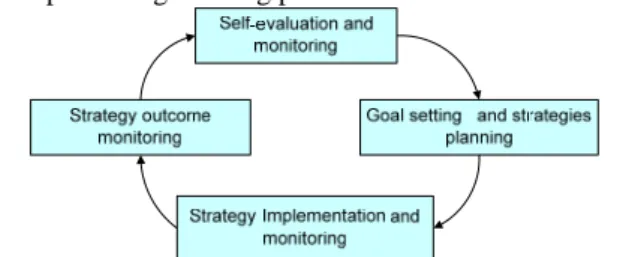
Zimmerman et al. (1996) referred to various aspects of self-regulated learning from different researchers to propose a learning model of self-regulation including four interrelated learning processes. Figure 1 shows the Zimmerman’s cyclic mode of self-regulated learning. The self-regulated learning model efficiently helps learners in self-examining and self-evaluating their learning performances via monitoring the target learning goals set by individual learners during learning processes. Once learners set their learning goals, they must be able to revise their learning strategies to achieve their learning goals. Moreover, the meta-cognition of learners can also be enhanced by self-evaluation and monitoring. More importantly, learners can adjust their learning strategies and
improve their learning behavior by self-examination, thus promoting learning performance.
Figure 1. The cyclic model of self-regulated learning proposed by Zimmerman
2.2. The Proposed Self-Regulated Learning
Model
Generally speaking, the active learners usually obtain higher learning performance than the passive learners. Therefore, except for considering self-regulated learning, this study also thinks about how to employ heteronomy mechanism that comes from teacher’s assistance to change the passive learners as active learners in a web-based learning environment. Based on the goals, this study aims to propose an effective self-regulated learning model derived from Zimmerman’s self-regulated learning theory, which simultaneously integrates heteronomy mechanism that comes from teacher’s concerns and self-regulation learning that comes from individual learner. Besides, performing master learning and spontaneous learning are also helpful to cultivate a smart learner. Figure 2 reveals the proposed self-regulated learning model simultaneously supported by self-regulated and heteronomy learning mechanisms.
Figure 2. The proposed self-regulated learning model based on Zimmerman’s self-regulated learning theory
3. The Proposed Self-Regulated Learning
Assisted Mechanisms in the Personalized
E-learning System
The personalized e-learning system (PELS) based on the Item Response Theory (Baker & Kim, 1992), which includes an off-line courseware modeling process, four intelligent agents and four databases, is presented in our previous study for adaptive courseware recommendation (Chen et al., 2005; Chen et al., 2006). Although personalized e-learning can effectively guide adaptive learning based on the difficulty parameters of courseware and learner ability of individual learner, cultivating learners toward fine learning attitude and self-regulated learning ability is also a critical goal for a web-based learning system. However, the PELS mainly focuses on performing adaptive learning, the self-regulated learning assisted mechanisms are lacked feature in this system. Based on the reason, the functionalities of the PELS system are extended to include the self-regulated learning assisted mechanisms in order to promote the spontaneous, autonomous and self-regulated learning abilities of learners.
3.2. System Architecture
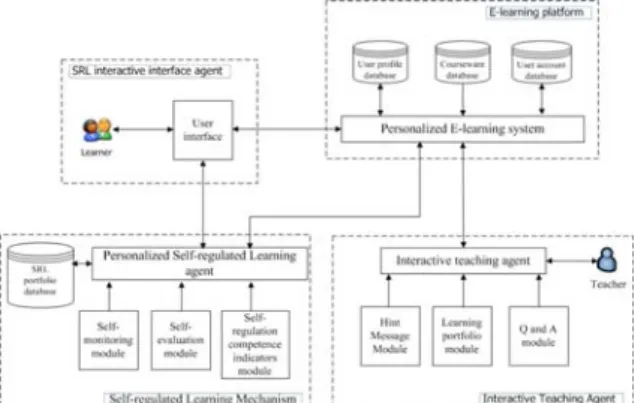
Based on cyclic model of self-regulated learning proposed by Zimmerman (Zimmerman et al., 1996), the proposed system architecture of the personalized e-learning system with self-regulated e-learning assisted mechanisms was extended to contain three intelligent agents including the personalized interactive interface agent, the interactive teaching agent (Chen et al., 2005), and the personalized self-regulated learning agent. In addition, the SRL portfolio database was employed to store all detailed self-regulated learning processes and the evaluated self-regulated competence indicators. The entire system architecture is shown as Fig. 3. The following subsections detail the functions and components of each agent.
Figure 3. The system architecture of the proposed personalized e-learning system with self-regulated learning assisted mechanisms
3.2.1. Personalized Self-Regulated Learning Agent.
The personalized self-regulated learning agent, which contains three modules and one database, was designed based on the self-regulated learning theory proposed by Zimmerman. The functions of these modules and SRL portfolio database are detailed as follows:
(1) Self-monitoring module: The self-monitoring
module helps individual learner find the best learning strategy and improve inappropriate learning behavior by inspecting the statuses of self-learning and meta-cognition. During learning processes, all self-regulated learning processes of individual learner and the self-regulated learning goals set by individual leaner will be automatically recorded in the SRL portfolio database. The recorded self-regulated learning processes for computing self-regulated learning competence indexes include the login time, the logout time, the starting learning time, the total learning time of each courseware, the number of learned courseware, the total idle learning time of each courseware, and so on. Additionally, the self-regulated learning goals set by individual leaner before learning contain the target learning time, the number of target learning courseware, and target achievement indexes of self-regulated learning competence indicators. From the view of leaner, the self-monitoring module aims at helping leaner to understand the difference between the current self-regulated learning indexes with the target self-regulated learning indexes, thus encouraging self-learning motive power. From the view of teacher, instructor can utilize this module to handle the current learning statuses of individual learners, so that immediately personalized assistances can be provided through the interactive teaching agent.
(2) Self-evaluation module: The self-evaluation
module provides a self-assessment interface for evaluating self-learning outcomes through grading a score for self-learning statuses and recording what courseware has learned during a learning process.
(3) Self-regulation learning competence indicator module: The self-regulation learning competence
indicator module is in charge of performing the analyses of the four proposed self-regulated learning indexes based on the learning data gathered in the SRL portfolio database. Besides, the proposed personalized e-learning system with self-regulated learning assisted mechanisms also evaluates the learning performance indexes including learning ability index, understanding degree index of learned courseware, and learning achievement index. Based on the defined four type relationships of the self-regulated learning competence index with the self-regulated learning performance index, learner’s learning difference can be identified,
thus helping teacher to plan learning strategies for learners with different learning differences.
(4) Self-regulated learning (SRL) portfolio database:
The SRL portfolio database aims at recording the generated regulated learning processes and self-assessing results of self-regulated learning from the self-monitoring and self-evaluation modules, respectively.
In this study, the proposed self-regulated learning indicators are distinguished as two kinds of indexes: one is the self-regulated learning competence index and another is the self-regulated learning performance index. The previous index was designed to evaluate the self-regulated learning behavior of individual learner, and the latter index was designed to assess the self-regulated learning performance of individual learner when learner performs learning actions assisted by the designed self-regulated learning assisted mechanisms during learning processes. The proposed self-regulated learning indicators are detailed as follows:
(1) Self-regulated learning competence index (a) Achievement index of learning time: How to
effectively plan and manage learning time could affect the learning performance of individual learner, because learner with poor ability of planning learning time easily leads to poor learning performance and efficiency. Based on the reason, the achievement index of learning time indicates the ratio of the total learning time to the target learning time set by individual learner based on personal self-learning goal. The mathematical formula can be represented as follows: 100 _ _ , _ min _ s time S s time S s time U S time G (1)
where G_time(S) represents the achievement index of
learning time, S_time(s) is the target learning time set by the th
s learner according to the self-regulated learning goal of individual learner, and U_time(s)is the
actual learning time of the th
s learner .
(b) Achievement index of effort level of learning courseware: The proposed system will automatically
record the learning time of each learned courseware for individual learners while they perform a learning process. The learning time of each learned courseware will be compared with
m
times of the minimum required learning time of the learned courseware set by course teacher to judge whether the learner performs a valid learning. The calculated formula is represented as follows: _ _ then , _ _ if 100, _ _ _ 1 i i i i n i i i s time c s time l time c m s time l n time c s time l S effort L (2)where L_effort(S) represents the achievement index of effort level of learning courseware, c _timei is the minimum required learning time of the th
i courseware
set by course teacher,
i
s time
l_ ( ) is the actual learning
time of the th
i courseware of the sth learner, n is the total number of learned courseware, and m is a adjustable constant determined by course teacher.
(c) Achievement index of reading rate: The
proposed system will also automatically record the total amount of reading courseware of individual learner in a course unit and compare it with the amount of target reading courseware set by self-request of individual learner to compute the achievement index of reading rate. The calculated formula is represented as follows: 100 _ _ ) ( _ s course S s course R S rate R (3)
where R_rate(S) represents the achievement index of
reading rate, S_course(s) is the target amount of reading
courseware set by the th
s learner, and R_course(s) is the
actual amount of reading courseware of the sth learner
during a learning process.
(d) Achievement index of concentrated learning: In
this study, the achievement index of concentrated learning is evaluated in according with the valid and idle learning time while learner performs a learning process. To evaluate the idle learning time accurately, the proposed system will filter out the invalid learning time by detecting the operating behavior of mouse and keyboard. Basically, the learning behavior of learner will be served as idle if the mouse operating detected by the personalized self-regulated learning agent is fixed at the same screen position as well as no any keyboard operation is executed. The calculated formula is represented as follows:
100 ) ( _ ) ( _ ) ( _ s time T s time R S con L (4)
where L_con(S) represents the achievement index of
concentrated learning, R_time(s) is the totally valid
learning time of the th
s learner, and T_time(s) is the
totally learning time of the th
s learner.
(2) Self-regulated learning performance index (a) Learning ability index: After learning the
recommendation courseware, the personalized e-learning system (Chen et al., 2005; Chen et al., 2006) can dynamically estimate the learner’s ability according to the Item Response Theory by collecting the replied responses of the learner to the randomly
selected testing questions in the learned course unit. The index value denotes the learner’s ability in the learned course unit, and the range of learner’s ability is limited from -3 to +3. The original index value of learner’s ability was transferred into the range from 0 (i.e. lowest ability –3) to 100 (i.e. highest ability +3) in this study.
(b) Understanding degree index of learned courseware: After a learner has learned the
recommended course material, the personalized e-learning system tests the learner on his understanding degree of the learned course material by randomly selecting a corresponding question from the testing item database. The rate of correct responses of the test questions helps determine the learner’s understanding degree to the learned courseware. The understanding degree index value of learned courseware was also transferred into the range from 0 (i.e. 0% correct response rate) to 100 (i.e. 100% correct response rate) in this study.
3.2.2. Interactive Teaching Agent. The interactive
teaching agent aims at assisting teacher to perform immediate interaction with learners during learning processes. The following subsections give the detailed descriptions for the proposed interactive teaching agent.
(1) Hint Message Module: In this module, teachers
can send a hint message to concern about learner’s learning statuses during a learning process or teach individual learner for the course materials that he/she has not learned well yet. Many past researchers related to the regulated-learning (Butler & Winne, 1995; Ley & Young, 2001) indicated that the learning performance can be promoted if teachers can provide suitable learning assistance in a web-based learning environment.
(2) Q & A Module: The proposed system also
provides a Q & A interface including a discussion board for helping learners to propose suffered learning questions and a help center live (HCL) for responding learner questions immediately. In the Q & A module, two modes can be selected to help teacher inspect learner’s questions. The first mode only shows the questions that teachers have not replied yet. Teachers can give immediate responses according to these no replied questions. The second mode can show all past learner’s questions that contain both the replied and no replied questions. Teachers can also modify the contents of replied questions through this interface. These learner’s questions and teacher’s corresponding answer responses are stored into the student Q & A database.
3.2.3. Self-Regulated Learning Interactive Interface Agent. The personalized interactive interface agent
aims at providing a friendly interface for learners to interact with the personalized e-learning system with self-regulated learning assisted mechanisms. The functions of the personalized interactive interface are detailed as follows:
(1) Immediate feedback of self-regulated learning competence index: The proposed system can display
immediately the learning statuses including the totally idle learning time and the self-regulated learning radar plot with five-dimension self-regulated learning indicators to individual learner during learning processes. These five self-regulated learning competence indicators contain four defined self-regulated learning competence indexes and one learning performance index mentioned in section 3.2.1. In particular, the radar plot with five-dimension self-regulated learning indicators can help individual learner understand how far it is from the actually current self-regulated learning competence indexes evaluated by the proposed system to the target self-regulated learning competence indexes set by the individual learner.
(2) Self-inspection of self-regulated learning competence index and learning process: Learner can
inspect the self-regulated learning index and learning process stored in the SRL portfolio database by the inspection interface in order to promote self-regulated learning ability as well as learning performance.
3.4. The Implemented Personalized E-learning
System with Self-Regulated Learning Assisted
Mechanisms
The proposed self-regulated learning assisted mechanisms are implemented in the personalized e-learning system proposed in our previous study (Chen et al., 2005; Chen et al., 2006) for promoting learning performance.
First, Figure 4 shows the registration and login interface.
Figure 4. Registration and login interface
After a learner logs in the system, he/she will be directed to fill a self-monitor form before progressing courseware learning. In the meanwhile, the system will also display automatically the self-regulated learning competence indicators set by individual learner in the previous learning process. The filled data fields contain the target learning time, the number of target learned courseware, the target effort level of learning courseware, the target concentrated study degree of learning courseware, and the target achievement index of learner ability. Figure 5 shows the self-monitor form that each learner has to fill.
Figure 5. The self-monitor form filled by learner
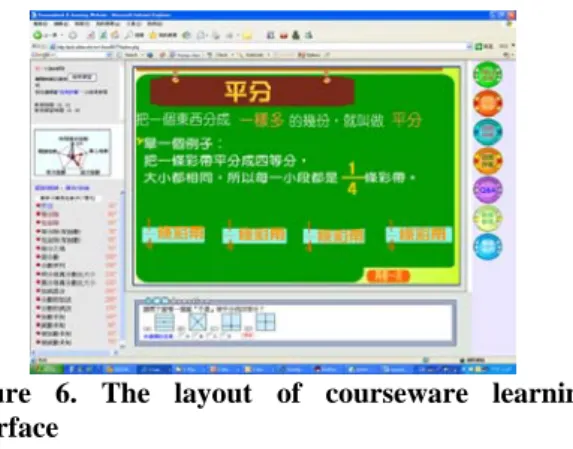
After filling the form, the system will guide the learner to enter the interface of courseware learning shown as Fig. 6. In the figure, the left-up frame reveals the immediate messages including the total learning time, the valid learning time and login information. The left-middle frame displays immediately the radar plot with five-dimension self-regulated learning indicators including four proposed self-regulated competence learning indexes and one learning performance index (i.e. learner ability index). This frame also shows the hint message from teacher through the hint message module. The middle-up frame exhibits the interactive animation courseware designed by Macromedia flash and the middle-down frame shows the corresponding quiz for the learned courseware. Finally, the right frame shows a fast function menu for quickly linking to the functions of performing monitor, inspection, self-evaluation, and Q & A.
Figure 6. The layout of courseware learning interface
When the learning time set by individual learner achieves or the learner presses terminative learning button, the system will direct the learner to fill a evaluation form shown as Fig. 7. Except for the self-evaluation form, all self-regulated learning competence indexes and learning performance indexes evaluated by the system will also be displayed to the learner. The function provides useful self-examination information to learners while they perform self-evaluation process.
Figure 7. The self-evaluation form for individual learner
After a learning process is terminated, learner can also view the self-regulated learning processes by the self-inspection interface as shown in Figure 8.
Figure 8. The self-inspection interface for observing the self-regulated learning states of individual learner
Besides, learners can interact with teacher by the discussion board and the Q & A module if they meet any questions during a learning process. Figure 9
exhibits the recorded discussion problems from learners. Moreover, Figure 10 shows the learner can progress immediate Q & A interaction with teacher by HCL module.
Figure 9. The interactive discussion board
Figure 10. The HCL immediate Q & A module
Figure 11 shows that the proposed system can automatically send an alarm message to individual learner while he/she occurs over long idle-learning time. Of course, teacher can also convey an encouraging or hint message to individual learner through the hint message module. Figure 12 shows an example that teacher conveys an encouraging message to a learner.
Figure 11. The alarm message for too long idle-learning time
Figure 12. The conveyed hint message for individual learner from teacher
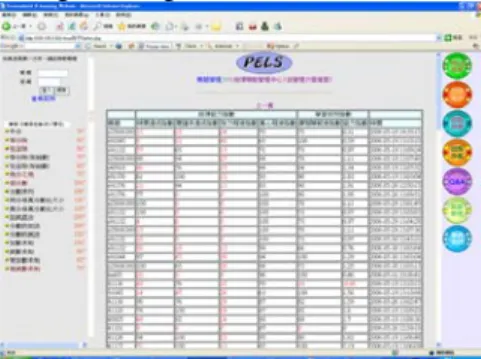
Moreover, Figure 13 shows that teacher can inspect the self-regulated learning processes of all learners through a legal management account of teacher.
Figure 13. The teacher’s inspection interface for observing the self-regulated learning processes of all learners
4. Experimental Analyses
.1. Design of Experimental Environment
This study adopted the quasi-experimental design to plan the experimental environment. Thus, four selecting randomly classes with normal distribution of score belonging to four grade students of Taichung County Da-Min Elementary School (2007) who have majored in the course unit of “Fraction” of mathematics were invited to participate in this experiment during the period of four weeks. Totally, there are 135 students belonging to different four classes to be divided into the treatment and control groups respectively containing two classes for the experiment. Since the selected Taichung County Da-Min Elementary School has divided students into classes based on the normal distribution of score, this study can reasonably suppose that four classes have the same academic level in mathematical learning, thus ignoring a pretest to evaluate students’ mathematical scores before learning. A posttest relating to the learned courseware was performed to compare the difference of learning performance after all students
participate in courseware learning of four weeks. The statistical information of experimental target is detailed in Table 1. In the designed experiment, the control and treatments groups performed courseware learning by the personalized e-learning system without and with self-regulated learning assisted mechanisms, respectively.
Table 1. The statistical information of learners Employed learning
platform
Sex & Number of learners Total number of learners PELS (Control group) Male: 30 Female: 36 66 PELS with SRL (Treatment group) Male: 34 Female: 35 69
4.2. Learning Performance Analysis of
Self-regulated Learning
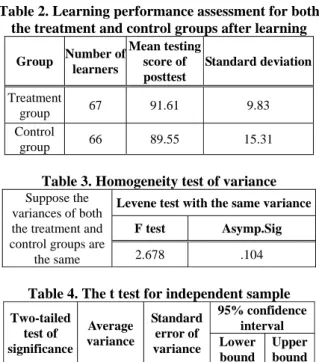
To evaluate the learning performance of the proposed self-regulated learning assisted mechanisms, this study adopted the posttest scores for both the treatment and control groups after all participators perform courseware learning of four weeks. The number of learners who participate in the posttest and the posttest scores of both the treatment and control groups are listed in Table 2. The experimental results indicated that the mean testing score of the treatment group surpasses the mean testing score of the control group as well as the standard deviation of the treatment group is obviously less than the standard deviation of the control group. Moreover, the homogeneity test of variance based on the Levene test was examined to estimate whether t test for independent sample can be further performed to verify the learning performance. The result of the homogeneity test of variance is listed in table 3, and the index value of Asymp.Sig is .104. The result shows that the homogeneity test of variance does not achieve significance. Therefore, the result confirmed that the variances of both the treatment and control groups are homogeneity. Based on the property of homogeneity, the t test for independent sample can be performed to verify the statistical significance related to the learning performance promotion, and listed in Table 4. Although the result of t test cannot shows that the learning performance of the treatment group is obviously superior to the control group, the mean testing score of the treatment group is higher 2.06 than the control group. The main reason could be that the self-regulated learning abilities affecting learning performance have to be cultivated in long-term learning. The short-term learning like our experimental design cannot reveal a significant difference.
Table 2. Learning performance assessment for both the treatment and control groups after learning
Group Number of learners Mean testing score of posttest Standard deviation Treatment group 67 91.61 9.83 Control group 66 89.55 15.31
Table 3. Homogeneity test of variance
Levene test with the same variance
F test Asymp.Sig
Suppose the variances of both the treatment and control groups are
the same 2.678 .104
Table 4. The t test for independent sample
95% confidence interval Two-tailed test of significance Average variance Standard error of variance Lower bound Upper bound .368 2.07 2.29 -2.46 6.6
5. Conclusion
This study presents a personalized e-learning system with self-regulated learning assisted mechanisms, which can promote self-regulated learning abilities of individual learners, to support learning performance promotion of individual learner. The proposed self-regulated learning assisted mechanisms efficiently helps learners in self-examining and self-evaluating their learning goals and performances via the immediately displaying regulated learning radar plot with five-dimension self-regulated learning indicators during learning processes. Moreover, the interactive teaching agent containing the hint message and immediate Q & A modules were respectively designed to support heteronomy learning for successfully assisting the proposed self-regulated learning model. In the summative learning performance assessment, although the assessing result of the treatment group is not obviously superior to the control group, the mean testing score of the treatment group progresses 2.06 points than the control group. The experimental results illustrate the proposed self-regulated learning mechanisms benefits learners in a web-based learning environment.
References
Baker, F. B. and Kim, S. H. (1992), Item Response Theory:
Butler, D. B. and Winne, P.H. (1995), “Feedback and self-regulated learning: a theoretical synthesis,” Review of
Education Research, vol. 65, no. 3, pp. 245-281.
Chang, M. M. (2005), Applying Self-Regulated Learning Strategies in a Web-Based Instruction-An Investigation of Motivation Perception, Computer Assisted Language
Learning, 18(3), 217-230.
Chen, C.M, Lee, H.M and Chen, Y.H (2005), Personalized E-Learning System Using Item Response Theory,
Journal of Computer & Education, vol. 44, no. 3, pp.
237-255.
Chen, C.M, Liu, M.C., and Hsu, S.H (2005), Applying Interactive Mobile Teaching Agent to Support E-Learning Platform for E-Learning Performance Promotion,
Proceedings of the IEEE International Conference on Advanced Learning Technologies, pp. 205-206.
Chih-Ming Chen, Chao-Yu Liu and Mei-Hui Chang, Personalized Curriculum Sequencing Using Modified Item Response Theory for Web-based Instruction,
Expert Systems with Applications, vol. 30, Issue 2, pp.
378-396, 2006.
Dabbagh Nada, Kitsantas Anastasia (2005). Using Web-based Pedagogical Tools as Scaffolds for Self-regulated Learning. Instructional Science, 33, 513-540.
Joo, Y. J., Bong, M., & Choi, H. J. (2000). Self-efficacy for self-regulated learning, academic self-efficacy, and internet self-efficacy in Web-based instruction.
Educational Technology, Research and Development,
48(2), 5-17.
Kumar V., Winne P., Hadwin A., Nesbit J., Jamieson-Noel D., Calvert T., Samin B. (2005). Effects of self-regulated learning in programming. Fifth IEEE International Conference on Advanced Learning Technologies, 383- 387. Ley, K., & Young, D., Instructional principles for self-regulated learning,
Educational Technology Research and Development,
vol. 49, no. 2, pp.93-102, 2001.
Niemi, H., Nevgi, A., and Virtanen, P., Towards self-regulation in Web-based learning, Journal of Educational Media, vol. 28, no. 1, pp. 49071, 2003.
Pang-Ning Tan, Michael Steinbach, Vipin Kumar, Introduction to Data Mining, Addison Wesley, 2006. Schunk, D.H. and Zimmerman, B.J. (1994), Self-regulation
of learning and performance: Issue and educational application. Hillsdale, NJ:Erlbaum.
Schunk, D.H. and Zimmerman, B.J. (1998), Self-regulated learning: from teaching to self-reflective practice. New York: Guilford.
Shih, K.P, Chang, C.Y., Chen, H.C., and Wang, S.S. (2005), A Self-Regulated Learning System with Scaffolding Support for Self-Regulated e/m-Learning, Proceedings
of the 3rd IEEE International Conference on Information Technology: Research and Education, 2005.
Susanne Narciss, Antje Proske and Hermann Koerndle. Promoting self-regulated learning in web-based learning environments. Computers in Human Behavior, Article In Press, Available online 17 November 2006. Taichung County Da-Min Elementary School, web available
at http://www.tmes.tcc.edu.tw/
Torrano Montalvo, F. and González Torres, MC. (2004), Self-Regulated Learning: Current and Future Directions, Electronic Journal of Research in Educational Psychology, 2(1), 1-34.
Zimmerman, B. J. (1986), A social cognitive view of self-regulated academic learning, Journal of Educational
Psychology, vol. 81, no. 3, pp.329-339.
Zimmerman, B. J. (1986), Development of self-regulated learning: Which are the Key subprocesses?,
Contemporary Educational Psychology, pp 307-313.
Zimmerman, B. J. and Schunk, D.H. (1989), Self-regulated learning and academic achievement: Theory, research, and practice. New York: Springer-Verlag.
Zimmerman, B. J., Bonner, S. and Kovach, R. (1996), Developing self-regulated learner: Beyond achievement to self-efficacy. Washington: APA.
Zimmerman, B.J. and Schunk, D.H. (2001), Self-regulated learning and academic achievement: theoretical perspectives. Hillsdale, NJ: Erlbaum.