
中小企業透過科技化合作促進回應能力之探討 - 政大學術集成
78
0
0
全文
(2) 中小企業透過科技化合作促進回應能力之探討. 摘要 近年來服務產業迅速的擴張與發展,對於經濟的影響力也不斷提升,其 中中小型的企業(SMEs)扮演了相當重要的角色。先前許多研究顯示回應能力對 於中小企業績效成長的重要性,然而卻少有文獻提及如何定義中小企業的回應 能力與如何發展中小企業的回應能力。本研究從文獻回顧中分別定義出了三個 層面的回應能力:市場感應能力、顧客連結能力與敏捷度。此外,我們認為中 小企業可以透過資訊科技為基礎之協同合作促進本身的回應能力,提供更佳的. 政 治 大. 服務給顧客,進而提升企業績效。因此,我們提出研究架構來驗證資訊科技為. 立. 基礎之協同合作、企業回應能力以及企業績效三者之間的關係,並且選擇宜蘭. ‧ 國. 學. 縣枕頭山休閒農業區為我們的實驗對象。從研究結果中我們發現中小企業透過 資訊科技為基礎之協同合作來提升回應能力並且也使績效有正向的成長。也幫. ‧. 助中小企業更了解如何運用科技化協同合作提升企業績效。. Nat. n. al. er. io. sit. y. 關鍵字:中小企業、回應能力、資訊科技化協同合作、企業績效、休閒農業. Ch. engchi. i n U. v.
(3) Enhancing SMEs’ Responsiveness Through IT-enabled Collaboration. ABSTRACT The service economy has been expanding recently, with small- and mediumsized enterprises (SMEs) playing an important role. Previous research has shown that responsiveness is one of the most important strategic capabilities that SMEs should consider for enhancing their performance; however, how to define responsiveness and how to develop it in the SME context are seldom discussed. A review of the literature leads us to propose three dimensions of responsiveness in the SME context: market. 政 治 大 collaboration should facilitate this capability. We develop a research framework to 立. sensing, customer linking, and promptness. Moreover, we propose that IT-enabled. examine the relations between IT-enabled collaboration, responsiveness, and. ‧ 國. 學. organizational performance. To verify our research framework, a case study that was deployed in the Mt. Pillow Leisure Agricultural Area in Yilan County. We observe. ‧. that SMEs can achieve higher level of performance after they have enhanced. y. Nat. responsiveness through cooperation via the IT-enabled platforms. The results of this. sit. study can also help SMEs improve their performance by realizing the importance of. er. io. responsiveness and how to enhance responsiveness through IT-enabled collaboration.. al. n. v i n C hIT-enabled collaboration, Keywords: SMEs, responsiveness, e n g c h i U performance, leisure agriculture. ii.
(4) CONTENTS CONTENTS ....................................................................................................................i FIGURES ..................................................................................................................... iii 1. INTRODUCTION ..................................................................................................... 4 1.1. Research Motivations.......................................................................................... 4 1.2. Research Objectives ............................................................................................ 5 1.3. Research Questions ............................................................................................. 6 2. LITERATURE REVIEW .......................................................................................... 7 2.1. Responsiveness ................................................................................................... 7 2.1.1. Market-Sensing Capability ........................................................................ 10 2.1.2. Customer-linking Capability...................................................................... 11 2.1.3. Promptness ................................................................................................. 12 2.2. IT-enabled collaboration among SMEs ............................................................ 14 2.2.1. Collaboration with SME Partners .............................................................. 14 2.2.2. Collaboration with Customers ................................................................... 16 3. RESEARCH MODEL AND HYPOTHESES ......................................................... 19. 立. 政 治 大. ‧ 國. 學. ‧. 3.1. The Effects of IT-enabled Collaboration .......................................................... 20 3.1.1. Effects of Collaboration with SME Partners ............................................. 20 3.1.2. Effects of Collaboration with Customers ................................................... 22 3.2. The Impact of Responsiveness Capabilities on Performance ........................... 24 4. RESEARCH ANALYSIS ........................................................................................ 26. sit. y. Nat. n. al. er. io. 4.1. Research Methodology ..................................................................................... 26 4.2. Data Collection ................................................................................................. 29 5. RESEARCH ANALYSIS ........................................................................................ 31. Ch. engchi. i n U. v. 5.1. Case Analysis .................................................................................................... 31 5.2. Analysis Results ................................................................................................ 40 5.2.1. Impact of IT-enabled Collaboration with Partners on Responsiveness ..... 40 5.2.2. Impact of IT-enabled Collaboration with Customers on Responsiveness . 41 5.2.3. Impact of Responsiveness Performance .................................................... 43 6. CONCLUSION ........................................................................................................ 46 6.1. Conclusion ........................................................................................................ 46 6.2. Limitations and Implication of Future Research .............................................. 47 REFERENCES ............................................................................................................ 48 APPENDIX A. QUESTIONS LIST OF THE INTERVIEW (CHINESE).................. 60 APPENDIX B. INTERVIEW CONTENTS (CHINESE) ........................................... 61. i.
(5) TABLES Table 2-1. Previous definitions of the Responsiveness ................................................. 8 Table 2-2. Four levels of customer involvement (Alam, 2002) ................................... 17 Table 4-1. Case background description ...................................................................... 27 Table 4-2. Validities and reliability tests ..................................................................... 30 Table 5-1. Cross-case analysis ..................................................................................... 39. 立. 政 治 大. ‧. ‧ 國. 學. n. er. io. sit. y. Nat. al. Ch. engchi. ii. i n U. v.
(6) FIGURES Figure 2-1. Market-driven processes for learning about markets (Day, 2002) ............ 10 Figure 3-1. Research framework.................................................................................. 19 Figure 4-1. The research road map .............................................................................. 29 Figure 5-1. Summary of case analysis (I) .................................................................... 40 Figure 5-2. Summary of case analysis (II) ................................................................... 41 Figure 5-3. Summary of case analysis (III) ................................................................. 43. 立. 政 治 大. ‧. ‧ 國. 學. n. er. io. sit. y. Nat. al. Ch. engchi. iii. i n U. v.
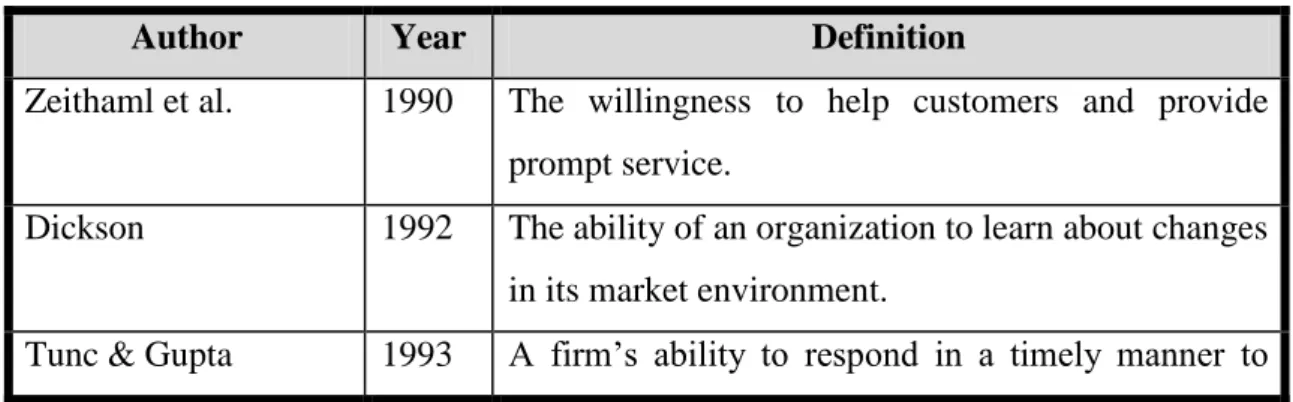
(7) 1. INTRODUCTION 1.1. Research Motivations Over the last few decades, small- and medium-sized enterprises (SMEs) have played an important role in the world’s economy (Mira, 2006; Robles-Estrada & Gómez-Suárez, 2007; Eikebrokk & Olsen, 2007). In recent years, SMEs have constituted a growing proportion of the service sector. Appiah-Adu and Singh (1998) found that SMEs are more service oriented than. 政 治 大. other enterprises in the service sector, and Flynn and Flynn (2004) suggest that. 立. service-oriented organizations need to have a common strategic capability for better. ‧ 國. 學. organizational performance. Responsiveness is one of the most important strategic capabilities that should be considered for enhancing the performance of service. ‧. organizations (Stalk & Hout, 1990; Teare, 1996). Responsiveness refers to the. y. Nat. sit. willingness to help customers and provide prompt service (Zeithaml et al., 1990). It. n. al. er. io. contributes to organizations’ ability to deal with changes in customer demands (Tsui,. i n U. v. 1994; Sharifi & Zhang, 1999) and enhances organizational performance (Stalk, 1988).. Ch. engchi. In the service industry, quality, speed and flexibility are associated with responsiveness (Zeithaml & Bitner, 2000). Customers are becoming more sophisticated in their needs and are increasingly demanding a higher standard of service. Therefore, when considering levels of performance as part of setting customer service objectives, service providers must take responsiveness into account as an important capability (Payne, 1995). Responsiveness is critical to the success of SMEs in remaining competitive and sustaining high performance levels. However, SMEs often have limited funding, time, staff, resources and technologies. Therefore, a primary task for resource-limited 4.
(8) SMEs in emerging economies has been to develop low-cost and easily implemented measures to improve their sustainability and to increase their chances of success when faced with rapid and often unforeseen changes in their external environments. One strategic response to increasing uncertainty is to establish collaboration between SMEs, often using information technology (IT) (Hitt et al., 2004; Sivadas & Dwyer, 2000; Bastos, 2001). Rosabeth Moss Kanter (1994) mentions that a welldeveloped ability to create and sustain fruitful collaborations gives organizations a significant competitive edge. Through IT-enabled collaboration, SMEs can become. 政 治 大 their partners and customers, thus improving their sustainability (Varadarajan & 立 more responsive by searching and collecting information quickly and efficiently from. Cunningham, 1995; Malecki & Tootle, 1996; Suarez-Villa, 1998).. ‧ 國. 學. In short, due to customers' growing influence, collaboration among SMEs. ‧. through IT is increasingly important for enhancing responsiveness and thus. y er. io. sit. this challenge.. Nat. performance. Nevertheless, little research has described how SMEs are responding to. 1.2. Research Objectivesa. n. iv l C n U of IT-enabled studies havehaddressed e n g c the h i role. Few existing. collaboration. among both SME partners and customers in enhancing SMEs' responsiveness to improve their performance. The main purpose of our research is to study the relationships between IT-enabled collaboration, responsiveness, and organizational performance. Our study proposes that the performance of SMEs could be improved through IT-enabled collaboration, with the relationship between these two constructs mediated by responsiveness. Specifically, the objectives of this study are as follows: 1) To measure SME responsiveness.. 5.
(9) 2) To examine the relationship between IT-enabled collaboration and responsiveness. 3) To examine the relationship between responsiveness and organizational performance.. 1.3. Research Questions Given the theoretical positions taken for this study and the status of the field as briefly described above, this study aims to answer the following questions: 1) Why is responsiveness so important for SMEs?. 政 治 大. 2) How will IT-enabled collaboration enhance SMEs’ responsiveness?. 立. 3) How does responsiveness relate to organizational performance?. ‧. ‧ 國. 學. n. er. io. sit. y. Nat. al. Ch. engchi. 6. i n U. v.
(10) 2. LITERATURE REVIEW To better understand how IT-enabled collaboration might enhance SMEs’ responsiveness, it is first necessary to understand what IT-enabled collaboration is and who should collaborate. In addition, it is necessary to have a basic understanding of SMEs and of how responsiveness plays an important role in this context and in related contexts. The literature review is composed of two parts. We introduce responsiveness in the first part and IT-enabled collaboration in the second.. 2.1. Responsiveness. 政 治 大. As mentioned earlier, responsiveness is defined as the willingness to help. 立. customers and provide prompt service (Zeithaml et al., 1990). In the service industry,. ‧ 國. 學. quality, speed and flexibility are all associated with responsiveness (Zeithaml & Bitner, 2000). Responsiveness is important to organizations’ ability to deal with. ‧. changes in customer demand (Tsui, 1994; Sharifi & Zhang, 1999) and to enhance. y. Nat. io. sit. organizational performance (Stalk, 1988).. n. al. er. As suggested by Carson (1990), the characteristics of SMEs are different from. Ch. i n U. v. those of large enterprises. SMEs are likely to be flatter, more informal, and more. engchi. flexibly structured organizations (Staniforth, 1994). For this reason, SMEs are usually more responsive in providing service that is more innovative and more customeroriented, with quicker response times for implementing changes (Humphrey & Schmitz, 1995; Pelham, 2000; Walczuch et al., 2000; Hmelnitchi & Neamtu, 2009). Therefore, we can conclude that responsiveness is a crucial factor that enables SMEs to implement their marketing actions more productively, which in turn, delivers greater value to customers, enhancing the organizations’ long-term survival. A summary of the literature on responsiveness is shown in Table 2-1. We classified prior studies’ definitions of responsiveness into three categories: (1) 7.
(11) Market-related, focusing on how organizations learn about changes in their market environment and adapt to changing market demands; (2) Customer-related, emphasizing how organizations manage their relationships with customers, including relation maintenance and understanding of customers; and (3) Time-related, highlighting an organization’s response time. Based on the three categories mentioned above, we defined three types of responsiveness capabilities in our research: (1) Market-sensing capability, which is a process for learning about present and prospective market environments; this. 政 治 大 views, which are simplified representations of the market and how it works (Day, 立. capability enables firms to formulate, test, revise, update and refine their market. 1994; Anderson & Narus, 2007). (2) Customer-linking capability, which is an ability. ‧ 國. 學. to create and manage relationships with customers (Day, 1994). (3) Promptness,. ‧. which is the capability of organizations to react quickly and effectively to changing. y. Nat. markets driven by customer-designed products and services (Gunasekaran, 1999).. er. io. sit. Zhang and Sharifi (2000) argued that an organization’s current level of promptness can be assessed through general factors such as the organization’s responsiveness to. al. n. v i n C h and effectiveness changes in its business environment at capturing the market and engchi U customer needs (Zaheer & Zaheer, 1997; Olavarrieta & Ellinger, 1997). We discuss each capability below. Table 2-1. Previous definitions of the Responsiveness Author Zeithaml et al.. Year 1990. Definition The willingness to help customers and provide prompt service.. Dickson. 1992. The ability of an organization to learn about changes in its market environment.. Tunc & Gupta. 1993. A firm’s ability to respond in a timely manner to. 8.
(12) customer’s needs and wants. Upton. 1995. The ability to fill customer’s requirement quickly.. Barclay & Dann. 1996. The ability to react purposefully and within an appropriate. timescale,. to. significant. events,. opportunities or threats to bring about or maintain competitive advantage. Gindy et al.. 1999. The ability to make a rapid and balanced response to the. predictable. and. unpredictable. changes. characterizing today’s environment. 2000. 2003. ‧. 2003. y. market signals.. io. The ability to plan and control the flow of materials through a sequence of supply chain processes in. al. n. Chen et al.. The ability to respond and adapt time-effectively based on the ability to read and understand actual. Nat. Harrison & Godsell. improvement effort.. sit. Catalan & Kotzab. to any service quality. 學. ‧ 國. 立. 治 政 大 and concerns are basic. Being responsive, come down with customer needs. 2004. er. Dayr & Leticia. v. order to meet end customer buying behavior.. Ch. engchi. i n U. The firm’s ability to respond in a timely manner to the needs and wants of its customers.. Atuahene-Gima et al.. 2005. The ability of a firm to quickly adapt to changing market demands.. Hooley et al.. 2005. The ability to recognize customer's demand that create, maintain and improve the way organizations providing service and products.. 9.
(13) 2.1.1. Market-Sensing Capability Market-sensing capability is critical to an organization’s ability to learn about customers, competitors, and channel members and continually sense and act on event and trends in present and prospective markets (Day, 1994). In current research, “market-sensing capability” refers to a firm’s ability to use market intelligence obtained through formal and informal mechanisms from various personal and public sources (Menon & Varadarajan, 1992; Moorman et al., 1992; Maltz & Kohli, 1996). Generally speaking, market-sensing capabilities are important in developing market. 政 治 大 Market-sensing can be divided into three processes: sensing activities, sense立. focus and thus, ultimately, organizational performance (Day, 1994).. making activities and reflection (Day, 1994; 2002), as shown in Figure 2-1. Sensing. ‧ 國. 學. activities include acquisition of information on consumers, competitors, and other. ‧. channel members; sense-making activities involve interpretation of gathered. sit. y. Nat. information based on past experiences and knowledge; reflection means the utilization. io. er. of the gathered and interpreted information in decision-making. Through the above three processes, intangible information and knowledge are transformed into visible. n. al. marketing responses.. Ch. engchi. i n U. v. Figure 2-1. Market-driven processes for learning about markets (Day, 2002) 10.
(14) Because. market-sensing. capability is. inseparable. from. organization. performance (Day, 2002), it can be assumed that organizations that are proficient in market-sensing activities gain a competitive advantage and achieve superior organization performance (Day, 2002). That is to say, an organization’s ability to learn about its market environment and use this information appropriately in its decision-making is the key driver of its performance (Dickson, 1992; Vorhies & Morgan, 2005). 2.1.2. Customer-linking Capability. 政 治 大. Customers are becoming more sophisticated in their requirements and are. 立. increasingly demanding a higher standard of service. To customers, service means. ‧ 國. 學. customer satisfaction, customer delight, service delivery, and customer relationships, among other definitions. Day (1994) refers to the ability to develop and manage close. ‧. customer relationships as customer-linking capability and argues that this capability is. Nat. sit. y. among the most valuable of any organization. Because customer-linking capabilities. n. al. er. io. take time to develop, rely on the integration of resources, and are inherently difficult. i n U. v. for competitors to duplicate, customer-linking capabilities are distinctive in their. Ch. engchi. potential to create a competitive advantage for firms that develop these capabilities. In a resource-based view, customer relationships are an intangible, marketbased resource that may be relatively rare and difficult for rivals to replicate (Srivastava et al., 1998). Hooley et al. (2005) also point out that this kind of relationship with customers is based on tacit knowledge and interpersonal skills, which are difficult to duplicate. Despite the theoretical importance of customer-linking capability, few empirical studies have examined its antecedents or outcomes. As noted by Day (2000), establishing good relationships helps organizations to learn more about their 11.
(15) customers. Organizations can easily collect and integrate customers’ thoughts, feedback and experiences for better service performance. Customer-linking capability thus refers to an organization’s ability to recognize customer demand and to create, maintain and improve the way it provides services and products to achieve a higher level of customer satisfaction and loyalty as well as increased sales and profits (Dick & Basu, 1994; Hooley et al., 2005). An organization’s customer-linking capability creates a potential competitive advantage in business (Rapp et al., 2010). Wellmanaged customer relationship creates a great opportunity to increase customer value. 政 治 大. and provides a way to systematically attract, acquire and retain customers (Lin & Su, 2003).. 立. ‧ 國. 學. 2.1.3. Promptness. According to surveys conducted in the service domain, many business people. ‧. believe that mistakes drive customers away, but that is a misconception. Customers. Nat. sit. y. tolerate mistakes, but the failure to respond promptly to resolve conflicts has the. n. al. er. io. potential to destroy relationships. Because a responsive organization is better prepared. i n U. v. to thrive in a competitive and turbulent environment, promptness has become a. Ch. engchi. necessary component in an organization’s competitive strategy (Richards, 1996; Yusuf et al., 1999; Meredith & Francis, 2000; Highsmith, 2004). Given the importance of promptness known as the agility, many definitions have emerged since Nagel and Dove (1991) first associate agility with organizational abilities. Kumar and Motwani (1995) define it as the ability to accelerate activities on a critical path that commences with the identification of a market need and terminates with the delivery of customized products and services. Vokur and Fliedner (1998) consider promptness to be the ability to produce and market successfully a broad range of low-cost, high-quality services with short lead times in varying lot sizes, 12.
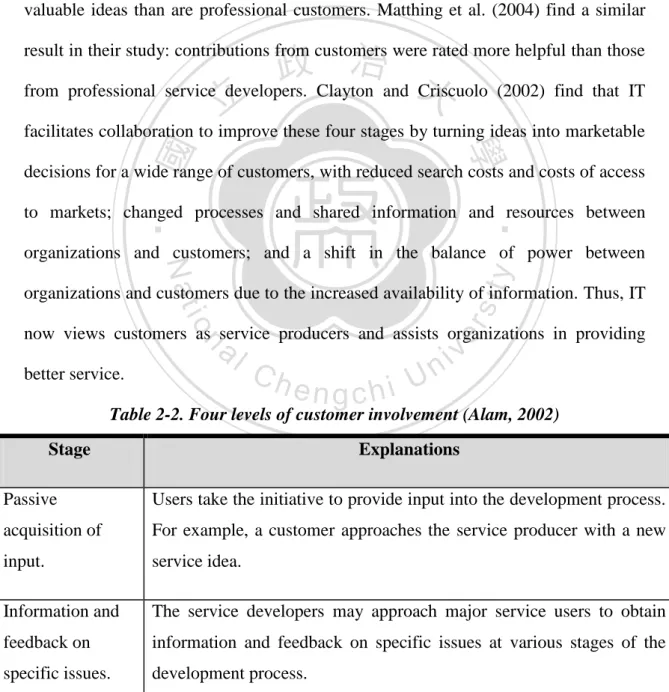
(16) thereby providing enhanced value to individual customers through customization. Sharifi and Zhang (1999) define it as the ability to cope with unexpected challenges, to survive unprecedented threats in the business environment, and to take advantage of changes as opportunities.. McGaughey (1999) and Gunasekaran (1999) both. describe it as the ability to provide service to customers quickly and effectively. For Sanchez and Nagi (2001), promptness is an overall strategy focused on thriving in an unpredictable environment by making prompt responses to the complexity brought about by constant change. Sambamurthy et al. (2003) define it as the ability to detect. 政 治 大 Among all of the definitions, the one Kidd (2000) provides is the most 立. and seize market opportunities with speed and surprise.. comprehensive: A prompt organization is a fast-moving, adaptable and robust. ‧ 國. 學. business. It is capable of rapid adaptation in response to unexpected changes and. ‧. events, market opportunities, and customer requirements. Such a business is founded. sit. y. Nat. on processes and structures that facilitate speed, adaptation and robustness and that. io. er. deliver a coordinated enterprise capable of achieving competitive performance in a highly dynamic and unpredictable business environment to which the enterprise’s. n. al. Ch. current practices are poorly suited.. engchi. i n U. v. SMEs must work especially hard to maintain the loyalty of their customers because they face an endless stream of competition from larger companies that have the money and manpower to be “on call” for their clients constantly. Based on the definitions above, we can conclude that fast responses and efficient communication in market, partners and customers are vital for SMEs if they are to achieve business success.. 13.
(17) 2.2. IT-enabled collaboration among SMEs SMEs' performance is usually limited by their scarce resources, such as their limited financial budget, few qualified employees, managerial and technological competency barriers, and a lack of long-term strategies (OECD, 2010). Many researchers have shown that collaboration is an effective way for SMEs to achieve better performance and long-term survival (Dollinger & Golden, 1992; GomesCasseres, 1997; Sivadas & Dwyer, 2000; Bastos, 2001; Hitt et al., 2004; Merrifield, 2007; OECD, 2010). Collaborations can be conducted either horizontally with SME. 政 治 大 The flourishing of IT in the last decade has facilitated collaboration (Pavlou, 立. partners or vertically with customers.. 2002; José-Juan et al., 2006; Skipper et al., 2008). Barua et al. (2004) and Martinez-. ‧ 國. 學. Fernandez (2001) state that information technology has provided the means to share. ‧. information more efficiently and effectively, thus improving coordination and. sit. y. Nat. collaboration activities. We will discuss two types of IT-enabled collaboration below:. io. n. al. 2.2.1. Collaboration with SME Partners. Ch. engchi. er. (1) collaboration with SME partners; and (2) collaboration with customers.. i n U. v. SMEs have faced challenges to their survival with their limited resources and little support from governments. These unfavorable circumstances deteriorate further in uncertain economic periods like the current crisis because SMEs do not have access to capital markets and their sources of external financing are much more limited than those of large organizations (Udell, 2009). However, studies have shown that collaboration between SME partners is an essential way for such companies to survive today (Berry, 1997; Hoffmann & Schlosser, 2001; Varamaki & Vesalainen, 2003; Narula, 2004).. 14.
(18) Collaboration between partners is the process by which two or more business partners work together to pursue a common purpose or goal using shared resources and co-commitment (Michael & Lois, 2010). The introduction of information technology communication tools offers a new way for organizations to form and maintain cooperative relationships with one another (Martinez-Fernandez, 2001). This IT-enabled collaboration creates new kinds of interfaces between organizations that can take a multitude of forms. An examination of the literature shows four types of benefits of collaboration. 政 治 大 information technology to achieve strategic objectives, such as gathering information, 立 among SMEs: (1) Strategy-oriented, where organizations collaborate through. maximizing profit, and gaining market advantages; (2) Transaction-cost-oriented,. ‧ 國. 學. where transaction costs can be reduced by including a larger population of. ‧. stakeholders in transactions for minimal marginal expense (Berry, 1997; Dhanaraj &. sit. y. Nat. Parkhe, 2006; Biswas et al., 2007; Meixner & Haas, 2008); (3) Resource-oriented,. io. er. where organizations in need of additional resources that cannot be purchased via market transactions or built internally with acceptable cost (risk) or within an. al. n. v i n C h & Schoonhoven, acceptable amount of time (Eisenhardt 1996) are able to engage in engchi U. value creation by combining internal and external resources in innovative ways (Ma, 2009); and (4) Knowledge-oriented, where, through seamless knowledge management, information exchange creates a convenient communication channel that establishes a sense of exclusivity among those organizations with collaborative access (José-Juan et al., 2006; Pavlou, 2002; Ma, 2009), and knowledge storage is achieved while collaborating (Meixner & Haas, 2008).. 15.
(19) 2.2.2. Collaboration with Customers Both large and small organizations must focus on their customers to survive. Customers tend to be slow to adopt new services if organizations do not provide effective cognitive tools to help customers learn about the benefits associated with these new services. Acquiring a new customer can cost up to five times more than persuading an existing customer to make a new purchase (Adrian, 2002). The insertion of the customer into the chain of value by acquiring direct knowledge of his/her opinions and complaints is a factor in the success of businesses engaged in IT-. 政 治 大 resource-limited SMEs to create innovative offerings with low-cost 立. enabled collaboration (José-Juan et al., 2006). Therefore, it is important to help and easily. obtained benefits to improve their sustainability and to increase their chances of. ‧ 國. 學. success.. ‧. Today, organizations increasingly involve their customers in service and. y. Nat. product processes (Kausch, 2007). One crucial reason for collaborating with. er. io. sit. customers is their low satisfaction with an organization’s existing services and products (Atuahene-Gima, 1995; Goldenberg et al., 2001). The main problem is that. al. n. v i n requirements C and expectations thatUare unknown hengchi. customers have. to the service. provider with the means to satisfy them (Thomke & Von Hippel, 2002). Encouraging customer collaboration from the beginning can provide better insight into customers’ requirements and expectations and can yield a product or service that is better suited to the market (Kausch, 2007). Another reason to collaborate with customers, offered by Chesbrough (2004), is the reduced amount of time available to develop new services and products due to the growing speed of information technology. Collaboration with customers can be facilitated by information technology. Alam (2002) describes four stages in which organizations maintain relationships with 16.
(20) their customers, as shown in Table 2-2: (1) passive acquisition of customers; (2) information and feedback on specific issues; (3) extensive consultation with customers; and (4) customer representation. Whereas the first two stages represent passive involvement of customers in the service development processes (with limited input and feedback), customers are increasingly being asked to contribute ideas and suggestions themselves, as in the latter two stages (Sawhney et al., 2005). Kristensson et al. (2004) find that ordinary customers are better able to develop original and valuable ideas than are professional customers. Matthing et al. (2004) find a similar. 政 治 大 from professional service developers. Clayton and Criscuolo (2002) find that IT 立 result in their study: contributions from customers were rated more helpful than those. facilitates collaboration to improve these four stages by turning ideas into marketable. ‧ 國. 學. decisions for a wide range of customers, with reduced search costs and costs of access. ‧. to markets; changed processes and shared information and resources between. sit. y. Nat. organizations and customers; and a shift in the balance of power between. io. er. organizations and customers due to the increased availability of information. Thus, IT now views customers as service producers and assists organizations in providing. n. al. better service.. Ch. engchi. i n U. v. Table 2-2. Four levels of customer involvement (Alam, 2002) Stage. Explanations. Passive. Users take the initiative to provide input into the development process.. acquisition of. For example, a customer approaches the service producer with a new. input.. service idea.. Information and. The service developers may approach major service users to obtain. feedback on. information and feedback on specific issues at various stages of the. specific issues.. development process.. 17.
(21) Extensive. The service producers take the initiative and invite user input by means. consultation with. of a planned process governed by predetermined objectives. Common. users.. examples include detailed interviews with the users, focus group research, and group discussions. Users are invited to join a new service development team, where they contribute to the specific stages of the development process in their capacity as a team member.. 立. 政 治 大. 學 ‧. ‧ 國 io. sit. y. Nat. n. al. er. Representation. Ch. engchi. 18. i n U. v.
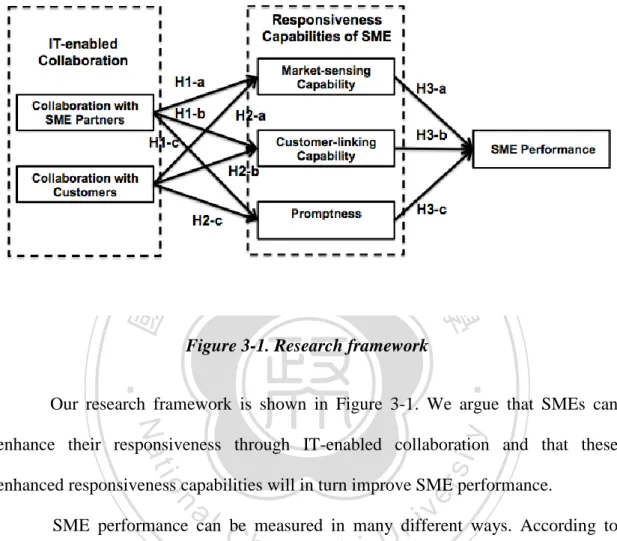
(22) 3. RESEARCH MODEL AND HYPOTHESES. 立. 政 治 大. ‧ 國. 學 Figure 3-1. Research framework. ‧. Our research framework is shown in Figure 3-1. We argue that SMEs can. y. Nat. io. sit. enhance their responsiveness through IT-enabled collaboration and that these. n. al. er. enhanced responsiveness capabilities will in turn improve SME performance.. Ch. i n U. v. SME performance can be measured in many different ways. According to. engchi. Dixon et al. (1990), until the 1980s, performance measurements in the literature largely concentrated on financial indicators, including profitability (e.g., return on investment [ROI], earnings before interest and tax [EBIT], and gross profit margins), market share growth, sales growth, and efficiency (e.g., return on sales [ROS] and return on equity [ROE]). In the 1990s, non-financial performance was widely discussed. For example, Huselid (1995) and Youndt et al. (1996) suggest that performance could be measured by product quality and delivery time, employee morale and productivity, and inventory management and equipment utilization. Wahlberg et al. (2009) suggest that an organization’s performance could also be 19.
(23) measured by CRM processes. Reinartz et al. (2004) investigate organizational performance by implementing CRM processes through relationship initiation, maintenance, and termination. To summarize the literature, measurements of organization performance fall into three categories: financial, operational and relational. We will measure SME performance accordingly, and the details of our research framework are described below.. 3.1. The Effects of IT-enabled Collaboration. 政 治 大. 3.1.1. Effects of Collaboration with SME Partners. 立. Marketing theorists stress the importance of continually learning about the. ‧ 國. 學. market environment. This learning process involves a series of information processing. ‧. activities (Day, 1994). Through IT-enabled collaboration with business partners, information on consumers, competitors and other channel members can be acquired. y. Nat. io. sit. and interpreted in light of past experiences and knowledge on the same platform, then. n. al. er. used to assist in decision-making. Through the above processes, intangible. Ch. i n U. v. information and knowledge are transformed into a visible marketing response (José-. engchi. Juan et al., 2006; Ma, 2009). Appropriate use of information is fundamental to the ability to sense market requirements (Rogers et al., 1991). If an organization does not have adequate and accessible resources and information, it stands at a distinct competitive disadvantage (Herbig & Shao, 1993). Haeckel and Nolan (1993) further stress that information technology is critical to managing conditions that are too turbulent to make sense of. IT-enabled collaboration thus allows resource-limited SMEs to acquire and share information efficiently and effectively, which strengthens their ability the read the market. Therefore, we hypothesize the following:. 20.
(24) Hypothesis 1-a: IT-enabled collaboration with SME partners has a positive impact on market-sensing capability.. Although customer relationships are viewed as an intangible resource that may be relatively rare and difficult for others to replicate (Srivastava et al., 1998; Hooley et al., 2005), the capability of SMEs to acquire and manage customer information is limited due to their smaller scale. By coordinating information and activities with strategic partners, a SME can develop more ways to attract customers, and become. 政 治 大 customer relations (Stock, 1990; Rapp et al., 2010). Therefore, we predict that 立 more responsive to customer requests and build greater customer loyalty and better. customer-linking capability can be improved by collaboration through information. ‧. ‧ 國. 學. technology:. io. er. impact on customer-linking capability.. sit. y. Nat. Hypothesis 1-b: IT-enabled collaboration with SME partners has a positive. al. n. v i n C h because of theirUlack of resources. To enhance SMEs usually lack promptness engchi. promptness, it is important to increase communication and collaboration and improve. decision-making processes (Lee et al., 2006). SMEs can acquire necessary resources and capabilities by forming alliances (Fernández & Nieto, 2005). Smith et al. (2007) argue that organizations involved in alliances are better able to utilize resources, improving their speed to the market and their speed in serving customers. Information technology makes such coordination more feasible (Kumar & Dissel, 1996). Paulraj and Chen (2007) state that IT-enabled collaboration increases information processing speed by providing an intermediary platform for partners to share knowledge, provide 21.
(25) timely information, and transcend each firm’s boundaries. We hypothesize the following:. Hypothesis 1-c: IT-enabled collaboration with SME partners has a positive impact on promptness.. 3.1.2. Effects of Collaboration with Customers Unlike large organizations, SMEs do not have the resources to engage in. 政 治 大. formal market research (Keh et al., 2007). For SMEs to sense the market precisely. 立. and adapt to it, they must collaborate with their customers to collect a significant. ‧ 國. 學. amount of data and analyze it. This analysis will provide them with better insight into customer requirements and expectations, ultimately resulting in a service that is more. ‧. suited to the market (Kausch, 2007). With the help of information technology, SMEs. Nat. sit. y. are able to gather, store, access, and analyze customer data to effectively make. n. al. er. io. strategic business decisions (Swafford et al., 2006). Therefore, we hypothesize that. i n U. v. IT-enabled collaboration with SME customers provides an environment for. Ch. engchi. organizations to collect and analyze market data from customers and thus enhances the capability of organizations to sense the market.. Hypothesis 2-a: IT-enabled collaboration with SME customers has a positive impact on market-sensing capability.. One crucial reason for conducting customer-linking activities is low customer satisfaction with services and products provided by organizations (Atuahene-Gima, 1995; Goldenberg et al., 2001). It is especially important for SMEs to listen to 22.
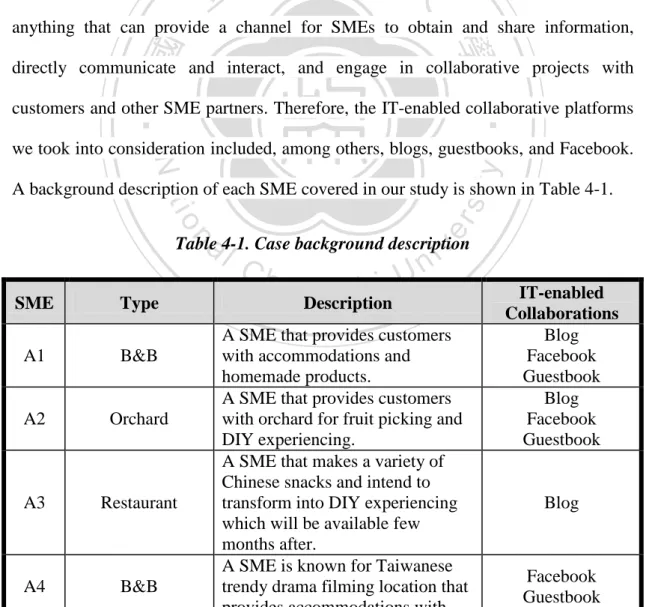
(26) customers’ opinions and complaints directly to raise their level of service and product satisfaction. However, linking to customers is a time-consuming and resourcedemanding process for SMEs. It is therefore essential for SMEs to enhance their customer-linking capability by collaborating with customers through a friendly, accessible, and directly interactive channel so that customers feel comfortable giving feedback (Kausch, 2007). Füller et al. (2009) observe that, with the help of IT, organizations are able to form new channels to collaborate with customers, effectively sharing knowledge and managing relationships. As a result, IT-enabled collaboration. 政 治 大 customers. Thus, we develop the following hypothesis: 立. with customers may reduce the distance between resource-limited SMEs and. ‧ 國. 學. Hypothesis 2-b: IT-enabled collaboration with SME customers has a positive. Nat. sit. y. ‧. impact on customer-linking capability.. io. er. Whereas large organizations can simply employ a number of people to take care of their customers immediately, resource-limited SMEs may struggle to respond. al. n. v i n of C their customers. ForUSMEs, hengchi. quickly to the demands. a fast and efficient. communication tool to learn about customers is vital if they are to achieve business success. Through collaboration with customers, SMEs are able to learn about their customers in multiple ways, shortening development time. Moreover, IT enables organizations to reduce the time required to share information and reduce response time to unforeseen events, thereby enhancing promptness (Katayama & Bennett, 1999; Mondragon et al., 2004). Therefore, we hypothesize that SMEs gain promptness through IT-enabled collaboration with customers.. 23.
(27) Hypothesis 2-c: IT-enabled collaboration with SME customers has a positive impact on promptness.. 3.2. The Impact of Responsiveness Capabilities on Performance Lack of financial assets is a problem that has long troubled SMEs, preventing their sustainable development and competitiveness in the long run. Therefore, it is especially important for SMEs to attract new customers at low cost. The literature suggests that market-sensing capability is related to aspects of firm performance such. 政 治 大. as profit and customer satisfaction. According to Slater and Narver (2000), better. 立. market-sensing capability allows an organization to discover underserved market. ‧ 國. 學. segments and those where its rivals' offerings may not be fulfilling customers’ needs. These underserved and unsatisfied segments are good targets for organizations. ‧. seeking new customers. Hult (1998) and Morgan et al. (2009) suggest that market-. Nat. sit. y. sensing capability provides market insights that enable organizations to reduce their. n. al. er. io. costs through effective use of resources by better matching the organization's resource. i n U. v. acquisitions and deployments with customer and prospect opportunities. By doing so,. Ch. engchi. we assume that SMEs are better able to forecast the value of different resources accurately, which enables them to manage resources better to achieve higher performance (Makadok, 2001). As a result, we expect the following:. Hypothesis 3-a: Market-sensing capability has a positive impact on SME performance.. 24.
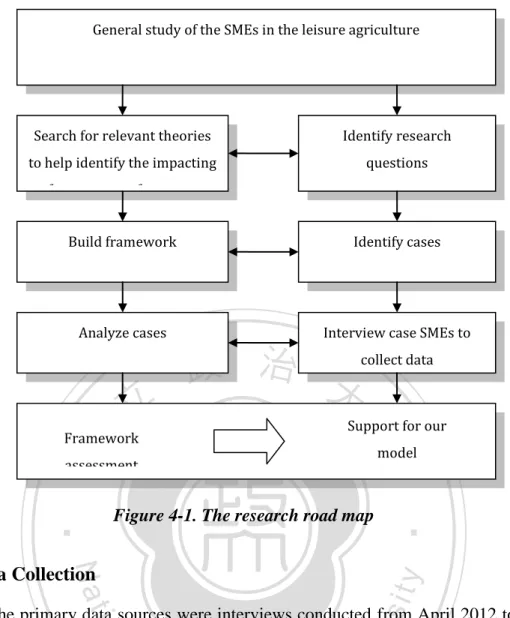
(28) SMEs may spend their limited resources and time on other tasks at the cost of customer satisfaction. This trade-off is a significant way in which SMEs lose business to their larger competitors. Managing relationships with customers is therefore critical. In our study, customer-linking capability has been defined as an organization’s ability to manage its relationship with its customers by contacting them directly. Direct customer contacts shorten service cycles and lower service costs. Nielsen (2002) and Hooley et al. (2005) suggest that customer-linking capability enables the development and maintenance of strong customer relations and ultimately improves. 政 治 大. customer satisfaction and loyalty. As a result, we expect the following:. 立. Hypothesis 3-b: Customer-linking capability has a positive impact on SME. ‧. ‧ 國. 學. performance.. Due to their smaller scale and limited funds, SMEs need to determine the most. Nat. sit. y. efficient and effective market strategies for improving their performance. A firm’s. n. al. er. io. promptness represents the strength of the interface between the organization and the. i n U. v. market (Mason-Jones & Towill, 1999). Organizations that are prompt in response to. Ch. engchi. customer requirements demonstrate operational flexibility, which can eliminate waste in their operations, better direct their interactions with their customers to improve customer retention, and in general, reduce the costs incurred in servicing their customer base. We believe that promptness can yield better SME performance in two ways: gaining profit by quickly adapting to market changes and reducing cost by eliminating waste from operations. Thus, we posit:. Hypothesis 3-c: Promptness has a positive impact on SME performance.. 25.
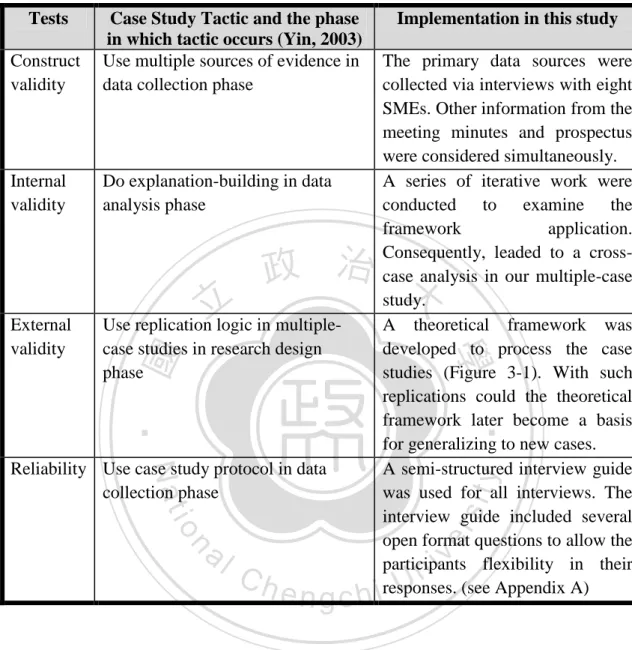
(29) 4. RESEARCH METHODS To test our research framework, we developed a case study of eight different case SMEs in the Mt. Pillow Leisure Agriculture Area in Yilan County. In this section, we will provide the background descriptions of our cases.. 4.1. Case Background & Research Methodology Tourism is an important industry for the Taiwanese economy and is dominated by SMEs, which represent 90% of all tourism businesses. Economic growth and social change have made leisure activities an important means of satisfying people's. 政 治 大. recreational needs. The recent rapid development of leisure agriculture in Taiwan. 立. illustrates the growing demand for recreation resources.. ‧ 國. 學. Leisure agriculture is a new trend in agricultural operations that combines local industry, cultural characteristics, leisure, natural ecology, and accommodations.. ‧. With its unique geography and diverse cultural and natural resources, Taiwan. y. Nat. io. sit. possesses significant potential to develop leisure agriculture. However, SMEs. n. al. er. involved in leisure agriculture are seldom able to collaborate to enhance their. Ch. i n U. v. competitiveness. Operating independently, they continue to suffer from low. engchi. productivity, lack of innovation, and slow growth due to their lack of the necessary resources to manage and fulfill customer needs efficiently. Based on our discussion above, we believe that IT-enabled collaboration will enable SMEs to enhance their responsiveness capabilities to achieve a higher level of service performance. For our study, we selected the SMEs in Mt. Pillow Leisure Agriculture Area, Yilan County. These SMEs in this area include, among others, farms, orchards, gardens,. restaurants,. natural. landscapes,. natural. ecological. areas,. and. accommodations. The case firms are as follows: A1 is a B&B with the part-time host. 26.
(30) A2 is a medium-sized sightseeing orchard. A3 is a small-sized Chinese snack wholesale who intending to transform into DIY provider which allows customers to make their own snack. A4 is a well-run B&B with some Taiwanese trendy dramas promotion. A5 and A6 are B&Bs who share their spare rooms to more or less support their family. A7 is a leisure farm of white michella and the new host only recently began renting the farm from the original proprietor and aims to add new services and products. Finally, A8 is a leisure farm growing bamboo shoots, but its main source of revenue is the well-known organic restaurant.. 政 治 大 a unified IT-enabled collaborative platform, we extended the target platform to 立. Because the SMEs in the Mt. Pillow Leisure Agriculture Area did not yet have. anything that can provide a channel for SMEs to obtain and share information,. ‧ 國. 學. directly communicate and interact, and engage in collaborative projects with. ‧. customers and other SME partners. Therefore, the IT-enabled collaborative platforms. sit. y. Nat. we took into consideration included, among others, blogs, guestbooks, and Facebook.. io. n. al. er. A background description of each SME covered in our study is shown in Table 4-1.. i n U. v. Table 4-1. Case background description SME. Type. A1. B&B. A2. Orchard. A3. Restaurant. A4. B&B. Ch. engchi. Description. A SME that provides customers with accommodations and homemade products. A SME that provides customers with orchard for fruit picking and DIY experiencing. A SME that makes a variety of Chinese snacks and intend to transform into DIY experiencing which will be available few months after. A SME is known for Taiwanese trendy drama filming location that provides accommodations with 27. IT-enabled Collaborations Blog Facebook Guestbook Blog Facebook Guestbook. Blog. Facebook Guestbook.
(31) B&B. A6. B&B. A7. Farm. A8. Farm. 立. Blog Facebook Guestbook. Facebook. Blog Facebook. 政 治 大. Blog. 學. ‧ 國. A5. high-class facilities and natural landscapes of Mt. Pillow. A SME that provides customers with home-feel accommodations, natural landscapes of Mt. Pillow beside, orchard in the backyard, and DIY experiencing. A SME that provides customers with accommodations and an overlook of the natural landscapes at top of the Mt. Pillow in the backyard. A SME that provides customers with magnolia garden for visiting, DIY experiencing, and related products. A SME that provides all kind of bamboo shoots DIY experiencing, meals, and related activities.. To better examine the responsiveness and performance of these SMEs, we. ‧. used the case study methodology to determine how IT-enabled collaboration impacts. sit. y. Nat. SMEs' responsiveness and performance, and analyzed these in our assessment. io. n. al. er. framework. Our research roadmap is shown in Figure 4-1.. Ch. engchi. 28. i n U. v.
(32) General study of the SMEs in the leisure agriculture. Search for relevant theories. Identify research. to help identify the impacting. questions. factors on performance Build framework. Identify cases. Analyze cases. Interview case SMEs to. 立. 政 治 大. Support for our. Framework. model. 學. assessment. Figure 4-1. The research road map. ‧. ‧ 國. collect data. Nat. sit. y. 4.2. Data Collection. n. al. er. io. The primary data sources were interviews conducted from April 2012 to May. i n U. v. 2012 with key respondents who were able to offer useful insights into their experience. Ch. engchi. using IT-enabled collaborative platforms. For each SME, we conducted two interviews, each lasting approximately 1 to 2 hours. All interviews were tape recorded, and all sessions were transcribed before the data were analyzed. To enhance the validity of answers, summaries of the major finding in each interview were verified by the participants after the end of each interview session. Moreover, to ensure the construct validity, internal validity, external validity and reliability of the case study, as suggested by Yin (2003), the recommended case study tactics were used. The results of this assessment are presented in Table 4-2.. 29.
(33) Table 4-2. Validities and reliability tests. Construct validity. Case Study Tactic and the phase in which tactic occurs (Yin, 2003) Use multiple sources of evidence in data collection phase. Internal validity. Do explanation-building in data analysis phase. 立. The primary data sources were collected via interviews with eight SMEs. Other information from the meeting minutes and prospectus were considered simultaneously. A series of iterative work were conducted to examine the framework application. Consequently, leaded to a crosscase analysis in our multiple-case study. A theoretical framework was developed to process the case studies (Figure 3-1). With such replications could the theoretical framework later become a basis for generalizing to new cases. A semi-structured interview guide was used for all interviews. The interview guide included several open format questions to allow the participants flexibility in their responses. (see Appendix A). Use replication logic in multiplecase studies in research design phase. 學. n. er. io. al. y. ‧. Nat. Reliability Use case study protocol in data collection phase. sit. External validity. Implementation in this study. 政 治 大. ‧ 國. Tests. Ch. engchi. 30. i n U. v.
(34) 5. RESEARCH ANALYSIS 5.1. Case Analysis IT-enabled Collaborations 1. IT-enabled collaboration with SMEs IT-enabled collaboration with SME partners is described as the degree of SMEs interaction through IT platforms. We assessed IT-enabled collaboration with SME partners based on three levels: do not/mostly do not interact with other SMEs. 政 治 大. through IT platforms; engage in basic interactions with SMEs through IT platforms;. 立. and engage in discussion or coordination with business partners through IT platforms.. ‧ 國. 學. We gave these levels the corresponding ratings of "Low", "Medium", and "High". Our interviews and analysis revealed that A2, A3, A6 and A8 do not interact with other. ‧. SMEs through IT and usually conduct their communications in person or over the. Nat. sit. y. phone. We thus rated these 4 cases as having low IT-enabled collaboration with. n. al. er. io. partners. A1, A4, A5 and A7 engage in basic interactions, such as leaving messages. i n U. v. and sharing pictures with other SMEs through Facebook as well as maintaining. Ch. engchi. friendships. We thus gave these 4 cases a medium rating. However, our interviews revealed that no case firm cooperates with partners with the help of IT. Below are excerpts from our interviews: We (SMEs) interchange information sometimes, such as on difficult customers. But only using face-to-face communications, we seldom go through Internet. (A6) I sometimes interact with other SMEs in Facebook. Give them a "like" or leave some messages¡K just like with non-business friendships. (A5). 31.
(35) 2. IT-enabled collaboration with customers As mentioned above, we define IT-enabled collaboration platforms as common integrated service system, such as social networking websites, blogs, and message boards, that can make firms communicate with both existing and potential customers. Through these platforms, managers are able to work alongside customers to generate new ideas. Therefore, to measure value co-creation through IT platforms, the frequency of the firm's communication with customers through IT-enabled collaboration was used.. 政 治 大 maintained guestbook and contacted them by e-mail. However, for personal reasons, 立. According to the interviews, in the past, A1 often replied to customers on its. she has changed her opinion and behavior with regard to IT-enabled collaboration.. ‧ 國. 學. We gave this special case a Medium rating. Unlike the precedent case, A2, A5, and. ‧. A7 show similar characteristics and communicate with their customers at a medium. sit. y. Nat. frequency. They sometimes interact with their customers, and believe that the IT-. io. er. enabled collaboration platforms are truly effective. Because of their medium frequency in interactions with customers through IT platforms, we give these three. al. n. v i n C h A3, A6, andUA8 are similar in their little use cases a medium rating for this category. engchi. of information technology to support their business operation, let alone to engage in. collaboration opportunities on IT-enabled platforms. Only A4 was given a high rating due to daily interactions with people on various Internet platforms. A4 regards these different platforms as valuable not only for promoting his business but also for knowing more about customers. This case is an ideal example of customer-friendly cooperation through information technology. Below are excerpts from our interviews:. 32.
(36) In the past, I have often interacted with customers. For example, I took some photos for my customers, uploaded them to my blog, and then e-mailed them out, the B&B holder said. She often replied to customers on the firm’s message board, and sent some greeting cards for Chinese New Year or other holidays. (A1) For example, it really works. If someone tells us that here have too many mosquitoes, I need to handle the situation; or if someone says that the area is messy, I will sweep immediately. (A7). Responsiveness. 立. 1. Market-sensing capability. 政 治 大. ‧ 國. 學. In our research, we assessed the degree of SMEs' market-sensing capability based on how SMEs participate in the three stages of market-sensing activities, which. ‧. we have mentioned in the previous chapter: collecting information on customers,. sit. y. Nat. partners, and competitors; interpreting and understanding the collected information;. io. al. er. and making informed decisions in the market. We measured the degree of market-. v i n C h A1 collectsU information following: engchi. n. sensing capability with the ratings "Low", "Medium", and "High". From the interviews, we found the. only for basic. understandings and does not want to follow market trends. A2 collects information to understand customer preferences and business operating conditions, but does so only as a reference tool. A4 has full knowledge of information not only on other SMEs and customers but also on its own advantages and positioning, all of which helps to make informed market decisions. A5 and A7 are similar in this regard, having collected some information and having fostered a certain degree of understanding and willingness to cooperate and change. Meanwhile, A3, A6 and A8 have not collected any information through IT-enabled platforms from partners or customers. We thus 33.
(37) gave A3, A6 and A8 a low rating, A1 and A2 a medium rating, and A4, A5 and A7 a high rating for market-sensing capability. Below are excerpts from our interviews: I understand the market trend, but it's uneconomical to spend a lot of money if I decide to change our room. (A1) I have information on customers and SMEs, but I prefer gaining experience in person. Information from the Internet is only for reference. (A2). 政 治 大. When products and services are different than others, all of the resources will. 立. come to me, so, it's important to maintain our strengths. I know where are my. ‧ 國. 學. customers and understand them as well, it is important. (A4). ‧. If we go the wrong direction (market trend), that will be terrible, so it is important. y. sit. io. n. al. er. business. (A7). Nat. to understand what others SMEs are doing and change the way we operate our. 2. Customer-linking capability. Ch. engchi. i n U. v. In our research, we assessed the degree of SMEs' customer-linking capability based on how SMEs attract, acquire and retain customers. To measure this degree, we gave the ratings "Low", "Medium", and "High". From the interviews, we found that A1 used to attract their customers to make purchase by using interesting photos and words, and contacting them with e-mails and interacting with them on Facebook to maintain the relationship. However, due to personal factors, A1 has changed its mind and behavior on customer relationship management. A2, A3, A6 and A8 seldom use computers to interact with their customer. A4 uses multiple avenues to increase its exposure, using the most natural way to attract customers and frequently contacting 34.
(38) and interacting with its customers on Facebook to maintain relationship. A5 did not expend much effort to attract the attention of consumers but was very successful in interacting with customers after serving them. A7 has several ideas for how to attract customers and has set up a fan page to interact with future customers and maintain good relationships, but the current owner took control of the business only a few months ago and has not yet begun operations. Our results show that A2, A3, A6 and A8 have a low level of customer-linking capability, A1, A5 and A7 have a medium level, and A4 has a high level.. 政 治 大. Below are excerpts from our interviews:. 立. I wrote blogs about travel, food, and B&B to attract customers, and I used to build. ‧ 國. 學. customer files and contact the customers often. (A1). ‧. I will use different advertising to help our B&B, so that customers can naturally. sit. y. Nat. recognize the surrounding environment here, rather than strong placement. n. al. er. io. marketing. In fact, I just often post something on Facebook of my. Many people. i n U. v. said that I could be the spokesperson of Wong Lung Pi. (A4). Ch. engchi. Some customers said that the photo shoots on our website are not very good, but that was a surprise. I think natural photo shoots are not very good, but customer's actual feeling is more important. (A5) I would like to interact with my customers. The ecology here is very rich, like tree frogs and fireflies, I take photos to it and post it on the blog. (A7) 3. Promptness In our research, we assessed the degree of SMEs' promptness based on whether there is an immediate response to the market, partners and customers. We 35.
(39) measured promptness with ratings of "Low", "Low-to-Medium", "Medium", and "High". We learned from interviews that A1 can quickly respond to partners and customers and also interact with them as well but has not responded to market changes. A2 responds regularly only to customers' demands and questions. A3, A6 and A8 cannot respond immediately to partners, customers, or the market. A4 responds immediately to customer feedbacks, constantly adjusts to the latest information on partners, and quickly adapt to popular market trend. Finally, A5 and A7 can respond quickly to customers and local activities. We determined that A4 has. 政 治 大 medium rating, A2, which was given a low-to-medium level, and A3, A6 and A8 立 the highest level of promptness, followed by A1, A5 and A7 which were given a. which were given a low rating.. ‧ 國. 學. Below are excerpts from our interviews:. ‧. Facebook's sharing feature is very good, you can see instant message anytime. (A1). sit. y. Nat. n. al. er. io. I contact customers mostly by phone, but if I see message I will reply to it as soon. i n U. v. as possible. When someone sends a message, I get an automatic alert. (A2). Ch. engchi. When a customer mentions us, a notification is automatically sent to me. I will see it immediately. (A4) I will regularly update the B&B information and check messages. (A5). Performance In our research, we assessed the case firms' performance based on whether they are improving in terms of income generation, customer relationships, and partner relationships. We rated performance as either "Low", "Low-to-Medium", "Medium", 36.
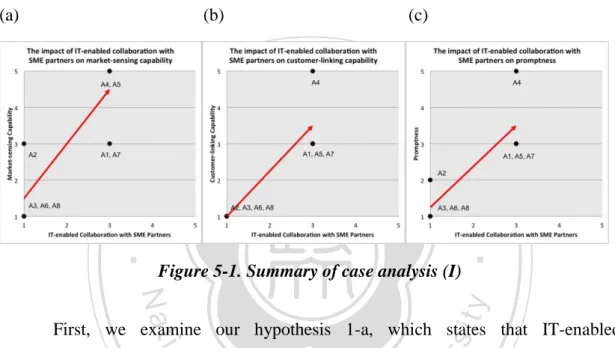
(40) or "High". We learned from the interviews that A1 earns income by selling the product and has a better relationship with customers by interacting with them. In addition, A2, A3, A6 and A8 have not experienced income growth or an improvement in their relationship with customers. A4 has successfully reduced the advertising cost, gained income, and improved relationships with both customers and partners. A5 has not substantially increased income but finds that interactions with partners and customers is helpful for maintaining a good relationship, and A7 has not yet begun to operate but has forged good relationships with partners. Therefore, we determined. 政 治 大 low-to-medium performance, and A2, A3, A6 and A8 show low performance. 立. that A4 shows high performance, A1 and A5 show medium performance, A7 shows. ‧ 國. 學. Below are excerpts from our interviews:. ‧. I am selling our products on Facebook now. (A1). sit. y. Nat. I use the information technology to do the marketing for free. I also have 900. n. al. er. io. friends on Facebook both SMEs and customers, most of whom added me as friend. i n U. v. actively. I think this kind of interaction is pretty good, not too commercial, and. Ch. engchi. unobtrusively promote our B&B. (A4). Through Facebook, I recognize some SMEs in other areas, and we have interaction sometimes on Facebook. Additionally, customers have asked me to recommend few restaurants for the New Year on Facebook, and then later thank me on Facebook, because the restaurant I recommended was really good and cheap. (A5). 37.
(41) For example, I have good relationship with some SMEs. The friends of theirs, though without connection currently, I still try to add them as friend on Facebook. (A7) The interviews, some preliminary analyses from the interview records on eight SME cases are summarized in Table 5-1.. 立. 政 治 大. ‧. ‧ 國. 學. n. er. io. sit. y. Nat. al. Ch. engchi. 38. i n U. v.
(42) Table 5-1. Cross-case analysis A3. A4. A5. A6. A7. A8. Medium. Low. Low. Medium. Medium. Low. Medium. Low. 政 治 大 Medium. Medium. Low. High. Medium. Low. Medium. Information collecting Information interpreting Decision-making. Medium. Medium. Low. High. High. Low. High. Low. Customer attract Customer acquire Customer retain. Medium. Low. Low. High. Medium. Low. Medium. Low. Medium. LowMedium. Low. iv. High. Medium. Low. Medium. Low. Low. High. Medium. Low. Low to Medium. Low. IT-enabled collaboration with customers. The level of interaction with customers through IT. Low. sit. y. al. n. Income generating Partner relationship building Customer relationship building. ‧. Immediate response to partners Immediate response to customers Immediate response to market. io. Performance. Nat. Customer-linking capability. 立. 學. A2. The level of interaction with partners through IT. Promptness. Dependent variable. A1. IT-enabled collaboration with partners. Market-sensing capability. Independent variable. Definition/Evidence. Ch. er. Independent variable. Item. ‧ 國. Factor. n engchi U. Medium. 39. Low.
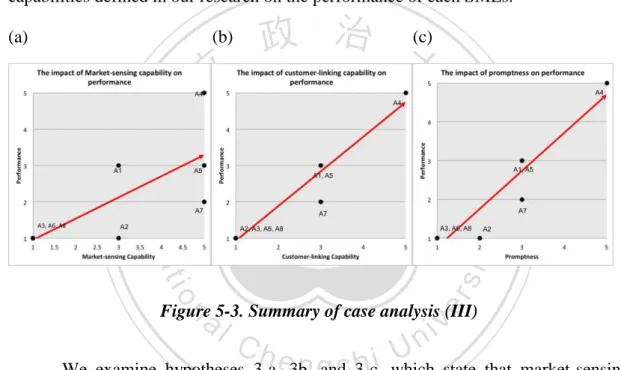
(43) 5.2. Analysis Results 5.2.1. Impact of IT-enabled Collaboration with Partners on Responsiveness Figure 5-1 shows the summary of the case analysis presented previously. As charts (a), (b), and (c) indicate, we can see the impact of the IT-enabled collaboration with SME partners on the responsiveness capabilities defined in our study of each SMEs. (a). (c). (b). 立. 政 治 大. ‧. ‧ 國. 學. Figure 5-1. Summary of case analysis (I). sit. y. Nat. io. er. First, we examine our hypothesis 1-a, which states that IT-enabled. al. collaboration with SME partners has a positive impact on market-sensing capability.. n. v i n C ha trend line showsUa positive relationship between As chart (a) of Figure 5-1 indicates, engchi IT-enabled collaboration with SME partners and market-sensing capability. We found that more interaction with partners firms make SME understand what others are doing. or actions they might take. In sum, our case study supports hypothesis 1-a, which stated: when there is good IT-enabled collaboration between SMEs, SMEs can contribute to higher levels of market-sensing capability. The second hypothesis we examine is hypothesis 1-b, which states that ITenabled collaboration with SME partners has a positive impact on customer-linking capability. As chart (b) of Figure 5-1 indicates, the trend line shows a positive 40.
(44) relationship between IT-enabled collaboration with SME partners and customerlinking capability. By obtaining information from partners, SMEs can generate more ideas, become more responsive to customer requests, and build greater customer loyalty and better customer relations. In sum, our case study support hypothesis 1-b, which stated: when there is good IT-enabled collaboration between SMEs, SMEs can contribute to higher levels of customer-linking capability. The third hypothesis we examine is hypothesis 1-c, which states that ITenabled collaboration with SME partners has a positive impact on promptness. As. 政 治 大 IT-enabled collaboration with SME partners and promptness. In sum, our case study 立 chart (c) of Figure 5-1 indicates, the trend line shows a positive relationship between. supports hypothesis 1-c, which states that when there is good IT-enabled collaboration. ‧ 國. 學. with other firm, SMEs can contribute to higher levels of promptness.. ‧. 5.2.2. Impact of IT-enabled Collaboration with Customers on Responsiveness. Nat. sit. y. Figure 5-2 presents a summary of the case analysis presented above. As charts. n. al. er. io. (a), (b), and (c) indicate, we can observe the impact of the IT-enabled collaboration. i n U. v. with customers on the responsiveness capabilities defined in our research of each SMEs. (a). Ch. engchi. (b). (c). Figure 5-2. Summary of case analysis (II) 41.
(45) First, we examine our hypothesis 2-a, which states that IT-enabled collaboration with customers has a positive impact on market-sensing capability. As chart (a) of Figure 5-2 indicates, the trend line shows a positive relationship between IT-enabled collaboration with customers and market-sensing capability. We observe that through direct contact with customers, SMEs are able to accurately apprehend present and future market trends. In sum, our case study supports hypothesis 2-a, which states that when there is good IT-enabled collaboration between customers, SMEs can contribute to higher levels of market-sensing capability.. 政 治 大 collaboration with customers has a positive impact on customer-linking capability. As 立 Second, we examine hypothesis 2-b, which states that IT-enabled. Figure 5-2 chart (b) indicates, A2 has a medium level of IT-enabled collaboration. ‧ 國. 學. with customers but a low level of customer-linking capability. We observe that A2. ‧. regularly replies to customers' questions but has not used this advantage to engage in. sit. y. Nat. further interactions with customers using IT resources. Therefore, A2 is not able to. io. er. enhance its customer-linking capability through IT-enabled collaboration with customers. Although the case of A2 does not show a positive relationship, the trend. al. n. v i n C h with customers line shows that IT-enabled collaboration have a positive impact on engchi U. customer-linking capability. In sum, our case study continues to support hypothesis 2b, which states that when there is good IT-enabled collaboration between customers, SMEs can contribute to higher levels of customer-linking capability. The next hypothesis we examine is hypothesis 2-c, which states that "ITenabled collaboration with customers has a positive impact on promptness. As the trend line in chart (c) of Figure 5-2 indicates, most SMEs demonstrate a positive relationship. The exception to this case is A2, which has a medium level of ITenabled collaboration with customers but a low-to-medium level of promptness. 42.
(46) Although this is not classified as being on the same level, we can still classify this as a positive relationship. In sum, our case study still supports hypothesis 2-c, which states that when there is good IT-enabled collaboration between customers, SMEs can contribute to higher levels of promptness. 5.2.3. Impact of Responsiveness Performance Figure 5-3 shows the summary of the case analysis presented previously. As charts (a), (b), and (c) indicate, we can see the impact of the responsiveness capabilities defined in our research on the performance of each SMEs. (a). (b). 立. 政 治 大(c). ‧. ‧ 國. 學 er. io. sit. y. Nat. al. n. Figure 5-3. Summary of case analysis (III). Ch. engchi. i n U. v. We examine hypotheses 3-a, 3b, and 3-c, which state that market-sensing capability, customer-linking capability, and promptness have a positive impact on SME performance. As charts (a), (b), and (c) of Figure 5-3 indicate, although the trend lines all show positive relationships between the responsiveness capabilities and performance, it appears that A2 and A7 did not show a positive relationship. A2 has a medium level of market-sensing capability and a low-to-medium level of promptness but also presents low performance. From the interview, we observe that the host of A2 is a traditional person and believes in face-to-face communication instead of ITenabled collaboration. Therefore, even though A2 has a medium level of market43.
(47) sensing capability and a low-to-medium level of promptness, their impact on performance remains low. A7 has a high level of market-sensing capability and medium levels of customer-linking capability and promptness but has only low-tomedium performance. We have obtained this result because the current host of A7 began renting the farm from the original proprietor not long ago and thus is still in the preparation phase. Therefore, it is expected that the financial performance would be low and that customer relationships would not yet be built, with only relationships with SME partners having been established. Therefore, we cannot yet observe a. 政 治 大 hypotheses 3-a, 3-b and 3-c, which state that when responsiveness capabilities are 立 significant impact on performance. In sum, our case study continues to support. enhanced through IT-enabled collaborations, SMEs can achieve higher performance.. ‧. ‧ 國. 學. 5.3. Findings. , A few interesting findings are listed below to further explore responsiveness. Nat. sit. y. capabilities defined in out study. We believe that these findings are able to help us to. er. io. design a more complete research model in the future.. n. a. The Attitude of Running la Business C. hengchi. i n U. v. Do all the SMEs demand for the responsiveness capabilities defined in our study? We found that the attitude of how the hosts run their business will impact the demand for market-related responsiveness capabilities. We classify the SMEs in our case into two categories: low and high demand for market-related responsiveness capabilities. We observe that those whom are yearn for market-related responsiveness capabilities have a positive attitude toward running their business and are very concerned about the trend of the market. Those whom showed low market-related responsiveness capabilities have a passive attitude on their business and prefer to keep 44.
(48) the original state. It seems that the attitude of running a business might affect the way that SMEs sense and respond the market. Therefore, we can conclude that the attitude of running a business will directly impact the demand for market-related responsiveness capabilities.. The Capability of Using IT All the SMEs in our case mentioned the importance of customer-linking capability, especially on attracting customer and maintaining customer relationship. Although the result shows that IT-enabled collaboration has a positive impact on. 政 治 大. customer-linking capability, we observe that the capability of using IT might play a. 立. role between IT-enabled collaboration and customer-linking capability. A2, for. ‧ 國. 學. example, replies to customers' requirements and questions regularly, but has not used. ‧. this advantage to engage in further interactions due to the capability of using IT. Therefore, the capability of using IT should be taken into account when we consider. y. Nat. n. al. er. io. sit. using IT-enabled collaboration to enhance SMEs' customer-linking capability.. Ch. engchi. 45. i n U. v.
(49) 6. CONCLUSION 6.1. Conclusion The service economy has grown significantly in the last decade, and SMEs are an important part of this sector. To serve customers in a turbulent environment, SMEs must enhance their responsiveness to retain their long-term competitiveness. Few published articles have addressed the issue of how to enhance SMEs’ responsiveness through IT-enabled collaboration. Our study aims to contribute to the literature by defining responsiveness capabilities in the SME context and providing a. 政 治 大. framework for examining the relationships between IT-enabled collaboration,. 立. responsiveness capabilities, and organizational performance. In our research. ‧ 國. 學. framework, we proposed two dimensions of IT-enabled collaboration: IT-enabled collaboration with partners, and IT-enabled collaboration with customers. Each. ‧. dimension directly influences the responsiveness capabilities defined in our research:. y. Nat. io. sit. market-sensing capability, customer-linking capability, and promptness.. n. al. er. We studied SMEs in the Mt. Pillow Leisure Agricultural Area in Yilan County. Ch. i n U. v. in particular to test the hypotheses proposed in our research. We conducted face-to-. engchi. face interviews in April and May of 2012 to gather useful information and gain more insights. The measurement and logical analysis of each case revealed strong support for the hypotheses, with the exceptional cases being adequately explained. In conclusion, SMEs should engage in IT-enabled collaboration to enhance their responsiveness capabilities and business performance. We believe that the study results will also help SMEs to develop their responsiveness capabilities and offer SMEs a guide to retaining their competitive advantage in the service economy through IT-enabled collaboration.. 46.
數據
+7


相關文件
Then, it is easy to see that there are 9 problems for which the iterative numbers of the algorithm using ψ α,θ,p in the case of θ = 1 and p = 3 are less than the one of the
(C) Some researchers say that if a person’s brain is right, she or he can easily have good musical skills.. (D) According to some researchers, the right brain helps us to improve
(D) It is good news that Janet has returned to her hometown forever 5.This drink became very popular in Europe so that everybody’s.. favorite was chocolate in milk instead
However, it is worthwhile to point out that they can not inherit all relations between matrix convex and matrix monotone functions, since the class of contin- uous
Infusing higher-order thinking and learning to learn into content instruction: A case study of secondary computing studies in Scotland. Critical thinking: What it is and why
嗚呼!仲以為桓公果能不用三子矣乎?仲與桓公處幾年矣,亦知桓公之為人
It is useful to augment the description of devices and services with annotations that are not captured in the UPnP Template Language. To a lesser extent, there is value in
Our main goal is to give a much simpler and completely self-contained proof of the decidability of satisfiability of the two-variable logic over data words.. We do it for the case
