Impact of Light Management on Photovoltaic Characteristics of GaAs
Solar Cells with Photonic Crystals and Quasi-Photonic Crystals
Yi-Chun Lai
a, Tung-Ting Yang
a, Peichen Yu
*a, Mu-Min Hung
aand Martin Charlton
ba
Department of Photonic & Institute of Electro-Optical Engineering, National Chiao Tung
University, 1001 Ta Hsueh Road, Hsinchu 300, Taiwan;
bSchool of Electronics and Computer
Science, University of Southampton, Highfield, Southampton SO17 1BJ, United Kingdom
ABSTRACT
In detailed balance model, the efficiency of single-junction solar cells can be potentially as high as 33.5% under AM 1.5G illumination. However the best state-of-the-art devices are still far lower than those figures, even the electronic quality is nearly perfect. Therefore the efficiency gap should stem from the light management inside solar cells. Recently, external radiation efficiency (𝜂ext) derived from detailed balance model is emphasized to evaluate light management and photon recycling, which aggregates the loss of backward emission into substrate and non-radiative recombination. This factor can be highly relevant to the cell’s performance, especially open-circuit voltage (Voc), and maximizing Voc is generally considered as the last mile to approach ultra-high efficiency limit.
In this work, we try to quantify the Voc enhancement in GaAs solar cells by enhancing light extraction. The simulation tools are RCWA simulation and photon recycling model NREL developed recently. The top structures we simulate here are TiO2 cones arranged in three PC/QPC lattices. After our calculation, the QPC 12-folds symmetry can make the biggest Voc enhancement 11.21meV compared with bare one, and the structure also possess extraordinary omni-directional anti-reflection ability for maintaining high Jsc. Our results also show that using this way to enhance Voc is especially suitable for cells with ordinary material quality. Therefore, the requests of ideal top structures for solar cells’ use are not only near-perfect anti-reflection, but the ability to maximize light extraction if no feature of angular filter exists.
Keywords: single-junction GaAs solar cells, photonic crystals, open-circuit voltage, light extraction efficiency, photon
recycling
1. INTRODUCTION
When recombination in the solar cell is dominated by radiative recombination, Shockley-Queisser limit [1] shows that the efficiency of single-junction GaAs solar cells can be as high as 33.5% under AM1.5G illumination because of its desirable band gap value. Although it had been stuck at 25.1% for nearly 20 years, Alta devices recently improved this world record to stunning 28.8% [2] by placing a good mirror on the back side of the cell, which reduces the substantial loss of emitted light in the substrate, so the dark current can be eliminated. Therefore the Voc can get big break through due to the better light management of solar cells.[3] According to detailed balance model, the Voc relation can be approximated as equation (1), where is external radiative efficiency defined in equation (2). [4]
(
) 𝜂 (1)
𝜂
(2)
The enhancement of ηext leading to higher open-circuit voltage can be understood in the following way. When a solar cell is operated at open-circuit, the induced electron-hole pairs have no place to go, and they must recombine in the end. If the cell is dominated by radiative recombination, it will eventually emit all the radiative photons and get the nearly 100% ηext. Otherwise, if non-radiative recombination exists, the dark current would increase, and the open-circuit voltage and ηext both go down. Though enhancing light extraction efficiency seems to conflict with the purpose of solar cells, but actually it could avoid the chance of encountering additional non-radiative recombination which will lead to the
Physics, Simulation, and Photonic Engineering of Photovoltaic Devices III, edited by Alexandre Freundlich, Jean-François Guillemoles, Proc. of SPIE Vol. 8981, 89810F · © 2014 SPIE
50 nm
4 um
750 nm
H H
FR=0.6 A 550nmammommmois
TPerfect Mirror
X 50nm
V(a)
'. . .. .
... ... ..
.. ;.. ..; ..
. .
...
..
..
..
..
... ..;..; .. ..
.. ..
.. ... ..
:::.:::.°.::
;
;
. ;..
.
..
..
:..::..::..:....i
,...,
... ... ...
.. .
..;..;..;
...
.. ;,
---open-circuit voltage loss. Therefore, the ηext of cells at ---open-circuit voltage could be a gauge to assess solar cells’ light management. [5]
In addition to ηext, the ratio of short-circuit current density Jsc and the dark current J0,rad caused by unavoidable radiative recombination loss also affects Voc. We often express this term as Vdb like the following equation shows.
(
) (3)
Vdb is the biggest Voc we can achieve calculated by detailed balance model which assumes that radiative recombination is the only loss mechanism. Since the electronic quality of modern GaAs solar cells are nearly perfect, in this work we try to discuss the Voc enhancement due to light management with different top optical design, and not focus on the back mirror. From equation (1), it’s evident that the optimized top structures should make both Jsc and ηext as high as possible, and traps the light in the absorbing layer to decrease radiative recombination loss J0,rad. As a result of increasing ηext and light trapping are totally opposite concepts, we must consider this trade-off in order to designing the desire top structures. In LED, many groups [6][7][8][9] has presented devices incorporated with photonic crystals (PC) and quasi-photonic crystals (QPC) in order to enhance light extraction efficiency. In the following contents, we are going to investigate how PC/QPC top structures could enhance Voc for a better understanding on how top optical design can improve solar cells’ efficiency.
2. SIMULATION METHODS & MODELING
To compute the ηext of GaAs solar cells with PC/QPC, here we introduce the photon recycling model NREL developed recently [10]. Photon recycling is the effect that the photon emitted by radiative recombination at Voc can undergo a series of re-absorption and re-emission processes due to interface reflection in the absorbing layer, and this process will terminate until the photon successfully escape from the solar cell or encounter non-radiative recombination. Therefore, it’s essential to consider photon recycling for ηext calculation. This photon recycling model is based on ray optics, and assumes the internal radiative efficiency ηint is the same everywhere which is valid when the minority carrier is uniform. Given ηint and internal reflection and transmission, this model can calculate the corresponding ηext. Because enormous data of reflection, transmission and absorption with different optical design are needed, these are approached by rigorous couple wave analysis (RCWA) method to complete the whole Voc computation.
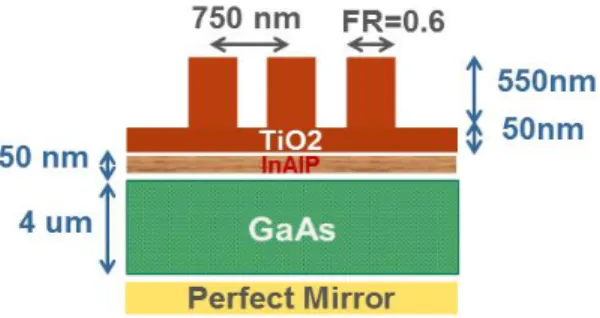
In this work, the 4um thick GaAs solar cells we simulated are shown in Fig 1. The PC/QPC structures are rods made of TiO2, and the arrangements include square lattice, triangular lattice and 12-fold symmetry [11] like Fig 2 shows. The rods’ diameter is expressed in filling ratio (FR) which is the ratio of dielectric area in single unit cell, and we keep it constant FR=0.6. The other parameters are also shown in the figure. Since we only focus on the enhancement of top structures, the back mirror is set to be perfect.
3. RESULT AND DISCUSSIONS
To explore the characteristics of PC/QPC top structures on GaAs solar cell, we discuss the influence of three PC/QPC arrangements by calculating corresponding Jsc, J0,rad and ηext. Finally the 3 parameters would be substituted into equation (1) to get the Voc.
3.1 Jsc, J0,rad and Vdb calculation
The Jsc is dependent on the anti-reflection ability of the PC/QPC structures. The reflectance simulations of three PC/QPC arrangements are shown below in Fig 3. To compare the anti-reflection ability of each top structures, we weighted solar spectrum AM1.5G from wavelength 350nm~870nm to calculate the weighted reflectance. The calculated weighted reflectance and the corresponding Jsc are listed in Table 1.
Fig. 3. The reflectance simulation result of three PC/QPC GaAs solar cells. Table 1. The weighted reflectance of three PC/QPC GaAs solar cells and the corresponding current density
Weighted Reflectance (%) Jsc (mA/cm2) SQR 12.91% 28.87 TRI 12.26% 29.07 12F 10.18% 29.70 SQ limit 0% 33.28
It’s worthy to note that except the 12F has the best normal incident AR in this case, it also exhibits extraordinary omni-directional AR ability. Fig 4 and Fig 5 are the polar-angle varying simulation and azimuthal-angle simulation. The results show that weighted reflectance won’t get much change until polar angle gets 60 degree, and it also stays constant around all azimuthal angles. These illustrate the 12F’s high rotational symmetry make it as an ideal AR structure for solar cells.
Fig. 4. The polar-angle varying simulation of QPC 12F GaAs solar cell.
0.4 0.5 0.6 0.7 0.8 0.9 1.0 0.0 0.1 0.2 0.3 0.4 0.5 SQR TRI 12F Re flecta nce Wavelength (um) 0 20 40 60 0.04 0.06 0.08 0.10 Sim 750P FR=0.6 WR=5.2% We igh te d Ref lect anc e
0
90 !I!: 135 . .818D. 0
0.6\F),
0
225315
0.2 270 -90 -60 -30 0 30 60 90 0 180 -90 90 135 ' ,45ik;.
225 315 270 -60 -30 0 30 60 90 0.8 0.6 0.4 0.2 0 180 -90 90 45 135 45L
22
270 -60 30 0 30 60 90 0.8 p0.6 .4 0.2Incident angle 0 Incident angle 0 Incident angle O
1 0.8 4.8 10.4 R -90 PC example 00 -0 30° Angular Filter 40 -1000 400 400 400 -200 0 200 100 600 800 Wavelength Om) 1000 -1000 400 400 400 -200 0 200 600 Wavelength Om) 800 1000 1 10.8 0.6 OA 0.2
Fig. 5. The azimuthal-angle varying simulation of QPC 12F GaAs solar cell.
According to detailed balance, J0,rad is relevant to the absorption of black body radiation 300K in absorbing layer. Using RCWA to simulate the absorbance a(E,θ,ϕ), and weighting it with black body radiation 300K, we can get the weighted absorbance a(θ,ϕ). The mapping plots are shown in Fig. 6. Integrating with the solid angle of entire hemisphere, the J0,rad can be calculated and listed in Table 2.
Fig. 6. (a) Square lattice (b) Triangular lattice (c) 12-folds symmetry
Table 2. The calculated short-circuitcurrent density, dark current and VDB enhancement of three PC/QPC GaAs solar cells.
Jsc (mA/cm2) J0,rad (mA/cm2) ΔVdb (meV) ηext (%) SQR 28.87 3.09E-18 0.6 26.18 TRI 29.07 3.13E-18 0.43 33.36 12F 29.70 3.10E-18 1.23 26.47 SQ limit 33.28 3.66E-18 0 100
Having Jsc and J0,rad, Vdb can be obtained from equation (3). The enhancements ΔVdb are tiny compared with SQ limit as Table 2 shows. Since the reflectance of 2D PC/QPC rods could be approximated to single layer coating by effective medium theorem, the weighted absorbance of each PC/QPC cells don’t possess much feature of angular filter like Fig. 7 shows. Basically Vdb would be nearly constant under this condition, and we’re going to show that the Voc enhancement would be dominated by external radiation efficiency ηext.
Fig. 7. The a(E, θ) plots of one PC GaAs solar cells and 30 degree ideal angular filter. 0.02 0.04 0.06 0.08 0 30 60 90 120 150 180 210 240 270 300 330 0.02 0.04 0.06 0.08
3.2 ηext and Voc calculation
Substituting internal reflectance and transmittance RCWA simulated into photon recycling model, and assuming that the ηint is 0.965 of high quality GaAs material, the ηext can be obtained as shown in Table 2. The Voc loss due to ηext is also listed in Table 3 below. It’s apparent to see the ηext term dominate the all Voc enhancement, and in our case the triangular lattice has the best light extraction ability, so the highest Voc. We also calculate the Voc value of triangular lattice with all ηint, the result is shown in Fig. 8. The Voc gets enhancement about 11.21meV in nearly the full range compared to the bare cell with no PC/QPC layer. The reason of Voc enhancement converges when ηint approaches 1 or 0 is that most of the emitted photons can escape from the cells for very high spontaneous emission rate or loss in the cells for very high probability of encountering non-radiative recombination. In both cases, the Voc value would not be relevant to the top structures. The result tells that using high light extraction structure to enhance Voc especially adapt to ordinary GaAs cells.
Table 3. The enhancement of VDB, ηext term and Voc of three PC/QPC GaAs solar cells.
ΔVdb (meV) kTln(ηext) (meV) ΔVoc (meV) SQR 0.6 -34.7 -34.1 TRI 0.43 -28.43 -28 12F 1.23 -34.33 -33.1
Fig. 8. The Voc versus ηint plot of TRI GaAs solar cell. The bare one is also shown for comparison, and the biggest enhancement is 11.21meV near ηint=0.5.
For completeness, we assume that ηext is invariant with voltage, so the J-V curve can be plotted as Fig. 9. Compared with SQ limit, the mainly loss in Jsc is due to non-perfect AR, and the Voc loss comes from the existence of non-radiative
recombination. However, the loss in Voc can be mitigated by employing high light-extraction top structures as the result
shows in Fig. 8. Since the cones structure arranged in 12F lattice possess not only spectacular AR ability, the high light extraction property also make it as the ideal top structure for solar cells.
Fig. 9. Assuming ηint=0.965 and ηext is invariant with voltage, IV curve of three PC/QPC GaAs solar cells can be plotted out. The SQ limit is also shown for comparison.
0.0 0.2 0.4 0.6 0.8 1.0 0.85 0.90 0.95 1.00 1.05 1.10 1.15 TRI Bare Voc of SQ limit Voc (V) int 11.21meV 0.0 0.2 0.4 0.6 0.8 1.0 1.2 0 5 10 15 20 25 30 35 Current Densit y (mA/cm 2 ) V oc (V) SQR 1.0945V TRI 1.1006V 12F 1.0955V SQ limit 1.1286V int=0.965
4. CONCLUSIONS
In reality non-radiative recombination must exist in solar cells, and the Voc would diminish due to the increase of dark
current. Here we propose using high light-extraction top optical designs to reduce Voc loss. The calculation shows that
TiO2 cones arranged in QPC 12F on single-junction GaAs solar cell can make 11.21meV enhancement in Voc compared with bare one, and it also possess extraordinary omni-directional anti-reflection ability for maintaining high Jsc. In our study, to increase Voc by enhancing light extraction especially adapts to cells with ordinary material quality. Since
common top structures don’t exhibit the feature of angular filter, the Voc generally would be dominated by light
extraction ability of the design. Therefore, the request of ideal top structure for solar cells should not only be near-perfect AR, but the ability to maximize light extraction.
REFERENCE
[1] W. Shockley and H. J. Queisser, "Detailed Balance Limit of Efficiency of p-n Junction Solar Cells," Journal of Applied Physics, 32, 510-519, 1961.
[2] M. A. Green, K. Emery, Y. Hishikawa, W. Warta, E. D. Dunlop, "Solar Cell Efficiency Table (version 41)," Progress in Photovoltaics, 21, 1, 1-11, 2013.
[3] A. Polman and H. Atwater, "Photonic design principles for ultrahigh-efficiency photovoltaics," Nature Materials commentary, 11, 174-177, 2012.
[4] O. D. Miller, E. Yablonovitch and S. R. Kurtz, "Strong Internal and External Luminescence as Solar Cells Approach the Shockley-Quisser Limit," IEEE Journal of Photovoltaics, 2, 3, 303-311, 2012.
[5] M. A. Green, "Radiative efficiency of state-of-the-art photovoltaic cells," Progress in Photovaltaics: Research and Applications, 20, 472-476, 2012.
[6] P. A. Shields, M. Charlton, T. Lee, M. E. Zoorob, D. W. E. Allsopp and W. N. Wang, " Enhanced Light Extraction by Photonic Quasi-Crystals in GaN Blue LEDs," IEEE Journal of Selected Topics in Quantum Electronics, 15, 4, 1269-1274, 2009.
[7] F. S. Diana, A. David, I. Meinel, R. Sharma, C. Weisbuch, S. Nakamura, and P. M. Petroff "Photonic Crystal-Assisted Light Extraction from a Colloidal Quantum Dot/GaN Hybrid Structure," Nano Letters, 6, 6, 1116-1120, 2006. [8] J. Shakya, K. H. Kim, J. Y. Lin, and H. X. Jiang, "Enhanced light extraction in III-nitride ultraviolet photonic crystal
light-emitting diodes," Applied Physics Letter, 85, 1, 142-144, 2004
[9] J. J. Wierer, M. R. Krames, J. E. Epler, N. F. Gardner and M. G. Craford, "InGaN/GaN quantum-well heterostructure light-emitting diodes employing photonic crystal structures," Applied Physics Letter, 84, 19, 3885-3887, 2004.
[10] M. A. Steiner, J. F. Geisz, I. Garcia, D. J. Friedman, A. Duda and S. R. Kurtz, Optical enhancement of the open-circuit voltage in high quality GaAs solar cells,“ J. Appl. Phys., vol. 113, p. 123109, 2013.
[11] M. E. Zoorob, M. D. B. Charlton, G. J. Parker, J. J. Baumberg and M. C. Netti, "Complete photonic bandgaps in 12-fold symmetric quasicrystals," Nature, 404, 740-743, 2000.