行政院國家科學委員會專題研究計畫 期中進度報告
子計畫四:網路行銷研究之探討:建立、驗證及應用(2/3)
計畫類別: 整合型計畫 計畫編號: NSC94-2416-H-004-003- 執行期間: 94 年 08 月 01 日至 95 年 07 月 31 日 執行單位: 國立政治大學企業管理學系 計畫主持人: 樓永堅 共同主持人: 張愛華,別蓮蒂 報告類型: 精簡報告 處理方式: 本計畫可公開查詢中 華 民 國 95 年 6 月 19 日
行政院國家科學委員會補助專題研究計畫期中進度報告
電子行銷典範—子計畫四:
網路行銷研究之探討:建立、驗證及應用(2/3)
計畫類別:□ 個別型計畫 ■ 整合型計畫
計畫編號:NSC
94-2416-H-004-003
執行期間:94 年 8 月 1 日至 95 年 7 月 31 日
計畫主持人:.樓永堅
成果報告類型(依經費核定清單規定繳交):■精簡報告 □完整報告
本成果報告包括以下應繳交之附件:
□赴國外出差或研習心得報告一份
□赴大陸地區出差或研習心得報告一份
□
出席國際學術會議心得報告及發表之論文各一份
□國際合作研究計畫國外研究報告書一份
處理方式:除產學合作研究計畫、提升產業技術及人才培育研究計畫、列
管計畫及下列情形者外,得立即公開查詢
□涉及專利或其他智慧財產權,□一年□二年後可公開查詢
執行單位:國立政治大學企業管理學系
中
華
民
國
九
十
四
年
五
月
三
十
日
Introduction
The Internet and World Wide Web are incredibly popular at schools and home alike. With advancement of Web-developing tools, the use of web-administered surveys by colleges and universities is becoming more prevalent. Accordingly, the Internet can be considered a new instrument for data collection and many researchers as well as practitioners have begun to pay much attention to this new research method. Gosling, Vazire, Srivastava, and John (2004) argue that there are three reasons why web-based surveys are interesting as a research subject to academic and commercial researchers. First, one major incentive is that web-based methods can provide access to samples beyond the reach of methods typically used in academic research. Secondly, potential benefit is the efficiency with which Internet data can be collected. Computerized administration, for instance, allows researchers to obtain sample sizes that far exceed those obtained with most traditional techniques such as paper-and-pencil format. Finally, compare with paper-and-pencil mode, web-based mode is relatively inexpensive. In order to attempts to fill this knowledge about understanding (dis)advantages of web-based surveys, many studies were conducted to compare the psychometric qualities of traditional and new research methods, such as paper-and-pencil surveys, and web-based surveys (e.g. Bachmann, Elfrink, and Vazzana 1996; Layne, DeCristoforo, and McGinty 1999; Meade and Michels, and Lautenschlager 2004; Kaplowitz, Hadlock, and Levine 2004; Smither, Walker, and Yap 2004). Bachmann et al. (1996) determine if web-based surveys could be used a surrogate for traditional paper-and-pencil surveys, they test for significant differences in the responses of the two modes and no differences are found at the 0.05 level. Ployhart, Weekley, Holtz, and Kemp (2003) find that relative to the applicants completing the paper-and-pencil measures, the Web-based measures showed better distributional properties, lower means, more variance, higher internal consistency reliabilities, and stronger inter-correlations. Kaplowitz, Hadlock, and Levine’s (2004) research suggest that, in a population in which each member has Web access, a Web survey application can achieve a comparable response rate to a questionnaire delivered by surface mail. Several studies also have confirmed that there are virtually no difference between web-based and paper-and-pencil surveys in observed scores for faculty evaluations (Layne et al. 1999), socially desirable responding (Meade et al. 2004), and self-monitoring (Buchanan and Smith 1999). In addition, Smither et al. (2004) did not find any significant difference between web-based and mail surveys on response quality.
Obviously, most of previous researches have addressed issues about the quality of data collected. Few, however, explicitly account for why there is any no significant or significant difference between web-based and face-to-face surveys on response quality; namely, what was the cause of these results is unclear. Hence, the object of this paper
tries to find the important factors which generate no significant or significant difference between the two modes on response style. The following section collects related factors affecting respondents’ response style according to previous literature on the subject and infers that whether there are significant differences between the two modes of questionnaires on these factors base on logic.
Factors affecting respondents’ response style
Lack of anonymity is regarded as one of the most important factors which affect response rates and response style (Kiesler and Sproull, 1986; Ranchhod and Zhou, 2001). Kuhnert and McCauley (1996) pointed out that because the validity of data gathered from surveys is directly tied to respondents’ trust in the confidentiality of their responses, it is imperative that respondents believe that their answers will remain anonymous and will not lead to retribution or negative outcomes. In the existing studies comparing survey results across web-based versus paper-and-pencil form of the same survey, several researchers have discovered that the lack of anonymity discourages some people from participating in surveys using the new medium (such as web-based survey) because of security and privacy concerns (Dommeyer and Moriarty, 1999; Parker, 1992). Furthermore, Heerwegh (2005) argue that differences in responses to sensitive questions were expected because personalization of e-mail invitations decreases the level of anonymity and perceived privacy. However, other empirical studies found that respondents considered the web survey more confidential (Booth-Kewley, Rosenfeld, and Edward 1993; Stanton 1998). For instance, in a survey carried out by Handwerk, Carson and Blackwell (2000), the results also showed web-based respondents have higher confidence than ones in paper-and-pencil survey and the overall response rate for web-based survey (37.5%) was significantly higher than that for the paper-and-pencil survey group (25.5%).
In addition to lack of anonymity, Baumgartner and Steenkamp (2001) proposed numbers of factors, such as time pressure, levels of the willingness, meaningful stimuli, anxiety and distraction, that might affect respondents’ response style. However, few previous researchers have examined whether there were really differences in these factors between a web-based and a paper-and-pencil survey and are seldom to clarify the mystery that how these differences will affect the response style of respondents participating in web-based or a paper-and-pencil survey.
Intuitively, both web-based and paper-and-pencil questionnaires are essentially different context, so there may be differences in these factors between a web-based survey and a paper-and-pencil form of the same survey. For example, since there is difference in the period of time for answering questionnaires between a web-based and a paper-and-pencil survey, time pressure was different among the two modes. In answering the web-based
questionnaires, respondents would be admitted to select the period of time most convenient for them to fill out the questionnaire, without any time limitation in the answering period; in contrast, respondents who answer the paper-and-pencil questionnaires are requested to complete the survey within a limited period of time. Hence, respondents answering the paper-and-pencil questionnaires perceive greater time pressure than ones answering the web-based questionnaires.
In addition, compared with the web-based questionnaire, the paper-and-pencil survey has less flexible in choosing the suitable time and the place to answer questionnaire. Therefore, respondents answering the paper-and-pencil questionnaires experience so great limited that their willingness to answer the questionnaires would decrease. In other words, the respondents answering the web-based questionnaires can decide the time and place they fill this survey, and they can freely choose their favorite time and place, thus, this maybe up grate their willingness to fill this survey.
However, the unrestrained form of web-based survey will also lower their concentration; for instance, while the respondents fill out questionnaires by internet at home, they can stop filling the survey to do other things in any answering period. Furthermore, sometimes the respondents will found the paper-and-pencil survey is more strenuous and inconvenient than web-based survey, and they will become anxiety and influencing their wiliness to fill this survey due to these factors. Since few researchers have examined whether there were really differences in the time pressure, levels of the willingness, meaningful stimuli, anxiety and distraction, especially between a web-based and a paper-and-pencil survey, the current study adopt the course evaluation as the sample to test the response style differences between the two modes of surveys. The reasons for choosing the course evaluation mainly due to the respondents (students) are supposed to be homogeneous in the sample profile. To understand the differences between the answering contexts between the two modes, this study conduct the pilot study to make sure if there is really difference existence of the above-mentioned problems which may cause the response style different. .
Pilot Study
We conducted a pilot study to understand the perceived difference in the above-mentioned factors between the two modes of questionnaires for students. The study contained the perceive time pressure, willingness, meaningful stimuli, anxiety and of distraction among two modes of questionnaires. All questionnaires were developed in terms of Baumgartner and Steenkamp’s (2001) definition; meanwhile, the study invites five professionals to assess all questionnaires in order to ensure the content validity. Moreover, all questionnaires were measured by using 5-point scales, ranging from strongly agree (5) to strongly disagree (1). Subjects were 49 university students and
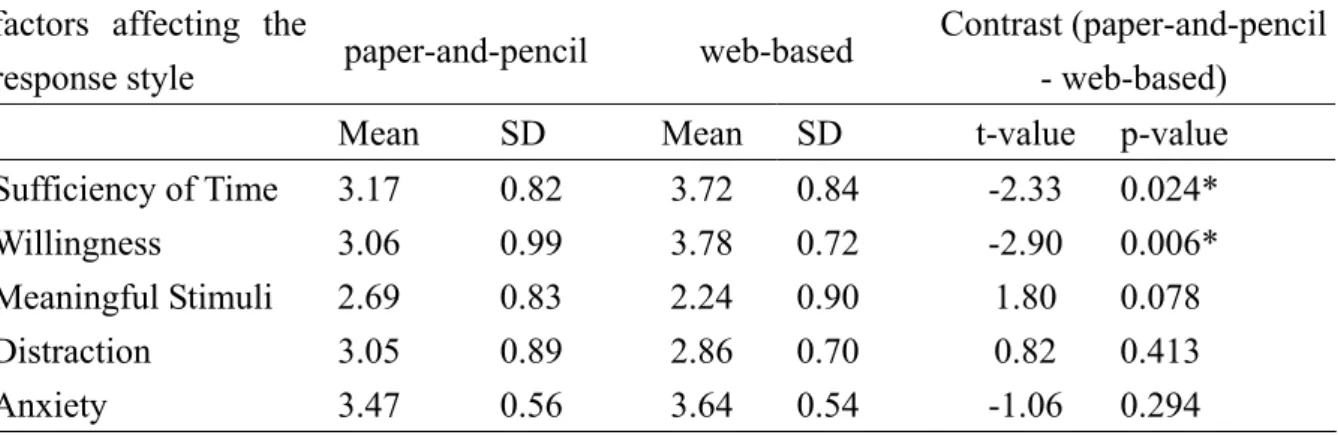
they were randomly assigned to response one of the two modes of questionnaires (such as web-based versus a paper-and-pencil). The results showed that there were not significant perceived difference in levels of meaningful stimuli, of anxiety and of distraction between a web-based and a paper-and-pencil survey, but there were significant perceived difference both in the levels of time pressure and the willingness (see table 1). In other words, respondents considered the web-based survey more sufficient than the paper-and-pencil one (web-based Mean = 3.72 vs. paper-and-pencil Mean = 3.17, p = 0.024)
as well as participants’ willingness to answer the questionnaires in web-based survey was significant higher than the one in paper-and-pencil survey (web-based Mean = 3.78 vs.
paper-and-pencil Mean = 3.06, p=0.006). We describe further our basic research concepts
and propose the following hypothesizes as a result of the above-mentioned outcome. ---
Table 1 insert about here
---
Basic concepts and hypotheses
First of all, in answering the paper-and-pencil questionnaires, respondents were asked to complete the survey within a limited period of time (20 minutes) during the class. But they would be allowed to choose the period of time most convenient for them to fill out the web-based questionnaire, without any time limitation in the answering process. Thus, time pressure was different among the two modes. Besides, based on the above-mentioned results, in the comparison of sufficiency of time for filling out the questionnaires, it was significantly lower for the paper-and-pencil questionnaire than the web-based one (p=0.024, significant at p<.05). McGee and Komorita (1963) manipulated the amount of time available for responding to each question, and find the tendency to make agreement responses varies inversely with the amount of time available to the respondents for considering the question. They infer that the results result from respondents’ lack of adequate cognitive resources. According to Baumgartner and Steenkamp (2001), under time pressure, Acquiescence Response Style tends to agree with items regardless of the content. While all the items in the questionnaire were targeted to evaluate the positive attitudes of the instructor in teaching, with higher scores indicating more approval, and Likert 5-point items was applied to the answers. Thus, compared with the web-based questionnaire, it is proposed that the proportion of selection for positive extremely is relatively higher in the paper-and-pencil questionnaire.
questionnaires than web-based ones.
As to the willingness to answer the questionnaires, the pretest result has shown that it was higher for the web-based questionnaire. Schuman and Presser (1981) point out that because respondents lack the willingness to read the instructions and interpret items appropriately, the tendency to use the middle scale category varies inversely with the level of the willingness to the respondents for considering the question. Base on Baumgartner and Steenkamp’s (2001) suggestion that if the sample’s willingness is lower, the response style tends to be Midpoint Responding. In terms of the Likert 5-point items adopted in this study, the proportion of the selection for midpoint responding would be higher. Thus, it is proposed that in comparison with the web-based questionnaires, the selections for midpoint responding are in a greater proportion in paper-and-pencil questionnaires.
H2: The proportions of selection for midpoint responding are higher in paper-and-pencil questionnaires than web-based ones.
Previous studies on the differences between web-based and paper-and-pencil questionnaires were mostly based on the higher anonymity and truer response due to the fact that the surveyed could not be easily identified (Dommeyer and Moriarty, 1999; Parker, 1992). As this study was aimed to evaluate the instructor’s teaching performance, in answering the paper-and-pencil questionnaire with lower anonymity, students would be worried that lower evaluation results might influence their instructor’s final evaluation on them if they were identified. As a result, this study proposed that the mean scores are lower from web-based questionnaires than paper-and-pencil ones.
H3: Evaluation scores are lower from web-based questionnaires than paper-and-pencil ones.
The aforementioned web-based questionnaires provided higher anonymity than the paper-and-pencil questionnaire, so respondents had less worries about the problem of identification, and were more willing to express their opinions. Davis’s (1997) and Handwerk, Carson, and Blackwell’s (2000) results show that relative to the applicants completing the paper-and-pencil surveys, the web-based surveys such as Web or e-mail make respondents so more confidential that respondents are willing to provide more information on web-based questionnaires than paper-and-pencil ones. 37.5% of a total of respondents completing web-based surveys is willing to fill out the open-ended; however, only 25.5% of a total of respondents completing paper-and-pencil surveys is willing to fill out the open-ended. Thus, it can be further inferred that respondents are willing to provide more information on web-based questionnaires than paper-and-pencil ones.
As to the amount of information provided, that samples make spontaneous efforts should be the precondition. Thus, the answers to open-end items were taken as the basis for
information provided by the respondents.
There are two indicates for the amount of information provided. First, for the 2 open-end questions (“Which part in the course do you consider the best?” and “Which part in the course do you consider necessary to improve?”), 2 unaware of the purpose of this study persons were asked to categorize the answers to these open-end items into “teaching style”, “teaching content”, “student interactivity”, “environment”, and “others”. Each was marked as either “positive” or “negative” expression to sum up the total counts. If any inconsistent was discovered in the categorization, two of the authors would discuss and decide how it should be categorized. The second indicator is the sum of total word counts of the answers to the 2 open-end items. Thus, the hypothesized as follows:
H4: The amount of information provided are greater in web-based questionnaires than paper-and-pencil ones.
Methodology
Considering the above-mentioned inconsistency among various research conclusions, this study focuses the comparison of web-based and paper-and-pencil survey. The sample units of this study are courses result which had been evaluated by students that took that course credits. The reasons for choosing course evaluation as the samples mainly due to the respondents (students) are already familiar with the Internet and the surveyed topic is highly concerned by the respondents to avoid exclusiveness.
Data Collection Process
The data of this study is the course evaluation by a university in northern Taiwan. The web-based survey of the course evaluation is conducted before the end of each semester. However, the web-based surveys are still partly accompanied by a small amount of conventional paper-and-pencil questionnaires to compare the response rate and the tendency of the answers. The paper-and-pencil surveys are randomly selected from all the available courses.
In order to make sure that respondents are truly the students of the course and answer one taken course once only, a non-anonymous method is adopted in both survey modes. It means that students are required to fill in their student ID before starting the survey. The Office of Academic Affairs ensures students that the instructor cannot see the individual answer. As for the paper-and-pencil questionnaire, the instructor has to finish the class and leave the classroom 20 minutes earlier. A staff from the Office of Academic Affairs distributes and then collects the questionnaires. The instructor is not allowed to access any part of the process. As for the web-based questionnaire, students take their own time fill out the questionnaire. Students are also required to enter their
student ID and password to access the system.
Data Structure
All of the courses in the commerce college were chosen as research samples mainly due to the consideration of homogeneity among samples (courses). That is to say, it was believed the teaching methods and contents in the commerce college were more consistent in comparison with other colleges. And when the Office of Academic Affairs sampled courses for the instructor evaluation survey, random sampling was adopted. Thus, no initial difference should have existed between the evaluations of web-based and paper-and-pencil courses. The only difference derived from different should be attributed to the answering modes.
There were totally 1,517 courses in the business college. The web-based questionnaire was adopted for 1,382 courses, and the paper-and-pencil questionnaire was adopted for remaining 135 ones. To avoid the impact of the deviations caused by outliers, only courses with more than 20 registered students, more than 10 respondents, and higher than 30% of respondent ratio (number of survey respondents / number of registered students) were included in the analysis. A total number of 30 paper-and-pencil questionnaire courses while 307of the web-based ones were including after the abovementioned sifting procedure. As there was a big difference samples size between the two modes, from the above qualified courses, 30 web-based courses were selected at random for further analyses.
RESULTS
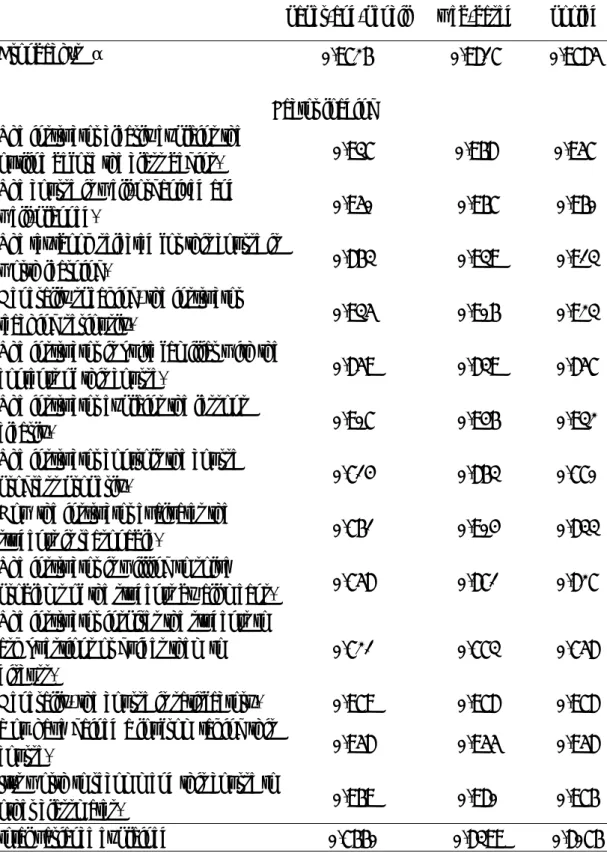
There were a total of 13 items in the evaluation. Exploratory factor analysis (EFA) was first employed. Under the principal component method, all of the 13 items fell into one factor no matter in the paper-and-pencil and web-based questionnaires. The total variance explained at least reached 76.60% and the cronbach’s αs all more than .97. Thus, we conclude these items had a certain degree of internal consistence, and the followed-up analyses would be conducted with the summed scores. Questions, factor analysis, and Cronbach alpha values were shown on Table 2.
--- Table 2 insert about here
---
First of all, for the two modes of questionnaires, each course was taken as the data point for the between subject comparison. In other words, in each mode, the respective
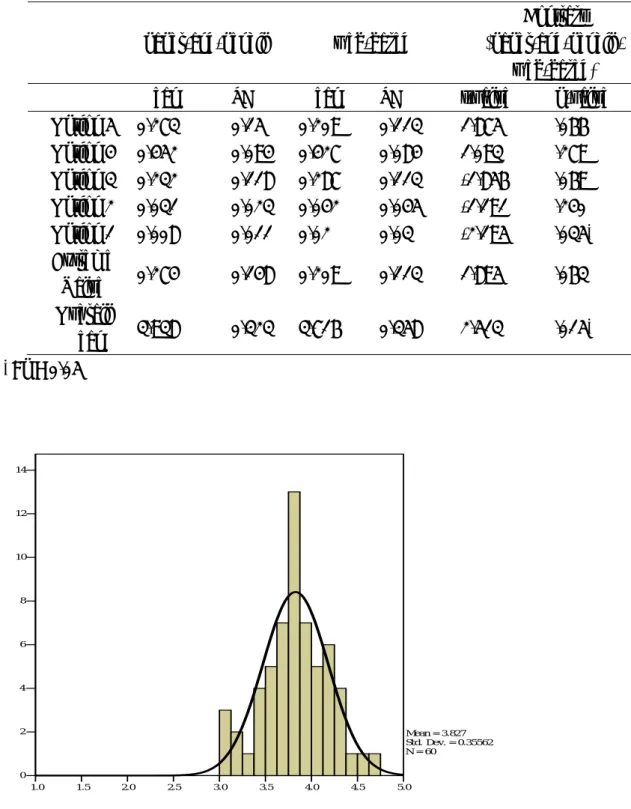
proportion of choices from 1 to 5 for all the courses were calculated with Equation (1). The mean score and SD (standard deviation) were shown as Table 3. The choices were presented in proportion, so the sum of means was equal to one. Because 5-point Likert scale was adopted by the course evaluation, the extreme value was the sum of the proportions of choosing 5 and choosing 1. As to the Overall Mean, each option was considered as a continuous variable; that is to say, it was the mean score of the evaluation. ∑∑∑ = = = × × = 30 1 1 13 1 ) 13 30 /( i n j k ijkl l S n Option ………(1)
where Sijkl=1 when the ith course, the jth student, the kth question, with choosing l elsewhere Sijkl=0
--- Table 3 insert about here
---
Table 3 showed that in the comparison of option 5, more respondents tended to select 5 in the paper-and-pencil questionnaires than the web-based ones. However, the difference did not reach the significant level (M = .273 vs. .209; p = .066), so H1 was not supported. In the comparison of option 3, no significant difference was observed either. And the proportion of choosing 3 was unexpectedly lower in the web-based questionnaires than the paper-and-pencil ones (M = .232 vs. .287; p = .069). The result was not consistent with our expectation, so H2 was not supported. The Overall Mean indicated that the scores were higher in the paper-and-pencil questionnaires than the web-based ones. That is to say respondents in the paper-and-pencil questionnaire were more satisfied with instructors’ teaching and the difference reached significance level. Thus, H3 was supported.
As to the conclusions with hypotheses not supported, the causes were discussed as follows. First, H1 was not supported but the tendency was consistent with our expectation, only the difference did not reach the significant level. Regarding to H2, the result showed that the proportion of choosing 3 was unexpectedly higher in the web-based questionnaire than the paper-and-pencil questionnaire. According to Baumgartner & Steenkamp (2001), when sample’s willingness is lower, the response style tends to be Midpoint Responding. But it was doubted that in the survey of course evaluations, the Midpoint Responding fell on option 3. That is, choosing 3 (the description was “normal”) was not considered to be neutral. When students thought the
instructor’s teaching performance was “normal”, it might have implied that the instructor was not good enough.
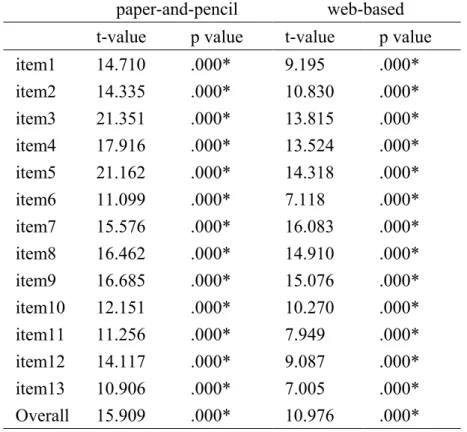
To test this argument, all the qualified samples were pooling. It was shown in Figure 1 that the mean was 3.87, and the difference between mean and 3 reached the significant level (t = 18.083; p = 0.000). The same result also occurred in only web-based (t=10.976; p=0.000) and paper-and-pencil (t=15.909; p=0.000) questionnaires. And the conclusion was consistent with each item. So it was reasonable to doubt that the Midpoint Responding of this survey did not fall on choosing 3.
--- Table 4 insert about here
--- ---
Figure 1 insert about here
---
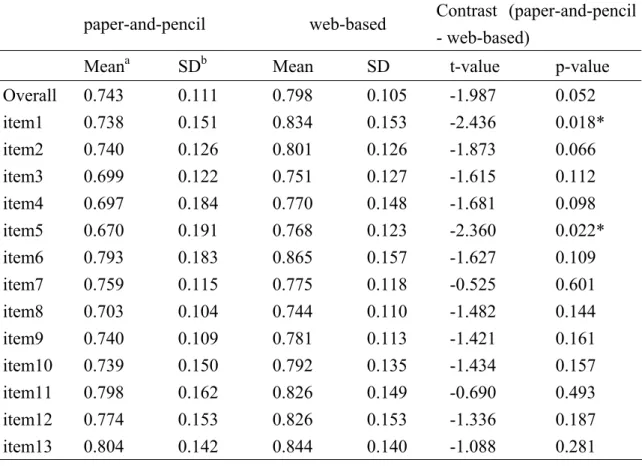
Due to the fact that Midpoint Responding could not be directly tested, an indirect approach of investigating its variance was adopted. It was believed that if Midpoint Responding was more likely to occur in the paper-and-pencil questionnaire, the variance would be smaller. The related results were shown in Table 5. It could be found from Table 5 that despite the fact that the differences in SD among most of the items were not reach the significant level, the direction showed the SD was lower in the web-based questionnaires than the paper-and-pencil ones; in other words, dispersion was larger in the web-based questionnaires. Thus, it was also consistent with the expected result.
--- Table 5 insert about here
---
As to the analysis on open questions, previous researchers relied more on the word count as the amount of provided information (e.g. Schaefer & Dillman, 1988). It is conceived in this study that simply using word count as a proxy will yield distorted results, due to the fact that what researcher really cares is the amount of information provided rather than word count. Though, in general situations, more amount of provided information requires the expression of more words. In addition to word count, to understand the difference between these two survey modes, content analysis was adopted to calculate the
amount of information provided by each student and sum the amount as the total amount of information provided for each course. First, two research staffs unaware of the research intent were asked to carry out the encoding of the answers to open-end questions. The encoding rule was based on the positive or negative evaluations for instructor’s teaching performance and respective amount of information. Take “the teacher explains the course articulately and clearly, and is serious in teaching” as an example. “Being articulate and clear” is a student’s positive attitude toward teacher’s teaching, and “being serious in teaching” represents an earnest attitude held by the instructor. There may not be a causal relationship between the two (as a teacher may be serious but not articulate, or be very clear in explaining but always about irrelevant issues), so they are considered two positive pieces of information. Besides, in the case where “the instructor is expected to have sufficient understanding about the course; otherwise, the student may still have no idea about the course after class”, the cause is “the instructor does not have sufficient understanding about the course”, and the result is “the student may still have no idea about the course after class.” Thus, there is only one negative piece of information in this case.
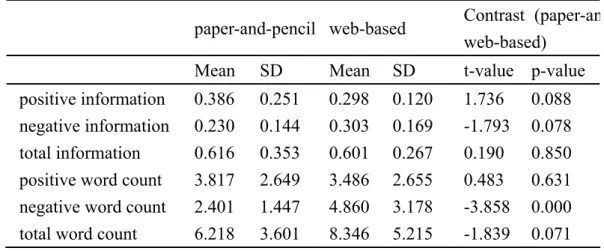
Among the 60 courses, there were totally 1,489 open-end replied. 206 of them were responded with a “no” or “no comment”, and among the rest 1,283 replies, 1,110 had a consistent results in the encoding of the 2 judgers. So, the consistency was 0.8652. For the inconsistent portion, after discussion, 1,412 pieces of information were generated. Among them, 777 were positive and 635 were negative. The comparisons are shown in Table 6.
--- Table 6 insert about here
---
From Table 6, we can find that in the aspect of positive information, the paper-and-pencil questionnaire tends to yield higher values than the web-based questionnaire, and in the aspect of negative information, the result was the opposite. This is consistent with our expectation, but the differences may not reach a significant level. In terms of word count, a consistent tendency is shown. However, only in the word count of negative attitude, the paper-and-pencil mode has a lower value than the web-based one and reaches the significant level. In terms of the total amount of information, no evidence supports any difference. But the p-value for the difference in word count reaches .071. Generally speaking, the above comparison data partial support H4.
Conclusion and Discussion
Previous studies on the comparison of web-based and paper-and-pencil questionnaires focused more on the direct comparisons between the two. When no significant difference is observed, web-based questionnaires can be reliable, and can act as an alternative. Thus, it assumed that the results from paper-and-pencil questionnaires are correct. However, in addition to the comparison of the two modes, this study further investigates the cause of the differences. That is, we are trying to find out which mode of questionnaire has better validity in every aspect. Even though not all of the hypotheses proposed in this study are supported, according to the research results, there is still a certain difference, if any, at least in students’ evaluation on the instructor, between the two survey modes. However, there may also some differences between course survey and other survey topics in management science, so the conclusions may not apply to all other surveys before the duplication.
First of all, there is time limit in the survey. In the pre-test, some students expressed they felt more time pressure when filling out the paper-and-pencil questionnaire. In the comparison of mean scores, result does not reveal that the paper-and-pencil questionnaire presents a stronger tendency in Acquiescence Response Style than the web-based questionnaire (p=.066). It is possible that the students were already familiar with the course survey, so that the difference in this time is not significant. Future studies may set a time control to investigate the impact of time. If the impact of time really causes
the Acquiescence Response Style, web-based questionnaire may be a better mode that response more correct results. For the researchers planning to adopt paper-and-pencil questionnaire, mail questionnaire can be used to replace direct face-to-face surveys, or abundant time can be provided to minimize this difference.
Besides, the hypothesis that Midpoint Responding tends to be higher in the paper-and-pencil questionnaire than the web-based one was not supported, but in the follow-up comparisons, this tendency was discovered. The research issue in this study were not neutral, and the response of social desirable might exist. So Midpoint
Responding did not occur on central answers. Future researchers may investigate into
more neutral issues. If the result shows a serious tendency of Midpoint Responding in the paper-and-pencil questionnaire, when adopting this mode of survey, more attention should be paid to the willingness of the respondents. Because just trying to extend the respondents amount by conducting conventional sampling without make sure the respondents’ willingness to answer the questionnaire may lead to biased conclusions. And the willingness can be enhanced through the stress on the importance of the study and proper encouragement. On the contrary, regarding to web-based questionnaire and mail questionnaire, because the respondents can be ignored if they show low willingness, the difference caused by this issue is relatively lower compare to face-to-face mode. If the survey questions are not neutral, anonymity plays an important factor. Web-based questionnaires that offer better anonymity may yield truer answers, and the amount of provided information may be higher. Thus, for paper-and-pencil questionnaires, the enhancement of anonymity becomes relatively important. In face-to-face surveys, the surveyor may have to keep a certain distance from the respondents, in order to acquire identifiable personal data, anonymity may be lowered. For mail questionnaires, it is essential to ensure the respondents that the received questionnaire and mail-back envelopes are consistent with those mailed to other respondents. The anonymity will be higher, and more information can be acquired.
Finally, the focus of this study was placed on the comparison of the differences in response styles in between web-based questionnaires and paper-and-pencil ones, not to find out which mode of surveys is more optimal. In our knowledge, respondents’ response styles depend on different situations and issues, rather than simply the mode of the survey. There are still limited issues pertaining to this aspect, so more issues and more conclusions are required to provide researchers with more information for design or control appropriate situations for the survey issues to derive truer conclusions.
Table 1 pilot study for factors affecting the response style factors affecting the
response style paper-and-pencil web-based
Contrast (paper-and-pencil - web-based)
Mean SD Mean SD t-value p-value
Sufficiency of Time 3.17 0.82 3.72 0.84 -2.33 0.024* Willingness 3.06 0.99 3.78 0.72 -2.90 0.006* Meaningful Stimuli 2.69 0.83 2.24 0.90 1.80 0.078 Distraction 3.05 0.89 2.86 0.70 0.82 0.413 Anxiety 3.47 0.56 3.64 0.54 -1.06 0.294 *: p < 0.05
Table 2 Results of Factor Analysis
paper-and-pencil web-based pooled
Cronbach’s α 0.9726 0.9817 0.9785
Factor loading The instructor clearly explains the
outline before the class begins. 0.937 0.968 0.957 The course is well-organized and
well-planned. 0.950 0.967 0.960
The textbook selected for this course is
worth learning. 0.863 0.939 0.913
Generally speaking, the instructor
teaching seriously. 0.935 0.906 0.923
The instructor is quite familiar with the
contents of this course. 0.859 0.839 0.857
The instructor explains the lessons
clearly. 0.907 0.946 0.932
The instructor controls the course
progress properly. 0.714 0.863 0.770
How the instructor evaluates the
students is reasonable. 0.761 0.904 0.833
The instructor is willing to solve
problems of the students by all means. 0.758 0.871 0.827 The instructor inspires the students to
ask questions or guides them to discuss.
0.721 0.773 0.758
Generally, the course is satisfactory. 0.979 0.978 0.978 You have gained a lot from taking this
course. 0.958 0.955 0.958
It’s worth to recommend this course to
other classmates. 0.969 0.980 0.976
Table 3 Descriptive Statistics paper-and-pencil web-based
Contrast (paper-and-pencil -
web-based)
Mean SD Mean SD t-value p-value
Option 5 0.273 0.15 0.209 0.113 1.875 .066 Option 4 0.452 0.094 0.427 0.084 1.093 .279 Option 3 0.232 0.118 0.287 0.113 -1.856 .069 Option 2 0.031 0.023 0.042 0.045 -1.191 .240 Option 1 0.008 0.011 0.02 0.03 -2.195 .035* Extreme Value 0.274 0.148 0.209 0.113 1.895 .063 Overall Mean 3.938 0.323 3.716 0.358 2.513 .015* *: p < 0.05 1.0 1.5 2.0 2.5 3.0 3.5 4.0 4.5 5.0 0 2 4 6 8 10 12 14 Mean = 3.827 Std. Dev. = 0.35562 N = 60
Table 4 Comparisons of the Mean and Choice 3 in Overall and Every Item paper-and-pencil web-based t-value p value t-value p value item1 14.710 .000* 9.195 .000* item2 14.335 .000* 10.830 .000* item3 21.351 .000* 13.815 .000* item4 17.916 .000* 13.524 .000* item5 21.162 .000* 14.318 .000* item6 11.099 .000* 7.118 .000* item7 15.576 .000* 16.083 .000* item8 16.462 .000* 14.910 .000* item9 16.685 .000* 15.076 .000* item10 12.151 .000* 10.270 .000* item11 11.256 .000* 7.949 .000* item12 14.117 .000* 9.087 .000* item13 10.906 .000* 7.005 .000* Overall 15.909 .000* 10.976 .000* *: p < 0.05
Table 5 Comparisons on Standard Deviations
paper-and-pencil web-based Contrast (paper-and-pencil - web-based)
Meana SDb Mean SD t-value p-value
Overall 0.743 0.111 0.798 0.105 -1.987 0.052 item1 0.738 0.151 0.834 0.153 -2.436 0.018* item2 0.740 0.126 0.801 0.126 -1.873 0.066 item3 0.699 0.122 0.751 0.127 -1.615 0.112 item4 0.697 0.184 0.770 0.148 -1.681 0.098 item5 0.670 0.191 0.768 0.123 -2.360 0.022* item6 0.793 0.183 0.865 0.157 -1.627 0.109 item7 0.759 0.115 0.775 0.118 -0.525 0.601 item8 0.703 0.104 0.744 0.110 -1.482 0.144 item9 0.740 0.109 0.781 0.113 -1.421 0.161 item10 0.739 0.150 0.792 0.135 -1.434 0.157 item11 0.798 0.162 0.826 0.149 -0.690 0.493 item12 0.774 0.153 0.826 0.153 -1.336 0.187 item13 0.804 0.142 0.844 0.140 -1.088 0.281 a: the mean of SD.
Table 6 Comparisons on Amount of Provided Informationa
paper-and-pencil web-based Contrast (paper-an web-based)
Mean SD Mean SD t-value p-value
positive information 0.386 0.251 0.298 0.120 1.736 0.088 negative information 0.230 0.144 0.303 0.169 -1.793 0.078 total information 0.616 0.353 0.601 0.267 0.190 0.850 positive word count 3.817 2.649 3.486 2.655 0.483 0.631 negative word count 2.401 1.447 4.860 3.178 -3.858 0.000 total word count 6.218 3.601 8.346 5.215 -1.839 0.071